Convenient sexism

Ah, the couch crouch! You know — the photo of Trump propagandist Kellyanne Conway kneeling on a sofa in the Oval Office, intent on whatever photo she was taking with her smartphone.

People lost their minds over it, inveighing about her lack of manners and/or claiming she violated the inner sanctum of power. With all the hysteria over it, it was honestly a little hard to tell which. I mention the couch crouch myself, not because it is independently significant, but because the reaction to it is revelatory.

America, it is 2017. And we’re still sexist.

You see, Conway wasn’t being blasted from all quarters because she for a moment forgot herself and hopped onto a sofa. Conway caught the internet’s guff because, in essence, she wasn’t being ladylike.

Cedric Richard, a Louisiana Democrat, said “she looked kind of familiar there in that position there,” and added an oblique reference to the Bill Clinton and Monica Lewinsky sex scandal in the 1990s. Richard’s was merely the most prominent voice offering the same basic attack, however. I saw other references along the lines of “woman on her knees” and the plain meaning. I saw other comments that took Conway to task over her looks. I have, myself, branded her a caustic “hag,” even though I thought the furor over her pose on the couch was stupid.

Trashing a woman’s appearance, or coming up with some version of “she’s a whore” to discredit her is nothing more than plain, old-fashioned misogyny. It spares the critic from actually disputing the woman’s ideas, words and meaningful conduct. It is convenient. And it tends to work.

In Conway’s case, the petty satisfaction of calling her whorish, ugly, or old, also can shift the focus from her ideas, words and meaningful conduct. Like a number of men in the administration, Kellyanne Conway is an opportunistic prevaricator who is enabling a dangerous autocrat. It doesn’t matter what sex she is, or what she looks like: she shills for Donald Trump, an unhinged, unqualified egomaniac whose conduct grows more alarming by the day. Pointing that out is not sexist. It is not flattering, but it is based on what she does, not on her anatomy.

Targeting a woman’s sex or appearance to discredit her is nothing new, and Conway isn’t alone among conservative- supporting women to be so targeted.

While I’m no fan of her husband, the constant barrage of sexism directed toward Melania Trump is appalling. It is true that she chose to pose nude and presumably collected money and fame for doing so. It is true that she became the third wife of an adulterer. A role model, she is not — particularly when attorneys indicated in a revived lawsuit she’d planned to capitalize on being “the most photographed woman in the world,” and when she insists on living in her husband’s golden tower at our expense (at least until June).

But she’s not your prop for moral outrage against Donald Trump and the spineless Congress that enables him, either. I have seen a number of comments on a number of sites use Melania’s dirty pictures as a means of discrediting Donald — when Donald discredits himself, why do that? Answer: A woman is a convenient target, especially if she steps outside the box into which “correct” female behavior has been placed.

Some targeting I’ve seen goes well beyond a crass joke or a jaundiced eye toward her past: On one very liberal site, a commentator called for criminal, sexual violence against Mrs. Trump. There’s no room for debate here: That is sexist, wildly inappropriate, unacceptable and immoral. (The site moderator, once informed, removed the comment and the entire thread that had generated it.)

It would be one thing to bring up Melania Trump’s modeling career if she were stepping up to speak of family values and lecturing about a woman’s traditional “place.” But she isn’t. Instead, people bring it up in the context of Michelle Obama, and how she was raked over the coals for once wearing a sleeveless dress. “Oh sure,” the basic complaint goes. “Lose your mind over Michelle’s arms, but bat not an eye at Melania’s nudity. Hypocrisy!” they cry.

Irony, say I. Because if Melania Trump were a liberal woman, or married to a Democratic president, some people who are in such a high dudgeon about her photographs now might defend them as female empowerment and sexual freedom, or excuse them as being “part of her past” and label criticism as pathetic.

But I see different standards being applied to conservative women. Don’t misunderstand me here: I am not saying that liberal women do not experience sexism. They do, and a very good example of such a person recently lost a presidential election to a madman, in part, because the standards for her were set much higher than they were for him. I just see a fair amount of sexist commentary thrown toward conservative women from people who probably pride themselves on being open-minded, tolerant, and feminist. Let a woman on the “other side” annoy them, though, and they resort to timeless misogyny.

Example: Bristol Palin. The young woman is Sarah Palin’s daughter and appears to be a chip off the block, politically. I do not find much merit in either Palin’s positions on a number of topics; I find the mother almost comically ignorant and shudder to think of her in a position of power. I can’t help, but notice, though, the response the daughter gets every time she sounds forth with an opinion: “Close your legs!” (An actual, verbatim, and frequently repeated comment.)

Although she is now married, Bristol Palin had two children out of wedlock, you see. Add to that her improbable position as an abstinence advocate, and, poof! Instant, rock-solid reason to discredit everything she has to say, ever, even if it’s “I like puppies.” Forgive me for thinking that her sex life is fair game only when she is discussing abstinence and/or telling other women how to behave sexually.

This is all tiresome — as well as unnecessary.

Because, if a woman is enabling an autocrat, you can say: “She is enabling an autocrat.” If you think Republicans are hypocritical for criticizing Michelle Obama’s sleeveless dress while they ignore past nude pics of Melania Trump, you can say: “Republicans are hypocritical about this.” Don’t like Bristol Palin’s politics? Criticize her politics. Think her mom lacks intelligence? Say so, rather than sneering “Caribou Barbie” or other misogynistic nicknames that associate her lack of brain power with her looks, as though the two had anything to do with each other.

In none of these situations is it necessary to bring up a woman’s looks, a woman’s age, another woman, a woman’s sexual history, or (ahem, self), her wrinkled visage. You’ll notice I am not calling on anyone to excuse these women’s conduct — Conway lies; she can be called a liar. Sarah Palin can be called unintelligent because her record is replete with unintelligent (even unintelligible) statements. But there is a line to be drawn when valid criticism gives way to personal attacks arising from the sex of the person being criticized.

Sexism does not cease being sexism just because it’s directed toward a woman with whom you disagree or dislike. Resorting to sexist insults is lazy thinking — and it gives sexism staying power. Again, it is 2017. Enough.

Katharhynn Heidelberg is an award-winning journalist in Montrose, Colo.

Published in Katharhynn Heidelberg

Begayisms

Unbeknownst to my wife, Sara, I have been secretly studying and am close to earning my master’s in Begayisms.

My wife’s maiden name is Begay and I soon discovered that her family has their own little ways of speaking, with little tidbits of speech or movie quotes that could confuse an outsider. Especially a Narragansett Indian from Rhode Island.

But before I could tackle Begayisms I first had to learn to navigate through Navajo. When I first moved to the reservation I would ask for directions and notice that people would stick out their lips. I thought they were making some joke about me having big lips or something. It took me several months before someone explained to me that Navajos aren’t supposed to use their fingers to point, so they use their lips instead.

Another misunderstanding was my thinking that the Navajo Nation Council laughed at everything. During meetings someone would speak and then say “ahe’hee’,” which sounded to me like “hee-hee.” I’d think to myself, That wasn’t even funny, so why are they laughing?

Turns out “ahe’hee’ ” means “thank you.”

Soon I was able to learn some Navajo words. So if my wife says “`áshii” I know enough to pass her the salt. Although sometimes when I’m not paying attention, I’ll pass the salt when she says “`áshii likan” (sugar).

And if I’m out hiking in Jellystone Park and a Navajo runs past and yells “shash!” I know he’s not telling me to be quiet. Shash is a bear.

Once I had a reasonable understanding of Navajo I thought I was ready to become a good in-law.

But Sara and her family have their own Begayspeak.

I spent my first 45 years only using the word “wack-o” once that I can recall. It was in college around 1986, and I was walking back to my dorm one winter night when I slipped on the ice and banged my head so hard I thought I had a concussion. When I was describing it to my brother later I said I fell and my head went “wacko” on the ice.

Now, I had heard of the word wack-o before. I believe it was on the old 1960s “Batman” series. “Wack-o!” was tucked in between “Ka-Pow!” and “Zowee!”

But in Begayism something wack-o is silly, like the groan-worthy puns I delight in uttering. This is not to be confused with “cheeeap,” which is reserved for an unusual observation or corny joke.

When I say something that makes my wife skeptical, she will reply, “Riiight.” This is from the Goldie Hawn movie “Wildcats.” For example, we will be going to Walmart and I’ll say, “I’m not going to buy any candy today.” And Sara raises an eyebrow and replies, “Riiight.”

Movie lines routinely work their way into Begayspeak.

Say I walk into a room and want Sara’s attention; I might say, “Breaker, breaker, little mate!” (from “Rescuers Down Under” ). If she’s busy at the moment, Sara will make an exaggerated coughing sound and say, “I’ll have to call you back” – imitating a funny scene from “Stakeout.”

Life is never dull with my khaleesi.

You just never know when a conversation between Sara and her siblings, Lolo, Kymmano or Big Bloke, will include snippets from “Fargo,” “The Commitments,” “Making Mr. Right,” or “Bridget Jones.”

I’ve tried to introduce my own Hopkinsisms to the mix, but so far “Hulk smash puny human” hasn’t caught on.

John Christian Hopkins, an award-winning novelist and humor columnist, is a member of the Narragansett Indian Tribe. See his writings at http://authorjohnchopkins.blogspot.com.

Published in John Christian Hopkins

Missing Nixon

Women are not a joke. My mother was not a joke and no self-respecting Republican should accept this treatment of their women.

Well, look at Bill Clinton, some say. He certainly had his problems and his behavior with Monica Lewinsky was shameful, but at least it was consensual. He left us a surplus and a stable economy.

Then we elected a spoiled son. To prove he was a better man than his father, he became a war president, bringing on the present debacle in the Mideast which has cost us 6,000-plus of our young lives and untold damage to many other Americans’ physical and mental well-being – not to mention the havoc wreaked on hundreds of thousands of innocent Iraqi families.

During W’s presidency, we lost lives, the surplus and as far as I am concerned, stature. With his shrugging of shoulders and “heh-heh-heh” chuckle, he seemed to say we shouldn’t take anything too seriously. Well, war, life and death are not funny.

After two terms of his ineptitude we elected (gasp!) a black president and the ghosts of the KKK began creeping out again. Mitch McConnell declared that his primary job in Congress was to see that Obama was not re-elected. But McConnell failed and Obama stopped a recession and saved us from a depression, putting us on fairly stable footing. The banks recovered, unemployment came down and he left with high marks. All without the help of the GOP, whose politicians sat on their asses, stonewalling Obama whenever possible while criticizing him for not being able to get anything done.

Then came Batman’s nemesis, the Joker, and we thought we were reading the Sunday funnies when we looked at the news pages. But it isn’t very humorous, now that we have two kids playing with the combination on the red box – Kim Ill One and Kill Any One.

What is Trump’s claim to fame and status? He coasted through life on his father’s name and fortune. He’s gone bankrupt numerous times (how the hell does one go bankrupt while making the millions he claims to have made, and when all the odds are in your favor?), he’s settled lawsuits against him, he’s screwed over his workers and contractors alike.

He’s rich, or so he states. I took could make that statement – just don’t take too many of my checks. I’ll admit I’m not in his class, living in the Taj Mahal in Florida, but I’ve never been bankrupt, either. I’ll bring up that pervert thing again. Trump was the one making those statements to Bush’s nephew. The nephew was thrown out of NBC and the pervert got to be president.

Now he seems to be trying to roll the movie reel in the wrong direction to take us back in time to the days when many men labored in coal mines and got black lung disease, or uranium mines and got cancer. And women sat at home and worried about how to look pretty for their husbands. Trump and his cronies are doing their damnedest to stop progress.

But the days of coal and oil are ending and the era of clean energy is coming. The change is here, just like when we moved from the horse and buggy to the auto.

Here’s a little-known fact: Kingsford charcoal briquets were a new and lucrative product made from cast-off material. Who came up with the idea? None other than Henry “You can have any color you want as long as it’s black” Ford. He used the waste from the lumber used in the building of his autos to make the briquets. He was a thinker who knew how to be innovative. Too bad we don’t have a president in office who respects people like that, instead of trying to lead us backward into the olden days.

But I still believe the course will be changed, we just have to convince those in the horse-and-buggy mode and replace the polluting, planet-warming energy industry. A new dawn is coming and the sun will shine on the earth again. I don’t know the particulars and being on the “bon voyage” side of life do not expect to see them take place. But some day we will have leadership once more that recognizes the need to prepare for the future.

Galen Larson lives near Cortez, Colo.

Published in Galen Larson

Begayisms

Unbeknownst to my wife, Sara, I have been secretly studying and am close to earning my master’s in Begayisms.

My wife’s maiden name is Begay and I soon discovered that her family has their own little ways of speaking, with little tidbits of speech or movie quotes that could confuse an outsider. Especially a Narragansett Indian from Rhode Island.

But before I could tackle Begayisms I first had to learn to navigate through Navajo. When I first moved to the reservation I would ask for directions and notice that people would stick out their lips. I thought they were making some joke about me having big lips or something. It took me several months before someone explained to me that Navajos aren’t supposed to use their fingers to point, so they use their lips instead.

Another misunderstanding was my thinking that the Navajo Nation Council laughed at everything. During meetings someone would speak and then say “ahe’hee’,” which sounded to me like “hee-hee.” I’d think to myself, That wasn’t even funny, so why are they laughing?

Turns out “ahe’hee’ ” means “thank you.”

Soon I was able to learn some Navajo words. So if my wife says “`áshii” I know enough to pass her the salt. Although sometimes when I’m not paying attention, I’ll pass the salt when she says “`áshii likan” (sugar).

And if I’m out hiking in Jellystone Park and a Navajo runs past and yells “shash!” I know he’s not telling me to be quiet. Shash is a bear.

Once I had a reasonable understanding of Navajo I thought I was ready to become a good in-law.

But Sara and her family have their own Begayspeak.

I spent my first 45 years only using the word “wack-o” once that I can recall. It was in college around 1986, and I was walking back to my dorm one winter night when I slipped on the ice and banged my head so hard I thought I had a concussion. When I was describing it to my brother later I said I fell and my head went “wacko” on the ice.

Now, I had heard of the word wack-o before. I believe it was on the old 1960s “Batman” series. “Wack-o!” was tucked in between “Ka-Pow!” and “Zowee!”

But in Begayism something wack-o is silly, like the groan-worthy puns I delight in uttering. This is not to be confused with “cheeeap,” which is reserved for an unusual observation or corny joke.

When I say something that makes my wife skeptical, she will reply, “Riiight.” This is from the Goldie Hawn movie “Wildcats.” For example, we will be going to Walmart and I’ll say, “I’m not going to buy any candy today.” And Sara raises an eyebrow and replies, “Riiight.”

Movie lines routinely work their way into Begayspeak.

Say I walk into a room and want Sara’s attention; I might say, “Breaker, breaker, little mate!” (from “Rescuers Down Under” ). If she’s busy at the moment, Sara will make an exaggerated coughing sound and say, “I’ll have to call you back” – imitating a funny scene from “Stakeout.”

Life is never dull with my khaleesi.

You just never know when a conversation between Sara and her siblings, Lolo, Kymmano or Big Bloke, will include snippets from “Fargo,” “The Commitments,” “Making Mr. Right,” or “Bridget Jones.”

I’ve tried to introduce my own Hopkinsisms to the mix, but so far “Hulk smash puny human” hasn’t caught on.

John Christian Hopkins, an award-winning novelist and humor columnist, is a member of the Narragansett Indian Tribe. See his writings at http://authorjohnchopkins.blogspot.com.

Published in John Christian Hopkins

An automatic reflex

Recently I wrote a short news story for the Free Press Facebook page about the armed robbery of a Durango pot shop in which I referred to the suspect’s weapon as an “automatic rifle.” In fact, it was an AR-15, commonly – and legally – known as a “semi-automatic” rifle. (The difference is that an automatic takes only one pull of the trigger to unloose a hail of bullets, while the semiautomatic requires the shooter to do the tiresome work of pulling the trigger to launch each hailstone.)

I admit the factual error may have been influenced by a personal bias I have against both types of weapons, since in my mind the distinction is pretty trivial – either is highly effective when it comes to killing people. But it was just a careless mistake, nothing more.

The swift response from a few readers was to eagerly point out the mistake and wonder how they could ever trust any of the paper’s reporting after such an egregious miscue.

One observed that the robber would be in much more serious trouble had he actually wielded a fully automatic rifle, since they are illegal to own. (I don’t think so. Committing an armed robbery and threatening the lives of others – regardless of the weapon used – is about as serious as it gets without actually shooting someone, but never mind.)

Anyway, the tenor of the posts made me wonder what sort of person reads an account of such a crime and takes away from it in large measure this one, to me, minor point. An obvious conclusion is that they must be folks very passionate about protecting their right to bear arms and very concerned about having this Second Amendment right eroded.

(And, just maybe, a few think the Free Press is a small part of some insidious mainstream-media conspiracy to rip all guns out of good Americans’ hands and ultimately enslave them in gray pajamas manufactured in China.)

So I just want to have my say about guns and the common-sense control of them in a country that seems to grow evermore crowded and violence-prone.

I don’t believe guns are intrinsically good or evil. They are tools that, like a drill or a hammer or a saw, have useful and handy functions, like putting food on the table and safeguarding one’s family. And, of course, they are essential for military defense and law enforcement.

Beyond that, they are a source of good, clean fun for a lot of folks who just like to sharpen their shooting skills on ranges and out on our ample public lands.

I first shot a gun when I was about eight years old – my father’s prized muzzleloader, which required a ram rod, powder horn, lead ball, cloth patches and a cap to load. It was so heavy I could barely hold it steady while pulling the main trigger, then gently touching the hair trigger and waiting a second for the delayed discharge and considerable recoil. It was a blast for a scrawny kid to make a tin can leap into the air amidst the smoke and noise and flying dirt.

A year or so later I was allowed to have a Daisy Red Ryder BB gun – only after memorizing and reciting the Ten Commandments of BB Gun Safety to my father. (I will not shoot birds . . . and so on)

I got my first real gun – a single-shot .22-caliber rifle – when I was about 10 and used it to hunt small game in the woods and fields near our rural home. A couple of years later I was allowed to own a 20-gauge full-choke shotgun, which I found much more efficient in slaying the dodgy critters.

My brother would occasionally let me shoot his semi-automatic .22 rifle for target practice (illegal for hunting, of course), and borrow his .32-caliber Winchester Special carbine for deer-hunting.

However, as a teenager I lost interest in hunting and guns, perhaps not coincidentally as my interest in the opposite sex increased. (Although we did covertly make a couple of zip guns in high-school shop just to be rebellious, like James Dean or something.)

Over the years I’ve owned a few other firearms, including a .38-caliber Smith and Wesson semi-automatic handgun. (Other than taking it out in the woods and firing off a few rounds to get the feel of it, I never had any occasion to use it.)

So with the above as a preamble to demonstrate that I’m not a stranger to firearms or opposed to gun ownership, I will finally get to my point:

I believe our country needs more effective gun-control measures to prevent the mass killings we’ve all become far too familiar with. The distinction of whether guns fire “automatically” or “semi-automatically” pales when it’s you or a loved one staring down the barrel of a maniac’s weapon, be it in a schoolroom, a theater or a shopping mall.

The easy availability of such weapons, along with large-capacity magazines, makes us all prey for any sicko who decides he’s been ignored long enough and wants to make his “statement” before he goes.

As those careful readers must know, there are limited uses for such guns, with killing other human beings real fast and dead being the one that leaps to mind most quickly. (And I’d bet they already have their legal weapons at the ready, and, moreover, they are not the criminals or crazies who wouldn’t be able to buy more, even with a more thorough vetting process.)

To go to the extreme, one interpretation of the Second Amendment would mean we should all be allowed to own fully automatic guns, bunker-buster bombs and nuclear arsenals.

This country has about 10,000 gun-related deaths annually, most of them crimes of passion committed with an ordinary pistol or long gun by someone whose hate for his ex and her new boyfriend finally reaches the boiling point or who just can’t stand the neighbor’s barking dog any longer. (Yeah, most of us are responsible gun owners until suddenly we’re not. )

But let’s get real. We’re supposedly working toward being a more civilized society where differences are not settled by brute force, but through reason and concern for our fellow travelers.

Life is compromise, and no “inherent” right is absolute. And, remember, one meaning of “automatic” is “without thought.”

David Long writes from Cortez, Colo.

Published in David Long

Taking entheogens out of the closet

SHROOMS GO MAINSTREAM … As a San Francisco-born born paleohippie who cut his adolescent teeth in the drug-experimentation days of the Sixties, I’ve never understood the mainstream’s fear of entheogens. As a health concern it seems mostly manufactured. Things that “unleashed the god within,” as the word “entheogen” suggests, were a great help to me in transitioning from medieval Roman Catholic seminary asceticism to post-WWII American societal experimentation. First-hand experience taught me to respect entheogens and eschew the opiates & stimulants & sundry synthetic pharmaceutical eccentricities available on the black market. And now it’s these same opiates and prescription drugs that constitute the biggest drug problem we face as a society … That said, the entheogenic experience can, on occasion, be terrifying, which is why it’s wise to have a guide – a designated driver, so to speak, in case the road gets bumpy … Some entheogens are substances that can take you away. Under their influence, you may not have executive control over your body anymore. Or your thoughts … Over the past 30-plus years of the Telluride Mushroom Festival, Dr. Andy Weil always emphasized the power of “set & setting” when crafting an entheogenic experience. Tripping in tranquil safety ought to be a prime directive for any aspiring psychonauts … Still, entheogens have been classified as dangerous drugs more out of fear than scientific study. But it’s coming to light, as research starts to gear up, that entheogens have amazing medical, therapeutic and life-enhancing properties … It seems that West Coast psychonauts have pioneered using small doses of entheogens like Psilocybe spp., LSD, DMT and others – a practice that’s come to be known as “microdosing.” Doses taken repeatedly over a period of time, too small to create any hallucinogenic effects, have been shown to enlarge the activity of the brains of people working on tasks. Exactly what that enlarged activity means in terms of creativity is not clear. But people engaged in microdosing report feelings of well-being and positive energy that they attribute to the practice. And the word I’ve heard is that Silicon Valley entrepreneurs have been known to encourage microdosing for their engineers and programmers as they search for the latest tech innovation … There’s even a new book about it, making the rounds of the national media: A Really Good Day: How Microdosing Made a Mega Difference in My Mood, My Marriage, and My Life by Ayelet Waldman (Knopf, 2017) … We’re hoping to learn more about all of this at this summer’s mushroom festival – the third week in August.

THUMBS UP … Kudos to the Dolores River Restoration Partnership for the great job they’ve restoring native plant communities along the Dolores River. I drove from Gateway to Uravan the other day and it was amazing to see the amount of riparian streamside cleared of invasive tamarisk. Begun after the Nature Conservancy had completed a tamarisk-clearing project on the San Miguel River, the Partnership brought together state and federal agencies at the behest of TNC and the Tamarisk Coalition <tamariskcoalition. wildapricot.org> … Kudos to the Montrose County Commissioners and the Montrose City Council for making peace. When I first took office 20 years ago, one local government was suing another up in Telluride. Taxpayers footing the bill for both sides. A bad situation that led to a decent settlement. But certainly it was not the easiest or cheapest way of resolving a conflict. It took folks from the Montrose-based Public Lands Partnership to teach me collaboration, and for San Miguel County and the two towns to mature politically and start intergovernmental meetings with each other.

SAN FRANCISCO … It was a treat to fly back to the city I was born in, and hang with my new grandbaby, Aurora, my daughter Iris Willow and her beau, Bertrand Fan. An IT software engineer, Bert just moved from Flickr to Slack, and the second day I was there he got a promotion and a raise (my kind of son-in-law) … Got to really know Bernal Heights, a neighborhood I hadn’t known. Cortland Ave. is even more laid back than my old hood in Noe Valley. A half dozen great restaurants. Three or four coffeehouses. A branch library with killer murals. Fell in love with the great folks at Little Bee Baking – to-die-for tarts, outrageous breakfast sandwiches, and delicious mocha breves (my cup of joe) … Got to push baby in carriage the full length of the Panhandle, while Iris got a massage. And together we toured Golden Gate Park’s Botanical Garden, admiring the April magnolias in bloom. At the Alemany Farmer’s Market we got amazing organic fruit from Twin Girls Farms of Reedley – and they were super friendly. Visit their website and learn how Nacho Sanchez went from farm worker to organic farmer, beautiful people with a beautiful story (www.saturdaymarket. com/twingirl.htm).

CHEESE … Okay. I’ve switched. Cowgirl Creamery, which moved from Pt. Reyes Station to Petaluma (some of my old California haunts) and sold to a company with capital, made what was – up to now – my favorite organic double and triple cream cheeses. Mt. Tam. Red Hawk. But, ever since finding them for sale out here in Colorado, I keep unwrapping the little rounds only to find a chalky center, not soft at all. I called the creamery once. But didn’t get much of an answer. Let it sit in the fridge for a month or more or something … And then Eureka! I found a Colorado creamery in Longmont that makes its own organic double cream baby brie: Haystack Mountain Cashmere … Creamy. No chalky center. To die for. Natural Grocer in Montrose has it. I’m hoping everyone gets it.

WEEKLY QUOTA … “The climate is a common good, belonging to all and meant for all. At the global level, it is a complex system linked to many of the essential conditions for human life. A very solid scientific consensus indicates that we are presently witnessing a disturbing warming of the climatic system. In recent decades this warming has been accompanied by a constant rise in the sea level and, it would appear, by an increase of extreme weather events, even if a scientifically determinable cause cannot be assigned to each particular phenomenon. Humanity is called to recognize the need for changes of lifestyle, production and consumption, in order to combat this warming or at least the human causes which produce or aggravate it.” –Pope Francis, from his encyclical

Laudato Si, On Care of our Common Home (2015) Art Goodtimes writes from San Miguel County, Colo.


The Talking Gourd

Local Politics
I turn away from those who know
what is right, no matter how
right they are. Or left.

—Danny Rosen
From Primate Poems
(Lithic Press, 2016)

Published in Art Goodtimes

Stewardship

Now, that is an interesting word! What does it mean to you? It can cover a lot of territory, such as the boss leaving the business under your care while he is gone on a business trip. As a steward, you are to care for, protect and hopefully make a business profit for the boss, exhibiting good qualities of “stewardship” by caring very well for another’s property, the boss’s.

Another area where “stewardship” is important is the Public Lands of the State. Merriam Webster defines it pretty well: “the conducting, supervising, or managing of something; especially: the careful and responsible management of something entrusted to one’s care stewardship of natural resources.” That sounds simple enough, right? Well, we need to start off with the question of who is the “steward,” caring and managing for what owner? The Enabling Act of 1875 declared the lands to be the State of Colorado.

COLORADO WILDFIRES: AVERAGE ANNUAL ACREATE BURNED, BY DECADE 1960-2015

From the 2016 Report on the Health of Colorado
Forests, by the Colorado State Forest Service

In the State of Colorado, 35 percent of the state’s public lands are still under the control of the federal government, involving three agencies. Here in Montezuma County, 73 percent of the lands are under the control of federal agencies, which also includes Indian Trust Lands. With that much land and resources under the control of the federal government, it raises the question of the stewardship of the state’s resources.

Beginning with statehood in 1876, the federal government acted as the steward for the unappropriated lands of the state, now referred to as “public lands,” while working to dispose of them for the state over the next 100 years. In 1976 the federal government decided to no longer be the steward for the state, but to keep the balance of the unappropriated lands of the state for itself (in violation of the Constitution, by the way). While acting in the stewardship role for the state, the forest and range resources were used to enhance the local economy and improve the watersheds, forage, and forest product conditions. In 1976 the passage of the Federal Lands Planning and Management Act (FLPMA) and the National Forest Management Act (NFMA) eliminated the stewardship role on behalf of the state on the now “public” lands of the state.

The reduction in forest stewardship management and use began the deterioration of the overall forest health resulting in overly dense forest growth, disease, insects and fuel buildups, which was reported in the recent 2016 Report on the Health of Colorado’s Forests by the Colorado State Forest Service. The full report can be viewed at The Colorado State Foresters website.

The report showed that as of 2015 there were 834 million standing dead trees, and they are being added to daily. That is in addition to the masses of older dead jack straw tree fuels on the ground. The lack of use and management has been reflected in the change in acreages burned from wildfires. The wildfire acreages burned when management and use of the forest was still happening in the 1960s and 1970s averaged 6,000 to 9,000 acres per year. After the 1976 changes in control and management of public lands, wildfire acreage burned shot up in the 1980s to 20,000, then up to 90,000 acres in the 2000s, and up to 100,000 acres in the 2010s, a tenfold increase. This graph shows how the changing impact of good vs. notso- good stewardship of the natural resources has a profound effect on overall forest health. Wildlife numbers are now suffering, with mule deer down nearly 50 percent, according to Colorado Parks and Wildlife.

The idea of setting aside large areas to not use stewardship management began in 1964 with the Wilderness Act. Colorado has 14.5 million acres of federal public forest lands, of which 8 million acres (over half) have been designated for no management or use, as designated wilderness or roadless areas, both of which harbor much if not most of the unhealthy forest stands that are critical to the watersheds throughout the state. Houston, we have a problem! Our stabilizer has burned out and we are pummeling through space with no controls or direction and no one seems to care. Over 80 percent of this state’s water originates on those forest lands, where over half have no stewardship activities being conducted. Do we not need and like to drink water and recreate on it and fish in it? Do we not like to hunt game in the forests and range lands? Do we not like to eat a good beef steak or lamb chop and wear leather and wool clothing? Do we not like to go to the lumberyard to buy some 2×4’s for the new deck? Do we not like to hike or ride in a beautiful forest environment? Well, you can have it all if you can have good stewardship planning and management action with local control.

There has been lots of fearful rhetoric over federal land transfers recently. Prior to 1976 that issue had never really surfaced much. While the federal control of land was and is, in violation of the Constitution, no one really cared then since the lands were being managed with good stewardship for benefit of the local county and state. So the real issue was not so much “ownership” but “stewardship.” Today, the question is, can good stewardship take place when there is no local control? Probably not, since too many people want the authority to control you, what you can do and your local resources, but want no responsibility for the outcome, or for you and your life. The times they are a-changing, it is a whole new world! So buckle up, Buttercup!

Dexter Gill is a retired forest manager who worked for private industry, three Western state forestry agencies, and the Navajo Nation forestry department. He writes from Lewis, Colo.

Published in Dexter Gill

The hood

After selling our three-acre rural homestead, complete with barn, pond, and irrigation water, and after moving into a smaller single-story house within the city limits, I received an email from a friend: Welcome to the hood.

I’d been living in the country for a long time. My first reaction to her message was a twinge of fear, that we’d inadvertently landed ourselves in the middle of a gang turf. The only tattoos I’d become familiar with in my old neighborhood were the stock brands on the animals that grazed next door.

Her use of the word hood, simple slang for its namesake, neighborhood, somehow felt out of character for my friend who is by profession, well, professional. I replied to her email, “Thank you” and promptly plowed this example of my un-hipness under the fertile soil of my imagination.

I bring the incident up again not to belabor the point, but because each spring, fresh ideas require as much sunshine as they can absorb. The solar kind. which has nothing to do with political luster or delirium, especially originating from anywhere near the White House.

Spring also seems like the right time to bring up some legal matters associated with bureaucracy in general, like the Sunshine Act of 1976, and assorted sunshine laws, which are regulations demanding openness in government or business. They require “meetings, records, votes, deliberations and other official actions be made available for public observation, participation and even inspection.”

And since the media is one of the bulbs a democracy uses to stay illuminated, restricting its access to governmental briefings goes against everything both political parties stand for – that is, if democracy is still what they stand for. Even George W. Bush, who did not win any popularity contests, especially during his second presidential term, went public with an credible opinion: “I consider the media to be indispensable to democracy.” Careful, G.W.B., you might find your name on a White House blacklist.

My friend’s slangy hello after our real estate move also prompted me to think about one of my favorite reading picks, dystopian novels, a genre of post-apocalyptic drama that tries to grapple with the possibilities inherent in a civilization’s untimely downward spiral and inevitable end, novels like George Orwell’s 1984 or Cormac McCarthy’s The Road. These are, of course, fiction; pure imagination twisted to look into an unwieldy and unpromising future.

Accordingly, these days feel very much like fiction. I do not like the way the story begins and I fear I will not be charmed by the ending.

A dystopian story typically starts with a pandemic or some other catastrophe that wipes out a majority of the population. You would think the survivors might band together to support each other, but no – they wreck-create in horrible ways and cause further havoc on the already shaken earth, looting and hoarding and killing and destroying any fragile semblance of order that remains visible. The survivors are obsessed with undermining the structure of the very society that nurtured them, one that in all likelihood required generations to put in place.

I know, it’s a rather bleak outlook for a reading recommendation, but I hope you’ll experiment a little outside your comfort zone, because art, they say, imitates life and insight often emerges, even when it seems all hope is quashed. Learning about human nature is what reading is about. Some people call it escapism. I call it research. As for living in a harsh world, that’s a storyline I prefer not to speculate about.

Instead, let me offer you a more vibrant reading recommendation. Emily St. John Mandel wrote an apocalyptic masterpiece: Station Eleven. Sure, she decimates a large portion of human life, but that’s how a dystopian sets the stage. What’s remarkable is that out of this disaster she conjures hope in the form of a traveling troupe that journeys around the Great Lakes. The party includes a company of Shakespearian actors and a traveling symphony. They carry imagination like fire to beleaguered hamlets where art and a sense of purpose are needed. Naturally, there’s a man who lives in the shadows with his minions, whose personal obsession is at odds with not only the troupe’s mission but also with civilization’s.

Welcome to the hood, friends, and remember mere survival is never sufficient.

David Feela, an award-winning poet, essayist, and author, writes in Cortez, Colo. See his works at http://feelasophy.weebly.com/

Published in David Feela

Missing Nixon

We have to look to the past to see how we wound up with this narcissistic sexual predator became president of the greatest country in the world. Why the world “pervert”? Well, by his own locker-room words he put himself in that category when jokingly bragging that he could grab women by their pussy if he pleased because of his fame and riches.

Women are not a joke. My mother was not a joke and no self-respecting Republican should accept this treatment of their women.

Well, look at Bill Clinton, some say. He certainly had his problems and his behavior with Monica Lewinsky was shameful, but at least it was consensual. He left us a surplus and a stable economy.

Then we elected a spoiled son. To prove he was a better man than his father, he became a war president, bringing on the present debacle in the Mideast which has cost us 6,000-plus of our young lives and untold damage to many other Americans’ physical and mental well-being – not to mention the havoc wreaked on hundreds of thousands of innocent Iraqi families.

During W’s presidency, we lost lives, the surplus and as far as I am concerned, stature. With his shrugging of shoulders and “heh-heh-heh” chuckle, he seemed to say we shouldn’t take anything too seriously. Well, war, life and death are not funny.

After two terms of his ineptitude we elected (gasp!) a black president and the ghosts of the KKK began creeping out again. Mitch McConnell declared that his primary job in Congress was to see that Obama was not re-elected. But McConnell failed and Obama stopped a recession and saved us from a depression, putting us on fairly stable footing. The banks recovered, unemployment came down and he left with high marks. All without the help of the GOP, whose politicians sat on their asses, stonewalling Obama whenever possible while criticizing him for not being able to get anything done.

Then came Batman’s nemesis, the Joker, and we thought we were reading the Sunday funnies when we looked at the news pages. But it isn’t very humorous, now that we have two kids playing with the combination on the red box – Kim Ill One and Kill Any One.

What is Trump’s claim to fame and status? He coasted through life on his father’s name and fortune. He’s gone bankrupt numerous times (how the hell does one go bankrupt while making the millions he claims to have made, and when all the odds are in your favor?), he’s settled lawsuits against him, he’s screwed over his workers and contractors alike.

He’s rich, or so he states. I took could make that statement – just don’t take too many of my checks. I’ll admit I’m not in his class, living in the Taj Mahal in Florida, but I’ve never been bankrupt, either. I’ll bring up that pervert thing again. Trump was the one making those statements to Bush’s nephew. The nephew was thrown out of NBC and the pervert got to be president.

Now he seems to be trying to roll the movie reel in the wrong direction to take us back in time to the days when many men labored in coal mines and got black lung disease, or uranium mines and got cancer. And women sat at home and worried about how to look pretty for their husbands. Trump and his cronies are doing their damnedest to stop progress.

But the days of coal and oil are ending and the era of clean energy is coming. The change is here, just like when we moved from the horse and buggy to the auto.

Here’s a little-known fact: Kingsford charcoal briquets were a new and lucrative product made from cast-off material. Who came up with the idea? None other than Henry “You can have any color you want as long as it’s black” Ford. He used the waste from the lumber used in the building of his autos to make the briquets. He was a thinker who knew how to be innovative. Too bad we don’t have a president in office who respects people like that, instead of trying to lead us backward into the olden days.

But I still believe the course will be changed, we just have to convince those in the horse-and-buggy mode and replace the polluting, planet-warming energy industry. A new dawn is coming and the sun will shine on the earth again. I don’t know the particulars and being on the “bon voyage” side of life do not expect to see them take place. But some day we will have leadership once more that recognizes the need to prepare for the future.

Galen Larson lives near Cortez, Colo.

Published in Galen Larson

Balking the walk

As a people, we’ve recently gone through one of the darkest periods in American history. Our national nightmare began on an otherwise perfectly typical evening in early November 2016, when the impossible happened. Ever since, the darkness has had its unabated way with us through the coldest, shortest days of winter. But now, finally and inevitably, baseball is back.

Granted, baseball will never be the same again, since the lovable cuddlable Cubbies won actual games to become the next Evil Empire, squatting in the Yankees’ pinstriped throne. But that little detail cannot change the euphoria that accompanies baseball in the air. Fresh clay, manicured grass, oiled mitts, hot dogs wrapped in hamburgers wrapped in bacon: these are the scents of spring.

In Colorado, of course, we have to imagine these smells, because spring does not happen here until autumn. But they exist somewhere, because spring-training baseball is happening, and that means I can soon fulfill a long-neglected promise.

You see, there’s this friend of mine — let’s call her a “business associate” because true friends possess an appropriately unquestioning love of baseball — who claims she wants to learn to understand the game. Or maybe she said she would never understand the game. Or maybe she said that baseball was boring. Or maybe it was golf.

Whatever she said, the mere possibility of a willing convert has me digging into the batter’s box. And hey, if her claim is actually just a ruse to drink alcoholic beverages in front of an ESPN broadcast, then I still have the hope of a free beer in exchange for explaining ground-rule doubles and intentional walks.

You may think this is a fool’s errand — after all, not even umpires understand what a balk is — but I’m a persistent evangelist. The Mormons win you over with cheerfulness; I will win her over with endurance. There’s 162 games a year, per team. That’s 2,430 games, plus playoffs. Something exciting is bound to happen at least once! And even when it doesn’t, every play offers a thrilling vocabulary lesson.

Take the intentional walk. It’s the most so-called “boring” execution of strategy in the sport. When the fielding team (comprised of “fielders”) decides it would rather put the batter (called “hey batter batter batter”) on first base than give him the chance to hit the ball (called “the ball”), the pitcher throws four unhittable pitches (also called “balls”) to the catcher, who stands far enough away to order a beverage from the vendor (called “Hey, Beer Man!”).

Nothing exciting ever happens during an intentional walk — except when it does. It turns out that professional athletes, who make hundreds of teachers’ salaries by throwing and catching baseballs at high velocity, struggle mightily to throw and catch baseballs at normal human velocities.

This strange reality results in humorous bloopers, which people enjoy watching even more than Olympic-caliber excellence. And it adds tension to the simple act of playing catch, which is perhaps the most mundane recreation involving more than one person.

I mean, seriously. I spent half an hour just last night playing catch with my dog. And my dog didn’t even know how to play catch. I taught him in no time, because catch is easy, yet mesmerizingly engrossing. I could charge people to watch my dog and me play catch, and they would pay. I could sell sponsorships. I could be a YouTube superstar. People say they watch baseball for the thrill of the home run, but let’s be honest, they watch to see men in pajamas play catch.

So imagine my disgust when I discovered that the commissioner of Major League Baseball had deconstructed the essence of America’s favorite pastime. No, he didn’t do away with the 40-hour workweek. Worse: he decreed that, starting this year, the intentional walk would require zero thrown pitches. The pitcher (who, nominally, is not a belly itcher) just says, “Yo, take your base,” and that’s that.

You can protest your congressional representatives and your fake news. Me, I’m taking a stand against the pitchless walk. If football still has to do kickoffs, and gymnasts still have to do floor routines, then you cannot tell me that the intentional walk is pointless. It has a point. Namely, the point is that baseball is full of ridiculously specific customs.

In a sport with so much nuance, how am I ever supposed to explain the pitchless walk to my business associate? It’s cheap and flimsy. The one facet of the game where no one has to do anything requiring any kernel of physical or strategic competence. Chewing Dubble Bubble and sunflower seeds at the same time requires more ability.

I’ll never change my stance on this corruption of the sacred rules. But I will keep on talking about it, if it gets me out of explaining the infield fly rule.

Zach Hively writes from Durango, Colo. He can be read at http://zachhively.com.

Published in Zach Hively

Convenient sexism

Ah, the couch crouch! You know — the photo of Trump propagandist Kellyanne Conway kneeling on a sofa in the Oval Office, intent on whatever photo she was taking with her smartphone.

People lost their minds over it, inveighing about her lack of manners and/or claiming she violated the inner sanctum of power. With all the hysteria over it, it was honestly a little hard to tell which. I mention the couch crouch myself, not because it is independently significant, but because the reaction to it is revelatory.

America, it is 2017. And we’re still sexist.

You see, Conway wasn’t being blasted from all quarters because she for a moment forgot herself and hopped onto a sofa. Conway caught the internet’s guff because, in essence, she wasn’t being ladylike.

Cedric Richard, a Louisiana Democrat, said “she looked kind of familiar there in that position there,” and added an oblique reference to the Bill Clinton and Monica Lewinsky sex scandal in the 1990s. Richard’s was merely the most prominent voice offering the same basic attack, however. I saw other references along the lines of “woman on her knees” and the plain meaning. I saw other comments that took Conway to task over her looks. I have, myself, branded her a caustic “hag,” even though I thought the furor over her pose on the couch was stupid.

Trashing a woman’s appearance, or coming up with some version of “she’s a whore” to discredit her is nothing more than plain, old-fashioned misogyny. It spares the critic from actually disputing the woman’s ideas, words and meaningful conduct. It is convenient. And it tends to work.

In Conway’s case, the petty satisfaction of calling her whorish, ugly, or old, also can shift the focus from her ideas, words and meaningful conduct. Like a number of men in the administration, Kellyanne Conway is an opportunistic prevaricator who is enabling a dangerous autocrat. It doesn’t matter what sex she is, or what she looks like: she shills for Donald Trump, an unhinged, unqualified egomaniac whose conduct grows more alarming by the day. Pointing that out is not sexist. It is not flattering, but it is based on what she does, not on her anatomy.

Targeting a woman’s sex or appearance to discredit her is nothing new, and Conway isn’t alone among conservative- supporting women to be so targeted.

While I’m no fan of her husband, the constant barrage of sexism directed toward Melania Trump is appalling. It is true that she chose to pose nude and presumably collected money and fame for doing so. It is true that she became the third wife of an adulterer. A role model, she is not — particularly when attorneys indicated in a revived lawsuit she’d planned to capitalize on being “the most photographed woman in the world,” and when she insists on living in her husband’s golden tower at our expense (at least until June).

But she’s not your prop for moral outrage against Donald Trump and the spineless Congress that enables him, either. I have seen a number of comments on a number of sites use Melania’s dirty pictures as a means of discrediting Donald — when Donald discredits himself, why do that? Answer: A woman is a convenient target, especially if she steps outside the box into which “correct” female behavior has been placed.

Some targeting I’ve seen goes well beyond a crass joke or a jaundiced eye toward her past: On one very liberal site, a commentator called for criminal, sexual violence against Mrs. Trump. There’s no room for debate here: That is sexist, wildly inappropriate, unacceptable and immoral. (The site moderator, once informed, removed the comment and the entire thread that had generated it.)

It would be one thing to bring up Melania Trump’s modeling career if she were stepping up to speak of family values and lecturing about a woman’s traditional “place.” But she isn’t. Instead, people bring it up in the context of Michelle Obama, and how she was raked over the coals for once wearing a sleeveless dress. “Oh sure,” the basic complaint goes. “Lose your mind over Michelle’s arms, but bat not an eye at Melania’s nudity. Hypocrisy!” they cry.

Irony, say I. Because if Melania Trump were a liberal woman, or married to a Democratic president, some people who are in such a high dudgeon about her photographs now might defend them as female empowerment and sexual freedom, or excuse them as being “part of her past” and label criticism as pathetic.

But I see different standards being applied to conservative women. Don’t misunderstand me here: I am not saying that liberal women do not experience sexism. They do, and a very good example of such a person recently lost a presidential election to a madman, in part, because the standards for her were set much higher than they were for him. I just see a fair amount of sexist commentary thrown toward conservative women from people who probably pride themselves on being open-minded, tolerant, and feminist. Let a woman on the “other side” annoy them, though, and they resort to timeless misogyny.

Example: Bristol Palin. The young woman is Sarah Palin’s daughter and appears to be a chip off the block, politically. I do not find much merit in either Palin’s positions on a number of topics; I find the mother almost comically ignorant and shudder to think of her in a position of power. I can’t help, but notice, though, the response the daughter gets every time she sounds forth with an opinion: “Close your legs!” (An actual, verbatim, and frequently repeated comment.)

Although she is now married, Bristol Palin had two children out of wedlock, you see. Add to that her improbable position as an abstinence advocate, and, poof! Instant, rock-solid reason to discredit everything she has to say, ever, even if it’s “I like puppies.” Forgive me for thinking that her sex life is fair game only when she is discussing abstinence and/or telling other women how to behave sexually.

This is all tiresome — as well as unnecessary.

Because, if a woman is enabling an autocrat, you can say: “She is enabling an autocrat.” If you think Republicans are hypocritical for criticizing Michelle Obama’s sleeveless dress while they ignore past nude pics of Melania Trump, you can say: “Republicans are hypocritical about this.” Don’t like Bristol Palin’s politics? Criticize her politics. Think her mom lacks intelligence? Say so, rather than sneering “Caribou Barbie” or other misogynistic nicknames that associate her lack of brain power with her looks, as though the two had anything to do with each other.

In none of these situations is it necessary to bring up a woman’s looks, a woman’s age, another woman, a woman’s sexual history, or (ahem, self), her wrinkled visage. You’ll notice I am not calling on anyone to excuse these women’s conduct — Conway lies; she can be called a liar. Sarah Palin can be called unintelligent because her record is replete with unintelligent (even unintelligible) statements. But there is a line to be drawn when valid criticism gives way to personal attacks arising from the sex of the person being criticized.

Sexism does not cease being sexism just because it’s directed toward a woman with whom you disagree or dislike. Resorting to sexist insults is lazy thinking — and it gives sexism staying power. Again, it is 2017. Enough.

Katharhynn Heidelberg is an award-winning journalist in Montrose, Colo.

Published in Katharhynn Heidelberg

The big picture: Graham documents people and places through wet-plate photography

CAROLE GRAHAM WET-PLATE PHOTOGRAPHY

Archaeologist Carole Graham uses a 19th-century technique to
produce stunning photographs of people and everyday objects.

As an archaeologist, Carole Graham is used to keeping an eye on the past. These days, her expert eye is looking at the world through a different kind of lens.

The Cortez resident is pursuing the 19th-century art of large-format wet-plate photography. Graham creates each of her tintype images through a painstaking process. She begins by pouring collodion (a liquid made up of nitrocellulose, ether, and grain alcohol) onto a thin piece of metal—hence the term “wet plate”—and then sensitizing the plate in a silver nitrate bath

She exposes the plate using an antique German camera made in the 1890s; an exposure takes 5 to 10 seconds. Then she has about 15 minutes to develop and fix the image. Finally, she applies a protective coating of varnish to the dried plate.

The technique produces a unique, positive image directly on the metal plate. (The plates Graham uses are actually aluminum, not tin.) There is no negative, so the result is not just an image—it’s also a handmade, one-of-a-kind object.

Wet-plate collodion photography flourished in the 1850s and 1860s. It was the era of the Civil War battlefield photography of Mathew Brady. So powerful was this new way of documenting images that in 1859, author and amateur photographer Oliver Wendell Holmes called photography “the mirror with a memory.” After the war, explorer/photographers such as Timothy O’Sullivan and Carleton Watkins hauled their large-format cameras and portable darkrooms up mountains and through canyons, photographing the rugged landscapes of the American West.

Archaeology and historical documentation led Graham to become a practitioner of large-format photography herself. In about 2008, through archaeological work, she discovered the photographs of Thomas Michael McKee, a photographer who worked in Montrose, Colo., in the late 1800s.

“I got into him because I was doing an archaeology project, and I was finding images of this historic property that he took,” she said. McKee’s work led her to Charles Goodman, another photographer who worked in Southwest Colorado. “He was a contemporary of William Henry Jackson, who everybody knows as the photographer of Colorado and the intermountain West. He basically operated in all the places I’m in: Montrose — he spent time in Mancos — he lived and died in Bluff [Utah].”

In 2014, Graham found an antique camera on eBay, and in early 2015 she made her first photograph — a view of her house in Cortez.

Inside that house, there’s a living room that feels a bit like a Victorian parlor. Graham’s personal collection of old photographs includes images from the studios of McKee, Goodman, and Jackson — she searches for them on eBay. There’s antique furniture and a library of well-thumbed books. Her kitchen cabinets feature decorative punched-tin panels that she designed and made herself. The darkroom is tucked into the basement. Clearly, this is a household where creativity rules.

The backyard serves as an open-air studio. There, Graham can produce images that are 2.5 by 3 inches, 3 by 5 (about the size of a smartphone), or 5 by 7. The large format allows the lens to record a great amount of detail. Besides the gleaming mahogany camera, her other equipment includes a variety of lenses and a portable darkroom, which enables her to take the camera on the road.

Wherever she is shooting, timing is key to the success of the process. A good photograph is not only a matter of framing the image well but also of mastering the complexities of changing light, weather, and even the age of the collodion, whose reactive properties alter over time.

“So many little things can go wrong at any moment,” Graham said. “You could have really old collodion and not realize it’s that tender, and you get it all beautiful. And you put the varnish on it [the plate], and it’s so fragile that the varnish eats away at it and destroys the image right before your eyes.”

In January of this year, Graham showed a selection of her images at the Cortez Recreation Center. The exhibition included some of her favorite subjects, such as portraits of her friends and relatives, including her husband and daughter. The portraits are a study in contrasts. The poses are dignified, almost formal — a requirement of the long exposure time. Because they’re tintypes, the images look, well, like something you might see behind glass in an antique shop. And yet the subjects are clearly people of today, in contemporary clothing and hairstyles, T-shirts and hoodies, sneakers or sandals.

“She’s not trying to make things look old-fashioned, she pulls in the modern elements. It can be jarring, it’s not what you’re expecting — and that makes it really interesting,” said Kari Schleher of Cortez, a friend of Graham’s who has sat for a portrait session with her.

A selection of these modern tintypes can be seen on Graham’s website, www. mycollodionjournal.com. Among them are a gleaming, vintage motorcycle; moody still lifes; and landscapes of canyons and archaeological sites, shot at locations such as Pedro Point and Cannonball Ruins at Canyons of the Ancients National Monument.

For Graham, images of people are part of the appeal of historic photo graphs. One of her favorite styles of 19th-century photography is the occupational portrait. A butcher would pose with his cleaver, a carpenter with his box of tools. As she describes these portraits, they sound a bit like the social-media profile pictures of their day.

“People would often use them to advertise or give out to customers,” she said. “I find those absolutely fascinating. If I had a little studio, that would be really fun — to invite people who have tools that identify their trade and have them pose — you know, like the IT guy with the computer.”

After two years of learning her craft, Graham recently began offering photo sessions. It’s a memorable experience. She’ll advise her subjects on the best colors to wear for a sitting. Even though the tintype is black and white (and shades of gray), the collodion is sensitive to light in such a way that certain colors aren’t recommended — they will come out too dark or light.

“It was a really fun process,” Kari recalled of her photo shoot. She says she especially enjoyed being able to go into the darkroom with Graham to see the images emerge.

“We’re in this instant-gratification world,” Kari said. “It’s interesting to see technology that takes a little longer.”

When Graham was a child, she felt strongly connected to 19th-century roots. During her Midwestern childhood, genealogy and old photographs of her ancestors were key to her sense of self. And American history was right in the neighborhood. “My stepfather’s family had a law office that was kitty corner to Lincoln’s house [a national historic site in Springfield, Ill.], so I used to go to Lincoln’s house, like, all the time when I was a kid. Seriously!”

Her enthusiasm for the past is infectious. It’s also tempered with an awareness, as an archaeologist and a student of history, that the past shapes our world today in powerful and not always positive ways. “We’re still living with the fallout of western expansion, that whole manifest-destiny thing.”

In any era, the camera sees both tiny details and the big picture; it takes portraits of individuals and also captures the social context of the time in which they happen to be living.

According to Graham, there was no commercial photo studio in Cortez in the 19th century. “I actually went and looked this up the other day, because I was really curious where it would have been,” she said. In old newspapers, she found only advertisements for traveling photographers who were coming to town.

A large-format wet-plate photography studio in Cortez? Perhaps it’s an opportunity that’s been waiting for someone like Carole Graham.

Published in April 2017

Muddy water: A former county commissioner questions actions taken in regards to an out-of-county ditch

A former Montezuma County commissioner is accusing the current board chairman, Larry Don Suckla, of inappropriate behavior and a conflict of interest in a dispute involving a water right on an irrigation ditch near Groundhog Reservoir.

On March 20, Gerald Koppenhafer – who represented the Mancos-area commission district from 2003 through 2012 – told Suckla he was “totally wrong” in actions he took in trying to keep water flowing through a man-made ditch in Dolores County some 30 miles north of the town of Dolores. The ditch links Little Fish Creek to Clear Creek and eventually to the reservoir. Part of the ditch runs through private land owned by Suckla.

Koppenhafer said Suckla’s actions have created problems for the Montezuma Valley Irrigation Company, the private water company that owns the ditch, and is costing it money.

In an extraordinary statement during the public-comment portion of the weekly commission meeting, Koppenhafer, now president of the MVI board of directors, said his board was “really interested in what Montezuma County’s interest is in our Little Fish feeder ditch that comes out of Little Fish Creek into Groundhog.”

He criticized Suckla for trying to get a state instream-flow water right appropriated on the ditch without MVI’s consent, and asking the U.S. Forest Service to investigate MVI’s plans to maintain the waterway.

“Every time this has come up, we had to spend money to have our lawyer defend our rights to clean our ditch,” Koppenhafer said.

“Your actions were inappropriate, I can tell you that right now, and these other commissioners can sit here and condone it, but I don’t. It’s wrong. What you did was totally wrong.”

But Suckla told the Free Press he doesn’t see how he could be harming MVI, a company in which he is also a shareholder.

“Gerald’s comment saying I was hurting MVI shareholders – I find that hard to believe, when I’m advocating to keep a ditch running that has been running for 69 years that goes into their lake,” Suckla said. “If I was hurting the shareholders, then I would be trying to stop the water from going into the lake.”

Drying up

The dispute has its origins last fall, when what is known as a “call” was placed on the Dolores River by the Colorado Water Conservation Board. That board, based in Denver, administers water rights — including instream flows, which are rights owned by the state that are to be left in streams and lakes to help protect the natural environment.

There is an instream flow of 78 cubic feet per second on the lower Dolores from McPhee Dam to the San Miguel River that is intended to help native fish. However, that right, which was decreed in 1975, is junior to many other, older rights, meaning it takes a lower priority. The Dolores River is tightly allocated, and only occasionally is the full 78 cfs water right fulfilled.

In October, the CWCB issued a call for the water, the first call on the Dolores in a decade. This was an administrative action to ensure that water was being taken from the river according to priority, to establish a record to protect the right, and to make sure that as much of the 78 cfs was being fulfilled as possible, according to Linda Bassi, who oversees the CWCB’s instream-flow program. The CWCB also placed calls on other rivers around the state with instream flows.

“We rely on gauges to tell us if flows are below our decreed instream flow,” she said in a phone interview. “We have been placing calls more frequently to establish a record of when instream flows aren’t met, so our users will know.”

Groundhog Reservoir is one of two reservoirs owned by MVI for irrigation purposes. The company has the right to fill the lake once a year, using water that comes from three natural drainages connected by a series of natural stream segments and man-made ditches.

The waterway in question runs across about a mile and a half of national-forest land before crossing onto Suckla’s property.

When the call was made, the annual Groundhog storage right had already been filled for the water season, so MVI was required by law to shut off the ditches flowing into the lake and let the water run instead down the Dolores River into McPhee.

The effect of the call was to dry up the Little Fish Creek feeder ditch for several weeks, until the new water year began Nov. 1. This reportedly threatened some trout ponds on Suckla’s land.

“Those beaver ponds and whatever along that ditch that they’ve been using our water to fill had their water shut off for two weeks till the new irrigation season started and we turned it back on,” Koppenhafer told the Free Press.

However, Suckla told the Free Press that although the water quit running through his property during that period, it was fine with him. “I have two live streams and it doesn’t matter if that stream was quit for good because I have a live stream that feeds into that other stream.”

‘Junior to everything’

Still, in county-commission meetings, Suckla repeatedly voiced concern about the call and the stream’s drying up.

In the Oct. 17 meeting, during a discussion with area wildlife manager Matt Thorpe of Colorado Parks and Wildlife, he brought up its impact on brook trout the stream supported, asking why it was all right to kill trout to save native suckers downstream.

Thorpe responded that brook trout are not native to Colorado.

Suckla raised the same concern in a discussion with Ken Curtis of the Dolores Water Conservancy District at the Oct. 24 commission meeting, saying that trout were going to die as a result of the call. Curtis explained that water rights are administered in priority.

Suckla arranged to take some interested people up to see the area. In November, the county’s federal-lands coordinator, James Dietrich, reached out to local radio station KSJD to invite a representative along for a field trip. No one from the station attended, but Dietrich later sent photos from the outing. [Note: Gail Binkly does contract work for KSJD.]

When Suckla’s concerns were not allayed, the commissioners asked their attorney, John Baxter, to contact the CWCB to see whether they could ask for a new instream flow right to be placed on the MVI ditch in order to keep water flowing.

As the minutes of the Nov. 14, 2016, commission meeting state, “Commissioner Suckla instructed Attorney Baxter to request the CWCB to file on an Instream flow on the stream going into Ground Hog based on the interest of the fish and the wetlands. Said request would be a potential partnered effort with Trout Unlimited.”

But the county learned that obtaining an instream flow on the ditch would not be feasible.

The CWCB’s Bassi told the Free Press that Baxter did contact the agency about Little Fish Creek.

“My staff and I spoke with Montezuma County about that potential,” she said. “The sticking point is that it’s a ditch, and it goes into a stream, and then it’s a ditch again. We can only appropriate an instream-flow right on a natural stream.

“I think we said we could work with them on the natural reaches of the stream. We have not heard back, so nothing really resulted from that discussion.”

Even if an instream-flow right were appropriated on that waterway, she said, “It would be junior to any future call and junior to everything else on that river and to McPhee, so it might not provide a whole lot of protection.”

Ditch maintenance

Having learned that the instream flow would not work, Suckla questioned Derek Padilla, Dolores District ranger with the U.S. Forest Service, about MVI’s plans to clean its ditch.

Irrigation ditches have to be cleaned periodically to remove obstructions such as willow brush so water can flow freely. MVI has a right to clean the ditch, but on the national-forest portion, it would have to work with the federal agency to make sure it followed its rules.

Koppenhafer said the Division 7 engineer with the Colorado Division of Water Resources had told MVI that part of the ditch was inadequate to carry the full 150 cfs of water the company had a right to and instead could carry only 80 cfs. After some discussion, it was agreed that MVI did not need to build new infrastructure but would have to clean the biggest part of that ditch, and this might entail removing some beaver dams in one section.

“We do have to clean the biggest part of that ditch because the division engineer wants us to,” Koppenhafer told the Free Press. “So it had all been resolved other than cleaning the ditch. Then Larry Don went to the Forest Service and started up all this other stuff about whether we had a permit to come across the forest and clean that ditch. It’s all about his personal property up there. He doesn’t want us to clean that ditch.

“They keep doing this stuff and it costs our company money. When you start paying a lawyer by the hour, it adds up pretty fast.”

He said MVI did not have the option of keeping the water running in the ditch during the call and that the law is clear.

“Those fish ponds are being fed by our water out of that ditch and we cannot allow that to happen. It’s illegal for us to use it for that purpose. It’s not supposed to be there.”

Mother Nature

Turning to Trout Unlimited, the CWCB, and the Forest Service for help was an unusual step for Suckla and the Montezuma County commission to take. The county is deeply conservative, and many residents view environmental interests and federal public-lands agencies with suspicion. Suckla, although unaffiliated with a political party, generally voices conservative views, and this county commission – while on polite terms with local Forest Service officials – has frequently complained about Forest Service management practices. It has supported the transfer of public lands from the U.S. government to the states.

Padilla told the Free Press the ditch question was brought to his attention in November, but because of snow, neither he nor any of his staff had been to the site.

Padilla said Suckla described a series of beaver dams that MVI proposed removing and “he was concerned why the Forest Service was allowing MVI to do that because in the ’80s or ’90s there was some erosion occurring in the area. They put in erosion-control structures that weren’t effective. He was saying, now with the beaver activity in the area Mother Nature seemed to be taking care of itself and the beaver complex was accomplishing the erosion control.”

Padilla said he called MVI general manager Brandon Johnson. “He said for years they’ve had to go in and dismantle these obstructions to allow for safe and effective transfer of water from Little Fish Creek and Clear Creek into Groundhog Lake, and this was going to be the same thing.

“From a Forest Service perspective, we view beaver activity as a natural ecological process and unless it’s creating a situation where if there was a major breach of the complex it would jeopardize infrastructure below the complex, we normally allow it to play its natural role.

“I told him we would need to go out there and take a look at it. If there is infrastructure in jeopardy, we will work with MVI, but if these aren’t in jeopardy and water is still being allowed to flow into Groundhog Lake, maybe it’s not necessary to disturb those complexes there.”

He said the Forest Service had never had an issue in the past with MVI’s ditch-cleaning in that location, but maybe it was because the agency didn’t realize the extent of the beaver activity.

Padilla emphasized that he had not been to the site yet and planned to have a discussion with the parties involved.

“It’s not our intent at all to overstep our authority,” he said. “We want to make sure they’re getting water into Groundhog but keep the benefits of the beaver dams if possible.”

Suckla told the Free Press he believes tearing out the beaver dams is “a bad decision.”

“This is a very unique ditch. It’s probably seven miles long and probably three miles of it is actually a ditch and the other four is drainages – canyons, natural drainages – where the beaver ponds are.”

He said some 30 years ago MVI built metal structures to try to stop erosion through a valley, but they didn’t work. “There’s probably seven or eight beaver ponds right where they were trying to stop the erosion, and that worked. And there’s no way that it’s going to constrict their water. So when I heard they were going to go tear those beaver dams out, that did not sit well with me.

“The ditch should be cleaned, but four miles of this – it leaves a ditch and goes into natural drainages, it’s created willows, fish habitat, beaver ponds, and it is a wetland. What needs to be done is the three miles of ditch needs to be cleaned and the four miles of wetland needs to be left alone because it’s in a deep canyon.

The water has to go down the draw, no matter whether there’s a beaver dam or not, and if those draws were to flood you better look out down below, because through my property it’s a canyon with 100-foot walls on each side.

“My point is, MVI is making a mistake by cleaning that ditch and bowing to whoever it is that’s forcing them to do that.”

‘Inappropriate’

But at the March 20 meeting, Koppenhafer questioned the propriety of Suckla bringing the county’s authority to bear on a matter that affected his private property. He said Suckla had told Padilla he was acting on behalf of Montezuma County’s interests.

“I think it’s inappropriate for him to represent himself as a Montezuma County commissioner in another county when it has to do with his own private land,” Koppenhafer told the board.

Suckla responded that he didn’t believe he had made such a statement.

Koppenhafer also criticized Suckla for trying to obtain an instream flow on a ditch owned by MVI without the company’s consent. “You’re trying to put a water right in our ditch. That’s what an instream flow is. It’s a water right in our ditch. It’s inappropriate what you did. It’s unethical.”

Suckla then argued that MVI should somehow have fought to keep the water in the ditch despite the call. “They shut your water off for a month and you didn’t fight back,” he told Koppenhafer.

“They shut a lot of water off,” Koppenhafer said, adding, “When you put a call on the river it shuts everybody off [that is junior]. You just don’t understand water rights and the law.”

Koppenhafer told the Free Press Suckla was out of bounds. “He had the Montezuma County lawyer petition the CWCB. They have James Dietrich researching the situation. He [Suckla] is not supposed to be spending county resources outside this county for his personal benefit.”

But Suckla said he has not acted improperly and the county has not done a great deal in regards to the situation.

He said he did take people to the site, including Greg Black of the MVI board, a representative of Trout Unlimited, Dietrich, and fellow Commissioner James Lambert. “After that, it got snowed in.”

He said the commission asked their attorney to check into the instream-flow possibility, but never filed for anything, and the only other action the county has taken was talking to the Forest Service.

“Three months ago I asked Derek Padilla in our [commission] meeting if they had any say about taking out those beaver dams on the forest land. There has been no action taken by Montezuma County except for the things that I’ve just said.”

Suckla said the county has an interest because the water eventually winds up within its boundaries. “That water flows through Montezuma County, and the MVI shareholders are Montezuma County residents. My whole beef was that they shut it off for 23 days. If that’s their water, why didn’t they [MVI] go turn it back on?

“Where I got all twisted is when they said they were going to clean seven miles of that ditch.”

But Koppenhafer scoffed at Suckla’s explanation, asking why the county commission hasn’t expressed concern about any other canals. “Why only this one that involved his property?”

He said, even if the county does have a legitimate interest in a feeder ditch in Dolores County, Suckla should not have taken such an active role in trying to get things sorted out. “He should have recused himself if the county had any involvement, if he had any ethics. What he did was wrong, plain and simple.”

Published in April 2017 Tagged ,

Here it comes! Dolores River to see a big, long rafting spill

DOLORES RIVER BOATING

Photo courtesy of Josh Munson

The start of this year’s rafting season on the lower Dolores River was for only the hardy. When managers began ramping up releases of frigid waters from the bottom of McPhee Dam on March 29, snow still lay along much of their path, and more fell on the first weekend of the managed release, April 1 and 2.

But the weather and the early timing can’t chill the red-hot enthusiasm of recreational boaters not just from the local area, but around the nation.

“It’s on everybody’s radar,” said Nathan Fey, Colorado River stewardship director with American Whitewater. “I’ve gotten messages from people from Georgia, West Virginia, Idaho, Washington, California – not just Denver and the Front Range area. The entire country is excited the Dolores is going to spill.”

Managers of McPhee Dam and Reservoir with the Bureau of Reclamation and Dolores Water Conservancy District knew for some time there would be a spill this year, and a big one – the first of this magnitude since 2008. There was a recreational boating release last year, but it was much shorter, with lower flows, and was an on-again, off-again proposition until the last moment.

2017 is the kind of year boaters dream of, when they can plan months ahead for a days-long ride through a rugged, primitive, scenic landscape that changes from ponderosa forest to piñon-juniper to sagebrush plain.

However, as the Scottish poet Robert Burns put it, “The best-laid plans o’ mice and men gang aft agley” (agley meaning awry), and that has proven true this year.

An unusually warm March sent icy streams of melted snow cascading into the upper Dolores way ahead of the usual time. With the reservoir fast approaching capacity, managers had no choice but to open the gates early.

Ken Curtis, engineer with the DWCD, says 2017 is similar to 2008 in many ways but the release has started about a week earlier. “We actually started 2008 on April 1, so this one isn’t too far ahead,” Curtis said.

Managers had thought the spill might not launch until mid-April, but that was not to be, given “the unexpected and unusual warming in March,” Curtis said. “No one could fully anticipate it, so it was slightly surprising.”

Fey said the earlier release will definitely affect the number of boaters visiting the river, as many try to arrange their stints on the river for late May, when it’s warmer and they can get vacation time.

“I’m getting calls and emails from people asking, ‘What happened?’”

But the spill will continue for weeks, providing time for many boaters to take advantage of the rare opportunity.

“I think the duration is going to be similar to 2008,” Curtis said, “except in 2008 we accentuated the length and did a lot of days at 800 cubic feet per second,” considered a minimum boatable flow. “This year we’re going right to 1200 cfs or the first week or so and we still intend to go to 2,000 for a much longer duration.”

The change in the flow regime was requested by boaters, Fey said.

“Historically we’ve all heard that if we have a spill, we can lengthen the season by releasing the minimal flow, which has been 800 cfs in the past but we know it needs to be a little higher today – but that doesn’t give us the range of experiences people really look for on the river.”

At 800 cfs, a typical rafter will float the river once but may not try it for a second or third time, said Fey, who hopes to be able to raft the Dolores in three separate trips this season. “The river changes dramatically with a range of flows.” Lower flows are more technical, he said, because there are more obstructions, while faster flows may be challenging in certain places but do allow boaters to float over many rocks.

This year, there are expected to be several days of peak flows as high as 4,000 cfs. Those higher flows will shorten the spill somewhat, but in addition to offering variety to boaters, they provide a number of potential ecological benefits.

The magnitude of the peaks is expected to help scour silt from cobbles used by native fish for spawning and from pools where they congregate during low-flow periods.

The pulse of rushing water is also expected to inundate the floodplain, encouraging the growth of native plants, and help clean willow and other brush from the river channel itself. In 2016, boaters decried the way that vegetation was choking the waterway, saying it scarcely resembled a river corridor after five years since the last spill in 2011.

The rafting community supports the release of high flows to aid the environment, Fey said.

“We hear this concern about native fish and potential listing of warm-water species and I think it’s important the recreational paddling community has sat up and said we are willing to shorten the duration of the season to provide those environmental flows. We are very supportive of restoring the kind of habitat down there, both environmental and recreational, that makes that river trip unique.”

The 2017 spill is expected to end some time in June, but precisely when is not known.

“With the early start, we’re afraid it will end a bit earlier in June,” Curtis said. “2008 almost went to the end of June, but there is still a lot of volume to the snowpack and we’re getting more snow today and there’s still snow on the ground. We expect to go through the bulk of April and May.”

With the area often in drought, reservoir managers have traditionally been extremely cautious about utilizing water for recreational spills, trying to ensure whenever possible that there will be supplies to meet all the allocations for the Dolores Project’s many users and have carryover for the next year.

But the carryover was not much needed this time because of the ample snowpack, creating the conditions for the early release, Fey noted.

“We had such great carryover storage in the reservoir, almost making next season a certainty, and combined with the ridiculously warm March, the unintended consequence was that the reservoir has no room to fill,” Fey said.

“In 2008 we had more space in the reservoir,” Curtis agreed. “The carryover this year, combined with that early melt-off, just initiated the spill a little earlier.”

With climate change advancing rapidly, it’s possibly there will continue to be early runoffs, but Curtis said so far there is no such trend in evidence.

“We haven’t established a long pattern of that early warming,” Curtis said. “In the 10-year record I’ve seen laid out, this is by far the earliest [snowmelt]. The Silverton, Colorado, snow and avalanche center tracked their 10 years of records and, no, it’s not a specific trend but they’re still looking at the data.

“Whether this is a forewarning of a future trend, I don’t know.”

Fey likewise said it’s unclear whether there will be many more springs with such early runoff. “It was a record-breaking March, but with the recent cold fronts and storms, I’m hoping the runoff will taper off a bit. Who knows? It caught everybody off guard. I don’t know if this is a new normal, but if so, we’ll have to adjust.”

Published in April 2017 Tagged

Rescued

A couple weeks ago, I carved a few hours out of my schedule to go for a hike. It may strike some of you as strange that I hike alone, but I’ve been doing it all my life and it seems as natural as breathing. I’m not much of a herd animal – I enjoy a certain amount of solitude. Anyway, at this point I don’t have anyone to accompany me, and I’m not going to give up my favorite pastime.

I steered my old station wagon slowly down a rocky dirt road on public land, pulling off onto a flat spot where other vehicles had parked over the years. There was no one else there that day, however, and I’d seen no one on the dirt road except a pickup that passed going the other way (the driver and I waved at each other in the rural tradition). I grabbed my fanny pack, locked the car and set off on foot along an old Jeep trail.

It was a perfect day – not yet too hot, though that’s coming in just a month or two. I hiked several miles, rested a bit, then turned around and headed back.

As I made my way toward my car, a vehicle suddenly appeared in the distance, trundling toward me along the trail. As it approached, I saw it was a sheriff ’s car. I moved over so it could get by, but instead the officer pulled up and rolled down his window.

“Do you have an old white car?” he asked.

I frantically wondered what I could have done wrong. Was I parked illegally? That seemed improbable.

“Yes,” I admitted.

“We got a call from someone who noticed that you apparently hit your oil pan on a rock. You’re leaking fluids. You shouldn’t drive your car, so we came out to make sure you didn’t get stranded.”

I was annoyed – not at him, but at the unfairness of this turn of events. I had been driving slower than 10 mph! I hadn’t felt the car hit anything.

The deputy emphasized that I should not drive the car and risk ruining the engine. He offered to call a tow truck, and did. Then he asked if I wanted a ride back to my old wagon. I gladly accepted.

When we got to my car, I was amused to see that he had festooned the antenna with crime-scene tape, to attract my attention. He’d also stuck a note on the windshield warning me not to start the motor.

We drove back the mile or two to the main road to wait for the tow truck. For most of that way, a thin line of liquid was visible, like a trail of bread crumbs, leading to a flat rock that stuck up out of the dirt. That was where my ancient Millennium Falcon had suffered its wound.

I was embarrassed that I’d caused the officer to come all this way out to a road in the backcountry, taking him from what were doubtless more pressing duties. I suspected that he thought I was a bit peculiar, a middle-aged (by the most charitable interpretation of that term) woman hiking all alone in the middle of nowhere, though he was too polite to say such a thing.

“I’ll wait here for the truck,” I offered, but he gallantly insisted he wouldn’t leave me until it arrived. So we sat in his car, watching as passing drivers spotted his SUV and quickly slowed down.

At last the truck came and I climbed in to go help retrieve the vehicle.

It turned out to be an expensive hike, but fortunately no fatal damage had been done to my wagon, which will survive to take me on another adventure.

That night I thought about two things. One was the alertness and courtesy of the eagle-eyed person – possibly the pickup driver I’d passed? – who noticed my car was damaged, and called the sheriff ’s office because he feared I might be stranded, there where cell service was spotty. It would have been easier to have shaken his head and done nothing, but that’s just not the way of people who drive on isolated rural roads.

The other was the fact that the sheriff ’s office hadn’t simply blown off the call and said, “Tough luck,” but had actually sent an officer out to look for the hapless owner of the marooned vehicle.

People in law enforcement take a lot of heat when they screw up, and rightfully so. Theirs is a position of great public trust and when one of them violates that trust, the consequences can be terrible. But police tend not to get a commensurate amount of recognition when they do something good, when they make an exceptional effort to help someone with a problem, as they frequently do.

The other day, I was the person with a problem, and an officer came to my rescue. So, thank you, Sergeant Ray, and thank you, anonymous driver who called the sheriff. I hope if I am ever in a situation where I can help someone with a problem, I’ll do as well as you two.

Gail Binkly is editor of the Free Press.

Published in Gail Binkly, March 2017

This land is whose land?

Don’t let them sell off our public land! Keep it open to the public! There is a lot of rhetoric, fears, misinformation and emotions being expressed over so called “public” lands. Today, people and groups are all fighting for control over something that each think is theirs.

So just whose land is it? A quick trip into history might help explain it. In the beginning, God created this fine little orb, so it is first and foremost His! Jumping through some millennia, the man that was here during the ice age exercised control over his hunting area, then Anasazi groups exercised controls over hunting and living areas. Later, various native tribes arrived on the scene and also fought each other for control of land areas for hunting and living. Long before the United States existed, Spain and then France had laid claim and control over what is Colorado today. So who “owned” the land?

Now back at the ranch, along came Jones – well, it was actually Congress who secured western territory from Mexico, Spain and France for the purpose of expanding and making more states to increase the size of the new United States for better security and economic growth, as per intent of the Constitution. Finally after several attempts during and after the Civil War, the State of Colorado was carved out of the secured foreign territories and established as a State in 1876. The Colorado Enabling Act authorized the Colorado pioneers to establish a new State and promised that the new State “shall be admitted into the Union upon an equal footing with the original states in all respects whatsoever, as hereinafter provided.” It then stated that “Said state of Colorado shall consist of all the territory included within the following boundaries,” and identified the boundaries as we enjoy today.

So now there was a land mass that was to be a state. Much of the lands in this new state had not yet been claimed by settlers or miners, so the “unappropriated” land needed to be disposed of on behalf of the state. Some of the land managed to be disposed of under federal land grants like railroad grants, grants to the state for schools, and under other disposal laws such as the Homestead Act. Other lands were still held by the government and we call these lands “public lands.”

But the government has no authority to hold on to lands it got from foreign countries such as Mexico and France. Thomas Jefferson said as much: “The Constitution has made no provision for holding foreign territory, still less for incorporating foreign nations into our Union.” The only powers the federal government has are those that the states gave to it. With regard to land, the power given to the government under the fourth article of the Constitution is the “power to dispose” of them. The Constitution is the people’s law and the supreme law of the land. Congress can’t do the opposite of what it is empowered to do because that would be rebelling against the people’s law.

So this debate over ownership of Colorado’s public lands really boils down to these questions. Are we going to expect Congress to obey the law? Our elected officials swore an oath to support and defend the Constitution. Are they going to honor that oath and demand that Congress do its Constitutional duty and dispose of the public lands in this state? Should the lands be disposed of to private parties by sale or grant, or should they be granted to the State of Colorado where they can be maintained as “state public lands”?

Now, 141 years after Colorado statehood, there is a myriad number of nontaxpaying groups and others claiming the “public ” lands of the state, now belong to them! We see “Don’t sell our wilderness,” “Don’t sell our hunting lands and rights,” “Don’t destroy our lands with drilling and fracking,” etc. Whoa! How did this happen? When did these people get title and right to the states’ public lands? How come the rest of us don’t have any title or right to these lands?

In 1894, the U.S. Supreme Court said that these public lands were held “in trust for the several states to be ultimately created out of the territory.” But in 1976, the feds decided to ignore the Supreme Law and keep the states’ public lands. Subsequently there have been numerous unconstitutional laws passed that affected those lands for themselves. Every diverse segment of the public sees the land as “theirs” and only they have a right to them, as long as they don’t have to pay tax and be responsible for them.

So who owns the “public” lands? Certainly not the Wilderness Society, or Sierra Club, or Center for Biodiversity. If you believe in the Constitution and Rule of Law, the federal government cannot own them in perpetuity. The Creator “owns” them, and the local established government of state and county are the constitutional and legally recognized stewards of the lands and resources that were intended by the framers of the Constitution to be in control at this time in history. Good stewards manage the lands and resources for their health, and the benefit of all the local residents. Land and resource management and use cannot fall prey to special interests by “taking a vote” on what they want. They all want something different and obtaining a simple majority of “wrong” votes, will not make it “right.” Ownership is a question answered by the Constitution but the real issue today is regarding the stewardship, management and local control for local benefits of the states’ public lands.

Dexter Gill is a retired forest manager who worked for private industry, three Western state forestry agencies, and the Navajo Nation forestry department. He writes from Lewis, Colo.

Published in Dexter Gill, March 2017

Frozen

I’d like to tell you about my favorite outhouse.

Do you have history with many outhouses? you ask…

Why yes, as a matter of fact, I do. When you pride yourself on being a dirt bag, ultra-hardy mountaineer, rebelling against the “norm” and trying to spend money on climbing trips not rent, yes, you might end up living in places that have very few amenities.

Running water? Electricity? Flush toilet?

I have lived without the above, in varying combinations, willingly, many times over.

I’ve had outhouses that suck or stink or are slightly precarious. Summer outhouses, winter ones, with roofs and doors, and without.

Probably the worst was south of Breckenridge, in the winter, at the base of a fourteener. Each morning, after a storm, one had to either shovel to get the door open or shovel to get the door closed. We kept the seat in the house, only carrying it out when necessary, because if it froze, one ran the risk of butt cheeks sticking to ice.

But the one rustic commode that I remember with the most fondness was in Utah, on top of Guardsman Pass … elevation 9,717 feet. It was part of my estate there in the Wasatch – my estate that could only be reached eight months out of the year on skis, up and over a pass, four miles in from the nearest plowed road.

So many things to tell about that cabin, but for today, I’m thinking about the outhouse only.

My cabin was a summer A-frame tucked away in an aspen grove overlooking the Timpanogos Mountains. It was solitude defined. My nearest neighbor, Ralph the hottie, was a gunshot away.

That meant that a gunshot in the distance signaled emergency and one should slog on over to the other’s as fast as possible in waist-deep snow to check out the situation and save the day. Granted, one had to hear the gunshot first.

I had electricity and a woodstove. I had a record player with Cheap Trick at Budokon and some old Time magazines with Michael Jackson on the covers.

The previous owners had gone up for a weekend in the summer of ’82, closed the door when they left, and never returned. It was a total time warp – lots of orange and avocado green and shag and shit.

Snow blew in through the single-pane windows. If I didn’t want things to freeze, I put them in the 1970s Freon-filled fridge. I melted snow in a dog bath on top of the woodstove. I cut wood on my skis with a chainsaw. I smoked a ton of grass– one of my four neighbors was a pot dealer; she lived only two miles away.

I had to be at work at 6 a.m. My morning ritual consisted of getting a fire going, brewing coffee, putting on 15 layers of clothing, and skiing over the pass, often in a blizzard or breaking trail right after one, to get to my car in time to change clothes and drive into town. It meant getting up at 3:30 every day.

It also meant frequent questioning of my sanity.

My alarm would go off, obviously in the dark. I’d brush the snow off my face (gotta love single-pane windows), roll down the ladder, stir the embers in the stove before loading it up, turn on the electric coffee percolator and then flick on the magic switch.

The simple, cream-colored light switch was the single most cherished item in my home and I will tell you why…

It miraculously turned on not only a light but also a heater in the outhouse 30 yards away. I ‘d turn it on, then begin the layering process:

Long underwear, tops

and bottoms, x2. Socks. Bibs. Sweater, vest, fleece, parka. Sorrels, hat, mittens, scarf, goggles.

Then out into the elements, shovel in hand. More often than not, I had to dig my way from the front door to the outhouse door. Often the walls along the pathway were so tall that I had no place to put more snow. I was usually sweating at 4 a.m. at minus 2 degrees by the time I reached the commode.

And then, as if on cue, (or so I like to imagine) the door would open up, welcoming me into the bright and the warmth to have just a few moments of luxury before spitting me back out into the dark and cold.

The outhouse wasn’t big – lots of banging elbows and such while trying to wrestle my way out of all of my layers – but I often thought that I should just move in and forgo the whole cabin, kitchen, bedroom thing.

And then things would start to thaw out just the tiniest bit and I was reminded that I probably didn’t really want to live in a toilet – not matter how warm it was.

Sometimes, and this was huge, if I took an extra few minutes to get out there, the seat would actually be a little too hot for my sensitive derriere. It was probably my only opportunity to say, “It’s too hot” that entire winter.

Leaving the outhouse to get on with my morning was challenging, but that was the purpose behind turning on the percolator before my morning constitutional – something to entice me back through the snow into the barely warm house.

And the entire pot of coffee at 4 a.m. is what enabled me to ski up my driveway and over the meadow and through the woods when any normal person was still asleep in their bed, knowing that when they awoke, they would pee without risking frostbite.

Living in my cabin that winter was a lot of work, it was a constant challenge, constant discomfort.

But there were certain things that so far outweighed the hard: the view of the mountains, the solitude, the simplicity, and the sheer joy of having to poo.

Suzanne Strazza is an award-winning writer in Mancos, Colo.

Published in March 2017, Suzanne Strazza

Star-struck

While shopping for discounted Christmas items, I overheard a conversation between a customer and a cashier. I should have moved along and minded my own business except the employee started gushing about her kids’ thoughtfulness. They’d bought her a star for Christmas.

In my mind I pictured an elegant ornament for the top of her tree, maybe illuminated by LED sparkles, or even a crafted piece of handblown glass. Something to replace a worn-out angel. I could get excited about a well-done star.

Lingering near the gift card display, eavesdropping, I learned that the star was not as trivial as a holiday keepsake. The woman referred to an actual star, one of those “billions and billions” of heavenly bodies that Carl Sagan raved about. This cashier’s star was apparently located somewhere along, or just below, Orion’s belt.

My first reaction: who in the world would pay good earth-bound money for a piece of the heavens that (so far) nobody owns? Apparently, the cashier’s children. My second: those poor children, so shamelessly scammed.

When I returned home I searched the internet and discovered at least one portal for stellar gift-giving. At Online Star Register (OSR) anyone with $33 can name a star for themselves or for a loved one. But for only $54 customers can opt for the “gift pack,” which includes free shipping! I’m not sure if that choice results in a chunk of space debris streaking across the sky, heading straight for your residential coordinates, or just a little stardust slipped into your mailbox.

The Netherlands-based company has been selling stars “since the start of this millennium.” Previously registered star names include Caterina, Matt Barrett, Chico, and Deb. Sophias Grace is on the register too, without an apostrophe, but perhaps the grammatical error is for emphasis, that the namesake better not even think about taking possession.

Alright, enough speculation, because I’m fairly certain the vast majority of OSR’s customers are sincere in their desire to bestow upon their loved ones a unique tribute.

Love itself is always difficult to express. That it exists and grows brighter with familiarity and vigilance is a characteristic of a star, and that it can fade and burn itself out long before we notice it’s gone, sadly, also typifies such celestial bodies. Any heart seeking to underscore its love shouldn’t be faulted for trying.

But I’m troubled by a 19th century mentality of manifest destiny that star marketing embraces. Historian Frederick Merk says this philosophy was born out of “a sense of mission to redeem the Old World by high example … generated by the potentialities of a new earth for building a new heaven.” But it’s one thing to stare up at the night sky and be inspired by its beauty, its depth, and its seeming eternal nature. It’s another thing entirely to hawk the heavens in the name of love.

The online star registration site posts many happy reviews of its services, all of them one-liners, none of them with anything less than a five-star rating. I’ve uncovered no complaints about the quality of a star, its inaccessibility, or the misspelling of a customer’s name. Patrons seem to be pleased, holding this abstraction in their hearts while remaining tight-lipped about the specifics.

Like I said, I’m less inclined to see the business as a service to humankind, much less to the universe. What if, for example, I’m sold a dud, a star that went supernova ten-thousand years ago and all I can see when I glance at my purchase is its last breathtaking pulse of light spewed across the galaxy? Can I return my star for a refund? What if I want to upgrade, add a star to my registry with plans to buy up an entire gal-de-sac and plot a new constellation bearing my own moniker? Will OSR work with me on keeping the undesirables out of my celestial neighborhood, or will the kinds of questions I’m asking define me as a democrat advocating international trouble?

Take heart. At least I’m not disparaging the marketing behind Hollywood’s Walk of Fame, a stretch of terrazzo and brass stars dedicated to over 2,500 entertainers. This Chamber of Commerce marketing scheme attracts millions of visitors annually, tourists who are excited to stare at their feet while paying tribute to their favorite personalities. Fixed to nearly 2 miles of sidewalk, it is by far a more concrete approach to immortality.

David Feela, an award-winning poet, essayist, and author, writes in Cortez, Colo. See his works at http://feelasophy.weebly.com/

Published in David Feela, March 2017

My alternative life story

So you think you know me? Well, what if I shared my life story with you – using alternative facts?

First, let me assure you that nothing would change from the original story of my birth.

I was born a coal miner’s daughter. As some of you may recall, I am an only child. Unless you count my siblings. But this is my story so I’ll decide what is or isn’t a fact.

Okay, maybe I do have a brother named Edward. And my name is John. Some of the more astute readers may look at those names and say, “A-Ha! John and Edward KENNEDY!”

Yes, I’m a scion of the famous Kennedy family. Or, I would be, if I knew what the hell a scion is. But my Kennedy kin kind of disavowed me because I did not have the attractive, athletic build they favored.

I wasn’t Hyannisport material, as much as I was Hyannisportly.

So I packed my grip and left the compound behind. The Compound W, that is. As things turned out, I wish I had kept the Compound W.

I moved to New York City, figuring if I could make it there, I could make it anywhere. I spent my teenage years in New York, living underground as a mutant ninja turtle.

Until the day I was accidentally bitten by a radioactive writer. I soon realized that I was developing super powers and, thus, I became the Amazing Writer-Man. I started with line type, cut and paste, until the day I became a bonafide Worldwide Web Slinger.

But it wasn’t that easy. When I first began to develop my writing skills, I realized one important thing: with great power comes great irresponsibility.

Of course I abused my newfound writing gift; though some of my best work can still be found on some of your finer restroom walls.

When I tired of my endeavors in potty poetry, I began to think of how I might make my mark upon the world.

Baseball fans may recall how I broke the coloring barrier. It seems that I could never stay between the lines.

Still needing to make a living, I moved to Memphis and soon became the Alternate Facts King of Rock and Roll, with such hits as “That’s All White, Mama” and “Hit the Road, Black.”

About that time I met The Colonel.

Colonel Don was a tireless self-promoter, but he knew what the audience wanted. Originally I was billed as John the Pelvis, but that name didn’t catch on. And then Sun Records signed some kid whose name actually rhymed with pelvis – what were the odds? – and my label dropped me.

I wonder whatever happened to that pelvis kid? He’s probably working in a fast-food joint in Kalamazoo or something.

After failing as John the Pelvis, I reinvented myself as The Hillbilly Albino Cat. I was a major draw at certain hooded conventions, where it turned out Colonel Don was also popular.

Soon albino cats everywhere were holding lighters up in their tiny paws and shouting “White Pawer!”

They decided they weren’t going to take it anymore. But the Albino Cats bided their time. They knew if they could find an Albino Cat with orange hair, they could make him president of the United States.

As for me, I tired of the rock god’s lifestyle. I mean, you can only grab so many women by their whatever before you just want to kick back and watch “Game of Thrones.”

I accepted my destiny to become the Amazing Writer-Man and spent many enjoyable hours producing fake news all across the country.

But after my fourth Pulitzer Prize, I decided to step away from my lucrative journalism career and experience life as an impoverished would-be author.

John Christian Hopkins, an award-winning novelist and humor columnist, is a member of the Narragansett Indian Tribe. See his writings at http://authorjohnchopkins.blogspot.com.

Published in John Christian Hopkins, March 2017

The Great Wall

about it. We’re building the wall. We’re building the wall. In fact, it’s going to start soon. Way ahead of schedule, way ahead of schedule. Way, way, way ahead of schedule. It’s going to start very soon.” — Donald Trump on Feb. 24

Where did all the so-called Christians go? My guess is, the same place they hid when Hitler was persecuting the Jews. Any time a so-called leader uses hatred in order to lead, one should be wary, as you may be next if you speak against his program.

Americans used to hate walls. Remember when the Soviet Union put a wall up between Berlin and East Berlin in Germany? They manned it with sharpshooters to kill people that tried to cross.

“Mr. Gorbachev, tear down this wall!” Ronald Reagan said in 1987, and everyone cheered. Now, we want to erect the walls.

What kind of America have we become that allows mothers to be separated from their children, that returns people to conditions of poverty and political persecution? Not something I can be proud of for myself or my country.

We’re told the ultimate cost of this wall is maybe $30 billion. Imagine $30 billion for early childhood education, infrastructure, even cleaning up some of the toxic messes left by the polluters Trump loves so much.

“And remember, we are getting the bad ones out. These are bad dudes. We’re getting the bad ones out, OK? We’re getting the bad – if you watch these people, it’s like gee, that’s so sad. We’re getting bad people out of this country, people that shouldn’t be, whether it’s drugs or murder or other things. We’re getting bad ones out, those are the ones that go first and I said it from day one.”

There are always a few rotten eggs in a basket, true. Some of the undocumented people who come across our border are drug-dealers or thieves. But most are not. And, remember, some of our worst crimes are committed by our own citizens and misguided youth:

  • A Planned Parenthood clinic, Colorado Springs, Colo., Nov. 19, 2015.

Three dead – a police officer, a war veteran and a woman, all of them parents.

  • A black church in Charleston, S.C., June 18, 2015. Nine dead.
  • Sandy Hook Elementary School, Conn., Dec. 14, 2012. Twenty-six dead.
  • Tucson, Ariz., Jan. 8, 2011. Six dead and a U.S. representative left with permanent brain damage.
  • Oklahoma City, Okla., April 19, 1995. One hundred sixty-eight dead. All crimes committed by Americans, not undocumented immigrants.

We are not perfect and the only one who supposedly was, they crucified. The last time I took inventory of the human animal (or maybe we should call ourselves a fungus creeping across the globe), they all were constructed fairly much alike. But we have allowed ourselves to be brainwashed into thinking we are very different and the only way to be safe is to keep the “other” people out.

So I guess we’ll build this wall. Maybe crime will end and Americans will flock to the low-paying, back-breaking jobs the immigrants were doing, cleaning motel rooms, picking chilis and lettuce 12 hours a day, laying shingles in the hot sun. And with our trade policies we will help ensure Mexico doesn’t have enough jobs for its own people.

And then we will be a great country.

Galen Larson writes from Montezuma County, Colo.

Published in Galen Larson, March 2017

Dialed up

Believe it or not, I have actual friends all over this country. All over the world! That way, I know I am loved in several time zones, but I don’t have people infringing on my free time for frivolous activities like “driving you to the airport” and “birthday parties” and “being there when you need emotional support.”

All the maintenance required for friendships abroad is the biannual phone call or email. For those, you don’t have to put on going-out clothes or find parking downtown — you can sit at home in your scuzziest pajamas, play solitaire on your laptop, and decide partway through to wear no clothes at all.

Essentially, long-distance friendships enable me to enjoy all the benefits of loneliness without any of the crippling drawbacks of being alone. It’s a perfect setup — or so I thought.

You see, everything has a cost. The cost of my friendship strategy is that phone calls take time. And I always have something else to do with my time. Things like saving the nation from runaway fascism.

Recap for anyone who just came out of cryogenic freezing: we now have a semi-sentient tangerine as the President of the United States of America. He is a narcissist and an egomaniac who believes very highly in his own capabilities. And I’m starting to think that, by gum, I am the one person with the smarts, the looks, and the Godgiven destiny to stop him.

I mean, I see all kinds of ways out of this. I just need Congress to listen to me, and the state governors, and the National Guard, and an assortment of woodland creatures. I’d have this whole kerfluffle dusted by St. Patrick’s Day. But then I decide to read the internet. That’s when I get downhearted. There’s too much for one person to combat. Immigration bans and administrative purges and health-care defunding, which might just be shiny headfakes designed to distract us plebes from the actual shifts in power structure that will send us spiraling into a world where we’d find cannibalism a reasonable alternative to Trump Steaks.

Taking on the new world order makes me tired. So I take lots of naps. And when I wake up to discover that nothing has changed for the better, that makes me really, really, really want to talk to my friends. Except that I know we’ll just end up rehashing the latest madness. And like I said, I have lots of other things to do with my time. Like writing Christmas thank-you notes.

These glittery, wintry cards have been sitting in their original packaging on my coffee table since December. And not the most recent December, either. You may be thinking that I should just pick up the phone and call my friends and family to say thanks. Maybe have an actual conversation while we’re at it. But why do that when I can send them a card? A card is a tangible representation of my affection. A card also says, “Hey, friend and/or family member, you are special enough that I don’t want our conversations to be traceable in any way.”

That’s right: in the last month-plus, I have become a paranoid survivalist. I don’t want the government tracking any of my activities, even if it’s just me thanking my grandparents for sending me a check instead of clothes. I don’t want the feds knowing where I shop, where I hike, who I talk to, or how much time I spend reading listicles instead of working.

Basically, I am taking preemptive action here. The only way to stay entirely safe is to cease to exist. I mean, crazed fans aren’t lining up to assassinate Meat Loaf, amirite?

But isn’t that what they want, the people in power? To divide us, to isolate us? That’s what will happen when we choose to live in fear and submission. And the antidote to division — isn’t that connection?

Connection doesn’t have to be on a large scale, million-person marches, grand demonstrations. It can also be two people who genuinely care about each other sending notes in the mail, calling each other just to say hi. Even if they end up discussing the Atwoodian dystopia at hand — isn’t open communication precisely what brings us together?

So that’s it. No more excuses. As an act of compassion and resistance, I’m going to call my friends. Right away. As soon as I figure how to tie off this column.

Zach Hively writes from Durango, Colo. He can be read and reached through http://zachhively.com and on Twitter @zachhively.

Published in March 2017, Zach Hively

Once upon a time in Berkeley. . .

Like Forrest Gump, I have witnessed a few key historical events close up, though I lay no claim to having played any meaningful role in them, nor even having grasped their significance at the time.

So the recent flurry of news stories about the muzzling of Milo Yiannopoulos – a trendy alt-right provocateur whose paid appearance at UC-Berkeley was cancelled in February after some left-wing student tantrums – stirred in me nostalgic memories of a somewhat similar time a half-century ago when I had one such brush with Big Doings.

In both cases, a central issue was our freedom as Americans to speak out, no matter how despicable or contemptible or even “unpatriotic” the words might be.

Until recently, baiting transgenders, Muslims and people of color had made Yiannopoulos a pretty good living – along with being an editor at Breitbart News, the love child of racist/sexist Steve Bannon, now Donald Trump’s right-hand man in the White – ahem – House. (Of course, Yiannopoulos’ fortunes have since taken a downturn – Breitbart canned him, a book deal was scotched and an appearance at CPAC, the annual orgy of the right wing, was cancelled after recordings came to light that showed him condoning pedophilia.)

So anyway, let’s return for a few minutes to those wonderful days of Yesteryear, in this case 1964 – the Autumn of Our Discontent in Berkeley, Calif., just a few years before the Summer of Love (another countercultural phenomenon to which I was privy) was proclaimed just across the bay.

Dubbed the Free Speech Movement, the happening’s protracted labor and birth occurred on the same campus where its demise has now been prematurely pronounced. I’d arrived a few weeks earlier – an aimless, rootless college dropout from Boulder, Colo., who was looking for some meaning in life, or maybe just a good relationship, or at least a good time. Politics, left or right, was a ways down on my list of passions. But when I couldn’t get day-labor jobs, I found the campus an ideal spot to hang out – dirt-cheap food in the cafeteria, a great library and friendly fellow travelers.

The hub of the university’s universe was Sproul Plaza, a huge paved courtyard with a giant fountain at the end of Telegraph Avenue, where crowds of students and non-students – the likes of me – mingled and traded sophomoric insights, a sort of Platonic vision of what higher education was supposed to look like. (How could it be otherwise, Socrates?)

For the politically inclined, the plaza, teeming with young impressionable minds and boundless energy, had for many years been an ideal recruiting spot to pass out information and propaganda. But what with the civil-rights unrest down South and the Vietnam War heating up, university officials had caved to political pressure and banned advocacy and fundraising activities on campus – which quickly proved to be like throwing a match into flammable liquid. After all, many young guys who were vulnerable to being drafted for cannon fodder found a lot of personal appeal in the anti-war sentiments.

In defiance of the ban, Jack Weinberg, a dedicated left-winger, set up a card table in the plaza that balmy October for CORE (the Congress of Racial Equality) to distribute material and solicit funds. He was promptly arrested and stuck in the back of a campus police car that had unwisely driven onto the plaza – a very bad strategic move, since the vehicle was immediately surrounded by a horde of indignant students who refused to allow its departure.

I lived a few blocks away and soon became aware of the hubbub, which I found interesting, though not inspirational in any political sense.

For the next two days Weinberg remained in situ, eating peanut-butter sandwiches passed through the car window and occasionally relieving himself in a bucket. Outside, students continued to hold the vehicle immobile. The top of the car was transformed into a speakers’ platform, and fiery oratory continued night and day from a host of free-speech supporters, most notably Mario Savio, who became a leader of the movement. The impasse quickly became national news and “negotiations” were conducted between student representatives and the administration.

As I said, my part was only as a witness, someone there to eat the free sandwiches being passed out while agreeing that authority sucked and war was bad.

Finally a compromise was reached and Weinberg was released with no charges filed. However, the fire he had lit continued to burn brightly for months, as masses of adamant if peaceful protesters staged sit-ins and rallies to demand a change in university policy.

Then one day in early December, it came to a head. I was sitting along Telegraph a few blocks down from Sather Gate when a low rumble grew into a loud roar as row after row of motorcycle cops in riot gear rode by, part of a larger force assembled to clear the plaza. It was like a scene out of a Cocteau movie.

The mass arrest of about 800 demonstrators was quickly accomplished (with no violence, fortunately) and the “suspects” were all released on their own recognizance a few hours later.

But their victory had been achieved. In January, UC-Berkeley’s freshly installed chancellor announced new policies that recognized their right to freedom of expression.

Thus the Free Speech Movement was born, and it has since been remembered proudly as part of Berkeley’s heritage. Until, that is, Yiannapolous’ invitation to speak there was canceled in the name of public safety. Berkeley, it appears, no longer stands for free speech.

It’s unfortunate. Because now, all these decades later, I like to believe I’m a bit more mature in my views and a little less confused. And this much has become clear to me:

Suppressing speech or any form of non-violent expression only lends credibility to those being gagged. In some instances, such as the civil rights and anti-war movements, the results of the gagging ultimately proved positive for society. Government attempts to smother dissent only created an echo chamber that helped nurture the protests into a din heard round the world, hurrying the notion of white supremacy and the domino theory of monolithic Communism onto the dung heap of history.

When speech is anti-civil rights instead of pro, however, it’s very tempting to want to muzzle the speakers. Don’t let the neo-Nazis, the anti-Semites, the Muslimophobes spew their rhetoric and we’ll have a better world – that’s the thinking. But it’s wrong. As the saying goes, we wouldn’t need a First Amendment if no one said anything objectionable. And it’s better if even poisonous views can be heard in the open rather than allowed to flourish in secret. Sunshine remains the best disinfectant.

As far as Yiannapolous, shutting him up only increased his power to draw likeminded bigots to gatherings like CPAC (at least until his apparent ambition to become president of the Man-Boy Love Club was exposed and he became radioactive).

No, free speech wasn’t dealt a deathblow by not allowing him to spout his garbage, but it did make lefties look like they have a double standard.

Milton said it best: “Let her [Truth] and Falshood grapple; who ever knew Truth put to the worse, in a free and open encounter.”

That’s a lesson that should be remembered at Berkeley and everywhere else. David Long writes from Cortez, Colo.

Published in David Long, March 2017

Repeat performance: Ute youth group scores with second film, produced as part of project to address recidivism

AT THE PREMIERE OF "STRENGTH OF SIBLINGS"

The Ute Mountain Ute community celebrated the Feb. 26 premiere of “The Strength of Siblings” in style. Rebecca Gardner, director of the Recidivism Reduction Initiative for the tribe, was invited to share the spotlight with filmmakers DeAndra Eaglefeather, left, and Talia Whyte. “Siblings” was the result of the second youth film-making workshop taught by Films by Youth Inside and funded by the initiative, a program of the Bureau of Indian Affairs Office of Justice. Photo by Sonja Horoshko.

The Ute Mountain Ute Tribe is addressing the problem of chronic substance abuse and criminal behavior with a wide range of measures designed to encourage individuals to make healthier lifestyle choices.

The Recidivism Reduction Initiative, a program offered through the Bureau of Indian Affairs Office of Justice Services, identifies groups of individuals incarcerated at adult and juvenile detention facilities who are at high risk for relapse into criminal behavior.

One result of that effort has been the Films by Youth Inside workshop, which teaches filmmaking skills to Towaoc youths who create their own movies.

The youths recently produced their second film, “The Strength of Siblings,” which premiered to a packed Sunflower Theatre in Cortez on Feb. 26.

Recidivism, one of the most fundamental concepts in criminal justice, is measured by criminal acts that result in rearrest, reconviction or return to prison with or without a new sentence during a three-year period following the prisoner’s release.

The rate of recidivism in Indian country is greater than the national non-Native rate. But the higher percentage can be distorted by factors that affect the choices available to Native Americans. Unemployment on reservations is sometimes nine times the national rate. Higher education and vocational training are scarce on isolated tribal lands, and access to career opportunities is complicated by poor roads and lack of infrastructure such as internet and telephone service — conveniences that most people take for granted.

Funding for the Recidivism Reduction Initiative, or RRI, at Towaoc resulted from the tribe’s efforts to identify approaches to recidivism reduction from the Ute cultural and judicial point of view.

The tribe and RRI Director Rebecca Gardner built a two-year cohort study around 70 individuals with the highest rate of recidivism in the community. The group included 12 juveniles.

“We first needed to establish a recidivism baseline,” Gardner explained. “We followed them through behavioral and psychological assessments in order to determine what could work to help reduce recidivism, why it could work and what approaches would truly address the issue from the Native point of view, and in particular, the UMU experience.”

Gardner says the rearrest rate dropped by 35 percent during the first two years of the assessment, and the attention the group was receiving was believed to be a factor. The tribe and RRI developed plans around the main contributing factors. “We worked with the individuals, families, community, and the tribe to build programs that would fit their needs – prevention and intervention among them.”

Although their proposal was built around many judicial-system and behavioral components, the plan included a workshop to mentor youths in filmmaking while creating a platform that could enhance critical choice-making skills.

The films would address recidivism, but decisions about the storylines and all the film-making work would be youth-driven – their point of view and their stories about behavior that puts them and their families at risk.

The BIA Office of Justice is on the right track, Gardener said. “For the first time the federal government isn’t controlling the tribe’s actions or choices.

Instead, the department asks the tribes to come up with answers to recidivism issues from their own community. “In the true spirit of self-determinism the government is asking the tribes to decide what’s best for them.”

Alex Muñoz, a director and filmmaker who has shaped part of his awardwinning career while working with prison inmates and underclass populations, teaches the film-making seminar at Towaoc. “We’re not making ‘film as commerce’ as I was taught at the University of Southern California film school. Instead, this is authentic representation, community empowerment through ethnographic realism,” said Muñoz, the founder of Films by Youth Inside.

The RRI funded the film project after youths identified the need to tell stories around recidivism in their lives. Some members of the youth group are juvenile offenders, but most are explaining how their lives are impacted by repeated criminal and abusive behavior and bad choices by people they love.

A crew of camera and sound technicians, make-up and writing professionals comes with Muñoz. They bring a professional tone to the classroom at Towaoc where the youths begin learning the specialized aspects of film production through a hands-on approach.

Production responsibilities transfer to life-skills, Gardener explained. The first part is in the classroom where they begin to feel comfortable with activities that build confidence, at ease with asking questions and working as a team. “The classroom project and the filming is hard work,” she said. “They must commit to being on time, yet be patient after they hurry up and then wait during reshoots to get it right. They also begin to value the process of other team members, to be silent, aware of the other people in the crew and respectful.”

The crew teaches them complex filmmaking skills, and then steps back while the youths write, produce, direct, maintain and work the camera and sound equipment. They also assess the quality of the storyline. They aren’t afraid to do retakes to strengthen the acting or redo make-up and costuming.

The youth film workshop has completed two movies in two years. “Escape,” their first, produced in 2015, draws attention to bullying, alcoholism, suicide, poverty, homophobia and domestic abuse. The film won Best Student Film at the 2015 Los Angeles Skins Fest, the largest Native American film festival.

The Towaoc film-makers reconvened in July 2016 to work on “The Strength of Siblings.” It was finished in two weeks. Grim and unflinchingly honest, with amazingly natural performances by the young actors, the 32-minute work shows the effect a meth user has on his own family. “They said that they wanted to make the story from their point of view, not the establishment’s view of them,” said Muñoz.

The workshop is only one of numerous approaches funded by the $250,000 annual grant to the Towaoc RRI. But the youth film project aims to support behavioral choices to prevent youths from committing offenses that could put them in detention facilities. The film narrative may keep others from going down the wrong road, Gardner explained, and it seems to be working.

Now that the workshop is in its second year, it has become a vigorous force in the community.

“We have learned that continuity matters,” Gardner said. “We know that the film project and the production team is a positive presence in their lives, and now the families feel it, too.

“We try to apply this lesson with other re-offender programs, to be present with them, consistent. In the film project we continue to support the youth even when the film is finished because they appreciate and respond to positive reinforcement.”

RRI intends to stay the course after the project is over. Financing helps implement the plans and connect recidivism issues to communitybased solutions, but RRI is also committed to sharing and evaluating the results, making it an even more positive force for recidivism clients and their families.

The Farm Bistro hosted a reception after the premier of The Strength of Siblings. The atmosphere was filled with the sweet scent of success as family and friends, actors, tribal and federal officials celebrated the second completed youth film project.

At the reception Muñoz told the Free Press that he has learned through his filmmaking projects that once the rage of the underclasses is filmed, finished and shown on the big screen, it renders the behavior unrepeatable. “It shifts behavior. We’re not making Hollywood films. We’re making transformation through the arts,” he said.

Rod Robinson, Office of Justice Initiative coordinator with the Ute Mountain Ute program, explained that the Towoac RRI is getting positive results. It’s consistent, he said.

“Funding for the program is not likely to go away. The project is giving youth a voice. It’s making a difference in the recidivism rates because the youth are telling us the reality of their lifestyles,” and what positive behavioral change looks like.

Published in March 2017 Tagged

This land is whose land?

Don’t let them sell off our public land! Keep it open to the public! There is a lot of rhetoric, fears, misinformation and emotions being expressed over so called “public” lands. Today, people and groups are all fighting for control over something that each think is theirs.

So just whose land is it? A quick trip into history might help explain it. In the beginning, God created this fine little orb, so it is first and foremost His! Jumping through some millennia, the man that was here during the ice age exercised control over his hunting area, then Anasazi groups exercised controls over hunting and living areas. Later, various native tribes arrived on the scene and also fought each other for control of land areas for hunting and living. Long before the United States existed, Spain and then France had laid claim and control over what is Colorado today. So who “owned” the land?

Now back at the ranch, along came Jones – well, it was actually Congress who secured western territory from Mexico, Spain and France for the purpose of expanding and making more states to increase the size of the new United States for better security and economic growth, as per intent of the Constitution. Finally after several attempts during and after the Civil War, the State of Colorado was carved out of the secured foreign territories and established as a State in 1876. The Colorado Enabling Act authorized the Colorado pioneers to establish a new State and promised that the new State “shall be admitted into the Union upon an equal footing with the original states in all respects whatsoever, as hereinafter provided.” It then stated that “Said state of Colorado shall consist of all the territory included within the following boundaries,” and identified the boundaries as we enjoy today.

So now there was a land mass that was to be a state. Much of the lands in this new state had not yet been claimed by settlers or miners, so the “unappropriated” land needed to be disposed of on behalf of the state. Some of the land managed to be disposed of under federal land grants like railroad grants, grants to the state for schools, and under other disposal laws such as the Homestead Act. Other lands were still held by the government and we call these lands “public lands.”

But the government has no authority to hold on to lands it got from foreign countries such as Mexico and France. Thomas Jefferson said as much: “The Constitution has made no provision for holding foreign territory, still less for incorporating foreign nations into our Union.” The only powers the federal government has are those that the states gave to it. With regard to land, the power given to the government under the fourth article of the Constitution is the “power to dispose” of them. The Constitution is the people’s law and the supreme law of the land. Congress can’t do the opposite of what it is empowered to do because that would be rebelling against the people’s law.

So this debate over ownership of Colorado’s public lands really boils down to these questions. Are we going to expect Congress to obey the law? Our elected officials swore an oath to support and defend the Constitution. Are they going to honor that oath and demand that Congress do its Constitutional duty and dispose of the public lands in this state? Should the lands be disposed of to private parties by sale or grant, or should they be granted to the State of Colorado where they can be maintained as “state public lands”?

Now, 141 years after Colorado statehood, there is a myriad number of nontaxpaying groups and others claiming the “public ” lands of the state, now belong to them! We see “Don’t sell our wilderness,” “Don’t sell our hunting lands and rights,” “Don’t destroy our lands with drilling and fracking,” etc. Whoa! How did this happen? When did these people get title and right to the states’ public lands? How come the rest of us don’t have any title or right to these lands?

In 1894, the U.S. Supreme Court said that these public lands were held “in trust for the several states to be ultimately created out of the territory.” But in 1976, the feds decided to ignore the Supreme Law and keep the states’ public lands. Subsequently there have been numerous unconstitutional laws passed that affected those lands for themselves. Every diverse segment of the public sees the land as “theirs” and only they have a right to them, as long as they don’t have to pay tax and be responsible for them.

So who owns the “public” lands? Certainly not the Wilderness Society, or Sierra Club, or Center for Biodiversity. If you believe in the Constitution and Rule of Law, the federal government cannot own them in perpetuity. The Creator “owns” them, and the local established government of state and county are the constitutional and legally recognized stewards of the lands and resources that were intended by the framers of the Constitution to be in control at this time in history. Good stewards manage the lands and resources for their health, and the benefit of all the local residents. Land and resource management and use cannot fall prey to special interests by “taking a vote” on what they want. They all want something different and obtaining a simple majority of “wrong” votes, will not make it “right.” Ownership is a question answered by the Constitution but the real issue today is regarding the stewardship, management and local control for local benefits of the states’ public lands.

Dexter Gill is a retired forest manager who worked for private industry, three Western state forestry agencies, and the Navajo Nation forestry department. He writes from Lewis, Colo.

Published in Dexter Gill

Homelessness in Cortez: How it happens

Homelessness has many facets. Each story is unique. Recently I was able to interview four guests staying at the Bridge Emergency Shelter in Cortez about the factors that led them there. The shelter provides free overnight housing from mid-October through mid-April in the Justice Building on the edge of Centennial Park. The shelter faces an uncertain future, as Montezuma County, which owns it, is trying to sell the building as part of a move to a new county courthouse.

I also spoke with Laurie Knutson, who is in her fourth year as the shelter’s executive director. She said the shelter averaged 40 guests a night in January. There were 49 one night in February when I visited.

The Bridge is unusual in that it accepts inebriated guests, but they constitute only about a fifth of its clients. The four men I interviewed are all part of the sober clientele.

All four provided their real names and were willing to have me use them. However, I ultimately decided to give them false names for this article because two of them talked about family members whom I was not able to interview for their perspective. Rather than have two clients using real names and two with false, I gave them all pseudonyms.
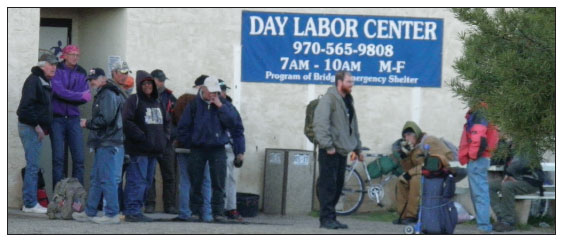
DAY LABOR CENTER IN CORTEZ, COLORADO

Guests at the Bridge Emergency Shelter in Cortez wait for it to open at 6 p.m. one night in February. Photo by Gail Binkly

“Fred,” 56, wound up at the Bridge in November because his brother is a convicted sex offender – at least, that’s how he sees it.

It’s the first time he’s ever stayed in a shelter. He tells the story of how he came to be there in short sentences, sounding almost apologetic.

“Family issues,” he says. “I didn’t get along with my younger brother. He lives with my mom, in Cortez.”

Fred says his parents moved to Cortez in 1984. He did, too, but later left for Salt Lake City, Utah, where he’s lived before. “I’ve been moving all around.”

Married and divorced twice, he has three grown children. The youngest, a 19-year-old daughter, recently became pregnant. She, Fred and his brother were staying at his mother’s place outside Cortez, his father having died in 2011. But the pregnancy changed the home’s dynamic, as Fred’s brother has been convicted three times of sexual assault on a child, the victims ranging in age from 11 to 15. He is registered as a sex offender and is listed as a sexually violent predator.

“When my daughter got pregnant, she got on social services,” Fred says. “They said the environment was not fit for a baby because my brother was convicted once of a violent sex crime. They told her they would take the baby if she stayed, because it could not be around him.

“My mom said my daughter would probably have to move. That upset me. I figured he should have been the one to pick up and go. She’s 19. He’s 42 years old.”

This led to an altercation during which law enforcement was called to escort Fred from the home. He says the situation never came to blows, and he was not charged with anything.

A friend told him about the Bridge. “This place really helps, especially when it’s cold,” he says. “In December it was 4 below.”

Fred has worked throughout his life, but physical problems now make it difficult to find employment.

He says he was born with a back problem that was exacerbated when he crashed on a three-wheeler at the age of 16. He also has spinal stenosis, arthritis, and carpal tunnel syndrome. In 2010 he began having seizures, and a few years ago he was diagnosed with Parkinson’s disease. Now he’s on a dozen medications.

He says he worked as a park ranger at Mesa Verde for five years until his back problems became too severe. He’s also a certified electrostatic painter, meaning he does powder-coating. He has done welding, carpentry, and mechanics, and has taken some business classes. Fred is on disability and has some retirement income as well, he says, “but when they take out my medical it’s not enough for a place to live.”

“In Utah or New Mexico, my Medicaid pays everything, but in Colorado I have a copay. They say, ‘we’re going to give you this but take $300 out’ and then they take it out of whatever little check you do get.”

He does odd jobs through day labor, to the extent that his back allows. “But if I work really good one day, it’s a week or so before I can work again.

“I’ve got a lot of history behind me, but my physical problems – people say I’m a liability on their insurance, so nobody wants to hire me.”

When he can’t work and the weather is cold, he hangs out at the usual places.

“I go to the library – City Market or Mc- Donald’s if I have a couple bucks.”

Fred is trying to save money to get back to Salt Lake City, where all his children now live. His daughter’s baby will be born in June, and he’d like to be there for her. His son would let him stay in his apartment, he says, but he is reluctant. “I don’t want to be a burden on them. They say I’m not a burden but with my seizures and stuff, I feel like I am. I try to stay away. I take my tent and camp in the mountains so I can be by myself. They say, ‘No, Dad, that’s homeless’.”

Last summer he lived in the tent for about a month. “My daughter did come see me every day.”

Although he wants to be near his children, living with them would be too much, he says, because they try to tell him what to do. “I love my kids, they’re great. But my youngest daughter is bossy. I spent 18 years taking care of them. I don’t need them to take care of me.” So if he does make it to Salt Lake this spring, he’ll try to find a place of his own for the winter.

In the meantime, he has the Bridge.

“It’s a lot better than most places I’ve been in and a lot better than when it was a jail,” he says with a laugh, referring to the fact that the Justice Building was once the county detention center. “I like all the staff. For the most part, I like the other people here.

“Everybody’s got a different story.”

Knutson agrees. “There are so many reasons for people to enter the homelessness cycle. Most will not talk about the traumas that disrupted their relationships with families or partners, and to deal with trauma and pain, people turn to chemicals and that becomes its own vicious trap.

“Some people just have the misfortune of running out of money in a country of renters. As mortgages have become less attainable, more people rent. That drives rents up and people get forced out of housing, especially if they’re aging.

“Few choose to be homeless. Those that do, tend not to come to the shelter. Most people who come here want to be housed, but some like living in tents in the middle of nowhere. Our BLM lands in the summer are full of people camped out in little corners.

“Homelessness is a complicated issue because there isn’t one entry point. If there were, it would be easier to construct services for that.”

Knutson says Fred is “the first one to help out the staff here and do extra things.” Most of the Bridge clients are “nice, nice people,” she says, “and they are more typical of homeless people than society wants to admit.

“You can be a very nice person and your biggest sin is not having a lot of money. No one is talking about the adverse effects of poverty and how that determines the outcomes of your life. Once a single male loses the ability to do full-time work, there’s not much help. If you’re 50 and worked for years doing really hard work and hurt your back, there’s not much help.

“Even if you can get disability, the average payment is about $750 a month. Try and live on that in Cortez, much less Denver.”

“Len,” 50, had “a nice house and three dogs and a husband of almost 22 years” in Dolores. That all changed one night in December.

Born in, California, Len says he did standup comedy in Hollywood in his late teens and even made a couple of demo CDs. Later he went to work in the entertainment industry, working on commercials and productions, casting and wardrobes.

He met his husband in 1995 and they developed a five-year plan to get out of Hollywood. But in just three months they had resigned their jobs and moved to Flagstaff, Ariz., near his parents. After a number of years they sold their house and moved to Vermont because the company Len worked for was supposedly going to expand there. However, the company pulled out, leaving them jobless in a beautiful home on two acres. After a long struggle, they lost the house.

A friend in Bluff, Utah, offered them a place, so they returned to the Southwest. In 2013 they moved to Dolores.

But all was not well. Len says both of them suffered from depression. When Gary lost his mother, his despondency became overwhelming and he attempted suicide “through a fall,” Len says. Gary suffered horrific injuries, including numerous broken bones and a shattered jaw. He was air-lifted to Grand Junction and wasn’t expected to be alive when the plane landed, but amazingly, he survived.

“So I made a big life decision,” Len says. “I made a leap of faith and picked him up from Grand Junction.”

But taking care of Gary turned out to be a herculean, around-the-clock task. “Summer was hell,” Len says.

He says Gary, who required numerous surgeries and still has limited mobility, began drinking and had frequent fits of delirium. Len, who has numerous mental- health issues, drank as well, though he’s sober now.

One night in December, Gary called police, saying Len had punched him and hit him with an iron poker. The lengthy incident report says Len appeared to have been drinking and the alcohol had possibly interacted with a new medication he was taking. He denied attacking Gary, but was charged with assault and domestic violence and thus had to leave. “I had nothing but a pair of sweats and a T-shirt. It was 15 degrees.” He ended up at the Bridge.

Len claims Gary had been abusing him, and rolls up his sleeves to show scars. He says he acted in self-defense that night. “I could see the look in his eyes — he had just checked out. I had to turn the tables.”

The court case was pending as of press time. For various reasons, Len hasn’t sought a civil standby that would allow him to return home to get his things, so he’s without even his smartphone.

“I have been tossed up and down like a goddamned salad over the last couple weeks. Luckily I have a very loving family.”

Len – who takes multiple medications for post-traumatic stress disorder, obsessive-compulsive disease and bipolar disease and sees a doctor and a social worker regularly – is on disability. “It gets me my coffee in the morning.” He often buys some for all the shelter clients.

One of the most difficult things about being homeless, he says, is occupying the hours between 7 a.m., when clients are turned out of the Bridge, and 6 p.m., when they can return. It’s a constant cycle of wandering between the library, the grocery stores, and fast food.

“What do we do all day? Kill time,” he says wearily.

He says he’s stigmatized as a troublemaker because of the actions of drunken street people. Len says he’s been ordered not to sit at tables outside local supermarkets even when he’s just purchased something from the deli inside.

But the shelter is a bright spot. He says the other guests are, on the whole, “a great bunch of people.”

“It’s a melting pot here. The different Americans are right here – people who are eating cat food, who can’t afford their medications. They’re wonderful people who’d give you the shirt off their back.

“I sing and I write. When I make it, I’m going to tell their story.”

He hopes the charges against him will be dismissed and he’ll be able to find a part-time job and reunite with his husband. His family is moving to Prescott, Ariz., he says, adding optimistically, “I think both Gary and I will end up there.”

Only a small number of the shelter’s guests, maybe 5 percent, are involved in domestic violence, either as victims or perpetrators, Knutson estimates. Women who have been the victims of a recent assault can go to the Renew safe house. Men wind up at the Bridge. Female domestic-violence victims who drink may come to the Bridge because drinking is against Renew’s policy.

If domestic violence is only a small factor in homelessness, mental-health problems and substance abuse are major ones. “I would guess half of our guests struggle with either or both mental health and addictions,” she says. “For decades there has not been a larger-picture response to those issues.”

Seeing people in the park, at the market, or on the street who are obviously mentally ill is disturbing, but most are harmless, Knutson says. “If you haven’t dealt with it, it can be pretty off-putting. It does not make people want to approach. All the hurts and heartaches that came before those mental-health issues or addiction are invisible, but the external behaviors are very visible. I know it makes people in the community unsettled. It’s unsettling for me.”

“Martin,” 57, isn’t homeless year-round. He works in Salina, Utah, from March through October, “and then the work shuts down and the town shuts down.” So he comes to Cortez to work, and stays at the Bridge.

Martin is a jack of all trades, able to do plumbing, electrical wiring, flooring, and more. Often he oversees projects.

He grew up on a farm and attended a Catholic school “when the nuns were still cracking knuckles.”

“I was raised by the back of the hand,” he says. “My parents were extremely strict. I graduated high school and then went straight into the army, so I’ve had a pretty straight and narrow life.”

He doesn’t drink or do drugs and has no physical ailments to speak of. “I have issues with my hearing, maybe from the artillery or from working in a steel mill, but other than that, the Lord blessed me.”

Martin was married and working at a good job in Arkansas, but seven years ago his life changed abruptly when his wife died. “Then the good Lord put me on a road trip and I wound up in Utah, then Cortez. I think it’s a beautiful world. I’ve seen 40 some states already and four countries.”

When he’s working in Utah, his employers provide him a home as part of his salary. This year he was able to rent it out, so when he goes back he’ll have some money put away. He saves half his salary in hopes he’ll eventually be able to retire to his Utah home.

“I hope the good Lord gives me 10 more years, because I want to work at least that long. I’m old-school. I love and respect everybody.” Martin found out about the Bridge one day four years ago, after he’d been working in Durango. “I got to Cortez after walking almost the whole way,” he says with a laugh. “It was a Sunday and people were leaving church. I was sitting at the Maverik and some people told me where the shelter was.

“There is a lot of compassion here. I’ve never seen anybody be derogatory toward anybody in this town. It’s a nice community. The police are great people. They don’t harass nobody unless you’re a knucklehead.”

He has nothing but praise for the Bridge and donates to it whenever he can. “The staff is compassionate and there are a lot of great people staying here. Fifty, 75 percent of them are working almost every day..”

Martin says it was a strange path that led him to Cortez. “I probably never would have left Arkansas,” he muses. “I made $1500 to $1600 a week. But when the good Lord took my wife home, it was a bumpy ride, so here I be.”

“Most of the homeless population is on the move,” Knutson says. “There are very few people who are here year after year. We had 323 different clients last year, with 40 to 43 people a night, so all of them can’t be here at one time.”

Some are able to obtain housing, but others just move on. “We counted at the end of last year and there were 43 who got long-term housing. Only two of them lost that. The problem is, last year we had 50 more homeless people than the year before. More people found places to go, but the problem didn’t dwindle.

“How do you find enough affordable housing? I can’t blame landlords for charging market rents but it makes it really impossible for the lower-income people. There will never be enough public housing, and some people – because of a choice they made long, long ago – will never be allowed in there anyway.

“If you ever sexually offended, you’re out of public housing. If you ever had a drug charge, that excludes you permanently from public housing. They may have been clean 10 or 20 years, but they’re not going to get into public housing. They’ll also have difficulty getting hired. I would find it discouraging if I were in that position myself. I don’t know how you dig out.”

“Allen,” 66, was born in California and has worked all his life. He says he spent 16 years in sales with Oscar Meyer in Los Angeles. He worked the last 13 years for two different employers in asphalt and seal-coating. The asphalt job kept him traveling across the West, from Texas to North Dakota or Montana. He’s never been married and was an only child, so he has no family now.

However, work dwindled, so he left Texas for Colorado. Over the past 18 months, unable to find steady employment, he’s been “living hand to mouth.”

Last October, he arrived in Alamosa and stayed in a shelter there, then moved on. He’s been at the Bridge since the first week in December.

“I’m thankful to have a place to go,” he says.

He seeks day labor and has worked about eight days for different employers. “I do clean-up, furniture-moving, helping somebody put together a shop, things like that. I’m willing to do basically anything. I’ve applied at some restaurants for dish-washing. Because of my age, it’s harder to get a job. I’m not a cook or a chef. I’ve registered with the workforce center. I go around and check with some of the businesses.”

He was able to get a cell phone with help from the nonprofit Piñon Project so employers have a place to reach him, since the shelter isn’t open days.

His health is good, he says, and he doesn’t do drugs or alcohol.

He recently filed for Social Security and Medicare and says that will be a big benefit. He plans to apply for public housing once he has a regular income, but it may be some time before anything opens up. Still, he has no complaints.

“I walk a lot. I enjoy just getting out. I make friends. I think you can learn something new every day. You’ve got to do the best you can. Nobody owes you a living.”

He says the Bridge’s clients all have different stories. “Some came from broken homes, some got in trouble in their teens. This is a place to go and try to get on your feet, not just a place to hang your head. It gives you somewhere to stay, do your laundry, eat.

“I ’m very thankful I have a place to come to and I’m taking advantage of the opportunity. You have to make an effort every day. I’m not a quitter.”

Knutson says the men’s stories are “pretty typical.”

“I think there’s still a good chunk of people who feel like the homeless have earned their status, but when you talk to them you find out how normal they are.” Many don’t need a shelter, she says, just affordable housing, but it’s nowhere to be found.

Last season the Bridge recorded more than 6,000 bed-nights (one person staying one night is a single bed-night). Knutson says this year they will be “way over that.”

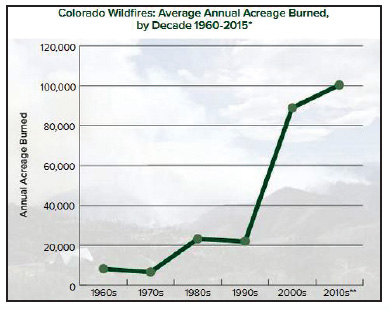
Published in March 2017 Tagged ,

Dialed up

Believe it or not, I have actual friends all over this country. All over the world! That way, I know I am loved in several time zones, but I don’t have people infringing on my free time for frivolous activities like “driving you to the airport” and “birthday parties” and “being there when you need emotional support.”

All the maintenance required for friendships abroad is the biannual phone call or email. For those, you don’t have to put on going-out clothes or find parking downtown — you can sit at home in your scuzziest pajamas, play solitaire on your laptop, and decide partway through to wear no clothes at all.

Essentially, long-distance friendships enable me to enjoy all the benefits of loneliness without any of the crippling drawbacks of being alone. It’s a perfect setup — or so I thought.

You see, everything has a cost. The cost of my friendship strategy is that phone calls take time. And I always have something else to do with my time. Things like saving the nation from runaway fascism.

Recap for anyone who just came out of cryogenic freezing: we now have a semi-sentient tangerine as the President of the United States of America. He is a narcissist and an egomaniac who believes very highly in his own capabilities. And I’m starting to think that, by gum, I am the one person with the smarts, the looks, and the Godgiven destiny to stop him.

I mean, I see all kinds of ways out of this. I just need Congress to listen to me, and the state governors, and the National Guard, and an assortment of woodland creatures. I’d have this whole kerfluffle dusted by St. Patrick’s Day. But then I decide to read the internet. That’s when I get downhearted. There’s too much for one person to combat. Immigration bans and administrative purges and health-care defunding, which might just be shiny headfakes designed to distract us plebes from the actual shifts in power structure that will send us spiraling into a world where we’d find cannibalism a reasonable alternative to Trump Steaks.

Taking on the new world order makes me tired. So I take lots of naps. And when I wake up to discover that nothing has changed for the better, that makes me really, really, really want to talk to my friends. Except that I know we’ll just end up rehashing the latest madness. And like I said, I have lots of other things to do with my time. Like writing Christmas thank-you notes.

These glittery, wintry cards have been sitting in their original packaging on my coffee table since December. And not the most recent December, either. You may be thinking that I should just pick up the phone and call my friends and family to say thanks. Maybe have an actual conversation while we’re at it. But why do that when I can send them a card? A card is a tangible representation of my affection. A card also says, “Hey, friend and/or family member, you are special enough that I don’t want our conversations to be traceable in any way.”

That’s right: in the last month-plus, I have become a paranoid survivalist. I don’t want the government tracking any of my activities, even if it’s just me thanking my grandparents for sending me a check instead of clothes. I don’t want the feds knowing where I shop, where I hike, who I talk to, or how much time I spend reading listicles instead of working.

Basically, I am taking preemptive action here. The only way to stay entirely safe is to cease to exist. I mean, crazed fans aren’t lining up to assassinate Meat Loaf, amirite?

But isn’t that what they want, the people in power? To divide us, to isolate us? That’s what will happen when we choose to live in fear and submission. And the antidote to division — isn’t that connection?

Connection doesn’t have to be on a large scale, million-person marches, grand demonstrations. It can also be two people who genuinely care about each other sending notes in the mail, calling each other just to say hi. Even if they end up discussing the Atwoodian dystopia at hand — isn’t open communication precisely what brings us together?

So that’s it. No more excuses. As an act of compassion and resistance, I’m going to call my friends. Right away. As soon as I figure how to tie off this column.

Zach Hively writes from Durango, Colo. He can be read and reached through http://zachhively.com and on Twitter @zachhively.

Published in Zach Hively

Don’t put too many eggs in the recreation basket

The astonishing downturn in the price of oil over recent months has had far-reaching consequences. One of those has been to give urgency to previously lackadaisical discussions in Montezuma County about finding “something” to drive the local economy beyond oil and gas extraction – mainly carbon-dioxide drilling by Kinder Morgan, the county’s largest taxpayer.

The demand for local CO2, you see, is closely tied to the price of oil, as the gas is used to pump additional black ooze from played-out wells in Texas. When oil declines in value, CO2-drilling and production decreases here, and county tax revenues decline.

County leaders have, commendably, been quick to see the cloud on the horizon and are already investigating a number of economic-development alternatives.

We’d like to urge a little caution.

In the zeal to find alternatives to oil and gas, leaders need to think hard about every possibility, since each likely has a down side. That doesn’t mean good ideas shouldn’t be pursued, only that drawbacks should be considered thoroughly to make sure they don’t outweigh the benefits.

Take recreation, for example, which is perennially touted as the answer to keeping the local economy afloat. And certainly Montezuma County has myriad delights to offer visitors.

The recent announcement that a proposed Cortez-to-Mancos recreational trail made it onto the list of Colorado’s 16 top-priority trail projects in 2016 is good news. It puts the “Paths to Mesa Verde” in a solid position to snag some of the grant funding available for such routes. This trail has been talked about for years, but only recently did the county become enthusiastic about working with Cortez, Mancos, Mesa Verde National Park, and the Colorado Department of Transportation to make it a reality.

We think the trail will be a tremendous asset, make no mistake. But it will be a costly project. $25 million is the ballpark figure being tossed around for completing the entire trail (a very rough estimate, as the specific route hasn’t even been decided yet, nor whether it will be a hard surface, soft surface, or both). Clearly the trail will have to be completed in stages. It isn’t going to happen in a hurry. And there are many questions to be answered about who will pay for maintenance, snow removal, weed control, the picking-up of horse manure and dog poop, and so on.

At a work session in January, the county Planning and Zoning Commission was quick to grasp these potential problems and to note that – because Montezuma County does not have a sales tax – it has no way to directly benefit from increased visitation even if more people do come here to travel the new trail. Yet the county would likely be expected to shoulder much of the burden of maintenance. Where will the money come from? That still has to be decided.

Local leaders are eager to see more tourism and we agree it would be beneficial – within reason. P&Z has spoken admiringly of Moab, Utah, and how at peak season it takes half an hour to drive across town, no one can get a seat at a restaurant, and all the motels are full. We aren’t sure locals want to see our area become quite like that. Industrial recreation has plenty of negative impacts on public lands and quality of life, and there are many folks who believe Moab has sold its soul for a mess of pottage.

Furthermore, jobs in recreation tend to be seasonal and low-paying. People say they want their children to be able to stay in Montezuma County and raise their families here. They aren’t likely to be able to do that waitressing or working in a gift shop. Recreation-industry jobs don’t bring prosperity, but they do create a huge need for affordable housing.

P&Z talked about developing and aggressively promoting more trails for equestrians, ATV riders, motorcyclists. (Predictably, they didn’t say much about hikers, because no one cares about them; they don’t use a lot of gear nor spend much money.) One suggestion was designating scenic routes for motorcyclists through McElmo Canyon and along county roads. That makes sense from an economic standpoint — bikers are good folks and do tend to spend money — but some local residents might be dismayed to suddenly be put on a “motorcycle route,” with hordes of Harleys roaring by their homes day and night.

And, remember, recreation is not altogether reliable. It is affected by international events, weather, wildfires, disease outbreaks (remember hantavirus?) and even, sadly, crime and terrorism.

P&Z suggested other ideas for economic development, one of which was developing industrial hemp, the non-intoxicating cousin to cannabis. We definitely like that idea, but it has problems, too. Despite the fact that marijuana is allowed in states such as Colorado and Washington, the conflict between federal and state law over cannabis has not been resolved, and hemp is caught up in that limbo. A new conservative president might reverse the Obama administration’s policy and crack down on states with legal pot, and that could affect the status of hemp as well. (Why isn’t anyone asking the candidates about this?)

One of the best things anyone can do to improve the local economy is invest in infrastructure and amenities. The county commissioners are wise to look toward making high-speed internet available in all corners of the county. A tentatively proposed solar farm (still in the discussion stage) is another idea well worth investigating.

Voters’ recent decisions to build a new high school in Cortez and expand the hospital will have long-term benefits, because such improvements draw new residents and help those already here.

It is to the commissioners’ credit that they are moving quickly to look at economic-development options beyond drilling, and it appears they will get some good advice from P&Z.

We just hope they won’t move too quickly in seizing upon any one alternative – particularly recreation – as the Next Great Thing. Consider the ramifications of each option, don’t assume anything is an unmitigated benefit, and most of all diversify, so that we never find ourselves again at the mercy of a one-product economy – like the banana republics of yore.

Published in Editorials

Is there a future for the trail?

It would be easy to lambaste the Montezuma County Planning and Zoning Commission for its apparent opposition to a 17-mile bicycle and pedestrian trail proposed between Cortez and Mancos.

The group of four (one member was absent) had little good to say at a Feb. 11 about the “Paths to Mesa Verde” route, which was recently named to a high-priority list called Colorado the Beautiful’s “16 in 2016” by Gov. John Hickenlooper. The county commissioners had eagerly sought the designation, but P&Z – in its newly expanded role of offering advice on economic development – had many concerns.

Raymond Boyd said he saw “a lot of initial investment, a lot of maintenance, and a lot of red tape” involved. He also opined that all (public) land within state borders belongs to Colorado and if the county starts working with the Bureau of Land Management and the National Park Service to cross their property, this would be an admission that those agencies actually have jurisdiction.

Bob Clayton, while less concerned about such issues – he said a precedent has already been set in other negotiations and agreements with federallands agencies – called the trail a nice idea but economically infeasible.

Michael Gaddy and Kelly Belt also worried about federal involvement in the project and voiced concerns about easements across private property.

Then, as the group discussed whether the trail would provide economic benefits, Clayton said it would largely attract users such as cyclists who don’t contribute much, and Belt made his now-infamous joke about them eating berries.

That comment raised the hackles of a lot of people in our area, and with some justification, as it appeared to dismiss a whole class of recreationists in favor of others such as motorcyclists, whom P&Z seems to value a great deal more.

But before we grow too indignant, let’s keep a few things in mind.

First, the folks on P&Z are unpaid. They spend a lot of hours reviewing the tedious minutiae of zoning and permit applications, and recently they have been meeting twice a month instead of once to fulfill the new duties the county commissioners have asked of them. They take their job very seriously and are working hard.

Second, they did raise legitimate concerns, particularly around the cost of maintenance. Upkeep for the trail will be labor-intensive and pricey, and that needs to be taken into account.

And third, P&Z has expressed a willingness to take public comments about the trail and to reconsider its position, for which they deserve a great deal of credit.

But P&Z needs to keep in mind several key things as well.

Little if any of the trail’s estimated $25 million cost will be paid by the county. Most will come through grants, and the trail will be built in stages, over time. We understand that some on P&Z have concerns about federal debt and the very idea of grant monies, but even the commissioners have come to see that it’s impossible to run a rural, sparsely populated county without relying on outside funds.

Furthermore, the idea that the trail needs to “pay for itself ” by attracting tourists who spend a lot of money here is off-kilter. The primary purpose of the trail, as we see it, is not to attract visitors. How many people are really going to travel from around the country to walk or bike from Cortez to Mesa Verde? Maybe a few, and of course some visitors who are coming here anyway will stay an extra day to use the route. But the trail alone will never draw hordes.

The real reason to build the path is to improve the quality of life for people who already live here. Note what Hickenlooper said in announcing the top-priority trails: “We need the kind of outdoor access that more easily brings all of us – especially our young people – into the fresh air and away from indoor distractions. Getting more Coloradans outdoors more often is good for our health. . . .”

By making this a great place to live – through amenities such as Cortez’s rec center and extensive parks, the expanded high-speed Internet the county is pursuing, good schools, a modern hospital, now maybe the trail – you invite more people to live here, both retirees and young families. You encourage health and fitness. Moreover, you make this an attractive place for companies such as Osprey that provide stable jobs with benefits rather than seasonal gift-shop and motel jobs.

P&Z is taking comments about the trail at its meeting Thursday, March 10, at 6 p.m.; or you can email them to lmilligan@co.montezuma.co.us. (Please, people, keep them civil. One Donald Trump in the world is plenty.) This is the time to step up for the trail if you want it.

Published in Editorials

The peculiar clash over mosquito control

The dispute between the Montezuma County commissioners and the Montezuma Mosquito Control District is one of the strangest clashes involving local-government entities in recent years.

On April 18, the commissioners voted 3-0 to oust the district from its office in a modest building – constructed and owned by the district – but sitting in the county road yard.

Montezuma County has no direct oversight over special districts, of which there are many in the local area – the hospital and sanitation districts, cemetery districts, and so on. They are separate entities with their own boards and their own mill levies. It’s highly unusual for the county to weigh in on how one of them should be managed. We can’t think of another such incident except when the county — at the request of hundreds of constituents — asserted a nominal amount of influence into the Montezuma County Hospital District in the 1990s, with the district’s agreement.

In this case, the county appears to have become interested in the district’s doings because the district board recently received a slap on the wrist from the Department of Local Affairs for running a sloppy ship – i.e., not adhering to regulations about holding elections and advertising vacancies on the board – but it has reportedly taken steps to rectify this. District representatives say there weren’t enough people interested in running, a fairly common situation with many local boards. Financial compensation for serving is minimal and other “rewards” generally include hearing from disgruntled citizens.

The commission also believes the annual contract for keeping mosquitoes at bay should be put out to bid. Colorado Mosquito Control, which operates statewide and is part of a global company, has been the contractor for the past 17 years, and the commissioners say they want to see if taxpayers could get a better deal from another company.

This seems reasonable, but the commissioners’ emphasis on seeking a local entity may be misplaced. Local preference in hiring is generally a good thing, but if anyone else is going to compete for the mosquito-control contract, that person or entity needs to be qualified. The days of simply hauling sprayers around and fogging the entire countryside with chemicals are over. Mosquito control has become a science-based effort that integrates biological control of larvae while still in the water with control of adult, airborne insects.

Mosquito control was hugely controversial in the county prior to 1999, when the district switched from the traditional control methods to the new and contracted with CMC to do the work.

This isn’t to say CMC is above criticism or shouldn’t face competition, nor that local people could not be just as qualified, with training. But it’s unclear why this is the county commissioners’ concern. It also should be kept in mind that the district’s entire purpose is mosquito control. True, if it shaves a few dollars off its budget through a cheaper contractor, it could return that money to voters by lowering the mill levy, but it wouldn’t amount to more than a few dollars per person in a year. Then, if climate change causes a crisis such as an invasion of new mosquito species carrying tropical disease, the district would have to hold an election to ask for that money back again — and elections cost real money. Efficiency is good, but bargain-basement mosquito control is probably not the way to go.

Nearly 40 years ago, the county and the mosquito district were so friendly, the county offered them space in its yard just as a helpful gesture. Now, a fractious relationship has arisen between the entities, which had a rather stormy get-together recently that apparently produced more bile than milk and honey, thus triggering the eviction notice.

Like many other special districts, the mosquito-control district has a big mission to perform on a limited budget, which is funded through a mill levy that generates around $200,000 annually.

And while it may not be perfect, the five-member board appears to be doing an adequate job of keeping the pesky devils from eating us alive: There have been no mosquito-borne epidemics ravaging our livestock, pets or selves.

The commissioners have criticized the district board as not very transparent, and that particular concern seems justified. While the office manager, CMC employee Jason Carruth, is easy to reach, the board members are maddeningly difficult to get hold of. It’s disappointing that there is no information online about the board or when it meets, and no contact information. The chairman, another board member, and the district’s (former? current? we don’t know) attorney all failed to return phone calls from the Free Press. Members of public boards need to be available to speak to the public and press, or they shouldn’t serve.

But, again, this really isn’t the county’s purview. It’s up to electors in the mosquito district to complain if they become dissatisfied, and if there are enough, change will come.

Still, with the very real, looming threat of the Zika virus (which can have disastrous consequences for pregnant woman) and the mosquito that carries it (which is expanding further north than first predicted), along with ongoing threats of mosquito-spread West Nile virus and encephalitis, the timely and competent treatment of the insects’ major breeding grounds is more important than ever.

Which raises the question of why the county commissions chose this critical time – with the mosquito season just ahead – to evict the district. Relocating its headquarters just as the employees are gearing up to combat the annual plague of bloodsuckers is bound to make the overall effort less focused and effective. What was the emergency?

We’ve heard the district has found a new home, but if not, we urge the commissioners to wait to kick them out of the county facility until this year’s control efforts are over – and to try to fashion a more harmonious relationship with the district board, which has two new members. It sounds as though some of the current dispute is driven by personality clashes, but everyone needs to take a breath and move beyond such issues.

We’d all like to see the district managed as efficiently and effectively as possible. Egos and muscle-flexing on either side should not get in the way of public safety. R.I.P., nasty bugs.

Published in Editorials

Bears Ears’ future

People are working themselves into a lather over Bears Ears National Monument – a monument that does not yet exist but has been proposed by a coalition of five Native American tribes. It would cover some 1.9 million acres in southeastern Utah, an area rich in Ancestral Puebloan and other cultural sites, red-rock scenery, and rugged beauty.

The governor of Utah has pleaded with the Obama administration not to employ his executive authority to designate the monument under the 1906 Antiquities Act, while the tribes have urged him to take action.

U.S. Rep. Rob Bishop says he will soon introduce a sweeping public lands bill offering alternative management plans for public lands in eastern Utah. Under his proposal, which came out of a massive stakeholder effort, Bears Ears would become a national conservation area about half the size of the proposed monument, with lesser protections.

Recently, three phony documents began appearing in public places in San Juan County: a letter supposedly signed by Interior Secretary Sally Jewell claiming the Obama administration was going to reduce the size of the Navajo Nation; a fake flier announcing a party to celebrate the new monument, saying environmental groups would provide “good food” but “Utah Navajos” were not invited; and a letter supposedly signed by the vice president of the Navajos’ Oljato Chapter, Albert Holiday, in which he proclaims his opposition to the monument. However, Holiday says he did not write or sign the letter and actually supports the monument.

These documents could have been passed off as satirical commentary if they didn’t involve putting real people’s names on things they did not actually sign – which may rise to the level of a criminal act. But the phony writings show just how desperate some folks are to stop the monument.

Opponents have produced a short video in which San Juan County Commissioner Rebecca Benally, a Navajo, and a half-dozen other Native Americans say they oppose the monument. But the five tribes have repeatedly stated their official position is in support of the designation.

So the question is: Does the Bears Ears area, which includes Cedar Mesa and Comb Ridge, merit monument status? Do its resources put it on a par with, say, Canyons of the Ancients, Hovenweep, Natural Bridges, and other nearby areas already designated so? Does it need greater protection than it is currently receiving? Would monument status help it or harm it?

We conclude – with some reluctance – that, yes, it ought to become a monument.

One main concern of opponents seems to be access for wood-cutting, as many Navajos living near Cedar Mesa rely on firewood to heat their homes. This is a problem that is solvable. There are ways to ensure firewood remains available, perhaps even by cutting an ample supply each year and hauling it to a central location for distribution, to avoid off-road damage. This should not be a deal-breaker.

Monument status will inevitably mean publicity and an increase in visitation, and this is not an unmitigated benefit. Recreational impacts can sometimes be as harmful as many of the uses traditionally decried as destructive, such as oil drilling. But a well-written plan can help ensure that recreation is kept in check and the monument’s many resources are better protected. As it is, the estimated 100,000 Native American sites within its boundaries are subject to rampant looting and vandalism. Monument status, we hope, would bring a little more money for law enforcement, though this is not always the case and it depends on the will of Congress.

We have some reservations about the Bears Ears Management Commission, which would be the monument’s policymaking body. As proposed, it would consist of representatives of each tribe involved (Navajo, Ute Mountain Ute, Zuni, Hopi, and Uintah and Ouray Ute), plus three federal agencies (BLM, U.S. Forest Service, National Park Service). While we welcome the ground-breaking idea of the tribes having a collaborative management role rather than just a “consulting” role, we believe the proposal may need tweaking. San Juan County deserves a seat at the table, for one thing. But those details can be worked out.

The land is already federal, so this would not affect the ongoing debate over federal lands vs. states’ rights. And San Juan County, which regularly promotes itself overseas and nationally to attract tourists, should welcome the new visitors who would come to the monument. (Yes, even cyclists and hikers spend money.)

We know the designation will cause an outcry and heighten resentment of the federal government, but obscurity and relaxed regulatory oversight are not adequately protecting the area.

In its proposal, the Bears Ears Intertribal Coalition states, “The wonder is that Bears Ears has not already received some sort of special Federal protection as a park, monument, or wilderness.” That state of affairs needs to change, and Bishop’s bill – which would allow expedited energy development on some archaeologically rich parts of the area – doesn’t go far enough and may never even come to fruition.

Is Bears Ears special enough to become a national monument? Clearly, the answer is yes.

Published in Editorials

Health insurers’ departures

Opponents of the Affordable Care Act, or Obamacare, have long been frustrated in their efforts to get it overturned. They’ve failed time and again both in Congress and the courts. But they may be winning the battle through another method altogether.

One insurance company after another nationwide is choosing to quit offering coverage in the ACA marketplaces. For instance, “six major health insurers that sell plans directly to consumers are bowing out or scaling back on the Affordable Care Act marketplace in Arizona,” according to the Arizona Republic. In that state’s largest county, Maricopa, only two marketplace insurers will remain, and Pinal County doesn’t have a single one left for next year. Here in Colorado, Rocky Mountain Health Plans, a major provider, especially in rural areas, is pullling out at the end of 2016. RMHP’s departure will leave some 3,100 people in Montezuma, Dolores, and La Plata counties scrambling to find another option — and it appears there may be just one, Anthem.

Competition through the ACA was supposed to keep prices down. In its absence, prices will likely keep climbing and the entire system may fall apart.

Hurray! say the ACA opponents, apparently secure in their own coverage through Medicare or employers. Get rid of Obamacare and replace it with “something else” (what is never clearly explained).

But not so fast.

It’s possible that the continual “drip, drip, drip” departure of insurers from the ACA marketplaces will have the opposite effect of what opponents desire, instead encouraging the development of public options or a single-payer system.

If the ACA were suddenly to end, as opponents dream, the vast majority of the millions of people nationwide who now obtain their insurance through it would not be able to purchase individual plans on their own, because their incomes are too low, they have major health problems, or both. They would simply fall out of the system and return to getting health care through hospitals’ emergency departments.

Faced with the possible deterioration of the ACA, the folks who now rely on it may start advocating for options such as Amendment 69, a proposal on Colorado’s ballot this November that would tax all citizens to establish a statewide insurance program with no deductibles and no limits on coverage.

The merits and downsides of Amendment 69 need to be thoroughly studied. We hope that even advocates of a single-payer system will carefully consider the fine print; we don’t want to put in place a system that is doomed to fail. It’s tempting to vote our gut instincts either yea or nay, as voters did when they passed the Taxpayers Bill of Rights, TABOR, which has merits but included so many poorly understood provisions that hundreds of local governments have had to “de-Bruce” to opt out of them.

Health care is a critical issue and will continue to be. Amendment 69 offers one answer. It deserves serious study and thorough consideration.

Published in Editorials

Irreplaceable

“Nobody’s irreplaceable,” my Free Press co-owner, Wendy Mimiaga, is fond of saying. Her point is that all of us leave our jobs at some point, and no matter how well we’ve filled our positions, eventually someone else is going to come in and do just fine.

More than 13 years ago, she and I founded this newspaper. We did pretty much everyrthing ourselves, working hard to coordinate our efforts and not get in each other’s way, sort of like those comedy duos who dress up in a two-piece horse suit. But, as I always told Wendy, she wound up with the hind end of the horse. I got to put my byline on stories and make assignments and occasionally win awards, while she did the unlovely grunt work of beating the bushes for advertisers, running out to shoot photos of ribbon-cuttings, cobbling together a computer system that would function for us, fixing it when it didn’t function, making sure we had the software needed to produce a paper, learning Quark and InDesign and Adobe Illustrator, and so on.

Now that is coming to an end. After 13 years of working full-time at another job and spending her lunch hours, evenings and weekends in our little Free Press office, Wendy has decided she’s tired of telling her husband no, she can’t go for a bike ride with him, she has to get the paper out. She’s leaving the Free Press.

Back when the Beatles broke up, John and Paul and George and Ringo said no one besides the four of them would ever understand the experience they had shared. It’s stretching a point to say we’re anything like the Beatles, but in that one regard, we know what they meant. Because no one else has any idea what we’ve experienced scraping this publication together on a shoestring budget. No one else knows how many hours we’ve spent hunched over our keyboards to produce these few pages every month. No one else knows how many times we’ve smiled politely and groaned inwardly when someone said, “How come it’s called the Free Press when it costs 50 cents?” No one else knows how many times we’ve cursed when someone promised us a press release and sent us a link to a web site instead. (“You can get the information off of this — you only have to look at four or five different pages and write an article from that!”)

And nobody else knows how wryly we’ve chuckled when somebody told us, “I went by your office and no one was there — where were all the reporters and staff ?”

It’s difficult to imagine why anyone would give up a posh position like this one, but she’s going to do it. So, fans of the Free Press, if you run into Wendy out sipping lattes or hiking Sand Canyon on the weekends, you might want to tell her thanks for making this paper possible for so many years.
Wendy’s a smart woman in most regards (except spelling, OK? I just have to say that!). But she isn’t right about everything.

Some people are irreplaceable.

— Gail Binkly

Published in Editorials

Fake news

After the 2016 presidential election results skidded across the internet at my house, I had to wonder what went wrong with those enormous data-driven insights into how the race would play out. The Huffington Post, for example, predicted a 98.something percent chance of Hillary Clinton winning the White House in all the models they had run. Donald Trump’s chances fluctuated between 1.4 percent and 1.7 percent. The experts were not only wrong, they were reporting fiction.

Now, not paying attention to media polls has become my top New Year resolution.

After all, 42.7 percent of all statistics are made up on the spot, so how can I do worse.

Here are six statistical quagmires:

1) 63 percent of voters going to the polls thought SCOTUS referred to a brand of toilet paper.

2) 45 percent of women surveyed said they hate 55 percent of all the women they’d ever met.

3) 18 percent of bashful Americans don’t vote because of the skimpy curtains at voting stations.

4) 98 percent of racists have attended at least one Nascar event.

5) 27 percent of boaters prefer Roe vs. Wade.

6) 72 percent of adults are confused by puns.

Here is an answer key of sorts, but remember that polling data only feels right if it skews toward the belief you already hold.

1) The Supreme Court of the United States, minus one justice, has been forced to hear cases with only eight sitting members. Every decision has the potential to be a political coin toss. I grew up believing that as a branch of government, the Supreme Court should be held to a higher standard of impartiality. Remember the statue of a blindfolded woman holding the a scale for justice? American history classes burned that image into my retina. Eight justices gives us a 50/50 chance of getting what we want half of the time.

2) German philosopher Arthur Schopenhauer wrote, “Men are by nature merely indifferent to one another; but women are by nature enemies.” In the 19th century Schopenhauer provided us with a reliable predictor of the gender gap, and how some women in particular would behave during the 2016 election, throwing rocks at that glass ceiling.

3) 97 million Americans did not vote. Not the worst non-turnout in recent history, but still disappointing. Being bashful could not account for such a statistic, but one thing I’m certain about is that it’s curtains for democracy if voters continue to feel disenfranchised and at the mercy of a system fueled by wealth and backroom bargaining. I’m reminded of the Wizard of Oz, of Dorothy yanking the curtain aside from the sparkling machinations of power to reveal a startled old man frantically operating the controls. How like a bad dream, how utterly Oz-ish.

4) “The race for the White House” — such a silly headline, as if campaign coordinators and pollsters serve as pit crew, and voters somehow fuel the election. Why do people watch Nascar? Internet forums declare that enthusiasts love the crashes, the near misses, the noise, and of course, the crashes. This year’s election — more of a demolition derby — explains why so many viewers tuned in to watch the presidential debates, and why so few bothered with the VP venue. Isn’t it strange how quickly racists perk up when cars crumple, especially if the incident is combined with a smell of something burning?

5) Comedian Wanda Sykes in her 2004 book, Yeah, I Said It, wrote, “Women and our right to choose were going to be challenged with Ashcroft around. When Bush appointed Ashcroft, I went out and got me four abortions. I stocked up. The doctor was like, ‘Listen, you’re not pregnant.’ I said, ‘Hey, just shut up and do your job. I’m exercising my right while I can, dammit.” Roe prevailed in the landmark 1973 Supreme Court decision, 7-2, but politicians wade into the same muddy waters every election cycle. I’m all for the sanctity of life, but I’m more inclined to start by making war and poverty illegal.

6) Most jokes revolve around ridicule, contempt, or cradling the “other” in the ineptitude of sloppy thinking and laziness. Blonde, Jewish, Mexican, Polish, Gay, Black — you’ve heard them all. But puns are a special breed of humor, because wordplay is 99.9 percent derisionfree. Haven’t we had enough hateful rhetoric to last at least four years? We’ve heard more than a few nasty jokes sponsored by this year’s election. Here’s a pun, the best joke of 2017: Love trumps hate.

Every time I hear that one, I smile.

David Feela, an award-winning poet, essayist, and author, writes from Montezuma County, Colo. See his works at http://feelasophy.weebly.com/.

Published in David Feela

The protection racket

It’s 1956, we are driving our car across the Mexican border into Nogales Sonora. Look, there is a parking place near some shops. We get out, lock the car and immediately a young boy comes up and offers to “watch our car” for us. He will “protect” it for 50 cents until we get back.

We had some fairly nice hub caps so decided it was a wise investment, gave him $1 to make sure. He did well, our hub caps were still there when we got back. Yeah, we knew it was a protection racket. Then there are the stories of the mob offering to “protect” a small business from a known arsonist in the area, for a small cost. It only took one that refused the “protection” for the others to decide to “hire” the services.

Recently we read where Obama “protected” thousands of acres of states’ lands by declaring them a national monument. They claim the Colorado Roadless Rule will “protect” 4.8 million acres. We pay for carbon credits, to “protect” the earth from climate change. There is the spotted owl and of course the Mexican jumping mouse, which we are told need to be “protected.” Do you ever wonder how stating that there might be some potential habitat for a mouse, bird or bug works to miraculously “protect” or “save” it? Shucks, they don’t know how many there are or where they are! How do they know if a mouse is endangered, and then who cares? My cat loves them.

The World Wildlife Fund claims 200 to 2,000 species go extinct every year. However, in 1980 in Panama they found 1,800 new species of beetles they didn’t know existed, on just 19 trees. The World Resources Institute stated, “Surprisingly, scientists have a better understanding of how many stars there are in the galaxy than how many species there are on Earth.”

Sooo how do they “know” how many, if any, species are going extinct? Fact is they don’t! So how do they “protect” something they don’t know exists, or that it needs or can be “protected”? They don’t! Are they trying to override nature’s law of “survival of the fittest” and evolution’s rule of “natural selection”?

I have wondered just what is being “protected” from whom or what? That of course raises the question of, What is protection? The dictionary refers to it as “something that keeps a person or thing from being harmed, lost, etc.” Does designating public lands as wildernesses, national monuments, national conservation areas or parks “protect” them from harm or loss? What does it protect them from? Does it protect them from wildfires, insects and disease, dying of old age, wind storms, landslides, earthquakes, floods? Nope! Wait – it “protects” from nasty drilling, right? Did you know right here in Montezuma County there have been over 900 oil and gas wells drilled over the past 70 years? About 120 are active and producing jobs and wealth for the county residents. Where are the 780 old wells? Don’t know, do you? What “harm, loss or damage” was done from drilling? Nothing!

So what do these designations “protect” them from? YOU! They are protected from YOU enjoying and managing them for increased land and resource health and wisely using parts of them for betterment of the lives of you and your neighbors and the rest of the county and state.

Our local San Juan National Forest is comprised of about 1.9 million acres. In the past, environmental corporations had about 22 percent of it “protected” as wilderness areas. Recently they got 32 percent more “protected” as roadless areas, which are quasi wilderness. Together about 54 percent of the forest, 1+ million acres, has been “protected” from most of the public, you, resource management and health improvement.

So why are the so-called “environmental/ conservation” corporations pushing for more wilderness, monuments and endangered species “protection,” less recreation use, and no drilling and other economic uses? Well, there is only one thing left that has not been mentioned. It is the old classic of “follow the money.”

The “environment” is the tool the corporations use to incite emotions to bring in money for them to claim to “protect” something that is nebulous in people’s minds, knowing the people will respond to a declared “crisis” that needs their support, especially their money. As one of the supporters, you will sleep much better believing you helped save the planet that has existed millennia before and will be here millennia after your dust spot in time ceases to exist. That is the “protection business” the corporations are in.

Nothing has been or is “saved” or “protected” by the environmental corporations. Wildfires still burn more wilderness and “protected” areas every year. Insects and disease have devastated vast acres of spruce and pine timber throughout the state and that continues. One thing that has actually been protected is the income of the environmental corporations that promote leaving the land and resources to stagnate, die, burn off and be wasted. The 2014 IRS 501(C3) records shows one of the larger environmental corporations here in the Southwest receives over $14 million a year and pays the chief fundraiser about $900,000 a year. A couple of local ones receive over $400,000 per year and pay their execs $47,000 to $100,000 per year.

These corporations lobby Congress, legislators and agencies for laws, rules and actions that can be used to convince you to send them more money to “protect” the environment from the public and resource managers, while the land manager gets the blame when the resource is not “protected.” The “environmental movement” is today’s “Protection Racket”! The resources lose and are harmed, and the people lose.

Do we want to truly “protect” our resources and economic lives? Then it is time to let the professional resource managers manage the forest, range, water, and minerals to improve them, free from the environmental corporations “protection rackets.”

Dexter Gill is a retired forest manager who worked for private industry, three Western state forestry agencies, and the Navajo Nation forestry department. He writes from Lewis, Colo.

Published in Dexter Gill

Enough daydreaming

I couldn’t bring myself to watch this year’s inauguration and from what I’ve heard about it, it was a good choice, blood pressure and all that.

I mean, that’s the next President up there on the dais in front of our Capitol building and what was there this quadrennial? A scowling vindictive narcissist telling the world:

“From this day forward, it’s going to be only America first, America first.”

The image is out of a nightmare, but we are living this one and the damages will be irreversible. Trump declared we are no longer the United States of America, we are from this day on the Corporation of Amerika.

Going forward, the amoral business interests of a rare few are the only things that matter in this government. The genuinely horrifying reality I’m struggling with is that such an ourageously self-destructive, childish attitude appears to sit well with most Americans.

What happened to us? Have we forgotten that we are a country of immigrants with loved ones and family connections to every country in the world? Weren’t we the proud leader of the world not long ago? America set the inspiration and moral standards for other countries to follow and now this?

It’s true that we have long since lost our absolute world supremacy, but we were still the cornerstone to a civil (if frazzled) global community. Now, rather than learning from our mistakes and taking a sober assessment of our Earth and the future we are inexorably moving into, we wrap ourselves in a child’s temper tantrum: “It all about me, me, me!”

How is it that so many Americans are on board with that? Have we become a nation of such scared citizens that we run into the arms of the first strongman with easy answers who comes along? Someone who pretends all our problems are the fault of others, rather than being the legacy of a string of short-sighted self-interested choices.

In these days, when the reality of global warming and biosphere destruction and social disintegration is knocking ever harder on our door, what Trump is offering America and his corporate buddies is akin to the American Indians’ Ghost Dance – a dying people’s last desperate attempt to return to better days when Earth was a cornucopia and opportunities were boundless. It didn’t work for them, and it won’t work for us or our corporate overlords now.

We have got to make it here on this living planet that We the People and our avarice are mangling beyond redemption. I know we are always supposed to end on a hopeful note, but I’m done with progressive daydreaming. We’ve handed our government over to people who have contempt for our government and want to destroy it. It’s worse, many are faith-shackled and literally want to see End Days of Earth and seem more than happy to help that along. Imagine, it’s going to be even worse than you dare imagine.

Then take a sober look at how we collectively allowed this to happen. The next two and four years could be our greatest hour, or it could be the final nail in the coffin. America, it’s your move.

Peter Miesler writes from near Durango, Colo., and hosts the blog No-VillageAtWolfCreek.blogspot.com.

Published in Peter Miesler

No admission

“No” is one of the most important words people learn as toddlers. It establishes boundaries, builds a sense of self, and enables one to sing the Bob Marley song “No Woman, No Cry.” So I am pretty proud of myself for learning, finally, to just say NO when people ask if I ski.

Not skiing is the blasphemy I’ve cradled ever since moving to Southwest Colorado. And I don’t even have the deflector shields of handy excuses for not skiing. It’s not because skiing is expensive and I don’t have the gear (even though it is and I don’t). I, quite simply, just don’t want to ski. I don’t want to learn. I don’t want to try it, because I won’t like it. And I’m tired of burying this part of myself under an avalanche of shame.

Around these parts, I could say something as unorthodox as “I’m part of President Obama’s gay menagerie,” and the most severe response I might get is “Do you want another beer?” But for years I have repressed my entire lack of skilust, because other people get flayed with ski poles for admitting that they don’t ski.

I’ve seen it happen. It’s like a Choose Your Own Adventure:

Chapter 1: You are with a group of friends when one of them asks you, “Do you ski?” You sense that your entire future rests upon your answer. (If you lie and say yes, go to Chapter 2. If you say no, go to Chapter 4.)

Chapter 2: “What kind of skiing?” they ask in a strangely cultish unison. (If you mumble words that might sound like skiing terms, go to Chapter 3. If you stare blankly, go to Chapter 4.)

Chapter 3: “Come with us this weekend!” one of your friends says. “I have my old gear you can use if you need it, and if the kind of skiing you mumbled requires a lift ticket, my buddy will get you a discount.” (You are forced into a corner, and rather than actually go skiing and make a fool of yourself, you admit that you do not ski. Go to Chapter 4.)

Chapter 4: Your so-called friends gape at you. “You seriously don’t ski?” they say. “Surely you must be mistaken. Everyone skis.” (If you decide to backpedal, go to Chapter 2. If you decide to fake a serious ski-related injury, go to Chapter 5. If you stick to your guns, go to Chapter 6.)

Chapter 5: Your friends offer you sympathy over your trashed ACL and suggest you go skiing together next winter. You have averted disaster for another year. The End.

Chapter 6: The pack of your former friends closes tightly around you. The light dims, and you welcome the inevitable onslaught. At least, in death, you will never again have to answer questions about skiing. The End.

This year, I am finished with choosing the same old adventures. I’m writing a new chapter, where I declare unabashedly that I CHOOSE NOT TO SKI and I will have tons of fun without paying for the privilege of breaking my femurs.

Holy powder days, what a liberating sensation this is. I’m going to declare all sorts of other things I’m supposed to like that I don’t! You ready for this? I don’t like New Year’s Eve. I don’t like the NFL. I don’t like that I don’t understand what the hell a “tapas” is. And I really don’t like lists.

However, as many toddlers learn by the time they’re 30 or 40, “no” is way more powerful when it is coupled with the power of “yes.” Saying nein frees me to be loud and proud about also saying ja. If I am crystal clear about both what I like and what I don’t like, then I will live life true to myself, even if I lose my remaining friends.

So what do I like? That is an excellent question, one I intend to spend much of 2017 exploring. There must be lots of things in the world to enjoy beyond not skiing. Like not snowboarding, for instance. But for the present, it turns out I really, really enjoy just saying no to things.

So come on. Make my day. Ask me to ski, please, so I can turn you down. And if you don’t like my answer, then ask me again. Because I might be willing to give cross-country a shot.

Zach Hively writes from Durango, Colo. He can be read and reached through http://zachhively.com and on Twitter @zachhively.

Published in Zach Hively

A lie is a lie

Post-truth.

Truthiness.

Alternative facts.

Some of the terms we’ve been hearing lately are inventive; one is even humorous — and intended as such. But all of them mean the same thing, and there’s nothing funny about the suggestion that we live in a “post-truth era.” All of these terms mean “lies.” It doesn’t matter how you package a lie, it is still a lie.

More dangerous is complacently believing that this actually is a “post-truth era.” While it is perhaps difficult to tell fact from fiction in the echo chambers of the Internet, that is not permission to surrender; as citizens, we do not get to shrug off our responsibility and then claim helplessness because someone has coined new words for lying.

I’m thinking of a few specific “someones.” The mediocre reality show has been and repeatedly bankrupt real estate magnate who became president has, with his surrogates, already grown a bumper crop of lies.

Exhibit A: The Fragile Narcissist In-Chief

Donald Trump, after trashing the intelligence community for its conclusions that Russia wanted him to win, went before the CIA to proclaim his love for the agency. And also to brag about how smart he is. And of course to call the media, apparently without a hint of self-awareness, “among the most dishonest human beings on earth.” Their sin? “ … they sort of made it sound like I had a feud with the intelligence community.”

If by “sort of,” Trump means “totally reported my own words as I threw a hissy fit about the unflattering allegations in a dossier,” then, sure. Witness his own Tweet on Jan. 11:

“Intelligence agencies should never have allowed this fake news to ‘leak’ into the public. One last shot at me. Are we living in Nazi Germany?”

I believe I have mentioned that Trump may lack self-awareness. At his CIA visit, he went on to say the media had been “caught in a beauty” of a lie over accurate reporting as to the size of his inauguration crowds versus Obama’s first-term turnout. He added: “I think they’re going to pay a big price.” Translation: “I will do my best to make sure they pay a big price, and in the process, also cut off the American people from accurate information.” Not only does accurate reporting rankle the guy who now has the nuclear launch codes, but what he’s perturbed about is, essentially, rally numbers.

At his first press conference after winning the Electoral College, Trump also railed against particular networks, refusing to take their questions on the basis that they were “fake news.” (Another world leader once called the media the “lying press.” That person was Hitler.)

But a story is not false merely because someone dislikes it. Trump signed up to be president (at least for the glory and adulation part), and it’s no one’s fault but his own that he doesn’t know what he is doing. Criticism comes with the territory. He’d better get used to it.

Exhibit B: Sean Spicer

Press secretary is a tough job. Spicer showed in January that he is in no way capable of it. He claimed that Trump’s inauguration was the most widely attended and viewed, ever, which is completely at odds with reality.

He tried to suggest that white ground coverings just made empty spaces stand out more than they had at Obama’s inauguration, and that greater security measures kept more people off the Washington Mall. The Secret Service said measures were not significantly different, per the New York Times.

On video, an angry Spicer reads as if from a script, claiming the media deliberately misrepresented the photos to “minimize” Trump’s “enormous support.” He further took a shot at a reporter who had incorrectly said Martin Luther King’s bust had been removed from the Oval Office. Spicer raved about this error as if it were The Worst Thing Ever, proof positive that all media are “reckless.” (And therefore, lying to them is OK?)

Then, in perhaps one of the most stunning lies of the day, he said Democrats had placed national security at risk by “stalling” confirmation hearings for Trump’s national security pick.

For those who may have missed it, a number of Trump’s Cabinet picks have been overwhelmingly unqualified for their jobs; some have not gone through the level of vetting required by law, and some have been found not to have made required disclosures. (Looking at you, Steve “the paperwork is complicated” Mnuchin.) But by all means, blame the Democrats as heel-draggers because Trump failed at the outset to adhere to the selection process.

“We’re going to hold the press accountable as well (for divisions in the nation),” Spicer fumed, before stalking out of the room.

Translation: “We’re going to continue to frame the press as your enemy. We want to control the information. It makes it easier for us.”

Exhibit C: Kellyanne Conway

Conway has been shilling for Trump since taking over his campaign, spinning so much it’s a wonder she’s not developed vertigo. But after the Spicer disaster, Conway outdid herself.

NBC’s Chuck Todd asked Conway why Trump had sent Spicer out to discuss a “provable falsehood,” with respect to inauguration numbers. Conway attempted to deflect by talking about the executive orders Trump had signed and what happened in the months prior that brought the public out.

Todd then had the nerve to ask why, if the size of the crowd does not matter after all, Trump had sent out Spicer “to utter a provable falsehood.”

Conway’s response? That if Todd was going to keep questioning the press secretary, “I think we’re going to have to rethink our relationship with the press here.” When Todd pointed out that she wasn’t answering the question, Conway, too, began talking about the MLK bust. Soon after, she uttered the words I hope haunt her for years to come: “Our press secretary gave alternative facts.”

Todd responded: “Alternative facts are not facts.”

It was like shouting into a tornado.

Alternative facts are not facts, but apparently, Conway hopes that if they are repeated often enough, they will become the equivalent of facts in people’s minds.

I would say we cannot let that happen, but in significant ways, we already have — such as when people, before Trump was elected, and independently of what he was doing, heralded this as the “post-truth era.” The national media did not help matters later, covering in breathless detail every trivial aspect of Trump’s campaign, and treating his candidacy as a joke, rather than as a threat. He was given free publicity because network executives thought ratings were more important than actual reporting.

Trump did not give us the talk of, and near-acceptance of a “post-truth era.” The seeming embrace, by some, of a post-truth era gave us Trump. On balance, the Trump candidacy had the feel of a giant con and the Trump Administration, to date, is one of gaslighting those who try to tell the truth. “Gaslighting” comes from the 1944 movie, “Gaslight,” and refers to making someone appear insane, or making that person believe he or she is insane, so that the victim doesn’t even trust his or her own judgment. It is aimed at destroying the victim’s power and ability to challenge the abuser.

When the media present facts — photographs, videos, Trump’s own words — he and his propagandists pounce with cries of “fake news!” and “dishonest media!”

When Walter Shaub Jr., head of the Office of Government Ethics, wrote Senate Democrats that vetting for Trump’s Cabinet picks hadn’t been conducted entirely in accordance with the Ethics in Government Act, Toxic Human Being Jason Chaffetz sent him a letter alleging that OGE Tweets in November had “publicized private discussions” with Trump’s counsel with respect to Trump divesting his business interests.

Chaffetz scolded Shaub:” “Your agency’s mission is to provide clear ethics guidance, not engage in public relations.” He noted that the OGE’s statutory authorization lapsed at the end of the fiscal year and that the House decides whether to reauthorize it. He wrote: “To help the committee understand how you perceive the OGE’s role, among other things, please make yourself available for a transcribed interview …”

In other words: “Shaub doesn’t know his place and now we’re going after him for Tweets that have exactly beans to do with whether Trump’s Cabinet picks are being properly vetted. This is to punish him for pointing out the Ethics in Government Act issue.”

When former CIA director John Brennan commented that Trump’s speech before the CIA was a “despicable display of self-aggrandizement,” Trump mouthpiece Reince Priebus declared Brennan was just “bitter” that he had not been retained.

Conway chimed in that Brennan is “a partisan political hack.” (Apparently, she has as much self-awareness as her master). In other words: “John Brennan is washed up — really, kind of a terrorist, and you can’t trust him!” Lost in the noise machine’s cacophony: That Trump, while standing in front of a CIA memorial wall, blathered about the turnout for the inauguration, the media, and how “smart” he is. Seems an awful lot like self-aggrandizement to me.

The Trump strategy is to deflect, deny, project and sabotage. The endgame is far more than protecting Trump’s eggshell- thin feelings. It is to undermine public faith in the traditional institutions for fact-checking and research, and, really, anyone who speaks out about what his administration is doing.

That is why his propagandists go off the rails when speaking to the press. It is why he Tweets while the world burns. Or, in “alternative-fact”-speak, it’s so he can “communicate directly with the people.”

Direct communication is well and good, but it cannot be the only way by which the people learn about what he is doing. The reasons for that should be obvious: Neither he nor any other elected official can actually be forced to tell the truth and, worse, Trump appears to have a pathological aversion to doing so.

There is a reason why press freedoms are enshrined in the Constitution. And Trump finds it much easier to erode faith in the press than to repeal the First Amendment. But the press is not the only victim, or even the primary one. America is the victim. If you cannot, or will not, watch what your government is doing, then it can do anything at all.

Katharhynn Heidelberg is an award-winning journalist in Montrose, Colo.

Published in Katharhynn Heidelberg

Dear GOP lawmakers: Use common sense

It’s been a decade since Republicans held the presidency as well as a majority in both houses of Congress, so it’s natural that they now have the bit in their teeth and want to move swiftly to further their agenda. Restricting abortion, building a border wall, tightening immigration policies, getting rid of Obamacare, throwing out the Endangered Species Act, undoing national monuments and gutting the 1906 Antiquities Act, dismantling the Environmental Protection Agency – all these measures and more are on the table.

This is understandable. Voters, after all, chose these lawmakers and picked Donald Trump for president.

But the GOP needs to keep a few things in mind.

First off, Donald Trump does not have any clear mandate as this country’s leader. He was chosen in a pretty half-hearted fashion, winning the Electoral College but losing the popular vote by a significant margin. He begins his administration with the lowest popularity ratings of any president in modern times, something like 45 percent, although that will surely fluctuate to some degree.

And while he has many ardent supporters, there were also quite a few voters who picked him only because they didn’t like Hillary Clinton, either, and thought Trump might truly “drain the swamp” (a claim now rendered dubious by his choosing a bunch of white male millionaires and billionaires for his Cabinet and refusing to clean up the massive spiderweb of business-related conflicts of interest that entangles him).

So we hope our elected Republican representatives – in particular Sen. Cory Gardner and Third District Congressman Scott Tipton, but all of the GOP in general – will use a little caution and common sense when deciding what actions to take in coming months.

Consider the Affordable Care Act. The GOP has been eager to undo it from the day it was passed. But now, for better or worse, many people have come to rely on it. Some 20 million Americans now have coverage who did not before. According to the Department of Health and Human Services, in Colorado the uninsured rate has plummeted by nearly half since the ACA’s implementation in 2010. Yes, the ACA has flaws and problems that need to be fixed, but does it really make sense to throw out this entire system without a better plan in sight? That’s like asking Americans to play “Let’s Make a Deal” – only they have to give up the prize they have in hand in favor of Door No. 2 without any idea what might be lurking back there.

And consider the impact that undoing the ACA may have on rural hospitals, such as Southwest Memorial in Cortez. For years these institutions have had to treat the indigent in their emergency rooms and swallow the cost. Now they are able to be reimbursed for many of those costs, since more people have insurance because of the ACA. Their future plans have been predicated on profit-and-loss ratios based on the ACA. Now they have no idea what to expect.

Sure, Republicans now have the ability to get rid of Obamacare, but they need to take a deep breath and consider the ramifications. The GOP has the power to take a plethora of swift actions on numerous issues to garner some speedy cheers and trumpet, “We did it! By golly, we did something!” But the consequences of those actions will be theirs to live with over the long term.

So we call on Gardner, Tipton, and the rest to use their heads and govern wisely. Try to do what’s truly best for all your constituents rather than seeking cheap short-term victories that will turn sour over time.

Published in Editorials

Antibiotic resistance a growing threat

The war between people and germs is as old as humanity itself. For a little while, in the heady days following the widespread introduction of penicillin in the 1940s, it looked like humanity might score a decisive victory against the bacteria that cause suffering, illness, and death.

Then the resistance began.

Today, it’s widely recognized that the war will never be completely won, for as soon as an antibiotic is discovered, bacteria begin to evolve that can survive against it.

“Resistance is never far behind the introduction” of a new antibiotic, said Dr. Katherine Fleming-Dutra of the Centers for Disease Control, in a presentation Jan. 25 to medical practitioners at the Sunflower Theatre in Cortez. “This is going to be a constant battle.”

Fleming-Dutra, a pediatric emergency- room physician who works with the CDC, was speaking in the second part of a four-part series about antibiotic resistance put on by Southwest Memorial Hospital. The hospital, its management company, Southwest Health System, and hospital pharmacist Marc Meyer have launched a major effort to promote the awareness of antibiotic resistance and “antibiotic stewardship,” the proper use of antibiotics.

“Back in Atlanta [home of the CDC], we’re really excited about what you’re doing,” Fleming-Dutra told her audience.

In 2013, the CDC estimated that antibiotic resistance caused 2.05 million illnesses and 23,000 deaths annually in the United States. “It’s one of the most pressing public-health threats of our time,” Fleming-Dutra said.

For years, concern has been mounting about the proliferation of antibiotic-resistant bacteria and the shortage of new drugs to combat them. Today there are antibiotic-resistant strains of tuberculosis, pneumonia, meningitis, sexually transmitted diseases, MRSA, and many more illnesses. In the days before the discovery of penicillin, people frequently died from bacterial diseases and from cuts, bites, and other puncture wounds that became infected. The advent of antibiotics seemed miraculous.

But now, human beings’ vulnerability to bacterial infections may be creeping back as existing antibiotics become less and less effective.

Overuse and misuse of antibiotics greatly exacerbates resistance, and there is a growing call to make sure they are used appropriately. For instance, about three-quarters of antibiotics sales in the nation are for use in livestock, and producers are being encouraged to reduce that.

Fleming-Dutra addressed the use of the drugs in outpatient settings, where 80 to 90 percent of use in humans occurs.

EXAMPLES OF HOW ANTIBIIOTIC RESISTANCE SPREADS

Source: The CDD

Most commonly (23 percent of the time) those drugs are prescribed by family practitioners, she said, but 9 percent of the time, they’re prescribed by dentists, a fact that somewhat surprised experts.

Every year, some 268 million courses of antibiotics are prescribed in the United States, at a rate of 835 courses per 1,000 population. By comparison, Fleming-Dutra said, in Sweden just 328 courses per 1,000 population were prescribed in 2014 – “and Sweden thinks they’re overprescribing.”

In the United States, there are big differences among states in how often antibiotics are given out. Lower rates tend to be in the West, with Alaska’s rate the lowest, while the state with the highest rate is West Virginia.

Fleming-Dutra said there are clearly differences in populations among states and among different countries, but they aren’t so different that the U.S. should have a rate more than twice as high as Sweden’s.

“That suggests we have some room to improve,” she said.

Why are the drugs prescribed? She said in 2010-11, sinusitis was the No. 1 reason for adult antibiotic prescriptions in the United States, with 11 percent of the scrips being written for that purpose. Five percent were for bronchitis and 5 percent for viral upper respiratory infections, she said, and antibiotics generally should not be used for those conditions because they are ineffective. Antibiotics do no good against viruses, which cause illnesses such as colds, flu, hepatitis, polio, rabies and more. They are effective only in combating bacteria. (Viral infections can sometimes be treated with other drugs or prevented with vaccines, but sometimes, as in the case of colds, they simply have to be endured until the patient can fight them off.)

Fleming-Dutra said it is estimated that 30 percent of antibiotic prescriptions are written unnecessarily, when the drugs will be useless.

The effort to use the drugs more judiciously has had some effect, she said. From 2011 to 2014, their use decreased 5 percent across all ages; however, most of that drop occurred among pediatric use, while adult use did not really change.

Fleming-Dutra said medical providers generally are aware of guidelines for antibiotic use, but may stray from those guidelines for several reasons. They worry about potential infectious complications of an illness, she said, but those fears are generally unfounded. Complications of common respirator infections are very rare, she said.

In contrast, the dangers of antibiotic overuse are very real. Many people may experience bad reactions and negative side effects from the drugs.

Worse, about 14,000 people a year die from intestinal infections caused by a type of bacteria called clostridium difficile. C. diff is most likely to infect hospital and nursing-home patients being given long-term treatment with antibiotics, which kill the good as well as bad bacteria in their digestive tracts. C. diff infects about 250,000 people annually, and Fleming- Dutra called it “an urgent threat.”

Also, she said, there is a growing concern that antibiotics adversely affect the “microbiome,” the collection of good bacteria and fungi that share the human body. The use of drugs called macrolides, of which Zithromax is the most common one, are particularly disturbing to the microbiome. She said a study found an association between antibiotic exposure in childhood and juvenile idiopathic arthritis, though no cause-and-effect relationship was proven.

She said medical providers often feel pressure from patients to prescribe antibiotics. However, studies involving parents with sick children found that the parents were generally satisfied even without a prescription if they were given a contingency plan (“Come back in three days if this doesn’t get better”) and positive steps to take to make their child more comfortable.

Another factor may be habit, she said. A study of 1 million outpatient visits to Veterans Administration clinics found that the 10 percent of providers who gave out the most antibiotic prescriptions did so for a whopping 95 percent of their patients with respiratory infections. Many of those respiratory infections would not require those drugs, Fleming-Dutra said.

She said antibiotics are certainly appropriate to treat many conditions. The key is to make sure they are prescribed only when needed and that the correct drugs is given for the right dose and the right amount of time. Guidelines for duration of treatment are growing shorter for some conditions, she said.

The CDC has a goal of reducing inappropriate antibiotic use by 50 percent by 2020, she said, and efforts such as the one being led by Southwest Memorial are helping in that effort.

“You’ve got a great health system that is already really leading the way in stewardship,” she said.

To find out more about antibiotics and the CDC guidelines for prescribing them, go to www.cdc.gov/getsmart. Contact the Southwest Memorial Hospital pharmacy at 970-564-2190.

Published in February 2017 Tagged

Fees increase at Mesa Verde

Entrance fees to Mesa Verde National Park have increased. The new fees are $20 for a private vehicle (up from $15); $10 per person (up from $7); and $15 per motorcycle (up from $10). The cost of an annual park pass remains at $40.

Fees are good for entrance to Mesa Verde National Park for up to 7 days. Entrance fees are not charged to persons under 16 years of age or holders of the America the Beautiful National Parks and Federal Recreational Lands Pass, Senior, Access, Military, or Volunteer Passes or the Annual 4th Grade Pass. These passes may be obtained at the park.

“We are committed to keeping the park affordable, but we also want to provide visitors with the best possible experience,” said Mesa Verde National Park Superintendent Cliff Spencer in a release. “The money from entrance fees is used to improve visitor facilities and amenities.”

Entrance fees have previously allowed for purchasing and installing water bottle filling stations and drinking fountains; providing additional visitor educational opportunities at Wetherill Mesa; construction of new restrooms; and stabilization work at Spruce Tree House and Cliff Palace cliff dwellings. Upcoming projects include rehabilitation of the Morefield Amphitheater, additional stabilization work at archaeological sites throughout the park, maintaining and updating infrastructure, and continue to provide additional visitor educational opportunities.

Mesa Verde National Park staff held a public Open House in September 2016, and also accepted public comment in August and September, regarding the fee increase. The majority of responses received by the park were supportive of the increase.

Mesa Verde National Park is a strong economic engine for the surrounding area. In 2015, more than 547,325 park visitors contributed $55.4 million to the local economy and supported 814 jobs related to tourism.

For more information about Mesa Verde National Park, see www.nps.gov/meve.

Published in February 2017