Farm animals, horses find refuge at Denkai

DENKAI ANIMAL SANCTUARY

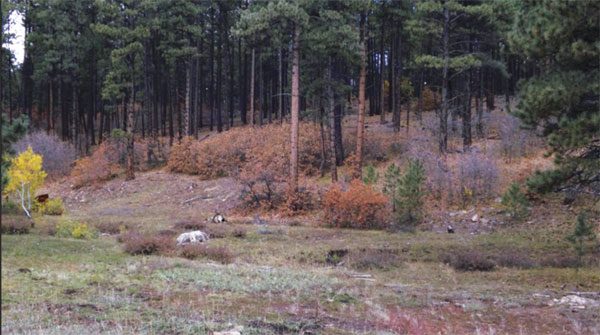
Floss Blackburn visits burros at the Denkai Animal Sanctuary in Yellow Jacket, Colo. They were part of a group of about 20 who had been turned loose on national-forest land near Pueblo and were found starving and near death. Denkai worked with Harmony Equine Center and Colorado Humane Society to take them in and place them. However, this group came back because the adopter had to retire and downsize. Denkai provides back-up for its equine/farm animals should a pitfall occur for adopters. Photo by Gail Binkly.

“We call them dumb animals, and so they are, for they cannot tell us how they feel, but they do not suffer less because they have no words.” — Anna Sewell

It started with a miniature horse.

“She was tiny, about 32 inches high,” recalled Floss Blackburn. “I was volunteering for another organization at the time. There was a woman who had paid $3500 for these miniature horses. She started talking to me. She said, ‘I can’t stand to look at her any more.’

The little horse had been so badly neglected that her hooves curled way up the backs of her legs. Blackburn, who has loved animals as long as she can remember, knew she had to do something.

“I took her in. I had her 10 years,” she recalled. “It took forever correcting her feet. We finally had to put her down. That’s what really kicked Denkai off.”

Denkai is a sanctuary for horses and farm animals, now located on a small farm in Yellow Jacket, Colo. The location is relatively new; Denkai originated on Colorado’s Front Range 14 years ago.

“We started with nothing,” said Blackburn, sitting at a table in the farmhouse at the Yellow Jacket property. “We rented places in the beginning. It was really hard.”

At one point she was living at a site in Nunn, in Weld County, without heat, running water or reliable electricity, taking care of a few abandoned and neglected farm animals.

“The animals did fine, but I paid a price big-time,” said Blackburn, who over the years has suffered serious health problems stemming from constant stress and hard work.

She struggled to expand her nonprofit, and eventually Denkai turned into a massive operation that included, in addition to the sanctuary for farm animals, a pet adoption clinic and a low-cost subsidized veterinary clinic.

“Our vet clinic performed about 25,000 procedures, the whole nine yards.

“We worked with municipalities – there were a lot of owner surrenders and cruelty cases. In total we’ve provided help to about 10,000 animals – equine, farm and pets. We also took in a lot of people who were homeless and needed help and had them working for the organization.”

Denkai was flourishing, but keeping it going took enormous effort.

“We had mortgages on all three properties, about $6,000 a month. We had to bring in $80,000 a month just to stay open. It took my health, but I couldn’t find somebody to replace me.”

At length the organization’s board decided to downsize, selling the vet clinic and adoption center in order to focus on large animals. The 640-acre site in Weld County was put up for sale as well.

“We were able to take funding from the sales of everything up north and buy this property outright,” Blackburn said. “We placed all the animals prior to closing it down. The farm part was the last to close.”

The decision to relocate to Montezuma County was natural, because Blackburn, the daughter of local author and historian Fred Blackburn, grew up here, graduating from Mancos High School.

On a brisk, windy day in February, Blackburn and Denkai’s outreach coordinator, Mary Fuller of Cortez, showed off the animals the sanctuary had taken in so far. They included llamas (surrendered by their owner), two horses acquired from Fresh Start Horse Rescue, goats, pot-bellied pigs (abandoned by their owner) from the animal shelter in Aztec, N.M., burros, and two horses of a small breed called Haflingers. The sixyear- old geldings, from a northern Colorado feedlot, are cases of neglect.

“We’re working on their feet,” Blackburn said.

Denkai’s focus is large beasts – horses and farm animals – that have been abandoned or neglected, or rescued from “kill sales” – horse auctions where buyers want the animals for slaughter. Most auctioned horses these days wind up at slaughterhouses, Blackburn said. “Cruelty cases are our No. 1 priority,” Blackburn said. “We accept owner surrenders. Some people bring their animals to use with an endowment – that’s the best-case scenario.”

Denkai seeks to find new homes for most of the animals whenever possible, but only if the adopters pledge not to slaughter the creatures.

Although Denkai’s focus is on farm animals and equines, it is working alongside Soul Dog Rescue to provide financial support and placement for dogs from Towaoc, Colo. It is also working to set up a low-cost veterinary clinic in the Cortez area to aid low-income individuals with pets and to establish a resale store for donated items that will support the efforts of the organization.

Denkai is funded through grants, monetary donations, and various fundraisers. The sanctuary also accepts donations of vehicles and scrap metal.

“My whole life I’ve been dragging home animals,” Blackburn said, adding with a laugh, “It used to drive my dad crazy. It took years to figure out that’s who I am.

“I’m really good at it. I really enjoy it. It’s good to be who I am and to do what I do. I like to help people and animals.”

Denkai is located at 22633 CR 17.6, Yellow Jacket, Colo. Contact them at 970-562- 1457 or 970-217-1457, or visit www.denkaisanctuary. org.

Published in May 2018

The cost of war: Legal battles are draining the coffers of San Juan County, Utah. Does bankruptcy loom?

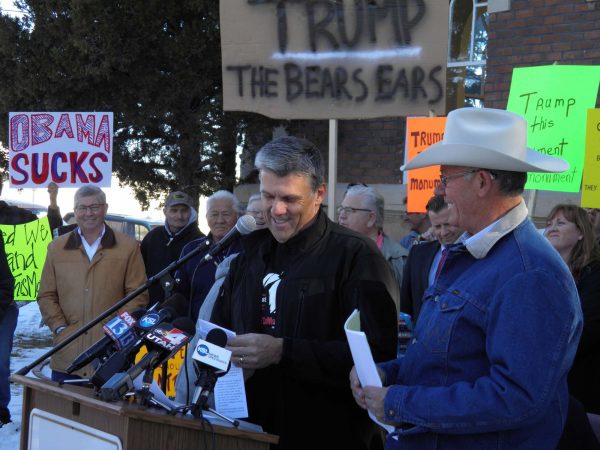
San Juan County Commissioner Phil Lyman, at podium, and Commissioner Bruce Adams enjoy a light moment at an anti-monument rally in 2016. Photo by Gail Binkly

After six years of voting-rights litigation with the Navajo Nation, Utah’s San Juan County could be pushed to the brink of bankruptcy in the near future.

According to the state auditor’s office, at the beginning of 2016 the county had over $9 million in general-fund reserves. Two years later, the fund had dropped to under $5 million.

Over $3 million in outstanding legal costs from the Navajo Nation suit are likely to be assessed in 2018 or 2019. Meanwhile, the county, which has a 30 percent poverty rate, is suing the federal government for title to a controversial right-of-way in Recapture Canyon, which could cost taxpayers tens or even hundreds of thousands of dollars.

Commissioner Bruce Adams said by phone that he’s “absolutely concerned” the general fund could become completely depleted. And if that happens, Adams said, “We’d be broke.”

One of Adams’ fellow commissioners, Phil Lyman, told the Free Press he’s “deeply, deeply concerned” about the county’s finances, but he was quick to shift any blame away from the county leadership. The real culprits, according to Lyman, are “frivolous, vexatious lawsuits with a completely ulterior motive.”

Over the last two years, the county has paid roughly $2 million to outside legal counsel, according to financial disclosures. Two voting-rights cases were brought against the county by the Navajo Nation and the Navajo Human Rights Commission, respectively. The county has paid for legal research into President Obama’s 2016 designation of Bears Ears National Monument while also initiating the Recapture Canyon lawsuit. In addition, it has been forced to pay for litigation related to a wind farm in Monticello and to a suit against the sheriff’s department.

The legal battles with the Navajo Nation are the costliest the county has faced in recent years, and its attorneys are currently appealing a district court ruling that found the county to be in violation of numerous voting-rights laws for discrimination against Native American residents.

Lyman maintains the case is “all Bears Ears-related and has nothing to do with race or voting or anything else. It’s completely environmentally driven by the same folks that have been filing lawsuits for the last 25 years in San Juan County.”

Decades of disputes over voting rights

In 1983, the Department of Justice sued San Juan County for voting-rights violations, and the county was required to begin electing commissioners by district as opposed to the previous at-large system. Following the change, Mark Maryboy became the county’s first-ever Navajo commissioner, and Navajos have continued to hold one seat on the board ever since.

The Navajo Nation sued the county in 2012, arguing that despite significant demographic shifts, the district boundaries for the commission and school board had changed little since the 1980s and that they were drawn intentionally to pack Navajo voters into certain districts. According to 2010 census data, the county is over 50 percent Native American and 47 percent white, yet Navajo representatives have never constituted a majority on either the commission or the school board.

San Juan County hired Suitter Axland, PLLC, a Salt Lake City-based law firm, to handle  the case in 2012. The county had paid the firm just under $1 million by 2017, when U.S. District Judge Robert Shelby found the county-drawn districts to be in violation of the 14th Amendment’s Equal Protection Clause and of Section 2 of the Voting Rights Act for systematic racial discrimination. Shelby ruled new districts had to be created for both the commission and school board and that elections had to be held for all seats in 2018.

The county has appealed the ruling to the Tenth Circuit Court in Denver. If it loses the appeal, it will be forced to pay plaintiff’s fees to the Navajo Nation as required under the Voting Rights Act. In January, the Navajo Nation attorneys filed in federal court for “a total award of $3,083,862.20 (fees and costs), plus interest and after-accruing fees and costs.”

Steven Boos, an attorney representing the Navajo Nation, told the Free Press, “I personally believe litigation is a foolish way of settling disputes.[…]We were pretty clear from the very beginning, the first time we met with [San Juan County’s attorneys] in 2012 that the county would lose and that the longer the case went on the more it would cost.”

Boos added, “It’s not uncommon for a voting-rights case like this, a redistricting case, to cost in the range of $5 million to $6 million. We actually came in pretty low.”

Court records show the Navajo Nation presented the county with a number of settlement offers dating back to 2014, all of which San Juan County either ignored or declined.

In March 2015, the Navajo Nation wrote that its expenses were more than $1 million, adding, “We estimate that these expenditures will easily double if the case is not settled relatively quickly.” The county did not accept that offer nor did it put forward a counter-offer.

One year later, in March 2016, the Navajo Nation proposed another settlement, noting that its costs had risen above $2 million and that they would likely total $3 million if the county did not settle. Again the county refused to negotiate. Shortly afterwards, the case proceeded to trial and a third-party “special master” was brought in to draw the new voting districts, which alone cost the county more than $75,000.

Since the 1980s, Native American voters have been packed almost entirely into a single commission district where they accounted for over 90 percent of voters. Now, after Shelby’s ruling, Native residents make up 60 percent or more of the voters in two of the three commission districts.

The settlement offers had proposed similar districts.

When asked whether the county should have settled, Commissioner Adams said, “I guess hindsight is 20-20. It would be easy to make a decision right now knowing what has happened. But I think we tried to make the best decision we could.” He clarified that he wouldn’t necessarily “go back and do anything different. I’d have to think about that.”

Boos believes the Navajo Nation always had a much stronger case than the county. “It’s pretty much turned out exactly how I told them [it would],” he said. “It seems to me the job of attorney is to tell a client what the law is and what the reasonable likelihood is they’ll succeed on any particular argument or position they want to take. I have never had the sense that the attorneys that represent the county have sat down and told the commissioners, ‘Here’s the way it is, this is the way the law works. These arguments that you want to make don’t make any sense.’”

But Commissioner Lyman has a different interpretation of the lawsuit, which he believes is tied to the goals of environmental groups such as the Southern Utah Wilderness Alliance (SUWA) and outdoor-gear brands like Patagonia, both of which have actively supported the Bears Ears National Monument designation.

“We’re going to be bankrupted by [Patagonia founder] Yvon Chouinard and [billionaire philanthropist] David Bonderman and Southern Utah Wilderness Alliance and [Judge] Robert Shelby,” Lyman said.

Lyman suggested that Boos’ firm (and, he added, the Free Press) had received donations from Chouinard and Bonderman. “But unfortunately for them they’re not dealing with a bunch of cowards in San Juan County,” Lyman said.

He said environmentalists are out to teach San Juan County a lesson. “The thing that’s sad about it is they think they’re the conservationists when the conservationists are the people in San Juan County. We’re the people that are saying just because this a special place doesn’t mean that we have to sell it. It doesn’t mean that we have to put a big national monument sticker on it and invite the entire world. It’s great for business but it’s not great for Indian ruins and artifacts and sacred sites.

“But the narrative is if you’re not in favor of the Red Rock Wilderness Bill, it’s because you’re unintelligent, ignorant, racist, anti-government, religious, whatever other label the Left wants to put on the people who actually live here and care deeply about these things.”

(In an email, Boos said neither he nor his firm has received support from Chouinard, Patagonia, Bonderman, or SUWA, and called the suggestion “pretty hilarious,” adding the “lawsuit has been entirely funded by the Navajo Nation.” The Free Press likewise has never received either donations or advertising from any of those parties.)

Two of the Navajo candidates for county commission in 2018, Willie Grayeyes and Kenneth Maryboy, do have ties to the pro-Bears Ears conservation group Utah Diné Bikéyah, which has received support from Patagonia.

When the federal court required the county commission to ratify the new districts earlier this year, Lyman refused.

“I’m happy to be held in contempt,” Lyman said. “I am in contempt. And the other two commissioners were not willing to do that. So it was a 2-1 split decision on accepting the decision of Judge Shelby. They didn’t want to go to jail, and I said I’m happy to.”

Climbing legal costs

The redistricting case is not the only legal battle draining San Juan County’s resources.

In 2016 and 2017 the county paid close to $590,000 to the New Orleans-based Davillier Law Group for legal research into the designation of Bears Ears National Monument. The Salt Lake Tribune reports the firm was also hired by the state of Utah a few years ago to “analyze Utah’s demand that the federal government hand over 31 million acres of public land.” Davillier later came under scrutiny for invoicing first-class flights and expensive meals to the state.

Since 2016, San Juan County has also paid more than $227,000 to John Howard, a San Diego-based lawyer who was a member of Utah’s Davillier-led public-lands team.

In November, Howard filed a claim in federal court requesting a right-of-way to a route in Recapture Canyon near Blanding.

The canyon was closed to motorized traffic in 2007 when Bureau of Land Management officials discovered an unauthorized ATV trail, which they claimed was resulting in damage to archaeological sites. In 2014, Lyman participated in a high-profile ATV ride in Recapture to protest the closures. Although Lyman did not enter the closed area, other protesters did, and Shelby, the same judge who later presided over the voting-rights case, oversaw a jury trial that found Lyman guilty of misdemeanor conspiracy and trespassing charges. Another judge then sentenced Lyman to 10 days in prison. The county did not pay for Lyman’s legal defense in that case.

Howard is arguing that among other things the county “regularly expended public funds” to maintain a road in Recapture Canyon in the 1930s, which may make it eligible to become a county road under RS 2477 laws.

In February 2018, the county settled a separate voting-rights lawsuit brought by the Navajo Human Rights Commission and Navajo Nation citizens over the county’s use of mail-in ballots.

According to the San Juan Record, over the last two years the county spent an additional $122,000 on legal fees related to a Monticello wind farm and $19,000 on legal fees related to law enforcement.

In addition, Boos estimates that the county’s voting-rights appeal in the Tenth Circuit could add hundreds of thousands to current costs if the county loses.

All told, the county spent over $2 million on legal defense in 2016 and 2017 while an additional $640,000 went to the county attorney’s office. The county’s general fund was depleted by $4 million during that same two-year period.

Between 2006 and 2015, by comparison, the most the county paid in legal defense in a single year was $290,000 in 2009. In most years, legal defense cost the county around $100,000.

The approved 2018 budget designates only $400,000 for legal defense, which is just 13 percent of the $3 million in legal fees being requested by the Navajo Nation alone.

Possible bankruptcy?

Whoever is elected to the county commission from the redrawn districts could face a dire financial situation.

Even without considering the Navajo Nation’s requested legal costs, the county is likely to run a million-dollar-plus deficit for the third year in a row in 2018. At a Feb. 6 commission work session, Adams said, “For this year, we’re $1 million in the negative for our county budget.”

Willie Grayeyes of Navajo Mountain, who is running for the commission seat in Lyman’s current district, told the Free Press he doesn’t believe litigation is the wisest use of the county’s limited funds.

“We have a lot of unmet needs in the county,” he said. “Roads, water, power lines, all of those things that are necessary to live comfortably. We need economic development efforts that are viable.”

Boos is concerned the exorbitant legal fees could be an intentional strategy on the part of the outgoing commissioners. “I’ve always wondered, and this is my totally paranoid perspective of course, whether there was some thought that if they were going to have to transfer authority to Native American commissioners that they were going to leave the place bankrupt, that they were going to burn it down on their way out. Then when the Navajo commissioners have no choice but to try and figure out ways of dealing with the deficit by raising real property taxes and so on, the non-Indian voters will say, ‘See, that’s what we told you they were going to do all along.’ So it becomes a self-fulfilling prophecy.”

Commissioners Benally and Adams are both running for re-election in 2018, and if they win, they’ll be forced to deal with the county’s finances into their next term. (Benally, the county’s sole Democratic and sole Navajo commissioner, declined a request for comment.)

Lyman is not seeking re-election to the county commission in 2018. He is instead running for a seat in the Utah House of Representatives.

Asked directly whether the county was at risk of bankruptcy, Lyman paused before replying, “You know, sometimes you do the right thing and deal with the consequences as they come. If the alternative is to cow down to Robert Shelby, I’ll spend every resource at my disposal to fight what is a tremendous injustice.”

On May 1, as this article was going to press, San Juan County attorneys filed a motion to intervene in two lawsuits brought by Native American tribes and environmental groups against President Trump over his downsizing of Bears Ears National Monument. San Juan County is asking to be admitted as a defendant in both lawsuits, which are being heard in the District of Columbia District Court.

To read a complete transcript of Zac Podmore’s interview with Phil Lyman, go to the Four Corners Free Press website at https://fourcornersfreepress.com/?p=6366

Published in May 2018 Tagged

Free Press takes 9 awards in regional contest

The Four Corners Free Press won nine awards in the four-state Society of Professional Journalists Top of the Rockies competition for work done in 2017. Winners were announced at a ceremony on Denver on April 20.

The Free Press swept the Personal/ Humor Column category, with Zach Hively taking first, David Feela second, and editor Gail Binkly third for collections of columns. About Hively’s work, the judge said, “Quirky and hilarious, these columns felt authentic and fresh. The writer’s relatable topics and uniquely funny angles on them made his work a standout.”

Sonja Horoshko took first place for front-page design for “Homeless in Cortez” on the cover of the March 2017 issue. The judge wrote, “Bold graphics in eye-catching design. Reader is told immediately of four dimensions of Homelessness in Cortez.”

Horoshko also placed second in the Business General Reporting category for “Coal-fired furor,” in July, about the renewal of a lease for the Navajo Generating Station power plant in Arizona.

Horoshko also took second in Legal General Reporting for “Dividing Lines” in December, about newly redrawn voting districts in San Juan County, Utah.

Austin Cope took second place in Investigative/Enterprise Reporting for “Under Wraps” in October, an examination of unused exhibit space in a new $2 million visitor center at Chaco Culture National Historical Park.

Binkly placed second in the Environment: General Reporting category for “Too Close for Comfort” in June, an article about Ute Mountain Ute opposition to a renewal of the lease for the White Mesa uranium mill in Utah.

And Carolyn Dunmire took second in A&E and Food Criticism for her Four Corners Foodie column.

The Free Press competes in the category for media outlets with circulation of under 10,000. That includes print, online, radio and TV.

Some other media outlets competing in the same division included the Durango Herald, Deming Headlight, Mountain Independent, Clear Creek Courant, Jackson Hole News and Guide, Colorado Springs Business Journal, Albuquerque Business First, Canyon Courier, Southern Ute Drum, InnovatioNews, Longmont Times-Call, Wyofile and more.

Published in May 2018

When rivers run orange: A new book recounts the saga of environmental conquest in the West

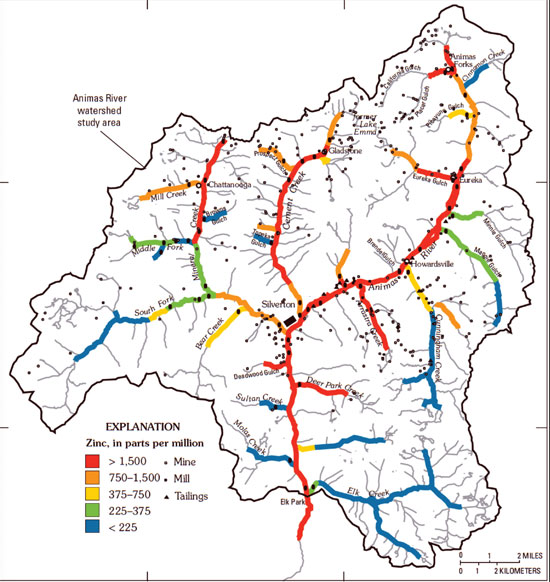
UPPER ANIMAS RIVER MAP SHOWING ZINC CONCENTRATIONS

This map shows concentrations of zinc, a heavy metal toxic to fish that is a good indicator of the presence of other metals, in the upper Animas River and its tributaries. The black dots represent mines, mills, and tailings
piles. Note that some stream segments have low zinc loads despite the presence of mines. US Geological Survey

What if ?

The audience at the San Juan Citizens Alliance’s Green Business Roundtable Luncheon in Durango on April 11 was left with that question following a presentation by Jonathan P. Thompson.

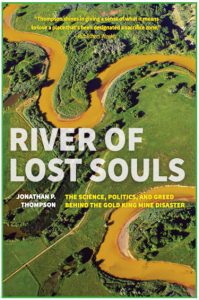
Thompson, a fifth-generation Colorado native and part-time resident of Durango, was speaking as part of a book tour for River of Lost Souls: The Science, Politics and Greed behind the Gold King Mine Disaster (Torrey Press) which came out in February.

During the roundtable presentation, Thompson outlined five areas on which his book focuses: acid mine drainage, mine tailings, uranium tailings, the Four Corners Power Plant, and emissions from oil and gas fields, including the methane hot spot over the Four Corners region.

The son of the late Crow Canyon Archaeological Center director Ian “Sandy” Thompson, Jonathan Thompson weaves stories of his ancestors’ experiences settling in the Animas River Valley into a narrative documenting the history of human settlement, activity and mining in Southwest Colorado.

But the book is not only for those with an interest in the region, or mining, or Durango. It is a comprehensive and detailed account of human attempts to conquer a rugged environment, including victories, struggles, economic booms and busts, and unforeseeable tragedy. “My intent is to show how the Animas River watershed is just a microcosm of the entire West,” Thompson said.

Researching the book took years. Thompson said he has circled around the topic for more than two decades in his roles as a writer and editor. He served as editor in chief for High Country News from 2007-10, and earlier as the owner of The Mountain Journal, which he created and merged with the Silverton Standard & The Miner, Silverton’s weekly newspaper since 1875.

The history of resource extraction in the Mountain West may not be at the top of your reading list, but Thompson captures readers’ attention by bringing to life individuals and activities associated with mining in the Silverton caldera. He links those events to contemporary lives and concerns via the Gold King Mine spill in August 2015 that turned the Animas River orange and made national headlines.

Thompson admires and respects some of the early miners, investors, and developers, even though he may not agree with all their actions. He describes the intelligence and creativity the miners displayed in the early days – like Edward Stoiber, the German engineer who ran the Silver Lake mine and built a mill in 1890 on the lake’s shores in order to process lower-grade ore.

RIVER OF LOST SOULS BY JONATHAN THOMPSONThompson’s question “What if ?” is applied to the ingenuity, hard work, creativity and innovation of the early settlers and miners. “What if they had devoted some of their smarts, money and energy to mine more cleanly?” he asked. Thompson was struck by how the early miners and developers overcame apparently insurmountable difficulties – avalanches, extreme cold, remote high-altitude locations – in their zeal to make more and more money.

He also observes that when mining companies were required to regulate some of their waste – toxic tailings, for instance – they were able to do so successfully.

Thompson is in favor of more strictly regulating extractive industries. “Why can’t they use a little bit of the energy they used to come up with fracking to figure out how to do it cleanly?” He said that with regulation, methane leaks resulting from oil and gas production can be captured, a benefit to everyone. “There is a new industry around the clean-up of the methane leaks inspired by laws and regulations,” he said.

Thompson said his motivation to write the book was not to expose only the “doom and gloom” aspect of the region’s past. “It is not my intent to bring down land prices in Durango,” chuckled Thompson, “even though a big part of the history is dirty.”

His interest is in keeping Durango and the Animas River Valley – and the entire watershed – cleaner and more sustainable.

“Part of what makes this area so great is the extractive industries,” said Thompson. Given that what happened in the past can’t be changed, he asks, “How do we use the energy associated with the Gold King spill to make this area a better place?” Thompson uses stories in his book to draw attention to how human behaviors that ultimately led to the 2015 spill are alive and well today. There is a common perception that “back then,” people didn’t really know the impact they were having on the environment, he said, but this is untrue. Actually, the early miners did know they were polluting, but they had the idea that once an area was already polluted, there was no point in cleaning it up.

“They’ve polluted it a little bit, so let’s go ahead and pollute it some more,” is an idea still alive and well today, said Thompson.

This manner of thinking leads to the development of “sacrifice zones” (including the Silverton Caldera, the Animas River and the San Juan Basin) that are developed heavily, perhaps in order to save someplace else.

Mine tailings are a great example. Originally, all mine tailings – material Thompson says is called “slime” – were just dumped into nearby creeks and rivers, adding zinc, lead, mercury, copper and lead as well as sulfuric acid to the drainages. This was common practice all over the West, and still is in some places.

In Colorado, farmers on the Front Range noticed the deleterious impacts of the toxic sludge and began pushing back in the 1880s, which is when the subject of hazardous mine tailings became a topic for newspapermen.

Local controversies pitting farmers and ranchers against miners broke out in places such as Aspen, Clear Creek and Telluride, where the owners of the Ames electric plant (still in operation today) sued an upstream mill operator because the tailings were mucking up its operations.

Electricity generated by the Ames plant lit up Telluride and was “the first large-scale commercial application of AC power.” In 1897 the Colorado State Court of Appeals ruled in favor of Ames, requiring mills to use “reasonable means” to prevent tailings from getting into streams.

But mill owners all over the state didn’t really change their ways because of that ruling, and the battle against mine pollution continued to pit farmers, ranchers and individual citizens against the miners, engineers, developers and politicians who stood to benefit from the profits.

Newspapermen also got involved in the controversy, and Thompson brings this to life with an account of David F. Day, who founded the Durango Democrat in 1892. Day “kept flogging at the mine owners for months,” writes Thompson, but the pollution in the Animas River just grew worse, so that by 1902 the City of Durango gave up trying to keep the Animas clean and bought water rights on the Florida River.

Up in Silverton, efforts to clean up mine tailings were unpopular, as evidenced more recently by the reluctance to agree to a Superfund cleanup.

But in 1902, mine owners and residents argued that clean-up would kill the goose that laid the golden egg.

Thompson explains the “bizarre” logic: “Mine owners and their surrogates admitted to poisoning the waters. But they argued that any ill effects felt by those downstream are offset by economics. Jobs are more important than health, gold is more valuable than water, and profit trumps everything.”

This attitude is still alive today, says Thompson, citing examples from natural- gas development in the region.

But he is hopeful. Increased awareness of mining’s impact on the regional environment is an important step towards improving it, according to Thompson. What if companies actually took care of the toxins they produced in the process of resource extraction? What if citizens really knew what they were exposed to as a result of mining? What if the energy industries were regulated in a way that minimized pollution?

“Why wait until the damage is done?” asked Thompson.

In his role as environmental author and journalist, Thompson is dedicated to providing information to educate the public. The book is an easy and informative read about complex subjects. He supplements the text with numerous graphs, maps, photos and explanations on his website, which can help readers understand what exactly happened at the Gold King Mine on Aug. 5, 2015.

The audience at Thompson’s talk seemed a little stunned by the extent of the regional pollution he described. Acid mine drainage in the Animas River. Radioactive uranium tailings and mine sludge used as topsoil, and to pave roads and build basements in Durango.

A methane hot spot over the Four Corners. Coal combustion at the San Juan Generating Station causing acid rain and resulting in high levels of mercury at Molas Pass. Natural gas pipeline and well explosions in residential areas. Native farmers unable to grow crops because of toxic irrigation water. “We’re all downstreamers” is the last chapter of the book.

One audience member asked, “How safe is it to live here?” amid laughter.

“I think maybe Durango is not as healthy as it could be,” said Thompson, “but it is a fabulous place to live. I think it’s safe.”

Will there be another Animas River spill? Probably. If not the Animas, perhaps in a river in Utah, Montana, or Wyoming. “The spill was a catalyst,” said Thompson. “The point I want to make is that the spill is not extraordinary. The Animas River is a microcosm of the entire West.”

Published in May 2018

Don’t fence me in: Wild animals face increasing habitat fragmentation, but some land managers are trying to help

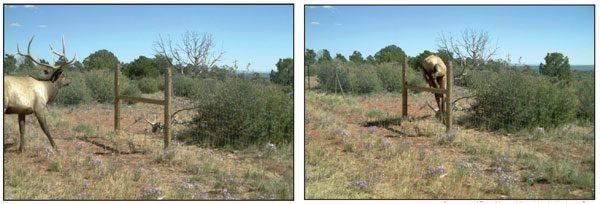
WILDLIFE FENCING AT MESA VERDE NATIONAL PARK

Images taken with a wildlife camera at Mesa Verde National Park show an elk successfully navigating special fencing. Courtesy of Paul Morey/Mesa Verde National Park

Good fences make good neighbors. — Robert Frost

One of the things most people relish about living in the Four Corners region is being surrounded by wildlife habitat.

We might come face to face with a deer (in town!), marvel as a herd of elk moves across a mountain meadow, or just find pleasure spying a kingfisher or bald eagle.

But as Colorado’s rural population grows and previously undeveloped areas become suburbs, industrial parks, farms, or drilling sites, wildlife habitat decreases, leading to conflicts between people and free-roaming animals. And despite Frost’s statement, fences can actually exacerbate those conflicts.

Colorado has been a “fenceout” state since the 1880s, meaning property owners who do not want livestock on their property must fence them out, since livestock owners do not have an obligation to keep their animals in.

Once any landowner builds a ‘lawful’ fence – defined in Colorado statutes as a “well-constructed three barbed wire fence with substantial posts set at a distance of approximately twenty feet apart” – then that landowner may “recover damages for trespass and injury to grass, garden or vegetable products, or other crops of such person from the owner of any livestock which break through such fence.”

But, “If no fence exists, animal owners are not responsible for nonwillful trespass,” according to a ruling in a 1940 case known as Bolten v. Gates.

But fences can cause problems for wild animals, interrupting migration routes and bisecting territory. While some animals can navigate the barriers either by jumping over them or crawling under, others get caught and suffer horribly.

That sad occurrence happens more often than you might think.

In a study in 2005 and 2006, Utah State University researchers J.J. Harrington and M.R. Conover walked, drove and flew over 600 miles of fence in two seasons, tallying animals they found trapped. They found an average of one tangled animal for every 2.5 miles of fence per year. Most were snared in the top two wires as described by Harper. Young animals were eight times more likely to get caught than adults, with deaths peaking in August, when fawns were weaned.

“It’s a pretty routine call for us, that an animal is caught in a fence,” said Dave Harper, wildlife program manager with Colorado Parks and Wildlife’s Durango office.

Calls come from both rural and urban locations. Harper said there are some fences that are “notorious animal catchers” in Durango, tall fences with spikes.

In addition to becoming entangled in fences, many ungulates were found dead next to a fence, trapped and stranded.

“The mothers can jump those fences with ease, but the little ones get trapped,” Harper said.

The Utah study found an average of one animal carcass lying next to a fence per every 1.2 miles per year. Ninety percent were fawns curled up next to the barrier.

Fences of woven wire topped by a single strand of barbed wire caused the most problems, according to the Utah researchers.

A “bad” fence does not adhere to regulations. It can have loose or broken wires, wires placed too close together, or posts too close. It will be too high for animals to jump or too low for them to crawl under. Barbed wire, stakes and metal posts can impale or cut a jumping animal.

Slow death

Paul Morey, wildlife manager at Mesa Verde National Park, told the Free Press a good range rider can alleviate some of the problems associated with bad fences. “You can drive around Montezuma County and see which fences aren’t maintained,” he said.

Range riders can tighten the wires to ensure livestock doesn’t get out, and can remove trapped animals.

CPW can respond to help landowners remove animals from fences safely. Harper recommends that people don’t try to do it themselves unless they know what to do.

“You can cause more damage if you do it wrong. If the animal is stressed out and trying to escape, cover their heads and eyes,” he said. “We’ll walk up and throw a jacket over them and then they calm down. Then we can make a determination once they’re out.”

He finds a lot of animals with a broken legs or a broken pelvis, or dislocated hips. He will assess what kind of injury the animal has sustained and whether or not it can be saved or the meat can be salvaged. This may depend on how long it’s been trapped, but usually the animals are so stressed that the meat is unfit for consumption.

Morey explained that deer jump with “their back legs facing forward, so the back legs slip between two wire strands and when they go over, the top and second wires are wrapped around their legs.” The result is often a slow, miserable death.

Friendly fencing

One solution is wildlife-friendly fencing, which comes in different designs and sizes, all intended to allow animals to either jump over or crawl under.

There are some key features of wildlife friendly fencing: it should be between 40 and 42 inches tall, with a distance of 12 inches between the top two wires. The bottom wire or rail should be at least 16 inches and preferably 18 above ground. Both the top and bottom wires should be smooth, not barbed.

Don’t use vertical stays on the wires, and make sure the posts are placed at 16.5-foot intervals. Gates, drop-down sections, or other lower, wildlife-friendly sections should be placed where animals are known to concentrate and cross.

Other ways to make fences more wildlife-friendly include making them more visible. Some landowners tie white or red flagging on the top wire. Another strategy includes using vinyl covered wire for the top strand, or coloring it. These techniques help game fowl such as grouse, or larger birds and raptors like swans, hawks, or eagles, see the fence. Morey was instrumental in getting wildlife-friendly fencing put in at Mesa Verde.“It’s more expensive but it’s proven to be highly effective for the park,” he said.

They installed a high-tensile fixed, not woven, fence, which is so highly tensile that the 12-gauge wire stretches. Morey said he saw someone drive a vehicle into this fence, which stretched 100 feet, then returned to its normal position without any damage.

About four miles of such fencing has been put up in the park so far, and they plan to install more over the next ten years.“The first fence we put up with this design was seven years ago,” Morey said.

“It’s half a mile long in an area with a high density of elk and horses, and lot of pressure from the outside. To date there are no breaks and we have done no maintenance.”

Morey has only seen one animal caught in a fence at the park since 2010. Elk are such large animals that they can ruin an entire section of fence if a herd is startled and crashes through. Wildlife-friendly fencing therefore prevents not only gruesome death, but also property damage.

Harper said animals can make it over fences if they’re made the right way and the animal is given a chance. “We need to back off and give the animals time to negotiate the fence,” he said. “By themselves, they have no problem, but if you get them hurried and running they will get into trouble. ” Morey agreed, saying that in places where the park has installed wildlife friendly fencing biologists have set up wildlife cameras and seen elk and deer walk along the fence to a lower spot, then jump over (see photos).“These animals that see the fence, they live in these areas, they know where the fences are, unless they’re being chased,” said Morey.

Harper said, “It’s when somebody’s pushing them, harassing them, getting too close in order to take photos, or when the deer get too close to snow machines, that they get caught. When people are driving up a road, they’ll startle the animals – and then they blow through the fencing.”

CPW urges people not to get too close to wild animals. Keep dogs from chasing wildlife, and don’t push or harass them by trying to get closer in your vehicle, snow machine or skis. Use your zoom to take a photo!

Keeping livestock out

Morey was trained as a biologist – he is leading a sold-out tour and giving a lecture on raptors for the Ute Mountain/ Mesa Verde Birding Festival. However, much of his job has to do with maintaining fences. In 1901,when Mesa Verde was created, there were no fenced boundaries and cattle were allowed to graze in the park. Now approximately 50 to 70 percent of the park is fenced, according to Morey.

The park’s concern is keeping livestock out and keeping wildlife habitat intact. There are about 80 horses and 12 cattle inside park boundaries. Besides the fact that cows and horses are not native, “the livestock in the park are having an impact on the natural and cultural resources,” said Morey. The park is trying to figure out what to do to get them out and keep them out.

The park is seeking public commentary on a livestock-removal project. This goes hand in hand with installing the new fencing, so livestock will stay out but wildlife can move back and forth. Interested citizens can see the plan at the visitor center or online and are encouraged to submit comments. (Link is in the “Resources” box at left.)

Wildlife-friendly fencing can be expensive. Morey estimated the installation of the high-tensile fence at Mesa Verde cost about $100,000 per mile. But this initial outlay is offset by the reduction in fence maintenance and animal retrieval, so he believes it is worth the expenditure.

Highway barriers

Right-of-way fencing and/or livestock fencing is in place along most highways, potentially creating barriers to wildlife migration.

Jeff Peterson, wildlife program manager with Colorado Department of Transportation, says CDOT determines whether to install wildlife-friendly fencing after consulting with CPW biologists about population numbers and migration routes of animals killed on highways.

“CDOT will not install wildlife fencing without providing a wildlife crossing every half-mile to a mile to allow for safe movement over or under the highway and installing escape ramps so if an animal does end up trapped on the highway, they have a way off,” Peterson said.

“We are very aware of the need to maintain daily and seasonal movements of wildlife and the importance of genetic flow on either side of the road. We would rather not install a fence than to prevent those things from occurring.”

Fencing and other wildlife-mitigation features including motion sensors, wildlife underpasses and overpasses are usually paid for out of the CDOT and federal highways budgets. CDOT’s most recent wildlife-friendly fence installation was on State Highway 9, south of Kremmling. Ten miles of fence were installed, along with the first wildlife overpasses in Colorado.

Peterson said this was an unusual situation: “A private landowner, very rich, gave CDOT money to redesign the road and put in wildlife mitigation. After we accomplished that, the landowner, Kremmling, Grand County, and private citizens raised money to add to CDOT and the federal highways budget to complete construction. Once it was completed we saw a 94 percent drop in animals being struck on the highway.”

Private landowners have several options if they want to build wildlife-friendly fences. CPW has an excellent brochure, Fencing with Wildlife in Mind, as does the state of Montana (links below). Most local fencing companies offer wildlife-friendly fencing options. The Habitat Partnership Program, funded by CPW through state big-game license revenues, is intended to reduce impacts caused to agriculture by elk, deer, pronghorn and moose. Landowners can apply for help with fencing repair and new construction, including wildlife-friendly fencing. They can also receive support for game damage to haystacks and fences; habitat manipulation such as weed-cutting and spraying; water development (usually pond construction or clearing); research and monitoring; as well as conservation easements and archaeological assessments.

Harper is a member of the Montelores HPP committee, which meets monthly to discuss local projects. Landowners wishing to build any kind of fence might want to recall another part of Frost’s Mending Wall: “Before I built a wall I’d ask to know, what I was walling in or walling out, and to whom I was like to give offense.”

Wild animals may not have the opportunity to express offense at being trapped by a fence. But their agonizing deaths surely cause humans some distress. The least we can do is be accountable stewards of the land who build fences that will sustain, not maim, wildlife and livestock.

“It’s usually more of a people problem than an animal problem,” said Harper.

Morey agreed. “You have to manage people to manage the wildlife.”

The Free Press thanks Deb Jensen of Mancos, Colo., for this story idea.


If you find an ensnared animal

To report injured wildlife or a problem call the CPW regional office, (970) 247-0855 during office hours, and after hours or on holidays call the Colorado State Patrol at 303-239- 4500. Do not try to remove an injured, living animal yourself.

Resources

Montana Fish and Wildlife brochure for wildlife-friendly fencing for landowners: http://fwp.mt.gov/fishAndWildlife/landowners/

Colorado Parks and Wildlife: Living with Wildlife
http://cpw.state.co.us/learn/Pages/LivingwithWildlife.aspx

CDOT wildlife program: https://www.codot.gov/programs/environmental/wildlife

Mesa Verde Livestock Removal Environmental Assessment (public comments due May 13): https://parkplanning.nps.gov/projectHome.cfm?projectID=60864

Published in May 2018

Blood donors and don’ts

I had one of my most brilliant and most heroic ideas last week immediately after finishing a grueling bike ride.

Normally my brilliant and heroic ideas come during grueling bike rides, rather than after. After grueling bike rides, all I usually think about is drinking chocolate milk, eating a sandwich made with whatever’s most accessible in the fridge, taking a hot shower, and then mounting my bike on the wall like a trophy moose head and never ever taking it down again.

During rides, however, my most genius ideas fly out of my mouth even more often than bugs fly into my mouth. Tragically, I don’t remember many of these ideas. Even I, a seasoned writer, am not skilled enough to slip my notebook out of my coolness-enhancing fanny pack and write them down with any sort of quality penmanship while maintaining momentum in the desired direction.

So when this brilliant and heroic idea struck after my ride, I still did not write it down, because it was an idea I could act upon immediately.

Now, I should mention that I am sympathetic to people who don’t give blood. Other people don’t donate blood because they’re afraid of needles, or they have fresh tattoos, or they just found out their spouses have been receiving money or other forms of payment in exchange for sex. Yet I’m also sympathetic to them because I also had never given blood. I abstained for years for the simple reason that my blood does its best work, generally speaking, inside my body.

But here was a sign from the universe. Whatever you believe about signs — heavenly messages or strange auspices or whatever you want to call them — this sign was pretty blatant and impossible to ignore. It was about three feet high, and it called on me to be a hero. It was an A-frame sign, and it read: “Donate Blood Today.”

And in case I missed the sign, a woman stood next to it, an angel waiting to ask me — me! — if I wanted to donate blood today.

In words I will remember forever, owing to the principle of repetition, this angel said, “Would you like to donate blood today?”

My first thought was: It depends. Do heroes ride bicycles? I genuinely wasn’t certain. I mean, maybe Batman never rides the Batbike because it prevents him from donating blood at a moment’s notice. However, I was still wearing pretty blatantly bicycle-related clothing, and this angel had asked me anyway. I deduced that helmet-haired heroes are still eligible blood donors.

My second thought was of the postride smorgasbord awaiting my sandwich bread. “Do I need a big lunch first?” I asked.

“It’s helpful to have eaten, yes,” she said.

“I have a banana in my fanny pack,” I said in a completely #MeToo-compliant way.

And five minutes later, I was on a blind date with a blood-drawing tech — let’s call him “Chad” because I didn’t hear his name over my banana-chomping and he looked like a Chad.

Chad spent enough time asking me questions that I burned through my banana and got hungry again. He also now knows more about my personal life than both my parents put together, including my weight and my mailing address. But I had no problem supplying him all the answers. After all, the questions he asked gave me fascinating insights into the kinds of things people must sometimes say “yes” to.

For instance, there’s that, “Have you ever received money or other forms of payment in exchange for having sex with an iguana smuggled from Guam since 1986?” question. Now, I’m a pretty good test-taker, and it’s clear to me that saying “yes” means I fail the test and don’t get to donate blood. It’s also easy to lie on this test, because they don’t even check to see if your fingers are crossed behind your back. So the only plausible reason I see for people answering “yes” to this question is that they really want a divorce but don’t have the cojones to tell their significant partner in person.

When Chad finally finished grilling me, he sat me in a chair and tied a band around my arm.

“How long should this take?” I asked, gauging my gnawing hunger level.

“Maybe ten or fifteen minutes,” he said. “Depends on your blood flow. Here, squeeze this piece of foam every five seconds.”

I squeezed it every three, because math tells me that I’d finish faster that way. And when I woke up, these nice people had put ice packs down my shirt and on my neck and turned all the fans on and they were asking me how I was doing, and even though I didn’t really know where I was anymore, they fed me pretzels and water and I didn’t have to go back to work for a full extra hour.

But they got their full donation in record time. Don’t thank me. I’m just a hero.

Zach Hively writes from Durango, Colo. He can be read and reached through http:// zachhively.com and on Twitter @zachhively.

Published in Zach Hively

Looking like a million

It’s flattering to learn that San Juan County, Utah, Commissioner Phil Lyman believes the Free Press is secretly being financed by Patagonia founder Yvon Chouinard and billionaire environmentalist David Bonderman. (See “Legal fees” by Zac Podmore starting on Page 1.) But, whether fortunately or unfortunately, we don’t get any donations from such people and never have. We don’t even have advertising from outdoor-gear companies such as Patagonia, and we’ve never gotten any money from the Southern Utah Wilderness Alliance, a nonprofit that has earned the ire of a number of folks like Lyman in San Juan County.

But it’s nice to hear that Lyman thinks we must be reaping such a windfall, because it indicates the Free Press must have the aura of a high-class publication, even though he doesn’t find its news coverage to his liking.

Lyman’s remarks come as the Free Press garnered nine awards in the annual Society of Professional Journalists Top of the Rockies competition for work done in 2017. Modesty doesn’t get you anywhere in this world, so we’re going to brag a little.

We’ve been in business almost 15 years, and we’ve won awards throughout that time. Those we picked up at the awards ceremony in Denver on April 20 of this year demonstrate the caliber of work we have in every section of our little newspaper. (A story with the complete list of winners is on Page 12.) There were awards for legal, business, and environmental reporting; investigative/ enterprise reporting; dining and food criticism; and front-page design. We compete against media outlets of all sorts across four states in the “under 10,000 circulation” category.

We were particularly pleased that the Free Press swept the category for personal/humor column writing, taking first, second and third place. We’ve said for a long time that we have the best opinion writers in the Four Corners. In addition to those who won this year (Zach Hively, David Feela, and Gail Binkly), a number of others have won for columns in years past: Katharhynn Heidelberg, John Christian Hopkins, David Long, Suzanne Strazza. And the opinion writers who haven’t (yet) picked up awards are excellent, too. Check them all out.

We have been swimming upstream since our inception. We offer quality, in-depth journalism in a time when people’s attention spans are declining on a daily basis and many spend more time surfing Facebook than keeping up with current events in their local neighborhood and region. But we believe there is an audience out there for something a bit beyond the superficial and fluffy. So as long as you keep reading, we’ll try to keep publishing.

Don’t forget to thank and support our advertisers, because they make everything we do possible.

And if any billionaires do have a little extra dough they’d like to send our way, hey, we’re not opposed to the possibility. But, no, Mr. Lyman, it hasn’t happened yet.

Published in Editorials

Thriving in drought

Well, it’s official. We are in a severe drought. Just a month ago there was hope that this year’s low snowpack could fill McPhee Reservoir. But with a dry April, it looks like the reservoir won’t fill completely and we are all faced with a water shortage.

After last year’s water bounty and months-long boating season on the lower Dolores River, it’s tough to face a dry spring. But we are resilient folk and we have developed many strategies to thrive when the water supplies are low. Everyone can do their part to conserve water for the “best and highest use” this growing season.

Whether you are a flower and vegetable gardener, rancher, or just tending a lawn with a semi-wild area, this is the year to invest in good irrigation equipment. It will be important to put water exactly where it is needed – the roots of our vegetables, flowers, and grasses. Not on the weeds. I am considering upgrading from soaker hoses to drip irrigation to reduce my water use and focus those drips exactly where I want them. There may be additional outdoor watering restrictions, but best practices recommend avoiding watering during the heat of the day. And don’t forget to fix those leaks; fix those leaks; fix those leaks!

In addition, good soil care and mulching will be well rewarded this year. After watering, keeping the soil cool and covered will help to minimize water loss to evaporation. It only seems logical after you carefully placed the water at the plant roots to make sure it gets absorbed by the plant, not the dry air. There’s a wide range of soil water-retention and mulching strategies. Everything from dryland farming that uses the dry topsoil as mulch, planting the seeds deep enough to reach the ground moisture, to no-till methods that retain the previous year’s plant matter as soil cover, to colored bark and straw raked carefully around the plants into colorful patterns and textures. Whichever soil cover strategy you choose, make sure to track water absorption and use the plants as an indicator of watering needs rather than “the dirt looks dry.” This is not the year to lose any plants to over-watering.

Since we all share water, each of us can help conserve it. This year every drop counts! Here are a few ideas to consider:

  • Repair any leaks in faucets, toilets, showers, and hoses.
  • Collect and reuse gray water – it can be as simple as washing veggies in a bowl and saving the water for houseplants, or as complex as diverting the outflow from your washing machine to an outdoor location.
  • If it ever does rain, consider collecting or diverting water from your roof gutters into a rain barrel or garden plot.
  • This is the year to get a good return on investment in xeriscape or droughttolerant plantings. Consider swapping out the usual plot of pansies and petunias with sage, sedum, and sunflowers.
  • Support local food growers by purchasing drought-tolerant varieties of vegetables. They may be new and look weird but giving them a try will help the local growers survive what could be a lean year.
  • Let the farmers know that you are doing your part to conserve water and support locally grown food, even when the barrel runs dry. My local food support strategy is to dig up some new salsa recipes to take advantage of the inevitable bounty of hot chilis that will thrive in the hot, dry weather. Finally, it never hurts to pray for rain!

Carolyn Dunmire writes from Cahone, Colo. Her Four Corners Foodie column took a second-place award at the regional Top of the Rockies competition in April.

Published in Carolyn Dunmire

A penny for my thoughts

I put together one of these last year and was asked to provide a new one, annually.

What follows is a compilation of scribbles on scraps of paper, direct from brain to hand, unfiltered, and somewhat embarrassing in that you now have some insight into the real inner workings of my brain.

 Love the word “home”

“Would you prefer to not share your campsite?”

Ghost hairs with braids

Pants with whales

Moki Dugway Freebird

The gentile and the saint

Universe did not throw a bone

Savory fry bread option

Elvis looks gripped

Stinkbug Headstands

Dodge ball tournament

Drive up wash, get out of truck, lie in sand, Elvis is sentry

Coyote number 2

Not saying I’m damaged – I’m wise

If I don’t do this, I might start putting rat poison in my muffins

J and C have jobs that require both an education and a wealth of experience

(implication: I do not)

Greek gods on a row of thrones

Cannot drink from a bathroom sink

3 out of 4 corners

Do Mormons make fry bread?

People who rely solely on mirrors when reversing make me shake

Everyone’s a professional photographer in Monument Valley

Blue-eyed crow

Spilled or spilt?

A lot of white and a fair amount of soft too

(I am pretty sure that’s about my midsection)

I’ve been stagnant

(See above)

I write for the fifty-cent Free Press

Elvis – doped – sitting in his anxious pose but his heart’s not in it

Gal on bike – “life is good” head nod

Have an owner’s manual, never taken out parts and…running shoes

Japanese man Jeep photo shoot

Totally cruisin’ then I found a rock and it fell apart

Are other people as entertained by themselves as I am?

Pleasant, likeable men

Things I say a lot:

  1. I’m Italian, I get really dark
  2. Yes, I go alone, no I don’t ever get lonely
  3. I’m the heavy one in my family

Storms get me revved

(revved? I would never use that word)

It’s like I’m in my mother’s body

Post-grand canyon fruita visitor center bath

Toothpicks and driving

Why do Mormon churches always have nice lawns?

In reality we were cocky and obnoxious and pains in the ass

Pants with crosses

Spacey with the worst sense of direction

All my water bottles are half full

Oh, to be a dog

Man flute a bee

Seniors art day at the Procession Panel

Elvis’ butt floats

Nekked in Utah

Not allowed cowl necks or Sassoon jeans

“Where’s your secret spot?”

Along with many other joyful challenges, menopause has brought the inability to sleep under down

Young gal who’d clearly been in her clothes for a few days

Adrenaline rush to get to restaurant sweating

I have Pavlov’s Dog

“To hell with herding piglets, I’d rather herd lizards any day.”

Sunset chair sweats book Martha’s Vineyard

Mountain Gazette

Predator skull was actually a deer pelvis

We in the west do gates

Not enough chert in this world

Splooting in the sun

Educated beyond their intelligence

Gas

Hit man returns

What’s it going to do, give me giardia?

Cashmere cook

Where the F@#$ are the F@#$ing cairns and why the f@#$ aren’t there more of them?

Scarred by today

Where is the line between not giving a hoot and batshit crazy?

Coffee, peppercorns, Kelly Y.

Do not EVER ask someone if they want to share their campsite

Suzanne Strazza writes from her cabin in Mancos, Colo.

Published in Suzanne Strazza

Saying last goodbyes

LIGHTNING HEART … Fred Haberlein was a muralist of note. Some 140 or so of his pieces grace Colorado walls, water tanks and municipal parks, as well spots in several adjoining states. He grew up in the San Luis Valley. Lived a ranch life. Got bit with the artist bug, and spent some years in Oracle, Ariz., learning his craft, and forging a lifelong association with the Yaqui people of the American Southwest. Every spring he attended their ceremonies. Danced with them. Practiced their traditional rituals … I had the good fortune to meet him through my brother-in-law, Wayne Goin. And we’d been friends every since. Artist and poet – two cultural creatives with a bent for indigenous wisdom … He and his wife Teresa lived in a sprawling log-cabin studio perched on a bench above No Name Creek outside Glenwood Springs. I’d visit them on my not-infrequent trips to Denver for state county commissioner business. They’d have a bed for me, and we’d stay up for hours talking, sharing stories, reflecting on our lives and the life of the Republic … Lightning Heart would come to the Telluride Mushroom Festival and offer an invocation, calling in the seven directions. It was how we began the event for the last dozen years … He’d had a tussle with cancer last year, but it seemed to be in remission. I’d stopped to catch up with them on a trip last month to Boulder. But no one was home … Then a week later I got a message that he was gravely ill again. I took my son to the Democratic Assembly in Broomfield before visiting my daughter Sara and her boyfriend Dylan in Steamboat Springs, where the two had gotten work for the winter as ski instructors. On the way to the Front Range, while my son slept in the car, I visited with Lightning Heart … Teresa ushered me into the bedroom, where he was lying, stretched out, resting. His face lit up with those scintillating sparks of Haberlein good humor when he saw me, and we spoke of various blessings (a word he kept using). We told some stories. Laughed … I didn’t stay too long. Hugged Teresa and her sister Lucy. Kissed Lightning Heart on the hand … He died the next day.

DALE PENDELL … Back in Sixties California, Dale Pendell was a poet allied with Gary Snyder’s back-to-the-land movement. He put out a journal of backcountry writing that included Snyder, Jerry Martien, Steve Sanfield, and others, calling it Kyoi/Kuksu. The name came from a pre-settlement Native Californian religious cult prevalent throughout Central California. I had a letter published in it, and I treasured every issue … Pendell went on to write an apothecary trilogy on plants, poisons and herbal craft, as well as philosophical treatises and poetry. I met him at an entheogenic conference in San Jose a dozen years ago. He was one of the literary honchos of the foothills of the Sierras, where many a Bay Area poet landed … He passed away in Santa Cruz, where he ended up. My Nevada City buddy Doc Dachtler sent me a slim chapbook of his early poems, Physics for the Heart (Exiled-In-America Press, 1986). He was one of those strong California mountain poets.

MARCH FOR OUR LIVES … Whatever the citizens of my generation may think about gun control, it’s clear that the youth of this nation are wresting the momentum of this national debate out of the hands of the NRA … In D.C. my youngest son, Gregorio, attended the rally earlier this year along with hundreds of thousands of like-minded Americans. And he said many of his American University students were there to hear speaker after speaker call for federal action to limit easy access to weapons of mass murder … Similarly, my oldest daughter in San Francisco, Iris – and her partner Bert and my granddaughter Aurora Willow Fan – all marched on the West Coast in solidarity with my youngest on the East Coast … As a rural citizen, I understand and support the reasonable right to bear arms. But increasing limitations on some guns – as already occurs with automatic weapons – seems justified. Even limitations on ownership in urban settings, or for individuals with mental-health problems, may be necessary … I think Governor Hickenlooper was right on a recent CPR interview to suggest that politicians ignore the youth of this nation on this issue at their own peril.

PETER PINO … The Telluride Institute, the Telluride Historical Museum, the Wilkinson Library and Ah Haa have an off-season treat in store for regional folks in mid-May – a free lecture Wednesday, May 16, at 6 p.m. at the Wilk by Zia elder and artist Peter Pino, as well as an Introductory Petroglyph Making workshop at Ah Haa from noon to 5 p.m. the next day, May 17. Call Ah Haa to reserve a place, 970-728-3886.

DANDELION FEST … Our old friend Katrina Blair, the wild-foods guru, is hosting Durango’s 10th celebration of wild plants, Beltane, pollinators and organic land stewardship on May 4-5 … Maypole dance, local food, dandelion ice cream, dandelion beer, live music, drum circle (BYOD), healing dome, educational workshops, thrift store, kid’s activities, live music and performances … Call Turtle Lake Refuge for more info, 970-247-8395.

OUT & ABOUT … I bumped into Norwood School Transportation Chief (and former Dolores County Commissioner Chair) Ernie Williams in Clark’s Market and he was all excited about a new Bluebird schoolbus he’s just purchased for the district … Ute elder Roland McCook of Montrose took first place at the Denver March Powwow in the Buckskin/War Bonnet category … Highway Sign Seen: Depresso = That feeling you get when you run out of coffee.

MATTER … In the context of normal existence, mystery is perhaps the ground of being, but it’s not usually something we tend to contemplate, even in our most curious moments. Which is why articles like this one that appeared in Science News recently are not near the top of anyone’s reading list, “Striving to Solve Antimatter Mystery: Quest to Identify Nature of Neutrino’s Alter Ego Heats Up” … Neutrinos. Quarks. Antimatter. For many of us in the arts, our minds start to glaze over when we encounter the vocabulary of quantum physics’ microhabitat. But it’s actually a big deal. Maybe numero uno … As MIT neutrino physicist Janet Conrad is quoted as saying, “The biggest mystery in the universe is who stole all the antimatter. There’s no bigger theft that has occurred than that” … The Big Bang should have created equal amounts of matter and antimatter in the early universe. But today, everything we see from the smallest life forms on Earth to the largest stellar objects is made almost entirely of matter. Comparatively, there is not much antimatter to be found. Something must have happened to tip the balance. So how did we get this matter antimatter asymmetry, theoretical physicists ask? If everything balanced, matter and anti-matter would have canceled themselves out. But as it is, we exist. Matter exists. And what some scientists are trying to figure out is how did we get imbalanced enough to come into existence … The answer may have something to do with neutrinos, which don’t have an anti-matter complement … Or it may have something to do with Western Civilization, which the Hopi have identified as Koyaanisqatsi.


THE TALKING GOURD

Carve this
on his tombstone

McRedeye said

So delighted to live
didn’t expect to die

Published in Art Goodtimes

Trees, trash and juice

I really love to eat roasted piñon nuts, they are so good but also hard to collect. However, I learned that if you can find a big packrat nest, it will likely have a nice stash of piñons in it, and all you have to do is pick them up. The rat has done all the work and I could benefit without all the labor – kind of reminds me of something else, but I digress.

The packrat story brings up the saying, “if you mess in your nest, then you lie in it”, and that is exactly what the packrat does. Consequently you want to be very discerning when collecting piñons from a rat nest cache. The rat doesn’t clean out his trash, I end up doing it for him.

We really aren’t much different, we pay for someone else to come pick up our trash and haul it away to the landfill (when I was young they were called dumps and never got filled because they were always burning), and they pay to dump it, so someone on a big tractor gets paid to crush and bury it, so it can decompose into that evil methane gas that someone else must get paid to try to figure out what to do with it. Today, we pay and pay to produce a future problem, or maybe an archaeological gold mine.

So where do the trees fit in? Well, the forest is full of dead and dying trees (trash) that we either leave lying around rotting, waiting for a wildfire to make a LOT of smoke, or pay someone to pile some of it, so we can pay the Forest Service to pay their fire crews to pay for fuel and fire equipment to go burn the pile or do broadcast burns (they call it prescribed fire these days) to make lots of smoke so we can pay the doctors in the emergency room and the pharmacist at the drug store for breathing and allergy treatments and medications. We do get to write letters complaining about air quality, though that is probably not really a beneficial aspect of the smoke problems. We pay and pay for no real value return here either.

So what is my point? We have become a lazy, trashy society that expects someone else to be responsible for the mess we make or allow to be made. The forest is dying, becoming trashy and burning because we won’t manage, use and improve it. Some say we have to save it by leaving it alone – to die and burn? The landfill is filling up because we don’t want to stop wasting almost everything. Our local landfill receives over 24,674 TONS per year, which is 68 tons every day. Our local landfill cup of blessings will be running over in 25-30 years with no place to go, what then? Is there a solution? Yep, flip the switch and turn on the juice!

Problem Solving 101 is turning lemons into lemonade, in this case “juice,” or rather “electricity.” What are the problems to solve?  First, a dying forest full of “trash material.” Second, a landfill site that must greatly reduce waste material within five years. Third, a state mandate to buy 30 percent of our electricity from renewable sources by 2020.

SO, take ALL our problem trash and use it to turn on the juice. No, I’m not crazy, there are around 84 power plants in 23 states whose main fuel source is Municipal Solid Waste (MSW) to produce power. They burn 96,000 tons/DAY and sell 14.5 million megawatt hours to the grid. They all surpass EPA air standards and are mostly privately owned and operated for profit. There are many other power plants that use waste products for producing gases and oils to run the boilers, including methane from old landfills. There are plants that are converting most plastics back into their original oil form for various repurposed oil products and uses.

Municipal Solid Waste and forest product waste are recognized as “renewable” fuel sources for power generation. Emergency management personnel recognize that in our area the greatest disaster would be one that compromised the electric grid to our area for any length of time, and many feel this is a very real possibility. A well-designed power plant to use the trash and forest wastes as fuel would have a multiplicity of benefits such as employment, economic returns, power source for local distribution, emergency stable power source, reducing forest wildfire fuels, and reducing landfill impacts, just to mention a few. Another possibility could be that this would make it feasible to capture the methane from drilling that is now flared off, and feed it into the fuel line for the plant.

The plants that are in operation all subscribe to the multipurpose concept and one concept that could work here could be to use the heat and gases from the boilers to run large vegetative greenhouses. Combustion produces lots of water and CO2, both of which are needed in greenhouse operations. In case you are wondering, this is not a new idea at all, much of Europe and the Far East have been doing similar things for years. The technology has been and is here, so let’s stand up and turn our sour lemon problems and attitudes into some beneficial sweet lemon Juice for our corner of the state.

Dexter Gill is a retired forest manager who worked for private industry, three Western state forestry agencies, and the Navajo Nation forestry department. He writes from Lewis, Colo.

Published in Dexter Gill

Hands up

Students gather around their teacher, pillows and cushions supporting their tender spots, as Miss Aimee introduces the book she’ll be reading.

“Children,” she says, “quiet down now. Our story this afternoon is titled Good Guns, Bad Guns. Don’t be afraid to ask questions, but remember to raise your hands first.”

No hands are raised, so she opens the book and begins.

“Bobby’s daddy owns a gun. He keeps it in a secret place. Bobby’s not supposed to touch it, even if he knows where his daddy hides it.”

The picture she shows the class depicts a bedroom, a bed, and a table beside the bed with a pistol inside an open drawer.

“Bobby’s daddy owns a good gun. We know it’s a good gun because it waits quietly like a guardian angel beside the place where Bobby’s mommy and daddy sleep.”

She turns the page and shows the class a picture of a gleaming pistol

“Bobby’s teacher also owns a gun. Sometimes she keeps it in her desk drawer. Her students know they’re not supposed to touch it.”

The page reveals a classroom picture, with students at their desks. A teacher stands at the blackboard spelling out the word G – U – N in precise capital letters. An American flag hangs beside the classroom door. All the drawers in the teacher’s desk are closed.

One hand shoots into the air. “Yes, Lee, do you have a question?”

“Why can’t we see the teacher’s gun?”

“That’s a good question, and it brings up a new word. This teacher carries a concealed weapon. Concealed means the gun is hidden, or difficult to see.”

“I think I see it behind the flag,” a girl in a red dress volunteers, pointing toward the book.

“No, Bristol, the gun not behind the flag.”

“I see it, I see it!” shouts a boy to her left. “It’s the shadow next to the teacher’s jacket.”

“You may be right, Donald, but wherever the gun is hiding, it’s also a good gun because the teacher takes care of it. Any more questions?”

No more hands are raised, so the teacher reads from the next page.

“Once upon a time schools were not allowed to keep guns in closets or cupboards, but Bobby’s dad’s gun was not enough to keep Bobby and his classmates safe.”

She rotates the book so her students can view the picture of a school cafeteria. Excited children stand in line to collect their lunches. The cook smiles as she serves each meal, a gun holstered at her waist. The principal makes sure nobody cuts in line. He too wears a gun. Parked near a table, the janitor’s cart waits while he mops up a spill. A rifle stands on the cart right beside a broom.

“How many guns can you count in this picture?”

Bristol counts one, Donald sees five, and Lee isn’t sure he sees any at all. Nobody notices the rifle mimicking the broom.

“Does anyone remember the word when a gun stays hidden?”

“Sealed?” Violet timidly suggests.

“That’s very close, Violet. The word is actually concealed, which means the gun is difficult to see.”

“Miss Aimee,” Donald blurts out, “how many guns are in the picture?”

“The school is much larger, Donald, than this one picture. It might be impossible to count them all, especially if some are hidden.”

“Are they all good guns?” Bristol asks.

“That’s a good question. Let’s turn the page and see if any bad guns appear.”

The teacher turns the page and starts to read.

“Slinky carries a backpack to school. He keeps it in his locker.”

Violet giggles, “Slinky’s a funny name,” but the teacher ignores her and continues reading.

“Slinky took his daddy’s gun while he wasn’t looking. He stuffed it into his backpack.”

She shows the class a picture of an open locker with the barrel of a bright red gun poking menacingly out of a backpack. She stands and walks among the seated children so they are able to carefully study the picture.

“Is it a good gun or a bad gun?” the teacher asks.

“It’s gotta be a good one.”

“What makes you think that, Lee?”

Donald excitedly waves his hand. “I know, I know,” he shouts.

“Let’s be patient, Donald, and listen first to what Lee thinks. Lee?”

“I think it’s a good gun because it’s in the school.”

“Okay, Donald, what do you think?”

“It’s a sealed gun and we can’t never tell if it’s good or bad if we can’t see it.”

“Do you mean a concealed gun, Donald?”

“I don’t know, Miss Aimee. This gun stuff is hard.”

Before the teacher can answer, the bell for recess rings.

“Okay, children, put your cushions away, and let’s not worry about how many guns we can or can’t see until we finish the story tomorrow.”

The students hurry out of the classroom. Miss Aimee closes the book and sits down behind her desk. She reviews her lesson plan. Surely it’s obvious which gun is bad. Something must be very wrong with the narrative.

David Feela is a retired teacher living in Cortez, Colo. He recently placed second in the “personal/humor columns” category in the Society of Professional Journalists’ four-state Top of the Rockies competition for work done in 2017. See his works at http://feelasophy.weebly.com/

Published in David Feela

Rumors of the death of expertise

By Sally Planalp and George Cheney

There’s a lot of talk these days in our country about the “death of expertise,” a phrase that has caught on, as well as being the title of a popular book by Tom Nichols. It’s not that knowledgeable and skilled people have gone away. Rather, we find that “experts” in many fields and occupations are not taken as seriously as they once were.

One of the best—or worst—examples of this is the declining confidence in scientific reports. There’s also a popular desire to have “fresh” faces in positions in government and the economy; sometimes this translates into elevating people who don’t really have a background in whatever they are supposed to be doing. Questioning what we hear and desiring change are natural responses to a complex and uncertain world, but these impulses can sometimes carry us too far.

One myth of expertise is that it is similar to intelligence. Certainly, intelligence is related to expertise in that intelligent people may be able to acquire expertise more easily; but what really matters is the expertise, not the smarts. The late great cosmologist Stephen Hawking was extremely intelligent – able to solve physics problems in a fraction of the time it took his fellow students. But he was a self-admitted goof-off until he was diagnosed with ALS and decided to work hard to acquire the expertise he needed to make a contribution to his chosen field while he was able.

It is easy to be suspicious of expertise because expertise is not easy to describe to others. It often takes years if not decades or a lifetime to develop. Writer Malcolm Gladwell’s popularization of Anders Ericsson’s “10,000 hours rule,” that it takes that much time to be truly expert at something, is hard to verify; but no one questions that many hours of deliberate practice are necessary to be truly expert at piano or golf. We can only imagine what is needed to be an effective mediator in Middle East conflicts or an accomplished neurosurgeon.

There is a reason we use the metaphor of deep or shallow knowledge because expertise lies below the surface unseen and can reach great depths. For that reason, our own knowledge can easily be overestimated even about everyday objects. When one group of psychology undergraduates were shown a drawing of a bicycle and asked to add the chain and the pedals so that it would work, only about half did it correctly. We may know basically how a bicycle works (or do we?), but odds are most of us could not build one.

Much expertise is made up of the accumulated experience of many people, often by hard trial and error, to learn what works and what doesn’t work in a particular situation. That knowledge is passed along as education and training to novices, who may add their own experience to the bank of expertise. We may think of expertise as something held by an individual, but much of it is actually a valuable collective resource.

Part of the resistance to valuing expertise may be that we balk at elevating experts above the rest of us, as well we should. Being an expert software engineer does not make you a better person. Just because you are an expert in one domain does not mean you are better able to handle other domains.

Advertising sometimes conveys the impression that if someone is successful in the sports world they would surely know a lot about cars, or home cleaning products, or pharmaceuticals. This is just one example of where we should be cautious about “expertise by association.” Because expertise is specific, we should value it specifically and not necessarily broadly.

Let’s think about the roles of experts closer to home. Do we really want to hire a plumber who hasn’t worked with others experienced in the trade and hasn’t bothered to learn plumbing in advance? In U.S. society, there has always been an element of questioning authority. This is important and valuable in motivating us to ask questions of those who tell us what to do or how things work. This is what we might call due diligence or healthy skepticism. Good teachers say “I don’t know” when they need to check on something. Good physicians are not threatened if a patient wants to get a second opinion about a recommended therapy.

Do we want a “fresh face” in the operating room who may not have the education and experience to take on our surgery? Do we want an insurance agent who doesn’t understand different kinds of policies? Of course, the answer is obvious, when we put the questions like this. Few would argue that we get a fresh perspective on bridge-building and ignore the experts.

It’s a risky proposition to celebrate lack of knowledge. Know-nothings are vulnerable to baseless assumptions, widely-rejected beliefs, ignoring the evidence, being quick to dismiss traditional wisdom, and excessive confidence that they can make better decisions because they are smart, no matter how complex the problem they are facing. Great decision-makers are made from years of developing expertise, not born.

Sally Planalp and George Cheney are residents of Moab and part-time professors of communication at the University of Colorado, Colorado Springs. Opinions expressed her are their own and do not represent those of the university. A previous version of this editorial was published in the Moab Times-Independent on April 19.

Published in Guest Column

Rogers, Ray, Nelson win fire-district election

Les Rogers, Bradly Ray and Jan Nelson won seats on the Cortez Fire Protection District board of directors in the May 8 election, topping a field of six candidates. Just 171 people cast ballots. Below are the vote totals:
Les Rogers – 102
Bradly Ray – 99
Jan Nelson – 79
Buck Woodman – 72
James Bridgewater – 65
Sherri M. Wright – 50

Published in May 2018

An affair to remember: The Sparsholt Affair, by Alan Hollinghurst

THE SPARSHOLT AFFAIR BY ALAN HOLLINGHURST“The evening when we first heard Sparsholt’s name seems the best place to start this little memoir.” That deceptively modest declaration begins The Sparsholt Affair, a novel of staggering depth and beauty from an author – Alan Hollinghurst – whom the The New Yorker’s Alexandra Schwartz describes as “not simply one of the best living English novelists but one of the best novelists working in English.”

If you’re not familiar with Hollinghurst’s work – and I’m chagrined to say that I wasn’t – it’s perhaps the result of its unique focus, although he has won the Man Booker Prize, in 2004, for his fourth novel The Line of Beauty, as well as the Somerset Maugham Award, the E. M. Forster Award of the American Academy of Arts and Letters, and the James Tait Black Memorial Prize for Fiction.

About that focus. All six of Hollinghurst’s novels explore, to one extent or another, gay life and culture in his native England, often from a multi-generational perspective. In keeping with its forebears, The Sparsholt Affair opens at Oxford in 1940, where memoirist Freddie Green’s circle of mostly gay friends – the writer Evert Dax among them – are smitten by David Sparsholt, a freshman Adonis marking time on campus until his eighteenth birthday, when he can finally join the Royal Air Force. Dax in particular, besotted to the point of obsession, is determined to seduce the new man and, despite Sparsholt’s recent engagement to his girlfriend Connie, succeeds in doing so, concluding the first of the novel’s five separate sections.

Fast forward to the 1960s, where the narrative shifts from the first to the third person and centers on David and Connie’s teenaged son Johnny Sparsholt, also gay, as he navigates the terra incognita of his own sexuality. David, late a war hero, is now a successful industrialist, and it’s through Johnny’s distracted eyes that we catch a fleeting glimpse of his father’s furtive dealings with Clifford Haxby, a neighbor, and Leslie Stevens, a Tory Member of Parliament.

In the novel’s third section the action moves to London, where Johnny, an aspiring portrait artist, crosses paths with the much older Dax, now a prominent art collector whose Cranley Gardens mansion is host to all nature of comings and goings in the still-clandestine gay subculture of the early 1970s. The Sparsholt name, we learn, has become infamous thanks to a vaguely-referenced but very public sex scandal – the titular “Sparsholt Affair” – that has rendered David (and Haxby and Stevens) national pariahs, and which 21-year-old Johnny now must wear as a kind of scarlet letter.

The 1990s find Johnny out and happily partnered with Patrick.  He is now both a successful artist and, improbably, the father of Lucy, whose lesbian mother Francesca is a wealthy daughter of the old Cranley Gardens set. Here Hollinghurst deftly illustrates the evolving but, at many levels, still hidebound social strata through which young Lucy – with her two mothers and her six grandparents – glides easily while the aged but still-infamous David Sparsholt, seen during a rare visit to London, is fated forever to struggle.

The novel’s final section – the culmination, if you will, of eight decades of British gay history – takes place in the present. Johnny is widowed now, and Lucy about to be married. Dipping his toes in the strange waters of contemporary gay life, Johnny, coaxed by a well-meaning friend, finds himself high on Ecstasy, sweatily gyrating in a London discotheque when he learns of his father’s death.

Even for those with no particular interest in its subject matter, The Sparsholt Affair ($28.95, from Knopf) will astound with its evocative language and its penetrating insights into the human condition. Consider this passage, in which Lucy accompanies Johnny back to Cranley Gardens to help the aged Dax dispose of his art collection:

“There was a tall window on each turn of the stair, throwing dirty light across the carpet, which was worn through to the floorboards in places. As they climbed they passed large dim oblongs, huge hooks, black drapery of cobwebs where pictures must have hung for a very long time. When they reached the landing they saw them stacked against the wall in their heavy gilt frames, trying to stay dignified while peering nervously over each other’s shoulders. The pictures left hanging, perhaps not worth selling, looked hopeless without them.”

If you value elegant writing, compelling characters, and incisive social commentary, then by all means, add Alan Hollinghurst to your short list of must-read authors.

Chuck Greaves is a member of the National Book Critics Circle and the author of five novels, most recently Tom & Lucky (Bloomsbury). You can visit him at www.chuckgreaves.com.

Published in May 2018, Prose and Cons

Phil Lyman on the costs of his county’s legal battles

Note: The following is a transcript of a recorded interview between the author and San Juan County, Utah, Commissioner Phil Lyman. The interview took place on April 20, 2018, and was done as research for an article appearing in the May 2018 issue of the Four Corners Free Press. It has been edited slightly for clarity, and two minor errors in transcription have been fixed.

Z: The litigation with the Navajo Nation is entering its sixth year. Are you confident you’ll get a favorable ruling this time in the Tenth Circuit?

P: Not at all confident. I’ve dealt with the Tenth Circuit. Hopeful but not at all confident.

Z: What happens if the appeal fails?

P: Nothing changes. We’re where we are.

Z: I know that the Navajo Nation’s attorneys have submitted attorney’s fees for the last six years of litigation and if the appeal fails the county will be asked to pay those, is that correct?

P: They have been asked to pay those, and that’s part of the appeal. If the appeal fails then that will become the next question whether those are awarded or not. They haven’t been awarded those, they’ve just asked for them.

Z: Would that be a separate case?

P: I believe if the appeal fails at the Tenth Circuit it would come back to Judge Shelby in Salt Lake on the attorneys’ fees.

Z: You’ve suggested in the past that going back to at-large voting would be a good move for the county. Do you still feel that way, and if so how would that interact with the 1984 consent decree? Is the county able to go back to at-large voting?

P: That’s the beautiful thing, the one beautiful thing that Judge Shelby did, was essentially lift the 1984 consent decree, we’re no longer under the consent decree. I asked him to his face if that was his intention, and he didn’t answer the question. The whole idea that the federal government can say you’re under a consent decree, wherein the federal court retains all jurisdiction over voting in San Juan County, yet turns around and sues San Juan County at the same time for unconstitutional districts which they themselves created. The whole thing is just so convoluted that you can’t make sense of it. In my mind, Judge Shelby lifted the 1984 consent decree, and there’s no language in this new decree that says the federal court is in charge of all voting matters in San Juan County. So yeah, we can do what we want to do.

Z: My understanding was that the 1984 decree just said the county had to elect commissioners by district but didn’t say anything specific about what the boundaries of those districts should be. Is that your understanding as well?

P: It’s a very similar process to what took place this time. We had to propose districts that met the demand of the Navajo Nation and the federal court. There was a lot of external input into those things. It was imposed on San Juan County, and San Juan County complied just like they did with this one. You know the county accepted the precincts. Judge Shelby calls on Jan 25th and says, ‘if you don’t accept this by Jan 31st you’ll be held in contempt.’ And then people turn around 30 years later and say, San Juan County did this. That’s why I said I’m happy to be held in contempt. I am in contempt. And the other two commissioners were not willing to do that. So it was a 2-1 split decision on accepting the decision of Judge Shelby. They didn’t want to go to jail, and I said I’m happy to. And that’s where we are. And 20 years from now they’ll say it was San Juan County that did this. It wasn’t it was the special master in San Francisco or wherever and Robert Shelby, best friends with Steve Bloch with SUWA, and it’s all Bears Ears related and it has nothing to do with race or voting or anything else. It’s completely environmentally driven by the same folks that have been filing lawsuits for the last 25 years in San Juan County.

Z: I’ve heard you say that before.

P: Well it’s true.

Z: I’m not familiar with the timeline exactly for the national monument, but I know this lawsuit started in 2012. Do you think Bears Ears was a motivating factor in the beginning of that suit in 2012?

P: Well, if you go back 25 years you can follow the career of Steven Boos and see where he’s at with San Juan County. The Red Rock Wilderness Bill has been on the books for 30 years, if you look at what started with Utah Diné Bikéyah to protect Cedar Mesa, the county was completely on board and working towards the same ends until Conservation Lands Foundation, Southern Utah Wilderness Alliance, they get involved and now you’ve got something that looks identical to the Red Rock Wilderness Bill as far as the San Juan County portion. So yeah, you can call it Bears Ears, you can call it Nahodishgish, you can call it Cedar Mesa, you can call it Red Rock Wilderness Bill. Now it’s called Bears Ears, I guess now it’s actually called Sash Jaa [laughs]. Don’t act naive that just because the monument was designated in 2016 or whatever it was not the motivating factor for the last 25 years. I know the designs of these groups and so do you.

Z: I’m getting a little far away from my story here, but I’m curious, when you’re referring to working with Diné Bikéyah in 2012 are you talking about the PLI [Public Lands Initiative]?

P: We rejected the PLI because we had [inaudible] MOU with Navajo Nation and Utah Diné Bikéyah. It was Utah Diné Bikéyah that came back and said, ‘we want San Juan County to do the PLI.’ Bob Bennett had done that in 2010 and was pushing for similar type things. Bob Bennett did it. As soon as Bob Bennett was done Rob Bishop picked up the torch. But in the meantime Utah Diné Bikéyah, which at that time was a local effort, at least from our perspective, wanted federal designation. It’s usually contrary to the county’s interest to pursue a federal designation. It doesn’t make sense for a county to go and seek federal oversight over the county, but if the citizens asked for it, which they did with Utah Diné Bikéyah, we said, ‘hey if it’s important to you, it’s important to us.’ We pursued it very earnestly and we had a proposal until Rob Bishop showed up with his PLI and that’s when Utah Diné Bikéyah said that they would prefer that the county join that. We rejected it on the front.

Z: Was it a National Conservation Area that was being considered at that point?

P: Yeah it was an NCA that they were seeking. That was before Josh Ewing showed up. It was before Gavin [Noyes] showed up. It was before Round River came on the scene and then Conservation Lands Foundation came in. And then we find out a year after the fact that Utah Diné Bikéyah had sold their soul to CLF and then Friends of Cedar Mesa, a group that I was proud to be a member of for years with Bill Lipe and archaeologists that care about this area, sold their soul to CLF. And you can go look at the CLF minutes that say they’re going to hitch their wagon to the Navajos. People go berserk when you say that the Navajos are being taken advantage of, but it’s still the truth. People can freak out over it but it’s still the truth. And it is very essential that to that story you’re doing on the voting.

Z: Yeah, I’ve heard you say that Judge Shelby has ties to SUWA members.

P: They’re going to teach San Juan County a lesson. The thing that’s sad about it is they think they’re the conservationists when the conservationists are the people in San Juan County. We’re the people that are saying just because this is a special place doesn’t mean that we have to sell it. It doesn’t mean that we have to put a big national monument sticker on it and invite the entire world. It’s great for business but it’s not great for Indian ruins and artifacts and sacred sites. But the narrative is if you’re not in favor of the Red Rock Wilderness Bill, it’s because you’re unintelligent, ignorant, racist, anti-government, religious, whatever other label the Left wants to put on the people who actually live here and care deeply about these things. So that’s the narrative, and Four Corners Free Press has done a really great job of perpetuating that narrative and I’m sure they will continue to. It’s sad because it’s the opposite of the truth. And it’s damaging. You know David Bonderman probably gave money to Four Corners Free Press and they’re obligated to him. I know he gave money to High Country News and he bought them out so they run stories that David Bonderman appreciates and Yvon Chouinard. I suspect that’s ultimately where your paycheck comes from.

Z: [laughs] Well I’m just a freelancer. This is my first story for them so I haven’t got a paycheck yet but I don’t imagine it will be very big if I do get one.

P: Just know that it’s probably Yvon Chouinard and Patagonia that’s paying.

Z: I’ll write them a letter asking for more when I get $50 for this article.

P: I don’t mean to be, you know, rude. I’m just being snide, I guess.

Z: No, I’m curious to hear all of this.

P: What I tell you is the truth.

Z: Yeah, so you don’t think any Navajo constituents in the county felt like it was impossible for them to win elections based on how the districts were drawn. It was all environmental groups?

P: I’m not sure what you’re asking.

Z: You seem to be suggesting that the voting rights case was entirely driven by environmental groups, not Navajo constituents in the county that felt disenfranchised.

P: I think the Navajos in San Juan County have every right to feel disenfranchised. They have been disenfranchised. They were put on a reservation. Their sheep herds were controlled and kept down. They were driven off their allotments north of the San Juan River. The important distinction there is that all of that was done by the federal government. None of that was done by San Juan County. San Juan County lobbied in the early 1900s, I can’t remember the date, to give the Navajo strip to the Navajo Nation. And the governor of Utah protested. The congressmen protested. And it was the people of San Juan County, the council of nine, that said, no this is the right thing to do. And when the BLM came in and drove the Navajos and their sheep into the river and off the north end, it was done at the protest of their friends who lived in Bluff, their neighbors, the white settlers, the Navajo settlers, the Ute settlers. Anyway, everything that San Juan County is criticized for and why people say we need the federal government to take over has all been done by the federal government. I’m not saying white citizens of San Juan County are saints. I’m not saying there aren’t some egregious historical abuses going in every direction, all directions. But when it comes to administrative, systematic disenfranchisement of Native Americans, that’s been done by the federal government. So it’s ironic that now the federal government now claims to be the savior of Native Americans with voting rights.


Z: So, I just dug through the county finance reports and it looks like the general fund has dropped from $9 million in reserve to $5 million over the last two years, and I know that the Navajo Nation’s attorneys are requesting $3 million more and there’s the pending RS 2477 lawsuit in Recapture. If all of that gets assessed this year, that could be between $3 million and $4 million. Would that come out of the general fund?

P: That’s where it comes out of. Yeah, that’s where it comes out if it’s paid.

Z: What happens if the general fund runs out? If $4 million gets assessed this year it will be down to $1 million based on my calculations.

P: Uh huh.

Z: Are you concerned about that at all?

P: Deeply, deeply concerned about that. The vexatious lawsuits, you know, a group of people, Yvon Chouinard decides to go bankrupt a small county like San Juan County. Steven Boos should be ashamed of himself. Robert Shelby should be ashamed of himself. But unfortunately for them they’re not dealing with a bunch of cowards in San Juan County. They’re dealing with a bunch of people who know the difference between a lie and the truth. If the media knew the difference we might have a fighting chance. What’s the word for taking money away from people? I don’t… Anyway, they come in and file lawsuit after lawsuit until the county is either bankrupt or we give them what they want.

Z: I saw the settlement offers going back to 2012 that made it pretty clear what the plaintiff’s costs were in the case and they were willing to settle with districts that are pretty similar to the ones that are in place now.

P: When they brought their map in and threw it down on the table, I said, explain to me, I’m okay with that. I mean, San Juan County can’t propose racially–we can’t take race into consideration when we’re drawing districts. The Navajo Nation can. And the federal courts can. San Juan County can’t. We still can’t. Even ratifying what Judge Shelby sent down is in my estimation way outside the legal boundaries of county government. We cannot make racially motivated districts in San Juan County. It’s against the Voting Rights Act. It’s against the law.

Z: I’ve got Judge Shelby’s ruling here. It says under Tenth Circuit precedent, “states may intentionally create majority-minority districts and otherwise take race into consideration without coming under strict scrutiny so long as traditional districting criteria are not subordinated.” And I believe that was the source of the lawsuit in 2012 was that Navajo Nation attorneys were contending that other processes weren’t being considered after the census data came in in 2010.

P: They lost on that case in court about the equal population–one man, one vote–position because they showed that San Juan County was more than compliant on that so they come back to this racial thing and say they’re suing under Article 2 vs. Article 5 or whatever those are. And they just keep working at it. I mean do a story on the mail-in ballots lawsuit because we spent a ton of money on that too and find out that the plaintiffs had requested mail-in ballots for years even though they’re saying that they don’t want mail-in ballots. They requested it long before it was mandatory. They were serving as translators at the polls and then they come back and say, ‘it’s not fair, we can’t speak English.’ They’re saying they live two hours from a polling place when they live 15 minutes from it. You’re talking about a bunch of hateful people who hate San Juan County, and yeah they’re being successful. But just because a lie is successful does not make it the truth. San Juan County has not districted themselves. The federal government districted San Juan County and they mandated the districts and when the population changed in 2010, we moved Ucolo and Cedar Point into my district and it balanced things out. And Judge Shelby comes down and says, ‘we want it as close to zero as possible.’ I’m like, well the law says there’s a little bit of variance. You’re dealing with the fastest growing county in the nation according to the census. And they’re going back to 2010 and saying we’re doing this based on the 2010 census in a vacuum, oblivious to the notion that things are not the way things were in 2010. The county took 2010 into consideration. We’ve done everything in compliance. We have not violated any laws. And yet we’re going to be bankrupted by Yvon Chouinard and David Bonderman and Southern Utah Wilderness Alliance and Robert Shelby. And it’s got absolutely nothing to do with voting. It’s got absolutely nothing to do with the rights of Native Americans. It’s got everything to do with their misconception of who they are and their false notion of domination over little rural towns in Utah that they wish were not here.

Z: Is it a serious concern that the county might go bankrupt?

P: [pause] Um, you know, sometimes you do the right thing and deal with the consequences as they come. If the alternative is to cow down to Robert Shelby, I’ll spend every resource at my disposal to fight what is a tremendous injustice. I’m a CPA. My whole purpose in getting into politics was the county’s financial situation. We were the highest taxed county in the state. The general fund was shrinking dramatically. I reversed that and changed that around. We’re now about middle of the pack on taxes. Our general fund is way up. And this is why the taxpayers of San Juan County pay taxes, so the government will protect their individual rights. If we bend on this, if we fold on this, and just turn over San Juan County to Robert Shelby and Scott Groene and Steven Bloch and Four Corners Free Press. You tell me what’s honorable and dishonorable. I don’t know anymore. But other than I won’t cave into bully tactics. Now [your article] will come out talking about the irresponsibility of San Juan County’s spending when it should talk about the irresponsibility of frivolous, vexatious lawsuits with a completely ulterior motive. I don’t know how you combat that. I’m hoping to go up to the state legislature and try to influence things a little bit there. I told the governor that it’s not right that the state sits with their hands in their pockets and watches these counties get torn to shreds by these lying, vicious environmental groups. The county may lack the resources and hopefully the state does not lack the resources. Voting is done under the Lt. Governor’s office. Counties do not have any authority in and of themselves other than what they receive as a sub-unit of the state of Utah. When they fail to step forward and defend their rights, their interests, and their citizens, you know, bad things happen. Either those rights are lost or the ones fighting for them go bankrupt doing it, personally and county-wise. And I’ve fought it personally and I’ve fought it county-wise. I detest these people. I detest these groups. I think they’re a disease and at some point people are going to recognize them for what they are and we’ll see things change and get rid of them. I’m talking about the environmental groups.

Z: Thanks very much for your time. Good luck with the campaign.

P: I’ll look for the article.

Published in May 2018

What to do with weeds? Durango’s Katrina Blair argues that these unwanted plants can be beneficial

This is the first in a series of occasional articles related to weeds and weed management. Finally, spring is here and many of us are digging into the dirt – ready to plant things we hope to see grow and bloom. But what about all those plants we don’t have to seed and nurture – the weeds? What is a weed anyway?

“What is a weed? A plant whose virtues have not yet been discovered.” — Ralph Waldo Emerson

“A plant that is not valued where it is growing and is usually of vigorous growth; especially one that tends to overgrow or choke out more desirable plants.” — Merriam Webster

“Noxious weeds are more than plants out of place; they are non-native plants that are disrupting our native vegetation and ecosystems.” — La Plata County Weed Management Program

KATRINA BLAIR

Author Katrina Blair, who argues that weeds can serve useful purposes, gives a presentation at the Cortez Public Library on March 14. Photo by Janelli Miller.

Katrina Blair, author of The Wild Wisdom of Weeds (2014, Chelsea Green Publishing), was at the Cortez library on March 14 as a part of the “Amazing Authors” series. During her presentation participants were treated to flax-seed crackers with dandelion pesto, dandelion apple juice, herbal chocolates and macaroons – all made with raw ingredients containing plants we think of as weeds.

Blair said she grew up with a hand-stitched frame of Emerson’s definition of weeds hanging on a wall, and she thinks that influenced her, as her life’s work has been to discover – and utilize – the many virtues of weeds. She shared her knowledge about the “wild 13,” including a short history of her experiences and information about her work with Turtle Lake Refuge and Turtle Lake Café near Durango.

Blair defines weeds as “permaculture plants.”

“They are often the first or second pioneer plants that can thrive in disturbed or compacted grounds where native plants can no longer survive,” she explained. “Over time they break up the compacted ground, aerate the soil with their deep taproots, and compost their leaves each season helping to regenerate the disturbed land… They eventually will create a more fertile landscape for the next plant in nature’s succession.” In order to be called a “noxious weed,” a plant has to be non-native and have one of the following characteristics:

  • may be poisonous to wildlife and livestock;
  • aggressively invades and/or damages agricultural or native plant communities;
  • may carry destructive insects, diseases or parasites;
  • is considered to be detrimental to sound land-management practices.

Even some native plants are poisonous, including:

  • Western water hemlock – poisonous to humans and animals, with violent death within half an hour of ingestion;
  • Larkspur – fatal to cattle;
  • Western whorled milkweed – toxic to livestock;
  • Locoweed – causes abortions in sheep and cattle, fatal to horses;
  • Two-grooved milkvetch – causes respiratory problems and paralysis in livestock.

Blair recommends that anyone interested in plants first learn the ones that are poisonous. There are not many, and most are easily identified. Once a person has learned the poisonous plants, she advises, “Start tasting the earth – it’s an incredible garden!”

Blair believes our connection with plants is important. “When we eat wild foods as a community we become stronger. It’s powerful.”

She explained this as her assistants passed out morsels of her “Wild Weed Truffles”: plantain pine needle, amaranth chili, dandelion lemon, lambsquarter rose, knotweed chai, and mallow mint. There wasn’t a person in the room who was not happily munching in agreement.

Mandatory management

But most people think of weeds as something to get rid of, not eat. Indeed, the primary goal of county weed-management programs is to manage and/or eradicate “noxious” plants. This includes educating landowners about weeds and their impact, along with plant identification and information about different types of eradication plans. The state of Colorado has a Noxious Weed program as well as a Weed Free Forage program, which inspects forage and mulch for weeds. It also recommends Certified Weed Free Companies selling wheat straw, alfalfa, grass, and other types of forage and mulch. Locally, Southwest Seed in Dolores offers one of the widest varieties of weed-free products, including mutton grass, Indian rice grass, arriba Western wheat, blue gramma grass, side oats, and gramma.

The usual strategies for weed management at the state and county levels are first to educate the public about what plants are considered weeds, then help landowners identify and eradicate them. In 1990, Colorado’s legislature tasked the State Department of Agriculture with enforcing regulations pertaining to the control of noxious weeds with the Colorado Noxious Weed Act, 35-5.5- 101-119 C.R.S. The act made it unlawful to intentionally introduce, cultivate or sell noxious weeds, and directs counties and municipalities to implement weed management plans, with county management plans designed and administered by local county commissions.

As a part of this regulation, certain plants have been categorized into three lists. List A plants are designated for elimination on all county, state, federal and private lands. List B includes plants whose continued spread should be stopped, and List C plants are selected for recommended control methods. All plants on these lists are mandated to be controlled under the Noxious Weed Act; however, not all of these plants are present in all parts of Colorado.

Weeds as solution?

“The term “weed” does not always indicate that a plant is totally undesirable, or that it cannot be beneficial under certain situations.” — Whitson, et al, Weeds of the West

Eradication is a kind of extreme measure – especially considering that plants become weeds only because they are “interfering” with desired human activities. Blair is an advocate for changing the way people think about weeds. She is in agreement with weed management programs that encourage people to be stewards of the land and to take responsibility for the impact of their actions upon the environment. But Blair has a different perspective when it comes to land “degradation” and plant “eradication.”

“The degradation of the land already happened by the overuse of human activities,” she said. “The weeds are a sign of nature coming in to regenerate the land’s previous disturbance. It is our responsibility as land stewards to help the land regain stability.”

Blair believes plants teach us how to live and become masters of our health. She notes that her experience in observing and ingesting plants for more than 30 years has given her a different point of view about so-called weeds.

“Nature is my best teacher,” she says.

According to Blair, wild plants are not only regenerative, but exist due to thousands of years of evolution and have an “innate intelligence” that can be accessed if people respect them and use them in a sustainable manner.

“We don’t consider anything a weed,” she laughed. Instead of thinking about eradication, Blair suggested that using the term “harvest.” “It’s such a different attitude,” she said, “when we harvest the weeds, we are giving thanks to nature’s abundance.”

Blair said the attitude of appreciation is joyful, while the attitude of eradication is angry. “As a steward of the land, it is far more beneficial to come to the land with an attitude of appreciation for nature rather than coming with the energy of having a ‘war on weeds’.”

Blair said it’s valid to think of weeds as something that need to be controlled, but encourages people to see “weeds are the problem” as a limiting perspective. Instead, she believes weeds are the solution. They help the land reclaim itself from human disturbance.

“We have to help the land return to its past fertility and stability before the land-altering disturbance,” she said. “‘Invasive’ weeds support the evolution of land toward a future stability and will increase soil fertility over time. Weeds help do this at nature’s pace.” In her point of view, it is best to harvest or move the plants considered troublesome.

She said applying herbicides continues to disrupt the soil ecology and mycology and furthers disturbance, which in turn encourages more weeds to grow. “It is a common practice to continue to spray every year because weeds come back where there is more disturbance. We observe this pattern by noticing that the amount of herbicides being sprayed each year across the county has been increasing, not decreasing. The common practice of driving ATVs on the land to spray weeds causes further disturbance by compacting the soil, and the plants that are growing to help regenerate the land are killed back for a season.”

Blair said weeds actually contribute to soil fertility and stability. “Their deep taproots pull minerals out of the ground and deposit them onto the surface each year. These plants make fantastic mulch, especially if you can pull them before they flower.”

Blair supports weed mitigation, explaining that many of the plants can be used as medicine and are also quite nutritious when eaten. “The weed plants are often more nutritious as food or medicine than anything we can buy in the supermarket.”

Although the plants in her book are not on the state ABC lists, except for thistle, she said some of the listed plants are useful. “We use all the varieties of thistles for making chai tea, mullein for a local smoking ingredient, hounds tongue for making healing salves, and oxeye daisy for salad greens. Bindweed is a laxative,” she noted. Others that have historical medicinal or food use include chicory, burdock, chamomile, and sage.

“The basic idea is that we are aiming to work with nature rather than against it with our weed practices,” said Blair. She is currently working with Bee Happy Lands doing weed mitigation managing 600 acres around Electra Lake, 560 acres in the Telluride Valley Floor, as well as with homeowner associations and other private landowners.

“We do not try to eradicate the weeds; instead we encourage other plant species to thrive in their place. Our method is aiming for the long-term solution. Landowners will see an immediate change from our work because we remove the big patches of noticeable weeds. Even though the weeds return the following year, they will diminish greatly in two or three years.”

The Montezuma County Weed Program lists several weed-control methods besides spraying, including biological controls (usually insects); cultural controls such as cultivation (cutting through and turning over the soil), re-seeding, fertilizing and irrigating; livestock overgrazing, mowing and cutting, prescribed burning and pulling. The county also has a no-spray agreement that landowners can sign and submit to petition the county to refrain from spraying herbicides on their land. The landowners must indicate their methods of control and are provided with the plant lists and legal obligations for weed eradication.

Blair speaks of weeds as guides. “The plants don’t need to be eradicated – they just need to be respected. Weeds act as midwives in the very beginning – they provide shade and protection.” She is a firm believer in plant succession, with primary-succession plants coming into an area when nothing else will grow there – such as after a fire. “They are adapted to establish life in a barren landscape.” Secondary-succession plants grow in disturbed areas, often caused by human development.

Blair has devoted her life to her cause She is happy to explain her point of view and share her wild foods. She invites anyone to come to her café, visit Turtle Lake Refuge, ask questions, taste plants, and learn about the relationship between plants and nature.

Next time you are in the yard, instead of cursing at that dandelion as you strain to pull its deep root, or helplessly watch millions of its tiny seeds scatter across your lawn, stop, take a breath and consider this. If you ate that dandelion it would keep you alive, providing all the nutrients you need to survive – at no cost!

“It is important to note that the weeds are not the problem, but actually nature’s solution to humanity’s land disturbing practices such as development, over-grazing and general living impacts.”

— Katrina Blair


Read the second article in the series: War of the Weeds.

Published in April 2018

The local food blockchain

As a curious person who likes to keep up with trends, I have been reading about the blockchain. While I still have no idea how this thing works, I realized that the concept of “creating incorruptible trust with a distributed system” mirrors our local food community.

We are privileged to live in a community that has the resources, infrastructure, and markets to support a thriving and diverse local-food economy, built on trust and mutual benefit. We are neighbors with farmers and ranchers of all shapes and sizes. We reside next to and sometimes within the infrastructure that supports an ag economy. In fact, it’s easy to overlook this blockchain because it is so tightly woven into our rural way of life.

The foundation of our blockchain is “a share of water.” The term itself explains why it is so important to our local food community. We share water, the most precious resource in our high-desert location. The physical and legal infrastructure that collects, stores, and distributes water to our farms, ranches, and homes is fundamental to our food network.

When I sat in Dolores River Dialogue meetings listening to water managers speak passionately about the importance of local control of water resources, I thought they were being overly-dramatic and greedy. But in our local food blockchain analogy, local control of “our” water resources enables the blockchain (incorruptible trust) to form. While it seems that the federal government controls our water, local water districts and irrigation companies make the decisions about how it is stored and allocated. Similarly, a diverse network of independent businesses and cooperatives supports the production, processing, and distribution of our food products. These include dry bean and wheat processing and storage at Midland Bean and Cortez Milling company, which produces high-quality flour from locally grown winter wheat. It is all too easy to overlook the myriad of metal buildings across Montezuma County that house agricultural-equipment repair and sales outlets as well as numerous meat-processing and storage facilities.

We ignore the maintenance and growth of this infrastructure at our peril. The Montezuma Orchard Restoration Project just completed a feasibility study about the investment that would be required to revive the once-thriving fruit economy in the Montezuma Valley. Recent fads have created new demand for the heritage apple varieties that still grow on our century-old trees. It wasn’t that long ago that the Mountain Sun juice plant in Dolores supported local fruit harvest and processing. When the plant was sold and closed in 2002, many of the orchards and supporting infrastructure were left in disrepair.

In less than 20 years, lack of investment in orchard maintenance, as well as fruit harvest, sorting, storage, and transport have made Grade A apple production for outside markets infeasible, even with premium pricing and insatiable demand. Now, wooden apple crates are more valuable as trendy décor than for apple storage. Because of this lack of infrastructure, the most viable buyers for apples in large quantities are cider-makers who can tolerate Grade B fruit and a few wormy apples.

We also enjoy a variety of independent markets where we can buy local food and specialty products. Of course, there are the farmers’ markets. But we are unique in the region to have a weekly auction at the Sale Barn. Most small-scale auctions lhave gone to bi-weekly or monthly cycles or closed altogether because profits are so low. We also have a great variety of U-pick or on-farm sales that offer honey, berries, fruit, and eggs. I would be remiss if I forgot to mention our local micro-breweries with these important producers.

After water, the other pillar of the local food blockchain is shared knowledge. Whether it is a request of the CSU Extension Office to identify a pest, or the School to Farm, 4-H, and FFA programs that teach youngsters how to grow, process and eat local food, shared knowledge keeps our local food community vibrant and sustainable. Personally, I continue my experiments growing quinoa, to share knowledge of how to grow (or how not to grow) ancient grains suited to high-altitude climes.

The best way to keep our local food blockchain intact is for the entire community to support its infrastructure and markets. Buy local flour, shop at the farmers’ markets, and support the education programs that will make future generations good stewards of this community. Share herbs from your overgrown garden with a neighbor and offer some helpful growing hints as well. Next time you are stuck behind a slow-moving trailer turning into the Sale Barn, instead of cursing, bless them for giving you an opportunity to earn some coin and increase the value of our local food blockchain.

Carolyn Dunmire writes from Cahone, Colo.

Published in Carolyn Dunmire

Hey, where’s the grass?

HAYCAMP MESA

This photo from Haycamp Mesa in the San Juan National Forest shows open forest drainage with grass and forbs in the bottom, next to a hillside of dense tree cover, without green grass or forbs. Photo by Dexter Gill.

You are walking through the forest, scouting for interesting wildlife when suddenly — there, on the edge of a little clearing, you see them. A doe mule deer with twin fawns, one nursing as the other explores its new world. You want to get a picture but too many trees are in the way so you carefully creep forward and suddenly CRUNCH! and the deer bolt out of sight.

You look down and see that you are walking on a mat of dry pine needles and aspen leaves. Rats, if this was green grass I would have been able to walk right up on them. Why is there no grass here, but there is where the deer were? Remember, you were in a thicket of trees and the deer were in an opening.

Grass and forbs (flowering plants) need lots of sunshine and water to thrive. In the thick forests, the trees take in the light and shade out the grasses and forbs, leaving only the continuous buildup of pine needles and leaves, which also prevent the seeds of grasses and forbs from taking root. Wildlife like open areas where the grasses and forbs are able to grow with adequate sunlight and water for their food.

Ever wonder why you see deer and elk near roadways and highways? Food, glorious food! I knew of some old-timers that would go elk hunting on horseback and tie a cowbell on the horse. Back then some ranchers would “bell” the lead cows in a herd. The cows were always where there was good forage and water that the rancher had worked up. So the hunter could ride right into the elk, which had learned there was food and water where the bell was heard.

The elk were just like some people, always looking for an easy meal, which is why they are in ranchers’ and farmers’ haystacks and fields in the winter. Wildlife have their own GPS systems that are programed for wherever man has prepared special meals for them, since nature has not done near as well as man has. It’s not even potluck, just bring their appetite. As you might guess, this can create somewhat of a problem.

Why isn’t there more forage in the forest to feed them there? There used to be, but things have changed. The forest has been allowed to become overgrown, with way too many trees for its own good. The trees have shaded out the grasses and also greatly reduced the amount of rain and snow that reaches the ground, as the trees are fighting each other for sunlight and water. So if you want more wildlife food you must drastically thin out the trees, and of course that costs money, so you need to find an economical use for the trees that will pay for the thinning.

The question comes up, just how much grass and forbs are needed to feed elk, which is what people are screaming they want more of and better access to hunt? Well, the average elk will eat about 3 pounds of forage per 100 pounds of weight. So a 600-pound elk would need 18 pounds of grass per day, plus water to process it.

I challenge you to get your clippers and go out in the forest thicket area and clip grass and forbs until you have 18 pounds and see how much ground you have covered. Now multiply that by a small herd of only 20, although winter herds can be 200-400 head. The 20 head of elk would need 360 pounds every day. That is over 2,000 two-wire bales of hay per year, or 100 bales per each elk per year.

So where is the grass? Mostly in stream bottoms, open swales and private farmlands. The stream bottoms and swales on public lands are over-used because that is where the forage is, since there has been little to no thinning and management of trees on the rest of the forest.

Hunters want more elk on public lands for free hunting. Free is nice, but remember, nothing is free; somebody pays. To provide forage, the forest must be thinned out. The wilderness advocates and so-called “quiet users” don’t want trees cut or any management action necessary to improve and sustain the forest, but do want to see elk and other wildlife numbers and conditions improve. Quite the conundrum! You can hear the forest vegetation screaming out to be cared for, healed, used, reproduced and given a productive future of forage, water and wood products, for man and wildlife. Is anyone listening? Are they going to do anything?

If you want better “free” hunting and recreation on public lands, the forest must be restored to a healthy condition with more diversity, quality and quantity of trees, shrubs, grasses and forbs. That can be done only by returning to management using wood products and livestock industries to accomplish the work. Those industries will have to be restored as well, for it all to take place.

Where is the grass? Not where it should and could be!

Dexter Gill is a retired forest manager who worked for private industry, three Western state forestry agencies, and the Navajo Nation forestry department. He writes from Lewis, Colo.

Published in Dexter Gill

Mourning mushrooms’ wise wild elder

GARY LINCOFF … Having come from immigrant shopkeepers, and a second generation of professionals – many of them doctors – Gary took a different tack. He studied philosophy in college and then took up with mushrooms. As he explained, “Perhaps because it was thought at the time as being of no account, a mere curiosity of nature, something that rotted everything else. My grandfather even had to say to me, when my behavior was already too far along to be corrected, ‘I like lettuce BUT I don’t study it!’ … Somehow I knew I was on the right track” … He not only studied mushrooms and plants all his life, much of it spent in Central Park, he also became a national expert on them. But he never fell into the role of stuffy pedant, sometimes common in mycological society circles in the Sixties, back when I started pursuing fungal entanglements … Gary was a hoot. He loved to dress up like a mushroom, or in increasingly bizarre and outlandish costumes, and drum his way down Telluride’s main street at the annual Mushroom Festival parade. Or to take a crew of late-night psychonauts on a guided field trip around Telluride, telling stories, giggling and laughing. Or to be the one to find the light of the moon inside a condo fridge, and have most of the room rolling around hysterically on the carpet … But his creds were impeccable. The Audubon Field Guide. New York Botanical Gardens. Multiple books. … Though he was happy to lump with the lumpers, he could split with the best of them … Check his Facebook page to learn the depth of the fungal soil he touched in so many … “Raconteur extraordinaire, but most of all a premiere friend of fungus” — Maria Reidelbach … “One of the most respected, brilliant, funny, charming mycologists” – Ethan Crenson … “His sense of humor was off the charts … I considered him to be the heart and soul of the Telluride Mushroom Festival” – Dr. Joel Kaufman … “Merry prankster, a voice for the mycological world, and all around fantastic human being” — Shangri Devi

POT SAFER THAN BOOZE … According to the latest issue of the University of Colorado’s Colorado Arts and Sciences Magazine, new research from the CU Change Lab suggests that longterm alcohol use is “much more damaging to the brain” than cannabis. This contradicts long-held misinformation on cannabinoid products, due mostly to a paucity of scientific studies. The CU study, published in the journal Addiction (www.addi c t ionjour na l . org), examined the brains of more than 1,000 participants of varying ages … Together with other studies just coming to light, cannabis is being shown to have numerous potential public health benefits, contrary to its untrue FDA listing as a Schedule I drug “defined as drugs with no currently accepted medical use and a high potential for abuse” … Meanwhile, the current opioid crisis belies their listing as Schedule II drugs, a clear example of federal mismanagement of these two substances … That communities like Norwood in San Miguel County continue to license liquor stores and refuse to license even one cannabis store in their towns is an ongoing example of unscientific thinking that perpetuates an inappropriate and unhealthy bias for booze and against pot.

NEW MEX POET TOUR … I’ve been visiting the Land of Enchantment (or is it the Land of Entrapment?) for 40 years. In fact, I was conceived there, though born in California. So I feel a certain affinity … Bill Nevins and his partner Jeannie Allen hosted me for a sweet reading at Angelfire (where baker and surprise audience member Danny Sanchez, once of Norwood and now of Taos, caught up with me) … Bill & Jeannie also hooked me up with Jules Playhouse in “Burque” – a marvelous house of poetry downtown, where I also got to read. Placitas poet Larry Goodell taped the evening and has it airing on his Duende Bandcamp website (also showing on FB) … But the largest crowd came to Teatro Paraguas in Santa Fe where Debbi Brody and Robyn Hunt joined me for a lively alternating voice show, In Awe of Nature.

IGNACIO … I took a little detour out of Durango to visit the Southern Ute Reservation and made a surprise call on the team from the Sun Ute Recreation Center that brought two van-loads of Ute kids to ski in Telluride a week in early March. I got a warm welcome … Virgil Morgan is the acting recreation manager, Shalaunda Roan is recreation coordinator, Kelsey Frost and Angelo Valdez are recreation specialists. We talked about doing a summer program – getting Ute youth up to San Miguel County for hiking, camping, fishing, star-gazing, and maybe even disc golf … Having made a formal apology for the shameful events of 130 some years ago when the Utes were forcibly moved onto small reservations and settlers took over the land they’d occupied for hundreds of years, San Miguel County and the Telluride Institute have been trying to establish exchanges with our Tribal neighbors to work towards healing and education. And frankly, it’s been inspiring to work with all three current Ute Tribes – the Southern Utes, the Ute Mountain Utes and the Ute Indian Tribe in Utah. The hope at the Telluride Institute is that we can move past the sad history of our collective pasts and become better friends and neighbors … And I think the changes at the Ute Indian Museum in Montrose reflect that same intent.

UTE SUITS … The Ute Indian Nation in Fort Duchesne filed two lawsuits in Washington, D.C., recently that could shake up the Inner Basin West. One seeks compensation in the Court of Federal Claims, contending that mineral royalties, grazing fees and proceeds from sales related to the original trust lands granted to the Uncompahgre and White River bands after their forced removal from Colorado, and then transferred into BLM jurisdiction, still belong to the tribe … The other action, filed in U.S. District Court, seeks a court declaration transferring title of “surplus land” that is currently under purview of the BLM that the federal government failed to sell or had given to Utah as trust lands … Tribal lawyer Jeremy Patterson told the Salt Lake Tribune, “The taking of homelands is the most devastating act taken against an Indian nation.”

Art Goodtimes writes from San Miguel County, Colo.


THE TALKING GOURD

Vernal Equinox 2018
and still it turns…. Galileo Galilei

“How many of you
can dance on the head of a pin?”
I ask an angel.
A dandelion laughs and blows
a thousand seeds into the air.
“Something like that,” the angel answers.
“Come with me and see.”

A purple crocus pushes up through snow,
a flock of robins appears,
red wings call at dawn,
light at eve.

Oh tell me that your cells aren’t singing
as sap rises in the trees
and buds swell,
that you at any age aren’t ready
to be born.

Yes, the Arctic is melting,
and species disappear,
Earth is getting warmer,
forests burn.
Yes, storms are getting wilder

…and still it turns.

—Amalia Hannon
New Jersey

Published in Art Goodtimes

Our fearless reader?

A long-anticipated book release is sometimes worth the wait. Mark Twain died in 1910. His autobiography was scheduled to appear (by his explicit instructions) a century after his death. Lucky for me, I only had to wait 64 years before a copy surfaced at my local thrift store, all 736 pages of its first volume. I stood in awe. As I slid the book from its shelf, my heart surely skipped a beat, a chance to become more intimately acquainted with the father of one of the best characters in American literature, Huckleberry Finn.

Deciding to read Twain’s book was a huge commitment, but nothing so crazy as the task Carlos Lozado set for himself in 2015, to binge-read eight books by Donald Trump. Of his experience Lozado eventually wrote, “Over the course of 2,212 pages, I encountered a world where bragging is breathing and insulting is talking, where repetition and contradiction come standard, where vengefulness and insecurity erupt at random.”

Twain and Trump are by no stretch of the imagination comparable. Sure, their last names start with the letter T, but that’s about as far as the likeness can be drawn. They both wrote books, but the difference between them is simply this: one of them can read and write; the other can’t.

In all fairness to Trump, Twain’s autobiography has been described as “a rambling collection of anecdotes and ruminations rather than a conventional autobiography.”

Hardly in a robust state of health or mind during the last four years of his life, Twain hired a stenographer and dictated his thoughts from memory, in whatever order they chose to arrive, which is exactly how the editors left it after his death.

Trump’s most talked-about examples of writing are his tweets, but so much of his output borders on implausible. He hired ghostwriters to pen his books. Not the same as a stenographer, whose task is to faithfully transcribe the author’s spoken word in shorthand. A ghostwriter’s job is to write for someone else who is the named author. The British journalist Giles Smith put it this way: “It may be that an old joke about David Beckham applies still more firmly to Trump, that he is in the unusual position of having written more books than he has read.”

Headlines reported White House Chief of Staff John Kelly admitting that Trump likely wouldn’t read the “quite lengthy” 10-page Democratic memo on the Russian investigation. Trump also declined to read “the Presidential Daily Brief – a tradition that seven of his predecessors have followed.” Only then did the director of national intelligence prepare a new kind of document significantly briefer than the original brief. On the bright side, over his first year in office Trump has demonstrated a noticeable improvement in reading from a teleprompter.

I admire Huck Finn because, when he speaks, Twain reveals an innocence that holds all the intolerant attitudes of human nature around him accountable. His conscience governs his behavior, and his heart is true. Trump is not a fictional character. When he speaks, everything manipulative and divisive about human nature surfaces, and I fear the man has no conscience.

Huck’s inability to speak correctly is endearing, because he’s uneducated, but it doesn’t interfere with his ability to act with compassion. He learns from his mistakes. Trump’s incapacity to master the English language has much to do with his being self-absorbed, unable to empathize. His brain mirrors his ego, his disconnectedness when he speaks tells me there must have been an accountability gap somewhere in his upbringing.

Studies confirm that brain connectivity and function improve when people read. A single novel acts like a jolt of caffeine. It wakes you up to a world outside yourself. Watching too much television actually impairs our “theory of mind” – that is, “our ability to attribute mental states – beliefs, intents, desires, pretending, knowledge, etc. – to oneself and others, and to understand that others have beliefs, desires, and intentions that are different from one’s own.”

A quotation often attributed to Twain appeals to me, but historians have been unable to confirm he ever penned it. Abigail Van Buren even thought she’d coined the phrase in a 1966 advice column. The person who does not read has no advantage over the person who cannot read. The passage loses nothing if readers simply substitute “Trump” for the word “person.” He’ll take credit for it anyway.

David Feela, an award-winning poet and author, writes from Montezuma County, Colo. See his works at http://feelasophy.weebly.com/.

Published in David Feela

Is this what we’ve become?

  1. What’s the difference between a dung hole and a dung house?
  2. A meaningless one, when the sitting president of the United States utters such a term to describe predominantly non-white countries, and follows the utterance by saying we need to attract more white people.

“Why do we want all these people from (dung) hole countries coming here?” Donald Trump is alleged to have said during a closed-door meeting in January. Trump — who had just ended protections for Salvadoran immigrants and who keeps trying to hold Congress hostage over an ill-conceived border wall — was referring to African countries and Haiti. He then said we should bring in more people from countries “like Norway.”

The response from his camp was predictable: Denial, blended with justifications. Senators Tom Cotton and David Perdue would later insist Trump hadn’t said “hole,” but “house.” The White House denied the comments, instead saying there was “tough language” on immigration. Others used blanket reasoning: Some parts and conditions in some of those countries are, indeed, very bad, so Trump was “just telling it like it is.” Others said, in effect, “No big deal” (because, you see, we all use crude language from time to time).

All of which misses the point. The problem isn’t whether Trump said hole or house, and it isn’t the vulgar word he said in front of the word hole or house, or how many people say that or worse (self included). It’s not whether the countries’ conditions are good, bad, or neutral.

It is that he said people from predominantly black countries are not worthy to come to the United States, but people from predominantly white countries should be courted. The problem is the racism and if Trump said those words, he could not have been more racist had he strolled down the Washington Mall in a white hood and sheet.

Yet this is our president. And this people defend, up to and including the body that is supposed to hold a president in check. Trump’s alleged statements are just the latest in a long line of troubling words, policies and plans.

The “travel ban” was aimed at Muslim- majority countries. And rhetoric about “terrorism” swirled, carrying the not-so-hard to sniff out undercurrent that holds all Muslims are terrorists; different; dangerous; “the other.”

Trump ended protections under the Deferred Action for Child Arrivals that prevented people brought here illegally as children from being deported. The decision brought lawsuits and, from his own lips, conflicting information. Now he’s for DACA; now he’s against it.

While DACA is not specific to Mexican migrants, that is what people most often think when hearing “DACA.” Many react with vicious, bigoted statements about Hispanic people, failing to draw a distinction between kids who had no say in what their parents did and adults who choose illegal entry. (Given the failure to understand something so simple, it is not surprising riled-up Americans don’t spare two seconds of sympathy in considering why a parent would make such a drastic choice.)

Even on the campaign trail, Trump was a megaphone for that bigotry: “They’re bringing drugs. They’re bringing crime. They’re rapists. And some, I assume, are good people.”

Those words speak for themselves. They are those of a con man blowing dog whistles, and if it doesn’t scare you that so many voters came running at the sound, well, it should.

Many times, upon reading history’s darker chapters, the question arises: How could people let this happen? The people who cheer Trump’s racist statements and policies have likely asked such questions themselves — of the past — but they are oblivious to what they are encouraging, even enabling, at present.

Trump and those who prop him up are working hard to define whole groups of people as “others” who threaten the country — either because of their religion; their race; their purported abuse of public benefit programs, or purported propensity to commit violent crime.

Although some migrants and religious minorities do (like individuals from any other group) commit crimes or abuse the system, Trump’s team seeks to cast blanket aspersions in order to stoke fears. This was on full display in a Jan. 21 ad, which opened with reference to Luis Bracamontes, an illegal immigrant who killed two officers and boasted about it.

“President Trump is right,” the narrator says. “Build the wall. Deport criminals. Stop illegal immigration now. Democrats who stand in our way will be complicit in every murder committed by illegal immigrants.”

That’s right. In the 21st century, we’re talking about building walls between us and “the others.” People who illegally enter the country are being linked in the same breath with violent criminals. And so is the president’s opposition party.

Some of the ad’s You Tube comments show people’s willingness to scapegoat “the others.” One: “People are being imported purposefully for political gain.” Another: “Democrats are putting illegals before actual citizens. They need to be jailed for treason.” And: “Build that wall. Build it with sniper towers so it’s clear.”

Is this what we have become? Fearful of “the others” to the point that we beg for a wall of the sort that once divided Germany? So afraid of brown-skinned people (no one is shouting for a border wall by Canada) that we would hand more and more power to a would-be autocrat with no capacity for real governance? To a man so blatantly racist that he calls predominantly black countries — I’ll say it now — shitholes?

It does no good to describe this remark, as have some, as Trump’s “new rock bottom.” Trump has no bottom.

The rest of us? It’s past time to plumb our own depths to see how low we are willing to let this man and his enablers take our country. The question is not whether we understand “how people let these things happen,” but whether we have the self-awareness to stop them from happening this time around.

Katharhynn Heidelberg writes from Montrose, Colo.

Published in Katharhynn Heidelberg

Vocal fried

It is a truth universally acknowledged that the surest way to prevent one from singing well is to tell one during one’s youth that one cannot sing, as a means of stopping one from singing “On Top of Spaghetti All Covered with Cheese” in the backseat during an unnecessary long road trip to a restaurant across town. The second surest way, of course, is to remove one’s vocal chords.

As I have no personal experience with either of these traumas, I am an excellent singer. I’m basically like Georgia O’Keeffe with a microphone: I possess a rich palette of colors, endless air, and a skull full of suggestive imagery.

But even Georgia O’Keeffe could have been a better singer if she had taken voice lessons. I decided to take my raw natural talent to new heights after all these years of singing brilliantly. So I signed up for voice coaching.

My vocal performance coach — let’s call her “Ashley” because that is her name — whisked me into an open room furnished with comfy chairs and rock posters and an admittedly large PA system. She started my first lesson by asking me about my goals and motivations.

What do you want out of voice lessons? (I’d like to sing better, please.) Do you see yourself performing? (Only when I look in the mirror.) Am I interested in touring? Songwriting? (Of course! That’s where I’ll get the money to pay for these lessons.) Which singers are my inspirations? (Neil Young.) No, I said singers. (Oh, I misheard. How about Bob Dylan. Tom Waits. Lucinda Williams. Ernie and Bert.) Alrighty then. Moving on…

Twenty minutes into this, I was killing it. My genius was uns toppabl e. Then Ashley sat at the keyboard.

Whoah whoah whoah. The way this artist sings is by singing words. Words! Words, with all their weight and complex subtextuality. Words like, “Dancing with my seh-elf, oh oh I’m dancing a-with my seh-elf,” or the “nah-nah-nah-nah” part of “Hey Jude,” or “I lost my poor meatball when somebody sneezed.” I do not sing mere notes, like those produced by a keyboard.

“Don’t worry,” Ashley said. “These are just vocal warmups. Just like you’d warm up your legs before running. It keeps your vocal chords healthy and helps you out.”

Well, okay. I’m fine with being helped out. So she ran me through a few of these warmups—you know, the old classic “la la la La LA” deep gasp “LA la la laaaaaaaaa”—before she stopped back on that first note (the “la”) and said, “Okay, let’s work on hitting this one for a bit.”

Now we were talking. Any ol’ virtuoso can run scales and jump octaves. But true art is born of simplicity. If we could unleash my raw abilities on a single note, I could seriously express the music burning in my heart in a way the world has never heard.

Ashley struck the one key — let’s just call it an F, because I think that’s a real musical note — and she sang along with it. “Aaaaaaaaaahhhhh,” she sang.

“Aaaaaaaaaahhhhh,” I sang.

She gave me a thumbs-up. Rock. On. I thumbs-upped back.

“No no. Higher,” she said, thrusting her thumb upward like she was a puppeteer or a proctologist.

So I took my F-note higher until she made a face and tamped down with her hand. “Lower.” Thumbs-up. I went higher. Tamp-down. I went lower. Thumbs-up. Higher.

“No, that was it!” she said. “You nailed it. That’s middle C. Now let’s do something completely different for a bit.”

She talked to me about giving myself permission to make strange faces to get the notes out, and opening my mouth to get the notes out, and some other very helpful stuff about getting the notes out but I kind of glazed over because getting notes out isn’t, to me, what voice lessons are all about. I was ready to work on some songs! Then she went to the whiteboard and did some more stuff about vowel sounds that still was distinctly not singing.

Before I knew it, BAM! my first lesson was up. Ashley leaped from her chair to politely open the door for me. But before I left, she said, “Whoever told you you couldn’t sing was wrong, you know. You already have everything you need to be a great singer. We just need to give you the confidence to match your natural abilities.”

Not one person with professional singing experience had ever seen me that way before. For decades, my poor meatball had been nothing but mush. I’m not saying I cried when I left that day. I’m only saying that, thanks to Ashley’s support and my own creative expression, I finally feel empowered to sing again — for real, mind you, not just with my seh-elf.

Zach Hively writes from Durango, Colo. He can be read and reached through http://zachhively.com and on Twitter @zachhively.

Published in Zach Hively

Loving Mick — it was a gas, gas, gas

Seems like the older I get the less inhibited I become.

Is this a good thing? Jury’s out on that one but I am certainly spending less time questioning what others think of me. Again, good thing?

Or not?

Therefore, in the spirit of liberation, I am going to share something that I have never shared with anyone.

I mean, anyone.

Oh my god, I am sweating as I type.

This is so embarrassing.

Please remember that I had some particularly awkward teenage years that included field hockey, some B@#$ putting rotten food in my locker and an unfortunate crush on Robbie Benson.

In my awkwardness, I developed a very vivid fantasy life. Fantasy as in a different reality, not in a sexual or erotic sort of way. I didn’t exactly have boys beating down my door (perhaps due to my total ineptitude in managing a stick and a ball, in defending myself, or in choosing boys) – I didn’t have enough sexual experience to fantasize about much.

It was 1981 and the Rolling Stones had just put out Tattoo You.

We Strazzas were already a Rolling Stones family ,thanks to my mother’s penchant for bad-boy musicians in makeup.

She loves Steven Tyler too.

She also has impeccable grammar, plays a mean game of tennis, has flirted with a Bavarian prince [[at his wedding,]] and used to shoot squirrels out her boudoir window with a .22.

Anyway, one of my first memories is of Mick Jagger making out with the TV camera with bright red painted lips.

Maybe that’s why I developed my weird obsession with the skinny little man in tights.

I found him to be one of the most intriguing men I had ever seen. He was sexy and irreverent, and daring, and …

Just sexy as hell.

Those lips!

And those hips!

Oh my!

Anyway, I started thinking about him in a “what if ” sort of way and then I began to think about him in a “well obviously we’d be in love” sort of way, and then, finally I slipped into total fantasy mode and created this long, involved, ongoing love story.

Not that abnormal until you realize how far this went.

I used to come home from school, grab a ding-dong and run up to my room so I could slip back into Mick and Suzanne’s world. I would get so wrapped up that I lost hours every day, for months.

I wanted to do nothing but continue with our love story. The lines between reality and fantasy even blurred a bit. I almost failed out of school because I wasn’t getting any homework done.

Have you ever seen the movie “Nurse Betty”?

It was pretty bizarre, but we were happy; our relationship was flourishing. I was moving to England after high school, so what did grades matter?

I won’t get into the details of our relationship right now, but almost 40 years later, I still remember the car that he drove and what he wore on our first date.

I somehow managed to keep my parents from realizing that I might need an intervention. That is, until they were called into my elite all-girls high school to be told that I might not be welcome there any longer.

I was grounded until the grades came up but I never spilled my secrets.

Until now.

Eventually I moved on – not from thinking he is sexy – he’s still got it. However, I have moved past our relationship.

Some might ask what it was about him, why this man, this musician?

Well, Duh.

Plus, the musician thing is pretty damn sexy all on its own.

Who are some other sexy-as-hell musicians?

To begin with, although it goes without saying, there is Emmylou.

I mean, she’s got it going on with all that white hair, ethereal voice, and shit. Totally hot.

Then there is Elvis. Presley.

The man, not my dog.

But that’s a given. Everyone thought he was sexy.

Common — man with a cause. Making bald sexy as s@#$.

And speaking of hot black men…

Snoop Doggy Dogg. For a lover of bad boys (I take after my mother) he is the cream of the crop.

Making hoodlum sexy as s@#$.

And then, there is Israel Kamakawiwo’ole.

That sweet melodic voice, sarong, ukulele; he wore his weight well.

Too bad he died.

If we had married, I would have probably kept my maiden name.

Then, saving the best for last, as I am sure you all will agree. At the very top of the sexy musician list…

Phil Lesh (the tall scrawny awkward member of the Grateful Dead.)

What?

Seriously?

The guy that does that weird chicken head-bob and has an Adam’s apple the size of Hesperus?

Yes, him. The one and only.

I mean, come on, he is such a geek – in a super-titillating way.

Who doesn’t love a guy with red, white, and blue terrycloth wristbands?

He’s good with words and doesn’t need to be the center of attention.

He still has a full head of hair, for God’s sake.

Pretty much the complete package.

And that’s my list for now. There are probably more artists to add, but I’ve given you my top six.

As I age, not only have I stopped worrying what others think, but also my priorities in a (fantasy, or not) mate have changed drastically. Hair, brain, still walking and talking – that’s all I ask for these days.

Suzanne Strazza writes from her cabin in Mancos, Colo.

Published in Suzanne Strazza

Navajos, county agree on voting procedures

The Navajo Nation and San Juan County, Utah, have reached a settlement in a 2016 lawsuit regarding access to voting for the county’s Navajo residents.

The suit, filed by the Navajo Human Rights Commission and several individuals, targeted the county clerk and county commissioners.

It charged that when the county adopted a primarily-mail voting system, it made it challenging for some Navajos to vote.

Under the agreement, filed Feb. 20 in U.S. District Court for the District of Utah, Central Division, the county agreed to provide three polling places on the Navajo Nation for primary and general elections. It is also to have three satellite offices on the reservation at least 28 days before each election and to provide a Navajo interpreter for in-person voting assistance.

However, Commissioner Bruce Adams told the Free Press that the settlement merely codifies what the county was already doing voluntarily.

He said the county already had polling places on the reservation. “We had three polling places and we had interpreters in the Navajo language,” he said. “And we had places where they could come and register prior to the election. We had that all along.

“We simply negotiated back to what San Juan County was doing voluntarily, but now it will be court-ordered. There was nothing new that came out of it.”

Both parties agreed to pay their own attorneys’ fees, Adams said.

Their joint motions ask U.S. District Judge Jill Parrish to dismiss the suit, but request the court keep jurisdiction, giving it the ability to enforce the agreement.

The lawsuit claimed that the county did not provide effective language assistance to the region’s many Navajospeaking voters. According to the 2016 U.S. Census, 4,312 of the 10,275 adult San Juan County residents speak a language other than English or Spanish. According to the Navajo Human Rights Commission, 18 percent of the Navajo-speaking residents speak English “less than very well.”

The suit also argued that the county’s 2014 decision to offer mail-in ballots and in-person voting at only one place located in a majority-white section of the county resulted in unequal voting opportunities for Navajo voters. The county closed all voting locations around the Navajo Nation at that time, according to the NNHRC statement issued in November 2016.

But during the litigation, three polling places were reopened, at Navajo Mountain, Oljeto, and Montezuma Creek. The goal was to get all eight polling places reopened, the statement said.

The county agreed to implement various measures aimed at providing meaningful language assistance and to create equal opportunities for the Navajo voters. The measures will begin in 2018. Three polling places will be maintained on the reservation for Election Day voting in person, each provided with Navajo language interpreters.

“Adding early, in-person voting and language assistance at locations inside the Navajo Nation where vehicle transportation and mail-delivery is often slow and unreliable will give San Juan County residents improved access to the ballot box,” said John Meija, legal director of the ACLU of Utah, the group that represented the Navajo commission in the suit. San Juan County Navajo residents live north of the Arizona border in the southern half of the county. Chapter houses can be long distances from polling places and post offices. Navajo Mountain is a five-hour drive from the county seat in Monticello. Nearly 50 percent of Navajo people on the reservation in the county do not own or have access to a second vehicle, and 10 percent have none at all.

While the mail-in system works well in most communities, the reservation does not have door-to-door mail delivery. All mail goes to boxes at the local post offices. The drive to the post offices can be an hour or more, and mail is often not picked up for weeks at a time.

At stake in the primary and general election in 2018 are three county commissioner seats and five school-board positions. San Juan County Clerk John David Nielson told the Free Press that the elections are on schedule. The primary, which affects parties with multiple candidates, will be Tuesday, June 26. The general will be Tuesday, Nov. 6.

“We have not had an increase in questions about polling places yet, but we will be posting the locations and the schedules on our website,” Nielson said. “We’ll also be furnishing directions to the in-person Election Day polling locations. We’ll make some flyers and get the information into the newspapers, and on the radio.” Six weeks prior to an election, the clerk’s office will provide a Navajo liaison to help answer questions about the polling locations, hours of operation and voter registration.

In a statement, Leonard Gorman, executive director of the Human Rights Commission, said, “Navajo Voting Rights is very important, especially in the counties on the Navajo Nation. The settlement with San Juan County is merely the bottom line which the county has committed to work with the Navajo people.”

In a related legal action, the U.S. District Court in Utah denied a motion filed by San Juan County to stay enforcement of a 2017 court order to adopt a final redistricting map with new boundaries for the commission and school-board districts. Nielson said the 2018 election will be held for all offices affected by the redistricting decisions.

“Bruce Adams won re-election in District 2 in the 2017 election,” Nielson said. “But the district he represented is no longer shaped as it was prior to these court decisions. So, as an example, he would have to run for election in District 2 again, in the new District 2 boundaries, if he wanted to continue being a county commissioner.”

Voting for other offices such as county attorney is county-wide, said Nielson. “They are not affected by the redistricting.”

Published in March 2018

Navajos reject bill shrinking Bears Ears

COTTONWOOD WASH CULTURAL SITE IN BEARS EARS NATIONAL MONUMENT

A cultural site on Forest Service lands above Cottonwood Wash in Bears Ears National Monument. Photo copyright Tim Peterson.

In an effort to shore up support for legislation that would codify President Trump’s changes to Bears Ears National Monument, Utah Congressman John Curtis accepted an invitation from Navajo Chapter presidents to meet with them at the Mexican Water chapter house in mid-February.

The freshman congressman hoped to hear suggestions from the Navajo leaders in his Utah district that could prompt changes to the Shash Jáa National Monument and Indian Creek National Monument Act, House Bill 4532, to strengthen its chances of passing.

If the Curtis Bill passes the U.S. House and Senate it will legislatively enact Trump’s unprecedented December 2017 executive order to deconstruct Bears Ears National Monument and declare President Obama’s 2016 protection of 1.3 million acres in San Juan County null and void.

The region, known for its vast archaeological and Native American cultural patrimony, is a living traditional resource for medicinal herbs and sacred ceremonies for the Zuni, Hopi, Ute Mountain Ute, Navajo and the Uintah Ute tribes. The five formally organized as the Bear Ears Coalition to negotiate with the Obama administration for the declaration of the monument.

Six of the seven Utah Navajo chapter presidents attended the meeting, as did Navajo Nation President Russell Begaye, Vice President Jonathan Nez, and Navajo Nation Attorney General Ethel Branch, officers and staff of Utah Diné Bikeyah and the Navajo Utah Commission.

Trump and Interior Secretary Ryan Zinke propose to shrink the existing monument by 85 percent and replace it with two smaller, separate monuments, Shaash Jáa and Indian Creek.

Fears are that the passage of a bill allowing such a reversal of a presidential monument declaration would spur flip-flopping between presidents in the future and therefore engender distrust among communities, or, in this case, sovereign tribal governments negotiating with the federal government for protection of areas under the Antiquities Act.

At the Mexican Water meeting, Curtis explained that the bill landed in his lap, right after he was elected to replace Jason Chaffetz, who retired late last year. He was glad to meet with the Navajo leaders, he said.

Mexican Water Chapter President Kenneth Maryboy welcomed him, “During all the years that we have elected Utah representatives to the House, you are the first congressman to come to Mexican Water,” he said.

Curtis explained the bill, pointing first to the Native co-management issue. The Bears Ears commission, described in the Obama declaration, consists of one elected official each from the five tribes, appointed by the tribes and reporting to the Interior Department’s Bears Ears Management team. Although the advisory commission was not a decision- making board, it was established to provide substantive guidance for the development and implementation of a comprehensive management plan.

All of Obama’s Bears Ears Commission stays intact under his bill, Curtis said, except the commission will now report to the Shash Jáa Management Council.

“H.B. 4532 preserves 100 percent of the Bears Ears Commission as it was defined in Obama’s declaration. It will stay in place,” he said. “It will advise the additional Shash Jáa Tribal Management Council included in the bill. The additional seven members of the management council will represent tribal points of view.”

In a recent Salt Lake Tribune op-ed piece, Curtis wrote, “Obama wanted to give tribes meaningful co-management of [BENM], his executive authority under the Antiquities Act was limited – because these are federally owned lands – and to achieve this worthy objective would require an act of Congress… Where the Bears Ears Commission gives the Native American tribes an opportunity to play an advisory role, my bill creates the first ever tribally co-managed national monument in history.”

Filtering their voice?

But instead of having the representatives elected by the tribes, the Curtis bill states that appointment to the Shash Jáa Management Council will be made by the U.S. president, with Utah congressional delegation approval. The seven members include one from the Department of the Interior or Agriculture, three from the Navajo Nation (one representing Aneth Chapter), one member of the White Mesa Ute or the Ute Mountain Ute Tribe, and two San Juan County commissioners.

Attorney General Branch discounted the plan as an effort by the Utah government and the U.S. President to circumvent the sovereign authority of the tribes.

“Our voice is filtered through the state and local government in this management model. The bill adds insult to injury. We decide for ourselves who represents us,” she told Curtis.

“Understand the history of the relationship. The U.S. government is to fulfill its trust duties to the native nations. Negotiations are between sovereign government to government, between the tribe and the federal government, not the tribe and the state. ”

Nez emphasized that the Navajo Nation is commemorating the 150th anniversary of the Treaty of 1868, which established the Navajo tribe as a sovereign nation entitled to government to government relations. “Native people have always honored their treaties, yet tribal nations often remind their federal counterparts to live up to their obligations,” he said.

No public hearings were held in this county with respect to Trump’s decision, Branch added. “We were given only one hour with Zinke when he visited the monument area in 2017, while the county spent four days with him. This bill is flawed,” she said. “You are the lead sponsor. You need to withdraw the bill and meet with us and take the tribes into consideration.”

In a statement, the Southern Utah Wilderness Society wrote, “The Curtis Bill hands over management for the two mini-monuments to separate ‘management councils’ that must include local officials. Two spots [will be] filled by local county commissioners – commissioners who actively oppose the protection of Bears Ears. The tribal members on the commission would be chosen in consultation with the Utah Congressional delegation, but not tribal governments, thereby undermining tribal sovereignty and diluting tribal input. The bill specifically excludes representation from the Hopi, Zuni and Ute Indian Tribe. Curtis argues that this hand-picked ‘local control’ is a good thing. His claim that it provides for Tribal management is false.”

A moving train

“If I get off the train, the train keeps moving forward,” Curtis countered. He said the tribes have three options.

“The first is to wait until a new president is elected and overturns Trump’s action. Or you can wait for the suit to be settled, which is a long pass, and maybe a decade of uncertainty, or you can offer suggestions that will move this bill through Congress.”

He cited expanded resource protection in his bill, which provides for 18 additional law-enforcement personnel to protect the monuments and the surrounding Bears Ears area. “Currently that land is protected by only two federal officers,” said Curtis.

As did the Obama declaration, the Curtis bill prohibits new resource extraction claims in the original 1.35 million acres of Bears Ears National Monument.

Navajo President Russell Begaye testified against the bill before the House Natural Resources Committee on Jan. 30 at the request of Democratic committee members who noted the absence of tribes at a Jan. 7 hearing on the bill.

Begaye reiterated his comments at the Mexican Water meeting, alleging that his tribe was never consulted about the Curtis proposal. In addition, he said the title, “Shash Jáa, the Navajo language for Bears Ears, is misleading. The tribe was never consulted about the use of the words in the name. It was suggested by someone who does not represent the tribe. It implies that the Navajo Nation supports this bill. We do not. Far from empowering tribes, it would put local politicians and hand-picked Native Americans in charge. The management in this bill is tribal in name only.”

Withdrawing

Wesley Jones, Aneth Chapter president, thanked Curtis for coming. His chapter is home to the most vocal Navajo opposition to Bears Ears. “It is hopeful,” he said, “maybe the congressman would come to all the chapters to learn about our needs, who we are. We are glad you are here. We invite you to come back because we want an equitable opportunity to be part of the county and state.” But he made it clear in his closing remarks that he wants Curtis to drop his bill.

Jones’ chapter did not respond to a poll late last year when Utah chapters held meetings where each member was given the opportunity to vote on the Bears Ears issue.

“All seven chapters were asked to participate over several months to measure support for Bears Ears,” said Council Delegate Davis Filfred, who represents five of the Utah chapters, including Aneth. Filfred said the poll found three people opposed to the new national monument, while 12 abstained. “Aneth Chapter did not respond. Totals of the other six chapters revealed that 98 percent of the Utah Navajo residents support the existing protections for Bears Ears as it was declared by the Obama administration.”

Aneth Chapter officials reportedly declined to allow the vote to proceed in October 2017.

Leaders described the development of Bears Ears, claiming a lack of cooperation from the county and the Utah congressional delegation when Utah Diné Bikeyah submitted proposals to the Utah Public Lands Initiative in 2011.

“This is hard for me to understand,” said Curtis. “I would like to work with you to understand where the breakdown is.”

“The Navajo Nation has passed multiple legislations supporting Bears Ears National Monument and opposing the Curtis Bill,” Filfred added. “Consultation [with the Navajo government] on your bill never happened. Your bill eliminates the other tribes that live outside the state, after the work of Utah Diné Bikeyah brought us together. We are all opposing your bill and want you to withdraw it.”

“I am resistant to withdrawing,” Curtis replied. “What do you want me to change?”

“Bears Ears provided protection for our people during the Long Walk,” Begaye said. “Many families hid there. There are more than 100,000 archeological, ancestral sites and only 10 percent of them have been recorded properly. We asked that 1.9 million acres of land be protected in the Bears Ears National monument. We settled for 1.3.

“We want to keep the existing Bears Ears National Monument. We want to advise, not answer to somebody. We do not want the state or the president appointing our members. We want to select our management team members.”

Branch advised the congressman to reach out to the Navajo Nation and chapter leadership. “You are driving the train and you can control the direction it takes. We want you to withdraw your bill.”

But when an audience member asked the congressman if he would withdraw his bill, Curtis replied, “You aren’t listening to me. If I withdraw the bill someone else will move it forward.”

The Free Press reached out to the congressman’s Washington, D.C., office requesting comment on the progress of the bill and any changes that might result from the meeting with the Navajo leaders. Curtis’s PIO, Katie Thompson, said the congressman will wait until after the recess to comment.

Published in March 2018 Tagged

Drought worries intensify: Even if farmers receive full allocations this summer, 2019 is a concern

SAN MIGUEL, DOLORES, ANIMAS, AND SAN JUAN RIVER BASINS MONTHLY SNOWPACK SUMMARY 2018

The San Miguel, Dolores, Animas and San Juan River Basins had just 53 percent of median snowpack as of March 1. Courtesy of Natural Resources Conservation Service.

As we face yet another year with low snowpack and uncertain flows in the Dolores River, the word “drought” has beenis being heard on the lips of many newscasters and water planners. Whether pronounced “drouth” or “dr-out”, the definition of drought and its potential impacts on water users vary as much as its pronunciation.

Until the St. Patrick’s Day storm, winter 2018 was looking an awful lot like 2002, a year with barely any measurable precipitation in the Four Corners. The low snowpack that year resulted in most irrigation users in Montezuma and Dolores counties getting only one-third of their allocation, even though the parched land could have soaked up much more.

A map developed by the National Integrated Drought Information System reporting drought status in Colorado as of March 20 of this year showed the southwest corner of the state in bright red, indicating extreme drought.

The definition of drought included in the recently completed Dolores Project Drought Contingency Plan is, “A period of insufficient snowpack and reservoir storage to provide adequate water to urban and rural areas.” (According to this definition, a drought is determined by snowpack levels, reservoir storage, and water demand.)

Snowpack is measured in terms of “snow-water equivalent” at SNOTEL sites in the watershed. The levels are compared to long-term data. As of March 1, the San Miguel, Dolores, and San Juan river basins had 53 percent or less of long-term water-equivalent at their SNOTEL sites as reported by the Natural Resources Conservation Service of the U.S. Department of Agriculture. (Shown at right.)

The SNOTEL data is combined with long-term weather forecasts to predict flows in major rivers. The Colorado Basin River Forecast Center, part of the National Oceanic and Atmospheric Administration, prepares the forecasts for the Dolores River. These forecasts are used by the Dolores Water Conservancy District and others to predict water allocations. The mid-March forecast as reported on the DWCD website read as follows:

“The runoff forecast has dropped since January: as of March 1st, the CBRFC 50% exceedance forecast for McPhee April through July inflows was only 113,000 AF. The SNOTEL sites are averaging only 46% of the median snow pack as of today, March 15th — down from the beginning of the month.”

Here’s a translation: The predicted Dolores River runoff, or inflow volume, to McPhee Reservoir has dropped since the beginning of the year. The median water-equivalent snowpack as measured at SNOTEL sites in the Dolores River basin dropped from 53 percent on March 1 to 46 percent on March 15. The “CBRFC 50% exceedance forecast” refers to the probability that the inflow to McPhee Reservoir will exceed the predicted inflow level in acre-feet (an acrefoot amounts to 325,851 gallons of water). Therefore, CBRFC’s prediction is that there is a 50-50 chance that inflow to McPhee Reservoir between April and July will exceed 113,000 acre-feet.

Timing is everything

The other factors that determine a drought (reservoir storage and water demand) are a function of timing. Water storage is dependent on capacity and carry-over. Capacity is the amount of water that the reservoir can hold. Ask any Dolores River whitewater boater when McPhee is “full,” and they will likely answer “6924.” But asking how much water that is will probably elicit a shrug.

The number “6924” refers to the lake’s elevation, or 6924 feet above sea level. According to DWCD, when the reservoir reaches this elevation, it is full, and has about 229,000 acre-feet of water available for irrigation and other uses of the Dolores Project. Since every drop of this water has been allocated, the perennial water-supply question gets distilled to, “Will McPhee fill this year?”

The answer for this year is yes, even though the current run-off prediction is less than half of the long-term average. This is because the reservoir was more than half full at the beginning of the water year. Since the reservoir started with 132,000 acre-feet, it only needs about 100,000 acre-feet of inflow to fill.

Past water shortages were not as well-timed. According to the Dolores Project Drought Contingency Plan, low carryover in McPhee Reservoir combined with lower-than-average inflow resulted in several years of reduced water allocations.

Mike Preston, DWCD’s general manager, highlighted this recent pattern when asked about his concerns regarding this water year. “Our primary focus in 2018 is meeting Dolores Project allocations,” he said. “If allocations are shorted, we have drought-plan measures to manage drought-induced shortages. The big concern is 2019. Even if we make 2018 allocations, we will end the water year very low in the reservoir and totally dependent on 2018-19 snowpack.”

Who is vulnerable?

The effects of this year’s water shortfall will vary greatly, depending on irrigation district and water demand. As noted earlier, irrigators dependent on McPhee Reservoir such as DWCD full-service irrigators and Montezuma Valley Irrigation Company (MVIC) users have better–than-even odds of getting a full water allocation this year.

However, irrigators dependent on other water-storage facilities with less capacity and carry-over, such as the Summit and Mancos irrigation systems, could experience serious shortfalls. Unless there is a miraculous change in the weather pattern and it rains whenever needed, reduced irrigation means reduced agricultural production.

Nina Williams, owner and operator of Haycamp Farm and Fruit, relies on irrigation water from the Summit system. She is expecting about 30 days of irrigation water this year.

Because she uses drip irrigation for her vegetable farm and fruit trees, she is not planning to reduce her market farm production. But she faces hard decisions in managing her herd of heritage beef cattle.

“I am more concerned this year about pasture and hay,” Williams said. “I will have reduced pasture and therefore have to lease additional pasture and incur additional livestock transport and management costs to keep the animals rotated on what could be sparse pasture. And local irrigated hay will also be in short supply and high demand. In the end, I will have to travel further to get hay and the cost of hay could very well be higher this year.”

This year, the most vulnerable water users could be those that rely on the river itself, such as wildlife, particularly trout below McPhee Dam. The drought plan includes an example of the impact of the 2013 year. Because the water allocated for fish is also shorted during drought years, in 2013, low flows in the river below the dam reduced the density of trout in the river by two-thirds, to 5 pounds per acre – well below the 60 pounds per acre required for Gold Medal status. The Dolores River reach between the dam and Bradfield Bridge held this coveted status for the first decade after the gates on the dam were closed.

Thriving during drought

There are a variety of strategies that agricultural water users and backyard gardeners can use to reduce water demand and keep growing during a drought. The drought plan, while not being implemented this year, is designed “to describe ways to increase carryover storage in McPhee.”

Preston noted that measures in the plan are already being implemented. “Dolores Project farmers have made substantial gains in on-farm efficiency with more efficient center-pivot sprinklers being installed with the help of High Desert Conservation and NRCS,” he said. “There are also specific experiments under way with alternative sprinkler-nozzle packages. MVIC is also making on-farm efficiency gains via center pivot installations and has made substantial delivery system efficiency improvements in recent years.”

Bob Bragg, a specialist in local agriculture, has advice for farmers considering fallowing a field because of irrigation shortages. “The best strategy is to plant a cover crop such as annual rye grass that will protect the soil and combat weeds.” Bragg said annual rye grass, Lolium multiflorum, is a cool-season grass that can be planted early in the spring, harrowed in, and with a couple of light irrigations, will usually produce a dense cover that can even provide some forage if it gets a little rain.

“If it starts to grow, then dies because of lack of water, it will still prevent wind and water erosion,” he said.

For backyard gardeners, Bragg recommends focusing on getting water to a plant’s root zone rather than sprinkling it on the surface. “The depth of the water infiltration can be measured with a simple soil probe. Soil probes have a round tip that make them difficult to push into dry soil, but easy to push into wet soil. For example, when the probe is pushed into the soil of a lawn, or grass pasture, and it goes in about 8 inches before running into harder, drier soil, the soil profile of the grass root zone is saturated, but water has not been wasted by going below where the roots can uptake the water.”

Without any realistic prospects for a boating release from McPhee this year (unlike the 60-day boating season enjoyed last year), Amber Clark, executive director of the nonprofit Dolores River Boating Advocates, reports that they are focusing “on the ground” this year.

“DRBA is formalizing relationships with federal government agencies including the U.S. Forest Service and Bureau of Land Management to partner on management efforts in the Dolores River corridor such as campground cleanup,” she said.

Despite the lack of boating releases, the group plans to fulfill its commitments to its youth programs by floating on the Dolores River above the dam, although scheduling these trips as well as the popular raft-rides at the annual Dolores River Festival in early June will be difficult this year. Predicting when Dolores River flow rates will be high enough to flow a raft is a whole other game.

Published in April 2018

Will your vehicle become a target? Experts say auto thefts are on the rise in Southwest Colorado

It was arguably the worst crime spree ever in Montezuma County, and it led to the greatest manhunt in Colorado history.

And it all began with a stolen vehicle.

On May 28, 1998, someone drove off with a water truck from a construction yard near Ignacio, Colo. The next day, a Cortez patrol officer, Dale Claxton, spied the stolen truck rumbling along County Road 27, just south of Cortez. He radioed for help while following the vehicle, waiting for backup to arrive.

Suddenly the truck pulled over, and so did Claxton. He stayed in his car, but one of the three men inside the truck sprang out with an automatic rifle and shot Claxton dead where he sat. Then the truck took off.

The fugitives fled into the canyonlands on the Utah-Colorado border, but before they left, they shot and critically wounded two more local law officers. Days later, a sheriff ’s deputy in Utah would also be shot and nearly killed by one of the fugitives.

On March 7, experts at a presentation in Cortez made the case that auto theft is a poorly understood crime whose seriousness is frequently overlooked. Speaking to a small group of law officers and reporters, Colorado State Patrol Capt. Mark Mason said stolen cars are often an integral part of other crimes such as kidnappings, drive-by shootings, bank robberies, and drug trafficking. “Stolen cars are a tool,” he said, noting that 97 percent of adult auto-theft offenders are charged with additional offenses.

Montezuma County Sheriff Steve Nowlin agrees.

“Stolen vehicles are often used to commit another crime. We’ve seen that time and time again,” he told the Free Press.

Nowlin is on the board of directors of CATPA, the Colorado Automobile Theft Prevention Authority, created in 2003 under the state Department of Public Safety. CATPA, which provides resources to deter auto theft, support prosecutors, and assist law enforcement, is funded through a $1 fee assessed on each automobile-insurance policy.

The March 7 talk, organized by the Colorado State Patrol, included experts with CATPA and its educational program, Coloradans Against Auto Theft.

Mason, who is part of a regional chapter of an initiative called BATTLE, for Beat Auto Theft Through Law Enforcement, said car theft is a “precursor crime that enables another crime.” He said it’s common for gang members to recruit younger members to steal vehicles and then hand them off to the gangs. Those cars can be used to commit a variety of crimes.

“Sometimes they’ll use one vehicle to smash through the front of a store, then a second to drive up and load up and pull away,” Mason said.

It may not be surprising to hear that juveniles are responsible for a significant portion of auto theft. The reason for that, however, may not be what you expect.

“Organized rings will hire juveniles to steal cars because typically juveniles make it through the court system much easier,” Mason said.

John Henry, a communications consultant with Coloradans Against Auto Theft, agreed. “They target them because they will get a slap on the wrist,” he said.

Mason said the idea that car theft primarily involves kids out for a joy ride is largely mistaken, as the face of auto theft has definitely changed.

That’s illustrated by a recent example from Denver. According to the Denver Post, a gang aptly called the Gutter Punk Crew frequented parking garages in the downtown area over a period of years, stealing items from inside vehicles, or sometimes the vehicles themselves. In October 2017, a Denver grand jury issued a 99-count indictment charging 19 people in the Gutter Punk Crew with a host of crimes going back to November 2015.

The thieves reportedly entered both residential and business parking garages by trailing other cars through the gates, by walking through open doors, or even by ramming barriers. Once inside the secure garages, they would check vehicles’ doors. When they found unlocked cars, they would snatch whatever was inside, or take the whole car.

More than $600,000 worth of vehicles were reportedly stolen, most of them either sold or traded for drugs, Mason said.

He said one crime that car theft facilitates is identity theft. “The thieves take purses, identification and so on from cars.” He said the Department of Motor Vehicles prints two registration cards for owners. The one without an address is supposed to be carried in your vehicle, but often people put it in their car, or they leave other items inside bearing their address – mail, receipts, packages.

Even worse, cars often contain garage- door openers. “If somebody breaks in, now they have your address and can open your garage door, and they can go to your house and steal,” Mason said.

Easy targets

People love their vehicles, spending a great deal of time in them, and often carry a host of items – particularly in rural areas, where a simple trip to the grocery store may involve a trip of 20 miles or more. One thing commonly toted around is a gun.

Unfortunately, a lot of people fail to lock their trucks, cars, and SUVs, perhaps believing the odds are slim that anyone will target that particular vehicle. In rural areas such as the Four Corners, where crime is lower than in metropolitan areas and rural homes are far apart, people feel freer to leave doors unlocked.

But burglaries and thefts are common in Southwest Colorado, and that includes thefts from vehicles.

Mason said guns are frequently stolen. “You’d be amazed how many people leave guns in their cars. So now the thieves have a tool to commit other crimes.”

And apparently some gun owners never learn, he recounted, like one gullible guy who left his car unlocked with a pistol inside. It was stolen, so he replaced it with another. . . but he still didn’t lock the car. So, inevitably it seemed, the second handgun was also taken, presumably by the same thief.

“It’s tough to get people to change their lifestyle,” admitted Henry. “It’s pushing uphill. They’re accustomed to living with their cars unlocked [in rural areas].”

People may have the idea that their vehicle won’t be targeted if it isn’t a newer model. But no automobile is safe, not even an old clunker, Nowlin said. “That’s a great vehicle to use to go break into a house,” he said.

Nowlin is something of an expert on auto theft himself. Before he was sheriff, he helped start a regional task force called the Southwest Auto Theft Team. As an investigator with the State Patrol, he was part of an investigation into stolen cement trucks that had been taken from Arizona and wound up at the Cortez business of a former county commissioner, Larrie Rule.

Rule denied knowing the trucks had been stolen and was not charged, but a New Mexico man was arrested.

Nowlin told the Free Press vehicle theft is a serious issue. “It is a problem here, and always has been. It rises, and it does decline when we break up those rings that are stealing cars. It’s on the rise again anew and it’s going to continue, mainly because cars are such easy targets.”

An average of 358 vehicles were stolen every week in Colorado in 2017, the majority along the Front Range. However, car theft is increasing sharply in Southwest Colorado.

According to the March 7 presentation, there were 261 such thefts in the region in 2015, 305 in 2016, and 388 in 2017. That’s a jump of 27 percent just from 2016 to ’17. “We want to address this increase now,” Mason said.

‘Puffers’

One of the easiest ways to take a car, of course, is if it’s sitting at the curb running with no one inside. That’s what is known as a “puffer,” referring to the exhaust coming from the tailpipe.

Nowlin said early this year, the Montezuma County Sheriff ’s Office participated in a statewide anti-puffer campaign. Winter months are the most common time to find puffers, as people start their cold cars, then leave them running with the keys in the ignition to warm up. Even though it’s both risky and illegal to leave a running vehicle unattended, it’s a common practice. Most often, people do it outside their homes, but they do it in other places as well.

“People leave their car running at the post office, or a convenience store, or even at the gas station,” Nowlin said. “Sometimes they even leave kids in the car. You might as well put a sign on it that says ‘take me’.”

The goal of the anti-puffer campaign is to educate people about the dangers of leaving a running car unattended. “Every time we do this, I get a rash of people complaining about us writing tickets and that’s not what we’re doing at all,” Nowlin said. Instead, officers will leave a note on the car. “We’re trying to spread the word that this is a perfect opportunity [for a thief].”

Right after the local anti-puffer campaign got going this year, its necessity was made clear. On Jan. 28, a driver left a Chevy Suburban idling on Chestnut Street in Cortez, and, in just a few minutes, alert thieves had hopped in and driven it away. The vehicle was later spotted at a gas station in Dolores. Two men got out and walked away, eluding capture.

According to an incident report from the sheriff ’s office, the vehicle’s license plates had been swapped for fake ones and a number of commercial containers of cannabis were inside the Suburban. “We’ve had several vehicles taken just like that,” Nowlin said, adding, “You’re putting other people’s lives in jeopardy when you let your car be stolen. Because, when [the thieves] are spotted, what do they try and do? Run.

“There’s some liability for car owners that could be there. Think about it.

“We’ve had several law-enforcement officers killed just because of stolen vehicles. It’s not a victimless crime and not a simple property crime. It’s not people just wanting a joyride, not a bit.”

Gun battle

Mason said in an incident in Longmont several years ago, a man left his car running while he went into a 7-Eleven. “A bad guy jumped in and took off.” During the ensuing spree, the thief committed two other carjackings. A state trooper setting out stop sticks to halt the fleeing suspect was hit and badly injured.

And on Feb. 5 of this year, a sheriff ’s deputy in El Paso County, Colo., was killed and two other deputies, a Colorado Springs police officer, and a civilian were injured in a shootout related to auto theft. According to the Colorado Springs Gazette, a member of that region’s BATTLE task force contacted an auto-theft suspect at an apartment complex. The 19-year-old began shooting, and a gun battle ensued that left the suspect dead. The danger isn’t limited to being shot or run over. At the March 7 briefing, Capt. Adrian Driscoll of the State Patrol said he knew a Southwest Colorado resident whose trailer was stolen and taken to Pagosa Springs. Officers managed to track it down, but the thief set it on fire to destroy the evidence, not realizing there were 5,000 rounds of ammunition inside it. “We thought we were being fired upon,” Driscoll said.

The number of vehicle thefts in the region remains small compared to the Denver area. In 2017, Montrose County had 100 reported thefts, followed by La Plata County with 58, Delta County (31) and Montezuma County with 23.

Still, Nowlin urges people to keep in mind what a hassle it would be to have their car or truck suddenly vanish.

“Besides your home, your vehicle is probably the No. 1 or 2 most important thing you have,” he said. “When it gets stolen you will feel the effect. It can cost you money, your job, transportation to school and work or other events.”

The theft of tool trailers, or heavy equipment such as skid steers or combines, also would be devastating to construction workers, contractors, or farmers.

Nowlin said large-implement and vehicle auctions often include stolen vehicles, but he hasn’t seen as many of them in the local area as he used to. “There was one out by Egnar where I got three stolen vehicles. Thieves send them to out-of-the-way places.”

‘Hardened’ cars

While prosecutors are beginning to recognize the gravity of auto theft, Mason said there remains room for improvement. When an offender is charged with several crimes related to a car theft, often that charge is plea-bargained away in favor of other crimes.

But, he said, “you get better sentencing enhancements if an offender has two or three auto-theft convictions. So we’re trying to get the word out to district attorneys.”

How likely is it that a stolen vehicle will be returned?

Mason said in 2017, 87 percent of cars stolen in Colorado were returned, well above the national average. But in Southwest Colorado, the rate was just 73 percent, perhaps because of the proximity of state borders that make it easy to move to another jurisdiction. And the recovery rate for trailers was only 49 percent.

Often, stolen cars are used in crimes, then taken to remote areas and burned, Nowlin said. Even if you do get the car back, it may be unnerving to learn how it’s been used. “Am I going to find out there was somebody’s body found in the trunk of my car?” Nowlin asked.

Nowlin said, furthermore, if you left the keys in your vehicle, an insurance company may balk at compensating you the full amount if it was stolen.

Also, many people may not carry comprehensive insurance, especially if they don’t have a lot of money to begin with. Those people can be especially hard-hit by car theft.

“A single mom may be only carrying liability,” said Henry at the briefing. “Maybe she has an older car. It’s taken and comes back in pieces. What does she do then? That’s why it’s important to get her and others like her to harden that car.”

Hardening a car means making it more difficult to break into or steal.

Nowlin says newer vehicles have antitheft devices, but older ones may not. But there are devices called kill switches that can be purchased for $100 to $500 apiece and used in any vehicle. “I have them in all our [sheriff ’s] vehicles,” he said. The devices can be removed when you sell your car and transferred to your new one.

Even if you can’t afford such a device or don’t want one, there is a simpler solution. “Don’t leave valuables in your car,” Nowlin said. “Lock your car and take the keys.”

The owners of the stolen water truck that set off the chain of events in 1998 that led to the death of Officer Claxton, he added, had left the keys in it.


Vehicles most stolen in Southwest Colo.

  1. Ford F series pickup
  2. Chevy Silverado pickup
  3. Dodge Ram pickup
  4. GMC Sierra pickup
  5. Chevy Trailblazer SUV

Prevention tips

The following are from experts and from the website lockdownyourcar.org:

  • Never leave your car running unattended.
  • Lock your doors every single time.
  • Consider installing a kill switch.
  • Always park in well-lit areas.
  • Don’t keep a spare set of keys in the car.
  • Put a tongue lock on trailers.
  • Put gifts and all valuables in the trunk or otherwise hidden.
  • Buy comprehensive insurance that covers stolen vehicles.
  • Report suspicious activity to a non-emergency police line.
Published in April 2018

A dark Texas under a high white sun

Dark, darker, darkest.

Despite its title, that’s the extent of the color palette in High White Sun, J. Todd Scott’s second crime thriller starring Chris Cherry, at 26 the unlikely

sheriff of Big Bend County, Texas. Those who appreciated the noir shade of Scott’s blood-soaked debut, The Far Empty, will relish the even bloodier tale that unfolds in Sun. Those hoping that, this time around at least, a few rays of metaphorical sunlight will visit Sheriff Cherry’s sun-blasted corner of desiccated south Texas will be disappointed.

HIGH WHITE SUN BY J. TODD SCOTTScott’s strong descriptive skills make the literal sun over Big Bend County one of the stars of High White Sun. Day after godforsaken day, it scorches young Sheriff Cherry and his crew of underpaid, overworked deputies as they search for the killer, or killers, of a Rio Grande raft guide found beaten to death outside a seedy riverside bar.

The investigation into the guide’s killing leads Cherry and his deputies to a largely abandoned mining town in the far reaches of the county recently inhabited by John Wesley Earl, a general in the Aryan Brotherhood of Texas, and his band of tattooed, trigger-happy followers.

Scott’s character descriptions, in particular, are worthy of savoring. Scott describes Cherry’s new, highly experienced chief deputy, Ben Harper, as “still goodlooking in a sharp-edged, cut-your-finger sort of way. He was too damn thin — always pulled tight like a wire — with his peppered hair shaved down to a memory and his eyes the color of a cold sky threatening snow.”

In the Big Bend world conjured by Scott, even the good guys like Chief Deputy Harper are bad around the edges. Harper is a confessed murderer, while Cherry’s second-best deputy is hiding a suitcase full of drug money at home in her closet.

The Aryan Brotherhood bad guys, meanwhile, are many shades worse. When they come after Cherry and his crew, the serial rounds of violence that follow provide every variation — fire bombings, car chases, hostage takings, shootouts — of the blood-red-tinged fireworks that make crime thrillers thrilling.

On the heels of the release last month of High White Sun to deservedly glowing reviews, Scott reports that the writing of his third crime thriller, This Side of Night, is complete. That book is slated for release next year, with a standalone novel in the works for 2020. That makes for more great writing to look forward to from Scott, a career federal lawman fast becoming one of America’s top crime writers.

Scott Graham is the National Outdoor Book Award-winning author of the National Park Mystery Series for Torrey House Press. The fourth book in the series, Yosemite Fall, will be released in June. Visit scottfranklingraham.com.

Published in April 2018, Prose and Cons

Broadband update

Why broadband?

What are the challenges?

Where do we go from here?

Candidates for local public office in Montezuma County along with other citizens chewed on these pressing concerns Feb. 20 at a presentation sponsored by the City of Cortez.

High-speed internet service has – on and off – been a hot topic locally for the past two years, ever since the county commissioners raised the possibility of building a $40 million system to bring broadband to county residents – even in remote areas – to encourage economic development. After an initial wave of enthusiasm, however, they cooled on the idea when opposition to a proposed sales tax to pay for the system’s construction became apparent even before they had decided to put it before voters.

About 50 people attended the forum, perhaps a sign that the flagging interest of the public could be rekindled, and several community members shared their perspectives on broadband.

The value of high-speed internet for local businesses – health care and hospital services, retirement homes and social services, nonprofits, business management services, information technology and education – was tossed around.

Broadband is an essential part of health care in rural areas these days, stressed Kent Rogers, CEO of Southwest Memorial Hospital. He explained the advent of telemedicine has greatly expanded patients’ options, since they can now consult health-care specialists via the Internet.

In addition, “All acute-care providers are connected,” Rogers said, and can share clinical data to help with diagnosis and treatment. But often such medical records include various imagery, and doctors’ ability to use them efficiently “all depends on the transmission speed.”

Cheryl Beene of Renew, the area’s battered women’s shelter, said they had gotten broadband just a week prior to the meeting, and “it has been phenomenal.”

“We work with people whose lives are in danger,” Beene said, and broadband is invaluable in finding services for clients calling for help immediately. She explained that improved internet services also mean that her staff can attend training seminars via the web.

Grant applications for the nonprofit can now be submitted online, she said, and record-keeping, including their client data base, can be kept electronically.

Carol Glover echoed the importance of high-speed internet for her business, C&G Healthcare, which manages eight nursing homes in rural Colorado. Around-the-clock communication with doctors, social workers, and corporate headquarters is essential, she said.  Glover added that they also are required to use certain software and keep detailed records, so that “it’s a matter of meeting the legal regulations” necessary to stay in business.

Education and health care are obviously important services in any community, but local businesses can also suffer or succeed depending upon whether or not there is high speed internet available. Jason Strickland, the IT director at Osprey, explained the company sells products to 70 countries, and that in addition to their recently built headquarters in Cortez Osprey has an office in Ho Chi Minh City, Vietnam. This means they are a 24-hour business, which Strickland says means “all our services and products need to be available quickly and effectively.”

Osprey’s owners are committed to the region, but the fact that the City of Cortez worked with them to provide fiber optic for their new headquarters was “absolutely critical” in order for the company to stay in Montezuma County. “Without connectivity, here we lose half of our services,” said Strickland. He added that Osprey would love to be able to tell other businesses that “you can be as successful here as us,” but that is contingent upon access to high-speed internet.

Lack of internet access was mentioned by several community members, including  Juan Diego, also of Osprey, and Warren Gaspar, retiree, who said internet access dictated their decisions as to where and whether to buy property in Montezuma County. Diego said he had to move twice because his residence had no high-speed internet access. Cortez City Manager Shane Hale noted that 25 percent of county residents have home businesses, many dependent upon internet.

Three junior students from Montezuma-Cortez High School explained how they needed online access to complete assignments, and mentioned a friend whose studies were suffering because there was no high-speed internet at home. They also said they used the internet to take online courses from San Juan College in Farmington, something many high school students are doing with increasing frequency in order to improve their chances for college admission.

The forum echoed much of what was covered in the September 2017 Free Press cover story on broadband, confirming that high-speed internet is now a necessity, and without it, the county could lose business, residents, jobs, and economic stability. Analogies were made in this regard to both railroad and electric services, in that the communities without those services were indeed, “left behind” as people relocated to areas with those services.  Hale said, “We have to think of the long term, otherwise we are going to leave the community in the dark.’’

Miriam Gillow-Wiles of the Southwest Council of Governments explained a bit more about the economics of providing broadband to a rural community. Topography, low population density, distances between communities, combined with a monopoly on telecom markets by a few corporate giants all contribute to the situation in the Four Corners area, meaning that there is no return on investment for private companies to build out fiber-optic high-speed internet, which is extremely expensive.

Hale said an estimate done by Connect 4 a few years back brought in a price tag of $40 million to provide high-speed services to all end users in Montezuma County. The Connect 4 group, a consortium of both city and county officials and residents interested in bringing broadband to the area, was stymied by that price tag.

Cortez May Karen Sheek said that the effort was good, however, because “it started the conversation and gave us a chance to begin to talk about it.” While the city is currently undertaking a feasibility study on broadband provision to end users, Sheek said, “We need it (high speed internet) here now, and we needed it yesterday, but we’re going to have to figure out a hybrid way to make it happen.”

By referring to “hybrid way” Sheek means a public-private partnership, which city and county officials have been looking at for the past few years. Because the cost is so high, no private companies want to undertake the job. If local governments can work together to provide some of the funds for the build-out, the private companies might be more interested in working to bring in fiber-optics to the area.

“If we can work together, we can make it work for all of us,” said Sheek, adding, “If any of the entities in the county can figure it out for themselves, it moves us all forward.”

Which basically means that a mechanism for funding the build-out needs to be found.   Sheek said in Montrose there was a partnership between a private telecom company and a local electric company, and the build-out cost $90 million. Meeker, Colo., provided fiber-optic to every home through a partnership that used $5 million of the county reserve funds along with $7 million of a DOLA grant.

Montezuma County Commissioner Larry Don Suckla said there is a county in Oregon that established a partnership between a high school and a private broadband company, and he thought this was a model worth looking into for the local region.

Greg Kemp of the Montezuma Community Economic Development Association noted the similarity to broadband now and electricity a hundred years ago, and mentioned how the federal government set up rural electric co-ops, which was successful in providing the necessary utility to rural residents. He wondered if that model would be feasible now.  Gillow-Wiles and Hale both mentioned a lack of federal monies for the effort. “There is no funding at any government level to build out broadband for communities,” said Gillow-Wiles. Hale agreed, saying that many federal monies, like the Connect America Fund, for example, have big pots of money for broadband deployment, but only big providers can apply for them. “There are so many strings and snares involved with these federal programs,” said Hale.

There was general consensus that the county and cities – officials and residents – want and need high-speed internet, and that broadband is increasingly an integral and necessary piece of any kind of regional economic growth and stability for the community.  The sticking point is funding.

Sheek said, “Our governments alone can’t afford to fund it. We need a groundswell of citizens who say ‘we need this.’ The citizens have to speak up.”

Gillow-Wiles took it one step further, saying “talk to your legislators,”  since right now there is a bill in the state legislature to limit the speed of internet public entities can provide to end users.

“No one is coming to save us, and we are getting left behind,” Hale said.

Suckla said that the county commissioners are 100 percent behind broadband, and that he knows there is a way forward – a sentiment that Sheek and Hale share. But what model will be used to obtain the funding is as yet unknown.

“It’s not off the table,” said Suckla, “we’re just stalled a little bit.”

Sheek encouraged everyone at the meeting to get involved. “Let’s do it.  We are willing. Talk to your neighbors!”

Published in March 2018 Tagged

The other side of the fence

When Mike Muñoz was five and his father Victor was still around, Mike begged to visit Disneyland. Not just for the rides or the other attractions, but for the beautiful landscaping – “the big, perfectly-formed Donald Duck- and Pluto-shaped bushes, the vibrant floral beds depicting Mickey and Minnie, and the impeccably manicured lawns” – he’d seen on a promotional video his mother once brought home from the public library.

One day Victor, worn down by his son’s incessant pleading, orders Mike into the family car. They leave their home near Seattle, stop at the minimart for a beer, and head south toward the Happiest Place on Earth. A few miles later near the old naval shipyard, Victor parks on a deserted side street. “C’mon,” he says, stashing his empty beer can under the seat. Father and son then walk to a chain link fence overlooking an empty expanse of concrete.

LAWN BOY BY JONATHAN EVISON“Well,” Victor says, drawing on a cigarette. “Looks like they moved. C’mon, let’s get out of here.”

Such was Mike’s childhood. And such is author Jonathan Evison’s masterly evocation of that childhood and the hardscrabble young-adulthood that follows in his moving, hilarious, and uplifting fifth novel Lawn Boy.

Now in his twenties, Mike still lives at home with his thrice-divorced mother and his special-needs brother, the former a cocktail waitress and the latter a three-hundred-pound toddler. When he’s not unemployed, which is depressingly often, Mike scratches out a subsistence living as a gardener. What he really craves, though, is a nice fat slice of that uniquely American pie of reinvention and the comfort and security it portends, both for himself and for his struggling family. Or maybe it’s to write the Great American Landscaping Novel. Or is it to stretch his wings as a topiary artist? Or would he settle for a date with Remy, a local waitress over whom he incessantly moons?

Who knows? Which is precisely the point of a novel about a young man adrift, searching both for himself and for his place in a consumer-driven culture where the millstones of race and parentage, circumstance and poverty seem hopelessly stacked upon him. Mike is, as that childhood vignette suggests, perpetually on the outside, peering through a fence that separates his verdurous dreams from his gray and barren reality.

Readers of this column already know my deep admiration of Evison’s writing, starting with his spectacular debut All About Lulu and including the New York Times bestseller West of Here, The Revised Fundamentals of Caregiving, and This is Your Live, Harriet Chance! And while Lawn Boy’s themes of longing and self-discovery are of a piece with its forebears, it also represents something of a departure.

Here Mike’s first-person narration is simple, his language unadorned. He is neither formally educated nor sophisticated in any conventional sense of the word. His humor can be crude, and at times sophomoric. There are no linguistic pyrotechnics in Lawn Boy ($26.95, from Algonquin), and no philosophical forays. What we get is the literary equivalent of plain text – the straightforward tale of a likeable young man raised in poverty who struggles to claw his way out:

“When Mom emerged from the kitchen, tumbler in hand, she sat in the old brown La-Z-Boy that used to be Ronnie’s. She picked up the remote and turned on the TV to nothing in particular, firing up a fresh heater and drawing deeply from it. Maybe it was just the sickly light from the TV, but behind her veil of smoke she looked a thousand years old. You could see the new crown on her front tooth and how it was whiter than everything else – and it ought to be for six hundred bucks.”

The genius of the novel, and of its author, lies in the complexity of emotions Mike’s journey evokes, both from its hopeful beginning to its unexpected fulfillment. But it’s also in the nature of that fulfillment – in the subtle sleight of hand Evison works to show that the grass can be greener on either side of the fence.

Chuck Greaves is a member of the National Book Critics Circle and the author of five novels, most recently Tom & Lucky (Bloomsbury). You can visit him at www.chuckgreaves.com.

Published in March 2018, Prose and Cons

What do you want?

Stop all the wildfires! We want more elk to hunt! No, we want more deer to hunt! Sage grouse, that is what we want! We want more wilderness and parks! We want wolves!

No, what we really need is for all the single-interest people and groups to butt out of land management, use and politics! The public lands of the state are being eaten by bugs, burned up with fires, eroded from wind and water and the varied special-interest people are demanding their individual idealistic dreams to be the answer for the future of the lands and resources that are not just theirs.

So what is the solution for correcting this mess? Well, open the emergency doors to the trauma center, bring in the experienced doctors and nurses, and kick out all non-emergency bystanders that may bring infection and confusion to the emergency room. Leave it to the local professionals that are experienced and can be held accountable, to meet the needs of the patient and concerns of the legal representatives of the patient. Cut, sew and staple to remove the cancer that is causing the problem, not wasting efforts putting Band-Aids on swollen pimples on the Gluteus Maximus.

The public lands are the trauma centers, and the trees, shrubs and grasses and forbs are the vegetative parts in desperate need of life support. They have not received care and nourishment for over 40 years. Perceived changes in wildlife, soil and waters are symptoms that reveal the illness of the vegetation. Good doctors don’t treat symptoms, but treat the cause.

Vegetation is the part of the environment that can actually be managed, and therein lies the cause of the other symptoms. The water, wildlife and soil are all dependent upon and respond to changes in the vegetation. Vegetation helps control how much, if any, rain or snow reaches the ground, and then if it penetrates the soil or just quickly runs off. Vegetation influences what wildlife may choose to inhabit an area. Wildlife species are very adaptable and mobile. They readily relocate to where they find food and water and a little shelter and it doesn’t matter if it is man-made or natural, as long as they can access and use it. The idea that we have to protect a certain habitat for a certain mouse or bird is pure baloney. If that habitat changes or disappears, they move on to another similar one. Actually, it can be argued that many of these so-called endangered species are actually invaders as they move to new areas where man has created new or better habitat than nature provided. But I digress, that is a whole story of its own.

Question, do you want more elk, or deer, or turkey, or – to hunt? Or maybe you want to see a New Mexico jumping mouse or a spotted owl to see if they are actually real. Well, leaving vegetative management to Nature will not provide that for you.

Nature manages by catastrophic event. Man can intervene and emulate nature in a more caring and controlled way. The key is to manage the vegetation for the greatest growth and healthiest combined mix of trees, shrubs and grasses that will benefit the vegetation and watershed retention and runoff. The wildlife will adapt to the level of food, water and cover that meets their needs. They know their own needs much better than any man. Their numbers will be reflected by what the habitat will support.

My grandparents homesteaded on the south rim of the Dolores River, there were no elk or deer to be seen in the scrub oak and sagebrush. Today, following the last 100 years of vegetation changes, developing fields and ponds, the same homestead has elk and deer that have moved in and a symbiotic relationship has been developed with man sharing a changed environment. When the Parks and Wildlife agency does the estimate of elk each January, which they have just completed, do you know where they go? To the private land habitat, because that is where the elk will be found.

Other wildlife responds the same, as the vegetative habitat changes, they adapt and relocate to better conditions as well. Vegetative and habitat changes are going to happen, either by nature or by man. The choice is, do we have a managed change by man or a catastrophic change by nature.

Don’t try to manage for more wildlife or recreation, but rather for healthy forest and range vegetation that will then provide the necessary habitat. Also don’t pretend to protect one animal, bird or fish over another one by man artificially picking winners and losers in the natural processes as environments and habitats change.

It is good to see that just maybe the Forest Service will attempt to once again begin to manage the vegetative resources in part of the local forest. This will need to employ the management “tools” of the logging and milling and livestock industries to restore healthy vegetative conditions for the benefit of all. It will also provide the opportunity to be innovative and develop a virtual kaleidoscope of uses for the woody products and by products to enhance our economy and reduce the potential for watershed damaging wildfires while rebuilding a healthy vegetative resource base. Recreation interests can then use and benefit from the restored forests and range that management use has developed.

This corner of the state was built on a “Can Do” attitude. It has been going through a “Don’t Do” attitude for a long time. Sure hope this can now be turned back into a “Will DO!” attitude. Let’s emulate nature to manage and use the vegetation that will in turn provide for the other resources.

Dexter Gill is a retired forest manager who worked for private industry, three Western state forestry agencies, and the Navajo Nation forestry department. He writes from Lewis, Colo.

Published in Dexter Gill

Take aim at the NRA

I’d like to talk about the Second Amendment and the misguided and misunderstood ways it has been interpreted. It seems to me to be some sort of riddle that would require a shaman to interpret. Some say it is about home protection. What has happened in society since the time of the Founding Fathers that we need so much home protection?

I grew up in a small farming community about the size of Cortez. No one locked their doors. We had no deer to hunt, as they were reduced during the Depression. There were people of many races and cultures coming through looking for work and a meal, always willing to trade labor for nourishment or a place to sleep. I can remember no break-ins, rapes or robberies.

My father had only a .22 rifle and 12-gauge shotgun for duck, goose and pheasant hunting. Yet we felt safe, despite not having an arsenal in our home.

Enough of history, now to my fears. With the many mass shootings and now the latest, the welfare-receiving elected politicians spout the same old line: Now is not the time to speak about the Second Amendment. If not now, when? It’s getting difficult to find time between one mass slaying and the next.

I was at one time a dues-paying member of the NRA, and possibly owned more weapons than most people. I even owned an AR- 15. I could hit the broad side of a barn with it but never the bull’s eye and it was a very costly, unnecessary weapon. I traded it for an over-and-under 20-gauge trap shotgun. My oldest son got some trophies with it — none being schoolchildren or concert-goers.

Now the latest idea for preventing tragedies such as the killing of 17 people in Florida is to pay attention to remarks one might make and who they are directed toward, and notify authorities of anything suspicious. But a word or phrase may be misunderstood and one may take it as a threat.

Your remark could be innocent, but you might have to hire an attorney to explain it to a judge. Off-hand remarks are made quite often and how someone interprets them could make your life a hassle. I have some trepidation as I listen to the politicians and police speak of examining what and how we are saying and thinking. It looks like bye, bye, First Amendment in order to protect the Second.

I have a small suggestion instead. We all know that Congress has passed legislation protecting the gun manufacturers from being sued for any damage done by their weapons of mass slaughter. But why not a class-action lawsuit directed at the National Rifle Association, aimed at making them pay for the funerals, hospital stays and emotional trauma for the families of those killed?

It’s the NRA, after all, that buys the loyalty of our politicians through their massive campaign donations (bribes). According to a full-page ad in the New York Times on Feb. 21, our own Third Congressional District Representative, Scott Tipton, has received $105,214 in funding from the NRA, while Senator Cory Gardner got a whopping $1.23 million. That ought to buy a lot of loyalty.

So if the NRA has money like that to throw around, they ought to be able to pony up for some floral bouquets for the dead and some physical therapy for the wounded who may need months of treatment.

If the NRA actually has to suffer consequences for its mindless support of every type of weapon and form of ammunition anyone can create, maybe they’ll be more willing to think about advocating for some common-sense measures like strict background checks (no loopholes!) and limits on semi-automatic weapons.

It would be far easier to do that than to try to ascertain the mental health of every person in America by monitoring their oral comments and Facebook posts. As I see it, because of the Second Amendment our First is in danger.

I’ve never tried it but I don’t think I would like the flavor of hemlock.

Galen Larson writes from Cortez, Colo.

Published in Galen Larson

Saving La Plata?

Children of the Intellectual Enlightenment, liberals, progressives, seekers of objective facts and rational learning based on constructive debates, believers in our pluralistic society and our democratic way of government, please look around and take note. We are in deep trouble.

For decades while we’ve been distracted with our own concerns, the Koch brothers and friends have been busy spreading their tentacles ever deeper into USA’s election process and they are getting poised for a hostile takeover bid this election season.

They are consolidating their forces and targeting liberal bastions for takedown. Their strategy is to find a local issue that raises blood pressures. Then they feed anxious people their Libertarian Siren Song, heavily dosed with contrived hostility and misinformation.

Here in Durango we have an example unfolding that I want to look at. First the set-up. The Koch front group Americans for Prosperity opened a recruitment office. (Some would call it a brainwashing center, since they don’t listen. Like over-the-top evangelicals brimming with self-certainty, they tell you what to think, accept it or become a bad guy.)

Then another outfit calling itself “SaveLaPlataCounty.com” pops up. Followed by yet another, this one calling itself the LaPlata Liberty Coalition, which set up a blog and Facebook page boasting the wonderfully vague libertarian mission statement: “A Coalition of ‘We The People’ Working to Protect and Preserve the Historical and Constitutional Rights of the Citizens of La Plata County.”

What’s that even mean? Historically we had the right to cruise local roads drinking beer and it wouldn’t bother anyone, but decades sneak by, landscapes that used to be wild and free are full of homes and septic tanks and traffic and kids and all that jazz. Then, “Save” La Plata County dot com. Let that one soak in for a moment. All things considered, “save” sounds a bit hysterical, doesn’t it? When I look at the outside world, seems to me we here are amongst the luckiest people alive. While they deny being connected to the Koch network, a closer look at their blog and braintrusts puts the lie to that denial. It’s too convoluted to explain in this short column, but you can find the documented details at my February 18 AmericansForKochsProsperity. blogspot.com article.

What does La Plata need saving from? The march of time and population growth? An overdue update to our county’s Land Use Code? What’s the gripe? Okay, it seems all sides agree, the Land Use Code’s first draft, released without proper vetting, was a disaster.

The consensus is that all three county commissioners share blame and they have been duly raked over the coals for it by the public outcry. SaveLaPlataCounty’s fix is to start a hostile recall petition against the guilty commissioners. Oh, but wait, they only went after one of them, Gwen Lachelt. I wonder why? Oh yes, Gwen, that squeaky wheel, constantly bitching about protecting public health and making oil companies responsible for their messes.

SaveLaPlata tells us she’s the cancer that must be cut out – it doesn’t matter that the other two commissioners are just as culpable, or that she was reelected with a comfortable margin, or that she has committed no misconduct. Koch and pals want to cleanse our political system of such misfits; she must go.

Interestingly, while “SaveLaPlata” was busy running around creating misunderstanding and ill feelings, on La Plata County’s “dryside” the remnants of our local land-use code planning group, made up of local landowners, approached the problem quite differently.

Four members whose terms had actually expired, but who had never been replaced, decided to take ownership of the problem. They put together a community meeting at the Breen Grange to explain the Land Use Code problems, or more specifically, explain the complex process and what went wrong, along with a suggestion to get the process back on track.

Around a hundred locals gathered to listen, share and learn. Thanks to Jenny Burbey, the ex-chairperson for the Fort Lewis Mesa Planning Group and a wonderfully competent speaker, the meeting was amazing. She explained things succinctly and fielded edgy questions with aplomb. She kept it informative, positive, and moving forward.

For a study in human nature there was the one talkative gent disparaging commissioners for sequestering themselves in town and having no interest in what happens out here in the county. Ironically, having it pointed out that all three commissioners were sitting in the audience listening to us didn’t seem to make much difference in his attitude. Begs the question, what’s the guy upset with, our commissioners or a phantom of his own making?

An interesting development was that, as the problems and process was explained and the layers peeled away, it became clear that it wasn’t only the commissioners’ fault. Surprise, surprise, turns out there is plenty of blame for everyone, including the Planning Department, as well as the firm doing the background research and compiling the draft. Compounding the problem was a decade slipping away with its continuity issues, new staff, forgotten knowledge, bureaucratic constraints – all this conspired to produce a preliminary draft no one likes.

But most fascinating was that it turns out there was another, and possibly the biggest baddest culprit in this fiasco. Our own citizen apathy.

Fact is, that for the past decade we’ve had local planning groups set up, made up of landowners. They were tasked with compiling our expectations and guiding the overall county planning process. That never happened. No surprise, it’s a hideously thorny issue with boring meetings scheduled and no one showing up, and so on and so forth, and the issue fell off everyone’s radar screen.

We set the tempo: ignore the issue. Why be surprised if our elected officials and the bureaucracy slipped into lethargy and dropped the ball? The beauty of the Breen meeting, besides Jenny clearly explaining the issues and problems, was that we got the message.

A reinvigorated community started taking names and making commitments, they set the next planning-group meeting, along with compiling a mailing list to keep the rest of us informed, even took donations for expenses and pretty much everyone pitched in. The ‘flmpg@ yahoo.com’ is back in business and all it took was a three hour meeting of our community talking with each other.

To me that’s what democracy looks like and it requires some good faith between neighbors, and we’d all be better off if the Koch Klan just kept out of our business, but it’s too late for that. Democracy, use it or lose it!

For more information on SaveLaPlata- County’s “Facts” Tainted by Koch’s Dark- Money Tentacles, see https://americansforkochsprosperity. blogspot.com/2018/02/ savelaplatacounty-facts-tainted-kochs.html

Peter Miesler writes from near Durango and has recently started a new blog dedicated to gathering and sharing articles and information about the Americans for (Kochs’) Prosperity, americansforkochsprosperity.blogspot.com

Published in Peter Miesler

Abraham Lincoln’s mass hangings

There are three names that will almost always get a negative reaction from Native Americans: Andrew Jackson, George Custer and our 16th president, Abraham Lincoln – who was born on Feb. 12.

Jackson’s genocidal actions toward Native Americans cannot be sugar-coated. Ignoring a ruling from the Supreme Court, President Jackson illegally forced the Cherokees and several neighboring tribes from their ancestral lands and made them walk to Oklahoma on the infamous Trail of Tears – where one in every four Indians died along the way.

General Custer is a controversial figure, to put it mildly. Yet he is often miscast as an “Indian hater.” He was a soldier, doing his duty.

Natives will point out that Custer’s men killed women and children during the battle at the Washita River.

What gets overlooked was that when it came to the general’s attention, he forcefully put a stop to those atrocities. In fact, compared to other military leaders of the time, Custer certainly had a better attitude toward the Indians.

He almost missed being at the Little Bighorn because President Ulysses Grant was miffed at him. Custer had testified before Congress about how the Indians were being cheated and abused on their reservations – and implicated the president’s brother as one of the culprits.

Custer’s fight on behalf of the natives was a far cry from the prevailing view of the time that “the only good Indian is a dead Indian.”

And then there’s Abraham Lincoln.

Natives will point out that Lincoln gave the go-ahead for the largest mass hanging in U.S. history – sending more than three dozen Sioux warriors to the gallows.

Yes, Lincoln did allow that.

But that doesn’t tell the full story.

In 1862, while the Union was busy fighting the Confederate army, the Dakota Sioux rose up in revolt in Minnesota.

Starving, tribal leaders approached the Indian agent, Andrew Myrick, to ask where their promised supplies were. Myrick told the Indian if they were hungry, they should eat grass.

Although Little Crow counseled against war, he was overruled. The Sioux launched several surprise raids in August of 1862. The brief but bloody war was over by December and nearly 800 settlers had been killed.

Once the situation was well in hand, war tribunals sentenced 303 Sioux men to be executed for murder and rape.

This is where Lincoln stepped in. The 16th president personally reviewed the case of each of the 303 condemned men – and commuted the death sentence for 265 of them.

In the end Lincoln upheld the sentence for 38 men that had been proven guilty beyond doubt. On Dec. 26, 1862, the 38 Sioux were hanged – the largest number of men hanged in a single day in American history.

Many natives point to the 38 men that died and use it to condemn Honest Abe – ignoring the 265 lives he single-handedly saved.

John Christian Hopkins, an award-winning novelist and humor columnist, is a member of the Narragansett Indian Tribe. See his writings at http://authorjohnchopkins.blogspot.com.

Published in John Christian Hopkins

Thou shalt not

A notice prohibiting smoking while filling one’s gas tank is posted at every service station. It’s a common-sense rule, quite the opposite of the warning on every pillow and mattress declaring, under penalty of law this tag is not to be removed. Many people are still sleeping on what to do with these tags.

But I’m not sure how to classify the list of rules at Pima County’s Agua Caliente Park, a beautiful Sonoran oasis 20 miles east of Tucson’s old town. Its 101 acres demonstrates a county government’s commitment to preserving for the public a rare and historic hot springs that spans over a century of private ownership, reaching all the way back to 1873. The county has managed the acreage since 1985.

At the foot of Mount Lemmon, the park’s entrance gate provides visitors with 19 commandments under the heading “The Following Are Prohibited.” Not just the usual edicts about avoiding drunken and disorderly conduct by forbidding the possession of alcohol, or that dogs must be on leash. These are standards I can live with.

When I read that pop-up shade canopies, jumping castles, piñatas, and balloons are not allowed, I glanced around the parking lot to see if any circus trucks had parked under the palm trees. None were to be found. Activities requiring staked nets or posts are also off-limits, so I knew that any Serena Williams-style grunting would not be permitted to startle me while I strolled the paths. Kites and motorized toys also have no place within the park’s boundaries, nor do metal detecting or geocaching, organized sports such as football, baseball, and volleyball, or the erecting of signs, fences, and other barriers. Loud music is not permitted, except during picnics, weddings, reunions, or gatherings when soft music will be tolerated if previously approved. All these rules prompted me to wonder if their list actually anticipated everything that might possibly go wrong.

Immediately an oversight came to mind. A friend related a story about a hike she’d taken with her friend on a desert trail near Tucson. The two women encountered a man wearing only shoes and a ski mask. They discouraged his advances by picking up rocks and hurling them in his direction. He took off like a jackrabbit. Apparently Arizona never posted any statute along its trails insisting that pants be worn. This kind of “bare” the public needs to discourage.

The park’s 13th commandment prohibits visitors from releasing or abandoning pets or wildlife. I tried to imagine folks walking in with an alligator that surreptitiously slips off its leash and vanishes into the pond. Or a pet turtle too slow to learn how to roll over like the family dog, dumped like a bag of kittens. You know, guppies and goldfish, that sort of thing. I’m sure it happens – has happened – but generally, people who do these things tend to be rule-breakers. They don’t care. Getting caught will make them unhappy, but it’s also possible that reading the Users Guide may give them ideas.

Naturally, Sonoran wildlife is free to wander in and wander out of the grounds, even after the gates close. How someone might go about releasing wildlife confuses me. First they’d have to catch the wildlife, and it seems silly to go through all that effort only to release it at a different and more restrictive location. Catch and release? Sounds fishy to me.

After filling my camera with lush images, I noticed a paragraph on the third panel of the trifold brochure with an alert about photography and filming. Apparently County Park Rule 1.020 requires prior written approval to photoshoot backdrops. I was shocked, pixelated, flummoxed. I hid my camera. Then to my relief, I noticed the rule only applies to Commercial and Professional photographers, not people like me whose skills lean toward pedestrian.

I spent considerable time examining the rules, mostly because the brochure encouraged me to do so: Make your visit enjoyable for everyone. KNOW THE RULES. If my scrutiny has in any way discouraged you from visiting, please reconsider. Though the hot springs no longer functions as a medicinal resort, the human spirit always benefits from a refresher. What better place than an oasis.

And you are permitted to carry water, but a 20th commandment might have to be added if everyone starts watering the desert plants.

David Feela, an award-winning poet, essayist, and author, writes from Montezuma County, Colo. See his works at http://feelasophy.weebly.com/

Published in David Feela

Things you should know before we date, 2/19/18

Eight years ago, I was a hot mess, and newly single. I wrote a column titled “50 things you should know before we date.”

I got myself a stalker suitor out of it.

Now, once again, I am single. But you, Dear Reader, probably already knew that since I have been the talk of the town for the last six months.

Below you will find an updated version of that informative list.

Thankfully, some things have improved, such as, I have reduced the cat population in my home by half; I currently have just two.

Also, I am now a renter so painting the walls drunk is no longer an option. Positive, forward movement, I would say.

Some things haven’t changed a bit.

Therefore, I have put together a new list, for this new era of my life. Those items which appear on both lists are marked with an *.

The List – Take 2

*I prefer to pee outside, on the ground, rather than in a toilet.

-The red dirt of the desert runs in my veins; if you don’t like sandy-scratchy-prickly- sharp-parched, you probably won’t like me either.

-Someone once said that you should always have more books around you than you will ever be able to read. I also believe this to be true.

-I have a dog named Elvis who is an extremely good judge of character. If he bites someone, I probably won’t date them.

-I have three, incredibly amazing, sons. They come first. Period. If one of them bites someone, I definitely will not date that person.

-I have been described as “fiery,” “passionate,” and “sensitive.” Interpret those words as you will, but there is never a dull moment in my world.

-If I have a feeling, no matter what it is, be it happy or sad or angry or hungry or sleepy, or excited, I will cry.

-I cook all f—-ing day long. For other people. Chances are, I am not going to cook for you when I come home.

-I read in bed.

-I watch movies in bed.

-I drink coffee in bed.

-Sometimes I enjoy a sweet bedtime snack and then, afterwards, I enjoy a crunchy bedtime snack.

-Both in bed.

-I love bed.

*I have a terrible potty mouth.

-I don’t run long distances anymore.

-However, if I’m alone and it’s warm, I can run/walk all damn day.

-Often, when I am driving, I will press the scan button and then forget about it. I’ve driven all the way to Durango to the tune of 3-second blips from every receivable radio station in the Four Corners.

-I do not wear lipstick, deodorant, or underwear.

-I no longer climb 5.12.

-Actually, I no longer climb.

-I enjoy flat water.

-I still diagonal ski.

-I. Love. Thrift stores. -Love them in a Confessions of a Shopaholic kind of way. The first three stops in any establishment are, in no particular order, shoes, dishes, cashmere.

-I prefer to thrift alone, although sometimes a whole day of it with a girlfriend is super fun.

-If pigs didn’t exist, I’d be a vegetarian.

-My newly acquired independence and freedom thing is going to provide tough competition for any suitor.

-More than once, I have put the comfort of my cats after the comfort of a man. I shall not do that again. My cats are more loyal and less demanding of attention.

-I paint my fingernails.

-I do not change my own oil.

-Lately, I haven’t been so good about recycling, either.

-Sometimes I pine for gas stations in New Jersey where they pumped my gas for me.

-If I have belt loops then I wear a belt. I expect the same from others, particularly anyone with whom I might sleep.

-If there is an underdog, I will be rooting for them.

-I was cheerleading captain in eighth grade.

-The reason that the man I loved in high school (and the one in college) didn’t love me back is because he is gay. It had nothing to do with me, or my braces, my bad Dorothy Hamill hair, or my awkward attempts at flirting.

*Coffee in the afternoon gives me gas.

-If it came out of the ocean, it does not go in me. Do not even try. I am a grown-up; you are not going to change my mind now.

-I’m a sucker for a Coke in a bottle. The ones from Mexico.

-I toured with the Dead.

-I also listen to party country and Tupac.

-I would like to date someone who has a healthy relationship with alcohol.

–Don’t f!@# with the Jersey girl in the Tacoma. There are etiquette rules at 4-way stops and in a drive-through.

Gimme Three Steps is my favorite Lynrd Skynrd song.

-When I tell a story, I will go way, way, way out on a tangent, but hang tight – I always circle back. You just might have to wait a while.

*My biggest pet peeve is people flossing in public.

*I hate the smells of spilled coffee and banana peels (not necessarily together), although I love both coffee and bananas

-I am Italian. I get really dark in the sun. I love to feed people (as long as I don’t have to do it on my days off,) I talk with my hands. We all shout in my family.

-I am a believer, supporter, and huge proponent of hunting. Just don’t feed me anything you killed. We Italians prefer olives, figs, and wine.

*No matter how much I love a person, they will eventually end up in my column.

-At the tender age of over-50, I don’t give two hoots about what others think of me anymore. #flyingmyfreakflag.

Suzanne Strazza writes from her cabin in Mancos where her flag is flying and she can pee in the back yard.

Published in Suzanne Strazza

Eat me

Don’t ask me how I ended up on the applied kinesiologist’s table, because frankly, I have no good excuse. But there I was, on my back with my arm in the air, and by the time I got up, I was no longer allowed to eat food.

If you have never experienced applied kinesiology, then you probably don’t understand how bad food is for you. It turns out that everything edible, which they teach you in school is what keeps your bones strong and your body medically alive, is secretly conspiring to undermine your existence.

This counterintuitive philosophy makes sense once you think about it. There’s the food pyramid, right? And pyramids are used to entomb dead pharaohs. What killed those pharaohs? Gluten, probably. This revealed code has Illuminati written all over it.

But I suspected none of that deep conspiracy when I jumped up on the table and consented to be strength-tested in the interest of needing something new to write about.

Here’s how an applied kinesiology session works. The kinesiologist takes small samples of various foods and other toxic substances and places them at the crown of my head. Then she presses against my elevated arm. If my arm remains strong and in place, then that substance is not currently harmful to my well-being. If, however, my arm goes flopsier than a tranquilized rabbit’s ear, then the substance is no bueno for me at the moment.

As representative samples of my results, here’s what I can eat: eggs, lemon juice, salad greens, cardboard, and road salt (for the electrolytes).

And here’s a representative sample of what I cannot eat: cheese, bread, Nutella, coffee, broccoli, pork, tire rubber, Chex mix, corn, soy, cigarettes, Thanksgiving dinner, honey, artificial flavors, natural flavors, peanuts, peanut butter, peanut butter M&Ms, yogurt, Styrofoam, dog food, potatoes, tap water, and lunch.

“You are a sensitive little being right now,” were the words of the kinesiologist, who you may notice remains nameless lest she take away my cardboard and road salt, too.

You may think I’m crazy for giving up my diet — any diet at all, really — but you may not have experienced your arm strength betraying you on an applied kinesiologist’s table. I don’t understand how this practice works, but I’m well aware of how my arm could not resist certain strength tests, even though I once did three reps of bicep curls in a single week.

Besides, if I am willing to believe that sticking acupuncture needles in my feet will aid my headaches, and that eating ginger will help my digestion, and that you can take the heart out of an already dead person and put it inside a barely still alive person and then keep the dead heart pumping, then I’m pretty much ready to believe anything, medically speaking.

But why? Why would I subject myself to a Jain’s diet with no actual medical need to do so? After all, I am the specimen of health. Nothing ails me that doesn’t ail everybody, you know, like sleep problems, and difficulty breathing through my nose, and some perfectly normal irregularities in my morning ablutions.

Well, it turns out that kinesiology recognizes a whole suite of low-level problems that the Western pharmacy-industrial complex wants to keep concealed from us plebes, just like they keep secret the true meaning of the food pyramid. There’s fungi, and mold, and viruses. In the name of patient confidentiality, I’ll tell you that I do not have a parasite, thank heavens, and that you should not go look up human parasites on the internet. Particularly not using an image search.

My applied kinesiologist gave me a scroll detailing all the ingredients I ought not eat, with assurances that I could eat everything again in three weeks, probably, unless I couldn’t. In three weeks, I ought to have starved out my little visitor (I told you, not a parasite!) and she would re-test me to make certain.

Now I could have decided not to go along with any of this. I could have never gone to the natural food store and bought an entirely new pantry of foods with words like “non-dairy” and “edible, we swear.” I could have continued chomping my way merrily through the world. But I decided to give this recommendation a try for two very valid reasons:

Maybe I would broaden my culinary horizons. I might learn that I genuinely like the way lemon juice tastes with road salt, or I might discover new ways of cooking eggs. This could be an adventure, if nothing else — and, at best, my health could become invincible with nothing more than some simple tweaks in my diet.

After three whole weeks, that first cup of coffee is going to be the best thing I have ever tasted in my entire life. Even if it kills me.

Zach Hively writes from Durango, Colo. He can be read and reached through http://zachhively.com and on Twitter @zachhively.

Published in Zach Hively

Say yes to extending the rec-center tax

Municipal elections are April 3 across Colorado, and a slew of candidates are running for seats on the three town-governmental bodies in Montezuma County.

Cortez has eight candidates vying for five open seats on its city council. In Mancos, five people are running for four trustee positions, and in Dolores two hopefuls are competing for mayor and a whopping 11 people are seeking four seats on the town board.

Here’s a tip about voting for municipal candidates: Don’t feel compelled to vote for five people if there are five open seats, to use the Cortez ballot as an example. You can vote for up to five. If there are, say, just two candidates you truly care about, your vote will have more weight if you vote for only those two. Otherwise, you could be helping to elect your No. 3, 4 and 5 choices over your top two.

Everyone who’s running deserves thanks for offering the voters so many choices. And if you aren’t sure yet whom to pick, keep in mind that the League of Women Voters of Montezuma County is holding three forums:

  • For Cortez City Council candidates, Thursday, March 15, at 6:30 p.m., at Cortez City Hall
  • For Dolores Town Board candidates, Friday, March 16, at 6:30 p.m., at the Dolores Community Center, 400 Riverside Ave.
  • For Mancos Town Board candidates, Friday, March 16, at 7 p.m. at the Mancos Community Center, 130 W. Grand Ave.

If that isn’t enough to inspire you to fill out your ballot (all voting is by mail), then consider that Cortez residents also will be considering a question to extend the current recreation center tax at a reduced rate.

When the rec center was built, citizens agreed to pay a 0.55-cent tax to fund it. (That’s 5 ½ cents on every $10.) That tax is due to expire at the end of 2021. The city is asking to continue the tax, but at the rate of 0.35 cents, 3 ½ cents per $10 purchase.

The Cortez Rec Center has become a hub of health and activity in the community. It’s busy around the clock, drawing the young, the old, and everyone in between. It helps people stay fit and active year-round, but particularly when the weather is nasty.

The facility is already built, of course, but it needs ongoing maintenance, and the tax would help pay for that. Moreover, it would let the city keep entrance fees affordable, so that the center doesn’t become a club for only the well-heeled.

People who live in the county but not the city won’t get to vote on this question. Under our current system, you don’t get to vote in elections where you shop, only where you reside.

We hope the city’s residents will give a thumbs-up to this tiny tax to keep the center going strong.

Published in Editorials

The methane controversy: Is it all hot air?

“There continues to be this fallacy that natural gas is clean. But for affected communities there are a lot of impacts, of which methane is one.” — Mike Eisenfeld, energy and climate program manager, San Juan Citizens Alliance

A furious fight is raging over the greenhouse gas methane — a fight that has particular relevance for the Four Corners.

In October 2014, NASA released a report about a study demonstrating that there was an atmospheric concentration of methane over the region.

The research, published in the journal Geophysical Research Letters, measured greenhouse gases from 2002 to 2012 using observations made by a European Space Agency spectrometer. The methane “hot spot,” as it has come to be called, persisted in the atmosphere throughout the study period, and was independently verified by a ground station at Los Alamos National Laboratory in New Mexico.
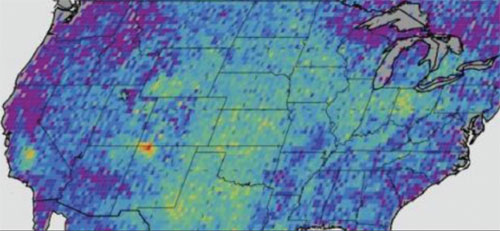
The enlarged image shows more exactly where the “hot spot” is located. The red shows the concentration of methane emissions; darker red means higher emissions. Courtesy of San Juan Citizens Alliance.

Seeking the source

The authors concluded it was energy development. They wrote that “long-established fossil fuel extraction, at least in the Four Corners region, likely has larger [methane] emissions, and subsequent greenhouse gas footprint, than accounted for in current inventories.”

Natural gas is 95-98 percent methane, and the hot spot sits primarily over the San Juan Basin, where there has been substantial oil and gas activity ever since the 1920s. The hot spot is approximately 2,500 square miles –the size of Delaware – largely in Colorado and New Mexico but also encompassing parts of northeastern Arizona and southeastern Utah.

But factors other than natural-gas production can result in atmospheric methane. The gas is released into the atmosphere from the ocean, agricultural operations such as feedlots, landfills and waste processing, and naturally occurring geologic seeps. Methane is colorless and odorless, and difficult to measure, which is why the NASA space-based observation was notable.

Because of the difficulty of specifying the sources of the hot spot, researchers used other methods to determine more precisely where the methane is coming from. In April 2015, a year after the NASA photo was published, a team of researchers conducted an “airborne campaign” in the Four Corners region. They measured methane plumes, using next-generation spectrometers. They detected over 250 methane plumes coming from infrastructure associated with natural-gas harvesting, processing and distribution, including processing facilities, leaky pipelines, storage tanks, well pads and a coal-mine venting shaft.

Ground teams visited the sites to document the leaks. As a result, some wells, tanks and pipelines have been shut down.

These studies seem to demonstrate that the natural-gas industry is primarily responsible for the elevated levels of methane. The San Juan Basin is home to 26,000 active oil and gas wells, and over 11,200 abandoned ones, many of which are leaking methane.

“When you live in a place like Farmington, you’re in close proximity to hundreds of natural-gas facilities that run all the way from the wells to the pipelines to the processing facilities,” noted Eisenfeld. He’s been in the area for over 20 years, working with San Juan Citizens Alliance for the past 11. “It’s really important for people to understand we have extensive natural-gas development already and that it’s inherently tied to the methane problem, there’s no doubt about it.”
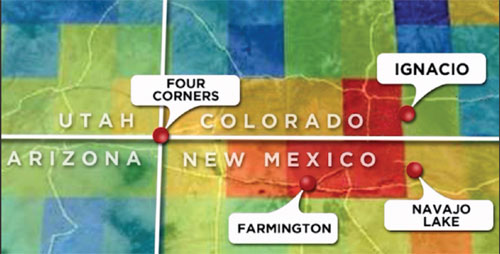
The Four Corners area, showing red in this image released by NASA in 2014, is the major hot spot for methane emissions. The map shows how much emissions varied from average background concentrations from 2003-2009 (dark colors are less than average and lighter colors higher). (This is the original image, and to date the only one released by NASA.) NASA/JPL-Cal Tech Univeresitiy/Univ. of Michigan

Ticking clock

“Obviously, methane is a very powerful greenhouse gas. It contributes to ozone formation, which has pretty serious public health impacts in many places.” – Michael Saul, senior attorney, Public Lands Program, Center for Biological Diversity

Saul, an attorney involved in litigating environmental issues on public lands, knows ozone formation to be one deleterious effect of methane. But not many people know about methane’s role as a greenhouse gas, or why ozone formation is problematic. While the link between climate change, rising carbon levels, and human activities is still hotly debated in some circles, scientific measurements are clear.

The level of atmospheric CO2 is rising quickly. Click on Bloomberg’s “carbon clock” (a real-time estimate of global monthly atmospheric CO2) at https://www.bloomberg.com/graphics/ carbon-clock/ to see how fast this is happening.

When the first measurements of CO2 took place in 1958, carbon was present at 316 parts per million. It is now, in January 2018, at 406 ppm. According to the Bloomberg clock website, for 800,000 years before industrialization the levels were around 280 ppm, and the rapid rise in the past 50 years is believed responsible for many of the changes in weather patterns worldwide.

Carbon dioxide is just one of several greenhouse gases, and each one has the potential to impact the world’s atmosphere, weather and human health. Besides methane (CH4), other greenhouse gases are nitrous oxide (N2O), water vapor, ozone, and industrial gases including hydrofluorocarbons (HFCs), perfluorocarbons (PFCs), sulfur hexafluoride (SF6) and nitrogen trifluoride (NF3). All of these except water vapor and ozone are included in international and national atmospheric estimates.

Together these gases create the “greenhouse effect,” meaning they trap heat in the atmosphere and lead to warming, similar to what happens when sunlight shines on your closed car windows. Without this greenhouse-gas action, earth’s temperature would be too low to support life as we know it. But too-hot atmospheric temperatures are also a threat to life as we know it. Climate change as a result of increasing temperatures worldwide can be seen in changes in storm patterns, including extreme, erratic and unusual weather such as this winter’s snow in the southern U.S. and lack of it in the San Juan Mountains.

Rising levels of methane are particularly worrisome because it is a more powerful greenhouse gas than carbon dioxide. According to the San Juan Citizens Alliance website, methane is far worse for the climate than carbon dioxide – 86 times more potent. This means that increased levels of atmospheric methane could contribute more to climate change than carbon dioxide.

Until the recent project measuring methane from space, there was no baseline from which to document changes in atmospheric methane, and to date, methane is mostly left out of the climate- change conversation.

Saul and Eisenfeld both belong to organizations that are fighting to ensure that methane does not continue to be released into the atmosphere.

But the energy industry and the Trump administration have other ideas.

Over the past year there has been a back-and-forth between the administration and environmental groups over an Obama-era rule to regulate methane emissions. The actions include executive orders, lawsuits, a Senate vote, and most recently, a lawsuit filed on Dec. 19 against the BLM, the Interior Department and Interior Secretary Ryan Zinke by a coalition of 17 environmental groups.

A strategy to cut methane emissions was a part of the Climate Action Plan of 2014. This plan addressed the four main sources of methane: landfills, coal mining, agriculture, and oil and gas production. The plan called for updating standards, with public input, to reduce emissions from landfills and outlined voluntary strategies to cut emissions in the dairy industry by 25 percent by 2020 through the use of methane digesters.

It called upon the BLM to gather public input on programs for the capture, sale and disposal of waste methane associated with coal mining on public lands.

It also took “new actions to encourage additional cost-effective reductions” in the oil and gas industry, including voluntary programs and regulations. A key element was updating standards to reduce flaring and venting on public lands.

This plan resulted in two “rules” to limit methane emissions – the EPA’s and the BLM’s. The EPA rule was adopted in 2016 and applies to new and modified oil and gas facilities. It requires oil and gas companies to stop leaks of methane and volatile organic compounds, and requires the gas lost in production, processing, transmission, and storage to be captured, including not only natural-gas wells but oil wells.

The BLM rule similarly requires oil and gas producers to dramatically reduce methane waste on federal public lands.

Reducing waste

“The rule that came out, from our perspective, is a pretty modest one – it doesn’t ban all venting and flaring – rather, it requires operators to take some reasonable measures – in most cases measures that pay for themselves.” — Michael Saul

Saul told the Free Press that the rule has been in effect for some time already but had phased-in compliance dates for industry for most of the things operators were required to do. The requirements for leak detection and control don’t take effect until January 2018, he said.

The rules require oil and gas operators to capture and sell the gas currently being released into the atmosphere, better maintenance to prevent leakage in pipes and wells, and minimizing of venting and flaring.

Flaring is done when a well is designed to produce oil, but methane is present as a byproduct. The producers burn or “flare” any natural gas deemed uneconomical to collect and sell. Gas mixed with toxic hydrogen sulfide is also often flared due to safety issues, since flaring converts the gas into a less-toxic substance.

However, the process of flaring not only burns gas that could be utilized, but produces toxins and VOCs including benzene, formaldehyde, polycyclic aromatic hydrocarbons (PAHs, including naphthalene), acetaldehyde, acrolein, propylene, toluene, xylenes, ethyl benzene and hexane. Over 60 different air pollutants have been measured downwind of natural-gas flares in Canada. Venting is the direct release of gas into the atmosphere, without burning.

Venting happens during maintenance (of wells, tanks, pipelines) and also during the development and completion of wells. Abandoned wells and storage tanks have the potential to vent also.

A 2010 U.S. General Accounting Office report states that “around 40 percent of natural gas estimated to be vented and flared on onshore federal leases could be economically captured with currently available control technologies. According to GAO analysis, such reductions could increase federal royalty payments by about $23 million annually and reduce greenhouse gas emissions by an amount equivalent to about 16.5 million metric tons of CO2—the annual emissions equivalent of 3.1 million cars.”

Saul told the Free Press that the evidence was “pretty overwhelming that the cost of complying with these rules would be something like under 1 percent of their profit, even for the small companies.”

He added, “This gas is a valuable commodity – if they capture it instead of let it leak, they can sell it and make a profit. Just two months ago, there was a study that found that the wasted methane from leaking, venting and flaring in New Mexico alone is somewhere between $182 million and $244 million worth of gas each year – that is about $27 million in lost tax revenues.”

Laura King, attorney with the Western Environmental Law Center, commented, “This rule had overwhelming public support and it is in the public interest and in the interest of the environment. This is a rule that saves money and is good for industry – it saves them money.”

Money and politics

“If you’re allowing methane to be emitted into the atmosphere then you’re missing out on the royalties, which is dumb.” — Mike Eisenfeld

“There is no reason those regulations should not be put in place, for our environment, for people’s health; and for the industry itself, to save them money.” — Carrie King, associate director, Great Old Broads for Wilderness

However, despite a long public review process, and despite the potential for increased revenues, the Trump administration has fought hard to delay

the implementation of the methane rule. The BLM tried two times to delay the compliance deadlines. In June 2017 the agency announced an indefinite “stay” of all provisions of the rule. The Conservation and Tribal Citizen Groups and the states of California and New Mexico responded by filing a lawsuit in U.S. District Court for the Northern District of California. On Oct. 4 the BLM was ordered to vacate the stay and reinstate the rule.

The next day, the BLM submitted a different proposal to delay compliance with that court order (which included a 30-day public-comment period to comply with existing law), and on Dec. 8 revised that proposal to request a delay for a year, until Jan. 17, 2019.

In response, a coalition of 17 environmental groups, including national groups as well as the local San Juan Citizens Alliance and Diné Citizens Against Ruining the Environment, filed a suit challenging the BLM’s amendment of the compliance deadlines.

“Our concerns have been ignored and communities like ours are only looked at for exported revenues and royalties,” said Eisenfeld.

Saul added, “The important thing to remember is that this is public oil and gas –under the Mineral Leasing Act, the federal government leases the public’s resources to private companies to extract.

“But the bounds of that statutory arrangement stipulate that those companies aren’t entitled to waste that gas. The BLM has not just an authority but a legal obligation of not simply maximizing income on private property but to ensure that the public, including the states who get about half of that royalty, are getting a fair return on the resources.”

Eisenfeld ticked off six reasons why it is important to keep the methane rule in place: “Number 1, the sheer waste; 2, the public health implications; 3, climate change implications; 4, the methane cost, meaning the cumulative public health problems associated with those emissions; 5, royalties and revenue issues – these emissions are on federal lands, and as a part of the leases that these companies hold the states are due their royalties; and 6, this rule went through a robust public involvement process, which was absolutely shoved aside.” Laura King of the Western Environmental Law Center said her organization filed a Freedom of Information Act request to find out why the BLM was trying to delay the rule in spite of widespread public support and in the face of evidence demonstrating that the rule would minimize emissions, improve public health, and increase income for both the companies and the states through the capture of gas now being wasted.

She said that basically, the administration “is buying themselves time to do a larger rulemaking process to replace the current rule.”

Saul agreed. “The administration’s priorities are clear – they want to promote oil and gas drilling at all costs and our position is that in doing so they are ignoring the public financial hit, ignoring public health, ignoring the climate burden of this activity and ignoring the law.”

The 17 organizations have been working together on this issue for several years, along with the Western Environmental Law Center and a couple other legal firms. Saul seems hopeful as to the outcome of the latest lawsuit: “This is a pretty modest rule, and Colorado has already at the state level put forth regulations to require similar leak detection and methane waste minimization.

“In New Mexico, the attorney general and the delegation have strongly supported this rule, both for the health benefits and the financial impact to New Mexico.”

King said a motion has been filed seeking a preliminary injunction to stop the delay, “so we’re trying to move this along as quickly as possible, hoping that the methane rule will continue in effect as scheduled in January 2018.”

The delay actually causes uncertainty for oil and gas operators, since they do not know whether they will have to begin capturing the wasted gas this month or if they will have another year to see what happens.

Currently the rule remains in effect, pending a ruling about the injunction.

So 2018 may see a reduction in methane waste in the San Juan Basin. Or, come mid-January, the rule could be delayed a year, as the Trump administration wants, and ultimately be reversed.

“It’s a very modest and cost-effective step and the Trump administration’s repeated attempts to undo it are truly radical,” Saul said, “and they don’t reflect the interests of the people of Southwest Colorado and northwestern New Mexico who bear the brunt of air pollution and lost revenue.”

Eisenfeld concurred. “You have federal agencies like the BLM basically being directed to ignore rules by their parent agency, the Department of the Interior, and the current presidential administration. They’re doing everything they can to avoid their responsibilities. It’s very poor stewardship of our public lands, our public health and our civil rights.”

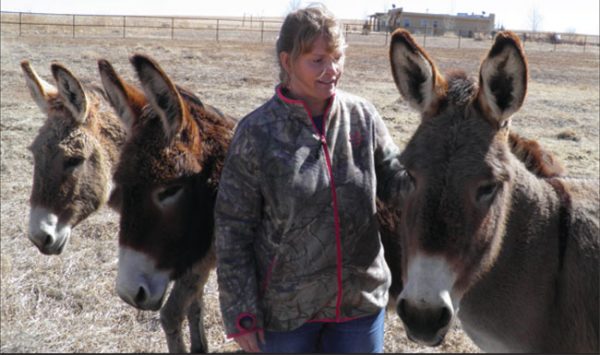
Published in January 2018