Turmoil and turbulence: The big stories of 2017

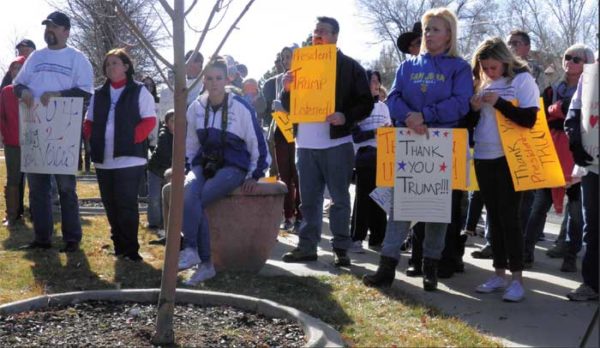
2017 INAUGURATION DAY PROTEST IN CORTEZ

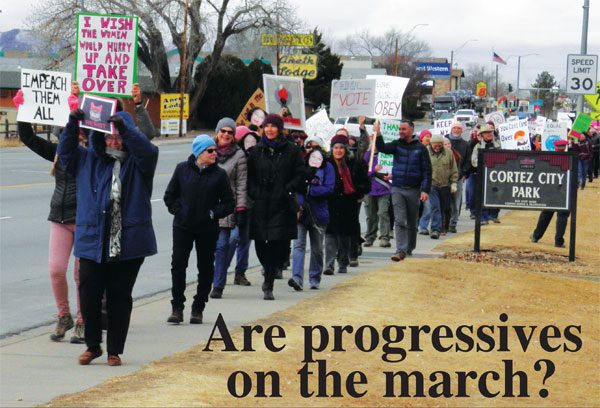
Marchers in Cortez joined protesters nationwide on the day after President Trump’s inauguration. Photo by Gail Binkly

2017 began in turmoil and ended the same way.

When Donald Trump took the reins of leadership from Barack Obama, it inaugurated a year that would be marked by marches and sign-waving, executive orders, litigation, and furious, partisan debate over the country’s new direction. And all of that was mirrored across the sprawling, diverse region known as the Four Corners.

Even as the rural, rightward-leaning people of the area hailed the election of a man they saw as a bold swamp-drainer, the vocal minority of progressives that also inhabits the area rose up in protest.

In January in Cortez, more than 500 people braved soggy snow to join with millions nationwide in the Women’s March the day after Trump was sworn in as commander in chief. It was the largest single-day protest in United States history. (The tally of 500-plus in Cortez wasn’t one of those loosey-goosey crowd estimates, either; it was verified by several people who counted as the marchers walked by.) It was a huge turnout by Cortez standards and it marked the beginning of a newly energized opposition to conservative policies, both locally and nationwide.

Protests would erupt periodically throughout the year in response to various actions by the new president.

But there were protests and rallies on the other side as well. In fact, the year was bracketed by two turnouts at the same site in San Juan County, Utah, which was home to a great deal of news in 2017.

‘Land grab’

The first protest actually took place two days before the start of the new year, when a crowd of more than 300 shivered in the wintry shade in front of the San Juan County courthouse in Monticello. Carrying signs that begged, “Trump this monument” and similar sentiments, they were there to protest Obama’s designation of a 1.35-millionacre national monument in their county.
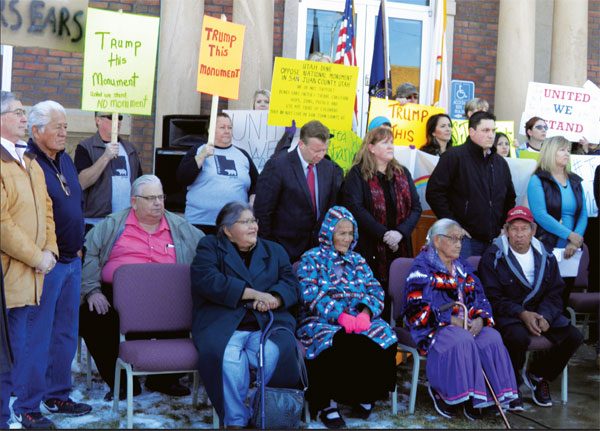
Bears Ears National Monument was the subject of furious debate throughout the year. Here, local citizens protest President Obama’s designation of the monument during a gathering in Monticello, Utah. Photo by Gail Binkly.

Bears Ears would become famous nationwide, partly for its cutesy name, partly because it was hailed as the first Native American national monument (its original plan contains provisions for oversight by five tribes), and partly because it was viewed by opponents as a symbol of presidential overreach and federal heavy-handedness.

Rhetoric flew. Critics of the monument called it a “land grab,” ignoring the fact that the lands placed under monument protection were federal lands to start out with.

Later, when Trump declared in November that he was going to reduce Bears Ears to two separate parcels totaling just 220,000 acres, a reduction of 85 percent (if it stands up in court), opponents of that action would accuse him of a “land grab,” again ignoring the fact that the monument had never changed hands.

Since it was federal land before and after Obama’s proclamation, and federal after the downsizing, why did the issue of its being a monument create such a furor?

Locals feared the greater protections involved in a monument management would mean an end to many traditional uses of the rugged, little-known area, such as firewood-gathering, motorized travel, and natural-resource extraction.

The whole question of oil and gas drilling and/or hardrock mining on the monument, however, is cloaked in mystery. Some monument critics say the designation isn’t needed because there aren’t enough resources to bother with, that drilling and mining will never be issues and the greater danger lies in the hordes of tourists that will flood the pristine area as it becomes more publicized.

Jam-packed parks

That’s not an unreasonable concern, given the fact that Utah’s national parks are jam-packed, thanks in part to a massive advertising campaign. The final 2017 numbers aren’t in, but some 14.4 million people visited the state’s 13 national park units in 2016, up 21 percent over the year before. Visitation at Arches near Moab has doubled over the past decade.
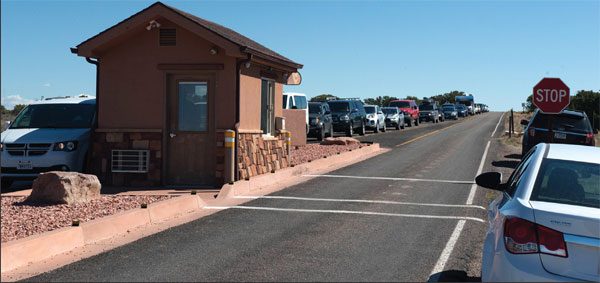
A line of cars waiting to enter the Island in the Sky section of Canyonlands National Park. National-park crowding and lack of funding was a major issue in 2017. Photo courtesy National Park Service.

Ironically, many visitors were coming to experience nature, solitude, peace and quiet. Instead, they found lines of cars, crowded trails, and constant noise.

Despite the parks’ popularity, congressional Republicans have been slashing funding for the Park Service, and late last year the service proposed hiking the entrance fee in 17 of the most popular parks to $75 per car. Those parks include Grand Canyon in Arizona; and Bryce, Zion, Canyonlands and Arches in Southeast Utah.

The Park Service also slashed the number of free entrance days it offers, from 16 just two years ago down to four in 2018.

Future in limbo

But back to Bears Ears and the question of its resources. Some monument critics argue the exact opposite, that the designation is bad precisely because it precludes mineral extraction and that there ARE resources there ripe for the plucking. In May, the board of the San Juan School District passed a resolution opposing the monument, saying the designation will cost the district money because it won’t allow natural-resources development. San Juan County is Utah’s poorest county, and board Vice President Merri Shumway told the Free Press that every single student in the district qualifies for the federal lunch program, so every additional dollar is needed.

At the moment, the future of Bears Ears as a monument is very much in limbo. Three separate lawsuits have been filed challenging Trump’s move to shrink the monument boundaries, and there is a real question about whether a president has the legal authority, under the 1906 Antiquities Act, to make such alterations.

Clouds around coal

Natural-resource and environmental issues were big in 2017, and nowhere more so than in the Four Corners. The future of coal in general, and coal-fired power plants in particular, remains a major concern.

In June, in a highly controversial action, the Navajo Nation approved a two-year replacement lease for the Navajo Generating Station near Page, Ariz. The owners of the power plant had warned the Navajo government they would close it in December if a lease extension were not negotiated. The two-year extension meant continued employment for about 800 people at the plant and the Kayenta Coal Mine that feeds it.

But the plant, the biggest coal-fired plant in the West, emits the second-highest amount of visual pollutants nationwide and the seventh-highest amount of carbon dioxide. The Navajo Nation is still trying to prepare for the plant’s impending closure, which has only been delayed unless a new owner/operator can be found. Meanwhile, San Juan County, N.M., is preparing for the closure of another coal-fired plant, the San Juan Generating Station near Waterflow. In December, it shut down two of its four units, although legislators were trying to find a way to soften the economic blow of the closure.

 Balancing act

The power-plant question is part of a larger issue that has long plagued the Four Corners – how to balance a clean environment with a robust economy. Many locals breathed a sigh of relief in recent years as lower oil prices slowed the pace of drilling, with its attendant noise, pollution, and traffic.

But county governments and others decried the loss of jobs and tax revenues.

The balancing act is involved in the whole issue of the methane rule, an Obama administration rule intended to force oil and gas operators on federal public lands to quit wasting methane, by making them capture and sell it instead of leaking, venting, or flaring it. (See the article here.)

Urged on by the energy industry, the Trump administration tried a number of ways to undo the rule. First it tried to have Congress overturn it, but that failed. Then the administration tried legal maneuvers to get around implementing the rule; as of press time, the matter was still being litigated.

Bye, bye MLP

As part of its relentless push to undo pretty much everything Obama put in place, the Trump administration announced that it plans to rescind a BLM “instruction memorandum” that provided for master leasing plans – specialized plans intended to offer focused oversight of energy development in particular areas.

The announcement appears to mean that the BLM will not be moving forward with a master leasing plan it had intended to create for 71,000 acres in Montezuma and La Plata counties. The MLP process had been approved by the state and national BLM offices following a lengthy public process in 2015 and 2016 in which the vast majority of individual comments supported an MLP.

The end of the MLP pleased the Montezuma County commissioners, who had steadfastly opposed its creation. They argued that the overarching management plan written by the BLM’s Tres Rios Field Office offers enough regulation of oil and gas drilling.

Budget squeeze

Their stance was motivated partly by a general dislike of federal land and the federal government, but also by concern about the county’s revenues, which have been hurt by two major factors.

One is a downturn in the production of carbon dioxide, which traditionally funds about half of the county’s property taxes. (CO2 production is tied to oil-drilling, so less drilling means less CO2 extraction.)

The other is an amendment to the state constitution called the Gallagher Amendment, which sets a ratio between residential and commercial property taxes that has the effect of keeping the former artificially low.

As Colorado’s Front Range booms with new houses, the rate at which residences are assessed keeps dropping, but not enough new homes are being built in rural areas to make up the lost tax revenues. Going into the budget process for 2018, Montezuma County faced a looming deficit of about $1.5 million. The commissioners and administration whittled that down to $475,000 through severe belt-tightening, and expected to make up the difference from their reserves.

‘No Nukes’

Controversy even swirled over hardrock mining. In 2017 the Four Corners region continue to debate the costs and lingering effects of 2015’s Gold King Mine disaster, in which 3 million gallons of toxic sludge from an abandoned gold mine in the Animas River watershed near Silverton, Colo., came spilling all the way into the San Juan River.
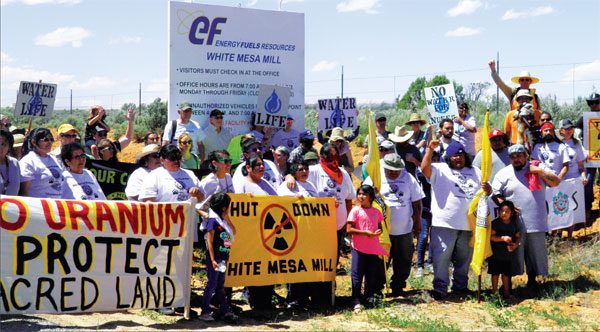
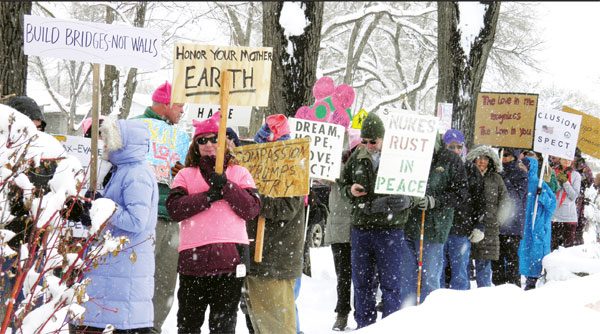
Environmental controversies abounded in the Four Corners in 2017. Here, marchers protest a possible license renewal for the White Mesa uranium mill in San Juan County, Utah. Photo by Gail Binkly.

And residents of San Juan County, Utah, argued over the future of the White Mesa uranium mill sitting just four miles north of the small Ute Mountain Ute tribal community of White Mesa.

In May, protesters marched north from the community, which is between the towns of Bluff and Blanding, to the mill site, on private land bordering Bears Ears National Monument (at least as it was originally configured under President Obama).

Carrying signs such as “Water Is Life” and “No Nukes,” they were protesting a proposed renewal of the mill’s radioactive- materials license, as well as an amendment to the license to allow the mill to process alternate feed material.

The Ute Mountain Ute Tribe and others are concerned about the mill’s proximity to their reservation. They say old tailings impoundments may leak and contaminate groundwater; they also raise concerns about airborne contaminants. But a 2014 lawsuit by the Grand Canyon Trust against the mill and its owner, Energy Fuels, over radon emissions was dismissed in September 2017.

Gerrymandering?

While Montezuma County dealt with budget woes, San Juan County, Utah, struggled with litigation in 2017. In December, a U.S. district judge upheld new voting-district boundaries for both the county commission and the San Juan School District.

The decision came after years of litigation between the county and the Navajo Nation, which had filed suit charging that the current districts were racially gerrymandered. Their main issue was with the three-member county commission, which since 1983 had been court-ordered to vote by district rather than at large.

Over the years, the commissioners left those districts intact even as the county’s population shifted and changed. They argued that they believed they weren’t allowed to change the boundaries, but the end result was that one commission district was more than 90 percent Navajo while the other two had white majorities, even though Native Americans by then constituted a slight majority countywide. That meant it was highly unlikely there would ever be more than a single Navajo on the commission. (Indians also have never held more than two seats on the five-member school board.)

In 2016, U.S. District Judge Robert Shelby ruled in favor of the Navajos and ordered the boundaries redrawn. When the county and Navajos couldn’t agree on new ones, the judge appointed an outside expert to redraw them, and his version became final. That is, barring any legal challenges by the county, which remained unhappy over the new districts because, for one thing, they divided Blanding and its surrounding area among all three districts.

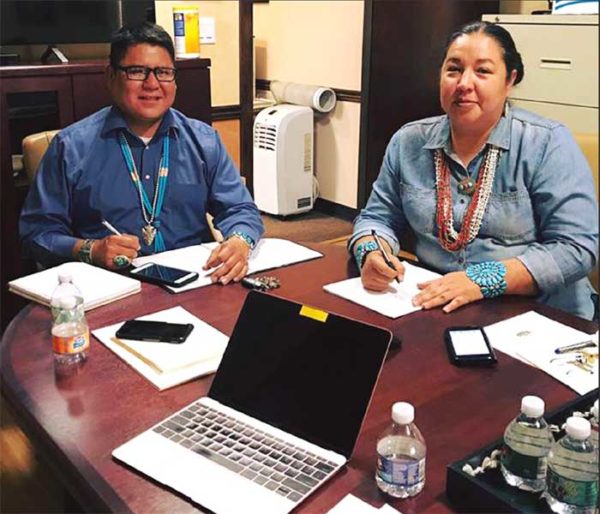
The Navajo Nation hailed the decision. “We had Navajo communities in Utah whose voices were drowned out by district lines that did not represent the majority populations,” Vice President Jonathan Nez said in a release. “Now we have voting districts that better reflect reality.”

But although the decision could mean major political shakeups, as the county’s Navajos tend to be Democrats, it by no means guarantees that two Navajo commissioners will be seated. Historically, Native Americans have not turned out to the polls in high numbers, and regardless, it can’t be assumed that voters will always cast their ballots along racial lines.

Shelby ruled that the new districts will take effect for the election in November 2018 and also that new commissioners and school-board members must be chosen then, for staggered terms. It remains to be seen whether the ruling will mean a political upheaval in the traditionally conservative county, or whether the election will result in business as usual.

Water roller-coaster

Just as the region has suffered through booms and busts in energy development, it rides a roller-coaster in terms of precipitation. When 2017 began, the Four Corners was flush with water, reveling in the benefits of an El Niño year. Deep snowfall meant a springtime boating spill on the Lower Dolores River that was rare in its magnitude.

Recreationists flocked to enjoy a two-month-long (albeit on-and-off), 200,000-acre-foot release from McPhee Dam. Biologists measured the effects on three native fish species in the river and on the riparian corridor.

The passage of a year, however, has brought a stark contrast. At press time, the snowpack in the Dolores, San Juan, Animas and San Miguel river basins was at just 25 percent of normal and the weather was preturnaturally warm, with people in shirtsleeves and shorts strolling the streets of Cortez.

And even as locals remarked on how “nice” the sunshine was, they also wondered what it might portend in terms of drought and wildfire come summer.

But no one knows what 2018 will bring. About all that can be predicted with certainty is that there will be continued juicy times for journalists.

Published in January 2018

A local shines on the national literary stage

It’s nigh impossible to make it as an author of adult literary fiction. Yet that’s the goal Four Corners writer Mandy Mikulencak set for herself in 2009.

Nine years later, Mikulencak has succeeded, brilliantly, with the release of The Last Suppers, the acclaimed debut hardback under the new Kensington Press imprint John Scoglamiglio Books.

THE LAST SUPPERS BY MANDY MIKULENCAKMikulencak’s The Last Suppers, released in December, has earned the admiration of readers and reviewers across the country for its lyrical prose and character-driven depiction of the inequitable treatment of death-penalty prisoners.

Mikulencak, former executive director of the Women’s Resource Center in Durango, tells her tale through protagonist Ginny Polk, the cook at fictional Greenmount Prison in 1950s Louisiana. Ginny’s father worked as a guard at the prison until he was murdered when Ginny was a child. His best friend, Roscoe Simms, is now warden — and Ginny’s unlikely lover.

As warden, Roscoe grudgingly accepts Ginny’s passion for preparing a select final meal for each death-row inmate, until Ginny’s devotion to men seen as monsters by the rest of society threatens to upset the delicate balance Roscoe has achieved between supporting the rights of the mostly black inmates at Greenmount while, at the same time, condoning enough of the inhumane treatment of the prisoners in his charge, as demanded by Louisianans half a century ago, to keep his job.

Mikulencak says she did not set out to write an issues book. Rather, she initially was drawn to the death-penalty subject at the center of The Last Suppers when she happened upon the true story of a condemned inmate who requested Frosted Flakes cereal as his final meal. She wondered, she says, “what goes into such a request — the memories, the sense of loss.”

“There is a public fascination with last meals,” Mikulencak points out, noting the online proliferation of photos and art depicting death-row inmates’ last suppers. For her part, Mikulencak, a talented home chef, is fascinated by cookbooks. “I collect them and I read them like others would read a novel,” she says.

The recipes for the meals Ginny conjures, at great effort and emotional cost, for condemned prisoners in The Last Suppers are derived from old, southern cookbooks Mikulencak discovered in the course of her research, and are included in an addendum to the book.

But for all the devotion by Mikulencak to authentic recipes and to depicting the brutal reality of the death penalty, the story at the heart of The Last Suppers is that of the relationship between Ginny and Roscoe. That’s where Mikulencak’s talent as a writer, and her work over the last decade to develop that talent, truly shines. In Ginny and Roscoe, Mikulencak has created flawed, damaged characters whose entwined lives, and the racially charged mystery at the heart of their relationship, drive The Last Suppers to a conclusion as tragic as it is ultimately uplifting.

Scott Graham is the National Outdoor Book Award-winning author of the National Park Mystery Series for Torrey House Press. The fourth book in the series, Yosemite Fall, will be released in June. Visit Graham at scottfranklingraham.com.

Published in February 2018, Prose and Cons

Spot fires

If you have ever been on a hot wildfire, you learn that you have two major concerns. First is the main fire and second is to be on the alert for spot fires that start behind you and the main fire. Those spot fires must be put out quickly for your own safety, all the while controlling the hot main fire that is causing the spot fires. You can’t concentrate on just the spots, as the main fire is making more spots and growing larger, before long you are consumed. You have got to control the source of the spots.

The public forests and lands of the state have been experiencing an increasing number of environmental “spot fires” popping up over the past few years. These have been forest road closures; restricting vehicle use on forest roads; trail development held up; bass fishing on lower Dolores being eliminated; water diversions for irrigation closed down; historical water rights use for the county stopped; a new monument controversy; livestock grazing on Canyons of the Ancients held up; push for a National Conservation Area on the Dolores River; hunters cited into court for driving on a forest road. Now there is a push to introduce wolves into western Colorado. Why? Question: What do all these issues have in common? Answer: They all relate to controls over our local public lands, resources and public’s use of them. What’s happened? Where are all these “spot fires” coming from?

The project of “Rewilding of North America” has been around for over 25 years now and working with about eight key large environmental corporations like Sierra Club, Center for Biodiversity, Grand Canyon Trust, Wilderness Society and more, all in concert as the “Wildlands Network.” It began in 1991, just before the U.N. Earth Summit document “Agenda 21” of 1992, hmm. The Rewilding America project has identified three key “Wild Ways,” Eastern, Pacific and Western, which is the Rocky Mountains and beginning in Mexico and ending 6,000 miles away in Alaska.

Western Colorado just happens to be dead center of this Wild Way. The goal is to make the entire area one where all wildlife roams freely, unencumbered by man. This coincides with the Agenda 21 to concentrate all men in controllable population centers outside of the public forest lands, or should we now say “wildlands”?

To achieve this requires man to be controlled, and the basic tenet of dispersed private-land ownership has to be eliminated to allow non-governmental organizations (NGOs) to be in control of the lands and resources via the government. Their vision is to tie all the national parks and monuments together into one very large “wild area” with no intervention by man.

To achieve this, the numerous unconstitutional federal environmental laws, such as the Endangered Species Act, Clean Water Act, Archaeological Protection act, Wilderness Act, and others have been and are being used by the activist non-governmental organizations to gain control over the public lands, waters and resources, using the state and federal land and resource agencies.

For example, after 15 years of resisting following the law to re-establish grazing in the Canyons of the Ancients, the BLM held special meetings with the Grand Canyon Trust and Great Old Broads for Wilderness to apparently get their permission to establish some grazing in the monument, so they would not be sued by the same. Last year, the state and federal wildlife agencies were accompanied by the activist Nature Conservancy nongovernmental organization to shockcount fish in the lower Dolores River below Bradfield Bridge. They took pleasure in throwing out all bass game fish they encountered to die and be wasted, stating, “they don’t belong here!” Uh, just who are they to decide?

The current push to bring in wolves to the Western Slope fits in perfect with the re-wilding agenda and is touted as being necessary to establish balance in the ecosystem. They say the wolves will be able to control the elk and deer populations. Uuhhh, I guess that means hunters are not welcome in the new “Wild Park”? Well, they say “sustainable” hunting may be permitted. Who decides if it will be allowed? Who gets a permit?

What is being ignored is that the private lands, ranching, farming, and mining have developed the balanced environment we enjoy today. There is far more diverse wildlife and habitat today than at the formation of the public lands. The Montezuma National Forest of 1907, now known as the San Juan National Forest, in 1930 estimated there were 150 elk and 900 mule deer on the entire forest. The settling by private land owners and development of ranching, farming and timbering created new viable wildlife habitat and waters that have resulted in higher numbers and diversity of wildlife and habitat. Why do environmental activists want our environment to return to an unmanaged and deteriorating condition? We should be working to build on and further improve the environment that our ancestors started, benefitting both wildlife and man, who is a critical part of the environment.

Here is a map copied from the public website of the “Rewilding Network” that depicts the vision and plan that has been and is currently being worked on to create the “Western Wildway,” a super wildlife park, at your expense. The “spot fires” we have been afflicted with are deliberate actions to consolidate as much control of land and resources as possible into a national/international natural wildlife park, devoid of man’s use and influence. The main “fire source” must be extinguished! In firefighting, you break one leg of the “triangle” of Air (O2), fuel and heat. I postulate the environmental triangle is money, politics and land availability. The land is unconstitutionally in only one holder, the federal government, which is why this “plan” has been working so well. Remove that one leg, placing the controls into the rightful states to squelch the faux environmental fire that is about to consume us.

Dexter Gill is a retired forest manager who worked for private industry, three Western state forestry agencies, and the Navajo Nation forestry department. He writes from Lewis, Colo.

Published in Dexter Gill

An aerial tour of the Colorado Plateau

FLYING HOME … Published by the Peaks, Plateaus & Canyons Association, Sojourns was a gorgeous Colorado Plateau journal of 14 years’ standing, only recently having ceased publication. According to co-editor Carol Haralson, they decided to send the photo-thick periodical into the archives with a special double-edition, and Craig Childs’ Flying Home: The Colorado Plateau From Above and Below was born … Once again, it’s gorgeous (Haralson is an excellent designer). A full-color perfect-bound coffeetable paperback, with a cover flyleaf that opens and sends us soaring cliff-high along the West Rim of Zion National Park, courtesy of a photo by Joe Braun. Indeed, all the book’s photographs are iconic. Gripping. Unfailingly spectacular. Even Elena Miras Garcia’s close-up “Datura unfurling” … The text is vintage Childs – adventure story, gonzo travelogue, lyric prose and eco-romance in a chili con carne of scientific fact. He and his buddy, an ex-cop, fly an old cloth-wing Cessna 140 two-seater into harrowing and unmappable places to touch down, hike and then soar off into the aether for days of high-altitude joyriding. There’s even a facsimile page or two torn from Childs’ journal … The flight path keeps pulling you in. Only the details of a day’s flight change shapes. Turn into stories. Remembrances. The possible discovery of a mammoth petroglyph on the Plateau that could be 13,000 years old. The third date with a new lover wandering pathless in the wilds of Petroglyph National Park … Childs and his pilot take you into the heart of the light and the darkness, from the depths of the Grand Canyon to the Columbine Shooting ballfield, where a young athlete lies dying. Each of the pieces are as mesmerizing as the rainbow trunks of petrified forest Childs wanders through with his mysterious lover “silhouetted against the indigo horizon” … Regina Lopez-Whiteskunk shows up in this book. As does Katie Lee, Fred Welch, Theodore Roosevelt, Ed Abbey, Joe Pachak, Neal Schwieterman. It’s a book with one foot in the past, and the other hanging out the side of a prop plane, as the wings tip to bring a cliff in focus, trying to get one more shot of the now. Highly recommended.

WESTERN COLORADO ALLIANCE … It’s exciting to see a longtime regional community action group re-invent itself. Kudos to Western Colorado Congress President Steve Allerton, Teresa Purcell of Purcell Public Affairs and the WCC board for making this significant change … My connection to WCC (and now WCA) goes back to before the group formed in the West Elk mountains outside Crested Butte. As a summer visitor to Telluride in 1979, I got to hang with my friend George Greenbank at a gathering up on Hastings Mesa known as the Colorado Plateau Rendezvous. A loose-knit, ad hoc event where regional enviros came together to see how they might work to socially and politically shake up the conservative Western Slope. Out of that meeting came a push for a progressive alternative to the development-oriented Club 20 of Grand Junction … I wasn’t part of the organizing group in the West Elks in 1980, but I visited the gathering by chance that spring and sat in on some of the discussions. I moved to San Miguel County in the fall of 1981 … When Jack Pera and I organized a group to fight against a bad timber sale on Lizard Head Pass in 1988, I spearheaded a drive for Sheep Mountain Alliance to join WCC after we won the battle with the Forest Service … Over the years I served as a WCC senator, representative to the Western Organization of Resource Councils and member of various committees … I had criticisms of the group, for all the good work they did. They used a Saul Alinsky empowerment model of community organizing that didn’t always work in resort towns. Over the years I watched as community groups joined WCC and then left… A few years ago I tried to talk to the board about the need for a reorganization, but arguing that the Club 20 structure (not its politics) was a good model for a supposed “congress,” I got nowhere … So, like many, I drifted away from participation in a group with dwindling numbers of community groups – in the last few years the “congress” only represented a handful of Western Slope counties … But I’m excited about the reorganization. I plan to join the group again, and I’m looking forward to their bringing back Colorado Rural Voters as a 501(c)4 project. As a seasoned pol of 20 years’ standing on the Slope, I think it’s time we all jump in to help “recruit, train and support new leaders” … WCC is dead. Long live WCA!

EDIBLE SOUTHWEST COLORADO … If you haven’t seen the annual Storytelling Issue of this free publication (#31, Winter 2018), grab one. Editors Rick Scibelli, Jr., and Rachel Turiel have done an outstanding job pulling together fine stories from some of the region’s best writers. … Scibelli got me going with his editor’s letter. Pretty soon I’m packing up a Saab for a retreat back to Connecticut and what turns into a failed restaurant gig, several years testing battery acid, and a back-to-school come-to-Jesus moment that leads back to a schoolboy dream of photography. Already my head’s spinning. I can almost see battery acid being sucked up a pipet with strange red dye … The first actual story made me sit back and remember. How my father died. How I went and spent hospice with him. Held his hand as he journeyed into the mystery. Sheryl McGourty writes quietly but powerfully: “What I came to witness is that someone’s death can often closely reflect the essence of how they lived.” … Scibelli’s kodak of a kite flyer on an Oregon beach is a strikingly nostalgic companion to McGourty’s My Father … And Jennifer Rane Hancock of Grand Junction has a lovely poem, In This Season of Soup, that honors the diversity as well as the food of her relatives and ancestors: “I cook to celebrate your lives, and cry/into the onions on the cutting board” … Rosemerry Wahtola Trommer, herself a fine poet, leads us down the in-law path of a holiday faux pas, only to be rescued by the grump whom she most feared. … Kierstin Bridger shares a diary, inverted, of watching as her 15-year-old tests boundaries she herself broke as a youth, trying to help Sophia “set her compass back to her own true north.” It’s a story almost any parent can understand. … Rachel Turiel knows how to pull a reader in. Her second sentence: “The days are just slivers of light sandwiched between thick slabs of darkness.” She’s a mom with a houseful of tweens, including her withdrawn son. When he asks to make dinner, she follows his lead and amplifies it into a 12-year-old success story. They name it Mungo. Her definition of how she copes with kids is one to remember: “This parenting is like a progression of dance moves … It’s beautiful and terrifying.” … In Dune’s Day Zach Healy takes us on a dog pilgrimage that teaches a lot about expectations and how what doesn’t work can teach us as much or more than easy success. … I wasn’t prepared for Samantha Tisdel Wright’s dazzling travelogue into a remote part of China. Of Pigs and Dragons is a marvelously droll tale with surprises galore and colorful language in several languages: “Since the only Naxi I knew was ‘oho-la-a-lay, dao a-kun dao-pay,’ which means ‘Hello, I can see chicken feet up your ass,’ (I had learned this during a raucous New Year’s Even celebration a couple weeks before) I tried Chinese instead” … I enjoyed the multipage interview stories by Scibelli. The second-to-last story took me completely by surprise. Amy Irving is an old friend and excellent writer who lives in the little Western Slope town of Norwood as I do. Inedible, with its unsigned sketch of a toadstool (maybe a russoula?), was a story I’d told many times. Only this time Amy was telling it; and I was turned quite around, being a character in someone else’s story. It’s one of those scary kid’s stories every parent fears, but all’s well that ends well. … Food, of course, figures prominently in most of the stories. But it’s the quality of the writing and all the places those stories take me that makes Edible Southwest Colorado a favorite regional magazine of mine … And it’s free!

Art Goodtimes writes from San Miguel County, Colo.


THE TALKING GOURD

Perfect

The trick
about perfection

McRedeye sez

is to get through it
Not just to it

Published in Art Goodtimes

Schmitt happens

By now you’ve probably heard all about how President Donald Trump referred to African nations as “Schmittholes.”

Were you outraged?

You shouldn’t have been. I mean you should expect a potty mouth from someone who has “rump” in his name, right?

Look at me. My name is John and I’ve made my share of schmitty jokes. Not on purpose, but, hey, Schmitt happens!

Of course it’s less cool when the person with Schmitt on his lips is the president of the United States. (Now POTUS stands for President of the Uttered Schmitthole.)

The world was justifiably outraged. The Schmitt really hit the fan.

But not his fans. To them, The Donald can do no wrong.

Make fun of handicapped people? Trumpheads think it’s funny.

Argue with our closest allies? Hey, he speaks his mind! Curiously the one country he tiptoes around is Russia. It’s like The Donald’s new favorite song is “Putin on the Ritz.”

Brag about sexually assaulting women? Oh, it’s just locker-room talk.

Pay off a porn star to keep her quiet about an affair? Hey, he’s contributing to the economy.

Secret backroom deals with Russians? FAKE NEWS!

Make racist comments? Oh, no, he didn’t …

Two Republican “leaders” who were in the room said they didn’t remember what Trump said. But, three days later, both had an epiphany and suddenly remembered that The Donald didn’t say “Schmitthole,” he said “Schmitthouse!”

Liberals roll their eyes and ask if that’s any better. Well, actually, it is. The only difference is the second part of the phrase, and “hole” sounds so cold and unappealing. Like a grave. But “house” is warm and comforting.

Look, you wouldn’t want to eat at a place called Schmitthole, would you? But, now think of a neon sign proclaiming Schmitthouse. Makes you hungry doesn’t it? Maybe it serves Schmitt on a shingle?

What about the president’s promise to appoint only “the best” people? One of those “best” people was Carl Higbie, who recently resigned after recordings emerged of him making sexist, racist and anti-Muslim comments. And worse.

Higbie is on tape saying Americans ought to be able to line up on the southern border and shoot down people trying to cross the Rio Grande.

Does that fit in with Christian values?

Still, some think that Trump walks on water. (If so, it’s because the water will be crusted over from all the oil spills his policies will lead to.)

The Donald has been the greatest bullSchmitter in U.S. political history, but his supporters don’t see it. He said he’d build a wall and Mexico would pay for it. But Mexico wanted nothing to do with that Schmitt. Now Trump wants U.S. citizens to pony up $18 billion for the wall! Once again, taxpayers may find themselves up Schmitt Creek without a paddle.

Trump brags that he’s the greatest dealmaker ever, but a year into his presidency it appears that he can’t even deal a deck of cards.

There are those who apparently swoon to the perfume of corruption, self-aggrandizement and using political office for personal gain. Too many Americans swill the Trump elixir of misogyny, racism and hate, and it leaves them Schmittfaced (and wearing Make America Great Again caps.)

After all the bizarre, narcissistic tweets and bald-faced lies, I can’t understand why anyone would still be a Trump goosestepper.

Unless, maybe, they like Schmitt?

John Christian Hopkins, an award-winning novelist and humor columnist, is a member of the Narragansett Indian Tribe. See his writings at http://authorjohnchopkins.blogspot.com.

Published in John Christian Hopkins

Sedimental journey

The cone-shaped formations at New Mexico’s Tent Rocks National Monument stand tall, having survived an era of great upheaval. Good for them. As I approached the park entrance gate I overheard the employee on duty giving phone instructions to an invisible workman about some scheduled repair.

“We may be closed tomorrow,” he announced to his hand. “Yeah, I’m kinda hoping for a day off.”

While I waited for him to finish his call, I scratched my head, puzzled by the news that the park service would be celebrating a holiday. I had no idea what it might be. Even feared I’d become a runof- the-mill, too-busy-to-pay-attention kind of American. Then it dawned on me. A government shutdown starts tomorrow, if stopgap funding isn’t negotiated by midnight.

No one can be blamed for not remembering such an irregular holiday, our national celebration of partisan politics. Instead of the usual flags, why not just refuse to wear Republican red or Democratic blue.

Sadly, the federal employee clad in brown and green standing before me had to show up for work the following day, even though three days earlier he must have listened with interest as the Republican White House drastically reduced the size of two other national monuments, Bears Ears and Grand Staircase-Escalante, both located in Utah, and both designated by Democratic presidents.

This political climate forces people to grapple with the mind of a border schizophrenic, an advocate for building walls while at the same time knocking national monument boundaries down. I wouldn’t blame Park Service employees if they started calling in every morning just to find out how much their salaries have been down-sized overnight.

Lucky for me I’d only planned to hike two miles of trail on 5,000 acres of safeguarded land. At the time I felt secure, confident that the trail wouldn’t be rolled up like a carpet and hauled away before I returned to my truck. There are people who still believe in public trust and I trust them. The ones who believe the State of New Mexico is in cahoots the Mexican government continue to make me nervous.

Tent Rocks was legally set aside under the 1906 Antiquities Act as a national monument by Bill Clinton in 1996. It preserves for future generations unique geological sculptures that formed when volcanic eruptions spewed enormous rock fragments and prompted an avalanche of pyroclastic flow. Seven million years later I can only say, cool!

I am not, however, impressed with the partisan effort to shrink our national heritage. If the Nevada rancher family of Bundys who led an armed revolt against the BLM at two locations in the West, and the armed ATV riders who raised a lot of hell-dust in San Juan County, Utah, across the fragile terrain of Puebloan ruins are leaders in a new era of public awareness, then I’m pinning my hopes for the future on a few more active volcanos.

As I hiked the trail, a steep climb through a magnificently carved slot canyon, a flurry of what looked like volcanic ash began to fall. It turned out to be snow. The idea that I might reach a vista to look back on this land motivated me to crawl over many wedged rocks, slipping through crevices so narrow I feared getting stuck.

We could all benefit from a better view. A chance to rise above the bickering and truly see the kind of legacy most Americans hold dear, this patchwork of public lands, national monuments and national parks that should exist in perpetuity. The extraction of resources is a poor excuse for turning our cultural heritage into tailings.

As I climbed I realized how fortunate I was to live in the West, able to be present in what others only hear about in the news. To them, a national monument is an abstraction. To me, it’s the dirt in my backyard, which could be why I get so sedimental about our public lands.

When I reached the mesa top I turned around and sat down just to catch my breath. Off in the distance, expansive views of the Sangre de Cristo, Jemez, and Sandia mountains. Snow continued to fall. Over a precipice I looked down on a congregation of Tent Rock formations standing at attention like soldiers, like old stone spires, like the relics of prehistoric cathedrals.

We may need to temporarily close Washington D.C. Send all our politicians on a little career-related holiday. Democrats to Utah. Republicans to Mexico.

David Feela, an award-winning poet, essayist, and author, writes from Montezuma County, Colo. See his works at http://feelasophy.weebly.com/

Published in David Feela

Alone again, naturally

Due to a very large, handful of unforeseen surprises in my life (read: my life imploded), I find myself in a situation that I never thought I’d be in again…

I live alone.

I live with two cats and one dog, so not alone alone. But, I have no other humans in my home.

Moreover, I am completely reveling in it.

When I got married and had kids I figured I would never live alone again. That is the plan, right? Until death do us part.

Then divorce did us part, but I still had kids at home. So. Not. Alone.

Eventually though, I loved having my own room so much that I came to a place of never wanting to live with anyone. Again.

Besides them.

Their time at home was limited.

I like my space.

I like going hours without talking to anyone.

And then, change of plans, I moved in with a boyfriend and became one in a household of five, four of whom are male.

Two dogs. Two cats. Fourteen chickens. Ten pigs. Two horses. A bunch of steers and various and sundry other human beings, all men, who lived and worked at our place.

And now, it’s just me.

Alone again.

Happily.

The last time I lived alone was 25 years ago in my cabin in the Wasatch. I had to ski 3.5 miles each way between home and work. I had no radio, no phone, no way to connect with the outside world when I was there.

My nearest neighbor was a half-mile of breaking trail through waist-deep snow away.

It was a joyous time in my life.

Then I fell in love, moved in with my then-future- now-ex-husband, and gave up all fantasies of ever experiencing that again.

And yet, at 52 years old, here I am.

“Aren’t you lonely?”

Most definitely not.

But I will say that my life looks very different in very many ways. Some changes are small, some more extreme than others.

For one, I no longer sleep in a king-size bed. Besides not needing that much space at the moment, a mattress that wide is bigger than my entire house.

In my full-size bed sleep two cats who had been forced to live outside for several years due to “allergies” and one cat’s propensity to pee on everything.

Interestingly enough, once the person with allergies was removed, the random and inappropriate urination ceased.

I have a right-handful of splinters. I can get them out of my left hand but am too uncoordinated with that hand to remove them from my right.

I don’t have that person to whom to say, “Honey, will you get the tweezers…”

I read books, do the crossword, write, and watch The Crown, all in the living room. No more hiding out in my bedroom to escape the testosterone-induced chaos and stink that filled the living room before this one.

When I buy food, it’s still in the fridge the next day.

After I finish the dishes, the sink remains empty. Sometimes from sunup to sundown.

I listen to music almost all of the time.

Before, the only place I ever listened consistently was work. Couldn’t do it at home; all of those bodies under one roof created enough music of their own.

My truck became my refuge. I drove in silence just to hear nothing. When I moved, I bought an Echo because I had no other source for tunes.

Alexa, oh Alexa: you royal pain in the arse. You are worse than a teenager. Do you ever get tired of me calling you a b@#$%?

I prepare actual meals and sit down to eat them.

And I don’t come downstairs in the morning to the aftermath.

I do have to be more careful as I move through my physical world. I am fully aware that one little mishap could turn south very quickly.

If I could remember my neighbors’ names it would be different, but essentially, if I get hurt or incapacitated, I’m on my own. Might as well still be living 3 miles in.

With that said, when I need to ascend my wood pile, I think, “If these logs roll, I could get broken, really uncomfortable, and cold, and I’d have some serious splinters to boot.”

I am terrified of splitting wood because I wonder what will happen if I cut off my hand or my leg? No one will find me and I will bleed out in my yard while Elvis mournfully looks on.

So, when I uber-cautiously put hatchet to log, I am embarrassingly hesitant and ineffectual. After a half-assed swing where metal simply glances off aspen instead of slicing through, everything falls on the ground, and I look over my shoulder sure that the nameless neighbors are watching out their windows with pity.

I walk around naked.

They’re probably watching that scene with pity also.

I stare out the window for hours on end. I don’t answer the phone. No one drops in.

I am not woken up. I don’t wait up to make sure my children are home safe and sound. I don’t have to clean boypee off the bathroom floor

I spend many a night sleeping on the futon in the living room. Because I can. Because I can see the stars. Because I can watch the sunrise without lifting my head off the pillow.

I spend more time in the neighboring towns.

I spend a lot more time outside, wandering. Not feeding chickens.

I have a chamber pot.

I sleep with the window open.

Skulls, plants, rocks adorn every surface.

I no longer have a gun safe in my bedroom.

Come on back, liberal hippie self, I’ve missed you.

THERE ARE NO MORE CHEW SPIT CUPS IN MY BEDROOM, LIVING ROOM, DINING ROOM, KITCHEN, BATHROOM, CAR, PATIO, GARAGE, HENHOUSE.

Downside:

I find myself drawn to the Loungewear section at TJ Maxx.

Yesterday I did NOT purchase a cashmere nightgown. I stood in the dressing room imagining myself wearing it every single day as soon as I got home from work, all day on weekends, hosting brunch in it…

Whoa, Suz, have some pride.

So, besides the unfortunate attraction to matching pajamas, this living -lone business, after living with so many others for so many years, is fantastic.

I’m even entertaining tomorrow.

Holy youknowwhat.

Suzanne Strazza writes from Montezuma County, Colo.

Published in Suzanne Strazza

Blowin’ up

My world performance debut on the harmonica was last month, and I’m still pretty excited about it. I was asked to play with a band at KDUR’s Tom Petty cover night. Of course I said yes, even though I do not, technically, play the harmonica.

Oh, sure, I’ve put a harmonica to my lips and breathed in and out. I even went so far as to acquire harmonicas in a couple different keys about two years ago and finally, only recently, got “Oh! Susannah” unstuck from my head.

But even though I don’t actually ever play the harmonica, I still love it. It has a distinct advantage over other instruments: You can tuck it away in a drawer. Compare this to a piano, which stares at you from three-quarters of your living room and guilts you for never learning anything beyond the opening riff of “Chopsticks.”

The harmonica is much more easygoing than a piano. It does not require a professionally certified technician to tune it. Nor does it ever go out of tune. It costs less than a college tuition, and no one at parties ever demands that you play in front of lots of other people who probably know more about it than you.

Besides, the harmonica has a certain cachet. Guitarists get the chicks, and bassists also get the chicks. But the harmonica gets people to back away from you slowly. They stop taking you seriously as a “musician,” because the harmonica doesn’t seem like a real instrument. It’s like the kazoo, or the glockenspiel. Sure, it’s fine when a lead singer whips one out during an instrumental break, because at least he’s playing something. But as a primary instrument?

I thought I was safe from being invited to play music, ever, by saying that I play the harmonica. No one needs a harmonicist. But then this Tom Petty cover band decided that their rendition of “Swingin” needed a harmonica to accompany the ukulele, the bass, the drums, the guitar, and the fiddle. And I decided why not – I’d already committed myself to a year’s worth of inspirational behavior, so what better place to start?

No, I didn’t get suckered into deluding myself with a New Year’s Resolution. But I was exposed to the idea of choosing a Word of the Year in a moment of weakness, and I decided that the most apropos word was Create.

In part, this word is very clever. A simple bit of mental gymnastics, and absolutely anything can become a creation. I am not making dinner — I am creating a meal. I am not oversleeping — I am creating rest. I am not playing harmonica in a band — I am creating a very legitimate reason for audience members to go buy a drink.

But I did not choose Create to be clever. I chose it because I want to create things. Things like I don’t know what exactly yet, because it’s only February, which is only the second month in an entire year. I have plenty of time to create things that I want to create! And I would be much farther along with my creation, if it weren’t for band practice.

Your average Rock & Roll Hall of Fame band makes it look like they just walk out on stage, pick up their instruments, and create sounds that are both musical and sexy. They don’t let on that they got this far by playing rehearsals, in which the band members work out their creative differences by agreeing that the drummer gets no say in anything.

Rehearsals take time. I don’t know how much time, exactly, because I only went to one rehearsal. And we had to stop the song over and over because certain amateur musicians in the band have never played into microphones before, and they don’t know the etiquette about when to solo over the vocals, or which key the song is in, or what a key is, anyway.

I’m not naming names here, because musicians don’t sell their bandmates up the river until after they stop writing about their lone scheduled performance. But suffice it to say that rehearsal, plus practicing in my living room (once through for each key, just in case), took up many minutes that I could otherwise have spent creating my list of things I want to create.

Now that this KDUR cover night is finished, though, and I’m no longer part of this endeavor to play a single Tom Petty song, perhaps I can move on to bigger and better things, like creating my own musical career as the world’s first worldclass harmonicist playing all sorts of Tom Petty songs. If you made the gig, you can say you saw me when! I was the guy with his microphone taken away, stashed somewhere behind the drummer.

Zach Hively writes from Durango, Colo. He can be read and reached through http://zachhively.com and on Twitter @zachhively.

Published in Zach Hively

Feral but fixed: There is high demand for a local program that neuters free-roaming felines

The United States is home to an estimated 80 million feral cats, sometimes called “community cats,” many living in colonies. In Montezuma County there are 45 known, active colonies today.

Trap, Neuter and Return, a method of controlling feral cat breeding, is designed to reduce feral-cat numbers by providing spay/neuter services. It is gaining increasing traction as a moral and ethical solution to the problem of cat overpopulation.

FERAL CAT PROGRAM

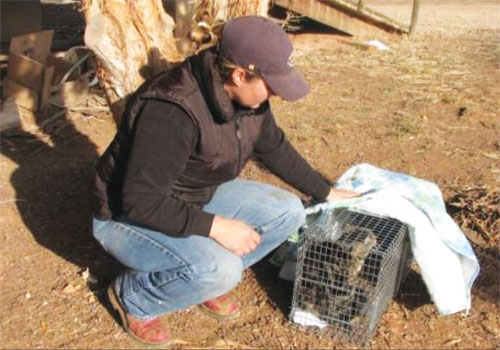
Feral cats such as this one are common in Montezuma and Dolores counties. Photo courtesy For Pets’ Sake.

Since 2009, For Pets’ Sake, a Montezuma County Humane Society, has faced the expensive and heartbreaking reality found in local feral cat populations.

“When we began the TNR project, people would call us for help with a feral colony,” explained Marian Rohman, director of the feral-cat program. “We’d put them on a waiting list because the demand was so intense in the beginning. Sometimes they’d wait for more than a year. People were calling right and left.”

But over the years the project, run entirely by about seven dedicated volunteers, adjusted to the needs of the cats because evidence indicated that neutering helps keep the wild cats from becoming pests – the kittens especially, Rohman said. “They may spread diseases, but they shouldn’t be killed because of that. They should be trapped and treated for the diseases. That’s a healthier approach.”

The TNR program managed by For Pets’ Sake is the primary control program for the feral cat population in Montezuma and Dolores counties. Trained volunteers, and sometimes cat colony caretakers, trap the cats and bring them to a vet for a checkup and the spay/neuter process. For Pets’ Sake funds the medical operation, which costs around $100. Veterinarians treat the cats for any diseases and worms they may have. They prescribe medications the cat may need, including antibiotics. For Pets’ Sake pays the veterinarian for the care and provides the medicine the cat needs to recover.

They are kept until they are healthy and can be returned to the colony. If they are able to adjust to domestic life they are placed in homes or with rescue organizations until homes can be found. Sometimes a lack of placement options forces the return to the wild colony where it was captured.

“At least they won’t breed more litters,” said Rohman. “and we return them healthy. We didn’t have to euthanize them because they are wild.”

Last year the wait time for the spay/ neuter dropped to three weeks or less, a promising direction and a record low. But for some reason Rohman said they don’t understand yet, the wait list is growing. Recent wait time is back up to six months.

Meanwhile, the program has started a Go Fund Me page to raise money to buy a few more traps that will enable it to serve more people and cat colonies. The page is at https://www.gofundme.com/ xt76m-traps-needed-to-save-feral-cats.

In proximity to people

Feral cats are not a new phenomenon. Outdoor cats are part of our history in this country and worldwide. Alley Cat Allies, a global organization advocating for cats, promotes innovative, cutting-edge programs like TNR that can protect and improve the feral animals’ lives.

TRAPPING, NEUTERING AND RELEASING FERAL CATS

Volunteers trap, neuter and release feral cats so they won’t breed and create more homeless animals. Photo courtesy For Pets’ Sake

TNR was pioneered in part by Becky Robinson, the founder and president of Alley Cat Allies. “Instead of killing them, it’s about sterilizing cats and letting them live the rest of their lives outdoors. It works for feral cats,” she said in a statement. “It stops the breeding of a cat, so there’s no more litters of kittens. We don’t need to kill them.”

They partner with hundreds of local humane societies to help offer low-cost spay and neuter policies and programs which were once viewed as radical concepts but are considered mainstream today.

According to the ACA website, feral cats thrive in every type of environment – urban, suburban, and rural. They colonized around humans when farming began, about 10,000 years ago, and, the site says, they are one of the only animals who domesticated themselves — choosing to live near humans to feed on the rodents attracted by stored grain.

Evolutionary research shows that the natural habitat of cats is outdoors in close proximity to humans. That is how they have lived, the website says, until the 1940s when kitty litter was invented.

In the last 20 years spay and neuter services for cats have, like litter, become more accessible and affordable. As late as the 1990s, kitten spaying/neutering was not done until the kitten was six months old, around the time it might first go into heat. But today, feral kittens brought into the TNR program are neutered if it is deemed safe by the vet, even if they are only a few weeks old.

Feral or just abandoned?

Cats live outside for many reasons. For true feral cats (born of females who’ve been making a life outdoors), it’s the life they were born into. Some feral cats live in barns and are valued for their role in keeping rodents in check. Others may be lost, or abandoned by heartless owners.

“People call us with feral cat colony problems from all sorts of places,” said Rohman. “We get calls about domesticated cats being left behind when someone moves or someone in the family develops cat allergies or they found that they didn’t really want that cute kitten after all. They are abandoned, or dumped somewhere. Our area has a serious issue with abandoned cats.”

What people may not realize is that cats want to go home. Even kittens will try to return home to the colony or the domestic family home. If they don’t make it they may die, she explains. Kittens left on their own outdoors have a 20 percent survival rate.

Cortez has four colonies — two in alleys, one in a trailer park and one in an abandoned building. That’s pretty standard for a small town. But in the country feral cats, even the working cats, still need to be trapped and neutered. If they aren’t they’ll breed more feral cats and may spread diseases.

“We cannot save them all, but we give every cat and kitten that comes to us the best possible chance at life,” she said.

The organization has had success with converting lost, abandoned, and even cats born totally feral into contented adoptable housecats. But it’s expensive. The group pays 100 percent of the vet bill, and they also run a food program to help promote healthy cat communities.

“We provide dry food to the caretakers of feral cat communities for a year.

The caretakers must get the cats spayed/ neutered or on the waiting list to get fixed in order to qualify. We provide dry food for a year if they agree.”

For Pets’ Sake spends $1,200 per month on the food program. According to Rohman they currently feed 45 of the 400 colonies they have worked with over the years in Montezuma County. Five of those colonies are being fed by For Pets’ Sake volunteers.

It is quite an accomplishment for a small, all-volunteer group working with limited funds. A few generous foundations add to the coffers.

“The PetSmart Charities were a great help in our early years, and the Friends of the Aspen Animal Shelter has been helping the outdoor cats in our area since 2011 by paying for over 800 spays and neuters. That’s a lot of surgeries and unwanted kittens,” Rohman explains.

Number-crunching

In 2017 For Pets’ Sake rescued 96 foster cats and kittens. Eighty-two came from feral cat communities. The work can take an emotional toll, Rohman said. “What you see, you remember. You remember the bad – the sad circumstances. We have to talk with each other.”

In one rescue six adult cats, some who had already been trapped, neutered and returned, were picked up with two mother cats nursing day-old kittens and three more one-day-old kittens without a mother. The colony was left behind when a long-time caretaker died the day before the For Pets Sake team was scheduled to trap the cats. One adult was very sick and had to be euthanized. Two adults were moved to a feral cat colony managed by another FPS volunteer. The rest were treated and neutered, before being sent to other rescue groups around the state.

More than 3400 cats have been treated in For Pets’ Sake’s TNR program since its beginning. It’s a record the group is very proud of, they say in their newsletter, and they are “overjoyed for those we have been able to rescue. This has happened through a lot of hard work on the part of the foster parents and the enormous funding for foster cats and kittens.”

But the costs add up. In 2017 they spent $51,642 on medical expenses and food for the 45 colonies.

“We are grateful for the funding that comes from grants, but the bulk of the money comes from donations to the Feral Cat Project and For Pets’ Sake through endless fundraising,” said Rohman.

For Pets’ Sake holds fundraisers throughout the year. They include the annual yard sale, (date, time and location to be announced); the Turkey Trot run in November, a Mid-Summer Wine Tasting at Cliffrose Gardens and Nursery, and the annual Animal Art Works exhibit at the Farm Bistro Feb. 10, from 4:30 – 6:30 at 34 W. Main, Cortez.

And yes, there will be a yard sale in the spring, Rohman said.

For more information contact For Pets’ Sake at 970-565-7387; www.forpetssakehs. org.

Published in February 2018

Are progressives on the march?: Liberal-leaning groups in Montezuma County are feeling emboldened

POWER TO THE POLLS MARCH JANUARY 21 IN CORTEZ

About 400 people turned out Jan. 21 in Cortez as part of a nationwide “Power to the Polls” event. Democrats in Montezuma County, encouraged by such turnouts, are setting their sights on the 2018 elections. Photo by Gail Binkly.

Normally the Democrats of Montezuma County open a temporary office about two months ahead of every presidential election.

But these are not normal times. So perhaps it isn’t surprising that on Feb. 1 of 2018 – a midterm election year – the Democrats were scheduled to launch an office at 215 E. Main St. near Wendy’s in downtown Cortez.

The office will be “anchored and signed for” by the Democrats, according to Alan Klein, co-chair (with Liz Bohm) of the Montezuma County Dems, but it will be intended as “the people’s office,” a home for progressive causes.

“We intend to keep the office through the 2020 election, where we will replace Donald Trump,” Klein said.

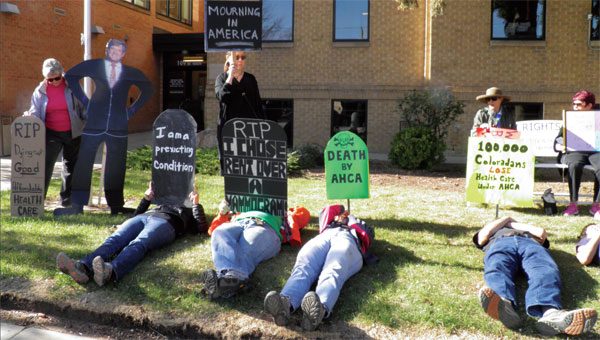
2017 HEALTH CARE PROTEST DURING A VISIT BY US REP SCOTT TIPTON

Strong turnouts at events such as this health-care protest during a visit by U.S. Rep. Scott Tipton to the Montezuma County commissioners in 2017 have encouraged the Montezuma County Democrats and local progressive groups. Photo by Gail Binkly.

Klein is understandably biased, but he sees 2018 as an opportunity for Democrats to make great strides in local and regional elections, no matter what may occur on the national stage.

He points to the fact that there are Democrats running for seats on the town boards of all three of the county’s municipalities – Cortez, Mancos and Dolores – this spring. Although these races typically aren’t partisan in nature and candidates don’t identify themselves by party, Klein says it’s good to have people running who share progressive values.

“We worked hard to get progressives to run for the school board, too,” he said. “We’re trying to get people on the most local elected positions and even special districts.”

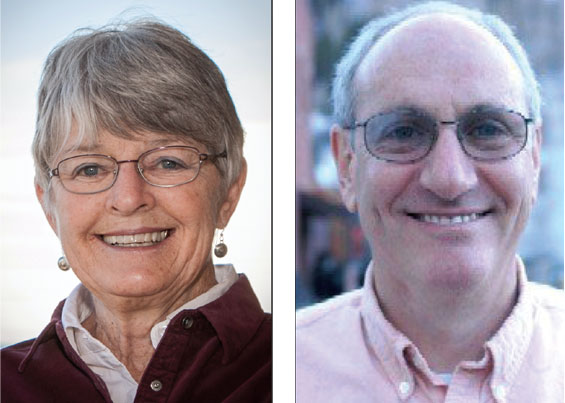
DEMOCRATS MARY BETH MCAFEE AND SETH CAGIN

Democrat Mary Beth McAfee of Lewis is seeking the seat on the Montezuma County Commission currently held by Republican James Lambert, while Democrat Seth Cagin of Telluride is running for the Colorado House from the 58th District, a GOP stronghold.

In addition, a Democrat, Mary Beth McAfee of Lewis, is running for the county-commission seat currently held by Republican James Lambert (who also faces two challengers on his party’s side). In 2014, no Democrat was willing to go up against Lambert, who easily defeated an independent candidate, Bill Utrup, 62 to 38 percent.

And a Democrat, Seth Cagin of Telluride, is mounting an energetic campaign for the 58th District seat in the Colorado House. It had been held by Republican Don Coram of Montrose until he left to fill a vacant seat in the state Senate. Marc Catlin of Montrose was appointed to fill out Coram’s term.

Cagin is the first Democrat even to run for the 58th in three elections, but he says he is hopeful he can be part of a “blue tide” this fall.

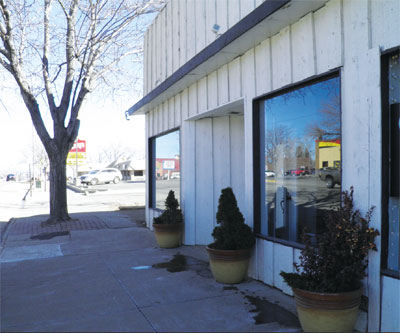
MONTEZUMA COUNTY DEMOCRATS OPEN CAMPAIGN OFFICE

The Montezuma County Democrats are opening an office this month on Cortez’s Main Street. Normally they do not have an office other than in presidential election years. Photo by David Long.

Nevertheless, Montezuma County remains a conservative stronghold, a challenging place for the left to gain a toehold.

The county went for Trump by 30 percentage points, 61 to 31 percent, in 2016, even though the state as a whole went for Hillary Clinton. There hasn’t been a Democratic county commissioner since Kelly Wilson, elected in 1996 and 2000, and he was not a raging liberal by any means. Though two of the current commissioners, Larry Don Suckla and Keenan Ertel, were elected as independents, that isn’t because they are moderate in their views — rather, they found the mainstream GOP too centrist for their sentiments.

Likewise, the 58th District – which includes red counties Montrose, Montezuma and Dolores along with one blue-leaning county, San Miguel – has been considered “in the vault” for Republicans in recent years.

So candidacies such as McAfee’s and Cagin’s may seem quixotic, but Klein doesn’t see it that way.

“We’ve witnessed a lot more involvement in our community. We have more people active in the Montezuma County Democrats but also we are seeing individual groups like the Montezuma Alliance for Unity and Four Corners Indivisible in Mancos that didn’t exist a few years ago,” Klein said.

Klein said both of those groups, which are part of the grassroots progressive “Indivisible” network, a 501(c)4 nonprofit, are “springboards from the disappointment and outrage over our new president.”

Klein has been heartened by the turnout at a number of local events over the past year, beginning with the Women’s March the day after Trump’s inauguration. That drew 500 people out on a snowy morning in Cortez to join with millions of marchers worldwide.

Since then, there has also been a “diein” during which protesters lay down in front of the Montezuma County courthouse during a visit by Congressman Scott Tipton to protest his support for repealing the Affordable Care Act; a Women’s History rally and march in the month of March in Cortez; a climate rally in April; a “Celebration of Canyons of the Ancients National Monument” event at the WildEdge Brewery in Cortez; and last month’s repeat of the Women’s March and rally, this one with a theme of “Power to the Polls.” That happening brought out 400 of the faithful (a number confirmed by this reporter as well as others who counted the marchers as they walked by) to Cortez’s City Park on a chilly morning.

Local activists at the rally decried the fact that fewer than 20 percent of the county’s voters cast ballots in the last presidential primary compared to 24 percent statewide. They exhorted citizens to vote.

Cortez Mayor Karen Sheek told the crowd, “The way you can have the most immediate effect on your quality of life is by electing people to your local governments.” She said people also need to show up to meetings of city councils, school boards, and other bodies.

McAfee, wearing a T-shirt that read “Don’t Just March – Run,” said grassroots activism matters. “You can make a difference right here,” she said, while calling for civility and government transparency.

“I never thought I’d see in Cortez the great turnout at this year’s march and all those other events,” Klein said. “We’ve really had a good turnout of people who realized we can’t just give lip service to involvement any more.

“We’re seeing the kind of energy we didn’t see before. It’s gone to a whole other level. We never used to work hard to make sure we had candidates on the ballots for all the town boards.

“I hate to admit it, but we’re learning from the Tea Party, which has been able to effect change through grassroots action.”

He cited the example of the healthcare protest at the county courthouse. Citizens packed the commissioners’ meeting room during Representative Tipton’s meeting with the board, and many made comments, all of them civil. Then a number of protesters chanted, “Shame on you!” at Tipton outside the building as he was leaving.

“If Scott or [Senator] Cory Gardner shows up in the area, there’s going to be a few hundred people with signs, not just glad-handing Republicans saying, ‘Keep it up’,” Klein said.

He said he knows getting progressives elected locally will be an uphill battle. “The key is to motivate our voting base to turn out, as well as pulling in some moderate Republicans and independents.

“I cut my teeth on protesting in college to end the Vietnam War. We know how to do this. It’s interesting to see young people becoming aware that they need to take action.”

Klein said he is realistic about what may transpire. “It’s not going to happen overnight. It’s not a groundswell, but I’m seeing more energy than we have had in the past.

“We’re not where we want to be yet, but I’m optimistic.”

Published in February 2018

Murder on Haycamp Mesa: Meth is believed to have played a role in the county’s first killing in 2018

Speed kills.

That nugget of wisdom from the last century’s methamphetamine craze remains, unfortunately, as relevant today as when the insidious drug infiltrated the peace-and-love counterculture of the 1960s and left it in ruins.

The present epidemic appears to be taking an even stronger grip on America, and the Four Corners is certainly no exception.

Montezuma County’s first murder of the new year allegedly took place under the influence of meth.

And the suspect’s stated reason for the fatal shooting of 42-year-old James Box Jr. certainly seems to be attuned to the twisted thinking of a speed freak.

Box was a member of the Southern Ute tribe and lived in Ignacio, Colo. He was a father with two children.

The man accused of his killing, Kevin Wade Folsom, 39, of Montezuma County, was arrested Jan. 3 and is charged with first-degree murder, along with numerous other felonies. Those include possession of a controlled substance, possession of a firearm by a previous offender, tampering with a deceased body, and being an habitual offender. He was advised of these charges Jan. 4 and remains in jail on a $500,000 bond.

Folsom has an extensive criminal history and had been paroled from prison in 2014 after serving six years for a burglary in La Plata County.

After his arrest, Folsom agreed to talk to a sheriff ’s detective without counsel, according to the affidavit of Detective Lt. Tyson Cox of the Montezuma County Sheriff ’s Office, and gave his version of the homicide.

Folsom told Cox he was partying and using meth at night on Haycamp Mesa with Box and Box’s wife, Jennifer, the affidavit recounts, when a physical struggle erupted between the couple, and then Folsom heard a gun go off.

“Kevin Folsom [said he] was not sure who had the gun or who had brought it, but he observed James Box, Jr. bleeding profusely,” the affidavit states. “He picked up the gun off the ground and shot [Box] in the head ‘to put him out of the misery’.”

But whether this is an accurate account of the event remains to be seen.

Whatever the truth, the powerful stimulant appears to have played a major part in the slaying.

“Apparently everybody was using meth – that’s why I said from the very beginning drugs were definitely involved,” Sheriff Steve Nowlin told the Free Press in a Jan. 26 interview.

When Cox asked Folsom why he didn’t call 911 to get the victim medical help instead of shooting him, the affidavit continues, Folsom said that he “didn’t believe [Box] would survive that long due to his extensive blood loss.”

Two bullet wounds to the head in close proximity were observed once the body was recovered from the crime scene, according to Nowlin. A gun believed to be the murder weapon was also recovered and was being tested by the CBI.

Folsom was apprehended Jan. 3 after Jennifer Box’s father contacted Nowlin and informed him that the suspect had told him about the shooting and demanded he help in disposing of Box’s body.

“He didn’t have much of a choice [but to accompany Folsom],” Nowlin said “He was pressured.”

However, Nowlin said, Box’s fatherin- law kept in touch with him by texting the sheriff from his cell phone as he accompanied the suspect back to Haycamp Mesa to the crime scene off Forest Service Road 557. There, the witness watched as Folsom removed Box’s pants from his body and placed them in the back of Folsom’s pickup, the affidavit states.

A team of detectives who were keeping the father-in-law’s residence under surveillance arrested Folsom shortly after he dropped off the witness at his residence.

Although Folsom was initially held for murder in the second degree, the charge was soon amended to first-degree murder, which, if he is convicted, could mean a sentence of death.

Nowlin said it was changed “because of the premeditation the evidence shows.”

“The district attorney believed that it definitely met all the elements of the crime of first-degree murder,” he said.

The sheriff declined to go into further detail about what that evidence may be.

“There’s a lot more to [the shooting] than what you’re seeing there [in the affidavit],” Nowlin said, “and if we didn’t have the elements to prove that beyond a reasonable doubt, he never would have been charged with what he has been charged with.

“The big thing is we don’t want to taint any potential jury pool,” he explained. “Everybody is entitled to a fair trial as provided by the Constitution and Mr. Folsom’s no different.

“But I feel very comfortable in everything he’s been charged with, that all of that can be proven.”

Pleasure and paranoia

Meanwhile, the damage meth is wreaking on the social fabric keeps on keeping on.

Incident reports from local law-enforcement agencies are rife with arrests for meth possession, both in smaller quantities as well as more significant amounts (often accompanied by scales and micro-baggies), which can bring the additional charge of distribution.

In many cases the arrests start out as routine traffic stops, or a warrant service or a domestic-violence investigation during which the drug is found.

Just last month, two juveniles found a pouch containing meth near the Dolores High School, which they turned over to a deputy. It had apparently been dropped by a careless consumer. “It’s everywhere,” said Nowlin, who believes the drug makes people more likely to engage in violent acts.

Researchers agree.

Methamphetamine is “a highly addictive, long-lasting chemical substance that affects the central nervous system and creates a feeling of intense euphoria in the user,” according to an article by Elements Behavioral Health.

Meth affects a user’s brain in two ways. It stimulates the limbic system to produce as much as 12 times the normal amount of dopamine, a neurotransmitter that causes pleasure, resulting in that euphoric state. However, at the same time meth destabilizes another part of the brain, the amygdala, reducing a user’s self-control and commonly producing a sense of paranoia, the feeling that “someone is out to get you.”

Statistics and estimates vary, but most are in agreement that nationally more than 1 million people are using meth, and drug treatment programs are seeing increasing numbers seeking to kick their habits.

More to come

The complete role that meth played in Box’s slaying is yet to be established, along with what other motive Folsom might have had for allegedly committing the cold-blooded murder.

A preliminary hearing is set for April 6, during which the prosecution would have to produce sufficient evidence to have the case bound over to district court for trial; but Folsom’s defense has the option of waiving the hearing and going directly to trial.

Either way, time will tell.

Published in February 2018

A green light for the AMBER alert: A system will be implemented at last on the Navajo Nation

Navajo Nation Council delegates Nathaniel Brown and Amber Kanazbah Crotty

Navajo Nation Council delegates Nathaniel Brown and Amber Kanazbah Crotty facilitate a teleconference meeting at Window Rock, Ariz., to intersect sexual assault prevention and human trafficking
policy development. Courtesy photo

The Navajo Nation is set to implement an AMBER Alert system that will cover the 27,000-square-mile reservation in Arizona, New Mexico and Utah, making it possible for authorities to send immediate notice across Navajo Country for missing persons, abductions, emergencies and hazards.

Money for the estimated $850,000 project is coming from the Navajo Nation appropriations bill. Council Delegate Amber Kanazbah Crotty was the sponsor for the proposed funding.

“It is the 2017 issue closest to my heart,” said Crotty. “We pushed council for [Navajo] funding after holding our own internal [Navajo government] process accountable. I have no authority to complete the paperwork, or push the job along faster, but I could keep my constituents informed of the progress we were making and build community support to get the process completed,” she told the Free Press.

The nation will be one of only a handful of the 560 Native tribes with a system in place to issue child-abduction alerts from their own law-enforcement departments. Most must coordinate with surrounding state authorities and the National Center for Missing and Exploited Children to send word about abductions.

Without their own AMBER Alert system, tribal law enforcement faced multiple steps to alert state authorities surrounding the reservation in an emergency. The process can delay the time an alert could be posted and endanger the lives of victims.

Interest in developing the system has been in the works since 2007, when the U.S. Department of Justice awarded a $330,000 grant to the tribe. It was intended to fund a pilot project that would expand the AMBER Alert system into tribal land. In the years since, half of the Navajo grant funding was spent on equipment, such as tents and megaphones. The remaining half was not spent while the pilot project languished.

Wake-up call

A wake-up call came in May 2016 when 11-year-old Ashylnne Mike was found dead a day after she was abducted by a stranger near Ship Rock, N.M., on the reservation. Navajo police followed all protocol in getting an alert issued but it didn’t show up on people’s cell phones until 2:30 the day after her abduction.

The delay raised the possibility that she could have been found alive if an alert had come soon. Navajo President Russell Begaye acknowledged the need for a more effective response system that uses modern technology.

The tragic event also spurred the council to create the Naabik’íyáti’ Committee’s Sexual Assault Prevention Subcommittee to develop safety initiatives and policy changes amending the nation’s laws, and programs to prevent sexual assault and child abduction.

Crotty was appointed chairperson of the SAP Subcommittee. It gave her the authority to keep the pressure on the Navajo government to develop the AMBER Alert system. “SAP requested several reports and updates from the Navajo Nation Department of Emergency Management and the Office of the President and Vice President regarding the implementation of the AMBER Alert system over the last year. We have been diligently tracking its progress since this issue was raised by Council in May 2016, and we will continue to do so until it is fully implemented,” she said. They hope to test the system in January 2018.

In December, President Begaye signed a contract with Everbridge, Inc., a company that provides mass-notification software that will be integrated with the Federal Emergency Management Agency’s Integrated Public Alert and Warning System on the Navajo Nation.

“Council recognized the challenges of the three-state emergency alert system. As a result funding was allocated to implement a Navajo-managed emergency alert system,” Crotty said in a statement. “However, it was concerning that it took over a year to obtain the emergency alert software after council approved funding in September 2016.”

In January the SAP Subcommittee, law enforcement and lawmakers will present the project kickoff. “It will be an exciting day. We are using our own funds to protect our own people,” she said.

Assault and trafficking

Crotty told the Free Press that issues around child safety, abduction, AMBER Alert systems, hazards, and emergencies, are closely linked with sexual assault and harassment, bullying, and even human trafficking on the reservation.

Well before the recent spate of sexual harassment charges ricocheting around celebrities, Crotty was speaking out in council chambers, where she is the only female among 24 delegates. She shoulders tough testimonies on behalf of programs such as Violence Against Native Women.

In a July council session she addressed the council, speaking out against the sexual harassment of female legislative staff by council delegates, and the intimidation and criticisms of the women in the council workplace.

“It’s epidemic,” she says. “Fifty-six percent of Native women experience sexual violence.”

She said the rates are compounded by issues such as colonization of the land and resources and women’s bodies are part of the violence. “We must educate leadership about the lateral oppression, how we mimic what has happened to us. Navajo-on-Navajo violence is our responsibility and our voice has the power to let colleagues know the truth about violence against women and the prevalence in Indian Country, shed light on the training needed for advocacy.”

More men are telling their stories, too, but, she said, “overwhelmingly our Navajo women and children are targeted. Every day I am notified of harassment in the workplace or of an assault in a Navajo community. Sexual assault and harassment has been normalized in Indian Country.”

Of immediate concern to Crotty and fellow Council Delegate Nathaniel Brown is education about sex trafficking. National trafficking corridors cross the reservation, Crotty explained. Sometimes the perpetrators lure people by promising movie careers, or work.

Brown sponsored legislation that became law in July, criminalizing human trafficking on the Navajo Nation by a unanimous vote. The law defines trafficking as “the illegal recruitment, transportation, transfer, harboring or receipt of a person, especially one from another country, with the intent to hold the person captive or exploit the person for labor, services or body parts.” Such offenses include forcing people into prostitution or marriage, slavery, sweat-shop labor or the harvesting of organs from unwilling donors.

The law calls for cooperation among government and civil institutions to define, prevent and combat the illegal “transporting, trading or dealing” of people.

It is the first law on the Navajo Nation to address human trafficking, Crotty said. It adds a specific, sex-related crime to the criminal code, allowing officers to make arrests.

Brown, who is also a member of the SAP Subcommittee, has testified with her at federal and state hearings on human trafficking and sexual assault on Native people.

The work of the SAP Subcommittee is just beginning, she said. It’s time to raise awareness now that the legislation has become law.

SAP Subcommittee members are often called upon to testify in state and federal hearings on sexual violence and harassment against women, and concerns such as dwindling funding for domestic-violence shelters, victims’ advocate training, prosecutors and datasharing.

“Last year I waited 13 hours to speak at the U.S. Department of Justice and then was only allowed five minutes,” Crotty said in a post to her nearly 6,500 followers on Facebook. “This year we provided more than thirty minutes of high level testimony.”

Published in January 2018

Beau knows Louis L’Amour

“This book may drive you crazy.”

So begins Beau L’Amour’s Introduction to Louis L’Amour’s Lost Treasures, Vol. 1, a 500-page compendium of his late father’s unfinished manuscripts, treatments, and notes. But in this, Beau misleads. Truer to have written, “This book will make you a Louis L’Amour fan for life, and if you’re already a fan, it will give you unprecedented insight into the creative process that made him one of America’s most popular storytellers.”

LOUIS L'AMOUR'S LOST TREASURES BY BEAU L'AMOURHow popular? His 91 novels have sold over 300 million copies worldwide. He also wrote nearly 400 short stories, articles, screenplays, and poems over the course of a 50-year career that culminated in both a National Book Award (in 1979) and a Presidential Medal of Freedom (in 1984.) Not bad for a North Dakota farm boy who’d spent his young adulthood toiling in mills and mines, sometimes hoboing and prizefighting, before crisscrossing the world as a merchant seaman. Louis captured this vagabond lifestyle in stories of action and adventure that he sold to the pulp magazines of the ‘30s and ‘40s. It was only after World War II, in which he’d served as an Army first lieutenant, that he finally found his stride as an author of Western novels. And the rest, as they say, is history.

Well, not exactly. “His success, though long in coming, was also limiting,” Beau tells us. “Since the end of World War II, Louis had made his name writing Westerns. He loved the West, and he loved being successful and making so many people happy with the entertainment he provided . . . but he also felt trapped. Trapped in the Western genre. Trapped by his own success.”

Here, then, is where Lost Treasures earns its keep, affording readers a glimpse of the stories Louis yearned to publish if only the marketplace, or his apprehension of it, had allowed. The book’s 21 chapters consist mainly of stories begun but never finished, running the gamut from supernatural horror to hardboiled noir, from high adventure to classic Western. They include deep-dive historical fiction, and Byzantine intrigues, and even meditations on reincarnation. And Beau sets the table for each chapter with historical or biographical notes that join each entry seamlessly to its neighbor.

Indeed, readers may find Beau’s insights and anecdotes – on inspiration, on process, on family – to be just as compelling as his father’s accompanying fiction, and that’s saying a mouthful. Take, for example, the time a German magazine photographer had Louis pose, typewriter in lap, in the middle of Sunset Boulevard. Not only did his father produce a half-day’s output during the shoot, Beau recounts, but a passing motorist lowered his window to shout, “You’ve got to be Louis L’Amour!”

As its title suggests, Louis L’Amour’s Lost Treasures, Vol. 1 ($28, from Bantam) is the first of two such planned volumes. It’s also the start of an ambitious program to re-issue the entire L’Amour canon in special mass-market paperback editions accompanied by Beau’s postscript commentaries. “Lost Treasures grew out of the material I was organizing for a much more comprehensive Louis L’Amour biography,” Beau told me from his home in Los Angeles. “I have always wanted to make Dad’s papers available to the public rather than allowing them to be locked up in a library somewhere, accessible only to scholars.” The result, I’m happy to report, is a compelling, insightful, and instructive look at the life and legacy of an American literary icon.

Four Corners bonus: To learn more about this book, the larger project, and the men behind both, join me in conversation with Beau L’Amour at the Cortez Public Library on Monday, Jan. 8 at 6 p.m. I promise that if that dialogue proves half as entertaining as the book, it will make for a night to remember.

Chuck Greaves is a member of the National Book Critics Circle and the author of five novels, most recently Tom & Lucky (Bloomsbury.) You can visit him at www.chuckgreaves.com.

Published in January 2018, Prose and Cons

Divine rite

You might think I’d be happy that my dog finished his course of chemotherapy. For the record, I’m not saying I’m not happy. I’m saying only that Wally’s last day of treatment triggered a wide variety of emotion-like symptoms and side effects that the veterinary literature did not disclose to me beforehand.

Why am I experiencing all of these emotions that aren’t pure joy and elation? I mean, my dog just graduated from a six-month treatment protocol, which means he no longer receives intensive doses of drugs with names like Rheumasmallpoxyanide and Cyanenemanimosity, and also my monthly expenses are about to re-enter normal atmospheric conditions. By all societal standards, I should be elated.

But here’s the conclusion I came to: no matter how much I say I’m living in the moment with Wally and appreciating every day we get together, I am still intensely disinterested in him dying.

Again, I feel I ought to be tickled 18 shades of rosy pink. Chemotherapy’s job was to treat Wally’s lymphoma. Now that he’s done with it, his chances are now much higher of living a) longer, b) happier, and c) at all.

But here’s the other conclusion I came to: doing chemo meant I was actively doing something to keep Wally afloat. And not doing chemo anymore? Well, that’s a whole lot of not doing anything but waiting to see if the cancer comes back – or not.

Besides, all the language in the veterinary literature discusses doggie survival rates in terms of months after chemo. Key word: after. It’s like I hit the big snooze button on my dog’s lymphoma for the summer and fall, and now that winter’s here, the clock is moving again.

I thought that reaching the end of chemo would be a triumph. Instead, it’s a finish line that runs me off a cliff. I have no ground under my feet. And I have no idea how far down the bottom is – if there’s even a bottom at all. If I’m very fortunate, all my mixed metaphors will cushion the blow down there.

But I was wrong to presume I couldn’t do anything now that chemo is finished. A friend suggested that I conduct a ritual to commemorate the end of the treatment, to celebrate Wally, and to release my anxieties before I drove everyone nuts angsting over not being able to do anything now that chemo is finished.

A brilliant idea! And one I could totally do, if I had any idea how to go about conducting a ritual.

The shape of the ritual itself, I’m led to understand, is not important. But when I consulted more authoritative sources, like Buffy the Vampire Slayer, it was clear that a botched ritual results in all sorts of unhinged demons and other high-school drama. So I built a ritual free of mythological invocations, blood, and any possibility of screwing it up. Seriously, it was on the sticks-and-stones level of technological innovation.

However, I’m not so sure I should spill the secrets of what my ritual entailed, exactly. A ritual is a highly private affair, not exactly meant to be shared with just anyone who can read. Plus, including a bullet-list ritual recipe is a cheap way to flesh out a column, and I have enough words left in me to finish this out, thank you very much.

On the day we ritualed away my anxieties, I packed up my rucksack with enough supplies to draw suspicion at the border. We went to a sacred stretch of riverbank, a place where we could be alone with the water and enjoy seclusion, far from prying eyes, which was handy because the ritual involved uncontained fire.

We scrambled down the rocks to the low-water shoreline, and – egads! A fly fisherman was already there. I whistled to make it look like I had no ulterior motives. La la la, nothing to see here. Just a boy and his dog, and a rucksack full of Wiccan contraband.

This was no good. I couldn’t have this rugged man observe my ritual and call the cops because some alleged delinquent was dancing around with his shirt off and yelling guttural sounds on public lands. Plus, he might think I was weird.

So we picked our way down the rocky shore, aiming for a turn in the river that would shield us from the fly fisherman’s view. We rounded the bend and – there was another fisherman!

I was willing to go to great lengths to remain inconspicuous to these sportsmen. Wally, I should note, was meanwhile busy doing his thing, which consists of drawing attention to himself. He ran around all hyper, greeting the fishermen, sniffing their tackle boxes, and generally making it clear that I was the human responsible for his behavior.

I finally lured Wally away from the interlopers-in-waders and to a secluded stretch of river rock. We were as far away from the second fisherman as we were from the family of three picnicking around the next bend upstream. Less than ideal. But I was ready to get a move on with this letting-go ritual thing.

So while Wally splashed in the water and hunted for fetching sticks, I arranged my elemental tools and lit them on fire until the wind blew them into the water, and then Wally tried to sniff the flames still on shore, and then I dunked the objects in water that weren’t already there, and by that point all I had left was a rock, which I offered to the sun in gratitude.

And when it was done, this dog baited me with his eyes – the same eyes that told me he wasn’t done living yet, that chemo was the right choice in the first place – right into chasing him through the woods and over boulders and through a picnic under fishing lines. We crumpled into a soggy, sandy heap. And then we went and ate barbecue.

The whole thing was absolutely ridiculous. But I’m glad we did it, even if there’s still nothing I can do for Wally now but wait and see.

Zach Hively writes from Durango, Colo. He can be read and reached through http://zachhively.com and on Twitter @zachhively.

Published in Zach Hively

We need a real dialogue about climate

Early in December, U.S. Environmental Protection Agency Administrator Scott Pruitt told lawmakers he intended to organize a “Red Team vs. Blue Team” exercise to debate climate change.

Pruitt is being willfully blind to the fact that the scientific aspects of global warming have already been thoroughly debated by experts. It’s expected that Pruitt will orchestrate a lawyerly winner-take- all debate. One that’s based on rhetorical trickery and a ruthless disregard for facts.

It’s a shame, since we Americans need a constructive, educational dialogue. A debate where honestly representing your opponent’s arguments and data is as important as honestly representing your own data. One where objective learning is the goal, and where truth matters.

Speaking of honestly representing the science, on Nov. 9 Dr. Kevin Trenberth (the senior scientist at the National Center for Atmospheric Research in Boulder and a lead author for IPCC’s Scientific Assessment in 1995, 2001, and 2007, a giant in the field of climate assessment) gave a talk at the Fort Lewis College Climate Symposium explaining what scientists have learned about our planet. It sounded to me like a potential Blue Team opening statement.

Since climate scientists and the science itself are under attack today as never before, it’s critical for more citizens to become aware and engaged. That’s why I want to share what Trenberth explained to us, along with some additional facts that make clear what an internally consistent understanding researchers have achieved.

Trenberth underscored that pretty much all climate scientists agree. As for the few outliers, they are driven by other causes, such as religious and political inclinations. He explained, “As a whole the data are of mixed quality and length. If you were to look at one little piece of it you might be able to be skeptical that climate change is happening, but when you put it all together there’s no doubt whatsoever that this is happening.”

Trenberth went on to use a metaphor of Earth as a patient obviously running a fever. If Earth could go to a doctor, that doctor would start by diagnosing her symptoms, such as the composition of key components. One of the first symptoms noted would be the atmosphere’s rapidly changing composition.

These increasing greenhouse gases, particularly carbon dioxide, happen to be our planet’s insulation regulator. At around 180 parts per million of CO2, Earth experiences Ice Ages; at roughly 280 ppm it’s nice temperate periods, such as those our society evolved in. Today, it’s past 400 ppm.

The physics of this earthly insulation blanket are understood so thoroughly that a great assortment of modern marvels such as satellite imagery and heat-seeking air-to-air missiles would be impossible without it. That is to say, “Atmospheric GHG Theory” is as certain as certain gets!

We also have a clear understanding of why these greenhouse-gas molecules are increasing. We know how much fossil fuel humanity has been extracting and how much has been burned and injected into our atmosphere (and oceans).

We also know how much atmospheric concentrations have risen. That reality was driven home when Trenberth showed us the Keeling Curve of atmospheric CO2 levels being collected at Mauna Loa Observatory in Hawaii since 1958.

On close examination the line graphically illustrates the seasonal ebb and flow in Earth’s respiration. Think inhalation and exhalation of life’s sustaining molecules. What’s terrifying is when zooming out and averaging those fluctuations, the line goes from 315 ppm in 1958, to beyond 400 ppm currently – an increase of 85 ppm in 60 years. Compare that to younger Earth which was used to taking around 50,000 years to go up or down by 100 ppm.

The doctor’s prognosis is that more warming will be disruptive to our particular biosphere, the one our current climate regime created, the one it has supported for thousands and tens of thousands of years. The one we are absolutely dependent on. Change is constant, but what’s happening to our Earth this time is something extraordinary. Trenberth then superimposed global mean temperatures on the Keeling Curve and explained how their similarity was no coincidence. The overall CO2/ temperature correlation is obvious, although there are sections where the two are clearly out of sync.

This is because greenhouse gases aren’t all there is to global temperatures. While Earth’s atmospheric insulation regulates the overall temperature setting, it’s a dynamic living planet with many age-old cycles and rhythms interfering and converging with each other.

For example, our oceans contain over 90 percent of our climate engine’s heat. That heat gets moved about in dozens of different currents and oscillation patterns that have profound but short-term effects on the atmosphere, weather and local temperatures, even global temperatures.

But in essence that’s only moving heat around the globe, impacting weather but not Earth’s overall temperature – that is done by our atmosphere.

In fact, you could say Earth is not heating, Earth is accumulating heat. Increasing GHG molecules are increasingly intercepting and slowing the escape of infrared radiation, thus allowing more to accumulate within our biosphere.

But climate changed before, you say? Yes, it did. Looking back into Earth’s deep-time, natural variations caused by geologic, planetary and solar forces had big impacts, but none of those factors are in play these days.

Yes, volcanoes drive natural variations with cooling caused by emitted aerosols. Aerosols that have short atmospheric “residence times” measured in weeks.

On the other hand, volcanoes also emit massive CO2, which has an atmospheric residence time measured in centuries, producing long-term warming. Incidentally, today human CO2 emissions dwarf current volcanism on the order of 60 to 1. What about the mid-21st century global cooling? Well, that cooling trend ended as nations took steps to clean their smoggy skies. It turned out sulfur aerosols acted as tiny reflectors mirroring a fraction of the sun’s ultraviolet rays back into space before those rays had a chance to convert into infrared radiation which warms our biosphere, thus driving that not-so-natural cooling trend.

What about last decade’s “warming hiatus”? That was a media farce, the “missing” surface heat was found where geophysics dictated it would be found, in the oceans. No hiatus, our atmosphere’s insulation works 24/7/365.

In a serious debate the Red Team would now need to respond to these facts, not with distractions and drama, but with facts and realistic, clearly enunciated challenges and a willingness to learn.

Peter Miesler writes from near Durango, Colo. His essays, along with global-warming information, are posted at Citizenschallenge.blogspot.com.

Published in Peter Miesler

Going back to Clovis people in Colorado

EAGLE ROCK SHELTER … For years I’ve been working on a calendar that will reflect this place where we live. I’ve wanted to base it on the earliest dates that humans might have settled the “New World” – as opposed to the Gregorian/ Julian calendar with its Old World roots in European traditions. So the latest archaeology intrigues me … I’d heard about a significant dig out near Austin in Delta County. I’d even made several attempts to find it. Finally, my friend Dea Jacobson of Cedaredge took me there. We followed a Lawhead Gulch Jeep track through the Gunnison Gorge National Conservation Area and down to the Gunnison River Rock Art Site (SDT 813). But no need to wander. The BLM has just built a convenient gravel road to the riverside overhang and erected new signage. They are welcoming visitors … I did some research, and I’m astounded … Tamie Meck of the Delta County Independent broke the story in the fall of last year. SDT 813 was reported to the agency in 24988 (1988 CE) as a “looted site.” It showed signs of Ute habitation and an Archaic layer dating back about 4000 years. “That’s to be expected,” said BLM archaeologist Glade Hadden with the Uncompahgre Field Office in Montrose. “Almost every rock shelter in this country dates back to about 4000 years, but never beyond that” … Thinking there might still be finds the looters missed, Hadden organized an excavation with Dr. Dudley Gardner of Western Wyoming Community College. In year one they found a 300-year-old Ute fire-pit and projectile points dating back 3000 years, including pre-Columbian Fremont points (rare in this area). In year two they hit a large stone layer where looters had stopped digging, evidence of earlier flash flooding along the Gunnison. Beneath that layer the students found undisturbed context going back 4000, 5000, 6000 years. In the 7000-year-old layer they found more evidence of human occupation … Then, six years ago, they found a hearth that carbon dated to 12,960 years ago – part of the ancient Clovis culture. Eagle Rock now had the distinction of being the oldest known archaeological site in Colorado. And beyond that, noted Hadden, “We have the only … stratified Paleo site in the world. The site, not much bigger than a small house, provides a complete record of Paleo culture over an extended period of time dating from between 13000 and 8000 years ago, with no gap in occupation” … Maybe, instead of a New World Calendar based on our species’ first steps on the continent (a 25000 plus or minus date that keeps shifting around with new archaeological evidence), we ought to craft a Western Slope Calendar based on the region’s earliest habitation at Eagle Rock Shelter in Delta County. How about we call this new year 13018 (WSC)

ALIENS ARE HERE! … Hawaii’s Pan-Starrs 1 telescope on Mauna Kea has confirmed it. An asteroid they’ve named ‘Ou-mua-mua (“first messenger from afar”) is the first sighting of an interstellar object from another solar system intercepting ours – something only recently observable with technical improvements … According to a NASA press release, “For decades we’ve theorized that such interstellar objects are out there, and now – for the first time – we have direct evidence they exist,” said Thomas Zurbuchen, associate administrator for NASA’s Science Mission Directorate in Washington. “This history-making discovery is opening a new window to study formation of solar systems beyond our own” … Multiple international scans now suggest a cigar-shaped asteroid – “highly elongated: about ten times as long as it is wide, with a complex, convoluted shape,” said Karen Meech of the Institute for Astronomy in Hawaii. “We also found that it had a reddish color, similar to objects in the outer solar system, and confirmed that it is completely inert, without the faintest hint of dust around it” … Inert or in hiding?

KATIE LEE … We lost this legendary eco-warrior, folk singer, actress, filmmaker, and writer at the end of last year. She was 98. Her passionate anger at the damming of Glen Canyon never abated after her visit to the pre-dam site with its 125 side canyons. At the time she said, “It was utterly and incredibly beautiful … All the colors were perfect. All the senses just came flashing out. I could hear better, I could feel better, I could speak better. Everything just … amplified.” I got to hear Katie speak a couple times. And once, when I came up to talk to her afterwards and upon hearing of my role as poetry editor for Earth First!, she grabbed me by shoulders and gave me a grand kiss on the lips … It’s a badge I will always wear proudly.

FAIRYLAND … Finally got around to reading Alysia Abbott’s memoir of her father, my San Francisco poet friend Steve Abbott, editor of Poetry Flash, organizer of the seminal Left/Write Conference in the early ‘80s, columnist for multiple gay publications, hip lit-zine editor and cartoonist extraordinaire. I remember him as a single dad from Nebraska raising his daughter in the Haight-Ashbury. She came to our readings sometimes. Now she’s come out with a widely celebrated book about what it meant growing up in a gay community – just as disaster struck in the ’80s. Steve died in the first waves of the AIDS epidemic … A Cloud House compatriot, Steve and I hung out at the 16th and Guerrero digs of that legendary San Francisco street bard Kush. Weekly readings, street actions, xerox broadsides, special events … While many of us formed a free-form movement called the Union of Street Poets, Steve went on to play a larger role in the avant-garde poetry scene in the city after he left Cloud House … In his magazine Soup, he even named a poetry movement in the Bay Area, “New Narrative.” It’s become a big discussion and the University of California held a Berkeley conference “Communal Presence” this past fall, led by “Language” poet Lyn Hejinian, to examine the “New Narrative Today” … Alysia’s is a formidable recounting, carefully researched (although the Loma Prieta earthquake was 80 miles south of San Francisco, not north). Her unflinching honesty and self-reflections as an adult enhance the paradoxes for a young girl growing up in a gay milieu, loved by her dad, but strained by the conflicts of shifting emotions and needs … It deserves the many accolades it got when it came out in 2013 (W.W. Norton). Recommended.

Art Goodtimes writes from San Miguel County, Colo.


THE TALKING GOURD

Sparkling

christmas lights here
Christmas lights there
Pretty soon

the yurt wears a rainbow
strand of twinkling pearls
day & night

The studio doors sport
a peace symbol the size of
a gas station’s logo

Lit up chili peppers
heat the kitchen. Angel
Illuminati haunt the porch

But for the life of me
McRedeye sez
all I can see are

the burning embers of
a thousand chunks of coal
sparkling into ash

Published in Art Goodtimes

A tree story

The Irish call them “The Dark Hedges” and perhaps they once resembled hedges when James Stuart’s family first planted 150 beech trees along the avenue leading to their newly constructed 18th-century Gracehill House. Had he been born a century later in the American West, he’d likely have settled for an imposing structure of log pillars at the entrance to his property. The sign swinging from a crosspiece would have christened his acreage “Grace Ranch” and I’d be uninspired, without anything else to write.

Luckily, over 200 years have passed, filling a gap in my imagination. Stuart’s narrow strip of “hedges,” intended to impress his neighbors, are now overseen by the Heritage Trust. The compact landmark stands in stark contrast to the vast national-park vistas America offers its visitors, like a tiny luminescent pearl in the history of northern Ireland.

Tour buses pass through the tunnel under the trees, then pull over just beyond it. Passengers disembark with cameras and swarm across the road surface, desperate for the perfect selfie angle or an inspired scenic photograph. I should know, I was one of them, but I also witnessed a woman nearly run over by an oncoming vehicle. Enchantments can prove risky.

A sudden squall of rain sent everyone running for cover. I captured my photo gem – just the trees – veiled in mist and shimmering in the stormy light.

Before stopping the bus, speaking into his microphone, the driver warned everyone, twice, about the danger of standing on the road for the sake of photos without paying attention to traffic. But the setting proved too irresistible, and not just for amateur photographers. HBO also made the location famous by featuring it as “the King’s Road” in its popular series Game of Thrones, which explains why more and more fans from around the globe travel to see how magically the light intersects with the latticework of limbs and leaves.

I returned to the bus. The driver laughed as I stepped inside, wiping the rain from my face. He explained how increasing visitors numbers are transforming the hedges into a traffic hazard, that tour buses might soon be required to register for a time slot if choosing to travel along the Bregagh Road.

“But the trees,” I said, “are so beautiful.”

“Aye,” he replied, “but it’s the population that can’t control its girth. Only 90 trees remain. They should be the protected ones.”

Eventually the sun peeked through the clouds as the green countryside rolled past our bus windows. The driver spoke again to his captive audience about a different tree in northern Ireland called the Fairy Thorn, also referred to as fairy bushes, which are really native hawthorns. Unlike beech trees, they tend to grow like hermits, in the middle of fields, on wind-blown rocky terrains, or at the crown of small hills. According to legend, one of their enchantments is to offer a safe habitat for the wee folk.

It’s also a national disgrace to harm them. Just try to cut one down and your axe handle will split, your chainsaw will sputter, the engine of your bulldozer will seize. Try poison and you’ll wake up feeling like you’ve been gut-shot. Stories about unsuccessful tree removals have been passed down for generations.

One tree, an ancient fairy bush, has been growing at the Ormeau Golf Club since 1893, when the course first opened. Greens keepers reportedly will not touch it or even trim it. If a golf ball hits it, the Irish don’t curse. Apologize to the tree, golfers say, and at least you won’t be given a bad game.

Many Irish believe in the power the wee folk wield to help the big ones. A tree might be discovered in the middle of nowhere, already adorned with ribbons and strips of material torn from the clothing of the sick or suffering. These offerings are not motivated by any fear of what harm the fairies might conjure, but in the sincere hope these spirits might help heal them.

Our driver promised to take his passengers to see a fairy thorn and I could feel a tremor of excitement ripple through the bus. As we approached a curve in the road, sure enough, a small tree just off the road stood festooned with a flurry of fluttering ribbons. He slowed the bus for the sake of the cameras.

“Can’t we stop for a closer look?” someone shouted from the back of the bus.

By way of an answer he stepped on the gas. Either the heavy side-traffic on this narrow road prompted his quick departure or he knew what the fairies could do to a busload of tourists trampling the turf where they reside. Either way, he probably saved lives.

David Feela, an award-winning poet, essayist and author, writes from Montezuma County, Colo. See his works at http://feelasophy.weebly.com/

Published in David Feela

Word pictures

Devastated, disastrous, pristine, beautiful, values, destroyed, protected, saved are all very good and descriptive words in our English language and are commonly used in discussing the status of management on the public lands of the state. Now take a minute and think of the mental picture you think of as you slowly read and say out loud each word. Don’t worry about anyone watching you and wondering, they already think you’re weird if you are reading my articles anyway.

Here is one more that I want you to visualize, Clearcut. What did you see? Did you see devastated, destroyed? It depends upon what you have been shown pictures of and been told in the past. Your conclusion is, that’s bad!

But is it? Just maybe you don’t know the whole story and the alternatives. Don’t jump to conclusions before you know all the true scientific facts. Here is another hot one — “Protect Bears Ears Monument.” OK, what did you picture? Did you ask yourself, protect what from what? What has happened that it suddenly needs protection? What effect does it have on you ? How will calling something by a different name protect it? Just what is meant by “protect”? Sounds like a government- sponsored “protection racket.” Again what are the alternative impacts?

Now that you are all worked up, take a deep breath, pour a cup of coffee and calmly read on, I will try to be nicer. The management, use and protection of the public lands of the states have been under attack by special-interest tax-exempt corporations to benefit their own interests and supporters at the expense of the much greater populace, you and me. This has been happening for over 50 years and now we are reaping the results with “devastating” effects from insect epidemics and massive intense wildfires. Some may say, “if those lands had been in wilderness and conserved, that would not be happening.” Well, that is where most have been, and thus precisely why it is happening. Over half of the National Forest lands in Colorado are in special “conservation” lockups as wilderness and roadless areas. In addition there are “Natural Conservation Areas”, “Special Management Areas”, “Natural Areas,” all being primed to die by insects and or wildfire. To make matters even worse, the Travel Management Plans close access for reasonable fire protection and fuel loading reduction and management. Wait! These are in “Conservation Protection” areas so that cannot be happening, right?

What is your visual picture when you hear “conservation”? Is it set aside from use and thus protected? You have been duped by the shrewd environmental word doctors. Webster defines conservation as “the act or practice of conserving; protection from loss, waste, etc.; preservation.” It is an “action to protect from loss or waste.” Conservation prevents waste and loss, by manipulating, using and enhancing a resource, not by letting it die from insects or disease and be wasted in wildfires and decay. That is gross irresponsibility for any true steward of lands and resources.

There are over a million acres in Colorado in insect epidemic conditions and we are now seeing massive wildfires, devastating the watersheds. How do you Conserve and Preserve fruits like apples, tomatoes, etc.? You plant, culture, prune, cultivate, thin, protect from insects, then harvest, treat for canning, drying or maybe brewing. You do not simply admire and take pictures of the plants as the weeds and insects invade, stagnating the plants, resulting in puny minimal fruit that you let fall to the ground and be wasted. That is precisely what we are doing with the National Forests, paying taxes to watch them be wasted and die while claiming they are being conserved and protected.

So what does this have to do with us in Southwest Colorado? Well, three-quarters of our lands are in federal control, with that containing nearly 100 percent of the productive watershed for the Dolores and Mancos drainages. There are designated wilderness, roadless and natural areas, Special Management areas where you are told they are being “protected and conserved.” Unfortunately, there is an increasing incidence of insect damage in the pine and spruce areas, which has grown from about 2000 acres a couple years ago to now approaching 10,000 acres, including areas from the Western Glade and the upper Dolores River.

Travel management plans have closed access for reasonable fuelwood gathering that would reduce fire hazards, and restricted rapid deployment of ground-based fire-suppression equipment. There have been some that cry that “climate change” is causing the insect and fire problems, nothing can be done. Baloney! The local conditions are now of unmanaged forest lands that have heavy fuel loading in many areas, combined with increasing insect and disease mortality in the forest and increasing drought conditions is a perfect set-up for loss of the Dolores and Mancos river watersheds which supplies our drinking, irrigation and recreation water. No time for finger pointing, now is the time for action!

The importance of “conservation and protection” of the forest and range resources of all the public lands is of highest priority. This means thinning trees and brush, removing dead fuels, managed livestock grazing, opening access for timely fire suppression, all to conserve, reduce and prevent waste of the resources. The greedy environmental corporations have been playing mind games, using words that carry varying visual meanings and elicit high emotional responses of support from the uninformed public who do not realize it is all a big lie to lock up the public lands of the state from true conservation and protection, allowing them to be wasted. The future of healthy public lands, resources, economies and lives of local counties and states is literally in the teetering balance.

Dexter Gill is a retired forest manager who worked for private industry, three Western state forestry agencies, and the Navajo Nation forestry department. He writes from Lewis, Colo.

Published in Dexter Gill

Trump throws sportsmen under the bus

By David Lien

During President Trump’s first year in office he promised to be a conservation president along the lines of America’s greatest hunter-conservationist, Theodore Roosevelt. Instead he — along with his Interior Secretary, Ryan Zinke — threw sportsmen under the bus by leading an unprecedented attack on our nation’s public-lands estate.

For starters, they removed national monument protection from 2 million acres of protected public hunting lands in Bears Ears and Grand Staircase-Escalante National Monuments in southern Utah. The Washington Post reported (in “The President Stole Your Land,” 12/5/17) that this is “the largest reduction of public-lands protection in U.S. history.” Similarly, The Hill reports (in “Trump slashed Utah land protections,” 12/4/17) that it’s “the largest-ever rollback of protected areas in history.”

Trump and Secretary Zinke did this despite that fact that during Zinke’s monuments review the Interior Department received roughly 3 million public comments, and 99 percent of them supported keeping national monument protections in place. Leasing for oil and gas drilling as well as uranium and coal mining could begin in as little as 60 days, according to proclamation language.

Talk of shrinking national monuments strikes home across the border in Colorado, as explained by Grand Junction City Councilor Bennett Boeschenstein. Visitation at Colorado National Monument “keeps going up year after year,” Boeschenstein said. Instead of shrinking national monuments, there should be talk of expanding them, he added. Unfortunately, Trump’s national monument “review” was a sham from the start with a predetermined outcome: shutting the public out of public lands and serving corporate special interests.

“America’s conservation legacy defines us and is the envy of the world,” said Backcountry Hunters & Anglers (BHA) President and CEO Land Tawney. “Today is a dark day for that legacy. Roosevelt is shaking his fists!”

“The decision today should be deeply alarming to sportsmen and women. Actions that erode protections for any national monument jeopardize others across the nation. Will that be next?” added Chris Wood, Trout Unlimited president/CEO.

Unfortunately, we’ve already found out “what’s next.” A Trump administration decision to reopen public lands near the 1.1-million-acre Boundary Waters Canoe Area Wilderness to industrial sulfide mining drew strong criticism from sportsmen. “The fact that the Interior Department lacked the courage even to issue a press release on this decision shows that they know it’s the wrong choice,” said Erik Packard, a Minnesota BHA board member and founder of Veterans for the Boundary Waters. “They are too cowardly to face the people who do not want to risk damaging the Boundary Waters because they know it’s wrong.”

The Trump administration also pushed Congress to pass legislation opening the Arctic National Wildlife Refuge (ANWR) in Alaska to oil and gas drilling. ANWR’s 1.5-million-acre coastal plain, known as the “1002 area,” will now be sacrificed to oil companies. In the not-so-distant past, Republican President Ronald Reagan worked with a Democratic majority in the House and a Republican majority in the Senate to pass and sign 43 bills yielding 10.6 million acres of wilderness areas in 31 states.

What has President Trump done? Removed protections from (or put at risk) some 4.6 million acres of public lands, and he’s just getting started. President Reagan (like Republican President Theodore Roosevelt before him) put our responsibility for public lands in the proper perspective when he said, “This is our patrimony. This is what we leave to our children. And our great moral responsibility is to leave it to them either as we found it or better than we found it.”

David Lien is a former Air Force officer and chairman of the Colorado Backcountry Hunters & Anglers. He’s the author of “Hunting for Experience: Tales of Hunting & Habitat Conservation” and during 2014 was recognized by Field & Stream as a “Hero of Conservation.”

Published in Guest Column, January 2018

Johnson mixes humor and intrigue in ‘Western Star’

I can attest from experience that injecting humor into an otherwise serious tale of murderous intrigue isn’t easy. But Craig Johnson has been pulling off that enviable trick in his murder mysteries for well over a decade now, to national and international acclaim.

I thoroughly enjoyed 2013’s As the Crow Flies, the first Longmire mystery I discovered. I’ve read and enjoyed all of Johnson’s books since.

the-western-star-craig-johnsonJohnson unspools not one but two absorbing mysteries in The Western Star, the recently released 13th installment in his Longmire series. Starring rural Absaroka County, Wyo., Sheriff Walt Longmire, the series serves as the basis for the hit Netflix TV show Longmire, now in its sixth season.
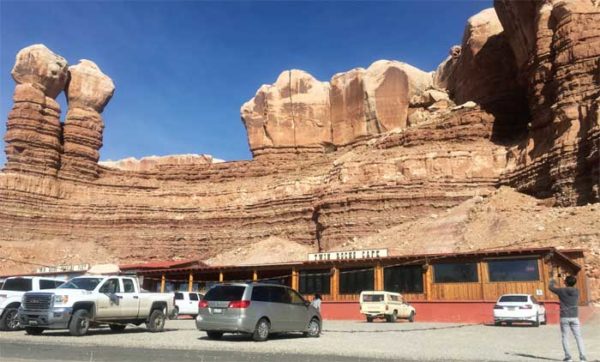
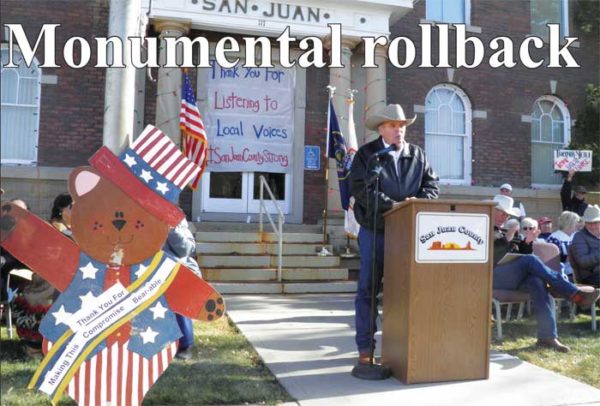
Johnson lives and writes on a ranch east of the Absaroka Mountains near Ucross, Wyo., population 25. He’s headed to the Four Corners region in late January, when he will speak and sign books in Durango.

Residents of the Four Corners area who appreciate the local, steam-powered Durango-Silverton Narrow Gauge Railroad will particularly enjoy The Western Star, which features as one of its parallel story lines a tale fashioned after Agatha Christie’s Murder on the Orient Express, set on an excursion steam-train ride across Wyoming.

Johnson credits a number of steam railroad experts with helping him get his train facts straight in The Western Star. Having spent several summers employed as a machinist’s helper in the Durango-Silverton roundhouse, I can vouch for Johnson’s accuracy in his latest Longmire installment, which also captures the flavor and enduring appeal of steam railroading.

The Western Star bounces between Walt Longmire’s train journey across Wyoming in 1972 as a newly minted deputy sheriff riding herd on a bunch of irascible, hard-drinking Wyoming county sheriffs, and a dilemma facing present-day-sheriff Longmire: whether to stand in the way, for deeply personal reasons, of the compassionate release from prison of a dying murderer.

While he unravels the train mystery, the 1972 version of Longmire wrestles with personal demons stemming from his service in the Vietnam War, making The Western Star darker than previous installments. No matter. The book’s two stories still combine to make for a fine read, straight through to the cliffhanger ending that sets the stage for an obvious sequel.

Johnson, personable and quick-witted, is renowned for his personal appearances. His upcoming local speaking engagement, before what is sure to be a packed house, will be held at the Durango Public Library on Thursday, Jan. 25, at 6 p.m., compliments of Durango’s inimitable, independent Maria’s Bookshop.

Scott Graham is the National Outdoor Book Award-winning author of the National Park Mystery Series for Torrey House Press. The fourth book in the series, Yosemite Fall, will be released in June 2018. Visit Graham at scottfranklingraham.com.


Published in December 2017, Prose and Cons

Public-lands conflicts

A friend recently asked me, why is there so much conflict over the use of the public lands, and what can be done to resolve those conflicts? Well, the first part is fairly simple to answer, however the second is not so easy. To answer the first part requires a look at some history.

All conflicts have a point of beginning, and most often they result from a difference of opinion over an agreement or action. In our state, this point of beginning lies in the Enabling Act of 1875, creating the State of Colorado and wherein it defined the boundaries and stated that all land therein shall be the State of Colorado. Further, the state had to have a Constitution with a republican form of government (not a democracy), to govern all the land and people therein. All this was done appropriately under the U.S. Constitution.

So where did the “public lands” enter the picture? At the formation of the new states and Constitution, the direction was for all lands to be in private ownership for people to be at liberty to live their own lives peaceably with their neighbors in freedom. The later developed federal government was not to control any land other than the portion specifically described as the District of Columbia and specific sites such as forts, dock yards, magazines and arsenals. Further down in Article IV, the new federal entity was authorized to secure new territory and dispose of it to form new states out of. This all worked under the new “Rule Book” (Constitution) for almost 70 years until war broke out over control of lands, resources and people, the very same issues that caused the Declaration of Independence and revolution.

Enter Colorado Enabling Act of 1875. When the state was formed, a large portion of the lands had not yet been “claimed” for various private ownership, so the federal entity decided to act as the real estate agent to sell off the unclaimed portions of land on behalf of the new state, and keep 95 percent of the sale value to retire federal debts from the recent War between the States, the first violation of the “rule book.” Some lands were sold and some homesteaded, but still a large portion was not suitable for homesteading and establishing an individual livelihood. Failing to sell the land for the state, the federal entity got greedy and decided to just keep the state’s land for itself and sell off the minerals, timber, etc. and keep most of the revenues, rather than fulfilling the compact in the Enabling Act and disposing of the unclaimed lands to the state for control and management.

Violation number 2. Those lands became identified as “public lands” under federal control, ignoring the Constitution and State Enabling Act, and governing the lands under its own rules and laws. Therein lays the beginning of the conflicts. A state is not a state if it does not control the lands and resources within its boundaries. The state cannot govern what it does not control. Thirty-six percent of Colorado, not including Indian and other trust lands, is under the control of an outside government, not responsible to the government of the State of Colorado.

Nobody really cared much at the time, as people were just working to survive and build their lives and the new federal agencies of the Forest Service and Bureau of Land Management were doing a pretty good job. By the 1960s, a segment of the population became affluent enough they could spend time and money just relaxing and developing the new idea of “recreation,” and sticking their noses in other people’s lives. The “public lands” were readily available, and the varied interests in recreation immediately became the focal point of competition for who should have priority of access and free use. The federal agencies promoted the misconception that the “public lands” were “YOUR LANDS,” resulting in all the differing interests actually believing the lands were theirs and demanding the federal land agencies provide access and management to meet their individual desires. The land control then became a national political-power issue, no longer a scientific and economic management one.

The next cycle of conflict over control of land, resources and people was off and running, a result of not following the “Rule Book” at the very beginning.

In 1992, the United Nations held the Earth Summit and produced a document titled “Agenda 21” that was the format for saving mankind and the Earth through controlling the people and their effect on the environment. In the U.S. the massive amounts of federally controlled land in the West was ideal to implement the policies of Agenda 21 as the federal politicians were already in control. The federal agencies redrafted management guidelines resulting in today’s restricted access, use, and management of the so called “public lands,” creating increased division and animosity among various users for what little access and use may be allowed.

Why doesn’t the eastern U.S. have these problems? The states are in control of their own lands, resources and people as per the “Rule Book.”

So how can the conflicts to be resolved? The problem has grown massive over the past 143 years, with outside powers and governments being in control. The not-so-simple answer is to return to 1875 and correct the “Rule Book” violations that were made then. Not likely. The only possibility now is for local counties to take the lead in executing their legal authority in developing plans for the “public lands” and petition the state to nullify the unconstitutional federal laws. The local people will have to realize that the lands are state lands, and not “theirs,” so we must all work together at the “local” level for management of the lands and vegetation for their health and productivity for all, not any one “use” preference over another. Good luck!

Dexter Gill is a retired forest manager who worked for private industry, three Western state forestry agencies, and the Navajo Nation forestry department. He writes from Lewis, Colo.

Published in Dexter Gill

Fulfilling a dream on my bucket list

BUCKET LISTS … The concept of a bucket list has intrigued folks like myself for years. There are certain things one wants to do in one’s life, but that seem perhaps unattainable. So you file them away in a bucket of what might be done and await opportunity … I’ve always wanted to go to Ashland, Ore., to see the Shakespeare Festival. My dad was in theater when I was a youth, and I have seen theater all over the country. But I’ve never had the chance to make my Oregon Shakespeare dream come true … Until this year, when my dear friends Jim Rosenthal and Carol Anne Modena, who have a rustic hideaway in Norwood, as well as a home in Port Townsend, invited me to join them, driving from Colorado to Oregon for the festival. I jumped at the chance.

HENRY IV … I’ve seen various productions of Shakespeare, both local community productions and movie productions like the recent film of Robin Lough’s Hamlet with Benedict Cumberbatch. The local shows have varied from exceptional to problematic. And seeing a film of a theater show just isn’t the same, as exceptional as Cumberbatch was and as well done as the National Theater production. Without the immediacy of a living person in front of you, celluloid is a pale shadow of the gestalt of the stage … So, I was excited to see professional actors interpreting Shakespeare at a festival renowned for its production excellence. And I was not disappointed … We got tickets for Henry IV (Part Two), and it was a treat, because I knew very little of the play or of that period of English history … The actors were amazing. Every gesture, every intonation contributed to the conceit. I was moved to tears, literally. And found myself laughing uproariously at Falstaff and his antics … Amazingly, although the language was difficult and the metaphors complex and original, I never felt lost. What might have been obscure in the wording was shown clearly embedded in the action, the way the actors carried themselves, how they motioned, paused or distributed emphasis … I think it will be hard to ever see another Shakespeare play without comparing it to the professional show I saw in Ashland, where I felt like I understood every speech, if not every line.

NINE LIVES #12 … As an astrological cat (Leo’s my sign, McRedeye sez), I almost lost it on Poncha Pass coming back from Salida in a moderate snowstorm back in October – the first of the season. I’d decided not to attempt Monarch. Had experienced some dicey times dodging stuck vehicles on that steep pass. So planned to take the long way out of Salida south to Saguache and over Cochetopa Pass to Gunnison … All the roads were slippery. Especially the lower part of Poncha. Fresh snow on top of sheet ice. I was passing slow vehicles but carefully. And had settled into a steady climb in third, when rounding a curve suddenly I see this heavy-duty pickup flipped over and careening towards me in the fast lane of the two uphill lanes. It’s being dragged by an outsized horse trailer that’s come around on the truck and is sliding along the guardrail of the downhill lane. They whiz past and I don’t even slow down. But a glance in the rearview mirror reveals the horse trailer flipping over like the pickup as it rounds the curve behind me … For a long ways after, I flash headlights. Try to get downhill vehicles to slow down. The snow is inexplicably lighter and the road less slick as I make it up to Poncha Pass and out onto the San Luis Valley … It will be a whole series of adventures, the storm easing up and then gusting fiercely, before I make it into Gunnison. Grab a mocha breve and try to calm my over-amped nerves.

IT COULD BE A BOOK … It’s a wild Paleohippic life I lead. Dashing across the state in all kinds of weather. For Ute reconciliation. For poetry. For politics. For family, friends & fun. Meeting incredible new characters. Reconnecting with old pals & sharing stories … OR, I could be caffeined to a screen. Manipulating glowing pixel embers of coal. Telling my tales to a plug-in machine. Facts embellished into fiction. Or maybe even a religion, like Joseph Smith, creating sacred cloth out of his idiosyncratic visions … Doing an oped column is far more humble. And halffun, ’cause I get to experience things to write about. Not quite a book, but always on the hunt for stories … McRedeye sez: One can give witness to the world, or be the world. Delicious choice!

KOKANEE SPAWNING … My son got in the annual salmon run in the upper reaches of the Dolores River this fall. So amazing to have salmon this high in the Rockies … According to fish experts, Kokanee are a healthier fish because they are not predators, and therefore don’t accumulate mercury like crawdads, trout, and bass. They utilize the middle lake habitat, live away from the shoreline and predators, and feed on phytoplankton.

Art Goodtimes writes from San Miguel County, Colo.


THE TALKING GOURD

Too Grabby

Grabby’s Towing
pulled my car
from the quick-park spot
outside the dry cleaners.

Crass, to hook and take
whose dimensions I know
like my own body’s,
like my peripheral vision
for parallel parking.

I said, this is mine,
don’t you grab it
He said, you’re late, you lose.
Pay up. Rules.

Good news is,
Grabby didn’t open the doors,
touch the wheel,
fidget my possessions.

I’m back to perfect
parallel parking.

—Deborah Kelly
Boulder, Colo.

Published in Art Goodtimes

A dark day in Cortez

Nov. 7 was not a red-letter day for Cortez. Black crepe would be more appropriate. We had a question on the ballot, Measure 3B, asking voters for an increase of close to 5 mills a year in our property tax to pay for better teacher salaries, new school buses and improved technology. It failed by 55 to 45 percent.

Education should not be considered an expense; it is an investment. Why anyone would not want a better education for our future leaders can only be chalked up to stupidity.

It may seem that if you don’t have children in school, you don’t have any stake in what happens to the new generation. But, just from a selfish standpoint, consider that they might be of help in your lifetime. Who knows what child today may come up with a cure for some malady (a disease or disorder of the animal body)? And, yes, we are an animal of the lower class, afflicted with a genetic disorder called greed. We are born helpless and seem to remain so for most of our lives and without education will remain so.

I personally am quite ignorant about many things in this universe but know enough that I want the best education for my children and grandchildren as well as the offspring of other parents. Ask any child of 5 in a third-world country what he wants and the answer is schooling. The first thing settlers to this country built was a church and school, sometimes sending miles away for a schoolmarm, much respected by the townfolk.

Anyone can follow a mule and manage a drawn plow but it’s the fellow that invented the tractor who got more and better crops. Education did that. And who may I ask started agriculture? The women. Instead of wandering all day in search of nuts and berries they figured out to carry some seeds back to the cave, plant them and nurture them. Self-education.

Education is progress. But we are fighting a war with a group who believes strongly that backwards is the way to go. Even as I write this, the U.S. House of Representatives has proposed tax-cut legislation that would eliminate a modest $250 deduction that teachers can take if they spend that much out of their own pockets (and many spend more) for school supplies for their kids. Teachers simply don’t get much respect these days.

I just received a request to rent my land to a group interested in building windmills. Our commissioners should meet with our local coal-industry representative and ask him why he didn’t provide the coal miners some training in building renewable-energy facilities. The change in jobs would have been easy and it comes with fresh air instead of coal dust in the lungs. Education and progress.

But back to the defeat of 3B. How can a community be proud of itself when it turns its backs on its children? Our teachers are a dedicated group. A modest increase in salary would help ensure that we can find and retain such good people, but the community turned them down. Is that selfish or stupid or both?

Where were our leaders? Shouldn’t they have come out strong in support of the children? Instead, our county commissioners were busy spreading “fake news.”

I would say, “Give education a thought,” but thinking apparently is not a prerequisite to live in this area.

Galen Larson writes from Montezuma County, Colo.

Published in Galen Larson

The music man

I have lately been pondering what it means to be a man. Manliness and manhood incorporate so many ideas of responsibility and strength, compassion and bodily odor, that it’s difficult to bring a single all-encompassing idea into focus. But I recently came to the conclusion that being a man, more than anything else, means buying records.

This epiphany struck me – entirely coincidentally – when I went to the record swap at the local VFW in Durango. For weeks, I was anticipating the event not because it would lead me to enlightenment about my own masculinity, but because I was simply anxious to “comb through the stacks” and “hunt for wax” until I found that one record. The Holy Grail. The rare and elusive album I’ve been searching for my whole life, ever since I got back into vinyl this summer.

I didn’t know what that album was, exactly, but I knew I would know it when I saw it, ya know?

“Get the good stuff before it’s gone!” proclaimed the ads. Hot diggity, I was not going to miss out on meeting my One True Record. So when the big day came this past month, I stuffed my cash in my pocket and got there in time to beat the crowds . But already, the crowds had hit. Twenty, thirty, maybe even a dozen people were already “flipping the hi-fis” when I strolled in. So I didn’t deliberate. I hit the nearest table and dug in to my quest.

But here’s the thing with record swaps: the records already have owners, and these fellas like to talk with you. It’s extremely difficult to evaluate whether or not each one of 3,000 records is your vinyl soulmate when the vendor is busy telling you about how these records are from his own personal collection. They’re so hard to part with, he says, because they’re his prized possessions. He doesn’t really want to part with them at all, as a matter of fact, but he has reasons.

He sizes you up at this point. Which reasons will get your sympathy and your cash? Maybe the wife says he has to sell them. Maybe he’s just running out of room on his record shelves. Maybe he just feels bad hoarding triplicates of Dan Fogelberg’s oeuvre.

It doesn’t matter which story he tells me. I know I am in a position of power. Because if I don’t personally buy all of these records, these vendors must schlep them back to their cars at the end of the day. And I know for a fact how heavy records are, because I’ve lost friends by having them carry my records on moving day.

So at the negotiating table, which happened to be the same table as the record-selling table, I had the high ground. I could have walked away, hands empty but pockets full. But that would have been a mistake, because there were SO MANY good records to be had! Many for cheaper than a Taco Bell Gordita Supreme, and without the unfortunate diarrhea to boot!

I was not going to miss out on all this great music just because these records weren’t my Holy Grail. So I traded little bits of my cash with the vendor here and there to buy some of his cherished “disco plates.” Three measly dollars hardly dented my stash, no matter how many times I spent it.

I feel I must explain my use of “he” and “him” for the vendor. He was, to all appearances, a man. With only the rarest exception, all the vendors were male. And all the men elbowing me out of the way for Loretta Lynn discs were various shades of male.

This was a peculiar observation. Why don’t more women attend record swaps and buy records? Does it have something to do with women having more sense than to spend actual money on an outdated and impractical form of recorded music? Is it because one cannot typically wear records on one’s feet? Or is it because – and I don’t intend to generalize here – buying records is something only men do because it makes them manly and so by definition all women are excluded?

I think these questions would require greater thought, if it weren’t so clear that buying records is a distinguishing feature of manhood. I feel good cradling this essential truth in my heart without further critical evaluation. Besides, even though I didn’t find a single record that lit up with angels and strains of Handel’s Messiah, I’ll be too busy sitting at home and “tossing the licorice pizza” to do anything else. At least until next payday.

Zach Hively writes from Durango, Colo. He can be read and reached through http://zachhively.com and on Twitter @zachhively.

Published in Zach Hively

World Toilet Day: Skip to my loo

The first toilet was a royal flush.

In 1596 Sir John Harrington, a member of Queen Elizabeth I’s court, invented the first flush toilet. It took nearly 200 years before Alexander Cumming received the first patent for a toilet. In 1775 he added the S-pipe, which allows water to stay in the bowl, thereby reducing odors.

Toilets have come a long way since then and yet more than 2.4 billion people today still do not have toilets! In fact, a United Nations report found that more people own cell phones than a toilet.

To bring attention to the lack of bathroom facilities, the United Nations in 2013 named Nov. 19 as World Toilet Day.

Now, as far as holidays go, World Toilet Day can leave you feeling down in the dumps. After all, there are no parties, turkeys or gifts exchanged.

Santa doesn’t slide down your chimney to use the john.

But, if he did, he’d likely find that the toilet seat is the cleanest spot in the bathroom. That’s because most people make sure the seat is clean before they sit down, explained University of Arizona microbiologists Charles Gerba. (Another clean spot in the bathroom is the door handle, because germs can’t survive for long on cold, dry surfaces.)

Here’s a tip: if you use a public restroom, the first cubicle is usually the cleanest. That’s because most people want privacy and are more likely to use a stall further from the door.

In 2013 a British magazine claimed that the average uncleaned laptop or smartphone had 600 units of bacteria on it, compare to just 20 units on a toilet seat. As for the cleaner sex, it’s women.

A 2010 study found that 93 percent of women wash their hands after using the toilet, compared to only 77 percent of men.

By the way, separate bathrooms for men and women were first offered in Paris, in 1739.

Did you know that the average person uses the loo about 2,500 times a year, and spends about 20 minutes a day indisposed. That means that in an average lifespan of 80 years, a person spends more than 13 months’ worth of time in the bathroom. (Even longer if you bring a good book with you!)

The first communal latrine was discovered in Argentina and dates back 240 million years. It was apparently the dumping ground for large rhino-like dinosaurs.

Just in case you like to flush money away, an Australian company offers for sale a toilet-paper roll made of 22-carat gold. One can be yours for the low, low price of just $1.4 million.

John Christian Hopkins, an award-winning novelist and humor columnist, is a member of the Narragansett Indian Tribe. See his writings at http://authorjohnchopkins.blogspot.com.

Published in John Christian Hopkins

Too much of this garbage

When the telephone rang, I listened to my answering machine. A “holiday change of schedule” announcement from my new trash service was being unloaded by a recorded voice. The week before, my old company sent me a letter letting its customers know it had been purchased by a competitor, the county’s other trash talker. Now the survivor essentially holds a monopoly in our little county, and its business, according to its website, is picking up in 15 states.

I deleted the message and phoned a representative headquartered in Texas. Without competition I suspected there’d be a rate increase. My old service had given me a bottom-of-the-pit price. It had a billing structure permitting customers who don’t produce large quantities of weekly trash to provide their own smaller receptacles instead of using the Darleks the company usually drops off with every new contract.

I asked if my new billing would reflect my old rate. A soft-spoken gentleman said he would dig up my account.

Waiting, I listened to some music that sounded like a backhoe being scraped along a stone cliff.

“Thanks for your patience,” the spokesman said. “What is your question?”

I explained the situation, a negotiated smaller-capacity bin I had been using curbside, and I hoped the new corporation would allow me to continue with it.

“That’s not a problem.”

“But will I be paying the regular rate, as if I’m using the larger corporate container?

“I’ll check on that. Could I put you on hold for another minute?”

Then more heavy-metal music.

“It appears your charges and billing cycle will remain the same. In fact, I shouldn’t be telling you this, but if you were a new customer, I wouldn’t be able to offer you this rate.”

I thanked him and hung up, but a dilemma parked itself at the end of my mental driveway. Who owns those details about my disposable life, the company that sold me or the corporation that bought me? It probably doesn’t matter. My personal data just gets collected like the weekly trash.

The recent Equifax fiasco is mindboggling, because most of those affected by the data breach were involuntary customers. They were acquired, like me, by second-party affiliations. The threat of stolen data being used by criminals against consumers comes with every corporate shift, takeover, or realignment in the never-ending struggle for dominance and control of the marketplace.

We exist in a subconscious world of business-as-usual customer service requiring clients to sign off on any number of questionable practices, ones that many companies deem necessary to augment their bottomline, like buried contract clauses obscured by intentionally stilted language: “…including without limitation to the party of the first bozo who agrees to digitally not complain about the pile of fecal exclamations enumerated at the bottom of the aforementioned corporate biomass.” Common practices, legal sleight-of-hand, crafted for the corporation’s convenience.

Of course, it’s always the customer’s choice, but that doesn’t translate into transparency. Too many times I have checked the “I agree” box without reading the accompanying 20-page document because it really amounts to the same ultimatum, take it or leave it, which like my garbage container always stinks, even after it’s emptied.

Data mining is another corporate excavation, further undermining our personal choices. It’s an approved practice for online vendors to act as digital trash collectors, gathering our discarded internet searches and using them or selling them to the highest bidder. I never realized it but the contents of my actual garbage can are not protected. A 1988 U.S. Supreme Court ruled that, “The 4th Amendment does not prohibit warrantless search and seizure of garbage which has been left for collection outside the curtilage of a home.” Good thing I leave mine at the curbilage.

Luck is the thread we all hang by, the notion that if we cross our fingers and try not to step on the sidewalk cracks, we’ll be spared. We’re small potatoes, we rationalize, as we dump our peelings into the disposal’s steel blades of oblivion. If only it were that simple, a data-disposal unit at the bottom of the sink, where we could listen with satisfaction to the sound of every insecurity being pulverized into a disgusting pulp. When that mass of information leaves our house we could be certain nobody wants to touch it.

David Feela, an award-winning poet, essayist, and author, writes from Montezuma County, Colo. See his works at http://feelasophy.weebly.com/

Published in David Feela

Alabama — Running with the devil?

Dear Alabama GOP:

Hello there! I see you are about to elect Roy Moore to the U.S. Senate.

Now, I could rail at you about why this is a spectacularly bad idea for anyone who wants America to continue functioning as a constitutional Republic, where everyone has freedom of religion, rather than just those who hold the “right” beliefs.

How Moore, as a theocrat, threatens such fundamentals; how his conduct as a justice in your fair state proves how corrosive a force he would be when it comes to equal rights. How he was twice removed from the bench for ignoring the law — but all that would be like shouting into quicksand.

Instead, I’ll try to appeal to your reason and godly beliefs, in light of news Moore has been accused of molesting teenage girls.

Your governor, Kay Ivey, has stated she believes at least some of the allegations against Moore.

To refresh you, these are that he stalked teenage girls at the Gadsden mall, hitting them up for dates until he became such a nuisance, he was barred from the shopping center. This was when he was in his 30s. And was an assistant district attorney.

Even more troubling allegations come from a fellow Republican, who said when she was 14, Moore offered to watch her while her mother attended a custody hearing; asked for her phone number; took her to his home and kissed her. During a second meeting, he allegedly got undressed, took off most of her clothing and began touching her underwear while trying to guide her hand over his, according to the Washington Post, which broke the story.

And then three more women came forward to report having been pestered by your candidate when they, too, were teenagers. Don’t forget yet another accuser, who alleges Moore sexually assaulted her when she was a teen and told her she would not be believed.

Ivey is on record saying she believes at least some of the accusers. I’m repeating that in case the point escaped you.

But she’s going to vote for Moore anyway, stating: “I believe in the Republican Party, what we stand for, and most important, we need to have a Republican in the United States Senate to vote on things like the Supreme Court justices.”

These kinds of statements should prompt vast introspection, both in your party, your state, and beyond. Have we, as a nation, fallen so far into tribalism that we will defend the person in “our” camp, no matter the allegations, just to score a partisan win?

It is true that about 20 years ago, partisans rallied around a president who was receiving oral sex from an intern while in office — and some of them continue to do so. Also true: Bill Clinton was impeached (the word means accused, not “removed”), and made to answer for having lied about the affair. And his partner was an adult who consented and perhaps even initiated it.

But it’s still true the power differential between a president and an intern is vast, and what Clinton did was wrong.

Did you see what I did there, Alabama GOP? I found fault with a leader. The world did not stop spinning.

Here’s another one: Sen. Al Franken.

Proving (in case there was any doubt) that creepy behavior knows no partisan bound, pictures surfaced of this Democrat pantomiming groping the breasts of a sleeping woman who’d worked with the then-comedian on a USO tour in 2006. The woman also said that as “practice” for a skit, Franken forcibly kissed her, ramming his tongue down her throat.

It’s been reasoned Franken wasn’t in the Senate at the time. It is also true he apologized and called for his own ethics investigation, rather than ginning up a bevy of excuses.

That does not erase what he did. And, Thanksgiving week, another woman came forward to allege sexual misconduct by Franken, this time, in 2010. When he was in the Senate.

I’m not going to defend Al Franken. I’m not going to defend Charlie Rose, who was taken off-air when eight women came forward with allegations. Or that New York Times reporter who was suspended when women made allegations.

I’m not going to run around yelling “the media” are out to get these men; or insist the accusers are just partisan plants; or, indeed, how surely that nice Mr. Franken asked that lady’s mama for permission first.

People in Alabama have trotted out these very conspiracy-laden excuses for Moore. Some even inventively suggested that because he was a Democrat at the time, the accusations just can’t put a blush on his name now.

Congressional-level Republicans weren’t giving Moore a pass. They said Moore has no place in the Senate, even hinted he might not be seated if he were elected, or might even be expelled.

Now, we’ve heard such principled talk before, prior to the election of Donald Trump, after it emerged he sees no reason to keep his tiny hands off women’s genitals. In the end, the GOP’s disgust proved mere lip service, and that will probably be the case if Moore is elected.

So, Alabama, don’t repeat the national- level mistake of Nov. 8, 2016. Don’t elect Roy Moore.

Of course, you likely will, though. Consider:

Bibb County GOP vice-chair Steve Morgan actually said these words to the Washington Post: “I never liked Roy Moore. But guess what? I’m voting for Roy Moore, because I hate the stupidity that has invaded the Republican Party.”

Words fail — other than suggesting he buy a mirror and self-help book so he can maybe overcome self-loathing. Other actual words spoken by actual people:

“I think they’d rather put Satan up there and then get him removed in the next election than lose the chance to correct what they think has been an injustice for eight years.” — Jonathan Gray, Republican strategist. (He’s referring to the past eight years during which the same seat has been held by a Republican. Let that sink in.)

“Nothing immoral or illegal here. … Maybe just a little bit unusual.” — Jim Zeigler, Alabama state auditor.

But wait! There’s more from Zeigler: “Take Joseph and Mary. Mary was a teenager and Joseph was an adult carpenter. They became parents of Jesus.”

I’ll leave it to you folks to sort out that morass of illogic — he’s yours, not mine.

So, Alabama GOP, I’ve got some questions about the values you claim to hold, and for some reason, believe Moore holds:

Is sexual predation — criminal or otherwise — a Christian value? (Yes, it occurs in the Bible; that wasn’t the question.) Is deflection (“it’s a media conspiracy!”) a Christian value? Is hypocrisy (“I believe the women, but I’m voting for him anyway”)? How about effectively pledging allegiance to the devil, rather than risk losing a Senate seat? What about bearing false witness?

The latter question might best be directed to Kayla Moore, Roy’s wife. In November, she circulated a letter signed by about 50 pastors who’d pledged support for her husband. The problem, though, was they had signed the letter before the allegations surfaced, and per published reports, some of the signatories pushed back.

Of course, none of the things above are values, Christian or otherwise. And yet, U.S. Rep. Mo Brooks of Alabama said: “ … Roy Moore is going to vote right.”

There’s voting the “right” way, and then there’s doing right, Mo. Only one of these is always going to be in keeping with Christian values; the other is expedience that sometimes might fit such values.

Now, Alabama GOP, turn back to the Bible read a bit of Matthew: “By their fruits ye shall know them.”

In backing Moore, you are not acting to protect your state’s rights; you are not acting to cement a conservative majority on the Supreme Court; you are not sticking it to Senate Majority Leader Mitch McConnell for having the audacity to suggest Moore would make a poor senator. You’re not even acting to elect a man qualified to make laws, given his poor track record of interpreting and applying them.

You. Are. Backing. A. Man. Accused. Of. Preying. On. Girls.

Gain a Senate seat, lose your soul. Apparently, you think that’s a fair trade.

Katharhynn Heidelberg is an award-winning journalist in Montrose, Colo.

Published in Katharhynn Heidelberg

Yanking the rug out from under our feet

A case can be made that Bears Ears National Monument was, at 1.35 million acres, too large when it was designated by President Obama in 2016. We’re not saying we wholly buy that, but it can reasonably be argued that the acreage was larger than absolutely necessary for protecting the “objects of historic and scientific interest” contained within the landscape.

Likewise, it can be argued – and was, back in 1996 – that President Clinton went a bit far in setting aside 1.9 million acres as Grand Staircase- Escalante National Monument.

But that doesn’t mean it was a good idea for President Trump to try to gut the two monuments, as he did with recent executive orders slashing Bears Ears by 85 percent and Grand Staircase by half.

We say “try” because it is unclear whether presidents have the authority under the 1906 Antiquities Act to undo monuments created by their predecessors. The act gives our chief executives the ability to designate monuments, but doesn’t specifically say they can un-designate them, a power normally reserved for Congress. Thus, Trump’s actions are certain to be challenged in court, and it will be up to judges to decide, probably years down the road, whether he acted within his legal authority.

In the meantime, these two monuments in southern Utah will be left in legal limbo.

But let’s assume for the moment that Trump acted within bounds and his executive orders will be ultimately upheld. That still doesn’t mean those orders were wise.

Undoing Bears Ears is not such a major operation since it was created quite recently and doesn’t even have a new management plan as a monument. This makes the drastic boundary revisions announced by Trump relatively easy to adopt. And while the changes won’t be popular with conservation groups nor the intertribal coalitions that support the larger monument, they’re a hit with many locals in the Bears Ears area.

However, ripping up Grand Staircase – a two-decade-old monument – makes far, far less sense. Businesses have grown up around the monument based on the tourism that it attracts. A management plan is in place. The monument and its trails are in place. Now, suddenly, Trump wants to tear it out of the ground like a 21-year-old tree, and uprooting it won’t be any easier to do.

His motivation, beyond simply pleasing his supporters in the rural West, seems to be opening up the Kaiparowits Plateau to coal-mining. Vast reserves of that fossil fuel sit beneath the plateau, and Trump is apparently eager to see them plumbed. In a day and age when thousands of people are losing jobs to robots and artificial intelligence (automation may force 70 million U.S. citizens out of their jobs in the next 13 years, according to the Washington Post) and to the so-called “retail apocalypse,” Trump’s nostalgic attachment to coalmining jobs is bizarre, but it’s apparently one of the keys of his economic-development strategy.

Beyond the impact to Grand Staircase, Trump’s actions could set a strange precedent. If presidents have the right to tear up 21-year-old monuments, where might that lead? Every president that comes into office could undo any or all of the monuments created by his predecessor(s). In this age of extreme partisanship and spitefulness, who’s to say that the next Democrat who gets into office – and there will be one, either in 2020 or 2024 – won’t undo a Republican’s monument? (Not one of Trump’s, of course, because Trump certainly will not designate any monuments larger than a few acres, if any. Conservation and preservation are not in his nature. But a Democrat could undo a monument established by one of the Bushes, or even Republican presidents long dead.)

This could launch a scenario under which a president proclaims a monument and the next un-does it, as in science fiction

stories where reality is constantly being changed, the rug constantly being pulled out from under our feet. (Remember Ursula K. LeGuin’s “The Lathe of Heaven”?) What a nightmare this would prove for public-lands managers.

There are those who will say the answer is to weaken or throw out altogether the Antiquities Act. We don’t agree, but that decision is up to Congress. If the American public wants to eliminate the ability of presidents to grant special protection to certain lands, then it’s up to our lawmakers to implement such a change.

For that matter, there are folks who believe the West shouldn’t even have vast tracts of public land, that it all should be privatized (or turned over to the states, which is essentially the same thing, as the states will do anything for a dollar. Just look at Utah’s SITLA lands.). We understand the importance of private-property rights to the American citizenry, but we believe public lands also have a key role in our quality of life. Imagine the popular Sand Canyon trails, now part of a national monument in Montezuma County, in the hands of a private developer. It’s not a prospect we like to contemplate.

We believe the Antiquities Act should stand and any changes made to it should be modest. It might be acceptable to put an acreage limit on future national monuments, or a stricter standard to be met before a monument can be created.

But any such measures should be approached with caution. Presidents of both major political parties have employed the act throughout the past century to set aside large swaths of land and even water when Congress failed to act. The Grand Canyon began as a monument created by Teddy Roosevelt. President George W. Bush used the act to protect the enormous Northwestern Hawaiian Islands Marine National Monument in 2006, as well as several other monuments.

The Antiquities Act gives presidents the power to create, not to destroy. We believe the latter power should remain in the hands of Congress. If Bears Ears and Grand Staircase need to be undone, it’s our legislators who should do that – not a single man who might operate on petty impulses and whims.

Published in Opinion

Dividing lines: New voting-district maps prompt controversy in San Juan County

After a five-year court battle between the Navajo Nation and San Juan County, Utah, registered voters in the county may finally have a chance for representation that adheres to the U.S. Constitution and the Voting Rights Act of 1965.

But local elected officials in San Juan County, including the county commissioners, are skeptical of the newly drawn districts and say they may fight them in court.

Final redistricting maps are expected to be approved by U.S. District Court Judge Robert Shelby in time for contenders in the new districts to file candidacy papers on Dec. 15 and the county to organize elections for three county commission and five school-board seats by November 2018.

US DISTRICT JUDGE ROBERT SHELBY

U.S. District Judge Robert Shelby arrives at a public hearing in Bluff, Utah, in November to discuss proposed maps for redrawing voting districts in San Juan County. Photo by Sonja Horoshko

Last year, Shelby had ruled in favor of the Navajo Nation in its 2012 lawsuit charging that the current election districts are unconstitutional. The new districts were drawn by Bernard Grofman, a redistricting special master appointed by Shelby after previous attempts to redraw the current districts did not withstand his scrutiny

Grofman submited final maps to the court in late November.

In response, San Juan County Commissioner Phil Lyman told the Free Press “We’ll wait for the 10th Circuit Court [to decide on the maps] – it’s more rational, impartial and [the decision] will be out of the hands of Shelby.”

Lyman said the 1965 Voter Rights Act “was declared under very different circumstances than we have here in San Juan County today,” implying the county may appeal Shelby’s decision to redraw the voting districts.

A court hearing is scheduled to hear comments to the final report in U.S. District Court in Utah on Dec. 6, and a final court order is anticipated on Dec. 15

Remedial maps

The county and the Navajo Nation had both redrawn the election-district maps, submitting them to the court in early 2017. But in July, Shelby found that the remedial plans submitted by San Juan County violated the Equal Protection Clause of the U.S. Constitution. His memorandum stated that in the plans “race predominated…,” concluding that “the County’s race-based districting decisions were not narrowly tailored to meet a compelling government interest, and thus fail strict scrutiny.”

The court declined to evaluate the proposed remedial plans submitted by the Navajo Nation. In September, Shelby appointed Grofman to assist the court in formulating lawful remedial districts.

Grofman submitted three conceptual county-commission district maps and two conceptual school-board-district maps to the court. Shelby then set meetings in Monticello and Bluff, Utah, in mid-November. Nearly 300 people attended one or both of the hearings to listen to the judge and Grofman explain the results.

‘Not what courts do’

Shelby was appointed to the District Court in October 2012, and was immediately given the case involving the Navajo Nation and San Juan County, which was only five months old at the time.

“Since 2012 two judges have presided over the case that brings us here today,” Judge Shelby said in his opening remarks to the audience in Bluff. “It has been a long and legally complex case. . . . Normally, elected representatives draw election district lines. It is not what courts do.”

But in this case, after many failed attempts to resolve the mapping issues through elected officials, he explained, “I appointed Dr. Grofman, an expert in redistricting, to assist me in re-drawing the districting lines.”

Shelby explained that Grofman has done work on redistricting that has been cited in nearly a dozen U.S. Supreme Court cases over the past four decades. Grofman has also worked as a consultant or expert witness for the U.S. Department of Justice and federal courts, as well as both political parties, the NAACP Legal Defense, the Mexican- American Legal Defense Fund, and political sub-units at both the state and local level.

“The highest praise I can give you is that you are good citizens participating in this process,” Grofman told the audience. “As an outsider coming in, I too have tried to be a good citizen by making use of the constitution and good government criteria to create these conceptual preliminary maps.”

Grofman’s preliminary report and conceptual plans were available on-line at the county website for comment before the meetings. “In my view,” Grofman wrote, “each of these [maps] can be used as the basis for a remedy of the constitutional infirmity found in the existing San Juan County election districts by this court. However, they are not intended as final plans. Rather, adjustments such as ones based on community of interest concerns, and avoidance of packing of the voting strength of racial minorities, and some population equalizing, may still be needed.”

He assured the audiences that their public testimony and written comments about the plans would be considered before he submitted his final plans to Shelby.

Grofman’s report explains that during his examination of the proposed county maps it became clear that race had affected the configurations of the three commission districts and strongly affected four of five districts in the case of the school board. As a consequence, the final commission and school-board district maps he drew make substantial changes from those proposed by the county.

Navajo translators were present at the two meetings, making it possible for elders to understand the complex issues. Comments were also translated into English from Navajo speakers.

During the meeting, Leonard Gorman, executive director of the Navajo Nation Human Rights Commission, told the community, “The 1965 Voting Rights Act was established to protect and enhance minority voting rights. This provides minority votes to be enhanced and not retrogress the voting power for minorities by cracking the voting strength, packing into a single district. We need to secure Native American voting strength in the county that aligns with the Voting Rights Act.”

Both the commission and the schoolboard districts maps were finished by late November in time for candidates to file for the new districts for the 2018 election cycle.

“Because the boundaries of present districts and proposed [new] districts overlap, it is necessary to have an election for all seats in 2018,” Grofman said. “To do otherwise would create confusion as to which representative represented which voters.”

Blanding divided

The maps are based on census blocks and other units of census geography, which Grofman says are the only units of geography for which there is reliable population estimates.

Grofman’s map for the county commission keeps whole the City of Monticello and all census places in the county. But unlike the commission map submitted by the county earlier this year, which divided the Navajo Nation in the southern half of the county into three parts, Grofman’s map divides it into only two parts.

The final commission map also divides the City of Blanding in two pieces, as the county remedial map did, but with boundaries that stop at city limits, excluding residents that live just outside the lines.

Lyman, from the current District 2, said that he and his wife were driving into Blanding recently after sunset. “As we crested a hill, still miles from the city, the twinkling lights of the city came into our view and she said, ‘Oh look. Blanding.’ I didn’t want to tell her she couldn’t say that until we crossed the city limits.

“The map that divides the city in two districts ignores the people of the community of Blanding by shutting out those living beyond the incorporated boundaries of the town. It puts them in another district.”

Joe Lyman, Blanding City Council member and cousin to Phil Lyman, submitted a written comment on the county website supporting that view. “[The mapper] fails to acknowledge the reality that approximately 22 percent of the population of the community of Blanding lies outside the incorporated boundaries,” he wrote.

In November the Blanding City Council voted to not support any of the conceptual maps Grofman drew. According to the San Juan Record, the council “worried over why the only notable concern in each redistricted area is a racial one.” Their strongest concern was splitting Blanding, although they said the municipality was divided in three rather than two.

“It is not difficult to understand why we see it as three districts now, not two,” Councilman Lyman wrote in an email to the Free Press. “The incorporated boundaries are only split into two districts. The greater Blanding area ‘our community’ is split into three districts on all three maps. Cutting the outlying areas out of our community is the way they make it appear that Blanding is only one split into two districts.

“If the people just outside of Blanding are not part of our community because they are unincorporated, how is it that other communities that are unincorporated are considered communities at all? For example, Aneth, Montezuma Creek, Mexican Hat, Oljato and so on.”

Consequences

A hotly debated consequence of the current election districts is the influence the sitting commissioners have on decisions related to federal lands in the county. Commissioner Rebecca Benally is the only Native American on the three-member commission. She represents District 3, the only current district with enough registered Native voters to elect their own representation.

Benally has been a vocal opponent of the declaration of Bears Ears National Monument last year. Benally insists that the San Juan County Native people agree with her.

But Wesley Jones, Aneth Chapter president in Benally’s district, says that Native people are “only seeking fair treatment, which has proven itself to be an impossible goal without a shift in power [in San Juan County]. I do not see the current San Juan County officials demonstrating this kind of fairness.”

In a Salt Lake Tribune opinion piece published in November, Jones says Bears Ears National Monument is a case in point. In all seven Utah Navajo chapters, 98 percent of the members voted this fall to support the monument, “yet three county commissioners tell everyone that we are puppets of environmental groups, and should not be listened to,” he wrote.

“The Navajo Nation Human Rights Commission is doing a great job in soliciting fairness in voting districts on behalf of Utah Natives. It makes me sad when I hear people speaking against our own Native people’s right to fair elections.”

Phil Lyman says the federal government doesn’t have any reason to be in San Juan County at all, “resolving such issues. Anyone who doesn’t think it [the redistricting suit] is not related to the [Bears Ears] monument is kidding themselves. Attorneys and environmental groups are attacking us,” he told the Free Press, “especially Blanding.”

Unlike other counties

Lyman believes the county is no longer bound by a 1984 court decree that ordered it to replace its election of three at-large commission seats with a threedistrict system.

Commissioner Bruce Adams agrees. “Why are they [the federal government] treating us different than everyone else in the country? It’s not the federal government’s business,” Adams said. “It’s up to the county commissioners and the state to change the voting processes.”

Every other county in America can opt for a default structure with three at-large commission districts, Adams said. “It’s time for us to get into the 21st century. We’re not bound by the 1984 agreement. The federal government wants to create division here in San Juan County where there is none.”

But according to Grofman, opinions and comments submitted to him during the comment period and at the community meetings that suggested elections should be held at-large or arguing that the Consent Decree of 1984 rendered the present lawsuit moot involved legal issues that had already been resolved.

Some proposals submitted to him suggested that he make the Navajo Nation a separate county. Many commented on the state of race relations in San Juan County, while other comments focused on laws affecting taxation on Native American lands.

He wrote in his final report that these issues were not directly relevant to his specifically charged task of drawing constitutional districts.

When asked what the commissioners will do about the eventual implementation of the final court-ordered maps, Commissioner Lyman said, “We’re not going to pay attention to them.”

He said the original decision by Judge Shelby in February 2016 that led to the mapping impasse and the consequential appointment of Grofman was not impartial. “That decision is undermining the good governance of San Juan County and Shelby should recuse himself from the case,” he said. “Judge Shelby cannot be impartial because he was the judge on my case.”

Lyman was convicted of two misdemeanor federal trespassing crimes in 2015 for leading a group of motorized vehicles into Recapture Canyon on federal land where motorized vehicles are not allowed. He is appealing his conviction in federal court.

Shelby was the judge in that trial.

But Navajo Nation Vice President Jonathon Nez said at the Bluff meeting that the Navajo Nation filed suit because San Juan County wasn’t doing what needed to be done to adequately represent all its citizens. “Instead of asking for fair representation, we took it upon ourselves to ensure that Native Americans have a larger voice,” Nez said.

Adams called that absurd. “Why do we have to pay attention to this district thing or even the races? Why can’t we go back to voting at-large like everyone else in the country?” Adams asked in a telephone interview.

“Two wrongs don’t make a right,” said Adams. “Why don’t they just leave us alone and let us decide like the rest of the country? I don’t know why the courts are deciding this in the first place.”

But Grofman said the conceptual plans adhere to the law. The proposals cannot violate the “one person, one vote” mandate and race cannot be a prominent factor when drawing lines, he said. Beyond that, the districts should be of similar population size.

Gorman, of the Human Rights Commission, noted that the Navajo Nation will be going through the redistricting process again in 2021 for all congressional, legislative, county, and school board districts. “It is paramount that all Navajos living on the Navajo Nation are counted during the 2020 census count,” he said.

Published in December 2017 Tagged ,

Bluff becomes a town — officially: The recent vote will mean changes, but most residents welcome them

ROCK FORMATIONS BEHIND TWIN ROCKS CAFE, BLUFF UTAH

The rock formations behind Twin Rocks Café are one of the most iconic features of Bluff, Utah. On Nov. 7, residents of the tiny town voted to formally incorporate as a municipality. Photo by Janelli F. Miller.

The first thing you notice about Bluff, Utah, is the spectacular scenery. Nestled along the wide and lazy San Juan River between steep red-rock walls, Bluff is about as close to the heart of the Four Corners canyon country as you can get.

A trip to Bluff requires driving hours on empty two-lane highways through amazing rock formations and miles of open range. Then, when you least expect it, you arrive in a sweet and shady little town that feels like the Old West.

But change is coming to Bluff.

On Nov. 7, 2017, residents and property owners voted 89 to 32 to incorporate the tiny town, which has been a two-square-mile “service area” since 1978. This is the second time the town has tried to become an official municipality, and residents are hopeful the vote will bring about positive changes, allowing town decisions to be made by locals instead of from afar.

Bluff stands out from other towns in San Juan County due to the fact that it offers a supply stop for the nearby Navajo reservation, tourist attractions including galleries and historicl sites, and necessary services for the 300 (more or less) locals.

At 10 a.m. on a weekday at the Twin Rocks Café you can hear a smattering of English, Navajo, German, French, Dutch or Japanese. Across the street at the junction of highways 191 and 162 at the Cow Canyon Trading Post, you might find proprietor Liza Doran, who will happily show you her collection of blankets, pottery, jewelry, books and other Native American and Mayan art.

A resident of Bluff for 31years, Doran put a sign saying “YES” in the window of her car when she heard the election results. She’s been involved in business in Bluff for over 25 years, once owning a restaurant in addition to the gallery, and is excited about what incorporation might bring. “I’m proud of my community,” she says, explaining that she believes incorporation will be a positive step.

When Doran’s trading post is closed, tourists often wander around and snap a photo or two of the picturesque scenery, which includes a green 1940s sedan parked near sun-drenched adobe buildings and old cottonwood trees, set against the red canyon walls. Heading south towards the center of town, one finds the Old Fort historic site, with stone buildings under renovation, and the Bluff Visitor Center. Doug Jensen of Monticello (once the mayor there) now staffs the Visitor Center in his spare time, and mentions that he thinks incorporation will be “a challenge.”

“It’s a good step and I hope it works out for them,” he says.

In what might be considered “downtown” Bluff, you’ll find the defunct Dairy café and gas station across the street from fairgrounds advertising the Navajo fair in September. Add an elementary school, the K & C convenience store, several RV parks, a senior center, a couple of hotel and motels, and a few restaurants (several closed for the season or permanently), and next thing you know you’re on your way out of the twomile “service area” – headed towards Mexican Hat and Monument Valley in Arizona on Highway 163 or to Many Farms on the Navajo reservation down Highway 191.

But now the new boundary has extended the town’s control to a 38-square-mile area (approximately 24,000 acres) stretching from a southern boundary along the San Juan River to approximately 3 miles north. The incorporated area reaches from Comb Ridge to Recapture Canyon. It is intended to provide local residents more of a say on what happens in this area, including oil and gas drilling and the possible sales of school trust lands.

The enlargement of the area will definitely contribute to Bluff ’s becoming what is sometimes called an “outdoor museum.” The town website brags about Bluff ’s stunning landscape, which after the vote includes a number of sites popular with tourists, including Comb Ridge’s unusual topography or the BLM-administered Sand Island Recreation site, which has a popular petroglyph panel, boat launch and campground.

Will incorporation change this small town? Most residents don’t think so, as evidenced by the overwhelming vote in favor of incorporation. Nathan Sosa, a lifelong resident of Bluff who works at the post office, thinks it will be good for Bluff, but “we’ll have some growing pains.” He’s referring to recent development in town, which includes two new motels providing an additional 60 rooms. But, Sosa says, incorporation will provide “local accountability” and overall is positive.

The area that is now Bluff was first settled by Ancestral Puebloans, as noted on a town sign reading, “Est. 650 AD.” It was home to nomadic indigenous peoples, including the Ute, Paiute and Navajo, who travelled through, stopping to hunt and gather, pasture sheep and farm the fertile river bottomlands.

White settlers passed through beginning in the 1700s, and in 1880, Bluff City was founded by the Mormon Hole in the Rock expedition, becoming the first Anglo settlement in the area. By 1878 settlers lived year-round in Bluff. They tried to support themselves by farming, but this proved tricky, and many moved 25 miles north to Blanding.

The handful of hardy folks who remained tried ranching and mining in addition to farming, all of which were subject to the vagaries of weather and international economics. Bluff was no stranger to the “boom and bust” cycles common to many small towns in the rural West.

Yet as time progressed and the Old West became an increasing focus of Hollywood films and the popular imagination, citizens of Bluff added catering to visitors to their local economy. By the 1960s Bluff was a destination for out-oftowners seeking a taste of the frontier or a glimpse of John Wayne. The desert scenery was made famous by John Ford Westerns starring Wayne, filmed in nearby Monument Valley – including Stagecoach, The Searchers and How the West was Won. As a border town, Bluff provided lodging and meals for visitors.

The increase in population due to growing tourism and recreation led a group of 130 local Bluff residents to successfully petition the San Juan County commissioners to incorporate the City of Bluff in 1976. However, Bluff City was short-lived, and in 1978 residents voted to discorporate.

Bluff then became a service area overseen by a board of trustees who did not always live in the town. Unincorporated areas in Utah are governed by the county, and Bluff had two groups, often at odds, working to control local decisions: the Service Area committee and Bluff Water Works.

The recent incorporation effort was mounted by a group of 60. This year, Bluff ’s Incorporation Committee, co-chaired by Linda Sosa and Brant Murray, requested a feasibility survey, a necessary step under Utah law. Bonneville Research was hired to assess the economic feasibility of becoming a self-sustaining town. The study was to see whether the town could provide necessary services – law enforcement, fire control, road maintenance, administration, park upkeep and so on.

On Aug. 8, Bob Springmeyer of Bonneville presented residents with the results, which found that incorporation was economically feasible.

Next was the Nov. 7 vote. Now will come an official public hearing Tuesday, Dec. 12, at 7 p.m. at the Bluff Community Center. The hearing will provide citizens with information about the legal repercussions of incorporation.

All incorporated towns in Utah must have a council, including a mayor, elected in a general election. Bluff ’s election is expected to take place in June 2018. The council will be responsible for making decisions about what services the town will provide.

According to Utah statutes, an incorporated town has the power to appropriate taxes, and has a say over how transportation, land use and development (planning and zoning), utilities (including water), buildings (design codes), trees, playgrounds, parks, airports, streets, sewers, lighting, garbage, litter, and so on will be managed. Details such as how streets will be numbered or named, what sales (of food, meat, intoxicating or controlled substances, etc.) may or may not be allowed, or what to do with beggars, prostitutes, vagrants and knives are all spelled out under Utah law.

The San Juan Record (Aug. 16, Zak Podmore) reported that San Juan County Administrator Kelly Pehrson suggested that there could be an option for Bluff ’s volunteer EMT and fire department to provide services beyond the incorporated area, in exchange for (yet to be determined) county services, and law enforcement could be contracted out. At this point, details of what will be regulated by the town and how much it will cost are still unknown.

One concern raised by residents before incorporation was water rights. The Bluff.inc website explains that “Incorporation constitutionally guarantees Bluff protection from transfer of water rights and forever secures adequate water supplies for the town of Bluff,” which may have been a reason some residents voted for it.

Several residents told the Free Press they are happy that San Juan County’s oldest settlement will now be officially a town. Some felt it wouldn’t make much difference in their daily lives. Others were pleased that town residents would be more in control of what happens in and around their homes.

Local accountability was a common theme – a sentiment expressed by Jim Hook, Bluff resident of 29 years and owner and operator of Recapture Lodge. “We have a place at the table now,” he notes.

Hook says Bluff is unique, and regional politicians do not really serve its best interests. “Our county commissioners are from Monticello, Blanding and the Navajo area – we’re not that. We’re not Moab, Aspen or Park City,” he says.

Sosa says what he likes about Bluff is “it’s a good mix of people and cultures. We have a diverse mix of both political views and cultural views. We’re kind of like the melting pot of San Juan County.”

This diversity was part of the impetus for incorporation. Locals wanted to have more control over what happens in their corner of the state, because they feel they are not like the rest of Utah. (Where else do you find a community coming together to burn giant effigies of paleo animals on the winter solstice?)

Doran says incorporation will “give Bluff a voice in its destiny.”

Now, “Bluff represents its own self, therefore it is able to make decisions independently,” he said.

Sosa agrees that “it will be good that we have local control and that we get to spend 100 percent of our property taxes here.”

But residents and members of the incorporation committee will have to decide exactly what they want their town to become. Will they keep the sleepy Old West, “outdoor museum” feel? Will they allow more hotels, restaurants, or festivals? What about mining and energy productions? How much say will residents of the nearby Navajo communities, who use Bluff services and work at some of the businesses, have?

“It will be a lot of work,” says Hook.

Doran says, “It’s already been a lot of work, and I’m thankful for the people who have worked so hard to bring it to a vote. I hope that everybody can get on board and have the common good in their hearts and minds.”

Published in December 2017 Tagged ,

Monument rollback: Trump dices Bears Ears, Grand Staircase-Escalante into five tracts; Utahns cheer but lawsuits begin

COMMISSIONER JERRY TAYLOR SPEAKS AT DEC. 2 RALLY IN MONTICELLO, UTAH

Commissioner Jerry Taylor of Garfield County, Utah, speaks at a Dec. 2 rally in Monticello in support of President Trump’s downsizing of Bears Ears and Grand Staircase-Escalante national monuments. Photo by Gail Binkly.

President Trump thumbed his nose at the legacy of two of his predecessors, Barack Obama and Bill Clinton, issuing proclamations on Dec. 4 slashing the national monuments they had designated in Utah.

Trump’s orders would reduce Bears Ears National Monument in San Juan County from the 1.35 million acres set aside in 2016 to two parcels totaling about 200,000 acres.

They also reduced Grand Staircase- Escalante, which sprawls across Garfield and Kane counties, from 1.9 million acres to about 1 million, scattering that among three separate parcels.

However, conservation groups and Native American coalitions say that isn’t the end of the story, and they will fight Trump’s actions in court.

“Today’s illegal proclamations by President Trump represent the single greatest attack a president has ever launched against America’s federal public lands,” said Southern Utah Wilderness Alliance Executive Director Scott Groene in a statement. “It is certain that the legacies of both President Trump, and Sen. Orrin Hatch, who goaded him into this despicable act, will be forever tainted by their assault on more than two million acres of Utah’s wild lands that are beloved by the American public.”

Speaking at the state Capitol in Salt Lake City before a hand-picked, invitation- only crowd, Trump said he was acting to “reverse federal over-reach and restore the right of this land to citizens.” He said he had asked “all the friends I have in Utah” and they had assured him this was the right thing for Utah. “They all said it wouldn’t be controversial,” he joked.

Trump’s appearance was greeted by both supporters and detractors lining the streets. Signs such as “Zinke is stinky” and “Don’t touch my p—y or my monuments” were common,. But the crowd was reportedly smaller than the estimated 5,000 who rallied at the Capitol on Dec. 2 to protest the rollbacks. Speakers at that rally included Navajo Nation Attorney General Ethel Branch and Virgil Johnson, chairman of the Confederated Tribes of Goshute, according to the Salt Lake Tribune.

SUPPORTERS OF PRESIDENT TRUMP'S DOWNSIZING OF UTAH NATIONAL MONUMENTS

Supporters of President Trump’s drastic downsizing of two Utah national monuments gathered in Monticello on Dec. 2. Photo by Gail Binkly.

Supporters of the president’s actions held a rally of their own in Monticello on Dec. 2 to thank Trump in advance of his announcement. About 200 people gathered in front of the county courthouse to hear from a number of dignitaries who praised Trump for listening to their voices and taking action. The crowd carried signs with slogans such as, “A monumental miracle” and “A monumental day.”

San Juan County Commissioner Bruce Adams told the assembly Trump is “not the ordinary politician” and had listened to 15,000 people who live in that county rather than the voices of outsiders who wanted the monument.

Adams thanked Utah’s Orrin Hatch for continually nagging Trump to downsize the monuments. Hatch, Adams said, “has been a soldier for San Juan County, Garfield and Kane.”

He also praised Interior Secretary Ryan Zinke, who conducted a review of more than two dozen monuments and toured the Utah monuments on horseback.

A second San Juan County commissioner, Rebecca Benally, who opposes Bears Ears despite the fact that the Navajo Nation officially supports it, said locals “have been bullied by special-interest groups.”

“People who thought they were experts wanted to define us,” she said, adding that such people “couldn’t find us on a map” before Bears Ears was designated.

“Bureaucrats thousands of miles away didn’t think we were capable of protecting and preserving our homeland,” she said.

GATEWAY TO BEARS EARS SIGN IN BLUFF, UTAH

Bluff, Utah, abounds with signs touting its Connection
with Bears Ears National Monument, which was slashed in size by about 85 percent in a proclamation issued by President Trump on Dec. 4. Photo by Janneli F. Miller.

And the other San Juan County commissioner, Phil Lyman, donned a red “Make America Great Again” ball cap at the end of his remarks. Paraphrasing Thomas Jefferson, he said, “Let’s not allow our children to become homeless on a continent our forefathers conquered.”

Jerry Taylor, a commissioner from Garfield County, said the organizations that supported the monuments are not just special-interest groups, but “selfish interest groups.”

“We love the land and we’re not out to destroy it or do anything with it,” he said.

In his remarks in Salt Lake City, Trump said that by undoing the monument designations on large swaths of land, he was likewise doing away with “harmful and unnecessary restrictions on hunting, ranching and reasonable economic development.”

He said he was restoring public access and enjoyment, though in fact the monuments have always been open to the public, and that people could now “put our nation’s treasures to great and wonderful use” such as hiking and cattle-grazing.

He did not mention coal-mining, but it is widely believed that part of his motivation for undoing stricter protections on the Kaiparowits Plateau, now part of Grand Staircase, was to open it up for extraction of the vast coal reserves under its surface.

“Together we will usher in a bright new future of wonder and wealth, liberty and law, and patriotism and pride all across this great land,” Trump said. But Trump’s orders are not the final word on the fate of the two monuments. Both were created under the authority of the 1906 Antiquities Act, which gives presidents the power to set aside lands for protection.

The act, however, does not specifically authorize presidents to undo or downsize previously created monuments, and a host of conservation groups plan to challenge Trump’s actions in court, issuing angry statements shortly after Trump’s event ended.

The ink had hardly dried on his signature on the proclamations before Earthjustice, representing a host of conservation organizations including the Wilderness Society, Grand Canyono Trust, Sierra Club and more, filed suit in U.S. District Court in Washington, D.C., against the downsizing of Grand Staircase.

A coalition of Native American tribes that had supported the monument, including the Navajo, Hopi Zuni, Ute Indian, and Ute Mountain Ute tribes, had also filed suit.

“President Trump has perpetrated a terrible violation of America’s public lands and heritage by going after this dinosaur treasure trove,” said Heidi McIntosh, managing attorney in Earthjustice’s Rocky Mountains office, in a statement.

“While past presidents have used the Antiquities Act to protect unique lands and cultural sites in America, Trump is instead mangling the law, opening this national monument to coal mining instead of protecting its scientific, historic, and wild heritage. We will not let this stand. We will use the power of the law to stop Trump’s illegal actions.”

Grand Staircase-Escalante monument reportedly contains dinosaur fossils found nowhere else in the world. Since the monument’s designation, 21 new dinosaur species have been unearthed by scientists, according to Earthjustice.

“In mid-October, scientists airlifted one of the most complete tyrannosaur skeletons ever found out of Grand Staircase,” the organization said in a statement. “These fossils are largely found in the Kaiparowits Plateau, where the coal industry has long coveted access for coal mining that would wreak havoc on this dinosaur treasure trove that belongs to the American people.”

Chris Saeger, executive director of the nonprofit Western Values Project, called Trump’s orders “a dangerous turn in our nation’s approach to protecting the places that have forged the Western way of life.”

“The fact that an American president would unlawfully remove protections on iconic public lands for political gain should deeply disturb anyone who wants these places, which are a birthright to our children, to continue to benefit all of us,” Saeger said in a statement.

“Fortunately, legal experts overwhelmingly agree that undoing these protections is unlawful and will not stand.”

But supporters of the rollbacks remained ecstatic even while warning that more challenges lie ahead.

Utah State Sen. David Hinkins told the crowd in Monticello on Dec. 2 that 80 to 90 percent of the state’s legislators supported the downsizings.

“We’ve won a battle here but I don’t think we have won the war,” he said.

“We need to get control of these lands under the state of Utah.”

Published in December 2017 Tagged

Fish out of water: A study shows climate change will shrink trout habitat in the upper Dolores River watershed

If you’re an angler, you probably have a favorite spot, maybe somewhere in the watershed of the upper Dolores River, above McPhee Dam.

But that favorite fishing hole may not support trout, salmon, or any fish at all in coming decades, thanks to the inexorable warming of the planet.

That was the message delivered by Duncan Rose, a past president of the Dolores River Anglers chapter of Trout Unlimited, in a presentation to the League of Women Voters of Montezuma County on Nov. 11.

Rose was co-director, with Matt Clark, of a study done by the anglers group and the Mountain Studies Institute to look at what might happen by the year 2100 to streams in the upper Dolores watershed.

The three-year analysis involved the work of two scientific consultants and about 3,000 volunteer hours for developing an adaptive-management framework for coldwater fisheries, Rose said.

The report was released in 2016.

Its conclusion, Rose said, is basically one of change. “Whether good or bad is up to the individual to perceive,” he said.

The various streams and reaches of the upper Dolores are a coldwater fishery, meaning one that supports basically trout, or salmonids. Rose said the 46 identified trout streams and 295 stream miles of viable trout habitat in the study area support four species (cutthroat, rainbow, cutbow and brown), kokanee salmon, and one species of char (brook).

Nearly every long-term perennial stream in the watershed has a viable trout population. However, Rose said studies indicate that “substantial systemic changes” are already under way and affecting both temperature and precipitation in the area.

The fourth National Climate Assessment, a congressionally mandated study by the U.S. Global Change Research Program whose first volume was released in November, found that, “Global annually averaged surface air temperature has increased by about 1.8°F (1.0°C) over the last 115 years (1901–2016). This period is now the warmest in the history of modern civilization.

“The last few years have also seen record-breaking, climate-related weather extremes, and the last three years have been the warmest years on record for the globe,” the report states. “These trends are expected to continue over climate timescales.”

Rose said the report predicts more episodes of drought for the American Southwest, especially from mid-century on. By 2035, droughts are expected to last two to five years; that may move to multi-decade droughts by century’s end.

“This is beyond the experience of post-Puebloan culture,” Rose said, adding that nothing like this has been seen since the late 13th Century, if ever during human history.

Rose said the Silverton-based Mountain Studies Institute, which conducts research into environmental issues in the San Juan Mountains of Southwest Colorado, hired an expert who ran 72 different models/scenarios regarding future climate in the area. These produced three possible “clusters” of climate potentials:

  • Hotter and drier
  • Feast or famine (swinging between extremes)
  • Warmer and wetter

Rose said all 72 models found temperatures in the area were likely to steadily increase.

Precipitation may stay close to current models, he said, as half of the scenarios showed more and half less in the watershed. However, more of that precipitation will occur as rain and less as snow, with snow coming later in the year and higher in elevation.

“This will likely reduce the amount of available water,” Rose said, since rain moves much faster than snow, which melts slowly and percolates through the soil.

“This has huge ramifications for farming and ranching because it changes the amount and timing of flows,” he said.

Local data from the National Oceanic and Atmospheric Association from 1949 through 2012 indicates that at present the area is primarily moving back and forth from wet years to drought, in the “feast or famine” scenario. This seems to predict that coming years will bring droughts of greater intensity with periodic relief.

A warming earth will have altered interactions between the oceans and air. As temperatures increase, there will be more “virgo,” rain that never touches the ground because it evaporates before it can hit.

Precipitation is closely tied to elevation, he said.

“If we did not have the mountains we have, we would not have fisheries here,” Rose said. For instance, in the LaSal Mountains in Utah, there is just a single trout stream, while the Abajos – also lower-elevation mountains – have three.

“Those mountains aren’t high enough,” he said. “You have to get to 12,000 or 13,000 feet in this area before you get substantial rain.” Lizard Head Pass, at about 10,000 feet, sees 54 inches of precipitation a year vs. 18 inches in the town of Dolores, elevation 6,900 feet.

But even higher elevations can’t protect the entire watershed from climate change. A 7-degree (F.) increase in temperature means a 29 percent reduction in stream flows on the Western Slope, Rose said.

And as air temperatures rise, water temperatures will follow.

“Lower, wide, slower, non-shaded streams may no longer support coldwater species by 2050 or 2070,” he said. That’s because warmer waters reduce growth, fertility and disease resistance in coldwater species.

“Trout may migrate upward,” he said, “but that higher habitat is smaller.”

Trout habitat will be increasingly threatened because of increased sedimentation resulting from wildfires, more trees dying because of beetle kills, and reduced flows.

“Some stream flows will be reduced periodically, some permanently.”

The streams most likely to retain their coldwater fisheries, he said, will have large areas of watershed at higher elevations, many feeder streams, a moderate gradient, and narrower walls that keep them more shaded.

Of the 46 trout streams, East Fork is the least vulnerable, Rose said, with some of the most vulnerable including Lost Canyon Creek, Ryman Creek, Taylor Creek and Rio Lado.

Fens and wetlands will become more valuable as the century marches forward, he said.

Twenty-nine streams in the upper Dolores watershed are home to cutthroat trout, the only native trout in Colorado. “But some of our best cutthroat streams are the most challenged,” Rose said. “Even Fish Creek will be challenged because of temperatures.”

He said potential management strategies include:

  • Instream construction to enhance and create pools to serve as fish refuges in arid times;
  • Increased regulations such as catch-and-release only, to deal with the fact that more anglers will be concentrated in a decreasing range;
  • Integrated management among agencies;
  • Greater cooperation with water users, water districts and irrigation companies;
  • A low-impact philosophy for public lands.

“This is a huge stage that’s being set,” he said. “It’s a train wreck that’s coming.”

2002 saw the worst drought in recorded history in the area. Stream-gauge flows at Rico that year were compared to average daily flows for 62 years, and the average daily flow reduction was 44 percent across 365 days, Rose said. “If you have that size of a reduction five years in a row, what does that mean for the governance structure in our community?” he asked. “There are some real ramifications.”

But the change is coming.

“Climate change is persistent and relentless,” he said. “Many streams and reaches in our area will face very serious challenges and changes as we move toward 2100. Many will become warm-water fisheries or will simply dissipate.”

He quoted the famous prayer by Reinholt Neibuhr: “God, grant me the serenity to accept the things I cannot change, the courage to change the things I can, and the wisdom to know the difference.”

In this case, he said, knowing the difference means knowing where to invest money and effort to save streams, and where to simply let change happen.


Resources

http://Coloradotu.org/camf/

https://science2017.globalchange.gov/chapter/executive-summary/

Published in December 2017

Nativity

We live in troubling times; nowhere more so than in the arena of women’s reproductive health. On his first day in office, President Trump signed a ban on federal money going to international aid groups that provide information on abortions – the so-called “global gag law.” Two months later, the House Freedom Caucus met with Vice President Pence to explore proposals for reforming our nation’s health care system that included eliminating contraception and maternity care from the Affordable Care Act’s suite of minimum benefits. Photographs from both events depict our smiling chief executives surrounded entirely by men, with nary a woman in sight.

If these images weren’t enough to give pause, then consider the men at the center of each. Candidate Trump had publicly stated his belief that “some form of punishment” must be in place for women who make the wrenching decision to terminate a pregnancy. As governor of Indiana, Pence had signed legislation outlawing abortion in the event of fetal abnormality and mandating that all unborn fetuses, including those resulting from miscarriage, either be interred or cremated. Both men, of course, have repeatedly supported the defunding of Planned Parenthood.

Future Home of the Living God by Louise ErdrichAgainst such a backdrop, it’s perhaps not surprising that the breakout bestseller of the Trump/Pence era – Amazon’s most-read novel of the past summer, in fact – was a book first published in 1985. Margaret Atwood’s The Handmaid’s Tale is a dystopian saga of Christian theocracy and misogyny in which environmental toxicity has rendered mankind increasingly infertile, leaving fertile women subjugated and enslaved to powerful men for the sole purpose of procreation.
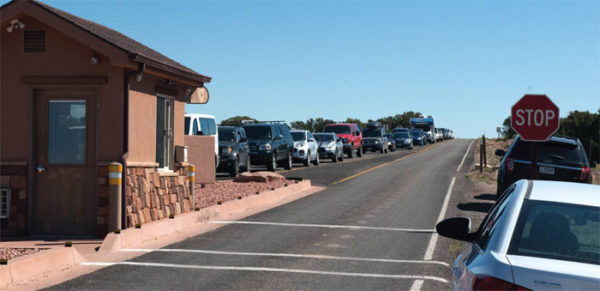
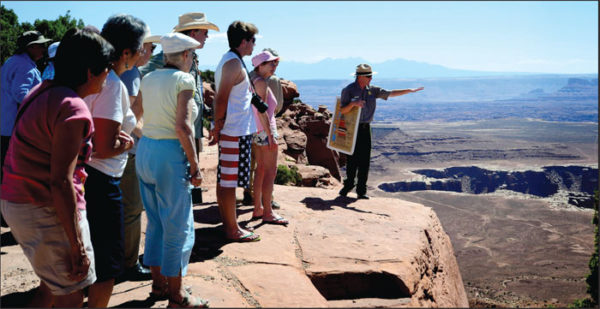

It’s impossible to ignore the many parallels between Atwood’s chilling work of speculative fiction and Louise Erdich’s latest novel, Future Home of the Living God. Both feature environmental crisis, religious fundamentalism, and governmental intrusion into the reproductive process. But while Atwood’s book seems to have anticipated current events, Erdrich’s, in a sense, reflects them. As its forward explains, Living God was actually begun, and then shelved, in 2002, only to be exhumed and completed in January of 2017. As such, it functions both as crystal ball and looking glass.

Cedar Hawk Songmaker is a young Native woman of Ojibwe parentage adopted and raised in suburban Minneapolis by earnest Anglo liberals. As the novel opens, Cedar is unmarried and pregnant and like the rest of the country, coming to grips with an uncertain future. For reasons somehow relating to the earth’s changing climate, evolution appears to have reversed itself, altering the human genome and causing wild mutations. America, in the ensuing panic, has devolved into a theocratic state – the Church of the New Constitution – in which civil rights are suspended and all pregnant women are consigned to birthing centers from which few ever seem to return. On the run from government forces and bounty hunters, endangered both from without and (literally) from within, Cedar seeks out her birth parents, enters what amounts to an underground railroad, and fights not just for her own independence, but for that of her unborn child.

While it might be tempting to dismiss Future Home of the Living God ($28.99, from Harper) as a cynical attempt to capitalize on The Handmaid’s Tale’s resurgent success, that would do both the novel and its author a gross disservice. Erdrich, who has won the National Book Award (for The Round House) and the National Book Critics Circle Award for Fiction (for LaRose), is a writer of extraordinary depth and talent who has crafted a novel both urgent and thought-provoking in its own right. With its engaging protagonist, its occasionally heart-pounding plot, and its thoughtful ruminations on subjects as diverse as Christianity, evolution, procreation, motherhood, government, freedom, family, Native identity, and female agency, Living God may just be the perfect novel for these decidedly imperfect times.

Chuck Greaves is a member of the National Book Critics Circle and the author of five novels, most recently Tom & Lucky (Bloomsbury). You can visit him at www.chuckgreaves.com.

Published in November 2017, Prose and Cons

Would you pay $70 to visit a national park? Should you?

ISLAND IN THE SKY ENTRANCE

Cars are backed up waiting at the entrance station to Island in the Sky, a portion of Canyonlands National Park near Moab, Utah. Photo courtesy of the National Park Service.

The National Park Service is hoping a proposed 2018 admission-rate increase at 17 parks will produce enough additional revenue to address some of the mounting deferred maintenance costs threatening the ability of park and monument managers to maintain a high-quality visitor experience.

The proposed rate increases – to $70 for a seven-day private non-commercial vehicle and its passengers during peak season – would more than double the price of entry in some locations. For instance, at Canyonlands National Park in Southeast Utah, the current seven-day entry fee now just $25.

In a press release, U.S. Secretary of the Interior Ryan Zinke said, “The infrastructure of our national parks is aging and in need of renovation and restoration. Targeted fee increases at some of our most-visited parks will help ensure that they are protected and preserved in perpetuity and that visitors enjoy a world-class experience that mirrors the amazing destinations they are visiting.”

But not everyone agrees, and the proposal is generating resistance.

The revenue from the rate increase would be a drop in the bucket, and doesn’t justify limiting access to the parks for low-income and working-class visitors, according to Jackie Ostfeld, associate director with the Sierra Club’s Outdoors Campaign and founder of the Outdoors Alliance for Kids.

“Doing so is an environmental injustice,” she told the Free Press. “It’s a growing issue today. Think about the people in the greater Los Angeles area, where the smog is so bad that a day trip to a national park or monument in nearby mountains is a chance to breathe clean air. Rate increases create a barrier to entry, a barrier to those people, including children.”

Grand Canyon and more

Under the proposal, the fee for motorcycles will jump to $50 per seven-day tour, while bicyclists and pedestrians will be charged $30. Commercial tours will also face peak-season fee hikes. The higher fees apply only during the busiest contiguous five-month period of visitation, usually through the summer.

The 17 parks are the top NPS destinations with the highest-priority needs. They are Grand Canyon in Arizona; Bryce, Zion, Canyonlands and Arches in Southeast Utah; Rocky Mountain in Colorado; and Acadia, Denali, Glacier, Grand Teton, Joshua Tree, Mount Rainier, Olympic, Sequoia and Kings Canyon, Shenandoah, Yellowstone, and Yosemite.

Funds raised from the increase are critical, the proposal states, to improve facilities and infrastructure and to provide an enhanced level of service.

Deferred projects

Deferred maintenance, called DM in agency lingo, is defined by the Park Service as identified activities not performed when scheduled, most often due to funding constraints, and delayed until the future resources can be found.

Jeremy Barnum, a spokesperson for the NPS Public Affairs Office in Washington, D.C., told the Free Press that the highest DM priorities are evaluated every year. “We work to get the most urgent of them funded, but the backlog has remained fairly steady for the past five or six years.”

If implemented, the new pricing structure is projected to bring in $70 million the first year, an increase of 34.3 percent in total entrance-fee revenues over the $199.9 million collected in 2016. Eighty percent of the entry fees will remain at the park where the money is collected. The remaining funds will be applied to other Park Service assets not affected by the proposed increase, including those that do not charge entry fees.

“There are 417 units in the park system and most of them are free. Only 118 sites charge admission,” Barnum told the Free Press. The estimated total cost of backlogged deferred maintenance at all the park units, he said, was $11.3 billion in 2016.

A huge inventory

The National Park Service protects natural, historic, cultural, and recreational sites in 50 states, the District of Columbia, and several U.S. territories. According to an NPS Transportation Program fact sheet, the inventory is second only to the Department of Defense in size, with a total of 70,000 facility assets such as visitor centers, lodges, utilities, roads and trails. All of the facility assets are designed to provide the public an enjoyable experience in harmony with resource protection.

Nearly 331 million people visited national parks in 2016, setting a record for the third year in a row, 23.7 million more than the previous year. Half of the visits were in 26 of the system’s superstar destinations such as the Smoky Mountains, Grand Canyon, Rocky Mountain, Yosemite and Yellowstone national parks. According to the Department of the Interior, the parks targeted for the increase collect 70 percent of all entrance fees throughout the country.

Non-recreational business visitations for maintenance and operation, vendor supply runs, staff travel and housing, and more increase in proportion as visitor numbers climb. In turn, the nonrecreational traffic and use adds to maintenance costs.

A surge in visitors

The Park Service’s Southeast Utah Group includes Canyonlands and Arches National Parks and two monuments, Natural Bridges and Hovenweep. The two monuments are not included in the proposed rate increase. But the four canyon- country destinations attract a large tourist population due to their relative proximity to each other as well as Mesa Verde, Zion and Bryce, along with Bears Ears and Grand Staircase-Escalante national monuments.

VISITORS TO ISLAND IN THE SKY

Visitors at the overlook at Island in the Sky, part of Canyonlands National Park. Canyonlands is one of 17 parks that could see a fee hike. Photo courtesy of the National Park Service.

Surging visitor numbers are creating traffic congestion everywhere in Canyonlands and Arches, says Canyonlands Superintendent Cate Cannon, but particularly at Island in the Sky, a district of Canyonlands, near Moab. In 2016 Canyonlands visitation reached threequarters of a million people, a 22 percent increase over 2015.

Nearly 600,000 visited Islands in the Sky, located on top of the red-rock country between the Colorado and Green Rivers. Island in the Sky recorded 71,299 visits in September 2017 alone.

The entrance to Island is near Moab, close to motels and campgrounds and easily accessed from the highway. “We advise people to get there early in the morning or the wait can be 45 minutes to an hour,” said Cannon. “Rather than travel around the sites you’ll spend your time looking for parking.”

Park officials are working to alleviate some of the problem through a five-year traffic plan for Arches, finished in late October. “We hope to alleviate the congestion by addressing peak times and hours,” Cannon said. “Canyonlands, which includes Island in the Sky, is not included yet because we need more evaluation.”

The plan addresses traffic at peak seasonal visits and times of day. “That pattern impacts the infrastructure of our facilities. Take toilets, as an example,” she said.

“Arches has 10,000 visitors a day and understandably needs more toilet availability. We really don’t want to build more toilets. We’re hoping the congestion plan will lower or flatten peak visitation, which would help alleviate the toilet demand.”

She said it’s unclear how additional revenues might help with the situation.

“It’s too early to tell what the impact of the proposed fee increase will be but the increase is designed to increase the level of revenue and put the money to the Deferred Maintenance projects whereas our five-year traffic plan is intended to change the pattern of visitation.”

Marketing

Although it is difficult to pinpoint the exact cause of the recent surge in visitation at many parks, a lot of the credit goes to successful marketing campaigns, such as Find Your Park, celebrating the 100-anniversary of the system in 2016, and the Every Kid in a Park, initiated in the White House two years ago.

The Obama administration took strides to increase visitor diversity in the parks, especially with the Every Kid in a Park program, said Ostfeld.

“It acknowledged that entry fees are a barrier for some families. By creating an introduction to the park system the program encouraged all families, including low-income, to use the public lands.”

The ongoing program gives every fourth-grader a pass to the parks for a year. The pass expires after the fourthgrade school year is completed, giving the student time to use it with their family during the summer. The next EKIP pass program begins again in September, with all the new fourth-grade students in the country. “The program considers how we invite people into the national parks,” Ostfeld said. “The proposed 2018 fee increase is the exact reversal of that.”

Both programs played a large part in the dramatic 7 percent increase in overall park attendance during 2016, which at the same time increased attendance at lesser known parks by 10 percent.

Increased visits

Although entrance fees are an important source of revenue, the increases will not provide enough to address deferred-maintenance problems. Estimates of the highest-priority needs top $2.4 billion. The proposal assures that all of the money collected through the increases will stay within the National Park Service and be spent on projects and activities that further its mission and purpose, with an emphasis on deferred-maintenance projects. This includes roads, bridges, campgrounds, waterlines, bathrooms, and other visitor services.

But Ostfeld questions how much good the fee increase will do. “If the parks are trying to address deferred-maintenance issues, this rate increase doesn’t even come close to that,” she told the Free Press. “The amount of revenue collected is so minimal compared to the enormous projects the Park Service says this will help.”

Visiting a national park represents an affordable vacation for many people, she said, but they may not be able to take advantage of the week-long entry their $70 will buy them. “Public land is an economic value for families, especially because travel costs on top of the $70 fee add up. What is lost on some decision makers is the fact that many low-income families cannot afford to take a week’s vacation. For many families, it’s just one night camping, or a day-trip away from work touring a park.”

Rocky local economies

Mesa Verde is not on the list for admission increases in 2018, but the park illustrates the dramatic impact visitors have on small-town economies. NPS archives indicate that there were 27 visitors to Mesa Verde in 1906, when President Theodore Roosevelt designated it a national monument.

Today, 110 years later, visitors to the 52,485-acre park and World Heritage Site reached 583,000 in 2016, spending $60 million at the destination and in surrounding communities. An additional $23.6 million is generated from 883 jobs at Mesa Verde, and most of it spent in the community.

Colorado’s Rocky Mountain National Park, 77 miles northeast of Denver, will raise vehicle fees in 2018 to $70 per week if the increase is accepted. It’s a very big park, a popular tourist attraction, and a day-drive for eastern Colorado residents. Visitation to the park was up 400,000 in 2016 after topping out at 4 million the prior year. Visitation directly affects the economy of nearby Estes Park, a town along the Big Thompson River with a population of 6,000 in the off season. The summer-resort community is home to Rocky Mountain park headquarters.

Spokespersons for towns near affected parks are expressing concern.

Elaine Gisler, director of the Moab Area Tourism Council, told the Free Press the proposed admission increases are not surprising. “We understand the infrastructure issues,” she said.

But the council is concerned about how the funds will be used. “If the increase goes to the park and decisions are made by the superintendents, not the Washington offices, local jobs would be created to help address the deferred maintenance challenges. The park management knows best what is needed on a day-to-day basis, the priorities and how to get the work done,” Gisler explained.

“We definitely understand the need for infrastructure repairs,” Kate Rusch, public information officer for the Town of Estes Park, told the Free Press. “However, this proposed increase is extreme and we’re concerned about how it will impact our local economy.

“The increase from $20 to $70 may decrease the millions of visitors we see every year. We have one highway through the park. We’re at the east highway entrance, and the highway is a destination in itself. We’re very concerned, and also about Grand Lake, the little town on the other end of the highway.”

U.S. Highway 36, Trail Ridge Road, is in the heart of Rocky Mountain National Park. It is the highest continuous motorway in the United States, a nationally designated All American Road, taking visitors above 11,000 feet for 11 miles.

“All of us understand deferred-maintenance issues,” said Katlyn Stahl, director of marketing for the Grand Lake Chamber of Commerce. “Our economy depends on the park and how well it’s maintained.”

During tourist season the town’s population explodes from 500 full-time residents to up to 15,000. The scenic byway is a key part of that.

“We’re close to Denver. It’s a day drive for many people. $70 to drive the road for a day is expensive,” Stahl said.

Currently admission to Rocky Mountain is $30. Annual passes cost $60. Both of those fees rose under the Obama administration by $10 each. “The gradual $10 increases are more reasonable,” Stahl said. “We’ll see what $70 does to the visitation numbers, but access to the park and the visitors’ experiences greatly affect our economy.”

When asked about the high price for a day drive on Trail Ridge Road, Barnum told the Free Press that the road has to be maintained and that’s some of what the $70 will be used for.

Limited access

In his release Secretary Zinke said the Interior Department needs “the vision to take action in order to ensure that our grandkids’ grandkids will have the same if not better experience than we have today. Shoring up our parks’ aging infrastructure will do that.”

But the Denver Post disagreed, in an editorial headlined, “Ryan Zinke’s national parks fee increase a slap to low-income families.”

“Seventy-five dollars might not sound like a lot of money to a Washington elite, but it’s real money for low-income families,” the Post’s editors wrote. “So call us amazed that the Make-America- Great-Again administration is stiffing poor families who wish to enjoy our most popular national parks.

“Call us doubly amazed that a Westerner … is the Trump official to hatch the idea. . . While [the Department of the Interior] seeks to more than double fees at these parks, the Trump administration has also proposed a 12 percent cut, or about $1.5 billion, to the National Park Service budget.”

The 2018 park budget is still being considered, said Barnum, who agrees that the $34 million the NPS is seeking for DM projects isn’t enough. But he said there are other opportunities such as public-private partnerships that can help. Since 2015 the National Park Service has leveraged over $45 million in funding from Congress through the Centennial Challenge program to attract more than $77 million from partner organizations supporting hundreds of projects across the country that have improved visitor services and strengthened partnerships to reinvigorate national parks.”

The senior director of the Sierra Club’s Our Wilds America campaign, Lena Moffit, said in a statement, “High entry fees will shut the public out of our parks. It’s increasingly clear that time outside is not just a luxury, but central to the health and well-being of our communities. We need to be looking for ways to expand outdoor opportunities for everyone.”

Other ways in

The Southeast Group is working to increase access to parks through free programs such as Canyon Country Outdoor Education, a cooperative venture among the Park Service, local school districts, and nonprofit organizations in Southeast Utah. “We conduct field trips to the parks after a ranger pays a day visit to the classroom and explains the destination,” Cannon explained. “We’re helping students safely experience and understand natural and cultural resources while exposing them to a wide range of environmentally responsible activities in the outdoors so they can develop skills, judgment, confidence and sensitivity.”

The program serves schools in Moab, Monticello, Blanding, Bluff, Montezuma Creek, and Monument Valley.

All American Indians, Native Alaskans, and Native Hawaiians requesting entry to federal lands to exercise their traditional religions will be granted a fee exemption, according to Mary Wilson, chief of interpretation and visitor services at Canyonlands and Arches.

Simply being Native American does not grant free entry, however. The intent must be to enter for traditional religious practices, as opposed to recreational activities.

Children 15 years and under enjoy free admission to all national parks, as do people holding military, senior, and volunteer passes.

The annual America the Beautiful National Parks and Federal Recreational Lands Pass, which provides free entrance to all parks for a year, will remain $80.

Legislation passed by Congress in December 2016 raised the cost of the lifetime Senior Pass from $10 to $80, Seniors age 62 and older had until August 2017 to purchase the lifetime pass at $10.

Ostfeld says senior activism surprised everyone. In early 2017 word spread that the cost of the senior pass would go up. The seniors “rioted,” said Ostfeld.

Canon concurred, adding that there was such a run on the passes that the parks ran out. “We borrowed from other parks,” she said. “We moved the passes around to accommodate all the demand until finally the entire National Park Service just ran out of senior passes. NPS had to order new printing just for all the seniors who wanted access to the parks.”

The legislation also established an annual fixed-budget senior pass for $20. It is valid for one year from the date of issuance, but four accumulated annual senior passes purchased in prior years can be traded in for a lifetime pass.

Taking comments A public comment period on the peak-season entrance-fee proposal will be open through Nov. 23, 2017, Thanksgiving, on the NPS Planning, Environment and Public Comment (PEPC) website https://parkplanning.nps.gov/ proposedpeakseasonfeerates. Written comments can be sent to 1849 C Street, NW, Mail Stop: 2346 Washington, DC 20240.

Because so many parks do not charge entrance fees “there is room for the DOI to expand the kiosk entry fee system in the future,” says Ostfeld. “With the short public comment period it feels like the DOI is testing the waters.”

Ostfeld said duplicate messages sometimes are not counted. “It’s better to respond with a personal comment and briefly explain how the increase will affect you as a family or individual.”

Barnum said the Park Service “will read, evaluate and analyze every comment with a third-party contractor and make the final decision.”

Published in November 2017

Trails, roads and use

Remember your first bicycle? Back in 1950 I got my shiny new $70 Schwinn with leather seat, headlight and even a horn, and with chrome fenders. They were all “one-speed” then. If you went up in the hills you just worked harder as you looked for roads to ride and waved at cars that came by.

Things have sure changed. After the big war, the country flourished economically and this gave rise to more free time, which gave rise to recreation. Along came fancier bikes, motor bikes, Jeeps, etc., to “get out and enjoy the outdoors”!

This was all good, and we all used the old logging, mining and rancher roads to enjoy the outdoors on the public lands in the pursuit of a recreation experience of sight-seeing, hunting, fishing and picnicking. Slowly at first, something ominous started to happen. Roads began to be closed, gates put up and locked, restrictions were placed on when you could ride where. Then restrictions were put on certain kinds of transportation that could travel on certain roads. Only hikers could be on many trails, no bikes of any kind. Other roads and trails were for pedal bikes only, while motor bikes could be on Jeep roads, but Jeeps could not be on the other roads. Equestrian users had to find their own areas.

The closing of many of the roads began to concentrate more users in smaller areas, resulting in animosity between recreational interests. Mountain bikers don’t want motor bikers on “their trails” and hikers don’t want any of the others on “their trails,” the OHV and ATV riders are left out of most areas and the jeep people are relegated to the scrap heap with no place to go besides the paved highway . I bet you even believed these lands were “your” lands!

Today, the direction seems to be to separate all users to their own designated trails and roads and never shall they have to meet or confront the others. This is people control. Unfortunately this is resulting in divisiveness with some users having more access than others. The BLM is expanding the Phil’s World mountain-bike trail system and trying to create equestrian trails in the attached area. The Forest Service is expanding the Boggy Draw mountain-bike trail system. However, the motorized-bike trails access is being reduced and the OHV, ATV and Jeep access has been and is being drastically reduced throughout all the public lands.

Most of the roads and trails were constructed and developed over the years by loggers, miners and ranchers, at their expense, as “tools” in the management of the lands. Resource management and use “paid” for and developed most of today’s recreation access roads and trails. The recent revelation that resource management needs to once again be done to salvage what is left of much of the forest and rangeland resources begs the question of why are they closing roads and trails needed for management, use and protection of the resources?

Protection from fire and insects can begin with accelerated fuelwood gathering by locals to remove the heavy dead fuels, but this requires the roads to be open to pickups and trucks the same size that the roads had been built for in the first place. They have taken a 10-12-foot road bed and either closed it or limited it to no vehicles over 50 or 60 inches. Some ATVs are wider than that, and my Jeep is 61 inches, a pickup is 75. How wide are the Forest Service fire trucks?

Is there a solution? Certainly! Redirection of the purpose of the public land management agencies to be for actively managing the forests and rangelands for their health and productivity in accord with local need and direction from a county! Reopen closed roads for access for management, protection and recreation. The road surface for management would determine the vehicle size access, not some arbitrary limitation to please one segment of the public. All roads and trails should be utilized by all users with suitable transportation for the road surface.

For the past 100 years horses, wagons, cars, trucks, bicycles, motor bikes, and hikers used the same roads and trails and respected each other’s right and need for their use. Recreation is important today, but recreation of any kind is not a tool for improving the health, protection and productivity of the land. Logging, grazing and managed fire are the tools used that recreation uses benefit from.

Incidentally, do you ever wonder why local firewood gatherers are restricted and must pay to remove the dead wood that later the taxpayer must otherwise pay a firefighter to burn? Heavy equipment is run through the forest to masticate and tear up trees and soil for fire prevention and thinning, but a recreation camper cannot drive off the designated road for fear of leaving a track? The recent Travel Management Plans reducing, limiting and eliminating road and trail access and uses are exacerbating the resource health and recreation problems. Let’s get common-sense management, protection and recreation back on track for the benefit of the lands, resources, economy and all users.

Dexter Gill is a retired forest manager who worked for private industry, three Western state forestry agencies, and the Navajo Nation forestry department. He writes from Lewis, Colo.

Published in Dexter Gill

Calling out predators

Tidal wave.

That’s how I was going to describe the growing number of accusations of sexual misconduct (and worse) in the wake of producer Harvey Weinstein’s fall.

Other Hollywood luminaries (director James Toback) have been accused since the news broke, as have television personalities (Mark Halperin, plus even more details as to the allegations against Bill O’Reilly have come to light); the bassist for Marilyn Manson … and George H.W. Bush. Poppy Bush! A tidal wave of reports — except, it isn’t, really – not when these recent, widely publicized reports are compared to how often sexual violence occurs. Sexual assault and sexual harassment are severely underreported. .

The National Sexual Violence Resource Center says “rape is the most underreported crime” and that 63 percent of sexual assaults are not reported to police. Additionally, only 12 percent of child sexual abuse is reported to authorities, per NSVRC’s statistics.

And, for those who like to insist “women are lying” (looking at you, Sarah Huckabee Sanders!), research cited by the center found the prevalence of false reporting to be between 2 and 10 percent. (Also, sexual assault and harassment victims include men: 1 in 71 men are raped at some point in their lives, according to the NSVRC. Are they lying, too, or is it “just” the statistical 1 rape victim among every 5 women?)

For every sexual-assault complaint you might hear about, there are who-knows- how-many instances in which the victim keeps silent.

It’s not hard to see why, especially when there is a power imbalance between victim and perpetrator. The scale is tipped further against victims because of persistent, if varying, views of how the victims “asked for it” or failed to prevent it, or didn’t react the way others thought she or he should.

“How do we display ourselves, how do we present ourselves as women, what are we asking?” This was fashion designer Donna Karan’s response to news that her friend Weinstein had been accused of multiple instances of sexual predation.

“ … You look at everything all over the world today, you know, and how women are dressing and, you know, what they’re asking by just presenting themselves the way they do. What are they asking for? Trouble.”

Karan has since backpedaled, calling her remarks a “horrible mistake.” You don’t say.

Karan is hardly alone in the mindset; even other women have said similar things since the news broke.

U.S. Rep. Eddie Bernice Johnson, a Texas Democrat, told an NBC station she grew up in a time when “it was as much the woman’s responsibility as the man’s.”

Had she stopped there, the remark might have been defensible as simply telling how people used to think. But she went on, “I’m from the old school that you can have behaviors that appear to be inviting. It can be interpreted as such. That’s the responsibility, I think, of the female. I think that males have a responsibility to be professional themselves.”

There’s a lot to unpack, here. According to the Texas Tribune, Johnson tried explaining she meant to empower women, saying women “have the power to control the situation” through reporting to the police, or by not cooperating, and that women allow offending men to get away with it (presumably by not reporting it).

Johnson was out of line. When your paycheck — or even your entire career — depends on not offending the man who signs the check, your options are limited. When reporting is met with doubt, ridicule and worse, the woman is not the one who is allowing the man to “get away with it.”

Johnson, too, later rescinded her comments and said she did not blame victims for the actions of perpetrators.

Response from alleged perpetrators has varied – from Weinstein, who, although he has denied criminal conduct, basically said he is helpless because of a “sex addiction,” to George Bush Sr. apologizing. (Other people in his camp, however, tried to use his age and infirmity to excuse reports by four different women that he groped them; his spokesman even trotted out the old he-didn’t-mean- anything-by-it defense.)

But we remain distressingly inclined to blame the victim, or even women in general, as Karan and Johnson’s statements — and countless similar statements through the centuries — show.

This does not tend to happen in crimes other than rape. While we might chide a burglary victim for leaving the door unlocked, we don’t say that because he didn’t secure his home, the law was not broken at all or he must have “wanted it to happen.”

The spate of news of prominent men being accused of sexual crimes and sexual harassment kept coming in October.

This is not because women suddenly wanted to pick up metaphorical torches and engage in a witch hunt. It is because seeing Weinstein topple made other victims feel emboldened enough to take the risk, to tell their story, to put on their social media accounts the hashtag “me too.”

Time magazine tackled the issue Oct. 12, with a cover referring to Weinstein as “producer, predator, pariah.” It was an important piece, featuring some of the accusers who have gone public, whose voices just may have sparked a movement. As central as Weinstein obviously was to the story, though, I could not help wishing the cover had featured some of these strong women, like Rose Mc- Gowan, who went on to take her message to the Women’s Convention in Detroit.

Maybe — just maybe — we are getting to the point in North America when an accuser might stand a chance of being believed, rather than scrutinized for an ulterior motive, or how she behaved, how much she drank, what she wore, what she looked like. Maybe, just maybe, we could even recognize them for their courage.

But maybe not.

In late October, two New York City officers were indicted on allegations they’d handcuffed a young woman for alleged drug possession, driven her to a parking lot and, while she was still cuffed, sexually assaulted her.

The officers have denied it — with, according to published reports, the go-to defense of the sex having been “consensual.” No word, though, on just why they thought it was appropriate to engage in any kind of sex with someone they had detained, while they were on duty.

The story gets worse. The officers also allegedly made hay of the woman’s social-media posts, which were less than virginal, and may have made a reference to a suit she filed. (Translation: “She must have wanted it, because look what she’s posting.”)

One news story about the matter, while well-rendered, included a photo of the woman posing in front of a mirror in a cropped blouse. The online version of this article did not include photographs of the officers, Eddie Martins and Richard Hall, even though they were the ones indicted.

And, as the Weinstein scandal erupted here, in Canada news emerged of a 2015 case involving a teenager whose taxi driver tried to kiss her, licked her face and groped her (BBC).

Judge Jean-Paul Braun convicted the defendant, Carl Figaro; however, he also brought up the victim’s appearance (“a bit overweight, but she has a pretty face”), suggesting she found the assailant’s attention flattering, since he “looks good … he has nice manners and … likes to wear cologne.”

Braun is supposed to apply the law. It is literally his job. Yet, the BBC reported Braun suggested “there are degrees of consent and question(ed) exactly which actions required (Figaro) to get the victim’s consent.”

The judge, per the BBC, also brought up kissing as compared to touching someone’s backside. So, because kissing someone supposedly isn’t as rape-y as grabbing a handful, a man doesn’t necessarily need the green light? I know very little about Canadian law, but … seriously?

This small sampling shows even the people who should most know better still give credence to old myths about a man’s “right” to sexual gratification, a woman’s “responsibility” to keep this supposedly superior being in check, and her trustworthiness.

It shows, distressingly, there might not be a society-wide, reliable way to get individuals to stop putting the onus of preventing assault onto the victims. Perhaps no amount of public outcry can change individual mindsets.

But individuals can. They should. And it’s past time that they do.

Katharhynn Heidelberg is an award-winning journalist in Montrose, Colo.

Published in Katharhynn Heidelberg

Eat. Pray. Shove it, Nate.

Friday, 3:20 PM: My airplane plummets while a whole chorus of Emergency Alert tones saws its way through the cabin. Not a reassuring sound when your aircraft is currently making landfall—or rather, swampfall—in New Orleans.

Fortunately, the alerts weren’t emanating from the cockpit. The Emergency Alerts were simply notifying us that a bunch of our fellow passengers had not put their phones in airplane mode. Also, that a hurricane was coming.

When we successfully landed, my own phone had this nice little greeting from the National Weather Service: “Hurricane Warning this area. Check local media and authorities. –NWS.”

Now, I didn’t come to New Orleans for a hurricane. I came to eat my way through the city. It was a day or two before departure when I first saw news of this tropical storm sprouting in the Gulf. I knew it wouldn’t be bad, because it was named Nate. Nothing against Nates. I know Nates. It’s just that they’re all mellow, even-keeled, gentle fellas. I couldn’t take a storm named Nate seriously.

Besides, I was so driven by visions of turtle soup and beignets and Sazeracs that I could hardly conceive of concern for hurricanes and chaos. And, frankly, once I realized the likelihood of flying right into it, I was excited to face the storm. It was forecast to pass before press time, and therefore, to spare me the trauma of finding another topic to write about.

So to bring this experience back home to all of you, who only have to face natural disasters during wildfire season and blizzard season and avalanche season and bear season, I decided to bravely live-journalism how to weather a hurricane without compromising the culinary experience.

The following log was written in real time and remains unaltered, except where necessary to enhance flavor and drama.

Saturday, 9:30 AM: Nate was not supposed to reach Category 1 status this soon. But it skipped off the Yucatan and into the Gulf. Radar shows a white swirl filling the Gulf of Mexico like ice cream filling a scoop. It’s already glazing over New Orleans. Slight breeze outside, with moving cloud cover. I can hardly wait. Food pairing: Barbecue shrimp and grits in meunière sauce. Shrimp for breakfast? Oui!

2:17 PM: Driving around Lee’s Circle when the rain hits. It hits HARD. I’ve been to car washes and extended family dinners with less pressure. So we go to a restaurant. This is what you do during a hurricane, because the power never goes out in the French Quarter. And if it does, you can quickly get too drunk to care.

Food pairing: Oysters, jambalaya, shrimp po’ boy. Recommended cocktail: Hurricane. And another, because what the hell.

5:28 PM: Rain has abated. Walking around the wharfs and the Quarter. Curfew is set for 7:00, and many restaurants are closing early. Several big events are canceled. No wind, still air. I suddenly understand the meaning of the phrase “calm before the storm.”

Food pairing: Boiled peanuts in a plastic “Thank You” bag. Recommended cocktail: another Hurricane, this time in a plastic geaux cup.

7:44 PM: Streets strangely empty of people. Three Hurricanes, and I have to pee so bad my kidneys hurt. You can run around naked here, but public urination will get you locked up.

Food pairing: I think I left a Clif Bar in the car. Recommended cocktail: Don’t even talk about liquids right now, you a-hole.

8:17 PM: Back to the home base and its bathroom. Holy hell, I can breathe again, except for this force of nature that has me twitching. I don’t know what to do in a hurricane. Stop drop and roll? Hug a tree? I’m so boned.

Food pairing: Canned goods, crackers. Recommended cocktail: Bottled water stockpiled by the Airbnb host.

11:31 PM: I can’t take it any more this hurricane needs to hurry up and do its worst the anticipation is killing me I want my mommy

Food pairing: Loot the store. The end of the world is nigh. Recommended cocktail: Toilet water, if you’re so lucky.

Sunday, 9:08 AM: Nate bypassed New Orleans. Traveling at the fastest forward speed of any hurricane in the gulf EVER, it hit land at such a rate that it fell apart and was downgraded back to a tropical storm. As far as the news shows, it caused no damage. I’m sitting outside sipping coffee in the sunlight. And it’s just now hitting me: I’m alive. I survived.

The only downside of the storm is that I will spend my whole life saying I endured record-breaking Hurricane Nate, when it could have been a much more distinguished N name, like Nefertiti or Nuala. Even the full-barreled Nathaniel would have been an improvement. But beggars can’t be choosers. And whatever the hurricane’s name, it showed me that I can survive anything. Anything at all. So long as I don’t have to pee.

Zach Hively writes from Durango, Colo. He can be read and reached through http://zachhively.com and on Twitter @zachhively.

Published in Zach Hively

What would the Village accomplish?

The suspense is over. Red McCombs and family have decided to appeal Judge Matsch’s May decision, which nullified the 2015 Village at Wolf Creek/ LMJV landswap agreement with the Rio Grande National Forest/US Agriculture Department.

There’s much to be said, but here I focus on a quote in the Durango Herald from Leavell-McCombs Joint Venture’s attorney Bill Leone, who is a partner with the heavyweight Fulbright and Jaworski Law Firm and a top notch legal gunslinger, who assures us:

“The Leavell-McCombs Joint-Venture believes strongly the project is a good project and the Forest Service did everything it needed to do to study the environmental impacts of that project.”

Good for whom? Good for what? What good will it be for the Rio Grande National Forest?

What good will it be for the Alberta Park watershed at the source waters of the Rio Grande River? What good will it be for the well-being of this wildlife corridor and its occupants? What good will it be for taxpayers and local governments who are left holding a boondoggle?

What good will it be for the huge, complex subsurface hydrology that supports, among other things, rare millennia- old fens? Which happen to be excellent for purification and storage of meltwater before it begins its course down the Rio Grande River to awaiting stakeholders.

My gosh, think about it, these developers and their lawyer know so little about biology and nature’s hydrology and rivers that they in all innocence proclaim that bulldozing a village of 8,000 into Alberta Park won’t adversely impact the Rio Grande River or the surrounding subalpine environment. Come on, who’s kidding whom?

They have no conception of Alberta Park as an integral part of the Rio Grande River’s source waters and the area’s wildlife. LMJV and their various spokesmen over the decades consistently dismiss legitimate concerns with vague assurances and an attitude of ‘trust us, we know what’s best.”

What is this Village at Wolf Creek speculation good for, Attorney Leone? Good for the lawyers earning their keep endlessly litigating like a dog chasing its tail? Mr. Leone’s grossly biased opinion is: “RGNF did all it needed to do.”

Think about where that’s coming from for a moment. The attorney’s world is devoid of objectivity, or concerns with honesty. Winning is all he cares about.

Senior Judge Matsch wrote in his May 2017 ruling: “What (the National Environmental Policy Act) requires is that before taking any major action a federal agency must stop and take a careful look to determine the environmental impact of that decision, and listen to the public before taking action. The Forest Service failed to do that in the Record of Decision. The duty of this Court is to set it aside.”

His September denial of the developers’ request to reconsider clearly stated: “The Forest Service cannot abdicate its responsibility to protect the forest by making an attempt at an artful dodge.”

We have still hanging over us an oligarch’s 1980s repeatedly foiled pipe dream. Now this billionaire is angry and believes Colorado owes him. Who is there to convince McCombs to accept NO? Lawyers who spend their lives litigating? The RGNF bureaucracy, where lawyers tell officials to be silent? Environmental groups that come across as private clubs? What about We the People? Red McCombs enterprises knows only profits and PR. Individually, we the people are impotent. But collectively? Do you love the Wolf Creek area? Sport a NoPillage at Wolf Creek bumper sticker? Well then, get engaged, get informed, take a pen or computer in hand, plead for the continued integrity of Alberta Park and the Wolf Creek area.

Peter Miesler writes from near Durango and maintains NO-VillageAtWolfCreek.blogspot.com, a kiosk of information advocating for Alberta Park to be left alone.

Published in Peter Miesler

Breaking news! TV is terrible

Okay, I’m mad as hell – and I’m not going to take it anymore.

Well, I might take it, but not before I rant and rave for a while.

Sara and I just moved to Newcomb, N.M., and finally got cable again. I was looking at the package I signed up for and noticed something that is bugging me.

I have a dozen or more Spanish channels – and they are considered part of the “minimum” cable package. That means that even though I can’t speak or understand Spanish I have no choice but to keep these channels.

That isn’t the part that bothers me. Dish is charging me $29.99 a month for channels that I can’t even understand. And I have no choice but to pay them roughly $360 a year for something I don’t need and don’t want!

That’s like going to an all-you-can-eat BBQ joint and them charging you $30 for a side of tofu.

I’m no lawyer, but there must be some class-action suit waiting to happen?

I even have complaints about the channels I do watch.

Like CNN, for example. All day long – with virtually every story they run – they call it Breaking News Do they not understand the concept of breaking news? If a story’s breaking at 6 a.m. it’s not “breaking” when you repeat the same story every hour. Stop the breaking-news headlines.

Another channel I used to like was the History Channel. But that was back when they actually aired shows that dealt with history. Now the History Channel is a “reality” channel with hillbilly duck hunters, pawn shops, toothless gator wrestlers, ice-road truck drivers and other fake drama series.

Has the History Channel run out of real history to explore?

Remember MTV? It used to play videos all day long. Now it’s a hodgepodge of teenage moms, Jersey Shores, Big Brothers and other so-called reality crap. I don’t even like rap music, but I used to watch “Yo! MTV Raps” because some of the videos were pretty cool.

And, of course, there was Michael Jackson!

Don’t get me started on CMT. I have to get up at like 5 a.m. to catch any country music videos. Not that today’s country music is worth listening to.

I mean, it seems like there’s one songwriter in Nashville and he just writes the same song for every singer.

There are few distinctive voices in country music today. There was a time when you could turn on the radio and recognize Johnny Cash, Loretta Lynn, George Jones, Marty Robbins, Dolly Parton and Ol’ Hank.

Now, I can’t tell Luke Whoever from Jason Whatchamacallit.

And every song was a guy “leaning in.” I assume they’re leaning in for a kiss, but none of them seem to finish the thought. And every girl wears cut-off jeans and has baby-blue eyes. No country girl ever just gets into a pick-up truck, they all “slide” in. What, do they have ice in the back pockets? Country girls seem to slide more than a toboggan after a snowfall.

Not that the female country singers are much better. Except for Miranda Lambert I can’t tell one voice from another. They all seem to be young and blonde, and look alike to me.

That’s my rant for today. I’ve got to see if I can catch a re-run of Honey Boo Boo.

John Christian Hopkins, an award-winning novelist and humor columnist, is a member of the Narragansett Indian Tribe. See his writings at http://authorjohnchopkins.blogspot.com.

Published in John Christian Hopkins

Aisle B watching

Instead of pushing a cart with a wonky wheel, I walked over to pick up a handy totable plastic basket. None were in sight. I asked an attendant if she knew where I’d find one.

“Not here, somebody walked out the door with the whole stack of them.”

It seems improbable that every basket the store owns had been lifted in a heist. It’s also difficult to imagine any practical plan for using 40 or so carrying baskets, all branded with the retail store’s company name. Abandoning a shopping cart along the sidewalk three or four blocks away from a grocery store, now that I understand. Groceries get heavy, especially when shopping on an empty stomach. When I find a “borrowed” basket I push it back, always looking forward to the day when someone repays me by leaving an electric mobility scooter with enough juice to ride all the way back to the store.

In larger cities where miles of sidewalks shape our pedestrian highways, shopping carts appear more often. I take these to be a street population’s alternative to pushing an SUV through rush-hour traffic. The carts are often heaped with belongings, bundles of useful but rather ungainly furnishings; staples for setting up a temporary life. I keep hoping there are groceries buried somewhere in the heap, at least enough fixings for an ala carte meal.

Soon another employee approached me and pointed out that the management had recently prohibited customers from bringing backpacks into the store and that we could thank the new high school next door for this policy. His glare and humorless expression suggested that he’d taken me for a codger whose malfunctioning hearing aid might have missed the news.

Resigned to becoming a pusher, I returned from the bike rack, yanked a cart away from a lineup of its companions, and headed disgruntledly down the aisle, one wheel wobbling its own inevitable complaint.

I had just bicycled three miles to get to the store. My devious plan involved purchasing all the items on my list, paying for them, and then pedaling home, my backpack filled with my provisions. When I left the house it seemed like a reasonable plan, one I’d used on many previous consumer expeditions to a variety of local businesses, including this one. It seems like only yesterday that shoppers were being chastised for not carrying their own reusable bags into the store. Now I was being asked to leave mine at home.

“Yep,” I said, “the kids these days sure don’t shoplift the way we used to.”

I grumbled my way down the aisle, fiddling with my earlobe, as if trying to adjust an imaginary hearing aid.

A few weeks earlier I carried the identical pack into the same store. I placed it in my cart, parked at the end of the aisle. When I returned my cart had vanished, along with my backpack. I glanced up at a surveillance camera and held my hands out in an exasperated gesture. Then I hoofed it up and down the neighboring aisles, attempting to catch the thief.

Tell me it hasn’t happened to you. Some lazy shopper simply takes the cart you’re using – even dumps your items onto the nearest shelf – and casually walks away. Eventually my cart and backpack surfaced in a different department, very near a store exit. I walked up to it and said loudly to a shopper who was occupied fondling bath towels that the cart with the backpack belonged to me.

“Well, take it then,” she replied, pointing toward a different cart a few yards away, “but leave mine alone.”

I never caught the culprit who tried to make off with my backpack, but I’m happy to report that at least I provided some lively entertainment for the employees stuck with the tedious job of monitoring shoplifting cameras while I conducted my frantic search.

David Feela is an award-winning poet, essayist, and author in Cortez, Colo. See his works at http://feelasophy.weebly.com/

Published in David Feela