Investigation is opened into Renew’s finances

The longtime executive director of the Cortez-based nonprofit Renew, Inc., has been suspended and an investigation has been opened into possible financial abuses at the organization.

Cortez Police Chief Roy Lane confirmed to the Four Corners Free Press that Cheryl Beene, who has been with the organization for the past 15 years, has been placed on suspension while the investigation goes on. Because Lane is a Renew board member, he said, the investigation is being conducted by the Montezuma County Sheriff’s Office, to avoid any conflict of interest.

Will Furse, district attorney for the 22nd Judicial District, also confirmed that an investigation was ongoing into financial practices at Renew.

Renew provides assistance to victims of domestic violence and sexual assault as well as adult survivors of child sexual assault in Montezuma and Dolores counties, according to its website. It maintains a safe house in Cortez, provides crisis intervention and counseling, and operates Second Chance Thrift Store in Dolores. Renew’s annual revenues from all sources were reported at about $325,000 last year.

David Long


Published in August 2018

Padilla denies allegations that forest officials let fires get out of control

A local resident suggested to the Montezuma County commissioners on Monday, Aug. 14, that officials with the San Juan National Forest deliberately accelerated two wildfires on public lands northeast of Dolores in order to conduct some sort of unregulated prescribed burn – an accusation soundly rejected by Dolores District Ranger Derek Padilla.

Casey McClellan, an ardent motorized-use advocate and a frequent critic of the Forest Service over trail restrictions, arrived at the county commission meeting Monday moments after the board had adjourned. After some hesitation, the commissioners reconvened in order to hear what he had to say.

McClellan proceeded to lay out a lengthy timeline for both the Plateau and West Guard fires, quoting from people who had told him they had seen suspicious things that led them to believe Forest Service officials were increasing the burns on purpose.

Padilla had responded to similar charges earlier in the meeting after Dexter Gill, a retired forester, read a lengthy statement during public comment that accused the Forest Service of using “fire bombs” to spur the Plateau Fire back to life after it was nearly extinguished.

“That’s not correct,” Padilla told the commissioners. “We never allowed it to be a controlled burn – it was full suppression from Day 1.”

He told the Four Corners Free Press that helicopters had indeed been used to ignite fire on the ground, but only as a means of doing burnout operations ahead of the wildfires.

The Plateau Fire was ignited by lightning on July 22 about 13 miles north of the town of Dolores. It eventually swept through more than 17,000 acres but is now more than 95 percent contained.

The West Guard Fire, in the Glade area of the national forest northwest of the Plateau blaze, was also sparked by lightning. It was discovered July 22 by someone in a helicopter working the Plateau Fire. The West Guard Fire burned more than 1,400 acres but is now mostly contained.

McClellan told the commissioners he had been asked by his cousin, Richard McClellan, to speak on his behalf. He said Richard and some other people were in a cabin in the vicinity of the Plateau Fire on July 22 when they spotted the smoke from the tree where the blaze began. The fire grew very little over the next day, and they returned to Cortez.

On Tuesday, July 24, McClellan recounted, two people checking the area stopped by Richard’s cabin and saw a helicopter flying back and forth over the trees up to 20 times for 30 to 40 minutes. Shortly thereafter, the fire’s intensity increased, they said.

Then on July 27, McClellan told the commissioners, his cousin saw a helicopter dropping objects into Plateau Canyon. His cousin told him the fire had been mostly contained at that point, but after the helicopter left, the blaze’s intensity increased.

McClellan said the fire took six days to grow to 70 acres but suddenly surged to 335 acres on July 28 and kept expanding rapidly thereafter.

“It seems extremely irresponsible to take this little fire that could have been put out and let it grow to 17,00 acres,” he said.

McClellan also expressed concerns about the West Guard Fire. He said a man who saw the fire on July 22 when it had just begun spoke with three BLM employees in the vicinity and they told him it would be allowed to burn overnight because there was a prescribed burn in the area anyway, even though the nearest such burn was nowhere near.

McClellan said it rained on July 25, and by July 26 the fire was virtually out. However, he then got a call from someone with the Forest Service who said they were going to reignite the West Guard Fire using a helicopter.

Padilla told the Four Corners Free Press that on July 24, the Forest Service did conduct burnout operations on the West Guard Fire. “So if someone saw a helicopter going back and forth [on the 24th], that was on the West Guard Fire.”

Padilla said firefighters identified Forest Service Road 512, which goes to the Glade Guard Station, Road 514 on the east side of the station and Road 504 on the south side as “control features” for battling the blaze. The meadow to the west of the station between roads 514 and 504 was set as the western boundary for the flames, “and we did burn out the fuel there,” he said.

Padilla said firefighters dug a handline around the guard station and burned out the area over approximately a day and a half with the help of a helicopter dispensing plastic spheres that contain chemicals to ignite small flames.

Regarding the Plateau Fire, Padilla said it began in a tree inside steep, rugged Plateau Canyon, which made a direct approach to battling the blaze unwise.

“Unfortunately, it was immediately in the canyon when it started and we weren’t able to put people in there. The tree was about 250 feet from the canyon edge and when people got there the fire was already down in the canyon. So we had to implement an indirect but full suppression.

“Had the fire not been in the canyon, we would have had more ability to go directly against it, but being in the canyon really limited our options to deal with it.”

Padilla said by July 27, the Plateau Fire had progressed southward, propelled by an unseasonable wind, and officials decided it was time to remove some fuels.

“Normally here in the Southwest at this time of year we have a southwest wind,” he said. “Those first couple of days, we did, but on Day 6, the 26th or 27th, we got an unpredicted north wind that persisted almost another week.” That wind, he said, kept pushing the fire southward.

Again, officials decided to remove fuel between the active fire and the control features, which in this case were roads 523 and 524. There were also burnout operations within the canyon itself, he said, “to ensure the fire doesn’t have the ability to gain a lot of momentum and intensity and ran out of the canyon uncontrolled.”

“When you can’t go direct on a fire – we couldn’t put people in that canyon or build a fire line –  the only thing we could do was to use fire up on the top to remove fuel,” Padilla said.

“You’re using fire to fight fire, basically.”

Padilla had also told the commissioners that the Forest Service had never planned or intended to let either wildfire simply burn, and that transcripts of the radio traffic from those days made this clear.

“It’s definitely documented [that] it was not a controlled burn but full suppression – it’s always been about protecting private property and other non-Forest Service lands.”

Responding to a question from Commissioner Keenan Ertel, Padilla assured him that the fires would have “little on no impact” on water quality at McPhee Reservoir, which is fed by the Dolores River.

The commissioners did not comment on the allegations made by McClellan and Gill. Ertel did ask McClellan whether he was insulating that the Forest Service had been conducting an “unofficial” controlled burn, and McClellan said, “I AM suggesting that.”

By Gail Binkly and David Long


Published in August 2018

Suckla voices impatience over planning delays

Montezuma County Commissioner Larry Don Suckla voiced concern Monday, Aug. 13, about the number of planning issues pending before the county. He said he had been told there are currently 84 issues backed up before the Planning and Zoning Commission, adding that was unacceptable and the process needs to be expedited.

County Administrator Melissa Brunner said not all of those cases involve delays on the part of the Planning Commission or Planning Department, because in some cases, the applicants themselves are holding off because they aren’t completely ready for their application to be put forward.

Suckla suggested making the Planning Department’s assistant a full-time instead of a part-time position, noting that the latest estimate from the assessor’s office is that the county will have a surplus next year of $700,000 to $900,000.

“Eighty-four people are waiting to do their land-use issues,” he said, later adding, “It’s our job to make this expedient so they can do what they want.” He said someday the county could potentially miss out on a multi-million-dollar venture such as a solar farm because of the backlog in the planning process.

“We could have a vote to do away with the land-use code,” he said. “That would fix that.”

The other commissioners laughed, and Keenan Ertel pointed out that such a drastic measure would first require a public hearing.

Suckla said he has heard that the Planning and Zoning Commission, which is appointed by the county commissioners, “gets too far in the weeds” and “could make decisions quicker.” He said if they didn’t speed up, they might need to be replaced.

Commission Chair James Lambert said he was not sure where the hang-up is in the process.

During the public-comment period, commission candidate M.B. McAfee said it was the commissioners’ job to be sure that people appointed to boards such as P&Z “are experienced and know the jobs they’re doing.” She said that was something to consider when appointing people to such a body.

– By Gail Binkly


Published in August 2018

Sharing the bounty: With food scarcity a growing concern, groups are teaming up to help

Food scarcity in Montezuma County is a growing concern as people struggle with low wages and an increased cost of living despite the surging U.S. economy.

It was good news in late July when the U.S. Commerce Department announced a 4.1 percent expansion in the economy during the second quarter of the year. It was the strongest growth yet during the Trump administration, surpassing the sluggish 2.2 percent growth in the first three months of 2018.

Although the current prosperity buoys confidence, a great sector of the Montezuma County population is untouched by the economic energy. Life is an economic struggle for many families.

According to the most current statistics from the Montezuma County Public Health Department, one-fifth of individual income levels in Montezuma County fell below poverty levels in 2015. Nearly 61 percent of students qualified for free or reduced school lunch programs that year. Even more startling, 54.8 percent of households received food stamps at that time, indicating that lower-income individuals tend to live together to share housing expenses.

Laurie Hall, co-owner of The Farm Bistro and director of Southwest Farm Fresh Co-op, explained that food security can provide traction in the effort to get ahead and stabilize one’s circumstances.

“Simply put, food affects everything and everything affects food. In Montezuma County, 1 out of 3 children suffers inadequate nutrition. The life-long consequences of missed meals, processed food, sugar, and artificial ingredients play out as diabetes, reduced brain function, poor performance in school, and emotional distress. The cost to our community can increase costs in health care, create an unfit workforce, and swell the crime rate,” she said. “All of this can be tied to food insecurity.”

Hope and Grace

During a recent lunch hour at Hope’s Kitchen ― one of two local church-based soup kitchens ― the atmosphere was social and lively, even familial. The line of people wound out the door onto the shaded sidewalk. A sense of modest abundance filled the large sunlit, cheerful room at the First United Methodist Church in Cortez.

Hope’s volunteer staff prepared enough home-made enchiladas, corn on the cob, and strawberries with whipped cream to feed 177 people that morning. The tally was 30 more than the average number they feed three days a week, boosting the nearly 500 per week and 20,000 meals they serve annually.

The staff was friendly and helpful, addressing guests by name, answering questions about the menu, and even kindly suggesting a person known to be diabetic might enjoy a lemon yogurt instead of a piece of cake.

A group of grandmothers read newspapers after they finished lunch. One talked happily on a cell phone while another spoke softly in Navajo with a visitor about their birthplaces on the reservation.

A guest told the Free Press that she was headed back to the recreation center after lunch to work on her garden. “I won a vegetable plot there when Good Samaritan [Center] held a lottery to have a community garden this year,” she said, describing how the vegetables are thriving, but also how the bugs have an enormous appetite for the carrot tops.

A group of young men talked softly at another table. Large, heavy backpacks stuffed with their belongings rested on the floor beside their chairs. A father helped his 3-year-old child into a high chair. He and a couple talked about their recent landscaping jobs and how glad they are that he has the lunch hour off from his job.

After the meal everyone pitched in to clean up.

Hope’s Kitchen began in 2002, when the homeless population in Cortez amounted to a handful of people. The need for food assistance has grown over the years and markedly increased in the past year, said Pastor Jean Schwien.

“Housing and food costs continue to rise as Cortez enjoys growing popularity with retirees and people relocating because of the rural lifestyle,” she said. “But wages for the people we serve, our people, do not correspond to the gentrification that comes with prosperity. The economic inequality, the gap keeps widening.”

Since 2013, the share of U.S. wealth owned by the top 1 percent of the population increased by nearly three percentage points.

Wealth owned by the bottom 90 percent of the people fell over the same period, said economist Edward Wolff in 2017. “That gap,” he concluded, “between the ultra-wealthy and everyone else, has only become wider in the past several decades, higher than it has ever been since 1962.”

Pastor Schwien said the current economy is beneficial on the whole, but is more advantageous for  CEOs, shareholders and professionals.

“Workers are suffering with low incomes, job losses, and strenuous working-parent schedules just to make ends meet,” Schwien said.  “Many rely on social safety-net programs to help them and their children simply survive. Income disparity is now a world-wide phenomenon, but we see it first-hand every day here at Hope’s Kitchen and in the park across the street.”

People come for lunch because they are chronically unemployed or homeless, are on a fixed income, or work a low-wage job. They bring their children in the summer when the school lunch program is not available. But, added Schwien, many come because they are lonely. “Almost all our guests enjoy eating together.”

She said stereotypes about their clientele need to be discarded. “Our lunch guests are diverse, experienced, and talented in many ways. They find themselves in a circumstance that may be a result of job loss, health issues, cost of medicines, aging issues, emotional and physical disabilities I want it to be perfectly clear that all of those are good reasons to ask for help. We turn no one away.”

Hope’s Kitchen director Pat Downey described the lunchtime clientele as a subculture. Most of the guests know each other.

“We serve on Monday, Wednesday and Friday. Grace’s Kitchen at St.  Barnabas Episcopal Church in Cortez serves people on Tuesday and Thursday and puts out 200 brown-bag lunches on Saturday. Most people know where to go, they know the locations, times and where the food is the freshest. For many it’s the only meal they have each day. By utilizing both resources people are able to have a hot meal six days a week. “

Cupboards are not bare

Grants and contributions stock Hope’s larders, pantries and coolers in the professional kitchen. The oven they have used for 16 years is no longer large enough for the volume of roasting and baking they will do in colder months. It’s being replaced by the congregation this summer.

Metal shelving and a large walk-in cooler hold fresh food and overstock contributed from Safeway, City Market, Walmart, Care and Share, the Good Samaritan Center, and the Community Gardens at the Rec Center. Local ranchers, farmers and gardeners also stop in to contribute food from their harvests.

Likewise, said Downey, Hope’s Kitchen passes along its surplus to Grace’s and the Bridge Emergency Shelter and sometimes has enough to offer extra food for a picnic in the park and meals later in the day.

“But at the end of the week, we also look for ways to extend the community benefit,” said Downey. “Dry bread crumbs go to the ducks in the park. We offer meat scraps to dogs, and produce, like corn or squash, to rabbits and chickens. Nothing goes to waste. Everything is recycled,” he said, pointing to boxes filled with the week’s supply of washed aluminum cans.

Schwien said Downey is an expert at public relations and running the kitchen.

Downey’s story is common in soup kitchens. “I was in line a few years ago, coming because I needed help with food. Soon I was volunteering in the kitchen. Now, I let people know that doing good work for others brings value and good things to your own life. It is a wonderful career for me and I’m proud of our teamwork, really glad we can help as many people as we do.”

While Hope’s Kitchen receives grants from the City of Cortez, the Ballantine Family, Anschutz Foundation and the Daniels Fund, the majority of the funding comes from the church congregation.

Support spokes

Many local organizations have been working independently to increase food security in Montezuma County. Thanks to a broad-based effort by TeamUp, a project of United Way, these groups are now collaborating as the Montezuma Food Coalition to effectively reach more people.

The group is renovating a spacious pink stucco building on the southeast corner of North Beech and North Streets. The group has not officially named the location, but they think of the building as a hub and their nearly 15 organizations as spokes.

“We’re building the structural connection in one place between organizations that share the same goal, to create health in the community,” said Hall.

One of the organizations is the Piñon Project. Every weekday, their summer lunch  program feeds 50 kids in Montezuma Park. The Southwest Farm Fresh Co-op connects with the Piñon Project through the Montezuma Food Coalition building.

The Good Samaritan Center breakfast program is another spoke of the hub, feeding kids who don’t have breakfast.

Hall said the group vision includes projects that reach out to people who don’t feel confident handling fresh food, because they haven’t learned the skills. ‟Today many people have been raised without cooking skills, relying mostly on packaged prepared food or fast food. We hope to change that with programs that provide access for people to learn what to do with fresh food – how to safely handle, store, prepare, maybe even grow their own food,” she said.

As you sow, so shall you reap

The newly developed Cortez Rec Center Community Garden delivered a bountiful harvest to the Good Samaritan Center this summer while also supporting an earnest group of novice gardeners.

The successful first-year rec-center demonstration plot was amplified when the city approved expanding the project at the site. Empire Electric helped with a small grant, too, while Kinder Morgan recently provided a pergola to shade the growing number of people tending their plots.

Fences and grading of the land to the south of the smaller demonstration garden paved the way for 10 family beds. The families that won the use of the community gardens through a lottery are now reaping the benefits.

Produce from the original demonstration plot continues to be delivered to the Good Samaritan Food Pantry. By late July, the demonstration garden had harvested and delivered 53 pounds of vegetables for families in need of food assistance in Cortez ― radishes, spinach, lettuce, pac choy, turnips, peas, beets, zucchini and broccoli; cilantro, dill, and garlic scapes.

36/38

Food scarcity is rapidly becoming a emergency issue in the United States. But Hall is hopeful that the vision of the organizations at the pink warehouse in Cortez will stave off the deepening crisis.

‟Imagine the bounty of local farms, ranches, and backyard gardens flowing into the warehouse to feed our community! A farmers market, a commercial kitchen, space for events and classes, art and music, a juice and coffee bar, and a food and farming information center that offers something for everyone!”

She admits it’s an over-the-top vision, but is confident it will come true. ‟Good food has the power to heal, nurture, and empower positive change. The collaboration is real. Local organizations and the producers share the common mission to reduce food insecurity in our county. Our work will improve the quality of life for everyone, including the people most in need.”

Published in August 2018

A troubled pair in beautiful Montana

Montana’s Glacier National Park is a troubled place these days — almost as troubled as the characters in A Sharp Solitude, Christine Carbo’s fourth and latest mystery, set in the park’s shadow.

A SHARP SOLITUDE BY CHRISTINE CARBOGlacier faces the climate-change-driven loss of its eponymous glaciers by 2030, its forests are under relentless attack by pine beetles emboldened by northern Montana’s rising temperatures, and smoke from drought-related wildfires now cloaks the park many summer months.

While the troubles facing the national park are all to the bad, those that haunt Carbo’s flawed heroes in A Sharp Solitude make for an atmospheric, suspenseful — and wholly captivating — character study of the finest order.

Like Glacier’s climate-related travails, the psychological challenges faced by Carbo’s dual protagonists, FBI agent Ali Paige and wildlife biologist Reeve Landon, are not of their own making. But their questionable choices at the outset of the story most certainly are.

Ali and Reeve have moved from New Jersey and Florida, respectively, as adults to the remote Flathead Valley outside Glacier National Park to escape separate childhood traumas. There, the former lovers are the wary co-parents of an adorable five-year-old.

When journalist Anne Marie Johnson is found shot to death at a cabin near the national park, Ali and Reeve make impulsively bad initial decisions. Ali pockets evidence from a potential crime scene near the murder site in an attempt to cover for Reeve, while Reeve lies to police interrogators about his encounter, possibly sexual, with the victim shortly before her death.

Ali and Reeve tell the tightly interwoven tale in alternating chapters from their respective first-person points of view. The choices the ex-lovers make at the start of the murder inquiry, and the harmful consequences that inevitably follow, provide Carbo the opportunity to explore the damaged psyches of adults facing — and too often failing to cope with — long-past childhood trauma.

Reeve, who killed a playmate in a gun accident as a boy, proves himself the more fallible of Carbo’s dual protagonists. Faced with the decision to fight or flee upon being named a suspect in Anne Marie’s murder, Reeve chooses flight, disappearing into the brooding Glacier backcountry with his trusty canine research assistant, McKay. Ali, meanwhile, earns the gold star, as she willingly lays her life and career on the line in her fight to prove Reeve’s innocence in his absence.

In true Montana fashion, grizzlies and gunfire figure into the dramatic climax of A Sharp Solitude. Through all the commotion, however, Carbo remains true to her primary theme, providing readers an engrossing look at a pair of imperfect but deeply sympathetic characters working to overcome psychological wounds suffered decades earlier.

Scott Graham is the National Outdoor Book Award-winning author of the National Park Mystery Series for Torrey House Press. The fourth book in the series, Yosemite Fall, was released in June. Visit Graham at scottfranklingraham. com.

Published in August 2018, Prose and Cons

The local Food Network

I need to start by saying this is not a pitch for the cable television channel or any of its shows. What it is – is a pitch for the communication chain and information-sharing that I recently uncovered in our community.

I suppose I could attribute this discovery to my commitment to mindful eating, but really it was an email that started the wheels turning. It was a request for rhubarb. It came to me secondhand, forwarded by one of my farmer friends who has heard me moan about the bounty of our rhubarb patch and my ongoing search for ideas for using this bounty. I am not sure it was in anticipation of the grasshopper horde that eventually ate my rhubarb to the stalks or just not having any inspiration on what to do with this year’s bounty, but I chopped and froze several gallon bags of the stuff. After a quick freezer inventory, I found that I had rhubarb from 2016 that needed to move out – so I responded to the email positively, mostly just to see what would happen.

What ensued was a rendezvous at Cox Conoco, where I shared my previous rhubarb bounty. I ended up with a recipe for rhubarb BBQ sauce as well as a few jars of pickles and the special BBQ sauce in exchange for a freezer cleanout. Good deal by me. But more importantly I added a new node to the local food network. I now know where to offer rhubarb and how to upcycle my rhubarb bounty into something friends and family might like to eat.

I don’t think we fully appreciate the unique knowledge and earthy wisdom that is shared by our local growers at the farmers’ markets. Where else can you get the freshest produce and a story about how it was grown and some suggestions on how to best cook and eat it? While I don’t go as far as to learn the name of the pig I am buying each fall, it is reassuring to know that she is doing well, enjoying the mud, and especially liked the apple seconds I have sent to her. Who else is better to ask about how to render lard than the pig farmer herself ? I finally understand why the lard brand is “Snow Cap,” as the whiter the lard, the slower the rendering process and better quality of the resulting product.

Recently at the Cortez Farmers’ Market I tuned in to the questions of fellow shoppers and the delightful answers offered by the growers. “What is that?” a woman asked as she pointed to a beautiful bunch of chard. “Well, that is chard,” said the grower. “It is really good for you – full of nutrients. In fact, my mom used to call it Super Charge because it is so great for you.” “Well, how do cook it?” the now-intrigued shopper asked.

At that point, the grower and I went into a litany of options – sauté it, steam it, or add it to stir fry or soups. That seemed to be a bit overwhelming – so we ended with a simple sauté recipe. At another booth, I overheard the same question by someone pointing to Lacinato or dinosaur kale. Again, the patient grower responded with a clear answer and stories about kale’s health benefits and how to cook it. Although I was a little taken aback. Kale? People don’t know about kale? Which rock have they been living under? And then it struck me. They have never purchased kale that didn’t have a plastic bag with a logo and large type saying, “ORGANIC BABY KALE.” Well, good for them to venture into the world of unpackaged vegetables.

I am constantly on the lookout for unusual produce at the farmers’ market. Something that I can’t find at the supermarket but might have seen in foreign produce markets. This week I found some rare Spanish cooking peppers – just the right combination of hot and sweet. Impossible to find fresh anywhere – the best I can do is some dried version from the international food aisle. Shishito peppers have been all the rage – another unique find that makes a one-of-a-kind appetizer if you are willing to ask how to prepare them. Also, I always pick up any weird fruit or berries such as currents or chokecherries. If someone is willing to pick those little buggers, I will happily use them to make jam or to flavor a liqueur. With access to these ingredients, I don’t feel like I live in the middle of the U.S.A., thousands of miles from an urban ethnic neighborhood. I can get the same international ingredients right here in Montezuma County. How lucky am I?

While the farmers’ markets are the obvious place to tap into the local food network, there are lots of other places. Don’t be shy about asking at restaurants that use local meat or produce, especially if you have a favorite dish that includes them. Chefs are usually happy to share where they got the local ingredients and how they prepare them. Look around your neighborhood for any unfamiliar apples or fruit hanging off a neighbor’s tree. Try to catch the owners and ask about it. You may be rewarded with a tasty fruit treat of your own or their making. But more importantly, you will inspire them to look at that old tree with new eyes – that worthless trash tree is producing something somebody wants?

Talk to the produce manager at the grocery store. Most of them would love to talk to a person (rather than a vegetable) and are happy to share information about the source as well as ideas for serving their produce. Finally, there are plenty of local institutions such as the CSU Extension Office and 4-H that teach safe preservation methods and healthy cooking ideas for local produce.

In the end it comes down to this – don’t be afraid to ask. A single question could pull you into the local food matrix and soon you too will be sending emails into the network seeking obscure ingredients to make that special BBQ sauce.

Carolyn Dunmires gardens, cooks and writes from Cahone, Colo.

Published in Carolyn Dunmire

An abuse of free-speech rights

Back in January, my Four Corners Free Press column was built around a talk by climate scientist Dr. Trenberth, an authority on our planet’s global heat and moisture distribution engine. In March there was a letter to the FCFP editor offering an alternative.

The writer offhandedly dismissed the scientific “consensus” as though it were just another opinion, while lamenting the politicization of science (apparently oblivious to the reality that his letter was nothing but a gross politicization).

Ironically, to underscore his legitimacy the writer encouraged us to read Jim Steele’s “LandscapesAndCycles” collection for a second opinion. As it happens, I’ll bet there are few who have studied Steele’s collection more than I have and I welcome this challenge to write about it.

You see, from my first introduction it seemed to me that what Steele was doing was a perfect example of “malicious abuse of our free-speech rights,” though I didn’t have the words for it then.

That started me on his trail. I did a detailed review of Steele’s 2014 talk to the International Electrical and Electronic Engineers. I also transcribed his Jan. 27, 2015, interview with Heartland’s Sterling Burnett in order to dissect his method. That one required 14 topic-specific posts to do his torrent of misinformation justice.

All told, I have some 50 posts unraveling Steele’s deceitfulness over at my ConfrontingScienceContrarians. blogspot.

In a nutshell, Steele proposes that landscapes and natural cycles are more powerful drivers of global warming than our insulating atmosphere.

His intellectual underpinning is a self-certain, but never explained, rejection of CO2 science. He maintains it’s a hoax with political underpinnings. This is something his Republican audiences want to hear, so he’s never asked to justify his supernatural assertion.

Steele has used his general environmental studies background to travel around the world learning about various wildlife studies with an eye towards finding errors to exploit. He learns about these errors and shortcomings from the wildlife scientists who were directly involved, who willingly shared their challenges and learning curves.

Where Steele gets nasty is the way he slams these same individuals by portraying them as clueless shills. Where he gets bizarre is leaping from those shortcomings in wildlife studies to claiming they prove global warming is a hoax and that we shouldn’t worry about it. An astounding chain of illogic.

As for flaws and errors in wildlife studies, Steele keeps it a secret that none of it was a secret. It was part of the scientific community’s ongoing discussion and literature. It’s the stuff of science marching forward, learning from mistakes as much as from successes. After all, wildlife studies over huge expanses of landscape are exceedingly difficult and running a perfect experiment is impossible.

Steele ignores the fact that every serious scientist, wildlife or otherwise, spends as much time studying and assessing their errors as they do their successes.

Once I got into researching Steele’s claims and contacting most of the scientists he singled out for derision, I was shocked at how shabbily he treated their hospitality and the collegial support he was given for whatever research project he claimed to be doing.

I have put much effort into documenting Steele’s words and claims. I specify his errors, I point out his misrepresentations and then I provide the information he hides from his audience to support my claims.

I have invited Steele to debate many times. He kept running away from my challenges, instead preferring the shelter and comfort of his Republican/libertarian echo-chamber, where he could lash out at me with unrestrained venom and irrationality.

As for scientific consensus, the astrophysicist Ethan Siegel wrote an excellent inquiry, “What Does ‘Scientific Consensus’ Mean?” at forbes.com on June 24, 2016, and I borrow his final paragraph:

“If you want to construct an accurate picture of what governs the Universe, you need to build on all that we’ve learned up to this point.

When we say ‘scientific consensus,’ that’s what we’re talking about: things we’ve already learned, and the solid foundation for where we go from here. And if there really is a problem with the consensus, it’s going to be the internal community of experts within that sub-field that’s going to find it.

Believe me: as a scientist, there’s nothing we like more than learning something surprising and new.”

You see, scientists are truly curious and skeptical, always looking for flaws that might hide new revelations. That’s a reason these people became scientists, the quest to be the first to understand something new. Fact is, that they simply don’t think like politicians, promoters or evangelicals, even if those people love projecting their own habits onto scientists.

Earlier, Siegel explained that when scientists talk about “science being settled”, they aren’t talking about “scientific consensus” as the final answer, but rather as the starting point that everyone agrees on.

In closing, the letter’s complaint that “they don’t want debate” begs the question what kind of debate shall we have? Steele prefers the melodramatic political debate, where winning is everything while truth and learning becomes irrelevant.

I myself prefer the curiosity-driven constructive debate. A scientific-style debate where each side honestly represents its opponent’s position and the facts. Where both sides agree that a better understanding is the goal.

I’d love to have that debate, but where’s Jim Steele?

Peter Miesler writes from near Durango, Colo., and maintains a few “information kiosk” blogs, including ConfrontingScienceContrarians.blogspot.com and NO-VillageAt- WolfCreek.blogspot.com.

Published in Peter Miesler

Lands, roads, and RS 2477

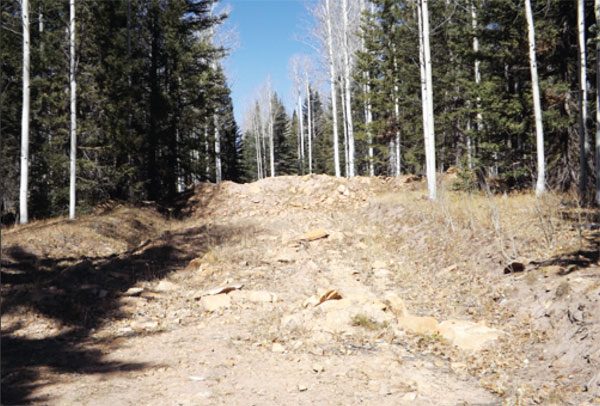
CLOSED HISTORIC WAGON ROAD IN THE HAYCAMP AREA OF THE SAN JUAN NATIONAL FOREST

A closed historic wagon road in the Haycamp area of the San Juan National Forest. In the author’s opinion, this means fire-response time ruined, past recreation
use ended, a negative impact on wildlife, increased noxious weeds,and fuel wood-gathering ended. Photo by Dexter Gill.

What in the world is the fuss over some dirty old roads all about? Most of the discussions center on current Forest Service road restrictions and closures, but do not look at the history of why there is this issue.

Meaningful history began about 1860 with the noise of some states deciding to secede from the Union and others deciding to not let them secede. They are still arguing over what the actual reasons were. The political fallout directly impacted the future of all the Western states to be, by ignoring much of the Constitution as it related to formation of new states from territories. To encourage settlement and development of the Western territory lands into new states following the “uncivil war,” legal access for roads was needed for mining claims, homesteads and to provide for development of the land. To ensure road access would happen and be available without conflict, in 1866 ( one year after the war) Congress passed Revised Statute 2477, which was probably the shortest act ever passed, which read in total, “The right-of- way for the construction of highways across public lands not reserved for public purposes is hereby granted.”

Shortly after the un-civil war, Colorado applied for statehood; however, maintaining control of political power was of concern to Congress, so was denied. After several tries, Colorado finally obtained statehood in 1876 with a caveat on certain lands. There were substantial lands that had not been claimed by towns, farmers, ranchers, miners, etc.. These were referred to as “unappropriated lands” with no private ownership claims. The federal government was to sell the unappropriated lands that would be “clear” for sale, acting as the “land agent” for and on behalf of the newly established State of Colorado, thus making the new state equal to others in private ownership of lands. Of course the federal government was to keep 95 percent of the sales. Unfortunately federal officials proved poor salesmen.

In 1905, Congress established the Montezuma National Forest, which was later added to and renamed the San Juan National Forest. The establishment of the National Forest from unappropriated lands of the State of Colorado was not consistent with Art. I, Sec. 8, Clause 17 of the U.S. Constitution. Lands not in forests continued under control of the General Land Office, later to become the Bureau of Land Management, which the objectives of land sales and rights-of-ways were still prominent. The road grants for access and use under RS 2477 were still valid.

In 1976, Congress passed the Federal Lands Policy and Management Act (FLPMA), declaring the unsold unappropriated lands to be kept by the federal government, again in violation of the Constitution of the United States, and Compact with the State of Colorado at statehood. The federal government declared the now-federal lands as “public lands” of all the people of the United States, and repealed and replaced several pre-existing land laws, but specifically and clearly reaffirmed the validity and intent of RS 2477 and all grants previously made by it after 110 years of success. The FLPMA gave people and entities outside the state power and control over the resources and economy of the state and counties via Washington, D.C., politicians.

The Forest Service and BLM then had new directions on how to manage the newly acquired federal lands. The management and use policies were being manipulated by so-called environmental interests, which were and are seeking to restrict use and access by man on those lands. As new management plans were prepared, they changed from resource protection and management of timber, water, forage, and wildlife, to recreation and perceived visual appearance, as preferred by certain public interests. Management tools such as logging and grazing have been greatly reduced and eliminated in many areas. With reduced protection and management, the push was to start closing roads, thus creating more “wilderness lookalike” acres, limiting public access and use. Allowing natural forces such as wildfires and storms has become the preferred management direction. Even recreation use is now being limited and restricted.

The above actions are now being observed to be resulting in insect infestations and wildfires destroying the forests, damaging the watersheds, reducing wildlife habitat, degrading waters and recreation and negatively impacting local economies. The light is now dawning that the past 42 years of no management and closing road access was a very bad decision. So some began to ask, how can the mess be corrected?

Enter here at stage right is the still-valid 152-year-old Congressional action, RS 2477, on most roads! One step at a time, first stop the closing of historically granted roads to allow use, protection and management actions to once again begin to take place. With the counties as the recognized legal authority to ensure that the public’s access over the historically granted road right-of-ways is maintained, the multiple-use principles of the lands and resources can once again be implemented through the true coordination process between the county and the two federal land agencies.

This is a brief overview of how we got to where we are today. The issue of RS 2477 roads is new to most of the public and has raised its head due to the last 42 years of restricting public access, use and beneficial management of the public lands. This has exposed how many of the acts of Congress regarding the lands have been and are unconstitutional. The bottom line in Colorado is that the problem began 142 years ago at statehood, when the Congress, due to political power struggles, chose to not comply with the Constitution in creation of the state, then again 42 years ago by expanding their choice of non-compliance by enacting the Federal Lands Policy and Management Act, by “taking” the lands of the state.

Dexter Gill is a retired forest manager who worked for private industry, three Western state forestry agencies, and the Navajo Nation forestry department. He writes from Lewis, Colo.

Published in Dexter Gill

Privileging the executive

Brett Kavanaugh’s July nomination to the United States Supreme Court prompted an explosion of worry from those who believe in women’s bodily autonomy, as well as those disturbed by his agreement with a 2015 ruling in favor of a program that tracked citizens’ metadata.

But there is an even more pressing reason to keep the current federal appeals judge off the high court. It is a reason that should unite people who otherwise disagree over things like female autonomy and the Fourth Amendment. Kavanaugh has a dangerous romance with executive power. The position to which he now aspires involves not only interpreting laws in light of the Constitution, but also functioning as a check on the legislative and executive branches.

Yet Kavanaugh, in his own words, opined that Congress should pass a law exempting a sitting president from civil suits and investigations, on the specious reasoning that because being president is serious business, such suits and investigations are a distraction and an inconvenience.

A few caveats: First, Kavanaugh wrote his now much-discussed “The Separation of Power During the 44th Presidency and Beyond” in 2009, nearly 10 years ago.

Not everything he floated in that Minnesota Law Review piece is poison. His suggestion of an amendment that would fix a president’s term to a single six-year period has merit, in that this would put a halt to presidents campaigning mid-way through their first term for their second term. Especially attractive was his call for the Senate to consider judicial nominees within six months.

But the points he raised about executive power are the ones in the news — and they should be.

Kavanaugh, in an “attempt to sketch out some possible solutions and call for further discussion,” said Congress should provide sitting presidents with a temporary deferral of civil suits and of criminal prosecutions and investigations.

Kavanaugh stated how hard the job of president is, that it “makes being a member of Congress or the judiciary look rather easy by comparison. … the job and the pressure never stop.”

He said he believes the president “should be excused from some of the burdens of ordinary citizenship while serving in office.”

But the president is a citizen. It does not matter how difficult the job is. Falling under an investigation “burdens” private citizens, too, but the mere fact someone may be inconvenienced is not a good reason to put investigations on hold. Neither is the possibility that a person who holds an important job would find an investigation “distracting,” which Kavanaugh also contended.

Presidents choose to seek the office and all that comes with it. To him whom much is given, much shall be expected. Or, as a past president reportedly said: If you can’t stand the heat, get out of the kitchen.

Kavanaugh in the article disclosed he did not always think presidents should be exempted from lawsuits, prosecution and investigation. But he suggests Congress pass a law that allows personal civil suits against presidents to be deferred so a president could “focus on the vital duties he was elected to perform.”

Additionally, Kavanaugh advocated that Congress do the same with respect to criminal investigations. “In particular, Congress might consider a law exempting a president — while in office — from criminal prosecution and investigation, including from questioning by criminal prosecutors or defense counsel.”

There is at least one president who would agree wholeheartedly, and that is the one who has nominated Kavanaugh.

It is of course impossible at this point to say with certainty whether SCOTUS will be making a determination about the Trump presidency, let alone how Kavanaugh, if appointed, would rule on such an issue. But it is not a far leap to say Kavanaugh would favor the executive. Or that Trump is banking on being able to lard the court with executive-friendly justices.

Think beyond Trump to the long-term dangers of that. Again, a function of any of the three branches is to keep the other two branches from amassing too much power at the expense of We, the People.

Yascha Mounk, in “The People Vs. Democracy,” spoke of “populists” who rise to power by directing anger against certain classes of people, then, after achieving power, go after “all institutions, formal or informal, that dare to contest their claim to a moral monopoly of representation.” It’s not hard to imagine the judiciary, the institution of actual recourse for rights violations, being on that list. An autocrat need not destroy the courts outright. He or she need only control them.

Kavanaugh in his 2009 article stated criminal investigations concerning a president are “inevitably politicized” and that the indictment and trial of a sitting president would “cripple the federal government.”

He further posited that criminal investigations will distract a president, taking his focus away from his responsibilities. (Apparently, a president’s responsibility not to create a situation that causes him to fall under investigation doesn’t factor in. And the current person in the Oval Office doesn’t even feign interest in the actual responsibilities of his job.)

Kavanaugh, as legal minds who have begun weighing in since his nomination have noted, did not say a sitting president can’t be investigated and prosecuted once out of office, but only that Congress should make a law shielding him while he is in office.

But that should be plenty to raise our collective hackles. It remains a staggering assertion, even despite Kavanaugh’s insistence in the piece that he is not trying to eliminate checks or place the president above the law, but merely to defer litigation and investigations until a president leaves office. The fact that Kavanaugh also notes the constitutional process of impeachment , similarly, is not enough to allay the concerns of anyone who opposes executive overreach.

If Congress were to shield a president in the way Kavanaugh envisions, a president would have to be removed from office before justice could be served. But if the Senate majority is unable or unwilling to put country ahead of party — a reality we are currently seeing play out— a criminal president could not only get away with his crimes, but could continue to commit them. We might, if we’re lucky, learn about it after such a president has been voted out, term-limited out, or resigned. But an investigation after the fact will not undo the damage, while a timely investigation might reduce harm.

I don’t know whether Kavanaugh contemplated that possibility. I am, however, convinced the Senate should question him closely on the matter — and not be seduced by glib assurances.

At present, there is no law as suggested by Kavanaugh. It is the job of the legislative branch to hold in check executive power, and not to issue blank checks for that power to be cemented. This is also a core job of the judicial branch.

Thus, the nomination to the Supreme Court of a man who advocated such extreme executive protections — on the ultimately flimsy reasoning that investigations are inconvenient — should be a non-starter.

Katharhynn Heidelberg is an award-winning journalist in Montrose, Colo.

Published in Katharhynn Heidelberg

Typecast

If there’s one thing I’m tired of, it’s people older than me complaining about kids these days. Kids these days don’t know how to have respect. Kids these days are afraid to get their hands dirty. Kids these days are always on their phones.

I know these are the things that people older than me say, because people older than me post all their thoughts on Facebook, where 95 percent of the most frequent users are people older than me.

So to get these people Facebooking about something else for a while, I decided to walk a mile in their shoes. Not literally, of course, because shoe comfort has come a long way since wooden soles. But I decided to inconvenience myself by writing this column on a typewriter.

Now, in the interest of full disclosure, I first write most of my columns by hand. Then I type them on the computer, because the editor would probably slash me with an ice skate if I submitted my columns by texting her photos of my handwritten draft at 9 a.m. on press day. But to really get into the mindset of developing sympathy for people older than me, I needed to transcribe my handwritten draft on the typewriter before asking a youth to log on to my AOL modem so I could email the editor for her mailing address.

Fortunately for this experiment, I already have a typewriter. It was my mother’s portable model Royal. I’m not certain it’s been serviced since the Carter administration, but nevertheless, I saved it years ago from a future yard sale. Not because I intended to use it, mind you, but because kids these days are into decorating their apartments with retro devices they don’t even understand how to use. Things like washboards and mustache wax and ovens. And, you know, typewriters.

So even though no one from my generation on down knows how to use their hands on anything that’s not a computer anymore, I seated myself in front of the mint-green Royal. I was armed with only my pen-and- paper draft, the lunch I’d just made for myself, and a distinct lack of access to You- Tube how-to videos.

I rolled in the first sheet of paper. I was raised on just enough movies featuring typewriters to know what I needed to type first:

“It was a dark and stormy night.”

Brilliantly rendered, each keystroke flawless, because I didn’t have any correction tape and I really didn’t want to have to type this column more than once. I mean, being a writer and all, I’m a decent typist. But here’s where I developed sympathy for people older than me, who peck at their phone screens with two index fingers (in those rare instances when they are on their phones, mind you, because they are NOT as obsessed as kids these days).

These typewriter keys required more gumption than my pinkies, unhardened by manual labor, could muster. I was reduced to two-finger typing, which meant I needed to perfectly render the next line of text, as well. After figuring out how to move down the page without a “return” or “enter” key, I typed it:

“ByZachHively.”

So the spacebar key didn’t entirely work. But you know what? I believed people would understand my intent. So I left it as I created it, and I paused here to stretch my weary finger joints and size up my handwritten sheets for what to type next.

And my heart broke because nowhere in my pages and pages of drafting did I begin this piece with the words “It was a dark and stormy night.” I had wasted untracked minutes, not to mention my fingers’ freshest and most vibrant energy, on a line that no one would ever read.

I seized the paper to jerk it from the typewriter, as creatively frustrated writers with misunderstood genius tend to do in films with typewriters. (Jerking sheets from computers is, I understand, much less dramatic.) But the paper got stuck in the typewriter instead of jerking free. I had to smooth it back out to feed it the rest of the way through.

By this point, I was even too emotionally tuckered to crumple the paper and throw it, with a natural balance of disgust and ennui, at the wastebasket. Good thing, because (as a kid these days) I don’t even own a wastebasket. So I laid the paper in the recycle bin, and I decided that the people older than me may also be wiser than me. They had moved on from rotary phones and adapted to smartphones. Which is why I trust that the editor is fine receiving this piece via Snapchat.

Zach Hively writes from Durango, Colo. He can be read and reached through http://zachhively.com and on Twitter @zachhively

Published in Zach Hively

Doing the Chilean Fungi Fest

VALDIVIA … I think I liked Valdivia best of all Chile’s cities I visited. It’s known by tourism boosters as La Perla del Sur (The Pearl of the South) … Its Pedro de Valdivia bridge made the link walkable between Universidad Austral de Chile and downtown, where the hostel for El Grupo was located. We must have crossed the span on foot a dozen times – as university students did daily, a hardware bin of sealed antique locks with initials latched to every inch of metal grillwork … A small-ish city of maybe 200,000, Valdivia is only 125 miles north of Monte Verde – a famous archaeological site of remains a thousand years older than the Clovis culture (carbon-dated to 18,500 BP, Before the Present). It was where a 13,000-yearold wild potato species was found, Solanum maglia … The Great Chilean Earthquake of 1960 was the most powerful earthquake ever recorded, at magnitude 9.5. Damage from the terremoto was still visible – twisted wrecks in the river, foundations of destroyed homes on isolated hillsides … The first day we arrived at probably the nicest lodging of the trip, Hostal Río de Luna, polished wood bannisters, jovial innkeeper and very pleasant rooms. We were whisked off to the university, where the second year of an annual Fungi Fest was underway. Our host, Giuliana Furci, had helped found the event. Entering the university hall, Giuliana introduced me to the organizers, Antonia DiseÑau Flandes and Robert Muñoz Alocilla. Voila! Instant recognition. They knew me as the crazy Parade-master from the many photos they’d seen of the Telluride Mushroom Festival. Soon we were hugging and jumping up and down. They gifted me with a lovely felt mushroom hat, and I gave them my Shroompa ballcap. We were all ecstatic, even if no one could really speak the other’s language. I bought a marvelous color chapbook children’s story that Antonia had written and illustrated, Guillermina y los Fungi (Spiralia, Valdivia, 2017) … My friend Gerry Mc- Donald wrote a journal of the tour, and remembered some of the offerings at the Fungi Fest: “There were many booths set up with artwork, jewelry, leather products, mushrooms and tinctures for sale and a grand display with a young senorita named Camellia. She showed me a piece of Grifola gargal, which she said typically grows on dead Nothofagus dombeyi. I also met a guy named Rodrigo who had a large display of Lactarius deliciosus and boxes of a tan coral fungus.” … Turns out that El Grupo had made it to the last day of the event, and they asked Britt to give a talk, which Giuliana translated, preceded by a poem by Shroompa. I did an improvised Talk/Yell poem, as Claire Blotter had taught us when she came to visit Telluride this spring. Making things up on the spot, I talked about the wonders of the Telluride Mushroom Festival in English between choruses where we all yelled the parade mantra in Spanish, Amamos Nosotros Los Hongos (“We Love Mushrooms”) … Here’s how McDonald describes the scene: “I thought it very interesting how [Art’s] persona morphed into a bigger-than-life character when he performed with his red muscaria hat … Britt’s talk was about happenings in the US, mushroom clubs, associations and festivals, with an emphasis on entheogens and ended with emphasis on the crown jewel, Mushroomfest in Telluride. . . One could definitely tell that Giuliana is a celebrity in the Chilean mushroom community.” … Even more special, after a marvelous dinner, I followed Giuliana and her assistants, Vero López and Caue Caue, to a private post-Fungi Fest party in a downtown bar. Since everyone was talking in Spanish, I was lost, although we all joked with gestures. Luckily I sat next to a young woman from Santiago who had come down for the fair, Constanza Fabiola Gonzalez. She translated some of the repartee around the large table, where various folks were acting out songs from a cult TV series. It was a lovely evening with lovely people. And we chatted about Chile and lots of stuff, from politics to social differences … At the end of the night, I found myself hugging people goodbye whom I only knew from their smiles.

SPEAKING OF FUNGI … Aug. 16-19 is the 38th annual Telluride Mushroom Festival with special guest Paul Stamets, legendary psychonaut and author of Mycelium Running: How Mushrooms Can Help Save the World (Ten Speed Press, 2005) … I think that whole-festival tickets are sold out, although individual tickets for events may be available at the door. Check the website … But if you want to just make a day trip without spending any money, bring the kids and head up to Telluride Saturday the 18th, picking mushrooms on the way in the San Juan National Forest. Once in town, bring them to Elks Park to be identified by experts in the free ID Tent. Make signs or costumes for you and the kids at a free workshop from 2-4 p.m. with Seven and Holly Ma. And then join in the mushroom parade down Main Street. The kids will love it.

THE VALLEY … Producer Ron Melmon has teamed up with Bryan Reinhart, Christopher S. Johnson and Stash Wislocki to do a documentary on the condemnation and purchase of the Valley Floor in Telluride. As one of those interviewed and having seen a pre-release cut, it’s hard not to get emotional about what the citizens of this small mountain community did to preserve their headwaters gateway as open space in the face of grandiose luxury home & hotel plans of Neal Blue and the San Miguel Development Corp … But this is not only an amazing David & Goliath tale, it’s a great film. Dazzling shots, smart directions, deft editing add up to a moving environmental success story … A movie not to miss. Out to the festivals soon.

RIDGWAY … There’s a rustic charm lost when you replace the road’s ragged edge with poured concrete & edgy benches, but there’s an ambiance gained transitioning from the Little Chief cowboy bar to an upscale Clinton Street with the likes of Kate’s, Burro Café & Crumb … And I LOVE the street sculpture just up from the library, Mother’s Tales by Chris Christie. Rocks doing unrock- like things.

Art Goodtimes writes from San Miguel County, Colo.


THE TALKING GOURD

Blessings
— for Fred Haberlein

Master muralist from the San Luis
His art everywhere, a people’s art

His warmth so quick to strike
they called him Lightning Heart

He lived in a log home perched
on the rush of No Name creek

with the love of his life, Teresa
And when last I saw him days

before he passed, all he could
talk about were blessings

The blessings of his art, the
blessings of his wife, his friends

& the blessings of a life with
a heart so quick to strike

Published in Art Goodtimes

Tacky tours

Recent threats over increased entrance fees targeted for parks located mostly in the West might make you might think it’s time to consider a few alternative travel itineraries for your summer vacation. After all, peak season had been defined by the National Park Service as the “busiest contiguous five-month periods of visitation,” which roughly translates into exactly when you have the opportunity to visit them.

Harshly criticized, the proposed fee structure prompted officials to rethink their plan, requiring only modest increases this year at all 117 parks where fees are charged. Many taxpayers believe Congress needs to step up and properly fund the parks it created, but expecting another dysfunctional federal budget to resolve decades of neglect is like Scrooge seeing Teddy Roosevelt’s ghost-of-national-parks-past, rattling a set of logging chains in the House of Representatives, dressed in a Santa Claus suit.

Let me assure you, America’s Southwest is filled with kitschy caches of cryptic consumerism, ones that Park Service personnel wouldn’t ever dream of mentioning in public. And for good reason. Your children will love these locations, because they are more cool-and-wow inspired than a bunch of breath-taking scenic vistas comprised of hazardous cliff edges, unstable rocks, and indigenous (sometimes poisonous) plants.

Have you ever seen an actual piece of petrified sloth dung? It might not be your first choice, but it’s less expensive than the Grand Canyon and it’s on display at the Sonoran Desert Museum in Tucson, a turd protected behind a piece of plexiglass so your children won’t be able to play with it, all encapsulated within a simulated cave experience that comes with only the ticket price.

Eleven miles away is a 20-foot-tall concrete wine bottle standing beside the Boondocks Lounge. Maybe the kids could climb on it while you go inside, purchase some liquid refreshment, and find an unregulated campsite out in the boondocks.

Here’s another idea if you’re touring Arizona. Joanne’s Gum Gallery Museum near downtown Quartzite displays over 4,000 pieces of gum that have been put aside by Joanne Brunet herself since she was a little girl in the early 1940s. The gum would easily be a worldclass attraction had the specimens been masticated and modeled into miniature portrait replicas of our founding fathers, then stuck to a bedpost, but alas, they are all displayed with their original packaging. Still, it’s a time capsule of sorts, and the admission is free.

New Mexico has a reputation for its military testing grounds, aliens, and nuclear bombs, but the town of Mesilla contains a reputedly classy dining experience at the Stabbed Lovers Haunted Restaurant. As the story goes, two teenage lovers, a servant girl and the son of a wealthy family, were discovered in a compromising position. The young boy’s mother then stabbed the girl with sewing shears, but during the tussle she skewered her son too. Both “ghost chairs” where the tragic spirits reportedly sit are off-limits. Don’t even think about sitting there.

Home to four of the 17 most popular national parks, Utah still has room for more than a few unusual escapes. The cliff where Thelma and Louise took the plunge in Dead Horse Point State Park near Moab is there, and an early 1900s bank built entirely from bricks sent to Vernal, Utah, by mail (not even postagedue), but the gem has to be the mounted dog head at the Shooting Star Saloon in Huntsville. “Buck” – a Guinness Book Record for the “World’s Largest St. Bernard” – weighed in at 298 pounds. Possibly drooling, possibly not, the preserved head hangs on the wall above a special booth in Utah’s oldest saloon. The saloon’s burgers were once written up in USA Today as the third best in America, and served in that particular booth they’ll always be under a Buck.

If time is as scarce as money, perhaps the Four Corners Monument, situated on tribal land and not under Park Service jurisdiction, will appeal to you. For just a few dollars at the gate an entire family can buy souvenirs while playing hopscotch in the crosshairs of the only spot in America where visiting four states at virtually the same moment is possible, a kind of transporter-beam experience, especially useful when the sun’s hot and you’ve lost the urge to energize.

While we wait for an unwavering commitment to the national parks from our elected officials, an annual pass still gives you access to every park. Think of the purchase as contributing to the restoration of America’s public lands and improving their aging infrastructure – roads, bridges, campgrounds, waterlines, bathrooms, and other visitor services. The task must be an enormous undertaking.

And just in case “enormous” generates the kind of electric excitement your family craves, the world’s largest nose can be found in Artvin, Turkey. It comes attached to Mehmet Ozyurek, who was born in 1949, and believe it or not, he’s still alive. It measures 4.5 inches. You can bet your last vacation dollar it will cost more than an annual park pass to see that unnatural wonder.

David Feela, an award-winning poet, essayist, and author, writes from Montezuma County, Colo. See his works at http://feelasophy.weebly.com/

Published in David Feela

Credit where credit is due

A newspaper’s head-editorial space is usually reserved for criticism, but as a change of pace this month, we’d like to offer some kudos instead. We do it warily, because inevitably when you praise something, other people are bound to say, “Well, why didn’t you mention (fill in the blank with any worthwhile project)?” So we want to make it clear that our list is in no way a comprehensive compilation of everything that is good in Montezuma County or the Four Corners area. If we tried to write something like that, we’d never be able to finish it. This is just a commentary on a few things that have struck us recently as praiseworthy.

  • The Montezuma County commissioners’ efforts toward transparency. We have criticized the commissioners over a number of issues, but they merit overdue thanks for their decision to televise their meetings. A number of local entities offer audio recordings of their meetings, but these are generally not live-streamed and have the drawback of listeners not always being able to tell who’s speaking. The commissioners, in broadcasting their meetings, have gone to a fair amount of trouble to make it possible for citizens to see governmental sausage-making in all its tedious glory. (It has to be noted that the Cortez City Council began televising its meetings years ago and does so now as well, with both live-streaming and archived video recordings available on their website.) Yes, we know this means the commissioners now conduct a fair amount of business via email, but they still deserve credit for going on air with their discussions and decisions. This is particularly notable when some local governments in the area still don’t put their agendas and minutes on their website.
  • This year’s fireworks display in Cortez’s Centennial Park. Bang, bang, ooh, ahh – fireworks displays start to seem all the same after you’ve seen, oh, 20 or more of them. But this year’s show stood out. Sponsored by the Cortez Retail Enhancement Association and a plethora of local businesses, it offered a truly amazing variety of cascading, wriggling, exploding lights. A number of other locales had to cancel their shows because of fire danger, so Cortez’s was enjoyed by many visitors from around the region.
  • Two appearances in Cortez by a New York Times-bestselling author. Jonathan Evison was here in July for a showing at the Sunflower Theatre of the film, “The Fundamentals of Caregiving,” based on one of his novels, as well as for a talk at the Cortez Public Library. The Sunflower event was sponsored by the Cortez Retail Enhancement Association and by First National Bank of Cortez as one in a series of occasional “TEZ Talks.” That series has brought a variety of notable speakers to Cortez, including former Denver Bronco Mark Jackson and Mike McGrath, who does a gardening show on NPR. Meanwhile, the Cortez library has for years been offering talks with phenomenal authors, including mystery writer Anne Hillerman (daughter of Tony), Kevin Fedarko (author of The Emerald Mile, about an epic raft ride through the Grand Canyon), a collection of female Navajo poets, and Beau L’Amour, son of famed Western novelist Louis L’Amour. Even among that stellar lineup, however, getting Evison here was a real coup. It takes a lot of work to put on events such as these and the Cortez library director and staff deserve tremendous credit for doing so. It also ought to be noted that all three libraries in Montezuma County – Cortez, Mancos, and Dolores – have really been hustling to provide a plethora of programs (musical, educational, crafts-oriented and more) to engage with children and adults and keep local libraries as hubs of information and learning for the communities they serve. So thanks to everyone involved in the aforementioned events and developments (as well as the many others left unrecognized). They are helping to make this a good place to live.
Published in Editorials

High and dry: 2018 is on pace for record-setting drought in the area

CANYON OF THE ANCIENTS

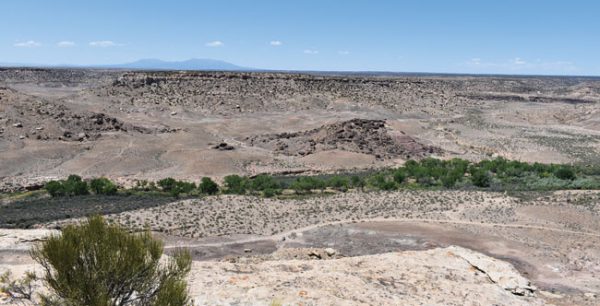
Green vegetation clings to life along a creek snaking across Canyons of the Ancients National Monument in the midst of an otherwise arid landscape.

National forests are closing. Wildfires are raging. Animals are dying in their quest for water.

2018 is shaping up to be one of the driest years on record in the Four Corners area.

Relief may be on the way, but it won’t likely arrive for another month or more. And even then there is no guarantee how substantial or sustained it will be.

2002 was a year of disastrous drought across the region. So far, this year is looking every bit as bad, with one key difference: Last year saw bountiful precipitation that filled area reservoirs, and thus there was good carryover going into this summer.

“We basically are tracking very similar to 2002,” said Ken Curtis, a hydrologist with the Dolores Water Conservancy District in Cortez.

“The snow wasn’t quite the same. In 2002 it snowed a little, then stayed dry. We had snow mixed with dry spells in December and January, then a bit more snow at the end of March. We ended up with very similar numbers. We were dry last fall, too, so that didn’t help.”

“That’s what’s saving our bacon in most of the region this year – the water supply in reservoirs was in good shape going into this past winter,” said Jim Pringle, meteorologist with the National Weather Service in Grand Junction. “Without that, we would be in a lot worse situation right now.”

Curtis agreed. “That’s the big difference. In 2002 and 2013 [another drought year], irrigators only got about 25 percent supply. This year it will be closer to 60 to 70 percent, and it’s all because of good carryover.”

According to the U.S. Drought Monitor, the Four Corners area is currently classified as in exceptional drought, the worst category. That’s as of May 29.

According to data collected by weather observer James Andrus, a little under a half-inch of moisture fell in May, about 58 percent of the 30-year average for the month. That followed a long stretch of months with below-average precipitation.

In October, precipitation was at just 4 percent of the historic average for the month. November and December each saw 2 percent of average. January got 85 percent, but then came February (33), March (22), and April (45).

So the balmy winter that had people rejoicing because they didn’t have to shovel snow has had a brutal impact of a different sort.

Through May, Cortez was at just under half  of the yearly average for the water year, which runs from October through September.

A SNOTEL map showing snow water equivalency as of June 4 showed indicated that, statewide, Colorado’s high country was at 22 percent of the usual levels of snow. In the San Miguel, Dolores, Animals and San Juan river watershed, the level was just 5 percent.

The drought is spread across the Four Corners states in varying degrees. At the end of May, officials with the U.S. Forest Service closed the 1.6-million-acre Santa Fe National Forest in northern New Mexico to all recreational activity. The highly unusual measure was reportedly implemented because people were largely ignoring the fire ban in the forest.

The closure came even as firefighters were battling an enormous, human-caused blaze, the Buzzard Fire, in the Gila National Forest in southwestern New Mexico. That epic fire had reached 37,000 acres by June 5 and was still just 50 percent contained.

At the same time, New Mexico was also combating the Ute Park Fire in the northeast, which was about 37,000 acres and just 25 percent contained by June 5. The cause of that fire was unknown.

To the north, some 800 homes were evacuated because of the 416 Fire some 13 miles north of Durango. That blaze was relatively modest in size, about 2400 acres as of June 4, but it had prompted recurring closures of the highway between Durango and Silverton, U.S. 550. The Durango & Silverton Narrow Gauge Railroad was forced to suspend operations until at least June 10, a blow to tourism, and the scenic Hermosa Watershed area of the San Juan National Forest was closed to visitors.

To the west, at Gray Mountain on the Navajo reservation in Arizona, 191 feral horses were found dead early in May at a drying stock pond. “These animals were searching for water to stay alive,” said Navajo Vice President Jonathan Nez in a release. “In the process, they, unfortunately, burrowed themselves into the mud and couldn’t escape because they were so weak.” The skeletal figures of still-living feral horses continue to plod across the Navajo Nation, starving for forage and desperate for water.

And June is typically the driest month of the year in the region.

People are pinning their hopes on forecasts for an above-normal monsoon season. Monsoons are annual storms resulting from subtropical moisture that tend to occur in mid-July through mid-September. Sometimes they do come earlier.

“The precipitation outlook for June, July and August calls for above-normal precipitation in western Colorado and much of Utah and the Four Corners area in general,” Pringle said. “One thing we’ve noticed is after a dry winter, we typically have an earlier onset of the monsoon season.”

Pringle said the area is emerging from the second La Niña year in a row, and that may bring some relief. “If you look at the climatology of two consecutive La Niña years, the second is usually drier than the first,” he said.

La Niña is one half of a phenomenon called the El Niño-Southern Oscillation, or ENSO,  cycle, according to the National Oceanic and Atmospheric Administration. The cycle involves fluctuations in temperature that occur between the ocean and atmosphere in the Pacific Ocean. The fluctuations can have major impacts globally.

Typical El Niño effects include warmer-than-average temperatures over the western and northern United States, and abundant precipitation in the southern part of the country.

La Niña impacts tend to be opposite those of El Niño, meaning drier conditions in the area.

Right now, it appears an El Niño year could be coming, which could mean above-normal moisture next winter in the local area.

Or not.

Curtis is skeptical of the impacts of the ENSO cycle on the Four Corners. “El Niño is just certain conditions, particularly to the south, that tend to favor wetter periods. We are in a transitional area [where the ENSO cycle may or may not have an effect]. The forecast for El Niño doesn’t mean a lot. I personally don’t track it.

“A year or two ago, 2015 or 2016, was an El Niño but it didn’t pan out to much moisture for us. Those are long-range, mass conditions, global conditions. They may or may not have a dramatic effect on us.

“Bringing predictability to our local area is very tough,” he added. “Beyond five to 10 days, nobody predicts weather very accurately.”

The current forecast for a strong monsoon season has nothing to do with the ENSO cycle, he said, but with conditions in the Gulf of Mexico and to the south in general.

“We’re hopeful for monsoons,” Curtis said. “They generally come more often than not here. The strength can vary a lot. 2012 we didn’t really have any, and last year they were pretty weak. Even when California got a big jump in precipitation in March of this year, the moisture stayed north of us.

“In 2013, we had a good monsoon coming out of a drought. We were close to the bottom [of the reservoir’s supply] till the rains came, around August.”

Pringle said the biggest challenge for irrigators will be getting through the next few weeks. “Dry weather is likely to extend well into June. The outlook through June 22 favors below-normal moisture to continue in the Four Corners.”

What storms do blow up, he said, typically will bring lightning and wind but not much rain – horrific conditions for firefighters.

Curtis said the carryover in McPhee Reservoir has definitely mitigated the impacts of the drought on irrigators. The problem now is what lies ahead.

“The [Dolores] river is dying and will not rise until some significant precipitation comes along. Next year is our big concern because we will effectively end the year close to empty [in the reservoir].

“We have hopes because they do predict a monsoon. We’ll have to wait and see.”

For now, however, the area is deep in drought and the end is not yet in sight,

“We’re setting records this year,” Curtis said. “It is probably going to be one of the worst for the Dolores.”

Published in June 2018

Commission drops internet-tax idea, wants general sales tax

By Gail Binkly

The Montezuma County commissioners have abandoned the idea of a tax on internet sales after hearing from the Colorado Department of Revenue that such a tax would be unconstitutional.

However, they are now leaning toward putting a question on the November ballot that would ask voters to approve a 1-cent general sales tax.

At two meetings Thursday, Aug. 2, the commissioners said they disagreed with the state about the constitutionality of the internet tax, but thought it might be too costly and difficult a legal battle to be worth fighting.

The commissioners held a town hall at the county fair in the afternoon and also met with the county Planning and Zoning Commission that evening.

They had said at a previous meeting that they wanted a tax of perhaps 3 to 5 percent on internet sales to level the playing field for local businesses, which unlike online retailers are required to collect state and local sales taxes.

They also spoke favorably about putting a tax on marijuana sales because, as 22nd Judicial District Attorney Will Furse put it at the evening meeting, “We’re experiencing all of the negatives and none of the positives” from legalized cannabis.

Commissioner Larry Don Suckla had called for the taxes to help with the county’s budget woes, which are being brought on by a combination of factors. Suckla said he did not feel, as the state did, that an internet sales tax would be unfairly targeting one entity because “the internet is not an entity, it’s a platform.”

Suckla did not attend the special meeting with P&Z, but Commissioners Keenan Ertel and James Lambert did.

They asked the members of P&Z for their thoughts on the sales tax, which led to expressions of some frustration, as P&Z had come out in favor of a sales tax more than a year ago and had discussed it at length, only to have the commissioners apparently abandon the idea.

The City of Cortez has a 4.05 percent sales tax and as a result has a fairly steady revenue stream, but the county has no sales tax at all – one of just a handful of Colorado counties in that situation. Ertel pointed out that this did not create much motivation for the county to promote tourism, since it gains nothing from increased sales.

“As a county, it’s not a wise investment for us to invest in commerce,” Ertel commented, adding, “The city has gobbled up a lot of the tax appetite in this county.”

Ertel said the county will face a budget shortfall of $600,000 to $700,000 this year and he is adamantly opposed to using reserves to make up the difference.

He said a sales tax is “the most equitable tax there is,” a sentiment echoed by planning commissioner Rob Pope.

Ertel and the members of P&Z appeared to be fully in favor of asking voters for the 1-cent sales tax, but Lambert said he had hoped the proposal would include a provision linking it to lower property taxes. However, the other officials said they did not want to “handcuff” the county in the future when the revenues might be needed.

Asking if the lack of a tie to a lower mill levy was a “showstopper” for him, Lambert said no.

However, others noted that Suckla probably would not support the sales-tax proposal without it including such a provision.

The commission is expected to take up the matter Monday. They have until Sept. 7 to give the final language for the ballot question to County Clerk and Recorder Kim Percell, or to drop the matter.

Published in August 2018

Saying no to reality

Recently, I was minding my own business listening to a fascinating talk on YouTube titled, “Rooted in Earth History: the Devonian transition to a forested planet.” It was about strategies that Earth’s first ground-hugging plants adapted to escape the confines of Earth’s surface. They did this in order to reach closer to our sun and further away from plant-eaters.

This led to Earth’s first forests, which in turn led to an explosion of new environmental niches for life to radiate into.

I learned some fascinating details regarding questions I’d been wondering about for a long time. The lecture increased my understanding of evolution on this fantastic planet, which has been a lifelong passion for me.

But my pleasant reverie was shattered by a YouTube comment that blind-sided me. One ‘Psalm1Tree’ wrote in all seriousness:

“There never was a Devonian period, just as there never was a Cambrian, Jurassic, Triassic etc. period. That’s because there never was a Geologic Column. That is a 19th century construct that has no data whatsoever to support it.”

Besides avoiding the topic of the video, the comment is such an ignorant statement on so many levels that most who know anything about geology and evolution would simply clamp on the head-vise and back away.

Unfortunately, decades of ignoring such belligerent ignorance about important aspects of our life and planet have led to its becoming so insidious and commonplace that our government is controlled by Republicans who disregard obvious physical realities on personal whim. Justified only by a hubristic conceit that they are doing “God’s duty,” they are in fact all about pursuing their own EGO’s bidding.

I decided to engage Psalm with a short video that rationally explains what the geologic column is all about. Then came my second shock. I was not prepared for the dozens of videos dedicated to childish denials of the “geologic column” that Google’s YouTube search algorithm threw between my search topic and reliable serious information.

The handful of videos I sampled broke the first law of Constructive Debate: Honestly represent your opponents’ position! Instead they painted a deliberately misleading cartoon, thus fabricating an easy target for battering to death.

Finally, my persistence brought me to a few serious videos by scientists who actually study these matters. The difference in tone was refreshing. Rather than attacking conjured-up enemies, they focus on explaining their own work and results, often discussing competing theories to give as complete a picture as possible. They even describe weaknesses in their own work and point out further questions needing clarification.

That’s how science is done. Everyone’s goal is learning, and fidelity to physical facts is the gold standard. Science is a world where Free Speech doesn’t mean it’s okay to lie and slander with malicious intent. Informed constructive skepticism is the rule. Dishonest bluster and bullying is a crime.

Psalm feels free to dismiss all that with a glib wave: “There never was a Devonian period, just as there never was a Cambrian, Jurassic, Triassic etc. period.”

Think about that. Psalm tells us one great period of time does not follow another. How does that work? Ignore the march of seasons? Ignore that plants and animals are formed, grow and die. Ignore that floods, volcanoes, earthquakes, tsunamis are ever rearranging the surface? Ignore that stuff piles up on top of what was laid down before?

Psalm also needs us to ignore that, in human terms, Earth is unimaginably old. It’s as though Psalm has no conception of creation’s time-line ticking ever forward. Years and millennia continue unfolding and it’s all happening one day at a time, piling on top of all the days that came before. Or? What’s the alternative, turning Earth’s creation into a one-dimensional cartoon?

As Psalm does when he tried to deceive me: “There never was a Geologic Column. That’s a 19th century construct that has no data whatsoever to support it. Fossils are jumbled, in no organized pattern whatsoever.”

Here’s an example of self-certain, but grossly mistaken, beliefs enabled by utter disregard for substance. A construct? Sure, it is a construct. So? Why not ask, what is it a construct of? What was it constructed for? Why not a little curiosity and discussion about the substance of this construct?

No data? Seriously? Has Psalm ever looked? It’s easy to track down when our understanding started, in the late 1700s. That’s when a handful of curious, observant individuals struggled to make sense of what they saw laid out across their countryside. In particular there was James Hutton the geologist, farmer, and canal builder who spent decades trying to understand the varied, sometimes bizarre rock exposures and landscapes throughout England and beyond.

Hutton was able to classify these exposures into specific rock types. He also showed how at some time in the distant past hot lava had moved through what was then claimed to be the oldest rock type, deforming the land. Furthermore, this had to have happened at extreme depths, though now it lay at the surface. Hutton’s work made it clear that Earth was unimaginably older than the good preacher Ussher’s 6,000-year assertion.

Another pioneer was William Smith, a colorful canal, railway and road surveyor and mapper of coal mines, a man dedicated to comprehending the landscape and creating the first modern geologic map that visually distilled hundreds (soon to be thousands) of land surveys into a form all could learn to comprehend at a glance.

Think about Smith’s geologic map. It only reflects what’s on the surface, but obviously there’s a great deal more underneath, as countless drill core samples attest. Compiling that data inevitably leads to a geologic column, basically a vertical map of what’s under our feet. How can that be a fiction when it IS totally data-driven from inception to finish?

In our few exchanges Psalm wasn’t interested in details and even less in doing any good-faith research on his own. All he wanted was short answers to empty “gotcha” questions.

It’s unfortunate because I do have a wonderful image of our own Colorado Basin’s geologic column to share. Along with a video where Wayne Ranney, its creator, explains all about the evidence and data that drove the creation of this geologic column.

Go to YouTube and search “Ancient Landscapes of the Colorado Plateau with Wayne Ranney” – you won’t be disappointed. Then you too can look at the supporting evidence every time you drive through our Four Corners wonderland.

Peter Miesler writes from near Durango, Colo., and has a blog, ConfrontingScienceContrarians.blogspot.com. He’s added posts dedicated to sharing more information about the work of Hutton, Smith, Ranney which helps clarify the substance of the geologic column.

Published in Peter Miesler

Me, too?

The issue of sexual harassment has been in the news lately and some prominent men have fallen into disgrace because of it. That’s a good thing, as public discussion of the issue is long overdue.

But what seems to be happening is that people are not sincere in talking about sexual harassment. They are being political; none more so than President Donald Trump, who himself has been accused of misconduct by a dozen women.

While Trump has remained silent when eight women accused Alabama’s Roy Moore – who was a candidate for the U.S. Senate – of inappropriate behavior, he leaped into the Twitterverse to castigate Minnesota Sen. Al Franken over a single accusation.

But it was the Franken case that got me thinking about this whole issue.

I told my wife, Sara, that the Franken case was slightly different than the others because he was a comedian and was likely trying to “be funny.”

Sara told me about instances in her life when men have made crude advances or comments and when she objected told her she couldn’t “take a joke” or had no sense of humor.

That opened my eyes – and my mind – a bit as I realized that two people could witness the same event and yet experience it differently.

Franken may have really thought he was just clowning around; the women may have really been offended. It is possible for both things to be true simultaneously.

I don’t think Franken, Moore, Trump, Harvey Weinstein, Kevin Spacey or any of the other men that have found themselves in the news lately over this issue are unique. I’d guess that you could randomly pluck just about any man off the street and at some point in his life he has sexually harassed someone.

Part of the problem is the way society works. The man is supposed to pursue the woman, to ask her out, to “make the first move.”

I remember a waitress I had one time that I thought was pretty. I asked her out, she said “no” and that was the end of it. But she could have felt harassed for all I know. Maybe, unbeknownst to me, several other men had asked her out that week and she was angry that she just couldn’t come to work without being hit on.

Now, in my case, if I asked a lady out and she said “no,” I walk away. But I have heard women complain that they turned a guy down because they “wanted him to work for it,” and were disappointed that he never came back and asked them out again.

Sometimes it can be difficult to know when a “no” is a “no” and not a “maybe.”

But I don’t say this to excuse sexual harassment, merely to point out that it’s not always so cut and dried to determine what happened.

Watching CNN and MSNBC and other news shows, I find that all the panelists seem to think that only men commit sexual harassment. That made me look back on my own life to incidents that maybe could be considered sexual harassment.

Some are clear-cut. When I was 16 I was standing on the sidewalk waiting for my friends who were still in a convenience store, when a car with four girls pulled up to the curb and asked me if I wanted to (bleep). I was so stunned I just stared at them with a Hostess cupcake in my hand.

“He’s just a farmboy,” one of them said when I could muster no response, and they drove off.

Imagine now if a car with four blokes propositioned a lone girl like that.

Then there was my first-ever kiss. I was a senior in high school when a girl I knew walked up to me and kissed me on the lips. She didn’t say anything and just walked away after. I was flabbergasted. Not because I was angry, or felt I’d been violated. I’d just never been kissed. Before that incident I thought a kiss was a chocolate candy!

Now, if I went up to some random girl today and did that I’d be accused of sexual harassment. I might even end up in jail – which would be the safest place for me once Sara heard about it! But at least I knew that girl, and we were friendly acquaintances.

That wasn’t the case when I was a sophomore in college. I was volunteering at a diabetes charity event when a girl I had never seen before walked up to me and said, “You look so much like Jerry Garcia, I just have to kiss you!”

She kissed me and walked away. I immediately did what anyone else in my place would have done – I asked my friend who Jerry Garcia was.

I had a female friend in college and I would stop by her dorm room to visit once in a while. One evening I stopped by and she was under her blankets. I sat on the side of her bed as I always did and started chatting. Then she said she had so much homework and got out of bed – in her underwear – and walked to her table. She bent over in front of me as she “looked” for her book.

I just continued talking. She returned to her bed, this time lying atop her covers and commented that she needed new underwear because the ones she was wearing had a tear. When I still didn’t react she said that I was the only guy she knew who would sit on her bed and not be all over her.

I thought it was a compliment that she trusted me enough to walk around in front of me in her underwear. (Yes, I was a tad naive.)

When I told a friend about what happened I remember his reaction: “You fool! She was hitting on you!”

That brings up another problem with sexual harassment. It’s a double standard.

If I tell that story to my guy friends they all think I was a doofus not to get the hint. But what if the situation was reversed? What if a man did that to a woman? When she told her girlfriends about it they’d all say he was a creep or a pig.

Now – SPOILER ALERT! – I was once accused of sexual harassment.

I was editor of a new weekly supplement that my newspaper was starting. The publisher wanted to run photos and brief bios of all the people who would be involved with the new project. It was my job to collect the photos and bios. Everyone complied except for three women in the advertising department. I sent them three reminders as the deadline drew closer. Still, no reaction.

The day before we were scheduled to go to print – with my publisher pushing me to get the information – I sent a final group email to the three women, none of whom I knew. In an attempt to be playful I explained that I needed their bio information and wrote something along the lines of “I know you’re cute but I need to put more than that under your picture.”

Two of the women immediately sent me their bios. The third filed a sexual harassment complaint against me. After a brief investigation I was cleared.

But did I cross the line? Did I sexually harass her?

She thought so. I did not.

But sometimes sexual harassment isn’t so easy to identify.

John Christian Hopkins, an award-winning novelist and humor columnist, is a member of the Narragansett Indian Tribe. See his writings at http://authorjohnchopkins.blogspot.com.

Published in John Christian Hopkins

Groovin’ to the music, once again

I went to my first Telluride Bluegrass Festival in 1988 – the 15th annual.

My friends and I loaded up the car with tie-dye, squirt bottles, blankets, and enough peanut-butter pot cookies to incapacitate an entire army.

We drove down from summer in the Wasatch, stopping at a secret swimming hole, which is now a high-school party spot in Moab. We giggled when we hit a skunk because it smelled like weed.

We rented a condo two blocks from Town Park, each of us chipping in $25, and we parked on the street right in front.

Into the festival, we took Wasatch Ale in bottles, a couple of dogs, and a lot of hallucinogenics.

We set up right next to the folks that brought in their own couch.

We danced to a very young Sam Bush’s mandolin, went to The Land of the Navajo with Peter Rowan, and sang gospel on Sunday mornings with John Cowan; all under the canopy of a gazillion stars cradled by the San Juan Mountains.

I did this for years and then the festival became too crowded, too expensive.

It became hip.

I outgrew hallucinogens and my babies outgrew sleeping under a tarp all day in the sun.

In other words, it was not as easy any more and I put it on the shelf as another cool thing I used to do.

Like touring with the Dead.

Then, this year, my friend offered me a ticket to the day of my choice, for the 45th annual Bluegrass Festival.

I said yes.

And thank you.

Which day?

Duh, Emmylou.

I got so excited I could barely stand it. I packed up my shit, remembering the relentless sun and frigid nights, nodding to the fact that I need more accouterments to remain comfortable at 53 than I did at 23.

Upon arrival, as I got my arm band, I felt like all of the stress of the last year, really of the last 30 years, rolled right off my back and I was filled with joy; I returned to that young, carefree gal that used to kick her heels up and hug everyone.

I found myself a spot, spread out my quilt, and settled in for the long haul. I was so thankful to be alone to just enjoy it as I wished.

(Last time I went to a music festival, I was dragged out before I was ready because the person I was with had seen the one band he wanted to see and was driving.)

After gyros and a lemonade, I got down to business: people-watching; there’s no place better to observe humanity at its weirdest and best.

There were the usual players, the hippies and the freaks, and there were some new additions. I took notes and will now share a few observations with you.

First of all, why do you think it’s okay to stand up in front of your seated neighbors? Oh, because you want to see the stage. Okay. I’m fine with staring at your ass instead of seeing the stage myself.

(Said no one ever)

You with the tie-dye dress that you just bought in that booth over there, the Prada handbag is a dead giveaway that you’re not really at home in Hippieland.

This is not Coachella.

There’s always the misplaced Dead Head, just dying for another opportunity to eat mushrooms and dance wildly in place.

Go big, Buddy, I miss them too.

To the gal with the perfect hair…are you aware of how stunning you look with those auburn tresses blowing in the wind?

Oh wait, you are.

To the gal on the phone giving the play-by-play to your Aunt Edna in Des Moines, tell her to get a ticket and get off the damn phone.

Very small child with weed spray bottle, thanks for giving my ankles a squirt, I feel much better.

Guy in velvet top hat and no shirt – I’ve seen you before – I think you’ve been at every music gathering this side of the Mississippi since the 80s.

Guy with plastic bird on your shoulder – WAY less creepy than Guy with stuffed iguana puppet.

The announcer letting people know where to smoke grass and to be careful if eating edibles…that’s new (not the smoking and the eating – just the open discussion). Welcome to Colorado.

Children, glow-stick snake, footie pajamas.

And speaking of children…mine suffered for years under the hot sun. We suffered for years carrying all of their shit. Nowadays there is so much [[stuff meant to avoid discomfort: collapsible wagons, giant shade structures big enough to stand or sleep under, camp chairs with hydraulics for rocking a nursing baby.

I would like to take pride in having been tougher than this new generation but really, I’m just jealous.

Girl behind me falling all over guy…he’s a putz. I’ve been listening to him talk about himself for the last 3 hours. He’s not an authority on bluegrass, nor on anything else he’s pretending to know about. Get out of his lap and run.

Gal with your elderly parents…you are a great daughter.

Frat boys in t-shirts from other concerts – yeah, you’re super cool.

Bitchy mom, if you bring your 7-year-old to a 4-day music festival, chances are that at some point he is going to get bored. What do kids do when they get bored (and hot and dehydrated)? They throw fits. So don’t act so f!@#ing surprised and do something other than ignore him.

Girl in crocheted bikini top – if I was 30 years younger…And BTW, your gaybestfriend is giving you a run for your money in the booty-shaking department.

Lady stuck in chair writing in a notebook, your middle age is showing.

(That was me.)

I enjoyed being somewhat of an elder there. Memories cascaded over me while the stunning and stunningly talented Emmylou serenaded me in the most beautiful place on the planet.

The house band played the music that was soundtrack to my son’s entry into the world.

I was so entertained.

The Telluride Bluegrass Festival is back on the to-do list.

Suzanne Strazza writes from Mancos, Colo.

Published in Suzanne Strazza

Baking day

A friend explained to me recently how sales and marketing have changed over the years. In the past, she said, people sold mostly tangible products. Now, they are more likely to market experiences.

Take the example of a cake, she said. In the old days, you made cakes from “scratch,” using butter and eggs, flour and sugar. (Some of you reading this may never have heard of such an astonishing thing, but it’s true.) However, that was time-consuming, so manufacturers came up with the idea of putting most of the ingredients in powdered form in a box. These mixes freed up the women who were doing most of the baking back then to indulge in other experiences.

As time went on, cakes evolved further; you could buy pre-made batters or frozen loaf cakes that you just popped into the oven. And soon grocery stores were offering entire cakes ready to eat, frosting and all. The only downside, of course, is that you pay much more than you would if you made a cake from basic ingredients or a mix.

Still, ready-made cakes, cookies, and so on save time so you can have other, presumably more enjoyable experiences than fussing around with a mixing bowl. It’s those intangibles – recreational experiences, trips, guided tours –  that are marketed today.

What my friend said made sense, but I found my mind wandering off on a tangent. I was thinking back to the days when I myself baked from scratch – at my mother’s side.

My family was not well-to-do. Mother sewed many of our clothes and cooked our meals in addition to working full-time as a teacher. She also baked, and I learned to do the same from watching her.

In those days, people commonly shared recipes or clipped them from newspapers. Many were for desserts. That was back before we realized how bad sugar was for you. (This is not an attempt to say that sugar isn’t bad just because I survived a childhood full of it. If I ate now as I did then, I’d probably be in the hospital.)

At any rate, we baked cakes and cookies and pies, lots of them. My dad, a letter carrier who did his route on foot, had a bountiful appetite despite being a lean man, and he loved desserts. My mother, my sister and I ate our share of the sweet treats as well.

My sister helped with the baking once in a while, but she’s three years younger than I, and often lacked the patience to see those projects through to the end. So it was mainly Mother and I in the kitchen. Nearly every weekend would find us stirring up some new delectable. We tried things with names like “Mrs. Sallee’s Cherry Coconut Bars” or “Easy Three-Layer Cake with Maple Foam Frosting.” As we worked, we talked constantly – about school, books, people, and life in general. We laughed at our culinary failures and crowed over our successes.

Just about every recipe began with the words, “In mixing bowl, cream butter with sugar.” Then came the eggs, then the flour mixture, and finally any flavorings or special ingredients.

Blissfully unaware of the dangers of e. coli in flour and salmonella in eggs, Mother and I consumed large quantities of the raw product. (Pound-cake batter and chocolate-cookie dough were two of my favorites.) Mother’s philosophy was, “If you don’t taste it, how will you know if you made a mistake?” Her theory was given validity when my sister made a batch of cookies with a tablespoon of salt instead of a teaspoon and did NOT taste the dough first.

Mother dispensed many such tips on those Saturday afternoons. One was, “Cakes are delicate, but cookies are forgiving.” (It’s true – it takes a lot to ruin cookies.) She knew that the secret to great fudge is enough salt. She recommended dumping a healthy dose of vanilla extract in everything. She believed in chopping walnuts coarsely rather than grinding them. (“I want to KNOW that I’m eating a walnut!”) She insisted on cooking the apples in a pie beforehand, so you didn’t bite into a crunchy piece of fruit.

We experimented constantly. We made “Eggless, Milkless, Butterless Cake,” a staple from the Great Depression (not bad if you can stand raisins). We made cakes with boiled frosting, buttercream frosting, cream-cheese frosting. We baked Christmas cookies in a hundred shapes, sprinkled with round silver things made of who-knows-what toxic ingredients. I still have our old recipe book; it flops open to the grease-stained page bearing the oatmeal-cookie recipe, one of our favorites.

One day, Mother and I baked pineapple upside-down cake that was so good we gobbled most of it ourselves shortly after pulling it out of the oven. My father was lucky to get a single serving.

Possibly the pinnacle of our achievements was creating doughnuts. We concocted a basic batter, then divided it into different bowls, adding chocolate to one, applesauce and nutmeg to another, buttermilk to another. We fried the doughnuts in a big vat, then dusted some with powdered sugar, rolled others in cinnamon and sugar, and frosted yet others. Then came shredded coconut, sliced almonds, sprinkles or walnuts.

By day’s end, there were more types of doughnut stacked around the kitchen than you could have found in Winchell’s doughnut shop. We were slightly sick from sampling them (but each and every kind was delicious). Both of us as well as the room were covered in flour and powdered sugar, which has a unique knack for adhering to any surface. Every bottle of food coloring and flavoring we possessed was sitting out on the linoleum counter, which was now stained with red dye. We were so tired, we had to leave the mess for the next day.

We never made doughnuts again, but they were sublime.

So when my friend was telling me about how grocery-store cakes free us from baking so we can have other experiences, I wondered what experiences my mother and I should have been having instead. Baking was the treat we looked forward to, the highlight of our week, an artistic endeavor with a delicious reward at the end.

Clearly, it’s good to have the option of buying ready-made food rather than being tied to the daily drudgery of making your own meals. But I find it ironic that one of the hottest culinary products of the modern era is boxes of ingredients for complete dinners delivered to your doorstep. They’re marketed as ways to bring your family together to share the experience of cooking and baking.

It’s a good idea, but one that is hardly new.

There’s a saying that goes, “Find a job you love, and you’ll never work a day in your life.” A corollary, perhaps, is, “Find a way to love the chores you have to do, and they won’t be chores any longer.”

It’s a lesson I learned from my mother, and if she were here today, we’d still be in the kitchen baking.

Gail Binkly is editor of the Four Corners Free Press.

Published in Gail Binkly

Groovin’ to the music, once again

I went to my first Telluride Bluegrass Festival in 1988 – the 15th annual.

My friends and I loaded up the car with tie-dye, squirt bottles, blankets, and enough peanut-butter pot cookies to incapacitate an entire army.

We drove down from summer in the Wasatch, stopping at a secret swimming hole, which is now a high-school party spot in Moab. We giggled when we hit a skunk because it smelled like weed.

We rented a condo two blocks from Town Park, each of us chipping in $25, and we parked on the street right in front.

Into the festival, we took Wasatch Ale in bottles, a couple of dogs, and a lot of hallucinogenics.

We set up right next to the folks that brought in their own couch.

We danced to a very young Sam Bush’s mandolin, went to The Land of the Navajo with Peter Rowan, and sang gospel on Sunday mornings with John Cowan; all under the canopy of a gazillion stars cradled by the San Juan Mountains.

I did this for years and then the festival became too crowded, too expensive.

It became hip.

I outgrew hallucinogens and my babies outgrew sleeping under a tarp all day in the sun.

In other words, it was not as easy any more and I put it on the shelf as another cool thing I used to do.

Like touring with the Dead.

Then, this year, my friend offered me a ticket to the day of my choice, for the 45th annual Bluegrass Festival.

I said yes.

And thank you.

Which day?

Duh, Emmylou.

I got so excited I could barely stand it. I packed up my shit, remembering the relentless sun and frigid nights, nodding to the fact that I need more accouterments to remain comfortable at 53 than I did at 23.

Upon arrival, as I got my arm band, I felt like all of the stress of the last year, really of the last 30 years, rolled right off my back and I was filled with joy; I returned to that young, carefree gal that used to kick her heels up and hug everyone.

I found myself a spot, spread out my quilt, and settled in for the long haul. I was so thankful to be alone to just enjoy it as I wished.

(Last time I went to a music festival, I was dragged out before I was ready because the person I was with had seen the one band he wanted to see and was driving.)

After gyros and a lemonade, I got down to business: people-watching; there’s no place better to observe humanity at its weirdest and best.

There were the usual players, the hippies and the freaks, and there were some new additions. I took notes and will now share a few observations with you.

First of all, why do you think it’s okay to stand up in front of your seated neighbors? Oh, because you want to see the stage. Okay. I’m fine with staring at your ass instead of seeing the stage myself.

(Said no one ever)

You with the tie-dye dress that you just bought in that booth over there, the Prada handbag is a dead giveaway that you’re not really at home in Hippieland.

This is not Coachella.

There’s always the misplaced Dead Head, just dying for another opportunity to eat mushrooms and dance wildly in place.

Go big, Buddy, I miss them too.

To the gal with the perfect hair…are you aware of how stunning you look with those auburn tresses blowing in the wind?

Oh wait, you are.

To the gal on the phone giving the play-by-play to your Aunt Edna in Des Moines, tell her to get a ticket and get off the damn phone.

Very small child with weed spray bottle, thanks for giving my ankles a squirt, I feel much better.

Guy in velvet top hat and no shirt – I’ve seen you before – I think you’ve been at every music gathering this side of the Mississippi since the 80s.

Guy with plastic bird on your shoulder – WAY less creepy than Guy with stuffed iguana puppet.

The announcer letting people know where to smoke grass and to be careful if eating edibles…that’s new (not the smoking and the eating – just the open discussion). Welcome to Colorado.

Children, glow-stick snake, footie pajamas.

And speaking of children…mine suffered for years under the hot sun. We suffered for years carrying all of their shit. Nowadays there is so much [[stuff meant to avoid discomfort: collapsible wagons, giant shade structures big enough to stand or sleep under, camp chairs with hydraulics for rocking a nursing baby.

I would like to take pride in having been tougher than this new generation but really, I’m just jealous.

Girl behind me falling all over guy…he’s a putz. I’ve been listening to him talk about himself for the last 3 hours. He’s not an authority on bluegrass, nor on anything else he’s pretending to know about. Get out of his lap and run.

Gal with your elderly parents…you are a great daughter.

Frat boys in t-shirts from other concerts – yeah, you’re super cool.

Bitchy mom, if you bring your 7-year-old to a 4-day music festival, chances are that at some point he is going to get bored. What do kids do when they get bored (and hot and dehydrated)? They throw fits. So don’t act so f!@#ing surprised and do something other than ignore him.

Girl in crocheted bikini top – if I was 30 years younger…And BTW, your gaybestfriend is giving you a run for your money in the booty-shaking department.

Lady stuck in chair writing in a notebook, your middle age is showing.

(That was me.)

I enjoyed being somewhat of an elder there. Memories cascaded over me while the stunning and stunningly talented Emmylou serenaded me in the most beautiful place on the planet.

The house band played the music that was soundtrack to my son’s entry into the world.

I was so entertained.

The Telluride Bluegrass Festival is back on the to-do list.

Suzanne Strazza writes from Mancos, Colo.

Published in Suzanne Strazza

What is true patriotism?

This is the month when Americans really show their patriotism, right? Lots of loud, bright fireworks, flags waving in the sun, red, white and blue frosted cakes – all to remind us what a great country we have.

We go to Fourth of July sales at the markets and furniture stores. We set off illegal fireworks surreptitiously in our back yards. We wear Stars and Stripes T-shirts and blue jeans.

I get tears in my eyes myself when I see Old Glory displayed and proudly saluted as it passes by in a parade.

But all that is symbolism and ceremony. It isn’t true patriotism. That takes work and, yes, sacrifice.

First off, I submit that one of the most patriotic things one can do is proudly pay the taxes we owe. Why? Because when we pay our taxes, we are saying to those that gave their all, “We will continue to support this great nation.”

In many ways, we have let those that die,  those who lie beneath the marble crosses in veterans’ cemeteries down, way down. We haven’t been the best citizens we could be. We haven’t always voted. And sometimes when we have voted, we picked candidates without knowing anything about them beyond the R or D after their names.

The least we can do is pay our taxes to support this nation, a gift to us from those who sweated and toiled and bled and died on battlefields throughout our history.

Let’ take a minute and think about who lies in those cemeteries, the men and women who could have been. The person who might have cured all cancers, or taught our youth a better way to live. Someone who found the most efficient way to provide renewable energy, or found a remedy for mental illness, or developed a new vaccine or better foods for our health.

The least we owe these people who sacrificed their lives for us is to honor their short lives with the monetary gift of taxes to support the necessities of a great nation:  infrastructure, the military, care for the elderly and vulnerable among us, law enforcement, a just judicial system, and so much more. Those things aren’t free of cost, no matter how much we might wish they were.

Those who cheat on their taxes, who fight against them tooth and nail, are not the patriots they claim to be. They wave their flags and spout platitudes, but their idea of patriotism is as empty as a bass drum.

Benjamin Franklin plainly stated, when asked what the founding fathers had given us, “A republic, if you can keep it.” In 241 years it has been freely given over to the moneyed corporations and welfare politicians. If millionaires and billionaires would pay their fair share in taxes, there would be no national debt.

People may say I’m a socialist or a communist, but I have been in business and worked the capitalistic system all my life. In one sense, there is no difference between socialism, communism and capitalism. It is just how the profits made by the people are divided up by those on top. Taxes aren’t evil, they are necessary to keep our freedom. Are you unhappy with the way our taxes are spent? Remember, we are the ones that sent those people to office, the ones making the decisions about spending. And that is the other big chunk of true patriotism: becoming an involved, active citizen.

If you don’t vote, don’t complain. If you vote out of ignorance, don’t complain. If you won’t take a few minutes now and then away from your TV and your Netflix and your video games to attend a local meeting or send an email to your representative or learn a bit about the Constitution and how our political system works, then I don’t care how loudly you sing the national anthem, you aren’t a true patriot.

Vote, participate, pay taxes – that is how you truly show your love for America.

Galen Larson writes from Cortez, Colo.

Published in Galen Larson

Saying no to reality

Recently, I was minding my own business listening to a fascinating talk on YouTube titled, “Rooted in Earth History: the Devonian transition to a forested planet.” It was about strategies that Earth’s first ground-hugging plants adapted to escape the confines of Earth’s surface. They did this in order to reach closer to our sun and further away from plant-eaters.

This led to Earth’s first forests, which in turn led to an explosion of new environmental niches for life to radiate into.

I learned some fascinating details regarding questions I’d been wondering about for a long time. The lecture increased my understanding of evolution on this fantastic planet, which has been a lifelong passion for me.

But my pleasant reverie was shattered by a YouTube comment that blind-sided me. One ‘Psalm1Tree’ wrote in all seriousness:

“There never was a Devonian period, just as there never was a Cambrian, Jurassic, Triassic etc. period. That’s because there never was a Geologic Column. That is a 19th century construct that has no data whatsoever to support it.”

Besides avoiding the topic of the video, the comment is such an ignorant statement on so many levels that most who know anything about geology and evolution would simply clamp on the head-vise and back away.

Unfortunately, decades of ignoring such belligerent ignorance about important aspects of our life and planet have led to its becoming so insidious and commonplace that our government is controlled by Republicans who disregard obvious physical realities on personal whim. Justified only by a hubristic conceit that they are doing “God’s duty,” they are in fact all about pursuing their own EGO’s bidding.

I decided to engage Psalm with a short video that rationally explains what the geologic column is all about. Then came my second shock. I was not prepared for the dozens of videos dedicated to childish denials of the “geologic column” that Google’s YouTube search algorithm threw between my search topic and reliable serious information.

The handful of videos I sampled broke the first law of Constructive Debate: Honestly represent your opponents’ position! Instead they painted a deliberately misleading cartoon, thus fabricating an easy target for battering to death.

Finally, my persistence brought me to a few serious videos by scientists who actually study these matters. The difference in tone was refreshing. Rather than attacking conjured-up enemies, they focus on explaining their own work and results, often discussing competing theories to give as complete a picture as possible. They even describe weaknesses in their own work and point out further questions needing clarification.

That’s how science is done. Everyone’s goal is learning, and fidelity to physical facts is the gold standard. Science is a world where Free Speech doesn’t mean it’s okay to lie and slander with malicious intent. Informed constructive skepticism is the rule. Dishonest bluster and bullying is a crime.

Psalm feels free to dismiss all that with a glib wave: “There never was a Devonian period, just as there never was a Cambrian, Jurassic, Triassic etc. period.”

Think about that. Psalm tells us one great period of time does not follow another. How does that work? Ignore the march of seasons? Ignore that plants and animals are formed, grow and die. Ignore that floods, volcanoes, earthquakes, tsunamis are ever rearranging the surface? Ignore that stuff piles up on top of what was laid down before?

Psalm also needs us to ignore that, in human terms, Earth is unimaginably old. It’s as though Psalm has no conception of creation’s time-line ticking ever forward. Years and millennia continue unfolding and it’s all happening one day at a time, piling on top of all the days that came before. Or? What’s the alternative, turning Earth’s creation into a one-dimensional cartoon?

As Psalm does when he tried to deceive me: “There never was a Geologic Column. That’s a 19th century construct that has no data whatsoever to support it. Fossils are jumbled, in no organized pattern whatsoever.”

Here’s an example of self-certain, but grossly mistaken, beliefs enabled by utter disregard for substance. A construct? Sure, it is a construct. So? Why not ask, what is it a construct of? What was it constructed for? Why not a little curiosity and discussion about the substance of this construct?

No data? Seriously? Has Psalm ever looked? It’s easy to track down when our understanding started, in the late 1700s. That’s when a handful of curious, observant individuals struggled to make sense of what they saw laid out across their countryside. In particular there was James Hutton the geologist, farmer, and canal builder who spent decades trying to understand the varied, sometimes bizarre rock exposures and landscapes throughout England and beyond.

Hutton was able to classify these exposures into specific rock types. He also showed how at some time in the distant past hot lava had moved through what was then claimed to be the oldest rock type, deforming the land. Furthermore, this had to have happened at extreme depths, though now it lay at the surface. Hutton’s work made it clear that Earth was unimaginably older than the good preacher Ussher’s 6,000-year assertion.

Another pioneer was William Smith, a colorful canal, railway and road surveyor and mapper of coal mines, a man dedicated to comprehending the landscape and creating the first modern geologic map that visually distilled hundreds (soon to be thousands) of land surveys into a form all could learn to comprehend at a glance.

Think about Smith’s geologic map. It only reflects what’s on the surface, but obviously there’s a great deal more underneath, as countless drill core samples attest. Compiling that data inevitably leads to a geologic column, basically a vertical map of what’s under our feet. How can that be a fiction when it IS totally data-driven from inception to finish?

In our few exchanges Psalm wasn’t interested in details and even less in doing any good-faith research on his own. All he wanted was short answers to empty “gotcha” questions.

It’s unfortunate because I do have a wonderful image of our own Colorado Basin’s geologic column to share. Along with a video where Wayne Ranney, its creator, explains all about the evidence and data that drove the creation of this geologic column.

Go to YouTube and search “Ancient Landscapes of the Colorado Plateau with Wayne Ranney” – you won’t be disappointed. Then you too can look at the supporting evidence every time you drive through our Four Corners wonderland.

Peter Miesler writes from near Durango, Colo., and has a blog, ConfrontingScienceContrarians.blogspot.com. He’s added posts dedicated to sharing more information about the work of Hutton, Smith, Ranney which helps clarify the substance of the geologic column.

Published in Peter Miesler

The osprey has landed

My daily bicycle ritual usually takes me north of town, past the hospital to pedal along our rural county roads. On a windy day at the end of April a most unusual scene unfolded as I headed out. I stopped to gawk at a crane grabbing hold of an osprey and lifting it almost 30 feet off the ground.

Before crying fowl, let me explain. The osprey weighed 2500 pounds. I know this because the crane operator shouted the information out his truck window while he manipulated the crane’s hydraulics with the skill of a pinball wizard. The osprey was already familiar to me, a commissioned sculpture designed and assembled by local artist Bill Teetzel at his studio north of town for the newly constructed Osprey headquarters, just across the street from our newly constructed combined-court building. Osprey is Cortez’s sanctuary for backpacks, not birds. The company designs, manufactures, and sells a trademark with greater recognition than the actual ospreys.

A half-dozen men scrambled to orchestrate a gentle landing for the sculpture after its awkward flight from a flatbed trailer, suspended by cables, swinging and swaying slightly as it hovered above its permanent concrete perch. Famous for its expansive six-foot wingspan, the osprey is impressive, but the record for any living bird’s wingspan is held by the wandering albatross, a spread of up to 12 feet. But who would want to go hiking with an Albatross backpack?

Teetzel’s osprey stands 9.5 feet tall and 18 feet wide. It, too, is impressive, constructed out of three gnarly sheets of half-inch crusher screen slightly arced, then welded in layers to form a three-dimensional background relief. The company’s skeletal trademark bird is fastened to that wired slice of sky.

While I admire the sculpture very much, what I admire even more is the way a community came together to make it happen. Osprey could have easily outsourced the art project, but they opted to work with local talent, ingenuity, and sweat.

Standing among a growing crowd of onlookers, I recognized many faces involved in the undertaking. The crane operator whom I first met at parent-teacher conferences while his boys studied their way through high school—the same school district where his wife and I taught. A volunteer at the county jail who instructs inmates wandered over to see what was going on, then vanished before I could say hello. The crew included a former manager from our local Empire Electric Co-op, a young Osprey employee assigned an eight-hour construction shift, and some friends who have worked with Teetzel for years, including Joanne, his wife, a nurse with a career in Four Corners public health. The scene smacked not of a business venture but of neighborhood celebration.

Bill Teetzel shared his vision with me, one of finding common ground between art and community, encouraging both to occupy the same gallery. His salvage-yard installation south of town stands as a case in point. It occupies a roof at Belt Salvage, depicting two enormous metal vultures gutting the carcass of an overturned car placed up there, no doubt by another crane. Three companion vultures survey the highway nearby, as if awaiting their turns. The sculpture constitutes a reality adjustment, a lens where Bill adds perspective, and humor. To a stream of amused tourists passing through, Teetzel’s vultures stand as goodwill ambassadors for the city of Cortez.

The word connectivity could be a source of confusion for those trying to grapple with the concept of community. Social platforms, followers, postings, and traffic shape the internet vocabulary for users trying to grow an audience. Donald J. Trump boasts over 51 million Twitter followers, yet he follows about 48. Katy Perry holds a Twitter record with almost 110 million fans. She follows about 200. Apparently, social media communities run mostly with one-way streets.

To people growing a physical community, a social platform might be as simple as a neighbor’s deck where food gets grilled and glasses refilled. Followers might be confused with stalkers. Postings occur at the Post Office, or on a public bulletin board if a pet disappears or some possession loses its charm and needs to be sold. As community traffic increases, we build medians and signal lights. An internet hit is trivial compared to one while pedestrians cross the street.

Eventually I bicycled home, because the serious work of drilling concrete and installing bolts gave me the willies. Relationship-building should never require wearing a hardhat.

David Feela is a retired teacher living in Cortez, Colo. See more of his works at http://feelasophy.weebly.com/

Published in David Feela

Is it too late?

To manage or not to manage, that is the question! How does that apply to the resources on our so-called Public Lands? Well, first, what do we mean by “manage”? According to Webster, manage is “To handle or direct with a degree of skill”, or “to work upon or try to alter for a purpose.” Both of those denote an action, therefore when we ask the question to manage or not, are we not differentiating between doing and not doing an action?

Last month we looked at how much of the states’ land and resources are under federal control, with as much as 40 percent falling into the “not doing an action,” or no real management, but leaving it to nature to “happen.” In the past week we have witnessed how “letting nature happen” has affected the lives of many peoples due to two local wildfires, the 416 near Durango and the Burro Fire east of Dolores in the Bear Creek drainage. Currently the 416 is over 34,000 acres and the Burro is around 4,000 acres. So far nobody’s house or animals were damaged, so what is the problem? For starters, the fires are not over, and will not be put out, but allow nature to do it whenever, allowing millions of cubic feet of forest products to be wasted, water quality and even recreation values to be degraded.

These two fires are only the beginning, as there will be more in the months and years to come. These fires and those to come are not, and will not be like so-called natural fires of the past, for several reasons. The fires will inflict serious damage to our watersheds, forest resources, fisheries, economies and possibly property and lives.

There are some that believe these losses are OK, as long as “nature rules” and humans are kept out and do not use the resources (except for themselves). Some put the blame for wildfires on past management, use and protection measures in the forest. That is simply not true, there have always been wildfires, many from natural causes, such as lightning, indigenous men in times past, and current man in various ways. The intensity of today’s wildfires results from discontinuing the stewardship management and use that was begun over 120 years ago and essentially ended in 1976 with the Federal Lands Policy and Management Act (FLPMA) and the new National Forest Management Act (NFMA) when scientific forest management on the public lands was changed to “ Pleasing People Management” (PPM  – that is my coinage) in the forest environment. The public has been erroneously told the so-called Public Lands are “their lands,” they belong to [[all]] the people. That is virtually impossible, if they are yours, then they can’t be mine and vice versa, right?

Aren’t we a democracy where all decide what to do with the lands? No, that is not how the government was set up! A democracy would provide for you and your buddies to out-vote me and my buddies on any land management issue as long as you got 51 percent of the vote. Our government was set up as a constitutional republic with a representative government, which is the case for both the federal and states. In the state, much of that representative authority is delegated to the county level with the Board of County Commissioners to represent [[all]] the people and oversight of all]] the lands and resources of the state, excepting Indian Treaty lands, for the health, safety and welfare of the county as a whole. So why do the environmental corporations and their buddies’ “votes” control the management or no management decisions on the Public Lands as if we are a democracy? Long story short, several laws have been passed that were not]] Pursuant to the Constitution that provide for ignoring and negating constitutional representative governance at the state and county level in preference for Pleasing People Management that will provide for parties to take the federal agencies to court if they are not pleased. Forest resource health and people of the counties and state do not matter.

With that background, what will happen to the nearly 40,000 acres of timber that has already been killed or severely damaged? Will it be salvaged for economic return to provide funding for reforestation work? Will access be developed to provide rapid response to control future fires? Will watershed improvement actions be conducted to reduce damage to the fisheries and water quality downstream? Under current repugnant laws and regulations, the answer is likely not.

These two wildfires are a giant wakeup call for the state to take action to begin to salvage the future health, protection and productivity of our critical watersheds by ensuring experienced scientific management and use of the public lands is reinstated for the benefit of [all[ the state, not the desires of the few. Is it too late to save the resources? To be good stewards of the lands and resources our Creator has endowed us with, it is never too late to start, but it is going to be a long task to restore 40 years of damage. Kinda like restoring an old homestead house that hasn’t been used for 70 or 80 years, it has to be approached with a “can do” attitude. The Forest Service Research has done lots of watershed studies in the 1950s to ’70s that clearly points the way for economically restoring the watersheds that will also be consistent with wildlife and recreation desires.

Dexter Gill is a retired forest manager who worked for private industry, three Western state forestry agencies, and the Navajo Nation forestry department. He writes from Lewis, Colo.

Published in Dexter Gill

Watering in a time of drought

AGUA PARA JARDINERíA … I came from a long line of gardeners. Growing one’s own food, even if only a portion, was a family tradition. And as a homeowner (in the capitalist sense), I feel a responsibility to increase the tilth of the acre I’ve had the privilege to caretake these last 30+ years … So, this winter’s lack of snow had me worried before I left for Chile in mid-April. I thoroughly watered all my young trees, special flower gardens and raised vegetable beds, pumping from my pond, as soon as the ice melted … But coming back from Santiago in mid-May, I found my pond shrinking. Before the end of May, it exposed a dry, cracked bottom, parched and empty of moisture. I used all my emergency storage on-site at Cloud Acre before I set up a system of hauling water. Working non-stop, into the second week of June, I finally got it all together: replenished my depleted storage systems, finished the year’s spud planting, and got my daily two hours of critical hand-watering down to an art (all puns of course intended) … At any rate, if I’ve seemed a hermit, forgive me. I haven’t much responded to messages, have missed meetings, have been somewhat incommunicado. For me, my relationship with the world of plants and pollinators, soil and water, sunshine and spring winds is what connects me best to the natural world. The spiritual world. The world that makes me most joyful. Watching things grow. Noticing bumblebees in the snapdragons and western swallowtails in the comfrey. Feeding my thirsty flora their life-giving water.

POST PINOCHET CHILE … I never expected to visit Chile. Although, my oldest daughter did live in Santiago for six months on a tech grant several years ago. And my youngest son hiked the new Parque Patagonia on a Telluride Mountain School experiential trip last year. The Doug Tompkins-funded conservation project of [[Parque Patagonia lies close to the seasonal home of my co-editor in literary crime at [[Sage Green Journal]], Lito Tejada-Flores … MountainFilm folks know Lito as one of the festival’s founder. Telluride émigrés, he and his photographer wife Linde Waidhofer now spend half the year on [[Lago General Carrera]] in Chile and the other half in Crestone at the foot of the Sangres … I was definitely attracted to Chile, but with a bit of a long-distance chip on my shoulder. Getting older, I find international travel appeals less and less. Airports are a future I’d prefer to shun – the carbon-footprint gargantuan. I love my little acre of potatoes and willows, cherry and apple trees. More than enough room for one small clan … Then last year Shroomfest mycologist (and psychonaut-in-chief) Gary Lincoff of New York City’s Botanical Garden had proposed a Chilean mushroom tour with the accomplished Chilean mushroom expert Giuliana Furci. I was among the first to sign up … Chile. A country that had touched me deeply, its poetry and its politics. Gary Lincoff, my friend of three days a year for the last 37 years, promising to keep all 26 or so of El Grupo in good humor for a whole three weeks on the road, flying to choice foray sites up and down Chile’s extraordinary coastline. And Giuliana, our tour guide, whose own mother had been tortured and forced out of the country at the hands of the despicable Pinochet — in league with Kissinger’s CIA. Giuli had returned from exile to become Chile’s premier mycologist, having founded the national organization [[Fundacion Fungi]], having changed laws in her country, having visiting us at the Telluride Mushroom Festival repeatedly, and now having written her country’s first field guide. It seemed like a dream trip … A couple dozen others signed up, including my good buddy from Alamosa, Dr. Joel Kaufman. Many were veterans of Gary’s Central Park walks, New Yorkers, East Coasters, and we were all set for a grand adventure … But tragically, Gary had a stroke this winter, and died within a week. I wrote about his passing in an earlier column … Still, it was decided that the tour would go on, in fact would be a memorial to him – El Grupo would help Giuli collect samples, as Gary would have done, for a third field guide in her developing series. Gary’s wife Irene agreed to join us … We had multiple opportunities to remember Gary on the trip that were all quite moving. And given the three weeks of non-stop sun – despite baskets of fungi, some quite unusual – venturing as we were into the fall start of Chile’s rainy season, it seemed as if Gary’s spirit of good humor had done the impossible and brought us blue skies.

JIM TIPTON … An extraordinary poet, he was living up in Fruita when I first met up with him. He introduced me to my literary buddy, poet/publisher/bookstore owner Danny Rosen, and Jim became a fixture on the regional poetry scene, performing at Sparrows in Salida and other Western Slope venues. His book, Letters from a Stranger (Conundrum Press, 12998 [1998 CE]), won the Colorado Book Award in Poetry in 12999 [1999 CE] … His childhood friend, Dr. Lorin Swinehart called him “a great bear of a man, sporting a snow-white beard.” Originally from Ohio, Jim had migrated from the Great Lakes to Colorado and eventually found a home up in Glade Park, where he had started growing saffron and raising bees. Whenever he read in Telluride, he’d bring Rosemerry and I a jar of his High Desert honey, along with his good cheer … Jim adored Isabel Allende. Would tie up his lush verse on the garden stakes of magical realism. And he loved the Lake Chapala region of Mexico – where he eventually went to live, and where he passed away in March. His last book came out this year from Librophilia Press, The Alphabet of Longing. Jim wrote a popular column, “Hearts at Work,” for the ex-pat English language magazine, El Ojo del Lago … Big-hearted and tall, Jim danced around podiums, savoring each word he read, charming us with his expansive breath and flights of lyric fancy … Chile’s Vicente Huidobro once wrote “El Poeta es un pequeño Dios” in his El espejo de agua (Santiago, 12916 [1916 CE]). For those of us who loved his poetry, Jim was one of those little Gods.

ODDITEMS … Gunnison County and the Colorado County Technical Services, the state’s county non-profit self-insurance group, took a big hit in a settlement agreement with former county sheriff deputy Scott Jackson for wrongful termination — $415,000. Jackson claimed his firing – after an unsuccessful 13014 [2014 CE] run against his boss, then incumbent Sheriff Rick Besecker – violated his constitutional rights … 50 years ago Science News warned that the threats to Florida’s dusky seaside sparrow (Ammodramus maritimus) were more serious than to the endangered whooping crane, suggesting that this tiny sparrow species was “as good as dead” unless its shrinking habitat around the Kennedy Space Center were protected. And in its May 26 issue, Science News confirmed that conservation efforts have kept the whooping crane alive, but the last known dusky, named “Orange Band,” died in captivity at Walt Disney World Resort in 12987 [1987 CE] … Tanzania’s Sokoine University of Agriculture has had a tough time convincing the World Health Organization and others to use African giant pouched rats (Cricetomys ansorgei) to detect tuberculosis. Zoonotic disease researcher Georgies Mgode explained that the meter-long rodents, when trained, had identified the smell of 13 specific volatile chemicals of Mycobacterium tuberculosis in a fifth of 55,000 sputum samples examined, roughly 11,000 cases of TB – a higher percentage and at significantly less expense than current detection methods. These same rats have been used since 13000 [2000 CE] to pick up the scent of TNT in land mines and, to date, have located over 20,000 land mines in Africa and Southeast Asia.

Art Goodtimes writes from San Miguel County, Colo.


THE TALKING GOURD

Eating the World
(excerpt)

I was born with my mouth open
entering this juicy world
of peaches and lemons and ripe sun
and the pink and secret flesh of women,
this world where dinner is in the breath
of the subtle desert,
in the spices of the distant sea
which late at night drift over sleep…
I want to serve you the low hum of bees
clustered together all winter
eating their honey.

-James Tipton
RIP

Published in Art Goodtimes

Winds of change?: Voters reject an incumbent commissioner in San Juan County, Utah

In their first election under new federally mandated voting districts, residents of San Juan County, Utah, on June 26 ousted incumbent commissioner Rebecca Benally.

Final election results are expected to be posted by July 10, but preliminary results for the Democratic primary in Commission District 3 show Kenneth Maryboy with 51.5 percent of the votes, landing him the nomination over Benally.

He won by 42 votes.

KENNETH MARYBOY

Kenneth Maryboy

Both Maryboy, who has been a commissioner in the past, and Benally are members of the Navajo Nation. However, Benally, though a Democrat, almost always sided with the two Republicans on the commission. Her loss may be a sign that things are changing in the politically divided county.

There is no Republican candidate for the District 3 commission race, meaning Maryboy appears to have captured the seat.

In the race for the Republican slot in the District 1, incumbent Bruce Adams won handily over challenger Logan Monson, by a 102-vote margin.

The general election is Nov. 6.

Shifting the balance

In 2016, U.S. District Judge Robert Shelby ruled that all three commission districts were unconstitutional, as well as the five school-board districts.

The ruling came after a long history of disputes over representation for Navajos in San Juan County. In 1983, the county agreed to eliminate at-large voting. One district has yielded a Navajo representative on the commission ever since then.

But, as time went on and demographics changed, Navajos began to chafe at the fact that they could never gain a majority on the commission even though Native residents outnumbered Anglos by a slight margin in the 2010 census. Ninety-three percent of the residents in that now-eradicated district were Navajo, but only 30 percent of the voters in the other two districts were. That led to Shelby’s ruling and a redrawing of the districts.

Now, for the first time in San Juan County history, voters are positioned to tip the balance of governance away from the predominantly Anglo, Republican party toward the Democratic party.

The new commission districts establish a 11.1 percent Native population in District 1, 65.6 percent in District 2, and 79.9 percent in District 3.

Turnout was high for the primary.

“I think the voter-registration effort paid off. We’ve now registered over 300 voters in the county,” James Adakai, president of the San Juan County Democrats, told the Four Corners Free Press.

Native voters tend to vote Democrat, he said.

Home base?

But two legal questions are swirling around the coming election.

One involves the Democratic candidate in District 2, the only district in which there will be both a Republican and a Democratic candidate in the general election.

Incumbent Phil Lyman, a Republican, opted not to run to retain his seat. Instead, he is seeking to be elected to the state House.

Kelly Laws, the father of county attorney Kendall Laws, is the Republican candidate in District 2.

WILLIE GRAYEYES

Willie Grayeyes

Willie Grayeyes, a resident of the Navajo Mountain community in Utah, was chosen at the Democrats’ caucus in March to be their candidate in District 2. But shortly after the caucus, San Juan County Clerk/ Auditor John David Nielson sent Grayeyes a letter demanding that Grayeyes prove his residency, the result of a challenge by an Anglo county resident.

As part of his response, Grayeyes invited the clerk to meet at this Navajo Mountain residence, where his family has lived since time immemorial, Grayeyes said in a press release. He sent the coordinates showing his residence on the satellite map and its relationship to the Arizona-Utah border.

His home in the Navajo Nation reservation is within Utah’s boundaries. His umbilical cord, buried in a traditional Navajo birth ritual, is at the site. Grayeyes sent Nielson the information and  a record of his longtime voter registration, a copy of his 1946 birth certificate and a document showing his cattle-ranching operations in the region. The state elections director confirmed he’d cast ballots for 26 years in Utah elections, too, and Adakai vouched for his Utah residency of at least 34 years.

But Nielson was not appeased.  By May, the issue was not resolved. In a letter dated May 4, Nielson wrote that there was “clear and convincing evidence” that Grayeyes was NOT a county resident.

Nielson said a sheriff’s deputy visited the property Grayeyes listed on his candidacy form. The dirt driveway did not have recent tire tracks or footprints. No one answered the door. The letter suggested that Grayeyes resides in Tuba City, Ariz., where he maintains a post-office box.  “I find that this evidence sufficiently rebuts the presumption of residency arising from your previous voter status,” Nielson wrote.

Racially motivated?

Lena Fowler, a member of the Coconino County, Ariz., Board of Supervisors representing the Arizona portion of Navajo Mountain, said in a declaration that Grayeyes resides in the Utah portion of Navajo Mountain. He is not registered to vote in Arizona and never has been, she said.

In a statement, Leonard Gorman, executive director of the Navajo Nation Civil Rights Commission, said, “The Navajo people’s permanent residence is within the four sacred mountains. Navajo individuals’ permanent residences, to which they return after being away for work, school and/or military services, is the place where their umbilical cords are buried. I believe the Utah laws, inadvertently, respect Navajo cultural beliefs, that is where the voter believes he or she returns on a permanent basis is his/her permanent residence.”

But Nielson struck Grayeyes’ name from the county’s voting rolls, claiming that Grayeyes is not a resident of Utah and not qualified to run for a seat on the commission in 2018.

Attorneys for Grayeyes filed a lawsuit in June, alleging that the disqualification was put together by conservative, white members of the county as an attack on Grayeyes’ race and political views.

In a press release, Steve Boos, Grayeyes’ lawyer, explained that the lawsuit calls for the county to reinstate his candidacy. Boos accused it of launching a racially politically motivated attack.

“The behavior of Mr. Nielson is despicable, especially when it takes its place in a shabby history of racial discrimination. Utah made it illegal for Native Americans to vote until 1957,” Boos stated. “San Juan County has long denied the right of Native Americans to fully participate in the election process. The County recently lost an election redistricting case based largely on racial discrimination. When will they learn they can’t do things this way?”

A court date is set for late July.

If the court keeps Grayeyes off the ballot, the Democratic Party will have the opportunity to replace him in August with a new candidate for the District 2 Commission race in November.

Adakai, who is also president of the Oljeto Chapter located in the same district, told the Free Press that the Democratic Party and the Navajo people are “very confident in Mr. Grayeyes’ appeal and that he lives in the district, and we are eagerly awaiting the results from that appeal. Mr. Grayeyes was removed from the ballot in a racist, partisan political attack. If the appeal doesn’t go our way, the county party will ensure we have a strong candidate to take on the Republican and elect a Democratic majority to the commission.”

Road signs

In areas where pale pink dirt roads meander through rural Utah on the Navajo reservation a family will often describe their residence in place-based language. In lieu of a street address, familiar landscape markers work to guide visitors to a home.

One such description given to the Four Corners Free Press many years ago advised, “Go north from the Aneth convenience store toward Hovenweep about five miles. Just before the ball field turn east on the buried tire road toward the river until you reach the twin rocks after the curve. It’s a mile further.”

Such directions work for family reunions or personal invitations, but not for mail delivery. Most families use post-office boxes for their mail.

Shelby’s order created a strenuous workload for the county clerk’s office as well as local communities. But watchdog groups pitched in to help inform voters throughout the county.

The ACLU of Utah provided printed flyers with details about how to identify district residencies, how to recognize ballot problems, and whom to call. They also published in-person polling locations and contact information for questions and concerns. The Navajo Nation Human Rights Commission, and the Rural Utah Project (RUP) launched voter registration drives to assist Native residents, who are now the demographic majority, as they grappled with identifying in the correct precincts and districts in which they live.

T.J. Ellerbeck, an RUP coordinator, organized a campaign in San Juan County that would assure voters that their registrations were correct. They also assisted with new voter registration. The group clarified any district changes that applied to a voter’s registration, what to expect of mail-in ballot procedures, how to vote by mail or in person, and how to recognize if ballots were not correct or tampered with.

The group mobilized at Navajo chapter houses, community events and health clinics, anywhere groups of people gathered. RUP recruited bilingual workers, making it possible to explain the new processes to elders and family members who speak the Navajo language when they drove to confirm residences using the description on the registration forms.

“We identified a lot of previous voter registrations with physical descriptions of addresses. In many cases the voter’s Post Office address did not correspond to the physical address description on the original registration form,” Ellerbeck said.  “They should match.”

The fox and the hen house

Those discrepancies led to the second legal action involving the election.

In April the group brought their growing concerns to the county clerk’s office.

“Knowing that they had voter registration records that could help identify precincts that had been cut-up, we began to work directly with the county clerk’s office to provide a really clear description of individual voter residences,” Ellerbeck said. “Google Quest mapping searches gave us coordinates making it possible to identify the precincts and districts exactly as they apply to individual voters.”

Misgivings over the incorrect registration documents and possible assignments of Native voters to the wrong precincts and districts led attorneys for six Navajo plaintiffs to file a motion June 12 requesting a temporary reopening of the Navajo Nation vs. San Juan County redistricting case.

The Navajo Nation Human Rights Commission said in a press release that the county is violating the judgment in the case by failing to properly assign up to 2,000 Navajo voters to precincts under the court-ordered redistricting plans. The plaintiffs allege that the county is delaying implementing the new boundaries and updating its precinct lists, leaving the Native voters with incorrect or missing ballots.

The motion calls for Nielsen to appear in court to explain why the county should not be held in contempt for failing to comply with the 2017 order.

A hearing is set for July 2.

“While it is important to recognize that the U.S. federal district court ruled in favor of the Navajo Nation,” said Gorman in the press release, “we also need to recognize that it is the same players that refused to lawfully redistrict the school board and county commission election districts that are at the helm of executing the judge’s order.  In other words, the fox is managing the hen house.”

Two days before the June 26 primary, Nielson assured the public on Fox 13 news that the county was voluntarily doing what the order mandates. “The process has been seamless. Every registered voter is getting a [primary] ballot by mail and Election Day voting will be available in Montezuma Creek, Monument Valley, Navajo Mountain and in Monticello.”

Wrong ballots

The basic voter-registration problem was identified by William S. Cooper, serving as a demographic and redistricting expert for the plaintiffs. “Many voters submitted updated registration forms but the county did not correctly update their voter records to reflect the correct election district,” he wrote in a declaration. “The result is that these voters will receive the wrong election ballot and may have already.”

Ellerbeck and the RUP were fielding calls from concerned voters. “We identified a large list of voters who received the wrong ballot,” he said. “Over 100 were registered in the wrong district. Some were probably corrected by the county on Election Day, but some of the voters probably cast their ballots in the wrong district.”

James Francom, San Juan County assistant clerk, admitted that some ballots were wrong. He said that the precinct boundaries, especially around Blanding, were slightly off, affecting about ten ballots outside the city boundaries and about two city blocks inside the boundaries.

“I personally hand-delivered the correct ballots to the blocks in Blanding once we identified the error. Overall, there were about 40 in error.”

Even if it was only 40, says Ellerbeck, “that could be enough to sway the results of some school board races.” In Utah any voter can participate in the Democratic primary, but only registered Republicans can participate in a Republican primary. And voters can change their party affiliation on Election Day if they want to vote in the Republican primary, he explained.

Francom confirmed that the county clerk’s office mailed ballots for the Democratic primary in District 3 (there was no Democratic primary in the other districts) to all registered Democrats and unaffiliated voters in the district, because unaffiliated people can vote in the Democratic primary.

But, he added, to be clear, “a registered Republican can request a ballot for a Democratic primary. By doing so he/she gives up the right to vote in the Republican primary held at the same time.”

Utah Lt. Governor’s Election Director Justin Lee confirmed the open primary process in an email to the Free Press.  “The Republican Party in Utah does have a closed primary,” he wrote, “and only registered Republicans can vote on those races. An unaffiliated voter can affiliate as a Republican on Election Day and then vote in the Republican Primary.

“The Democratic Party has an open primary and any voter can cast a ballot in those races. A voter can only vote in one party’s primary.”

Francon said the office could not provide the number of registered Republican voters requesting a Democratic primary ballot for District 3, but could possibly make the number available in the future.

Cooper suggests that over the next few months, outreach in the form of door-to-door contact or community meetings could resolve precinct assignments for voters on the Navajo Reservation who do not have street addresses. County staff could review the original voter registration forms, which are appended to the voter file, and may be used to determine whether or not the voter registration file correctly reflects the physical

address as recorded by the voter.”

Adakai of the San Juan County Democrats said the general election should be a lively one.

“Once the two legal issues are settled in July, and the candidate for District 2 is decided, we will have a vigorous turnout for the November general. It will be an intense election.”

Published in July 2018

Judgment day

Good news! I believe I am now an official local celebrity, because I was asked to judge an elementary school dance-off.

The dance-off is the culmination of an annual program in the schools called Take the Lead. The program’s reputation is so well established that it can afford to take daring risks with your school-age children, such as minting new local celebrities without so much as fingerprinting them.

Of course, when the program leader asked me to judge, I said yes. I’d already been judging fifth-graders all my life. This competition finally afforded me the chance to do so openly, in a socially sanctioned way: by critiquing their rhythm.

I know precisely how much rhythm fifth-graders have, because I was once one myself, and I knew dozens of other fifth-graders all at the exact same time. And all of us together spent two whole weeks, at an hour a week, square dancing in PE class.

The square dance unit was, to put it kindly, brutal. This was unlike flag football or floor hockey, wherein we waddled around the gym on lowrider contraptions that you motored by swerving the handlebars back and forth, and which I cannot find anywhere on the internet to prove that they actually exist.

Square dancing, on the other hand, offered relatively few practical life skills. In fact, we all spent the entire unit trying to a) butt-bump our partner so hard that someone would get knocked over, or b) hip-thrust away from a butt-bump so that the butt-bumper would bump his or her (hint: his) own butt on the floor in a glorious collapse.

There are other skills in square dancing, of course, like the do-si-do and promenading and attempting not to come in actual skin-to-skin contact with another human being if that human being is a girl. We performed all these skills to a recorded voice on a vinyl record; I presume that choreographed square dance music has to this day still never made the leap to CD-savvy listeners.

Meanwhile, Coach sequestered himself in his office. That poor saint had to suffer through entire hours of this music every year of his professional life. I should call him to see how he’s hanging in there, and also to ask him about those wheelie hockey carts.

Anyway, that’s when I really began judging fifth-graders in earnest, particularly on their rhythm and steps. Even when clearly directed to allemande, all my classmates would stop moving, stare at each other to see who would brave a first guess as to what “allemande” was, and then shuffle in vague circles until finally we got rescued by social studies.

In other words, this day of judgment was decades in the making. I arrived early to the dance-off, which was held in a local elementary school gym. In case you’ve never been in more than one elementary school gym, I’m here to tell you that all of them are the same. They have the same cinder blocks, and the same mascots painted on the walls, and the same suffering ghosts of dodgeball victims past. Despite the passing of a generation since my own personal days of yore, I would bet your life that this gym still has a cheap record player, too.

The other three judges and I were briefed on the scoring protocol, and then we took our seats at the head of the room. We stared out at all the nervous, anxious, antsy faces whose hopes and dreams we were about to dash.

But enough about the parents. The kids, whom we were already judging the moment they marched through the door, appeared absolutely composed. They were calm and smiling. They were willing to link arms with other flesh-and-blood fifth-graders. They wore clothing that required dry-cleaning.

Then they actually started dancing, to actual music stored using modern technology and lacking any choreographed calls whatsoever. They danced waltz and swing. They danced tango and merengue. They held roses between their teeth, and they finished with flourishes, and they didn’t faint from having 200 people and four judges breathing down their necks.

Dare I say it? They were actually entertaining. They performed the steps to each of these dances more rhythmically and accurately than any adults I’ve seen, and I presume they weren’t even aided by alcohol. Watching them made me wish, for the first time in my life, that I could go back to being 11 years old just so I could start taking dance seriously as an artform with the capacity to enrich my life at that age. Perhaps young me could even find inner stillness through the meditative movement of dance.

And then I remembered that I was there to score the little boogers. So I scribbled down some 4s and some 5s, and they should all feel lucky to receive hasty pencil-scribbled comments from such a fine local dignitary. Unfortunately, not every child can win. But next year, now that everybody knows who I am, they can offer me bribes.

Zach Hively writes from Durango, Colo. He can be read and reached through http://zachhively.com and on Twitter @zachhively.

Published in Zach Hively

How an extension agent came to be banned from his new office

A peculiar situation in which Montezuma County’s longtime extension agent, Tom Hooten, was locked out of his new office has apparently been resolved.

Both Hooten and his supervisor, C.J. Mucklow, the western regional supervisor for the Colorado State University Extension Service, confirmed recently that Hooten has finally been allowed into the new office at the county annex at 107 N. Chestnut in Cortez.

TOM HOOTEN

Tom Hooten

The lockout was the result of a long-running dispute between the county commissioners, who last fall voiced concerns about Hooten’s job performance.

Hooten told the Four Corners Free Press he was in the longtime extension office in the basement of the former county courthouse on Main Street on May 29 when Commissioner Larry Don Suckla came in as Hooten was sorting through materials preparing for the move.

According to Hooten, Suckla told him, “Tom, I hate to do this to you but you’re not allowed in the new building. You have the rest of this week to get your stuff out of here and CSU can do with you whatever they want.” Hooten said Suckla also told him, “Maybe you can work from home.”

Hooten said he removed his notebooks, files, and reference materials from the office, leaving behind county property and the key.

He said he later requested notice from the county in writing and received an email from Administrator Melissa Brunner stating that the commissioners were no longer providing him with office space.

The CSU Extension Service provides educational services to counties throughout Colorado. It is operated by the state, but Montezuma County contributes $108,000 annually to fund the office and pay a portion of Hooten’s salary.

A memorandum of understanding between the Extension Service and the county specifies that the county will provide space for the extension office, so Hooten said the decision to lock him out seemed strange.

“It just seemed odd to me that I was singled out. They would provide office space for the rest of extension, but not me.”

He said Suckla’s edict came with no warning. Hooten and the rest of the extension staff believed a prior dispute with the county had been worked out. A new extension director was being hired. (Kacey Riedel, a Pleasant View resident, was scheduled to start work July 2.)

“CSU was to fund the new position entirely for two years,” Hooten said. “I would step down as director when that person started. I would be just an extension agent for two years, and then I plan to retire.

“We were all cruising in that direction and then the bombshell was dropped. ‘Bizarre’ is a word that has been used.”

Hooten began working from his home, his vehicle, and the public library, while two other extension employees, administrative assistant Kathy Harris and 4-H Director Andrea Jeter, staffed the office. Hooten said he had no access to the office’s resources, office phone or computer.

On June 12, Mucklow confirmed the lockout to the Free Press but said he was working to get the problem resolved.

Hooten has been in the local extension office nearly 15 years. Prior to that he was a research associate at the Southwestern Colorado research Center at Yellow Jacket. He was appointed director of the local office after Jan Sennhenn retired in 2012.

Suckla could not be reached for comment, but he has been openly critical of Hooten since last fall.

In September, the commissioners had an executive session that included discussion of a “personnel issue” with Hooten, although he isn’t actually a county employee.

On Oct. 2, the commissioners voted to de-fund the extension office, a move that brought Mucklow to Montezuma County later that month. During a lengthy discussion with the county commissioners, Mucklow said de-funding the extension program would mean ending the local 4-H program because it is operated through the U.S. Department of Agriculture and CSU.

The commissioners said they had had numerous complaints from 4-H parents and the county fair board about Hooten. Suckla voiced considerable concern over the fact that photos of buyers and sellers in the annual 4-H livestock auction at the county fair had not yet been published in the Cortez Journal. Mucklow said CSU’s general policy is that the extension program doesn’t have responsibility for county fairs.

Suckla accused Hooten of playing chess all day in his office and repeatedly called for him to be fired. He said Hooten lacked ambition.

Mucklow said Hooten was evaluated regularly along with all extension staff, but that he couldn’t comment on his job performance because that was a personnel issue, to which Suckla responded, “He doesn’t work for me!”

Ultimately the commissioners and Mucklow agreed to several measures. The local extension advisory committee, which guides the extension office, would be revitalized and would meet quarterly. An extension agent from a neighboring county would provide oversight of Montezuma County’s office for several months. An MOU between the fair board and the extension office would clarify responsibilities for the fair. (Such a memo was signed Jan. 8.)

Suckla then said the county had never planned to de-fund the extension program, but that that was “fake news” they had put forth in order to get Mucklow’s attention.

However, during a meeting in June the commissioners said that things with the extension office had gotten worse rather than better, though they did not give specifics, and shortly thereafter, Hooten was told about the lockout.

However, Hooten later said, and Mucklow confirmed, that the county had reconsidered and was allowing Hooten into the office.

Hooten said Mucklow had written a letter to the county in mid-June contesting the lockout, and that Suckla had called Hooten on June 19 and told him he would be permitted into the new office after all.

“He spelled out what my relationship with Kacey [the new director] should be,” Hooten said. “I felt rather insulted by it because it’s all things I would do anyway. He said, ‘Work well with her’ and “use your experience and knowledge,’ things like that.

“He called back and said, ‘If she wants to try something new, don’t tell her it won’t work’. He said, ‘If she fails, we’re going to take it out on you’.”

Hooten said he asked for something in writing stating that he was allowed into the new office, and Brunner sent him an email.

Hooten told the Free Press that June 25 was the first day he was able to go to the office and begin organizing. “I’m actually enjoying it,” he said.

He will no longer be involved with the county fair, he said, which gives him the latitude to do other things. Recently, for instance, he helped a local vintner with problems he was having with his grapevines, worked with a state entomologist on bark beetles and helped FireWise of Montezuma County with a workshop.

But Hooten said he isn’t sure the entire dispute with the county has been resolved.

“It’s not over,” he said. “But it’s better.”

Published in July 2018

Staking their claim: The Montezuma County commissioners pass a bold resolution, but what does it really mean?

In a move that supporters called significant but skeptics said was meaningless, the Montezuma County commissioners have adopted a resolution asserting claims over a number of roads and trails crossing public lands.

The resolution, passed unanimously on June 18, names 17 roads and trails it says are “public highways” under the law known as RS 2477, an old mining statute dating from 1866. The brief statute states, “And be it further enacted, That the right of way for the construction of highways over public lands, not reserved for public uses, is hereby granted.”

The routes the commissioners voted to claim include everything from the Dolores-Norwood Road, a well-traveled byway leading between the two towns, to a number of trails on the San Juan National Forest, most within the Rico-West Dolores Travel Management Plan. Those include the Bear Creek, Ryman Creek, Priest Gulch, and Calico North and South trails.

Although the resolution sailed through the board with no difficulty, it sparked some pushback. The measure was brought up during the morning session of the commissioners’ June 18 meeting. But M.B. McAfee, who has attended the commission’s meetings for more than three years and is now running for the board herself, said the public ought to have a chance to weigh in.

“The entire draft resolution has not been shown to the public,” she said, adding that only the title page and first few paragraphs of the four-page measure had been “flashed onto the [viewing] screen” in the meeting room.

The commissioners agreed to allow public comment during their afternoon session. However, the resolution itself was not on the commission’s agenda – resolutions typically don’t require a public hearing – so the general public wasn’t aware of the discussion.

Word apparently spread to a few people at lunchtime, and during the allotted comment period that afternoon, several county residents praised the board for its stance.

A level playing field

“I believe this will be an effective path in protecting the rights of our citizens,” said Dennis Atwater, a longtime critic of federal-lands agencies. He said some of the roads and trails in question have deteriorated to the point that they are nearly invisible, but that proponents of the RS 2477 claims are not asking for the trails to be improved. “We’re just saying that we have a right to them.”

Atwater and Duane Likes criticized previous work done by the Forest Service to rip out old roads that had been closed. The agency in some cases used bulldozers to demolish the roadways, putting berms and boulders across them. Likes said that created mosquito-infested pools and patches of noxious weeds.

Casey McClellan, a vocal advocate for motorized recreation, also thanked the board, saying, “What this does is level the playing field unlike anything else could. This is significant.”

Bud Garner of the local 9-12 Project, a conservative group, called the vote “a very good first step in reclaiming our country, reclaiming our state and reclaiming our county.” He said the commission should continue to assert such claims and should “tell the federal agencies what to do.”

“I hope that one day within our lifetime we can see the improvement of our liberties and the right of citizens of Montezuma County to enjoy every square inch of their public lands,” Garner said.

Dexter Gill, another critic of the Forest Service (and a Free Press columnist) said, “This will bring the Forest Service to coordination. It puts them into the position of having to coordinate.”

Atwater said he and others would pledge $1,000 to the county to pay filing fees or other legal costs, adding, “I don’t think you can put a price on liberty.”

However, commission attorney John Baxter said the county didn’t intend to file anything at this point, as the county would be the party defending its assertion.

Broad implications

Asked what immediate impact the resolution would have, Baxter said it might not be much. “These rights-of-way already exist,” he said.

McAfee, who took off her campaign buttons as she went to the podium to show that she was speaking as a private citizen, said the RS 2477 issue is a major one and the commissioners were having what was in effect a public hearing, although it had not been advertised as one. She said most county resolutions are administrative in nature,  whereas this one was substantive, and she called for the public to have more say.

An exasperated Commissioner Larry Don Suckla said McAfee had criticized the board that morning for not being transparent because they hadn’t allowed public comment, but now that they were doing so, she still wasn’t satisfied.

“I said [you weren’t transparent] because you hadn’t let the public see the resolution,” McAfee replied.

“You were given the resolution,” he said.

“I got it at noon,” she said.

Ertel said the county has been discussing the RS 2477 issue for years, particularly in regard to the Dolores-Norwood Road, and all that was different about the resolution was the reference to the additional routes.

However, McAfee said the resolution was a “package deal” and it might have broad implications for the public. She also questioned the inclusion of routes that extend into other counties, namely Dolores and San Miguel.

Baxter said Montezuma County has no say over what happens in other counties and if Dolores or San Miguel counties chose to abandon claims to their portion of the routes, Montezuma County couldn’t stop them.
“If it doesn’t make any difference, then why even name the other counties?” McAfee asked. “If you name them in the resolution, I believe you should have something in writing from them. That is only common sense to me.”

McAfee also brought up the matter of money. She noted that San Juan County, Utah, has spent millions of dollars pursuing RS 2477 claims (Free Press, May 2018) and said Montezuma County, by asserting such claims, was committing county resources to defend them. “I want to know if you talked about that. If big lawsuits are brought and we’re having a budget shortfall, have you thought about this?”

But Baxter said the resolution did not make any financial commitments. “If a lawsuit is filed and it will cost a lot to defend, then the commissioners could decide.”

Cortez resident Chris Wolf then commented, “This is a big deal. I was shocked to learn we are voting on it today. It affects a lot of user groups and I would like to see where you’re at before you stamp it.”

Lambert said Wolf could read the resolution, and Wolf said sarcastically, “It’s a good thing I swung by today!”

The commissioners then voted to pass the measure.

But the debate over their action was far from over.

Not interested in a middle ground?

A number of the routes in the resolution extend into Dolores County, and the Dolores-Norwood Road runs through Dolores County into San Miguel County. This reportedly sparked some concern on the part of those county commissions, although the language in the resolution does state that, “All public roads and public highways located within Montezuma County, Colorado. . . which are listed in this resolution are hereby asserted as public highways.”

Kris Holstrom, chair of the San Miguel County commissioners, told the Free Press that their main concern was that the language “was a little unclear” that Montezuma County was only asserting jurisdiction over the portion of the road within its boundaries.

“I believe our two attorneys have been in touch,” she said. “That needed to be clarified.”

On June 28, the Dolores County commissioners met with Montezuma County Commission Chair James Lambert in Dove Creek and reportedly voiced some concerns, particularly about the costs associated with pursuing RS 2477 claims and with then maintaining the routes. The Dolores County commissioners have commented that, although some advocates say proving historic road claims is simple, it is in fact anything but.

The Durango-based environmental nonprofit San Juan Citizens Alliance reacted to the resolution with a statement that reads, “The Montezuma County commissioners attempt to claim control over both roads and trails on public lands through their RS2477 resolution represents their latest attempt to craft an outcome of the Rico West Dolores Travel Management plan that fits their desire. Strangely, their vision includes exerting control of travel use designations that are mostly OUTSIDE of the county as the vast majority of the routes they list are located within Dolores County. Their resolution indicates a complete dis-interest in finding a middle-ground solution to a balance of trail use designations in the Rico West Dolores as evidenced through the statement of a county employee that the RS2477 effort is aimed “to preserve motorized routes.”

RS 2477 is seen by motorized-use advocates as a tool to prevent the Forest Service and BLM from closing roads or routes. The statute was repealed by the Federal Land Policy and Management Act of 1976, meaning no new 2477 roads could be created, but FLPMA left existing 2477 routes in place.

The problem has been deciding what those routes are.

According to states’ rights proponents, any road that pre-dates the passage of FLPMA might qualify, and any publicly used roads across national forests pre-dating FLPMA should automatically have 2477 status.

But courts, attorneys and the Forest Service say RS 2477 claims are never automatically decided but must be proven in court.

In general, courts have held that routes across national forests have to pre-date the creation of that forest, rather than the passage of FLPMA, to qualify as 2477s. In Southwest Colorado, national-forest lands, including those now belonging to the San Juan National Forest, were “reserved” for that use by Teddy Roosevelt in 1905.

The standard is different for BLM lands; in that case, 1976 is often considered the cut-off date.

‘Get more control’

Commissioner Keenan Ertel told the Free Press that the resolution grew out of the county’s assertion of RS 2477 claims to the Dolores-Norwood Road. “We believe historically that road has been a path, a road, a trail, and a connecting point back to migration of the Ute Mountain Ute Tribe for way longer than the United States has been here.”

He said the commissioners have been concerned that the Forest Service does not spend enough money maintaining the Dolores-Norwood Road, even though it charges commercial haulers such as logging trucks a fee for using it. The revenues generated aren’t all returned to that road, Ertel said, but can be spent at the agency’s discretion on other Forest Service roads.

“That’s not right,” Ertel said. “That began our decision to get more control over some of the things in Montezuma County that relate to our forest.”

Ertel, emphasizing that he was now speaking for himself and not for the board as a whole, said he believes the county has been treated as a “stepchild” by the Forest Service. “They only come to us with their plans that have already been formulated,” he said. “They say, ‘Here’s what we’ve decided.’ They go on right ahead no matter what we say. We have not been treated as a coordinator or a cooperator.”

He said his personal belief is that if the county can assert jurisdiction over the listed routes, “this affords us an opportunity to give the county some leverage with the Forest Service so we can say, ‘There are some things in your forest that we have governance over, Mr. Forest Service. These trails and routes are granted to the county and now you have to come and talk to us about what we are going to do with them’.”

Ertel said the list of 17 roads and trails was provided to the commissioners by James Dietrich, the county’s federal-lands coordinator, who was given a map by a private citizen. That map, reportedly from the 1880s or 1890s, shows the routes in question as already in existence, which would mean they pre-dated the reservation of the San Juan National Forest.

Ertel said he is concerned about “the way the Forest Service is starting to restrict the type of activity and going against multiple use of our public lands – the shrinking of our national forest in how it is to be accessed.”

Reiterating that he was speaking only for himself, Ertel said, “Hikers can go anywhere in the national forest, yet we keep hearing the cry, ‘We need more quiet use.’

“Much of the national forest is not accessible by any type of motorized vehicle,” he said.

Ertel said he is not concerned just about motorized access, but also about equestrian access.

He said he was aware that it could be a lengthy process to validate an RS 2477 claim, but he is hopeful a bill introduced in Congress in 2017 might help. HR 3270, the Historic Routes Preservation Act ( SB 468 in the Senate), would provide a simple administrative process for establishing RS 2477 claims and would set a 25-year deadline for making them.

The bill is supported by the National Association of Counties; however, it has not moved beyond committee in either the House or Senate and one tracking website estimated it has just a 3 percent chance of passage.

“My take is, if we can get those trails and routes designated as county rights-of-way, it will give us some leverage with the Forest Service,” Ertel said.

But that process evidently won’t be simple, and the resolution’s passage appears to be only symbolic.

Sending a message?

Ted Zukoski, an attorney for the environmental-law nonprofit Earthjustice in Denver, told the Free Press the legal meaning of the resolution was “none.”

“For those roads to have been established [as historic], they would have to have been established by 1976 or when a [national-forest] reservation occurred, whichever is earlier. A resolution now is mainly a message to the Forest Service that the county thinks those roads are theirs.

“If they actually wanted to prove them up, federal court precedent is very clear that the burden is on the county to go to court to prove that those rights-of-way exist, which is the approach the counties in Utah have taken.” In Utah, some 29 such cases have been filed over claimsto some 12,000 routes.

Zukoski said such resolutions typically show that a county is “hoping to get the attention of the federal government to say, ‘We’re serious about this. We really think these are our roads and you need to take our concerns into account’.”

He said it was “very unusual” for a county to pass such a resolution involving routes in other counties, however. “That seems a provocative act,” he said.

Nothing has changed

Derek Padilla, Dolores Ranger District manager with the San Juan National Forest, likewise told the Free Press the passage of the resolution “doesn’t change anything” and the routes’ status will remain the same unless the county persuades a court to validate its claims.

Padilla said for many of the listed trails, the historic portion actually dead-ends because they were created to access mines. “So if the county were able to prove their assertion [that the routes are historic under RS 2477] it would only be for a portion of the trails, not what is in existence today,” he said. “Prior to the forest reservation, most of these went to a mining claim and stopped. We built trails all the way through that have loops.”

He added that several of the routes claimed by the county are no longer in existence, so they would have to be re-created if they were validated by a court.

In an email, Padilla also said some of the trails cross private property and that has limited their use. “For several of them, the Forest Service does not have documented legal access for recreational purposes, which led to many of the routes being designated as non-motorized,” he wrote. “In all instances where this occurs, the private landowners have indicated that they will not authorize motorized trails going through their property, but they will allow non-motorized use of the trails (hiking, equestrian, mountain biking). This pertains to Morrison Trail, a portion of Bear Creek Trail, and Horse Creek Trail. In addition, the town of Rico opposes designation of the Burnett Creek trail for motorized use.”

Padilla said the dispute between motorized and non-motorized users primarily involves single-track trails where motorcycles could go. He said there are currently 218 miles of non-motorized trail and 144 miles of single-track motorized trails on the Dolores District.

Padilla added that the Forest Service has moved to “less impactful approaches” to road closures than the drastic methods used in the past that created such controversy. Now, if a road is identified as no longer available for motorized use, at first the Forest Service does nothing. If people keep using it then a sign is placed at the entrance. If that doesn’t work, boulders are set in place.

But even that may not deter some users, he said; people have used winches to pull boulders away. “We’ll put them back, but if it continues we may resort to ripping the road and making it impassable, but that’s the last resort,” Padilla said.

He added that despite the resolution, nothing has changed regarding the management of the 17 routes. “The public understands that until such time as the county formalizes their RS 2477 assertions, any designations we make for those routes are how they’re going to be managed,” he said.

If somebody uses a motorized vehicle on a closed road, he said, “There is a potential that they could be cited and fined. We hope not to go there, but the resolution will not change any management of those routes.”

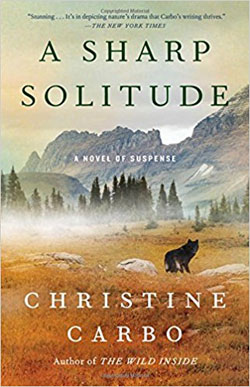
Published in July 2018

Wry spy

What’s the recipe for a great summer novel? Page-turning suspense, for starters, and a plucky heroine for whom to root. Lyrical writing is a bonus, as are reversed roles and upended expectations. Mix in a Cold War setting and radical politics, garnish with an exotic locale and a dash of sexual frisson, and the result is a frosty cocktail guaranteed to quench even the most parched reader’s thirst for a satisfying dog-days diversion.

Meet Vera Kelly. Vera is a CIA operative on her first mission abroad. The year is 1966, and Buenos Aires is a hotbed of student activism, KGB infiltration, and political instability. Vera’s assignment there is twofold. First, with the aid of Nico Fermetti, a local CIA asset, she is to bug and monitor the Congreso Nacional office of Argentine vice president Carlos Perettte. Second, and this time on her own initiative, she is to pose as a Canadian exchange student in order to infiltrate a Marxist cell within the Universidad Central led by Román Orellanos, a charismatic law student suspected of having recently purchased a large quantity of explosives.

WHO IS VERA KELLY BY ROSALIE KNECHTWhile that setup, courtesy of Rosalie Knecht’s delightful second novel, might sound straight out of a John le Carré thriller, it is there that the similarities end. Instead, Who is Vera Kelly? leans more toward literary character study than plot-driven whodunit, and the chain-smoking, gin sipping Vera is more an adult Nancy Drew than a web-spinning spymaster of the George Smiley ilk.

Vera, for one thing, is a lesbian, and her troubled backstory, told in parallel with the main action, provides both empathy for Vera and insight into her unflappable resolve. Her sexual orientation also proves no small complication for a newbie spy navigating a mid-century Latin American culture where infiltration and seduction are standard tools of the trade. Consider:

“He lived up a narrow staircase, in an apartment that was bigger than I expected. When he turned on the lights, his expression was so hopeful and open that I took my shoes off right away. He had a good profile. I wheeled around his living room for a few minutes in bare feet with the gin and tonic he made me, joking about his furniture. It had been a long time since I had gone home with a man, and I felt like I was reverting to an old script, a script I’d learned from novels and films like every other girl: waiting for him to cross the room, watching him nervously refresh his drink. And then later, being small and breathless, and seeing that he liked it. With a woman I always felt a bit like we were the first two people to ever do what we were doing, that we were inventing it, that we decided in each transaction who we were.”

Vera’s insinuation into Román Orellanos’ orbit of student radicals requires another type of seduction in the form of her coerced friendship with Victoria, Román’s girlfriend and co-conspirator, an arrangement that evolves its own complications. Then, when a coup d’état upends the Argentine political order and separates Vera from her handlers, she’s forced to rely on her wits and her training to find her friends, avoid her enemies, and determine which are which.

If an intelligent, literary, female-driven spy thriller sounds like your cup of (iced) tea, then by all means add Who is Vera Kelly? ($21.95, from Tin House) to your summer reading list.

MARK YOUR CALENDARS:  I’m also excited to announce that New York Times-bestselling author Jonathan Evison (West of Here, The Revised Fundamentals of Caregiving) will be at the Cortez Public Library on Friday, July 13 at 7:00 p.m. where we will discuss, and where Jonathan will sign, his latest novel Lawn Boy, which I reviewed here in March. I hope you’ll join us for what promises to be a lively evening of literary conversation with a man thrice nominated by the American Booksellers Association as “America’s Most Engaging Author.”  See you there!

Chuck Greaves is a member of the National Book Critics Circle and the author of five novels, most recently Tom & Lucky (Bloomsbury). You can visit him at www.chuckgreaves.com.

Published in July 2018, Prose and Cons

An icy cool debut by a young Colorado author

GIRL IN SNOW BY JONATHAN EVISONI approached Danya Kukafka’s effusively praised and wildly popular debut novel Girl in Snow with trepidation.
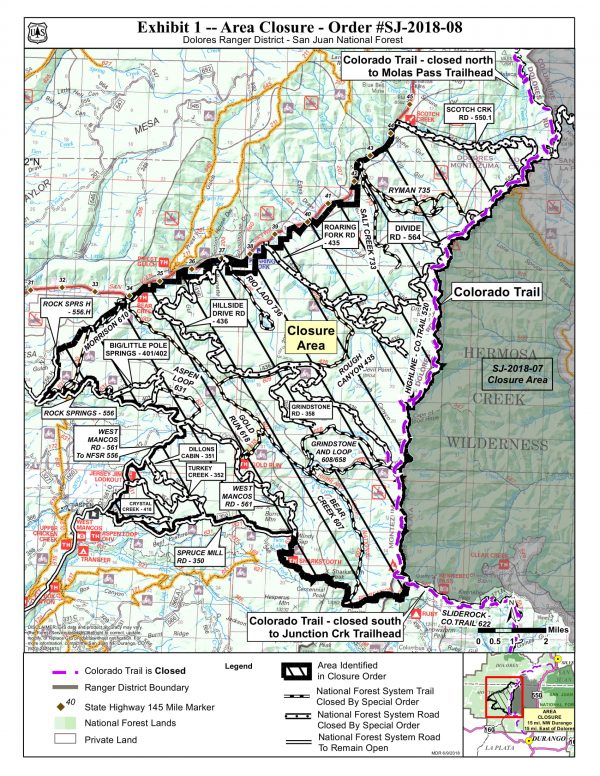
I wanted very much to enjoy the book because Kukafka is a fellow Coloradan and, in her mid-twenties, is preposterously young to have written what is widely considered one of last year’s top adult fiction releases.

Happily, Girl in Snow, just out in paperback, lives up to its advance billing.

Kukafka’s debut features three troubled characters—mentally challenged, 15-year-old Cameron; tough, 18-year-old Jade; and world-worn, 40-something cop Russ—whose lives intersect in the aftermath of the murder in their suburban Colorado neighborhood of high school freshman and golden girl Lucinda Hayes. Despite the fact that each of the three main characters is the potential murderer of the eponymous girl in snow, their foibles make them easy to like.

Kukafka purposefully set Girl in Snow prior to the advent of Facebook, Instagram, and Snapchat, in 2005. Freed of the bother and bombardment of social media, Cameron, Jade, and Russ explore their complex emotional responses to Lucinda’s murder in deeply personal ways. Before the murder, Cameron worshipped Lucinda from afar as a creepy peeping Tom. An accomplished artist, he creates sketch after sketch of Lucinda after her death—including a had-to-have-been-there drawing of her corpse, leading him to wonder if he unknowingly killed the girl he loved. Jade envies Lucinda’s popularity while, at the same time, the murder of the neighborhood favorite affords Jade the opportunity to face up to her own difficult station in life. Russ, unhappy at work and unlucky in love, is forced by Lucinda’s death to assume responsibility for his unflattering past actions.

Kukafka deftly unspools the mystery surrounding the murder while alternating between the points of view of Cameron, Jade, and Russ. As she explores the line between love and obsession, Kukafka’s prose, like the teenagers her story features, is dark and brooding one minute and eerily light and airy the next. As Girl in Snow nears its conclusion, readers find themselves pulling for Cameron, Jade, and Russ even as they wonder who among the three killed Lucinda and left her body to freeze on a schoolyard merry-go-round in the dead of winter.

A generation ago, Michael Chabon wrote the intellectually astute and emotionally moving The Mysteries of Pittsburgh when he was barely 20 years old. Chabon’s many and varied subsequent books have delighted and enlightened millions of readers in the decades since. Here’s hoping the same for Kukafka in the years to come, following the equally astute and moving Girl in Snow.

Scott Graham is the National Outdoor Book Award-winning author of the National Park Mystery Series for Torrey House Press. The fourth book in the series, Yosemite Fall, will be released June 18. Visit Graham at scottfranklingraham.com.

Published in June 2018, Prose and Cons

Wildfires lead to closure of part of San Juan National Forest

A portion of the San Juan National Forest is being closed because of the two ongoing wildfires, the 416 Fire and the Burro Fire, which are about 13 miles apart. Below is the full release from the Forest Service.
FOR IMMEDIATE RELEASE: June 9, 2018
DURANGO, CO – Due to the Burro Fire, which started June 8 on the Dolores Ranger District, and the 416 Fire, which started June 1 on the Columbine Ranger District, the San Juan National Forest is implementing an area closure beginning immediately, June 9, 2018. With on-going aerial firefighting operations and unknown future fire activity, the closure is necessary to protect public health and safety and provide for firefighter safety during fire operations. The two fires are about 13 miles apart on opposite sides of the Hermosa Creek watershed.
The closure prohibits all public entry into the closure area of the Forest. Campgrounds, trails and trailheads, and National Forest System roads will be closed.
Please refer to the attached Special Restriction Order Number SJ-2018-08.
PROHIBITION:
1) Being within the area bounded by the Divide Road (FSR 564); Roaring Fork Road (FSR 435), Scotch Creek Road (FSR 550), Windy Gap Area Road (FSR 350). Spruce Mill Road(FSR351), Upper Hay Camp Area Road (FSR 556).
T38 N R l 1 W Sections: 1-5, 7-9, 11, 13, 14
T 39 N R 10 W Sections: 13, 16, 18, 20, 22, 24, 26, 33
T 39 N R 11 W Sections: 9, 13, 14, 17, 20, 21, 23, 25, 27-36
2) Additionally, being on trails: Salt Creek Trail (559), Ryman Trail (735), Corral Draw Trail (521), the Colorado Trail from Molas Pass to Junction Creek, and Upper Ryman Trail (735).
T 38 N R 11 W Sections 1, 12, 13, 24, 26, 35
T 37 N R 11 W Sections 2, 11, 14
T 36 N R 10 W Sections 28, 29, 30, 33
T 35 N R 10 W Sections 4, 9, 16, 21, 26, 27, 28, 35.
T 39 N R 9 W Sections 5, 6, 10, 11, 15, 16, 17
T 38 N R 11 W Sections: 1-5, 7-9, 11, 13, 14
T 39 N R 10 W Sections: 13, 16, 18, 20, 22, 24, 26, 33
T 39 N R 11 W Sections: 9, 13, 14, 17, 20, 21, 23, 25, 27-36

3) Additionally, being on roads: Divide Road (FSR 564), Roaring Fork Road (FSR 435), Scotch Creek Road (FSR 550) and Hotel Draw Road (550).

A map will be forthcoming.

The following persons are exempt from this order:
1.Any federal, state or local official, or member of an organized rescue or fire fighting force in the performance of an authorized official duty; or
2. Persons with a Forest Service permit specifically authorizing the otherwise prohibited act or omission.
3. Forest Service maintenance crews engaged in the performance of their official work related duties.
The San Juan National Forest wants concerned citizens to know that forest area closures are not taken lightly, as they affect many people, businesses, partner agencies, and the public.
The closure will remain in effect until July 31, 2018, or until rescinded, whichever occurs first. Extension of the closure timeframe or closure area may occur depending on fire activity. The existing order #SJ-2018-08 closing the Hermosa Creek watershed remains in effect.

Violations of the closure are punishable by up to a $5,000 fine for anindividual, or $10,000 fine for an organization, or imprisonment of up to six (6) months, or both.
Areas outside of the closure remain in Stage 2 fire restrictions.
For more information on the closure and fire restrictions, please contact the San Juan National Forest at 970-247-4874 or visit the Forest webpage at https://www.fs.usda.gov/sanjuan/ . You can also follow @SanJuanNF on Twitter and Facebook.
To report a fire on federal lands, please contact the Durango Interagency Fire Dispatch Center at (970) 385-1324.

Published in Uncategorized

Opening day

It’s a beautiful, warm Saturday morning and I am enjoying the sound of bird song and the scent of blooming lilacs while dreaming about opening day.  It’s true that I am a baseball fan and that the outdoor pool ranks near the top of my favorite summertime activities, but I am looking forward to the first Cortez Farmers Market on Saturday, June 2. For my money, it is the best shopping experience around. Where else can you find the freshest vegetables, meat, and eggs; peruse handicrafts and baked goods that you could never put together yourself; and catch up with friends and family in an outdoor mall with live music and story time?

As with any annual commencement, there is apprehension around the changes that the winter brought to the sellers and their wares.  Births, deaths, births, new love – all change the complexion of the market atmosphere. It’s hard to imagine that anybody but the “Matriarchs of Montezuma County” (including Velma Hollen and Bessie White, who started the market 45 years ago) would claim the anchor location smack on the corner of Main and Elm streets. It will be interesting to note which sellers expand their booths in anticipation of a bigger harvest after cultivating a new section of their market garden or installing a hoop house. It will also be fun to track the local food fads – will shishito peppers continue to be the vegetable to try, or will a new herb, tomato or beet variety take its place?

While the winter farmers’ market alleviates some of the loss of fresh food and familiar faces, the Cortez market has a much larger variety of food and people to experience. Plus, there’s a group of folks that I only meet up with at the Cortez Farmers Market. Some are snowbirds that winter in Arizona or Mexico.  I can’t wait to point out that they could have saved their money this year and stayed at home for all the snow we had!

It’s also a time for us amateur gardeners to consult with the professionals regarding drought conditions and pests. It is impossible to compare my meager efforts with the scale of bounty that these pros produce, But a burden shared is a burden halved. This year, I will be looking for any ideas on plant varieties and cultivation techniques to minimize water use.  I will also monitor the gossip to appraise the odds of a fruit harvest. What I am hoping to hear is that there are some apricots on the old trees, despite that freeze while they were blossoming.

Like any other fan at the start of a new season I will resolve to catch some away games and shop other markets this year. There’s the town of Dolores on Wednesday and Mancos on Thursdays, always a good option for picking up something for dinner on the way home from a trip to Durango.  There’s a new market starting in Dove Creek on Saturday and Sunday – can’t wait to see what Dolores County will add to the market mix.

When I have out-of-town guests, it is fun to venture to Telluride for the Friday mid-day market or visit Durango Farmers’ Market instead of Cortez on Saturday morning. So many possibilities, I am just itching to start cooking with all that freshness. Though I need to rein in my expectations for June. Usually there’s a lot of greens to start – giving a new dimension to spring cleaning. But with our unseasonably warm weather this year and more farms with greenhouses, maybe there will be some carrots or snow peas or green onions on opening day.

Time to take an inventory of my farmers’ market necessities. Bags – check; cash – check; cooler to store purchases in car while I complete my Saturday errands – check; sunhat and sunscreen – will have to collect those. Maybe it will be cool and shady to start, though I am sure we will be wishing for these cooler temperatures someday soon, as it is only weeks until the summer solstice. I cast my mind back to the last market in October to remember any other necessities. The smell of roasting chilis wafts by and the laughter of children trying to lift a giant banana squash rings through the corners of my mind. Even on opening day, the farmers’ market season already seems too short.

Carolyn Dunmire writes from Cahone, Colo. Her “Four Corners Foodie” column won a second-place award for food commentary in the four-state Society of Professional Journalists Top of the Rockies competition for work done in 2017.

Published in Carolyn Dunmire

Wilderness? Whatszat?

So excited! Going to have a real Wilderness Experience, just like the explorers and trappers in the early days. Let’s see, need new mountaineering boots, ventilated four-season tent, waterproof breathable sleeping bag, propane stove, and for sure need a Sherpa solar charging kit for my tablet and android. Wait a minute I don’t think this is much like what the explorers, trappers and traders experienced, actually not much different than driving into a “primitive” Forest Service campsite with no running water or electric hookup.

So what IS this thing politicians call “wilderness”? It can be a lot of things, like the open sea, the wild environs of New York City, an open or treed area or even Calvin & Hobbs’ backyard. Some have conjured up the mental picture derived from reading pulp fiction of the Old West. Their minds picture Lewis & Clark with beautiful Sacagawea standing on the mountaintop surveying the vast unspoiled landscape where all of nature was in balance and peaceful. Pop the bubble – that was not how it was.

So what is the excitement over the words “wilderness area”? There weren’t any designated wilderness areas until 1964, when the dreamers sold the misconception to Congress that land areas they liked should be preserved for themselves in the way they preferred. In their ignorance, they didn’t realize (or care) that you can’t preserve natural resources like a photo point in time as conditions are constantly changing, and have been since the beginning of time.

The Wilderness Act, passed in 1964, stated that nothing would change except the designated area was to be managed to maintain its “primeval character and influence”. Of particular interest was the statement in Sec. 4 (a) (1) “Nothing in this Act shall be deemed to be in interference with the purpose for which national forests are established as set forth in the Act of June 4, 1897 (30 Stat.11), and the Multiple Use Sustained –Yield Act of June 12, 1960 (74 Stat. 215).” The purpose stated therein was “to improve and protect the forest, or to secure favorable conditions of water flows, and to furnish a continuous supply of timber.” Actually everything was to continue as it was – so how has it gotten so screwed up? Well, the Wilderness Act also gave the Secretary of Agriculture the authority to make regulations as he deemed necessary. The Congress abdicated its constitutional authority to make law, giving it to the administrative branch that has no lawmaking authority. That was the beginning of the end of resource management, conservation and protection.

By 1970, there had been conceived about 9 million acres of man-defined “wilderness” areas. Today, there are 765 wildernesses in 45 states encompassing over 110 million acres. The 12 Western states contain 104.4 million acres of that 110 million. There are also an additional 12.7 million acres of BLM lands designated as “Wilderness Study Areas” that are treated under Wilderness Act rules (non- management) that are years past due for a decision.

Don’t forget the 60 national parks with 52.2 million acres and numerous other recreation withdrawals from conservation management. They also are “wilderness”.

Here in Colorado, there are eight different names for “wilderness” land set aside from conservation management. There are eight national monuments, four national parks, 41 designated wilderness areas, designated roadless areas, two national recreation areas, two national conservation areas, eight national wildlife refuges, 54 wilderness study areas, all totaling over 10 million acres, all with the common goal of single-purpose withdrawal from conservation management and protection.

For perspective, there is 25 million acres of federally controlled public lands In Colorado, so a full 40 percent of the public lands are not multiple- use managed and obviously not protected from insects, disease and wildfire. Can you guess where most of that 40 percent is? Nearly all of it is in the higher elevations of forest watershed lands where the majority of all the water in the state originates. Think about that when you get notice that there is not enough water to irrigate crops, or that daily shower you like so much. What was the charge to the Forest Service in 1897 about securing favorable flows of water? Why has 40 percent of our watersheds been shut down from improvement, conservation and management?

There is a huge misconception that designating a piece of forest or other land base as wilderness magically “protects” it. The only thing it is protected from is improvement, conservation, and YOU. It is not protected from wildfires, insects and disease, floods or erosion. There is no threat impending that would destroy these watershed lands except for them to continue to be designated for single purpose and no management as has been done with the 10 million acres of special “protected areas”. It can easily be argued that the wilderness and other false protection designations have contributed to the low water flows and increased wildfire losses we are and will be experiencing. The drought conditions will exacerbate these losses. The highest and best purpose and use for ALL the public lands of the state is to actively manage for health and production of the watersheds. Any and all recreation, tourism, hunting and other uses will be enhanced and improved.

One thing is for certain, we do NOT need another 61,000 acres of “designated wilderness” to be set up for wildfires to damage the already hurting watersheds of the state. Wake up, recreation of all kinds can take place on well-managed public lands. Each special interest group does not need nor have a right to their own designated area. Time to turn around land and resource management for the benefit of the land, resources, people and the state while there is still a little bit left to manage. What is “wilderness”? Not what we have been told!

Dexter Gill is a retired forest manager who worked for private industry, three Western state forestry agencies, and the Navajo Nation forestry department. He writes from Lewis, Colo.

Published in Dexter Gill

The danger of Trump fatigue syndrome

Evil triumphs when good men do nothing

Attributed to Edmund Burke (paraphrased)

Raise your hand if you’re tired of hearing about the latest in Things Trump. (I’m raising both right now, so you know.)

Any president is a newsmaker, but few have reliably generated so much scandal, been so transparently avaricious, or been as plainly desperate for adulation.

Donald Trump has in less than two years told a documented 3,000-plus lies (Washington Post’s fact-checking analysis). Everyone lies, but Trump lies about things large and small, even when what he says can be easily disproved, and even when it doesn’t profit him to prevaricate. (He did not, for instance, have a larger inauguration crowd than former President Obama.)

Trump has a habit of rewarding flatterers. His attempt to install as the head of Veterans Affairs Admiral Ronny Jackson — a physician who declared Trump the healthiest man to ever hold the office of president — was among his latest efforts.

He routinely attacks those who are insufficiently sycophantic.

Think of his reprehensible remarks about John McCain, both while on the campaign trail and after. The latest came from the mouth of a White House staffer, who said the cancer-stricken McCain’s opinions don’t matter because “he’s dying anyway.” (This was defended as “a joke.”)

Think of the press, which Trump deemed “the enemy of the people” and “fake news.” In May, it was reported Trump was toying with yanking the press credentials of outlets that provide critical coverage.

Think, too, of his childish rage toward the FBI and Department of Justice and his undermining of Robert Mueller. Remember, though, the indictments that have come down so far because of Mueller’s investigation. Remember too, that although “collusion” has not been proven and may never be, it ITALICS was END ITALICS proven that a foreign, hostile power interfered in our election process. This is not a partisan issue.

We can add to the list Trump’s cruelty.

There is the casual: Inventing stupid nicknames for people he dislikes, and, tantrum-like, ranting at his own people when he hasn’t gotten his way and needs a dog to kick. The latest victim: Department of Homeland Security’s Kirstjen Nielsen.

There is the consequential: The insistence on a border wall and threatening Congress for not getting the funding; treating as faceless bargaining chips those once protected under Deferred Action on Childhood Arrivals; plainly demonizing brown-skinned migrants, and, disturbingly, advocating through the attorney general a punitive policy of separating migrants from their children.

And there is also the ongoing sex scandal involving porn actress Stephanie Clifford, her publicity-hound attorney, and whatever is going on with “Trump personal attorney” and “fixer” Michael Cohen, who allegedly conned businesses into paying for access to Trump that he could not deliver.

Interspersed with the repeated demonstrations of Trump’s unfitness are bright spots: There may be progress with North Korea. Whether that is due to Trump, or due to North Korea’s allies helping that nation’s dictator understand how easy it is to manipulate the president, remains to be seen.

In May, too, three Americans held prisoner in North Korea were freed. Under Trump, Americans held prisoner in Egypt also have been released. In listing his sins, it is important to also give credit where it is due.

But as to his sins and missteps, it is hard to keep up. They are overwhelming — and that is the danger. Battle fatigue is real. When siege is laid, it’s usually a matter of waiting for the other side to run out of provisions and energy. In our case, sanity is under siege. Who will tire first?

Because Trump never pretended to be anything other than a shameless, conscience-free, walking id, nothing he does should necessarily surprise anyone. The threat he posed to our country was obvious the day he came down the escalator to announce his candidacy. We cannot just shrug off the latest outrage because we’re tried of hearing about Things Trump; the price of apathy is too high.

In a 2016 column, when Trump was just a candidate, I worried over what kind of a future awaited if an unhinged, unqualified, manipulative megalomaniac were to be elevated to the presidency. The worry extended to what sort of person might take power after Trump, “the Trump next time.”

There was nothing said that others with eyes to see did not already know — we were not wise, so much as Trump was obvious.

But we had not reckoned on a spineless Congress. We hadn’t reckoned on a grown man being unable to delay gratification, conduct himself with a degree of decorum, or display even a passing interest in learning his job.

Seeing Trump in action has become a grinding, brain-killing chore. He deflects. He distracts. He projects. His enablers take up the baton. The watchdogs chase their tails trying to argue with the enablers. Within days, if not hours, a sub-scandal erupts, or the Infant in Chief sounds his yawp on Twitter and we are distracted again.

But we’ve got to do the work.

If we don’t watch, if we don’t speak out, if we stop paying attention; if we claim to be moral yet give a serial adulterer, grifter and pathological deceiver “a mulligan” for his conduct; if we let the so-called “law and order” president denigrate the legal community for doing its job; if we allow him to rove, unloosed and fact-free, on the world stage with his ears open to the flattery of dictators while closed to our allies; if we continue to tolerate his attacks on the free press … Burke, quoted at the start of this piece, will again be proved correct.

Trump might not finish off this republic. His crass lack of subtlety and glaring character defects might preclude that. But as discussed in 2016, we’ve set the stage for future “Trumps” — men and women much smarter, much more circumspect, less overtly ridiculous and thus, far, far more dangerous.

At the same time, the conditions on the ground are already in their favor: Division, rancor, distrust in the institutions that, despite sometimes glaring imperfections, have served this nation for decades, and paranoia — coupled with growing corporate power over our laws and courts and vast disparity between rich and poor.

Evil will triumph. Because we did nothing. So as exhausting as Trump is, it seems the least we can do is pay attention.

Noli sinere malos insolentesque te vexare.

–Don’t let the evil and insolent grind you down.

Katharhynn Heidelberg is an award-winning journalist in Montrose, Colo.

Published in Katharhynn Heidelberg

Suspicious minds

Two black guys walk into a Starbuck’s …

Stop me if you’ve heard this one before.

I mean, we’ve been inundated recently with frightened (?) white people calling the police to report black people for suspicious behavior, such as golfing too slow, leaving an AirBnB rental or having a cookout.

Of course, those loony liberals are quick to call it racism.

Everything is racist these days.

Just because you think undocumented immigrants are animals and criminals does not necessarily make you a racist. Besides, you’re not talking about all immigrants – just those from bleephole countries. People from Sweden are okay.

Instead of mocking those good citizens that call the police when they see a black person refusing to pay for a plastic fork at a Waffle House or trying to use their gym membership during white people hours, I think we should all embrace that attitude.

See something, say something, right?

There are plenty of things that make me nervous and from now on I’m going to call the police when they happen.

I get the heebie jeebies when I see a vegetarian eating at the same restaurant I’m at. I mean, what if their zucchini touches my hamburger? Eww.

And I definitely don’t want beet juice on my French fries.

I’m just giving fair warning, folks. I’m going to be looking out for people doing things that make me nervous.

If I see you jogging, I have every reason to believe that you’re fleeing a crime scene. In slow motion.

We can’t have suspicious joggers on our streets. The police should be notified so they can check it out. I mean, what if a jogger is escaping a wave of zombies?

We need to know if zombies are on the loose, and we can’t be sure unless the police come and check it out.

Did you see where an immigration agent detained two American citizens because he overheard them speaking Spanish?

Good man! We all must be vigilant on immigration issues.

That’s why I’m going to hang out at Taco Bell and call the police if I hear anyone using Spanish words like “burrito” or “tostada.”

I’m always been suspicious of that Jimmy Chonga guy anyway. I always hear his name at Mexican restaurants, but who is he? Does he have a green card?

Oh, I can’t wait until the next time I see someone eating a corn dog. I’ll be on my phone so fast, I tell you what.

That really makes me nervous. I have nothing against eating corn, but I’m suspicious of people that want to eat their dogs. Doubly so for those people who think they’re sneaky by hiding their dogs inside of corn.

Living on the Navajo reservation I see lots of white people walking around with cameras. That’s pretty suspicious, right?

What are they taking photos of? And who are they sending those pictures to – Wikileaks? The Kremlin?

No, no no. The world has gotten dangerous and we must all be hyper vigilant. I’m going to keep my eyes open from now on.

I think I’m going to put the FBI on my speed dial.

You think I’m kidding?

Let me see you eating carrot sticks in public.

I dare you!

John Christian Hopkins, an award-winning novelist and humor columnist, is a member of the Narragansett Indian Tribe. See his writings at http://authorjohnchopkins.blogspot.com.

Published in John Christian Hopkins

Poets Anonymous

I headed for the podium. The audience fell silent, all eyes pivoting toward the front of the room where I stood. Working up the courage to face them, I pulled my shoulders back, stood tall, and recited the words I alone had to hear.

Hello, my name is David, and I am a poet.

I mention this because National Poetry month has come and gone and despite having more than two decades of annual appreciation, and would you believe some people have never heard of it, ever picked up a poetry book, or even attended a reading? Some even snort and ask if it was all just an April Fool’s joke. A few dare to scrunch up their faces and mutter something like, “A whole month?”

Yes, it lasts the entire month and nobody needs to pretend dealing with the thought of poetry for that long is any worse than a lethal dose of March Madness. People don’t realize how millions of poets suffer for 11 tedious months trying to find an audience willing to listen. No pharmaceutical magic bullet exists that can be swallowed as an antidote. We poets have to deal with it, each in our own way.

Shakespeare suffered the slings and arrows of outrageous poetry, and somebody burned down his theatre. I’m certainly not recommending arson. I would, however, like to see more people cultivating a glazed expression which could be mistaken for a passing interest.

It’s nearly impossible for aspiring poets not to end up at open mics. Either a metaphorical arm reaches out of the cosmos and places them there, or news of an upcoming event surfaces and inspires a fresh avalanche of white notebook paper. Poets are attracted to these gatherings like moths drawn to an old sweater. We can’t help it. We’re addicted.

But there’s nothing worse than sitting at a literary event where a moderately receptive audience suddenly cringes, their faces contorted into an expression of WTF was that? I sympathize. I’ve wondered too. Somebody responsible ought to say something.

Obscurity has long been the demon of poetry. A gentle audience, genuinely trying to follow the figures of speech along a narrow path running treacherously close to an unfathomable abyss, hopes the poet will lead them to safety. But no, the reader reads on, long past the recommended two or three minutes until the crook of a cane reaching up from of the abyss is all the audience can hope for.

Maybe you’ve listened to unseasoned readers who hardly practice their delivery before  reciting. The mumbling monotoned meter, sentimentalizing, or unleashing such outrageous  emotions they ripple the listener’s scalp. Be forewarned, poets: the words themselves won’t work like an elixir if administered like castor oil.

Poetry is my Nemesis too. So many poems stay confined to my notebooks. They are not – and should never be – released for aural consumption. They keep too intimate company with the spirits of depression, the statues of ego, or like an internet god they seek to sell my personal information to perfect strangers.

If people show up to listen, what a blessing! No performer should ever take such a gift for granted, even if the audience is packed with readers anxiously waiting their turn. Once I was graciously invited to a reading and the only person who showed up turned out to be the librarian who organized the event. We waited. We laughed. We justified. Eventually we headed back to our respective homes. The memory still humbles me. I keep it close and protect it like a candle flame.

The literary establishment never got around to crediting a founder for Poets Anonymous.

I nominate Emily Dickinson. She wrote over 1,800 poems, published only ten (anonymously) during her 55 years on this planet, and to my knowledge she never read before an audience other than her family, never stood at a podium to introduce herself, never heard the applause she deserved. Despite a total lack of recognition for her powerful and beautifully rendered poems, she still possessed the resources to imagine her listeners as she stood at her Amherst window, staring out at the world, shaping words to fit so perfectly inside a stranger’s heart.

While Poets Anonymous will never preach abstinence, its mission must stay focused on  advocating sober preparation. Ask poets to stop writing? Impossible. And poetry is unlikely to destroy any other life than the poet’s. It has, however, turned far too many listeners away. Like secondhand smoke, a room filled with what amounts to jibber-jabber endangers the health of our future audiences. Maybe by next April we poets will earn the opportunity to stand before a room filled with enthusiastic patrons, not just a few people to bolt and reconvene at the nearest saloon.

David Feela is a retired teacher living in Cortez, Colo. He recently placed second in the “personal/humor columns” category in the Society of Professional Journalists’ four-state Top of the Rockies competition for work done in 2017. See his works at http://feelasophy.weebly.com/

Published in David Feela

Crossing off the list

A lot of you have followed my dog Wally’s story on this page for more than two years now. And since last summer you’ve kept tabs on his post-cancer-diagnosis Doggie Bucket List adventures, when all our Someday Things became Right Now Things. While he was rocking his chemo treatments, we traveled to the Great Sand Dunes and we attempted going to concerts and we ate way more hot dogs than the Surgeon General recommends. We had a professional photo shoot, we camped so remotely that I had to take my first shave in the woods, and when Wally went into remission (that’s the good one—it’s out of remission you don’t want; this confuses everyone), we celebrated with a ritual at his favorite river spot.

ZACH HIVELY AND WALLY

Zach Hively and Wally

That riverside ritual was the last update I wrote to you all, because in January, I took Wally to the vet for a tooth issue and he came back out with cancer again. At that point, with Wally out of remission (that’s the bad one), the Doggie Bucket List shifted gears. The diems we now carped had much more to do with spending time on the couch and taking slower walks than we used to.

But there was still one big item on the list: go to the ocean. That entry started off as a joke on this page, that we’d recreate the finest beach-running scenes in Hollywood history if someone would sponsor our adventures on their private beach. That Bucket List entry wasn’t nearly as important to me as enjoying all the daily joys of our life together. I wanted those most of all; I just wanted them, plus beach too.

And the window of opportunity actually opened up to have our hot dogs and eat them too. I had the chance this spring to switch day jobs to one that would give me more daily time at home with Wally. And I could also have a gap between jobs in late April. Perfect timing for a road trip to a secluded, pristine stretch of California shoreline.

I put it on the calendar several weeks out at the time: Road Trip with Wally.

I didn’t figure the trek would heal Wally. But we’d fit it in after his second chemo protocol, which was hitting him so hard that we had to keep skipping treatments. Still, the plan was to have him back in remission (that’s the good one) by then. Maybe he’d even be moving better, and livelier, than he’d been since starting this round of chemo.

Not two weeks after putting that on the calendar, Wally started yelping when I’d pet the side of his face the wrong way. We’d never treated that tooth problem, so I took him back to the vet.

It wasn’t the tooth.

“We could run tests,” his vet said, “but I think we both know what this is.”

Then she said some more things about keeping an eye on him and making him comfortable, and then she told me she’d be out of town that weekend, and inside I was like, why are you telling me your travel schedule, and then I was like, “Oh,” and the room closed in on me and every hope I’d buttressed for 11 months collapsed at once.

“You’re saying I could have to let him go this weekend,” I practically accused her.

“Worst case, yeah,” she said.

That was a Wednesday morning. I didn’t believe her. Wally wasn’t suffering THAT badly. We weren’t done yet. But I left the vet’s office and I immediately cleared every commitment I had through Sunday. I told my work I wouldn’t be coming in. And I didn’t care what anyone said or did or felt about it.

This moment right here was the entire Doggie Bucket List, focused down to a pinprick, as tight and narrow as a fainter’s vision. Do it right now. If Wally lived another six weeks, or six months, or six years, according to plan, then I would still cherish this long weekend we had together. And if he died, the last thing I ever wanted to say in retrospect was, “Gee, I wish I’d taken off Thursday to be with him.”

We were going to spend every moment together for the next five days. Every moment. And we were going to eat everything we wanted, too.

That was almost seven weeks ago, when I listened to all the things that dog taught me and prioritized what was important right now over everything else. And I’m finally writing this to all of you while my calendar says Road Trip with Wally. I didn’t make it to the beach this weekend, but I did make it to the desert, where Wally and I tried to go every spring. I took a long walk up an empty trail, where I didn’t see a single other human being. But I did hear someone’s dog in the junipers.

I stopped to listen through the wind, thinking maybe I’d imagined the sound, and I heard the collar one more time. The dog never materialized. But he was there. He’s always there.

Zach Hively writes from Durango, Colo. He can be read and reached through http://zachhively.com and on Twitter @zachhively.

Published in Zach Hively

War of the weeds: Invasive plants are transforming landscapes, harming crops and animals

RUSSIAN KNAPWEED

Russian knapweed is one of the most problematic noxious weeds in Montezuma County. Credit: © Stan Shebs
https://www.inaturalist.org/taxa/75285-Acroptilon-repens

This is the second in an occasional series about weeds and weed management in the Four Corners. The first article ran in the April 2018 issue.

Since the invention of agriculture, farmers and gardeners have cursed weeds – any plants that grow where they aren’t wanted.

But weeds today have grown into much more than a nuisance. Spread by hikers, livestock, motor vehicles, pets, birds, and the wind, weeds are everywhere, and battling them has become a major endeavor.

What are “noxious” weeds and why is it so important to get rid of them? The word “noxious” means physically harmful or destructive to living beings. The word also includes the idea of having “a harmful influence on mind or behavior, especially morally corrupting” according to Merriam Webster.

We could argue about how morally corrupting a thistle is, but a noxious weed is defined as a non-native plant that has one or more of the following characteristics:

may be poisonous to wildlife and livestock;

aggressively invades and/or damages agricultural or native plant communities;

may carry destructive insects, diseases or parasites;

is considered to be detrimental to ‘sound’ land management practices.

Bonnie Loving, director of the Montezuma County Noxious Weed Program, sums it up by saying that a noxious plant “is injurious to agricultural or horticultural crops, natural habitats or ecosystems, or humans or livestock.”

Loss of habitat

The county’s weed department was created under the 1996 Colorado Noxious Weed Act, which states that “certain undesirable plants constitute a present threat to the continued economic and environmental value of the lands of the state and if present in any area of the state must be managed.”

The Colorado Department of Agriculture places noxious weeds into three categories, but local governments can move plants from one list onto a higher-priority one, said Loving.

“List A requires eradication, List B requires control and suppression, and List C highly recommends control and suppression. Montezuma County has many that are on the state List B that we have moved onto our List A, such as cutleaf teasel.”

Eddy Lewis, a member of the Weed Advisory Board for the weed program and owner of Southwest Weed Control, told the Free Press he thinks  hoary cress (Cardaria draba), also called whitetop, is one of the most troublesome weeds locally.

“It’s a deep-rooted mustard perennial. It’s really hard to control – you can spray it, but if I treat it this year it will be back the next year. Nobody really knows if it is coming back from the root, or the seed. It’s one of those things that you have to keep re-treating,” he explained.

One of the concerns about noxious weeds is the harm they can do to livestock. For example, leafy spurge (Euphorbia esula), which is on the county’s A list, is toxic to cattle and elk.

Spotted knapweed, also on the county’s A list, can take over and alter a habitat so much that it reduces forage for wildlife. It invades ecosystems above 7,000 feet and was responsible for loss of prime elk habitat in Montana and Idaho – a disaster, according to Lewis, since the elk moved out due to the loss of the natural forage. In those states, managers had to spray herbicide in the national forest with helicopters to get rid of the weed – an expensive endeavor.

“We’re really concerned about it taking over the forest – we’re really trying to stay on top of it,” Lewis said.

Russian knapweed (Acroptilon repens) has the same potential at lower elevations. Not only will it take over, but it is very toxic to horses. “The plant has a chemical that affects the animal’s brain, essentially paralyzing the jaw muscles. This is non-reversible,” said Loving.

Russian knapweed is currently found on 1 out of 20 properties in Montezuma County, she said.

“It is so widespread it is hard to know where to start solving the problem and reclaiming the land. It is also very hard to manage. If we let Russian knapweed completely take over, our deer and elk will move out, we won’t have hay for our horses or cows, and our farmers will give up on their crops, since it’s too expensive to be constantly fighting the weeds,”

Lewis agrees Russian knapweed is one of his biggest concerns. “It will invade into alfalfa, roadsides, waste areas, into anything.”

“Thousands of acres of crops, rangeland, and habitat for wildlife and native plant communities are being destroyed by noxious weeds each year,” states the Colorado Noxious Weed Act – and that was in 1996.

“They are taking over,” said Loving.

50-year seeds

The fact that these invasives spread so quickly and are so hardy is a huge problem. Many are drought-resistant and will crowd out native and agricultural plants.

Lewis said that some species’ seeds can last up to 50 years – bindweed (Convolvulaceae sp.) has a hard shell that will not break down easily, and so does spotted knapweed.

Cheatgrass (Bromus tectorum) is shallow-rooted, and Lewis has seen some patches of it fail this year due to the drought. But, he continued, “It takes five years of actually getting rid of the cheatgrass seed for it to go actually go away.”

Another problem is that weed seeds are blowing from one property to another. Sometimes birds spread the seeds, and wildlife also pick the seeds up and carry them from place to place.

Some of these plants are also “allelopathic,” meaning they are “monoculture species” that emit biochemicals that impact other plants – usually harmfully. Allelopathic inhibition is when one plant kills or destroys another by diminishing seed production, germination and growth, or altering the soil composition.

Loving used the example of Canada thistle to explain this situation: “In our area we are well known for our quality alfalfa. It is a problem when neighbors to alfalfa fields have Canada thistle problems. Canada thistle is a monoculture species that will form dense stands and continue to grow outward, displacing the native vegetation or crops that were once there.”

Loving said most herbicides utilized to control Canada thistle also kill alfalfa, meaning that ranchers can lose product whether or not the thistle is treated. Ranchers may have to rotate their crops to get rid of the thistle after applying herbicides.

“Overall, the outcome is poor for alfalfa. The rancher will lose significant crop yield to the Canada thistle and most people purchasing the alfalfa don’t want it contaminated with thistle,” explained Loving.  “When you have a farmer growing a nice alfalfa field next to a crop of Canada thistle it is a big problem.”

Russian knapweed is also an allelopathic plant. Lewis said what is especially insidious about Russian knapweed is that “it puts out its own chemical that kills everything around it – but it doesn’t affect whitetop.” Thus, Russian knapweed and whitetop are commonly found together, making it difficult to control either one.

Another concern about noxious weeds is their impact on recreation. “A lot of people go into the backcountry, and they don’t want to be walking through musk thistle,” said Lewis. “We try to educate as many types of people that are going into the backcountry as we can,” he said. If citizens know what the noxious weeds are, and how seriously they can impact the environment, then they can help with the control of these invasives.

A variety of tools

Loving said her department has all kinds of programs to help residents learn about and control noxious weeds. “We are constantly putting on public seminars and promoting other natural-resource organizations who put on seminars. We strive to help our community become stewards of the land.”

The county offers a cost-share program that reimburses landowners for some of the costs of weed management. “Our program does property visits for free. We have a lot of people calling in asking for our help in identifying what they have growing on their properties. We get phone calls about animals dying and the landowners aren’t sure what is killing them, so we will come out and help identify poisonous plants both noxious and native,” said Loving.

How are these plants eradicated or suppressed? Loving said the best strategy is to use a combination of methods, with identification and education of the problem weeds required before taking any other steps.

“Our program recommends using an integrated management approach to dealing with noxious weeds. This means, use more than one tool in your toolbox. The categories of these tools are biological, mechanical, chemical, and cultural. We use all of these methods. You have to deal with noxious weeds by a case by case scenario.”

Herbicides used are primarily 2,4-D, and Escort, according to Lewis. These will break down in the soil quickly and thus not harm nearby native plants.

Lewis said he has been in business and on the Weed Advisory Board for over 21 years, and in that time has contracted with the county, Forest Service and private property owners to spray herbicides and remove noxious weeds. He said that 2,4-D is the standard because it degrades relatively in a few weeks and is efficient.

According to Tom Hooten of the Colorado State University Extension Office for Montezuma County, the time it takes for an herbicide to break down depends upon soil pH, microbial activity, moisture and temperature. Basically, depending upon the chemical content of the herbicide, the lower the soil’s pH and the higher the moisture and temperature, the more quickly the herbicide will degrade. “2,4-D is probably one of the safer ones,” he said.

Late fall is the best time to treat with herbicide because the plant will absorb the herbicide into its root system, said Loving. She said some “herbaphobic” people want to till instead of applying herbicides, but when it comes to Russian knapweed tilling may actually exacerbate the problem since it breaks up the roots, which leads to the weed spreading.

Hooten acknowledged that “pesticides and herbicides are prevalent throughout the environment globally – residues are found in Antarctica and in the ocean…You are never going to totally eliminate your exposure, but you can try to minimize your exposure and minimize the risk of exposure.”

Lewis, who makes a living spraying noxious weeds, said the important thing is to be educated about the plants and the herbicides. “Know when to treat the weeds, what time of year is best to treat which plant, and learn which chemicals are the most effective.”

He is a strong proponent of knowing where the nasty plants are, in order to monitor them and keep them under control.

“Be wise,” he said, “Don’t waste your time. With the problem weeds like whitetop and Russian knapweed, you have to retreat and watch.”

Keeping an eye out

The Montezuma County Noxious Weed Program works to do just that, locating weeds throughout the county. “Every year we drive public roads and map the noxious weeds we can see on private and public land. This way we can get an understanding of which species we have where and the rate they are spreading,” Loving said.

Landowners are notified when they have noxious weeds on their lands, and need to file a weed-management plan with the county. The Noxious Weed Act requires eradication of all plants on the A list, so if one of those species is found, either the county or the landowner must have an eradication strategy in place.

Loving said the county has a legal obligation to enforce weed management on all county properties. In 2017 they had to take enforcement action on several properties, and so far in 2018 they have had a similar number. If the landowner does nothing after the county contacts the owner and requests a management plan, the county has the authority to eradicate the weeds and charge the owner for the costs through a lien on the property.

Lewis urges vigilance about noxious weeds. “The more eyes we have out there, the better. Early detection is the key,” he said.

Hooten said his office is available for information and advice as well. He recommends that people read all labels closely. “It’s required that we control these weeds – it’s a legal issue. It’s also a part of the law to follow the herbicide directions,” he said.

If you find plants on your property or neighborhood that might be noxious weeds, call the Montezuma County Noxious Weeds Program or the Extension Office for help. You can also attend the next Noxious Weed Field ID seminar offered by the county.

“We strive to help our community become stewards of the land,” said Loving. “Land is a scarce resource and we should do all we can to protect it and make it healthy.”


Resources

http://montezumacounty.org/web/departments/weeds/

http://montezumacounty.org/web/departments/extension/

Published in June 2018 Tagged

Scraping bottom: Vanadium recovery at White Mesa Mill

SETTLING PONDS WHITE MESA URANIUM MILL

During its 38-year operating history, the White Mesa uranium mill near Blanding, Utah, has produced more than 45 million pounds of vanadium — or over $500 million of vanadium at today’s prices, according to Energy Fuels. Company officials believe the dissolved vanadium in the settling ponds can be recovered using existing equipment and process streams at the mill, similar to how dissolved uranium is currently recovered from the same brine ponds. Photo by Angelo Baca.

Energy Fuels, Inc., the Canadian uranium-mining company that owns and operates the White Mesa uranium mill south of Blanding, Utah, is set to resume recovery operations for vanadium pentoxide from ponds at the mill.

Vanadium has the potential to be a lucrative venture for the mill. But the prospect has many environmentalists and members of the Ute Mountain Ute Tribe, whose reservation borders the mill, very concerned.

The White Mesa mill has a long history of conventional vanadium recovery. In 2013, it produced 1.5 million pounds of the rare metal, a small portion of the 45 million pounds it has processed over its 38-year operating history. When market prices slowed after 2013 vanadium mining and milling became economically untenable. The company stopped production. Two years later the metal bottomed at $2.50 per pound. But today it sells for $15 per pound as the exploding worldwide demand for vanadium swelled its market value more than 400 percent in the last 24 months.

The mill is the only currently operating facility in the United States with the ability to do vanadium recovery and is the nation’s the only operating conventional uranium-processing facility as well.

The company has identified significant concentrations of dissolved vanadium in solutions found in the settling ponds at the Mill, ranging between 1.4 and 2.0 g/L. Based on current estimates, the Company believes these pond solutions, which result from past mineral, uranium and vanadium processing campaigns at the Mill,

Curtis Moore, Energy Fuels’ vice president of marketing and corporate development, told the Free Press that the company estimates the pond solutions contain as much as 4 million pounds of dissolved vanadium. They hope to recover an eighth of it during the first year.

“White Mesa Mill is also the only facility in the U.S. capable of producing vanadium that comes from mines – as has been the case for a number of years,” Moore explained in an email referring to the plethora of nearby Utah and Colorado uranium/vanadium mines also owned by the company.

Vanadium is a rare metal that is strong, resistant to corrosion and stable against alkalis, acids and salt water. It is typically produced from steel smelter slag and heavy oil flue dust, or as a by-product of uranium-mining and has the ability to make things stronger, lighter, more efficient and more powerful. Adding 0.5 percent vanadium to steel doubles its strength. Although it has been used since the late 1800s in steel and other alloys, new global steel-industry standards are requiring more vanadium in construction steel to ensure safer buildings.

China’s response to recent earthquake damage in the western part of the country, and Japan’s recovery from the Fukushima nuclear disaster, resulted in policy changes in those nations requiring steelmakers to boost the amount of vanadium in rebar product to create a higher tensile strength. This sent the vanadium market into turmoil as steelmakers worldwide exhausted all existing inventories.

Vanadium had been a relatively small market, with annual production of 75,000 to 80,000 tons per year and of that, about 85 percent has always been used in steel production. But new applications, such as large-scale community renewable energy storage, and increased research and development like emerging space exploration alloy materials, have spurred demand for more production.

VFB storage?

Efficient mass storage has been renewable energy’s biggest challenge. Before the recent invention of the Vanadium Flow Battery, known among energy wonks as the “VFB,” any renewable energy not used immediately in the grid was lost. The industry needed reliable, large-scale storage capacity before renewable wind and solar could be serious competitors in energy markets. The VFB is the answer, and it is being used to store energy from 100-megawatt projects all over the world today.

The VFB is chemically and structurally different from other batteries. It can run tens of thousands of cycles without wear and tear. It does not self-discharge while idle or generate high amounts of heat when charging. It can charge and discharge simultaneously, and can release huge amounts of electricity instantly ― over and over again, for up to 20 years.

Today it is the only battery ca­pable of powering everything from single-kilowatt uses, ideal for single-home and commercial applications, to the megawatt hour capacity demands of a pow­er grid. It’s also ideal for stand-alone storage systems for solar/wind farm installations.

Vanadium pentoxide is the lead substance in Vanadium Flow Batteries. Its application to energy storage is now creating substantial growth in renewable-energy projects and compatible storage systems, an industry that was predicted in the Piper Jaffray Energy 2009 report to swell to $600 billion by 2020.

John Lee, chairman and CEO of Prophecy Development Corp., invested more than $3 million to acquire the Prophecy vanadium mine in Nevada’s Battle Mountain region northeast of Las Vegas.

In an interview with Peter Clausi, InvestorIntel, Lee said, “Today’s solar and wind generating capacity amounts to over 700 gigawatts. That is equivalent to seventy nuclear power plants or seventy Hoover Dam hydro plants. It was less than 100 gigawatts seven years ago. You are looking at 700 percent in growth.

“Unfortunately up to 50 percent of the wind and solar energy has gone unused because by nature they are unpredictable resources. The interesting point today is that the VRB utility scale grid batteries only amount to two gigawatts, less than three percent of this [existing] renewable capacity. There’s a lot of room to catch up and. . . you could have 500-700 percent growth in the next few years in grid-scale batteries. Vanadium, as the metal of choice for grid storage batteries, would require an exponential increase in supply.”

Washing water?

But environmental groups and Native American tribes located near uranium-extraction projects on the Colorado Plateau remain worried about the potential dangers of new processing efforts at the White Mesa mill, after ugly experiences in the past that exposed uranium workers, residents and tribes to uranium toxicity from mining, milling and waste.

Amber Reimondo, energy program director at the environmental nonprofit Grand Canyon Trust, told the Free Press the trust is not working directly on vanadium-mining at this time. “I’m not sure of anyone who is,” she said.

“For what it’s worth, it’s mined alongside uranium from sandstone deposits, like those in southeast Utah. So, while it’s not a mineral that our group specifically focuses on, we view vanadium-mining in the region through the lens of uranium –  meaning at the very least, because of its association with uranium, vanadium-mining and processing at the White Mesa Mill creates environmental risks similar to those created by uranium-mining. Given the poor record of the industry in the region, it’s not an operation we support.”

In a recent statement on the vanadium program, Mark Chalmers, Energy Fuels president and CEO, was optimistic about the new venture, saying, “If this [the pond recovery project] is successful, Energy Fuels would expect to become a commercial-scale vanadium producer for the next few years, just from pond solutions.

According to a company statement Energy Fuels owns a number of mines in Utah and Colorado that contain large quantities of vanadium resources. It is exploring additional vanadium opportunities beyond the pond recovery project, including the potential of its resources at the Whirlwind Mine and the La Sal Complex, which recently received government expansion approvals.

“Our mill last produced vanadium in 2013. We have a number of mines in Utah and Colorado that contain large quantities of high-grade vanadium,” Chalmers explained.  “For longer term alternatives, we are evaluating other vanadium production, including the processing of previously mined uranium/vanadium stockpiles in the vicinity of the Mill, processing other vanadium-bearing streams, and, with improved uranium prices, the re-initiation of conventional uranium/vanadium mine production from certain of our mines that contain large, high-grade vanadium resources, including the La Sal and Whirlwind mines which are currently on standby.”

In a recent effort to put more muscle in demand for U.S. uranium production Energy Fuels exercised the Trade Expansion Act of 1962, Section 232, designed by Congress to allow the president to adjust trade for national security purposes.

Chalmers is hopeful that the uranium 232 petition, submitted January 2018 to the U.S. Department of Commerce, will reduce the quantity of uranium coming into the U.S. from state-subsidized enterprises in Russia, Kazakhstan, Uzbekistan and China.  The countries represent a threat to U.S. national security, the petition claims, and if ignored, that dangerous threat will become even more dire in 2018 and beyond. The Petition seeks a remedy setting a quota to limit imports of uranium into the U.S., effectively reserving 25 percent of the U.S. nuclear market for U.S. uranium production. Less than 3 percent of the uranium consumed in the U.S. is produced domestically, yet the U.S. is the largest uranium consumer in the world.

“We would expect improvements in uranium prices, which could potentially allow these mines – and others in the region – to resume commercial uranium and vanadium production, underpinning the sustainability of the company’s uranium and vanadium production well into the future,”

Worried neighbors

Of concern to Uranium Watch, an education and environmental advocacy group based in Monticello, UT, is the possible restart of the La Sal Mines complex for the production of vanadium. The group has been working on issues related to the environmental impacts associated with uranium milling in Utah, including at the White Mesa mill for more than ten years. Sarah Fields, program director for U.W., told Free Press that the location of the mine is very close to the small La Sal, Utah community. “The Beaver Shaft portion of the complex emits radon gas one quarter-mile from the La Sal Elementary School, post office, senior center, and store. The La Sal mines should never reopen,” she said.

The fact that vanadium contributes to clean-energy storage and stronger, safer steel construction doesn’t reassure Regina Lopez Whiteskunk, a member of the White Mesa Ute Tribe ten miles south of the mill location. “It’s ironic,” she says. “Today’s usefulness will mean waste tomorrow. What will that future disposal look like? Is possible contamination the tomorrow our grandchildren will inherit? That is not the kind of inheritance I want to leave my grandchildren.”

In an email reply to the Free Press, Moore said the company believes the dissolved vanadium in the ponds can be recovered utilizing existing equipment and process streams at the mill, in a fashion similar to how the mill has been recovering dissolved uranium from the ponds.

The company says it has a successful recent record of recovering uranium from pond solutions from the same ponds. During 2017, it produced approximately 308,000 pounds of U3O8 from pond solutions, and in 2018 the company expects to produce a further 175,000 to 215,000 pounds of U3O8 from pond solutions.

Asked if uranium effluents would be disturbed during the first phase of vanadium reclamation, Moore replied that the company is “simply recycling our water. There are not contamination concerns with this project.”

Whiteskunk, a former White Mesa/Ute Mountain Ute council member, now an activist and author, wants to know more. “What is that process, and what is the plan for the supposed cleaning of the water? Send the plan to the Utes,” she said.

The company will evaluate its actual 2018 vanadium costs and recoveries, and depending on the vanadium market, would expect to continue vanadium production from pond returns in 2019 and 2020. Energy Fuels would only continue vanadium recovery operations at White Mesa Mill in subsequent years if vanadium prices continued to be strong enough to justify production.

It should also be noted, Moore said, that because the company’s analysis has not yet been proven at full-scale production, the ultimate outcome is uncertain.

Published in June 2018