Good news, bad news

October brought two significant pieces of news in the regional battle against unneeded developments in beautiful natural areas.

First, the good news: On Oct. 31, the Navajo Nation Council voted 16-2 against legislation that would have given a green light to the Grand Canyon Escalade Project. That proposal, put forth by a group called Confluence Partners, LLC, would have installed a gondola tramway leading from the rim of the Grand Canyon down to the Colorado River. There, a riverwalk would be carved out along the bottom of the canyon, and there would be sites for hotels, vendor booths, and a “Discovery Center” offering dining, shopping, and more.

All this would have been located on Navajo land bordering Grand Canyon National Park, at the confluence of the Colorado and Little Colorado rivers.

On their website, the developers point out that, at 420 acres, the Escalade Project is much smaller than the 8,500-acre Grand Canyon Village on the South Rim and would be minimally intrusive in comparison. And we’re sure that’s true.

The point is, there is no pressing need for yet another development in or near the Grand Canyon, one of the greatest natural wonders in the entire world. Many Navajo, Zuni and Hopi view the confluence as sacred land. Certainly it deserves better than becoming a commercial ground zero for hordes of flush tourists.

The Navajo Nation Council rejected the proposal for a variety of reasons, many having to do with the terms of the agreement, which required the nation to pony up $65 million for infrastructure to serve the remote site.

Delegates noted that economic development is badly needed on the nation, particularly in light of the fact that the Navajo Generating Station, a coal-fired power plant near Page, Ariz., is likely to shut down soon. Their willingness to reject the proposal nevertheless is a testament to their clear-headedness and ability to look at the long view.

It’s not clear what will happen to the project, but its prospects appear shaky for the time being, and for that we’re thankful.

Now to the bad news: You’ve got to say this for Texas billionaire Red McCombs and the whole Village at Wolf Creek crew – they never give up.

Following years, even decades, of fierce fighting over their proposal for a luxury resort high on the frigid, pristine slopes of Wolf Creek Pass in Southwest Colorado, the Leavell- McCombs Joint Venture was dealt a major blow in May. That’s when Senior U.S. District Judge Richard P. Matsch issued a ruling that the Forest Service had not followed proper procedures when it approved a land swap that would provide road access to the private inholding where the Village is proposed. Matsch lambasted officials with the Rio Grande National Forest, saying they had not thoroughly scrutinized the impacts of the proposal, which includes up to 1,711 hotel rooms, condominiums, townhomes, single-family dwellings, and commercial spaces. All this would be plunked down in an area that is a wildlife corridor and watershed, the site of rare “fen” wetlands, and home to the federally threatened lynx.

Opponents of the proposal hoped the ruling would spell the end of it, but no. In October, the developers appealed the decision to the Tenth Circuit Court of Appeals, ensuring years of litigation and uncertainty to come.

As with the would-be developers of the Grand Canyon Escalade, the Village’s backers cite economic development as a reason to create this monstrosity, implying that they are proposing it out of altruistic concern for the local community.

Economic development is certainly important, particularly for impoverished rural communities, wherever they may be. But there are ways to spur development without destroying beautiful places. The world doesn’t need another chalet-style resort where people can sip $20 glasses of wine and purchase overpriced coats (perhaps trimmed in lynx fur!).

It’s difficult to see how the developers could win their appeal, but one never knows what a court will do. Meantime, let’s all hope that Red Mc- Combs has a “Road to Damascus” change of heart and decides, as his enduring legacy, to donate his inholding to the national forest and let the trees, animals and wetlands remain undisturbed.

Perhaps he could even get together with the Navajo Nation and invest in some environmentally friendly development on the reservation that would create much-needed jobs and demonstrate his respect for the Mother Earth we all share.

Now that would be a legacy to be proud of.

Published in Editorials

A growing movement: Volunteers revitalize a community garden at Cortez’s Rec Center

CORTEZ RECREATION CENTER COMMUNITY GARDEN VOLUNTEERS

Debra Sheldon, Read Brugger, Ben Mates and Kirbi Vaughn, volunteers at the Cortez Recreation Center’s community garden, worked during midsummer to thin the overgrown strawberry patch. The remaining plants thrived, producing a harvest of fruits while re-establishing a healthy strawberry patch for 2018. The left-over plants were nurtured in pots until they could be sold as a fundraiser. Photo by Sonja Horoshko.

This fall, arriving Canada geese cast shadows as they fly over a revived and thriving community garden that bloomed and bore fruit last summer just outside the Cortez Recreation Center. Mellowing grapevines turn crisp and red, spilling over two 7-foot fences enclosing the site. Raspberry canes and perennials stiffen beneath them. Stone benches provide a place for volunteer gardeners to contemplate the mellowing season now that the chores are done.

It was not always so. Recently, the garden had fallen into disrepair. Weeds prospered and plants withered. For residents and visitors to the rec center, the community garden was a mystery, a secret garden behind a locked gate, until late July, when a small group of volunteers began meeting there twice a week. In only three months they resurrected the garden into a city asset.

It was a bit of a miracle, according to organizers Kirbi Vaughn and Read Brugger, who hatched the plan to repair it following a Southwest Colorado Growing Partners workshop early in 2017.

The idea

After moving to Cortez two years ago, Brugger wanted to put into practice his past community-garden experience in Maine. “During the workshop we toured similar community-garden projects in Pagosa Springs, Bayfield and Durango. It was inspiring,” Brugger said.

Vaughn, an early-childhood educator and graphic designer, signed up for the workshop because she believes food scarcity is a top issue.

Vaughn and Brugger discovered they live two blocks from each other in Cortez. It was only a matter of time before they identified the nearby recreation center garden as a potential site for their community effort.

“Both of us are committed to making Cortez a more sustainable city,” said Brugger. “We see the garden as part of a larger vision for our area.”

The garden was one of many projects under the purview of the Montezuma School to Farm program. But the group’s capacity to maintain the rec-center garden was diminishing as its project list expanded.

With the aid of regional food maps and food-security strategies from the Growing Partners workshop, Vaughn and Brugger developed a proposal for the School to Farm program to relinquish its responsibility for the garden to the city.

By mid-summer the city had signed on to their plan. It was a little late to plant, but that didn’t stop Brugger and Vaughn. They began weeding and watering, taking inventory of what was worth saving, and reaching out to attract other volunteers who could help tackle the overgrown, unkempt plots.

“We are now devoting a great amount of personal time to transforming the garden,” said Brugger. “By next growing season it will be a showcase demonstration garden.

“Current, successful examples of public garden spaces in Cortez are confined to school grounds, where the public rarely interacts with the spaces. The garden at the rec center is very visible and is remedying that.”

The garden project belongs to the people, Vaughn said. “We want to integrate what we will be doing into that larger context – healthy, local food sources and gardening education for families. Numerous groups are already doing that work in our area and we’re reaching out to them to develop inspiring plans that support access to healthy food.”

A lot of people come to the city government with good concepts, said Cortez Parks and Recreation Director Dean Palmquist. But the supporting amenities they need, such as accessible water, bathrooms and supervision when no one is working in the garden, can be problematic.

In this project, Palmquist said, the community garden at the rec center is the perfect fit. “We have all the support amenities in place and it makes it easier for the volunteers, while lifting some of the work load from Kirbi and Read. They’re able to focus on essential gardening with others and enhance how volunteers can best be a part of it.”

Childhood roots

Ellen Foster lives in Montezuma County, but her love of gardening bloomed in Brooklyn. When she heard about the community garden, she wanted to help because as a child she was nourished by a program at the botanical gardens in her hometown, where family gardens were rare.

When she was 10, her parents enrolled her in the community project at the Brooklyn Botanical Gardens.

“My mother put me on the city bus to the Botanic Gardens and the bus driver watched over me to make sure I got off and returned at the right places. It was so wonderful for a city kid who didn’t even have a back yard. They gave us seeds and tools and taught us how to grow our own food. I have never forgotten the lessons and my good fortune.”

Foster said by volunteering she hopes to encourage children to garden and to teach people about the significance of growing food. She saves seeds now to develop varieties of plants adapted to the specific climate characteristics of the local area. “I think it’s important for everybody to know how to grow their own food, even if it is in a tiny pot.”

The demonstration aspect of the garden will become even more important, she added, as the volunteers develop plans for creative workshops.

Sharing the larder

Produce from the garden is shared with involved youth and volunteers, but surplus goes to the Good Samaritan Food Pantry in Cortez.

People deserve good nutrition regardless of their income, said director Kristen Tworek. “This year we provided 677 people per month with a box of food. Annually we supply over 12 percent of Montezuma County.” In August the number spiked to nearly 800.

Brugger volunteers at the pantry. “If we can augment the provisions with fresh food from our community garden and some family recipes it may provide hope, not just nutrition,” he said.

The Good Samaritan helps any hungry person in Colorado. Clients receive food six times a year. “We get leftovers from the Cortez Farmers Market once a month in the summer,” Tworek said, “but in the other seasons we rely on grocer contributions, and national organizations such as Feeding America and Care and Share.”

Food drives such as the 25th annual Letter Carriers’ Stamp Out Hunger Food Drive last May and the annual KRTZ Stuff the Bus are a huge help, too, she said.

This year the community garden started late and so the harvest was thin, Brugger said, “but with the help of volunteers to prepare the garden this fall for an early planting next spring we’ll be able to amplify the harvest next year.”

Creative responses are coming from the local business community. Brandon Shubert, owner and chef at Stonefish Sushi & More in Cortez, has agreed to create a selection of plants for a plot in the chef ’s bed next year.

“We’ll probably select some herbs like mint and basil and some vegetables like those we use in our menu, maybe offer some recipes as an example of something people can learn to use at home,” Shubert said.

Gustavo Casillas, owner of Gustavo’s Mexican Restaurant, also in Cortez, is looking forward to growing some demonstration jalapeño peppers in the chef ’s plot. “It is a beautiful experience to eat something delicious that you learned to nurture from a seedling, especially for children.”

No task too small

Foster remembers how proud she felt to get on the bus after a day of gardening at the Brooklyn project, carrying a brown paper bag with produce and flowers from her garden efforts.

One Saturday her harvest was so great that she couldn’t carry it. Her father arrived on his bicycle to help get her home safely.

“He put my harvest bag on the back of the bike and me on the handlebars carrying the biggest cabbage I had ever seen,” Foster recalled. “I’ll never forget how it felt to ride home like that, knowing I had grown it myself. Kirbi and Read are providing an opportunity to create memories for the children in the garden.”

Vaughn hopes to offer classes soon. “The garden at the rec center could be a fabulous vehicle for teaching about kitchen gardens, small plantings of annual vegetables.”

Eleanor Kuhl of Cortez was using the rec center every morning to rehabilitate her knees after surgery. She noticed the activity in the garden and asked Vaughn how she could help. Vaughn showed her the strawberry bed – overgrown and not producing. If the runners were potted up they would need water every morning. If they survived, the strawberry plants could be passed on to others.

Kuhl began watering, and eventually the potted plants were distributed. The thinned strawberry bed began to recover from its overcrowding, increasing the possibility that the strawberries will be a bumper crop in 2018.

The changes in the garden in such a short time are remarkable, said Kuhl.

“The chard and broccoli were plentiful. To think that this produce recovered and was dispersed to help people at the food pantry is wonderful.”

City assistance

The city provided materials, though not financial resources, for the project, Vaughn explained. “We asked for woodchip ground cover for mulch and within a day they delivered it. It’s a very supportive relationship.”

Palmquist said the city tries to hold up its end. “This summer we provided compost and tools and we hope to create shade around the benches in the center.

“The garden is a reciprocal benefit to the city. The resurrection of the garden is an extension of what the rec center is to our community. It isn’t just about good exercise and health. It is also about connectivity. Linking healthy activities to people increases the quality of life in our city.”

Last month Vaughn announced that the city has connected the garden to the park’s irrigation system. “We’re off domestic water and saving the city that expense. The new system is fully filtered and we are able to continue using our current drip system. But, because the amenities at the rec center are nearby, the potable tap will still be available.”

Vaughn and Brugger are planning a wide variety of workshop offerings next year. Water conservation, food preparation, planting and harvesting techniques, permaculture theory, season extension, and organic methods are on their list. As an example, the immediate concern for recent frosts was turned into an opportunity to educate anyone willing to help extend the growing season. Lettuce was covered with a plastic row tunnel; squash and cucumbers with layers of fabric, and the tomatoes and peppers, too. After the frost, the garden thrived a few more weeks.

Palmquist, Vaughn and Brugger have proposed an additional 10-plot expansion on the south side of the existing garden. The projected raised beds are twice the size of the current beds.

“What I most want in the spring is the realization of all our preparations,” said Brugger. “We have been acting on the premise that people in Cortez want to have a space to grow some of their own food. We hope we’ve laid the groundwork for that to happen.”

If the garden expansion is approved, the spaces will be offered through a lottery system to five client families at the Food Pantry and five families in Cortez next year. The city will provide the water and the Food Pantry is writing grants it hopes can supply some tools and seeds.

The lottery winners are fully responsible for the work associated with their plots, but the harvest they produce is all theirs. “We have a great group of volunteers ready to help educate the gardeners if they need the support,” Brugger explained. “They won’t be alone here.”

Palmquist said the garden is fundamentally about community. “It’s been a lot of work for them all, but we are grateful for their vision. It’s a perfect fit for the city and a benefit to everyone. We all thrive as the garden does.”

Published in November 2017

Zinke wants to sink master leasing plans: Interior Department cites need to reduce burdens on oil and gas drilling

They were supposed to be another tool in the Bureau of Land Management’s proverbial tool chest, a way for public-lands managers to oversee oil and gas development on a mid-range scale, somewhere between over-arching resource management plans and site-specific drilling applications.

Now, it appears the BLM’s master leasing plans will wind up in “the trash can of history,” as Jimbo Buickerood, lands and forest protection program manager for the nonprofit San Juan Citizens Alliance, puts it.

The BLM’s Tres Rios Field Office, which manages more than half a million acres in Southwest Colorado, was set to move ahead with a master leasing plan, or MLP, covering 71,000 acres in Montezuma and La Plata counties. The field office got approval from the state and national BLM offices to create the plan following a lengthy and rigorous process in 2015 and 2016 that included public meetings and solicitation of individual comments from elected officials as well as concerned citizens and entrepreneurs. The vast majority of those who gave input favored developing an MLP.

But late in October, the Department of Interior put forth a report titled, “Review of the Department of the Interior Actions That Burden Domestic Energy.” Among other measures, it calls for rescinding a BLM “instruction memorandum” that allows for MLPs, saying, “The BLM is currently evaluating existing MLP efforts with the goal of ending this approach.”

The agency’s new direction is supposed to be in place by March 2018. The report concludes, “Interior is aggressively working to put America on track to achieve the President’s vision for energy dominance and bring jobs back to communities across the country. Working with state, local and tribal communities, as well as other stakeholders, Secretary [Ryan] Zinke is instituting sweeping reforms to unleash America’s energy opportunities.”

New tool

MLPs, a relatively new agency tool, are intended to scrutinize energy development in certain areas of special interest. The 71,000 acres that was to be the focus of the local MLP included the Phil’s World bike-trail system east of Cortez, areas along the Mesa Verde escarpment, and BLM lands near Summit Lake and in western La Plata County.

The Montezuma County commissioners steadfastly opposed the development of an MLP. They said the resource management plan for the entire Tres Rios Field Office contains enough regulations regarding oil and gas, noting there is a whole appendix devoted to the subject.

The commissioners pointed out that the BLM already has a “no surface occupancy” stipulation for drilling in the Mesa Verde escarpment, meaning that drillers cannot put their equipment on those lands, and the county worked to keep Phil’s World from being drilled through an arcane provision in state law allowing for protection of “areas of state interest.”

But Buickerood said there are concerns remaining that could have been addressed through an MLP, which can allow stricter regulations on certain portions of the lands managed by a field office.

“The Mesa Verde escarpment is ‘no surface occupancy,’ but there are places that are not – some in front of Mesa Verde and stretching over to Phil’s World,” he said.

Protecting resources

The commissioners’ opposition to the MLP was a minority view. The plan had broad support from those who provided feedback.

In a 2016 letter to the BLM, Mesa Verde National Park Superintendent Cliff Spencer weighed in on the side of the plan. He wrote that as a Class I area under the Clean Air Act, the park “requires the highest levels of protection from atmospheric pollutants.”

“Industrial development of oil and gas on the order seen today in the San Juan Basin in close proximity to [the park] would significantly degrade the park’s air quality related values. . .,” Spencer wrote. The San Juan Basin in the New Mexico portion of the Four Corners is notoriously crowded with well pads and often crowned with a soupy haze that is visible for many miles.

Spencer said an MLP could strengthen air-quality protections by ensuring that best management practices were not “waived by discretionary or permissive language.” The City of Cortez, Crow Canyon Archaeological Center, Osprey Packs and two dozen other businesses in Montezuma and La Plata counties, the Rocky Mountain Farmers Union, the La Plata County commissioners, and many others supported the creation of an MLP.

Crow Canyon President and CEO Deborah Gangloff wrote that an MLP would help protect cultural resources in the Mesa Verde escarpment, many of which have not yet been surveyed. “The MLP can do this through measures that cluster the impacts in areas with the fewest cultural resources and minimize the cumulative effects that could occur if leasing and extraction proceeded on a case-by-case/well-pad-by-well-pad basis,” she wrote.

Ignoring ag

Buickerood said the alternative now is to depend on the BLM to protect key resources such as cultural sites, viewscapes, air quality, and more through sitespecific stipulations on individual applications for permits to drill, or APDs.

“We would have to be totally relying on the BLM and lease stipulations for the APDs,” he said.

Buickerood said some 10,000 acres that had been proposed by the BLM for oil and gas leasing in 2013 on the west side of La Plata County and the east end of Montezuma County near the Menefee Wilderness Study Area have been deferred for leasing until the development of the MLP. If MLPs go out the window, he said, it is likely the 10,000 acres will go on the auction block for leasing again.

Buickerood said the Tres Rios resource management plan does not address some concerns that could have been covered in an MLP. “There are no stipulations available for BLM to use that are really tied specifically to agriculture,” he said. “Ag is not included in any of the stipulations at all. That whole Appendix H in the RMP doesn’t say ‘agriculture’ once.”

In addition, the RMP does not specifically address conservation easements, he said. “Colorado Parks and Wildlife is very concerned.” A great deal of public money under the Greater Outdoors Colorado program has been invested in conservation easements, many of which are related to wildlife, he said. “The public has invested monies, but are those areas really going to be protected?”

He said he was not certain how MLPs that are already in place, such as one in the Moab area, would be affected by the Interior Department’s new policy. Buickerood said the Moab MLP enjoys widespread support, even from the energy industry, because their representatives believe it will reduce haggling over and protests of individual drilling applications.

The Interior Department’s intention of fast-tracking leasing and removing “burdens” on energy development is just a way to reduce the public’s influence on decision-making, Buickerood maintained.

“Streamlining just means removing the public input — this administration thinks it’s a burden that the public provides input, it’s a burden that there are protected areas.”

Published in November 2017 Tagged

Under wraps: Chaco had a beautiful space ready to showcase stunning artifacts. What went wrong?

EMPTY EXHIBIT SPACES AT THE NEW VISITOR CENTER AT CHOACO CULTURAL NATIONAL HISTORICAL PARK
Empty spaces await cultural artifacts at the new visitor center at Chaco Cultural National Historical Park, but it’s unclear when if ever the room will be able to house them. Photo by Austin Cope
EMPTY EXHIBIT SPACE BEHIND CLOSED DOORS AT CHACO VISITOR CENTER
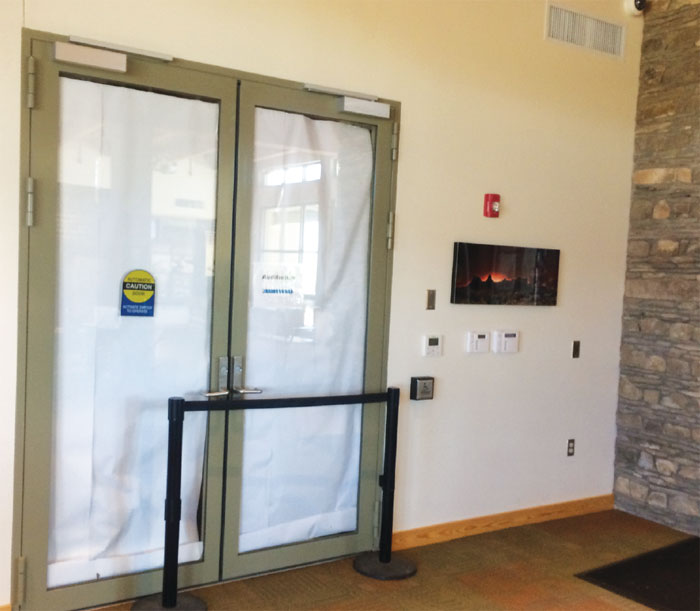
The exhibit lies behind closed doors within the Chaco visitor center. According to the park’s website, that part of the building is still under construction. It’s unclear when it will open. Photo by Austin Cope.
EMTPY EXHIBIT DISPLAY FOR JET FROG EFFIGY
Some of the most iconic artifacts found at Chaco, including the jet frog effigy, reside at the American Museum of Natural History. Photo by Austin Cope.
NOTORIOUSLY BUMPY ROADS LEAD TO CHACO CULTURE NATIONAL HISTORICAL PARK
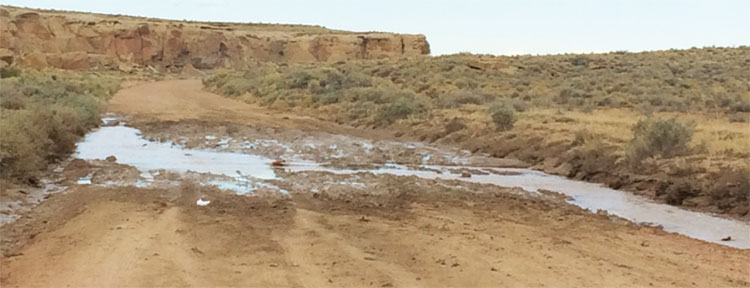
The gravel road to Chaco Culture National Historical Park is notoriously bumpy and full of potholes. The park’s remoteness has been blamed for the inability to open a planned exhibit of artifacts. Photo by Austin Cope.

Behind a closed door inside a new $2 million visitor center at Chaco Culture National Historical Park sits a room full of informational signs, empty display cases, mounts, and lights. People who ask about the mysterious exhibit are allowed inside, according to the park’s public information officer, but the room holds no artifacts of interest – no secrets of the past.

During the 1100s, the dwellings that are now part of the park in northern New Mexico housed what would become some of the most valuable cultural objects ever found in the American Southwest. Pottery, musical instruments, gems, copper bells – even skeletons of macaws brought from central America filled the rooms.

“It was sort of like Fort Knox and the Metropolitan Museum all in one,” said former Chaco Superintendent Barbara West. She said a professor from the University of Virginia told her that more turquoise had been found in one room in Pueblo Bonito than in the entire rest of the American Southwest combined.

But when archaeologists in the late 1800s and early 1900s excavated the sites, they took most of those priceless artifacts back to their home institutions on the East Coast.

“It had been plundered by the museums,” West said. “Visitors would come in and ask, ‘Where’s all the stuff ?’ It was hard to tell them that it was in New York and D.C.”

Many of the most valuable artifacts excavated from Chaco now rest in storage cabinets and drawers at the American Museum of Natural History in New York and the Smithsonian Institution and National Museum of the American Indian in Washington, D.C. Over 2,000 miles away, when visitors tour Chaco’s ancient buildings, they see only the empty rooms. And though Chaco displays a collection of some artifacts and specimens collected from excavations in the 1970s and 1980s, the majority still live in storage.

Today – despite a years-long effort to return some of the most extraordinary artifacts back to Chaco and house them in a state-of-the-art facility for visitors and the descendants of Chaco’s inhabitants to see – those artifacts may remain in the cabinets and drawers on the East Coast indefinitely.

Meanwhile, the mostly-finished exhibit room sits vacant in Chaco’s new visitor center, rendered unusable by a faulty heating, ventilation, and air-conditioning (HVAC) system. Behind the whole building lies a set of conflicting accounts about what is happening and why the problems are so hard to fix. The Free Press spoke with present and former employees to try to understand how the story got to where it is today.

The plan

When West arrived as superintendent of Chaco in 2005, its 1950s-era visitor center was in bad shape. In an interview with the Free Press, she explained the building had a leaking roof, electrical problems, and serious structural defects. It wasn’t hard to convince the National Park Service to fund a replacement for the visitor center, but the park’s artifact exhibits would likely have to remain in a wing of the old center, which had been remodeled in the late 1990s. The rest was to be rehabilitated as office space.

However, when crews began the renovation, they found even more defects, said West. She said she worried that even though visitors might eventually have a new visitor center, the only exhibits they would see would still be housed in a deteriorating building.

So she applied for more funding from the Park Service’s regional offices, wrote project proposals, and almost two years later, convinced the Park Service to fund a special exhibit space to be housed in the new visitor center.

The old center was torn down at the end of 2010, and in 2011 construction began on the new visitor center, according to a park web page from 2012. The visitor center would soon open to the public, but the special exhibit space would need more careful planning.

Dabney Ford was Chaco’s chief archaeologist at the time. She told the Free Press that she, West, the park’s curator, and the park’s chief of interpretation had started planning the exhibition about five years before its planned installation. They reached out to the East Coast museums that held the artifacts to negotiate loan agreements, and traveled to New York and Washington, D.C., to choose which items to put on display.

Ford said they wanted to show artifacts that represented “the high level of artistic, scientific, and technological advancement the people at Chaco had reached,” rather than items from simple, day-to-day Chacoan life. They consulted with members of the 21 modern Pueblos to decide which artifacts would be culturally appropriate to display to the public. Ford said apart from some elders, few of the Pueblo people even knew the priceless artifacts existed. “They were just blown away,” she said.

Ford also explained that park law enforcement, maintenance, and curatorial staff worked together to make sure the exhibit hall was designed to properly hold the artifacts. They added security features, including cameras and intrusion alarms that would sound in multiple places, even the chief ranger’s house. They made sure there were no windows, and that water pipes didn’t go near the display cases. The entire space was designed to adhere to the standards of both the Park Service and the lending institutions — on par with museums in big cities.

The process continued after Ford retired in February 2016. Chaco staff worked with exhibit and preservation experts in Harper’s Ferry, W.Va., where the Park Service designs and creates its museum materials. They designed floor plans, interpretive signs, display cases, and podiums for the exhibits. Staff, along with interns and university archaeologists, carefully inspected each artifact chosen for display to make sure it was ready. They gave each one special mounts, felt bases, and tiny fasteners to hold it upright — even painting the fasteners to match the color of the object.

Teams also made detailed preparations to ship the artifacts to Chaco — a process called conservation, which involves assessing each article’s readiness to travel, filing extensive paperwork, and building cases to hold the artifacts during travel.

The exhibit space was almost ready for the artifacts, but there was one huge problem. The room’s heating, ventilation, and air-conditioning system kept malfunctioning. Though the visitor center portion of the building remained comfortable, temperatures in the exhibit room would swing wildly from one extreme to the other, and humidity levels would fluctuate unpredictably.

One winter day, the space was a chilly 39 degrees, according to a January 2017 article in the Santa Fe Reporter. During the summer, a former park volunteer recalled propping a fan between the visitor center and a door to the sweltering exhibit room to balance out the temperatures.

The conditions were not at all acceptable to hold the delicate and perishable artifacts, some of which are made of wood or textiles that could easily deteriorate such conditions. They require extremely precise sets of humidity and temperature to meet Park Service – and lending-institution – standards. And the current system is still nowhere close to meeting those conditions.

The problems

Exactly what is wrong with the HVAC system, and why it is so hard to fix, are difficult questions to answer. West and her two successors give differing accounts.

West retired from Chaco in January 2013 — shortly after the visitor center had opened to the public, but long before the exhibit area was finished. That section was still in its planning phase, she said, but it had a detailed plan that been shared with the Park Service and approved by the regional office.

West echoed Ford’s account of the security and preservation features that park staff had requested for the exhibit. But she said she had no idea that something was wrong until she spoke with a member of the staff last spring, who explained the HVAC problems. “Everything was working fine when I left,” she said. “So someone didn’t do something right.”

After West retired, Larry Turk, then superintendent of Aztec Ruins National Monument northeast of Farmington, N.M., became superintendent of Chaco, in addition to his duties at Aztec.

“When I got on board, we started looking at the exhibit hall closer,” Turk told the Free Press. “That’s when we realized we would need a more controlled environment for the exhibit, and a stand-alone HVAC system.”

He said his time at Chaco was mostly spent on constructing and installing the exhibit, and the HVAC system hadn’t been completed by the time he left. The heating and cooling system’s was installed at the same time that other parts of the exhibit were being constructed. Turk said any specific information on plans was the responsibility of the contractors and the employees at the regional office who managed them. He said some improvements were made, and plans were developed for a backup generator that would power the building in case of power outages.

When asked if he noticed any problems during construction, Turk said there were a few, but they were minor.

“We ran into snags, just like you do in any project,” he said. “But by the time I left there, I was unaware of any major issues.” He said he thought all had been going according to plan after he left, and seemed surprised to hear that there were major HVAC issues.

Turk left Chaco in June 2016, and became superintendent of four National Historic Sites in New York. During his interview with the Free Press, he emphasized repeatedly that he was no longer speaking for Chaco. He said he had had very little contact with Chaco’s new superintendent, Michael Quijano-West (no relation to Barbara West), after his move.

Turk mentioned one single phone conversation, shortly after Quijano- West arrived, when HVAC issues did come up.

“I just told him what I knew,” Turk said, but he couldn’t remember specifics because the conversation had included other construction questions as well. “I thought it had been going according to what had been planned,” Turk said.

But Quijano-West said when he arrived at Chaco in November 2016, there were already problems with the HVAC system.

“There’s a long history of things, and I’m not acquainted with all the time periods and issues that have been happening,” he told the Free Press.

Climate extremes

In Quijano-West’s eyes, the main problem was not the HVAC system itself, but the park’s isolated location, extreme climate, and drastic temperature and humidity fluctuations. The high concentration of minerals in the water supply also makes it difficult for machines to control humidity, he said. Another major problem is the frequent blackouts and brownouts of the park’s electrical infrastructure. The power fluctuations reset the HVAC system’s computers and erase data, and specially-trained operators from Santa Fe or Albuquerque are needed to correct the problem. “Even our IT people can’t tweak HVAC systems,” Quijano-West said.

Moreover, the park’s facilities are located at the end of a 20-mile gravel road and more than 150 miles from any city, so it can take hours or sometimes days for help to arrive.

He stated that the HVAC system had already been replaced twice, information neither previous superintendent had shared. He also indicated that the exhibit hall and visitor center may not have been planned adequately in the first place.

“I don’t know if [the previous superintendents] were assessing what the capabilities on the ground were,” he said. “Employees have expressed to me that there had been problems in this building since it was built.” (Chaco’s public information officer and chief of interpretation, Nathan Hatfield, also agreed that the exhibit’s system had had problems since he had arrived in September 2015.)

But Quijano-West could not point to any specific problems with the system besides power issues and the isolated environment. No one within the park was trained in the system’s operation. He said only the off-site contractors were fully aware of its issues. And he would not identify those contractors, citing regulations requiring contractors to work only with the regional office. Having a reporter speak directly with a contractor might interfere with the contract agreement, he said.

After repeated questioning, he agreed to forward any specific questions about the HVAC system to the regional officer via email, but could not guarantee a timely response.

No opening date

The superintendent was also unclear about when the exhibit might open. He said the park had ordered a new backup generator, and experts were making specific adjustments to the HVAC controls. He expected the installation process to take about 45 days, but even if the system could be fixed, he explained, it must go through a long test period to make sure the temperatures and humidity are fully stable. He did not say exactly how long that would take, but said it could be a few seasons – enough to monitor the changing environmental conditions of the park. Once that test period concludes, then the system may meet Park Service – and eventually lending-institution – standards.

Few visitors are likely to know the exhibit exists. According to the park’s website, “the museum in the Visitor Center is under construction and is expected to be completed in the spring of 2017.” Though there were two public meetings held about the exhibit earlier this year, only one newspaper has written about it during the past year. More information may eventually become available; Hatfield and Quijano-West confirmed two Freedom of Information Act requests from media organizations related to the exhibit. They refused to provide details.

The exhibit’s total financial costs are still unclear. According to Quijano-West, the visitor center cost about $2 million to construct. But he refused to give estimates on the cost of the exhibit itself. West also said she had no idea on the exhibit’s total cost, and Ford wouldn’t speculate either.

Exact numbers likely lie deep within Park Service budget documents, building plans, and contractor invoices. The total cost of the exhibit may not be known until years after it opens – if ever.

Larger issues

Both Ford and West said the exhibit’s problems represent broader problems with Chaco’s management. They pointed to the decision by upper-level Park Service officials to consolidate management of the Aztec and Chaco units, which allowed park managers to live almost 70 miles away in the town of Aztec. “There’s just a lack of [employee] presence, and that affects interest in getting the exhibit done,” Ford said.

Furthermore, Ford hinted at communication gaps during the transition between Turk and Quijano-West. She said that “little had happened” by the time Quijano-West arrived, though she wasn’t specific about issues during Turk’s tenure. Quijano-West “did walk into a bit of a mess,” she said, “but I think he was not really aware of the amount of planning and the number of consultations we had…A lot of the decisions that had been made [by administrators] may have been based on a lack of understanding.”

In response, Quijano-West flatly denied that the new management structure had any effect on the exhibit’s problems. “I managed two parks [Salem Maritime and Saugus Ironworks in Massachusetts] before I came here,” he said. “I could see some of our older staff thinking that’s problematic, but with computers, cell phones, and multiple ways to communicate, that has helped.” But he did say that he has had very little contact with the people who planned the building.

“They’re all retired,” he said.

At the end of the day, Ford says the exhibit’s problems affect visitors the most. “If the public knew how much had been invested, and how close we were to being finished, I don’t think they’d be happy at all, ” she said.

But Quijano-West says there’s a larger problem. “This kind of an exhibit should have never been created to begin with,” he told the Santa Fe Reporter in January. “It’s unrealistic to expect us to do a New York City-style exhibit here.”

Today, as the seasons change and the park moves toward winter, the exhibit space will likely remain empty. While temperatures inside Pueblo Bonito drop into the teens and 20s, artifacts that once lived in the 800-year-old building will remain in boxes and drawers inside modern, temperature-controlled rooms 2,000 miles away. They will be out of sight of the public – and of the descendants of the ancient people who created them. But they will be safe from a faulty HVAC system – as well as the harsh climate of Chaco Canyon.

Published in October 2017 Tagged

Smoke and mirrors

BOGGY DRAW

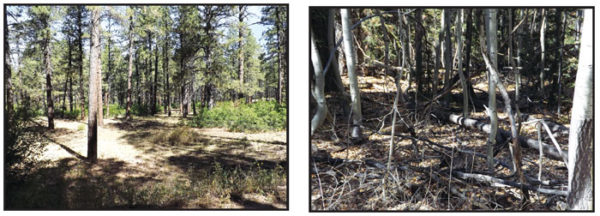
On left, the forest in the Boggy Draw vicinity shows the results of past logging, thinning and grazing. There is very little fuel for fires. On the right, in the Haycamp area of the national forest near the old Wagon Road, fuel build-up is increasing, roads are blocked off and travel restrictions prevent fuelwood gathering to reduce fuel loading. A fire here would cause great resource damage. Photo by Dexter Gill.

Where was all the smoke in the skies coming from recently? Well, mostly from Montana, Oregon and Washington, but later we had our own wildfire in the Boggy Draw area above Dolores. Started small, but the Forest Service decided to let it burn to clean up and restore some natural conditions, and it ended up being over 1,400 acres. Why did this not end up like so many other disastrous wildfires? Very simply, the area has historically been heavily logged to harvest the old dying pines, then later thinned and the slash collected for home fuelwood, burned and cleaned up and with livestock grazing use continuing . The area had been well managed with roads, trails and well used! This has resulted in very little fuel accumulation to support the larger disastrous wildfires while benefitting wildlife, livestock, water production, recreation and economy.

This is a good example of the benefits of economic management. The recent fire was beneficial in maintaining and improving what had been established by past historical management actions. Yes the smoke was irritating and even debilitating to many with breathing difficulties, but the reality is that we will always have fire in the forest and range lands, so we must choose between having lots of uncontrollable smoke and wasting resources or lesser amounts of controllable fire and smoke saving and improving resources. The fires can be a management tool for beneficial results or an uncontrolled disaster to the resources and communities.

I remember the days when we used fire regularly as a tool, in the time of year when it was easily contained and with not so much smoke generated. Unfortunately some people didn’t like any smoke, and dreamed of a utopian environment where it was always pristine with bunny rabbits frolicking with Bambi and there were no nasty woodsmen or hunters and ranchers. However, they did like the wood for their houses and verandas to sit on while barbecuing the filet mignon after spending time relaxing in their hot tub with a glass of wine from the local vineyard. As a result, the rise of the movement to “protect the environment” was born through selfish ignorance and using trickery to establish laws restricting management and use of the forests and range lands. As the disastrous fires have become more common the blame is being placed on “man-made climate change” (a farce), on past management, use and especially fire protection efforts. That is like blaming the nation’s epidemic of obesity on climate change, the farmers and supermarkets for providing too much food. The doctors are complicit for not providing a magic elixir to prevent the obesity from ever happening.

I took a drive through part of the Boggy fire and viewed unburned areas to view the fuel conditions and then some burned areas where it demonstrated simple cleaning maintenance with no lasting damage, except to the oak brush in places, which was a very desirable result. The only thing that could have been better would be that the area could have been burned a month later with less smoke, control and management costs. So why not do it that way? Well, to have a prescribed burn requires preparing an environmental analysis, costing months of personnel time and salaries, and meeting unrealistic air quality criteria with the possibility of an escaped burn costing even more and putting fire fighters’ lives in danger. So when forest management and use has been done well and a late-season fire occurs naturally, it can be left to burn without all those costs of an EA. One thing that is important to be aware of is that this burn was within a previously well-managed and used area. Much of the rest of the forest is not in this well-managed condition. The wilderness and roadless designated areas (which are the majority of the San Juan Forest) are developing heavy fuel loads and the road access for use and protection is being reduced and even eliminated. When the next fire occurs the local forest may look like the drive over Wolf Creek – beautiful for hiking and recreating in, right? It would be better to shoot for putting the local forest in managed conditions that benefit from the natural occurring wildfires and prescribed fires to maintain their health and economy.

What can be done? How about local control over management instead of a shadow government group 2,000 miles away? The forest must be actively managed for maximum health, protected from wasteful wildfires, insects and disease and used for local needs, economy and recreational improvement Did you know that the State of Colorado is larger than the United Kingdom? In the UK (State), they have many “National Parks, which include forests, ranges, fields, private lands, even towns, all of which are governed and run by the local entity that would be kin to our counties! There is not a shadowy group in Hungary controlling what the UK does with its forests and parks even though they were all part of the European Union similar to our United States. As many have said, the smallest local form of government is the most efficient and best form of government. The control and management of all the lands and resources of the counties belong with the counties.

Dexter Gill is a retired forest manager who worked for private industry, three Western state forestry agencies, and the Navajo Nation forestry department. He writes from Lewis, Colo.

Published in Dexter Gill

Telluride Museum hosts Indigenous Peoples Day

The Telluride Institute’s Ute Reconciliation program is hosting the Second Annual Indigenous Peoples Day in Telluride, in partnership with San Miguel County and the Telluride Historical Museum … “Following last year’s successful event, we wanted to continue the process of cultural healing and education that can lead us to a true reconciliation between Native-Americans and Euro-Americans,” said Art Goodtimes, program director … Three speakers will talk at the Telluride Historical Museum on Saturday, Oct. 7, starting at 4 p.m.: Peter Pino, former governor of the Zia Pueblo and board member of the Boulder-based Native American Rights Fund; Ernest House, Jr., director of the Colorado Commission on Indian Affairs; and Regina Lopez- Whiteskunk, Ute Indian Museum educator and former co-chair of the Bears Ears Inter-tribal Coalition … All three are scheduled to speak to classes at the Telluride Mountain School and Telluride Public School on Friday, Oct. 6 … The museum event is free, although donations to continue TI’s cultural outreach programs are encouraged. Two Ute Youth Ski Days are in planning among the Ute Mountain Ute Tribe, TI and the Telluride Ski & Golf, one in December and another in March. We could use help from volunteers to provide for lodging and general assistance with ski plans for Ute youth from the Ute Mountain Ute Tribe in Towaoc. Please contact me at shroompa@ gmail.com if you are interested in assisting. … Started by San Miguel County last year, Indigenous Peoples Day is being provided county funding to match private funding raised by the Telluride Institute and is delegating administrative responsibilities to the Institute this year, in cooperation with the Telluride Historical Museum’s providing a venue.

PETER PINO … He is a former governor and war chief of the Pueblo of Zia. He has a master’s in Business Administration (1975) from the University of New Mexico. From 1977-2014, Peter served as the Pueblo of Zia tribal administrator and treasurer. He is a traditional spiritual leader, holding a lifetime appointment as one of the tribe’s Keeper of Songs. He is also a traditional craftsman who tans deer hides and makes moccasins, bows, arrows, digging sticks, rabbit sticks, rock art and bone tools, using the techniques employed by his Puebloan ancestors. His archaeological interests have led him to committee and board commitments with Crow Canyon Archaeological Center and Mesa Verde National Park. He is also the first Native American to serve as a commissioner for the New Mexico Game and Fish Commission; his term ended in January 2007 … As tribal administrator Peter presided over the return of more than 56,000 acres of Zia Pueblo tribal ancestral lands re-incorporated into Pueblo Trust lands from various federal, state, local and private agencies. He was also instrumental in establishing the Ojito Wilderness in conjunction with the U.S. Congress (2005) and the U.S. Bureau of Land Management (2012)

ERNEST HOUSE, JR … As executive director for the Colorado Commission of Indian Affairs (CCIA), Ernest maintains communication among the Southern Ute Indian Tribe, the Ute Mountain Ute Indian Tribe, and other American Indian organizations, state agencies and affiliated groups. Ernest works closely with Gov. John Hickenlooper, Lt. Gov. Donna Lynne, and CCIA members to maintain a government- to-government relationship between the State of Colorado and tribal governments … Ernest is an enrolled member of the Ute Mountain Ute Tribe in Towaoc. He previously held the position of executive director from 2005- 2010. Ernest is a 2012 American Marshall Memorial Fellow, 2013 Denver Business Journal Forty under 40 awardee, and 2015 President’s Award recipient from History Colorado for his great service to Tribes and historic preservation in Colorado. He currently serves on the Fort Lewis College Board of Trustees, the Mesa Verde Foundation, and the Global Livingston Institute. He holds a rich tradition in his position as son of the late Ernest House, Sr., a long-time tribal leader for the Ute Mountain Ute Tribe and great-grandson of Chief Jack House, the last hereditary chief of the Ute Mountain Ute Tribe.

REGINA LOPEZWHITESKUNK … She was born and raised in Southwest Colorado and is a member of the Ute Mountain Ute Tribe. At an early age she advocated for the well-being of the land, air, water and animals. She attended schools in Cortez and has received degrees from Chief Dull Knife College, Laame Deer, Montana, and American InterContinental University, Hoffman Estates, Illinois. She spent ten years in the information technology field working for Chief Dull Knife College, the Southern Ute Indian and Ute Mountain Ute Indian Tribes of Colorado … Regina has traveled extensively throughout the country presenting and sharing Ute culture. In October 2013 she was elected to the Ute Mountain Ute Tribal Council. She is a former member of the CCIA and the Bears Ears Inter-tribal Coalition, among many other committees and boards … Regina strongly believes that the inner core of healing comes from the knowledge of our land and elders. Currently she is serving as education director for the Ute Indian Museum in Montrose, Colo. She is honored to continue to protect, preserve and serve through education, creating a better understanding of our land and culture.

SCIENCE IN SILVERTON … “The Future Is Bright” was the slogan for the anniversary celebration the Mountain Studies Institute (MSI) held in Silverton last month at the underrenovation Wyman Hotel. Exec. Director Marcie Demmy Bidwell emceed … As an early board member, I got invited to say a few words … San Juan County Commissioner Pete McKay had initially roped me into serving on the MSI board. Pete and I have been friends, colleagues and allies for the past 16 years. He’s still hard at work for his constituents, while I’m happily retired … Silverton was also the home of my teacher and friend Dolores LaChapelle. So joining a (at-thetime) Silverton-based board was appealing … But Dolores has passed. I left the board and relinquished my seat to San Miguel County Commissioner Joan May, who did a great job representing our region. MSI’s Dr. Rory Cowie is currently working for the Town of Telluride doing research sampling on the Valley Floor … I still feel strongly about supporting MSI because it was a dream of legendary Durango geomorphologist Rob Blair, a close friend of LaChapelle. He envisioned a Silverton- based Science Center that would, as MSI’s mission statement suggests, “empower communities, managers and scientists to innovate solutions through mountain research, education and practice.” And MSI is working towards just that. So I agreed to serve on the MSI advisory board at the urging of board member Judy Graham … Rob also wanted a clearinghouse for information on scientific research papers published in or about the San Juan Mountains. And he wanted stronger connections among all the San Juan Mountain communities. Both of which MSI continues to work towards … It was a lovely day in the ancient caldera of Silverton, and a good turn-out made it a celebratory event … Learn more about MSI’s work at www. mountainstudies.org

Art Goodtimes writes from San Miguel County, Colo.


THE TALKING GOURD

Shippers and Receivers
Do Not Confuse

These two grimy black
railroad tank cars
coupled to a siding
in Mojave Desert heat
at the old Southern Pacific depot,
Kelso, California.

One tank car is stenciled:
HYDROCHLORIC ACID

The other:
EDIBLE LARD

—Doc Dachtler
Nevada City

Published in Art Goodtimes

Derby is my jam

Last month, I attended a Durango Roller Girls roller derby. My friend – let’s call him “Tim” because that is his name – and I had very different experiences. For my own part, I have to say that it was a relief to watch a sport where I as an audience member don’t objectify the participants. Unlike, say, football.

I’ve really gotten turned off of football, and it’s not because of the NFL’s unwillingness to tackle the long-term effects of head injuries, or the slogging minutes of nothing happening between spurts of commercials. No, what gets my goat is that Americans tune in to football so they can goggle over the glorified male physiques on display while ignoring the athleticism, dedication, and detection-evading performance-enhancing drugs that these athletes bring to every game.

We reduce these individuals to their position on the field, their artificially enhanced shoulders and quads, and a last name on their jerseys. We forget that these men have college degrees and childhood traumas, mistresses and drug addictions all their own. They are not mere slabs of meat with regional logos on their heads.

Derby girls, on the other hand, are impossible for me to reduce to their physical bodies. That’s not to say these women don’t have phenomenal physiques. They’re athletes, after all, and Tim defaulted to viewing them just like football players. Perhaps I too could appreciate their sculpted frames if I weren’t so invested in the nuances of skating, strategy, and whatever the hell else is going on out there during the game-jam-competition thingy.

Tim wanted to know how I enjoy this sport without reducing the participants to pinups, and here’s how I explained it: these derby girls are whole human beings with the full spectrum of their selves on display, augmented only with pragmatic sporting equipment like fishnets and tattoos and high socks. Oh, and roller skates. Speaking for myself here, I cannot focus on superficial aspects when there’s so much more to these women.

Also, unlike those objectionally objectifiable professional footballers, these women are everyday people like me and, presumably, you. They are bankers, therapists, EMTs, administrative assistants, and marijuana retailers. Like I said, just everyday folk, with everyday names like Eager Beaver and Mutha Stucka and Quadess of Pain and Illegal Peaches.

But – and I cannot stress this enough – that’s the end of where these women are like the rest of us. Put wheels on their feet, and they turn into superhumans. Also unlike the rest of us, you can tell just by observing that these ladies are truly well-rounded people.

Throughout the night, Tim and I discussed just how well developed they are as individuals. Certainly they discuss philosophy, recite poetry, and repair automobiles. Without a doubt, they’re philanthropists; they probably gave money to Irma relief before Harvey was even finished. We wondered what they’re like in bedlam – they are undoubtedly level-headed under duress. And we concluded they must be really good at giving heads-up notices to their business associates when derby schedules conflict with work commitments.

But that was just two men getting carried away, daydreaming about the fullness of these women’s personalities. For this hour and a half, none of those qualities matter to the derby girls. All that counts is the competition. They channel all their passions quite fiercely into it.

And for all the other diverse and well-developed qualities these roller girls bring to the rink, it’s their badassery at roller derbying that is most obviously and undeniably blatant. It ill behooves me to ignore this facet of their stunning characters. To truly appreciate these women and their accomplishments, we made certain to appreciate the skills they were practicing right before our very eyes. I don’t wish to single out any one player, so I won’t identify whose skills Tim and I studied in greatest depth throughout the match-bout-contest whatsit. One might think one would overlook this player because her name doesn’t rhyme with one of the more popularly censored phrases in our vernacular. But during any particular scrum-tangle-block-event, she uses her skills so deftly – so gracefully, in fact – that one could only acknowledge that “oh, THOSE are her peaches.”

And that’s why… wait, what was I driving toward?

Oh yeah. A conclusion. To be honest, I expected to reach an understanding of our deeper humanity by this point in the column. Something that connected my roller derby experience with an intrinsic truth about decency and respect. But such growth was not for me; I entered the rink already able to value human beings for who they are, without resorting to judgment on superficial levels.

But I was fortunate to be able to aid Tim in expanding his myopic focus and appreciating our Durango Derby Girls as profoundly talented human beings. Next season, we will be rinkside for every home bout-joust-round, in hopes that one of them will flash us her real name and invite us out for an intellectual conversation.

Zach Hively writes from Durango, Colo. He can be read and reached through http://zachhively.com and on Twitter @zachhively.

Published in Zach Hively

Adjective deficit disorder

In my neighborhood a house has been boarded up, its grass crispy and uncut, a stubble of weeds longer than a 5 o’clock shadow. The absent owner leaned an enormous piece of plywood against the side of the house and crudely spray-painted the words, “Trespassers Will Be Prose.”

A slow walker will notice a faint attempt at including the letter C after the word Prose but for some reason the fullness of the threat never materialized. I smile whenever I walk by, because in my imagination I have already scaled the chainlink fence and responded with my own spray-painted reply, “Visitors Will Be Poetry.”

As a former English teacher, I learned to tell, for instance, when my students had a grasp on the most basic grammar just by noticing which ones laughed when I posed this simple riddle in class: what’s the difference between a cat and a comma? Of course, nobody would be laughing yet, not until I answered the riddle: one has its claws at the end of its paws, and the other is a pause at the end of a clause. At its root grammar is a kind of logic you don’t have to memorize.

But everyone stumbles over language’s peculiarities, and no one needs to feel guilty about being exposed with his or her modifiers dangling. Nobody’s perfect, and nobody should seek that distinction. Once I asked a doctor before undergoing a medical procedure if a colonoscopy would interfere with my ability to punctuate correctly. He scratched his head, gave me a quizzical look, and immediately put me under. I swear I heard a round of applause in the background before I lost consciousness.

The abandoned house I mentioned is on display for public comment, but an internet search yields many better examples of language deficits. Lynne Truss, author of the 2003 best-selling book Eats, Shoots & Leaves, writes about a group I think of as “The Grammar Police” that roams streets in England, equipped with black markers and white paint, prepared to correct the most egregious errors they find displayed. Misplaced or missing apostrophes, commas gone comatose, crippled contractions, all misspoken signage that is helpless to correct itself.

Misspellings are the most common errors, some of them simply typos, and many of them switched by a software’s auto-correction feature. Occasionally a truly poetic misspelling unintentionally occurs. I’ve seen Thursday appear as Turdsday, which seems to me to be a perfect descriptor for having to spend one more day at work so close to the thought of Friday. These mistakes riddle many of the documents we reed too quickly without taking enough time to proofread.

I tried to explain to a ex-student’s mother why it’s important to be aware of errors, but not to get past, present, or even future tense.

“My son has no idea what an adjective is.”

“That’s not unusual for a ninth grader.”

“But he doesn’t want to know.”

“That’s not so strange either. Most adults hate grammar.”

“How will he ever be able to describe what’s going on inside of him?”

“Adjectives aren’t the only parts of speech that describe.”

“I have a confession.”

“I know, you’re not sure what an adjective is either.”

“It’s a genetic flaw. Not even my parents had a clue.”

“Relax. Millions of people lead full and happy lives without knowing.”

“Do you think if I study up and start using them, my son will get interested?”

“You’ve already been using them.”

“I’m sorry, I wasn’t paying attention.”

“No apology necessary.”

“Apology. That’s an adjective, isn’t it?”

“No, apology is a noun, but sorry is an adjective.”

“How can sorry be an adjective when it’s an apology?”

“The labyrinths of grammar are complicated.” “What’s a labyrinths?”

“Labyrinth is a noun, labyrinths is the plural form of the noun.”

“I feel so stupid.”

“Stupid is an adjective.”

“Oh, well then, I feel so adjective.”

“Actually, the word adjective is a noun.”

“Is there a pill I can take to help me?” “Grammar itself is a pill.”

“I swear I took it, but I never passed it.” “It takes a lifetime to digest.”

David Feela, an award-winning poet, essayist, and author, writes from Montezuma County, Colo. See his works at http://feelasophy.weebly.com/


Published in David Feela

A crazy little thing called love

Like Michael Jackson said, it’s close to midnight – and there’s something lurking in the dark.

It’s happiness and bliss. It’s joy and gratitude.

It’s a crazy little thing called love.

This is Sept. 22, 2017, and Sara and I have been married 10 years today.

It almost didn’t happen. No, I didn’t get cold feet, I just got too comfortable. I fell asleep in my hotel room in Page, Arizona. The wedding was set to begin at 4 p.m.

At first I thought the ringing sound was part of a dream, and then I thought it must be from the TV. This old cowpoke fell asleep watching a western on the hotel TV – and they don’t have too many phones in them.

I finally realized it was the phone in my room and I groggily picked up the receiver.

“Open the door,” I heard Sara say.

“Your brother’s here.”

“Huh?” I replied, rubbing the sleep from my eyes. My family’s on the East Coast – Rhode Island and Florida – and as far as I knew none of them were going to be able to make it to the wedding.

And then I heard my older brother Eddy’s voice from the other side of the door. “Open the door, you knucklehead!”

Yep, that was my brother. I opened the door. Eddy was there with his youngest daughter Brandi and her husband John.

“You’re not dressed,” Brandi noticed. I had clothes on, just not my wedding attire. It was 3:40 p.m.

I hurriedly dressed and we made it to the Navajo Village hogan where the ceremony was to take place. Sara, the daughter of Page residents Bernice Austin-Begay and Reuben D. Begay, and I were having a traditional Navajo wedding. I huddled beneath an overhang to hide from the deluge falling from the sky.

I didn’t know how it was for Navajos, but in my Narragansett culture it is a good sign when rain falls on a solemn occasion. It means you are being blessed by tears from heaven.

Man, was I being blessed. Luckily I was so fast that I was able to dodge all the rain as I made my way inside the hogan. Well, I wasn’t that fast. I arrived at the hogan looking like a half-drowned puppy.

A few moments later – at 4 p.m. – Sara, a 1987 Page High School graduate, entered the hogan carrying the Navajo wedding basket filled with the blue corn mush. Later, some of the guests who could not squeeze into the hogan told us something amazing happened. As Sara entered the hogan the sun came out, the rain lessened – and a rainbow appeared over the hogan.

Yes, we were being blessed.

For those who know Norse mythology, the rainbow was Bifrost, the bridge the gods used to travel between Asgard and Midgard (earth).

I guess I was being blessed the Narragansett way, and by Thor, Odin and Freya. Freya is the goddess of love and beauty – I guess she came to see her rival!

Sara had versed me on the Navajo ceremony. There was one part I didn’t much look forward to. No, not the honeymoon part. It was something else.

To bind the two families together the medicine man, Johnson Dennison, blessed the basket of mush with the Navajo corn pollen offering, and presented us with the blue corn mush to eat. Now, I hate blue mush. As far as that goes, I don’t eat green eggs and ham either. Well, maybe I would eat green ham.

From an earlier wedding ceremony she attended Sara informed me that the bride and groom eat a handful of mush and then the basket gets passed around to the families. I decided to be slick. I took the tiniest pinch of blue corn mush and swallowed it.

“We’ll be here all day if you’re going to eat it like that,” Dennison said.

He did the ceremony differently and Sara and I had to eat the whole basket of blue mush ourselves.

It was worth it. It’s been 10 years, and yet it feels like only 10 days. My heart skips a beat every time I see her. Maybe the rainbow appeared over the hogan because it wanted to see something more beautiful than itself.

I don’t know how I got so lucky. Not only did I get a pretty wife, but I got my best friend, my soulmate.

She encourages my writing, always with a word of support. When my spirit is down, she lifts me up.

She’s the rock that I lean on.

Sara is smart and kind; she still leaves me little notes taped to the bathroom mirror. I can’t help but grin when I spot a note from her.

We laugh a lot together; we seem to read each other’s minds and hearts.

I value her advice more than anyone else’s. With a life of loneliness and unhappiness behind me, it seems strange to have someone that I know always has my back. To know I have someone in my life who loves me unconditionally and accepts my faults.

I have my own lovely angel, and I pray that it will always be so.

John Christian Hopkins, an award-winning novelist and humor columnist, is a member of the Narragansett Indian Tribe. See his writings at http://authorjohnchopkins.blogspot.com.

Published in John Christian Hopkins

Don’t imitate Texas

I have to take issue with another Free Press columnist, Dexter Gill, over his views on public lands. He seems to believe they should be privatized or turned over to the states to manage. Maybe he hasn’t traveled very much. Let’s start with Texas, one huge state in anyone’s eyes. Yet you cannot hunt anywhere down there or even have a picnic under the trees. Almost all of that vast state belongs to one private party or another. Why do you think so many Texans come here to hunt, picnic, hike, boat and enjoy our great outdoors?

I once worked for a huge company that paid me very well to fence people out of the outdoors. This company didn’t even buy the public land they used, they leased it for their benefit. We have a number of them here on the Western Slope of Colorado. Try to cross the areas of the CO2 plants without permission. If you become unruly when they herd you to the exit, you can be prosecuted.

At the head of Cottonwood Canyon up in the Glade of the San Juan National Forest, there is now a noisy facility with fences and Keep Out signs. One year I got a nice elk just about where that facility is. I am sure if it so happened that I shot an elk or deer today just outside the fence that now exists, there would be some ramifications. And anyone would be questioned if he were to walk around the premises and especially if you took out your camera and innocently took a picture to send to someone in another state to show what has happened to bar us from that location.

There are approximately 7 billion people on this planet and most of them have no wilderness to enjoy. We are fortunate to live in a country that does have a great deal of public land. We would not have the giant sequoias to hold in awe if it weren’t for John Muir and others stopping the loggers from cutting them all down.

Those trees are now in danger of becoming extinct, however, because some in this country do not believe in global warming. For instance, the Oklahoma senator who carried in a snowball to prove his point that the world isn’t getting hotter. It was winter – you do get snow in December, at least for now. People like him think the Koch brothers are Santa Claus – they will bring gifts, glitter, and prosperity. Truth be known, they will run over us like an 18-wheeler does a prairie dog.

Who do you think has an interest in that facility at the head of Cottonwood Canyon? Don’t even try to find out if I’m right or wrong – the truth is buried so far down in paperwork and corporate labyrinths that they may not even know. How many names has the facility built by Shell been known under in its 30-year life? Every time energy companies change the name through the sale of a facility there is a cost to the consumer and a tax break for the company.

As I stated, I worked for an international company that built such facilities. There were so many different changes they used up most all the colors in the crayon box on the checks.

Giving over our public land to corporations is like selling your children into slavery – you may make a quick short-term gain, but you will never see them again. Anyone who adds 2 and 2 can come up with 5 and you soon realize how things work in the hive. It all goes to the Queen.

It is necessary more than ever to save our public land. What is that saying? – we don’t own the land, we borrow it from our grandchildren. Let’s not cheat them out of their heritage.

Galen Larson writes from Montezuma County, Colo.

Published in Galen Larson

A nice surprise

“We didn’t get to be the top species on the planet by being nice.” That statement, made by a veteran in the documentary “The Vietnam War,” stuck with me long after I finished watching the riveting and very sad 10-part series on PBS.

Certainly it’s true. The history of the human race is one of astonishing cruelty and viciousness.

But it’s also not true. Because humans can also be surprisingly nice – and that, too, is part of our history.

On Labor Day, as many of you Cortezans already know, a sudden squall swirled through our city. My husband and I were sitting in our upstairs bedroom when there was a loud crack! and a tree appeared just outside the window.

One of the three ancient, 50-foot-tall blue spruces that marked the eastern boundary of our yard had been blown over by a “microburst.” The wind was so intense that it yanked the giant roots right out of the ground from under the concrete driveway. The enormous conifer, home to countless birds (and wasps!) crashed onto the roof. Its two close companions were untouched.

That was all remarkable enough, but what happened next was even more so.

David and I rushed downstairs to assess the damage, and could barely squirm out our front door, as giant blue-spruce limbs with stiff bristly needles filled the porch. The police stopped by to make sure we were all right and wished us well.

What to do next? It was a holiday. I wasn’t sure whom to call to get the tree off the porch, let alone off the roof. Our neighborhood’s power was out so we had no Internet service. (No, I don’t use a smartphone.) The tree was also totally enveloping our Subaru, so it looked like I would have to trek downtown to the office to use the computer there.

Then people started appearing. Not our immediate neighbors, who weren’t home then, but people from blocks away whom I had never met. Everyone ooohed and aaahed over the giant tree. And then they set to work. Wielding chain saws, men began sawing limbs off the blue spruce. Others showed up with trucks and trailers and gathered the limbs to haul to the landfill the next day. Before long our Subaru, miraculously unscathed, was freed. “Thank you!” I told everyone.

But our helpers weren’t finished. Scampering up and down the now-bare trunk, they began slicing it into chunks to haul away as firewood. Then the tree was gone, except for the stump. I managed to give everyone a beer before they disappeared as quickly as they had come.

They didn’t know me, what religion I was, or what political affiliation I might have. They asked nothing in return. They simply saw an opportunity to help someone, and took it.

The statement from the war veteran will linger with me. But so will the memory of the fallen tree and the unsung helpers who turned a minor disaster into something very special.

Gail Binkly is editor of the Free Press.

Published in Gail Binkly

Election features two school-bond issues

In Montezuma County, two school-bond issues are coming up for a vote in November.

Mancos Re-6 Ballot Measure 3A

Mancos residents will be asked to approve a bond measure to raise taxes to renovate school buildings. The Mancos High School is the oldest continuously used high school in the entire state of Colorado and is listed on the National Historic Register. The school facilities are in need of maintenance and renovation, a fact most residents of Mancos are aware of.

The bond measure, Ballot Question 3A, would increase the school district’s debt by $4.98 million in order to raise matching funds for a BEST (Building Excellent Schools Today)-approved grant. The matching funds would allow the school district to receive $19.7 million in state funding. If voters don’t approve the measure, the state grant will not be available for use in Mancos any more.

The funds would be used to improve traffic flow in front of the pre-school. The bond is to be paid off by raising district property taxes up to a total of $575,000 annually.

“The idea that the state is willing to give us $20 million with only a 20 percent match is unprecedented,” Anne Benson, a member of the volunteer committee supporting the bond measure, told the Free Press. “We are the first and only district to receive that kind of break on the matching funds.”

The $24,680,000 is designated for a campus improvement project to repair infrastructure, incorporate security measures, upgrade classrooms and technology, and make the entire campus safer.

“The facilities are aging and in need of repair and this is kind of a once-in-a-lifetime opportunity for the school district to upgrade both building technology and safety,” Benson said.

She said safety is a major concern at the Mancos schools.

“We have no security. Lots of things can go wrong. Anyone can walk right through and get in. The doors to the classrooms are ancient – it’s difficult to keep people out.”

Other concerns about the aging buildings, she said, include:

  • There are no fire sprinklers,
  • The roof leaks in at least three of the buildings,
  • The kitchen is small and the cafeteria is also used for a gym floor.
  • Dropping kids off in front of the school is difficult.

“The road going into the pre-school on Walnut Street is pretty much a nightmare right now,” Benson said. “We need safe parking for students and staff, so pre-schoolers can go into campus without going onto the main road.” The project would include funding for improvements to Walnut Street and construction of a parking lot near the elementary school.

The campus upgrade would provide for a number of improvements, she said. The middle school’s two buildings would be connected, so kids don’t have to go in and out to get from class to class. Heating and the server room will be housed one room instead of spread all over campus to have good internet and security systems so they can monitor the whole campus. A new elementary- school playground would be built. The school nurse, who currently operates out of a minuscule closet, might be able to have a modest clinic.

A community meeting featuring a school-board presentation and discussion of the proposal will take place Oct. 23, from 6 to 8 p.m., at the Mancos Public Library, 211 W. 1st St.

For more information, contact Anne Benson, southwestanne@yahoo.com, 970-946-7039 or visit www.facebook. com/MancosSchoolBondVoteYes.

Cortez Re-1 Ballot Measure 3B

Once upon a time, teachers were generally admired, and teaching was considered a good job – if not for the money, then for the benefits. But times are changing.

Colorado is in the midst of a serious teacher shortage, and the situation doesn’t seem likely to improve soon. The Denver Post reported in April that up to 3,000 new teachers are needed to fill positions in classrooms statewide, but fewer and fewer people are graduating from teacher-preparation programs. The number of such graduates has reportedly declined by nearly 25 percent over the past five years.

Endless paperwork, constant criticism, and stressful, overcrowded classrooms are all factors in the decline of teaching’s popularity, but low salaries are also a major issue.

The Montezuma-Cortez Re-1 School District is seeking to address that concern to some degree with a measure on the November ballot, 3B, that seeks a mill-levy override. Seventy-eight percent of the money raised would go to improve teacher salaries in the district, 15 percent would go to technology such as new computers, and 7 percent would be earmarked for improving the district’s aging bus fleet.

The average teacher salary in Colorado is about $36,000, but in rural corners of the state, that average is lower. At a recent workshop of the Cortez City Council, Southwest Open teacher Matt Keefauver said the average teacher salary in districts such as Mancos and Dolores is $33,000, while the average in Cortez is $29,000.

Teacher salaries have shrunk by 7.7 percent in Colorado in the past 10 years, according to the National Education Association, when adjusted for inflation.

Keefauver told the board higher teacher salaries are instrumental in recruiting and retaining good, dedicated educators. Money from the mill-levy override would enable Cortez to move the median salary upward and make it more competitive in hiring teachers, he said.

He added that there is a certain irony in the fact that while Colorado’s current economic boom is largely driven by high-tech firms, the state ranks near the bottom – 48th – in per-pupil spending, which includes items such as technology in the classroom.

Re-1 human resources director Dan Porter discussed concerns about the school buses currently used by the district.

He said the federal Department of Transportation recommends buses be replaced after 300,000 miles or 15 years. However, more than half of Re-1’s 20 buses have more miles and/or are older than those recommendations. Most, in fact, have manual transmissions. The override would raise property taxes about $36 per year per $100,000 of home value. For commercial properties, the increase would be about $143 per $100,000 of value annually.

Keefauver said 120 districts statewide have mill-levy overrides already, but Re-1 is one of 58 that do not.

The override’s supporters have a Facebook page called “For Our Kids’ Future.” at https://www.facebook. com/YesOn3B/

Published in Uncategorized Tagged ,

Indigenous Peoples Day is declared in Farmington, N.M.; Salt Lake to vote Oct. 3

The Utah League of Native American Voters celebrate in Salt Lake City Council chambers after a vote to support Standing Rock in 2016.In 1992, Berkeley, Calif., became the first U.S. city to replace Columbus Day, a national holiday held on the second Monday in October, by declaring Indigenous Peoples Day in its place. The city was the first to officially recognize the legacy of indigenous people who lived in North America long before Columbus landed in the Bahamas in 1492.

During the 25 years since, 42 cities, two states (Minnesota and Vermont) and the institutions of Brown, Cornell and the University of Utah followed suit, all celebrating the Native American presence on the continent prior to the Eurocentric colonization.

Farmington, N.M., joined their ranks on Sept. 26, when Mayor Tommy Roberts announced the proclamation of Indigenous Peoples Day during the city council meeting. “I read it and handed it to [Navajo Nation] Shiprock Chapter President Chili Yazzie,” he said in a telephone interview. “It was the right thing to do, an opportunity to recognize the historical and current contributions of the Native people in our community.”

The proclamations shed light on the accuracy of the historic account that Columbus “discovered” America, while questioning the heroism of the Italian-born explorer in light of the genocide he inflicted on Native tribes.

Columbus Day was set by President Franklin D. Roosevelt in 1937. Originally observed on Oct. 12, it was permanently set at the second Monday in October in 1971.

Simultaneous holidays

Unlike the groundbreaking Berkeley declaration, most other declarations do not replace Columbus Day, but designate the same day as Indigenous Peoples Day as well, enabling simultaneous celebrations.

The chance for Farmington to do the same was brought to Mayor Roberts’ attention in November 2016 when a group of students from the Native American Club at San Juan College in Farmington met with him about a city declaration.

“Although I was willing to consider the declaration, I suggested they come back after the first of the year. We could plan to introduce the proclamation so that it wouldn’t conflict or be confused [in the public perception] with other indigenous population days.” He explained that the United Nations declared Aug. 9 as International Day of the World’s Indigenous Peoples in 1994, a day that is now very popular and celebrated by many countries around the world.

In addition, some of the other city and state declarations on the same second Monday in October are titled Native American Day. The intent is the same, but the names are slightly different.

The college students didn’t come back, Roberts said, but in early September Yazzie brought the topic up again.

“The mayor talked about declaring a day different than Columbus Day, the day before or the day after, which would be disappointing,” Yazzie told the Free Press. “I said I would not be a part of that decision because it would be a cursory effort. Although our meeting was a bit contentious, a week later he called back. He had thought it through and decided to go with it, declare Indigenous Day on the same day as Columbus Day.”

Roberts did not want to purport to abolish or replace Columbus Day. “Because it’s a national holiday we don’t have the authority, but after considering the significance of the Native American point of view I was willing to consider a proclamation that declared Indigenous Peoples Day on the same day as Columbus Day.”

Yazzie says it is a positive step toward building greater communication and collaboration between the communities.

“The proclamation prepares us to dialogue with the intent of bringing our communities to some parity, for the sake of justice and humanity. No doubt there will be opportunities if we are to partner in the effort to achieve this.”

SLC votes

A joint referendum declaring the second Monday in October as Indigenous Peoples Day in Salt Lake City, Utah, has been introduced in the city council by Councilman Charlie Luke, District 6.

MORONI BENALLYSalt Lake City is home to the University of Utah. The city represents a tight urban environment, packed into only five square miles. Moroni Benally, Diné, Tohlikan Chapter, director of the Utah League of Native American Voters, moved to the city about two years ago from his home in the Navajo Nation after working as director of the Diné Policy Institute and vice president of government affairs and public relations at Diné College, in Tsaile, Ariz. He was also the executive director for the Navajo Nation Division of Natural Resources.

Benally told the Free Press that the League of Native American Voters has worked hard to develop a good relationship with local government and multi-cultural engagement in Salt Lake. “We’ve expanded outreach collaborations between numerous groups representing people of color and are now able to mobilize community members around issues.”

Although the group addressed Indigenous Day with the state in 2016, it was too soon, he said. The legislative measure failed in the Utah Senate.

But in September he saw an opportunity to try again when the Charlottesville, Va., alt-right march opened a divisive moment in U.S. race relations.

In the aftermath, confederate statues were toppling and the focus turned to condemning white supremacy. Erroneous interpretations of history came to the fore, he said.

“We can no longer hold up fictional and sanitized versions of history, including the Christopher Columbus story. Given what’s happening, it’s coming down. Charlottesville seemed like an opening to address Indigenous Day legislation with the Salt Lake City council. They’ve made overtures to some recent Native issues including support of Standing Rock last year,” he explained.

Benally thanked Luke and other council members who have worked with him to bring the issue to a vote October 3. “I anticipate that it will pass,” he said.

The Farmington proclamation was attended by members of the neighboring Native communities. After the declaration, Yazzie thanked the mayor.

“This [proclamation] is recognition of a great egregious wrong that was done to the Native people of this western hemisphere,” Yazzie said. “With great deliberateness, [Columbus] smashed our indigenous world with annihilation and forced subjugation. … we did not have to be slaughtered. …Columbus is not a man to be celebrated; his reputed accomplishment is overshadowed by the atrocities that he perpetrated.”

Yazzie explained later to the Free Press that the education Native tribes can offer to enlighten people helps everyone.

“I think Farmington Mayor Roberts did some of his own research on the atrocities Columbus inflicted on the Native American people. That may be part of the growing shift in consciousness. People are checking facts for themselves, being more objective while looking back at historic events,” he added.

Quiet pushback

Although there has been no pushback yet in Salt Lake City, Benally expects that it could erupt quickly on social media and in rallies as they get closer to the October 3 vote.

“One of the biggest issues around Christopher Columbus in Utah is the expansive heroic role it is believed Columbus played in fulfilling Mormon prophecy, his presence in Mormon theology.”

Benally, a member of the Mormon Church of the Latter Day Saints, explained, “The legacy teaches that God inspired Christopher Columbus to open up the Americas for the gentiles in order that the church could found the Restoration.” It is a quiet but very potent belief and could impact a declaration such as Indigenous Day, he said.

But in Farmington the Sept. 26 proclamation came about without incident. There was really no dissent at the city council meeting, said Mayor Roberts. When Yazzie received the proclamation, he reminded the audience that “the struggle between our communities brought about by racism, discrimination and murder of family members cannot be healed by such a proclamation. I don’t bring this up to aggravate anyone, only to say that we must accept the dynamics between our communities, good and bad.

“Our challenge is to have us use the mayor’s proclamation as a catalyst to greater communication and collaboration for the mutual benefit of our communities and the future of our grandchildren.”

Published in October 2017 Tagged

A fine Navajoland whodunnit

Despite confronting the bodies of four murdered young people at the start of Katayoun Medhat’s The Quality of Mercy, readers know they’re in for an enjoyable — if dark — ride by the end of the first chapter of Medhat’s debut, the latest entrant in the Navajoland mystery niche pioneered by Tony Hillerman.

The Quality of Mercy introduces cynical protagonist K, a police officer in the remote Southwest town of Milagro, an obvious stand-in for Cortez, Colo., near the sprawling Navajo Reservation. K, short for Franz Kafka, has landed in Milagro because of the opportunity it provides him to disappear from the wider world. K’s droll observations — of his fellow police officers, local citizens, and life in general — are as cutting as they are funny.

THE QUALITY OF MERCY BY KATAYOUN MEDHATK teams with Navajo cop and expert tracker Robbie Begay to investigate the opening murder spree. As the two crisscross the reservation delving into the primary murder victim’s troubled past, they trade witticisms and insults in equal measure, making their conversation-filled drives across the high desert some of the book’s best passages. The mystery, which involves crystal meth dealers, New Age mysticism, and the ultimate unmasking of a close-to-home murderer, is wellcrafted but almost beside the point, so rich is the tapestry of characters Medhat has created.

Raised in Iran and Germany and a resident of England, Medhat is an unlikely Hillerman protégé. She wrote The Quality of Mercy after she developed a fascination with the Navajo Nation and Diné people during a stint researching mental health services on the reservation for her Ph.D. in medical anthropology. She says The Quality of Mercy is the “unplanned side-product” of her dissertation research among the Navajo people, and even includes a Navajo language glossary at the end of the book.

Medhat credits a creative writing course she took at Durango’s Fort Lewis College in southwest Colorado for sparking her interest in writing mysteries. The Quality of Mercy won the 2016 Leapfrog Writing Contest and was released last month by Leapfrog Press.

Medhat appeared at Maria’s Bookshop in Durango on Oct. 3 for a reading and signing of her Milagro Mystery series debut. She is at work on Lacandon Dreams, the second installment in the series featuring the wry K and brilliant Robbie Begay detective team.

Scott Graham is the National Outdoor Book Award-winning author of the National Park Mystery Series for Torrey House Press. The fourth book in the series, Yosemite Fall, will be released in June 2018. Visit Graham at scottfranklingraham.com.

Published in October 2017, Prose and Cons

Handing the myco-baton to the young

NEW GENERATION … It was a grand celebration at the Telluride Mushroom Festival last month – the 37th time fungophiles have gathered in San Miguel County to foray for shrooms in the surrounding hills. To meet and listen to experts detail the many guises of the fungal kindom [sic]. And to be taught the awe and wonder of all that mushrooms can do and are doing in our interconnected world … This year’s Salzman Award went to Tony and Wendi Corbin and in memory of their dad John Corbin – a mushroom- cultivation pioneer who brought a wealth of information and a heart of gold to Shroomfest until his passing in 2009. Tony, who lives in Kansas City, has been coming every year since he was 5 to lead forays and enjoy the company of old friends … Britt Bunyard gave his Executive Director Award to Graham Steinruck of Boulder, whose gourmet mushroom dinners were one of the event’s highlights, and who has worked for several years assisting the festival in a number of ways … It was great to hear from Dennis McKenna (who grew up in Paonia) about the history in this country of the use of psychedelic mushrooms, in which he and his brother Terence were intimately involved. These days he’s a respected scientific researcher delving into the medicinal properties of psilocybin and psilocin. Awardwinning journalist Don Lattin chronicled the on-going transformation of magic mushrooms from hippie panacea to useful medicine … The list of senior presenters was impressive: emeritus biology professor Bob Cummings of Santa Barbara City College on fungal decay, past president of the New York Mycological Society Elinoar Shavit on dessert truffles, University of Alabama professor Peter Hendricks on psilocybin-facilitated psychotherapy for cocaine dependence, inspirational wild man Larry Evans of Montana, our own San Miguel County Commissioner Kris Holstom, Mark Jones of the Sharondale Mushroom Farm in Virginia, internist and pediatrician Jonathan Reisman on the role of fungi in human health and disease, Miami University Nicholas Money from Ohio, John Michelotti of Catskill Fungi of New York, Steve Shapson on slow food and gourmet cooking with mushrooms, the exuberant Daniel Winkler of mushroaming.com, business whiz Penelope Zeller, and – of course – the amazing mycologist, philosopher and myco-guru Gary Lincoff … But the most impressive aspect of the festival for me this year was the amazing young people who are stepping into the mycological limelight. Chile’s Giuliana Furci wasn’t content with mycological breakthroughs cataloguing her native fungi, she founded the Fungi Foundation and has been making incredible political changes in her country and around the world. A number of us are planning a mycological tour with her in Chile next spring, and discussions are in the works to extend her Fungi Foundation to the States to begin lobbying for political changes to extend the work of mushrooms in our health, forest remedication, agricultural pesticides, oil spill cleanup, and other areas … Tradd Cotter is my new myco-hero in this country. He and his wife Olga have created a mushroom research center, Mushroom Mountain LLC, in the mountains of South Carolina. His vision of what mushrooms can do for our society is expansive and visionary … Katrina Blair of Durango hikes up to Telluride every year, eating wild foods and mushrooms along the way. One of our regional goddesses … William Padilla is an evangelist of mushrooms, teaching all over the country … Peter McCoy, Daniel Reyes, Oliver Quintanilla – these young mycologists are changing the world with mushrooms. If anything gives me hope in these dark times, it’s these dedicated young fungophiles.

SARCODON IMBRICATUS … That’s the latest name for what mycologists used to call Hydnum imbricatum, and which Wikipedia calls “shingled hedgehog” or “scaley hedgehog,” but which most of us local shroomers know as “hawkswing” or “hawkwing” … It’s one of the complications of mushrooming — the nomenclature is in a constant state of scientific flux, along with regional nicknames that differ widely … This mushroom has always been one of my favorites, and I collect a lot when they are in abundance. Their tooth-like undersides (instead of pores or gills) make identification relatively fool-proof, quite handy if you’re a myco-newbie … For years some folks have complained about their bitterness. David Arora’s book calls that out. But I’ve never experienced it until this year. My son and I picked a small one and fried it up at home. Inexplicably, several bites were delicious. And several bites were too bitter to swallow … Some folks say the young ones aren’t as bitter, but instead we found it was bitter and choice in the same mushrooms. Definitely a myco-mystery … I get around any bitterness in the mix by sauteing the mushrooms and adding sour cream. Buffered that way, I’ve never noticed any bitterness.

GLOBAL DRUG SURVEY … Governments around the world consider shrooms and LSD as the most dangerous of illicit substances. In the U.S. they are Schedule I drugs, judged extremely dangerous with no medicinal value. But in this year’s Global Drug Survey involving almost 20,000 respondents who had ingested either magic mushrooms or LSD, just over 100 reported seeking emergency medical treatment, according to Nick Wing in Huffington Post (May 25th) – with lysergic acid diethylamide racking up most of those emergency cases … To turn that into percentages – 1 percent of LSD users and 0.2 of shroomheads sought professional help after tripping. By that metric, the survey concludes that mushrooms are “the safest recreational drug.” Cannabis users registered 0.6 percent. So shrooms would seem to be safer than pot when it comes to bad trips … As could be expected, alcohol was the most widely used intoxicant and had 1.3 percent rate of people reporting trouble. And as also might be expected, methamphetamines seemed to be the most harmful substance in the survey, with a rate of 4.8 percent.

SUMMER OF LOVE … It was 50 years ago this past summer that I returned from my stint as a VISTA volunteer on the Crow Indian Reservation in Montana and came back to San Francisco with flowers in my hair. I’d been born in the Mission, moved to the suburbs and now was returning to college in the fabled metropolis my mother had told me endless stories of. “The City,” as we called it — from down in the Peninsula’s suburbs. Devotees of Larraburu french bread, Gary Snyder’s poetry and Herb Caen’s threedot journalism in the pre-Hearst Chronicle … My poet buddy Rafael Jesús González has written a wonderful essay about the Summer of Love, how its counter-cultural power continues to influence America 50 years after the fact. Read it in English and in Spanish here: rjgonzalez.blogspot.com/2017/07/ summer-of-love-2017-2017.html

BODY MASS INDEX … If you’re overweight, as I am, this is a measure beyond mere weight to give you an idea how overweight you might be. The World Health Organization’s BMI was disappointing to me, as I appeared to be “obese,” which seemed a stretch, though my potbelly has been expansive in the past … Luckily, I found the Smart Body Mass Index from Europe which measures more variables, including age. On that scale, I was only slightly overweight. Lose another 15 pounds and I’m right in the sweet spot … Having lost 25 pounds last year, that goal seems achievable. And best, the site suggests not to diet. Just eat less of the foods you love, and exercise regularly, being sure to do a lot of fruit, vegetable and nuts … If weight is an issue for you, visit: www.smartbmicalculator.com/

Art Goodtimes writes from San Miguel County, Colo.


THE TALKING GOURD

After

Sometimes
the raw
data of doing
just • doesn’t • jell
until • way late • in the canning
or • cleaning • or • whatever •
comes
after • cling peaches • blushing
apricots • & • whipped cream

Published in Art Goodtimes

Remembering Elvis

Forty years ago – Aug. 16, 1977 – The King died on the throne. It was an infamous ending for one of the most famous men to ever live.

Elvis Aron Presley was only 42 when he died, leaving his legions of fans to ponder what might have been in the future for this legendary entertainer.

Would he have aged gracefully, like Frank Sinatra or Bing Crosby? Or would he have become a caricature of himself as John Barrymore did at the end of his alcohol-addled career?

Elvis’ path to international fame was extraordinary. He was born dirt-poor during the Great Depression. His father, Vernon, was jailed for forging a check to feed his family.

The odds were stacked against young Elvis.

It would be like a child being born in Pueblo Pintado and within 20 years becoming world-famous.

That kind of lightning doesn’t strike often.

Elvis’ psyche was scarred at birth. His twin brother, Jesse Garon, was stillborn and Elvis would often wonder why Jesse had died and he had lived.

A shy child, Elvis made few friends at all-white Humes High School. He was seen as being odd – wearing his hair long in an era of crew cuts – and always lugging around his guitar.

His high school music teacher failed him. She wasn’t the last to fail to recognize Elvis’ talent.

There was Jim Denny, who worked for the Grand Ol’ Opry. He told Elvis to stick to driving a truck. (Denny also fired country icon Hank Williams, Sr.)

According to legend, Elvis went to Sun Studios in Memphis to make a record for his mother. Sun owner Sam Phillips had often said if he could find a white singer with a black voice he could make a million dollars.

He found it in 1953, but didn’t realize it at first. Then a song came in and Phillips couldn’t find the original singer, so he decided to re-record it. His secretary reminded him of the Presley kid with the sideburns. It was the summer of 1954.

Phillips called in 19-year-old Elvis, teaming him with Scotty Moore and Bill Black. But the trio couldn’t get the song right.

Phillips was ready to quit when, during a break, the trio began fooling around, jamming as musicians do. They started doing a song called “That’s Alright, Mama.”

Phillips ran into the studio and Elvis began to apologize.

Don’t apologize, Phillips told them, but whatever you’re doing, do it again!

Elvis became a local sensation, then regional.

That’s when Col. Tom Parker got involved. The cunning colonel took Elvis to heights few performers ever reach.

In January 1956, Elvis released “Heartbreak Hotel” and the King of Rock ’n’ Roll was born.

He took the music world by storm, scoring Number One records in country, rhythm and blues, pop, rock, adult contemporary, gospel. Often his songs topped multiple charts at the same time – something that had never been done before.

In another first, Elvis released a single and saw both sides become gold records. The record was “Hound Dog,” with “Don’t Be Cruel” on the flip side.

So what would Elvis’ future have been like?

Well, consider this: 40 years after his death he remains a top-selling artist and thousands of people visit his home, Graceland Mansion, each year. (Graceland is the second most popular private home to visit, trailing only the White House.)

Crowds of fans come to Memphis on the anniversary of his death to remember The King who left too soon.

It would seem that Elvis Presley, were he alive, would still be relevant today.

The King is dead, long live The King.

John Christian Hopkins, an award-winning novelist and humor columnist, is a member of the Narragansett Indian Tribe. See his writings at http://authorjohnchopkins.blogspot.com.

Published in John Christian Hopkins

Why?

Why do we want to eat, have some kind of shelter, a piece of land, clothing and water? Why do we want to go hiking, fishing, boating or biking? Why do we want to work? You probably answered those pretty easily, but now think about these questions. Why do you want to prevent others from being able to secure a piece of land to build a house on to raise their family? Why do you want to prevent others from being able to secure wood to build their house from and to maybe heat it? Why do you want others to give up their use of water for you to use? Why do you think there should be laws to force others to do and act as you think they should?

By now you are wondering what this has to do with my usual comments on public lands and resources. Well, the first set of questions should be easy to answer since they fall under our unalienable, God-given rights as expressed in our Declaration of Independence as the Right to “Life, Liberty and Pursuit of Happiness.”

The second set you probably take issue with, right? How can I suggest that you are guilty of thinking like that? Let me explain.

This country was founded on the principles of private land ownership to enable a man to be free to exercise his God-given liberty to live his life as he saw fit and to work to pursue his own happiness. The government was established to protect those rights and to keep each other from infringing on one another’s rights. That all worked well as new states were formed and the country grew, UNTIL the western states began to be formed.

Today, continued private ownership of land has been halted by people thinking, “I’ve got mine, you don’t need any!” Furthermore, “I want the rest of the land to be as I want it, and I want you to pay for it!” They will make sure that happens by passing laws to prevent the others from exercising their God-given rights.

The unconstitutional laws to restrict your rights began in the early 20th century, but really got moving in the ’60s and then went on rampage in the ’90s with passage of myriad laws and regulations that were proclaimed to protect the environment, especially on the public lands of the states that were then being declared as federal lands. The environmental corporations pushed for laws that curtailed and even stopped land and resource management and use, the very entities that provided work opportunity that developed wealth to enable the people to better manage and use the resources to provide for all to realize their God-given rights of life, liberty and to pursue happiness. Why did they do that? Apparently they were/are an unhappy bunch that don’t want to work as they “already have what they want,” BUT also want more of what they don’t want you to have, but for free. They sure don’t want anyone else to be happy in freedom and liberty, working and enjoying life?

To ensure their goal is not thwarted, laws were passed to ensure the public lands were securely locked up. Using differing names for the same thing has kept the public confused and unaware of the truth. The laws started off with National Parks, Monuments, Wildlife Refuges, Wilderness Areas, Roadless Areas, Wilderness Study Areas, National Conservation Areas, Wild & Scenic Rivers, Natural Study Areas, ACEC’s (Area of Critical Environmental Concern). I know there are more that I can’t think of. All of these areas have one thing in common, no beneficial uses or management of the land and resources such as in parks and wilderness, and severely limited in the other areas and your freedom and liberty to use all the areas is severely limited or restricted. Colorado is 36 percent federally controlled. Of these lands, the combined special designations that restrict economic use, management and public access comprise the majority of the public lands that we are told are so valuable they need to be protected. An item has no real value unless it is used to generate a value to the holder. If you were given a “ Strad” violin, but couldn’t play it, just keep it, what is the real value? Nothing, until you sell or exchange it for something you can use! What is the value of all the land and resources being locked up? Nothing! They are actually of negative value as they are naturally deteriorating via natural environmental processes and costing in the attempt to protect them from you and themselves.

Most are not aware of “The Wildlands Project” which began in 1991. It is a consortium of environmental corporations whose mission has been and is to “reconnect, restore and rewild North America so that life in all its diversity can thrive”. We are in dead center of this projects’ southern Rockies “Western Wildway”, a designated strip of land from Chihuahua, Mexico, up the Rocky Mountains to the Brooks Range in Alaska. The width varies, and here in Colorado it extends from the edge of the front range westward to the Nevada Border. The goal is to turn as much of the land back to their view of “wilderness” without man’s intervention. The implementation of all of the above land non-use designations has been the means so far, and including securing of private lands through the “Conservation Easement” purchases, using public funds. The Travel Management Plans of the Forest Service and BLM seek to eliminate or restrict many historical access roads, trails and uses, aiding to further the “project.” Currently they are working to have more ACEC lands designated (130,000 acres in SW Colorado), and approve an NCA on the lower Dolores River that will likely limit and may eventually remove historical uses, water rights, game fishery, and recreational development.

Why is the American Dream of Freedom to our God-given rights of Life, Liberty and Pursuit of Happiness being systematically removed by the environmental corporations and our government is not protecting those rights as they are charged to do? Well, they have theirs, they get rich and they don’t want your grandchildren to have ANY!

Dexter Gill is a retired forest manager who worked for private industry, three Western state forestry agencies, and the Navajo Nation forestry department. He writes from Lewis, Colo.

Published in Dexter Gill

It’s 2017

It’s 2017.

I know that’s hardly news to anyone; we’ve all got calendars and the ability to keep track of time. And yet, I wonder.

The Aug. 12 murder in Charlottesville, Va., of Heather Heyer weighs heavily on the mind. Heyer, 32, was among those who turned out by the scores to counter actual neo-Nazis marching in public, sans clown —er, Klan — hoods. These racists were angry that a Confederate statue was to be removed from public property.

What happened next is disputed, though it should not be. There is video evidence and it is crystal clear. It shows a crowd of counter protesters clustered in and around a street. From a great distance away a vehicle accelerates, hurtling down a clear part of the street, and plows through the crowd, ramming another car into the pedestrians.

The suspect, James Fields Jr., went to Charlottesville to protest the removal of the Confederate monument. He was not as spinmeisters and conspiracists quickly asserted, a member of the “anti-fa,” or anti-fascist movement, who mowed down Heyer and injured 19 others in a bid to “discredit” the racist Unite the Right rallygoers. (Newflash to Nazi sympathizers: No effort is required to discredit that hateful movement. It does it all by itself.)

Another questionable notion is that the driver of the car, allegedly Fields, was “just defending himself.” Again, the video clearly shows the driver racing toward a crowd of people and striking them. The bottom feeder Richard Spencer suggested the driver just panicked and floored it after someone hit his car with a bat — a thin excuse the video refutes. The car was clear of any traffic when it appeared in the frame, and zooming toward the protesters. If someone had bashed it with a bat, the driver was clearly able to get away — and had plenty of time to stop before reaching the crowd.

Even more distasteful responses have been those suggesting Heyer was some kind of paid disruptor who somehow got what was coming to her. The milder form of this response is also distasteful, as well as chilling: That motorists should somehow have the right to run over protesters who are in their way.

That’s no exaggeration. In 2017, roughly 20 state legislatures proposed bills restricting protest rights, and some also proposed measures that would provide protections to motorists who hit protesters.

According to summaries from the American Civil Liberties Union:

Under a bill in North Carolina, motorists who hit protesters blocking traffic would be immune from penalty, unless the protest had a permit. Hello, North Carolina — Slippery Slope is calling! Florida and Tennessee had proposed bills with similar provisions.

An Arizona bill (died in the House) would have allowed anyone who participated in a protest that turned into a riot to be punished, regardless of whether the individual’s conduct rose to the level of rioting. It would also have allowed their assets to be seized.

Four states actually passed protest-restricting bills and according to the ACLU three more had them in session as of June. (And those who are inclined to bash the ACLU should remember the organization has also defended the rights of white supremacist groups to demonstrate.)

Let’s be clear: It doesn’t matter what you think of protests. Providing the shield of law to those who use their vehicles as weapons against protesters is immoral, unconscionable, and chilling. Motorists who accidentally strike protesters should be afforded fairness and protections, of course, and laws could be more narrowly tailored with respect to blocking emergency vehicles. The evident problem with motorist immunity laws, though, is that they sanction the murder of fully fledged human beings. In 2017.

Also in North Carolina, a legislator said he wanted to introduce a bill that would criminalize the heckling of politicians. As cowardly and anti-American as this sounds, recall that Desiree Fairooz was convicted of disorderly, disruptive conduct and obstructing passage on the grounds of the U.S. Capitol. Fairooz’s “crime”? She laughed during the confirmation hearing for Attorney General Jeff Sessions. Her conviction was later tossed and, according to published reports, a new trial was ordered on the basis the government had improperly argued her laugh alone was sufficient for conviction.

Again, what you might think of her and her viewpoint is not relevant. She exercised her rights and was nearly imprisoned for doing so. She still faces a trial. In 2017.

No one, not even white supremacists, should be imprisoned for merely offering an unpopular point of view. But when one of them actually murders another U.S. citizen, that is, obviously as unacceptable and reprehensible as thinking folk find white supremacy to begin with.

We are also, in 2017, arguing over the display of Confederate monuments on public grounds. I’m not referring to cemeteries where Confederate soldiers are buried, or even plaques mentioning those who died as prisoners of war. If you want a statue of General Lee on your own property, go right ahead. But as I discussed at length in a 2015 column about the Confederate flag, what Confederate monuments represent is systemic racism, revolt and treason. That’s nothing to celebrate. That’s no loss worth mourning.

Removing these monuments does not scrub out history. Racism is a permanent stain on the pages of history, a stain that remains visible — and affords teachable moments aplenty — without having monuments erected to those who practiced it and who (in contrast to slave owners like Washington and Jefferson), staged an armed insurrection to preserve their “right” to own other human beings.

More simply put, no one is going to forget the Civil War, General Lee, or Stonewall Jackson if Lee is not cast in marble and perched over the town square.

History has not forgotten George III simply because colonists pulled down one of his statues. We have not forgotten the Revolution because no Union Jacks are flying on capitol steps.

We have not forgotten World War II just because no public schools are named for Hitler, and no swastikas are displayed on public government buildings in the name of history.

The information is there, in books, museums, and even at concentration camp sites in Europe. These preserve reality, without celebrating those responsible for inflicting the most monstrous crimes in history. It is one thing to remember victims of racism and anti- Semitism. It is another to place — literally — perpetrators on a pedestal.

And yet, we debate whether it is OK to remove statues of those who led — and lost — an armed revolt against the United States. In 2017.

Dear America. Take a long, hard look in the mirror and hold it up to your soul. We have lawmakers attempting to criminalize protests. We have people who confuse acknowledging dark chapters with celebrating them. We have Nazis and their sympathizers marching in our streets, and blaming victims for their own murders.

And it’s 2017.

Katharhynn Heidelberg is an award-winning journalist in Montrose, Colo.

Published in Katharhynn Heidelberg

The best a man can get

I’m almost afraid to admit this, living in such an outdoorsy region as we do. But here goes: I have never shaved in the woods.

Well, okay; that’s not entirely true. I shaved in the woods once, in that I happened to be in the woods when I shaved. But I can’t count it as a legitimate shave-in- the-woods experience because it was during summer camp, and it was an emotional disaster.

That week, I had already failed at lathing a wooden log into a lamp because no camp counselor taught me how to use a lathe, safely or otherwise. I’d already cried in the tent at night from being friendless and homesick and attempted to pass off my sniffles as allergies, which the other 9- to 13-year-old boys totally bought.

So when we woke up in the deep wilderness, and I was faced with another whole day of camp before I could take care of this pressing stubble in the familiar confines of my own home, I wandered off to shave far away from prying eyes and critical peers.

But no one, camp counselors or parents or PBS television shows, had taught me anything about shaving in the woods. The only aftershave I could find was oak leaves and pine needles. When I wandered back to camp, I’m certain it was evident that this had not been my closest, smoothest shave ever.

I honestly had not dredged up this experience for 15 years. What brought the episode to mind was my recent decision to really rough it, dispersed-camping style. I camp a lot, but always in places with premade fire pits and neighbors to complain about. This was the first time I’d go camping where, if I died chopping firewood, the bears would make a Jackson Pollack canvas out of me before anyone knew I was missing. But the likelihood of that scenario didn’t bother me as much as the raging, freshly unrepressed possibility that I might need to shave at some point during the weekend.

However, I wondered: isn’t shaving in the woods the epitome of capable, self-assured, resourceful, and rugged manhood? Wasn’t this — self-therapy alert! — a prime opportunity for me to claim the share of manliness denied me ever since that summer camp for thoroughly unemployable camp counselors? Was this not a chance for me to gain greater access to the Four Corners umwelt, where even women shave in the woods, thereby throwing doubt on this whole “manliness and manhood” theory?

Rather than answering those tough questions before departing, I acquiesced to the pressure from my dog, who was giving me the look of “Can we GO already?” So we went, and I decided that I would shave in the woods if it became necessary. Which was a remarkably big “if.”

You see, if there’s not reliable and dedicated shaving facilities, my body goes into Travel Mode. It’s like my self-regulating physical processes suspend themselves in a state of full summer-camp- traumatization (look, doc, a breakthrough!) and my beard just… stops growing. I swear, it holds back all that hair for a massive growth spurt when I return home. Rudimentary facilities are just fine, but I’ve certainly never dug a hole in the ground to shave in.

As with many personal demons, I had to face this one down to overcome its taxing impact on my existence. So, naturally, I put it off (with a lot of help from Travel Mode) until the last morning camping. Things could go either way at that point. I figured I could do without a shave until after one last hike, but this was a Big Moment in Life. Dagummit, I had to do this. I set off to find a nice clearing in a copse, asked my dog to keep his distance, and…

… without going into all the details…

I did it. I shaved in the woods. And it didn’t traumatize me at all.

In fact, the birds were trumpeting, the breeze cooled my cheeks, and the sun came out to light up the entire forest. Whether or not shaving in the woods for the first time is a rite of manhood, I felt like a man. Like Man, archetypal and indomitable. One with Nature. Steward of all the light touches.

I buried my shavings and set off to return to civilization, free of doubt and a spring in my step. But can such changes really be permanent? Am I altered, as all heroes are, by my quest? I’m no licensed self-therapist, but the answer seems to me as obvious as bears shaving in the woods.

Zach Hively writes from Durango, Colo. He can be read and reached through http://zachhively.com and on Twitter @zachhively.

Published in Zach Hively

Domestic archaeology

Just like that noted Egyptologist, Howard Carter – the one who discovered King Tut’s mummified remains surrounded by a breathtaking array of splendid treasures – except in my case, no treasures. All I’d come noseto- nose with in the dim tomb-like confines turned out to be the desiccated carcass of a cat that had never belonged to me. I bagged the corpse and dragged it out of the crawlspace. Then, sucking a few more gulps of fresh air, I went back in to fix a leaking water pipe.

They say there are no atheists in foxholes, a sentiment that must hold true for crawlspaces. As a boy raised in the Midwest, I experienced full basements. My subterranean subconscious tells me they still stand for stalwart tornado shelters, laundry rooms, workshops, and root cellars. But a crawlspace? Not until moving to the Southwest.

My catacomb-like expanse stretched out the length of our doublewide trailer, yet barely two feet high. Previous owners had skirted it with stacked field stones, then plastered the stones together with cement. The outside sunlight filtered through myriad holes and cracks where the cement had fallen away. Spiderwebs hung like beaded curtains. I absolutely did not want to be in that space and had avoided it for years. In fact, when we first purchased the place it required only a cursory peek behind the access flap to assure me that nothing could possibly go wrong under there!

Of course, sewer lines seep, pipes freeze, critters creep, and snakes slither. It’s deterioration enhanced by human nature’s practice to build as cheaply as possible. Clean crawlspaces actually exist, with vapor barriers and tight foundations footings, leveling and lighting, but not where I’ve lived. One home I inspected came with the equivalent of a bear den under the floor, another with a set of trenches straight out of the history books from WW I. Cortez enjoys an average of 240 sunny days annually, but there are dark places people don’t talk about.

The only way to reach my water pipes required unrolling a long black avenue of sheet plastic which I pulled myself along, using its slickness against my back while grabbing the undercarriage of the mobile home’s metal frame. Dust clouded my vision with each foot of progress. My partner in excavation stood somewhere above me tapping a broomstick against the kitchen floor, emitting a kind of wooden sonar designed to help me locate the offending leak. I wore a headlamp like a miner, its beam punctuating my fright each time it lighted on some creepy shadow off in the distance.

The dirt floor was littered with rusted cans, beer bottles, mason jars, useless lengths of pipe, a Barbie doll, crumpled and yellowed newspaper, and shards of tin, all amid the rubble of wood and concrete blocks that once propped up the trailer’s frame. I began to suspect a hidden trapdoor existed in the floor above me where former residents simply dropped their trash. How else could this mess have arrived? Unless people host secret crawlspace gatherings, plotting the overthrow of governments, near and far. I wasn’t sure.

With a shudder of despair I noticed that no cables had been secured to keep the trailer from flying away in a Wizardof- Oz-ish fashion, so I knew I’d be underneath again, tethering my worries. Then the critter agenda manifested itself, a gap in the stones where an unidentified flurry of furry critters had left evidence of their visitations. My headlamp swept the area like a searchlight, expecting to find a set of glowing eyes staring back at me. All I found was a dusty soda bottle tipped on its side, only the crescent of its bottom still visible above the soft dirt like a new moon on its way to ground.

Eventually I located and fixed the pipe, which proved to be much easier than I’d expected. The task required all my concentration, so immediately all the ghosts receded from my imagination as I shuttled back and forth along my plastic slide, retrieving the tools I needed.

But I should also mention the curse that manifested itself as a result of opening the crawlspace. Every time I even think about going back down there, trickles of sweat work their way down my temples. When I think about something else, they go away. Imagine that.

David Feela, an award-winning poet, essayist, and author, writes from Montezuma County, Colo. See his works at http://feelasophy.weebly.com/

Published in David Feela

Enemies of the People?

We humans are tribal creatures, and it’s simple to get us to view other “tribes” — people not exactly like us — with suspicion and distrust. Hatred is easy; tolerance is difficult.

Which is why it’s so disturbing to see how citizens are being worked into a frenzy against the press nowadays. Sure, there are many legitimate criticisms that can be leveled at the various media – too superficial, too focused on quick and easy ratings, too disposed to “follow the leader.” Those issues, and more, deserve to be the subject of thoughtful discussions and serious soul-searching on the part of editors and reporters.

But thoughtful discussions are in short supply these days. Instead, we have the nation’s president calling journalists “enemies of the people,” liars, losers, failures and more.

We aren’t going to argue here that journalists are nobler than anyone else, but we aren’t any less noble, either. Journalists aren’t a bloc. There are good reporters and bad reporters, just as there are brutal cops and patient cops, helpful store clerks and hateful ones.

It would be very peculiar if the president were suddenly to start claiming that all plumbers were liars or that most doctors disseminated “fake diagnoses.” But when he stands up in front of a crowd of ardent supporters and claims that most journalists lie on a regular basis, he gets raucous applause. And members of one particular profession become the objects of hatred, to the point where it’s quite possible that some unhinged person or other is eventually going to go after a newsroom with an assault rifle.

Mr. Trump certainly isn’t the only person slamming the press these days. The far left is always carping that the “mainstream media,” which they believe to be one single giant entity, is too timid, too corporate, and even too kind to Donald Trump (yes, there are people who believe that). And various fringe groups lambaste the MSM for not taking seriously different conspiracy theories (9-11 was perpetrated by the Bush administration, vaccines are a form of population control, and so on).

All this, coupled with rapid technological change and people’s diminishing interest in reading, means it’s a tough time to be working in the media these days.

The simplest solution, if you’re reporting or publishing, is to go bland. Write about the least-controversial topics you can. When you report on the president, a governor or even your own city council, just report what they say and do — don’t question or fact-check their statements. If you’re a newspaper, publish inoffensive, pleasant columns that don’t contain strong opinions.

We at the Free Press have struggled with these decisions. Because of the topics we write about, there are people in the local area who feel they would turn to stone if they ever once eyeballed a copy of the Free Press. And there are some of our own readers who threaten to cancel their subscriptions because they don’t like one particular column or other that doesn’t reinforce their pre-existing views.

Our choice has been, and will continue to be, to try to offer a smorgasbord – serious news, feature stories, a smattering of entertainment, humorous columns as well as serious, ideally with differing political views. It’s a buffet, folks – you don’t have to sample everything.

The fact that we’re starting our 15th year shows that most people understand that. But it’s dispiriting to feel, after all this time, that we are regarded as somehow less than human because of our president’s constant, sweeping complaints. People take their cues from their leader, and some of this filters down to the local level. There are leaders here who have made pronouncements in public meetings that one piece of reporting or other was “inaccurate” without giving the reporters a chance to defend themselves. (At times they’ve later admitted they were wrong and the original story was right – but they do that in private.) Like Trump, they fail to grasp a simple truth: Our best leaders, the ones we commoners most admire, are those who take responsibility for their own misstatements and errors of judgment, and would never stoop to hiding behind such flimsy excuses as being “misquoted” or “taken out of context.”

Journalism is hard work but it is valuable and necessary. Those who practice it don’t deserve to be demonized.

So we ask, if you have criticisms of our efforts, call us to account. Write letters or columns. Quit reading, if you must. But don’t fall into the easy trap of believing that we or any other members of much larger press organizations are enemies of the people. Don’t be drawn into a mob mentality of lobbing wild complaints not justified by the facts.

You don’t have to like the press, but you need it. The country needs it. The Founding Fathers recognized that fact.

Published in Editorials

Getting down and dirty: The Montezuma Land Conservancy tackles a new challenge: farming

FOZZIE'S FARM IS OWNED AND MANAGED BY THE MONTEZUMA LAND CONSERVANCY

Ken and Kathy Lausten and their family recently moved Ferdinand the bull and some cow-calf pairs onto Fozzie’s Farm for summer grazing. This is the first grazing lease for Fozzie’s Farm, owned and managed by the Montezuma
Land Conservancy. Photo courtesy of MLC.

There’s a new farmer in Montezuma County, but this one doesn’t wear a cowboy hat. That’s because it’s not a person but a non-profit organization, the Montezuma Land Conservancy (MLC), which is known for helping farmers keep their land in agricultural production rather than doing any farming itself.

There are several reasons the nonprofit’s board decided to venture into farming and ranching, but the most important was to reach a new generation of potential land-lovers. Getting a younger generation on the land to more deeply experience and appreciate the local agricultural landscape is the goal of MLC’s investment in Fozzie’s Farm.

The 83-acre tract near Lewis, Colo., includes 60 shares of Montezuma Valley Irrigation Company water. The land had a conservation easement to keep it in agricultural production and was designated to be passed on to MLC eventually. The former executive director of MLC, Jon Leibowitz, asked the owners to make this donation sooner rather than later to give the organization an opportunity to implement the community conservation concept, understood in the non-profit world as “people support what they care about.” MLC took ownership of the farm in October 2016.

As MLC board vice president Betty Janes put it, “We are in the business of conserving land in perpetuity. That means that MLC must be a going concern well into the future and we must be looking at who will support us in the long term. Fozzie’s Farm gives us the opportunity to expand our funding portfolio and to foster a connection to the land with young people.”

A new business model

The opportunity to take on Fozzie’s Farm came at time when MLC was rethinking its business model. After almost 20 years, MLC has considered or completed most of the “low-hanging fruit” of conservation easements in Montezuma and Dolores counties.

MLC recently began offering landsuccession planning to help families make conservation decisions. Rather than dividing the property into a section for each child, succession planning with both generations makes it possible to keep the property intact and renders it more feasible as a conservation project. Furthermore, working lands such as farms and ranches must be managed to keep the agricultural easement sustainable in the long term.

“Fozzie’s Farm helps MLC understand the challenges of managing large land plots,” said Jay Loschert, MLC’s outreach and education coordinator (and de facto manager of Fozzie’s Farm). “It connects and grounds the organization to the community and landscape that we are serving.”

Duncan Rose, MLC board member and part of the farm operations committee, said there are three functional areas defined for Fozzie’s Farm: commercial production; research and demonstration; and education.

Commercial production of hay and leasing of pasture land offer new cashflow opportunities. In addition, MLC plans to use the farm to research new crops and growing methods as well as to demonstrate to the community how to sustainably operate an 80-acre farm. However, education is the most important goal.

Since March more than 400 students have visited the farm to learn about soil health, water, wildlife and more. “Classroom lessons come alive when they are connected to the real issues facing our community’s farmers and ranchers,” says MLC’s website.

“The current focus of Fozzie’s Farm educational programs is on older kids,” Loschert said. “It allows younger kids introduced to agriculture in the School to Farm program in elementary school to grow into commercial-scale production with irrigation, hay, and animals in high school.”

For example, Future Farmers of America (FFA) groups in local high schools have completed projects taking soil and water samples at Fozzie’s Farm. Southwest Open School has also completed several “service-learn-ing projects” there installing raptor poles that invite raptors to help control the local prairie dog population.

Another student group studying water visited the farm with local water managers to understand the workings of the local irrigation system.

The most rewarding part of Loschert’s job is programming. “I like to tailor the educational opportunities to teachers’ and students’ needs. At Fozzie’s Farm, we have agricultural land and natural areas that can be used to support a diversity of learning opportunities.”

Facing reality

Loschert freely admits that before MLC took on the farm, “we had no real concept of what it takes to manage land.” Some of the management challenges include efficient and effective management of MVI water, weed management in problem areas, the established prairie-dog colony on part of the property, and management of natural areas to preserve species health and diversity. In addition, MLC’s staff had to negotiate a grazing lease and figure out how to get the hay field cut, baled, transported, and sold in the local market.

Like many local farmers, MLC has relied on expertise from local government and non-profit agencies for support navigating these thorny management decisions. Loschert sees it as “an opportunity to deepen MLC’s connection to the agricultural community.”

“We have worked with Colorado State Extension agents, High Desert Conservation District, the Farmers’ Union, Montezuma County Weed Department, and others, he said. “Fozzie’s Farm provides a way for MLC to strengthen the bridge between the agricultural producers and other parts of the community.”

One of the biggest challenges facing MLC is making Fozzie’s Farm financially sustainable. For the 2017 farming season, that means covering out-of-pocket costs to operate the farm. These costs are currently being covered by income from a 15-acre hay field and a grazing lease held by Ken Lausten of Cachuma Ranch. When asked why he chose to lease on Fozzie’s Farm, Lausten answered, “I hold a similar philosophy to land management as MLC. This is productive ground. Our cattle are doing well here. It has good soil and clean water.”

To support the educational programs, MLC has applied for funding under the GOCO Community Conservation grant program. In addition, MLC received a private donation to support development of infrastructure for educational programs at the farm, such as an access road, structures, and septic system.

Like any other beginner

With long-term financial sustainability a major challenge, MLC has turned to Cindy Dvergsten of Whole New Concepts, LLC. Dvergsten, a local Holistic Management-certified educator, teaches whole farm and ranch business planning and runs local classes for new and experienced farmers. She is working with MLC to develop a farm business and operations plan.

“MLC is just like any other beginning farmer,” Dvergsten said. “They need to determine goals for the farm and develop enterprise plans to meet those goals.”

She notes that MLC faces an additional hurdle not faced by most farmers. “As an organization, rather than a private owner, MLC must also determine who the decision-makers are (rather than advisors) and create a transparent decision-making process.”

She sees the organization moving forward with Fozzie’s Farm by taking in data. “They have already completed some baseline surveys of soil and water quality as well as vegetation surveys. They need to determine what they have now.”

After that MLC will need to create a decision-making process and use that to set goals for the farm and prepare a management plan defining how to reach those goals and monitor progress. Dvergsten is confident that MLC is up to the tasks ahead.

The success of the farm may look a bit different than on other 80-acre farms in the area. When following holistic management principles, financial sustainability is based on long-term sustainability of soil and water.

But Fozzie’s Farm is also a community conservation project. To Janes, “Success is seeing kids out there, being outside, having fun.” She would like to see “school groups clambering to get a day at Fozzie’s. Maybe in the future every third-grader spends a day out there.”

Rose agreed, saying he finds this “a fascinating project. It gets under your skin and into your soul.”

To learn more about Fozzie’s Farm visit MLC’s website at https://montezumaland. org/ or participate in MLC’s annual Harvest Brewfest on Saturday, Sept. 9, at Parque de Vida in Cortez.

Published in September 2017 Tagged

An oasis on Cortez’s Main Street: The saga of how a tiny park came to be, thanks to the Lions Club

Photo by Sonja Horoshko

Cortez is in the design development stage of a Main Street beautification project the city hopes will slow traffic, enhance the identity of the city and grace the lives of residents and businesses in the five-block downtown corridor at the center of the concept.

In a July community outreach meeting, City Public Works Director Phil Johnson said that the Main Street project is focusing on building a median that will improve the central business area.

“The medians will be installed on each block from Elm to Ash,” Johnson said. “Medians are a traffic-calming technique, because as you narrow a lane people tend to slow down. The medians will feature landscaping and possibly some public art.”

But one block west of Elm, another older Main Street asset – a minuscule park in the middle of the intersection where the street divides – has been beautifying the city for decades without much fanfare. Although the mini-park feature has flourished since the late 1950s, it has also become so much a part of the city landscape that it is almost invisible to the general public. Cortez has grown accustomed to its charm.

Planted on the east side of the landscaped triangle is a 50-foot blue spruce tree. It marks the spot where the street divides, splitting half of the Main Street traffic off on Piñon Drive toward North Broadway. The other traffic continues on towards South Broadway a few blocks west of the split. “The West Y” is a vernacular mapping reference to the west end of town.

The city adorns the tree with multicolored Christmas lights in December and maintains a plentiful flower bed brimming with blossoms during summer months. The area thrives in the middle of Main Street, withstanding the pollution and noise generated from increasing traffic on the street that is also U.S. Highway 160, a trucking route and a link to native communities and tourist destinations.

But the tiny Main Street beauty feature was not the idea of the city when it was built. Nor was the concept put out to bid or constructed by a company. It was, instead, a project of a handful of Cortez businessmen who sought to enhance the city. They were not interested in slowing traffic in those days, but on embellishing the city with a water fountain.

Short-lived fountain

Cortez resident William Winkler chronicled the story of the water project in a hand-written journal entry submitted to Slavens True Value Hardware during its 60th anniversary in 2011. Winkler, now in his early 90s, explains that the original water fountain was the brainstorm of Basil Slavens, the owner of the hardware store directly south of the Main Street triangle where it was built. He elicited the help of a few other men, including Winkler, to construct the landscape feature. All were members of the Cortez Lions Club, and took on the project in the name of public service.

“It was the late 1950s when we had finished the hospital and were looking for a new project. The triangle in front of the store had a lawn, but no trees or bushes,” wrote Winkler.

The Lions Club members, known for civic-minded work, were inspired by the location of the small triangle at what was then the center of town. “Beautifying that triangle became our project. As we worked on it, one of the men had a 5 foot blue spruce growing in his lawn at Market and Montezuma. I had a twin boom wrecker and the experience to ball and burlap the tree. It weighed several tons, so the wrecker was needed to move and transplant the tree that still grows there.

“The tree, only an infant at the time, was an idea that we added during the process of building the water fountain, which was constructed by Slavens.”

Winkler told the Free Press that the tree really added a lot to the project, but the fountain was the highlight. “It was great. It even had footlights to illuminate the water spray.”

But the fountain was not to last.

“Problem was the kids,” he recalled. “They would not leave it alone. They added soap to the water to make lots of bubbles and it ruined the pump.”

After several incidents and repairs to the pump the fountain was abandoned. Today the circular fountain serves as the backdrop for the garden bed maintained by the city.

“They called my grandfather ‘The First Cortez Landscaper on Main Street,’” said Gary Slavens in an interview with the Free Press. He remembers his dad, Dale Slavens, and his grandfather discussing the construction details of the decorative Lions Club fountain. “George Kelly, the horticulturist who lived in McElmo Canyon, was involved, too,” he explained.

It was one of several local Lions Club projects in the 1960s when he was in high school. “They hoped to complete it in a few months,” he said, “and when it was turned on I remember it shooting way up in the air. People really appreciated the fountain spray.”

‘Bootstrap town’

Local historian June Head describes the Main Street fountain project as confirmation that Cortez was a “bootstrap town.”

“We recognized that we could im prove things. By working together we were able to do some things to beautify the city, pull ourselves up after the war [WW II]. The whole town came out when Basil dedicated the fountain, all of us — about 4,000 people.”

She told the Free Press that the water was a metaphor for the founding of Cortez. “It’s a land-development town. It couldn’t develop without water and so after the irrigation projects, farmers and ranchers began to locate in the county and Cortez became the supply hub for the community. It was the big issue in those days and so the fountain was an important addition to our Main Street. In those days that split in the highway — the West Y— was the heart of the county. The fountain symbolized that. It was a significant project.”

But according to Lions Club secretary/ treasure Irene Aldaz, the city didn’t approve of it. Lions Vice President Kathy Kester said the county didn’t, either, “They weren’t supposed to build it because the tree would block the view for traffic.” But they did it anyway, said Aldaz, and the town appreciated the project.

Founding Lions

The Cortez Lions Club was founded in 1942. It is an affiliate of the Lions Clubs International, the largest service organization in the world with 1.4 million members in more than 46,000 clubs worldwide. The Cortez club sponsored the Dove Creek Lions

In 1976 and the Mancos Valley Club in 1982. According to a press statement, the Cortez Lioness Club was chartered in 1978 and merged with the Cortez Lions Club in 1993.

Although membership in the organization was thriving in Basil Slavens’ day, it is declining today. The trend puts many historical records of the club’s service projects at risk. Facts are hard to check. And the membership is aging. The only member involved in the water-fountain project still living is Winkler.

“New presidents traditionally inherit the record from the previous presidents,” said Aldaz, but in recent years, with only nine members, the records are scanty. She was unable to find a record of the fountain project that could verify the date of the construction. Winkler was present on the crew then and vividly recalls the group enthusiasm for the project. But the late ’50s date he ascribes to it falls vaguely between the mid-’60s suggested by Slaven’s grandson and Head’s recollections.

As the Free Press initiated interviews about the water fountain, stories grew about other projects in the city, all of them contributing to a healthier, more attractive town, but none could be confirmed or dated exactly because the records are minimal and membership is dwindling.

Montezuma Park, the lively summer location for the Cortez Retail Enhancement Association’s Third Thurs market, was originally built by the club, said Winkler, and donated to the city. It was the first park in Cortez.

Today its stately trees provide shade for families and events in a peaceful location two blocks from Main Street on North Market and Montezuma Avenue. Record numbers of vendors and attendance at the CREA events have renewed attention for the gracious setting. The Lions Club recently dedicated a new green bench to the members who built the park, but there is no date is on the plaque.

The Lions Club erected a booth at the August CREA Market, hoping to attract some interest in the local all-volunteer organization. Marcy Aldaz, current president, told the Free Press that they are organizing an outreach effort to collect stories of past Lions Club projects because they represent a foundation of facts about city history. As an example, he said, the beautification project the city is undertaking today rarely acknowledges past community efforts that the club and other volunteer groups initiated.

According to a recent press release, the Lions Club projects have been many and varied. Some prominent ones include spearheading the funding for the first swimming pool in Cortez as well as the first hospital. The club built the birdhouses at Hawkins Preserve, and funded Cortez City Park and the large pavilion with several picnic tables and benches at Centennial Park. They also provided the fully equipped kitchen at the Montezuma County Fairgrounds and also at the county annex, which is used by the senior citizens.

The club also supports the Kid Sight Program and provides assistance to individuals unable to afford eyewear. Grants have provided up to 24 pairs of glasses annually, a Lions Club brochure states.

President Aldaz hopes to elicit interest in membership to continue these programs. It is hard to imagine how they can go on without volunteer support, he said. In 1993 they had 12 members, and now they’re down to nine.

Winkler said the water fountain “was a clean-up-America project and we did that with so many little projects over time.” It was a vigorous time for the Lions then. After they finished the hospital the administrator would call them and ask for help with things like repainting the hallways, or repairs – changing light fixtures, or fixing window trim. It was a time of true volunteer work. None of the members wanted credit for what they did, and that may be part of the records issue.

The water fountain, now a garden feature on Main Street near the west end of the future new median, is an historic marker. Today the triangular piece of land is engulfed in burgeoning traffic at the intersection. Visitors to the minuscule-park must be vigilant crossing the multitude of streets surrounding it, but once there, they may find the former fountain, now garden planter, a surprise. Large embedded sandstone markers outside the sizable rock structure are carved with directive letters: E, S, W and an arrowhead pointing north. There is a commemorative brass plaque there, too: “Built and donated to the city by the Cortez Lions Club.” It lists no names, and is not dated.

Aldaz is hoping that families of past Cortez Lion Club members may have photos or stories and will contact the club through its website to share the information. “There are probably some aging members who do remember the work they contributed to the town long ago. I hope they call us soon,” said Aldaz.

It was always the project, said Winkler, not the individuals, that mattered in those days. And there was always a project to do. The Lions Club honored Winkler with a life-time membership after 50 years of service to the Cortez community.

For more information on the Cortez Lions Club, or to contribute facts and stories to their record, call Irene Aldaz at 970-565-3830, or visit their website at www.e-clubhouse.org/sites/

Published in September 2017

What would it take to bring broadband to Montezuma County? And do we really even need it?

Have you ever been watching a Netflix movie on your computer, only to become frustrated because it skips and stalls due to your slow internet connection? Or maybe you do not even have the ability to stream videos or download music at home, stuck instead with a dialup connection that barely enables you to use email, if that.

Perhaps you live in town and already have high-speed internet but you pay an arm and a leg for it, since there is only one provider monopolizing the market. Or maybe you don’t even care if you have internet at home, since you rarely use it anyway, or have access at work.

Montezuma County consists of approximately 26 percent private property, averaging a population density of 12 persons per square mile. This means many residents live in rural areas where internet access, if available, can be spotty at best. The municipalities of Cortez, Dolores and Mancos have high-speed internet available to most residents, but in outlying areas of the county, some residents may not even be able to get internet services at all.

But do we need internet?

Cortez City Manager Shane Hale notes that he could talk to two Montezuma County residents in the same day, similar in socioeconomic status, age, and ethnicity, and one would say they don’t need the internet and their tax monies should not go to developing broadband access, while the other would say they’re going to leave the county if there is not high-speed internet access available soon.

Economic development is generally the reason broadband access is said to be critically needed. Jim McClain, director of IT for Montezuma County, said one of the main reasons Osprey Packs built its new headquarters in Cortez was because the city of Cortez was able to provide them with “serious high-speed” internet services.

“Without the fiber-optic, they could not have stayed,” McClain said. “If we want to move forward and attract businesses, this is one of the first requirements. From an economic standpoint it’s crucial.”

Greg Kemp, a member of the Mancos Grange and a citizen active in the effort to get broadband to residents throughout Montezuma County, agrees that high-speed internet is essential for economic development, because it increases property values. He added, “high-speed is not a luxury anymore.”

According to July 2016 census data, 20 percent of the population in Montezuma County is over the age of 65, many retired, attracted by the county’s scenic beauty and rural nature. But according to Kemp, “they’re not willing to buy property if they can’t get highspeed internet, because they want to use the internet to communicate with their families – like making video calls with the grandkids.”

Another concern for older people is medical access. “If we need specialized medical care, we can videoconference with a MD, but if you don’t have high speed internet you can’t do that,” Kemp explained. “And there are medical monitors that send information out – like Fitbit and iPhone apps – except without high-speed internet you cannot take advantage of that modern healthcare service.”

Shopping is another reason people want the faster internet. In remote rural areas, there may not be brick-and-mortar stores nearby, but purchases can be made using the internet, and even local stores have an internet presence. The Montezuma Community Economic Development Association (MCEDA) carried out a voluntary nonscientific questionnaire sent out with Empire Electric bills in April 2016. Of the 1700 respondents, 80 percent said they had internet, and of those who had it, 80 percent used it for news, information, research, purchasing and email, while over 50 percent used it to work from home.

Seventy percent used it for entertainment, and another 50 percent used it for video calls.

Two months later, in June 2016, the City of Cortez contracted with Jack Schuenemeyer, a Cortez resident with the Discovery Research Group, to conduct a scientific (random digit dialing) fiber-optic survey. According to this survey, which has more a more reliable (representative) sample than the MCEDA questionnaire, 89 percent of the respondents had internet service, but the majority were not happy with its speed, and did not believe their internet service was a good value.

Of those who did not have internet service – 11 percent of the total sample – 55 percent said they had no need for it, and 50 percent said it was too expensive.

Ninety percent of the respondents in this survey used the internet for purchasing, 91 percent for news and information, 93 percent for research, and 89 percent for emailing video and pictures, while 20 percent operated a home business. Both of these surveys indicate that most residents of Montezuma County use the internet, but are not happy with the speed, cost or availability of the service.

McClain is one of these residents, explaining, “I live out in the county, and the internet I have is horrible. I am an IT guy and I can’t work from home.” As the IT director for Montezuma County, he said he wanted to find a way to bring broadband to everybody.

But it has not been easy to accomplish. As in many rural areas across the United States, private internet service providers may not be interested in building out the infrastructure needed to get everyone connected. It is not cost-effective for a private company to put in a fiber-optic line when there may be only one or five customers who will use the service.

It can cost as much as $1 to $6 per linear foot for fiber-optic cable installation (depending on the fiber count), plus the cost of connection hardware and terminations. In urban areas where population densities are much higher than in Montezuma County, it is cost-effective for the private providers to install the cables, since they are likely to attract enough customers to ensure that their investment pays off. In rural areas, the higher profit margins are not there, which is the reason why few internet service providers offer high-speed service, or charge higher prices for the services they do offer.

The City of Cortez got on board early with high-speed internet access in 1999, receiving $1 million from the Southwest Colorado Council of Governments (SWCOG) to install fiber-optics along Main Street. The city conducted a fiber survey with residents and businesses, completed by Southwest Statistical Consulting, LLC, in March 2009 and implemented the Fiber to the Home (FTTH) project soon thereafter.

According to the city’s website, the Cortez city network currently has over 120,000 linear feet of fiber, serving “anchor institutions” such as city and county facilities, the hospital, fire district, schools, and the downtown core business district.

Phase one of the FTTH project is completed, with costs coming in around $3 million. The next step is to deploy fiber services to the outlying areas of the city, so that all residents have high-speed service, but the city does not yet have funding for this.

The towns of Dolores and Mancos also have fiber-optic cables, but not all residents can access the higher speeds, since the lines were prioritized for the anchor-institution users, including government and schools, by the funding agencies.

“The cable might go right past your house but you can’t hook into it,” Kemps said.

The Mount Lookout Grange in Mancos has begun to explore other options, and in August 2017 proposed resolutions to support public-private partnerships and net neutrality. Kemp says that in the 1930s there was a similar situation with electricity – rural areas were lagging behind urban ones in getting electric service.

President Franklin Roosevelt set up and provided the initial federal funding for rural electric co-ops, which made it economically feasible for smaller rural communities to get electricity. Kemp said something similar could happen with broadband, noting, “We would like the state-level Grange to use whatever influence they might have to encourage the federal government to get involved in this issue.”

Challenges

Obviously, funding is a big piece of the puzzle, but there are also legal and technological challenges. Colorado Senate Bill 152, passed in 2005, and supported by internet service companies, prohibited local governments from providing broadband services to “end users,” meaning regular citizens. Since Cortez began installing broadband before the law went into effect, it is exempt from the law. However, other communities had to opt out of the law before any progress towards improving internet access could be developed. Mancos opted out in 2015, while Dolores and Montezuma County did so in November 2016. But opting out of the law’s restrictions is just one step.

Other legal concerns include easements, which have to be procured in order to allow fiber-optic cable to be installed. If a cable is going to be hung from an existing electric-company pole, for example, the easement has to be secured, since it may have originally only been granted to the electric company for electric lines, not for fiber-optic cable. “It can be costly and time-consuming to perfect these easements, which is another hurdle for us to address,” says City Manager Hale.

The technology is also not simple. As mentioned above, the installation of fiber-optic cable is costly, and may not be feasible in all areas of rural Montezuma County due to geography and distance. The engineering estimate to bring broadband via fiber-optic cable to all county residents came in at $39 million. County commissioners Larry Don Suckla, Keenan Ertel, and James Lambert, all supportive of high-speed internet for all citizens in the county, last year discussed a 1 percent sales tax to fund broadband and hoped to send the matter to voters in November 2016, along with the opt-out measure. The tax would have been earmarked for high-speed internet, would sunset after a specific date, and would have generated $1.7 million to $2 million a year. However, after pushback from some citizens who questioned the need for such a tax for broadband, the sales tax did not end up on the ballot, leaving the county and municipalities still in need of funds. The county did pass the opt-out measure.

Because of this, other ideas have been floated, including a combination of wireless and fiber-optic. In this scenario, fiber-optic cable could be installed in some locations, while others would have wireless transmitters attached to existing towers or poles. A wireless line-of-sight option using microwave technologies connecting to a wireless node is currently available with VelocityNet, but only to customers in certain locations. Another option, currently available with Farmer’s Telephone, is satellite internet access, but it requires a hefty installation package investment including satellite dish and cables.

PPP’s to the rescue?

When Montezuma County voters opted out of SB 152, they also allowed their elected officials to engage in public-private partnerships to obtain high-speed internet. This strategy is currently being pursued, since it addresses the question McClain asks: “What is it that the county can provide that’s not going to break the county, without adding sales tax or being a burden on the taxpayers?”

A public-private partnership allows the county to partner with a private service provider. Currently Connect4 and the county are discussing partnership options with the five internet service providers that responded to an RFP (request for proposals) sent out earlier this year. The five companies are Mammoth Networks, Data Safe Services, Farmer’s Telephone, Foresight, and Zuma.com.

McClain said he’s setting up meetings with each of these companies to discuss what a PPP would look like. He’d like to spend a couple of hours in interviews with the companies and local leaders involved in Connect4 to determine the details of a partnership that could be affordable for the county and also desirable for the private company.

Hale explained: “The two scenarios are, either we find a private partner that really adds value that allows us to deploy without putting in high taxpayer money, or we find someone who is willing to invest in the infrastructure. We want to do an open-access model. The idea would be everybody contributes something to make it happen.”

Cooperation is key to this strategy. Mc- Clain commented, “In order to make anything work, everyone has to be together – all the communities, the leaders – they have to work together to accomplish a goal. It really is a question of finding the right partner. It’s a pretty big project, so it has to be someone that can handle the project.”

Kemp is passionate about this issue. “High-speed internet is not a luxury anymore, it really is a necessity, and people are beginning more and more to realize that.”

Hale agreed: “More and more, we’re talking about fiber as a utility. Maybe 10 years ago it was something nice to have, but the way society and technology and the world has moved, it has become more of a utility. At some point it’s going to be, either have it or be left behind.”

Residents of Montezuma County are encouraged to let their local representatives know their sentiments. Because, as Hale said: “Any local official is just working for the taxpayer – if there’s really a majority of them who want us to be more active, then we will.”


Some internet-related definitions

Broadband

In January 2015, the Federal Communications Commission (FCC) determined that only connections with download speeds of 25 megabits per second (Mbps) or faster will qualify as broadband. Montezuma county officials working to provide county residents with broadband use the FCC definition. According to the FCC Measuring Broadband America Fixed Broadband Report of December 2016, the average speed in the US is 39 Mbps.

Colorado SB-152

A bill passed in Colorado in 2005, which defined high speed internet as 256 kbps, and prohibited local governments from using taxpayer funds to improve local broadband infrastructure and services. The law was passed with the support of large telecom providers, and only allowed local municipalities and counties to build out telecommunications infrastructure to other government entities, such as town halls, county offices, police, fire, ambulance, as well as schools, libraries and hospitals. It did not allow local governments to provide service to “end users” or to engage in Public-Private Partnerships (PPP) intended to provide broadband services. In November 2016, Montezuma County citizens voted to opt out of this law, thus enabling county government to provide broadband services. To date, over 100 Colorado municipalities, counties and school districts have opted out of this bill, including Durango, Telluride, Cortez, Mancos, Bayfield, Delta, Ignacio, Ophir, Ridgeway, as well as La Plata, San Juan and Archuleta counties.

Connect 4

A local group formed in March 2015 for the purpose of getting affordable county-wide broadband services to all residents of Montezuma County. It consists of government leaders from Cortez, Dolores, Mancos, Montezuma County Commissioners, the Ute Tribe, as well as members of MCEDA, city and county officials involved in Information Technology and public works, as well as interested citizens. www.connect4.org

DSL

Digital Subscriber Line, which refers to a set of technologies used to transmit digital data over telephone lines. Generally speeds are lower, with average ranges up to 768 Kbps, and some companies refer to this as “high speed.”

Fiber-optic cable

This is the fastest high-speed data transmission medium. The cables contain a core that consists of tiny strands of glass or plastic fibers thin as a human hair, which carry light beams enabling data to be transmitted via rapid pulses of light, at the speed of light. The receiving end of the cable translates the light pulses into binary values which are read by computers. The fiber-optic cables are thinner and lighter-weight than copper cable, non, flammable and subject to less electromagnetic interference than copper. There are two types of optical fibers: single-mode which can only transmit one signal per fiber, and multi-mode which has a larger core and can transmit multiple signals per fiber.

High-speed internet

This term is used in comparison to dial-up data-transfer speeds. Dial-up internet speed is 768 kilobytes per second, so anything over this speed can be called “high-speed” internet. Generally, private companies determine this definition according to the location and the competition in the area they are providing services, and in this case “high speed” means faster than the average. Services are provided via cable, satellite and wireless connections. In Montezuma County, companies have speeds ranging from 512 kbs to over 25 mbs, some up to 100 mbs. Note: download speeds may be different than upload speeds.

Kilo bits, Mega bits and Giga bits

These are measures of speed. Data transfer speed over internet networks is calculated in terms of bits per second: kilobits (kb small case “k” and small case “b”). The higher the kbps i.e. more the bits transferred per second, more the speed, faster the network/connection. k stands for 1000 1 kbps (kilo bits per second) = 1000 bits per second 1 Mbps (mega bits per second) = 1000 kilo bits per second. 1 Gbps (giga bits per second) = 1,000 mega bits per second. These are often easily confused with KiloBytes (KBS) MegaBytes (MBS) and GigaBytes (MBS), which are measures of file size — how much space a file measures on a hard disk. These terms relate to data storage and file size, while the “bits” refer to speed of transfer of files.

Open Access Network

The open access model allows multiple service providers to compete over the same network at wholesale prices. It’s a business model strategy applied to internet and telecomm services. “The primary purpose of any open access policy is to create service-based competition by allowing a competing provider to share in the use of an incumbent’s facilities.” (Glenn A. Woroch, 2002)

Public-Private Partnerships (PPP)

The PPP Knowledge Lab defines a PPP as “a long-term contract between a private party and a government entity, for providing a public asset or service, in which the private party bears significant risk and management responsibility, and remuneration is linked to performance.”

SCAN

Southwest Colorado Access Network — regional network funded by SWCCOG to improve broadband services in Montezuma and Dolores counties.

SWCCOG or COG

The Southwest Colorado Council of Governments was awarded a $3 million grant in 2010 to implement a high capacity network for regional governments. The project intended to complete “lastmile” fiber and wireless infrastructure in designated communities and create a region-wide government network to connect these towns, cities and college campuses. Participants included Ignacio, Cortez, Durango, Dolores, Silverton, Dove Creek, Mancos, Rico, Bayfield, Pagosa Springs, and Archuleta, Dolores, La Plata, and San Juan counties; and Southwest Colorado Community College.

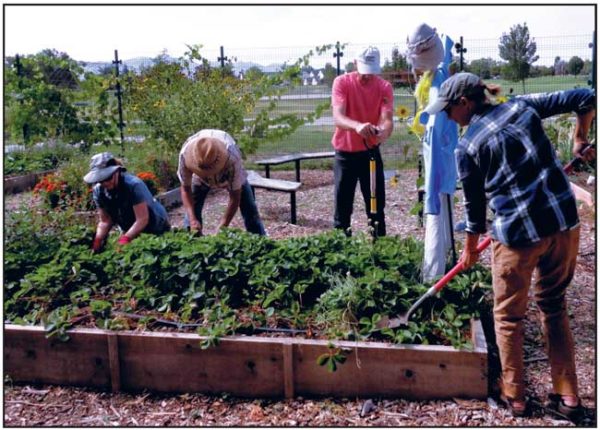
Published in September 2017 Tagged ,

Gothic ramblings

Race, like a flaming cross at a Klan rally, stands at the center of Sing, Unburied, Sing, casting shadows on all that transpires. The novel, Jesmyn Ward’s third and the first since her National Book Award-winning Salvage the Bones, depicts a tumultuous week in the lives of three generations of the River family, proud but impoverished denizens of bayou Mississippi.

Pop, the family patriarch, is haunted by memories of his juvenile incarceration at Parchman Farm – the Mississippi State Penitentiary – the brutality of which we glimpse in lurid flashbacks. Mam, bedridden with cancer, is a Santera whose gift of clairvoyance has passed to her daughter Leonie even if her healing arts and empathetic wisdom have not. As for Leonie, her indifference to motherhood contrasts with her dedication to methamphetamine, leaving it to her son Jojo, wise beyond his 13 years, to care for his infant sister Kayla.

SING, UNBURIED, SING BY JESMYN WARDThe novel’s action centers on the imminent release from prison of Jojo and Kayla’s father Michael, an event that occasions a road trip back to Parchman, a primer on bad parenting, and Jojo’s own initiation to the supernatural when the troubled ghost of Richie, a young inmate whom Pop had protected while in prison years ago, follows Jojo home.


One might reasonably expect that this combination of a celebrated writer, a colorful and well-imagined cast of characters, and a fraught inciting incident would lead to a compelling novel. In the case of Sing, Unburied, Sing ($26, from Scribner), however, that expectation goes largely unrealized.

Take, for starters, the author’s prose. Although a skilled wordsmith, Ward seems way too fond of her own talent. When characters laugh, it’s a sound “erupting from her insides like a hard shovel cleaved it from her.” When they drive, “the horizon opens up like a shucked oyster shell.” When they hug, “blood thuds thickly under my ear, the skin of his arm like tepid water.” And so it goes.

The novel’s shortcomings include more than just rampant adverbs and affected similes. For one thing, it’s an unrelenting downer. Michael cooks meth. His cousin murdered Leonie’s brother while his father, the bigoted county sheriff, covered it up. Little Kayla is always sick or hungry or both, and when Michael and Leonie aren’t neglecting their children, they’re slapping them. And then there’s Richie, the spirit presence from Parchman, whose Dickensian backstory will all but curl your hair.

Next is the matter of stereotyping. In the rural dystopia Ward has confected, every white person we encounter – Michael, his father, his lawyer, their friend Misty, their schoolmates, a police officer, the prison guards – is a druggie, a racist, or worse. And while this might be expected to provide the sort of antagonism upon which good fiction depends, the effect here is almost cartoonish, leaving one to wonder how the novel would be received were the racial roles reversed.

The author’s worst sin, however, is entropy. The story meanders, and we follow, and it’s never quite clear where we’re going. Worse, it’s never clear why. What was her goal in creating these characters, this story, this novel? What was the urgency? Was it to tell us that life is tough, then you die? That the past haunts our present? Or was there something more?

I don’t know, and my guess is neither will you once you’ve finally reached the end. In fairness to Ward, however, reading is a subjective exercise. If lyric prose and domestic horror are to your liking, then by all means, give it a try. Rest assured you won’t be alone, since the author’s pedigree and the book’s pre-publication buzz all but guarantee bestsellerdom. But for my money, if it’s a moving evocation of class and racial struggle you’re looking for, you might want to try Toni Morrison or Alice Walker instead.

Chuck Greaves is a member of the National Book Critics Circle and the author of five novels, most recently Tom & Lucky (Bloomsbury.) You can visit him at www.chuckgreaves.com.

Published in Prose and Cons, September 2017

An open letter to Red McCombs

I believe it is appropriate to personally petition Mr. McCombs and his daughter Marsha M. Shields, asking them to completely reconsider their out-of-date plans for a mountain village at Alberta Park, high on Wolf Creek Pass in Southwest Colorado. I encourage others to send their own thoughtful and constructive petitions on behalf of themselves, Alberta Park and all the wildlife and biology that can’t speak for itself.

Dear Mr. McCombs,

We’ve met a couple times. Once was in Creede, at your 2005 Village at Wolf Creek presentation. I was passing out my No-VWC pamphlet and though we never got close, we did share a couple eye-to-eyes during the many speeches. Then at Congressman Salazar’s 2010 (Adam’s State College) roundtable in Alamosa.

You walked up to me and accepted my flier, then you surprised me by extending your hand and I was honored to shake it. Not much was said, just two guys sizing each other up and walking away. I honestly cherish the memory since it made you a real person to me and not some distant cartoon.

Given Judge Matsch’s decision and the Village at Wolf Creek land trade being nullified, I feel it’s a good time to personally explain why I’ve been dogging your project and to ask that you and your daughter stop to consider Alberta Park as the irreplaceable biological treasure that it is.

You have millennia-old fens scattered throughout the area that are among the healthiest examples of such fens remaining in Colorado. The surrounding watershed, the complex underground hydrology provide a real service – lacing it with trenches and foundations and tainted runoff will destroy that, no way around it.

The Rio Grande River needs these sorts of wetlands for snow storage and water-filtering chores and to help moderate water release, thus helping summer flows last longer. All of this has created habitat for an extensive wildlife community including the elusive lynx. Alberta Park also provides a critically important wildlife corridor between the La Garita and Weminuche wilderness areas.

What’s important and needs stressing is what Federal Judge Matsch made clear: The land’s intrinsic value has standing and the public’s input is appropriate and must be heeded – and valid issues must be resolved, not sidestepped.

I lived in Silverton, Colo., from 1979 to ’86 at elevation 9,318. I know firsthand that high-altitude living has its challenges. It requires a hardy character and a healthy body. We are not built for extended living in thin air and harsh, cold conditions. Some do fine, others find that with the years an assortment of minor aliments develop into major issues. Most leave.

Consider your VWC business plan: to build a happy residential village for rich people of leisure. At Alberta Park? Basically on the Continental Divide. How much time have any of your developers and boosters actually spent at Alberta Park? How many days and nights have they lived up there to get a sense for the appropriateness of inviting families and retirees to invest savings and lives into that location which earns a “Continental Subarctic Climate” rating?

I’m not saying it isn’t wonderful. Remember the adage “there’s no such thing as bad weather, only bad clothing” and you’re good to go. I arrived at Alberta Park one day mid-June, a sunny “warm” day and had a nice walk, yet the wind made it impossible to sit outside to read a book in any sort of comfort.

A campfire to stare at before going to sleep was likewise out of the question. Rather than the stars, I chose my camper shell for the night’s canopy. In the morning I did take a few minutes to burn some spruce bark beetle dead-fall out of curiosity. Yipes, for the next few years, least until all those twigs and most of those trees fall, it’s going to be a firestorm tinder box throughout the bark beetle ravaged Rio Grande National Forest.

It’s creepy seeing the many fallen trees and watching standing dead swaying in the frequent wind gusts, knowing one could snap in an instant. No place I’d want to spend much time in.

From other visits and another campover my impression is that the wind blows incessantly. Go figure, that slope above Alberta Park goes right up to the Continental Divide at over 11,000 feet. Why would we expect calm afternoons, or evenings, or mornings, or days?

Mr. McCombs, aside from the construction challenges, there are issues of law enforcement, fire protection, medical services, power, fuel, IT and sewer infrastructure involved with your proposed village. Everyone is demanding tremendous outlays of cash just to adequately study and plan for, let alone implement, these things – for a residential/ vacation real estate speculation in subarctic weather conditions?

It’s not the ’80s and ’90s any more, no sir. There is no pot of gold behind this Village at Wolf Creek dream, only more financial losses, along with human and ecological misery.

Speaking of human costs, what about your legacy, Mr. McCombs? Right now, thanks to this decades-long Alberta Park struggle, with its political intrigues and lost court battles, many see you as a development- fixated Texan land robber out to despoil a valuable natural (some would say national) resource, come what may.

Please step back to look at the bigger picture. Think of the Rio Grande River that flows through your beloved Texas. If the health of that river matters to you, then geophysical reality makes preserving the purity of its source waters a major priority. Your development company holds and endangers a keystone parcel of that source-watershed.

Pursuing a land-preservation option for your Alberta Park parcel of heartaches, headaches and self-pilfering would transform your problem into a positive contribution to society and to your memory. Please give it some consideration.

Peter Miesler writes from near Durango, Colo., and maintains the blog NO-VillageAt- WolfCreek.blogspot.com, where you can find information supporting claims made in this letter.

Below are some addresses for Billy Joe “Red” McCombs and his daughter Marsha Shields:

www.mccombsenterprises.com/foundation

www.thevillageatwolfcreek.com/contact

McCombs Foundation, Inc. c/o Mr. Billy Joe ‘Red’ McCombs Re. Village at Wolf Creek 755 E. Mulberry, Ste. 600 San Antonio, Texas 78212-6013

Koontz McCombs Construction, LTD c/o Marsha McCombs Shields 755 E Mulberry, Ste. 100 San Antonio, Texas 78212

For information about the Village at Wolf Creek planning team, see http://www.thevillageatwolfcreek.com/team

Published in Peter Miesler

Is Chief Wahoo demeaning?

Yoo-hoo, Wahoo, someone’s watching you.

That someone is a Canadian tribunal which might consider whether the team logo of Major League Baseball’s Cleveland Indians is racist or not.

The logo in question is a grinning Native American caricature known as “Chief Wahoo.”

Canadian architect Douglas Cardinal had sought an injunction last fall – when the Indians met the Toronto Blue Jays in the American League play-offs – barring the use of the Cleveland team’s name and logo during broadcasts.

Cardinal, who has Blackfoot and Ojibway ancestry, claimed the name and logo were discriminatory. The court denied Cardinal’s request last fall.

But the Human Rights Tribunal of Ontario said the court’s decision did not impact Cardinal’s claim before it.

The tribunal decided at the end of May that Cardinal’s case could proceed. The tribunal decided that a “full evidentiary record” was needed before the full tribunal could render an opinion.

Use of “demeaning and degrading” Native American team names, logos and mascots are insensitive and ridicule native cultures, according to Cardinal.

Similar complaints have been lodged over the years against baseball’s Atlanta Braves and football’s Washington Redskins.

The Cleveland franchise argued that the team’s name was meant to honor a former player, Louis Sockalexis. Sockalexis, a member of the Penobscot tribe, appeared in less than 100 games for the Cleveland Spiders over a three year period. He enjoyed a robust rookie year in 1897, where he batted a spectacular .338 in 66 games. Cleveland, then in the National League, finished in fifth place.

But tht was also the beginning of the end for Sockalexis. In July he injured his ankle when he jumped from a brothel window while drunk.

After that Sockalexis’ career dropped off dramatically.

He played in only 21 games in 1898, hitting a measly .224. He ended his career in 1899 after playing in only seven games.

Sockalexis is sometimes reported as the first Native American to play major league baseball. However, there has been some dispute about this. In the 1880’s the American Association was the major league of the sport and one of the teams had a catcher named Jim Toy, said to be native.

The first full-blooded Native American was Moses “Chief ” Yellowhorse, a member of the Pawnee tribe. Yellowhorse pitched for the Pittsburgh Pirates in 1921 and 1922, winning eight games during his career while losing four. In 1915 Cleveland, then in the

American League, were known as the “Naps,” a homage to their legendary second baseman Napoleon Lajoie. The team, so the story goes, asked fans what the new name should be and a “young girl” suggested the Indians, supposedly mentioning Sockalexis by name.

However, before the days of TV, it seems hard to believe that a young girl would remember a player who had been out of the game for 16 years! Even more damning to the team’s story is that a 1915 newspaper article on the name change did not mention Sockalexis.

Recently, the Cleveland Indians have changed their stance on the logo and want to work with the baseball commissioner’s office to find a suitable solution.

There is one baseball Hall of Famer with the nickname Wahoo; that is former Detroit Tigers star “Wahoo Sam” Crawford. But the moniker came from Crawford’s hometown of Wahoo, Neb.

John Christian Hopkins, an award-winning novelist and humor columnist, is a member of the Narragansett Indian Tribe. See his writings at http://authorjohnchopkins. blogspot.com.

Published in John Christian Hopkins

Summer vacation

Travel plans blossom suddenly like roses as summer nears. Maybe a camping expedition to the lake come Memorial Day, just a warm up exercise. A national park after that. If the imagination is permitted free rein, soon enough you’ll be checking airfares promising to take you to exotic locations. Italian villas. Hawaiian beaches. The Alaskan wilderness.

But if memory serves, air travel aboard commercial airlines will have left the sour taste in your brain, a bitterness associated with security screening, leg room, body odor, or lost luggage. Even the slightly fishy aroma of a meal advertised as turkey tetrazzini.

Samuel Taylor Coleridge coined the phrase, “a willing suspension of disbelief.” In literature the phrase refers to abandoning common sense to believe in and enjoy a fictional storyline. Every time I break down and purchase an airline ticket, I think of old Coleridge and wonder if he knew how desperate people become after being cooped up for an entire winter.

There is, however, a more sensible approach to travel, especially if your travel budget is getting crappy mileage.

In libraries all across America, people occupy chairs, researching and reading. So far as I know no librarian has ever dragged a patron down the aisle between bookshelves and tossed the uncooperative lout out the door just for moving his lips while reading.

Books are like that. The printed word functions as an economy vehicle to escape this field of gravity, to transport you a different location. Let the airlines fend for themselves.

In 1978 William Least Heat-Moon, after a series of personal misfortunes and setbacks, headed out on an actual three-month journey in his van along what he then referred to as “blue highways.” His 1982 classic, a thick 448-page travel book, eloquently describes his encounters on a latticework of our rural American backroads.

Not everyone has three months to travel, let alone a healthy chunk of time to read that many pages, which is why I want to mention a man I’ve never met, but one I’ve taken along with me on more than a few road trips.

Almost 35 years ago, according to his website, Peter Anderson took a job writing for a small-town daily newspaper just east of the Continental Divide. He currently lives in Crestone, Colo., “an eccentric mountain town full of spiritual seekers, old hippies and neo-rastafarians, Buddhist monks, modem cowboys, retired bikers, former executives turned poets, ranchers, philosopher-plumbers, green-leaning realtors, artists, writers, and musicians. He loves the San Luis Valley as well as the Sangre de Cristo and San Juan Mountains that shape it.”

His latest offering maps a great expedition in just 84 pages, prose with the power of poetry, fueled by humor, insight, and a passionate understanding of life in the American West.

Heading Home: Field Notes (Conundrum Press, 2017) starts by invoking the spirit of Jack Kerouac. Then Anderson takes the wheel, meditates on every curve in the road, draws the scenery into focus by displaying it like postcards from the soul. Personal points of interest. Characters living within a landscape we call the American Southwest. Backbumper Gospels. A journey — some of it interior — conserving all that fuel that might have been burned up zig-zagging across a literal topography of space and time.

“I’ve been driving a big circle —” the author writes, “Colorado through red-rock country, home along the Arizona Strip, now across the rez to the San Juans.” At an early rest stop in Kayenta, Ariz., Anderson introduces us to a high-octane road companion, a cup of Nava- Joe, but not without offering us a page which contains the Navajo barista’s perspective on the Bible as translated by his people’s traditional sheepherding.

Another road attraction arrives with economy. A total of 156 words draws you to the edge of an abandoned iron mine, waiting, until thousands of bats emerge. It’s also the night that emerges, “a vast, whirling column,” a chilling vision because “Now you know where the night comes from.”

Habitation (Part III) embraces a seasonal cycle, a Sand County Almanac for the American Southwest. There’s a calendar inside this book.

Heading Home takes us through “The Big Empty,” and then exits where the Nowhere Cafe remains nestled in “the glow of a small town over the rise.” No matter what rutted road receives his attention, the author locates no cafe. Only a dying town. An emptiness that longs to be filled.

“… And you say the only words you have left to say: Empty me . . . that I might be whole again.”

Heading Home is a trip worth taking.

David Feela, an award-winning poet, essayist, and author, writes from Cortez, Colo. See his works at http://feelasophy.weebly.com/.

Published in David Feela

Wood is good!

We hear that phrase, but then wonder, what is it really good for? Well, naturally it is good for lumber and firewood, but what else? It always seemed good to snag my fishing hook on a submerged branch or small log, or even my flyfishing hook on an overhanging branch. Surely it must have other uses.

Well, it does, there are literally hundreds, from housing to high-tech medicines, energy production, agriculture, and the list goes on. Oh, and it is really good at producing smoky skies when not used for manufacturing the other hundreds of beneficial products. Isn’t it interesting that we complain about a power plant producing a little wisp of smoke along with the water vapor, but then allow and even set large fires dumping tons and tons of heavy smoke particles into the air and say that is good?

With so many beneficial uses for wood, you would think that we would thin out and harvest the trees using as much of every part possible for beneficial uses, then cleaning up the small branches left, using prescribed fire. That would greatly reduce the monster wildfires of today and at the same time, improve the watershed, tree growth, beauty, wildlife habitat, recreation opportunity and forage. The harvesting and manufacturing of the wood products grows jobs and economy so we can afford to do an even better job of management.

The recent loss of the Western Excelsior plant in Mancos is a major economic loss to the entire county and beyond. Over 100 direct jobs lost, but many don’t see all the support businesses that lose and the funding for the school district, and the list goes on. One major item that escapes most is the loss of forest management opportunity. The aspen stands are starting to die out from old age and the way to regenerate them is to cut them and of course use them for beneficial purposes. The only other option is to allow massive, very hot fires, producing tons of smoke to burn up the trees to let nature start over again. That would be a terrible waste of the resources that our Creator provided for us to use.

The wood-products businesses are the only economical “tools” for managing the forests. These forests are way behind in management needs if they are to see a healthy future. This will require more industry tools to harvest and regenerate just what is dying off every year in the spruce, fir and pine areas. The Excelsior plant loss is a real blow to forest management as well as local economic health. That leaves the area with only two full-time milling operations, the Aspen Wallwood plant and Stoner Top Lumber. To make full economical use of the forest products, we need more diversity and production of manufactured products.

ASPEN WALLWOOD

Below, pine logs at Aspen Wallwood that are set to be turned into paneling, rather than wildfire smoke. At right, blue-stain pine that will be milled into beautiful paneling. In the author’s opinion, these photos depict forest management in real life.

Many of you probably don’t realize that a pine beetle infestation is killing off ponderosa pines on the west end of the Glade on the forest. What can be done with the dead wood? Two choices are to let it burn or use it. With some innovative thinking and marketing, the Aspen Wallwood plant has found that the beetle-killed trees become infected with a fungus that turns the sapwood a blue/gray color that many builders really like for paneling, so they harvest them, mill them into higher-quality paneling. This is an example of how our local wood industry is reducing potential wildfire smoke, improving watersheds, creating better forage for wildlife and livestock, providing jobs and improving local economy by being able to harvest and utilize the dying trees. If we want a healthy forest to enjoy, we are going to need to help develop a more diverse and higher production wood industry tool to do the job for us. That of course requires that the Forest Service is able to make the timber available in a very short and timely manner before the wood begins to rot, becoming unusable except for wildfire smoke production. Support our local wood industries. Shucks, we have lumber, paneling in pine, spruce, aspen, hardwood flooring, pressed wood firewood logs and more.

Dexter Gill is a retired forest manager who worked for private industry, three Western state forestry agencies, and the Navajo Nation forestry department. He writes from Lewis, Colo.

Published in Dexter Gill

Our community needs a solid foundation

In my travels and work throughout my life, I have never been in an area where there is so much stupidity. I would have said ignorance, but ignorance can be eliminated by education. Not stupidity.

Doesn’t anyone in a leadership position see the downward slide of this area?

After examining many locations in other states my wife and I years ago chose this little town with all its bountiful amenities for comfortable retirement. But due to poor leadership, over the decades we seem to have slipped back in time. One can scarcely purchase anything in this locale from outlets that are locally owned, other than dinners at restaurants. I realize there is a nationwide trend in which retail is dying and everything is being sold online, but we should be doing everything we can to buck that trend. Nothing can replace the experience of walking into a small, locally owned shop and buying something from a person we know, our neighbor perhaps, who talks with us a bit as we hand over our money. It’s sad to see so much of that disappear, to be replaced by automated self-checkouts or (even worse) UPS drivers and someday drones dropping things on our porches while we huddle inside, hunched over our smartphones.

This area has been and is supported by a welfare economy, from top to bottom. People resent the idea of welfare and food stamps for the poor, but don’t mind a generous government check going to those that need it the least and have no clue as to leadership.

It seems we adhere to a motto that is correct in every way: It won’t work and can’t be done. That has become a self-fulfilling prophecy.

In another example, of poor leadership, our elected officials are afraid to even mention, much less support, a tax for fear of losing their welfare positions. Here’s a simple analogy: If the roof leaks, it needs shingles. That is a tax.

To build a structure, or a community, you need a solid foundation. Without that, the structure will not stand. The people that settled this area had vision and a can-do attitude. We, on the other hand, seem to be overcome with cataracts. As the saying goes, meetings didn’t build the meeting hall. If I were a leader I would be ashamed of a position at the bottom of the ladder and never thinking of looking up.

As a starting place I would comfortably lean toward the sheriff ’s request for funds for more deputies to keep the peace, investigate crimes, and yes, give out a few speeding tickets. I myself have had a few. Too much mouth, not enough couth.

The sun has set to bed I lay How grateful I am that I was able to help someone today.

Try it, it will make you feel good.

Galen Larson writes from Montezuma County, Colo.

Published in Galen Larson

Rose invents a new genre with ‘Thief’ (Prose and Cons)

Augustus Rose may have invented a new genre with his debut novel, The Readymade Thief, released Aug. 1 by Viking Press.

Let’s call Rose’s creation a Young Adult novel for adults; rather than a YA novel, Rose has written a YAA novel. In The Readymade Thief, Rose adopts many of the norms of a novel aimed at teenage readers to tell a thought-provoking coming-of-age tale layered with adult themes.

THE READY MADE THIEF BY AUGUSTUS ROSELike the protagonists in many YA stories, the heroine of The Readymade Thief is young, whip-smart, abandoned by family, and blackballed by society. It turns out — and nearly goes without saying — that 17-year-old Lee also has been pre-selected by mysterious forces for bigger things than she ever could have imagined for herself.
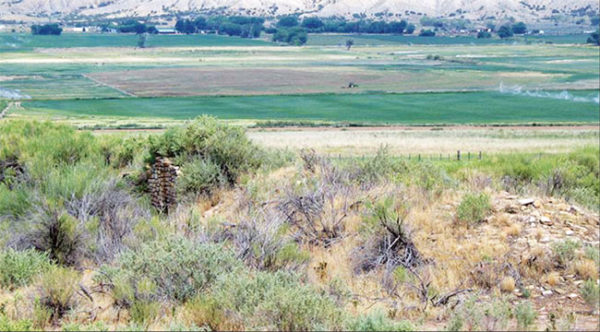


Though addicted to shoplifting, Lee at the outset of the story is in all other ways an average, middle-class product of suburban Philadelphia poised to graduate from high school, go off to college, and live an unremarkable post-collegiate life. Then, in short order, Lee’s best friend frames her for a drug deal gone bad, her mother shuns her in favor of a controlling boyfriend, and she is sentenced to a year and a half in juvenile detention.

Within weeks, Lee escapes incarceration and finds herself homeless and on the lam, whereupon she meets and is befriended by an array of quirky characters surviving on the margins of Philadelphia society. Among them are the Station Master, an informal foster parent to homeless youth who may be absconding with the souls of the young people he aids, leaving them brain-dead and wandering the streets with glowing, gel-filled eyes.

Ever resourceful and unfailingly resilient, Lee slips the Station Master’s clutches and falls in with Tomi, a member of a Philadelphia subculture devoted to creeping — exploring abandoned tunnels, structures and buildings throughout the city in the dark of night. The adult themes of The Readymade Thief arise when Lee becomes pregnant by Tomi, leading her to struggle with whether to end her pregnancy. At the same time, she and Tomi are stalked by the Station Master and his henchmen for perplexing reasons having to do with French artist Marcel Duchamp, into whose avant-garde works author Rose delves in great detail.

Aided by several too many coincidences — another YA staple — the plot of The Readymade Thief hums along, with Lee and Tomi using their respective skills in thievery and creeping to remain a step ahead of their pursuers. As they work to unravel the Duchamp-related riddle and save Philly’s unwitting teens from the Station Master, Lee and Tomi race from one to another of several unlikely yet fully realized locales, including a former intercontinental ballistic missile silo refashioned by the Station Master as youth-party central, an abandoned aquarium on a deserted island in the Delaware River turned amateur art space, and a subbasement hideaway beneath the Philadelphia Museum of Art where, author Rose posits, Duchamp secretly sequestered himself for decades while fashioning his biggest and best-ever work of art—one that, decades after the artist’s death, may yet have the potential to alter the very fabric of the universe.

Over the course of The Readymade Thief, Lee confronts love, loss, heartbreak and, ultimately, redemption. Readers who don’t poke too hard at the unlikeliness of the novel’s plot will enjoy following along with Lee as she solves the puzzle presented by Duchamp’s work, and, in the process, matures into a fully capable young woman ready to make her own way in the world.

Scott Graham is the National Outdoor Book Award-winning author of the National Park Mystery Series for Torrey House Press. The fourth book in the series, Yosemite Fall, will be released in June 2018. Visit Graham at scottfranklingraham.com.

Published in August 2017, Prose and Cons

Climate change: Eight reasons for hope

By Susan Atkinson

If you are looking for reasons to be depressed about our warming planet, there is no shortage of concerns. We are inundated with new findings on a daily basis about the breaking of yet another arctic shelf, acidification of our oceans, drought-fueled wildfires, and methane leaks compounding the greenhouse gas effect. Are there any signs of hope? These are mine:

  1. The Kids Federal Constitutional Climate Lawsuit against the U.S. government. Plaintiffs include world-renowned climate scientist Dr. James Hansen serving as a guardian for future generations. Their complaint asserts that, through the government’s affirmative actions that cause climate change, it has violated the youngest generation’s constitutional rights to life, liberty, and property, as well as failed to protect essential public trust resources. Trial date Feb 5, 2018. Stay tuned.
  2. Renewable energy is replacing coal and nuclear energy generation as the most economical choice. As the price of wind and solar continue to drop, the demand goes up, which in turn draws the cost down even more.
  3. A growing number of citizens are building coalitions aimed at educating the public about climate change and applying pressure on our elected officials from national, state, and local levels of government to act on climate change solutions. They are a force to be reckoned with.
  4. The Climate Solutions Caucus formed in the House of Representatives has quickly climbed to 48 members. They are a bipartisan group (equal number of Republicans and Democrats) serving as an organization to educate members on economically viable options to reduce climate risk and protect our nation’s economy, security, infrastructure, agriculture, water supply and public safety. Republicans in Congress recently made a move to influence climate policy — in the right direction — dozens of House Republicans joined Democrats to vote down an anti-climate amendment and sent a strong message that the military should prepare for and fight climate change.
  5. Following Trump’s announcement regarding withdrawal from the Paris Climate Agreement, three states — California, New York and Washington — launched the United States Climate Alliance. Fourteen states (including Colorado) have now joined. Two hundred cities and 1400 companies and institutions have committed to “WE Are Still In” meeting the Paris targets. “As the federal government turns its back on the environment, New York and states across the country are picking up the mantle of climate leadership and showing the world it’s possible to address climate change while also creating goodpaying careers,” said New York Gov. Andrew M. Cuomo
  6. China, the world’s largest carbon polluter, has reduced its coal consumption. The Chinese government has been urgently pushing toward cleaner energy to alleviate air pollution and other environmental damage. They are the world’s top producer of solar panels and are the poster child of how to transition toward a robust renewable energy economy. Many Chinese cities have a carbon price that’s helping drive the transition of China away from coal.
  7. The divestment movement in colleges and university campuses across the country has successfully moved away from fossil-fuel investments, responding to pressure from students. Fewer investment dollars in fossil fuel translates to impeded growth of a high-carbon economy.
  8. The Climate Leadership Council, recently founded by former conservative statesmen James Baker, George Schultz, and others is promoting a market-friendly carbon-dividends framework as the most cost-effective, equitable, and politically viable climate solution. Their four-part carbon-dividends plan would strengthen our economy, help working class Americans and protect our shared environment, while bridging the partisan divide. (See https://www.clcouncil.org/)

“Optimism is a political act. Where no one believes in a better future, despair is a logical choice, and people in despair almost never change anything. Where no one believes a better solution is possible, those benefiting from the continuation of a problem are safe. Where no one believes in the possibility of action, apathy becomes an insurmountable obstacle to reform. But introduce intelligent reasons for believing that action is possible, that better solutions are available, and that a better future can be built, and you unleash the power of people to act out of their highest principles. Shared belief in a better future is the strongest glue there is: it creates the opportunity for us to love one another, and love is an explosive force in politics. Great movements for social change always begin with statements of great optimism.” — Excerpts from Alex Steffen, “The Politics of Optimism”

Susan Atkinson is a climate-change volunteer with Citizens Climate Lobby, living in Durango, Colo.

Published in Guest Column

Fighting the oligarchy

We are fast losing our place in the world as a leader of a free people.

Freedom is a costly commodity that takes an open mind, a steady hand and a lot of compassion. We cannot become the bully of the world and retain our respect. If we are to follow the framers’ guidelines, we should learn about the Constitution – a living document that changes with the times and requires periodic, modest adjustments.

A couple of good books on the Constitution are available at our Cortez Public Library: America’s Constitution: A Biography, and The Constitution Today, by Akhill Reed Amar.

Don’t let the name throw you off. The man has done his homework and worked for many Supreme Court justices and taught in many of our top universities. Both books are up-to-date through 2016. They may change your mind about laws, elections, and the governing of a free people.

Every four years we become obsessed by the race for the presidency, but the fact is, Congress really runs the country and we should be more concerned as to whom we send there and whom they show allegiance to. Is it the people, or the oligarchy and its lobbyists?

There are supposed to be three branches of government: executive, legislative and judicial. But the real power these days lies in the lobbyists for the oligarchy – the few who buy and sell our elected leaders. As with any strip club, money gets you the lap dance.

When a politician promises to lower your taxes (a surefire way to become popular), use a little skepticism. Ask them this: Who will pay your salary? Usually we find out that they will take it from children, the elderly and education. Children are our future, education is a dire necessity and Social Security is not an unearned entitlement, it is an insurance policy everyone buys from our government. The reason the Social Security system is supposedly broke is because politicians have plundered it to cover their mistakes. Promissory notes do not pay interest.

The oligarchy has tried to destroy this democracy since before its beginning. After all these years and hundreds of thousands of good lives sacrificed, we are still slaves. The Koch brothers and their fellow oligarchy members are hellbent on destroying this nation.

George W. Bush got his name on the cornerstone of the World Trade Center monument and thousands got their name on marble crosses that we honor several times every year during holidays that have become nothing more than excuses for corporate-boosting sales. How proud I am! I’m a Korean War vet and my monument is a communism-supporting corporation.

If we want to take our country back from the oligarchy, we have to do more than focus on a media-driven “horse race” between two candidates every four years. We have to know the Constitution and our government. We have to know the system. And we have to know the candidates for the House and Senate. They’re the ones making the sausage, not our mop-topped, orange-headed president.


To Willetta:

The morn doesn’t come with the crack of dawn.
It starts with a stretch and then a yawn
a face to wash and teeth to brush
as we hear the first song of the thrush
To the perking aroma filling the room
the first cup over which we swoon
Then out on the deck with cup in hand
to listen to the waking of the birds in the land
Surrounded by them in a wreath of trees,
sometimes putting me on my knees
They’re free to fly and to perch as they will
knowingly they harmonize their free will
The call of the coyote, the rustle of deer
The squirrel with its chatter brings me to tears
Knowing you’re gone, though your love remains here
With this refrain it is you here again.


Galen Larson writes from Montezuma County, Colo.

Published in Galen Larson

We, the Peasants?

Donald Trump is at once a unique danger to the Republic and that for which it stands — and the leader we had coming.

The man genuinely behaves as though he can do whatever he pleases and, when curbed, acts aggrieved. With a stable of spin doctors, he sets out to destroy those who would rein him in, and paints as liars those who point out his lies.

And people buy it. Indeed, they embrace it, and cheer it, and declare transparent falsehoods as bold truth.

What accounts for this willingness to discard proven institutions in favor of whatever inanity Donald Trump feels like blurting out?

In “Idiot America,” Charles Pierce lays out “how stupidity became a virtue in the land of the free.” The title and subtitle are his words, not mine, and it’s also worth noting the book was published in 2010, well before good, intelligent people made one catastrophic choice at 2016’s ballot box.

“The people to be most distrusted were those who actually knew what they were talking about. This is how people get elected while claiming not to be politicians,” Pierce writes, in reference to a 2004 dust-up in Dover, Pa., over the scientific theory of evolution versus the non-scientific theory of intelligent design. Pierce also later notes: “The pursuit of the presidency is now a contest of narratives.”

More prescient, I think, was his description of the crank. Pierce’s example, Ignatius Donnelly, burned through harebrained theories about Atlantis, Shakespeare, and comet-driven tectonic shifts. (The media, notes Pierce, “ate it up,” at least the first time.)

But it’s not cranks that should worry us — according to Pierce, it’s charlatans: “A charlatan is a crank with a book deal and a radio program and a suit in federal court. A charlatan succeeds only in Idiot America.”

To give poor summary of Pierce’s overall point: Idiot America is the place where we distrust those who trade in objective proof, and where we ignore actual dangers in favor of ridiculous conspiracies. It is the place that was bound to elect a charlatan as leader.

Donald Trump is that charlatan.

And we are in trouble.

Of course other presidents have lied to, and manipulated, people, and/or exhibited difficult personalities. Trump stands out, however, even in D.C. — which, in one of the few accurate things he’s said, is a political cesspool. It’s just he’s either deaf to his own noisy contributions to the effluent, or is hoping we are

Strip away his colorful braggadocio — the Twitter rants, the insults, the golf games, the incoherent speeches, the inability to keep his mouth shut when it counts, personal insults, nepotism, scandal upon scandal and the dozens of ways he embarrasses the nation every week — and we are left still, with a man as colossally dangerous as he is incompetent.

His Cabinet is larded with people who are short on applicable skill, and long on hostility to the very mission of the agencies they oversee. (Rick Perry experienced brain freeze mid-debate once, and couldn’t come up with the name of the Energy Department as one of three he would like to do away with. He is now head of it. That’s just one example.)

Trump is undermining the institutions that would hold him accountable, particularly the press, and he’s launched a “voter fraud commission” on the insane pretext that Hillary Clinton’s 3 million popular-vote lead over his tally (seven months ago!) is somehow tainted by illegal voting. Fearless prediction: This commission will find exactly what Trump wants, or at least a niggling of doubt it can blow up as “proof.”

Also, while bemoaning how “weak” America is, Trump’s conduct on the global stage has actively undermined American power and prominence. Allies are looking beyond us now; some may be close to writing us off entirely. This will harm us geopolitically and economically. It will not harm Trump. If this continues, it is bound to make us the target of something much worse, when those who are not our allies see an opening.

The cherry atop this unpalatable sundae is the man’s obsession with loyalty — he demands unswerving fealty from others, but hardly responds in kind.

Consider Trump in tandem with the so-far tepid reactions of the House and Senate, which are supposed to act as a check on the presidency.

Members of Congress have only rarely stood up to a man they allegedly do not fear. Apparently, it does not lie within their personal interests. For many decades, we’ve allowed them to forget who they serve; now we reap the whirlwind.

Add to this tit-for-tat obstructionism. In but one recent example, the Republicans refused to hold a hearing on Obama’s Supreme Court pick; Democrats subsequently did everything they could to block a hearing on Trump’s. As much as I dislike some of Neal Gorsuch’s pre-Supreme Court rulings, he is a competent jurist and deserved the hearing he ultimately received — just like Obama’s nominee, Merrick Garland, who did not receive one.

And of course, health care. While there are many legitimate criticisms of the Affordable Care Act, it is unconscionable that the party with seven years to come up with something better has not, but instead, was in late July still working hard to repeal the act for the sake of repeal — to hell with the millions who will be hurt.

Perhaps taking a page from the way Trump tries to undermine objective information that doesn’t fit what he wants to be true, some Republicans were working to cripple the Congressional Budget Office’s ability to objectively assess the costs of proposed legislation. One idea was to drain funding, and force the CBO to rely on the work of “think tanks” instead of conducting its own research. Whether liberal or conservative, think tanks can be biased, as can the data they produce. Think about that!

If the situation were just one of an incompetent president or a weak Congress, it would not be so dire. When executive incompetence meets congressional weakness, though, it brews a toxic mix. The overarching danger is that We, the People, will be stripped of recourse and the ability to rein in abuses.

Trump’s voting “integrity” commission, combined with growing efforts to restrict voting access, will lead to loss of voice in governance, and a government that no longer even pretends to hear that voice.

Some are nervously eyeing Trump’s likely judiciary picks, fearing we could wind up with someone more loyal to the man than the rule of law. If that happens on a broad scale, we lose meaningful legal recourse and instead will be crushed by a deck stacked in favor of a personality cult. Personality cults breed dictatorships.

If the agencies charged with protecting our water, air, food and drug safety, voting rights, election processes, civil rights, education, privacy and our very freedom are headed by someone with no experience and no regard for the mission, we are doomed in ways we’ve only begun to imagine.

Humanity has been here before. What happens when we fail to learn from history is by now more self-fulfilling prophecy than sage warning.

We appear on track to repeat a particular chapter of history — the time when “might makes right” was reality; when the majority literally and directly lived and died at the whim of the minority who had the swords and armies; when Church and State truly were one; when free speech wasn’t even a daring whisper.

Don’t be swayed by fairy tales and fantasy novels: The Middle Ages were no sort of utopia — there wasn’t even clean water. It was like the Third World, only with Christian Europeans in it.

History indeed shows power and wealth have long been concentrated in the hands of a comparative few. But history also shows people can be propelled into action, despite great risk.

In the past, people pushed back by challenging power, up to and beyond our own country’s founders — elite and commoner — who laid the groundwork for a system based on equality under the law, checks and balances and the consent of the governed. These things are not hollow relics; they are our means of recourse, and allowing them to erode is perilous.

In 2016, people got pushed toward the wrong sort of leader — the crank and the charlatan, presently enabled by a weak-kneed and self-serving Congress.

We, the People, need to use our established power to push that pendulum back.

The current state of affairs is not entirely gloomy. Our constitutional protections can still be a bulwark, if we use them. There are for now dedicated civil servants we must support, before all of the principled and competent ones leave in frustration or are removed. We must also support Congress in its rare forays into common sense, as seen July 26, when even conservative members spoke against Trump’s transgendered-troops ban, and criticized his attempt to vilify his own attorney general.

And, on July 27, Democrats with three Republicans — Lisa Murkowski, Susan Collins and John McCain — halted (for now) the highly flawed and rushed efforts on health-care repeal.

Murkowski as much as told Trump she was not elected to do his bidding, and also stood up to his sleazy blackmail efforts delivered through Interior Secretary Ryan Zinke. Collins reminded the body of the necessity of bipartisanship. McCain, who had at first voted to advance debate on the repeal efforts, came through at the end.

These are encouraging signs. We, the People, need to act against the excesses of power before it’s too late and America becomes the land of We, the Peasants.

Katharhynn Heidelberg is an award-winning journalist in Montrose, Colo.

Published in Katharhynn Heidelberg

Plan ahead — act now

Green green, it’s green they say on the far side of the hill. Remember that old song by the New Christy Minstrels? Dating myself, I guess, oh well. The song simply expressed what we still do today, looking over the hill for greener pastures and greener trees. Unfortunately as things have changed over time, the next hill we go over is not greener, but turning rusty brown or even black as insects and disease kill the trees and wildfires race through, leaving a blackened landscape, which is not so pretty and green.

We can join in the crowd pointing fingers at whose fault it is, but that is not going to correct or remedy what has been and is happening to the lands and resources of the state. The first thing we have to acknowledge is that nothing will stay the same as it is today. The only constant in nature and the world is change!

Today we have set aside lands and waters to accommodate certain special interests such as parks, wilderness, bike trails, horse trails, and river rafting, thinking they will remain as we have decided they will be. Well they will not, they will change from both natural and human influence. What we need to do is get off the bandwagon of promoting everyone’s myriad special interests and concentrate on maintaining the lands and resources in the most healthy and productive condition for the greatest benefit to the resources, for the health safety and welfare of all the people of the state. We must manage the resources for their own maximum productivity and health, not for any one special-use interest.

There has been a lot of rhetoric about Go Green for a number of years now, so how can we turn our brown and black forest back to the green that we thought would always be? If we want to be consistently green then we cannot waste the resources our Creator has blessed us with. We can start by harvesting the dead and dying trees to stimulate and make way for new growth, begin thinning management of the rest. That will take more years than any of us will be around, so we must plan and start now.

One way to use the massive volumes of waste would be to establish an electric power plant designed to operate on wood waste, via gasification process which produces Bio-Char as a byproduct for soil enhancement. Also, the plant could be a biomass plant that would burn our municipal trash as fuel, thereby extending the life of the landfill and thus reducing its methane production. You may think that is crazy but there are many such power plants here in the U.S. that have been producing at least since 1988. One company in particular has over 41 plants operating here in North America since then. A consortium of 20 small communities in Maine has been operating such a plant as a non-profit to supply electricity, eliminating their trash problem. Europe has over 470 trash-to-power plants, and Norway is a leader, even shipping in trash for power.

So, plan ahead for establishing a multipurpose biomass power plant and encourage more and diverse forest product industries. What would be some benefits of this taking place? More and better jobs for our youth, increased local economy, healthier forests, soil conditioner for agriculture improvement, more stable watershed production for all uses, reduced smoke from wildfires and trash fires, less waste to bury in landfills, less methane production, increased and better public recreational opportunities, local electrical supply when outside sources are compromised (when there is a grid failure outside, we are of little concern to Denver, etc.), turning wastes into beneficial uses instead of continuing our selfish wasteful ways.

One additional possibility is that the power plant will have emission scrubbers, which will have valuable by-products of heat, water and CO2, all of which can be utilized in a large greenhouse operation providing fresh vegetables year-round. Incidentally, the value of trash, paper, boards, and plastics are all tanking, so recycling them is going to be a problem that the power plant could easily solve.

We talk “green,” but do brown, black and dead! Others talk “sustainability” via reducing populations (they mean you and me, not them) and eliminating use of natural resources by man, to sustain the primitive un-natural environment for animals only. How about we plan to sustain our neighbors, ourselves and the environment by Taking Action to go green by managing, developing and using our resources? – including the waste and trash, for development and growth of our spiritual, economic , safety and health.

There will be the usual naysayers, but this is not a new concept, it has been and is being done around the world and here in the U.S. in various ways. We have deceived ourselves into believing nothing is going to change and Denver and Washington will take care of us. However, it has, it is and it will change. We have the choice to be part of directing the change for the benefit of all, or to be lost in the change since Denver and Washington don’t know or care what happens to us. We have to take care of ourselves! We need to Plan Ahead and Act Now!

Dexter Gill is a retired forest manager who worked for private industry, three Western state forestry agencies, and the Navajo Nation forestry department. He writes from Lewis, Colo.

Published in Dexter Gill

Shroomfest features Dennis McKenna

PAONIA BOY … The 37th annual Telluride Mushroom Festival kicks off Aug. 17th this year and features a marvelously full schedule of wonderful speakers, forays, workshops, parade, etc. But the star of this year’s show will be Dennis McKenna, brother of the famed psychedelic guru Terence. Dennis has a memoir out about his relationship with his brother called The Brotherhood of the Screaming Abyss (2012) which speaks about his growing up in Paonia. Dennis is a noted researcher who’s done groundbreaking work with ayahuasca and other psychotropic compounds … Check out the schedule and at least figure on dressing up like a mushroom and coming out Saturday to join us for the parade.

WRITE THE ROCKIES … I got to participate in a panel discussion at Gunnison’s Western State Colorado University last month for the 18th edition of this prestigious national literary conference run by David Rothman, who also moonlights as the current Western Slope Poet Laureate. Our topic was “Why Homer and Virgil Still Matter” … Classical scholars Frederick Turner and Tyson Hausdoerffer did a great job explicating the history of the Homeric tales as well as epics in general … As a performing poet who prizes the bardic function of poetry, arising from the storytelling tradition, which is older than recorded history, I got to focus on translation and how today many poets still practice the ancient task of telling the story of place. It was fun hearing all these different perspectives. And especially as a former Latin teacher for the Telluride Mountain School … Forsan et haec olim meminisse juvabit — one of my favorite Virgil quotes of all time. I still use it in certain situations. Look it up. It’s a great one.

ALLURE OF THE SEA … Fifteen years ago my late wife Mary Friedberg’s relatives gifted our young family with a sea cruise. My young son Gregorio was only 3, and remembers only a few fragments of the trip. My daughter Sara had a chance to bond with Mary’s sister Jean and brothers Bill and Bob along with their wives and children, and with her grandparents Harold and Pat, as well as our Turkish in-laws. Jean had married into the Ozler family of orchardists in Adana. Suddenly I was an uncle to nephew Ozbek and niece Deniz. Their father Ali was a very generous and cosmopolitan man. I was in awe of him, and uncertain around everyone else … As a Green hippie politician on a slim salary , I had no idea what to expect on a Royal Caribbean cruise, or what was expected of me in a traditional Catholic family. It was an adventure far outside my realm of experience, but I felt welcomed … Fast-forward to this summer. The Friedbergs decided to honor Harold on his 90th birthday with a second cruise, and gifted me and my two grown-up kids with a shipboard room. I was honored to be included as part of the extended Friedberg family. Mary had passed away five years ago. I was able to be with her at the end, singing her into the mystery. But the Friedbergs didn’t have to include me in their family. That they did was an honor. And it made this second cruise a far more meaningful experience for me … Bob treated us to an off-boat Jamaican adventure, fishing for mahi mahi (we caught two) and snorkeling a coral reef. All of the Friedbergs love good food, and Bill is a connoisseur of fine wines. Deniz had only recently married the family’s newest addition, a wonderful Frenchman, Valentin Bani. The suave and kind Ozbek was now deeply involved in the family business and married to a lovely wife, Esen. They had with them their new son, Alican – an “easy” baby who became the hit of the voyage. Bill’s wife Beth told tales of their New Jersey life. Bob’s daughter Lily is a math whiz and son Damon is hoping to become a surgeon. And I had a chance to speak with Ali’s mother Terim, learning of her interests in psychology and gardening – a passion we share … The cruise was a chance to connect with Mary vicariously through her family, and with fellow clan members – French, Turkish, American — united by blood and marriage, with whom we now share good memories and hopes for future gatherings.

A TALE OF TWO SHERIFFS … Joe Arpaio, who called himself the “toughest sheriff in America,” lost his Maricopa County, Arizona, election in 2016, after only 24 years in office. And now he is facing racial-profiling charges in federal court. That guarantees he makes national headlines … San Miguel County’s Bill Masters is planning to run for re-election in 2018 after almost 40 years on the job. But a recent newspaper story by Regan Tuttle in Telluride may be the only media waves he makes for a while. Why? He’s no softie. He upholds the law. But he does it by following the ethic of a “peace officer” – one who keeps the peace … While some accuse the media of fake news, I don’t agree. There’s precious little of that in this country, except for the tweets and PR machines of various media- conscious entities. But I think it’s easier for the third estate in America to play up the bad things that are going on rather than focus on what’s working … I’m just proud to have Masters as my sheriff, and I’ll vote for him as many times as he runs … And if ever there was an argument against term limits, Masters is it.

WEEKLY QUOTA … “No wonder psychedelics are threatening to an authoritarian religious hierarchy. You don’t need faith to benefit from a psychedelic experience, let alone a priest or even a shaman to interpret it. What you need is courage – courage to drink the brew, eat the mushrooms, or whatever it is, and then to pay attention, and make of it what you will. Suddenly, the tools for direct contact with the transcendent other (whether you call it God or something else) is taken from the hands of an anointed elite and given to the individual seeker.” — Dennis McKenna in The Brotherhood of the Screaming Abyss (2012).

Art Goodtimes writes from San Miguel County, Colo.


The Talking Gourd

asking a question
I don’t want answered—
earwigs under the tarp

—Rosemerry Wahtola Trommer
Placerville


Published in Art Goodtimes

Double dog diss

The latest thing I’ve always wanted to do with my dog is take a road trip and go to a concert together.

In case you want to cry again, here’s the recap: I wrote recently about my dog Wally. He has lymphoma, and so we are fulfilling a Doggie Bucket List of all the someday-things we want to do as a duo. Things like dress as Han Solo and Chewbarka for Halloween, and eat dessert before dinner, and recreate the finest beach-running scenes in Hollywood history.

The response I got from that column was so overwhelming, and so touching, that world-class establishments would be wise to sponsor our adventures from here on out.

Anyway, I recently thought of this lifelong desire to take a concert road trip because an artist I’ve actually heard of was coming through this part of the world. No one I’ve heard of comes through this part of the world, unless it’s to play Telluride for the equivalent cost of my winter utility bills. Also, I haven’t heard of that many musicians— for instance, I recently discovered that Taylor Swift is not just a really speedy line of suit shops.

But I have heard of Eilen Jewell and her country/rockabilly/surfer/blues music. And she was playing Ridgway and Moab two nights in a row. And the concerts were free! And they were at farmers’ markets, so food.

I added “Road trip & concert” to the Doggie Bucket List, and I chose the Moab show to fulfill the wish. I had my reasons, but the main one is that Ridgway does not allow dogs at these shows.

That’s right. There really is a place in Colorado that does not allow dogs. Two, actually: concerts in Ridgway, and my day job.

The concerts I halfway understand: people would spend all their attention on ohwhaddacutedoggie, to the detriment of the band’s merch table. But my day employer needs to realize that I—and everyone else with a dog, probably—spend the entire day thinking “I wish I were with my dog,” which means that meeting minutes are actually just doodles of dogs, or brainstorms for the Doggie Bucket List. (Spoiler alert: none of the items are work-related.) If we had dogs at work, our meetings would be equally productive, and employee morale would be higher, because we wouldn’t bother having meetings at all.

But dogs aren’t allowed, so I spend the bulk of my evenings and weekends taking pictures of Wally for me to stare at while at work. And in Moab, I intended to take concert selfies with the band, because no one can say no to a happy dog with cancer.

At least, not to his face. They can say no from afar. This I learned when I read these words from the Moab Farmers’ Market: “The city has a ban on dogs in all parks. Sorry.”

Woof. This directive stung, and not least of all because it diminishes the likelihood that Wally and I will ever road-trip to see Eilen Jewell perform at the farm ers’ market in Moab. But it stung deeper than that, like a splinter you can’t see because it’s in the deeper skin of your finger. It stung because it’s a denial of my very humanity.

That is not hyperbole. Lemme splain. There’s a scientific theory, developed by actual scientists or at least this one guy who wrote a book I read, that humans didn’t simply domesticate dogs. Rather, we evolved together as parts of an inseparable symbiosis. We humans agreed to shed our basic emotional intelligence and carry the load of survival strategies and 50-pound bags of dog food. And the dogs agreed to shed their wolfish cunning in order to feel all the feelings for us, and also to fetch our slippers and pose for calendars.

In other words, without dogs, humans aren’t complete beings.

I can’t get angry at Moab for its inhumane park law, because really they are banning people who leave behind dog turds and people who think rabies shots are conspiracies.

But I can choose to pursue lifelong dreams for my dog and me in places where we are welcome and desired. We can enjoy the parks and trails in our hometown, which accept dogs and for which I am suddenly very grateful. We can enjoy plenty of barbecue scraps in the comfort of home.

And if you are interested in joining in the inspiration, we can continue our inspiring journey in the inspired setting of your world-class establishment. Especially if it’s on the beach.

Zach Hively writes from Durango, Colo. He can be read and reached through http://zachhively. com and on Twitter @zachhively.

Published in Zach Hively

Lodging a complaint

I pulled into the motel parking lot, shut off my engine, and looked around without stepping out of the truck. From a distance I thought the motel might qualify for a three-star rating. Then after a closer look, no, no more than two stars, and that without knowing what the inside of a room might look like.

Many travelers would have accelerated down the road. I got out of the truck and walked toward the office. The Vacancy sign sputtered like the burner on an old gas stove and I was warmed by the thought that the place at least had its electricity on. The lobby stood unlocked but empty. I approached the check-in desk, tapped the bell. A slightly disheveled woman emerged from behind a beaded curtain.

“Do you have a room for the night?” I asked.

A rhetorical question. Of course she had a room. The motel contained nearly 50 rooms with only five vehicles in the parking lot. For handing her my credit card, I would be given a key to open a door leading to a few basic amenities.

My trip from Cortez formed an awkward circle, over Wolf Creek Pass, then overnight stops in Alamosa and Trinidad, across the New Mexico border with a stay in Taos, then back home. Scenery so exquisite it wouldn’t all fit into my camera, but the memory of my motel accommodations left me wondering if I should tell someone about this road experiment. Every time I brought up the subject of my recent lodgings at sleazy motels, my wife feigned a mental rash and ran out of the room.

The better lodgings these days line themselves up like dominos on the outskirts, along highways that lean toward but hesitate to actually locate themselves at the spot where business once thrived. I’d decided before I left home that I wanted to stay in the old town centers whenever I could, where the nightlife was once lively but perhaps not so much anymore. In megalopolis America, historic city centers often receive revitalization cash, but in small-town Colorado, main streets have been left to harbor a slightly seedy appearance.

I didn’t know, for instance, that bedbugs inhabit some of these dives, not until I returned home and discovered a bedbug registry internet site while attempting to research a few historic details concerning one of my motel stops. The site invites users to search for motels by name or location.

Of my three overnight beds, two offered me the comforting assurance that no bedbug encounters had been recorded, which meant I’d lodged at one motel that did. The next half hour I spent looking at pictures of bedbugs, forgetting about my original search for historic landmark photographs. If you haven’t seen a bedbug on a magnified computer screen shot, you owe yourself an encounter. Luckily, no bedbugs surfaced at my home, in my luggage or on my person, so I don’t have anything to report, but I feel obligated to mention a few other irregularities from my road trip.

One eye-opener involved a swimming pool — its gate securely locked, I should add — filled to the brim with stagnant water so green and thick with algae it surprised me that frogs weren’t croaking from king and queen-sized lily pads. This pool hadn’t been used in years, a piece of history soured by some great loss, economic or otherwise.

Another curiosity — and it ticked me off a bit — involved clocks, or rather, the complete lack of them. Not one of my three motels offered even a cheap plastic portal into time. Without a doubt the motels themselves were time capsules, and while showering I couldn’t stop singing Chicago’s lyrics, “Does anybody really know what time it is? Does anybody really care?” Obviously not. Perhaps the type of guests who stay at places like these steal anything not nailed down, but then I asked myself, So why are you staying here? I glanced around the room, taking inventory, but nothing appeared all that tempting.

My next road trip might involve just a tent or a patch of night sky above a swaying hammock. Spiders and ants. A gob of tree sap or bird shit in my hair. I’m still welcome at the motels where I stayed, because I didn’t complain or post any two-star reviews. After all, even the universe is deteriorating, one star at a time.

David Feela, an award-winning poet, essayist, and author, writes from Cortez, Colo. See his works at http://feelasophy.weebly.com/.

Published in David Feela

Horoshko recognized in National Federation of Press Women contest

Free Press reporter Sonja Horoshko won awards in the National Federation of Press Women 2017 Communications Competition.

Female journalists are eligible to enter published writing in state affiliation competitions. Journalists working in states without an affiliate competition, such as Colorado, enter a 26-state atlarge competition. All first-place winners in affiliate and at-large contests are entered in the NFPW national communications competition.

Horoshko took first in the national at-large competition in the category “Continuing Coverage or Unfolding News” for four stories on the Utah Public Lands Initiative and the controversy over Bears Ears National Monument in 2016.

“This judge appreciated the reporter’s commitment to representing all points of view, as well as to presenting a complete picture of this saga as it unfolded,” the judge wrote. “The temptation is great to side with one group or another, but the reporter obviously worked hard to represent the reader in her efforts to get to the bottom of the story.” She took home third place in the national contest.

Also, two articles by Horoshko about voting-rights issues in San Juan County, Utah, took first place in both the at-large and the national contest for “Specialty Articles-Government and Politics.” The articles were “San Juan County, Utah, told to redraw districts” in April 2016; and “Are mail-in ballots unfair to Navajo voters?” in June 2016.

The judges commented, “Excellent in-depth journalism about an important topic. Well-written and researched, and used many sources. Journalism lives! The articles flowed well, were factual, tried to represent all sides fairly, and were interesting to read. Both articles stayed on point and didn’t get swallowed up by national politics.”

The National Federation of Press Women Communications Competition rewards excellence in communication in a wide range of categories, with entries judged by experts in their fields.

Awards will be presented at the national conference in September 2017.

Published in August 2017

Prickly situation: The county’s stance on federal lands acquisitions may complicate access issues at little-known Yucca House

YUCCA HOUSE

Remnants of Ancestral Puebloan architecture at Yucca House National Monument are surrounded by private farmland. Photo courtesy National Park Service

The Montezuma County commissioners’ passage earlier this year of a resolution concerning federal land acquisitions is complicating the solution to an already knotty problem: the development of an alternate public access route to Yucca House National Monument, a small but significant archaeological site southwest of Cortez.

Three years ago a transfer of private land – through a donation – was proposed as a way to resolve an ongoing problem with access to Yucca House, located near the base of the Sleeping Ute Mountain. The 34-acre site, which is managed by Mesa Verde National Park, contains a large Ancestral Puebloan ruins group that includes one of the few Great Kiva rooms in the Four Corners area.

For nearly a century since its creation, getting to Yucca House has involved visitors traveling across a privately owned ranch and parking within a few yards of the main residence, an arrangement about which the current owners – Box Bar Ranch, LLC – understandably have some reservations. They have maintained that even though visitor traffic is limited, it can clash with day-to-day operations and possibly result in property damage and vandalism.

As Montezuma County Commissioner Keenan Ertel observed during a previous discussion of the issue in 2014, “I don’t think it’s fair to have your front yard used as a parking lot.”

Still, former owners of the ranch obviously had no objection to this arrangement and, in fact, donated the land to create the monument, which was designated by President Woodrow Wilson in 1919.

Henry Van Kleek had donated the original 10-acre site, and rancher Hallie Ismay, its unofficial steward for six decades, donated another 24-acre buffer zone in 1991 to better protect the undisturbed ruins. And the deed to the ranch property includes a permanent easement to allow public access to the sprawling ruins.

But after the death of Ismay in 2002, the ranch was purchased by Cortez businessman Joe Keesee, whose representative approached the commission in 2014 to request the portion of County Road 20.5 that provides access to the monument be vacated.

The remote ruins group has fewer than 1,000 visitors annually, according to Mesa Verde Superintendent Cliff Spencer.

Much of the ruins complex lies underground, and there is little visible but crumbling walls and mounds covered in brush. (Although the site was named Yucca House because the Ute Indians described the area as having a great deal of yucca, there is reportedly no yucca growing at the monument today.)

There are no facilities and no groomed trails, and thus little to attract tourists. However, the park conducts occasional guided visits there and the site is open to the public.

Spencer proposed a possible solution for the access issue to the county in 2014 – one that has been in the works ever since but is still far from settled.

Adjacent property owners Bernard and Nancy Karwick have offered to donate an additional 160-acre tract on which an alternate approach could be constructed, Spencer explained to the commission at the time, but accepting the gift would require either a boundary adjustment or federal legislation that could take a few years to get accomplished.

In the meantime, he said, the Park Service would be opposed to closing the route through the Box Bar Ranch.

After a public hearing in 2014, that request was denied, at least until an alternate route to the ruins could be developed, and the commission appeared to support the Karwick donation as a viable option.

However, in February of this year, the commissioners unanimously passed a resolution “supporting no net loss of private lands” in the county. They argued that because only about 27 percent of the county is in private hands vs. 40 percent that is federal public land and another 34 percent that is tribal, in the future any acquisition of lands by the federal government should be offset by an equal allocation of private land.

“This balance can be achieved through land exchanges within Montezuma County, auction of equitable public lands to the private sector, or other available legal means. . .,” their resolution states. One goal of the resolution is to preserve what they see as a dwindling property- tax base that is not adequately offset by the federal PILT (Payment in Lieu of Taxes) program.

The commissioners have voiced concern about private-land transfers to Canyons of the Ancients National Monument and other land acquisitions by the BLM and Forest Service. Even though they have not been occurring wholesale and are done with willing sellers, and even though the land involved is often agricultural — meaning the owners were paying very little in property tax — the commissioners have argued that taking those lands out of private hands precludes the possibility of future, more lucrative uses that might bring more tax revenues.

The question of tax revenues is looming larger as the county sees fewer taxes from traditional sources such as carbon-dioxide extraction, which in the past reliably supplied about half the county’s property taxes. But Kinder Morgan’s production of CO2 has swung up and down in recent years and is expected to decline over time.

At the July 24 commission meeting, Spencer learned the commissioners have developed some strong reservations about the Karwick donation – which would require a letter of support from them before federal action would be considered.

Ertel pointed out that the resolution passed in February now requires any land transferred to a federal agency result in no net loss of taxable property without fair compensation to the county.

“I understand times change, but three or four years ago you were supportive of this [donation],” Spencer said. “You said you weren’t going to stand in the way of a private property owner doing what he wants.”

“We supported getting the Ismay Ranch separated from Yucca House,” Ertel responded, adding that the reduction of only 160 acres “is not meaningless to the tax base,” even in a county of over 2,000 square miles. He said the commission is “still willing to talk a deal.”

“Maybe we should include the BLM and the Forest Service in the conversation,” he added, suggesting Spencer return during the Sept. 18 meeting, when the agenda includes a monthly discussion with representatives of those federal lands agencies, to see whether some sort of property exchange might be feasible.

In a subsequent interview with the Free Press, Spencer said he plans to attend that meeting and consult with the federal agencies beforehand. He expressed optimism about resolving the impasse, but declined to discuss what recourse might be explored otherwise.

“We’re going to try to work as best we can with the commission and with the other federal land holders on reaching a solution that’s equitable to everybody,” he said.

Access to public lands through private property is also raising some sticky issues with residents of a Summit Ridge subdivision that borders on BLM land the agency wants to open to recreation. Currently the subdivision’s roads are marked wirh red signs, which means they are maintained by the residents, who turned out en masse at a July public hearing to protest the county re-signing them as green roads, indicating they are open to the public. The residents, who recounted spending thousands of dollars on road maintenance, expressed fears that increased traffic and heavy vehicles such as horse trailers would take a heavy toll on the roads, and more visitation would equal more incidents of vandalism. They demanded the county take responsibility for maintaining the roads if they made this change, and the commissioners in turn said the BLM should shoulder some of the burden. The matter was shelved for further discussion.

Published in August 2017 Tagged