Reminders that, yes, I am getting divorced

1. Sleeping alone is no longer a novelty.

2. The other side of the bed is covered with trashy magazines, the clickers, extra clothing and cats. I clear it off only to change the sheets.

3. There are no longer little beard hairs in the bathroom sink.

4. I worry a lot more about losing my job.

5. My kids are eating a LOT of Ramen.

6. They are also watching a LOT of movies.

7. I don’t feel ashamed about either.

8. I am suddenly a person with appointments: Attorney, Realtor, Therapist.

9. I had to find the fuse box.

10. I do things like drive to Bluff for dinner.

11. I have horrible imaginings about the car breaking down, knowing that I no longer have a person to call from the side of the road.

12. There is finally enough room (almost) in my closet for all of my shoes.

13. I wake up early and write — it’s quiet in the house at 5:30.

14. It’s also quiet in the house at 7 p.m.

15. In fact, it’s just quiet in the house.

16. The kids never fight any more.

17. When I clean out their lunch boxes, I find unrecognizable things in there. Oh, yeah, Dad packed this.

18. When I am telling a story, I stumble over the word “we.”

19. If I cook a steak, I don’t have to share it with anyone.

20. I know, without looking, that the last Little Debbie is right where I left it in the pantry.

21. Now the chocolate is in my underwear drawer out of convenience, not necessity.

22. My big heavy river kitchen lives in my living room because I can’t move it into the garage all by myself.

23. I occasionally wake up in the middle of the night unable to breathe.

24. No one at work ever says, “Suz, your husband is on the phone.”

25. I’ve ditched the really long, impractical hyphenated last name.

26. Every time I sign a check, I have to remind myself to stop after “Strazza.”

27. My to-do lists often say “Shower. Get dressed. Eat.”

28. Sometimes they even tell me to “Get out of bed.”

29. I get to spend my 15th wedding anniversary in court.

30. I no longer have to feign interest in things I really don’t give two hoots about.

31. “That’s not my job any more” is my new mantra.

32. I say things that start with “I am a single mother.”

33. I use the phrase “the boys’ father.”

34. I’m dating.

35. I left my sick child at home while I went to work. (see #4)

36. Sometimes I burst into tears for no apparent reason.

37. When I paint or rearrange the furniture, I don’t have to justify it.

38. I catch myself wanting to “check in” when I make decisions. I have to consciously tell myself that I no longer have to ask permission to do something like go to a movie or drive to Bluff for dinner.

39. When I first wake up, I lie in bed in the dark and try to remember if there are children in the next rooms or not.

40. I feel guilty all of the time.

41. I am eating a lot of curry.

42. I have to get up and get my own coffee in the mornings.

43. “What would you like for dinner?” never comes out of my mouth.

44. See #5.

45. I cook AND do the dishes and take out the trash and bring in the wood and shovel snow and scrub the toilets and mop and tile the baseboard.

46. We haven’t eaten at the table in six months.

47. I buy bottles of wine. Although they just sit, unopened, in the pantry because drinking alone still seems a bit pathetic.

48. There are times when I have no idea where my children are.

49. I can listen to whatever music I want, whenever I want.

50. I have a LOT to write about.

Suzanna Strazza writes from Mancos, Colo.

Published in Suzanne Strazza

Marching backward into the future

No one looked particularly enslaved — yet a return to the “freedoms” of the past was the theme of a Tea Party rally in Cortez on April 15, the most painful day of all for those who believe they pay way too many taxes to support a bunch of slackers.

Speakers treated the gathering of about 200 to the dollar menu of right-wingradio talking points, which contained no real policy arguments or discussion and consisted mostly of a condemnation of the current political reality, as well as battle cries of “Take the country back!”

The crowd’s demographics included uniformly white people with an average age of 60 or so, all nicely dressed (a few in cute Revolutionary War garb) and from what I witnessed, congenial, wellmannered and respectful of others. They also looked pretty prosperous, with the many expensive cars, trucks and SUVs parked around the edges of City Park attesting to this.

Being in the 60+ white crowd myself, I got to thinking about how the average citizen’s freedoms and blessings today, stemming from our present government of the people, compared to those in the earlier periods of my own life.

Around the time I was born, thousands of Japanese-American citizens were being rounded up on the West Coast and shipped to detention camps in Colorado because of fears they might be supporters of Japan, which had sparked the Pacific theatre of World War II by attacking Pearl Harbor. There were no reasonable (or even rational) grounds cited for these concerns, but the roundup was considered justified by the American government because of the enormous stakes involved in the conflict. Many of these patriotic families lost their homes and businesses as a result of this dislocation, but it wasn’t until several decades later that they received any compensation for their unconstitutional imprisonment.

So things were not all that “free” for this particular segment of our population in the 1940s.

When I was a child, segregation was still in full bloom in the deep South, with millions of African-Americans still being assigned to subservient positions by mandates of law (and never mind the outlawing of slavery the previous century). Southern black children were given inferior schooling, and the results were cited as proof that they were incapable of scaling the heights of academia anyway. (Besides, someone had to pick crops and clean houses, and it didn’t take people who could understand calculus. Ever think about where the term “slave wages” came from?)

So here was yet another group of American citizens for whom the terms “equal justice” and “equal opportunity” rang hollow, and for whom freedom meant being free to be lynched, demeaned and otherwise abused by a resentful white majority whose ingrained feelings of superiority were being threatened.

When I was a teenager in the mid- 1950s, communist witch hunts were in vogue, with the drugged and drunken Sen. Joseph McCarthy accusing anyone to the political left of Edmund Burke of being card-carrying pinkos infiltrating our government to bring it down. The Un-American Activities Committee of the U.S. House of Representatives also took up the cause of ferreting out “traitors,” holding hearings that would have been comical had not so many lives and careers been ruined by these contemptible charades. The freedom of some of our most creative citizens, who had expressed their passionate opposition to the widespread inequities in our democracy, was curtailed by their being jailed and put on “blacklists” that prevented them from working. But, of course, they still had the freedom to breathe and, when enough pressure was applied, to rat on “fellow travelers,” thus destroying their own integrity and the lives of others who were supposed to be their friends.

In the 1960s and ’70s, many young guys my age were involuntarily inducted into military service to become cannon fodder in Vietnam, a war that proved both pointless and nearly endless. I was exempted from the draft for medical reasons, but I knew lots of others whose lives were shattered by being forced to participate in this carnage sponsored by American war criminals. Of course, what the draftees got for free upon their return was cursory care by an indifferent Veterans Administration and the contempt of antiwar activists.

Then (speaking of pointless and endless), in the 1980s President Reagan began the great War on Drugs, which continues to this day to throw people in prison for using any drugs other than the most harmful of all — alcohol — a discredited approach to a problem that is, unfortunately, far too profitable for everyone involved (except the users) to want to change. So the victims in this war have had their freedom stolen twice – once by their addiction and then by authorities in a legal system mainly interested in keeping prisons full and their own jobs secure.

More recently, under the Bush administration, many of our rights to privacy (aka personal freedoms) were assaulted under the guise of fighting terrorism. American citizens were imprisoned without being charged with a crime, and eavesdropped upon by government agents who opened mail, tapped phones and spied on other electronic communications using the excuse of national security. (And as Benjamin Franklin said, those who would sacrifice liberty for the promise of security deserve neither.)

So I got to wondering which of these “freedom-loving” eras the Tea Party supporters want to return to? (Or do they want to go back even further, to the revered Colonial era, when women couldn’t vote and blacks were still in chains?) Certainly they don’t want to get rid of those socialistic programs that provide many of them with monthly Social Security checks and Medicare coverage, which makes receiving good health care possible without the prospect of losing one’s home and moving to the county poor house, another unappealing feature of the good old days.

Me, I’m not entirely happy with the way things are either, what with other needless wars being waged, an ultraright- wing Supreme Court bent on curtailing some of our remaining freedoms, and a growing gulf between the rich and the poor.

But what I don’t want is a return to some past where “true freedom” allegedly existed – a reality that, upon closer examination, turns out to be nothing but a nostalgic mirage.

David Grant Long writes from Cortez, Colo.

Published in David Long, May 2010

The BLM rejects protests to Canyons of the Ancients’ plan

Nearly 10 years after the creation of Canyons of the Ancients National Monument, a management plan for the 166,000-acre area appears headed toward implementation.

The office of BLM Director Bob Abbey denied or dismissed all 14 protests that had been filed against the monument’s plan, opening the way for the plan to be formally adopted.

Monument Manager LouAnn Jacobson said she hopes the final resource management plan can be adopted some time this summer.

“We’re just going step by step through the final stages,” she said. Those include working on the formal record of decision and awaiting approval for the Federal Register Notice of Availability to be published. Jacobson said the final plan as stated in the record of decision will be very close to the proposed plan. “There won’t be any surprises.”

Three individuals, five energy companies, the Ute Mountain Ute Tribe, a coalition of two environmental organizations, two grazing-related organizations and the county commissioners for Dolores and Montezuma counties had protested the plan over a host of issues.

In a 44-page “protest resolution report” from the director dated April 4, the BLM rejected all the protests.

Canyons of the Ancients has been a source of controversy in Montezuma County since President Bill Clinton created the monument in June 2000. Many locals did not want to see the area become a national monument and had fought off an effort to have it made into a national conservation area, a designation that would have meant writing special legislation tailored to the area.

Instead, at the urging of then-Interior Secretary Bruce Babbitt, Clinton issued a proclamation creating the monument, as he did with a host of other new monuments around the West.

Since then, Canyons of the Ancients has grown in popularity with tourists and recreationists, but some locals insist the monument’s creation has meant a reduction in traditional uses such as livestockgrazing and energy production.

That concern was among the issues that prompted protests of the management plan, along with a relatively new issue — travel management, specifically in regard to mountain-biking in the Sand/East Rock Canyon area.

Defining ‘off-road’

The mountain-biking question, seemingly a minor one, actually loomed large at one point, when the National Trust for Historic Preservation, a non-profit based in Washington, D.C., threatened to sue the monument. The trust was concerned because Canyons of the Ancients allows mountain-biking despite language in the monument’s proclamation that states, “. . . the Secretary of the Interior shall prohibit all motorized and mechanized vehicle use off road, except for emergency or authorized administrative purposes.”

But mountain-biking has become one of the most popular activities in the monument. Fat-tire enthusiasts say the winding network of trails that includes a 7-mile path from McElmo Canyon to Sand Canyon Pueblo and a route through East Rock Canyon offers world-class singletrack riding.

In January 2004, the National Trust sent a letter to the BLM arguing that permitting bikes off-road was inconsistent with the presidential proclamation and stating, “In particular, mountain bikes, and the unfettered proliferation of new trails, are threatening to destroy the integrity of the landscape in the Monument, and are causing damage to standing structures, archaeological sites, and other fragile cultural resources, especially within Sand Canyon.”

The trust was also concerned because many monuments have similar language in their proclamations and allowing mountain- biking at one could set a precedent for others.

“It was a huge deal at one point,” said Jimbo Buickerood of the San Juan Citizens Alliance, a local environmental non-profit. “We were definitely interested in continuing the ongoing bicycle use of the area that would potentially have been terminated, depending on the definition that would have used. We wanted to find a way for the ongoing use to continue but not be problematic for other monuments.”

Monument officials were able to work out a temporary compromise that offered greater protection for sites near trails while allowing mountain-biking to continue. But the issue had not been resolved, and the National Trust and the Wilderness Society both filed protests to the management plan, saying the BLM had not defined what constituted roads, primitive roads, and trails on the monument. Instead, they said, the BLM simply labeled the entire system as “routes” in order to get around saying what would constitute “offroad.”

But the BLM director upheld the monument’s transportation system, saying it “reconciles past planning decisions, management direction from the Secretary, the Proclamation, and Interim Guidance” and “addresses the unique circumstances” of the monument by limiting travel to “designated routes.”

Decisions made in the plan, the language states, “are exclusive to Canyons of the Ancients National Monument and address unique circumstances for the planning area.”

“Overall I think it’s a great solution,” said Buickerood. “Mountain-bikers will still be able to use Sand Canyon, along with foot and horseback traffic. The language is crafted in such a way that even though it’s called a route it won’t be a precedent for other national monuments in terms of routes being used as roads.”

“That’s our opinion,” Jacobson agreed. “There will be a little bit of clarification in the record of decision. Our position is that what we did could not be done by any other BLM office without going through exactly the same public process that we did with the draft and the proposed plan. They [other monuments] can’t just say, ‘Canyons of the Ancients did this so we will do it too’.”

Impediments to drilling

Many of the protests were from companies involved in energy production and exploration: Kinder Morgan CO2 Co., Robert L. Bayless Producer LLC, Bill Barrett Corp., Questar, and DJ Simmons, Inc. Some cited concerns about the effects that language about protecting cultural, visual, environmental and other resources might have on oil and gas leasing and development. Some also said the BLM’s recommendation for directional drilling in many circumstances was not feasible because of high cost and steep topography.

But the BLM said it had discussed the benefits and drawbacks to new and existing leases for its proposed management objectives, and had decided that protecting the monument’s cultural resources may sometimes make resource extraction more expensive for the operators. “Impediments to fluid mineral extraction may include the reduced access and/or restrictions that make mineral extraction costly. Other impacts may include the loss of available exploration acreage due to No Surface Occupancy or Timing Limitation stipulations.”

The director’s office also responded that there are four conventional oil and gas wells on the monument that were drilled directionally and at least two carbon dioxide wells drilled horizontally, and this “makes it apparent that, in some cases, the operators and the BLM can apply this technology to avoid impacts to resources, and drill new wells from existing surface disturbance. BLM acknowledges these technologies add cost to drilling projects. . . .”

Several companies also protested parts of the plan that set up air-quality and visibility objectives within the monument, saying the BLM does not have the authority to regulate air quality, air emissions or visibility standards.

But the BLM responded that federal law requires public-lands agencies to manage those lands so as to protect air quality.

Working well together

Bob Clayton, production supervisor for Kinder Morgan — by far the largest operator on the monument — said the company has not decided whether to further appeal the BLM’s decisions. “I’m not at liberty to say whether we will have further litigation at this point.” He said the company is waiting to see the final record of decision and any changes that might have been made in it.

A big concern for Kinder Morgan has been its long stalled proposal to drill seven carbon-dioxide wells in the Goodman Point area. That project has been held up by concerns about the density of archaeological sites in the vicinity. However, Clayton said he is optimistic it will go through.

“We just had a tour recently with representatives of the tribes and BLM and a third-party archaeologist and the state historic preservation officer, and it was a good meeting,” Clayton said.

He said Kinder Morgan has been working hard to satisfy concerns about environmental and cultural protection at the site and is hopeful that drilling will start soon. Kinder Morgan will drill two wells from each pad and will be the first operator to do directional drilling from the Paradox Basin, he said.

In addition, trees that have to be cut will be chopped into firewood and delivered to Pueblo tribes, Clayton said, and yucca and cacti that have to be dug up will be kept alive and then replanted.

“Those are some of the things we’ve done for the tribes and the environment, and I believe it’s really the right thing to do to be a responsible operator,” Clayton said.

“We have no desire to upset any of the sites. So I think everything is going to work out fine.”

Clayton said he and Jacobson “work well together” and that “she has bent over backward in some cases for Kinder Morgan because she knows we’re a good operator.”

However, the company has to be concerned about what goes into the plan because “once this is in black and white and LouAnn leaves some day, we don’t know who’s next, so we have to be real protective of how this is written.”

Multiple-use

Montezuma and Dolores counties had protested the plan based on their feeling that the plan conflicted with their policies promoting multiple use, including livestock- grazing and energy development.

But the B L M r e sponded that while its planning regu l a t i o n s require that its plans be cons i s t ent with the official plans of local governments, that is only so long as “these resource-related plans comport with FLPMA [the Federal Land Policy and Management Act] and other Federal laws and regulations.”

“The BLM determined that the County management direction of placing a priority on grazing, timber harvest and energy development is contradictory to FLPMA . . . [and] the County Plan is inconsistent with the Proclamation’s stated purpose of protecting the objects listed therein,” the response states.

James Dietrich, federal-lands coordinator for Montezuma County, said he believes if Kinder Morgan’s application to drill at Goodman Point receives final approval, the county probably won’t pursue further appeals against the plan. “If the application gets approval, that’s probably a good thing for the relationship between the commissioners and the monument,” he said.

Jacobson said the Kinder Morgan project is indeed moving forward. “We’re making good progress; we just had a really good field trip.”

She said, contrary to critics’ claims that new drilling has been shut down since the monument was established, 12 applications for new drilling have been approved during that time.

Once adopted, the plan should be in place for about 15 years, Jacobson said. “They’re intended for that long. As new issues come up, there may be amendments to the plan — that’s not uncommon.”

But for now Jacobson is glad the process is nearly over. “We’re looking forward to being done and moving into implementation and working on some restoration and reclamation projects.”

Published in May 2010

Commissioners mull options for zoning

The Montezuma County commissioners are pondering whether to revise the landuse code to deal with the perennial problem of unzoned properties.

On April 19, they heard from the county planning commission and planning department about options for dealing with zoning concerns. The presentation came about a week after the commissioners learned that their zoning decision in a case involving Empire Electric Association had been upheld in district court.

About a dozen people attended the April 19 discussion, at which Planning Commission Chair Jon Callender and Planning Director Susan Carver presented five options for the commissioners to mull regarding zoning.

About a year ago, the county started on a process of reviewing the current comprehensive plan, a separate document from the land-use code. After holding public workshops around the county, the planning department and planning commission recommended that the comprehensive plan not be rewritten but that zoning needed work.

“At the end of 2009 we made the recommendation to you that the comprehensive plan should not be revised or rewritten,” Callender told the commissioners, “but also that there were certain issues that seemed to be substantial that the workshops brought out, and things going on that suggested another look at zoning the unzoned portions of the county.”

The comprehensive plan was created in 1996 and offers a broad, general vision for development, while the land-use code provides details to carry out that plan. The land-use code and its system of landownerinitiated zoning (LIZ) were adopted in 1998.

Under LIZ, landowners were given a certain time period to voluntarily zone their properties, the idea being that neighborhood trends would thus emerge without zoning being imposed by the county. However, two-thirds of the county remains unzoned more than a decade later, Callender said, and a number of citizens at the comprehensive-plan workshops said that was a concern.

“It was recommended that action be taken to zone the unzoned parts of the county and create zoning districts,” Callender said, reading from a paper on options that was given to the commissioners.

Critics have said that the large number of unzoned properties means no predictability as to land use.

“Montezuma County, utility service providers, and others are having a difficult time with handling long-term planning for future developments and to adequately respond to growth in a cost-effective manner,” the options paper states.

In response to a question from the commissioners, Callender and Carver said the comprehensive-plan meetings had had uneven attendance, with only a handful of people showing up to some while the Mancos meeting drew around 70.

“Some meetings were better attended than others, but we felt confident that we had gotten a diversity of views,” Callender said. “The comprehensive plan did not need to be revised, but the issue of clarifying predictability for future land use was one that was identified in all the workshops.”

Another issue that was cited at all the meetings was the question of handling commercial and industrial uses.

That question was at the heart of the Empire Electric lawsuit, which was filed by three citizens against the county commissioners, Empire Electric, Montezuma Valley Irrigation Company, and a private landowner, Keith Cole, over Empire’s plan to create a a two-lot planned unit development west of Highway 491 and north of Road L. The business park is to be located on a 43-acre tract that Empire purchased from Cole that was zoned for agricultural use and an adjoining four-acre tract owned by MVIC that was unzoned.

Empire officials say the co-op is running out of space at its aging facilities at 801 N. Broadway. Empire’s headquarters are to remain there for now, but Empire wanted the new space for the maintenance shops. The companies ultimately sought to have their properties zoned industrial.

The planning commission had earlier struggled with the proposal, taking three votes to clarify its final position. On April 23, 2009, the board rejected 3-2 a motion to grant commercial zoning to the tract, then voted down industrial zoning 5-0, then passed a third motion 4-1 to deny either zoning to the applicants. The planning commission recommended against the industrial re-zoning on a 5-0 vote, citing concerns about compatibility with the surrounding neighborhood, which is residential and agricultural with some commercial activities.

Empire took its case to the county commissioners, and on July 20, 2009, they voted unanimously to grant the zoning change.

A number of neighbors objected to the proposal, saying it would create a precedent by establishing industrial uses in their area. But Commissioner Gerald Koppenhafer noted that most of the neighboring properties were not actually zoned residential or agricultural, but remained unzoned.

Neighboring landowners Shawn Well, Glenn Wells, and Danny Wilkin then filed the lawsuit.

“Evidence at the July 20, 2009, hearing indicated that there were existing industrial areas in the County available for EEA and MVI’s expansion plans, but that these were not as convenient for the Applicants,” attorney Jon Kelly wrote for the plaintiffs in their complaint.

“The neighboring Landowners presented evidence that EEA’s proposed use was industrial in nature and therefore entirely out of character with existing uses in the area. . .”

The plaintiffs charged that the zoning application and proposal failed to meet the requirements of the land-use code, and that the zoning change “would cause significant adverse impacts to surrounding properties, including those of the plaintiffs.”

However, Kelly wrote in the complaint, “The Board found that if landowners wished to protect their properties from encroaching industrial uses, they must zone their property from unzoned to some other zoning designation. . . and that the only means for neighboring land owners to protect their property values . . . was this: ‘You better get it zoned, the whole neighborhood, if that’s what you want to do to keep everything else out of your neighborhood’.” The latter was a quote from Koppenhafer.

The plaintiffs also quoted Koppenhafer’s statement that “I’m here to protect the [applicants’] property rights as much as I can.”

However, Senior Judge Robert Ogburn, acting in the place of District Judge Sharon Hansen, ruled in favor of the county in a decision issued April 9.

Ogburn, whose writing style is less formal formal than that of Hansen, opened his written decision with an African proverb: “When elephants congregate, the grass suffers.”

Ogburn noted, under state law, the key question in such zoning cases is whether there is competent evidence in the record to support the commissioners’ decision — not whether the original decision was right or wrong.

“In fact, it has been held that it is inappropriate for a reviewing court to ‘weigh the evidence’ in a zoning case,” Ogburn wrote.

“Plaintiffs have a tremendous burden in this kind of case,” he also wrote. “. . .The plaintiffs simply cannot sustain this burden.”

He wrote that the plaintiffs “seize upon the inartful expressions of Commissioner Koppenhafer” to suggest the board was biased in favor of landowner Cole rather than the neighbors, but “there is no evidence that BOCC gave different treatment to the property rights of any similarly situated persons. . .”

Ogburn wrote that the rezoning decision also did not constitute “spot zoning,” as the plaintiffs had charged.

“The decision in this case was made with thoughtful consideration and balancing of both the public interest of the community and the interest of the immediate neighbors of the property in question. It is true the elephants have congregated; but, hopefully, because of careful planning, the grass will not suffer too much.”

Published in May 2010

Debating the cost of coal on Black Mesa

“How many college students will $250,000 fund?”

Answers from the audience at the Hardrock, Ariz., Senior Citizens meeting hall began with, “Five!” Then someone offered, “Three,” and finally someone in the back called out, “How about just one in today’s economy?”

KATHERINE SMITH WINDOW ROCK ARIZONA

Katherine Smith demonstrates against the Peabody coal proposal in Window Rock, Ariz. Photo courtesy of Wahleah Johns

The question, posed by Milton Bluehouse, Sr., a former president of the Navajo Nation, drew attention to details in the current royalty-rate negotiations between Peabody Western Coal Company and the tribe.

The scholarship offer increases the existing $186,000 per year available to qualified Navajo students. Hardrock Chapter, in the Navajo Nation just north of Hopi Second Mesa, is on Black Mesa, site of two Peabody mining operations, No. 8580 and No. 9910. Residents have organized in response to the Peabody lease-renewal offers. Peabody’s leases come up for renegotiation every 10 years.

The royalty rates on both leases are fixed at 12.5 percent. If and when the Navajo Nation Council approves pending legislation, it would permit the Peabody mining lease until 2016. In addition to the scholarship increase, the offer adds a $1.55 million one-time signing bonus and another bonus of $3.5 million per year for 10 years on both leases.

People speak

But local grassroots organizations want in on the negotiations and are pulling together at meetings like those held at Hardrock during March. They want the consequences of coal-mining operations in their own back yard to be known and they want remediation compensation and revenue. At all of the meetings residents tell of respiratory diseases, relocation trauma, and social, emotional, and physical concerns and poverty that, they say, is the result of living in the communities beside the coal operations.

Peabody has been operating the two mines, Black Mesa Mine and Kayenta Mine, for more than 40 years. The Black Mesa Mine has been closed since the Mohave Generating Station in Nevada, which utilized that coal, was shut down because of environmental concerns in December 2005, but the Kayenta Mine is in full operation. Peabody is seeking renewal of both leases because the company is hopeful of finding another buyer for the Black Mesa coal.

Norman Benally, leasehold resident, passed out a prepared statement in which he wrote, “It has been more than forty-five years since the original leases… In that time much of the surface and ground water has been polluted by Peabody. This was never a part of the original lease agreement.

According to the elders Peabody proposed they would leave the land in better condition than they found it. In our view that has not been the case, even as it applies to natural springs and the Black Mesa aquifer. Today more and more people are hauling water for livestock, crops and household use. This should not be the case considering all the drinking water that has been used to slurry coal to the Mohave Generating Station and coal revenues sent to Window Rock [Navajo Nation Government] and not allocated back to the communities impacted the worst from the Peabody mining activities.”

Milton Bluehouse Jr. said, “We recognize the divisive nature of the coal company. We should all own a common theme.”

The groups, including Black Mesa Water Coalition, Tonizhoni Ani and Dine CARES, meet regularly at Hardrock to discuss ideas for reclamation, compensation and strategies that will include local community input in central-government negotiation procedures.

A possible outcome of their success, however, could be that the Navajo Nation would not agree to terms in the Peabody negotiations legislation. In that case the tribe could be liable to pay back $3.5 million already in the Navajo coffers from Peabody payments while risking the loss of $36.5 million from the current lease period in question running through 2016.

On April 1, the Navajo Nation council met in a special work session to discuss the legislation sponsored by Council Delegate George Arthur (T’iistoh Sikaad/San Juan/Nenanezad), chairman of the Resources Committee. People from the grassroots organizations expected they would be given an opportunity to address the council at that session. Tonizhoni Ani (Beautiful Water Speaks) representatives Nicole Horseherder and Marshall Johnson, and Wahleah Johns, field director of Black Mesa Water Coalition, waited in the audience.

But the citizens’ group line-up at the lectern included only Kee Yazzie, a member of Black Mesa United, Inc., and Phil Russell, a representative of United Mine Workers of America, which represents Peabody employees on Black Mesa.

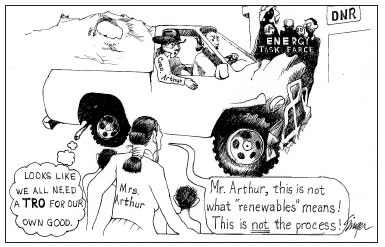
Additional presentations were made by a representative of Peabody Coal Company, and Arvin Trujillo, executive director of N.N. Division of Natural Resources, Attorney General Louis Denetsosie and council delegate George Arthur, all members of the Renewable Energy Task Force.

It was a disappointment for Johns, Horseherder and Johnson. “We have a right to be heard,” said Johns.

Homework

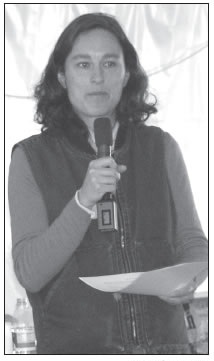
At the meetings prior to the work session, the groups had done their homework. Marie Gladue, a resident of Hardrock, hosted the meetings inviting Elisabeth Holland, a scientist working in the Atmospheric Chemistry Division at the National Center for Atmospheric Research since 1989.

She focused her lecture on global warming trends, showing evidence that the scientific community agrees is contributing to real global warming and that emissions from coal-fire power plants are affecting the Black Mesa regional environment..

An energized group of youth activists worked beside their elders describing a vision of organic local gardens, Navajoowned businesses, preservation of language and culture, no harmful chemicals or genetically modified synthetic products, recycling in every home, green jobs, renewable energy, no foreign businesses, no cornbased industries, and no multi-national corporations. They want a farmers’ market, wellness and continuation of livestock and the traditional Navajo lifestyle.

Within two weeks another meeting was held. Attendance was growing as word spread that the groups want to be heard in Navajo Nation Council decisions affecting their local communities.

Llouis Benally, a board member of Black Mesa Water Coalition, said, “The issue is about escalating global climate change and we should transform … from coal to renewable energy instead of being controlled by it.”

Nicole Horserider, Tonizhoni Ani, said, “We need to get renewable energy into the Peabody negotiations in Window Rock.”

There are existing leases and, “money coming from them,” said Tulley Haswood, Rock Springs, N.M. “Money comes from the mine.

“We’re stuck with the leases and don’t have money for renewables. We should go for the 10-year lease while we negotiate for our needs. It’s in our hands. We can go there.”

Saddle up

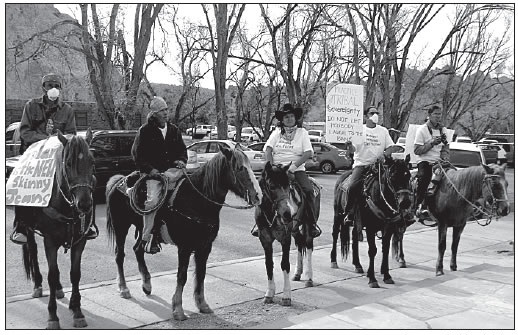
And so they did. Tonizhoni Ani sent out a call to organize around a four-day horseback ride to the council session beginning at the Black Mesa Pinon Chapter. Only three riders showed up, but as they camped out and rode toward Window Rock, the number of supporters grew. By Sunday, April 18, the day before the council’s spring session was due to open, 50 to 60 people joined them at St. Michaels, Ariz.

NAVAJO PROTESTERS ON HORSEBACK IN WINDOW ROCK, ARIZONA

Riders, some of whom traveled 100 miles, protest outside the Navajo Nation Council’s opening session in Window Rock, Ariz., on April 19. Photo courtesy of Wahleah Johns

Black Mesa Water Coalition, Tonizhioni Ani and Dine Cares held an educational forum throughout the day, welcoming discussion and information about the history of Black Mesa mining.

Johns, field director for BMWC, said, “It was our intent to educate the people about the Peabody leases, gather support and create a platform for the inclusion in negotiations, and build a presence, a smooth transition [from fossil fuels] and support for renewable-energy projects.”

People used the day to make signs for the march. They silk-screened T-shirts, vented opinions and, “told the stories about dealing with a legacy of 40 years where we have not included people from the communities,” said Johns. “We have invited the Natural Resources Committee to our community but they’ve never sent anybody out to our meetings.”

Monday morning, approximately 75 people from Black Mesa met at the Wells Fargo bank in Window Rock to march on foot and ride on horseback to council chambers.

“We had a presence,” Johns said. “I don’t think they expected us in such numbers. Finally a few came out to talk.”

George Arthur stayed outside almost 45 minutes listening to the concerns. “It was really powerful. He promised the group that they will hold community hearings out there [Black Mesa],” said Johns.

Title 18

During the demonstration, grassroots leaders learned of legislation sponsored by Forest Lake (a Black Mesa chapter) Council Delegate Amos Johnson. It introduces amendments to the Navajo Nation Code Title 18 procedures on mineral lease permits to include community input. The amendments would strengthen involvement of chapters in the approval of mineral permits, including a requirement to conduct public hearings at the affected chapters prior to the consideration of resolutions approving mineral, carbon-based, or renewable-energy operations.

“Basically, it pushes the chapters to have more input all over the reservation, not just Black Mesa,” explained Johns.

In an telephone interview with the Free Press, delegate Johnson said his resolution ultimately failed. “It passed Resources Committee on March 29 and then went on to Ethics and Rules on April 2. From there it went before the spring session of the council, where it did not pass, 19 to 45. It is dead now, but this amendment to Title 18 needs to take hold nationwide as a grassroots effort. I haven’t heard of anyone volunteering to do the footwork. Maybe now it has opened the eyes and minds of the people.”

“The problem with the legislation is that he didn’t communicate with us that he was submitting this — again leaving us out of the input,” said Johns. “Our message was pretty clean, we make a presence and are vigilant about it.”

Johnson admitted that he, too, heard from the people at the rally in Window Rock. “They gave me an earful. I told them they need to go read the legislation so we do not have misunderstandings.”

A green economy

Black Mesa Water Coalition and To Nizhone Ani are collaborating on a solar project located on the Peabody Coal reclamation land. They are seeking funding from Navajo Nation royalties from the mining operations to build a solar plant modeled after the Nevada Solar One project, based in Boulder City, Nev.

Horseherder explained that the Nevada Solar One project was chosen because it is a comparable land base and the size relates to the Peabody reclamation site.

According to the Solar One web site, the Nevada project is a utility-scale power, 400-acre, 64-megawatt plant harnessing solar energy to power more than 14,000 homes every year. It is the third-largest concentrating solar power plant in the world and the first such plant built in 17 years.

With space still available in the transmission lines near Black Mesa, the groups hope to create a green economy on Black Mesa.

“Peabody Lease re-opener is an opportunity to push for a large percentage of these funds to develop this project and solar manufacturing, installation, education and green job training,” Johns said.

A low-carbon, green economy is closer to becoming a reality in the Navajo Nation. BMWC mounted a successful campaign to legislate for a Navajo Green Economy program. It passed in tribal council on July 21, 2009, after a strategic lobbying campaign which included peaceful demonstrations and marches on Window Rock, and support from organizations such as the Grand Canyon Trust and Sierra Club.

Johns has subsequently been appointed the first commissioner of that program. When the legislation passed, Johns said, “The United States really needs to stand behind our tribal nations that are adopting green-jobs legislation.

“Green-job development is something we are used to as indigenous people. We always talk about being green, about the caretaking of Mother Earth, and so that’s always been the message. I think passing this legislation really proves that.”

Published in May 2010

Noble breeds: Mancos sculptor captures animals’ essence

One day, sculptor Patsy Davis’ wire-hair pointer paced the house, begging to go out. Davis ignored her — until a squeak caught her attention. Picturing mischief, she dashed to see what the dog was doing.

The dog wasn’t doing anything. She had bumped a duck figure that bounced on springs. Patsy let her outside. Now when the pointer wants a word with her mistress, she pokes the duck.

BRONZE SCULPTURE OF DOG TITLED SEMPER FI BY PATSY DAVIS

“Semper Fi,” an 8 1/2-foot bronze sculpture created by Mancos artist Patsy Davis, is one of many works in which she explores the personality of dogs and other animals. Her sculptures are on display at the Goodnight Trail Gallery of Western Art in Mancos.

“I could go on for hours about all the things she’s communicated to me,” Davis chuckles in a phone conversation from her home in Mancos. “I’ve had dogs all my life. I love dogs.”

So she sculpts them, fusing personality and physical presence into the bronze forms she creates. Her ideas come from her experience of owning many breeds of dogs, hunting with bird dogs, and working sheep with border collies.

The impetus for one of her pieces, “Semper Fi,” an 8 1/2-foot bronze at the Goodnight Trail Gallery of Western Art in Mancos, came when she heard an NPR story exploring how the United States has used dogs in wars, and on 9-11.

Interested in how people put animals to work, she studied rescue dogs, learning that “if dogs looking for live victims find too many dead bodies, they stop searching. Their handlers get depressed and the dogs don’t want to make their handlers sad.”

She decided to sculpt a tribute to rescue dogs, and in her studio, created a clay German Shepherd atop a collapsed doorway. One day, she left a heat lamp on the model when she finished working with it.

Returning later, she discovered light from the lamp flinging cross-shaped shadows on her studio walls. “Which really blew me away. I can’t explain the impact of walking up the stairs, and looking into my room, and seeing those shadows.”

Crucifixion in its historical sense prior to Christianity, combined with thoughts of dogs at work, became the emotional core of “Semper Fi,” short for Semper Fidelis, the Marine Corps motto.

She altered her design to let the German shepherd look down into a pile of crossed beams and girders with an expression of tenderness “I wanted it to be obvious that the dog had found something living.”

“Semper Fi” toured the country in a show entitled “Paws and Reflect The Art of Canines,” organized by the Society of Animal Artists. Davis received letters stating that the sculpture touched viewers.

“I’m glad,” she says. “It was a piece that moved me so much in the making of it.”

Making any piece is an emotional experience for her. “I am totally in love with making sculpture.”

Her creative process begins with observation. “For me it’s more a matter of eliminating a hundred ideas I have for a piece and settling on one that’s worth time and the financial investment to make.”

She infuses her sculptures with energy, even when subjects stand still. For a bronze entitled “Not Very Hairy” she used a hunting dog that didn’t point to birds with one leg raised. She placed him on all fours staring a bird down. “I always try to show what animal’s thinking, doing, and why they are there.”

Besides dogs, she sculpts baby elk, parrots, pigs, cows and calves. “Cows are great for sculpture. They’re bony and have great planes.”

Working on the calves as the stock market plunged, she named a sculpture of a running baby “Plunging Stock,” a calf scrambling off the ground “Rising Stock,” and one standing for the first time “Taking Stock.” She named her pregnant pig “Great Expectations,” and the two bull elk she’s creating right now “Reign Dance.”

Her interest in art goes back to childhood days in Des Moines, Iowa. As a kindergartner, she made ash trays to sell her friends as Christmas presents for their parents.

She stuck any animal that she could catch or “make follow {her} home” into a cardboard box long enough to copy it in modeling clay, play dough, or mud.

When she wasn’t creating animals, she sat on the creek bank near her house making cowboy and Indian villages.

Upon graduation from high school in the 1970s, she attended the Rhode Island College of Design in Providence. The curriculum stressed abstract and conceptual art, which taught her the principles of using form and plane. Though she did little of the realistic work she loves, she considers her education “a great experience.”

A freelance career in industrial design followed college. As the “jewelry capital of the world,” Providence offered her the chance to create everything from pewter table top statues to figures for Hasbro Toys. She helped develop several of the My Little Ponies, and created a Snow White and the Seven Dwarfs chess set for Disney.

In 2002, Hasbro and other companies began out sourcing design work to China. Davis came to Colorado and started working in bronze. A friend introduced her to Veryl Goodnight, who guided her to good foundries and shared her own knowledge of bronze with Davis.

“Right from the start Veryl and I were crazy about each other. She couldn’t have been more helpful. So now I’m a starving artist,” Davis laughs.

Though she’s teasing, she points out that casting bronze is a long, expensive, unpredictable process. At any step, the technology can fail and ruin the piece.

She puts up with that because bronze will “still be here when people are gone.” Permanent, durable, rich, and beautiful, “it’s a great public medium.”

Published in Arts & Entertainment, May 2010

Study: Mining near Grand Canyon could threaten water

A new study by the U.S. Geologic Survey indicates that the Grand Canyon watershed is susceptible to additional radioactive contamination from future uranium-mining.

The 350-page report was completed as part of a proposal by the Obama Administration to ban new mining in the mineral-rich region for 20 years to safeguard human health and the environment.

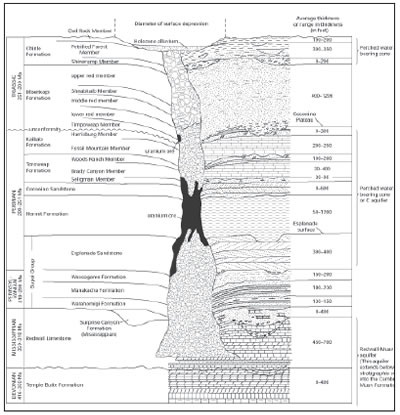
STRATIGRAPHIC COLUMN OF BRECCIA PIPE

This shows a stratigraphic column of a breccia pipe showing relation of breccia pipe to surrounding rock, ore bodies, and perched water-bearing zones and aquifers. Photo courtesy of U.S. Geological Survey

Of special concern is the protection of aquifers and springs that discharge into the Colorado River, a primary source of drinking water for an estimated 25 million people living downstream. Several American Indian tribes in the immediate area also depend on springs and groundwater wells for their communities, as do native plants and animals.

Thousands of uranium claims, with dozens ready to be developed, are scattered on the mesas outside the boundaries of Grand Canyon National Park, which does not allow mining. One million acres north and south of the park boundaries are especially rich in uranium ore and are the target of a mineral withdrawal, or mining ban, initiated by U.S. Department of Interior Secretary Ken Salazar last summer.

For now the area is under a twoyear mining segregation ban, subject to valid existing rights (Free Press, March 2010), while an environmental impact study is conducted, which includes the USGS study.

Roger Clark of the non-profit Grand Canyon Trust says the region has suffered enough from irresponsible uranium-mining in the past and that protecting the Grand Canyon from further pollution is a national interest.

“Once the groundwater is contaminated, there is no remedy, so it becomes forever polluted, and that is unacceptable for Native tribes living there and all the downstream users,” he told the Free Press.

Rich uranium reserves

According to the USGS report, “uranium mining within the watershed may increase the amount of radioactive materials and heavy metals in the surface water and groundwater flowing into Grand Canyon National Park and the Colorado River, and deep mining activities may increase mobilization of uranium through the rock strata into the aquifers. In addition, waste rock and ore from mined areas may be transported away from the mines by wind and runoff.”

Northern Arizona contains significant uranium reserves, mostly found in “breccia pipes,” geologic features formed at least 200 million years ago. These vertical columns within the rock layers began as dissolved caves in the Red wall limestone, 2,500 feet below the surface. Progressive ceiling collapse over millennia formed rubble- filled columns that are concentrated with heavy metals including uranium ore, which is typically located 1,000 feet below the mesas.

There is an estimated 326 million pounds of uranium oxide within the proposed withdrawal area, which amounts to 12 percent of the total undiscovered uranium in northern Arizona. By comparison, the U.S. consumes 55 million pounds of uranium oxide each year in its nuclear reactors, most of which comes from Canada, Australia and Russia.

USGS scientists analyzed water samples from 428 sites in the region and reported that 70 sites exceeded maximum contaminant levels for uranium and other heavy metals.

Samples from 15 springs and five wells in the area contained dissolved uranium concentrations greater than the U.S. Environmental Protection Agency maximum contaminant level for drinking water of 30 parts per billion, according to the report. The contamination is caused partly by direct contact with naturally occurring uranium ore, but also by mining processes, the report says.

“Uranium mining has already contaminated lands and water in and around the Grand Canyon, and this research confirms that new uraniummining would threaten aquifers that feed the Grand Canyon’s springs, the Colorado River and nearly 100 species of concern,” said Taylor McKinnon, of the Center for Biological Diversity, in a press release. “These risks aren’t worth taking — and they’re risks neither the government nor industry can guarantee against.”

Contamination from the past

Heavy mining in the past has contaminated rivers and drainages in the Grand Canyon region that are still health hazards today. In the northwest corner of the study area, especially high uranium contaminations of 80 parts per billion were found in the Virgin River, the report states. Elevated uranium levels that exceed natural background levels also exist at the Kanab North mine and the Hack uranium-mine complex.

In 1984, a flash flood washed tons of high-grade uranium ore from the Hack Canyon mine into Kanab Creek, a tributary of the Grand Canyon. In 1979, the Church Rock (N.M.) mine waste ponds breached and flooded the Puerco River, a tributary of the Little Colorado, with millions of gallons of toxic sludge.

The closed Orphan Mine, on the Grand Canyon park’s south rim, also continues to contaminate creeks, prompting the National Park Service to warn backpackers along the Tonto Trail not to use water from the area.

The NPS also advises against “drinking and bathing” in the Little Colorado River, Kanab Creek, Paria River, Havasu River and others where excessive radionuclides have been found.

The study notes that samples of surface water from the Colorado River in the Grand Canyon typically contained less than 5 parts per billion of dissolved uranium.

Whether more mining will increase the release of uranium and other heavy metals into the major aquifers that feed the Colorado is a concern. Two main aquifers — the “C” about 1,000 feet below the rim, and the Red Wall-Muav located 3,000 feet down — naturally drain uranium and other metals such as zinc, silver, copper, lead, selenium, vanadium, and molybdenum into the Colorado River.

“Perched water-bearing zones,” which are separate from the aquifers, also feed springs and well water for local people, plants and animals. Breccia pipes loaded with mineral wealth intersect these zones, aquifers and groundwater reservoirs at various points, a concern because the pipes are targets for mining.

Burden of proof

The USGS had mapped more than 1,200 possible breccias pipes in the northern Arizona region and they are thought to possess high-grade ores. Traditional hard-rock mining with tunneling is used to extract the uranium, which is then shipped to the White Mesa Mill in Blanding, Utah, for processing.

Researchers fear that disrupting uranium and other ores through mining could cause increased infiltration of toxic heavy metals through rocklayers into critical aquifers that discharge into the Colorado River.

Hard-rock mining exposes uranium to oxidation, potentially increasing its solubility and therefore its movement into groundwater. Also, mine tunnels are susceptible to runoff and flooding that can unnaturally push heavy metals into aquifers, springs and rivers — a process that would not occur if the ore were left locked in the rock.

Geologic structures such as joints, fractures, faults, folds and bedding planes direct groundwater movement toward spring discharge areas and deeper aquifers, according to the report. Structural weaknesses along the Kaibab Plateau and on the south rim that host uranium-ore breccias pipes “have the greatest potential for remobilization of radiochemical elements” into the environment.

“Mining activity can result in changes to these habitats that may increase exposure of the biological resources to chemical elements including uranium, radium, and other radioactive decay products,” the report states.

“The identification of biological pathways of exposure and the compilation of the chemical and radiological hazards for these radionuclides are important for understanding potential effects of uranium mining on the northern Arizona ecosystem.”

In-situ mining, a relatively new and controversial technology that injects chemicals underground to dissolve uranium and then pump it out, is not used for breccia-type ore loads that dominate the Grand Canyon region.

“The burden of proof is on the advocates of uranium-mining to show it will not contaminate groundwater, and they have not done so,” Clark said. “There are no assurances in the USGS report that increased mining will not further contaminate land and water, so it is not worth taking the risk.”

The USGS study, titled “Hydrological, Geological, and Biological Characterization of Breccia Pipe Uranium Deposits in Northern Arizona,” can be accessed at http://pubs.usgs.gov/sir/2010/ 5025.

Published in May 2010

Fruit of the boom

Recently I took a flight from the Albuquerque Sunport. Rather than use the hotel’s free shuttle, I walked to the airport, a distance of about four city blocks. I toted my own luggage — one carry-on suitcase with wheels. It was the most relaxed and efficient departure out of what I consider the most perfect airport in the country.

I should mention, however, that I had exactly five pairs of clean underwear inside the suitcase and one pair in a plastic bag that I’d worn the day before. I don’t usually tell strangers about my underwear, but the 2009 Christmas bomb scare on an international flight from Amsterdam has wedged the shyness right out of me.

I know terrorism is no joking matter, but you’ve got to laugh to think a would-be terrorist who tripped so many alarms on his way to being seated beside the plane’s fuel tanks would still be offered his bag of nuts en-route to the U.S. You’ve got to laugh, because the alternative is to scream.

Massive security changes are being considered as a result of such a close call, but the full-body imaging scan — a technology that has been available for the past eight years — is likely to show up at all major airport hubs across the U.S. The reason it hasn’t been a consistent part of security screenings since America’s first encounter with radical terrorism on 9/11 is because of its high cost.

I have a proposal to drastically cut those costs and improve the efficiency of air travel across America — potentially, across the world. I know some travelers will be upset to hear about it, but that’s where the efficiency kicks in.

Certainly, we still need the gauntlet, the portals where passengers are herded to reach their departure gates. But the technology need not be any more sophisticated than the golden arches if we simply require travelers to remove all their clothing before stepping through. I mean, why spend billions of dollars on state-of-the-art imaging technology to see through a few layers of cotton and polyester, all for the sake of modesty. With strip-searching, airport crowding in America will be reduced by half. Scandinavian flights will be completely booked.

It’s not like I’m insensitive to those who refuse to travel in the nude. For them I have another proposal.

If we’re going to spend billions of dollars screening potential terrorists with full-body imaging, why not up the ante and provide medically approved MRIs? Here’s a way to implement health-care reform while continuing the war on terror. Every passenger would be able to undergo advanced medical screening for the cost of, say, a one-way ticket from San Francisco to Chicago. And what a relief, to know the passenger sitting next to you doesn’t have loaded underpants, all while you are receiving a full report on cancerous tumors and other long-term health risks.

Terrorists, as we have seen, will stop at nothing to kill their enemies, even if innocent lives must be sacrificed to reach their ideological goals. Is there any reason we should be less committed to stopping them?

Any security system will always fail, because we depend on human beings to run it. There are no easy answers. In the skies over Detroit, the answer turned out to be about 80 grams.

And the question?

What’s the difference between a naked airline passenger and a terrorist?

David Feela writes from rural Montezuma County, Colo.

Published in David Feela

Getting by with a little help from my friend

I am 15 years old, sitting at a table on the expansive front porch of the Colonial Inn, the table is covered with Marlboro Lights and Long Island Iced Teas. I would never have gotten in on my own, but fortunately, I am with M (14) who, being who she is, has just convinced the 250-pound bouncer that it is imperative that not only do we gain access to the coolest bar in town, but that we also get the best table and an endless supply of cocktails.

Thank God for M.

With our view of the harbor and the yachts within, a little loopy although never admitting it, we do not solve the problems of the world. But we do try to solve the problems of our very important, central-to-the-happiness-of-all-mankind, love lives.

We talk about the boys we like and those who should like us. We complain bitterly about our bosses (they want us to both show up on time and actually work) and then we spend a fair amount of time talking about the varied flaws of all of our other friends.

Who would have guessed, during those idyllic summer evenings, that 30 years later, and across the country, we would be racing off into the sunset together (drinking coffee, not Iced Teas) towards the court-appointed parenting class that is required for finalizing our divorces?

We are carpooling to Cortez. I am driving. Out of the kindness of my heart, I decide to get a latte for each of us. Unfortunately, this takes longer than we have time for and suddenly, we are late. M informs me that they will lock the door promptly at 5:30 and it is clearly not an option to be on the outside of that locked door.

Bigger than the fear of missing the class is my fear of pissing off M – she is my biggest crutch through this whole thing and I cannot afford to alienate her over a cup of coffee.

So I must do my part to make sure that we are on time. I race to her house and fling open the car door for Q, her son whom we have to drop off at Summit “on the way” to Cortez from Mancos. I yell at him to get in the car, screech at her to drink her damn latte and head north.

Driving up 184, I begin to race the car to keep pace with my heart. Faster and faster, wired on caffeine we repeat over and over, “Okay, it’s 5:00, 10 minutes to Summit, then do you think we can make it to Cortez in 15 from there?” I turn to the backseat, where her sweet 8-year-old looks at me and says, “Suzanne, we should have left earlier.”

Thanks, Q.

So I tell him that it’s time for him to practice his duck and roll because I don’t have time to actually stop when we get to his friend’s house so I am going to slow down and he can just leap from the car.

M calls the friend. “Can you meet us at the bottom of your road – we don’t have time to drive the 1/8 mile to your house.” We have now dragged yet another person into our drama, just like we did at 15.

The friend, bless her heart, is at the end of the road and needs no direction. We stop, throw Q out of the car, dump his skis and backpack in the middle of the road and tear off.

Suddenly, the person who hyperventilates at the thought of going 2 mph over the speed limit, is now going 84 mph on 184.

M, who, of course, knows the parenting teacher (because she knows everyone), calls the woman and leaves a message begging the poor thing not to lock us out.

I pass a cop.

F#$%.

I slam on the brakes, coffee spraying across the dashboard, as we began to bite each others’ heads off. I say, “I am so sorry – I just wanted to do something nice for you (and me).”

M replies, “I won’t hate you. But, if I have to do this all over again next month after I arranged child care and all THIS month, I’m going to be pissed.”

F#$%.

I speed back up from my post-cop crawl of 37 mph, back to the low 80s. We manage to pass three more sheriff’s deputies, none of whom decide to chase us, thank GOD. They must have sensed that stopping us, in the state we were in, would only make their lives more difficult.

We get caught behind another Subaru going a mere 68 mph. I tailgate. I get flipped off.

Caffeine and anxiety coursing through our bloodstreams, sweat pouring down between my shoulder blades, we laugh hysterically at ourselves and the fact that after 30 years, this is where we have ended up.

But at least we are still friends and sniping at each other as only friends like us can do.

We screech into the parking lot with exactly 2 minutes to spare. By now, our bond is even tighter than before, due to yet another shared, harrowing experience. I park while M pulls my notebook, checkbook and Clif Bar out of my bag. We leap out of the car like Starsky and Hutch and race to the front door where there is a sign that reads…

“Due to illness, the parenting class is cancelled and has been rescheduled for…”

Seriously?

I would cry except I begin to become unhinged instead. So M and I begin to giggle, a bit maniacally. My neighbor, who is also attending the class and a fourth gal, whom we decide we would like to be friends with, both pull into the parking lot. They panic, taking our outside presence as a sign that the door is locked. They stare, in disbelief, at the front door’s sign, thinking about all that they, too, have gone through to make it possible to be here at 5:30 without children.

Then M decides that since we have no young ones, we should go to her house.

By the time we get back to Mancos, we are calm, there is no longer coffee oozing out of our pores and we have apologized for biting off and chewing each others’ heads. We pass two more sheriff’s cars and I silently thank the heavens above that even though nothing else seems to have changed in the last 30 years, at least I am not still driving drunk.

Having circumnavigated the county, we end up sitting around a table that is littered with goat cheese and bread crumbs, not Marlboro Lights. We sip wine and try to remember what is even in a Long Island Iced Tea. We talk about the boys we like and those that used to like us. We complain about having to work to support ourselves, children, pets. Then we pick apart our friends, their greatest crime being happily married when we no longer are.

If someone had walked up to our table in the Colonial 30 years ago and told us that we would still be friends, living in Mancos, getting divorced and going to court together, we would have laughed.

Although we might have believed the part about having to go to court.

But thanks to my childhood friend, we are laughing through most of this too.

Thank God for M.

Suzanne Strazza writes from Mancos, Colo.

Published in Suzanne Strazza

Will politics trump justice?

Do as I say, not as I do.

This is the admonition parents occasionally finger-wag at their naughty children for minor transgressions of which they themselves have been guilty. (Son, we just didn’t know how harmful it was for teenagers to drink beer when I was a kid. And, damn it, don’t cuss like that!)

It certainly is not a piece of fatherly advice a district attorney can convincingly convey to a defendant who is about to be sentenced for the exact same crime — drunk driving — that he himself has been charged with. In fact, the defendant might rightly expect a little leniency from a fellow traveller who’s been there, done that. And you can bet whatever the sentence is, the defendant is going to be turned into a total cynic about our justice system.

Yet Jim Wilson, district attorney in the 22nd Judicial District, plans to blithely continue in his position until his second term has expired 2 1/2 years from now — presumably throwing the book at all the other alleged law-breakers who put the lives of the public in peril under similar circumstances.

Of all so-called misdemeanors, none is more deadly than driving under the influence. It accounts for hundreds of deaths annually in this state and injuries that run in the thousands, ruining lives and breaking hearts without regard to race, religion or occupation (such as officer of the court sworn to uphold our laws). It has been compared to holding a loaded gun out a car window and randomly firing toward oncoming traffic, figuring the odds are very slim that anyone will actually be struck. It is difficult to imagine more a irresponsible act or attitude.

And yet that’s the crime of which our DA has been accused.

Wilson got busted in February near Buena Vista when a Colorado state trooper allegedly saw his vehicle make an unsafe pass and pulled him over, then determined the suspect was intoxicated beyond the .080 DUI threshold. According to the Cortez Journal, it was a little after 10 a.m. and the cop allegedly discovered an open bottle of booze in the car, which is illegal as well. And speaking of guns, he also allegedly found a 9mm semi-automatic handgun in Mr. Wilson’s possession, which, under Colorado law, is also illegal if the person is drunk.

So let’s see, an unsafe pass in mountainous terrain (allegedly), a strong suspicion by the trooper that Wilson was drunk, a chemical test that allegedly confirmed this suspicion, an inventory of the vehicle that, allegedly, turned up a rapid-fire handgun and an opened jug of Old Shitface. I say allegedly, of course, because Mr. Wilson is legally considered innocent until these charges are proven in court (and because I don’t want to defame Mr. Wilson in the event the officer was mistaken, or just had nothing better to do than harass a sober, safe driver that morning, or that the case is dismissed through some technicality).

When queried about his future by Journal reporter Steve Grazier, Wilson seemed shaken yet defiant.

He hastened to assure the reading public that the incident was virgin territory for him, calling it “an anomaly.”

“It’s scary — I’ve never been in this situation before,” he added. “It’s just never, ever happened to me before.”

Personally, as a guy who has driven drunk several times in my distant past but never got caught, I’d like a little clarification: Is he saying he’s never, ever been arrested for DUI before, or is he saying that never, ever before in his 57 years on earth had a few too many and slipped behind the wheel, thinking it would be okay because he has better judgment and reactions than most after imbibing, or that he wasn’t really going very far or he couldn’t miss an important meeting? (If the answer is “Never, ever drove drunk,” then that’s commendable, but I’d still need some convincing.)

Along with having my own checkered and shameful past in that regard, I have a particular interest in this offense because my current occupation involves sobering up drunk drivers and occasionally teaching classes intended to show people how not to become repeat offenders and just what the tragic consequences of drunk driving can be. According to the extensive data inflicted on my students, chances are a person will drive drunk 10 or more times before getting caught.

As far as we know, of course, Wilson has only been involved in this single incident, but it still resulted in charges that would cost many otherwise competent and wellmeaning officials their jobs.

Yet Wilson said the accusations do not warrant him resigning as chief law-enforcement officer of the 22nd Judicial District, or even stepping aside until the matter is resolved.

“There is nothing about (these) charges that would require me to step down as district attorney,” he told the Journal. “I intend to go ahead and finish my term out.”

Well, he ought to know if there is any legal requirement for a district attorney not to have been convicted of drunk driving, but that is hardly the only — or most important — consideration.

The larger concern should be doing the honorable thing and falling on his professional sword by voluntarily stepping down, or at least temporarily aside. That would be an admirable nod to the concept of equal justice and raise his esteem greatly in the eyes of many local citizens.

And, yes, I realize the job of DA is often thankless. It involves hard work for pay that, while decent by local standards, is small compared to what a good attorney could make in private practice. The DA’s budget is never adequate to the needs of the office, and hiring and keeping wellqualified deputy DAs is always a challenge because of the modest salaries.

Still, this would seem to be the bottom line:

Even if Wilson’s assistants handle all DUI cases from here on out, it’s still his office, after all, and the concept of blind justice will be tainted for the remainder of his term. Every plea bargain involving a DUI would raise questions. Did the defendant get off easy because, after all, the DA himself was accused of the same crime? Or, if the defendant wound up with stiff penalties, wouldn’t that smack of blatant hypocrisy?

Of course, as noted earlier, it is possible that these charges against Wilson are patently false and that he was the victim of some enormous miscarriage of justice. But even in that circumstance, he would be put in an uncomfortable position, since he would find himself arguing against the law enforcement system that he is normally required to support and defend.

There is one other wretched consideration in all this — the politics of elected office.

Wilson, a Republican, had the immediate, backing of the Montezuma County GOP Central Committee.

Chairwoman Pat Rule told Grazier, “We still support him as our DA, and see this more as a personal thing than a political thing.” But then the chairwoman seemed to over-Rule herself, noting that if Wilson resigned, Colorado Gov. Bill Ritter, a Democrat, would get to name his successor.

What a horrible thought: The possible appointment of a Democrat to a job that is totally apolitical in nature anyway.

Much better, I guess, to have a heavy cloud hanging over the local “justice department” for the next couple of years.

David Grant Long writes from Cortez, Colo.


Published in April 2010, David Long

Back to the drawing board for Rico-West Dolores travel management


In a couple of months, the soaring slopes and ridges between Dolores and Rico, Colo., will burst with new life, from wildflowers to fawns.

Flocking to enjoy the views, the blooms and the fresh air will be outdoor enthusiasts of all stripes — hikers, mountain-bikers, horseback riders and motorcyclists.
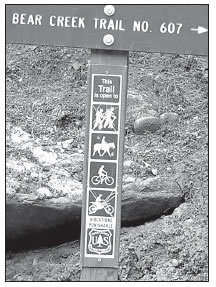
SCRATCHED UP SIGN AT BEAR CREEK TRAILHEAD

A sign at the Bear Creek trailhead demonstrates the contentiousness of travel-management issues in the area, as some of the icons have been scratched off. Photo by David Grant Long

But the question of who will be able to go where is unanswered at the moment.

That’s because the plan that was to guide and regulate different types of travel on San Juan National Forest lands in the Rico- Dolores area was essentially scrapped late last year — remanded on appeal to the Dolores Public Lands Office for another try.

“We’re going to reinitiate the [planning] project after Oct. 1,” said Steve Beverlin, district ranger for the Dolores District of the San Juan. “We’ll start all over, utilizing existing information and data we have. There’s some good stuff in there [the plan] that we’ll use, but basically it’s back to the drawing board.”

Beverlin approved what was supposed to be the final travel-management plan for the 244,550-acre Rico-West Dolores area in September 2009. However, six separate parties appealed the decision, charging among other things that the DPLO had not conducted adequate analyses, had not adequately informed the public about some decisions in the plan, and had violated the overall forest plan by designating some trails as motorized within nonmotorized areas.

After reviewing their concerns, a Forest Service appeal-reviewing officer sided with the appellants on most of the charges and recommended remanding the plan to the DPLO. Of 15 specific issues cited by the appeal officer, he recommended reversing the manager on 11 and affirming the manager’s decision on the remaining four.

San Juan National Forest Supervisor Mark Stiles concurred and in December 2009 reversed “in whole” the approval of the plan. “The Manager is directed to review the concerns . . . and to take appropriate action to address them. . .,” Stiles wrote.

In a March 18 e-mail to interested parties, Beverlin stated that the DPLO, San Juan Public Lands Center and Forest Service Regional Office had decided to start the new effort after Oct. 1.

The DPLO will have to “re-scope” the project, meaning do new outreach and take more public comments. All scoping comments from the original project will also be used in the new analysis, Beverlin stated.

The area will need interim management guidelines in place before late May or early June, when heavy recreational use begins, Beverlin said in the e-mail, and those guidelines will be decided by the three Forest Service entities. “We’re all working together,” Beverlin told the Free Press.

Also still to be decided is whether the new planning effort will entail doing an environmental assessment or a more intensive environmental impact statement — one of the major bones of contention in the appeal of the first travel plan.

In his recommendations, the appeals officer, Robert Sprentall, wrote that one of the common issues of the different appellants was their belief that an EIS should have been prepared instead of the EA that was done. “I recommend reversing the Managers [sic] decision on this point,” Sprentall wrote.

However, Beverlin told the Free Press that the question of whether to do an EA or an EIS “will be decided later. We’ll decide that some time before we reinitiate this project.”

He said an EIS has more requirements for public scoping and usually offers a longer comment period, but is not substantially different from an EA. Beverlin said it’s common for appellants to argue that an EIS should have been done. “We get that issue every time we have an appeal,” he said. “So we step back and look.”

‘Most divisive’

Travel management on public lands is tremendously controversial nationwide, largely because of the conflict between motorized and non-motorized recreation.

The thorniness of the issues involved is demonstrated by the fact that the Rico- West Dolores plan was appealed by five parties concerned about the expansion of motorized uses (the San Juan Citizens Alliance, former Montezuma County Commissioner Gene Story, a Montezuma County couple, Trout Unlimited- Colorado Backcountry Hunters and Anglers, and the Dunton resort) — but also by the Blue Ribbon Coalition, which advocates for motorized recreation.

“The Rico-West Dolores Travel Management Plan has been the most divisive and difficult issue I have dealt with since I became the District Ranger/Field Office Manager for the [DPLO] in August of 2005,” Beverlin wrote in the decision notice for the now-remanded plan.

The DPLO has been working on travel management plans for four areas: Mancos- Cortez, Rico-West Dolores, Boggy-Glade and a BLM-managed landscape that includes Dry Creek, Big Gypsum and Disappointment Valley.

The Mancos-Cortez plan was finalized in September 2008 without much fanfare and with only an EA having been done. There was one appeal, according to Beverlin, but the plan was upheld. The office is working on the Boggy- Glade plan and hopes to have a preliminary EA released by the middle of this month. Work will begin later on the Big Gypsum-Disappointment landscape.

Travel management isn’t the only controversial issue that public-lands managers have to deal with, Beverlin pointed out — oil and gas development, grazing, wilderness, and wild and scenic rivers are all contentious. But travel management is “toward the more-contentious end,” he admitted.

The trails that snake around the Rico- West Dolores area are generally narrow and steep, winding through grassy meadows and aspen forests and teetering along high ridges. They are cherished by hikers, hunters, wildlife aficionados and horseback riders.

They are also embraced by motorcyclists, who relish the challenge of maneuvering around hairpin turns, over rocks and through streams. A 2008 video showing motorcyclists grinding along the district’s popular Calico Trail can be seen on YouTube (search under Motorcycle Ride Calico Trail).

The motorized users, it’s fair to say, raise a lot of dust — and a lot of hackles.

“I’ve had hunts destroyed by motorized users,” said Bob Marion, who with his wife, Nancy, was one of the parties that successfully appealed the Rico plan. “You can be out in an area hunting, and if a motorcycle rider comes through a trail just once a day, you won’t find an elk in that region for at least a couple days. I’ve had that happen.

“I’ve had encounters where they [riders] actually tried to run me off the trail. My personal experience has not been good.”

The Marions, both retired, are residents of Montezuma County. “We spend probably 160 to 180 days a year in the outdoors, and a lot of it is up in the Dolores drainage,” he said. “I hunt a lot. We fish, hike, cross-country-ski, mountain-bike — about all the quiet-use activities.”

But Marion said he is definitely not trying to have motorized users eliminated from the area. “To me it’s not an issue of, are you in favor of motorized or against,” he said. “I think we need to reach a happy medium between providing single-track motorized trails and also protecting habitat for wildlife and so on.”

However, he believes many of the trails in the Rico-West Dolores area were designated for motorized use without the appropriate NEPA (National Environmental Policy Act) process being followed, and this prompted him to take action.

“This is our first time to file an appeal,” Marion said. “We’re individuals, not an organization. My wife and I are concerned citizens.

“We think we know the issues quite well and I think what’s been done over the past years has not been done in compliance with Forest Service policies, procedures and laws.”

Doing damage?

Steve Johnson, attorney for Dunton, LLC, which owns the Dunton Hot Springs Resort and several other properties in the West Dolores area, agreed.

“When we saw the one-sided, non-scientific, poorly documented decision, we had to file an appeal,” he said.

One of the main points raised by those appealing was that certain trails such as Priest Gulch, Stoner Creek, Johnny Bull and Wildcat, which have permitted motorized uses for some time, became motorized without the Forest Service having gone through the requisite legal process.

Such trails lie within portions of the forest that are currently designated as “semiprimitive, non-motorized.” While such areas are sometimes allowed to have motorized corridors going through them, an appropriate NEPA process has to be followed first, something several of the appellants contend was not done.

“We don’t believe the motorized designations have ever gone through the NEPA review process,” Johnson said.

“We think there has been a bias in the [Dolores Public Lands] office in favor of motorized uses and designations. More and more trails have been getting signed for motorized use in the Rico-Dolores area, through the 1990s and beyond. We’re very concerned about the trend.”

Dunton is a private resort located off the West Dolores Road between Dolores and Rico. It specializes in a remote, quiet experience for its guests, Johnson said, and motorized users on nearby trails threaten that experience.

Dunton has seen “numerous instances of motorcycle trespass,” he said. Riders coming down the nearby Fall Creek Trail, which dead-ends above Dunton, sometimes try to ride through the Dunton property; when stopped, they may become angry. “There have been incidents, threats and even altercations,” he said.

Motorized users are also causing widespread damage, Johnson contends.

One nearby trail popular with the resort’s guests is the Winter Trail, which extends from the Calico trailhead. “The Winter Trail crosses numerous side streams, beautiful little streams,” he said. But over the years, motorcycles have created bogs, pits and mud holes in the trail to the extent that you “can’t even mountainbike there,” Johnson said. Water left standing in the mud holes eventually saturated nearby tree roots and killed the trees. Johnson said the Forest Service was slow to respond to the damage, finally putting planks across the bogs that are often slick and dangerous for horses or hikers.

Beverlin, however, sees it differently.

“Dunton [workers] took photos of that trail and stood on the planks, so they didn’t have any problem hiking it,” Beverlin said. “We’re comfortable with how the Winter Trail is maintained. There are three small, very minor parts [with problems] but the other 98.7 percent of the traill meets our standards.”

He said it’s not unusual for trees to die and fall down even when human activity is not involved. “All the snow we’ve had may cause trees to fall over because the soil is saturated. It’s a natural process.”

‘A lightning rod’

Many of the public comments and much of the debate involve the Calico Trail, a 19- mile route described in the DPLO’s decision as “a lightning rod in this decision” and “the backbone of the skeleton” because so many other trails intersect it.

It is the highest-elevation motorized trail on the San Juan National Forest, according to the decision, and “provides a high quality, technically challenging, and diverse experience with loop opportunities” for motorized users.

The uppermost reaches of the Calico Trail are above timberline, climaxing at Sockrider Peak, elevation 12,150 feet. The trail then descends southward to the Priest Gulch trailhead.

Under the travel plan, Calico would remain motorized, a fact that some of the appellants found troubling.

“The top five miles of the north Calico Trail and adjoining meadows are widely acknowledged as trashed from single-track motorized and historical ATV uses,” wrote Johnson in Dunton’s appeal.

Mike Curran, a member of the Rico Alpine Society, a nonprofit volunteer group based in Rico, told the Free Press the society is concerned about damage to Calico. “That’s ne of our biggest concerns at this point, not just the fact that it’s designated for motorized use, but the fact there’s so much resource damage been occurring. We’d just like to see it addressed more than it has been.”

The Division of Wildlife expressed concern about Calico in a Feb. 7, 2008, letter submitted during the original public scoping period for the travel-management plan. Patt Dorsey, area wildlife manager, wrote, “We urge the USFS to restrict motorized use of this trail as it is not compatible with and is dangerous to other users such as horseback riders. It is a steep trail above timberline and erodes easily damaged soils and delicate vegetation. Numerous people have driven off of the trail above timberline. . . Motorized vehicle use on this trail also inhibits wildlife use of this important habitat by increasing fragmentation. The trail bisects important elk habitat. . . .”

In a June 5, 2009, letter in response to the release of the preliminary EA, Dorsey wrote that the Forest Service’s preferred alternative “addresses few of the concerns” cited in her earlier letter, and urged that, among other trails, the Calico and Lower Calico trails should be designated as nonmotorized. However, the final decision allowed Calico to remain motorized for its entire length, except for a quarter-mile that was to be re-routed around a mining claim.

In the decision notice for the travel plan, Beverlin stated there was “rutting in wet meadows at the northern end, and other isolated wet and rutted areas along the Calico and associated trails” but said the Rico-West Dolores trails are generally in good condition. Beverlin also wrote that he had prioritized the northern Calico Trail for future maintenance.

“That trail is 19 miles long and along that length there’s sore spots that need to be fixed, and that’s what we’re doing,” Beverlin told the Free Press, “but overall it meets our trail standards for maintenance.”

He said it’s the lower, wetter sections near the trailhead (just off Forest Road 471, at the southern edge of the Lizard Head Wilderness Area), which are heavily used by both motorized and non-motorized recreationists, that typically see damage and draw complaints because most hikers don’t go more than a couple of miles from the trailhead. “They see the area that’s heavily used and not those middle sections that are maintained to good standards,” he said. ‘I think it’s a gross exaggeration to say the entire Calico Trail is in bad condition and needs to be closed [to motorized use].”

Sensitive terrain

Jimbo Buickerood of the San Juan Citizens Alliance said Calico is one of the trails that became motorized without benefit of a NEPA analysis. “About 15 of these routes have never undergone NEPA,” he said. “The signs just magically changed [to allowing motorized uses]. We thought that would be addressed under travel management, but it wasn’t.”

Marion said he believes it is possible for all types of users to coexist, but that shouldn’t happen above timberline. “The argument I hear is that Calico is the only above-alpine motorcycle trail in Colorado. What I say is, there must be a reason, because every other forest has decided it’s not appropriate to have motorized use up there. The terrain is far too sensitive and the recovery period for damage is so long.”

Johnson agreed. “We don’t think motorcycles belong above timberline or in wetlands. There are plenty of motorized opportunities throughout the San Juan National Forest,.”

Marion, Buickerood and Johnson believe that motorcycles and dirt bikes have exploded in popularity to the extent they are driving out other users who contribute more to the local economy.

“Motorcycle use is now predominant and is driving out other quiet uses in the area,” Johnson said. “We have seen a sharp and distinct trend in increasing numbers of motorcycles and dirt-bikers in the vicinity, and there are major safety concerns.”

Johnson cited the YouTube video as evidence that some motorized users show reckless disregard for the rules, saying the motorcyclist is on a steep, hikers-only trail at the summit of Sockrider Peak.

“It’s not just a few bad apples,” he said. “We see teams of them out there and they’re off-trail.” Last summer, he said, a group of riders was racing on the Calico Trail, wearing bibs and numbers.

The DPLO’s decision on the Rico-West Dolores travel plan did not include an adequate socioeconomic analysis as required by NEPA, Johnson added, and did not view Dunton as a major stakeholder even though the resort pays more than $1.5 million in payroll and property taxes and creates some 50 jobs in Dolores County.

In the San Juan Citizens Alliance’s appeal, Buickerood wrote that “hunters are likely to provide greater economic benefit to the Rico/West Dolores area than motorized trail users on a per-user basis,” citing a statistic from the San Juan National Forest itself that says hunters spend $60 per visitor day vs. $13.29 per visitor day for users of off-highway vehicles.

‘A deep cut’

But a spokesman for motorized recreation said motorized users are being unfairly stigmatized.

Brian Hawthorne is public-lands policy director for the Blue Ribbon Coalition, a nationwide group that advocates for responsible recreation on public lands. The coalition appealed the DPLO’s decision on several bases, one of which was that it had not offered sufficient reason to justify seasonal closures on some trails popular with motorcyclists.

He said the DPLO didn’t tell the public in the proposed travel plan what the closure dates might be, but just announced them in the decision. Upper-elevation trails were designated as open only from June 24 through Sept. 7 annually and lower-elevation trails were to be open June 24 through Oct. 9.

“That [the closures] just came out of the blue in the record of decision,”Hawthorne told the Free Press.

At present there are no seasonal closures except those imposed by nature; the new dates would cut by one-third the typical motorized riding season, Hawthorne said. “That was a pretty deep cut for us.”

Motorcycles and dirt bikes do cause damage, but so do other users, Hawthorne said. “We’re portrayed as, ‘we don’t care, we pollute, we’re noisy, we cause trail damage.’ Well, the facts are in. Humans using trails cause trail damage, whether on a horse or a bike or on foot.”

Hawthorne said he visits Southwest Colorado regularly and is impressed with the work local motorized groups have done to restore trails. “I rarely have been to a place where they have done so much work to minimize resource damage,” he said. “Not every linear inch is up to snuff, but it’s rare to find a trail system where you see new work done every year. I’m very proud of our people.”

While he knows some hunters are bothered by the presence of motorized vehicles, Hawthorne said the hunting community “is a broad and diverse group.”

“About half use motorized when they hunt and the other half hates them,” he said. “But it’s not like there’s no opportunities for primitive hunting up there. It abounds in that region.”

He said he was surprised by the level of “vitriol” expressed about motorized use in public comments. “It was unfortunate that it devolved into what appeared to be a shouting match.”

While the noise created by dirt bikes is a valid issue, Hawthorne admitted, he said new technology such as electric OHVs will soon make that a moot point.

“There’s no reason to be riding a loud bike any more. We have a no-tolerance policy for loud machines in our groups.” He noted that in 2008, Colorado passed a law requiring all ATVs and dirt bikes operating on public lands in the states to meet a sound limit of 96 decibels, except for machines manufactured before 1998.

Hawthorne called for tolerance.

“Motorized people just want to keep what they have open today, keep what’s on the travel map. There’s a couple of user-created routes, sure, so close them. We don’t want those. We accept that we only have to ride on designated trails.”

But he said it’s important to motorized enthusiasts to have some high-elevation trails to ride on in the Rico area. “We were looking at that as being one of the last few areas that is open for us today. We are interested in keeping it open and working with the user groups to fix whatever problems may be occurring.”

Left with the unenviable task of sorting all this out are Beverlin and the DPLO. “I hope the groups on both sides will come to consensus instead of fighting in the courts where nobody really benefits,” he said. “That’s my real hope.

“I think the real issue is if those user groups can seek a compromise within themselves to work with the other people. If they can seek some common ground and get some of what they want and don’t get entrenched in ‘I want everything motorized or non-motorized,’ that’s the trick.”

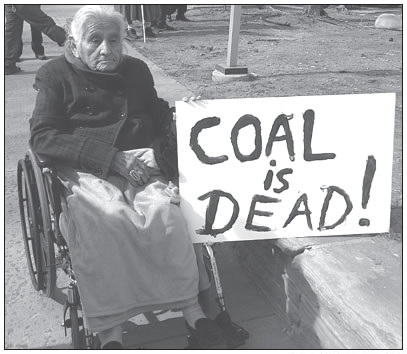
Published in April 2010

The future of farming

Farmers and ranchers must change the way they see themselves, becoming more than just a cog in the giant industrial production wheel.

That was the message delivered by Lisa Hamilton, author of “Deeply Rooted: Unconventional Farmers in the Age of Agribusiness,” at the Four States Agricultural Expo on March 20. Hamilton spoke to a crowd of more than 100 in the morning and also participated in a panel on agriculture in the afternoon.

LISA HAMILTON

Lisa Hamilton, author of “Deeply Rooted: Unconventional Farmers in the Age of Agribusiness,” discusses the future of farming before a crowd at the Four States Ag Expo on March 20. Photo by David Grant Long

Farmers and ranchers were “some of the true founders of the West,” Hamilton said. They had a strong role as citizens and community leaders; “they were simply the majority of the population,” she said. They were stewards of the land, innovators and experimenters.

But the beginning of the 20th Century brought the massive transformation of the nation from an agricultural to an industrial economy, and farmers had no choice but to become part of that industrial machine. Over time, their role became narrower and narrower, distilled down to producing raw materials for corporations, she said.

Their duty was simply to “produce as much as possible for as little as possible.”

And over time the image of farmers changed to one of people who are “stolid, reserved, and quiet” — passive rather than active. When the public hears about farmers and ranchers being discontented, it’s usually in the context of a natural disaster against which they are largely helpless, such as a flood or drought.

However, farmers have risen up and become politically active at different times in the nation’s history. Hamilton showed slides of the great farm protest in Washington, D.C., in the winter of 1979, when farmers from around the country drove their tractors to the nation’s capital — some of them taking 18 days to make the journey in their slow-moving vehicles.

The tractors caused massive traffic jams for D.C. commuters — “in effect slowing them down to a farmer’s pace for a moment,” Hamilton said.

The protest, led by the American Agriculture Movement and seeking higher prices for crops — largely failed, however. “It’s the nature of the industrial system to pay farmers as industrial producers,” in effect, as little as possible, Hamilton said.

At that time, it wasn’t really possible for farmers to redefine their role, but she believes it is now.

“Agriculture is entering a whole new stage,” she said, prompted by climate change, the depletion of water resources and the looming end of cheap energy.

Of all the fresh water used in the United States, 80 percent is used in agriculture, she said. Although just 16 percent of American farmland is irrigated, that 16 percent accounts for nearly half of the value of agricultural products grown and sold in the U.S.

Agriculture has come to depend on an artificial scaffold of pesticides, imported water, and fertilizers made from natural gas, Hamilton said. This system has produced tremendous yields and allowed the human population to grow enormously, creating an even greater demand for food, so that now there is the sense that agriculture could not function and the world could not survive without that scaffold.

“Water is a major, major driver of the whole agricultural economy,” she said. “But what happens when water becomes scarce? When energy goes from being cheap to expensive, and the climate goes from being stable to unstable?”

Farmers and ranchers must take on the role of being stewards, innovators and leaders in helping agriculture adapt to new conditions, she said.

“Scaffold” farming eliminated the farmer as steward; he or she wasn’t asked to think or care or protect, just follow the conventional wisdom. But that approach is short-sighted, she said.

“We can’t afford to have farmers and ranchers be considered just industrial producers,” she said, comparing that to having doctors focus on manufacturing Band-Aids. “Farmers and ranchers have the most knowledge about how agriculture works on the ground from day to day. They are figuring out how to adapt agriculture to this new set of conditions.”

She described a North Dakota farm family, the Podolls, that is one of three families profiled in her book. Although everyone around them was growing vast tracts of corn and soybeans to sell and then going to the supermarket for food to eat, the Podolls started with the idea that they wanted to be able to feed themselves first, then sell to others.

When growing a commodity crop, Hamilton said, there’s always a “whisper” in the back of the farmer’s mind that he or she isn’t quite competent, that he needs help, that he doesn’t know everything he should. But when someone is raising a garden with foods that can be eaten at their own table, “you feel capable,” she said.

Interestingly, former President Bill Clinton recently echoed Hamilton’s observations when he said that he had been wrong to implement low tariffs on American-grown rice and crops that were then sent to Haiti in the 1990s. The cheap food encouraged Haitians to become dependent on imports and to abandon their own farms, something that is now haunting them as they try to recover from the disastrous earthquake in January.

The Podolls started saving seeds from the most successful plants in their garden so they would have strains that had adapted well to their area. Over time their crops flourished, and they had 480 acres planted, much of it in grains.

Climate change has arrived in North Dakota, as recent headlines demonstrate, bringing wetter and wetter years. It’s no longer possible to grow wheat without fungicides. Many farmers had to give up that crop, “and it was heart-breaking,” Hamilton said.

However, some farmers decided to look to themselves, working with researchers from North Dakota State University and forming a “Farm Breeder Club.” While “prima donna” strains of crops can survive in an artificial environment, the farmers wanted workhorse seeds that could thrive in harsher conditions. For instance, there is a new strain of millet that can emerge in bone-dry soil and drive out Canada thistle, she said.

They decided to seek a better strain of wheat, one that didn’t just produce high yields but could emerge quickly and shade out weeds and that would flourish in tough climate conditions. It also had to be organic, meaning it had to be free of genetically modified organisms.

They received a sample of seed from a man in Oregon who heard of the effort and sent some wheat that had worked for him — no strings attached. The Podolls and others began working with that seed, taking “the first step in restoring the vital partnership between farmers and the plants they grow,” Hamilton said.

Today, the Farm Breeder Club has introduced a variety of hard red spring wheat called KW 175 that has good yields, is pest-resistant and grows well in both wet and dry conditions. Best of all, Hamilton said, the seeds belong to no one, because the strain is not patented. Each shipment comes with a letter from the breeder club asking the buyer to share it with neighbors and if they sell the seed, to try to send 10 percent of the profit back to the club.

“This is not an isolated example, Hamilton said, and transformation won’t come from an isolated piece of legislation or a court decision. Rather, it will come from farmers making “small but deliberate decisions” such as growing their own seed and then working hard to make those decisions succeed.

Hamilton noted that Jude Scheuenemeyer, co-owner of Let It Grow Nursery in Cortez, has proposed reinstituting the old concept of the grange with an emphasis on sharing knowledge and building a new community around agriculture. Hamilton said that would be a good idea.

“We shouldn’t see this as a nostalgic effort,” she said, “but as an important part in the vital cutting-edge need to redefine what it means to be a farmer and a rancher in the 21st Century.”

Published in April 2010

A long way from Window Rock for the Navajos’ west side

The Navajo Western Agency wants to play a greater part in the operations of its central government.

A resolution calling for decentralization of general services and divisions of the Navajo Nation government, located in Window Rock, Ariz., passed 55-6-2 during the quarterly meeting of the 18 agency member chapters March 20 in Chilchinbito, Ariz., on the eastern escarpment of Black Mesa.

THE WESTERN AGENCY CHAPTERS OF THE NAVAJO NATION

This map depicts the Western Agency chapters of the Navajo Nation.

The vote sets in motion a process that could allow the westernmost citizens of the Navajo Nation to have a central administrative office in one of their own towns instead of in faraway Window Rock.

Council Delegate Leslie Dele of Tonalea introduced the resolution by drawing attention to the inefficient use of people’s time and vehicles. He pointed out that two of the biggest reasons to drive to Window Rock relate to personnel issues and government finances. Nobody takes an official count, he said, but there are estimates that 30 to 60 white tribal vehicles leave the Tuba City area and about that many return every day, completing the round trip in six hours.

LeChee Chapter, 70 miles north of Tuba City at Page, Ariz., is a 5 1/2-hour drive from Window Rock; Navajo Mountain is 244 miles and 6 1/2 hours away; Leupp, 153 miles and three hours on the most direct route; Shonto, at 213 miles is four hours away over some rough roads; while Oljeto, tucked away behind a canyon west of Monument Valley 210 miles from Window Rock, requires a five-hour drive.

The Navajo Nation, largest and most populated of all Native American tribes, is the size of West Virginia. It is divided into five agencies, comparable to U.S. states. Communities within the agencies are organized into local chapters, with a chapter house serving as the disseminating office for information and news. The chapter house is also the assembly hall for official meetings and public hearings.

But all government business conducted there on behalf of the people is done without local access and availability to Navajo Nation central government personnel, staff or records.

Like the Pony Express of the 1860s, chapters expedite delivery of documents by physically transporting them to Window Rock. The process might be compared to hand-delivering your income-tax return to Washington, D.C.

Meetings, too, are scheduled and announced at Window Rock locations. Ordinary Navajo citizens living hours away are welcome to attend if they are able to drive, can afford gas, have a vehicle in good repair, can take time off work and can visit relatives on the way. If not, they are the ones that can fall through the cracks.

For the 18 chapters included in the Navajo Western Agency, where many roads are dirt or gravel and inclement weather is frequent, the distance from Window Rock is a major obstacle to efficient operation of services and government.

A bureaucratic quagmire

“Every major service program is centralized in Window Rock. Decentralization would save the nation funds in transportation and wear and tear on our vehicles — and save us the night in a motel,” said Council Delegate Katherine Benally, Denehotso. “We Navajos have perpetuated what we accuse the U.S. government of, we have fine-tuned bureaucracy from Window Rock.”

Benally, an organizer of the decentralization project, said, “As it stands now, the services are slowed by the constant shuffling back and forth to Window Rock, and the people who need to deal directly with offices there have no choice but to drive those lengths of time to do their business. They take time off work, lose money. Decentralizing will save the nation money, if we move out one-fifth of every program to a western location more accessible to the people.”

“I think the time is right for something new and innovative that would be beneficial to the people,” said Leupp Chapter Delegate Leonard Chee. “As it is now, the distances we travel are immense and this would cut that.” Chee drives 153 miles from Leupp to represent his chapter in the Navajo Legislative Council.

Although slightly closer (149 miles to central government), the Kayenta Township is still affected by the delays. Even though the roads from Kayenta to Window Rock are paved, it is still a three-hour drive or more. Keith Betsuie, town manager, said the effort to decentralize the government services “would be a positive step, an efficient use of scarce resources.”

In addition, it would surely reduce the tribe’s carbon footprint and auto emissions at a time when air quality and environmental consciousness are becoming major issues for the nation.

Power in the West Side

The Western Agency is also home to the richest natural resources on Navajo land. Coal, uranium, the Black Mesa water aquifer, the Colorado and Little Colorado rivers, and now wind and solar power and ecotourism are the foundations of future economic development.

Surrounding chapters are beginning to feel the leverage and power associated with such rich land. The agency is growing in collective strength as its individual chapters challenge central government, alleging Window Rock lags in support of local community initiatives that directly benefit residents of the area. Economic-development projects such as the Cameron wind farm and the Maverick Helicopter tour business have been held up for years, according to local officials, while Window Rock jockeys for control of the lucrative enterprises [Free Press, December 2008, January 2009, February 2010].

In an unintended show of solidarity, 16 of the 18 Western Agency chapters voted against a Dec. 15, 2009, initiative to reduce council-delegate representation in the central government proposed by President Joe Shirley, Jr. The unofficial count showed the initiative passed among the 110 chapters nationwide, 61 to 39 percent.

“The move to decentralize central government is prompted by the Dec. 15th elections that clearly showed the Western Agency chapters voting against reducing the number of council delegates from 88 to 24,” Benally said.

Since then, the Western Agency has been in the news as Leupp resident Timothy Nelson brought a lawsuit against the Initiative Committee and president’s office, challenging the legality of the election. Although the suit was dismissed on grounds he had sued the wrong parties, oral arguments on Nelson’s appeal to the Navajo Nation Supreme Court are scheduled for April 20.

Until the complaint is settled, the Navajo election board can’t certify results of the Dec. 15 special election. Nelson’s lawsuit is holding up that certification and subsequently the plans to reapportion official chapter boundaries.

Joshua Lavar Butler, communications director for Navajo Nation Council Speaker Lawrence Morgan, told the Free Press in a phone interview, “It is very understandable that 16 of 18 chapters in the Western Agency would oppose the council reduction. They are so far from central government, they could feel forgotten. They are also the most traditional and remote. Representation is critical to them. Speaker Morgan is very supportive of this [decentralization]. It represents real government and budget reform.

The coming reapportionment will match communities to the new, limited number of delegates. The move aims to streamline council duties by assigning more chapters to fewer delegates.

“There is also some discussion in the Western Agency to keep the current structure of council delegates even when council reduction goes into effect,” Butler said. “It is kind of a serious situation.”

Leonard Chee is in his second term as a delegate. He believes that in the Western Agency, “There is that sense of oneness, that we should stand together and, of course, we’re stronger when we do stand together. We’ve been in the headlines since the Dec 15th election drew attention to the Western Agency. In the past we’ve been silent and so far from Window Rock.”

Spirited presentations

At the March meeting, speakers lined up to address the audience of council delegates, chapter officials and visiting dignitaries, including Arizona Sen. Albert Hale, a former president of the Navajo Nation. Jack Jackson Jr. and Sylvia Laughter, Navajo candidates for Arizona State Senate, District 2, addressed the crowd in campaign speeches followed by Round Rock Delegate Rex Lee Jim, candidate for the 2010 presidential election. The Chilchinbito gymnasium, packed with over 150 people, was charged with vigorous discussion.

Arbin Mitchell, director of the Navajo Division of Community Development, said that decentralization is “part of selfdetermination, …millions of dollars of federal funds being returned due to all these problems related to oppressive travel and delayed meetings that keep us from getting the job done.”

The crowd applauded Chapter President Max Goldtooth, Toh Nanees Dizi/Tuba City, as he added, “We should have no fear of innovative endeavor. We can do it!”

While not much is being said publicly in central government on the subject, a Feb. 25 press release reports that Western Agency council delegates directed Paulson Chaco, executive director for the Office of Navajo Government Development, to develop and draft chapter resolutions to support the Western Navajo Agency Decentralization Project.

“I believe the Western Agency delegates have a legitimate concern to decentralize certain functions of the central government,” Chaco said. His office “will assist them in achieving any goals. I look forward to working with them. It will be a big responsibility and it’s my office’s duty to carry out those types of functions.”

The project will bring many much-needed services directly to the people. In the same press release, Council Delegate Lena Manheimer, Ts’ah Bii Kin/Navajo Mountain, stated it will also “… provide opportunities for economic development really necessary for our communities. This project will help eliminate a lot of stress.”

The resolution goes now to the individual chapters. Benally is careful to point out that the next step on the chapter level is critical to understanding the benefits and responsibilities of decentralization. “We’ll fine-tune all of this, see what we can do, then every chapter will be informed, educated and the information presented to the people there for consideration when public hearings are held.”

Location, location, location

But if the Western Agency gains its own administrative center, where should it be?

“There are 5,000 travel employees [nationwide] going back and forth to Window Rock daily,” Butler said. “It’s ridiculous how much gas and time is spent when coordinated efforts don’t exist. A centralized office in Tuba City would be good. We now have the technology to do it. I’d like to see one courier a day instead of all the driving done presently. It could possibly be a prototype for other agencies.”

Tuba City has been developing at a rapid pace during the last decade. Two- and three-story commercial buildings are now part of the city-scape. It also boasts a 100,000-watt public radio station, KGHR, housed at the Greyhills Academy grant school. The library parking lot is filled each day after school and on weekends. A coffee house serves lattes, chai and biscotti to customers connecting to free WiFi. The Tuba City Indian Health Service Hospital has renovated while expanding services to keep up with the needs of the region, and Bashas grocery is beginning to carry some organic products. All are signs of a growing diversified economy.

But can the Tuba City infrastructure hold up to the pressure of a boom in construction if decentralization locates there? Other chapter locations may be in the running, offering the build-out amenities needed to accommodate the sizable needs of such a democratic change.

Tonalea, 30 miles east of Tuba City on U.S. Highway 160, has the water, power, space and technical capacity to accept the project. Technology is big business in Leupp, too, where Tooh Dineh Industries assembles circuitry boards and is the major employer in the community. All three possible locations are easily accessed by the other chapters in the agency.

Another bonus of decentralization would be job creation in construction and professional employment. As it is, residents of the Ft. Defiance / Window Rock area have more opportunity to work in government because they live close to the work sites. If decentralization happens it will equalize opportunity by spreading job access into the far reaches of the Western chapters.

Supporters of the plan indicate that the transformation of services, not just duplication of services, is central to success. The restructuring could address efficiency on many levels, not all of which are business.

It might potentially ease strain on family relations, as Benally pointed out. “Decentralization will free more time for family and community for council delegates, as well as families in our communities who are constantly driving to Window Rock for services and business. It can increase the quality of life for us all.”

If the decentralization resolutions are passed on the chapter level, the project will be placed before the council for approval, making it feasible to begin construction of a new center within three years.

“The sooner the better,” said Kayenta’s Betsuie. “I hope it will be received well in council because it is an action where we take hold of our own destiny.”

What would the buildings look like? “Just give us a hogan,” Benally said. “We’ll be happy. We’ll make it work.”

Published in April 2010

Struggling to find more water in the Lower Dolores

The Dolores River quenches the thirst of many people, crops and creatures as it winds down from Bolam Pass through Rico and Dolores, across McPhee Reservoir, past the alfalfa fields of Dove Creek, and into spectacular desert canyons before merging with the Colorado River in Utah.

But dividing the water fairly among competing interests along the way — ranging from a native fishery and anglers to farmers and boaters — is a constant struggle for government agencies that control how the water is allocated.

THE LOWER DOLORES RIVER

Management of the Lower Dolores River has spawned a number of controversies. Photo by Wendy Mimiaga

To protect water rights while promoting preservation of the remote lower stretches, the Dolores River Dialogue was formed in 2004 to bring together different interests including environmental groups, recreationists, water managers and county, state and federal agencies for discussions and research.

After five years, some management ideas have emerged, and were presented at a DRD meeting in March.

Wilderness qualities

“The Dolores River Dialogue represents diverse groups with diverse interests,” said Don Schwindt, vice president of the Dolores Water Conservancy District. “We are still trying for consensus to move these contentious issues forward.”

The often-competing uses of the Lower Dolores have sparked acrimonious controversy in the past, especially over limited rafting flows and chronically low water levels for fish below the dam. But a professional and civil mood has prevailed more recently, a point that did not go unnoticed.

“Just seeing both of you standing together up there says a lot for this process,” observed fisherman Dale Smith, following opening remarks by Schwindt and Megan Graham, executive director of the San Juan Citizens Alliance, an environmental group.

The Lower Dolores River was recently designated by the BLM as “preliminarily suitable” for consideration as a Wild and Scenic River. Portions of the landscape along the corridor are being considered for wilderness or conservation-area status, all of which would potentially limit development (such as roads and oil and gas).

During the meeting, cooperation, communication and transparency of the process was touted as key to success. But outside forces can get in the way.

“I hear about communication all the time, but it would have been nice to be contacted when thousands of acres in our county were proposed for wilderness,” said Julie Kibel, a Dolores County commissioner.

“We don’t want to wake up with a new dog on our porch and not know whose it is,” chimed in Doug Stowe, also a Dolores commissioner.

They were referring to a recurring wilderness proposal presented to Congress every year by U.S. Rep. Diana DeGette (DColo). The bill proposes 34 areas on the Western Slope for designation as wilderness areas, including sections along the Lower Dolores.

With the Democrats in power, the bill received a congressional hearing in March for the first time in 10 years. U. S. Rep John Salazar (D-Colo.) testified that wilderness proposals need to protect water rights and evolve from a grassroots approach on a regional level rather than a sweeping proposal such as DeGette’s bill.

Forty or so professionals at the meeting grappled with minutia of proposal-vetting and final decision-making on management of the Lower Dolores. Underneath the veneer of cooperative spirit, the difficult nature of the negotiations was evident.

Schwindt said the DWCD needs to be kept in the loop more about special management areas proposed on the river below the dam, especially regarding any minimum flows associated with wilderness and Wild and Scenic River designations.

“The DRD has evolved and has history and clout, but how does this clout not get abused?” he said. “This is a large group and at times (the DWCD) has not known what was going on as much as we should have.”

A six-person steering committee representing various stakeholders is slated for drafting proposed recommendations for river management. The standing members are the Bureau of Reclamation, Colorado Division of Wildlife, DWCD, Montezuma Valley Irrigation Company, San Juan Citizens Alliance and Nature Conservancy. But there was concern that the even number of members could lead to a stalled process.

“Inevitably there will be some tough decisions not everyone agrees with, so I would suggest making it seven [members]” to break a potential stalemate, suggested Dave Vackar of Trout Unlimited.

But Schwindt and moderator Marcia Porter-Norton responded that consensus in the process made a seventh member on the steering committee unnecessary.

Native fish suffering

The Lower Dolores hosts a number of fish populations, both native and nonnative. Native fish include the roundtail chub, bluemouth sucker and flannelmouth sucker. Non-native trout are stocked in the stretches just below the dam for sport fishing.

Studies show a significant drop in native fish populations and range in the Lower Dolores since 1993, reported Dan Kowalski, an aquatic biologist with the Colorado Division of Wildlife.

“Their range has contracted significantly,” he said. “In a 53-mile stretch above Disappointment Creek where native suckers were common nowadays, there are very few when compared to historical numbers, so it is pretty grim.”

He said it is likely that the pikeminnow has gone extinct in the Lower Dolores due to a narrowing of the channel, low water levels and an absence of natural spring floods since McPhee dam was built. The pikeminnow, a predator that can reach 80 pounds and live 50 years, historically used the Lower Dolores to spawn in shallow sandbars and riffles cre ated by regular spring flooding. That sediment is captured by the dam now, Kowalski said, altering downstream habitat.

“The pikeminnow is a keystone predator, so its being absent is a significant difference,” Kowalski said.

The report of insufficient water levels due to the dam drew some criticism at the meeting. Not much is known about historic water levels on the Lower Dolores before 1982 due to substantial diversion projects dating back 122 years. In 1888, the Great Cut Dike tunnel began diverting agricultural water to Montezuma Valley from the Dolores River near Big Bend, spurring the growth of Cortez. Because Montezuma Valley drains into the San Juan River, not the Dolores, that water is known as a transbasin diversion.

Blaming McPhee is an “unfair comparison due to the transbasin diversion factor,” Schwindt said.

“Pre-dam is not natural either, so the question becomes, what is historic?” Kowalski responded. McPhee Dam and the reservoir were completed in 1987 and irrigate mostly land draining into the San Juan Basin as well.

The DWCD manages a “fishery pool” of 31,900 acre-feet in the reservoir for timed release below the dam over the year. Not counting rafting releases, the river typically receives 75 cfs during the summer months and drops to 30 cfs in the winter from the pool. Rafting spills do not count against the fishery pool, so for years when there is a boating season, the Lower Dolores will see slightly higher flows for the year.

The DOW biologists recommend a fish pool of 36,500 acre-feet with the ultimate objective of a year-round minimum flow of 78 cfs to improve the fishery.

The DOW reports that “the current fish pool is 43 percent of the minimum flow necessary to protect a barely viable fishery and protects less than five percent of native fish habitat.” Non-native rainbow trout are also in decline. On a positive note, just a little more water will lead to large habitat and population gains, the DOW reports.

“The Dolores River above the San Miguel River [confluence] has one of the poorest native-fish populations compared to other large western rivers,” Kowalski said. “The cause is insufficient flows.”

Another recommendation by biologists is to slowly ramp up rafting-flow releases earlier, beginning in late March and early April to better mimic a natural spring hydrograph that native fish are programmed to respond to for more successful spawning.

But that conflicts with the needs of rafters, who prefer a later release in May and June when the weather is warmer. Rafting releases range from 200 cfs up to 2,500 cfs for between one week and five weeks depending on the snowpack levels. Rafting spills are usually timed to include the Memorial Day weekend. During drought years, no rafting flows are released.

“Sustainability is how to balance natural values with human needs,” remarked Peter Mueller of the Nature Conservancy. “The rafting benchmark has been for recreation, so human needs are shaping the river” more than natural values.

A draft of the recommendations states that river permits will not be required for boating on the Dolores River, meaning private boaters can launch and float on any section in Colorado. (Permits are required in Utah sections.) Campsites will remain on a first-come first-served basis. The Slickrock put-in/takeout owned by the Randolph family will remain, but will be monitored for possible additional management in the future.

BLM river ranger Rick Ryan, now retired, also recommended camping only at designated campsites between mile markers 84 and 86. Additional posted campsites for small and large groups in this area may be created and enforced through a pilot program.

Overall, the Dolores River Dialogue process has improved awareness of the river and the importance of protecting it, members agreed.

“We are finally looking at the Dolores River as a watershed and not just incremental pieces of it,” said Vackar of Trout Unlimited. “When we bring together county, state and federal agencies in the same place and the same time to communicate, I don’t see how we can fail.”

Published in April 2010

A woman’s intelligence

Durango’s Harris broke ground gathering info for the military

One day, 5-year-old Gail Harris sat at home in Newark, N.J., watching TV with her dad.

“Now my dad was both visionary and old-fashioned,” she laughs. “You know. ‘We watch what I wanna watch when I’m home’.”

BOOK COVER A WOMAN'S WAR BY GAIL HARRIS

“A Woman’s War: The Professional and Personal Journey of the Navy’s First African American Female Intelligence Officer” Paperback: 284 pages Publisher: Scarecrow Press (Jan. 16, 2010) $34.94

He was watching ‘Wing and a Prayer,’ the story of the aircraft carrier USS Enterprise. When Commander Harper, played by Don Amece, briefed his pilots about Japanese positions on Midway, Gail announced that she would do that when she grew up.

Her father could have told her that very few African American men — let alone women — became military officers. Instead, he said, “This is America. You can do whatever you want.”

So in 1973 Gail Harris became the first woman in naval history to serve as an intelligence officer in a combat aviation squadron. Thereafter, as the first female or African American in every job assigned to her, she assumed leadership positions in conflicts from the Cold War to El Salvador, Desert Storm, and Kosovo. She headed the Defense Department Intelligence Support for the 1988 Olympics in South Korea, and worked to counter cyber-warfare. At retirement in December 2001, Capt. Gail Harris held the highest rank of any African American woman in the Navy.

Now, she has written her memoir, “A Woman’s War: The Professional and Personal Journey of the Navy’s First African American Female Intelligence Officer,” published by The Scarecrow Press. Harris, a resident of Durango, Colo., has appeared recently in several venues in the Four Corners to do booksignings and talks.

“In the back of my mind I always wanted to write a book, but I didn’t know what topic,” she says. Then came 9-11. Listening to the criticism of the intelligence community and realizing that sound-bite TV news didn’t deliver enough information for people to understand the world situation, she decided to write about intelligence work. She also wanted to encourage young people into the intelligence profession. “My dream had been so unlikely, and yet I achieved it.”

She achieved her dream through self-motivation, because after her initial training, she received no follow-up courses. “If you weren’t highly motivated, you wouldn’t do a very good job.”

For some situations, there was no preparation. She recalls coming on duty one Sunday expecting a peaceful shift. “The Soviets might not believe in God, but they don’t work much on Sundays. So for once my hair [wouldn’t] be on fire and I [wouldn’t] be running around with no time to go to the ladies’ room.“

Buying herself an ice-cream sandwich, she settled at her desk, glanced at her computer and saw Soviet reconnaissance flights over international waters. Usually they flew north of Japan. Today they headed south, between Japanese and South Korean air space.

Viet Nam and Russia had signed a friendship treaty. China had invaded Viet Nam. But now what? Were the Russians going to war for Viet Nam, or just showing China their strength?

“How do you train somebody for that?” She chuckles. “I never did get to finish my ice-cream sandwich.”

Many times, she taught herself. When assigned to Latin American intelligence projects, she read every book she could find on the area. “I decided to become a competent Latin American analyst, and I did.”

In “A Woman’s War,” she states that despite belief to the contrary, intelligence agencies work closely together. The CIA is one of 16 such organizations, and together on any given day, they can gather a billion pieces of information, much of it shaky. Intelligence officers must rely on their knowledge to interpret what they have found.

“Colin Powell said it best,” she explains. “‘Tell me what you know; tell me what you don’t know, and then tell me the significance of what you don’t know’.”

Harris always employed her sense of humor. Her commanders warned her that as a woman, she would meet resistance, and gave her a few jokes to help her approach the male officers on her first job. She used them. They accepted her.

Commanders ordered men to watch their language in her presence. When they forgot and blushed, she said, “That’s okay — I don’t speak French.”

Once, an angry sailor accused her of taking a job from a man. She said, “You know, you’re right, but I’m from a poor family and nobody wanted to marry me.”

Writing “A Woman’s War” brought her both pleasure and pain. She had to learn to write, and she also was forced to recall nasty experiences as well as good ones. She didn’t want to whine about the bad stuff, so she tried to write from a “detached perspective. I think it was an emotional healing and a cleansing.”

Then Cold War information was declassified, and she could explain the nitty-gritty intelligence work. She decided she could sell her book because she often gave motivational speeches to business people, and audiences relished her stories.

However, when she finished “A Woman’s War,” traditional publishers saw no market for it, since she did not sensationalize her story. Seven years of rejections followed, and she decided to give up if no offers came by January 2009. Scarecrow’s acceptance letter arrived in December 2008.

Harris laughs. “Just goes to show you. Don’t be afraid. Just keep trying.” That’s got to be the understatement of her life.

Published in April 2010, Arts & Entertainment

Life as a PERAsite

A retired educator with whom I often take my mid-morning coffee break has been at the retirement business longer than me. Since 1983 he has been living off his investment, which has been generous enough to include the price of coffee. The way I figure it, I’ll need to purchase and consume over 5,460 cups to catch up with him.

One morning while we were sipping in the sun he announced he was living a parasitic existence. It sounded unhealthy and I wanted to ask him if he had a tapeworm or some kind of mite, but how do you tactfully ask that kind of question? Then I noticed he was still smiling, so like the unschooled sucker I was, I asked: “What exactly do you mean?”

“I’m collecting a retirement check each month that exceeds the amount of money I contributed to the fund,” he replied. “I’m living the life of a parasite.”

Biologically, he was right, because a parasite is an organism that lives on another organism and benefits by deriving nutrients at the host’s expense, but technically, he was slightly inaccurate. As a former educator, he’s actually a PERAsite, one that’s attached to the Public Employee Retirement Association, a Colorado fund that functions much like Social Security for many of the state’s public workers. PERA had been investing his money like a poker player for 28 years, anteing up his contributions every working year to be dealt into the longevity game.

Dick has been retired for 23 years. Last year he received a letter from the PERA people informing him that his beneficiary would not benefit from his death. He already knew that. But they felt obliged to inform him that his investment had expired before he did. Naturally, those are not the words the PERA people used in the letter, but the tables and charts explained everything.

PERA, like many retirement strategies in these lean economic times, is in financial trouble, though the Colorado legislature recently approved a plan to increase PERA’s solvency by reducing cost-of-living increases to existing retirees, stepping up contributions from employers and employees, and pushing back the age of retirement for those who recently joined the ranks. In other words, by the time I’m dead, PERA hopes to be profitable again.

I got to thinking about Dick, who was thinking about himself as a parasite, and I wanted to explain how the insurance and retirement investment industries function as real parasites. On my way to retirement, my health-insurance premium increased for 27 years and I redeemed a small percentage of what I paid in. I know, I’m lucky. I’ve insured my vehicles for 40 years and claimed virtually nothing. Lucky again. My houses have been protected against most kinds of disaster, and I’m still lucky my life has been so claim-free.

Still, it bugs me anyone could make Dick think of himself a parasite. The insurance industry is the real creepy crawly thing that profits by juggling an actuary table of risks against the hazards of living and like a casino, more often than not, the corporation wins.

I’m happy that Dick is alive beyond his calculated window for survival. I hope we all live as long, so that we can reclaim our invested interest. As for me, I’m thinking longevity has something to do with coffee. Black. Just lift that cup up to your lips and sip that sucker dry.

David Feela, a retired teacher, lives in rural Montezuma County, Colo.

Published in David Feela

50 things you should know before we date

50 things you should know before we date…

1. Rumor has it, I snore. But I think this is just smack talk.

2. I am the crazy cat lady. Four cats, three of whom are asleep on me as I write this, one screaming at the back door.

3. I hate the feeling of wet hair, unless I am on the river. Therefore, I blow dry my hair.

4. My blow dryer is pink.

5. I read trashy magazines and I enjoy them.

6. I pick my nose (kind of gross) but I don’t eat it. That would be totally gross.

7. I burp out loud with my sons.

8. Everett (my oldest) and I like to beat each other up.

9. I like to walk, not run, although sometimes I do that too, but I could walk from here to California.

10. Sometimes I carry lime-green handweights when I walk. Nerd.

11. I am really horny these days.

12. I cannot function in the morning without coffee.

13. Coffee in the afternoon gives me gas.

14. I have a terrible potty mouth – even in front of my children.

15. If it came out of the ocean, it does not go in me.

16. I am a wretched housewife. I’d rather play than scrub toilets.

17. Sometimes, instead of scrubbing those toilets, I pour bleach in, close the lid and hope for the best.

18. My brain is so fragile and fried right now that I can’t think in full sentences. Only lists.

19. Sometimes, when my recycling is full, I throw cans in the trash. I am so ashamed.

20. I have a tendency to paint the walls and the furniture when life gets too hectic.

21. I am a sloppy painter. Especially when drinking wine.

22. I love thrift stores, but hate regular stores. Although sometimes the City Market is soothing.

23. I am a little bit ADD.

24. I am a cheap drunk. One glass of wine and I am on my lips.

25. I prefer to pee outside, on the ground, rather than in a toilet.

26. I occasionally listen to bad pop music and pretend I am from the hood, not horse country.

27. My favorite birds are turkey vultures. Ravens are a close second.

28. My biggest pet peeve is people flossing in public. Especially in the kitchen while camping.

29. I don’t floss. My dentist groans when I walk in the door.

30. I hate the smells of spilled coffee and banana peels (not necessarily together), although I love both coffee and bananas.

31. I do not read the newspaper.

32. I don’t shower very often. Someone recently told me that it was OK to do so more frequently.

33. I am a hermit and don’t really like people very much. I prefer my cats.

34. I am seriously damaged.

35. I still hide chocolate in my underwear drawer and eat some every night.

36. My favorite sandwich is bananas, peanut butter and mayonnaise.

37. I’ve watched the 6-hour BBC version of “Pride and Prejudice” more times than I can count. And will continue to do so throughout the rest of my life.

38. Same with “Bridget Jones.”

39. I frequently wear running clothes and PJ’s inside out. I just discovered that my brother also does this – it’s genetic.

40. Also genetic is the lack of desire to snuggle. Sleep is about sleep. We Strazzas don’t spoon.

41. I do not like pancakes, waffles or anything else sweet for breakfast. I want bacon.

42. I pretend to be a deep thinker, well-read and concerned with the plight of the world. Honestly, I am quite shallow and unfeeling.

43. I often drive to work instead of walking. It is a half-mile away. I love fossil fuels.

44. I prefer the desert to the mountains.

45. I do not like area skiing.

46. I never, ever get movies back on time. I spend more on late fees than I do on food for my children.

47. I don’t twitter. Actually don’t even know what the hell it is.

48. If you tell me something and tell me not to tell, I won’t… but if you don’t say that, I am probably going to tell everyone I know.

49. No matter how much I love a person, they will eventually end up in my column

50. I screen my calls, so even if after reading this, you are dying to go out with me and get up the guts to call, I probably won’t answer.

Suzanne Strazza writes from Mancos, Colo.

Published in Suzanne Strazza

With (Wall Street) friends like these …

The steps the government took to rescue AIG were motivated solely by what we believed to be in the best interests of the American people” — Timothy Geithner, Newsweek, February

This is one of the biggest lies to ever trip off a forked tongue. I say “one of the biggest,” because it’s been said before, notably by (former) Treasury Secretary Hank Paulson, when he told Congress on Sept. 24, 2008, that the proposed Troubled Asset Relief Program was “about benefiting the American people, because today’s fragile system puts their economic wellbeing at risk.”

According to author Nomi Prins, though, there was a lot Paulson and his banker buddies, including Geithner (then president of the New York Federal Reserve) and others weren’t telling Congress, such as: “We need the taxpayer to buy up our toxic assets because no sane private business will,” and: “We sat down and came up with this idea in about an hour; can we please have billions?” and: “Homeowners with bad mortgages are the perfect scapegoats for our greed.” Further, their ties and vested financial interests in the “too big to fail” banks somehow failed to raise eyebrows in Washington.

Now We the People find ourselves in a fine little pickle, funding a government that continues to throw (our) good money after bad.

Fortunately for the Average Joe and Jane, Prins is on our side. In her book “It Takes a Pillage: Behind the Bailouts, Bonuses and Backroom Deals from Washington to Wall Street,” Prins, a journalist and former Goldman Sachs managing director, uses plain English to explain that we’ve done been hornswaggled — and that the outrageous bonuses paid to Wall Street execs are the least of the scandal.

Actually, scandal is too tame a word. The more apt word would be “crime.”

As Prins tells it, neither of two firms, Barclays and Bank of America, stepped up to buy faltering Lehman Brothers, which failed on Sept. 14, 2008. The day after, though, Barclays picked up Lehman Brothers’ $72 billion in assets for a song — $250 million — all allegedly with the knowledge of Paulson, Geithner, SEC Chairman Chris Cox and the CEOs of several other large banks, which held an “emergency meeting” a few days earlier. Later, Bank of America was able to take over Merrill Lynch for $50 billion, but stock kept nosediving, and BOA’s board of directors tried to back out under the material- adverse-change clause. “Paulson,” writes Prins, “would have none of it.”

Instead, he and Ben Bernake “promised (BOA’s CEO Ken) Lewis they would provide taxpayer money to help out with the takeover of Merrill, but it had to be done in secret … The public’s money kept this merger financed.”

Then there was the matter of AIG, for which Paulson assured a total of $182 billion in taxpayer dollars to back “AIG’s credit bets and the corporate clients to whom it owed money.”

In other words, the very people who denounce “regulation” as the killer of capitalism used our money to effect private mergers and line their own pockets.

The idea behind TARP, of course, was to give the big banks enough credit to lend out to you and me, but as we know, this did not happen. We’ve seen little relief.

And, what is the solution floating around Washington these days? Another bailout. Apparently, our elected representatives didn’t get the memo. Either that, or they’re practicing selective blindness because Wall Street is funding their campaigns. Prins reports that Democratic Sen. Chris Dodd netted $132,000 from the banking and mortgage industries during the 2008 election year.

When reading “It Takes a Pillage,” it’s hard to decide what’s most offensive. There is the rapacious conduct of Wall Street, and the manipulation and shady dealings of those who are supposed to protect us, or, at a minimum, be honest. But there’s also a truth so stark that Prins used it to title one of her chapters: Everyone saw this coming.

As well they should have. The Great Depression was, after all, decades ago, and following it, a strong law (the Glass-Steagall Act) was put into place. Among other things, it prohibited commercial banks from merging with investment banks. The idea was “that a single bank entity should not control financial products that had widely varying levels of risk that could damage the American public,” Prins explains. At about the same time, the Securities Act of 1933 was passed and the SEC was created to enforce the act. Under Glass-Steagall, further, only commercial banks could receive government backing, and not investment banks, which engaged in risky speculation. Wall Street then, as now, pitched a fit about the regulation, yet America somehow survived — without another Depression.

Until, that is, the Glass-Steagall Act was repealed during the Clinton years, and without critical “legislation to strengthen regulatory oversight for newly consolidated supermarket financial firms amalgamated from brokerdealers, commercial banks, and insurance companies.”

This, Prins says, is bad for a simple reason: “History had already shown that if commercial banks speculate or borrow too heavily against their customers’ assets, the system self-destructs.”

I am no financial wizard. I can balance my checkbook and sort of do my taxes. But I can understand what’s put in front of me, and my fearless suggestion is this:

Send the next bailout directly to the banks on Main Street, with the explicit order to lend out that credit. The little banks, the ones that didn’t screw us over in the first place, can then lend to businesses, which can use the money to grow and put people back to work. These newly employed people, together with their newly invigorated workplaces, will then “stimulate” the economy like nothing else.

It’s been said that it’s not what you know, but who you know. Nowhere does that appear truer than on Wall Street. It also appears certain avaricious hucksters who convinced us deregulation is good for the economy own the very people entrusted with representing our interests. What a pity we, the taxpayers, don’t have friends like these.

“It Takes a Pillage” is available through all major booksellers. Read it. And pass it on to your congressman or senator.

Katharhynn Heidelberg writes from Montrose, Colo. She recently won four individual first-place awards from the Colorado Press Association and shared in two more first-place staff awards forher work with the Montrose Daily Press.

Published in Katharhynn Heidelberg

Celebrating the diversity of agriculture

Agriculture is supposed to be dead or dying in the Four Corners, but every year, the Four States Ag Expo makes it clear that reports of ag’s death are quite premature.

The Four States Ag Expo in Montezuma County is now in its 28th year and is the largest agricultural exposition between the Great Plains and the West Coast.

It generally attracts 10,000 to 12,000 people every year, according to Elizabeth Testa, a member of the Ag Expo board. “They come from all four of the states in the Four Corners area,” she said.

The event, which will take place March 18-21 at the county fairgrounds, features vendors with expertise in everything from large farms to backyard gardens, raising a few animals to running large ranches, harvesting techniques, sustainability, bee-keeping and organics.

There will be hands-on demonstrations, competitive events, children’s activities, and FFA activities for the next generation of ag producers. More than 20 educational clinics, seminars and demonstrations will provide information on a variety of topics. In addition, there will be entertainment including antique tractor pulls and draft horses pulling trolleys.

“We have a bull sale and a big horse program, ranch rodeo and ranch sorting,” Testa said. “We have a youth and family day on Sunday. So we try to be all things to all ag people.”

This year, organizers are excited about the appearance of journalist and photographer Lisa Hamilton as a featured speaker on Saturday, March 20. Hamilton is the author of the critically acclaimed book, “Deeply Rooted: Unconventional Farmers in the Age of Agribusiness.”

Hamilton has researched issues of sustainability and economic viability in agriculture, and profiled three families who have adopted a new approach to farming on a small scale. Her basic question is: What practices result in a sustainable food supply, and how do farmers and ranchers embrace these good practices while remaining economically viable?

It’s a complicated matter, but there are solutions that she will present at the expo Saturday, beginning at 11 a.m.. A panel discussion at 3 p.m. will address the topic as it applies to different aspects of agriculture, such as sustainable cattle-ranching, boutique specialty farming, the community-supported agriculture movement, and the 21st century grange.

“This marks an expansion of the Ag Expo program into the realm of the sustainable and new approaches to agriculture,” Testa said.

She mentioned an historic-orchard project being done by Let It Grow Nursery in Cortez to capture and propagate the cuttings from historic trees in the area. “That’s the kind of new/old farm interests we want to attract to the Ag Expo,” she said. “I’m excited about this because I don’t think we’ve tapped into this before. We have had good coverage of traditional agriculture, and we will continue to do so, but now we’re also moving into orchardists, wine-growers, the real artisanal stuff like cheese-makers and organic wheat farmers in Dove Creek.”

In addition, there will be a full schedule of equestrian events to participate in or to watch, including workshops and demonstrations, equine clinicis, mounted shooting, ranch sorting and ranch rodeo.

Animals of all sorts will be on display and for sale, including at the second annual Four State Bull Sale. There will be beef/equine and swine judging and showmanship.

And on Sunday, the expo will offer “hands-on happiness” in a day for kids and families. All four days of the Ag Expo will offer events for kids such as carriage rides, a petting zoo, animals and more, but Sunday will have some especially kid-friendly bonuses: a stick-horse rodeo, face-painting, mutton- bustin’, and a beef show with a youth showmanship contest.

“We want to attract multiple generations,” Testa said, “so people realize agriculture is for the young generations as well and that the young people are involved in it.”

As for agriculture’s continued viability, she quoted something that Jude Schuenemeyer, owner of Let It Grow, likes to say: “If you eat, you’re involved in agriculture.”

The fairgrounds is 3 miles east of Cortez on Highway 160. Parking has been refined this year to increase capacity and reduced confusion.

For more info, see www. FourStatesAgExpo.com or call 970-565- 3414.

Published in March 2010

The debate rages over coal-mining at Black Mesa, Ariz.

A judge’s decision earlier this year to halt the expansion of coal-mining at Black Mesa near Kayenta, Ariz., drew cheers from environmental groups opposed to the mines. But a closer look reveals that celebration may not really be in order.

“Peabody Western Coal Company’s Black Mesa Coal Complex has suffered a major setback as an Administrative Law Judge for the U.S. Department of the Interior (DOI) vacated a permit for the massive coal mining complex,” announced the Sierra Club and other environmental groups in a Jan. 8 press release, under the title “Hopi and Navajo Residents Stop Peabody’s Coal Mine Expansion on Black Mesa.”

The language is strange in part because no one involved with the mine – least of all Peabody Energy or the federal Office of Surface Mining, charged to regulate it – has noticed the major setback.

“Kayenta mine continues operating in a business-as-usual fashion with its existing permit,” said Beth Sutton, an Arizona-based Peabody spokeswoman.

Added OSM’s Rick Holbrook, who manages the agency’s Western Indian lands program: “Their permit allows them to continue operations at the Kayenta mine. There is enough coal in mining areas approved for mining to last until 2026.”

The Kayenta mine still supplies coal to the 2,250-megawatt Navajo Generating Station, 80 miles away in Page, Ariz. The other part of the Black Mesa Complex, the Black Mesa mine, went dormant with the shutdown of the Mojave (Nev.) Generating Station in June 2006.

Peabody is angling to secure a new permit in the hopes that the company can find a new customer for the remaining Black Mesa coal by 2026. The celebrated order represents little more than a slowdown in that process: Judge Robert Holt vacated a December 2008 permit granted by the Office of Surface Mining for a proposed expansion by Peabody because he found that the OSM had failed to conduct an adequate analysis of the proposal, which had been substantially changed from the time it was first prepared. Therefore, OSM will have to reconsider the permit and gather more information this time around.

So why all the rejoicing? Possibly because mining opponents have little else to celebrate, in the ongoing march of Peabody Coal through Navajo and Hopi lands.

Controversial giant

Peabody Coal is the world’s largest private coal company, “with 2009 sales of 244 million tons and $6 billion in revenues,” boasts the company’s web site. “Its coal products fuel 10 percent of all U.S. electricity generation and 2 percent of worldwide electricity.” A real-time counter representing tons of coal sold in 2010 tics up too fast to track: 36,960,903 and climbing, at press time.

The Black Mesa Complex contains hundreds of millions of tons of coal that’s world-renowned for its quality; Peabody has been making bank on the deposit. The company runs 28 coal operations, and Black Mesa has long been one of its brightest stars.

It’s also been costly. Charles Wilkinson, a legal scholar at the University of Colorado at Boulder, wrote in his 1999 book “Fire on the Plateau” that the mining tore up graves, forced 36 traditional Navajo sheepherders to relocate, and polluted the air and water.

“One Hopi woman, a cautious, conservative person, told me the mining and air pollution were like rape,” he wrote.

Members of both tribes remember those original hurts, as well as new insults that have come with the mine’s ongoing feeding off the land. Many of those people are the activists who have formed groups like the Black Mesa Water Coalition and Diné Alliance, both of which have joined with the Sierra Club, the Center for Biological Diversity and other groups to fight the mines.

As just one example, water is a major ongoing source of strife at Black Mesa. The Hopis are a traditional farming people who rely on springs to irrigate their crops. But many of them are struggling to cope with springs they say were decimated by water withdrawals for the 273-mile pipeline that slurried coal to the now-defunct Mojave Generating Station. A 2000 report and a 2006 follow-up analysis by the Natural Resources Defense Council corroborated the link, using data from OSM, the EPA and Peabody.

“The Office of Surface Mining has not done anything about reclaiming the water that Peabody has pumped out of the aquifers, which is now over 45 billion gallons,” complained Vernon Masayesva, a former Hopi chairman and executive director of the Black Mesa Trust.

Perspectives at odds

The Peabody leases were signed at a time when the tribes had little power to protect their interests, in terms of economy, human or environmental health. Over time, both tribes have made extraordinary strides in regaining that power and building the level of respect that’s appropriate for fully functioning governments.

Injustices remain. But today, the business- savvy elected leaders at Navajo and Hopi say even if the judge’s order were a thorn in the side for purveyors and regulators of Peabody coal, that wouldn’t be good news. Because today, $3 billion in tribal revenue from mining (as estimated by Peabody), including jobs for Navajo workers and a smaller number of Hopis, is part of the tribes’ hard-won power.

The Hopi tribal council got its back up last fall, and issued a unanimous statement that environmentalists weren’t welcome on the reservation, owing mostly to their role in the shutdown of Mojave and the consequent loss of up to $8.5 million a year in revenues for the tribe.

Navajo Nation president Joe Shirley quickly issued a statement supporting the Hopi decree.

“Unlike ever before, environmental activists and organizations are among the greatest threat to tribal sovereignty, tribal self-determination, and our quest for independence,” Shirley wrote. “By their actions, environmentalists would have tribes remain dependent on the federal government, and that is not our choice.”

George Hardeen, spokesman for the Navajo Nation, said environmentalists’ celebration of the closure of Mojave has continued to rankle the Navajo government.

“Nobody was saying anything about the people who lost their jobs. There was no compassion,” he said. “That bothered President Shirley. He spent 16 years as a professional social worker. He has a lot of empathy for people who lose their jobs on the Navajo Nation.” And beyond economic hardship, Hardeen said, job losses can lead to an erosion of culture – especially when tribal members are forced to leave the reservation to find work.

However, an environmental activist like Masayesva falls into a more privileged position, given that he’s also a Hopi tribal member.

“The council is controlled by what I call pro-Peabody [interests],” Masayesva said, “people who do not represent the feelings and positions of the grassroots people. They only speak for themselves and Peabody Coal Company.” His view could be fueled partly by an ongoing awkwardness between a centralized government formed at the behest of white influences and the traditional, village-based leadership with which it has never fully meshed.

In the bigger picture, Masayesva said, “Every Hopi is an environmentalist. Being Hopi means being an environmentalist. Every Hopi knows that we are supposed to be protectors, guardians of the Earth.”

Beyond 2026

Although the official tribal positions blast environmentalists’ perceived goal of stopping all mining at Black Mesa, Masayesva says that’s not the position of all the activists.

“The Hopi people are not opposed to mining, per se. We have a teaching handed down hundreds of years about the wealth at Black Mesa. . . underneath us. We are opposed to the destructive way that coal-mining is now being done. Strip-mining is the most destructive way to mine coal,” he said.

Peabody, meanwhile, has worked hard despite the decades of controversy to portray its mining operations as being environmentally sound and progressive. Sutton, the company spokeswoman, said Peabody has a solid track record of compliance with Department of Interior requirements and EPA regulations for clean air and water.

“Peabody has a good record of compliance with the Clean Water Act and believes the issues raised by groups long opposed to mining are frivolous,” she said.

Moreover, Sutton said, a lot of good can come from mining. Peabody as a whole, for example, “is pursuing a dozen global projects and partnerships to advance near-zero emissions and carbon-management technologies.”

She said the company has been culturally sensitive in its dealings with the tribes, and points to $360,000 in annual tribal scholarships as well as reclaimed lands “that are typically 20 times more productive for grazing than native range. A first-of-its-kind cultural plant program restores plants and herbs used for medicinal and ceremonial purposes.” Last fall, that program won the Arizona State Mine Inspector’s inaugural Best Reclamation Award.

But the relationship isn’t all rosy. In 2003, the Supreme Court ruled against the Navajo Nation when it sued the Department of Interior for $600 million and accused the department of failing to uphold the tribe’s interest. At issue were 1987 lease amendments that set coal royalties at 12.5 percent – well above the rates laid out in the original 1960s leases, but far below the 20 percent the tribe wanted. The tribe had produced evidence that shady wrangling by Peabody executives had resulted in the lower royalties – which are still in effect today – but the argument found no purchase.

“It’s not as if the Navajo Nation and Peabody walk in lockstep on every issue,” said the Navajo Nation’s Hardeen. “That’s not to say the Navajo Nation is eager to evict Peabody. Clearly, we need the jobs.”

Masayesva wishes that the Navajo and Hopi tribes would join together in demanding redress for what he sees as a litany of ongoing environmental, health and cultural insults. But he knows that won’t happen without action against Peabody by the tribal governments, which have indicated just the opposite intention. His hope for change lies in the longer term.

“I’m going to predict that Navajo Generating Station is going to shut down in 2026,” he said, citing tightening environmental regulations, including a pending revision of EPA rules for Peabody’s water emissions. Right now, Peabody’s discharge permit doesn’t regulate anything but temperature, but new rules would include limits for selenium, nitrates, and other heavy metals and toxic pollutants.

“When Peabody has to pay the true costs of mining, and owners of [the Navajo Generating Station] have to pay the true cost of generating energy, it’s going to be very, very expensive,” Masayesva said.

And if he’s right, Masayesva sees an opportunity – and ample time — for the tribes to be ready to replace the lost energy production with renewable energy sources.

“That’s what Hopis and Navajos should be doing — looking for the bright side,” he said. “We need to be optimistic. The people who will do it right, and become a showcase for the world, are Hopis and Navajos. That’s what I would like to see: Hopis and Navajos coming together and making a vision for the future.”

Published in March 2010

A dog’s voice

Everyone knows the adage, “If at first you don’t succeed, try, try again.” But few people have taken it to heart more than Connie Gotsch.

Gotsch, of Farmington, N.M., knew as a child that she wanted to become a writer. But she didn’t realize how many setbacks, discouragements and obstacles she would have to face before she could make her dream come true.

BELLE'S STAR

“Belle’s Star” By Connie Gotsch Artemisia Publishing, 2009

“It was a long time coming,” said Gotsch, whose most recent book, a children’s story called “Belle’s Star,” has garnered considerable praise. Gotsch also writes arts and entertainment articles for the Four Corners Free Press and other publications and is program director for KSJE Radio.

“I very much wanted to be a writer as a child. I wrote stories, mostly based on the stories I’d read. Girl has problems, goes to farm, finds a horse that has problems, and they heal each other. That sort of thing.

“My mother encouraged that kind of writing, but when I got to the point of writing about reality, she squashed that. She was very negative. And I didn’t have enough sense to not show her my stories.”

Gotsch persisted with her writing, attempting to join the staff of her highschool and college newspapers, but was rejected. She was shut out of creative- writing classes and critique groups. “They told me, ‘Your characters are trite’.”

In her 20s she wrote a novel and submitted it to a publisher she knew, “and she threw it at me, in front of people, at the church coffee. My mother told me, ‘I knew that’s what would happen.’ I just assumed that was what the publishing business did to you if they didn’t like your work. I didn’t know the reaction was extremely rude and excessive.”

But one of her professors told her, “Never mind, put it behind you and keep writing.”

She didn’t do that for a time, however. She gave up and, having obtained her bachelor’s, went to grad school and received her doctorate in communication. Later, while teaching at Eastern New Mexico University in Portales, N.M., she became friends with Patrick Rucker, head of the theater department, who advised her about the importance of body language, scenery and props in getting across an idea, even in writing. “It was like he let loose a tiger,” she said. “I will love Patrick till the day I die.”

Eventually Gotsch moved to Farmington to work full-time in public radio. There, she met other writers and began writing again. Eventually, she wrote a novel about university politics called “A Mouth Full of Shell,” which was published by DLSIJ Press in 2001. That was followed by “Snap Me a Future,” a print-on-demand novel about a former investigative reporter who uncovers looting at Anasazi sites.

“A Mouth Full of Shell” took first place for full-length novel in the 2001 New Mexico Press Women Communication Contest. “Snap Me a Future” garnered a second-place award in same category in the 2005 contest.

Both of those works were for adults. But then Gotsch met author Gwynne Spencer of Mancos, a friend to many writers, who died last November at the age of 63. Spencer loved animals. “If there was a sick animal in the universe, she would take it home,” Gotsch recalled.

In 1995, Spencer told Gotsch she’d stopped at a gas station “and there was some ugly, nasty man kicking a dog.” The dog, a small red-heeler mix, ran up to Spencer. The man, who was drunk, said he didn’t want the dog and offered it to Spencer for a dollar.

She took it home, whereupon (she told Gotsch) her husband told her, “You have dogs, cats, a son, me, a cage of finches, and a pot-bellied pig. You have to choose.” Gotsch paused. “She said she thought and thought, and finally she kept him. Of course, they were both laughing when they told me this story.”

The thrust was that Gotsch should adopt the dog, and she did. Kiri, who is now 16, became “Belle” of “Belle’s Star.” Kiri was a shy little thing when she came to Gotsch, and to this day she growls at tall men and flees if she smells liquor or hears Gotsch open a can of beer.

“Gwynne said one day, her story would make an ideal story for abused children. I started on it and eventually the novel came out.”

At Spencer’s suggestion, Gotsch wrote the novel in first person from the point of view of Belle, who describes the slow process of overcoming her fear of humans after suffering abuse at their hands. Belle is adopted by a 12- year-old girl, Darcy, and is encouraged to trust Darcy by other pets, including dogs and a cat. “I don’t think it would have occurred to me to write it that way without Gwynne’s suggestion,” Gotsch said, “but it became fun to do.”

To write it, she had to become more attuned to dogs — how they might think and feel.

“How much do they notice? How much do they pick up? I had to think about that.”

Gotsch had two dogs at the time, Kiri and Ben, a “big black galumphus” who became “Buster” in the book. “I swear they have a communication system we don’t know about,” Gotsch said. “Ben [who has since died] loved to be outside in the yard. I’d go check on him regularly and say, ‘Ben, do you want to come in?’ He’d wag, wag, and go back to sleep. So I’d go away. Then Kiri would come to me all excited, wanting something. I’d say, ‘Where’s Ben?’ and I’d go to the door and in would come Ben. They must have been communicating on some other frequency.”

In the book, Gotsch was careful to incorporate smells as an integral part of Belle’s reaction to people, describing the spicy, peppery scent of fear and the foul stench of Toby and Bonehead, her former owners. “Dogs’ noses are phenomental,” Gotsch noted. “So I began describing people in terms of smell.”

Writing the book did not take long, Gotsch said, but then came “the agonizing business of trying to find a publisher. I got my share of cheesy form letters when you knew damn well they had never read it. Others said, ‘This is a beautifully written story, but not for us’. Still others said I should rewrite it from the girl’s point of view instead of the dog’s. I threw those in the trash.”

Finally, a friend told her to contact Artemisia, a small publisher in Albuquerque. Artemisia accepted her book and even asked if she had a sequel in mind.

Published last year with illustrations by nationally known artist John Colgan of New Mexico, “Belle’s Star” received a silver award for Juvenile Fiction Level II (ages 9-12) from the Mom’s Choice Awards®, which recognize familyfriendly media, products and services. The book was also a finalist in the 2009 New Mexico Book Awards for the Juvenile Book category.

Gotsch has also received numerous other awards, including the New Mexico Press Women’s Communicator of Achievement Award in 2007.

A sequel to “Belle” is in the editing process, and Gotsch is researching the next book in the series. “I have a sequel and a trequel and a quadrequel and I don’t know what we’ll have eventually,” she laughed.

Gotsch is not getting rich from her writing, but she’s content. “Am I a John Grisham? No. I probably never will be, unless somebody likes this enough to make a movie out of it.”

Gotsch is shopping around her third adult book, but “Belle” is consuming a lot of her time. Her veterinarian read the story and liked it, so she did a book-signing at his clinic. She’s hoping to do a signing in the Cortez area soon in conjunction with For Pets’ Sake Humane Society.

Meanwhile, award-winning journalist and retired Farmington elementaryschool counselor Margaret Cheasebro has designed an activities booklet for “Belle.” The booklet, designed to help elementary-school students understand and deal with abuse by talking about Belle’s experiences, is available in downloadable form upon purchase of the novel at apbooks.net.

Gotsch has never quite understood why her mother was so negative about her writing, but she is sorry her parents didn’t live to see her become a successful writer. Still, she’s pleased with the direction her life has taken.

“I think this will go on for a while,” she said. “I’ve found a niche for the moment.”

Published in Arts & Entertainment, March 2010

A modest proposal for the Four Corners Monument

Don’t hold your breath just yet, but some improvements are in the works at the decrepit Four Corners Monument, which continues to be a popular tourist stop despite its primitive accommodations.

But the plans fall far short of what the project could have been – a $4 million landscaped oasis complete with an air-conditioned interpretive center that was originally conceived and funded more than a decade ago.

DAMAGES TO THE FOUR CORNERS MONUMENT

The Four Corners Monument shows signs of wear and tear, as this crumbling interpretive area demonstrates. Plans are under way for improvements, but they are far more modest than originally planned. Photo by David Grant Long

The monument marks the only spot in the country where four states touch, and it also marks a boundary between Navajo and Ute Mountain Ute tribal lands.

But now, thanks largely to the persistence of the Four Corners Heritage Council — in the person of chairman Cleal Bradford of Blanding, Utah — construction of what is now termed Phase One of the projects is under way at least and, according to the $680,000 contract awarded to Weeminuche Construction Authority last month, must be completed by fall. The work will consist of lowering the actual marker, a granite and bronze pie divided into quarters that face the states they anchor, eight feet below its current location and making other improvements to the surrounding plaza.

Entrance to the momument presently costs $3 per head, for which sum visitors get to pose and photograph one another with a limb in each of the four adjoining states — Colorado, Utah, New Mexico and Arizona.

Beyond this unique American oddity, however, the present amenities are sparse. The restrooms consist of portable toilets, and the loosely named visitors’ center is a rather barren room with a rack of sightseeing brochures and a space heater. Vendors at plywood stalls around the perimeter hawk jewelry, fry bread and other Native American wares. So twelve bucks for a family of four with two hot kids may seem a little steep.

Improvements have been long sought.

Bradford is an original member of the Heritage Council, which was appointed by the four states’ governors in 1991 to develop upgrades at the monument, along with other area projects it has since taken on. He has worked tirelessly to see the monument revamp implemented, but the road to fruition has been a bumpy one.

In 1999, Congress designated $2.2 million for improvements, with a provision that each of the states contribute up to $500,000 in matching funds. In other words, the feds would match whatever amount of money the states agreed to put in up to $2 million. Arizona kicked in its share largely in kind, drawing up detailed, comprehensive plans for the landscaping, interpretive center, real restrooms and much nicer stalls for the vendors.

The other states, with Colorado in the rear, finally ponied up their shares, and in 2004 a sort of groundbreaking was held at the monument with great fanfare.

Then nothing happened for five years except squabbling between the Navajo Nation and the Ute Mountain Ute Tribe, which jointly own the land on which the monument is located, with the Colorado quarter controlled by the Utes and the rest under Navajo (or Dine) rule. There were disagreements about whether the interpretive center and restrooms would be built on the Ute or Navajo land, and how the fees would be split — 50- 50 or 75-25. One member of the Heritage Council board called their differences as intractable as those between the Israelis and Palestinians. During that interlude, New Mexico took back its $500,000, Utah took back $200,000 and Colorado took back $300,000 that had been committed by the Department of Local Affairs, Bradford explained.

“That leaves us $1 million short of our local match, so we can’t use that half of the federal funds,” Bradford said. “That’s why we reduced the project down to what we’re calling Phase One, and we’re not using all the available funds on it.

“We lost a million dollars of the local match because of the delay, and hopefully that can be regained, but this isn’t the year to do it — everybody’s budget is being cut.”

The heritage council is only involved in getting the project built, Bradford stressed, not in the management of the site.

“That is not part of our participation — the Four Corners Heritage Council is assisting in the construction and getting it to where it’s an upgraded site,” he said, “but the management is something they (the tribes) have put into the future — I don’t even want to address that.”

DRAFTED IMAGE OF PROPOSED MONUMENT UPGRADE

The original proposal for the monument, here shown as envisioned by an artist, has been scaled down considerably.

Still, Bradford is excited to see the project finally moving forward after the long delay.

“We don’t know exactly what it (the marker) is going to look like when we get it all torn apart,” Bradford said in a recent telephone interview, “but the idea is to preserve as much as possible (of) the granite and all those materials.” The relocation will facilitate picture- taking, he explained, since tourists will no longer have to climb to a deck area to shoot their friends, but can now take photos from ground level.

However, the much-hoped-for restrooms and running water will not be forthcoming in the near future.

“Initially, we had planned to have the ‘vendor village’ all around be part of the project and then have restrooms and the interpretive center,” Bradford said, “but because of the fact we don’t have power and water there yet, we don’t want to build the restrooms and just have them sit.” When power and water might be installed is unknown, he said.

“We still feel there would be more pressure on being able to get more matching funds (from the states) if we go ahead with the things that can be finished, and that would better serve the public. We wouldn’t want to build something just to stay vacant until other things happen.”

The monument will remain open druing the construction, Bradford noted, with access to the vendors but not to the intersection of the states, which will barricaded with chain-link fence.

The two tribes haven’t yet addressed certain issues, including revenue-sharing, according to program manager Martin Begay of the Navajo Nation’s park system, and probably won’t in the near future.

Begay said the revenues from the entrance fees are currently “retained for operation of the monument.” The Utes at present don’t receive any revenues from the monument other than what individual vendors might collect, he said. Working out a revenue-sharing agreement will come at a later date, he said.

“We haven’t reached that point yet,” Begay said. “The only thing we have (at this point) is a memorandum of agreement for the construction.

“That issue — if it is an issue — will be covered by the finance plan that will be drawn up between the two tribes,” he said, and this will only happen “when the entire facility is built.”

And given the state of the economy, that may be a long time coming.

Published in March 2010

New uranium boom raising questions

Nuclear energy can power millions of homes without emitting significant pollution, making it an attractive alternative to burning fossil fuels. But mining the uranium to power nuclear plants can produce political division, racial injustice and environmental degradation.

Indigenous tribes still suffer from horrific health problems and lingering contamination to land and water as a result of the last uranium boom, which fueled the nuclear-arms race of the Cold War. As a result the Navajo, Havasupai and Hopi peoples have banned uranium-mining on their lands and are fighting mines proposed on their borders.

MAP OF SEGREGATED AREAS AROUND GRAND CANYON NATIONAL PARK

This map shows the areas near Grand Canyon National Park in Arizona that have been placed under a “segregation order” banning new uranium mines for two years. However, mines with valid existing rights can continue to operate. Photo courtesy of BLM

But elsewhere, uranium is experiencing a resurgence. Near the Grand Canyon, a mine known as Arizona 1 symbolizes the struggle between demand for the relatively clean energy of nuclear power and the desire to protect our health and natural heritage.

The mine has approval from the BLM, and is touted as a new domestic energy source and an opportunity for jobs. But it is being challenged by environmental groups who say its permit has long expired and that it should be re-evaluated based on new ecological circumstances and scientific information in the sensitive Grand Canyon watershed.

“The legacy of past uranium-mining still lingers as deadly contamination of land and water near the Grand Canyon, and to think that new mining will yield different results is foolish and irresponsible,” said Taylor McKinnon, public-lands campaign director for the Center for Biological Diversity, an activist group known for challenging industry and government in court.

“If the U.S. decides to build new nuclear plants, and intends to source that material from domestic mines on public lands, then the consequence will be adding to a high radioactive-contamination burden that already exists throughout the Four Corners area.”

The center, along with the Sierra Club, Grand Canyon Trust and the Kaibab-Paiute Indian tribe, is suing the BLM for allowing the Arizona 1 mine to re-start without conducting supplemental environmental reviews after it sat dormant for 15 years. The traditional hard-rock mine sits on BLM lands 10 miles north of Grand Canyon National Park, and 35 miles south of Fredonia, Ariz. The ore will be trucked through a portion of the Kaibab-Paiute reservation on its way to the White Mesa Mill near Blanding, Utah.

Last summer, Interior Secretary Ken Salazar issued a segregation order that bans new uranium mines for two years on nearly 1 million acres of public land surrounding Grand Canyon National Park in order to better study mining’s environmental impacts.

However, mines with “valid existing rights” issued before the July 21, 2009, order — which includes the Arizona 1 mine — are exempt from the ban, a point of contention that has spurred a legal battle for public records and calls for increased federal scrutiny of mining impacts around the park.

The temporary segregation order could expand to a 20- year moratorium on mining in the area, called a mineral withdrawal, depending on the results of an ongoing environmental impact statement on the region due out next year.

A changing landscape

The Arizona 1 mine, owned by Denison Mines of Toronto, Canada, had shut down because of a poor uranium market in 1992, but was revived in 2007 after prices rebounded and is operating today on the original permit issued in 1988.

“The segregation [order] is subject to valid existing rights, so it does not stop all mining activity,” explained Scott Florence, BLM manager for the Arizona Strip district, where thousands of uranium mining claims are located. “Arizona 1 is a previously permitted mine, so it does not stop it and neither would a longer term withdrawal.”

But environmental groups disagree, arguing in their lawsuit that the mine’s permit and plan of operation are invalid because they expired after 10 years. They say the mine’s impacts must be judged in the light of new data regarding groundwater hydrology in the area, as well as changes in the landscape such as the arrival of the endangered California condor, increased tourism and more residents.

According to the revised lawsuit filed last month, the BLM 1988 Decision Record for the mine stated that “the duration of this operation is approximately 10 years,” and that BLM regulations provide that a plan of operations “remains in effect” only so long as the claimant is “conducting operations.”

“You can’t pretend this thing is still a valid mining plan when for 15 years nothing was going on at the site, or say that nothing has changed in the area for the last 20 years,” Roger Flynn, an attorney for the environmental groups, told the Free Press. “The BLM’s own regulations say it expires.”

The BLM disagrees, noting that some changes were made to the permit, such as a larger reclamation bond that corresponds with current prices, and a requirement that the mine obtain an air-quality permit from the Arizona Department of Environment, which it did. But additional studies beyond the original 1988 environmental assessment (a less-rigorous analysis than an EIS) were not required and the permit to mine had not expired.

“The plan of operation remains in effect until for some reason the company wanted to do something that was outside the scope of the original plan; then that might trigger a revision,” Florence said. “Basically, once the plan is approved, and they continue to operate within the parameters of that plan, then they can go until the mine is mined out and reclaimed.”

As far as changes in the area, the BLM is not convinced they require additional study, not even potential impacts on the endangered California condor, introduced to the area in 1996.

Under the Endangered Species Act, federal agencies are required to consult with the U.S. Fish and Wildlife Service to protect endangered animals near a project area. But Florence said consultation was not required in this case because the condor falls under an “experimental population” designation and therefore “doesn’t have the full protection of the ESA; it puts them outside the realm of a regular listed species.”

High-paying jobs

Are the mining claims still valid?

“We believe so,” said Ron Hochstein, president and CEO of Denison Mines, in a phone interview. “The mine still holds its full plan of operations from 1990 when the shaft was sunk, but then it was stopped because of low uranium prices. We were put on care and maintenance of the mine, and when uranium prices justified going back in, that is when we started work again.”

Hochstein downplayed the environmental impacts of the smaller mine, and said it brings good jobs to an economically suffering region.

“People wrongly think these are very large open-pit mines, but they have a very small surface disturbance, between 10 and 20 acres, and are mined out and fully reclaimed within five years,” he said. “After it is done, you would not know a mine was even there.”

The Arizona 1 mine will produce some 50 local and contract jobs, he said. The ore is being trucked 300 miles to the White Mesa Mill in Blanding, Utah, also owned by Denison. That mill, the only uranium mill operating in the country, will employ up to 130 people once it is fully ramped up.

White Mesa processes the ore into yellowcake, a concentrated form of uranium that is shipped off to be processed into a gas and then into fuel rods for nuclear power plants.

Denison Mines also plans to re-open two other uranium mines that company officials say have valid existing rights in the segregation area – the Canyon Mine and the Pine Nut Mine — and has mines already operating in Utah and Colorado.

“We are hiring at all of our mines right now,” Hochstein said. “The U.S. wants to supply its own destiny; I don’t know what’s worse, having to rely on the Arabs for oil or the Russians for uranium.”

Hochstein said environmentalists’ contention that more studies are needed “are just allegations; there is no scientific reason we should not be mining.”

Eight linear feet

The BLM has eight linear feet of information regarding mines owned by Denison Mines in the segregated area, according to an agency response to a Freedom of Information Act request by the Center for Biological Diversity.

“But so far we have only received about three inches of that,” said Mc- Kinnon, whose office is suing the BLM in a separate lawsuit for refusing to disclose the public records. In order to makes its case against the Arizona 1 mine, more information is needed on the original plan of operations and environmental reviews, he said.

“[President] Obama has given very clear directions to federal agencies to carry an assumption of disclosure, but the BLM has taken the opposite approach, and rather staunchly at that. They are behaving as a fiefdom, not as public agency.”

The BLM says there are approximately 10,600 claims being mined within the boundaries of the segregation order and proposed 20-year withdrawal. Salazar’s order grandfathers mines that have “valid existing rights,” a complicated legal distinction that is hotly debated and not clearcut.

But BLM officials say they have discretion in deciding on a valid claim. Mine owners must have done exploration and must prove the existence of a valuable mineral deposit, a fact that may or may not be verified by the BLM, before operations can begin.

“That is the Catch-22 if a withdrawal were to be put in place,” Florence said. “If the claim had prior exploration and could show they had an economically viable deposit, then most likely the claim would be found valid, but if they had not done any exploration then they probably would not be able to do that after a withdrawal.”

“The clear intent of the segregation order was to limit further activity to those mining claims,” countered McKinnon. “To my knowledge, none of the mining claims have valid existing rights because despite their own regulations, the BLM and the Forest Service never required mining companies to establish those rights, which they are supposed to do.”

Published in March 2010

Summerhaven: The saga may continue

The saga of Summerhaven may not be over.

Pete Singleton, an agent for the subdivision proposed on Granath Mesa north of Dolores, says the developers are leaning toward appealing a district judge’s recent decision overturning Montezuma County’s approval of zoning for Summerhaven.

“We have another week to make the decision,” Singleton told the Free Press on Feb. 27. “But it’s looking like that’s the route we’re going to go.”

Whether or not the developers choose to take the case to the Colorado Court of Appeals, Singleton said, it’s likely that they will return to the county with another application for small-lot zoning. The proposal has already come to the county twice, but this time, Pete Singleton and his brother, Tim, also an agent for Summerhaven, hope to present more information about water availability.

“That [a new application] may be a quicker route [than an appeal],” Pete Singleton said. “We want to present the water information that we weren’t able to present last time and make a stronger case.”

Summerhaven is proposed for a 160- acre tract owned by the Singleton family and their company, Sin Vacas, LLC, on Granath Mesa about 2 miles north of Dolores. There is no domestic water service to the mesa, and water availability was one of the most contentious issues in the often-heated debates that took place regarding the proposed subdivision.

The Singletons came before the county planning commission early in 2007 seeking approval for Agricultural- Residential 3-to-9-acre zoning for the development, which at that time was projected at 44 lots and which was to be supplied with water only through cisterns. They were turned down both by the planning commission and the county commissioners after opponents raised a number of concerns about fire safety and compatibility with existing zoning on the mesa, which is primarily in large tracts.

They returned with a new proposal in December 2007, this time proposing 36 lots and having obtained permission from the state for each homeowner to drill a well. The planning commission again recommended against the proposal, but this time the county commissioners gave the zoning change their OK on March 10, 2008.

Three Granath Mesa landowners sued the county and Sin Vacas over the zoning approval, and on Jan. 16, 22nd Judicial District Judge Sharon Hansen overturned the commissioners’ decision, saying there had not been “substantial changes in facts or circumstances” that justified the reversal of their original decision under Colorado law.

The ruling came on the heels of another case in which Hansen found in favor of the county, which had rejected a proposal for a large evaporativepond waste facility proposed by Casey and Kelly McClellan near Hovenweep National Monument. The cases demonstrate the thorniness of land-use planning in Montezuma County and the vigor with which both proponents and opponents of projects will defend their views.

Pete Singleton takes issue with Hansen’s ruling against Summerhaven, particularly her contention that little changed from the first proposal to the second. In one portion of her ruling, she stated, “Both proposals relied upon water for the Summerhaven Subdivision through wells.” “That’s 100 percent wrong,” he said.

“That’s a complete fabrication of fact. The first proposal was cisterns only, and a covenant disallowed anyone to drill a well.”

The reasoning behind that, he said, was that the developers hoped to persuade Montezuma Water Company, the rural water supplier in the area, to run a pipeline up to the 7,000-foot-elevation mesa, something that the company has said would be cost-prohibitive.

Singleton said the developers were going to charge a per-lot fee for each tract sold, and put the money into an account as a “giant carrot” for Montezuma Water.

However, after the subdivision’s first rejection, the developers changed tactics, opting to allow homeowners to drill wells. They obtained a letter from the Dolores Water Conservancy District indicating its willingness to sell augmentation water to the owners to make up for the water that would be removed from the aquifer by the wells. In addition, they drilled a test well to ensure that water was available in the area. They have since drilled a second well, he said.

“We had a full augmentation plan, with every single residence being covered through DWCD,” Singleton said. ‘I bought water for every residence.

“For Judge Hansen to say there’s no substantial change from the first proposal is just wrong,” he said.

Another of the main objections voiced to the subdivision by opponents was that it would be incompatible with the neighborhood. According to one opponent who spoke before the planning commission, there are only 56 dwellings on the mesa now, and the subdivision would nearly double that number. David Doran, one of the landowners who sued, told the county commissioners that more than 4,000 acres of Granath Mesa is currently in tracts of 35 acres or more, while about 380 acres is in parcels smaller than that.

No AR 3-9 zoning had been formally granted anywhere on the mesa prior to the Singletons’ application, as Hansen noted in her ruling.

Singleton maintains that AR 3-9 zoning, though the smallest zoning designation allowed by the county except for PUDs and urban-influence areas, is big enough to maintain the county’s rural character, one of the goals stated in the land-use code. “They look at a three-acre lot like it’s a condominum plot,” he said of opponents of his subdivision. “But that’s a big tract. In a lot of other places, you can have half-acre lots or smaller.”

He also said opponents misunderstand the concept of compatibility by interpreting it to mean similar lot sizes.

“Their theory is larger acreage, larger acreage,” he said. “So if you have one development with small acreage, you’re going to have giant clusters of small acreage in that area.

“The land-use code describes LIZ [Landowner-Initiated Zoning] as a patchwork. There needs to be a mix. Of the 4,500 acres on the mesa, 2,500 is in 35 unsplittable tracts. There needs to be some room for other people. What the land-use code is saying about like zoning means residential with residential, not having massive industrial [projects] in a residential neighborhood. It doesn’t mean lot size.”

Singleton said keeping the lots small will make them affordable to locals and people looking for summer cabins with easy access to the national forest.

“I understand that the people opposed to this are looking basically at us having AR 10-34 but that seems out of the running for us.

“There’s only one spot in the county where there is a restriction against AR 3-9 zoning, and that’s the Dolores River Valley, so why should there be a problem with our project?

“I don’t know exactly what the right formula is for our county to move forward with preserving our rural character, but you don’t protect rural character by removing everyone’s rights.

“Three acres now sells for about $75,000. For most people, that leaves living in Cortez as their last option.

We’ve kind of reached that price point where we’re going to have a county where the prices have totally outgrown what the people here kind of need.”

Singleton agrees with opponents, however, that more thought needs to be put into land-use planning in the county. “There needs to be more public input and more planning. We need to have mixed areas, buffers between different kinds of uses — I would agree with that.”

Singleton said he is frustrated by the process his family has had to go through.

“The appeal process is insane. I waited an entire 12 months to get this done. Casey McClellan had his decision way before mine.

“I’m three years into this thing. It’s crazy. I feel like I’m Red McCombs.

“We’ve gone through the wringer, spent close to $100,000 in legal fees to zone a property that is totally unzoned.”

Published in March 2010

Uranium’s legacy lingers for Navajos

Ember Moreno of Mesa, Ariz., grew up in Blue Canyon, near the Tuba City/Red Lake area of northern Arizona.

She remembers, as a child, “going to get water from a water pump at the covered uranium site right there east of Tuba City,” a site now known as Site 160, where toxic wastes were dumped. “We drank the water, we washed our clothes at the spigot near the side of the road in front of where the trailers are now.

GATED AREA AROUND SITE 160

Site 160, where hazardous materials were deposited, sits on the north side of Highway 160 four miles east of Tuba City, Ariz., across the road from the site of the former Rare Metals Mill, which processed uranium ore from 1956 to 1966. Photo by Sonja Horoshko

“I was born in ’57, so this was in the early ’60s.”

She said there were always several vehicles lined up and everyone was getting water there.

“Nobody ever said, ‘Don’t drink it!’” recalled Moreno, now an insurance verification representative at the Banner Heart Hospital in Mesa.

Contaminated water

Fifty years later, the legacy of uranium- mining still hangs like a specter over the Navajo Nation.

Tourist maps call the country in the Western Agency of the Navajo Nation, the area near the Grand Canyon, a painted desert. Mineral-rich land in the yellows, salmons and reds of earth and sandstone unfolds under a cerulean sky north of Flagstaff, west of Kayenta and south of the Glen Canyon Dam.

The region spreads on both side of highways 89 and 160, dog-legging the Hopi-reservation mesas high above the Little Colorado River and other small drainages that meander past hamlets such as Black Falls, Gap-bythe Way, Coalmine, Cameron, Gray Mountain, Inscription House, Grand Falls, Black Mesa, Oljeto and Kayenta.

An Indian Country map circa 1960 hangs in a Kayenta café identifying these places with symbols. Four miles east of Tuba City, a black dot marks, “Rare Metals,” as if it were a town.

Instead, it is the site of Rare Metals Corporation, a uranium mill that processed yellow ore dug from hundreds of mines picked out of the desert to fuel atomic-energy projects during the Cold War.

From June 1956 to November 1966, the Tuba City Rare Metals Mill processed 796,489 tons of uranium ore. According to the U.S. Department of Energy, when the mill closed and control of the site reverted to the Navajo Nation, three connected milltailings piles containing some 800,000 tons of material and three evaporation ponds remained. The mill became a Superfund site.

All that is left of the Rare Metals Mill today is a fenced remediation site, some concrete building foundations overgrown with weeds near the highway, a few scattered mobile homes, used until recently as residences — and concern that the groundwater downhill from the mill contains elevated concentrations of contaminants related to milling operations.

In 1968, according to the U.S. EPA, the surface of the tailings piles was treated with a chemical binder to keep the material intact, but by 1974, the crust “was no longer effective.”

In 1972, a gamma-radiation survey of the Tuba City mill site and adjacent area found “anomalous gamma radioactivity” at 14 sites, seven of which contained uranium tailings. “The contamination was attributed to dispersal of tailings material by wind action,” states the EPA’s web site.

In June 1988 the DOE, assuming responsibility for remediation of the Rare Metals site, began construction of a disposal cell. When completed in 1990, it covered about 50 acres. Nearly 2.3 million tons of contaminated materials are entombed in the cell and, according to the DOE fact sheet, the cell contains “all of the residual radioactive materials at the mill site, the contaminated windblown materials from surrounding properties, and debris from the demolished buildings.”

Although the DOE has long-term responsibility for the site, the Navajo Nation retains title to the land.

A plume on the move?

But the hazardous materials in the area continue to defy containment. The DOE subsequently found a contaminated groundwater plume covering about 320 acres extending downhill to the the south and southwest from the former mill site.

Levels of molybdenum, nitrate, selenium, and uranium in the 3.8 millioncubic- yard contaminated groundwater plume exceed the U.S. EPA’s maximum safe limit.

The DOE’s groundwater-remediation strategy is designed to reduce concentrations of these five contaminants in the groundwater plume, which extends from the former mill site toward the Tuba City Open Dump site and beyond it to the Moenkopi Wash drainage. However, the precise source of the contamination is unclear.

Complicating the situation is the presence of the dump, which straddles the Navajo-Hopi border and operated from 1950 through 1997 with limited oversight by the BIA. During that time it was an uncontrolled dump that received solid waste from local communities in the Tuba City and Moenkopi areas. There are allegations that hazardous wastes from the mill were also buried there.

In 1995, the BIA began studies of soil and groundwater in the vicinity of the mill and dump. Those studies resulted in the shutdown of the dump in 1997. From 1999 to 2008, the BIA funded studies by the Hopi tribe to investigate the shallow groundwater near the open dump site; those studies found contaminants in excess of EPA standards.

Further studies at the dump site have concluded that most of the material in the dump is municipal solid waste. Although the assessments found arsenic, strontium, vanadium and copper at elevated concentrations compared to native soil and rock, they found that the contaminants were not due to hazardous waste present at the site.

The BIA continued doing groundwater monitoring, installing 38 monitoring wells. The results showed elevated levels of 13 chemicals in the shallow groundwater near the dump site. Uranium was one of them; it was detected immediately down-gradient of the site at up to eight times the EPA Maximum Contaminant Level, MCL, for drinking water. Outside the site, contaminant concentrations in wells ranged from non-detectable to 2 times the MCL.   By 2007 the BIA had begun investigating possible additional sources of contamination. The agency collected testimony from multiple residents who said that Rare Metals Mill wastes and tailings were deposited at the dump.

Carl Warren, project manager for EPA’s Region 9, told the Free Press that the EPA has no record of this testimony, although there may be a record with the BIA. BIA officials did not return phone calls by press time.

“Even though actual EPA records do not exist of this testimony,” Warren said, “there are enough alleged reports that waste material may have been brought there from the former milling plant. Actual records do not exist at the open dump site because it was uncontrolled, unsecured and unmanned. However, there are reports that debris was brought there. We’re taking these reports seriously and will conduct more formal investigations into the stories.”

Marbles and bolts

Residents also tell of peoples cavenging for construction material from condemned buildings in the area around Rare Metals Mill and the open dump. Whole families would go to take apart the houses near Rare Metals before they were demolished, using materials found to repair existing homes.

The scavenging was a result of the Bennett Freeze, a moratorium on development in a 1.5-million-acre area imposed in 1966 by Commissioner of Indian Affairs Robert Bennett because of land disputes between the Navajos and Hopis in the Western Agency area.

“For more than 40 years, Navajo families residing in the Bennett Freeze area lived under an oppressive and unjust law that has essentially made poverty mandatory,” Roman Bitsuie, executive director of the Navajo-Hopi Land Commission Office, told reporter Kathy Helms of the Gallup Independent in March 2009.

Residents of the Bennett Freeze area were barred from making any improvements — even minor repairs to their homes and property, such as fixing a leaky roof. It was against federal regulations to do new construction or develop new businesses.

Thus, in desperate visits to the dump and mill site, people removed what they could use to save homes and buildings.

Children brought toys and odd items from the dump, while adults prized nuts and bolts, metal scraps and construction materials. People recall friends and family moving into abandoned houses and trailers near the Rare Metals Mill; some even moved the temporary homes off the site onto personal property.

The U.S. EPA agreed to work with the tribes and BIA to evaluate permanent closure options for the dump. Today, partners involved in the complex dump-remediation project include the Navajo Nation EPA; U.S. EPA; Hopi Water Resources Department; BIA; DOE and Indian Health Services, which is responsible for the permanent fence erected recently around the Tuba City Open Dump site.

Three years ago, the U.S. EPA bored an additional 250 monitoring wells, identifying MW-07 at the dump site as showing the highest concentration of uranium in the shallow groundwater.

At community meetings in Tuba City and in Moenkopi last October, EPA officials explained the Open Dump field work on MW-07. The project was completed this February. It included surface assessment, soil borings and pits, tests of soil and waste samples to determine chemical and radiological content, excavation of waste that may contribute to elevated uranium concentrates in the shallow groundwater, disposal of all hazardous wastes during excavation, installation of two shallow groundwater wells and restoration of the disturbed area.

Results of the investigation and the feasibility study evaluating long-term clean-up and closure options are expected to be done by mid-March.

A new site

The relationship between the Rare Metals Mill and the Tuba City Open Dump sites has been studied for more than 10 years. Remediation is taking place.

But, like radioactivity itself, the problems associated with the uranium mill seem to linger.

Several years ago, rumors surfaced of another waste site across Highway 160 from the former mill. Residents reported seeing trucks carrying 55-gallon drums of waste and burying them there. The Highway 160 Site is about four miles northeast and possibly upgradient of the dump.

It is listed in EPA updates as a potential source for the radioactive materials found in the groundwater at the dump.

Warren concurs, noting that Site 160 was “found about seven years ago. . . the Navajo Nation has received funding from the DOE to address the clean-up.”

In a Feb. 11, 2010, press release, Cassandra Bloedel, environmental-program supervisor with Navajo Nation EPA, stated, “In 2003, information was received by local families who knew of the contaminated site. They were witnesses to those uranium activities in the late 1950s and in the early 1960s. In February 2004, the site was reported to the USEPA, Emergency Response… investigation that followed in May that year showing radioactive waste located within the 7.6 acre site.”

According to the press release, the NNEPA hired a contractor in January 2006 to investigate. He “identified further mill-related waste, found the mill balls used in uranium processing, and showed the site had high areas of radioactivity,” added Bloedel.

Whose responsibility?

In July 1962, the Rare Metals Corp. merged into the El Paso Natural Gas Company. EPNG signed a new contract with the Atomic Energy Commission, which later was incorporated into the DOE.

Bloedel stated in the press release, “The company did their own investigation of the site and determined that Site 160 did possess waste from the Rare Metals Mill. The DOE then fenced in the site to protect humans and livestock, and a palliative cover that hardens like a crust was placed on top to prevent contamination leaving the site due to typical winds recorded as high as 50 miles per hour.”

The Omnibus Appropriations Bill passed in March 2009 provides $5 million for cleaning up Site 160.

On Feb. 11, the Resources Committee of the Navajo Nation Council passed legislation that also provides $4.5 million to clean the site.

“Responsibility at this site is a challenging question,” said the EPA’s Warren. “We may need forensic analysis to determine responsibility. With that, the EPA will evaluate all available information, ascertain responsibility and compel the responsible party to participate in the clean-up.”

Meanwhile, the people who lived in contaminated homes, drank contaminated water and breathed contaminated air are left to deal with the longterm consequences to their health.

“The DOE created a demand for uranium to feed the U.S. Cold War strategy,” said Ed Singer, president of the Cameron Chapter, one of the Navajo Nation’s Western Agency chapters.

“The Navajo people are to this very day paying for that with their health and lives. Large areas of Navajo land and scarce waters upon it as well as the lives and health of the Navajo people became the biggest sacrifice cost ever visited on a people.”

Published in March 2010

Dear Abbie

ºI should have written this book review when the book first appeared, not waited like I have until readers forgot about it, but 38 years late is probably better than never.

Back in the early ’70s when I worked as a public library employee, a patron submitted an interlibrary loan request for Abbie Hoffman’s “Steal This Book.” I knew very little about Hoffman at the time except as a news item, for protests associated with the Vietnam War. He was, I learned, one of the Chicago Seven, tried and convicted (the conviction was later overturned) for inciting riots in Chicago during the 1968 Democratic Convention.

Dutifully I sat down at my teletype machine and forwarded the library patron’s request. I’ll never forget the reply that arrived the next day: This book has been stolen from all holding libraries. I was impressed. To be able to write a book seemed magical, but to inspire legions of readers to walk off with the thing bordered on the absurd. Here was marketing gone mad, but in a way that surprised me.

I never actually read Hoffman’s book, not until last month when a used-bookstore copy surfaced in Flagstaff. It’s actually a facsimile edition printed in 1996, nearly a decade after Abbie Hoffman killed himself by overdose. According to those who believe in conspiracies, the jury is still out on that conclusion. Strangely, what he outlines in his “Table of Discontents” is nothing short of a declaring war on the system. The FBI kept a file on Hoffman’s activities that amounted to 13,262 pages. That’s 12,954 more pages than Hoffman’s actual book!

Still, as a radical and part-time underground fugitive, Hoffman inspired a generation to question authority and in every possible way, rip off the system, something many people are very committed to, even today. Illegal downloads and pirated movies rank high as popular domestic abuse, while Ponzi schemes and mismanaged banking practices have made the hit list as corporate criminal misconduct. In his book Hoffman openly advocated illegal behavior, but he always maintained “corporate feudalism [is] the only robbery worthy of being called a ‘crime,’ for it is committed against the people as a whole.”

Hoffman’s book obsesses on the idea of getting things for free, by scheme or outright theft. 1970s society was shocked by what he had to say, but Hoffman only touched a nerve that pretty much functions today as a pulse. Our latest economic meltdown emphasizes this trend — a new kind of American Free-dumb, just another word for nothing left to steal. Hoffman’s book might just as well be republished and sold, titled to appeal to today’s pseudo-revolutionaries: “Steal This Loan,” “Steal This Home,” “Steal This Medicare Payment,” “Steal This Retirement Fund,” “Steal This Bonus,” or “Steal This Identity.”

At the funeral a Rabbi eulogized Hoffman’s life as an embodiment of a Jewish tradition, one that seeks to “comfort the afflicted and afflict the comfortable.” To that end, Hoffman’s entire book is readily available on the internet for anyone to use, for free, sponsored by sites dedicated to keeping his style of political activism alive, but if you want to pilfer the book like a true Yippie of the ’70s, pull up in the dark to an unsuspecting and securitylax WiFi hot spot in your neighborhood and steal his download. It’s not exactly illegal, but if you’re sitting at home worrying about losing your job, a distraction might be just what you need.

David Feela writes from rural Montezuma County, Colo.

Published in David Feela

Things I have done since the split

Bought a brown velvet couch.

Bought a table that I painted red.

Yelled at several nice people who tried to help fit the brown couch and soon-to-be-red table into the back of my Subaru using words along the lines of, “I am getting divorced! I have to do this all by MYSELF. Dammit! But thank you anyway.”

Feng shui-ed all traces of the past out of my bedroom. My bed is now under the windows so I can look at the stars all night since I am not sleeping. I filled the gaps with a giant television and the brown couch.

Bought new sheets. They’re blue. And organic. And clean. And All Mine.

Tried to get a puppy, but I couldn’t find the right one. Got a kitten instead.

Shopped in Durango while unbeknownst to me, blood trickled down the bridge of my nose from a recently embedded claw of said kitten.

Bought myself a fluffy bathrobe.

Got a prescription for Xanax.

Googled at least five ex-boyfriends but chickened out on contacting them. They are ex for a reason.

Freaked out about who will get the boat.

Rearranged all the furniture and hung Christmas lights. Feng-Shui-ing again.

Called my mother 350 times.

Cleaned out my files, figuring that if I couldn’t control the chaos in my life then maybe I could at least appear to have my shit together. Discovered there is not a hanging file for “icky feelings.”

Downloaded all of my favorite music from before I was married, then danced around the house singing.

Discovered that half the music really isn’t that good – it only sounded that way when I was stoned.

Walked 562 miles (and still walking).

Scrubbed the toilets trying to flush away ALL of the s#$% in my life.

Had two skin cancers and a wart removed – trying to burn the remaining s#$% out of my life.

Took the wedding pictures off the walls.

Gave the wedding ring (which I was allergic to and which made my finger bleed) to my 10-year-old son so he can play Lord of the Rings.

Got a Divorce Ring.

Contacted a man that I have always had a mad crush on.

Didn’t get contacted back by said man.

Interlibrary-loaned 89 books on surviving divorce.

Became an overnight Buddhist. Considered becoming a Catholic or a Jew.

Called my mother again.

In a total fit of anger, cleaned out the garage so that I can actually park my car there. Had six sheets of plywood fall on my head, tweaked my back, found seven random kids’ socks frozen to the cement and when I saw the boat frame, freaked out again about custody of it. I am also hoping that my car will now start if it has a warm place to sleep, because if I have to spend another four hours trying with no luck to get the damn motor to turn over, I am going to hurt someone.

Bought a vibrator.

Wondered, often, why I hadn’t bought a vibrator before.

Dyed my hair (That’s no surprise.)

Watched two full seasons of “Private Practice.” One full season of “Thirty Something,” but only one because I couldn’t get past the shoulder pads and scrunchies. I watched five seasons of “Gray’s Anatomy,” five of “House,” but decided that that needed to stop because I was figuring out what ailed the patients before Hugh Laurie did. I moved on to “Bones” and started fantasizing about Republican FBI agents (frightening) then watched two seasons of “Big Love” and fantasized about marrying a polygamist in Sandy, Utah (really really frightening). The last season of “Brothers and Sisters” I finished in two nights. And, yes, I had thoughts about Republican senators and gay older brothers, and finally moved on to Cisely, Alaska, day one when Dr. Fleischman arrives despondently to begin his medical career.

Thought about moving to Cisely; obviously Joel’s pleated khakis and feathered hair don’t bother me like the aforementioned shoulder pads.

Listened to “I kissed a girl” 53 times and thought that it sounds like a pretty good idea.

Fantasized about my perfect man: Rich and Foreign. Concluded that the only one like that I will come up with here in Montezuma County is a Mexican cocaine dealer.

Upped my Prozac.

Said F#$% at least 2,147 times. Found out how many incredible friends I have.

Wondered why… I’m not that nice.

Bought a coffeemaker with a timer because he used to bring me coffee in bed every morning and getting up without the coffee is bad for everyone: me, the kids, the dog, cats, the neighbors and particularly my co-workers.

Paid bills for the first time in five years. Came unglued about how expensive it is to take a hot shower these days.

Cleaned out the refrigerator. Threw out all of the condiments I don’t like.

Discovered four half-used bottles of ketchup way in the back, next to the three unopened jars of curry paste. He hates curry.

Made curry.

Made a lot of bitter greens – he hated those too.

Discovered that when you make a very small change on your Facebook status it can have a very large ripple effect.

Lost my credit card out of my back pocket when I stopped to pee on the side of the highway somewhere in the middle of Nowhere, Utah.

Took a run in my neighborhood, priding myself on how together I am. Stopped to chat with a neighbor and to assure him of how well I am doing. Looked down as I sprinted off and saw not one but two socks static-clinging to my pants leg.

Realized that maybe I don’t have a handle on this.

Ran over my boss’s dog (definitely do not have a handle on this).

Did I mention Xanax?

Suzanne Strazza, newly single, writes from Mancos, Colo.

Published in Suzanne Strazza

Hunting the wrong bear

A criminal is a person with predatory instincts who has not sufficient capital to form a corporation.— Economist Howard Scot.

I really have to give credit to the Tea Baggers and 9-12 people. If nothing else, I admire their diligence and commitment to protect this nation’s great document, the Constitution of the United States.

The problem is they are hunting the wrong bear. It isn’t the government that is destroying this document. It’s the corporations — huge, uncontrolled, and with no allegiance to any principle but profits.

From the time the Mayflower hit Plymouth Rock, the self-serving money moguls have been destroying our nation and our planet. They have subverted every rule of human decency, including our Constitution, under the guise of a better life for all. They convolute rules and regulations to their benefit, squander our tax monies to further their greed, instigate wars and send other people to do the killing for them.

People migrated to this country to escape the yoke of control by a few, but like a disease it came along with them.

Corporations have been at the trough since the founding of this nation. They manipulated, bribed and blackmailed our elected officials to deed them every other section across the nation with the mineral and timber rights. Timber companies used the Homestead Act to acquire great tracts. They then squeezed the small farmer off his land and took over agriculture, giving us hybrid seeds (genetically altered so as to be patented).

The corporations determine the price and quality of all merchandise, food, homes and clothing we purchase. They destroy the working man’s unions. They set the market value of our currency, work to pass laws to suppress us, and seek to control all aspects of law and government.

They created a disaster in our nation’s finances but accept no blame for their actions even as they stick their hand out for taxpayer money to cover the losses they incurred through mismanagement and fraud. Meanwhile, ordinary people declare bankruptcy because they can’t pay soaring medical bills.

It seems strange that all those Tea Baggers and 9-12ers who are opposed to communism and socialism blindly support every corporation that flees the country, sets up overseas sweatshops and sells us inferior goods. Even our local Legion here has a ballcap made in Sri Lanka. One would think they could find an American manufacturer to make an American Legion ballcap.

Through the chicanery of advertising we have become a fat-assed mass of sheep. Thanks to fast food and corn-syrupy drinks sold to us by mega-corporations, we have become an unhealthy nation. Now those corporations turn around and cry that the health-care costs for their employees are too high. They want to tell their workers how much they can weigh, what their blood pressure should be, whether they can smoke cigarettes — but they sure don’t want a tax on soda pop that would discourage the consumption of something that contributes to obesity and diabetes!

Korea and Vietnam were corporate-instigated wars — marketed under the guise that we were fighting communism, all while the corporations profited. It cost $300,000 in bombs and materials to kill a single Viet Cong, not counting the 53,000 lives we ended. Who now is over there? Nike, KFC, Walmart, Wendy’s, Ralph Lauren. Life is strange. Twice we gave our young to fight communism; now we gladly give our money to support it. Shame on us.

The corporations give us bad medicine, genetically modified food, useless products and pornography. They control the major newspapers and the morning and evening news. They sell us artificial foods grown with artificial fertilizers. They persuade us to buy water for $1 a bottle in cancer-causing containers. T. Boone Pickens, Coca- Cola, Pepsi and others are buying up water rights all over the world. He who controls the water controls life.

When threatened by the organic foods movement, they were quick to craft the rules as to what constitutes “organic.” Corporations have polluted the world’s water, air and soils. They are slashing rain forests at a stomach-wrenching rate. And the majority of the American people are rejoicing.

Corporations do nothing unless it’s with our money, through subsidies and tax breaks. T. Boone was touting wind energy, but when the government subsidies were pulled, he folded like a used dog bed.

The golden goose is being plucked and we must realize who the pluckers are (pronounce that word however you wish!). A great Republican who gave us our parks and open space enacted the Sherman Antitrust Act to control unbridled corporations and another Republican president warned us about the military-industrial complex. We have heeded neither. We stayed too long at the carnival and came home to find the farm in disrepair. We can rebuild it, but it will take ingenuity, money and sacrifice. Be American, demand American, and refrain from supporting communism through your purchases. I’m 80 and will soon be out of here. Most others seem too ignorant or greedy to look at what we are leaving the coming generations. So beat your drums, say your prayers, salute the flag and continue to ignore the laughter of Glenn Beck and Rush Limbaugh and all their corporate sponsors. You are playing into the very hands that control and suppress you.

So if the Tea Party and 9-12ers really want to change things, they should pay more heed to the workings of the world’s corporations than of the buffoons in Washington, D.C. One World Government won’t come from elections; it will come from fear, manipulation and control by the multinational mega-groups.

Galen Larson writes from rural Montezuma County, Colo.

Published in Galen Larson

The year in dumb

When it comes to dumb, too often, we’re spoiled for choice. 2009 was no exception. The high — er — low lights of the Year in Dumb, in no particular order, are:

Judge Racist: In October 2009, Louisiana Justice of the Peace Keith Bardwell refused to sign a marriage license for Beth Humphrey and Terence McKay. Why? Because they are an interracial couple. But Bardwell isn’t a racist – oh, no! To hear him tell it, he’s simply a social engineer who is thinking of the children: “I don’t do interracial marriages because I don’t want to put children in a situation they didn’t bring on themselves. In my heart, I feel the children will later suffer.”

Apparently, Bardwell didn’t get the memo: Any suffering experienced by children because of their dual racial heritage is the result of racism, and not the fact that they exist, or that a state sanctioned the union of their parents.

Constitution? What constitution? Hard though it is to believe, in 2009, Asheville, N.C. City Councilman Cecil Bothwell found himself battling some heavy Kool-Aid drinkers, who claimed that because he is an atheist, he cannot hold public office.

Apparently, no one noticed that he was of little faith until Bothwell recited an alternative oath of office that didn’t bring up “Almighty God.” Extreme conservatives began making a racket because North Carolina’s constitution (from 1868) disqualifies officials who “shall deny the being of Almighty God.” One critic, H.K. Edgerton, threatened to sue the city, stating that as a Christian, “I have problems with people who don’t believe in God.”

Lessee… Freedom of religion is a civil right. Freedom from religion is a civil right. When the people vote, they exercise another civil right, deciding who shall lead them. A religious test for office is illegal in this country, despite what North Carolina’s outmoded constitution says. Also, I’m pretty sure that North Carolina councilmen’s duties have nothing to do with religion.

So, who is Edgerton? According to the New York Times, he’s “a local civil rights leader.”

Obama appoints tax cheat as Treasury secretary: Tim Geithner. ’Nough said.

Abortion snag in health-insurance reform: Among the many truly boneheaded moves in health-insurance reform efforts (which include calling it “health-care reform”), the refusal by some politicians to support the reform if it includes funding for abortion takes the cake. No, I am not saying people on either side of the abortion issue are themselves “stupid.” What I am saying is the arguments against “federal funding” for abortion do not wash.

Lots of folks wind up paying for things they might not agree with – I help fund the $3 trillion boondoggle known as the Iraq War, for instance, which involves the taking of actual human life, rather than the cancelingout of human potential in utero. I’m also forced to pay for abstinence-only education, which is not effective, nor, in some cases, scientifically accurate.

More to the point, abortion, no matter how odious to some, is a legal procedure of medical significance. If the government is not taking steps to restrict or deny funding for other legal procedures of medical significance, on what basis does it restrict or deny abortion? (The answer, of course, is that doing so will make it impossible for many women to obtain an abortion, while allowing woman-hating propagandists to skirt Roe v. Wade. The strategy, like other anti-choice ploys, also seeks to “punish” women for having sex, even though there’s no comparable medical procedure that busybodies and politicians would like to see men denied).

An additional bit of idiocy: Some Dems who scuttled abortion coverage in health-insurance reform in 2009 forgot that they don’t work for the Catholic Church, whose bishops appealed to them on the matter. Problem is, We the People did not elect bishops, and we vote for representation, not for moral guidance.

Further abortion stupidity: The man who murdered late-term abortion provider George Tiller tried to raise the “necessity defense” to escape punishment for his blood-soaked rampage at the doctor’s church on a quiet Sunday morning in 2009.

According to published reports, Scott Roeder confessed to murdering Tiller in Kansas. He claimed shooting Tiller was “necessary” to save “unborn children.” An odd claim, as well as a stupid one, given that Tiller was not performing abortions that morning, let alone at his church.

A judge last December had the good sense to reject Roeder’s argument, finding that abortion is legal (duh?) and, according to the Associated Press, he further stated it was “difficult to consider the shooting of Tiller in the back of a church on a Sunday morning, with no overt act by Tiller himself, as an act spurred by an imminent threat of death or bodily harm.” (None of this stopped Roeder’s lawyers this year from trying to package the cowardly, hypocritical act as “voluntary manslaughter,” though the judge ultimately disallowed such a defense. In Kansas, voluntary manslaughter would mean Roeder held an unreasonable, but honest, belief that there were circumstances justifying the slaying. This is, of course, baloney. Roeder murdered Tiller because he wanted to — witness his admission to several plans to kill Tiller — and is now trying to act the martyr.)

A reasonable person’s opinion about Roeder goes something like this:

Even if we all agreed abortion is murder, random people are not allowed to simply decide someone is a murderer, skip that little thing called a trial, impose the death penalty, and carry it out whenever the mood strikes them. This nation of laws has something called “due process,” and it applies to those who are actually sucking down air, extra-utero.

Long live the porn king’s “good name”! Something so dumb you couldn’t make it up! Larry Flynt, ever the gentleman, sued his own nephews (after booting their dad from the family company) for using his name on their porn.

Never mind that Jimmy and Dustin are also surnamed Flynt – a jury said using the name infringed on Larry’s “trademark.” To avoid pissing on such sacred ground, they now must also use their first names when slapping “Flynt” on their smut.

As the Associated Press reported, the gist of Larry’s argument was that his nephews’ enterprise tarnished his image. “The junk they publish hurts my reputation,” said the producer of such classy fare as “Barely Legal.”

The 24-hour news cycle: Thank you, cycle, for the endless coverage of truly meaningless occurrences, like just how well Tiger Woods controls his, ahem, “swing,” the drama of an empty balloon floating through the air, or whatever shall become of Jon and Kate Gosselin and their flock of brats. You win a spot on my list because of your detailed analysis of the meaningless. In 2009, this included following up your endless coverage by asking: “Why is everyone so obsessed with this junk, anyway?”

A dumb year for me, too: Despite 10-plus years in the news business, I wound up misquoting my own father, when I said in my November, 2009 column that he didn’t remember every detail of his near-fatal encounter with Ohio killer Buck Wilson. Actually, he does. And he says that contrary to a contemporary news report, Wilson never ordered him and his friend to go get money.

What could be worse than botching your own dad’s information? Doing so in a tribute column. Ouch.

Katharhynn Heidelberg writes from Montrose, Colo.

Published in Katharhynn Heidelberg

Bison in the Grand Canyon?

A bison herd on the North Rim of the Grand Canyon has recovered from a beleaguered past, only to land in the middle of a hairy controversy about its future.

The shaggy creatures are the relics of an experiment, nearly a century ago, at the hands of a character named Charles “Buffalo” Jones. Desirous of a heartier beef cow, he tried to breed bison with domestic cattle to yield progeny he wanted to call “cattelo.” Those attempts failed.

GRAND CANYON BISON HERD

The state-owned House Rock bison herd, pictured here, has been making its way west into Grand Canyon National Park. For years the park has been unwilling host to the rapidly expanding herd, but finally, an inter-agency compromise is appearing more likely. Photo by George Andrejko / Arizona Game and Fish

By 1930 the 50-member herd had been sold to the state of Arizona and since the 1950s, the state has issued permits for hunts of the trophy animals. Until about 2000 there was no trouble. The herd stayed at House Rock Valley, just east and north of the Grand Canyon National Park’s North Rim, and hunters kept the herd at around 100 animals.

Then things changed. Possibly the extended drought initially drove the animals in search of cooler, greener pastures inside the park. Once there, they thrived. Humans seem to be their only threats.

“Mountain lions may be killing the young, but it’s not appearing that there’s much predation going on,” said Martha Hahn, Grand Canyon’s chief of natural resources.

In less than a decade, the herd’s numbers have roughly tripled.

But all is not well. Park officials have been complaining for several years that the gangly beasts are trampling park resources that deserve protection, including seeps, springs and the highaltitude meadows where the animals are foraging for grasses.

“They also in the winter hang out on the points [overlooking the canyon], because the snow gets melted off there, which is causing tremendous impact,” Hahn said. “We’ve found these tremendous wallowing areas in the meadows. These are grasslands that weren’t adapted to this kind of grazing.”

She said bison aren’t really competing for food with other herbivores. The park supports a large deer population, but those animals feed primarily on the tender lower leaves of deciduous trees rather than grasses. There are no elk on the North Rim.

But, besides their wallowing and trampling, park biologists worry that the bulky bison will compete with the deer at water sources, or even trample cultural sites. The park hasn’t done an inventory of prehistoric sites on the North Rim — which is worrisome in itself, Hahn said — but she’s concerned about the bison herd around the park’s historic cabins.

Park officials maintain that they have no responsibility to harbor the bison. The animals are hybrids, they say, because they retain still-traceable genes from Jones’ century-old experiments. And they say no evidence has ever been found showing bison were native to the area – although, to be fair to the bison, searches for native ancestors have not been comprehensive.

Park biologists still disparagingly use the term “cattelo” to describe the herd. Whatever you call them, the park wants them out.

For years park biologists have hit a wall, because the state hasn’t seen fit to help return the bison to the valley they used to call home. Finally, the agencies are talking, with the help of a Flagstaffbased scientist known for engineering far-reaching, cooperative solutions. But everyone involved with the issue is on a hard road – not least of all, potentially, the bison.

Communication breakdown

The House Rock herd is now spending most of its time on remote, forested points overlooking the grandeur of the Grand Canyon. The animals appear to be unaware of their partially domestic heritage. That is to say, they look and behave like pure bison; they seem wild. On multiple occasions, teams led by park biologists have tried to get close to the herd. They have always failed. Multiple-day tracking efforts resembling military missions have resulted in mere glimpses of the animals.

One such team went out in 2003 with James Derr, a geneticist from Texas A & M University. The goal was simple: tranquilize an animal or two, draw some blood, and test it for casttle genes. Each morning, the biologists got up before dawn to track bison. On the third day, by following hoofprints and other sign, one team got within 100 feet of a small group of bison. They tiptoed in silence like dedicated hunters, getting close enough to hear bulls snorting — only to watch the woolly beasts scatter through the trees like smoke when a veterinarian’s tranquilizer gun clicked against its case. Instead of blood, the genetic testing had to rely on tufts of fur the animals left behind – which turned out to be enough to reveal the presence of the tell-tale cattle genes, and confirm the animals’ mixed heritage.

A few years later, some of those same biologists went out on horseback to test the feasibility of herding the bison as a control measure, to keep them out of the park’s more sensitive areas. That effort went about as well as the first.

Meanwhile, the herd has continued to expand.

“They’re much easier to see and find, and they’re hanging out primarily in the park,” Hahn said. But that doesn’t help park officials who don’t know what to do when they catch up with them, especially since management responsibilities belong to the state.

Representatives from the Arizona Game and Fish Department have sometimes tagged along on the tracking efforts, but the agency’s official position has been clear.

“They’re free-roaming wildlife from the state of Arizona’s perspective and have been since 1926 or so, when the state acquired the herd,” said Ron Sieg, the Flagstaff-based regional supervisor for Arizona Game and Fish.

“Under our state laws we have to treat them as we would other wildlife in the state.”

Besides, free-roaming bison are worth big bucks to hunters. Arizona residents pay about $1,000 for the chance to shoot a bull. A non-resident tag goes for up to four times that much.

“That’s the highest-fee tag we have in the state,” Sieg said. “It’s a once-ina- lifetime harvest.” An elk tag, by comparison, costs about $100 for residents and $600 for out-of-state hunters.

Sieg said the House Rock herd is especially popular among trophy hunters because it’s one of the last free-roaming herds in the country. That means it’s one of the only herds from which trophy kills are eligible to be recognized by record-keeping groups such as the Boone and Crockett Club.

And whereas park biologists have been frustrated by the wild nature of the House Rock herd, that’s just what trophy hunters want, Sieg said.

“We say in our advertisements that this is one of the hardest hunts you’ll have in the state of Arizona, and that’s true,” he said. “Some of the hunters work very hard. They’ll rent snowmobiles … and work them for months.”

A compromise?

For years, the bison have seemed fated to thrive in the crosshairs of the stalemate. Hahn began working at the park three years ago, and found the issue stagnant.

“I could see there was a lot of fingerpointing going on,” she said.

Just recently, there’s a crack in the wall. Representatives from the state, the park and the Forest Service – which has remained quiet on the issue but sometimes hosts the bison on its land — have agreed to cooperate on a study of the issue.

Tom Sisk, at Northern Arizona University in Flagstaff, will head up the study. Sisk is an ecology professor at NAU, but he’s carved out a niche for himself that goes beyond science. He has a penchant for bringing research to bear on some of the toughest naturalresource issues facing the West – like ranching, and wildfire – and coming out with innovative policy solutions that involve multiple, formerly incompatible players.

“I think to some extent problems find us,” he said. And the House Rock Bison herd is right up his alley.

“There have been several runs on this issue,” he said. “People have tried various ways to deal with it, in a purely policy context, or a science context. This has defied resolution.”

Sisk’s involvement is in the early stages. He’s hired a graduate student, Evan Reimondo, to document impacts of the bison at seeps and springs on the North Rim – impacts that park biologists have seen for years, but haven’t quantified. And Reimondo will head to the park this winter to observe how the bison are using the habitat there, and decide whether other impacts should be studied in addition to the seeps and springs.

As a first-year master’s student, Reimondo is excited about his project. “I like the way the science is applied directly to a controversy, an ongoing management issue,” he said.

The science may be easy, next to the politics. Sisk must encourage three agencies with very different approaches to the bison – the Forest Service philosophy is closer to the state’s – to come toward some workable solution.

Any solution will require compromise. It would be difficult, for example, to open up Grand Canyon National Park to professional hunters who would cull the herd, but not impossible. It’s being done with elk at Rocky Mountain National Park.

Putting up some sort of bison barrier, like a fence, would be cumbersome and would likely interfere with the movements of other species, which is distasteful to all three agencies. But that’s been part of the discussion for years. In any case, the agencies are talking. And that’s a step forward.

Sisk is hopeful. “We’ve certainly got a very strong and visionary group of people engaged in it,” he said. “They seem to be pretty convinced we’ve got to figure it out.”

“We’re working cooperatively trying to reach resolution on this,” Sieg agreed. “That’s progress.”

Published in February 2010

A cautious yes to evaporative ponds in Dolores County

The Dolores County commissioners gave a guarded thumbs-up Feb. 1 to a proposal for an energy-waste facility, but only after a 4 1/2-hour public hearing that included considerable wrangling over the exact terms of the approval.

“I think this is a big decision and it takes a little time to get it right,” said Commissioner Ernie Williams.

The proposal by brothers Casey and Kelly McClellan of Four Corners Recycling Systems is for evaporative basins to treat wastes generated from energy exploration and production. It would be built on 80 acres of a larger tract owned by Fred and Betty Holley, about 4 miles west of Cahone and 8 miles south of Dove Creek. The site is surrounded by BLM lands and the Holleys’ other property.

The facility would start with two four-acre evaporative ponds but could eventually expand to 10.

It is very similar to a project the McClellans had hoped to build near Hovenweep National Monument, but that plan was rejected by Montezuma County in June 2009 after citizens voiced concerns about effects on groundwater, air quality, and traffic.

The McClellans sued the county over the denial, but 22nd Judicial District Judge Sharon Hansen upheld the county’s action in a ruling Dec. 23.

The McClellans met with a friendlier reception in Dolores County.

The audience of more than 40 that packed into the Dove Creek courtroom on Feb. 1 included many people obviously familiar with and savvy about the energy industry. The group appeared largely in favor of the proposal, but some raised questions and objections.

Dirk Hood of Cahone asked where the waste sludge is being taken now.

Nathan Barton, environmental engineer for the project, said the waste is not sludge, but “produced water,” the result of drillers pumping thousands of gallons into the ground to “frack” a formation. Produced water contains salts and small amounts of chemicals.

Barton said the water currently is hauled to facilities near Naturita, Colo., and in Utah, or is taken to New Mexico to be injected back into the ground. Having to haul the wastes so far raises expenses for companies, he said.

Barton addressed concerns that had been raised at a planning-commission meeting in December [Free Press, January 2010]. He said odor from such facilities is caused by hydrocarbons and the bacteria that eat them, plus contaminants such as sulfur dioxide. The facility will separate out hydrocarbons as rapidly as possible, beginning at the well head, and contaminants will be filtered out as well.

“Odor is not a significant problem for a properly maintained and properly operating facility,” Barton said.

Regarding noise, Barton said generators will be run only during daylight hours, except in emergencies. The facility will operate from 7 a.m. to 6 p.m., except during emergencies — which could be on-site, such as a leak requiring repair; or off-site, such as a spill where wastes would have to be hauled to the site immediately.

Contamination of groundwater is highly unlikely since the formations under the site aren’t normally aquifercontaining and the nearest wells are more than 2 miles away, he said.

Barton said the developers expect about 10 6,000-gallon trucks per day, or their equivalent, coming to the facility, but Casey McClellan said that that number could increase.

County resident Michael Kesterson asked how the facility would benefit Dolores County. “I’m not really interested in taking the waste from San Miguel or San Juan or Montezuma County,” he said. He also asked what taxes would be paid and to what county.

Barton said tax is based on where products are sold or services performed, not where a bill comes from.

Casey McClellan said, when their proposal was being considered in Montezuma County, “we got a bunch of blank stares” about taxation. “There wasn’t really a method for that.” If the proposal had been approved, he said, “we were just going to volunteer something to the county — we were just going to give X to the county.”

“What was your X going to be?” asked Commissioner Doug Stowe, to widespread laughter.

McClellan said it could have been an amount per barrel. He said he hadn’t mentioned it to Montezuma County because it might have been seen as a bribe.

Canyons of the Ancients Manager LouAnn Jacobson sent a letter stating that the BLM has concerns because the project “has the potential to impact resources on adjacent public lands.”

She wrote that the application “provides very little technical information” regarding health and safety, the proposed leak-detection system is inadequate because it does not provide an immediate warning, the analysis of surface runoff is inadequate, and a proposed land-farming operation is not discussed in the document.

In addition, there was no explanation of what techniques will be used to treat water so that it could be used on roads or even crops, one of the McClellans’ goals, Jacobson wrote.

“The BLM understands there is a need for this facility,” but more information is needed, said Tom Rice of the Dolores Public Lands Office, who read the letter aloud at the meeting.

Barton said the items will indeed be addressed in the applicants’ plan to the state. “We’re not at that point yet.”

The state needs approval for the land-use change from the county before the state will consider the proposal. Then, if the state gives approval, the applicants must return to the county for a “certificate of designation” for the waste facility, Barton said.

But the commissioners seemed to concur with the BLM that the application was vague.

Williams noted that Barton had not spoken about the land farm to treat petroleum-contaminated soils. Barton said the land farm would be a basin where the soils would be aired and treated by the sun.

Williams also said there were no specifics about the technology that would be used to treat water for recycling for irrigation, and what noise that machinery might produce. Also, he voiced doubts about whether the facility could stick to daylight-only operation during an energy boom, when operators might run out of room to store fluids produced from fracking, which occurs around the clock.

Williams also said the application was too vague about what materials the site could accept. “Unless you say you’re only taking produced water, that means you can take almost anything from the oil field that is not hazardous materials,” he said. “I think it’s only fair to the public to say what you can and can’t take.”

Casey McClellan said they anticipate about 85 percent of the material to be produced water. The materials haven’t been characterized yet, but they will later in the process, he said.

Regarding the water-filtering and treatment method, the exact one hasn’t been chosen, McClellan said.

Williams also had concerns about approving the facility for 10 ponds. “Why not do one to three ponds and if there’s a need for expansion, based on your track record, [approve that then]?”

McClellan said they want to be able to expand quickly if need be, rather than going through the lengthy approval process again.

The commissioners then went into an executive session for 25 minutes to receive legal advice from their attorney, Dennis Golbricht.

When they returned, Williams said he would still like to approve just a few ponds to start. He said the location was perfect and the project needed, but “this is so vague right here I don’t know what I’m approving or disapproving.”

Stowe and Chair Julie Kibel agreed. “I’ve graded enough papers in my day that [I know] it’s here but it’s not all here,” Kibel said. She said there needs to be a definition of an “emergency” that would require operation at night, as well as a delineation of the materials to be accepted.

The applicants and the commissioners then wrangled over how the motion to approve should be worded.

Casey McClellan said they did not believe the state would consider a proposal that had only “preliminary” approval.

“The board may not feel comfortable approving a land-use change given the information they’ve been provided today,” responded Golbricht.

At last the board voted 3-0 to give preliminary approval to allow the application to advance to the state. The commissioners reserved the right to review the project anew after the state’s recommendation, and said any approval later may be with conditions including restrictions on build-out of all the ponds. They said no landdevelopment agreement was issued with the preliminary approval, and required that the applicants accept the fact that this was a modification of the usual county approval process.

They also said that if the state rejects the application because of the wording of their motion, it would come back to the county for a solution to be found.

Published in February 2010

‘Dog-crazy’

Goodnight’s sculptures celebrate animals and the American West

“Look at your hand and turn it 360 degrees. You can see how much form there is in that,” Mancos artist Veryl Goodnight replies when asked why she uses live models to create her bronzes and paintings.

“Photography is very limiting. It can distort. It keeps me excited to have my subject in front of me in motion.” Her subjects are usually animals. They rule her life. She met her husband, Roger Brooks, on horseback, and describes herself as “dog-crazy.” “Loving animals has been the driving force in my work coming on 40 years now.”

SCULPTURE OF PIONEER WOMAN FEEDING A BISON CALF

This sculpture by Veryl Goodnight, called “Back from the Brink,” depicts pioneer Mary Ann Goodnight feeding a bison calf. Goodnight owns the Goodnight Trail Gallery in Mancos.

So has family history. She often recreates the animals in the lives of her distant cousin, cattle baron Charles Goodnight, and his wife, Mary Ann. His story piqued Veryl’s interest when her father had her name her dachshund “Gretchen Goodnight.”

Later, J. Evetts Haley Jr., son of Goodnight’s biographer, approached her to create a lifesized sculpture of one of Goodnight’s cows, Old Maude, for the Haley Memorial Library and Research Center in Midland, Texas.

That and a trip on the Goodnight Loving Trail with a chuck wagon and longhorns hooked her. She became especially intrigued with the story of how in the 1870s, at the height of the bison slaughter on the Great Plains, Mary Ann begged Charles to bring her the orphaned calves to bottle-feed. Ultimately, the Goodnights helped restore the bison to the prairies.

Veryl Goodnight decided to sculpt Mary Ann feeding a baby bison, but needed a little one to observe. “I put out inquires to people who knew me and wouldn’t think I was crazy when I asked if they had an orphan buffalo I could raise.”

A friend offered her a calf named Charlie. Goodnight thought he came on loan, but the buffalo bonded to Roger Brooks, often barging into the house to find him.

“I replaced [the lower part of the screen door] a couple of times and he kept poking his head through,” she laughs. “I finally taped a little piece of paper across the top that said ‘buffalo door’.”

Charlie’s owner gave him to Roger. Even after Charlie grew to 2,000 pounds, “He was still as gentle as a dog,” says Goodnight. “It’s one of the most beautiful connections between animal and human being I’ve ever seen.”

The sculpture, “Back from the Brink,” depicts Mary Ann Goodnight holding a bottle for a calf.

Veryl Goodnight started her art career drawing on her math, English, and history papers in school. Arriving in college in 1965, she painted wildlife and horses instead of the abstract forms popular at the time.

“They were putting paint on bicycle tires and riding over canvas,” she recalls. Disenchanted, she turned to sculpture to teach herself anatomy; and to understand movement and plane in an image.

Today she both paints and sculpts. To compose a statue, she begins with video to establish the best position for the animal. “I can print off the most exciting pose.”

Still photography and sketches give her a sense of her model’s form. When she’s ready to work, she sets a revolving stand in front of her subject, rotating it as the animal moves and working on the part the animal presents. Sometimes models stick their noses in the middle of her work. “I’ve lost a lot of ears, heads, legs to their participation,” she laughs. “But a lot of animals have creative juices running in them, too. They want to help.”

Currently, a Santa Rita longhorn named Gordie is lending a hoof with a sculpture of Old Blue, the steer Charles Goodnight used to lead cattle along the Goodnight Loving Trail from West Central Texas through New Mexico and Colorado to Wyoming. When Veryl Goodnight finishes the clay moquette, her founder of 25 years, Dmitry Spirdon, will cast it.

When not sculpting Charles Goodnight’s story, she enjoys modeling strong pioneer women and particularly likes her piece “A New Beginning,” depicting a lady in a traveling costume of 1890, the year Wyoming women got the vote. The lady looks ready for heady adventure.

Goodnight considers “The Day the Wall Came Down” her best-known sculpture. Depicting five horses jumping over a crumbling Berlin Wall, it stands in Berlin in front of the Allied Museum. A second casting stands at the George Bush Presidential Library at Texas A&M University.

When commissioned by Bluebell Creamery of Brenham, Texas, to create its logo, Goodnight asked her young neighbor, Chessie Kimble, to pose leading a cow. Out came the life-size bronze, “Country Living.”

In Mancos, Goodnight shows her work at the Goodnight Trail Gallery of Western Art, which belongs to her husband. The gallery also carries work by painters Rose Sandifer, Carole Cooke, Ralph Oberg, and Wayne Wolfe. Sandifer also sculpts.

Photographer Barbara van Cleve has published many books, including “Hard Twist,” on Montana ranchwomen. Sculptor Patsy Davis worked for Disney and Warner Brothers before retiring to specialize in life-size dogs. Bill Nebeker sculpts horses and other wildlife. Mike Desatnik works with native American subjects. Bonnie Bryant creates painted jewelry.

The gallery also carries vintage Navajo rugs, Western books, and saddles by Lisa and Loren Skyhorse. Many of the artists have known Veryl Goodnight for most of her professional life. Most have national reputations.

“We love {the gallery},” says Goodnight. “The term ‘Western’ is broad. It can be a landscape, animals, a seascape, as long as it depicts the culture of the American West.”

Published in Arts & Entertainment, February 2010

Judges to rule on uranium mine

Denver, CO — A panel of 11 judges from the U.S. 10th Circuit Court of Appeals heard final arguments in January regarding a controversial uranium mine proposed on private land within the Navajo Nation.

At issue is whether private land owned by mining company Hydro Resources Inc. northeast of Gallup, N.M., falls under a legal jurisdiction known as “dependent Indian Country.”

In 2005, the Navajo Nation banned uranium-mining on the 16 million-acre reservation because of its legacy of environmental and health problems. But demand for uranium is rising as nuclear power gains popularity as an alternative to fossil fuels.

To circumvent the Navajo ban and tap uranium deposits, mining companies are taking advantage of the reservation’s southern “checkerboard” region, a mix of private, public, and tribal lands.

During the Allotment and Termination Eras (1887-1960s) the U.S. government attempted to dissolve reservation lands by allotting parcels to individual tribal members and then granting fee title. The programs were abandoned after tribes resisted, but some parcels within the reservation boundaries did come under private and public ownership and have since been sold or leased for mining.

Last April, in a 2-1 decision, the U.S. 10th Circuit Court of Appeals upheld a U.S. District Court ruling that the private parcels in the checkerboard area are legally “Indian Country,” under federal jurisdiction. The land is thus subject to U.S. EPA groundwater regulations.

The ruling meant HRI would have to obtain an underground-injection-control permit under the Safe Drinking Water Act from the EPA, rather than from the state, to do in-situ mining. The in-situ process involves injecting water and chemicals deep underground to dissolve uranium and pump it to the surface, rather than digging it out.

HRI was unsuccessful in convincing the appeals court that its private inholdings within the Church Rock Chapter of the Navajo Nation should be regulated by the New Mexico Department of Environment, which had already granted the company an underground-injection-control permit.

But HRI successfully petitioned for the case to be heard en banc, a rarely granted, last-ditch appeal procedure that requires 11 judges of the U.S. 10th Circuit Court of Appeals to review the decision and submit a final ruling.

“If they agree to hear en banc, that means the court has some issue with the decision already handed down,” explained an attorney who identified herself only as an Indian-rights advocate.

On Jan. 12, the judges gathered before a phalanx of attorneys and about 50 onlookers at the Byron White Federal Courthouse in downtown Denver and heard arguments a final time. The key test for Indian Country designation is whether the land is Indian in character and is part of the Navajo community.

According to the historical record, argued Marc Flink, an attorney representing HRI, the land and minerals are privately or publicly owned and should be regulated accordingly.

“If you go back to 1908 and 1911, Congressional action terminated sections of reservations and restored it to the public domain,” Flink said. “Now there is an attempt to remake history and restore it to Indian-land status. The Navajos and the EPA are drawing a border around allotments and [private] fee land and saying it is off limits.”

But the U.S. Supreme Court and Congress have stated that some nonreservation land does fall under dependent Indian Country status, replied U.S. 10th Circuit Chief Appeals Judge Robert Henry.

“The problem with your test is that it leaves community out,” Henry said. “When Congress used the word ‘community’ it intended a broader sense; they looked at Indian characteristics of hundreds of thousands of acres.”

David Carson, a U.S. Department of Justice attorney for EPA, said that the region is predominantly Navajo, is governed by the Navajo government, and is partly funded by the federal government under Indian treaty obligations.

“The map is clear that the land was set aside for Indians. The chapter is formed around existing communities and historically the property has been used for livestock-grazing by Navajos.”

But the sparse population lessens the chances of impacts from mining, noted Judge Paul Kelly. “How far is this 160 acres from any other Indian? It is in the middle of nowhere,” he said. “Not really a community, is it?”

“Just because it is rural does not mean it is not a community,” responded Carson. “There are people living there,” near the parcels proposed for mining.

Protecting groundwater, a drinking source for the 2,900 Navajos residing in the Church Rock area, is a chief concern. Church Rock is one of the chapters within the Navajo Nation that have seen horrific impacts from uranium-mining. Mining officials say the in-situ technique will protect groundwater and comply with standards of the Safe Drinking Water Act.

But Navajo leaders and environmentalists fear radioactive contamination of the aquifer is a risk.

“Groundwater in the West does not come in neat little squares,” said U.S. 10th Circuit Appeals Judge Carlos Lucero. “In what way can you inject [insitu chemicals] into the groundwater and ensure it stays on your 160 acres?”

Another judge asked whether the aquifers under two of the proposed mine sites are linked. Flink said “hydraulically, there may be some connection, but along the perimeter we install wells that draw the water out” to prevent seepage. “The New Mexico [water] engineer said the effect of injection will not be an injury to drinking water.”

The court is not ruling on whether the mine falls under the Navajo ban on uranium-mining, said David Taylor, senior attorney for the Navajo Department of Justice. Rather, the issue is which agency has jurisdiction over the underground-injection permit.

“Historically, EPA has a trust responsibility that the state does not have, and we expect the EPA to fulfill that trust responsibility,” Taylor told the Free Press following the hearing.

The court’s decision is expected to take between six months and a year.

Published in February 2010

Setback for a controversial subdivision

Win one, lose one.

A month after receiving a favorable court ruling about a land-use decision, Montezuma County has wound up on the losing side of a different court decision.

On. Jan. 16, District Judge Sharon Hansen overturned the county commissioners’ decision in March 2008 to approve 3-to-9-acre zoning for the Summerhaven subdivision on Granath Mesa north of Dolores.

The development proposal turned into one of the most convoluted sagas in recent county history, prompting four lengthy public hearings.

The subdivision, proposed for a 160- acre tract owned by the Singleton family and their company, Sin Vacas, LLC, had drawn opposition from some other residents of the rural mesa, who said it was not compatible with the generally large tracts in the surrounding area [Free Press, March 2007, January 2008, April 2008, August 2008].

They also raised concerns about water supply to the development, which would rely on wells or cisterns. Running a pipeline up to the 7,000- foot-elevation mesa would be cost-prohibitive, according to officials with Montezuma Water Company, the rural water supplier in the area.

Tim and Peter Singleton, real-estate agents representing their family and Sin Vacas, came before the Montezuma County Planning Commission in February 2007 seeking approval for AR (Agricultural-Residential) 3-9 zoning and a presketch plan for what they then projected to be a 44-lot subdivision, called Summerhaven.

The planning commission voted 5-1 to recommend denial of the zoning and plan.

The Singletons appealed to the county commissioners, who unanimously rejected the zoning and presketch plan on June 18, 2007, citing concerns about water for firefighting. The Singletons then scaled their plans down to a 36-lot subdivision, and also obtained permission from the Colorado Division of Water Resources for each homeowner to drill a well, with the water being augmented through the Dolores Water Conservancy District.

In December 2007 they went again to the planning commission, which again recommended denial of the zoning and plan — this time on a 7-0 vote.

On March 10, 2008, the county commissioners had a public hearing on the new proposal and, reversing prior decisions, approved the zoning 2-0 (Steve Chappell was absent). However, they rejected the pre-sketch plan, reiterating their concerns about water.

“If it wasn’t for this water issue, I personally have no problem with your lot size,” Commissioner Gerald Koppenhafer said at the time. “This water thing bothers me. I’ll tell you that right up front.”

Three landowners on the mesa — David Doran, John Hernandez and Don Raney — subsequently sued the commissioners and Sin Vacas over the decision.

Substantial changes?

State law provides for judicial review of “quasi-judicial” decisions made by government entities, such as zoning and land-use decisions. Generally, such reviews are limited to ascertaining whether the government body based its decision on evidence, or acted arbitrarily.

On Dec. 23 of last year, Hansen found in favor of the county in a lawsuit by Four Corners Recycling Systems and brothers Casey and Kelly McClellan over an energy-waste facility that the county commissioners had rejected. “The decision of the [commissioners] was not arbitrary; it was supported by competent evidence in the Record. . .,” Hansen wrote in regard to that case.

But in her eight-page ruling in the Sin Vacas case, Hansen said that a key consideration was the fact that the commissioners had first rejected the zoning.

“In a case where a zoning designation has previously been denied and then approved, a Court must determine whether there had been substantial changes in facts or circumstances (emphasis added) demonstrated to the Board. . .,” she wrote.

Additional evidence presented at the second hearing before the county commissioners consisted of a letter from the Dolores Water Conservancy District indicating its willingness to sell augmentation water to the subdivision’s landowners, Hansen wrote, along with a statement by the developers that the residents could get water from wells. At the first hearing it was stated they would get water by well or cistern.

Issues about fire suppression were unchanged between the first hearing and the second, Hansen wrote.

“The evidence in the March 20, 2008 hearing failed to support a finding by the [county commissioners] that a proven water supply existed that was any different from the water supply proposed by Sin Vacas in the June 18, 2007 hearing when the A/R 3-9 designation was denied,” she wrote. “Both proposals relied upon water for the Summerhaven Subdivision through wells.”

Hansen also noted that at the time of the approval there was no other A/R 3- 9 zoning on the mesa and most tracts were 10 acres or larger. Some landowners had expressed a preference for A/R 3-9 zoning, but it had not been formally granted by the county. There are some older subdivisions with small-acre zoning, but they predate the Montezuma County Land Use Code.

She concluded, “The decision to approve the A/R 3-9 zoning, made on March 10, 2008, is therefore an abuse of the [commissioners’] discretion as defined by [state law].”

At their regular meeting on Jan. 25, the commissioners discussed the decision, saying they did not concur with it.

“The difference between the two hearings to me was that we actually heard they could augment the water and provide the water,” said Commissioner Gerald Koppenhafer. “It wasn’t there in the first hearing and it was in the second. To me that was the difference. We knew it was available.”

The town of Dolores, he noted, also had said it has plenty of water to fill the subdivision’s cisterns.

The commissioners asked their attorney, Bob Slough, what would happen if the Singletons appeal the court’s decision. “Would we still be involved?” asked Chairman Larrie Rule.

Slough said the extent of their involvement would be up to them. “The county does not have to take a position,” he said.

The Singletons now have the option of appealing the district court’s decision, or returning to the county with a proposal for a different zoning designation with larger lots.

Published in February 2010

Winds of dispute in Cameron, Ariz.

Dealing a blow to the Cameron Chapter’s plans for economic development, the Navajo Nation central government and Navajo Tribal Utility Authority (NTUA) recently announced plans to break ground late this year on an 85-megawatt wind farm 80 miles west of Flagstaff, Ariz., on the Big Boquillas Ranch.

Touted in the Dec. 24, 2009, press release as the United States’ first large-scale wind project to have majority ownership by a Native American tribe, “Big Bo” was also described as the first large-scale wind project in the Navajo Nation.

CAMERON CHAPTER NAVAJO NATION PUBLIC MEETING

Members of the Cameron(Ariz.) Chapter of the Navajo Nation listen Dec. 15 as officials with IPP and Sempra deliver bad news about the prospects for a much-hoped-for wind farm that would bring badly needed revenues to Cameron. Photo by Sonja Horoshko

“This is historic,” said Walter Haase, NTUA general manager in the press release. “For the first time, the Navajo Nation is a majority owner of an energy project that will introduce a new economy to the Navajo Nation for the benefit of the Navajo people.”

But chapter officials at Cameron, Ariz., a small, impoverished community in the Navajo Nation near Tuba City, do not see the project that way.

Cameron Chapter has been working to develop a 500-megawatt, $1 billion wind farm on nearby Gray Mountain. [Free Press, December 2008, February 2009 and April 2009]. The Big Bo farm could take up capacity on transmission lines that Cameron was hoping to use.

The Cameron effort “has been in process over three years,” explained Chapter President Ed Singer. “It’s the largest and the first on Navajo land. We’re ready — we’ve been ready for two years. It’s only [Navajo] central government, the RETF (Renewable Energy Task Force) and NTUA that have not responded to our request for a business-site lease.

“Instead, they hijacked our time frame with delays that risk keeping us off the transmission lines while they fasttracked the Big Bo project, which means Big Bo did not have to go through the process as they asked us to do.”

The transmission lines crossing the Cameron community are critical to the project’s feasibility. Three years ago the chapter chose International Piping Products to develop a wind farm on Gray Mountain as a local community initiative, giving the Texas-based company authority to conduct a feasibility study. IPP then stepped up into the queue on the transmission lines that could carry the power for sale in Nevada and California.

Since then the company has spent nearly $3 million to measure the wind and cover the hard costs associated with anemometer construction, data collection, environmental and archaeological studies, and requirements by federal, state and local as well as Navajo agencies. Data now confirms that the site is possibly the most consistent Class 4 (on a 1-10 scale, with 10 the best) wind source in Arizona.

Indicators of that quality make it possible to partner with large, experienced energy companies capable of building a wind farm of that size. Sempra Energy, a California company with a renewable-energy track record, joined IPP and the Cameron Chapter in the effort to build the wind farm.

The chapter voted to award Sempra the business-site lease required to break ground. A request for approval of this step was delivered to the tribe’s central government in Window Rock, and thus began a race to reap control of the wind.

“Their [the Navajo government’s] job is to review the requirements and approve the request; sign off so we can get on with our project. It is not their job to change ownership of the project, replace it with something else or another company, or do business with our work,” said Singer.

ARVIN TRUJILLO

Arvin Trujillo, director of the Navajo Division of Natural Resources, conducts a Renewable Energy Task Force intake meeting with Cameron Chapter representatives on Jan. 15 in Flagstaff, Ariz. Photo by Sonja Horoshko

Instead, the Division of Natural Resources, headed by Director Arvin Trujillo, responded in March 2009 by calling for a 12-week moratorium on all renewable-energy projects, citing a need for the Navajo Nation to develop a renewable-energy policy and appoint an energy task force by the beginning of summer.

According to Singer, “the project was hijacked long before, back in December 2008, when the Economic Development Committee and the Resources Committee met to decide who had the authority over energy development. At that time they decided we should work with the Division of Natural Resources even though they did not have an energy policy.”

Twelve weeks passed with no energy- policy decisions and no task force in place.

Cameron Chapter, Sempra and IPP began hearing rumors that the Division of Natural Resources was expanding the role of NTUA to include renewable- energy development. NTUA, a Navajo enterprise inexperienced in building renewable-energy projects of this scale, was now poised to assume command as the lead agency for Navajo energy projects.

President Joe Shirley, Jr., agreed to a meeting on Aug. 3 with the Cameron Chapter. It opened with a helicopter tour over the Gray Mountain site. Later, Arvin Trujillo and Louis Denetsosie, tribal attorney general, joined the group in a roundtable discussion in the presence of the community with Jim Sahagian, Sempra project manager, and the Window Rock entourage.

“I will do everything I can to help out,” Shirley told Sahagian. “I appreciate all the work you’ve done this far here at Gray Mountain. We are here working together… legislative and judicial. But we need expertise, we need NTUA. I want you to get together and talk [with NTUA] right after this meeting.”

This was the first official announcement of NTUA’s presence in the project.

Sahagian replied, “We are different from other companies. We want to work in close partnership with the local chapter, we have worked with Cameron and we can do the project. It sounds like you are committed to move the project ahead. Can we look to your office for support?”

Shirley reassured Sahagian, “Whenever you come to an impasse you can come to my office.”

But by late summer, when negotiations between NTUA and Sempra/IPP stalled, Shirley was unavailable. He was embroiled in his own campaign to hold a special election in December reforming the government. Two initiatives were scheduled for a vote of the people. The first would reduce the number of council delegates representing the local chapters from 88 to 24. The second would grant the president line-item veto power on portions of the council spending measures.

CAMERON WIND FARM CARTOON

The controversy over a wind farm on the Navajo reservation in Cameron, Ariz., has grown heated. Ed Singer, president of the Cameron Chapter of the Navajo Nation, drew this cartoon recently as a commentary on the dispute.

Shirley’s focus was elsewhere while Gray Mountain wind-farm negotiations floundered and time began to run out on the transmission lines’ availability.

NTUA wanted 51 percent equity in the project. Sempra offered 20 percent ownership to the Navajo Nation with the possibility of more buy-in as the first 12 months of the project proceeded. But NTUA held fast, saying that it was the directive of the council that all business done with the nation must now be done with 51 percent ownership by the tribe.

Turmoil erupted in October when the Navajo Nation council voted to place Shirley on leave pending investigation into alleged illegal preferential treatment of two corporations operating on the reservation.

As the reservation’s residents focused on the election and Shirley’s appeals for reinstatement, no one had time to listen to the people in Cameron, or respond to the term sheet proposed by Sempra.

Time flies

Months passed without progress on the wind farm.

On Dec. 15, the Cameron chapter house glittered with tinsel and a lighted Christmas tree near the dais. Sides of beef roasted in the chapter kitchen ovens. A few elders arrived two hours early to socialize while officials set up tables and chairs for a banquet after the meeting. The Christmas meeting was about to begin without presents under the tree — no reply from NTUA, Window Rock, the energy task force or DNR; no movement on the economic opportunity that the wind farm represented for the Cameron people.

Sempra representative Mark Haarer and IPP Vice President Bruce McAlvain arrived with pumpkin pies and baskets of fruit, then surprised officials by requesting time on the agenda. They informed the people of Cameron that in this state of delay the project could not be further funded.

“IPP has invested $3 million in this project so far,” said McAlvain. “I have put over 100,000 miles on my truck going to meetings in Window Rock, Phoenix, Las Vegas and Flagstaff to make this project work for us all. And even though my family is here in Cameron, I have to think first about the well-being of my business and my family first. I cannot do more.

“After all the delays we have experienced, 13 new renewable-energy projects surrounding the area are moving forward. We are losing our place on the transmission lines. Even though they are smaller projects, collectively they are impacting the feasibility of doing the wind farm on Gray Mountain,” McAlvain said.

The formidable elder grandmothers took the microphone. They talked about central government letting them down, how they are being ignored, how the plans they had for their grandchildren are gone if this project isn’t built; how the forgotten people in their community are drinking yellow water seeping from the uranium sites in their backyards.

Nine days later, the news broke that Big Bo Wind was a go.

No people at Big Bo

What wasn’t stated in the press release was that no people live on Big Bo; it is fee-simple grazing land traded in a deal with then-Navajo Nation President Peter MacDonald in 1989. “Bo-Gate” unraveled his presidency as revelations of fraudulent procurement in the Big Boquillas Ranch purchase came to light.

Big Bo is a chapter in Navajo political history. It is not a chapter in the Navajo reservation.

“No community will directly benefit from development of its marginal natural resources,” said Singer.

A critical point in the negotiations surrounding Gray Mountain is how much income will flow directly to the chapter. Cameron developed the local community initiative and is now exercising rights to 1 percent of the revenue from the single-phase project, projected at close to $1.2 million a year, with the potential to grow as power prices increase.

Sempra is offering 4 percent of the gross off the top, said McAlvain, “meaning the community and nation get paid before any other bill is paid or even if the project loses money. Cameron Chapter will get 1 percent, the nation 3 percent, of that amount.”

During the last quarter of 2009, Sempra learned that the Division of Natural Resources, NTUA and the Shirley administration want the entire 4 percent of gross revenues to go to the central government and then trickle down to communities throughout the reservation, rather than to Cameron.

Respecting that Cameron Chapter was dealing directly with them as a business partner, Sempra/ IPP offered 1.5 percent for the chapter. When NTUA countered with one-half percent, Sempra/IPP went back with a request for a full 1 percent straight to the chapter as called for in the November term sheet and 3 percent for the central government, with a 20 percent equity in the project.

The proposal drew no response from the Window Rock entities. Meanwhile, the nation was in an uproar over the upcoming election and the issues around Shirley’s administrative leave.

On the eve of the Dec. 17 special election, Shirley was reinstated by Window Rock District Judge Geraldine Benally, who ruled that the council had not properly reviewed the bill that placed Shirley on leave. The next day the voters passed the president’s initiatives — the line-item veto and council reduction.

A glimmer of hope opened the New Year when Arvin Trujillo finally called a meeting in Flagstaff on Jan. 15 to discuss the Gray Mountain wind farm with the Renewable Energy Task Force led by George Arthur, also chairman of the Natural Resources Committee, and four other members: Trujillo; DNR Director Louis Denetsosie; Steve Gunderson of Tallsalt Asset Management Investments, Scottsdale, Ariz.; and Bill McCabe, a petroleum engineer who worked for IPP during the initial feasibility stages of the wind project but was let go a year earlier.

Trujillo then directed that the meeting format be split: Cameron Chapter representatives would meet with the task force, then the task force would meet with Sempra /IPP. They would not all sit in the negotiations together.

Divide and disappear

Trujillo asked the Cameron leaders, “How do you see your role in this wind project?”

Chapter President Singer outlined the project, including the partnership with Sempra and IPP. “My community has passed resolutions in support of building our wind farm on our land. We want more than just lease rates. We want our fair share of the income to use for our own economic development.

“We agree that terms submitted by Sempra are fair to us. This is an economic opportunity that is fading because of the interference of central government, their unwillingness to respond to our requests. Time is of the essence. We are ready. We want Sempra to receive the business-site lease and get on with the project.”

Council Delegate Jack Colorado added, “We have worked with Sempra since 2007 and, yes, it is the type of company the people would like to work with. Central government doesn’t even begin to think about what the people are saying. . . The people are frustrated. They want to go forward. They want to be included.”

Gunderson explained that NTUA and the Renewable Energy Task Force have worked out “a Wall Street model for the Big Bo project” that can be used for all the nation’s renewable-energy projects.

The meeting closed inconclusively with Colorado asking the chairman to reconsider letting representatives from the Cameron community in the meeting with Sempra/IPP. His request was granted. The community stayed, but the press was excused from the room.

After 15 minutes the door opened and all left with a new term sheet in hand, prepared by the task force long before the meeting.

The new terms restated 51 percent ownership by the tribe, but a critical item was missing: a percentage for the Cameron community.

Cameron had been eliminated by its own government. If the project should proceed, the community that developed it will receive only what revenues the tribal government chooses to send them.

Singer, a court interpreter, told the Free Press of comments made in the meeting by Sempra cultural consultant Peterson Zah, former president of the Navajo Nation.

Zah told the task force, and specifically George Arthur, “I came on this project two years ago. This is the 43rd meeting for me. … It is like we are having trouble consummating a marriage – we can’t get the union done.

“This project is different from Big Bo, where there are no human inhabitants. Gray Mountain is different. People live out there. People are affected by this.

“The community has gone through a lot. They live without power, with power lines overhead. This is their land. They are just out of the Bennett Freeze [a moratorium on development imposed because of a land dispute with the Hopi Nation]. You, especially, the Resources Committee, should understand this. People are drinking uranium water…

“I ask myself, ‘Will I see this? Am I too old?’ Instead, you should be helping the community. Good luck,” and he nodded toward Arthur, “with Big Bo. Mr. Haase [NTUA’s manager] is rejoicing too soon.”

According to Singer, Sempra’s final term sheet still calls for 20 percent tribal equity in the project and for 1 percent of revenues for the Cameron chapter. A meeting has been scheduled Feb. 12 with representatives of central government, the Resources Committee and the Renewable Energy Task Force.

Published in February 2010

Virtual learning

A young mother told me she sat her baby down in front of the web camera, just after the baby had learned to sit, and tried to enroll her in a premier online preschool program.

Because her daughter couldn’t complete the registration herself, the mother filled in all the pertinent information. She rattled her baby’s favorite toy to get her to smile for the camera (her first school photo) then changed her diaper off camera so she’d be ready for her first day.

You see, she didn’t want the baby ridiculed by other students for appearing at school with dirty diapers.

Unfortunately, before the first lesson materialized on screen, the baby played patty-cake with the keyboard and the server lost its connection.

Okay, I admit I only imagined how things might be if the popularity of online schools continues to expand, because I couldn’t help thinking about my former mentor in education. Public schools are still in business, though I wonder for how long. Students are opting out of the classroom in record numbers, too often to avoid dealing with the problems they encounter within their non-virtual lives.

A former high-school English instructor, Janet McCabe, took the time to educate me as a young teacher in the school district where I worked. She offered this advice nearly 30 years ago for streamlining education: Just issue a diploma with the birth certificate; then schools could get on with the difficult job of teaching those students that actually want to learn.

I laughed when I first heard her say this, but she was serious.

Mrs. McCabe was a demanding teacher. She expected much from her students and some of her expectations had to do with competencies larger than mere reading and writing. She wanted her students to respect the opinions of others, the dead and the living, to listen even when they didn’t want to listen, to be patient, and most importantly to demonstrate they could negotiate those treacherous chasms between having relationships with their peers and being able to foster and maintain meaningful relationships with their teachers, especially the ones that required something out of them that proved difficult to master.

Online coursework may be the answer for people busy with jobs to hold down and families to raise, but teens ought to be steered toward the Internet as a substitute for school with great caution. It’s not that the Internet can’t instruct, but I seriously question its ability to teach.

I sat in my mentor’s classroom to observe her teaching more than once, but I’ll never forget the day when her students were quietly reading a passage out of a Hemingway novel and one student sighed heavily, then reported “I’m bored to death!”

Mrs. McCabe looked up from her task of grading the same old vocabulary quizzes and smiled, the most genuine grin I’d ever seen cross her face. “If you’re bored at your age,” she replied, “I can’t imagine how you’ll ever survive until you’re 50.”

David Feela writes from rural Montezuma County.

Published in David Feela

Quality of life requires water and open space

Happy New Year, Montezuma County. The country and the state are in dire straits. But we here can with ingenuity and unity still stand a good chance of making lemonade.

By that statement you may think I’m saying Montezuma County is a lemon. With the past leadership and a few greedy people we could become one, but that is not all bad. Lemons are a very versatile fruit that makes a cool healthful drink to refresh the body on a hot day. Lemons prevented scurvy on sailing ships of the past. They have a refreshing smell and are used in many delicious dishes.

Like lemons, the resources of our county can be utilized in many ways. Doing so takes many recipes (ideas) from a lot of different people, not just a few, and not always the same old cooks or you wind up with some tasteless hash.

It is about time we try something different that seems to have worked in the past and change the mindset here from “can’t do” to “can do.” We have the resources, now all we have to do is come together and work as a team.

Agriculture and education remain the two most promising and sustainable economic engines we have. If you think this is a beautiful area now, just envision it covered by small prosperous farms and greenhouses. Not only would we help our overall economy, we would enhance the area.

Our county commissioners constantly make a big thing about how much oil and gas contribute to the coffers of Montezuma County. However, I have a different perspective, as you can imagine: The energy companies are carpetbaggers. The oil and gas executives care not about the county and its people. They come in, remove the largest part of the wealth of the county and leave a pittance for the amount of damage they do, all because of a cadre of non-thinkers with an “I want it now” mentality.

To sustain a civilized society there is an absolute need for open space and water, without which society perishes. We here on the Western Slope had best get our rear in gear and put pressure on all elected officials to protect our water sources.

Remember, water flows to money: Nevada, Arizona, New Mexico and here in our own state, Denver and the Front Range. They have shut off the wells of farmers in their areas and grabbed the Arkansas River water and are now coming after ours.

Mark Twain could not have been righter when he said, “Whisky’s for drinking and water’s for fighting.”

The last four or five years were an experiment by the corporations as to what they could get the public to pay for water by the ounce. Coca-Cola, Pepsi and T. Boone Pickens are heavily invested in water around the world. If you think we are a slave to fossil fuels, just wait till the majority of water is owned by just a few. The corporate masters then won’t have to spend money enticing us to purchase unhealthy sugar-saturated drinks. They can, without great expense and no enhancement, sell us bottled water for more than they get now for carbonated liquid sugar.

Denver is growing like gangrene on its resources (and some from others) to enhance the gerbil wheel of growth. We here on the Western Slope would be well advised not to follow in their path.

Let’s start cataloguing our precious resources and using them sparingly. Let’s talk about sustainability instead of constant, bloated growth that sucks the resources away from other places.

And, remember, oil and gas development takes water — a lot of it.

Woeful waste makes woeful wants. Secure our water, preserve our open space, get a handle on growth. Land and water are our only wealth.

A thought for the day:

Those that are greedy wind up being the needy.

So put your trust in God. He gave us water and sod.

Galen Larson writes from rural Montezuma County, Colo.

Published in Galen Larson

The goshawk: The spotted owl of Arizona’s forests?

Goshawks are soul-stirring creatures, prized by falconers and bird-watchers alike for their fierce and formidable hunting skills. They’re also perched near the top of the food chain, which makes them a key species to watch when gauging forest health.

As such, goshawks have come to fill an iconic role in controversies about how to manage some of the last oldgrowth forests in the United States. It happens that the best of these oldgrowth forests (tracts with undisturbed old trees) lie north of the Grand Canyon, within Grand Canyon National Park and in remote reaches of the Kaibab National Forest in Arizona.

GOSHAWK PERCHED ON TREE

The goshawk known as KG6 perches in a tree in Arizona. Photo by Richard Reynolds

There, environmental groups and foresters are engaged in a standoff nearly as old as the settled West. The environmentalists see the North Rim as a prize – a thriving relic of original Western forest land. For them, the goshawk embodies the living spirit of the place.

“To witness a goshawk dashing between trees in pursuit of a squirrel is as thrilling as seeing a wolf on the run,” said Kieran Suckling, executive director of the Center for Biological Diversity in Tucson.

The Forest Service has funneled two decades’ worth of funding and manpower into goshawk research. But the agency also wants to carry out a key component of its founding mission: science-based forest management to produce a sustainable yield of timber.

Much like the spotted owl, the dashing, raven-sized goshawk is the species in the middle.

Truth-seekers

Of all the scientists who have studied goshawks, no one has dedicated more time to the species than Richard Reynolds, research wildlife biologist with the U.S. Forest Service. For 19 summers, he’s set up shop at the Forest Service’s Big Springs Ranger Station, deep in the Kaibab National Forest near Jacob Lake.

He and his workers – mostly graduate students and interns – inhabit a small cluster of cabins that edge a lush little meadow in a forest clearing. They wake early, meeting each morning over hot coffee and planning the day’s approach. They pore over maps of the surrounding ponderosa-pine forest, dotted with small round stickers denoting places where they’ve spotted single goshawks, or confirmed nesting pairs. They pack for a full day’s outing – lunches, sturdy boots, climbing gear. And they’re off, crowded in well-maintained Forest Service trucks that still squawk and bounce on the rooty and rutted back roads.

Reynolds and his team have been ranking more than 120 goshawk home ranges from best to worst based on survival of parents and their offspring, among other factors. They then tie those observations back to habitat measures, including forest structure on a variety of spatial scales.

In a summary of his studies written this fall for the Forest Service, Reynolds notes that goshawk success depends on a number of factors. Food comes first, he said – the goshawk needs its prey species to be healthy. Climate and weather hold ample sway, especially when drought limits prey. Then comes forest structure – including the presence or absence of old-growth trees and small openings between groups.

Reynolds has used his science to inform forest-management guidelines that are in play to some degree throughout the Four Corners states. Forest Service land managers in Arizona and New Mexico rely on them, Utah has incorporated them in part, and Colorado foresters are encouraged to consider them in drafting their forest plans.

But the “goshawk guidelines,” as they’re called, have drawn a vocal contingent of critics.

The Center for Biological Diversity has joined in several attempts to get the U.S. Fish and Wildlife Service to list the northern goshawk as an endangered species. So far, they’ve not been successful. But Suckling – a founder of the group as well as its executive director – says the guidelines are woefully biased against the goshawk.

There are two sides to Richard Reynolds, Suckling alleges – the scientist, and the Forest Service employee who helps write the agency’s goshawk guidelines.

Suckling has no gripe with Reynolds’ science, aside from the observation that he’s “sort of endlessly concluding his reports by saying more research is needed.” But he thinks the science gets lost in the management plans.

A JUVENILE GOSHAWK

A juvenile goshawk. Photo by Richard Reynolds/U.S. Forest Service

Northern goshawks live well beyond the North Rim of the Grand Canyon. Their range extends throughout the western United States north into the Canadian Rockies and Alaska. They also inhabit forests in the Great Lakes area and the northeastern United States, where they’ve been rebounding as the area recovers from past intensive logging. But the North Rim hosts higher densities of northern goshawks than anywhere else in the country.

In Washington, Oregon and the Sierra Nevada forests, goshawk management plans focus on forest structure, Suckling points out, with a goal to maintain large, old trees. He said a majority of goshawk research has shown that goshawks prefer oldgrowth forests, and spend the majority of their time within that type of habitat.

“This is an old-growth species,” Suckling says. “It’s going to eat whatever it finds in the old-growth forest.”

But Reynolds’ science lends a different foundation to management guidelines. That’s because Reynolds believes goshawks are more dependent on prey than on old-growth habitat. And managing for their typical prey species means not just the preservation of old growth. It means the maintenance of a variety of habitat types, including forest openings, shrubby areas and the edges that divide them. Such a diverse forest can be created by a variety of timber cuts, some of which might harvest large, old trees.

Suckling sees an underlying motive in the Southwest’s prey-based goshawk-management plans: money.

“Most forests have turned a corner because big trees are gone,” Suckling said. “You look at it and you go, my God, you’ve beat up everything else, and now you want to drive the last big old-growth forest down the tubes as well? It should be treated as a biological treasure, not as the last few scraps of old-growth timber.”

‘Goshawk guidelines’ get support, too

Reynolds is not daunted by such criticism; he’s heard it before.

“Some view me as tainted because I am an employee of the Forest Service,” he acknowledged. “But I can assure you that this has not influenced my recommendations to the national forests, which I advise constantly around the West.”

Reynolds said much of the opposition to the goshawk guidelines comes from people who have seen them misinterpreted on the ground – as timber cuts that don’t actually adhere to the recommendations.

As such, he’s been working with the Forest Service to develop showcase areas in Arizona and New Mexico, where the so-called goshawk guidelines have been correctly put in place.

“In 2007, I marked a 40-acre area east of Williams, Ariz., to the goshawk specifications that has since been treated. It looks good,” he said.

Reynolds is now proposing to restore a two-square-mile section of the Forest Service’s Long Valley Experimental Forest, 60 miles southeast of Flagstaff. The site has seldom been harvested, and young trees have crowded in since the last fire in 1898. It’s an ideal place, he says, to showcase the goshawkrestoration approach – because it has the old trees necessary for the mix,a nd small openings can be restored by harvesting young trees.

“This showcase is needed to provide an understanding and trust of the Forest Service’s restoration goals for both Forest Service employees and the public,” he said.

Reynolds’ guidelines got a vote of confidence in 2006, when they were compared on an experimental forest plot to those of Northern Arizona University forestry professor Wally Covington. Covington heads up the university’s Ecological Restoration Institute, which has been given nearly $20 million since 2000 for studies of forest health. Covington has been studying ponderosa-pine forests for decades, using historic evidence of their structure and fire patterns, whereas Reynolds has been looking at the forest through the eyes of goshawks.

By 2006, the researchers had been working independently on forest restoration for 15 years. So when they finally got together, they were happily surprised to see that their findings had all but converged. Both believe ponderosa- pine forests should be dynamic mixes of different-aged trees at different densities, not the uniform forests maintained by logging practices in the past.

And they say that convergence means forest managers can plan tree cuts according to the overlapping research findings — with confidence that they’ll hold up in court.

Reynolds adds that even by themselves, the goshawk guidelines have helped the Forest Service fend off numerous challenges to its forestry program, and have prevented goshawks from being listed as endangered or threatened. He’s proud of that. He estimates that the 1993 listing of the Mexican spotted owl cost the Forest Service more than $30 million by 1996.

“Because the goshawk occurs in eight of the nine Forest Service regions, our work on the Kaibab potentially saved the United States government hundreds of millions of dollars,” he said.

And now that the results have been independently verified by another prominent research program, Reynolds believes the Forest Service is on even firmer ground.

So far, he’s been right.

Keeping watch

In 1991, the Audubon Society, Forest Guardians, the Southern Utah Wilderness Alliance and half a dozen other groups petitioned the Fish and Wildlife Service to list the northern goshawk as endangered in the forested United States west of the 100th meridian. In 1992, the FWS found that the petition had not presented enough information to indicate that listing may be warranted, but considered the northern goshawk a “candidate species” for listing at some time.

The Center for Biological Diversity and other groups sued three times in the intervening years to overturn that denial. Their efforts stalled out, after the Forest Service rolled the goshawk guidelines into its forest management plans and convinced Fish and Wildlife that they were protective enough.

The Center for Biological Diversity hasn’t let up. They took action in 2003 to stymie a timber-industry attack on the guidelines that would have rendered them less protective of oldgrowth timber and goshawks. And in 2007, when the Coconino National Forest near Flagstaff tried to work outside of the guidelines, the Center stopped that too.

So Suckling and his colleagues have held the line on the guidelines as they are – even though they deny they’re good enough for the goshawk.

They’ve pointed out that goshawk reproduction on the Kaibab Plateau declined after Reynolds’ studies began in the 1990s. The Center for Biological Diversity said that’s because timber sales and forest management have hammered habitat on the Kaibab Plateau.

Reynolds’ research has consistently tied the decline on record-breaking drought conditions, which were a hit to the goshawks’ prey base.

Suckling isn’t buying it.

“We examined Reynolds’ data a few years ago,” he said, “and determined that from 1991 through 2004, non-timber- sale territories on the North Kaibab experienced a 29 percent chance of [goshawk-nest] failure while those subjected to the goshawk guidelines experienced a 54 percent failure rate.”

For now, the center has little to do but monitor timber sales, opposing those that look bad for old-growth forests. Suckling and his team have successfully challenged nearly every old-growth timber sale on the North Rim in the past decade.

But another clock is ticking. Many of the forest plans that include the guidelines were published in the mid-1990s – and forest-management plans are to be reviewed and revised every decade. So far, the Forest Service in controversial goshawk country has been skating by on extensions. But it remains to be seen whether new plans, when they are proposed, will include changes to goshawk-management strategies that allow for the cutting of more oldgrowth trees.

The Center for Biological Diversity will be watching. Meanwhile, monitoring is ongoing to see how goshawks respond to the management plans already in place. Results come in slowly from studies of the stealth, secretive birds.

“By about 2015 or so,” Suckling said, “I think we’ll have a lot of good, new long-term data.”

Published in January 2010

Horses and women who ride

Women have always had a special affinity for horses, and a unique mother- daughter show at the Edge of Cedars State Park Museum in Blanding, Utah, celebrates that bond.

“Desert Horses (Painted by the Women Who Ride Them)” features 35 equine paintings by Page Holland and her daughter, Sunnie Holland. The show is on display through January.

PAINTINGS OF HORSES

“GoIn Home” (left) an oil painting by Sunnie Holland of Moab, Utah, displays her fondness for depicting horses in beautiful, surrealistic landscapes. “Aging Gracefully” (right) is an acrylic painting by Page Holland, Sunnie’s mother, who focuses on more realistic images of horses. The works are part of an exhibit on display at Edge of the Cedars State Park Museum in Blanding, Utah through January.

“(Horses are) really beautiful animals,” Sunnie muses as she and Page discuss their exhibit by telephone. “You can paint them so many different ways. They have such a beautiful form.”

Neither Sunnie nor Page considers horses easy to draw. Coming at them with a sketch pad or camera causes them to either pose or run. “They turn their butt to you and ignore you,” Page chortles. “Just the act of staring at them affects them.”

Sunnie interjects that horses have strange shapes, with small feet, long legs, and interesting heads. “The perception of a horse isn’t always what it seems.”

Page adds, “You really have to go through a lot of film to catch the legs in the right position.”

Sunnie and Page love the challenge. Page grew up around horses in Crescent Junction, Utah, and considers riding her favorite activity. She and her husband camp and ride on BLM and state land around Moab, where they live.

Sunnie remembers watching horses wander the range back of her grandfather’s house in Crescent Junction. Later, she enjoyed the camping trips and rides with her parents through the Moab area’s “absolutely fantastic’ redrock landscape. As did her mother, she fell in love with the desert.

Page began drawing the desert at age 12. She taught Sunnie to draw and paint when the little girl began hanging out in Page’s studio. They’ve been discussing art ever since. Now, when something on Page’s canvas frustrates her, she turns to Sunnie for insight, and hopes Sunnie will do the same when she gets stuck.

A painting major in college who owns a framing business in Austin, Texas, Sunnie bubbles. “It’s really helpful to have another artist to help you see the world, things you may not notice.”

While they support one another, each woman has her own painting style. Page places realistic horses and riders against landscapes. “I have always been really fascinated with highly realistic works of others,” she explains. “It’s really important to me to make the people and animals have some life.”

Her work contains a strong element of design, which she attributes to a desire to create good compositions. “Photoshop and the computer have helped me to compose tighter pictures,” she says.

Once she decides how a painting will look, she begins by laying the colors she desires over their complements, or mixing values directly onto the canvas.

She admits that because she has worked so long amid red rocks, she has difficulty producing shades of green, and has challenged herself to learn to paint green en plein aire in the La Sal Mountains where she and her husband have property.

Sunnie has also been exploring green, especially since coming to Austin, and describes her style as “evolving all the time.” Her horses run through shimmering dust or fog in ethereal or surreal settings.

Using simple backgrounds for paintings pleases her because a viewer can fill in elements of a picture from his or her own imagination. When trying to capture a horse’s mood, Sunnie doesn’t want distractions such as trees or hills behind the animals.

She begins a work by planning a composition on her computer screen. Until recently, she started a painting by laying down washes and building thick oil color on top of them, as she learned in college.

“But lately I’ve discovered the luminosity of the canvas, which has been really fun for me. It’s opened up the possibility of glazes.”

“Desert Horses (Painted by the Women Who Ride Them)” took shape after Page told the manager of Edge of Cedars that she was looking for exhibit space. The manager invited her to use the museum’s gallery. Page suggested to Sunnie that they do “a mother- daughter thing.”

The idea thrilled Sunnie because all her life, she’s loved doing projects with her mother, on canvas, on horseback, hiking the Grand Canyon, or rafting down a river.

“It was a blessed experience for me,” she says. “I was all the way out in Texas and I got to come home and do this show with my mom. I couldn’t be happier about it.”

Neither artist saw the other’s horse paintings until they arrived at the museum to hang the show. Page provided about two-thirds of the canvases, and Sunnie brought the rest.

Each believes the other’s work complements her own, and they hope to do another show together in a year or two. After that, they’ll make showing with each other a tradition.

Meantime, Sunnie will continue to place her elegant horses in swirling, ethereal backgrounds, letting her style evolve from there.

Page plans to pursue a series of paintings featuring cowboys and music, and also wants to draw stagecoaches. There’s another image she would love to paint.

On a recent backcountry ride, her husband crested a hill and startled a golden eagle roosting in a tree. It swooped close to him and he chased it with a lasso.

Page roars. “It was comical. Impossible (to catch) of course, and a shock. If I can figure out a composition to put that in some time, I might try that.”


Published in Arts & Entertainment, January 2010

Is the monument’s plan too restrictive? The debate continues

Is the new management plan for Canyons of the Ancients National Monument skewed toward preservation to the detriment of energy exploration?

The Montezuma County commissioners believe so, and they have led a charge to protest the plan in a lastditch appeal to have portions of it changed.

EAST ROCK CANYON

Hikers visit one of the signature Ancestral Puebloan sites in East Rock Canyon in Canyons of the Ancients National Monument. Photo by Wendy Mimiaga

Their efforts have been supported by the Dolores County commissioners, the city of Cortez, Empire Electric Association, the Montezuma Community Economic Development Association and the Cortez Area Chamber of Commerce, as well as Gov. Bill Ritter, state Sen. Bruce Whitehead, and state representatives Ellen Roberts and Scott Tipton.

According to a paper prepared by Montezuma County, problems with the proposed plan include that it “does not provide for multiple use” and “is not honest about how restrictive it is.”

The energy companies Kinder Morgan, Bill Barrett, Questar and Bayless have written letters officially protesting the proposed plan.

But officials with the BLM, which manages the monument, believe the plan is a reasonable effort to balance the many uses occurring on the monument, which contains the highest density of archaeological sites in the country as well as one of the nation’s richest sources of carbon dioxide, the McElmo Dome field. CO2 is used to help extract oil from wells.

“When people think of multiple use, they need to remember that doesn’t mean every use on every acre,” said Bill Dunkelberger, BLM San Juan Public Lands associate manager, “especially in a national monument which has a special management directive in a proclamation from the president that protects certain values and elevates them over others.”

The struggle between Montezuma County and the BLM over the monument is a long-standing one.

The 165,000-acre monument was designated in 2000 by President Bill Clinton after local residents shot down efforts to have the area protected as a National Conservation Area under special legislation.

The monument designation was unpopular among many locals, who worried that it would mean a curtailment of traditional activities such as cattle-grazing and energy development. A few fading “No National Monument” billboards still stand defiantly along roads around the county.

However, the tourism industry and conservationists welcomed the designation as a way to protect irreplaceable Ancestral Puebloan sites.

Balancing act

The monument functioned throughout the 2000s without an official management plan. After more than five years of work, the BLM released a draft plan in October 2007; the Montezuma County commissioners at that time submitted concerns about what they saw as a squeezing out of grazing and energy development, and the loss of some historic access to private inholdings.

The actual proposed plan, with some revisions in response to comments, was released on July 31, 2009. A protest period for the filing of formal objections closed this fall. The BLM’s national office had not responded to the protests as of press time.

Although past commissioners have been critical of the monument, the current board — Larrie Rule, Steve Chappell, and Gerald Koppenhafer — has been especially so.

Chappell and Koppenhafer expressed their frustration at a meeting in August 2008, at which time they told Monument Manager LouAnn Jacobson and other officials that the BLM was creating unreasonable delays for energy projects.

“Everything everybody was worried about when they created this monument is coming true,” Koppenhafer said then.

Balancing the different interests involved in Canyons of the Ancients has always been difficult. The proclamation creating the monument states that it “shall remain open to oil and gas leasing and development; provided, the Secretary of the Interior shall manage the development, subject to valid existing rights, so as not to create any new impacts that interfere with the proper care and management of the objects protected by this proclamation. . .”

The commissioners believe the phrase “subject to valid existing rights” means that traditional uses should have equal standing with archaeological protection, but the BLM’s position is that activities such as energy production can occur only if they don’t affect the resources.

After the release of the proposed plan in July 2009, the commissioners set to work soliciting support for their appeal, even sending out sample letters for sympathizers to to use when writing the BLM or elected officials.

They received numerous responses.

In an Oct. 26, 2009 letter to Sen. Mark Udall, the Cortez City Council wrote, “As a small southwestern municipality, the importance of continuing the longstanding multiple-use management strategy on public lands is vital to the diversity of our local economy. . . .We are very concerned that the proposed [plan] does not honor the [presidential] Proclamation language. . . and fails to give full effect to valid existing rights. . .”

Cortez City Manager Jay Harrington said the letter had been reviewed by the council during a work session and was signed by Mayor Orly Lucero. He said it was not a formal action and no vote was taken.

“There was a bit of talk of the overall importance of Kinder Morgan and the CO2 production to the entire community,” Harrington said. “But they were also sensitive to the value of archaeology and tourism.”

Empire Electric also weighed in on the county’s side, sending a letter to Sen. Michael Bennett that noted that Kinder Morgan is “Empire’s single largest customer accounting for almost [one-half] of Empire’s total annual revenue” and stating that the “importance of multiple-use to our small western Colorado communities and to Empire’s 15,700 active customers simply cannot be overstated.”

“We have been informed that the proposed [plan] imposes new restrictions on energy production that will severely curtail or even completely prohibit future energy development,” wrote General Manager Neal Stephens for the electric co-op. “We simply ask the BLM to strike a reasonable balance between [multiple uses and cultural protection] as we believe the Proclamation directs.”

‘Reasonable access’

The Montezuma County commissioners and Kinder Morgan, the major CO2 operator on the monument, organized a meeting and a tour on Dec. 15 to discuss some of the concerns. The meeting, which was not announced to the public, included Commissioner Gerald Koppenhafer, aides with the offices of Colorado’s two senators and with Rep. John Salazar’s office, the monument’s Jacobson, San Juan Public Lands Center Director Mark Stiles, and a few energy-company officials. (The meeting did not include a quorum of any governmental body, so it was in compliance with state sunshine laws.)

Jacobson reportedly presented facts about drilling and grazing, and Bob Clayton, operations superintendent for Kinder Morgan, showed the attendees a couple of drilling sites.

James Dietrich, the county’s federallands coordinator, went on the tour and said CO2 production is “really a top-notch operation.”

He said the county’s position had not changed as a result of anything said in the meeting.

“I would say the commissioners’ position remains the same,” he said. “Basically what we’re after is having reasonable access to oil and gas deposits.

“We understand all the cultural resources are very valuable. Nobody wants to do anything that would harm any of the cultural values, but we feel there should be certain compromises.”

The density of cultural sites is so great, Dietrich said, it makes it difficult for energy production to occur. “It’s just carpeted with things out there. We just want the BLM to work with the oil and gas companies to come up with reasonable solutions.”

One of the county’s concerns, Dietrich said, is the push for more “directional drilling” — using one well pad to drill several wells at angles instead of having multiple wells that go straight down. “That may or may not work in all cases,” Dietrich said.

Although the county is primarily concerned about how the new plan will affect future projects, “We’re also worried about the way it’s working now,” he said. “They’re already holding the drilling companies to new standards.”

Both Kinder Morgan and Questar have met obstacles with recent proposals, Dietrich said. “It’s part of an overall pattern the county’s really worried about. The approval process has been slow — it’s taken years where it probably should have taken months.”

A Questar spokesman declined to comment on the matter.

Clayton said Kinder Morgan’s concerns — as expressed in its 43-page protest letter — include the plan’s classification of visual resources. The BLM has a Visual Resource Management system that classifies areas according to their scenic value. Class I areas can undergo only minimal changes to the landscape, while Class 4 areas are allowed to have activities that cause major changes.

“Most of the monument, although leased, is in VRM 2, which is very contradictory with oil and gas,” Clayton said. Most court decisions have said that drilling should occur only in VRM 3 or 4 areas, he said.

Another concern the company outlined in its protest is about the term “settlement clusters,” which was used in the plan to replace an earlier term, “cultural community,” which had prompted widespread criticism. However, Clayton doesn’t believe the new term alleviates his concerns.

“They’re pretty much stating they will deny any APDs [applications to drill] in these areas [of settlement clusters],” Clayton said. “Our concern is, we hold wells in there and it’s really outright denying the use of our lease.”

A proposal to drill seven wells on Burro Point is an example of how new policies have already affected Kinder Morgan, Clayton said. The company found an unexpectedly high density of archaeological sites there, and the proposal languished for years while the logistics of drilling were hashed out. “We did find some areas that were clear, but LouAnn [Jacobson] felt they were still too close [to sites],” he said. Now, the wells will be situated on three pads, and directional drilling will be done from there.

For 27 years, Kinder Morgan followed an established procedure to define the perimeter of a cultural site, Clayton said — not merely outlining surface walls or rubble mounds, but establishing an area where there is no evidence of cultural activity below ground, then moving 50 feet beyond that.

The new plan calls for drilling no closer than 100 meters to cultural sites. “That makes it almost impossible to find something that doesn’t infringe on something — it’s a cultural site surrounded by a football field,” he said.

The company also is concerned about rules limiting noise, he said. “We would like some exemption for the actual drilling.”

Clayton said Kinder Morgan has a good reputation and operates respectfully on the monument. “Once we’re done, everything is put back into native grass except for a little teardrop road around the wellhead,” he said.

Clayton said, as a longtime resident of Cortez, he wants to see energy production on the monument because it is critical to the county’s economic welfare. Energy production supplies nearly half the county’s property-tax revenues, and the largest portion of those revenues comes from Kinder Morgan. The biggest chunk of the tax revenues goes to school districts.

In allowing energy development within a national monument, Canyons of the Ancients is extremely rare. Clayton said this is “an opportunity for industry to really shine and show that this can be done responsibly.”

He said the letters of support from Ritter, Salazar, and the local entities are helping. “The heat’s really getting put on.”

A road map

Jacobson was on vacation and could not be reached for comment. However, Dunkelberger said the BLM works to balance all types of uses on the monument and to support “valid existing rights.” However, cultural-resource protection comes first, he said.

“The proclamation reinforced that the cultural-resource values are so significant, we have to mitigate the effects on those resources before we permit oil and gas, recreation, grazing or other uses,” he said.

“This is one of the few national monuments where oil and gas development is permitted. I’m not aware of any others.”

Approximately 85 percent of the monument is leased for energy development, according to information from the BLM, and there are 125 producing oil and gas wells (half of them for CO2, others for natural gas or oil). Since June 2000, 12 new drilling applications have been approved, as well as 20 permits for extending the life of existing wells.

Jimbo Buickerood, public-lands organizer with the nonprofit San Juan Citizens Alliance in Cortez, said his group supports the new plan. He called it “a balanced plan that is really true to the proclamation.”

“Multiple use will continue,” Buickerood said. “Hunting, grazing, bird-watching, fluid-minerals development all will continue. The average citizen’s not going to see a change. You’ll still be able to horseback-ride, travel on roads and trails, and view most archaeological sites.

“Most of the grazing areas are still open. And the plan is for all the fluidmineral rights, whether CO2 or natural gas, to be open for exploration, within the restriction of taking care of the cultural resources.”

Buickerood said the long-awaited plan will make things easier for everyone “by providing a road map of how to proceed, whether you’re an energy interest or you want to go rock-climbing or you have some private property and want to change your right of way.”

And although the plan has been a long time coming, he said, “By taking that much time, it’s probably going to be correct, legal and fair.”

BLM National Director Bob Abbey is expected to rule soon on the appeals after examining the issues raised in the protests, according to Dunkelberger. If the analysis is found to have been insufficient in regard to a significant issue, the plan could be remanded to the monument to be rewritten, a very rare occurrence. The plan can also be affirmed in its entirety, or affirmed with instructions to supplement certain parts of the analysis, he said. If it is affirmed, any further protests would have to be as court challenges.

For more information, see www.blm.gov/co/st/en/BLM_Programs/land_use_planning/rmp/canyons_of _the_ancients.html.

Published in January 2010