A waste-pond proposal in Dolores County

Having lost at the district-court level in their lawsuit against Montezuma County, brothers Casey and Kelly McClellan are moving ahead with a proposal to create a waste-treatment facility in Dolores County similar to the one that was rejected locally.

On Dec. 28, the Dolores County Planning Commission voted 5-0 to pass the proposal on to the county commissioners with a recommendation for approval.

The new project, called the McCloud Point Facility, would be built on 80 acres of a larger tract owned by Fred and Betty Holley. It would be for the treatment and recycling of energy wastes and would include up to 10 evaporative basins and solids-treatment basins. It would be located about 7 1/2 miles south of Dove Creek and about 6 miles due west of Cahone and Highway 491.

Casey McClellan told the Free Press that the remote Dolores County location is excellent. “The great thing is, we didn’t approach them, Fred [Holley] called us,” he said. “I came out and looked at it, then Nathan [Barton, the project’s environmental engineer] came out. I think we passed by three houses to get there — that’s all.”

McClellan said the launch of the McCloud Point proposal, which had occurred well before a Dec. 23 ruling upholding Montezuma County’s decision to reject the McClellans’ very similar project near Hovenweep National Monument [see accompanying story], does not necessarily mean the McClellans will abandon the Hovenweep proposal. He said they are still deciding whether to appeal the court’s decision.

In the meantime, he said he was pleased by the Dolores County Planning Commission’s recommendation. “I feel like people are much more open to the idea here,” he said.

However, the favorable vote did not come without some dissent. About 50 people packed into the room at the Dolores County courthouse for the public meeting, and the proposal prompted some lively debate.

Evaporative-pond proposals in the region have generally met with resistance. The Hovenweep proposal drew dozens of comments in opposition and prompted the formation of a grassroots group that hired attorney Erin Johnson to fight the project.

An earlier proposal in Dolores County failed when it turned out the ponds would be too close to neighbors, in violation of state law. The developer, David Cressler, sought to move the project to San Juan County, Utah, but officials there frowned on it.

In 2007, the state of Utah denied a proposal for a single evaporative pond, also near Hovenweep, after San Juan County officials objected.

As outlined by Barton, the proposal by the McClellans and their company, Four Corners Recycling Systems, would start with two ponds and expand to as many as 10, each about 400 feet square, including berms.

The facility would treat wastes from energy exploration and production. Much would be in the form of “production water,” the briney water recovered after fresh water is pumped into natural-gas-containing formations in a process called “fracking.” McClellan said he has been told by the Bill Barrett Corp., a natural-gas exploration company, that it takes approximately 50,000 barrels of water to frack one well and about 15,000 of that is recovered.

Access would be primarily off Dolores County Road 9 but could come from several other roads.

Planning Chairman Steve Garchar said the company and the county commissioners would work out an agreement for paying for impacts to the county roads.

Worried about smells

Barton said the site’s pluses include the geology and soils. The foundation is Dakota sandstone and the formations below that are not normally aquifer-containing, he said. Rainfall is low, which would speed up the evaporation process.

There are few private tracts adjoining the Holleys’; much of the surrounding land is BLM-owned. The nearest residence is nearly a mile away, and the site is far from most water wells.

Barton said the lifespan of the facility will depend on demand, but that individual cells have a lifespan of 20 to 25 years, after which time a pond’s liner begins to break down.

Barton said the driller must remove 95 percent of the volatile organic compounds from the produced or recovered water at the well head before the water can be transported off-site. It then goes through one or more steps whereby remaining oil is skimmed off before being placed in an evaporative pond.

In the ponds the water can be further purified through the use of carbon filters, air strippers, reverse osmosis, and/or enzymes. The particular system to be used at McCloud has yet to be decided.

Barton said the water could eventually be used for dust control, as it would contain sodium and magnesium chlorides used by road departments. It could also be used in fracking instead of fresh water, or if purified sufficiently, could be used for irrigation.

No solids will be left at the site; everything will be recycled or hauled away, he said.

“The idea is to use anything possible in a beneficial manner and remove everything else,” Barton said.

Audience members had a number of questions, many relating to possibile smells from the VOCs, sulfur or other compounds. Barton said Colorado law strictly regulates odors (Utah, however, does not) and that there is a device that can measure odors.

Local resident Michael Kesterson asked what recourse a landowner would have if he did smell an odor, other than buying the $1,400 device to measure it. Barton said the burden is on the developers to prove that they are in compliance and if there is a complaint, they would have to supply the device.

Barton said the technology used to treat the wastes made it extremely unlikely there would be any smells beyond the property.

Loren Workman, however, said he had researched similar facilities and learned that many did produce odors. Also, while traveling through Baggs, Wyo., he smelled an odor and was told by residents that it came from a similar wastewater facility 2 1/2 miles away.

“My place is downwind and I don’t think I want to be a guinea pig for something you guys are trying to get a handle on,” Workman said. He added that he wasn’t convinced the developers had provided enough specifics about their treatment methods.

“I do have concerns,” Workman said. “I put my life investment in our place here.”

A ripple effect

Albert Colcord agreed, saying he was worried about odor and air quality. Given prevailing winds, he said, “I’m going to get the first whiff.” He also said there needed to be more specifics. “There are too many ifs, ands and adlib scenarios,” he said.

McClellan said Bill Barrett has leased 450,000 acres in Montezuma and Dolores counties, and it’s just one of more than 30 companies that hold mineral leases. “So there’s a lot of hope that oil and gas development will occur, but by far every one of those well sites is going to have a much stronger odor than this facility,” he said.

Colcord also asked how many people the facility would employ.

Casey McClellan said, following construction, there would be two full-time employees, but that four or five new jobs in Dolores County would be equivalent to 350 jobs in Denver. He said, by lowering oil and gas companies’ waste-disposal costs, his facility would encourage production and create a far-reaching “ripple effect.”

“It may allow the oil and gas companies to commit to this area. . .,” he said. “There may be more oil and gas development, so somebody’s farm might be saved.” Maybe the Dove Creek Conoco station will reopen, McClellan added.

Kesterson then suggested the facility take wastes only from production in Dolores County instead of accepting wastes from surrounding areas that don’t want them. “We’ll take what we make,” he said.

However, McClellan said it would make no sense for trucks to travel through Dolores County to a disposal site in Montrose County or elsewhere.

Several others spoke for the facility, citing the need for economic development in the impoverished county — Dolores County in recent months has had the highest unemployment rate in Colorado.

“It’s time we wake up,” said Stanley Daves. “Do you want to keep your kids here?”

Tom Wood of San Miguel County said he would be “happy to donate the property to these guys and live right beside it.”

“We are in a hard-hit area,” Wood said, telling Workman, “You may be retired, but there’s young people that need jobs.”

Dennis Atwater, a member of the Montezuma County Planning Commission, gave an impassioned speech in favor of the facility after making it clear he was not representing the planning board.

“I studied the project when it was proposed [near Hovenweep],” he said. “There wasn’t a better place in our county to put this. It belonged there. The planning commissioners voted unanimously to pass it on to the commissioners to be approved.

“But the commissioners didn’t, and they didn’t for the wrong reasons, and they didn’t to the detriment of the whole region, and I’m still mad about it. It became a political thing. . . .

“In my opinion we missed a great opportunity to have this facility in Montezuma County. It’s going to benefit the whole region.”

McClellan insisted the facility would be safe and beneficial.

“This is a green project,” McClellan said. “I can’t imagine how we can make this any greener.”

The planning commission then voted in favor of the facility.
Published in January 2010

Court upholds decision in Four Corners Recycling case

Montezuma County has won a district-court ruling in its favor in a lawsuit involving a hotly disputed waste facility near Hovenweep National Monument.

District Judge Sharon Hansen issued a ruling Dec. 23 stating that the county was justified in denying a special-use permit and a high-impact permit for the proposed facility by Four Corners Recycling Systems and its owners, brothers Casey and Kelly McClellan.

In the two-page ruling, Hansen wrote, “The decision of the MCBCC [Montezuma County Board of County Commissioners] was not arbitrary; it was supported by competent evidence in the Record to support their decision to deny the High Impact Permit.”

The commissioners had voted 2-1 to deny the permits after an all-day public hearing on June 1, 2009. A month later, they issued formal findings of fact to support their decision. The McClellans had appealed the inclusion of those subsequent findings in the case, but Hansen allowed them to be included, noting in her ruling then that this was not an uncommon occurrence in such proceedings.

In the Dec. 23 ruling, Hansen said that the state law that allows for judicial review of “quasi-judicial” decisions by governmental bodies limits that review to “a determination of whether the body or officer has exceeded its jurisidiction or abused its discretion. . .” Citing other cases statewide, Hansen wrote that a reviewing court must uphold the decision of the governmental entity “unless there is no competent evidence in the record to support it.”

Published in January 2010

Taxing the public’s patience

The next time my birthday comes around, I’m going to claim I turned a year and half younger. When my income taxes are due, I’m planning to duplicate copies of my salary from 2002, explaining that for seven years my cost-of-living raise has been declared legally dead. I’m going to stick with my weight when I was 29, my eyesight as 20/20, and I’m going to use up all my 42-cent postage stamps and pretend the latest postal-rate increase never happened.

I know this all sounds a little backward, but has anyone else received their latest assessment from the Montezuma County assessor’s office? They just assessed my 2009 property taxes with values from mid-2007, before the real-estate bubble popped and while property was still selling like pop tarts.

No doubt Montezuma County residents don’t have to try to imagine this, because if they read the news regularly they know that while property values have plummeted around the nation, assessed local land and house values have actually increased. If they went downtown to complain like I did, they were probably not consoled to learn that the spike in our county’s proposed property taxes is just a technicality of timing. I was told not to worry, the county is just playing catch-up.

I was even told it’s possible that once the county starts the process of assessing property values for its next cycle of taxes — which would take into consideration the downturn in the real-estate market—- my taxes might even go down. “Duh-down?” I stammered. “You want me to use the word ‘down’ in the same sentence with ‘taxes?’”

I had to be hearing things wrong, but no, it was clear the poor secretary inundated with complaints had to offer some carrot of hope — even if it ranked as a miracle—- to quell the rising tide of irate taxpayers washing up against her desk.

The practice of assessing non-current values is completely legal, though it strikes me as questionable. Why anyone, much less an entire county (and state), would choose to live in the past is beyond me. Property ought to be assessed based on its current value and then taxed appropriately. Even the poorest people on earth understand the basics of consumer economics: When the food is plentiful, eat plenty; when the food supply is lean, lose a few pounds and pickle your greens.

What a world it would be if we could all live so that the consequences for any stupid decisions we make don’t take place for another year and a half. I know, that’s a little too much like the court system, but it’s going to take me at least another year to figure out what I want to write about that subject.

And if I’ve said anything here that makes anyone upset, please remember, there’s a year-and-a-half grace period before you are allowed to send any complaints to the editor.

David Feela writes from Montezuma County, Colo.

Published in David Feela

Do the right thing: Support universal health care

On Nov. 15, I attended a meeting about health care put on by a group of concerned citizens. I was disturbed by the poor turnout on such an important topic. The speaker, a doctor from out of state, gave his views on health-care reform. To be fair to him, he gave some positives and negatives, but mostly he spouted a lot of fear of government. I was under the impression that we the people are the government. If not, then we are in a lot more trouble than I realized.

After his comments on the danger of the people being involved in health care, I spoke up and told the group, “Thank you very much for my taxpayer- funded health care for which I pay nothing in premiums and under which I get prescription drugs with a low copay.” I then explained that I am a Korean War veteran. “Well, you deserve those benefits, then,” the doctor told me.

“Sure, I do,” I said, “but what about everyone else? What about the people who supported the war effort at home, built the munitions that we used, waited and worried for their loved ones to come back, even suffered the loss of a husband or son?” He had no answer.

He also told us how bad it would be if we the people used a centralized computer system to contain all of our medical history and such. He said this meant our problems would hang out there for all to see. Well, folks, my health care is on a computer network and I am extremely pleased. I can travel the 50 states and walk into any VA hospital, give them my last four numbers of my Social Security card, and the receptionist within a few minutes has my records. No filling out reams of paperwork at each station. I can get my prescription filled, see a doctor, nurse or specialist, get a prescription — whatever I need. All of this free, never to be canceled, no matter what ailment strikes me. I get all this from your tax dollars and have never heard an unkind remark from you, only praise and thanks for being a veteran. Well, thank you in return.

It is much stated that we veterans fought for freedom. Well, what do we mean by freedom? What kind? I am under the impression that freedom is many things — not only being independent of foreign control, but being free from starvation, abuse, and more. One of those criteria should be the freedom to not have to worry about how you are going to pay for desperately needed treatment for a catastrophic illness without losing your home, savings or peace of mind. That, to me, is part of the freedom I served my country for.

One gentleman at the meeting stated that we should all look in a mirror and see who is responsible. Well, he’s right. How can we look ourselves in the face and go on spending untold trillions for war and killing, and not as a Christian nation spend a paltry sum to bring health to our entire nation? Is this not hypocritical?

In this month of generous giving, dedicated to a modest person who cared about everyone (including the poor, diseased and homeless) and took time and effort to heal the sick, we should be able to throw off our fears and support Universal Health Care. He gave his life — you only have to come up with a few bucks — dollars that might well benefit you in the long run if you or your loved ones are ever sick.

Galen Larson writes from Montezuma County, Colo.

Published in Galen Larson

Truly ‘domestic’ terrorism

Tina. Sarah. Amina. Noor.

All died young, violently, at the hands of their own fathers, over perceived sexual misconduct — and in the United States of America.

They have more than that in common. Like thousands of women the world over, they were victims of “domestic” terrorism in its most literal sense: so-called “honor killings.”

In 1989, Tina Isa’s father stabbed her to death in St. Louis while her mother held her down. Tina’s sin? She had a boyfriend and she did what most parents would like to see their teens do: she got a job. The shocking murder was recorded; the FBI had tapped the phone because the father was a suspected terrorist.

On New Year’s Day 2008, Texas sisters Sarah and Amina Said were shot to death in the taxicab belonging to their father, Egyptian-born Yaser Abdel Said. The FBI suspects him of shooting the girls for “acting Western” and dating non-Muslims. He has not been captured.

In October, the hit-and-run that ultimately claimed the life of Noor Almaleki shocked the state of Arizona. Her father, Iraqi-born Faleh Almaleki, stands accused of running down his 20-year-old daughter, and the mother of her boyfriend, in a Peoria parking lot. Noor lingered in a coma for a few weeks before dying. The other woman, Amal Edan Kahlaf, was recovering at last report. Noor’s father was captured in Atlanta, after first attempting to flee to Britain, but the U.K. denied him entry.

Noor, as you probably realized, was also “too Western” to suit her father. She had been forced to marry a man in Iraq, but when she returned to Arizona — where she was considered a person in her own right — she made her own choices and moved in with another man. A logical person would conclude the remedy in this case was divorce, not murder. A logical person would say that while Faleh Almaleki can be disappointed or angry, he cannot be permitted to kill, in the name of “culture,” or anything else.

But logic is critically absent among men who kill female family members for stepping out of (often imaginary) bounds that the women had no say in setting. It is not enough to say that “honor killings” are inexcusable crimes. Most people know that. Many wonder why these crimes happen. The answer is as simple as it is chilling.

In an “honor killing,” women are murdered to send a message to other women. That is the critical point and that — after the loss of innocent life — is the problem. Honor killings are not about the woman’s behavior, but about the man’s power and control, or the control of the hyper-masculinized society in which he might live.

Americans might be too bewildered by the sheer evil of honor killings to realize the control component in such murders is at least equal to the “punishment” factor, but in other parts of the world, where an honor killing is nothing out of the ordinary, this is implicitly understood. Indeed, there are places where honor killings are planned by entire families, witnessed by neighbors and applauded.

In Ayse Onal’s book, “Honour Killing: Stories of Men Who Killed,” we learn that in Turkey, younger men are often forced to strike the fatal blow, because the law deals more leniently with them. They go to prison, where some live in deep regret, while others say bluntly they would do it again.

One father saw his favorite daughter shot, from behind, by his sexually predacious son-in-law, who’d claimed the child was “soiled.” Another man murdered his sister because neighborhood women said she was a prostitute. A post-mortem revealed she was a virgin. Fourteen-year-old Nuran’s father strangled her with a cord in his sister’s house. Nuran, tired of his constant beatings, ran away from home, and had the misfortune to be raped at the bus station.

Many people featured in the book (though, encouragingly, not all of them) see nothing wrong with killing women to protect their family’s reputation, which apparently counts for more than the life of a mere female. A murderer named Mehmet Sait even said those who stand up for the women are trying to make them “modern.” In a novel defense, he claimed “modernists” cause the murders by teaching women “to break from our ways.”

The issue, of course, is not about being “modern,” but about being human and gifted with basic freedom — the same kind of freedom Mehmet Sait no doubt feels entitled to.

People (not just men) who support honor killings are heavily invested in the idea that a woman’s only honor is sexual, because her only worth is sexual and her only purpose is sexual. At the same time, she cannot be trusted and, conversely, despite her “weakness” and “inferiority,” she is responsible for how men react to her, as well as responsible for their choices, no matter the situation, and despite the fact that the men hold the power.

To say honor killings are about terrorizing an entire group — in this case, women — is not far-fetched feminism. Another young man in Turkey, Bahri, shot his sister in the street after the girl was impregnated by their aunt’s husband. (Uncle Scoundrel, with the aunt, was “at the head of the approving mob.”) Bahri freely admitted to Onal that he was using terror to control women.

“Our society expects morality from women, and dignity from men,” he said. “The authority of our family over the girls would have been shaken if I hadn’t shot Naile.” (Emphasis mine).

“Can you control the other girls if you don’t shoot the one who has proved herself immoral? And if you don’t shoot the immoral one, you jeopardize the morality of the others. All the girls in your family will be soiled.”

Missing from Bahri’s defense, of course, is a credible explanation as to how murder is either dignified or moral. Implicit, though, is that girls cannot control themselves unless they are terrorized into submission. (“All the girls in your family will be soiled.”)

Though the direct victims pay the highest price for male (or societal) insecurity, honor kilºlings threaten all women — and that is by design, not accident. It is why the murders of Tina, Sarah, Amina and Noor enrage me. It is why I do, in fact, give a damn about what happens to women in Turkey, Iraq, Iran, Afghanistan, Saudi Arabia, etc.

Though I’ve named predominantly Muslim countries, do not mistake honor killings as being unique to Islam. Plenty of Christian sects place high value on female submission and chastity, some to the degree of preaching that a woman’s total submission to her earthly “master” is necessary for her salvation. Finally, do not make the mistake of believing that the mindset underlying honor killings does not exist right here, in the United States of America, among some native-born citizens.

It is here where women are routinely murdered by intimate partners because the partner can’t stand the thought of the victim leaving, working, driving, visiting her own family, choosing her own clothing, etc. It is in this country, too, that the first thing some people say after learning about a rape is: “What did she do (to stop it/encourage it)?”

Disturbingly, our own thought patterns are not always so different from those of Bahri and Mehmet Sait, even when the result is not murder. It’s past time that the world realizes the obvious:

The type of “honor” that depends on controlling a captive, passive and ultimately sexual servant who does not even aspire to think for hersel, is too cheap and too weak a thing to even qualify as honor. The cowards’ rationale has worn thin.

Katharhynn Heidelberg writes from Montrose, Colo.

Published in Katharhynn Heidelberg

Teams’ ‘respect’ for Indians is only Skin-deep

After a couple decades during which public opinion has waxed, then waned in its superficial indignation, the U.S. Supreme Court has finally spoken:

There ain’t nothin’ wrong with a little well-intentioned racism when it’s cloaked in the glamour of the NFL and used against a minority that has traditionally gotten the short end of the stick from America the Beautiful.

Without comment, the court recently declined to hear an appeal of a lower-court decision that allows the Washington REDSKINS to go right on using this trademarked moniker, regardless of how offensive it is to some of those extra-sensitive Native Americans who have seen the term historically applied to denigrate them. (As in, “The only good redskin is a dead redskin,” or “That dirty redskin heathen shot that kindly settler with a confounded arrow,” and so on, the jargon of B-grade Westerns from my and many others’ childhoods.)

And, after all, polls have found that only about a fourth of the country’s American Indians find the term insulting or degrading.

But some of that one-quarter initiated a court action in 1992 that would have stripped the NFL franchise of the trademark protection that gives it the exclusive right to use the term and market all sorts of merchandise. It wouldn’t have prohibited the corporate owners from continuing to use the name, but anyone else also could have sold jerseys, blankets and all the other parapnernalia that makes the company huge amounts of cash. The idea was to wound them bad enough in the pocketbook that they would adopt a new name in self-defense.

After several years of litigation the group, led by activist Suzan S. Harjo, won a decision from the Trademark Trial and Appeal Board, which ruled the name could be considered offensive to Native Americans. (Trademark law forbids registration of names that “may disparage . .. persons living or dead . . . or bring them into contempt or disrepute.”)

Their victory was short-lived, however, and the football team’s legions of lawyers convinced a federal judge to overrule the board’s decision, saying the plaintiffs hadn’t produced enough evidence that the name was so insulting it didn’t deserve trademark protection. The judge also said the activists had waited too long to make their complaint, and in the meantime, the Washington team had spent millions marketing itself.

So once again the almighty dollar (or should I say wampum?) trumped all other considerations.

Even former U.S. Sen. Ben Nighthorse Campbell, who proudly identifies himself as a Native American, had a 180-degree change of heart on the matter doing his time representing Colorado. (Campbell is more Portuguese than Indian, but never mind, he’s entitled to call himself a REDSKIN if he wants, by Pemmican!)

When the REDSKINS were riding high in the mid-1980s and going to the Super Bowl, he defended their name, saying the team used it “with respect,” whatever that means. Then several years later Campbell, who had also changed political parties — from the Democrats, who had elected him, to the Republicans, who happened to be in power at the time – condemned the use of the name, and tried to make the team’s use of federal land on which to build a new stadium conditional on it adopting a new one. (He had no success, but it was in keeping the tenor of the times, always an important consideration to such a political animal.)

Of course, the ‘Skins’ aren’t the only pro sports team to use this continent’s original inhabitants as their mascots. There are the Atlanta Braves, with their fans making the obnoxious “Tomahawk Chop” gesture during baseball games to signify just how merciless and bloodthirsty they and their team are, and the Cleveland Indians, whose mascot, Chief Wahoo, is an equally demeaning stereotypical cartoon character with a feather sticking from his head and a nose the size of Toledo. (Hey, it’s all in good fun.)

At the college level, there are the Florida State Seminoles, who have a (non-Indian) guy in a war bonnet riding a horse around during their football games, apparently to show just what savages they are underneath that thin veneer of civilization. (Not to mention the so-called “scalpers” who lurk around the perimeters of all major sporting events and charge the desperate several times the face value of tickets to get inside.)

During more liberal times in the last century, several college and high school teams with derivations of the Native American label switched appellations. For instance, Stanford University’s Indians became the Cardinals, thus allowing their red uniforms to remain relevant, and many high schools across the country underwent similar metamorphoses when threatened with lawsuits or pressured by taxpayers. (On the other hand, the Lamar, Colo., high-school team sticks with “Savages,” but has scrapped its crude portrayal of a Native American.)

The fact that so many of these supposedly “respectful” teams used unflattering caricatures of Indians when they first developed their mascots seems to undermine the notion that they were intended to honor the natives. As the web site www.aistm.org (for American Indian Sports Team Mascots) states, “Many, if not most, of these types of ethnic icons were selected at a time when American Indian people were. . . portrayed by the popular media. . . as unrelenting, sneaky, and especially warlike. It therefore seems that when many ‘Indian’ sports team tokens were first chosen it wasn’t because of ‘honorable’ characteristics but because of qualities that would strike fear into and intimidate opponents. . . .” And, respectful or no, the notion of having a race of people as a mascot — unless your team consists of people of that race — seems peculiar at the very least.

Just try to imagine what the reaction would be if a sports team adopted as its name the Darkies, Chinks or Honkies — or, as aistm.org suggests, the Nuremberg Hebrews. No one would dream of doing such a thing, of course, but the phony concept of the indigenous Noble Savage provides cover for a singular exception to what defenders would no doubt dismiss as political correctness, the catch-all phrase they use to mock complaints about any affronts to minorities that aren’t “all that bad.”

Perhaps someday, in more enlightened times, Americans will indeed get beyond political correctness and go all the way to human correctness. But if that ever happens, you can be sure there will no longer be an NFL that ranks making money as its MVP (Most Venal Priority).

David Grant Long writes from Cortez, Colo.

Published in David Long, December 2009

Piecing together the past

A dozen volunteers gathered in Canyons of the Ancients National Monument in November to learn how archaeologists piece together the past, and why cultural sites must remain intact in order for their stories to be told.

As part of an Exploritas service project, participants came from all over the country to help the BLM survey a portion of the national monument that had never before been inventoried for archaeological resources. Exploritas is the new name for the international nonprofit program Elderhostel, which offers life-long learning and educational travel.

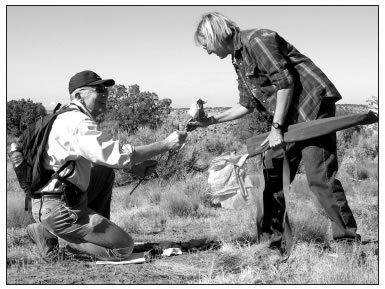
VOLUNTEER DOUG SPORN AND ARCHAEOLOGIST LINDA FARNSWORTH

Exploritas volunteer Doug Sporn of Darnestown, Md., is handed flagging for the day from archaeologist Linda Farnsworth in preparation for conducting a cultural survey in Canyons of the Ancients National Monument. Photo by Ann Bond/San Juan Public Lands Center

Under the guidance of the BLM, McElmo Canyon Research Institute at the Kelly Place, and San Juan Mountains Association, the volunteers spent a week searching for and documenting archaeological sites on a high, dry mesa surrounding one of the monument’s Ancestral Puebloan structures.

Canyons of the Ancients, which was established in 2001 to protect cultural resources on a broad landscape scale, has the highest density of recorded archaeological sites in the nation, yet only one-quarter of its 170,000 acres has been inventoried for cultural sites.

In the past, archaeologists often focused on excavating structures and removing artifacts. Today, they concentrate their efforts on conducting surveys of surface clues spread across landscapes. The goal is to paint a picture of daily life hundreds or thousands of years ago – to learn how the native communities found food and water, and how they were able to prosper in harsh environments. Archaeologists also now consult closely with modern Native American tribes on the cultural context of what is discovered.

The key to success lies in having an intact cultural landscape to survey.

“There are certain artifacts that act like time clocks, and if someone walks away with a vital piece, we lose the evidence that can tell us important things, like what time period was involved or how the people survived,” said Jim Colleran, Exploritas coordinator for the Kelly Place.

First, the volunteers were assigned to the tasks of mapping, flagging, measuring, and recording under the tutelage of the professional archaeologists. Next, they were given the tools of the trade – clipboards and key charts, mapping tape, digital cameras, protractors, flagging, etc. – and were assigned to different areas. In addition to searching for artifacts, they were asked to identify vegetation and soil types.

“They learned there are several interrelated sciences that go into archaeology,” Colleran said.

Each carried a colorful bouquet of pin flags to mark clues they might find – ceramics, lithics or flakes, ground stone, room blocks, wall alignments, even details like rocks or plants that appeared altered or out of place.

“The composition of the colors of the flags offers a visual reference to site boundaries,” said Kristie Arrington, a retired BLM archaeologist, who coordinated the field work on behalf of the San Juan Mountains Association. “The flags can reveal different types of habitation activities, such as cooking, tool production, and trash disposal.”

As pin flags sprouted among the sand and sagebrush, patterns began to appear. One of the most exciting discoveries was a dry sloping slick-rock basin lined with large boulders. When Arrington first spied it, she suspected it had been a prehistoric reservoir. The group postulated that it also appeared to have only recently been breached. Further evidence nearby verified their theories. An old metal project tag was found tacked to the trunk of an oldgrowth juniper on the site.

“These tags were used by the Grazing Service, which later became part of the BLM, to inventory water sources, such as water traps or ponds, as suitable for livestock use between 1935 and 1950,” Arrington said. “It appears that this prehistoric reservoir was so effective that it was still holding reliable water six centuries later when the U.S. government began to regulate multiple uses in the mid 20th Century.”

Below the reservoir, the group added a series of water-control features along a major drainage to their inventory.

“These may have been used to enhance a spring and store extra runoff water,” Arrington said. “The smaller features along the terraces on either side of the drainage were check dams, which could have been used to trap soil for use in fields.”

The Exploritas group also made other discoveries that spanned centuries – from prehistoric Basketmaker habitation to a 1908 field camp important in the history of archaeology itself.

“We completed about 45 acres of intensive survey and located nine sites, including an early 20th Century camp that we believe to be the field camp of Sylvanus Morley,” Arrington said.

Morley, who worked under the auspices of both the Carnegie Institution and National Geographic Society during his career, is best known for his discoveries of Mayan structures in Meso-America. Lesser known is that Morley conducted his earliest field work in the area now within the boundaries of Canyons of the Ancients National Monument. Evidence thought to be the remains of the field camp he used during his excavation of a nearby pueblo were carefully measured, mapped, flagged, and recorded by the volunteers.

The results of the surveys will be documented in a report that will be added to the knowledge base of the monument’s cultural resources.

“The baseline information will allow us to track what kind of human and natural impacts are occurring at the sites in this area,” said Linda Farnsworth, Canyons of the Ancients archaeologist. “It will also help us determine appropriate mitigation for those impacts.”

The volunteers said they gained as much from the experience as the agency will from the information.

“I learned a new interest that I didn’t even know I had,” said Kappy Bolland of Minneapolis, Minn. “I’m fascinated with the inventiveness of these people who didn’t have the resources we do now.”

Ann Bond is a San Juan Public Lands Public Affairs Specialist

Published in December 2009

Living near industry can have drawbacks, citizens say

In the past few years, proposals for new industrial projects in Montezuma County have stirred up a storm of protests.

• In July, neighbors objected vociferously to Empire Electric’s plan to create a two-lot industrial planned unit development on 43 acres at Highway 491 and Road L. The county commissioners did grant the request for industrial zoning [Free Press, Aug. 2009].

• In June, the commissioners, voting 2-1, rejected a hugely controversial proposal for a treatment facility for energy-production wastes in the remote western part of the county. The developer has sued over the turndown. [Free Press, June 2009]

• Every proposal for permits for gravel and asphalt operations in the Mancos Valley has met with stiff resistance since 2007, when an especially odiferous hot-mix plant angered residents there.

• And a dispute over the placement of a 20,000-gallon propane-storage tank in a four-lot residential subdivision near Highway 184 in 2008 was so bitter that the county had sheriff’s deputies at a public hearing on the subject. [Free Press, January 2009] That proposal was eventually scrapped.

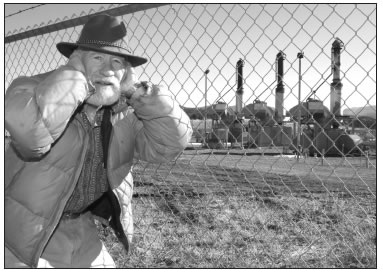
NED HARPER OUTSIDE NATURAL GAS COMPRESSOR STATION

Ned Harper of Summit Ridge stands next to a natural-gas compressor station that neighbors say is obnoxiously loud. Photo by Wendy Mimiaga

“It seems every time something comes along that would help the economy, we have a loud outcry,” said Commissioner Steve Chappell at a public hearing Jan. 12 for the first proposed asphalt operation in the Mancos Valley since the controversial one in 2007. “I think we have to be careful about destroying the economy and making this just somebody’s playground or retirement area.”

Chappell’s comments reflected the sentiments of many of the traditional residents in the county — that newcomers to the area (frequently wealthy retirees) complain about anything that might bring much-needed jobs and tax revenues.

But the situation is not so simple. People who have lived or are living near industrial uses tell a different story. While there are many cases where industry and homeowners can co-exist happily — and where industry even helps landowners by providing extra income to people with pipelines or gas wells on their property — industrial and residential uses are not always a good mix.

The problem, say people who have experienced some of the down side of living near major projects, is twofold: First, the most obnoxious impacts of some projects are often borne by people who see few if any of the financial benefits.

And second, when an operation does something that brings it out of compliance with rules and regulations, it can take months or years for neighbors to get their complaint heard by the appropriate agencies and to receive any relief.

The case of the asphalt plant was a perfect example.

Oh, that smell

Back in the summer of 2007, a number of Mancos Valley residents endured the impacts of a nearby industrial use when the Sky Ute Sand and Gravel Company and its sub-contractor, Kirtland, began making asphalt for a federal paving project for Mesa Verde National Park. Patricia Burk, who lives adjacent to the Noland gravel pit where the asphalt was being made, was among those affected the most.

“They would start these furnaces about 6:30 in the morning,” Burk said. “Then there would be 20 hours of this awful black stuff.”

Burk’s family has owned her property since 1949, when she and her parents first moved there. Burk left home, but moved back in 2001 with her husband. When Highway 160 was built decades ago, it split the tract in two. She now owns 10 acres on the north side of the highway and another 9 acres of the original homestead on the south side, plus more land they bought to the east.

The entrance to the Noland pit lies a few hundred yards to the east of her, with two other gravel pits (Stone and Four Corners Materials) to the east of Noland. “We have an industrial-commercial complex in these few miles along Highway 160,” Burk said.

Truck traffic, noise and dust were also concerns in 2007, but it was the smell that was intolerable, she said. The fumes were foul, by all accounts. The company was making a special type of asphalt required by the federal government for the national park. However, other operators, including officials with Ledcor CMI Inc., which plans a new asphalt project at the Noland pit next summer, have said there was no reason for the fumes to smell so bad and that the other operator was not doing the job right.

The last week in August of 2007 was the worst, according to Burk. “Our house was enveloped in asphalt fumes. You cannot believe what it looked like. Our house, our cattle, the cattle to the south of us — we were just blanketed in asphalt. We raise grass-fed cows and they don’t eat asphalt very well.”

Mary Jane Gosselin and her husband, Toma, moved to the Mancos Valley three years ago as a place to retire, purchasing seven acres on the south side of the highway. “We bought it because of the atmosphere, the cows, the views,” she said. “I was aware there was a gravel pit across the highway but you couldn’t see it.”

But they became well aware of its proximity in summer 2007. “We couldn’t open our window at night and we didn’t have any other cooling in our house,” Gosselin said. “We couldn’t plan a picnic in our yard because you never knew when the bad smells would show up. It made it very difficult to enjoy our own property.”

Seeking a remedy

Initially, neighbors tried to work things out. Gosselin was one of the first people to contact Sky Ute officials. “They said they’d be perfectly willing to work with us and they’d remedy the smells, but it didn’t happen.”

Burk agreed. “We didn’t realize if we wanted something done we had to do everything ourselves,” she said. “We had to get in touch with every agency and file complaints. That’s a very laborious thing for a citizenry to do. We learned these agencies weren’t caretaking our concerns. The EPA didn’t do anything to help us.”

Frustrated citizens finally brought the matter to the county’s attention, but relief was slow in coming. The planning department finally decided that although the Noland gravel pit had been in existence since before the land-use code was adopted, the asphalt operation was something new and therefore required a permit, which the companies had not sought.

“Weeks went by, while the companies were still spewing their crud into our world,” Burk said.

So, having found no help from federal or state agencies, the citizens pressed the county to stop a project that was being run under a contract with the federal government. And the county did shut down the asphalt operation, although by then the project was essentially over.

“Nothing happened and nobody helped us until we went to the commissioners,” Gosselin said. “They shut them down but it was three days before the project was due to end anyway. We lost that entire summer in terms of going outside and enjoying ourselves.”

The Noland family, owners of the pit, sued the county over the shutdown, claiming they did not need a high-impact permit, but the county prevailed in district court.

Making noise

Industry of a completely different type has affected a number of people living on Summit Ridge in the vicinity of a natural-gas compressor station called the Dolores Pumping Station. The compressor is run by Enterprise Products, which recently merged with Teppco Partners LP to create the largest publicly traded energy partnership in the country, according to the company’s web site.

The station is one of many compressors along a Mid-America Pipeline Company (MAPCO) pipeline that runs from Wyoming through Utah, Colorado and New Mexico. The main problem with the compressor station, neighbors say, is the noise.

“You can’t even see the place from where I live, yet it roars all night long,” said John Whitaker, who lives nearly a mile away. “We notice it mostly in the summer at night. There’s a constant roar. It sounds like a jet engine going over, all night long.”

Whitaker, who owns a company that does custom coating of metal surfaces, said he is certainly not opposed to industry. “I think we need some light industry to improve employment,” he said. “I’m all for it.”

But his own company operates from the Cortez Industrial Park and has been careful to use dust control and all appropriate mitigation, he said. So he was surprised that the pumping station’s operators were reluctant to do anything to help the neighbors. Years ago, when Whitaker lived in another house in the same area, he complained to the companies that then owned the station, Williams and Questar. “They sent out a guy, but we never got any resolution. They just said, ‘Sorry, guys. These are our residential mufflers already on it’.”

Jack Spence, a retired chemistry professor who lives about a mile away, said the noise can be loud at his place too. “It depends on the direction of the wind and on how many of their compressors are running,” he said. For people living closer, the noise intensifies exponentially. Those closest to it experience noise that is “way above what it’s supposed to be, 55 decibels at the maximum,” according to Spence’s calculations.

When another expansion of the pipeline was proposed in 2001, Spence obtained a copy of the environmental impact statement and wrote comments to the BLM, which was overseeing the project because it was on public lands. “I was appalled at the poor quality of the EIS,” Spence recalled. He said a map showed the plant as being near Dolores and stated that no one was living nearby. “It was just ridiculous. I took a topographic map and marked 10 or 15 places that were within 3,000 feet of it and sent it to them, but they never answered.”

The BLM eventually gave the goahead to the expansion, but there was an economic downturn and Williams abandoned the plan, Spence said.

He said he believes the company should either install quieter electric turbines, or do as was promised by running only at night and at a much lower volume. “But that reduces the capacity of the line and they’re interested in getting the maximum amount of gas down to Texas,” he said.

Lighting the sky

Of course, most of the people now living near the compressor station moved there after the original small station was in place, but not all of them. Dave Petillo was in his home in 1980 when the station was constructed just 200 yards away.

“At that point I was definitely the only one in this area,” he said. He knows there was a public notice and comment period, but he didn’t pay much attention. “I didn’t get involved,” Petillo said. “I knew there was going to be a pipeline, not that there was going to be a compressor station.”

But one morning he woke to the ground rumbling. “I looked out my bedroom window and there were four V-8 Caterpillars all over the hill, clearing the right of way,” he said. “That was when everything really hit me.”

When the station began operating, it was so noisy that Petillo talked to company officials. “They said it was just the start-up phase and that it was going to be quiet,” he said. But it was not quiet. And in later years the station doubled in size. Shortly after, there was such a huge flare from the station that Petillo called the fire department. “It lit up the sky,” he said. “The next day I got a call from a company official in Houston, Texas, saying if I had a problem I should call them, not the fire department.”

That is the only contact he’s had with any of the companies, he said. Meanwhile, the noise continues. “What it sounds like is a jet engine. It’s every day, but it varies in time,” he said. “It’s usually in the four-hour range per day, no more than that.”

At one point, he said, there was an even louder bellowing and red dust came out the top of the stacks. The company reportedly said “something got in the line and it destroyed one of the turbines.” In addition, there is sometimes a smell. “It hasn’t been very often, but at times you would definitely have to shut the windows and doors because it would burn your eyes.” Bright lights have also been a problem, but the company eventually adjusted the lights so they aren’t as intrusive, and Petillo keeps his blinds closed.

Petillo said he turns on a fan to mask the turbines’ sound at night, but if the wind is blowing from the south, he can’t sleep with the window open, even in summer. “It’s that irritating.”

Petillo said he recognizes that natural gas is needed, pipelines and compressor stations are needed, and jobs and tax revenues are important. But he believes he and his neighbors are being asked to shoulder too much of the burden for someone else’s profits.

“The people that own this place, they don’t want it in their backyard,” he said. “I would say within a half-mile radius you have maybe a hundred people around this thing. Why not try putting this in Cortez and see what response you would get?

“I just hope one day they run out of whatever they’re pumping out of the ground and it shuts down, because nothing seems to have deterred them.”

Feeling optimistic

Like the neighbors of the Mancos asphalt operation, neighbors of the pumping station have found it a frustrating experience trying to get the problem mitigated.

Ned Harper said he called the Colorado Oil and Gas Commission and a woman came out and measured the sound. She found that the decibel levels exceeded state rules, but said the COGCC had no jurisdiction because the pipeline originated out of state. Harper contacted the Federal Energy Regulatory Commission but said he was told that they did not have jurisdiction over liquid natural gas, only the gas itself.

The county has no authority because the station pre-dates the land-use code.

Neighbors have signed petitions, made calls, and written letters, but to no avail so far.

However, at press time Harper said he had spoken to a man with Enterprise Products in New Mexico who promised him the company would erect baffles around the working turbines to muffle the sound and would also redirect the exhaust so it points away from the nearby homes.

The Mancos Valley residents say things have improved greatly since 2007. Although more gravel operations have been approved at adjoining pits, and the county has given the go-ahead to the new hot-mix plant at the Noland pit, Burk is optimistic. She said the county commissioners have been receptive to residents’ concerns and it showed with the Ledcor proposal, which was passed with some stringent stipulations, including air-quality monitoring, county oversight of the testing, and required shutdowns for violations.

She praised the efforts of the commissioners’ attorney, Bob Slough, in working to achieve the stipulations and mitigations. “He understand; he listens,” she said. She also praised county planning director Susan Carver for being responsive and receptive.

Burk advises other citizens with problems to be persistent. “You have to stick wtih an issue. You have to be involved. It took us 2 1/2 years to get these gains.”

But there are still impacts, she said.

“After 2 1/2 years I have come to the conclusion that the noise and the dust — you can’t mitigate it no matter how you try,” she said.

Gosselin said she is also optimistic, but she still believes the concentration of industrial activities along that stretch in the valley is too much. “I can understand one gravel pit in the neighborhood, but now we’ve got three and it seems to me overkill.”

Gosselin said her father and grandfather were in the lumber industry and she knows industry is important, but it must be done right. “I really do believe in property rights and I do believe people should be able to do what they want on their own property if it’s not hurting the neighbors,” she said. “When what people do affects someone else’s property, that’s where the line should be drawn.”

So far, with two gravel operations going, “it doesn’t seem to be much of a nuisance,” Gosselin said.

But she said if she had been looking for a house during the summer of 2007, she would never have bought that tract. “If I’d been looking and that terrible smell was there, no, I wouldn’t have bought it. I just hope Ledcor will do what they say they’ll do.”

Published in December 2009

Celebrating the holidays, Four Corners style

Webster’s dictionary defines “give” as: “to present voluntarily and without expecting compensation; to care about something; to relinquish or sacrifice (to give one’s … for); make a gift or contribute.”

This time of year, our thoughts normally turn to giving. Many of us are frantically making lists of family and friends as the hysteria and pressure of the holiday commercials begin their pre-Christmas attack.

However, giving is not limited to the holiday season. Nor is it limited to tangible gifts bought by money. In parenting circles the giving of “time and self” is hands-down the most powerful and important gift any child can receive from a caregiver. This holds true for family and friends.

The gift of time and self is also critically important to the many causes and organizations which simply cannot function without volunteers. Time and energy are often the most important contributions a person can share.

Whether we are talking about a financial gift or a gift of self, the fact is that most of us really enjoy giving. We love seeing the smile on a loved one’s face when they open the special present you spent so much time finding. Or that feeling of warmth after spending an evening at the homeless shelter helping serve food; taking a child with few or no resources out to a movie; baking a pie to sell at a bake sale to help animals. Giving makes us feel good and those that receive our gifts are richer as a result.

Why do people give? Where do they give?

People give to the individuals and causes they believe in, the things that tug at their hearts and speak to their values. In a “village” such as ours people have a wide variety of passions and causes. Because of this giving, the many service organizations in a community can continue to function. In fact, without the gifts of time and/or money from the community, many of these organizations would cease to exist.

Depending on what you value, support, and care about, you have many options for giving in the local area. Your gifts need not be monetary; many organizations can use volunteers or board members. And remember there are a host of thrift stores in the area that support charitable causes, including the La Plata County Humane Society, Salvation Army and Volunteers of America; just shopping at those can help support a cause.

Here are a few suggestions, broken down by category of service:

Children

Did you ever go to the Piñon Project talent show or Partners’ Twelve Hours of Mesa Verde bike race? The money from these events and others helps children and families in need.

The needs of children in this area are legion. There are organizations that reach out to disadvantaged children and families. The Piñon Project is a place that brings together people and resources needed to support families in Montezuma County. Partners is a mentoring and support program for atrisk youth.

Victims of abuse and neglect receive help from The Nest, which provides a safe, child-friendly environment that eases the emotional trauma experienced by children during the investigation and prosecution of child abuse cases. For the disabled, Southwest Kids, a program of Community Connections, Inc., provides early-intervention supports and services.

The School Community Youth Coalition undertakes a variety of activities and programs that meet the needs of youth in our community including Teen Maze, Meth Action, STUDS (Students Taking Action Against Underage Drinking) radio shows and newsletters.

The disadvantaged

Stop by one of Cortez’s soup kitchen (Grace’s or Hope’s Kitchen) and see the volunteers cheerily dishing up mashed potatoes. Or stick your head into the Bridge Emergency Shelter on any winter night and watch a volunteer help an elderly gentleman to bed, offer hot soup to someone shivering with cold, or play cards with someone lonely, out-on-their-luck and tired. Come by the Good Samaritan Center in its modest office behind Slavens in downtown Cortez, and see the disadvantaged receive food, help with lodging, and information on other resources. Lift a hammmer with volunteers for Habitat for Humanity, which has chapters in La Plata and Montezuma counties. Find out how local churches and faith-based organizations are helping those who, at some point in life, cannot help themselves. Helping the disadvantaged in our world and/or community weaves the thread of compassion to help us realize: “There but for the grace of God go I.”

The disabled

Talk to the folks at Community Connections and see them light up as they recount the success of one of their residents. Or learn how the Medicine Horse Center in Mancos offers horseassisted therapy for children and adults with disabilities as well as for people recovering from trauma such as sexual abuse.

Sit by the bed of someone living their last few months or weeks, and help them with their passage – it’s what Hospice of Montezuma does on a daily basis. Helping those deep transitions from life to death or from helplessness to empowerment connects the circle of true community.

The abused

Montezuma County now has its own safe house (called Wings) for abused individuals. Durango has another called the Southwest Safehouse. Safe housing, along with the free counseling offered by Renew, can help empower the powerless, offering them security and hope. Renew is a private, not-for-profit agency for victims of domestic violence and sexual assault and for adult survivors of child sex abuse. Abuse can only be stopped if it is acknowledged. The Nest offers help and safety for children and youth. Looking into the dark eyes of an abused soul can change your life forever.

In addition, the Durango Community Shelter provides temporary housing for the sober homeless.

Animals

How many of you have bought mouth-watering baked goods in front of City Market to help For Pet’s Sake Humane Society, the nonprofit serving Montezuma and Dolores counties? Did you know there was a local horse rescue or that wildlife rehabilitator Sheryl Rose is still working hard saving injured raptors and animals large and small? Animals cannot speak for themselves. The organizations that are devoted to speaking for and saving animals, are a vital component to this our community. Many such organizations can use donations not just of money, but of items such as dog and cat food, clean sheets or towels, bleach, dog houses and more.

The environment

The region is home to a host of organizations that fight sometimesexhausting battles to protect our land, water and air. San Juan Citizens Alliance, with offices in both Durango and Cortez, works on issues involving oil and gas, watershed protection, air quality and more in Southwest Colorado and northern New Mexico. Community members from Greater Dolores Action, a citizens’ nonprofit, just worked in November to clean up metal hazards such as old cars from the Dolores River, making it cleaner and safer for wildlife, fishermen and rafters.

Great Old Broads for Wilderness, based in Durango, focuses on impacts to public lands in Southwest Colorado and southeastern Utah. The San Juan Mountains Association, working with public-lands agencies, provides education and outdoor excursions.

Community

Community is a broad topic. There are people committed to helping create sustainability through the encouragement of local food producers. The Southwest Community Leadership Collaborative houses Leadership Montezuma, High School Leadership Montezuma, and The Summit Leadership series. KSJD Dryland Community Radio works to provide locally based, community-oriented radio.

All are dedicated to create awareness; education and encouragement to a generation of leaders who will help govern all aspects of our community. This paper (Free Press) is an example of dedication to the community. One small ad can make the difference in the survival of community outreach programs such as the radio station or the paper.

Health

Most of us have been touched by health issues – either with ourselves, our families or friends. Cancer and heart disease still rob us of wonderful people daily. Families are fractured by the slow and devastating effects of Alzheimer’s. Supporting the organizations that fight these and other terrible diseases can make a difference. The local Relay for Life chapter is already hard at work preparing for its next fundraiser in the summer.

The elderly

Would you have time to visit a nursing home or volunteer at a local senior center? Your presence would mean the world to an elderly person – who someday may be you.

The list of worthy causes and organizations is huge, and limited only by the vision and passion of the people committed to giving time and money to support these causes. Some organizations like the United Way help support a great number of these organizations which casts your gifts in a wide web of worthy recipients.

However, these days the pie is small and getting smaller. The recession is hitting service organizations — hard. As people lose jobs they stop giving – often out of necessity. Some groups have reported a huge drop in funding and giving since last year. They are worried.

So if you think your gift is too small or inconsequential, think again. Every dollar and ounce of energy counts, whether it comes from a cookie or a tote bag, an ad on the radio or in the paper, an evening spent at the shelter, volunteer time managing phones or QuickBooks, marathon meetings, gathering items for a silent auction, taking a child to the park, wiping the tears of an abused woman, washing dishes, sorting clothes — it all matters. And it’s all vitally important.

This season, take into consideration your own passions, concerns and values and if possible give “voluntarily and without expecting compensation” to the things that matter most to your heart. Suggestions:

• Instead of giving “stuff” to family and friends, make a donation to their favorite cause.

• At holiday parties, have everyone put their favorite cause into a hat. Whatever name you draw, you donate to an organization that supports it.

• Buy local if possible. Those local providers donate resources and money to the organizations you care about.

• Spend time learning more about the organizations that support your passion. Join a board or just visit. Give whatever you can – however you can. It may surprise you how far a little can go.

For a detailed listing of local nonprofits, charities, and organizations that could use your help, visit www.fourcornersfreepress.com and click on Community Resources and Giving Opportunities.

Published in December 2009

Facing a painted reality

Ed Singer is an artist who renders contemporary reality on the Navajo reservation with a hard experiential lens on internal politics. It’s what he sees, hears, observes and knows firsthand.

“Even so,” he insists, “it’s not political art.” It is instead a reflection of his Native American point of view in Cameron, Ariz., where he is also president of his local Navajo Nation chapter.

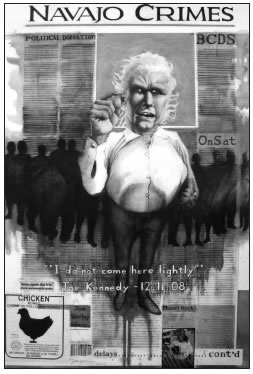
PAINTING BY ED SINGER TITLED ANNUNCIATION

“Annunciation,” by Ed Singer, is on display at the Dessert Pearl Gallery in Cortez as part of his new exhibit.

Singer compares the current situation in the Navajo Nation central government to a painting by Francisco de Goya, “Saturn Devouring his Son,” in which he is eating his children at birth because he fears they will overthrow him. “Our council delegates voted in support of the local community- initiative structure that allows us to decide our own destiny, to develop projects that bring benefits for the first time to the communities in which they are emergent,” Singer said.

“But the reality is this: we are shut down instead, like our wind farm has been stalled by political parlaying behind the scenes to keep us out of direct financial benefit and out of the driver’s seat, even though the wind-farm site is on our land in our back yard and our personal family histories. It feels like the content in Goya’s painting.” As chapter president, Singer has been wrangling with the powers in Window Rock, site of the Navajo Nation central government, over the wind-farm resolution his community passed more than two years ago to contract with two outside companies to build a 500-megawatt project on the slopes of Gray Mountain in northern Arizona. The project remains in the planning stages, held at bay while shifting interests and outsiders, such as Citizens Energy CEO Joe Kennedy II of Boston, vie with Cameron’s community for development rights and fiscal control of the project.

Singer’s current body of work reflects his present life and the rebuff he and his community have experienced. “Navajo Crimes,” a mixed-media piece in his new exhibit at The Desert Pearl Gallery in Cortez, presents Joe Kennedy II in the foreground, dominating the Cameron wind-farm project. His caricature floats out of the text columns, headlines, masthead and photojournalism found in a newspaper format. He shakes his finger at the Cameron community, and at Singer, as he did at a meeting in December 2008, saying, “I do not come here lightly!” It is rendered in pencil, ink, oil washes, photocopies and a black-and-white label taken off a government surplus can of Chicken (Sin Hueso).

“The piece has been in my mind for a long time,” Singer said. “It is a parody because ‘Navajo Crimes’ rhymes with the newspaper ‘Navajo Times,’ where some of the topics are addressed — but not all of them, such as the condescending, insulting treatment of our community. It [the newspaper] happens to be the vehicle for the message. But the content of the piece shows the economic abuses being committed against the Navajo people by outsiders as well as our own central government.”

Hand-drawn images of council delegates and Navajo President Joe Shirley (now on administrative leave) support headlines referencing Shirley’s alleged procurement violations involving contracts with companies doing business with the Navajo Nation, as well as business meetings held in Las Vegas at the expense of the people.

Desert Rock, the proposed coal-fired power plant that would be the fourth on the Navajo reservation is also on the front page above a photograph of a Navajo woman singing behind a chain-link fence, suggesting the familiar decay of people who remain spectators locked behind a circular pattern of “delay, waiting, abuse……….. cont’d” lettered into the banner at the bottom of the page.

The politics in Singer’s current work are an outgrowth of what is in front of him today, but he says his works are not intended as political statements.

CARTOON DEPICTION OF JOSEPH KENNEDY

“Navajo Crimes,” a poster by Ed Singer, depicts Joseph Kennedy II, who is in a power struggle with the Cameron, Ariz., community where Singer lives.

“There is no way you can be a political painter if you are Native American in the USA today, especially in an age when there is such wholesale disregard for treaty obligations. I do not paint and draw political statements. Because I am an artist I react to my environment and the life around me. To me they are just paintings and drawings.”

Other works in the exhibit show his powerful return to the large oil paintings he was known for in the 1970s – 1990s. The latest canvas measures 7 by 5 1/2 feet. It is monumental in its museum scale and old masters glazing technique. The content is based on a comment he heard while interpreting during Navajo intake meetings held by the National Park Service. At that time many elders came to tell their stories about the Long Walk (see Free Press, September 2009) and to offer opinions on the proposed National Historic Trail designation commemorating the 1864 forced march relocating 10,000 Navajos to Bosque Redondo, Ft. Sumner, N.M..

“One old man told how his father said they walked home from the four-year incarceration ‘on a road of bones and hair.’” That statement has stuck with Singer since he heard it in 2006. The painting depicts the grim road, bones and hair partially buried in shadow beneath dark magenta earth. But above it he painted a trail of victorious people returning in a warm yellow landscape awash in sunlight. He began the painting six months ago while serving as artist-in-residence at the Aspen Guard Station. It is on view for the first time since its completion in Cortez.

Singer is also exhibiting “Annunciation,” a 10-by-6- foot portrait of Gray Mountain at the western edge of the Navajo reservation. It has been shipped from Phoenix to Cortez by the collector who wants it on public exhibit. Although Gray Mountain is a vast geological monocline, “the size of the painting,” said Singer, “is due primarily to the commission. It’s really the size the collector wanted.”

The great expanse of canvas gave Singer a chance to represent the same dynamic upheavals found in the rocky, serrated, severe mountain terrain that has been his family home for generations.

Initially he used a hose to spray water on the fresh paint, creating runs and drips incorporated in the final painting. Such a fluid state of medium can show through the following layers of built-up oil paint, offering the artist an opportunity to create obscure resolutions on the smaller land forms in the composition. Singer followed the metaphorical narrative in the cloud formations, too, showing another dynamic dialogue between the arching forces, the upheaval that brings rapid rains and windstorms in late summer and with them the bounty contained in the earth.

“The mountain is known to the Navajo people as a mountain of providence. I named it ‘Annunciation,’ in honor of the hope that another appearance of providence will initiate renewable- energy projects and benefits to the people in our community.”

Additional work in his exhibit includes caricature drawings of Navajo politicians and council delegates. Many are done in situ while he sits in meetings in Window Rock, a four-hour drive from his home.

“My work as an artist is similar to the interpreting I do. For a long time my community relied only on me to interpret English and Navajo for them. I have encouraged others to develop their own interpreting skills. It feels good now that a few have begun because a language, a culture, only stays alive as long as it’s used.

“I was fortunate to learn this traditional adult form of Navajo because it was what was before me when I was a child. It is the same with the paintings. I show what is before me, what is happening. I do not seek a political narrative. It’s just there when I pick up my pencil and paintbrush.”

Published in Arts & Entertainment, December 2009

Make mine pulp, please

On the B-Lazy Ranch, the paperboy — still wearing his pajamas — boots up his computer and attaches his neighborhood route subscribers with a special command, then he pushes a button and crawls back into bed. Even before he has fallen asleep, the newest edition of the e-news has been delivered to a couple hundred virtual doorsteps.

As a naive teenager in the late 1960s, that’s how I’d have imagined a futuristic America, one where any work required of me would would demand less physical exertion. And maybe today’s electronic world is more efficient, though I’m disappointed that paperboys are becoming obsolete along with the newspapers they used to deliver, so quickly turning into artifacts.

Back then I’d set my alarm to wake before sunrise, dress in warm clothes, then load my bicycle baskets with news so fresh my hands would be black with the ink of a hundred headlines. Don’t get me wrong: I’m glad I still don’t have to deliver newspapers for a living, but I’m saddened by the gradual demise of the news in its print form, especially on Sundays when the headlines possessed such an undeniable weight.

As the economy forces us to believe that dollars make the only sense, it’s easy to see why traditional newspapers are folding in record numbers. Good, solid research as a prerequisite for journalism costs money, and it takes time. And isn’t it kind of arrogant to believe the entire world’s population should be plugged into the electronic age? In terms of resources, sure, it appears like an ecological no-brainer to reduce the news to a tweet and a twitter, but have you ever tried to complete a crossword puzzle on your iPhone or been forced to drape a laptop over the arm of your chair while you go for another cup of coffee? As with every new technology, they say change is inevitable, but somebody should also say, well, there’s good and there’s bad news. Which do you want to hear first?

Without newsprint the British will have nothing to wrap their fish and chips. The homeless will be colder. An inordinate number of dogs may be injured when their owners try to discipline them with rolled-up keyboards.

Of course, there’s also good news, because newspapers are, by their very nature, wireless, and you’ll never have to wait for newspaper ads to finishing loading before you’re allowed to read the next page. I’m all for change but “All the news that’s fit to blog” will never catch on, because, frankly, it just sounds stupid.

So you see, there’s nothing old-fashioned about picking up a newspaper. They’re mostly recyclable, and if the power goes out, you can always start a fire with yesterday’s news. Try doing that with your laptop.

David Feela writes from rural Montezuma County, Colo.

Published in David Feela

Why is population a forbidden subject?

Over the last few months, I’ve been asking friends, relatives, and strangers what they think of when they hear the word “save.” The answers were varied; some made reference to one’s soul, while others talked about saving money for the future. Money and material items were at the top of the list.

Only a few mentioned the environment or natural resources, but think about it. What use are money and material goods if we destroy this planet? All my life I’ve been hearing about conservation, but so far the efforts seem to have made little headway. We have clean-air laws, but pollution blows over from China. We have laws about clean water, but then people in the West drink from their wells and discovers they’ve been contaminated by nearby natural-gas-drilling.

Across the country there is a call for more and more power plants, even while it becomes obvious that burning fossil fuels is heating up this old globe at a rapid rate. Rain forests are being mowed down to make room for crops. The Sahara Desert grows as poor people chop down vegetation to build fires. Animals go extinct due to loss of habitat. We are losing our precious food source from the oceans thanks to over-fishing and pollution.

What’s the common thread in all this? A thinking person might say, “Eureka! It’s the population, stupid!”

What matters may not be how much we throw away but how many throw away how much.

But wait! you say. Isn’t it taboo to discuss population? Doesn’t it amount to the closed-gate theory: “I’m here, so I want to keep out others”?

Well, no. I’m not concerned about keeping out others in order to make room for me. I know my time will come. But I have left behind a multiplier of three. We best take a good long look at the facts. Two-thirds of this planet is covered by water. Of this, only a small portion is potable. Much of the land is mountainous or desert, not the best for human habitation. That leaves only a small portion of this earth that can provide food and habitat for human beings.

Why is the idea of limiting our population so shocking? We know that game animals in the wild must be culled, whether by four-legged predators or humans with guns, or they would cover the earth. We know that pasture lands will sustain only so many domestic animals at a time. And yes, we are animals too, no matter if one believes we fell out of a tree, slithered from under a rock, washed ashore or were driven from the Garden of Eden.

Why, then, have we not realized that we cannot sustain an ever-growing human population? “Go forth and multiply” is no longer the road to survival. Centuries of wars, famine and disease have done little to stem the tide of overpopulation. Nor has abstinence ever caught on. Only education about birth control and the consequences of overpopulation will suffice. We can get as “green” as we want and conserve as much as we can — recycle, monitor air and water, buy organic — but until we confront the real polluter, human overpopulation, we are just spinning our wheels in the sands of time and throwing up a dust screen.

In my short 80 years, the United States has grown from about 125 million in the 1930s to more than 300 million today. China, despite horrifically strict laws about birth control and reproduction, numbers 1.3 billion and counting. Then there is India, which cannot feed its people or provide them with centralized sewer systems.

Clean air, clean water, and open space to grow food: Without these, King Midas himself would be a poor man. But the more children we raise, the less room, water and food each will have. We have found ways to squeeze more crops out of farm land through the use of chemical fertilizers, but how long can that go on? And what about water? No technology has been found yet to efficiently and cheaply de-salinate ocean water. It’s pie in the sky to believe that technology will always find an answer and that the population can just grow forever.

People say that anyone who worries about overpopulation must want others to die, but that isn’t the case at all. The fact is, if we just keep growing, more people will die prematurely from starvation, wars and disease. The more children we raise, the less room, water and food for each of them, which only leads to more war and starvation.

I want the people who are here, plus our future generations, to be able to live full lives with all the food and clean water and space they need. There is no technology that can make the earth larger and give us new continents to spread onto. “Fly me to the moon” is a love song, not a road map to a new frontier.

Galen Larson writes from rural Montezuma County, Colo.

Published in Galen Larson

While there is time

For the world, Sept. 14 is the day actor Patrick Swayze died of pancreatic cancer. For me, it’s the day after I learned my 71-year-old father had been diagnosed with the same deadly disease. He’d complained of stomach pain for a few months. By the time the diagnosis came down, he was Stage IV. The 6- foot-1 man who often joked about living to 120 is now fighting hard to see Christmas.

Pancreatic cancer is aggressive. In most cases, chemo can only temporarily arrest its spread. By the time of diagnosis, it is too late for many patients. Organ failure is the end result of this little-understood, devastating disease.

In the quiet spaces between learning this information and receiving sympathy from kind people, there’s the grim reality I can’t wrap my head around. What I do know is, I cannot control it. There is no reason “why.” There is only what is.

Dad knows what is. His words, at least, demonstrate acceptance — he even told one of my cousins he was “jiggy with” his diagnosis.

I am not jiggy with it. I can’t comprehend life without him.

But that is because Dad is not dead. While there is time, I am determined to use it well. I am also trying to remember he is still Dad; that he did not turn overnight into a zoo exhibit to be stared at, followed everywhere, and treated as a person who no longer owns his humanity just because we are afraid.

While there is time, I call him nightly. While there is time, I visit. While there is time, I record the stories he told throughout his life. Two of those stories, now, stand out.

In the 1950s, Dad nearly dies when the car he’s riding in slams into a tree at a high rate of speed. The doctors tell my grandparents and my uncle to prepare for the worst. It doesn’t happen. He pulls through, though, he says, the crutches got in the way when he attempted to “settle” with the driver the way young hotheads tended to settle differences back then.

Flashback to the 50s again. Dad’s giving a ride to a buddy and the buddy’s girl. He makes a wrong turn, onto a dead end lane. A car comes up behind them, and he tries to tell the driver to turn around because there is nowhere to go. But something is “off” with the other driver, who’s clearly interested in the girl. Dad never has the chance to hit the man with the length of chain he has on the floorboard. There’s a gun in his face. He and his friend are ordered out of the car and told to run on ahead, without looking back.

Dad has no choice but to leave, but he refuses to run, and gets mouthy with the gunman. Ohio murderer Alfred “Buck” Wilson lets them live, apparently, because he feels like it. The girl is not so lucky. Her body is found later; she was shot to death. An Ohio trooper later shoots Wilson from a tree, killing him.

Dad doesn’t remember every detail of that night. Contemporary news accounts refer to “two boys” being forced away from the girl and told to “get money.” He does not recall that, but he does remember being run off from the first place he and his friend went for help. He remembers the next place, as well — it was the second time in one night that he had a gun shoved in his face. The woman who answered the door was none too trusting of strangers, and kept her gun trained on him while he called authorities. These stories stand out for one reason: They are perspective. While cancer is cheating Dad out of the balance of his life, from another view, he was given extra decades. The stories are proof of an uncomfortable truth: Sometimes you get lucky, but in the end, luck runs out. Or, as Dad, who only rarely sugarcoats things, says: We’ve all been dying since the day we were born.

Thomas Heidelberg is a retired sign painter. Maybe you’ve heard of him; maybe not. But I have: He is my dad and always will be. I can’t save him. I can’t let him go. There is one thing, though, that I can do. While there is time, I can say: “I love you.”

Katharhynn Heidelberg writes from Montrose, Colo.

Published in Katharhynn Heidelberg

Alternative views on combating flu: Holistic practitioners offer options for the vaccine-leery


Related story

Swine-flu furor

For naturopathic and alternativemedicine practitioners, a shot in the arm is not the preferred way to prevent the flu, whether it’s H1N1 or the typical season flu.

While they say there may be certain patients for whom a flu vaccination is a good idea, alternative-medicine practitioners advocate building up one’s immune system and avoiding germs as ways to stay well, particularly for people who are leery of vaccines.

“Vaccination is a very controversial subject,” said Jeff Santay, a doctor of Oriental medicine practicing in Cortez. He said he received the swine-flu vaccine during the pandemic scare of 1976, “and I’ve never been sicker in my life, as a result of the vaccination.”

Since then, he doesn’t get flu shots. “If somebody is used to getting a flu shot every year, I don’t tell them not to do it, but personally I believe keeping the immune system stronger is the way to go,” he said.

Lyn Patrick, a doctor of naturopathy with Durango Natural medicine, agrees. While she is not opposed to all vaccines, she does believe there may be alternatives to flu vaccine for people who are hesitant to be vaccinated.

“Whether to get vaccinated is a very, very political issue,” she said. “I believe there are alternatives to being vaccinated, unless someone is immune-compromised. [Such individuals include people with severe respiratory diseases, diabetes, heart disease or other health conditions.] People in those high-risk categories need to be considered on a case-by-case basis.”

Patrick said she has concerns about the H1N1 vaccine because it was hurried into production. “We do have a historical perspective from the last time there was a fast-tracked vaccine that the U.S. population was subjected to,” she said, referring to the 1976 swineflu vaccine also cited by Santay.

That episode lingers in the minds of many older Americans as an example of the government scaring people needlessly over a possible pandemic that never materialized. After reports of a potentially dangerous swine-flu strain emerging early in 1976, the government launched a $137 million program to produce and distribute a vaccine against that flu.

Seasonal-flu vaccine: The skeptics’ view

The journals, newsletters and Internet sites published by complementary physicians and other health professionals are replete with commentaries critical of the flu vaccine and those who push it onto the public (such as officials at the Centers For Disease Control, or CDC, who often have ties to the pharmaceutical industry).

For example, Mark A. Sircus, O.M.D., writes (http://www. mercola.com/ 2004/oct/23/ flu_crimes.htm) that officials at the CDC, trying to marshal whatever evidence they can to substantiate the belief that flu vaccines are needed, state that 135 children died during the 2003-2204 flu season. Well, 59 of these children had received the “much-needed” flu shots. Yet a researcher at the CDC estimated that from 1990 to 1999, an average of approximately only 92 influenza-related deaths occurred each year among children less than 5 years of age. How many of those were vaccinerelated, and, given the fact that those who died with flu usually do so because of compromised immune systems from other causes such as poor nutrition or other environmental causes, not flu virus, who, other than those who profit from it, would want to recommend a vaccine? (See SCDC: www.cdc.gov/flu/ avian/gen-info/pandemics.htm and www.cdc.gov/ flu/about/qa/ 0304season.htm)

For adults who think the flu vaccine may be helpful for them, Sircus notes that Dr. Hugh Fudenburg states that if an individual has five consecutive flu shots his or her chances of developing Alzheimer’s disease are 10 times greater than if they had one, two or no shots. Sircus paraphrases Fudenburg speaking about officials at the CDC who set vaccine policy nationwide: “Medical’ terrorist [could be a description] because of their well-known conflicts of interests with the major pharmaceutical companies, meaning too many people in the medical establishment benefit directly or indirectly from pharmaceutical profits.

The entire vaccine department at the CDC should be faced with Nuremberg Trials for they are breaking the Nuremberg Code by administering the flu vaccine [with its toxic load of mercury, aluminum and even formaldehyde — in addition to the already heavy childhood immunization schedule in place] to 6-month-old babies starting this year, and every year thereafter.” (See reference above. Dr. Fudenburg’s comments are from his speech at the NVIC International Vaccine Conference, Arlington VA, September, 1997.

For more vaccine related information see http://www.909shot.com/, http://www.vaccines.net, http://www.access1.net/via and http://home.sprynet.com/~gyrene/ind ex.htm.)

This commentary is provided by Dyanna Hoffman and is reprinted from the January/February 2005 issue of Well Being Journal.

Not long after people began being vaccinated, there were reports that the vaccine increased the risk for Guillain- Barre syndrome, a rare and dangerous neurological condition. Some 40 million Americans received the shots and 500 reportedly developed Guillain- Barre syndrome. Tenty-five died, a number that Patrick believes may be too low because of under-reporting.

“The episode triggered an enduring public backlash against flu vaccination, embarrassed the federal government and cost the director of the U.S. Center for Disease Control. . . his job,” stated an article in the Los Angeles Times published earlier this year.

“When you fast-track vaccines, people have to suffer the consequences,” Patrick said. She is especially concerned about pregnant women receiving the H1N1 vaccine. “I think subjecting a fetus to a vaccine whose safety has not been tested on pregnant women on a large scale is a big concern.”

However, she knows that pregnant women are also especially vulnerable to the effects of the H1N1 flu and she emphasized that she is not telling people not to be vaccinated. “I’m not telling them what to do. You have to educate people thoroughly and let them decide.”

Patrick said there are many vaccines that are definitely beneficial under certain circumstances. For example, people who carry the Hepatitis C virus need to be vaccinated against Hepatitis A and B because those illnesses can be swiftly fatal otherwise, she said. “There are situations in which I absolutely believe vaccination is appropriate and necessary. I’m not an anti-vaccination person as a physician, but the question has to be decided on a case-by-case basis.”

The Los Angeles Times article noted that flu vaccines have been given annually since 1976 without such serious side effects, and the technology used to develop vaccines has improved greatly in the three decades since then.

For people who don’t want to get a flu shot, Patrick recommends the standard common-sense hygiene practices. She also suggests taking Vitamin D supplements — it should be D3, not D2, she said — of up to 2,000 IUs per day. Americans tend to have low levels of Vitamin D, and the literature suggests it helps strengthen the immune system.

Several recently published studies have suggested a relationship between low Vitamin D levels and susceptibility to upper respiratory infections. One study published in the Archives of Internal medicine in February found that in a group of 19,000 people 12 and over, those with low levels of the vitamin were 55 percent more likely to have had a respiratory infection recently. Some researchers even speculate that the flu could flourish in the fall and winter because people aren’t in the sunshine and have less Vitamin D in their blood then.

Patrick also recommends supplements of N-acetyl cysteine, an overthe- counter amino acid, and getting plenty of sleep.

Santay likewise recommends taking other measures to stay healthy rather than just relying on vaccination. He said people in the United States become sick for two major reasons.

First, they simply don’t take enough preventive measures to avoid illness in general.

He said he went to a house recently where a party was going on, “and there was a woman in the middle of the room sitting with a box of Kleenex, sneezing and blowing her nose constantly. I just turned around and walked out. People don’t think about the fact that, if you sneeze, the germs will travel 9 to 12 feet.

“In China and Japan, people are much more conscientious about germs and prevention, perhaps because of the higher population density.”

Wearing a mask to avoid airborne germs is a commonly accepted practice in the Orient, but is rarely seen in the United States. “If you see somebody wearing a mask in Wal-mart or City Market, very likely they’re one of my patients,” Santay said. “We don’t tend to do that in America, and that’s one reason why colds and flu spread so much in our culture. You go to stores and there are people coughing and hacking — they’re coughing on the things we’re going to put in our shopping basket. These viruses can live on a surface for hours or even days, but we aren’t educated in prevention in this country.”

He said frequent hand-washing is hugely important. “I wash my hands 15 to 20 times a day, sometimes until my knuckles bleed,” Santay said. “That’s because of my profession, but I’d do it anyway.”

The second major reason Americans get sick, he said, is “the standard diet of wheat, dairy, sugar, beef and pork, especially dairy and sugar.” Dairy products and sugar are phlegm-producing foods, he said.

Santay said there are Chinese herbal formulas for different stages of illness, whether colds or flu, that can strengthen the immune system and shorten the course of the disease. He believes in high doses of Vitamin C for illness prevention; the Nobel Prize-winning scientist Linus Pauling took several grams a day, he said, and lived to be 93. Drinking orange juice is not as good as Vitamin C pills, he said, because the acidity upsets the body’s pH balance.

Chinese herbal-medicine prevention is very effective, he said, and acupuncture can also help.

Santay also advises using saline nasal sprays or neti pots to keep the sinuses moist and flushed out, especially in the Four Corners’ dry climate.

“To me, prevention is the best way to go,” he said.

Published in November 2009

Swine-flu furor

As people scramble for vaccines, others wonder if fears are overblown

Related story

Alternative views on combating flu

Lori Cooper, head of the Montezuma County Health Department, likes to say that her job has become “all swine, all the time” in recent months.

Interest in and fears about the H1N1 swine-flu virus are escalating both locally and around the country — even as health officials say that, for most people, H1N1 is no greater a threat than the seasonal flu that sweeps the population each year.

CHILD GETTING NASAL VACCINE AT COUNTY HEALTH DEPARTMENT

Bobbi Lock, a nurse with the Montezuma County Health Department, gives 3-year-old Kevin Ruiz a nasal-spray vaccination against H1N1 flu while his father, Rosario, and his brother, Joseph, look on. Joseph, 4, said he received the shot in the arm and he was scared, but it didn’t hurt. Photo by Wendy Mimiaga

“It’s still generally a mild disease and people recover at home,” Cooper said, “but sometimes it goes deep in the lungs. They’re not sure why it hits some people so hard and not others.”

Nationwide, more than 1,000 deaths have been attributed to H1N1; nearly 100 of those were children. In October, two Montezuma County men died as a result of H1N1, becoming the first swine-flu deaths in Southwest Colorado.

The numbers seem alarming, but by comparison, about 36,000 people die every year across the United States from the seasonal flu and its complications.

“It has to be put into perspective,” said Lyn Patrick, a doctor of naturopathy in Durango. “What’s different about the swine flu is that there are different high-risk populations.”

And that’s the key. While the seasonal flu normally preys on the very young and the very elderly, the swine flu has struck hard at some unusual populations.

According to the Colorado Department of Public Health and Environment, through Oct. 24 there had been 25 deaths from H1N1 in the state. The majority of those, eight, were in the age group from 25 to 49. Seven victims were under 18, and just four were over 65.

The two men who died in Montezuma County were 51 and 29.

In addition, pregnant women seem to be especially vulnerable to the swine flu. Public health officials reported that, nationwide, 100 pregnant women had to be hospitalized in intensive- care units during the first four months of the H1N1 outbreak, and of those, 28 died from the virus.

“People under 24 years of age seem to be reacting the most,” Cooper said. “For the over-65 age group the threat is much less. Actually, percentage- wise, infants under 6 months are at the highest risk, and pregnant women.”

Researchers theorize that flu can be more dangerous for pregnant women because the pregnancy puts pressure on their lungs, making them more vulnerable to respiratory illnesses. This is true for the seasonal flu as well as H1N1.

“There also seem to be some connection with obesity,” Cooper said, probably for the same reason — reduced lung space.

The highest-risk groups for H1N1 are considered to be children under 5, pregnant women and people from 5 to 25 with an underlying conditions such as cancer, blood disorders (including sickle cell disease), chronic lung disease such as asthma or COPD, diabetes, heart disease, kidney or liver disorders, neurological disorders, neuromuscular disorders (including muscular dystrophy and multiple sclerosis), and weakened immune systems (including people with AIDS).

It’s impossible to say how many people are contracting H1N1 because most will not need to see a doctor. However, public health reports indicate that flu activity has been unusually high so far this season, and officials say flu that occurred before November was most likely H1N1.

Sue Ciccia, director of health services for School District Re-1 in Montezuma County, said in early October the district had many children with flu, but that the number has been decreasing. “We have no way of knowing whether it’s H1N1 or seasonal flu,” she said.

Because there aren’t enough doses of swine-flu vaccine to go around yet, Ciccia said the district is emphasizing the need for good hygiene and prevention. She thinks the message is getting out.

The district’s nurses started back at the end of August with a “cover your coughs, wash your hands” campaign, providing school principals with information to give to parents and teachers. “I think being a bit proactive helped.”

The district has actually been promoting good hygiene for the past three years, after the district developed a pandemic-flu plan. “We’ve been teaching them about washing their hands, counting to 20 or singing Happy Birthday twice,” Ciccia said. “I hear from parents that the kids come home and they remind their parents if they haven’t counted to 20 while washing their hands.”

Ciccia said it’s important for parents to keep recovering children home from school until they have been fever-free for at least 24 hours, to avoid spreading the illness to other kids. “The children will cough for a while after the flu, and they should cough into the crook of their arms so they don’t share it with everyone else.”

Ciccia said school officials have talked about when and if school closings might be necessary. “If there weren’t enough teachers to teach and monitor the students safely, that’s when we’d probably do it,” she said. “We do talk about it. Absenteeism, homework, activities would all have to be considered. We’re not there yet, but we have had that conversation.”

The worst flu

“The sickness preyed on the young and healthy. One day you are fine, strong, invulnerable. . . You might notice a dull headache. Your eyes might start to burn. You start to shiver and you will take to your bed, curling up in a ball. . . It may take a few days, it may take a few hours, but there isnothing that can stop the disease’s progress. . . You die — by drowning, actually — as your lungs fill with a reddish fluid. . . .

“Children were orphaned, families destroyed. Some who lived through it said it was so horrible that they would not even talk about it. . . It went away as mysteriously as it appeared. And when it was over, humanity had been struck by a disease that killed more people in a few months’ time than any other illness in the history of the world.” — Gina Kolata, “Flu: The Story of the Great Influenza Pandemic

Since the influenza outbreak of 1918- 19, nothing like it has been seen again – and public health officials would like to keep it that way.

That flu pandemic killed half a million Americans and an estimated 20 million to 100 million people worldwide.

One in every four people fell ill, many of them young and healthy. The virus is believed to have killed by a cytokine reaction that ignited the immune system against itself, so that those with the strongest immune systems became the sickest. More people died than were killed by the Black Death in the Middle Ages, or in the world war that was ending then.

But after that winter, that particular pandemic went away, never to return.

People have wondered ever since: Could such an apocalyptic plague occur again? Or do modern medical techniques and knowledge about prevention make a recurrence unlikely?

Guy Walton, infection-control specialist and employee-health nurse at Mercy Regional Medical Center in Durango, said many things are different today from the conditions in 1918, but that doesn’t mean another deadly pandemic can’t happen.

“A lot of things have changed that make it more scary and less scary,” Walton said. “The fact that traveling around the world takes much less time than it did 93 years ago is a huge difference. It means that the spread of disease can be much more universal, more likely.

“On the other hand, a lot of people who have serious problems with influenza actually develop and die of secondary infections like pneumonia, and in 1918 they didn’t have the antibiotics to treat those.”

The flu of 1918 was a strain that was both easily contagious and highly deadly. There were many reports of young, healthy people dying within hours of falling ill.

So far, no other flu strain has emerged that has had both characteristics, Walton said. The H5N1 avian (bird) flu that developed in the Orient in recent years is a much deadlier disease than the typical seasonal flu, killing up to two-thirds of its victims, but is not very contagious. H1N1 is very contagious but does not have nearly such a high mortality rate, except for people in the high-risk categories.

“The 1918 flu was deadly, and many people were susceptible to it,” he said.

Still, H1N1 has some things in common with the 1918 flu — in particular, the fact that it can be deadlier in the young than in the elderly, who mostly seem to carry some immunity to H1N1, evidently having been exposed to a similar virus in the past.

Walton said it’s important to take the flu seriously and not to assume that it can be “cured” if someone does get seriously ill.

“A lot of people just assume Tamiflu [an antiviral medication] is a good treatment for the flu,” he said. Tamiflu can help ward off the flu in some situations, but it is not a cure in the way that antibiotics are for bacterial infections, he said.

“And we’re worried about overusing antivirals,” Walton added. If it’s prescribed too often, the viruses will develop Tamiflu resistance.

Public health officials don’t want to take chances. They urge people, particularly those in high-risk groups, to be vaccinated annually against the seasonal flu and against the new strains, such as this year’s H1N1, that may emerge.

Walton said the H1N1 vaccine is very effective. “One thing that’s really good about the H1N1 vaccine that’s different from the seasonal flu vaccines we’ve done before is they developed it so soon,” before the virus could mutate, he said. H1N1 emerged as a threat last spring, and researchers were able to isolate the virus and develop a vaccine for it quickly. In contrast, seasonal flu vaccines have to be developed long before the flu emerges in the winter, and researchers essentially are guessing as to which strains will be circulating. Flu viruses like to mutate into new forms, so that developing a vaccine against them is like shooting at a moving target.

“The H1N1 vaccine is a very good match” for the virus, Walton said. “With H1N1 they knew specifically what they were looking at. So it’s not likely we’ll have something much more effective until there’s another leap in science.”

Walton said he does think there may be excessive concern about H1N1 vs. the seasonal flu. “I think people are very excited about it,” he said, “because they’re very worried. I think some of their worries aren’t realistic, and some of them are.”

Part of the concern is the fact that so much of the population carries no immunity against the virus and will thus get sick, even though most cases will not be life-threatening. The other thing that scares people is “the fact that the people who are getting seriously ill don’t fit into the regular flu patterns,” he said.

The vaccination debate

As flu cases soar, demand for swine-flu vaccine has been high across the country, even as production of the vaccine has lagged.

According to CNN, some 100 million doses were supposed to have been ready by the end of October, but instead the manufacturer had only released about 40 million, with 10 million more expected per week after that.

But even as more people seek to be vaccinated against both swine flu and seasonal flu, there is a vocal minority that balks at flu vaccines and even vaccinations in general, believing them to riskier than the diseases they are intended to prevent. Some theorize that the push toward vaccination is a government or pharmaceutical-company conspiracy.

“If you have some idiot government official demanding, telling me I must take this vaccine, I’ll never take it,” talk-show host Rush Limbaugh has vowed, and on the other side of the political spectrum, liberal commentator Bill Maher has also said he fears the vaccine.

This leaves many citizens in the middle, wondering whether it’s worthwhile to get the shot. Is the vaccine dangerous? Is the virus a real threat? Or is the whole matter overblown?

Public health officials say the vaccines are safe and effective and that the benefits outweigh the risks, particularly in high-risk populations.

“Normally I would like to see five years of safety data on anything, especially something I’m going to give to my kids,” said CNN’s chief medical correspon dent, Dr. Sanjay Gupta, on one program late in October. However, he said, there has been a much higher rate of pediatric deaths from H1N1 than is normally seen at this time of year from the seasonal flu, and a third of those deaths were in children with no underlying medical conditions, so he had his children vaccinated.

Some people are concerned about flu shots in particular and vaccinations as a whole. However, public health officials say those fears are groundless.

Concern has been expressed that flu vaccines carry dangerous amounts of mercury, aluminum and formaldehyde. Health officials say that’s untrue. They say the mercury present in the vaccines (as part of the preservative thimerosal), is a tiny amount, used to kill the vaccine and keep it free from contamination. The mercury is not methylmercury, the form that is present in some fish and is easily absorbed by the body, but is another form that is simply excreted.

There is no aluminum in the U.S. flu vaccines, according to the Denver Post, and any formaldehyde used in vaccines is not the type of smelly chemical used to preserve animal cadavers, but is a type of formaldehyde that naturally occurs in the body.

Still, there is growing doubt about the effectiveness of seasonal flu vaccines in the elderly, the high-risk group that is usually urged to get them. An article in the November 2009 Atlantic magazine maintains there is no scientific evidence to show that seasonal flu shots reduce deaths in the elderly, but concluded, “There is little immediate danger from getting a seasonal flu shot, aside from a sore arm and mild flu-like symptoms. The safety of the swine flu vaccine remains to be seen. In the absence of better evidence, vaccines and antivirals must be viewed as only partial and uncertain defenses against the flu.”

[For another look at doubters’ concerns, see “Alternative views“]

Still, local officials generally agree that the flu shots are effective and worthwhile — and they’re all that’s available to stave off the flu, other than the standard measures of good hygiene and avoiding sick people.

Vaccination against pneumonia may also be a good idea, especially for the elderly. “We do recommend the pneumonia vaccine,” said Cooper. “You can get that at all ages.” The shot protects against a number of different strains of bacterial pneumonia — the type that might develop following the flu — and is good for several years.

Jane Looney, a spokesperson for the San Juan Basin Health Department in Durango, said that every year when seasonal flu clinics are conducted, health workers promote the pneumonia vaccine. “For the seasonal flu clinics, the majority of folks are seniors over 65, and we make sure they’re upto- date on the pneumonia vaccine,” she said. “Now it’s also recommended for people under 65.”

Concerns about H1N1 may be exaggerated, at least for the majority of people, but officials say the publicity has also raised awareness of the dangers of the annual flu.

And for those debating whether to be vaccinated, many will ultimately decide based not so much on whether they are at risk of death from influenza, but on whether they are willing to risk a week of fever dreams, bonedeep chills, a fiercely sore throat, and a hacking cough.

“I always get the seasonal flu shot,” said Re-1’s Ciccia. “I’ve had the flu enough times that I just don’t want to do that any more.”

Published in November 2009

Casey McClellan on his lawsuit against the county

A year and a half ago, Casey McClellan was a well-liked member of the Montezuma County Planning Commission who was considering a run for the county commission – a candidacy that, it appeared, was going to have the support of a number of people in the pro-planning camp.

Today he’s one of the county’s most controversial figures – still well-liked by many, but the object of harsh criticism from many of the advocates of stricter land-use regulations who had initially been sympathetic to his possible candidacy.

The abrupt change was the result, of course, of McClellan’s proposal to build a facility for treating and recycling energy exploration and production (E & P) wastes on land he owns near the western boundary of the county – a project he staunchly defends.

After the proposal was rejected by the commissioners on a 2-1 vote on June 1, McClellan and his business partner, his brother Kelly, filed suit against the county.

Hovenweep Alliance allowed to join suit over waste facility

The Hovenweep Alliance, a coalition of citizens opposed to a controversial facility that would treat energy-production wastes near Hovenweep National Monument, has been granted standing to enter into a lawsuit filed against Montezuma County.

The developers of the proposed facility, Casey McClellan and his brother Kelly McClellan, filed suit June 30 against the county after the commissioners denied permits for the proposed solid-waste facility on June 1.

On Oct. 13, District Judge Sharon Hansen granted the alliance’s motion to be allowed to intervene in the lawsuit in support of the commissioners’ decision. “It is clear that the residents surrounding the proposed [facility] have an interest in the use of adjoining lands and that their articulation of the issues may not align completely with the County,” Hansen wrote in her order. “It is appropriate that they have a right to representation of their own and therefore a right to intervene in this action.”

“The reason the court allowed us in is that our set of concerns is unique from that of the county’s,” Erin Johnson, attorney for the Hovenweep Alliance, told the Free Press. “In a lot of ways they’re very similar, but there are things we think the county isn’t adequately representing on our behalf.”

Johnson said decisions about appeals of land-use decisions such as this one must be decided solely on the record made during the commission’s public hearings rather than on new evidence. “The court only decides whether the commissioners made a decision correctly and did not abuse their discretion.”

She said because of the decision to allow the Hovenweep Alliance to be part of the lawsuit, an extensive brief she prepared before the public hearing and introduced as part of the process will now become part of the record. “So it was a real milestone to allow us in.”

The lawsuit is in its early stages. Recently, a third party, the Hovenweep Alliance, was granted standing as an interested party. [See sidebar].

McClellan told the Free Press that as a former planning commissioner who worked to craft some of the county’s current regulations, he feels strange suing the county.

“I would rather not be in this position,” he said. “I wish there were some other method, some other means of appealing. But the only way to appeal is with a lawsuit.

“I would rather not do this, but we have proposed a very solid project and the commissioners seem to agree with that, based on things they’ve said.

“To propose a solid project, a green project, something that’s about recycling, and have the commissioners agree it’s a solid project, and then to have it denied because of a technicality or some vagueness in the land-use code – that doesn’t feel right. We felt like we had to do something.”

The proposal by the McClellans was for an 83-acre facility to be run by their company, Four Corners Recycling Systems, on their 473-acre Hovenweep Canyon Ranch. The facility would be for the storage, treat ment and recycling of briney, chemical-containing liquid E & P wastes in a series of lined evaporative ponds. It would also treat petroleum- contaminated soils by spreading the soils out on the ground to let the chemicals break down.

The proposal instantly ignited controversy. Although the site is in one of the county’s least-populated areas, it lies near the entrance to Hovenweep National Monument and to a popular ancient Puebloan site on Canyons of the Ancients National Monument. Farmers, ranchers and neighbors in the vicinity also voiced worries about possible air pollution from the evaporative ponds, groundwater contamination, and the impacts of heavy truck traffic on the narrow county road.

In their complaint against the county, the plaintiffs charge that the commissioners’ decision to deny permits for the project was based solely upon their conclusion that Section 3303.4 of the land-use code would not allow the permits because the code does not specifically list waste-disposal sites as among the 14 “temporary or interim”??? uses that can be allowed on agricultural lands via a special-use permit. The McClellans chose not to seek industrial zoning for the project.

McClellan said he believes the board’s decision was wrong because the facility would not even be a waste-disposal facility.

“When the project’s over, everything gets taken out of there. The pond liners are stripped out and taken to a landfill, the salts are disposed of wherever we can dispose of them. If we can separate the magnesium chlorides from the sodium chlorides we’ll use those to spread on roads. The reclaimed soils could go for reclamation projects – they could go in somebody’s front yard. Nothing’s covered up or buried and left behind.”

In the county’s answer to the complaint, the commissioners’ attorney, Bob Slough, denied that the board’s decision was based solely upon the project not being a listed special use. In their formal findings about their decision, the commissioners stated that the proposal would “generate significant adverse impacts on other property in the area. . .”

However, McClellan maintains that the commissioners had nothing negative to say about the project. “The project is not harmful and the concerns could be mitigated. That’s all on the record. Our attorneys have two pages of quotes from the commissioners saying that.”

He said the board’s vote was based solely on the project not being on the list of 14 special uses. That list is preceded in the code by the statement, “Said special uses include the following.” On Oct. 26, the commissioners voted to table a proposed amendment to change that language to “include but are not limited to,” because of the ongoing lawsuit.

“We don’t see the point in postponing this,” McClellan said. “The decision to change the land-use code is either right or wrong. Either there are only 14 approvable uses or there aren’t. If they decide to leave it that way, there will be an impact to job creation in Montezuma County. Anything that’s proposed from here on out, if that land-use code isn’t changed, and the proposal isn’t on the list, it has to be denied because they’re saying they don’t have the discretion to approve anything other than those 14 items.”

Other industrial uses could of course be approved if industrial zoning were granted to a site, but that can be problematic. In areas where there is no nearby industrial zoning, a new industrial project could be challenged as illegal “spot zoning.” And McClellan firmly believes it’s better to allow ag tracts to keep their agricultural zoning and allow limited industrial uses through the special-use-permit system.

“The whole special-use-permit system is to get away from spot zoning,” McClellan said. “Every oil and gas well isn’t going to be around forever. It could be there 20, 40, 50 years, but those wells are on the list of 14 items. Would you create a little industrial zone for every one of those?

“Our facility would have a shorter lifespan than the oil and gas development around here.”

Opponents of the E & P waste facility had complained that it would be far from temporary and that the McClellans could just open a new facility on an unused portion of their land once they were done with the first site, but McClellan said that would not be the case.

“A pit liner has a 20-year lifespan, after which we would reclaim everything and get out of there. Would we move to another part of the property? That’s not the way we’re going to operate. We’re not asking for a little, thinking that we’ll turn this into so much more. We’re asking for what we’re asking. Where we have it is the best place on the property. We have no interest in expanding it.”

McClellan said industrial activities are critical to economic development in Montezuma County and limiting those to a prescribed list, at least on ag lands, would hamstring the quest to create jobs.

“Look at all the natural resources we have and what comes from them in the area. Oil and gas, coal and lumber, and aggregates, which you use for asphalt and concrete. There’s molybdenum in Rico. Who doesn’t use those on a daily basis?

“Everybody needs these things but nobody wants them – they want them in somebody else’s backyard. The thing about our facility is it wasn’t in anybody’s backyard. I bet within a five-mile radius we didn’t have five neighbors.

“The citizens of this county need to figure out whether we want to be a bedroom community and do away with all these things, or are we going to build a sustainable economic base with the natural resources we have?”

He said preserving agriculture is always mentioned as a priority in the county, but most farmers and ranchers can’t make a living without other sources of income. “I hope every farm and ranch has a gas well on it because that might be what it takes to sustain those farms and ranches and keep them together. There are people right now that will tell you they would have lost their farm years ago if they had not received carbon-dioxide royalties from Kinder-Morgan.”

McClellan said he knows he has made enemies with his proposal and lawsuit, but he is undaunted. “I don’t take any of this personally, and if somebody wants to make it a personal issue, I am still not going to take it personally.

“I’ve seen this happen over and over again. It’s not just this project. There’s a lot of animosity toward industrial activities in this area.” He blames this on “a small core group that raises all the Cain.”

McClellan said he enjoyed his 3 1/2 years on the planning commission (he resigned in July) but has no desire to repeat it. He would still, however, consider a run for commissioner. “I would consider that, yeah. I definitely would.” He backed out of consideration in 2008 because he was moving from one district to another.

But for now, he said, his sights are focused on getting the controversial project reconsidered. “All we’ve asked from the very beginning was that the county commissioners consider our project on its merits and not make a determination based on technicalities in the code.

“So one message I really want to make clear here is that if this county is limited to 14 uses in the rural areas then it will have a significant impact on job creation in this county.”

Published in November 2009

Art in public places

Wheat-paste images surprise drivers on Navajo rez

It’s easy to miss highway wheatpaste street art while traveling 70 mph across the northern Navajo Nation, under the mesmerizing influence of the sensual land. The beauty swallows the presence of occasional vacant buildings covered in graffiti, empty billboards and bare interiors of cobbled- together arts and crafts kiosks. Life flows effortlessly on Highway 160 until something out of place flicks by like a deep-tone jewel at the side of the road, causing us to notice that something timeless, fixed, has changed.

WHEAT PASTED IMAGES OF NAVAJO CODE-TALKERS ON LARGE TANKS

Images of code-talkers from a Navajo Mountain celebration are wheat-pasted on tanks near Cameron, Ariz. Photo courtesy of Jetsonorama

We stop, turn the vehicle around, back-track to the Cow Springs Trading Post pull-out, and park.

There, pasted on the roofless, abandoned, crumbling building under the barely legible signage stands a giant portrait of a traditional Navajo grandpa, Hank Nez, wheat-pasted over graffiti painted by an earlier generation of guerrilla artists. His wife, Thelma, twirls out over the enigmatic messages and rubble one vacant window away from his side.

It is a magnanimous silent message bearing no signature in the bottom corner, no ego attached. Anonymous.

The impact feels like love, like a surprise birthday gift; Christmas morning; child in wonderland. Who did this — for us — when we weren’t watching?

Guerrilla art

Street art — public art on concrete canvas, the unsanctioned, hip, political statement — is usually made in urban settings. By definition it is found where a lot of people travel on foot, bicycle, public transportation and skateboards. Political content, and social comment such as that found in the technical virtuosity at www.blublu.com, is intended to generate a subculture buzz. In that urban milieu it can, because artists are agents of change.

But so can it happen out here. Today the corrugated-metal siding on abandoned buildings, cinder-block laundromats and plywood bead stands on the rural rez serve as frontage for a street artist living in the Navajo Nation.

Even though much of his current work is sanctioned, “Jetson,” a Shonto, Ariz., man, prefers not to use his real name in order to protect his day job. Plus, it keeps his work “clean” — centered on the purpose, the liberties found in public art.

Jetson is bringing back a message of beauty that has been fading from public view. Now, elders, sheep, the rodeo bronc rider, Susie — clutching her Bible to her bosom while singing on the side of a vacant convent — an occasional horse and three code-talkers walk out from the surfaces of these places because of the gratitude Jetson feels for the Navajo people.

“Working on the Navajo Nation has proved to be one of the most difficult, yet rewarding experiences of my life,” he said. “I’m indebted to the Navajo people for the life lessons they’ve taught me.”

Jetson’s medium is wheat-paste, a style of guerrilla street art where the work is pasted to buildings or other surfaces. Prior to these projects he concentrated on photography, creating portfolios of Navajo culture and lifestyle that are culturally sensitive and produced with the permission of the people. He uses his own photographs for this current public art.

“The wheat-pasting is a way of putting myself out there a little. I’m really thankful for the opportunity to give something back in a different way than I have been engaged in over the past 22 years. I look forward to the dialogue it may return.”

‘Everybody’s grandma’

ART ON THE BACK WALL OF CONVENIENCE STORE

Jetson and a fellow anonymous artist collaborated on this public wheat paste project near the convenience store at Black Mesa Junction on Highway 16 west of Kayenta, Ariz. Photo courtesy of Jetsonorama

And the dialogue has already begun, with another anonymous artist adding to Jetson’s work put up on unsanctioned locations, such as a bead stand on Highway 89 near Tuba City, Ariz.

At first Jetson worked alone, when nobody was looking. But then one morning a black-and-white copy of a wolf appeared in the flock of sheep he had pasted on a plywood wall in the presence of the three code-talkers. “The wolf isn’t mine. I love it. . . that I started a dialogue with another artist who was inspired by my initial pasting.”

The two now occasionally collaborate under the moniker, “No Reservation Required Crew, NRRC.” In October they pasted an enormous wall at the Black Mesa junction convenience store. Corn stalks and ravens contributed by the other artist add a Navajo context, a spatial depth of field surrounding the 12-foot grandmother and 15-foot young man on a horse. When asked what he thought of the startling image appearing overnight, a Black Mesa customer said, “That’s everybody’s grandma on the reservation. She stands for all the grandmas of us Navajos,” and then he asked, “But how’d he do it?”

It is problematic anywhere to make copies 15 feet tall and 10 feet wide. Jetson uses a combination of digital technology, Kinko’s copy services and old-fashioned wheat paste made exclusively from Blue Bird flour, water and a little sugar. After tiling the high-resolution black-and-white photographs, he prints them in sections which are then cut out like paper dolls, matched, seamed and pasted back together on the wall.

He says that the process magnifies his feelings for the land and the people. Both are very alive and special, “and my sensitivity to wind and weather has increased. It will inhibit a pasting session because it’s so difficult to control the paper,” on a tall ladder, braced against a building at sunset while they put up 10-foot strips of paper beside the next 10-foot strip.

In urban settings, street artists work at night because the pasting is mostly done in unsanctioned locations. But Jetson takes the opportunity to work in daylight out on the rez. “The Navajos do not harass me and that includes the authorities. Instead, I am respected as an artist.”

‘A jolt of joy’

The majority of his work is pasted near the highway because it is a highly visible way to share on a large scale and “easier to remove my ego,” he says. “I don’t sign my pieces. There is no way to find out from the piece who I am. In that way it is not about me or for growth into the gallery scene.”

In fact, his public art is given freely to more intimate sites as well, in extremely rural locations, for the benefit of the people who actually live there. You will not see these sites unless you live nearby. But because Jetson is developing a following he now makes some of the projects available in stop-action films produced during the process and posted on YouTube.

Watching the No Reservations Required Crew on video is an opportunity to see the magic in art.

There he is, Jetson in Bitter Springs, balanced on his side, dangling over the tall, tall chimney of an empty home in a blazing orange canyon at sunset. Time passes with no audience or patron; no outside funding for his art, no gallery percentage or marketing budget as he pastes up his friend, the giant grandpa, Hank Nez, to stand tall, inhabit the house, and remind us that people like Hank and Thelma lived here once upon a time, somewhere near Navajo Mountain.

French street artist JR says in a video documentary of his current wheat-paste project in Paris, “The pictures may disappear over time, but the images will stay in people’s minds. It changes the way we used to see the places and the walls on which the images are glued.” JR is right; wind, rain and time may obliterate the paper, paste and ink, but the desire to look upon these silent people bearing messages of dignity and harmony is renewed.

“The real deal is happening out on the rez, where it’s all about context,” Jetson said. “Driving across the desolate and somewhat impoverished landscape is overwhelming in a soothing way, but then to suddenly have art appear is, I hope, a jolt of joy to the system.”

Jetson’s work may be found on an Internet search for “Jetsonorama.” His YouTube videos are titled: “black mesa junction 10 10 09”, “bitter springs 10 11 09”, “gray mountain 10 12 09 (new + improved).”

Published in Arts & Entertainment, November 2009

About face

“By the time you reach the age of 35, you have the face you deserve.” – Everyone’s grandmother

Facebook is an Internet phenomenon but despite its popularity, I’m still reluctant to join.

Maybe it’s that old Groucho Marx sentiment, I wouldn’t want to belong to any club that would have me as a member. Or maybe it’s just my age. I did, after all, shoot black-and-white photos with my dad’s Brownie box camera and I still have a few prints in a cardboard box to prove it. None of them (so far as I know) have been digitalized and appear on the Internet.

I would, however, like to come clean about my face. I have a photo from 1979 that appeared in the original facebook, a U.S. Passport, and it still makes me cringe. In it I have shoulderlength hair and a scraggly beard. Back then I could easily have been victimized by facial profiling, restricted from leaving the country and traveling to England, because the authorities would have (incorrectly) concluded that I was a hippie, a troublemaker, and a risk to international relations everywhere.

My passport photo has been successfully kept under wraps now for 30 years. Sadly, privacy has had its day, and we live in a society where you can be photographed by security cameras a half-dozen times in the course of a trip to the supermarket, and you can receive a traffic violation in the mail issued by a photo cop, yet Facebook would have us believe we are connected to each other like charms on a bracelet. It seems to me we are connected to each other, but maybe more like voyeurs. It’s by mutual consent, of course, but who knows who’s watching.

When I first heard about sexting, I thought, Gee, I was worried about my mother showing my girlfriend one of my baby photos where I was nude, stretched out on a bath towel. Cell phones are so handy when it comes to capturing an image, it has become popular as a form of flashing, except these kids haven’t had the decency to wait until they are old and disgusting.

Now it’s protocol to invite others to join your network so everyone who vaguely remembers you can be connected like a string of Christmas lights. I must be the bulb that doesn’t Flickr. I appreciate the invitations. I always decline.

The way I see it, the graciousness of individuals is being used by technobusiness as a marketing strategy, not so different from the logic of a chain letter: send this to 10 friends and something wonderful will happen, like maybe, if you’re lucky, you’ll be down by about 5 friends. I’ve even heard rumors of companies that won’t consider applications for e m p l o y m e n t unless you have at least, say, 50 twits on your Twitter list.

Old-fashioned networking used to depend on how many hands you shook. Now you can shake your iPhone.

Yeah, I guess I’m complaining, but if you want to join me, please complain on my blog at feelasophy. blogspot.com. There is nothing I hate more than somebody who whines about the way things used to be, but does it in person.

David Feela lives in rural Montezuma County, Colo.

Published in David Feela

The strange tale of a bear, a baby and a back seat

Last fall, I found myself driving over the hill to Durango at 4 a.m. without a drop of caffeine in me. Why? You ask.

Well, because I was with folks who, for religious reasons, do not indulge in the toxic substance that feeds my soul.

Or were you asking why I was on the road at that hour? Well, my sweet young friend, S, was in the backseat of my Subaru, having back-to-back contractions and verging on birthing a baby in said backseat.

Also in the car were the Baby Daddy, who, turns out wasn’t really the Baby Daddy but is now, and S’s sister-in-law who is a ROCK.

Earlier that evening, S called me just as I was crawling into bed. “Suz, I think I am in labor. Can you come over?”

“Sure, I was just looking around for something to occupy myself, why not go deliver a newborn.”

Sure enough, she was in labor. Slow at first, but things picked up pretty darn fast.

Her brother and dad were there, clad in camo, draped over the piles of clean laundry stacked on the Lazy Boy and the couch. They had just spent the day elk-hunting (unsuccessfully) and were exhausted and quite stinky. A, the sister- in-law, was there, timing the contractions, giving the impression that this was something that she did every day – instead of her being a birthing virgin.

When it finally became clear that this baby was not going to stop trying to find a way out, we decided to leave for the hospital. I grabbed S and A, and told the men to take their own vehicle.

We drove over to Baby Daddy’s house to pick him up, looking like a deer in the headlights and just as we pulled out onto the highway, the phone rang. We had the keys to the man-car. So, after dealing with that, all while S’s contractions were about a minute and a half apart, we started over the hill.

I drove along, trying to be calm while rehearsing in my head all that I know about cords and shoulders and placentas in case I ended up being in charge of getting all of that into the world on the side of 160.

Suddenly, A gasped and I looked out her side of the windshield just in time to see the fuzzy brown head with the cute round ears flash in my headlights before flying through the air. The resounding THUMP came a split second later.

F*%$. Oh, God, did I just say that in a car full of the faithful? Yes, of course I did.

I backed up, ready to jump out of the car and attend to Ursa minor, not really thinking about Ursa major (momma) lingering on the sidelines ready to avenge her baby’s death. I did realize, as S’s moans were quickly intensifying, that to take the time to deal with the bear was going to cost us the possibility of delivering in the hospital. Just then an 18-wheeler flew down the hill in the other direction and promptly put to rest any question I had of whether or not the bear was truly dead.

Knowing that I was not leaving a suffering animal in the middle of the road, I drove on. Adrenaline rushing, I no longer missed the caffeine and thought that, “I can at least be thankful for that.”

When we headed out past Bodo towards the hospital, S dragged herself out of her trance to ask if we could stop at Wal-Mart.

“Are you F-ing kidding me???!!??” Yes, I said it again. “Do you really think that we have time to go shopping right now, Crazy Girl?”

“Baby Daddy’s going to be sick.”

Now my friends, being much more well-mannered than I am, don’t just pull over onto the side of the road and let loose whatever bodily fluids need to be disposed of. Since I am a roadside pee-er, vomiting on the side of the road is a given.

Thank goodness there are some people in this world with more class than I possess.

We pulled up in front of the Wal- Mart entrance, Daddy running out the door before I had even stopped mov ing. I figured that I should take a moment to check out the damage to the front of the Subaru.

It was covered in bear poo. (Thank God, not Pooh Bear).

I walked in and asked the cashier for some paper towels.

She asked if I was okay.

“Well, I have a gal about to give birth in the back seat of my car out there, the dad is currently puking in your restroom and the front of my car is covered in feces from the baby bear that I just killed.”

“Here,” she replied, “take the whole roll.”

We made it to the hospital on time and a beautiful baby boy was born shortly afterwards. Daddy’s brother and pregnant sister-in-law killed an elk on their way to join the party.

I stopped to sit with the bear on my way home. I sobbed into his fur. I made a spectacle of myself. (Once again). I talked to anyone who would listen, attempting to alleviate my guilt.

Many a friend tried to find spiritual meaning in the bear’s death: “This bear gave its life for that baby”; “That bear was on its own path – it was his destiny.”

None of it helped. I grieved.

And then a very wise man said to me, “Suzanne, shit happens.” And those were the magic words.

Suzanne Strazza writes from Mancos, Colo.

Published in Suzanne Strazza

Gambling: a tax, an addiction, but not a game

Recently I read an article touting the education of trained pickpockets. But they didn’t call them that, they called them casino workers. The feature told about the benefits of a business that trains people to deal cards. When did gambling become so respectable? Is it now considered a profession right up there with being a doctor or an accountant?

Gambling started across the nation as a lottery, or as it was called in many cities, the numbers racket — illegal, run by the Mafia, and hotly pursued by law enforcement. How did this illegal act become a source of revenue for politicians and state governments? I remember when bars and clubs had the pull tabs and legion Elks had the slots. My goodness, we couldn’t stand for that! Police raided clubs across the nation and there were pictures on the front page of newspapers showing bulldozers crushing those evil gambling devices. Of course, in that case, the politicians never received any of the gains — instead, they went to help the communities. After all the selfrighteous settled down, the politicians decided that gambling was a clever way to tax the people without calling it a tax. What a revelation! Money would pour into the state and city coffers and it was all “voluntary.” No one could label it a tax on the poor, which is something that people would have decried.

Then they changed the name to “gaming.” (Isn’t it strange how changing the name of something can make it acceptable? Consider “manure” vs. “shit.” Refined ladies would never put their dainty hands in the latter but have no problem spreading the former on their flowerbeds.)

Why is it when people are pushing for gambling in their county, state or area, they call it “gaming,” and when people lose job, home, savings or marriage, to say nothing of necessities for their children, it’s “gambling,” as in a gambling addiction?

We are greatly concerned about drug addiction, whether it’s to prescription pills or illegal substances. We use the full force of law enforcement to attack drug addiction and to at least curb alcohol addiction and drunk driving. Yet, on the other hand, greedy governments actively promote gambling, which often turns into an addiction. We are deluged with advertisements showing people enjoying themselves in an atmosphere of fun and flaunting their fabulous winnings. There aren’t any ads picturing the person trying to catch a ride home after losing everything.

The politicians fostered the lottery on us gradually, like weeds in a field. How could anyone in good conscience not accept a program to help the Great Outdoors? If officials had proposed a tax for parks or recreation we would have squealed like a pig under a gate. We even object to taxes to fix roads. But a voluntary tax that only “losers” would pay? We could accept that!

As we became lackadaisical about the lottery, we were easily led to accept more and more casinos. We were told only of the benefits: fun! excitement! jobs! And if some people became addicted, not to worry. We had just created more jobs with the necessity for counselors of all types. It’s like cheering on cancer to create employment for doctors but at the painful anguish of others.

I once took my father on a tour of Las Vegas. When we finished I asked him what he thought. “Sure took a lot of losers to build this place,” he replied, and never placed a bet. It wasn’t that he didn’t gamble, as he was a farmer, and we all know what a gamble that is. But he bet on himself and he was in control.

Do I believe all gambling can be eradicated? No more than the Pope. But I think for the betterment of the nation it should have stayed in Las Vegas and the churches. And we should be honest about it. Gaming is gambling, no matter how you paint it, and a state lottery is just another way to suck money from the pockets of those who can least afford to lose it.

Galen Larson writes from rural Montezuma County, Colo.

Published in Galen Larson

Whom are you calling ‘elite’?

Alas for Cal Thomas. The syndicated commentator was the latest, as of mid- September, to take the easy route — by slapping an emotionally charged label on the people with whom he disagrees, a label which, further, is defined solely by those who agree with him!

This label is “elites.”

On the scale of Tiresome Distractions from the Facts, it ranks up there with “socialist,” as applied to anyone with the temerity to suggest our tax dollars ought to be used to benefit the majority of Americans, rather than to further line the pockets of, um, the real elites; or describing those who could not countenance a war with Iraq when our true enemy was in Afghanistan as “unpatriotic.”

Those defining the word “elite” most often use it as a modifier for “media” — which they would have people believe is some sinister group of killer alien robots, rather than individuals with human wants, needs, failings, attributes, and a job that, when done correctly, is critical to the preservation of democracy.

Witness Thomas’ piece from the week of Sept. 13. The column addresses a case in which a homeschooled student’s father succeeded through the courts in having her sent to public school because of her mother’s supposed extremism. There’s nothing wrong with Thomas questioning the wisdom of the judge’s decision; just about anyone can see the slippery slope when a court starts decreeing whose views are “extreme.”

It’s Thomas’s conclusion that is bizarre — that the case is ºone more example of arrogant elitism run amok.

“I’m on the side of the people,” he wrote. “The judge and the Obama administration are on the side of the elites. And that’s why so many are justifiably angry.”

I’m confused. Did Obama order the little girl to public school (the better, no doubt, to brainwash her into aiding his “agenda”)? Or was the child’s father wealthy and powerful?

I also take issue with Thomas’ trite lament: that “a small cadre of government, academic and media elite (care) nothing about (people) except when it comes to their tax dollars.”

One of the immediate problems with such labeling — other than its wild inaccuracy — is the hypocrisy. It usually comes from wildly popular pundits (members of the media, by the way!) who themselves make money hand over fist, or politicians who were born practically choking on their silver spoons.

Then of course, there is the inaccuracy. I’ll grant that there are government elitists, and that they come from both sides of the aisle.

You might be surprised to learn that I — a member of “the media” and “a Democrat” and, arguably, “a liberal” — live paycheck to paycheck, had to get a loan for my Hyundai (a Hyundai!), once was a desperately poor temp living in my sister’s basement, and before that, a video store clerk, and before that, summer help for a wealthy (and decent) man. Before that, even, I hoed beans in Dove Creek at the age of 12 so I could buy my own school clothes.

So who’s the media elitist — liberal me, or the super-rich, conservative Rush Limbaugh, Glenn Beck, Ann Coulter, et al.?

The biggest problem with the old “The media and academic elite are controlling us!” notion is that it was made up in the first place in order to anger “real” people so they would be easier to manipulate. The people who helped create this myth are, ironically, members of the actual elite. And a fair number of them sign the paychecks of the pundits who help spread the misinformation.

Still, I can’t really fault Thomas. Not when the supposedly reformed welearned- our-lesson Republican party is sending out “Obama Agenda Surveys” that are nothing more than a list of push-poll questions — and a naked appeal for contributions from those who can least afford it.

Because of poor record-keeping, I guess, the GOP sends me these surveys, and I take delight in completing them. This year, an accompanying letter from GOP national chairman Michael Steele takes first prize for sheer audacity.

The highlights:

“You know that the liberal media elites and the Obama Democrats are hoping you will put this letter down right now and do nothing…”

Yeah. And they’re gulping down baby-flavored doughnuts and swilling unicorn tears in between beating up kittens and obsessing about me. Gotcha.

“They want you to give up…and walk away from your conservative principles.”

Well, why not? The national GOP already has!

“…We intend…to actively oppose and expose the truth about the Obama Democrat agenda.”

Oh, goody! I love me some agendas! Almost as much as I love conspiracy theories!

“We believe that you and every one of the more than 60 million voters who did not vote for Barack Obama deserve to have a voice in the way this country is governed.”

Well, of course they do. It’s called a ballot box. I mean, it’s not as if anyone deliberately disenfranchised voters by playing tricks with polling places and hours, had a party operative in charge of a key state’s elections, or convinced the Supreme Court overrule the will of the people. …Right?

“There is so much about the Obama agenda that most Americans do not know, thanks to the nonstop, swooning coverage of the ultra-biased media.”

Swooning coverage? Fair enough. Ultra-biased? I know what you mean — it’s time to rein in FOX!

“He intends to … create a massive new government bureaucracy.”

Wow. So there’s another Patriot Act afoot?

“I know we aren’t going to win every battle, but we must fight for our principles, values and beliefs on every issue.”

Fine. You first. Kick out the hypocrites, the liars, the pocket-liners, the fear-mongers, the war-mongers, and start fighting for the things that benefit me, instead of investing all your energy into scaring me into complying with your agenda. Then teach the Democrats to do the same. As for themoney you later ask for? Go beg it from Rupert Murdoch and your other pimps.

“We have been on the defensive as the Democrats in Congress put partisan politics in front of the best interests of the nation, attacked our leaders with personal smears and saturated the media with propaganda.”

You. Have. Got. To. Be. Kidding. Karl Rove’s a Democrat? Rush Limbaugh’s going liberal? Florida Republican party chair Jim Greer didn’t call Barack Obama’s speech to students a socialist plot? Every major network isn’t giving plenty of air time to disaffected citizens?

I’ve got a memo for Michael Steele: Your letter’s rhetoric insults the intelligence of every person who received it. You, and your party’s own cadre of media elites, probably ought to prepare for the day when everyone else grows as weary of your transparent attempts at manipulation and your blatant hypocrisy as I have.

Because on that day, propaganda, no matter how slick, won’t save your own agenda.

Katharhynn Heidelberg writes from Montrose, Colo.

Published in Katharhynn Heidelberg

Stepping Out: A local concert series launches another season

The Dove Creek school system has no music program, but thanks to the SouthWest Colorado Concert Association, and a Dove Creek bank, interested students and adults can attend classical, jazz, and pop concerts.

Every year, the SWCCA brings soloists and small ensembles to the Montazuma-Cortez High School twice in the fall and twice in the spring. In addition to Dove Creek students, local high school vocalists, band, and orchestra members can get free tickets to performances featuring their instruments.

EVERYTHING FITZ

Everything Fitz, a Canadian group featuring fiery fiddling and snappy step-dancing, will perform in Cortez on Monday, Oct. 5, as the first concert in the SouthWest Colorado Concerts Series.

SWCCA President Earl Rohrbaugh believes his organization fills an important niche in the Cortez area. While Farmington and Durango have access to classical and jazz concerts, Cortez would only hear rock and bar concerts, if SWCCA didn’t provide an alternative.

This year’s SWCCA season opens Oct. 5 with Everything Fitz, a Canadian family band of fiddlers and step-dancers from Quebec. Band members Julie, Kerry, and Tom Fitz are all champion fiddlers. Pat adds percussion, and parents Pam and Paddy provide piano and bass.

“They come pretty highly recommended,” says Rohrbaugh.

On Nov. 7, tenor, pianist and composer Tony Desare arrives to add jazz to the mix. His repertoire ranges from Gershwin to the latest by Tom Walts.

“(He’s) been quite a hit on the New York scene,” says Rohrbaugh. “He’s been likened to the new young Sinatra.”

A flute and piano usher in spring when the Chatterton Duo arrives March 22. Flautist Linda Chatterton plans a selection of solo, chamber music, and concerto repertoire for the evening.

On April 8 the Boston Brass presents a musical experience including classical arrangements, vocal harmony, and jazz standards for the whole family.

“We try to bring a variety each year,” says Rohrbaugh, “and try not to repeat last year’s concert offerings too closely.”

The SWCCA has brought musical variety to the Cortez area since 1954. At that time artist and educator Buford Wayt joined Mary Helma, and Idonma Wilson to create the Basin Community Concert Association, which booked its concerts through the Community Concerts Association in New York.

In 2003 the national group went out of business. Its local agent, Bill Fegan, immediately started working for Allied Concert Services in Minneapolis.

Basin Community Concert Association changed its name to the SouthWest Colorado Concert Association and continued booking programs, bringing in the Chinese Golden Dragon Acrobats, Woods Tea Company, Scott Kirby, and Alborada.

Rohrbaugh chuckles, “The style of the concerts we offered was very much the same as before.”

SWCCA tries to offer three to five concerts a year, though recently four has become the norm. The booking process takes place annually. Fegan presents preview tapes to the SWCCA board of directors. With a budget of $18,000 to $21,000 a year, the board chooses acts.

“So far we’ve been real pleased with the things we’ve been able to select,” says Rohrbaugh.

SWCCA draws income from three sources. Local businesses buy $100 ads for a booklet inserted into each concert program. The businesses receive a pair of adult season tickets, allowing SWCCA to increase its audience.

Many sponsors left after the recent economic downturn, but thanks to the hard work of board member Joyce Stevenson, new patrons have come on board.

“We’ve more than made up for (the loss) in some successful contacts with new local businesses,” says Rohrbaugh.

In addition to business support, SWCCA receives donations from people who buy tickets. Finally, the tickets themselves make up the bulk of the organization’s revenue.

Not long ago, several board members attended Philanthropy Days in Durango and learned where to apply for three small grants, which SWCCA received last year. The board plans to try again for the same funding.

Rohrbaugh admits the past couple of years have not been easy for the association. “It’s a situation where we meet our expenses each year by limiting our expenditures. We’ve had to watch our selections carefully.”

Volunteers run the organization. Montezuma-Cortez High School donates the auditorium for performances, and provides a sound and light technician to whom SWCCA pays a gratuity. The association must carry its own liability insurance.

The board bears the expense of brochures and programs, as well as mailings, and support personnel such as piano tuners. Individual board members provide musicians with refreshments during rehearsals. Performers pay their own travel and lodging.

“This time of year when we’re in the process of selling tickets for the coming year it’s always a nail-biting thing,” says Rohrbaugh. “We hope we get enough without going into the red.”

Rohrbaugh and his wife, Helen became involved with SWCCA about 10 years ago when they bought season tickets from a friend. Next they began sitting on the board. Helen now serves as membership chairman.

SWCCA season tickets cost $35 for adults and $17.50 for youths 18 and under. “That’s four concerts for the price of two,” says Rohrbaugh.

A family pass for two adults and unlimited children under 18 costs $75. A single-parent family pass costs $40 for an adult and all members under 18. SWCCA sells season tickets during each fall concert. Single tickets cost $15 for adults and $7.50 for youth.

Besides going to SWCCA concerts, ticket-holders may attend Delta-Montrose Community Concert Association and Gallup Community Concert Association performances.

The SWCCA hopes to start an endowment, but so far all money raised has gone to expenses.

“(SWCCA) is important and we have to keep it going,” Rohrbaugh says.

Published in Arts & Entertainment, October 2009

More septic concerns in the tiny town of Bluff, Utah

No doubt the disposition of human waste has been a problem since people first started living together in groups.

And while the dilemma has not been quite that protracted in Bluff, Utah, it sometimes seems so. For several decades, at least, residents and business people in the tiny town perched on the northern bank of the San Juan River have wrestled with treating their sewage in a safe yet affordable way, teetering on the edge of creating a public-health danger by relying solely on septic tanks and low-tech lagoons to process their waste even while some people have called for more modern and efficient methods.

Last month, the Recapture Lodge, a hotel that is one of Bluff’s largest businesses, was issued a notice of violation by the Utah Division of Water Quality for reported failures of its waste-disposal systems and the unauthorized discharge of wastewater and sludge into an unapproved lagoon system.

The development would appear to give weight to the arguments of those who say the town needs some sort of centralized sewage-treatment system. But efforts to come to an agreement on a community system appear to be in limbo at the moment.

According to a Sept. 10 letter to Recapture Lodge owner Jim Hook from Walter Baker, executive secretary for the Utah Water Quality Board, officials with the Division of Water Quality and San Juan County “conducted a site inspection of the wastewater treatment and disposal system and abandoned lagoon system” at the lodge on July 30 and found violations.

The notice of violation and compliance order gives Hook 30 days to respond in writing with a plan for resolving the problem, or face penalties.

Five violations of state law were listed: discharge of wastes “where there is probable cause to believe it will cause pollution…”; discharge without a permit; failure to notify the state of a discharge “which may cause the pollution of the waters of the state”; discharge of effluent from an onsite wastewater system onto the ground; and allowing a failing wastewater system to create or contribute to an unsanitary condition “which may involve a public health hazard. . .”

According to the notice of violation, an unauthorized, unlined three-cell municipal wastewater lagoon system has been on the property of Recapture Lodge since at least November 1967. In September 1996, DWQ issued Recapture a construction permit for a “large underground wastewater disposal system consisting of multiple septic tanks and a drainfield” to handle the wastewater from the 54-unit hotel and its laundry facility. One condition of the construction permit was that the old lagoon would be abandoned after the new system was placed in service.

The notice of violation states that Hook notified DWQ in November 1996 that the new underground disposal system was complete and in operation, and that the 4-inch discharge line to the old lagoon had been “permanently cemented shut.”

However, DWQ staff and officials with the county found during their inspection on July 30, 2009, that there were two 4-inch pipes leading to the northwest corner of the first lagoon cell and “a trickle of liquid” that “appeared to be wastewater” was flowing into the lagoon from one pipe.

Officials also found that the secondary clarifier at the wastewater-pretreatment site was “poorly maintained based on accumulations of sludge and the presence of weeds growing in the effluent launder.” The officials saw effluent flowing out of the clarifier into the wet well, the notice states.

“Upon returning to the lagoon, full pipe flow was observed entering the first lagoon from both of the 4-inch discharge pipes,” the notice states. Water was also seen overflowing into a second lagoon through a breach in the dike. After about a minute, the water turned into heavy sludge.

“Sludge discharges of the magnitude observed indicate grossly inadequate sludge wasting and performance monitoring practices by the facility,” the notice states.

“Failure to operate and monitor the pretreatment system at the Recapture Lodge in accordance with the basic principles and minimum industry standards. . . have resulted in the discharge of sludge into the large underground disposal system, which has plugged the drainfield causing a failure of the large underground disposal system.”

The notice says the unlawful discharge is believed to have occurred over an “extensive period of time.”

“Recapture Lodge installed an emergency overflow line to the abandoned lagoon system,” the notice states, and the resulting discharge of wastewater and sludge “is probable cause for degradation of the quality and beneficial uses of ground water.”

How serious?

Just how serious this degradation might be remains a large unknown.

State water engineer John Mackey, the project manager who is assisting the town in developing whatever sewer project may eventually be decided upon, said while he is not directly involved with groundwater issues or in writing such violations, the danger of groundwater contamination is undetermined at this point.

“Frankly, we don’t know,” Mackey said. “Nobody’s done a detailed study of that release — its impact on the shallow groundwater or its potential to reach the San Juan River.

“If your question is, ‘How bad is it?’, you know, it hasn’t been measured,” he said. “We suspect that it’s been going on for a long time.” But he said unless someone could supply a specific date when Recapture’s underground three-tank system failed and the sewage was diverted to the two abandoned lagoons, the extent of the problem will be difficult to assess.

“That would be important in being able to determine the overall impacts on groundwater,” he added. “That said, that’s a slow-moving acquifer — it’s very flat in that area and it’s a long way to the San Juan — the 6,000 gallons-aday maximum that could have been released from Recapture is infinitesimally small compared to the 700 cfs (cubic feet per second) that flows through the San Juan.”

Mackey said the risk of contamination of the San Juan is minimal also because most of the bacteria in the effluent would already be filtered out between the lagoon and the river.

Regardless of Bluff residents’ diametrically opposed views on the desirability of a public sewer system, Mackey said, no one wants to see Recapture Lodge driven out of business by draconian fines or cost-prohibitive requirements to set the problem right.

“Everybody loves Recapture Lodge — it’s famous, it’s got character and they have just struggled and struggled at getting a working solution for their wastewater,” he said.

For years the state and the county have pushed Bluff to get a centralized wastewater system, but many locals have resisted, arguing that the cost would be high and that there is little need in a town with a population of less than 400. But proponents say the system is needed because of Bluff’s proximity to the river and its soils, which are not ideal for handling septicsystem effluvia.

An underlying factor in the controversy is disagreement over the desirability of growth in the stunningly scenic, low-key berg. Obviously major commercial development, such as chain restaurants and motels, could be encouraged by the availability of a public sewage system.

“I don’t know if I’d call them the progrowth crowd, but there is a group that feels that what you really need to put in is a substantial system that is proven technology and long-lasting,” he said, “and as a state worker, I feel that’s our job — to have visions of improving communities and helping them not just survive, but thrive.”

Opposing a sewer system as a means of limiting growth is short-sighted, Mackey said, and there are better ways of controlling how a town develops.

“If the people of Bluff are concerned about how they grow — if they don’t want a McDonald’s or a chain motel or a chemical factory — then they have the wherewithal to do it,” he said. “If they really care about their town and the future of their town, then they should plan their town.

“Limiting your sanitation options just seems like a real poor mechanism for controlling growth.”

Little progress

But formal planning and growth control is difficult in a town that is not even incorporated.

Meanwhile, little progress toward a permanent solution to the town’s sewage concerns has been made since a May 2008 public meeting at which it appeared the Bluff Service Area Board, the local governing authority in the absence of a town government, would proceed with its “preferred option.”

That option was for a hybrid treatment system that involves placing septic tanks in front of users’ properties that are hooked up to a central treatment plant where the effluvia is run through a series of filters, leaving the water fit for underground drip irrigation but not for human contact. The system would have cost about $5 miliion, funded mostly by grants along with a $1.4 million loan that would have been repaid through user fees, ranging from $26 a month for a threebedroom house on up, according to usage and the size of the residence or business.

“We had moved forward to pick the preferred option,” said Skip Meier, who has the thankless task of chairing the service-area board and working to find a solution, “but then the state thought maybe we didn’t do things according to Hoyle, and they wanted us to certify it to satisfy the (Utah State) attorney general and that took about three or four months. After that passed, we got a petition from some of the residents of Bluff saying we shouldn’t do anything, and then the state said, ‘Maybe we should start thinking about this again . . .’

“So as a result we’re just about the same place where we were two years ago,” Meier said. He said that while he still prefers the hybrid system, the state wants Bluff to also consider the option of a “non-discharging lagoon with a conventional big-pipe sewer system.” Under this system, he explained, the raw sewage “wouldn’t be treated, it would just be exposed to the air.

“You just put the water in this basin, maintain levels about four to six feet and let it evaporate away, let the wind stir it up a little bit, let algae grow but not plants because they could pierce the bottom and then the water would drain into the ground.” He said other small southeastern Utah communities such as Mexican Hat and Montezuma Creek have this type of system.

Hook, who declined to be interviewed, is one of a sizable number of residents who have long opposed a centralized sewage-treatment system.

Another outspoken opponent is Eugene Foushee, who long ago owned Recapture. He wrote in an e-mail to service-area board members in March 2009 that he opposes the central system as “an inappropriate system fraught with expense, engineering, disruption and committing the Bluff community to an eternity of debt before Bluff has even become an incorporated town.”

Warring factions

Meier said there are three camps concerning sewage in Bluff, each comprising about a quarter of the population, “and the other 25 percent doesn’t care.”

“Bluff is Bluff and the factions [for and against a public sewage system] are very vocal and have sufficient numbers of followers to make it very difficult to get consensus.”

One anti-sewer group “thinks that it is anti-American to not take care of your own. They feel that the Bluff community is more than competent and qualified to maintain their own systems and people should pay their own way — they shouldn’t be getting large amounts of state and federal money.”

Another group also believes those residents who can take care of their own waste should be allowed to do so, he explained, but that a public system should be available for those who can’t because of their small lot sizes or other impediments. “They would like to see as many people as possible stay on their own systems and those who can’t become part of this collective. In other words, create a community-wide wastewater system for those who’ve got to have it and for all those who don’t need it, they can do whatever they want.”

Although this may sound reasonable, the result would be a town-wide public system with sewer pipes running right by properties with septic systems, and all residents would still foot the bill for the public system. “It would be a real nightmare to handle,” Meier said.

One group firmly supports the nondischarging lagoon system. “They say, ‘That’s what we want, period,” and maintain it is the only practical solution for a a small town.

“Other people say lagoons don’t work, they smell two or three times a year and that it’s going to be environmentally damaging and degrading to put in a big collection system.”

But the hybrid system also has vociferious opponents. “They say what is being proposed — the pack-bed media for treatment [the filtering technique] – is too complicated, will never work and will always be broken down.”

So at public meetings there’s often a majority that opposes whatever is suggested. “Fifty to 60 percent of the community gets together and shoots down whatever is proposed,” Meier said.

“We finally get something that seems like it will work and in the end we get community members writing petitions or demanding it go to a vote — they say, ‘I’m not getting what I want and I’m not going to settle for anything else, so I’m going to vote your choice down.”

Meier said the service-area board has no legislative or enforcement powers to take action concerning any sewage system that is malfunctioning. “And the county isn’t going to shut down a business because of a small problem like sewage leaking,” he said, “so then what do you do? You don’t do anything.”

Mackey said the state certainly hasn’t given up on helping Bluff find a solution. He said DWQ maintains a “project priority list” for all projects that may receive funding through the state revolving fund. Bluff has moved lower on this list because of new funding requests that have come in while Bluff has mulled a sewage system.

However, he wrote in an e-mail to the Free Press, “The change in Bluff’s position has nothing to do with changes in their need for a sewer or their need for funding. It has to do with competing needs of other communities that have joined Bluff in the funding queue.”

He added that Bluff has commissioned numerous studies dating back to at least 1977 to assess the need for a sewage-treatment system. “None of these studies have recommended the community take no action.”

Published in October 2009

Montezuma County may put teeth in its dog law

A dog ordinance will have its day in November, when the Montezuma County commissioners will hold a public hearing on a proposal to amend and tighten the county’s existing law.

On Sept. 28, commissioners Gerald Koppenhafer and Steve Chappell (Larrie Rule was absent) agreed to set a hearing to discuss possible provisions in a stricter dog-control ordinance. They tentatively set the hearing for Monday, Nov. 23, at 9 a.m. in the county annex. Public notices with the time and date, as well as the complete draft ordinance, will be published in local papers.

A DOG

Montezuma County is considering amending its laws to give officers more options for dealing with problem canines. Photo by Wendy Mimiaga

Sheriff Gerald Wallace and Undersheriff Dave Hart told the commissioners they would like to move toward a “care-and-control ordinance” rather than a simple vicious-dog ordinance, which is what the county now has.

Hart said he worked for a county in Missouri that had such an ordinance. The “care” portion addressed dogs that were malnourished or ill-treated or that barked constantly, while the “control” portion delineated when a dog that was off its own property was considered out of control.

The rough draft of the county’s proposed resolution, which would amend an existing resolution, addresses only control, however, not care.

A half-dozen people showed up for the discussion, and all seemed to be in favor of more regulation of roaming and barking dogs. But the commissioners and sheriff’s officers noted that regulating dog behavior can be a difficult and complex task.

“You don’t want to make the pendulum swing too far the other way,” Wallace said.

The draft ordinance is much narrower in scope than those in the audience would have liked; it does not regulate barking and does not require licensing.

Wallace said he envisions a complaint- driven ordinance that would cover situations such as dogs that repeatedly menace cyclists or joggers on county roads. “Right now there is nothing until the dog becomes vicious and bites someone,” he said, likening the system to “putting up a stop light after you have a lot of accidents.”

Montezuma County has one of the highest incidences of reported dog bites in Colorado, and there are also numerous complaints about dogs chasing and killing livestock. Nationwide, dogs kill more livestock than any other animal except coyotes, according to U.S. Department of Agriculture statistics.

Dogs also cause traffic problems, Wallace said. “We have a number of accidents where dogs are out walking on the highway and people swerve to miss them,” he said.

Wallace said under current county law, there is little officers can do about a problem dog until it bites a person. “A vicious-dog ordinance works after the fact,” he said. “If there’s a way to deal with the problem so people don’t get bitten just walking down the road or riding their bike, you need to look at it.”

Owners of offending dogs would be contacted and asked to keep their dog from chasing people or causing other problems. If they didn’t comply, then they could be cited, and dogs not under control could be impounded. “This puts some teeth in the law,” Wallace said. “Now there’s no teeth. You say, ‘Please take care of your dog’ and they say, ‘Whatever’.”

The resolution as drafted provides for penalties of up to $1,000 in fines and/or up to 90 days of jail time for violations not involving bodily injury. Any offenses involving injury to a person by a dog are considered Class 2 misdemeanors and carry a separate set of penalties. The penalties are set by state law, not the county.

Hart said the county’s law would not be intended to crack down on dogs that are simply running loose. The city of Cortez has a dog-at-large ordinance and an animal-control officer that picks up roaming dogs, but the county would not do that. “I don’t think you want to become that stringent,” he said.

Wallace said the sheriff’s office has an agricultural officer who deals with complaints involving water disputes and livestock, and that individual could specialize in dog complaints as well. But any deputies would have the authority to respond to such complaints.

Hart said he knows the stricter law may not be entirely popular. “A lot of people in this community are used to having dogs running free, and they won’t want to see a change,” he said. “But we also get a lot of people asking us, ‘Why aren’t you doing something about this?’ ”

The officials generally agreed that regulating barking – something not called for in the draft resolution – would be difficult. “You cannot stop dogs from barking,” said Koppenhafer, who is a large-animal veterinarian. “What is the threshold for a complaint? Deer come into my yard and my dogs are going to bark.”

“If they’re barking during the day, that’s kind of life,” agreed Hart.

However, a woman in the audience disagreed, saying she had neighbors’ dogs barking around the clock. “The key words are ‘habitual’ and ‘persistent’,” she said, citing barking-dog ordinances from other places. “Why should we be penalized for living in the county?” She said she had called the county and was told her only option was to sue her neighbors.

“We’ve stayed awake many, many nights listening to dogs bark,” said another woman. “They never seem to bother the owners. When you have to get up at 5 a.m. to work, it’s hard.”

Hart said that, as current law is written, the problem of barking dogs in the county doesn’t even come under “disturbing the peace.”

A man in the audience said he and his wife can’t walk to their garage without a barrage of barking from the neighbors’ dogs. “It gets old,” he said. “What we’re finding here today is there’s no relief, and there’s really going to be no relief, for barking.”

Wallace said barking is a separate issue for another discussion.

The commissioners said they want to hear public input before deciding what the resolution will contain in the final version.

“We’re not going to reinvent the wheel, but we may add a few spokes,” Chappell quipped.

Published in October 2009

Desert Rock goes back to the drawing board

Is the controversial Desert Rock power plant down for the count?

Its backers say no, but environmentalists are ecstatic over the recent announcement that the Environmental Protection Agency will take a hard second look at the air-pollution permit it had issued in 2008 for the proposed 1,500-megawatt coal-fired plant. The plant, a project of Sithe Global and the Diné Power Authority of the Navajo Nation, is supposed to be built on reservation land 25 miles south of Farmington, N.M., but it has been struggling against delays and opposition.

THE BHP NAVAJO COAL MINE IN NEW MEXICO

A drag line scrapes the earth at the BHP Navajo Coal Mine in New Mexico. Opponents of the proposed Desert Rock power plant, which would be located not far from this mine, say there is already too much coal-related activity and pollution in the region to justify a third coal-fired power plant. Photo by Gail Binkly

A coalition of environmental groups had appealed the EPA’s issuance of the air-pollution permit, and in April 2009 the EPA itself asked to be allowed to remand and reconsider the permit.

In a decision Sept. 24, the Environmental Appeals Board, a panel that hears appeals of decisions by the EPA, decided to grant the EPA’s request. The Desert Rock permitting is being handled by the EPA’s Region 9 office San Francisco, which has some jurisdiction over proposals within the Navajo Nation.

“This validates the concerns people have had throughout our communities about adding a third power plant in the region,” said Mike Eisenfeld, an organizer with the San Juan Citizens Alliance in New Mexico. “The EPA themselves wanted this permit back and wanted to redo it.”

Desert Rock, Diné Power Authority, and the American Coalition for Clean Coal Electricity had opposed the motion to remand the permit.


In its 83-page ruling, the appeals board found that the EPA had the right to ask to remand the permit and that the motion was not frivolous or made in bad faith.

The board said the EPA had valid concerns about issues with the permit, concerns shared by the appeals board.

An “overarching” concern, the board said, was the fact that the EPA had failed to consider making Desert Rock’s backers build a plant under a new technology called Integrated Gasification Combined Cycle (IGCC), which captures carbon-dioxide emissions before they enter the atmosphere.

“. . .the Region abused its discretion in declining to consider [IGCC] as a potential control technology” in its analysis of the facility, the board said in its ruling.

In all likelihood, Desert Rock’s carbon- dioxide emissions — expected to be 10 million to 12 million tons per year – will have to be taken into account, Eisenfeld said.

“The wild card is carbon dioxide. All indications are it’s soon going to be regulated as a pollutant under the Clean Air Act. You can’t just dismiss global warming in three paragraphs in your EIS.”

The EPA will also have to take a closer look at how Desert Rock’s emissions would add to the levels of mercury, ozone precursors and particulates in the air, Eisenfeld said. Desert Rock would be much cleaner than existing power plants in ther region, but would still release about 3,500 tons of sulfur dioxide, 3,500 tons of nitrogen oxide, and 120 pounds of mercury into the air.

“One of the issues we raised is the fact that we are on the cusp of being out of attainment [with federal standards] on ozone” in the Four Corners region, he said.

Mercury is also a special concern in the area. Numerous bodies of water around the region carry warnings about mercury-contaminated fish, including Totten and Narraguinnep reservoirs in Montezuma County and Vallecito Lake in La Plata County, and levels of airborne mercury detected at a monitor at Mesa Verde National Park are very high.

Furthermore, the EPA this time around will require endangeredspecies consultations that had been ignored by the project’s proponents during the first permitting process, Eisenfeld said.

Normally, the EPA would have required endangered-species consultations with the U.S. Fish and Wildlife Service, Eisenfeld said, but Sithe and DPA deferred that consultation, saying it was something the Bureau of Indian Affairs would do during its own permitting process for Desert Rock.

“But we said, ‘You have a distinct permit and have to do that yourselves’,” Eisenfeld said.

Endangered species in the region that could be affected by increased pollution from Desert Rock include the Colorado pikeminnow and razorback sucker, two types of warmwater fish, as well as the Southwestern willow flycatcher, a bird.

In its ruling, the appeals board said the Fish and Wildlife Service had informed EPA’s Region 9 that “its own analysis has led it to determine that mercury emissions may be adversely affecting the endangered Colorado pikeminnow, as well as contributing to numerous fish consumption advisories in the Four Corners area.”

Eisenfeld said the impacts to endangered species have broader implications.

“I don’t think it’s as important to focus just on the endangered species, but the fact that all these pollutants are going into the river systems and the food chain and our soils is indicative of something bigger,” he said. “This is one of about 50 issues these guys need to grapple with. I don’t think much thought was given to the permitting process. They thought it was just a formality.”

Eisenfeld said the appeal’s board’s ruling was highly significant. “This is an indication that we have a different EPA now that’s going to be looking at the science behind these proposals, and that’s what we’ve been asking for all along.”

Desert Rock has been touted by Navajo President Joe Shirley Jr. as a source of good jobs for the impoverished nation; it would provide an estimated 1,000 jobs during construction and 200 permanent jobs afterward. It has been opposed, however, by a broad coalition of environmental groups, including SJCA, EarthJustice, Environmental Defense Fund, Grand Canyon Trust, Natural Resources Defense Council, Sierra Club, and the grassroots Diné CARE, which has urged Navajo leaders to look to renewable energy for economic development.

Desert Rock would release much less pollution than the old, existing power plants in the vicinity – the Four Corners Power Plant on the Navajo Reservation, and the San Juan Generating Station near Waterflow, N.M. But Eisenfeld said it would exacerbate existing problems with air quality.

“We focused early on on the fact that Desert Rock is not being proposed in a vacuum. This area has a massive coal complex – three coal mines, two major, major coal-fired power plants, and significant water use coming out of the San Juan River for those projects. We said, ‘You can’t look at Desert Rock without contextualizing it with the other plants.’

“We said early on, during the scoping in 2004, that if Desert Rock were tied in with closing one of the existing facilities,” this could be a benefit, he said. “But to just throw a third plant out there is a fatal flaw.”

Eisenfeld also noted that none of the electricity generated by Desert Rock is slated to be used in the Four Corners. Instead, it will go to markets such as Phoenix, Tucson and Las Vegas. “I don’t think we should be depended upon to provide electricity for Tucson. They should require the large-scale power plants to be built closer to the market. I’m tired of us being treated like an energy-export zone with no evaluations of the consequences to us.”

Desert Rock still faces a plethora of hurdles, including numerous other permits it must obtain.

“The whole reason this permit was so important is because that was the one they needed to start marketing and get contracts for the power,” he said.

“I think this is a huge legal precedent for any plant that’s going to be proposed. They will have to look at the permitting process and the costs they are going to incur. Coal has become a very expensive way to produce electricity.”

Eisenfeld said he hopes this will push people in the region to look into renewable energy. “I hope leaders around here, be it Montezuma County or the Navajo Nation or the Farmington City Council ,will have a little different vision of what we can do.”

Published in October 2009

Starry vistas prove a boon for Natural Bridges

The national parks in the Four Corners area, known for their stark and rugged beauty by day, offer another kind of beauty at night.

A number of parks in the region offer star-gazing and astronomical programs to take advantage of the relatively unpolluted night skies. But of all the area’s parks, the darkest of the dark, at least officially, is Natural Bridges National Monument, which in 2007 became the world’s first International Dark Sky Park, a designation granted by the International Dark- Sky Association (IDA).

THE NIGHT SKY AT NATURAL BRIDGES NATIONAL MONUMENT

The night sky as seen from Owachomo Bridge in Utah’s Natural Bridges National Monument, which became the world’s first International Dark-Sky Park in 2007. Photo courtesy of National Park Service

The distinction is beginning to be known by more and more visitors, according to Scott Ryan, chief ranger for Natural Bridges and Hovenweep national monuments.

“We are starting to get a significant fraction of the people coming to this park already advising they knew about the dark skies or calling to inquire about it. I’d say probably 20 percent are aware of our status as a dark-sky park.”

The monument’s previous chief ranger, Ralph Jones, was instrumental in obtaining the designation, going to Tucson to work with the IDA, Ryan said.

Parks must apply for the status and have to meet three criteria. First, “You have to have a good dark sky,” Ryan said. IDA members utilize a meter that measures ambient light. Natural Bridges was found to be a 2 on the “Bortle Class 2” scale, which ranges from 1 to 10, with 1 being the darkest and 10 having the most light pollution.

However, national parks don’t have to be absolutely dark in order to receive a listing.

“The very second International Dark- Sky Park named was Cherry Springs in Pocono, Pa.,” Ryan said. “It did not get a rating of 2, but they have several tiers of darkness so they can also promote preservation of relatively dark skies even on the East Coast, rather than just giving up on them.

“You need to have some nice darksky places back East as well. They want to encourage preservation for various stages of dark skies.”

In addition to having relatively unpolluted night skies, a potential dark-sky park must agree to retrofit its lighting to be more sky-friendly. The bulbs must be shielded, pointed down and only as bright as minimally necessary.

This proved to be little problem for Natural Bridges, Ryan said. “We’re a very small park, so there were not that many lights to retrofit.” Most of the outdoor fixtures now contain 13-watt compact fluorescent light bulbs and prevent stray light from interfering with the starry vistas.

Parks also must make a commitment to put on astronomical programs. Natural Bridges offers an astronomy program Friday and Saturday nights throughout the summer, continuing until the end of October. The program features a ranger talk and the opportunity to view through a telescope the features of the sky that interest the audience, whether bright stars, planets, binary stars, or nebulae.

“Different stars have different colors, depending on their size and heat, so people can get a glimpse of the different- colored stars that way,” he said.

Not every park in the Four Corners would qualify. Grand Canyon National Park has fairly dark skies and does offer astronomy presentations, “but it would be a tremendous expense for them to retrofit all the lights along the South Rim,” Ryan explained.

Natural Bridges, Capitol Reef and Bryce Canyon are reportedly the darkest spots in the state of Utah. Bryce Canyon has offered astronomical presentations for many years — “they are pretty much the standard for all of us trying to get our programs up to speed,” Ryan said.

Astronomy presentations are also offered at Capitol Reef, Glen Canyon National Recreation Area, and the Island in the Sky area of Canyonlands National Park. However, even these sites don’t offer the darkness of Natural Bridges. Bryce has a dim glow on the horizon from the town of Panguitch, and Island in the Sky is seeing some light pollution from the rapidly growing town of Moab.

In contrast, Natural Bridges is fortunate “to be surrounded by all this BLM and Forest Service land that won’t be developed for a long, long, long time, if ever,” Ryan said.

Hovenweep National Monument, while quite remote and dark, devotes its resources to preserving and promoting its ancient Puebloan sites rather than its night skies.

Still, officials across the national-park system in general are becoming more and more conscious of their skies as a resource. The National Park Service has been working with the IDA to protect dark vistas whenever possible.

“There have been advocates of dark sky preservation in the Park Service to the point where we have dark skies in many of our management plans,” Ryan said.

“At our regional office in Denver, there is a dark-sky contingent that is assisting parks in developing astronomy programs.”

Advocates offer a clearinghouse of astronomers, both professional and amateur, willing to help parks with presentations.

Two highly qualified volunteer astronomers came to Natural Bridges to give night talks, and one is working on a video showcasing the monument’s night skies, Ryan said.

“We’ve also been fortunate this year to have a seasonal ranger who is a devoted amateur astronomer,” he said. The park is seeking additional funding to have an astronomer on staff year-round.

Ryan said visitors who attend the night-time programs greatly enjoy them. “We get a fair amount of people from the Four Corners who are used to dark skies, but we also have folks from the crowded seaboard or big cities, and they are just awed by the vividness of the dark sky we have.”

The sight of the Milky Way as a “river of light,” as one Natural Bridges press release called it, is particularly amazing to some visitors.

The majority of people in the United States cannot see the Milky Way outside their homes because of light pollution, and a sizable number have never seen it in their lives, Ryan said.

“They come here and they are just blown away.”

He added, “There’s an anecdote used by a lot of astronomers, about a massive power outage in the L.A. area [after an earthquake in 1994], when people were seeing the night sky for the first time in their lives. Many people called 911 to report a mysterious linear light streak in the sky — they didn’t know it was the Milky Way.”

Ryan said he has heard no negative comments about the new sky-friendly lighting or the darkness in general at Natural Bridges.

“There are certainly people who don’t like the dark, whether they’re afraid of the dark or just agitated because they can’t see everything, but I haven’t heard any complaints from people wanting us to put brighter lights up,” he said.

“People coming here know they are coming to a remote area and are looking for a pure, natural experience.”

Natural Bridges, located some 35 miles west of Blanding, Utah, is indeed off the beaten path, but its visitation is about 95,000 a year and climbing. This may be partly attributable to its status as a dark-sky park, something that is promoted at visitors centers in Monticello and Blanding as well as on the park service’s web site.

Ryan said a representative of the Japanese tourism industry stationed in Salt Lake City attended one of the night programs at Natural Bridges and is now promoting the night-sky resources of the Four Corners area to Japan.

“I think we’re getting on the map,” Ryan said.

Ryan, who came to Natural Bridges a year and a half ago after working many years at other Four Corners parks including Lake Powell and the Grand Canyon, said he never tires of seeing the stars himself.

“It’s always spectacular to be able to take a walk at night around here and see a whole extra aspect of your world that you just don’t get during the day,” he said. “It’s amazing to look up and feel that connection to the whole universe.”

Published in October 2009

Dark Skies: Are they worth preserving?

“If stars should appear one night in a thousand years, how would men believe and adore. . . But every night come out these envoys of beauty, and light the universe with their admonishing smile.”

Ralph Waldo Emerson

Driving into a big city at night is like driving into a sunrise. The glow can be seen for miles, growing brighter and brighter until it is all-encompassing and the dark is eradicated.

In the Four Corners, the night sky – with all the wonders that Emerson praised – is still visible, most of its stunning features intact. But how long will that last? Should dark night skies be preserved? And if so, how?

Photo by Susan Matteson

The issue of dark skies – once something that only astronomers cared about – is gaining attention worldwide. National Geographic featured it on its cover in November 2008. Cities scattered around the globe are adopting regulations to preserve some natural darkness.

And, locally, “dark skies” popped up as an attribute worth preserving about Montezuma County at every one of the county’s four recent workshops on comprehensive planning.

Greg Kemp, a member of Montezuma Vision Project, a grassroots group that advocates more land-use planning, said he, Southwest Colorado Greens chair Jim Skvorc, and others recently approached the planning commission about implementing lighting regulations, but the board felt the issue was too complex to tackle at this time.

Kemp said MVP is not pushing for stricter regulation of lighting, but believes it is a topic of interest and wants to provide citizens with information so they can decide whether to support it.

Kemp himself would like to see dark skies preserved. “In my opinion it’s really a pretty simple thing to do,” he said. “If people feel they need security lighting, there is a wide array of fixtures available that don’t cast a wide glare and also tend to be more energyefficient. The light output is lower, but it’s adequate.

“I think it’s something people should consider in any new houses or any housing upgrades. It’s very easy to do and it can be done without compromising security in any way whatsoever.”

Harmful to health?

The push for dark-sky preservation was initially motivated largely by people’s desire to continue beholding the beauties of stars, nebulae, and planets. For years astronomers have decried the growing sky haze that has obscured their observations. In 1958, the city of Flagstaff, Ariz., adopted an ordinance to reduce advertising lights in order to help keep nearby Lowell Observatory viable. In 2001, Flagstaff was named the first International Dark-Sky City by the nonprofit International Dark-Sky Association (IDA); Flagstaff has its own chapter of the IDA and a campaign called “Stars Up/Lights Down.”

But more recently, the call for lessintrusive lighting and more natural skies has been bolstered by biologists’ reports that artificial lighting may be harmful to the health of wild animals and humans alike.

Insects, birds and bats are often powerfully drawn to light; artificial sources may hamper their normal navigation, migration, feeding, and reproduction. For instance, endangered sea turtles nest on dark beaches and their hatchlings instinctively move toward the relatively light ocean when they emerge from their shells. Nowadays, the baby turtles often head inland instead toward artificially shining cities – and die.

Round-the-clock lighting is even believed to depress the formation of chlorophyll in leaves and increase algae growth in ponds, according to the IDA (www.darksky.org).

Today, two-thirds of the people in the United States and half of those in European cannot see the Milky Way where they live, according to a 2001 report by the Royal Astronomical Society. As we turn night into day through bright lights and intrusive noises, people find themselves out of synch with their natural biorhythms and may have difficulty sleeping and staying healthy.

Different researchers have found indications that artificial light at night reduces people’s production of melatonin, a hormone critical for many functions including a properly working immune system. The Journal of the National Cancer Institute in England reported that night-shift workers are 60 percent more likely to develop breast cancer.

In June, the American Medical Association adopted a powerfully worded resolution advocating stronger light-pollution-control efforts.

The AMA argued that light pollution is a waste of energy, a source of carbon dioxide that may contribute to global warming, and a safety hazard for older people whose visibility is affected by glare at night. Also, the AMA said, “Light trespass has been implicated in disruption of the human and animal circadian rhythm, and strongly suspected as an etiology of suppressed melatonin production, depressed immune systems, and increase in cancer rates such as breast cancers.”

It also “disrupts nocturnal animal activity” and may diminish the populations of many animals, the AMA said.

Simple solutions

The irony is that, in many cases, retaining dark skies is possible without losing visibility and security. Simple technologies such as lights activated by motion sensors and lights that shine downward rather than in a glowing globe can greatly reduce light pollution.

Empire Electric Association, a rural electric co-op that serves Southwest Colorado and San Juan County in Utah, has implemented a dark-sky initiative for street lights. Whenever a fixture needs repairing or even when a bulb must be replaced, Empire workers replace the entire old “cobra-head” fixture with cutoff-lens street lighting, said Doug Sparks, member-services manager for Empire.

“The light is cut off at a prescribed angle,” Sparks said. “You could take a pencil and draw a line around the light, as opposed to a dispersed light.

“That’s what it’s all about, not allowing the light to go up, only to come down.”

Empire has adopted the policy throughout its system and in its franchise agreement with the city of Cortez, he said. The goal is to have all the lights replaced within the next few years.

“The trend is toward more dark sky,” Sparks said. “The technology is coming along.” The next wave of change will probably be the implementation of LED lights, which are much more energy- efficient than the old fixtures, he said, but they remain too expensive for Empire to utilize now.

Sparks said the cutoff lighting does not shine straight down, but at an angle of 35 or 40 degrees from horizontal. It does result in a minute loss in lighting on the street, he said.

“We bought several different styles and let the city [of Cortez] decide what they could live with,” he said. “You now have a distinct dark line you step into.” But the lights are designed so the lighted areas overlap “So far there haven’t been any complaints and no safety issues at the intersections.”

The adoption of more dark-skyfriendly street lighting seems like a nobrainer, but Sparks said there have been people who objected to it in other places. “Historical societies don’t want modern lighting,” particularly in historically-oriented towns, he said. “They want the big old lamp posts that were designed for gas-powered light. When you make the lights more subdued and more efficient, they have a very modern look.”

Still, Empire is committed to replacing its street lights to decrease light pollution. “It was a corporate decision about five years ago to lean in that direction,” Sparks said.

An issue to be dealt with

MVP’s Kemp said he would like to see Montezuma County and its municipalities adopt regulations requiring dark-sky-friendly residential and security lighting in addition to street lighting, but he knows there may be obstacles. For instance, he said he’s been told that it’s very difficult to objectively measure light output because of reflected light from vehicles, wet pavement, snow and other factors.

But he believes the issue is worth pursuing. “People around here tend to take the night sky for granted, but when you talk to people from metropolitan areas, they are just in awe at what we have.”

Montezuma County has received only two complaints specifically about lighting this year, according to Planning Director Susan Carver.

Jon Callender, chair of the Montezuma County planning commission, said lighting comes up whenever the group mulls applications for commercial or industrial activities. “Lighting is one of the things we often talk about, particularly when the facility is going to be in a site that was not commercial or not developed that much previously, because the neighbors are used to a much darker environment.

“If you build a storage unit in the middle of a black space, every single neighbor is going to be concerned. But I don’t know how you stop it. Can you even regulate it, and do you want to?”

Still, aesthetics in general are a topic that will have to be dealt with, Callender believes. “One of the things identified in the original county comprehensive plan was the issue of visual blight, and we never really dealt with that, whether lighting or junk or poorly kept-up properties,” he said. “But it’s a difficult issue and one this county is sensitive to because we don’t want to interfere with people’s private property rights.”

In the past few months, Callender has led four meetings around the county to gather input on whether the comprehensive plan should be revised. With the exception of the meeting in Mancos, the workshops were lightly attended. However, “dark skies” were mentioned at every meeting as something worth preserving in the county.

“My take is, it’s an issue we have to deal with, but not the top issue,” Callender said.

“This is a gross oversimplification, but basically there are two kinds of people in the county. One is people who see light as an indication of growth and positive economic development. The other is those who see it as an intrusion into what would be a much more bucolic and rural environment.

“The latter see light as a measure of ever-increasing population and development pressure. There is a strong and articulate group who believe this is one of the markers for many things they are concerned about.”

Callender noted that new technology is making it much easier for people to have both dark skies and well-lighted areas on the ground. “I think what we’re going to move toward is, first, public discussion of these things at a higher level than we have in the past, and second, some sort of plan by which we stimulate people to adopt those types of technologies, whether we regulate it or not,” he said. “Fairness and self-regulation can often be a very effective way to reduce and mitigate these kinds of problems. This county is not inclined to over-regulate things.”

The planning commission will at some time have a workshop to consider changing and strengthening lighting regulations in the land-use code, Callender said. “We definitely as a planning commission are going to consider some sort of lighting issues.”

But he does not want to see the county go overboard in adopting rules to limit people’s lighting options, warning that they could have unintended consequences. It would be better if people simply chose to use lighting that serves their purposes but preserves dark skies.

“Maybe it’s better for us to all work together because we believe it would be beautiful to have dark skies around here,” he said. “We can think about that any time we screw in a light bulb. I think that would be excellent.”

Published in October 2009

Money for nothing

We’d paid our vehicle entrance fee at a local Colorado state park and I prepared to unhook the trailer. It’s only a 13-foot Scamp, so I can lift the trailer by its tongue and push it around by hand. Of course, we’d have to pay the camping fee too, but first I wanted to choose a site. I’d almost completed the setup by the time Pam came back from the bathroom with a surprising state park quiz.

“Guess what?” she asked.

I sighed: “Don’t tell me there’s a toilet- paper fee.”

“No, I saw a motor home with a toad threaten to turn the park manager into a dwarf.”

“Aside from warts, I didn’t think toads were dangerous.”

It was Pam’s turn to sigh. She explained that when a motor home tows a vehicle, the attachment is referred to as a toad, and in all Colorado state parks the driver must pay the vehicle entrance fee twice — once for the motor home, and a second time for the toad. Our trailer has no engine. It’s not a toad, nor are fifth wheels, horse trailers, toy haulers, or pop-up campers. These require no additional fees, and there’s so little left in this culture that doesn’t come with a fee, I felt like kissing my trailer.

But I didn’t want to kiss the toad. No telling what it would turn into.

RVers are justifiably upset. Double the entrance dollars per day for rigs to drive under the thin wire of what defines a vehicle is a tough act to follow. And what would the park personnel prefer? It makes economic and environmental sense to use a smaller vehicle once the motorhome has been docked. Of course, it might make better sense if the Chinese bought all our motor homes, like they’ve proposed with all our Hummers, but what can I say? I’m Scamping instead of tenting.

We have become a culture of feeloaders, which is not that different from freeloaders. By definition, a freeloader is “a person who takes advantage of others’ generosity without giving anything in return.” Colorado state parks, for instance, have decided — according to park officials — to stave off a $3 million funding deficit by increasing fees, which will mean “program reductions, small fee increases, and shorter hours at certain state parks.” More fees, less service. Sounds like a feeloader to me.

Of course, such tactics for increasing revenue are being used all across the West, and Colorado state parks are only following the corporate-thinking model that sectors of American business have been abusing for generations. It amounts to this kind of thinking: Generate more revenue by reducing the quality of the product, then passing an illusion of innovation on to the consumer, which is why we often find goods repackaged and labeled as “new and improved.” I wouldn’t be surprised if campers all across America find their sites reclassified as suites, requiring additional fees if campers occupy both the sleeping and kitchen quarters of their dirt.

I can also imagine a strategy that breaks down the concept of fees into their atomic components. When you see a park sign, you are assessed a recognition fee, which helps pay for the rising cost of advertising for our tourism dollars. When you enter the park, you are charged an hourly use fee, which offsets the hourly salary all park employees are still required by law to be paid.

Naturally, there will be an overnight fee if you intend to stay, and if you use water provided by the park, a water fee may be applicable. Toilet fees would be impractical, because nobody wants to encourage random peeing in the woods.

Maybe the problem with living in a fee-enriched economy is forgetting that the public is growing fee-weary. We are all towing that economic toad, and brother, it’s heavy. Isn’t it time someone concluded that a fee increase ought to come with some kind of improvement in product or service?

I mean, I like the advertised image of staying at our local parks as if I were camping in my own backyard, but really, I got my latest county tax assessment and I’m already paying extra to park in my own driveway.

David Feela is a rural dweller in Montezuma County, Colo.

Published in David Feela

No, agriculture isn’t dead

The wheels of progress grind slowly, especially in Montezuma County. But we should thank everyone who worked so hard to bring us an expanded college campus, Southwest. There is no cleaner nor more lofty economic engine than education.

We shouldn’t rest on our laurels but should get behind this effort and expand the campus further with dorms and other amenities. I say, hip-hiphooray! for this glorious day. We can attract students from all walks of life.

Now, if we could just get a group of dedicated economic-development persons together to study the amenities of the county and how to use those to further enhance the community instead of standing with one hand on our brow looking to the horizon for a savior.

Oil and gas, oh, how we coddle them. But the past shows that this is a feast-or-famine venture. They threaten us with the statement that they will leave if not allowed to rape and pillage. I say, let them! They can’t take the oil and gas with them. This is where they have to drill for it. This product is a non-renewable amenity and when it’s gone so are the oil and gas companies. If they do leave now, as they so often threaten, when they come back the future residents may be even stricter in regulating oil and gas.

By that time people may truly realize the potential of agriculture niche markets. No reason we can’t do as other communities in Colorado have done, such as Olathe corn, Montrose and Delta truck gardening, and chicken and egg production, to name a few. Let’s not forget Palisade’s fruit and wine. And right in the Four Corners area there is a family making a good living on their farm products (more on this later).

We need to come together as an agricultural community, trade and support others’ ideas. Three hundred days of sunshine, good soil if properly treated, and a reliable water supply — we have what we need. But we will lose this potential if the area is covered with homes, lawns and golf courses. I am not a termite, so houses provide me with no food; golf balls are too chewy to make meatballs; and lawns use more water than crops.

There is no reason we can’t grow food and other agricultural products such as bulbs and flowers the year round through the use of greenhouses. So instead of writing and getting a grant for $50,000 for agritourism, which we don’t have yet, it should have been for small agribusiness loans for the purchase and construction of greenhouses. Then we could attract agritourism.

This will take investors, labor, ingenuity, marketing and research, all of which we have here. But those interested have to come together and form a nucleus and from that will grow the mass to make it happen.

Agriculture and education: two clean economic enterprises to enhance the quality of life and the beauty of our area. Anyone interested? I would more than welcome the chance to discuss and invest. I’m in the phone book We don’t want to be like Farmington, or Moab, or Durango. Why not be our own unique selves and prosper?

Galen Larson writes from Montezuma County, Colo.

Published in Galen Larson

Too much (useless) information

There was a time when the stories of Everyman were few and far between — and such as existed were most often told by folks several tiers up the social ladder, with their own spin.

How times have changed. We now have multiple means of storing or sharing information, but a paucity of actual information — and this was before the Internet, cell phones and the like were really cooking. In other words, there is too much information, about things of too little consequence.

Books

I have seen, even purchased books about Harvard-student hookers (excuse me; I mean escorts); about an undercover stripper (as absurd as that might sound!), and countless other tawdry tales from Everyman/ Everywoman. Some books actually do offer a glimpse into an ordinary person’s struggle for meaning. But many take a cue from TV: the lowest common denominator takes all. It took a browse through the Powell’s Bookstore branch at Portland’s airport recently, though, to at last break my patience. “Thanks for Coming,” one title read, “One Young Woman’s Quest for Orgasm.”

My reaction wasn’t moral outrage, or even an eye roll at the book’s supposed purpose, “a look at our obsession with, and anxiety over the female orgasm.” It was: “Who the hell cares?” Publishing is driven by the dollar, and so, the book’s presence on the shelf meant someone, somewhere knew there was a market for it. Someone was, in effect, paid to write it and to “research” something that happens millions of times a day (well, maybe hundreds).

Obviously, I have been pitching the wrong things to publishers. So, I’ve come up with some new ideas in hopes of satisfying people’s apparent obsession with strangers’ mundane activities and dubious achievements.

1. Red Light District: My Quest to Cross the Street Without Being Hit. Oh, wait. I already read a story like that. (And it ended badly). Damn Twitter!

2. Kissing the Fat Girl. (Hint: It’s like kissing anyone else. And the action in the sacksion is, too, only maybe a little bouncier).

3. Cats I Have Known. If a potentially neat cat story can be made unbearably dull through bad writing, as was the case with “Dewey: The Small Town Library Cat Who Touched the World,” then my boring stories about pets can at least be made readable. And I’ve got pictures!

4. I Haven’t Seriously Screwed Up, Broken the Law or Flashed My Bits, But Can’t I Be Rewarded With Money and Attention Too? An unwieldy title, but so far, my favorite idea!

Facebook & MySpace

Don’t talk to strangers, we were told as children. Don’t talk to strangers, we tell our kids. Don’t give out personal information. Oh, and girlfriend, tell me all about it on Facebook and MySpace! After all, I’m your friend. I’d never hurt you, honest.

Now, I’m not totally against electronic networking sites. Like everything, they can be fun, even useful, in moderation. But back in the olden days, we used to keep in touch with our friends by, you know, talking to them, visiting them, and doing things with them — like hunting dinosaurs. We didn’t communicate via electronic note-passing, especially if we were walking down the freakin’ street with our friends at the time, and we didn’t create mini electronic billboards about such thrills-aminute as grocery shopping (Twitter).

So-called journalism

Whether online or in print, journalism is supposed to provide an accurate record of those events that have the greatest meaning. In that, journalism has been failing abysmally, and is geared toward a progressively lower standard, wherein what people (presumably) “want to hear” trumps what they need to know.

Obvious Example: June 2009, when most every “real” news outlet devoted days, if not weeks, of coverage to the death of Michael Jackson, including providing a forum for his shameless father, apparently on the basis that “everyone else!” was going to have the “story.” Though you might not have realized it by watching the news, other people died, a dozen of whom were soldiers in Afghanistan.

It isn’t that there was no coverage of other (more) important events. It’s that the coverage was eclipsed by overblown reaction to the death of a celebrity with a suspect past, and all the associated gossip.

A thousand years from now, one friend will ask another what happened in 2009. They will find endless details about some pop singer’s last hours on earth. They will know all about the screaming deal Bob Smith got on grapefruit at City Market, and will have their pick of hilarious cat or baby videos. But if they’re looking for information about things that actually mattered to society as a whole, they could be out of luck.

The folks in the future will know a great deal about us. They will know most of us were self-centered drones, spoiled brats with too much time on our hands, and yet, too few hobbies. And they will pronounce us far less interesting than we thought we were.

Katharhynn Heidelberg writes from Montrose, Colo.

Published in Katharhynn Heidelberg

‘Wings’ shelter for abused women to open

Domestic violence creates a world of hurt, from the obvious and ugly physical wounds and scars to the more subtle psychic ones. Its victims are degraded, diminished and demeaned, given a clear message they are of little or no value and incapable of caring for themselves in an uncaring universe.

For those ready and courageous enough to get out of such a relationship, the first step is often finding shelter – a place to live.

CHERYL BEENE

Cheryl Beene, executive director of RENEW, is excited that a domestic-violence safehouse will soon be opening in Cortez. Photo by Wendy Mimiaga

In Montezuma County that’s where RENEW will soon be stepping in.

Starting next month, the women’s advocacy group will be providing such a shelter with the opening of WINGS, a five-bedroom safehouse that gets its name from the acronym of Women In Need Gaining Strength. RENEW helped more than 500 families last year in Montezuma and Dolores counties, said Executive Director Cheryl Beene, and fielded more than 2,200 calls on its crisis hot line. Its other functions include supporting domestic-violence victims in court and providing information and referrals to other agencies for help.

Currently women trying to get out of an abusive relationship have the option of going to the Southwest Safehouse in Durango or other regional shelters, but many local women don’t want to relocate, Beene explained.

“I started watching the number of people who didn’t want to go to Durango for various reasons — they didn’t want to leave their family support, didn’t want to leave their job or take their kids out of school,” she said, and in the past two years there were more than 100 families that decided not to go to shelters in Durango, Farmington, Shiprock or Blanding.

Additionally, relocating can mean isolation and the severing of whatever social relationships they do have.

“There’s a large percentage of our population that was born and raised here, so to leave and go to Durango or Bayfield or even further — Alamosa or Montrose — that’s asking them to go into a situation very similar to what they’ve just left — of being without family, friends.

“What we have been doing is providing one or two nights in a motel, but with limited funds that doesn’t give anybody enough time to explore their options and figure out what is the safest thing for them to do.”

Too often, she said, the result is that the victims return home.

She said a national survey several years ago showed that it takes repeated attempts — “from seven to 10 times of a victim leaving before they actually get it done.”

Batterers are usually men, their targets women, but not always.

So far, the problem of men seeking shelter from an abusive relationship has been handled on a case-by-case basis because the situation has been rare — just three instances in the six years Beene’s been with RENEW.

The length of stay at a safe house varies. “Some people will go only for a few days if they’re waiting for a protection order so they can go back to their homes,” she said, while others may stay for one to three months while they are finding jobs and permanent places to live.

Domestic violence runs the gamut in severity from pushing and slapping to punching and strangling, but it goes beyond physical abuse.

“There is always verbal and emotional abuse as well,” Beene said.

There is also what Beene termed financial abuse, “controlling all the money in the home, even making her work and controlling that money.”

Domestic violence also often includes the abuse of family pets, as an example of what can happen to the human victims.

“It’s saying, ‘You’re no better than that dog.’ If he’s abusing animals, he’s probably abusing someone in that household.”

Beene discourages the use of the term “victim” for persons who have experienced domestic violence and are working on making changes.

“Once they come here to our agency, that’s the first step away from being a victim,” she explained.

“It’s a psychological thought process for them — I’m not a victim any more and I’m going to participate in my future. These are my decisions.

“We’ll never make a decision for them — all we do is provide options and they get to make the decisions. Often it’s the first time they’ve been able to do that in a very long time.”

Funding for RENEW comes from “a unique combination of federal, state, local and private foundations,” she said, along with individual contributions and occasional fund-raisers.

WINGS will be staffed 24 hours a day, will have multiple security systems to ensure the safety of its clients, Beene said, and is quite cozy.

“This isn’t Club Med, but it’s a very comfortable situation,” she said, with a full kitchen, living/dining room area, a handicapped-accessible bathroom and a patio outside as well as a play area for the kids.

The house is located close to local law-enforcement agencies, with a response time of less than a minute. It will be staffed by both paid personnel and vounteers. “We figure between the office and the safehouse it will take five staff,” she said.

RENEW works closely with other local agencies to provide a network of services to help woman gain and maintain control of their own lives.

“We can do employment education and budgeting and finance-management through the Piñon Project,” she said. “They actually come and get these women and take them to these classes, and they have parenting classes to help the non-violent parent teach their children to be non-violent.”

RENEW also works closely with the county social services office, the housing authority and the Work Force Center.

Having domestic-violence charges dismissed in court because of insufficient evidence or the victim refusing to testify is becoming less common than in years past, Beene said.

“Our law-enforcement agencies have really stepped up to the plate and trained officers in doing a proper investigation up front — getting the pictures, getting that outcry statement so the DA has enough to go forward, even if the victim does recant or disappear.”

WINGS will be opening in October, which is also National Domestic Violence Awareness Month. Been said the safehouse is pretty well fixed as far as furniture and other essentials, but cash donations are always needed and can be made through the Dolores State Bank, or mailed directly to P.O. Box 169 in Cortez.

Published in September 2009

Two town halls demonstrate the deep division over health care

My husband and I were walking along a sidewalk in Grand Junction, Colo., a few weeks ago when a man standing nearby shouted, “Freedom!” at the top of his lungs as we passed.

Startled, we turned back to look at him. “If you keep going in that direction, you’re against freedom,” he warned.

PRESIDENT OBAMA IN GRAND JUNCTION COLORADO

President Obama faces questioners at a town-hall meeting before a crowd of 1,600 in Grand Junction on Aug. 15. Photo by David Grant Long

“Uh, OK, thanks,” I said uncertainly, and we kept walking.

We were headed to Central High School for the Aug. 15 town-hall appearance of President Obama. It was several hours before the event, but even so, we had been forced to park at a shopping center nearly a mile away. When I ducked in to use the restroom at the mall there was a line of women, one of whom told me excitedly, “We’re going to the rally!”

As David and I neared the high school, we encountered protesters with signs such as “Our soldiers didn’t die for socialism.” On the other hand, there was a thick cluster of people at the traffic light in front of the school being led in a chant by a woman with a loudspeaker. “President,” she’d shout, and the crowd would reply, “Obama!” “Reform!” “Now!”

Getting our press passes just involved giving our names to someone who checked a list and handed us each a laminated, hand-written card and a safety pin to fasten it to our shirts. We found seats among the other press people — most of whom seemed very young — at the side of the gym.

I had a quivery knot in my stomach. The President’s decision to come to the highly conservative Western Slope of Colorado to tout health-care reform seemed a little reckless. Sure, there were metal detectors and Secret Service agents, but what if one crazed person rushed the stage and a melee ensued? As David and I waited, I pictured increasingly bizarre but disastrous ways in which someone without a metal object could wreck havoc. Someone could take a match and start a fire. . . or hurl objects at the stage, like the famous shoe-throwing at George W. Bush. . . People might start fighting as if in some barroom brawl. . .

David, on the other hand, was serene. “This isn’t like the town halls with senators,” he reassured me, pointing at a few of the numerous Secret Service agents.

Eventually the gym filled with about 1,600 people chattering restlessly and craning their necks for the first glimpse of the President. There was an invocation, the Pledge of Allegiance, the national anthem. The Secret Service agents paced ceaselessly up and down throughout, but some held their hands over their hearts as the pledge was spoken.

There was another lull, during which late-arriving press people scrambled to find places to set up their laptops (most of which, as far as I could see, were used for nothing but surfing the Net throughout the event).

Suddenly, an enormous cheer erupted from the people on the floor. Some of the dignitaries had obviously walked in, but from our side of the gym we couldn’t see them. Was Obama with them? I wasn’t sure. There had been no “Hail to the Chief,” no announcement.

A man named Nathan Wilkes stepped to the podium and described his experience with the health-care system. An electrical engineer from back East, he said, neither he nor his wife has ever been uninsured, “yet despite these facts we face numerous struggles because of the cost of our health care.” His second child, a boy, was diagnosed with hemophilia when he was born, Wilkes recounted. The family had good insurance through Wilkes’ employer, but as the claims mounted, the insurance company hiked premiums for all the company’s employees. Eventually the Wilkes family reached their cap for coverage and the insurer would pay no more.

Wilkes was paying about $25,000 a year out of pocket and bills were mounting. A social worker suggested the couple divorce so Wilkes’ wife and son could go on Medicaid and enter the state’s pool for high-risk clients, but it also had a cap, and the couple didn’t want to divorce anyway.

“I know our country needs health insurance reform,” Wilkes said, to tremendous applause. Then he introduced Obama.

A HEALTH CARE REFORM PROTESTER

A protester greets people coming to the Obama gathering in Grand Junction. Photo by David Grant Long

When Obama came to the podium, an unearthly roar rose up. Its intensity lifted the hairs on the back of my neck. People were standing, yelling, pounding their hands together. I tried to think skeptically: How had this audience been picked? Supposedly they were chosen at random from people who applied on-line. If so, not many naysayers had applied, because this crowd could not have been more excited or more welcoming.

Does every president get such a reception? I wondered. Obama is only the third president I’ve seen in the flesh. The first, John F. Kennedy, came to Colorado Springs back in 1963. I was so young I just remember him waving from his convertible (in those innocent days) as he drove past. Later I saw Ronald Reagan meeting with athletes at the U.S. Olympic Center when I was a sports writer in Colorado Springs, but I didn’t see him in front of a big crowd.

Surely all presidents at the height of their popularity do get the proverbial rock-star reception, yet it still seemed that there was a different element here, an extra excitement, perhaps because Obama represents the first person to break the White Male Presidents Only barrier, perhaps because he seems to offer sunny optimism and hope instead of fears and threats.

At any rate, after introducing the Colorado dignitaries present (Gov. Bill Ritter, Senators Mark Udall and Michael Bennet, Rep John Salazar, and Grand Junction Mayor Bruce Hill), Obama launched into his health-care speech.

When you hear tales of people victimized by bad or nonexistent coverage, Obama said, “Remember one thing: There but for the grace of God go I. This is something we have sometimes forgotten in the course of this health-care debate.”

Obama soon doffed his suitcoat and stood before the crowd in a white shirt and brown pleated slacks, a trim, almost slight figure. He was interrupted numerous times by applause, sometimes when he clearly did not expect it.

“We’re going to fix [this] when we pass health-insurance reform this year.” Big applause, one boo.

“Health-insurance reform is a key pillar of this new foundation.” Applause.

“No one in America should go broke because they get sick.” Applause.

Obama criticized the media, TV in particular, for focusing on tempers flaring rather than town halls that go well. He spoke of his town hall in Bozeman, Mont., the previous day, saying it was a mixed crowd that asked tough questions, “but Montanans didn’t shout at one another. They were there to listen.”

The Grand Junction crowd certainly listened as Obama outlined his proposals, which include what he called “a common-sense set of protections” for people with health insurance. For instance, there would be no arbitrary cap on the amount of coverage someone can receive. Currently, he noted, when you hit the limit on your private plan, “it’s suddenly like you have no insurance at all.”

Companies will also be stopped from canceling coverage because someone gets sick or denying coverage because of someone’s medical history, Obama said. In the past few years more than 12 million Americans have been discriminated against because of pre-existing conditions, he said.

In addition, insurance will have to cover preventive care that saves lives, such as mammograms and colonoscopies, he said.

People who like their current private plan can keep it, he said, but there should be a public option available as well. People don’t want government bureaucrats meddling in their health care and neither does he, he said, “but I don’t want insurance-company bureaucrats meddling in your health care, either,” a line that drew a raucous cheer and a standing ovation.

There were a few dissenters in the gym. One man emitted a huge boo after Obama said that when he walked into the White House, “I had a gift wrapped and waiting for me at the door — a $1.3 trillion deficit.” But what was the man booing — the deficit? Obama mentioning the deficit? It was unclear.

Several audience members posed skeptical questions. University of Colorado student Zach Lahn asked how private insurance companies could compete with a government- run plan. Obama said the public option would have to operate as an independent nonprofit not subsidized by taxes

A Colorado Springs business owner named Julie, a Republican who voted for Obama, she is a good employer and a community volunteer. “Why is what we do now not enough?” she asked.

Obama said under his plan, small business owners who already offer health benefits will gain because they will receive government subsidies. If they aren’t offering health benefits, however, they will have to make a contribution.

The questions did nothing to dampen the enthusiasm of the crowd, which applauded fervently as Obama made his exit, and kept clapping to the beat of John Phillips Souza.

As we headed back toward the street, we passed another clot of protesters at the intersection, some pro- Obama, but many anti. “Obama crushing the American Dream one freedom at a time,” read one huge banner. “My freedom’s not for sale. Is yours?” asked another.

The words of the old Buffalo Springfield song sprang irresistibly to my mind: “There’s battle lines being drawn/nobody’s right if everybody’s wrong. . ./Singing songs and carrying signs/Mostly say, hooray for our side.”

As we headed toward our car, we began passing a long stream of people walking toward us. Most were holding signs at their side. We deduced they were protesters who’d lined the street in hopes of being seen by Obama as he passed (Obama’s motorcade did not take that route, however).

They seemed to take heart as they encountered the crowd emptying from the gym, and held their signs up again. Many warned against socialism. One young man dressed in Colonial-era garb carried a copy of the classic “Don’t tread on me” flag. We passed four men in their 20s, all lean, their heads shaven, eerily identical. But the dissenters mostly varied widely in age and appearance. There were at least a couple hundred who passed us.

As we approached one group, a man among them muttered darkly to his companions, “Just look at them. You can tell what kind of people they are.”

They were looking at us. I turned to see if there was anyone behind us, but there wasn’t for a long way.

I glanced over at David in his blue jeans and long-sleeved shirt. I was in jeans and a striped blouse. Neither of us had any sort of slogan or sign on our clothing, no pink hair, no nose rings. What kind of people were we? I wondered. But I was too chicken to ask.

YOUTH SHOWING THEIR SIGNS SUPPORTING OBAMA'S HEALTH CARE PROPOSALS

Supporters of Obama’s health-care proposals show off their signs. Photo by Gail Binkly

Farther on we passed a group of teenage boys capering about and holding up signs. They read, “Standing together for health insurance reform” on one side, “Thank you” on the other (for cars that honked).

Obama’s town hall had left me without a clear sense of the area’s overriding sentiments regarding health-care reform, so when I learned that Colorado Sen. Mark Udall had scheduled a town hall in Durango on Aug. 27, I decided to attend. I didn’t bother with press credentials but figured I’d hang out with the crowd.

The event was set for 1 p.m., but people began lining up outside the La Plata County Courthouse well before noon. Again, there were many clashing signs. Although the topic of the meeting was ostensibly energy, most of the signs involved health care.

“Free men are not equal and equal men are not free,” explained one sign. “Only slaves are equal — equally miserable.”

“Government takeover: Kennedy’s dream, America’s nightmare,” read another. (Sen. Ted Kennedy had just died.)

Others took the opposite view. One sign said, “I don’t hear senior citizens and our veterans wanting to get rid of their socialized government programs!”

And a woman in a purple robe held a placard stating: “Jesus healed people with pre-existing conditions. Health care reform now.”

It was apparent that the crowd was as deeply divided as the one in Grand Junction, but the Durango crowd was mellow, and the pro-reform people clearly outnumbered the opposition. People were polite in line, shuffling patiently into the courthouse. It soon became obvious that not everyone would make it inside, and there was grumbling about why the event had been slated for such a small venue.

Organizers put loudspeakers outside so that Udall’s remarks could be heard, but after he’d talked about energy for 10 minutes, the speakers began cutting out.

“Electronic failure — that way we’ll all disperse,” mumbled one man. And indeed, many of the 200 or so seated on the lawn began to leave.

When someone asked about pollution from Chinese power plants, the loudspeakers cut out again and the crowd groaned. The speakers began failing more and more, until they were silent most of the time, with a few tantalizing words getting through now and then.

A middle-aged woman carrying a small flag became annoyed and stomped off, yelling, “If they can’t get this to work how can they take care of our health care? God bless America! Hold it at the fairgrounds next time!”

The sound came on and cut out again, to be replaced by weird electronic moaning and squealing noises.

“Sounds like they’re kissing in there,” someone said snidely.

One of Udall’s aides announced that the senator would come to the courthouse door to address the outsiders remaining. When he appeared, he said the crowd inside had been civil despite “clearly different points of view.”

A few people began chanting, “Health care now!”

“We’re going to get health care!”

Udall replied, to which a man yelled, “Who’s going to pay for it?”

“You are!” someone yelled back, and there was general laughter.

Udall left and the crowd drifted away.

It was a far cry from the heated, even hateful town halls that have been shown on television recently, with people booing senators and congressmen so loudly that sometimes nothing else can be heard. Clearly there is a sizable contingent opposed to health-care reform, but are they in the majority? And are they truly concerned about health care per se, or is the entire debate about something larger?

I thought of the man saying, “You can see what kind of people they are.” He, at least, seemed to view the healthcare debate as a culture clash, which is probably valid. The peculiarity is that those who voice the most patriotism, the most love of country, seem to simultaneously be the most deeply afraid of government — and those who are the most anti-authoritarian expect the government to take the largest role in caring for people’s needs.

“I worry that we’ll end up in a civil war,” one friend e-mailed me recently. But this political divide has been around since the Vietnam War, and somehow the country has survived.

When David and I were driving home to Cortez after the Grand Junction town hall, thinking about the complexities of the health-care debate and the contrast between Obama’s welcome inside and the protesters outside, we heard on the radio a news summary of the day’s events.

“President Obama came to Grand Junction today for a town hall designed to defend his embattled health-care plan, which has drawn heated protests at gatherings across the nation,” it said.

That was it. No pros and cons, not even a basic explanation of what the “embattled” plan might entail. Apparently, despite the crowds and demonstrators, the story didn’t justify that much coverage.

Published in September 2009

Never a quiet moment for Montezuma County: Industrial proposals spark more lawsuits

Two lawsuits filed this summer against Montezuma County indicate the amount of controversy that continues to swirl about major land-use decisions.

In one case, the county is being sued for approving an application. In the other, it’s being sued because the county commissioners turned a project down.

What should Montezuma County look like in 10 or 20 years? Does the current comprehensive plan offer enough guidance, or should it be revised?

Citizens will have the opportunity to give input into those questions on Thursday, Sept. 10, at 6 p.m. at the Lewis-Arriola Community Center, 21176 Road S. The Montezuma County Planning Commission has been conducting scoping meetings focusing on the need to update or rewrite the county comprehensive plan. This is the fourth in a series of four meetings.

Anyone interested can attend and give input; you don’t have to live in Lewis-Arriola.

For a Power Point presentation about the current plan visit www.co.montezuma.co.us and click on Montezuma Comprehensive Plan Presentation.

Still, the two cases have a couple of things in common. In both, the county commissioners made a decision that was contrary to the recommendation of the planning commission. And both suits involve plaintiffs who were interested in becoming county commissioners themselves.

A complaint filed Aug. 19 in District Court against the commissioners, Empire Electric, Montezuma Valley Irrigation Company, and landowner Keith Cole seeks to overturn the commissioners’ July 20 decision to approve an application by Empire and MVIC for industrial zoning on a 76-acre agicultural tract owned by Cole at 11401 Road 24, near Highway 491.

The zoning change paved the way for Empire and MVIC to create a twolot planned unit development to house their headquarters. The actual PUD plan, however, still must be approved by the county.

The plaintiffs — Shawn Wells, Glenn Wells and Danny Wilkin — are neighboring landowners who opposed the zoning change. They and their attorney, Jon Kelly of Dolores, state in the complaint that the plaintiffs and others at the July public hearing presented evidence that rezoning the property as industrial violates the requirements of the land-use code, “would cause significant adverse impacts to surrounding properties, including those of the plaintiffs,” and “impairs the health, safety and welfare of the surrounding property owners. . .”

The complaint also charges that the decision does not comply with state law, the land-use code or the county’s comprehensive plan; that it is not supported by competent evidence in the record; and that it constitutes unlawful spot zoning.

The complaint seeks an order from the court vacating the approval of the industrial zoning and compensating the plaintiffs for attorney’s fees.

Not on the list

The other lawsuit — by Four Corners Recycling Systems and Hovenweep Canyon Ranch — was filed June 30 against the county over the rejection of an application for special-use and high-impact permits for a proposed waste site near Hovenweep National Monument.

The highly controversial facility was proposed for 83 acres of a 473-acre tract in the remote western part of the county. It would have been for the storage, treatment and recycling of wastes from oil and gas exploration and production.

Such wastes include briney, chemical- containing liquids and petroleumcontaminated soils, E & P waste facilities are typically controversial. Another, much smaller proposal for evaporative ponds 16 miles east of Monticello, Utah, recently received a thumbs-down recommendation from the San Juan County Planning Commission and now will go before the county commissioners there, according to the San Juan Record.

The complaint by Four Corners Recycling and Hovenweep Canyon Ranch, which is owned by brothers Casey and Kelly McClellan, charges that the commission’s 2-1 decision on June 1 to deny permits for the waste site was “based solely upon its legal conclusion” that Section 3303.4 of the land-use code does not allow such a project because it does not list wastedisposal sites as among the uses allowed under a special-use permit.

The plaintiffs and their attorneys, Michael Chapman and David Hall of Durango, claimed the commissioners have the discretion to approve special uses not specifically identified on that list and that they have in fact already done so.

The language in 3303.4 was revamped in July 2008, when the commissioners adopted amendments stipulating that a wide variety of industrial and commercial uses can be allowed on agricultural or unzoned tracts through special-use permits, without rezoning the properties.

Among the 14 uses listed as allowed by permit are sewage systems, oil and gas wells, gravel mines, mobile asphalt plants, and special events such as concerts and motorcycle rallies.

“Waste-disposal sites” and “public and private landfills” were originally also among the uses proposed for listing, but they were removed from the list by the county commissioners and were not adopted as part of the 2008 land-use-code amendments.

‘Adverse impacts’

In the county’s answer to the complaint, commission attorney Bob Slough denied that the board’s decision was based solely upon waste facilities not being a listed use, and also denied the claims that the commissioners have the discretion to approve other special uses and have already done so.

In their formal findings regarding the decision, the commissioners had stated that the proposed special-use permit was “not in conformity with the Montezuma County Land Use Code” and that it would “generate significant adverse impacts on other property in the area. . .”

Also, during discussion at the June 1 public hearing, Slough noted that the land-use code says that conditional uses on ag lands must satisfy several conditions, including that the proposed use “does not create any danger to safety in surrounding areas.” He then cited a state statute that says that “disposal of wastes from oil and gas energy and production raises public health concerns. . .”

The county’s response also notes that one of the owners of Hovenweep Canyon Ranch, Casey McClellan, was a member of the planning commission at ºthe time the amendments were crafted and adopted, and knew that waste sites were not on the list.

McClellan, the response states, “was involved in the legislative process of amending the Montezuma County Land Use Code. . ., including the current version of Sect. 3303.4. . . . Because of his involvement in said legislative process, Plaintiffs’ principal has personal knowledge that Defendant Board specifically refused to include ‘Public or private landfills’ and ‘Waste disposal sites’ in said amendments.”

McClellan had talked seriously of challenging incumbent Commissioner Gerald Koppenhafer in the 2008 election, but at the last minute decided not to, saying he was moving to another district. He resigned from the planning commission July 5 of this year after 3 1/2 years of service.

Wilkin, a residential developer and one of the plaintiffs in the Empire Electric lawsuit, did run against incumbent Larrie Rule in 2008, but lost in the Republican primary.

Where to put industry?

Wilkin told the Free Press that he and his co-plaintiffs were reluctant to sue. “We’re suing ourselves three times,” he said. “We all own shares in MVIC, we’re all members of Empire Electric, and we’re all county residents.”

However, he said he feels strongly that the Empire development should not be allowed in an agricultural-residential area. “I really feel what they’re doing is irresponsible development, because everybody knows we need an [established] industrial zone in the county, and until the commissioners draw the line and say, ‘We’re doing something that makes sense,’ we’re going to continue to have these battles.”

He said this would have been the perfect time for the commissioners to figure out where an industrial area or industrial park should be located. “I think the commissioners really dropped the ball,” he said. “We feel like they totally overlooked that industrial zoning has impacts on neighborhoods.”

Wilkin said Empire Electric probably will be a good neighbor, “but once you set the precedent of industrial zoning in that area, you don’t know who your next neighbor is going to be. We’ve chosen to build our homes there. We don’t want industrial zoning out there – that’s the bottom line.”

Wilkin said either the area south of Cortez along South Broadway and around the airport, or the area east of Cortez near the fairgrounds, would be better-suited to an industrial area. Such a project could actually beautify the entryway into the city, he said. “Look at Bodo Park [in Durango],” he said. “It’s not an eyesore. There’s a lot of good professional businesses. It creates a lot of jobs. We could have something comparable.”

He said he doesn’t believe land prices in these sites are too high, as some have said, but added that at any rate, “Who says industrial development should always be cheap?”

The reluctance of companies to locate within 5 miles of the state port of entry on South Broadway (because their trucks then must clear the port every time they leave the business) is also a weak reason not to have industry south of Cortez, Wilkin said.

“If there’s a problem with the port of entry, the commissioners need to talk to the state or the legislators or whoever to get it changed,” he said.

Confusion over zoning

Wilkin also criticized the commissioners for citing the fact that properties surrounding the Cole tract are unzoned as justification for allowing an industrial use in the neighborhood.

“The land-use code allows for unzoned property,” Wilkin said. “It’s a land-use classification. If they’re going to use that against a person they need to tell everybody that. They need to say, ‘If your property is unzoned, you have no rights.’ ”

However, when he ran against Rule, Wilkin was highly critical of the unzoned classification, saying it needed to be taken off the books. He says that’s still the case.

After the land-use code was adopted in 1998, county landowners were given a year to voluntarily zone their own properties. If they chose a small-lot designation such as 3-to-9-acre zoning, however, they could only express that as a “preference” until they actually applied for the zoning change and got county permission.

Landowners who didn’t zone themselves were considered unzoned.

Wilkin said there is widespread confusion about what it means to be unzoned, with people thinking they can do anything they want on their land. (Actually, if they change their current land use, they have to seek county permission.) He said people also mistakenly believe if they expressed a zoning “preference” they are already zoned, which they aren’t.

He said the commissioners should set about getting the entire county zoned, starting with seeing what preferences people have chosen but not finalized. However, he said the fact that people have to pay $500 for an application for zoning is a deterrent. “The county ought to look at changing that and make it simple and easy for people.”

Wilkin also said there needs to be more consistency and predictability in the code and in how applications are approved or denied. He noted that the county commissioners ignored the recommendations of the planning commission both in the Empire PUD approval and in the rejection of the Hovenweep-area waste pits.

“Whether you’re a property owner, a business owner, or a developer, you don’t know what’s going to happen in Montezuma County on any given day,” he charged. “You should be able to say, ‘All right, we know this project will never fly in the county.’ But you don’t have that.

“I’m not a person who wants to stop everything. But I think we’re always slapping a Band-Aid on something and always putting out fires, and until we get things in the land-use code cleared up, that’s going to go on.”

Published in September 2009

A historic trail is proposed to commemorate the Navajos’ Long Walk

From 1862 to 1868, more than 8,000 Navajo women, children, babies, warriors, cooks, blacksmiths, herders, farmers, teachers, weavers, warriors, mothers, fathers, elders, chiefs and medicine men were forced out over the thresholds of their hogans and herded to an Army reserve at Ft. Sumner and the Bosque Redondo, in New Mexico.

Many walked 22 days to the destination they call in Navajo Hwéeldi (The Fort), 400 miles away. An estimated 2,500 people died from exhaustion, hunger, illness, disease and exposure on the walk, drowned in the Rio Grande and Pecos rivers on the way, or died while incarcerated at Hwéeldi.

MAP OF PROPOSED ROUTES

The routes proposed for a Long Walk National Historic Trail wind from Canyon de Chelly, Ariz., to Bosque Redondo, N.M. Photo courtesy of the National Park Service

Orders to remove the small, nomadic Mescalero Apache tribe preceded the campaign against the Navajos. By the time success was assured just over 500 men, women and children — the whole tribe—had surrendered to banishment at Bosque Redondo.

The event is a black mark on the U.S. government, bruising even more deeply because of the self-imposed Navajo and Mescalero Apache silence about the walk, and U.S. government denial and revisionist storytelling around the four-year incarceration.

Some historians place the Long Walk under the umbrella of Manifest Destiny, “implying that Navajos deserved the violence and brutality visited upon them,” said Jennifer Nez Denetdale, associate professor of history at Northern Arizona Univ ersity, and author of “Reclaiming Diné History: The Legacies of Navajo Chief Manuelito and Juanita.” “Forced removal of the Diné was part of the cycle of invasion, conquest, removal and colonization that facilitated white settlement of America.”

But today, especially in the Southwest, the hush around the topic is ending. Many current projects are broaching the tragic event.

The most public is the National Park Service’s proposal to create a Long Walk National Historic Trail. A feasibility study / environmental impact statement has been released that proposes four alternatives regarding a trail that could stretch as far as 1,350 miles along routes recognizing the forced removal of the Mescalero Apache and Navajo people.

Harry Myers, retired project leader for the NPS National Trail System, was the lead planner when the project was launched in 2002. Then-U.S. Rep. Tom Udall of New Mexico introduced legislation in Congress to establish the Long Walk Trail feasibility study.

Myers told the Free Press that Udall had a real commitment, “a belief in the need for this project that really showed.” When he received the order to proceed, Myers said, he brought in Robert Begay, now director of the Navajo Nation Archaeology Depart ment, and Holly Houghten, tribal historic preservation officer for the Mescalero Apaches. Together they developed a plan that would enable the Park Service to work with the tribes to do what all agreed was essential: Do justice to the story.

Begay said the Park Service “did a pretty good job of listening when we made suggestions that they needed public input from the five Navajo regions. They hired the interpreters and held the ethnographic intake meetings, which we facilitated for our people. When we wanted them to present a resolution in support of the trail designation before the Navajo Nation Council they did an excellent job.”

But despite positive public comment before the council in 2006, the resolution to support the trail lost by 10 votes.

“It’s a very, very sensitive issue, especially among the elders,” Begay said. “Basically it’s viewed as a bad, really awful part of Navajo history that must not be spoken of.”

Intake meetings in the Navajo and Apache communities showed the divisiveness of the issue. Myers said the Park Service laid out the essential purposes of a historic trail — how it is not for recreation but for interpretation and education. “But people were really commenting on whether it should be talked about at all. We heard that they were not supposed to talk about it. ‘It’s, yii yah, scary! Something bad will come back and hurt us,’ they said.”

At the same meetings, though, many young people said they wanted to talk about the Long Walk because their collective heritage will be lost if they don’t.

“I went to the meetings,” said NAU’s Denetdale. “Out of that came the motivation to write my books. It was so powerful, some people waited all day to tell their story. Navajos are very forthcoming about the dehumanization that took place. They were treated lower than animals by the American people.”

She said the Navajo oral tradition accurately “bears witness to the U.S. government’s unwillingness to recognize its responsibility to Navajos and other Native people.”

“The Mescalero Apache people did not talk about it and now they have very little memory of it,” added Myers. “Loss and lack of knowledge about the Long Walk experience is still going on today.”

The silence on the subject spreads across the borders around the tribes. What young Navajos and Mescalero Apaches do not know, most people of the dominant cultures surrounding the reserves also do not know.

Irene Nakai Hamilton teaches language arts in Kirtland Central High School, N.M. This summer she attended, “The Middle Ground: Government Reports Documenting U.S. Relations with the Navajo Nation,” a seminar at the University of Northern Colorado. “Last year the participants studied the Long Walk and went to Bosque Redondo. This year we focus on the urban Indian experience — episodes of removal and relocation. The Long Walk was the first in a series which include the boarding-school projects run by the BIA and the vocational training programs that began in the 1950s that moved Indians off the homeland and into the cities.”

Durango poet Christie Ferrato is working on a project titled, “Erasure Treaty” – erasing selected parts of the Treaty of 1868 which emancipated the captive Navajos living at Bosque Redondo and released them to return back to Dinetah (the Navajo homeland).

“Largely, the Long Walk has been ignored,” Ferrato said. “You would be hard-pressed to find any mention of the Long Walk in any public-school history textbook. We just don’t talk about it. When most people think about American history in the mid- 1800s, they think Civil War and slavery. Only a small percentage of people outside the Navajo Nation know about the Long Walk, know about Native Americans being held as slaves, know about the scorched-earth campaign, or the annihilation of thousands of Navajos.”

Published in September 2009

Beastly beauty: An exhibit depicts cougars in art, pop culture

The horse rears, tossing the sheriff over the cliff and down an incline. Tumbling and rolling, he lands on a ledge jutting high above boulder strewn white water.

Before he can recover his wits, a snarl penetrates his shaken mind. Two feet away, a mountain lion crouches on an outcropping, ready to spring —

MOUNTAIN LION IN A FIELD WITH THE SUN SETTING IN THE BACKGROUIND

This photo by Durango’s Robert Winslow, “Lion at Sunset,” is one of the many art works on display at the Fort Lewis College Center of Southwest Studies as part of an exhibit called “Mountain Lion.”

“Cut. That’s a wrap.”

Cut? Is this a movie?

Yup. A total movie. A real-life encounter with a mountain lion would be far different.

“In reality, [it] would run off,” chuckles Kevin Britz, director of the Center of Southwest Studies at Fort Lewis College in Durango. “Mountain lions are by nature very shy and elusive and tend to avoid humans. But that’s Hollywood, a kind of alternative reality.“

The center has opened an exhibit, “Mountain Lion,” a blend of history, science, art, popular culture, biology, and paleontology designed to separate fact from fiction concerning mountain lions.

The very name “mountain lion” is a misnomer. These cats are not lions, but cousins of cheetahs and jaguars. Sixteenth Century English colonists in Maryland and Virginia heard stories but could not glimpse the evasive animals, and so confused them with lions.

Further, the colonists failed to realize that mountain lions lived from Canada to South America. When pioneers spread out and heard more big cat tales, they called the animals mountain lions, cougars, pumas and many other names.

Few settlers may not have seen mountain lions, but they surely heard them. Mountain lions utter sounds from growls to loud purrs. At 150 pounds for a male, mountain lions are the world’s largest purring cat.

Mountain lions are solitary and territorial until mating season. Then a female calls a gentleman by letting out a howl some people liken to a woman screaming.

“Those are the ones if you’re camping that’ll really send you into shivers, because it’s really blood-curdling,” says Britz.

Kittens stay with Mom about a year and a half, learning to hunt. Once they acquire the skill, Mama pushes them out of the nest, and the young ones must find their own place to roam.

People have interacted with mountain lions for 10,000 years. The cats preyed on early humans, just as sabertooth tigers and giant lions did.

“We have this visceral fear of big predators,” muses Britz. “That may go back to the time when people were eaten regularly by those things.”

Mystery surrounds mountain-lion paleontology, because mountain-lion ancestors lived in forests, and jungles, where fossils don’t easily form. However, scientists think that cougars descended from some ancestral cat, and appeared about 300,000 years ago.

Because of mountain lions’ adaptability, hunting skills, and intelligence, Native Americans revered them, depicting them in rock drawings.

Mountain lions fascinated white settlers until the strictly carnivorous cats began bringing down cattle, horses, and dogs.

Cougars eat any kind of meat, pouncing on elk, moose, and birds. One of the few animals that eats porcupines, they deftly remove the quills to find the flesh. Fish, snails, and road kill also make gourmet meals.

“They’re opportunists, as long as it’s fresh,” says Britz.

But of all the repasts a mountain lion can choose, he likes venison best. That creates trouble with modern humans. As deer come into urban areas, mountain lions follow, despite their shyness. Three mountain lions wandered onto the Fort Lewis campus last summer and animal-control officers recently killed one near an elementary school.

So if a cougar takes up residence in the woods next to a house, how’s the best way for the homeowner to be neighborly?

“Don’t feed deer,” Britz states.

Also, keep the lid on the garbage can. Skunks and raccoons make tasty mountain-lion treats.

Should a mountain lion turn up on a hiking trail or in a back yard, screaming, yelling, arm-waving, stamping, flinging stones or dirt, hefting a mountain bike, any aggressive act will set the cat running.

Mountain lions rarely attack humans. More people die annually from bee stings, dog attacks, or vehicle collisions with deer than are killed by cougars.

Most so-called mountain lion sightings are not actual sightings. Britz laughs. “They’re house cats, golden retrievers, bears, or bobcats. If you see [a mountain lion], consider yourself very lucky.”

The “Mountain Lion” exhibit uses artifacts and interactive components to make its point about these cats. A replica of the skull of a Panthera leo atrox, a prehistoric American lion found at the La Brea tar pits, as well as dioramas of sabertooth tigers and other large cats, depict the evolution of the mountain lion.

A Navajo story explains how humans gained hunting knowledge from cougars. A section on popular culture explores how people perceive them.

“We have a whole section of kitschy, wacky mountain-lion stuff,” says Britz. “Think about the Carolina Panthers, the Brigham Young Cougars, the Puma shoes you wear. Snagglepuss.”

The pop-culture component includes a reminder that mountain lions are not pink and cuddly like Snagglepuss, but wild.

Visitors can also see examples of mountain lions in fine art, courtesy of many of the Durango galleries.

“There’s something for everybody: kids, scholars, hikers, and the curious,” says Britz. “This is a family-oriented exhibit.”

Published in Arts & Entertainment, September 2009

Faint glory

“It’s not so difficult to feel like a fool when you actually behave like one.” — from “Faintly Coherent” (a book I still intend to write)

My mother marched the three of us into the doctor’s office and ordered us to behave. After she’d filled out a stack of papers, the doctor called us in for our immunizations. At the time, I didn’t know what a shot was and I don’t think I would have liked the sound of it, but luckily my mother used the bigger word, Immunizations. When the doctor asked which of us would volunteer to be first, I stepped forward and declared, “I’m not afraid.”

He swabbed my arm with alcohol and stuck the needle into me. When he finished I turned toward my quivering siblings and proudly announced, “There, that didn’t hurt” — then promptly passed out. Supposedly the screams from my terrorized brother and sister were enough to shut that office down for 10 full minutes while my mother shushed them and shooed them out the door. I can’t account for the details of this melee, because those minutes were taken from me, melded into a blur I now refer to as down time.

Since then I have passed out dozens of times. Each occasion embarrasses me, but none more so than the time I held my cat for his distemper shot and I keeled over backward, smashing my skull on the doorknob. The cat went flying, and after the vet put his eyes back into his head, he ministered to me as I returned to the conscious world. “Where am I?” I reportedly asked. “You are on the floor,” replied the vet, “and your cat ran out the door.” It could be that my state of disorientation transported me for an instant into a Dr. Seuss book.

Once in the 1970s during a swine-flu scare, I went over onto a mattress that had been arranged on the armory floor to collect the falling bodies. Not only did I land on the mattress, but I found myself positioned between the softest parts of a very buxom woman who had sprawled there before me. The encounter would have been even more embarrassing than my usual faint except that the woman was more out of it than I was, and I managed to regain my stature before she could regain her composure.

These days I disclose to medical professionals my likelihood to faint, or, as one doctor put it, to engage my hyperactive vagal nerve. Supposedly, the vagal response is a leftover instinct from primitive times, when fear sent a high-powered jolt of adrenaline through the body so the just getting- on-their feet homo sapiens could outrun, say, a tiger looking for some not-so-fast food. When the adrenalin kicks in, blood pressure drops, which prompts me to drop. Supposedly, wrestling the tiger would put the wasted adrenalin to work and save me the embarrassment of fainting, but I’m not sure which would be worse.

Nowadays, I try to avoid situations where I might conk out, like volunteering to be a blood donor or running down to the supermarket to pick up a dozen eggs and a shingles vaccination, but I know the possibility will remain with me for the rest of my life. It may even prove to be my death. Last year I flat-lined after a colonoscopy procedure, and a few months ago a toothache knocked me out cold on my own bathroom floor at 3 in the morn ing. I have scars on my face to prove it.

I know I’m not the only person suffering with this condition. I should form a group, Vagals Anonymous, so others can share their experiences and come to terms with the fear and shame of slipping uncontrollably into the unconscious world. I’m afraid, however, that at the first meeting I’d stand up, state my name, and immediately pass out.

David Feela writes from rural Montezuma County, Colo.

Published in David Feela

Chocolate in the underwear drawer

“You keep chocolate, where?”

“In my underwear drawer.” Duh, doesn’t everyone?

“Well, that’s just weird.”

Why would my co-worker think it’s weird to hide chocolate in my delicates?

Oh. Because she doesn’t have children.

But when I mention this conversation to my friends that are parents, it makes perfect sense to them: chocolate in the panties, licorice in the linen closet, Oreos in the cleaning cabinet.

Nothing is sacred when there are children in the house (husbands, too, but I won’t get into that right now), not chocolate, Scotch tape, clean towels. Also, not quiet time, personal space, sex. EVERYTHING becomes group gear, group time, group space.

And for as much as we love our children, sharing everything, having no personal anything, at times, can feel like living at Guantanamo.

Like the chocolate, I am feeling the Chocolove these days with their chili, cherry dark chocolate. Since I am actually not a sweet-eater, the fact that I am craving this takes on great significance and that craving must be satisfied. In other words, when I need it, nothing had better get in my way. So, in order to ensure that I will not go searching and come up with an empty wrapper, I keep it in one place I know that no one else will venture. This works for me.

Although, after speaking with my non-parent friend, I have spent many hours fantasizing, not about the chocolove, but about being able to leave it on the kitchen counter, OUT IN THE OPEN. It is beyond my imagination. I can’t even begin to say how often I have come upon one teaspoon of grapefruit juice left in the fridge, or a crumb of chip left in the bottom of the bag and suffered great heartbreak because the one thing I wanted was gone.

But this need for “me” does not just cover food. When kids are in the picture, there is no privacy, no opportunity to be spontaneous, read a book, take a bike ride, talk on the phone. When my boys were little-er, I craved personal space so badly at times I could cry. I wanted peace, time to think, time when there weren’t little snotty hands pawing at me. We had two bathrooms at that point, one of which was teensy tiny, just barely enough room for a toilet. I would often claim the need to pooh, just to have the chance to sneak off into that room. I would sit on top of the closed lid and stare out the window, sucking in fresh, silent air.

Tom thought I had such bad digestive trouble that I needed to see a doctor.

I remember when a friend of mine was pregnant with number two. It was hot, she was huge and her son was 2 and needy. He wanted to be entertained (as all 2-year-olds do), wanted her attention and did not need five naps a day. She, on the other hand saw what her life was going to be like as soon as she gave birth to another and wanted to get in a little bit of reading before she gave it all up. She worked out a deal with her child; she could lie on the couch and read romance novels and he could play “Mountain Climber” on her enormous belly – as long as he didn’t talk to her.

Rather pathetic if you haven’t tried to read anything longer than the back of a cereal box with a 2-year-old.

Then there is the biggie – sex. You lose all, and I mean all, privacy when you have little ones crawling around, wanting to play, eat, sleep, cry, or just generally be in your presence. You become desperate; doing it in the garage while taking out the trash or on the hard floor while the child sleeps soundly in the bed. My friend’s father, who was in the military, rarely got the opportunity for intimate time with his wife. He was rarely home, sometimes gone for 9 months at a time, and when he did arrive, not only did his wife want some attention, but the kids ran around screaming “daddydaddydaddy.”

In his desperation, he would scatter 49 quarters throughout the back yard. Then, he would tell the kids that there were 50 of them out there and not to come inside until they found them all. When my friend got old enough he finally gave up on caring about the one last quarter and Dad had to come up with a new plan.

Desperation can also breed poor choices. But when you haven’t had a minute to yourself, or a bite of the chocolove, poor choices be damned. Sometimes Mommy’s sanity is more important than child’s safety. A broken leg can be fixed, but a crazy mother can’t be.

Imagine the mom whose phone rings at 8 p.m. It is her best friend from high school with whom she hasn’t spoken in six months. It is also the first adult that she has spoken with since noon the day before. NOTHING is going to get in the way of catching up. While they are chatting, the friend screeches; her child has just drawn five giant cows on the couch in red Sharpie. While our Mom is laughing, her daughter comes out of the bathroom licking the plunger like a lollipop. They continue to chat. Really, what’s a new slipcover or a little e-coli compared to a bit of adult time and sanity for our moms?

So judge at will. Laugh at the ridiculousness of a bra with chocolate smudges. Shake your head in disbelief when you see a mother talking on the phone while her child plays in the street.

Just please, please, don’t ever take for granted the freedom of opening the fridge and finding exactly what you put in there the day before, the joy of reading more than two sentences in one sitting, or the pleasure of long luxurious sex in your very own bed.

Suzanne Strazza is a wife and mother in Mancos, Colo.

Published in Suzanne Strazza

A rhyme for our times

Hey, Joe, where did our country go? Off to China, don’t you know.

Thanks to Walmart, who led the way as our nation went astray.

Other companies followed suit. About America they don‘t give a hoot.

Of course the public shared in the greed, crying, “Cheap goods are our greatest need!”

“Unions are bad,” the corporations moan, “it’s slave labor we like to own.

Foreign child workers are the best. 14-hour days without any rest.

The sweatshop workers can barely survive — who cares? Look, a blouse for $9.95!”

Darker days came with a stolen election and a man who led us in the wrong direction.

On the terrible day of the September blast he jumped in a plane to save his own ass.

Then when the smoke had finally cleared he told the fanatics he was to be feared.

He scrambled and rambled and attacked the wrong place and told some lies just to save face.

He gathered together some draftdodging men and we hung the dictator who’d once been our friend.

In the process we sacrificed many brave souls. We’re still digging ourselves out of this hole.

The country is in shambles, regulations we have none. Corporations from our shores have run.

Global warming is the threat today. How did we ever end up this way?

Years ago there was a shortage of gas. Our autos got smaller and the crisis passed.

But in later times when gas went down, we bought big cars to show off in town.

We forgot those gas lines as we laughed and joked, not realizing we had our necks in a yoke.

Four-wheeling made us go weak in the knees. Then we just had to have SUVs.

Finally GM brought out the Hummer — is there any way we could be any dumber?

Al Gore says our world’s about to catch fire, and all we do is call him a liar.

Along came free trade — it sounded so grand. Lots of cheap goods from faraway lands.

In came appliances, clothing and crap, but we had manufactured nothing to swap.

Homes covered our farmlands, mortgages went sky-high —

“So what?” said economists, “the stock market’s on the rise.

We don’t have to produce anything but a dream.” Then the boom melted like warm ice cream.

Who will finally get us back on our feet? As always it will be the man on the street.

He will dig in his pocket and pay all the bills and stand up and help those who have nil.

We worship the corporations and banks, but they are the ones who owe us their thanks.

“Too big to fail,” they oft did declare, but we found out it was all hot air.

When things go wrong they whimper and shout and we have to turn and bail them out.

Without the labor of the working class our nation would shrivel like unwatered grass.

Our country will rebound if we gather our pride and push the cheap foreign goods aside.

It’s time to bring back U.S. ingenuity and in order to do it we need labor unity.

Buy U.S. products, treat workers right, keep a rein on CEOS that’s mighty tight.

Then once again we will be on the rise and garner respect in the world’s eyes.

Galen Larson writes from rural Montezuma County, Colo.

Published in Galen Larson

Excuses, excuses

Dear South Carolina: Had an awesome time down in Argentina in my love nest with my mistress;the one my decidedly better half told me to dump. I know y’all didn’t know about that, or that I was even in Argentina, on account of me not being real direct about it. I know it panicked some folks, not knowing where I was, seeing as I didn’t bother to first transfer power to the lieutenant governor. Then there were those fears that some of your money might have funded my dirty weekend, but that’s not true, so don’t worry. Did I mention my lover is my soul mate? But I promise to fall back inlove with my wife, because I am a good Christian; my marriage counselor told me to, and obviously, bad things happen when I think for myself. Besides, I’M SORRY! We’re still cool, right?— XOXO, Gov. Mark Sanford

Ugh. I can’t take any more. It’s not political sex scandals per se — those have been common since at least the days of ancient Rome, plus politics and adultery often involve the same basic types of moral failure (lies, betrayal, hypocrisy).

What I can’t stand are the excuses, and, just as Sanford has taken the political sex scandal to one of the lowest points since a merry troupe of Republican adulterers busted Bill Clinton for lying about a blow job, he’s also taken the excuses/apology cycle from tiresome to offensive. Sanford and his camp are invoking his faith. That’s right. Faith.

There’s the supposed tough love stance of obviously failed Sanford marriage counselor Warren Culbertson, who has confused love with staid, wearing “duty.” Now, I don’t dispute that Culbertson is probably a good and well-meaning man, but his belief — that the best things couples can do is stay married, even if they live in soul-crushing misery and their relationship is destroying everything and everyone around them — is misguided and potentially dangerous.

“… you do it because that’s what we’re called to do — out of obedience instead of passion,” Culbertson told the Associated Press, in explaining why spouses should stay together. But though Culbertson was busy indoctrinating people to “stay married or else,” Sanford was busy e-mailing his Argentine mistress Bible verses about love’s staying power. He referred, in other communications, to Maria Belen Chapur as his “soul mate.” Yet, when he got caught, he came running to his wife, and had the nerve to invoke the importance of being there for his children. (Memo to Sanford: Spare us! OK?)

Yet despite overwhelming evidence that he shouldn’t, Culbertson has little trouble trusting Mark Sanford, and he excused Sanford’s months-long affair with Chapur as the governor being surprised by “the power of darkness.”

If that excuse were tenable, though, why don’t conservative Christians apply it to every politician who is caught with his pants down, instead of reserving the “hate the sin, love the sinner” rationale only for those likely to support the conservative agenda? On the flip side, detractors who don’t believe Sanford is fit for office should be talking more about his record and less about his sex life. (Again, it’s his self-serving excuses I take issue with; I have no opinion about him remaining the governor of South Carolina).

Culbertson and Sanford both need to understand that relationships aren’t about concepts or “duty.” They are about people, and people are flawed. Truly moral people (of whom there are few) own up to the flaws, sans excuses, and not just when it is expedient. They accept the consequences without trying to diminish the impact. And they change.

Mark Sanford cries, talks about the Lord and King David, makes crappy attempts at poetry and, in essence, tries to have both his soul mate and his wife. Sanford’s party, which on a national level once tried to impeach a president for less, voted to merely censure him. Meanwhile, his Christian pals talk about sin, about love, and about duty, but they seem more concerned with keeping the Far Right sweet, no matter how blatantly he spits in the face of those voters’ values.

And Sanford’s excuses are truly vomit-inducing. To wit, the way he described his adultery: “It’s a love story. A forbidden love, a tragic one.” Add to that mainstream media stories yammering on about Sanford’s emotional struggle between his “heart and his value system” as though the struggle was heroic. (Can a movie deal be long in coming?)

The truth is, Sanford could have made many other choices than to carry on an affair after both his wife and Culbertson told him to end it, but he made none of the choices that require courage, or even chutzpah. This is not a helpless, naive modern-day Romeo who was overcome by “darkness.” This is a man who, having made his choice, seeks to escape the consequences.

That’s no love story — just the oldest story in the book.

Katharhynn Heidelberg is a journalist in Montrose, Colo.

Published in Katharhynn Heidelberg

Where could Montezuma have an industrial area?

The Montezuma County commissioners’ decision July 21 to grant industrial zoning for a 43-acre tract at Highway 491 and Road L brought to the forefront once again the thorny issue of how to handle industrial activities.

Over the objections of neighbors, the commissioners voted 3-0 to allow Empire Electric and Montezuma Valley Irrigation Company to create a two-lot planned unit development west of Highway 491 and north of Road L.

The county planning commission had earlier struggled with the question, taking three votes to clarify their final position. On April 23, at a hearing that had been continued from the previous month, the board rejected 3-2 a motion to grant commercial zoning to the tract, then voted down industrial zoning 5-0, then passed a third motion 4-1 to deny either zoning to the applicants.

Like many other hearings about industrial activities in the county, this one pitted convenience and cost savings for the applicants against residents’ concerns about compabitility and property values.

“This piece of property is the most member-friendly property Empire can find,” said Empire General Manager Neal Stephens. “It has the most convenient and safe access.” Other sites that had been suggested, such as on Highway 145 toward Dolores, near the fairgrounds, or on a more remote county road, would cost extra millions for improvements, he said.

Scott Ehmke, operations manager for Empire, said the co-op is running out of space at its aging facilities at 801 N. Broadway. He said the plan is to keep Empire’s headquarters there for now and move the maintenance shops onto the new property, leaving much of the tract still as open space. However, in the future, Empire will have to expand, he said.

A number of neighbors objected to the proposal.

Danny Wilkin voiced concern about the precedent that would be set by approving the first industrial zone in the neighborhood. He noted that the landowner selling the property to Empire, Keith Cole, still owns some 40 acres to the south. “If he decides to sell off the next part, you have the industrial- zoning precedent there. We dont’ want this to be a piggyback deal.”

Neighbor Shawn Wells said the key is balancing private property rights with property values. “I would agree with protecting his [Cole’s] rights but not at the cost of sacrificing my right to enjoy my property,” he said.

“Industrial zoning next to residential property takes value away. . . This is incompatible with the current use, the current zoning and the neighbors.”

Wells, like many others, called for the county to develop a designated industrial area. “Simply taking a half-mile swipe out of completely residential land is spot zoning,” he said. “There is no industrial land north of Cortez for three miles. If there is no industrial activity at all within the neighborhood, how is that not spot zoning?”

Wells said when he looks out his window, he sees “pretty green pastures with cattle grazing and hay being produced. It’s quiet, it’s dark, it’s peaceful, deer graze — it’s not an industrial park.” Now, he said, Empire will be “moving in steel buildings, gravel pads, chain-link fence and lights.”

Planning-commission chair Jon Callender said his group recommended against the proposal based on its concern that the zone would extend a half-mile west of the highway. He also noted that “industrial and commercial zoning is a target, an attractor. It creates precedent for the future.”

But the commissioners decided to approve the project over the planning commission’s recommendation.

In explaining his decision, Commissioner Gerald Koppenhafer said he did not believe Empire had another viable location for its facility. “I can understand your issues with moving south of town and I wouldn’t build a business there for anything and have to go through that port of entry,” he said, adding that the port “is in the wrong location as far as I’m concerned.”

He also noted that much of the area surrounding the new location remains unzoned. “If you people want to control what’s in your area you need to zone your property,” he told the audience. “I’d like to see all these parcels along the highway zoned, especially the commercial parcels, the sooner the better. . . .

“If we’re going to just shoot everything down, stop all types of movement in this community, we’re going to kill it, period,” he continued. “If you stop all growth, this community is going to die.”

But Jerry Giacomo, a building designer and certified building-code inspector who is active with Montezuma Vision Project, a local group promoting land-use planning, warned the commissioners that the issue of where to put industry is going to keep coming up.

“If you don’t deal with this, it’s going to keep coming back to bite you,” he said.

New definitions

The debate over where to allow industrial activities within the county has grown more and more intense in recent years. Public hearings about gravel pits, asphalt plants, and a proposed treatment facility for energy-production wastes have all drawn large crowds and heated comments.

In most cases, the commissioners have approved the applications, though they did turn down the oil and gas waste facility near Hovenweep on a 2-1 vote in June.

Recently, the planning commission began having meetings to gather public input about possibly revising the county’s comprehensive plan. County Planning Director Susan Carver said that at the two meetings held so far, industrial uses have come up often as a concern, with people calling for a defined industrial area and more regulation of industrial uses. “People say, ‘If I would have known what somebody could do next door to me, I wouldn’t have bought property there.”

Carver said the planning department and planning commission have developed 19 proposed amendments to the land-use code, one of which would change the definitions of commercial and industrial uses.

Carver said she hopes the commissioners will hold a public hearing on the proposed amendments in early September — “the sooner the better,” she said. “I believe it would help the planning process in establishing what zoning could be allowed. Right now the definitions in the code are unclear. The proposed definitions are more precise.”

But clearer definitions won’t solve the problem of residential landowners objecting to industrial activities starting up in their neighborhoods. Many people have called for the county to designate a space where such activities — at least the ones that aren’t tied to a particular site, such as gravel pits or gas wells — could be concentrated.

However, developing such a place is far easier said than done.

Port problems

Commissioner Larrie Rule told the Free Press that choosing a location for a large designated industrial area or industrial park in the county is a real challenge.

The area south of Cortez, either along South Broadway or near the airport, is often mentioned as a good location. However, there are several problems.

One, as Koppenhafer said the Empire hearing, is the port of entry, located at the intersection of Road G and Highway 491. Any truck weighing more than 16,000 pounds empty that comes within a 5-mile radius of the port is supposed to go through it, a fact that has proven to be a hassle for local businesses that haul gravel, mix concrete, use large repair trucks, and so on, Rule said.

“It’s the craziest thing,” Rule said. “Any kind of [large] commercial vehicle has to go through there. We’ve fought with the state of Colorado over that for years. Why does this town have to do that when other cities don’t?”

Echoing complaints often heard by truckers in the area, Rule said having to be processed through the port can delay drivers a long time. “Those DOT [Department of Transportation] inspections are so stringent, they’ll tie you up for hours over nothing, like a tail light or an oil leak. It’s become a bigger and bigger issue.”

Mark Couch, a spokesman for the Colorado Department of Revenue, which oversees ports of entries, said there are free temporary permits available for local trucks working on special jobs, but it is true that every local truck, whether in a fleet or not, must go through the port whenever within the 5-mile radius.

Shifting soils

Another problem with the area south of Cortez is its expansive, shifting soils, a factor that spawned a lawsuit several years ago between the Cortez Sanitation District and the contractor it hired to build its new building. The contractor received a $1.35 million settlement based partially on its claim that it was given bad data about the soils.

“Anywhere south of town, it would cost you three to four times as much to build,” Rule said. “Sometimes you don’t have to go but 2 feet down and it will just sink on you. People say, ‘Move it down by the airport,’ but that’s the worst place in the world. They have trouble with the runway because the ground is bad and the water pushes up. The runway constantly has to be repaved.”

An additional issue is that the city of Cortez has approached the county about designating a 2-mile “airport influence area” to conform with Federal Aviation Administration requirements. The area would extend 150 feet above the highest runway elevation and in a 10,000-foot radius from the center line of the end of the runway. Within the area, no new structures could be more than 35 feet high and nothing could be built that would interfere with radio or electronic communications between the airport and aircraft.

Clearly, this would preclude some industrial operations; Empire Electric, for instance, is planning a 65-foot communications tower with its new facility.

According to Carver, the planning commission is scheduled to take up the airport influence zone — which would have to be adopted as part of the land-use code — at its meeting Thursday, Aug. 20, at 7 p.m. in the county courthouse. Also at that meeting, the group will be talking about the sketch plan for Empire’s development.

Rule said there is often mention of other likely industrial areas, such as along Highway 160 east of Cortez, but not a lot of land is available there, and the price can be high.

Rule noted that the city of Cortez has an industrial park on Road L, built some three decades ago, and it still has two or three lots vacant, although they are too small for some industries.

Durango has an industrial park on its east side, Bodo, and Dolores County has the Weber Industrial Park, site of a facility that processes plant seeds for cooking oil. But Montezuma County officials past and present, for whatever reason, have shown little interest in developing either an industrial park with established infrastructure or just a general industrial area.

“Where would you put it, and who’s going to pay for it?” Rule asked. “Unless you can get somebody to donate something, the county can’t afford to buy a bunch of land. You have to pay a fortune to put in infrastructure.”

He said many businesses would rather buy their own tract and develop it as they see fit. “It’s probably going to cost any business three to four times as much to build in an industrial park because they would have to design roads and everything. A piece in Bodo Park costs five times as much as any piece in Montezuma County, but they have the business for it over there.”

Industries in Montezuma County now have the option of creating their infrastructure to suit their needs, Rule said. For instance, Tuffy Securities south of town has “a nice gravel road,” Rule said, “but if they’d gone in an industrial park they would have had to have a paved road.

“It takes a lot of money to set up the structure and design for an industrial park, and I don’t see anybody stepping up to the plate,” Rule said.

Also, Rule said, no matter where the county might try to develop an industrial area or park, there would be opposition from neighbors.

Rule said ideally, if existing subdivisions and the port of entry were taken out of the equation, a good place for an industrial park would have been toward the San Juan Technical College campus east of Cortez. But available land is scarce there now.

‘A hodgepodge’

Giacomo, however, told the Free Press he believes the issue must be dealt with, not ignored.

“My feeling is it’s a hodgepodge right now and unless we define certain industrial areas, it’s going to continue that way,” Giacomo said. “Even Archuleta and Dolores counties have an industrial park, and they’re sparsely populated.”

Giacomo said the area south of town has highway access and some existing industry such as Belt Salvage, Fraley Gas, and the airport, “so I don’t see what the problem is.” He said he isn’t convinced that the soils are so bad they can’t be worked with. “Things may have to be properly engineered, but you can still build.”

Giacomo said it’s not too late to create an industrial area, even though there are now homes throughout the county. “They could create buffer zones [around the industrial area] — that might be a way to resolve it.”

He called for the commissioners to form a working group to study the issue. “Unless we locate a place for industrial use that meets the criteria, we’re just going to continue to have these applications for industrial-type uses in areas where they are incompatible.”

Certainly the county has had not seen the end of controversial land-use applications. On Aug. 27, the planning commission will consider a proposal for an asphalt operation at the Noland gravel pit west of Mancos. That meeting, also at 7, will be held in the county annex because of the anticipated high attendance.

Published in August 2009