Certified organic? Does it matter?

Several weeks ago as I was roasting coffee, a woman came into our shop. She looked to be about 30, a wholesome “earth mama” type with a 6- or 7-year-old in tow.

“Is your coffee organic?” she asked. I proceeded to enlighten her as to the botany and culture of coffea arabica with full orchestration and rich bold explanation when she stopped me right there and said, “I don’t care. It’s my husband… he believes that his body has a reaction to anything that is not certified organic.”

To which I might have said a great many things, but instead I replied “Yes, we have organically certified coffee.”

About 15 minutes later, the above woman with child returned with a skinny, post-grunge-looking guy.

“Do you have organic coffee?” he asked. “Yes,” I replied pointing to the Bolivian. “This coffee is certified Fair Trade and organic.”

“My body reacts if I have anything that is not certified organic,” he reminded me.

“This coffee is certified Fair Trade and organic,” I again reassured him.

It has been just four years since Michael Pollen released “Omnivore’s Dilemma.” In it he talked about supermarket pastoral, a cow in the field on every milk carton, a free-range chicken on every dozen eggs. This was the ideal of the organic food movement – growing healthy food on family farms for a public that knew and cared about the farms and the farmers.

By the time “Omnivore’s Dilemma” was released, the picture of a happy, modern American Gothic was already a myth. Local family farms were replaced by large corporations, organic or otherwise. Neither Whole Foods nor the organic section in your local store can keep their shelves stocked by relying on the whims of a hundred small farms to meet the desires of a thousand different customers. One or two farm corporations are much simpler to deal with.

While there is nothing wrong with getting big with success this type of large-scale farming does not address one of the most basic problems with agriculture in this country: one-fifth of our nation’s energy consumption is used in agriculture. Only one-fifth of that is actually used on the farm – the remaining majority is burned in holding, transporting, and processing food. The Gulf Oil spill that went on for months this spring and summer resulted in a net loss of a five-hour oil supply for our country. Five hours, that’s it. Using up to 57 calories of fossil-fuel energy for each food calorie falls well short of the organic ideal.

When most of us think organic, we think of happy plants and happy animals on happy farms. The nuances of cows having access to pasture or chickens having the ability to range free are not in our thoughts. But as little organic became Big Organic the cow grazing on grass by a red barn became a fantasy of how we wished that animal to live, not how the cow actually eats the cabbage.

This is because the rules governing organic certification are in the domain of the U.S. Department of Agriculture, an agency as prone to political manipulation as any. Do you want to use synthetic preservatives in your organic TV dinner? Lobby away, anything can be bought for a price.

The problem here is not with the USDA or with Big Organic. This is a consumer-driven issue. We want good, nutritive food, food that tastes as pure to our morals as it does literally to our pallets. But we don’t want to pay too much for it nor know too much about it; a blissful believable story will do just fine.

And now, instead of the story of supermarket pastoral, we can substitute your favorite businesses logos next to the USDA Organic logo and voila, instant goodness without all of those confusing details. Who wouldn’t be proud to have their company logo next to the same agency that also brings us genetically engineered crops? Recently I saw a USDA Local logo. Imagine that. Perhaps they can co-op the under-used Homeland Security color-coded system to inform and ensure localness. They could add a few new colors – cyan for really close, eggplant for sort of close, burnt chocolate for far away. Of course consumers might confuse this system with the fall Patagonia catalog. Better to stay with a simple logo that requires far less understanding to attain fulfillment.

The nut to crack is this: does organic certification make something better for you, and you better for consuming it? Does putting on a ball cap with Jesus’s name make you more Christian? Does wearing red, white, and blue underwear make you a truer American? What matters more the marketing or the product, the idea or the ideals?

In this country we enjoy artificially cheap food. Complain all day long about high taxes and illegal immigration, but if you buy eggs for 89 cents a dozen you are participating in tax-supported agriculture and illegal immigration. You want to make the world a better place by the things that you purchase? Endeavour to buy into more than a marketing program. Your body can live without the certification; your soul will know the difference.

Jude Schuenemeyer is co-owner of Let It Grow Nursery and Garden Café in Cortez, Colo.


Published in Jude Schuenemeyer

Water, water everywhere?

Water, water all around and not a drop to drink. The more houses we build, the more runs down the sink.

We here on the beautiful Western Slope do not have much in the form of industry. But we have an ingredient that can and would sustain us and others if we use it wisely.

Water and agriculture — two items one cannot live without. We had better open our eyes and make a stand to protect both. Water runs to money uphill or down, turbulent or placid — money directs its course.

Just look at Colorado’s Front Range. It has already taken the water away from its farmers. The Arkansas River water has been sold, affecting Rocky Ford canteloupes and other agriculture.

Ah, you say, we can get our foodstuffs from other nations. Stop and think for a minute. Do you believe an underpaid peon in another nation cares about the product he sends us? I for one do not relish the thought of my shrimp being raised in sewage in Taiwan or wondering who pissed on my celery in Peru. Unwashed hands picking my plums, meat mixed with meats from other countries with less stringent regulation — ugh. We have some of the strictest food rules, yet e. coli and salmonella pop up regularly. Imagiune how much worse things will be if we let all our food be grown in foreign countries.

Products locally raised and locally sold should be our motto. Healthy, wholesome food is a lot cheaper than a trip to the emergency room, to say nothing of the anguish of a funeral.

And in order to keep agriculture, we have to have water — plenty of it. The Front Range has used up all its sources and is greedily looking at the Western Slope. They fully intend to siphon water from Flaming Gorge reservoir with a pipeline down Interstate 80 to 25 to Denver and the Front Range. Can’t do it, you say? Ask the people in Owen Valley, Calif. L.A. took their water in the late 1800s to early 1900s and dried up an agricultural valley, and now after years of court battles are now graciously pumping them back L.A. sewage.

From Washington to our local we have been led to believe that growth, meaning sprawl, is the only way to progress. Throughout the world we are screwing ourselves away from the table, ignoring the fact there is only so much potable water and agricultural land available on this planet.

Last September the Cadillac of irrigation districts in California’s San Joaquin Valley was and still is in a fight for irrigation water. The politicians and residents blame everyone and everything for the problem. No one stated the fact; population and growth were the culprits.

Only termites can survive on houses; human beings need meat, vegetables and potable water. Speaking of potable water, San Diego has a state-of-the-art reclamation plant that makes sewage water into allegedly potable water. (I’ll take my bourbon neat, please hold the water, thank you!). That certainly gives one pause. I could maybe get by on faith that the urine and fecal matter have been processed out, but I have some problems with the pharmaceutical products that remain due to the fact they cannot be filtered out. Remember, the byproduct of every drug we take gets excreted into our sewage systems.

We here on the Western Slope so far have good clear water, but not an abundance of it, and there will be a lot less when the Front Range brings its money into play. We are like an arranged marriage with the often-used comforting words “who is joined here today let no man put asunder,” and we know how long that statement lasts when it comes to money and lawyers.

A short true story about how water controls behavior. I at one time in Arizona worked for a fellow who purchased a ranch. No one had worked it for six or seven years. Their cattle were wild and spooky. We couldn’t get close to them using two horses apiece each day. Finally we covered all but one water hole with brush and built a corral around the open one, sat back and waited. Within three days, here they came and walked right into the corral.

Well, we are no different from those animals. He who controls the water controls life.

Water, water all around and not a drop to drink — just because we failed to think.

Galen Larson writes from rural Montezuma County, Colo.

Published in Galen Larson

FLDS sect’s victims also have rights

I don’t care about Warren Jeffs’ civil rights.

That is, I don’t care as much about them as about the rights of women who are allegedly abused, and men who are used and discarded under the watch of this self-aggrandizing false prophet of the Fundamentalist Church of Jesus Christ of Latter Day Saints (the FLDS: distinct from the mainline Mormon church).

Prior to being arrested (in Vegas!) a few years back, Jeffs was the petty tyrant of his own theocracy, a dictatorship that exists in the United States of America, with barely a whimper from anyone with enough power to make a bang.

The FLDS claims that polygamy, which is illegal in the United States, is a religious belief, so that makes authorities reluctant to do much about it. Mustn’t repeat the mistakes of the Short Creek raids of the 1950s, when polygamist families were ripped apart (and this was indeed lamentable). Mustn’t be seen as intolerant! The authorities fear even the whisper of the words “religious persecution.”

Still, in 2007, Jeffs was convicted of being an accomplice to rape after Elissa Wall bravely told a Utah jury that when she was 14, Jeffs forced her to marry her 19-year-old cousin.

But this July, Jeffs wound up skating, due to what the Utah Supreme Court said were jury instructions that misstated the law. His conviction was overturned; it was not clear in early August whether Utah would re-try him.

And his attorneys began bleating these words: “Religious persecution and a religious prosecution.”

It’s catchy. I accept that everyone is entitled to a defense. But it’s still baloney.

Jeffs has been accused of arranging several underage marriages, sometimes involving brides as young as 12. Texas is seeking to extradite him on allegations that Jeffs himself married underage girls. Those who have escaped his closed communities in Texas, Utah, and Arizona allege gross abuses of power: families split up on Jeffs’ whim; mismanagement of the church’s trust fund; and a police force that does little more than act as Jeffs’ muscle.

And there’s the polygamy: a.k.a. “the Principle,” a.k.a., the misogynistic fantasy of a libidinous con-man; a.k.a., in the words of (non-FLDS) polygamy survivor Rowenna Erickson, “one big eternal f***.”

It is one thing to hold plural marriage as a religious tenet. It is another thing entirely to coerce children into polygamy — children who are too young and inexperienced to know what they want, or how to make a free choice (even if their environment were somehow coercion-free).

But let’s dispense with polygamy for a moment. After all, Team Jeffs wants us to believe it’s just another lifestyle unfairly under attack. They welcome the distraction that comes with squabbling over when polygamy is and is not OK.

Instead, let’s talk about REAL persecution and civil-rights violations:

• Brainwashing females from their infancy into believing their only ticket to salvation is “keeping sweet” as older men rape and impregnate them.

• “Reassigning” a man’s wives and children to another man at the whim of a false prophet.

• Casting out boys and young men because they are competition for (young) brides. This is especially cruel when these boys have been deliberately kept from the knowledge that would enable them to cope in the real world.

• Using the threat of “blood atonement” (murder) to keep followers in line.

• Forcing a child to wed an older man. This isn’t a religious difference, it’s complicity in child rape. Transporting children to other states for the purpose of underage marriage (alleged by sect survivors) is human trafficking. Such conduct is a gross violation of civil rights – and civil rights are enforceable, even in Jeffs’ compounds in Utah, Arizona and Texas.

If, indeed, Jeffs’ civil rights were violated, what about the rights of those over whom this manipulative bully wielded his power? Civil rights, say Carolyn Jessop, Elissa Wall, Flora Jessop and other ex-FLDS members, are routinely violated and denied by the FLDS on far more than sexual grounds. The feds need to investigate, and, if there’s evidence, prosecute.

Now let’s talk about the law:

• Credible allegations of child rape and abuse should be investigated. “We’re polygamists” is not a defense; it’s a red herring. (An extreme analogy: Charles Manson’s followers were free to believe he was their messiah. But that can hardly be taken to mean they were therefore free to murder somebody because their “messiah” said to.)

• When Texas authorities raided the FLDS compound in El Dorado, Texas, in 2008, they were attempting to enforce the law. The call triggering the raid was a hoax, but what authorities found there was not. Per Carolyn Jessop: The Department of Family and Protective Services found that 12 girls on the “Yearning for Zion” Ranch were victims of sexual abuse; 262 kids were neglected under Texas law; there were 124 designated perpetrators; and 62 percent of 146 families interviewed had substantiated findings of abuse or neglect. In 91 families, Texas officials said, it was reasonable to believe that one or both parents sexually abused or neglected a child through underage marriage, or failure to prevent it. Shockingly, the children had already been returned to the sect by the time this report was issued. What about their rights?

• In 2008, Sen. Henry Reid called the FLDS “a lawless organization” and “a web of criminal conduct, involving welfare fraud, tax evasion, massive corruption and strong-arm tactics to maintain the status quo … frequently carried out across state lines.”

• Added the Arizona Attorney General: “The work being done by my office is not about religion, culture or lifestyle. It is about protecting women and children from domestic abuse and sexual violation, combating fraud and public corruption, enforcing civil rights (emphasis added), upholding peace officer standards and ensuring that the rule of law is applied equally.”

In short, Warren Jeffs was not prosecuted for his beliefs, but for his alleged deeds — the same as any other criminal suspect. Jeffs has the right to his beliefs, no matter how insane. But “religious freedom” does not provide blanket protection for violating the rights of others. That is what brought Jeffs before a jury the first time, and it needs to bring him there again.

For further reading on the FLDS: “When Men Become Gods,” by Stephen Singular; “Church of Lies,” by Flora Jessop; “Stolen Innocence,” by Elissa Wall; “Escape,” by Carolyn Jessop, and “Triumph,” also by Carolyn Jessop. Other polygamist sects: “God’s Brothel,” by Andrea Moore-Emmett. General resources: “Predators,” by Anna P. Salters; “The Slave Next Door: Human Trafficking and Slavery in America Today,” by Kevin Bales and Ron Soodalter; “The Sociopath Next Door,” by Martha Stout.

Katharhynn Heidelberg is a journalist in Montrose, Colo.

Published in Katharhynn Heidelberg

Myers seeks stability, focus for office


District Attorney Mac Myers sees the recent history of the prosecutor’s office in the 22nd Judicial District as troubling and, if elected to a full term in November, plans to continue on a path toward what he believes are sorely needed reforms.

“I’m probably viewed as a tougher prosecutor than past prosecutors here, but we make every effort to be fair,” he said. “I’m not trying to say the Wilson administration wasn’t doing things right, but I do things differently.”

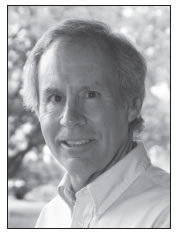
MAC MYERS

Mac Myers

Myers, a Democrat, was appointed by Gov. Bill Ritter only this summer to fill the vacancy left after former DA Jim Wilson died in a motorcycle accident in May. Myers had resigned as one of Wilson’s assistant DAs in 2007 and came within 150 votes of replacing him in one of the closest races in the state during the last general election. (In the rather incestuous world of Western Slope justice, Wilson had also served as a deputy under Myers in the 9th District, the Glenwood Springs area; and Russ Wasley, Myers’ Republican opponent this November, has worked for Myers as a assistant DA in the 9th as well.)

During his previous election bid, Myers cited a high turnover among the staff as a perennial problem, along with the resulting lack of experience.

Turnover is not currently an issue, Myers said, and the staff has gained some experience during the interim.

“Of course, two more years have gone by, and so one of the attorneys who’s still here certainly is more experienced,” he said. Three of the four assistant prosecutors own their homes, he said, which would seem to indicate they plan to stick around.

“We’re basically changing some of our prosecution standards,” he said of his plans. “I’m wanting all our lawyers to try more cases and we’re also trying to get more training done.”

Myers has worked as a prosecutor for 23 years since finishing law school in 1980, including eight years as DA in the 9th District, and hopes to use his experience to tighten up the procedures and practices here. He has also worked as a criminal defense attorney.

Myers said he is trying to bring more focus to the DA’s office.

“We’re trying to prioritize our cases and focus our resources on those that create the most damage to the community,” he said. Those crimes include sexual assaults and child molestations at the district-court level and domestic violence and DUI cases in county court, with repeat offenders getting special attention.

“One of the very last guys I filed on before I left the office in 2007 was the first guy I filed on when I came back,” he said. “In the long run it’s going to be a huge benefit to the community in terms of public safety to go after the violent and repeat offenders.”

However, he added, “I’m not suggesting that we’re ignoring (property crimes). Obviously they hurt people when things are stolen, when checks are forged.”

Myers said drug laws need to be applied judiciously.

“I do think there needs to be a response (to drug-abuse problems),” he said, but if people busted for possession and use are willing to get treatment, “we’re willing to work with them.

“In a sense drug abuse is a medical/social problem,” he said. “There are a lot of otherwise productive people in our society who have a drug problem and we don’t want to destroy their lives and cause them to be unduly hampered once they get over their addictions.”

But trafficking in drugs is a different matter, Myers added.

“Those are the people I take very seriously,” he said. “I think the distribution of drugs — particularly methamphetamine — has really had a bad impact on our community. I think drug dealers need to be treated very separately from users, and more severely.”

Even people who deal to support their own habits “do so at their peril,” he said.

Asked if legalizing drugs to eliminate the crime associated with street trade might be a better approach, Myers drew some fine distinctions.

“There’s a lot of talk about legalizing drugs, but when you look at it closely I think you need to separate them out,” he said. “I’m not overly concerned with marijuana and I think there’s a lot to be said about exploring the possibility of legalizing it.

“But other drugs, like methamphetamine, are just too hazardous to the community. I would not be supportive of legalizing a drug like meth.”

Myers said he has no problem with medical- marijuana clinics as long as they are operated according to state law. He compared the regulations to those that apply to the alcohol industry.

“When you get a liquor license, they run background checks, so I don’t think the old pot farmers out in the county who may have been busted a few times are really the ones you want if you’re doing a legitimate business.

“But I do think there’s a place for medical marijuana in our society, and I don’t personally have any problems with it” so long as the dispensaries are kept away from schools and residential neighborhoods through local zoning ordinances.

A large bone of contention between the candidates is the manner in which Wasley left his job. Wasley has maintained he was terminated by Myers, and questions the sincerity of the incumbent’s decrying high turnover while forcing him out.

Myers has a different take.

He explained that deputy DAs serve at the pleasure of the district attorney and whenever that office changes hands, the deputies all take a new oath of office. Wasley was not reappointed, he said.

Myers said Wasley was “not a bad employee” when he worked under him in the 9th Judicial District, something Wasley had cited as evidence of why he should have been retained.

“But that was back in 2004,” Myers said, “and he did county court work there, traffic and misdemeanor cases — things have changed.

“I would have preferred that (Wasley) would have been able to stay because I didn’t want to put the stress on the office,” he said.

“But what I kept trying to impress upon Russ is that it was important to me to bring this office together because there had been a lot of bad things that had occurred.””(Wilson had been arrested for DUI a few months before his fatal accident.)

“Yeah, I was happy with him in the 9th, but what was puzzling to me was why he had bounced around so much, why he had been in so many different judicial districts.” Myers pointed out that Wasley had worked for only nine months in the 14th Judicial District after leaving the Glenwood Springs office. (In his interview with the Free Press, Wasley said it is not unusual for a deputy DA to change jurisdictions, and said that Myers had moved around quite a bit himself.)

Myers said reducing conflicts in the office was the main factor behind his decision not to reappoint Wasley.

“I said, ‘I just don’t understand how I can trust you to execute my policies when you’re working against me,’ and he seemed to understand that.”

To fill the vacancy, Myers promoted assistant DA Adam Barnhurst to do district court cases and hired Rebecca Voymas, who had nine months’ experience in the Steamboat Springs office, to handle county court work.

Myers said partisan politics should have no place in the DA’s office. “As far as I’m concerned, everybody gets equal justice and it doesn’t matter what your party affiliation is.”

That includes his staff, he added, whom he told would not be expected to support him through donations or yard signs.

“I’d like people of the district to think of the race as a job application,” he said, “and if they can set their partisan feelings aside and look at my experience and record and what I’ve done with my career over 30 years compared to my opponent, I think they’ll reach a reasonable conclusion.”

Published in Election, September 2010

Wasley pledges to live within DA’s budget


Russell Wasley knows the resources of the 22nd Judicial District are limited. So, as the Republican candidate for district attorney, he is promising to focus on several types of offender if elected: repeat criminals, meth dealers, violent criminals, and felony probation violators.

The 53-year-old, who until recently was a deputy district attorney in the 22nd, is challenging incumbent Democrat Mac Myers for the position. Myers was appointed DA this summer after the May 22 death in a motorcycle accident of Republican Jim Wilson.

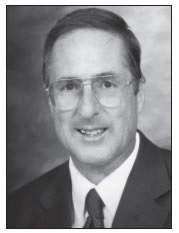
RUSSELL WASLEY

Russell Wasley

Wasley said he is prepared to deal with the tight budget in the 22nd and took a dig at Myers for asking the county commissioners for more funds.

“I believe it is important for the DA to live within our means,” he said. “The final budget for 2010 was approximately $605,000. It’s my understanding that Mr. Myers has asked for a supplemental allocation of $10,500 for the remainder of 2010 and is asking for additional money next year.

“I intend to live within the scope of the existing budget.”

One of the ways to do this is to focus the efforts of the office, Wasley said. A large percentage of crimes are committed by a disproportionately small number of offenders, and his first priority would be using Colorado’s habitual-offender laws to seek tougher sentences for repeat criminals.

For instance, someone committing a felony after three prior felony convictions can receive a sentence of four times what would otherwise be the maximum.

There are also habitual-offender statutes for some misdemeanors, he said, including burglary and domestic violence.

“I am not trying to turn the office into Attila the Hun,” Wasley said, “But I want to target those felons who need the most attention.

“Though I enjoyed working with Jim, I think we had a different philosophy when it came to prosecution of repeat criminals. I felt there were more individuals who needed to be prosecuted that way. But that decision had to be made by the DA.”

Wasley also wants to crack down on felony probation violators. Typically such offenders, when given probation, must comply with conditions such as submitting to drug-testing or seeking regular employment.

Too frequently, however, they fail to comply, Wasley said, and he wants to ask the judge for “appropriate re-sentencing.”

“I think in some instances some individuals have gotten off too lightly.”

Another priority will be prosecution of meth dealers. “Methamphetamine is a very dangerous drug,” Wasley said. “It’s a real danger in the community and I believe the dealers have to be dealt with in a serious and harsh way.”

Wasley said he is not, however, trying to crack down on users. “There is a drug court with [District] Judge [Douglas] Walker. It works very well. It tries to focus on treatment of drug addicts.”

Asked whether the distinction between dealers and users is always clear, Wasley admitted it can be blurry. “It’s quite possible someone can be mainly a user and buys 2 grams of meth and may sell a quartergram to a buddy to support their existence. That person is probably by and large a user.”

However, he said, “It’s one thing to sell to a friend once or twice and it’s another for someone to sell four or five times. There has to be a low level of tolerance for dealing. Meth has the potential to destroy a large number of lives in the district.”

Wasley also has strong concerns about the growth of the medical-marijuana industry and spoke before the Cortez City Council on July 13 to urge them to ban dispensaries in the city; the council, however, decided to allow them.

Wasley said he still believes there are too many loopholes in state marijuana laws and that too many prescriptions are not justified by patients’ medical conditions.

“I do feel uncomfortable about the whole dispensary industry,” he said. “I think this whole situation needs tighter regulation, even tighter than has been recently passed. I would really prefer that THC [the active ingredient in marijuana], if it’s going to be dispensed, be dispensed through a pharmacy.”

However, Wasley said keeping a watchful eye on dispensaries to make sure they are following all the new regulations, such as the 70-30 rule (a dispensary must grow 70 percent of the pot it sells)can’t be a high priority.

“We have a small DA’s office. It’s very important to prioritize where those resources go,” he said. “Before addressing marijuana you have to look at more serious issues: meth, repeat offenders, all crimes of violence, murders, residential burglaries, assaults against children, sexual assaults — those are the areas where there has to be attention in terms of the DA before expending enormous resources on the medical marijuana.”

Wasley came to the 22nd in December 2008 after being defeated that November in his bid for DA of the 6th Judicial District, which includes La Plata, San Juan and Archuleta counties. Prior to that, he was a deputy DA in Colorado’s 6th, 14th, and 9th judicial districts. He came to Colorado from Lubbock County, Texas, where he was an assistant DA.

In his decade as a prosecutor, Wasley said, he has prosecuted about 70 jury trials, including six murder trials, the most recent of which resulted in a second-degree murder conviction for Ignacio Rael of Cortez for killing his girlfriend, Diane Cordova, in 2008. In that case he shared duties and closing arguments with Wilson.

“It was a three-week trial involving DNA evidence, and we split it down the middle,” he said. “I handled the scientific evidence and we split the closing arguments.

“It was a sad case, an awful case.”

Wasley applied to fill Wilson’s position, but Myers, who had narrowly lost the DA’s race against Wilson in 2008, was chosen by Gov. Bill Ritter instead. Myers reportedly said Wasley could stay on as deputy DA if he would promise not to run against him, but Wasley refused. The two were already acquainted, having worked together previously in the 9th Judicial District when Myers was DA there. Wasley has been public about his indignation over being forced to leave the office because of his candidacy.

“He [Myers] told me he would be happy to keep me on if I decided not to run in November,” Wasley said. “He said that if I chose to withdraw my candidacy that I was in, I could bank on that. He said he was hoping I would stay, and that he enjoyed working with me in the 9th Judicial District.”

However, Wasley said, he had already been chosen by the local Republican Party as their candidate and had no intention of withdrawing. He believes Myers should have let him remain.

“I think in a DA’s office, public safety should always be the No. 1 concern, not politics,” he said. “The most important qualifications for a deputy DA are competence, fairness, hard work and intelligence. In regard to Mr. Myers’ decision with regard to me, I do not believe that was the best decision.”

Wasley said he had promised Myers that if Myers reappointed him as a deputy, Wasley would make his job his first priority and that politics “would not affect me at all and that during the work day there would be no discussion of politics.” Myers, however, has said that having two competing candidates in the same office would unavoidably cause conflicts.

“Mr. Myers did write a letter to the editor in the Cortez Journal raising the issue of loyalty,” Wasley said, “but the DA’s office is about public safety, protection of victims, and loyalty to the community. “It’s not supposed to be about personal loyalty.”

Wasley said he would be honored to be elected and would aim to be “an accessible and responsible DA.”

Published in Election, September 2010

Pot Luck: Conflicting rules play havoc with the medical-marijuana industry

Second of a two-part series

Related stories

Not long ago, Colorado’s pot farms were clandestine operations hiding from helicopter flyovers, narcs and undercover police investigations. Nowadays in the booming medical-marijuana industry, growers are more worried about bureaucracy and unpredictable regulations than law enforcement.

Cities and counties across Colorado are struggling to decide how to regulate the production, sale and distribution of medical marijuana — made legal by state voters in 2000, but still banned by the federal government.

The Montezuma County commissioners’ recent decision to ban MMJ in the unincorporated county further clouded the issue, as dispensaries are legal in the municipalities of Cortez, Dolores and Mancos. However, under new state laws adopted this summer, dispensaries must grow 70 percent of their own supply, and the bans in Dolores County and now Montezuma mean some of them will be scrambling to find a place to grow.

“There are a multitude of things that are problematic or contradictory in the laws,” said Travis Pollock, owner of the Nature’s Own Wellness medical-marijuana centers in Durango and Cortez.

“Home-grown’s all right with me, homegrown is the way it should be,” sang ’60s rocker Neil Young, and that is apparently the way Colorado voters envisioned that patients would be supplied when they passed an amendment legalizing medical marijuana in 2000.

Under Amendment 20, a resident with a state-approved MMJ card can grow pot in his or her backyard, home, vacant field or farm. The law allows each patient six plants, three in the mature flowering stage and three in the younger stage.

If patients do not have the expertise or facilities to grow their own medicine, they can appoint a caregiver to grow the six plants for them. Caregivers and individual patients can legally grow anywhere in the state.

Or they can go shopping at any of the 717 dispensaries that have sprouted up statewide since the Obama administration announced it wouldn’t be enforcing federal laws against medical marijuana.

Scrambling to keep up with the industry, the Colorado legislature passed a plethora of new regulations this summer. One rule limits caregivers to five patients each (30 plants). Any operation with more plants is considered a dispensary (now called a center) and must be licensed by the Colorado Department of Revenue.

The state put a moratorium on new license applications until Feb 1, 2011, while waiting for more thorough regulations to be developed by the revenue department.

The new requirement that dispensaries grow 70 percent of their product and that growers sell 70 percent of their product to one dispensary is designed to cut down on black-market suppliers, but this may lead to a shortage of product for MMJ patients, something that has already happened in New Mexico.

Grow operations are legal in Montezuma County’s three municipalities, but finding a viable site can sometimes be a problem.

Pollock said the new rule has indeed caused some adjustments for dispensaries. “The biggest hindrance we’re seeing is the 70-30 rule, and no longer being able to purchase from caregivers. Before, we were able to purchase from caregivers, purchase their excess medicine.

“It’s hindered us in trying to have access and availability. We are having to run all over the system and form new relationships.”

But not all owners have found the new regulations a problem.

“The state stepping in to make sure dispensaries grow our own medicine is welcomed,” said Aric Yoder of the Herbal Alternative, located on Cortez’s Main Street.

“That way the product is better controlled and lessens the black-market influence. A lot of places were getting their medicines from God knows where with God knows what on it.”

Owner control of their product makes for a better product, Yoder said, which translates to patient safety.

“People who need medicines often have weaker immune systems, so they do not need to be exposed to harmful chemicals or fertilizers.”

In Southwest Colorado, with its strong agricultural roots, growing MMJ as a caregiver may sound appealing. But cultivating marijuana can be challenging, and don’t ask for tips from the local CSU extension office, said Tom Hooten, interim director of the Montezuma County office.

“They are on their own, because it is still a banned drug federally and we are under the umbrella of the USDA, so we legally cannot give them any advice,” he said.

The new laws allow counties and municipalities to ban dispensaries and commercial grow operations if they please, or to pass additional regulations if they are allowed. When Montezuma County decided to ban commercial MMJ, the decision made any pot farms currently in the county illegal.

Dale Kirkman, who manages Buckethead Herbal Healing Center in Dolores, said he and his business partner, Eric Haley, have sunk $250,000 into their marijuana dispensary and commercial pot farm located in the county, but could suddenly lose it all.

“I came here for the job opportunity and sank my life savings and two years of labor into this business, and now that I am finally able to pay the bills they want to take it from me,” said Kirkman. “If I have to shut down, I’ll lose the farm and my $50,000 down payment, plus all the money to renovate. I’ll be broke.”

Buckethead had to put up $10,000 to apply for a state license from the Department of Revenue, with no guarantee of a refund if the application is denied, Kirkman said.

“No other business has this much oversight,” he said.

Another hurdle for dispensaries in Cortez is the increased security required for grow operations, which law officers worry will become a target for theft. Increased patrols around dispensaries and a strong relationship with police are important, those in the business say.

“We’ve had the police chief, mayor and drug task force people in to check it out so they know what is going on,” Yoder said. Buckethead’s grow operations have also been visited by the sheriff ‘s office, Kirkman said.

“They have visited my farm and store and have been supportive, saying as long as you have a license, we are not going to touch you, because it is medication and we are doing everything by the rules.”

But some of the regulations and fees imposed on MMJ centers are onerous, Kirkman said. For example, to apply for a state license, “you have to sign away your civil rights, and that is unfair. They have the right to search your place and records with no warrant, for example, and they limit your rights to go to court and defend yourself.

“This scared off a lot of people and they closed up shop and left town,” he said, adding that he thinks the fees are also unreasonable, netting the state $7.3 million to date.

“The license is $10,000 for two years. Liquor stores don’t pay that much. I’m paying 50 percent of my profits for license fees at different government levels.”

He speculated that pharmaceutical companies are pushing for regulations as a way to drive out the competition that medical marijuana represents.

“A lot of my patients are coming into my shop for medicinal marijuana and throwing their pills in the garbage, which means less money being spent on pharmaceuticals, and so those companies are saying, ‘We need to get rid of these people’,” Kirkman said.

Dispensaries face another obstacle in that obtaining financial services is difficult because of MMJ’s illegal status at the federal level. James Kahn is a Telluride attorney who represents medical-marijuana patients and caregivers and also helps operate Durango Healing Center, a dispensary. He said Bank of Durango and Alpine Bank ended the healing center’s accounts after discovering the nature of the business.

“We just found out today that our bank dropped us after we tried to set up some payroll accounts, so now we are looking into credit unions up in Denver,” he said.

Another contradictory aspect of the law involves the surplus generated by harvested plants. Patients are allowed to possess 2 ounces of usable marijuana, but a single plant can yield a pound or more, putting caregivers and patients at risk for being over the limit.

“This is a dilemma, because three budding plants could produce more than 2 ounces and that puts you out of compliance,” Kahn said, adding that patients could stagger the timing of their harvest to provide 2 ounces at a time as needed to avoid larger one-time yields.

Pollock said there is also confusion over infused-products manufacturing. Infused products include baked goods containing marijuana. In the past, a lot of the goods were made by people who rented a local restaurant for a few hours, he said, but the new regulations require that each infusedproducts license be dedicated to one kitchen and that kitchen not make anything other than infused-marijuana products.

Pollock said some manufacturers are continuing to operate in violation of the rules. “We have had to drop some of the vendors we have been working with because of that,” he said. “We have had to build out a whole kitchen — that was really interesting.”

Pollock said he works to follow the letter of the law in every regard. “We try to position ourselves correctly to make sure we are conforming with House Bill 1284 and not forming relationships with anybody operating in the gray areas.”

He has a good relationship with law enforcement, he said. “Law enforcement has been awesome. We have open lines of communication with the chiefs of police, sheriff ’s deputies, and the Southwest Drug Task Force.”

Pollock is working with the Arizona Medical Marijuana Policy Project, a grassroots effort to get Arizona voters to pass the MMJ initiative that is on their November 2010 ballot. He said the times ahead will be interesting for proponents of marijuana availability.

“I think this is going to be an issue that is going to sweep across the nation over the next 20 years,” he said. “Directly behind medical marijuana will be the recreational aspect. I think we will have medical marijuana going from West to East over the next 10 years and recreational access will follow. It will be real interesting to follow it and see how this plays out.”

Published in September 2010

County bans commercial MMJ


Related stories

The Montezuma County commissioners didn’t take long on Aug. 30 to decide to ban commercial medical-marijuana operations in the unincorporated county.

After listening to more than 90 minutes of public comments, most in favor of medical marijuana, the commissioners swiftly voted 3-0 in favor of a resolution banning MMJ retail centers, cultivation operations, and infused-products manufacturing.

“For us to start licensing a medical product — we don’t license any medical products whatsoever,” said Commissioner Gerald Koppenhafer.

“It’s just sticking Montezuma County’s head out to get it chopped off because the first time anything irresponsible happens, who are they going to sue? Montezuma County, because we licensed it.”

Commissioner Steve Chappell agreed, saying he didn’t want to increase the size of government by having the county regulate marijuana, and Chair Larrie Rule said he had lost a daughter to a drunk driver and, “I just don’t feel like putting another drug out there that could cause this problem.”

The ban took effect immediately, and Sheriff Gerald Wallace warned any growers operating in the county that they will need to get rid of their excess plants promptly.

“If they’re a caregiver, they can have that many plants (up to 30),” Wallace said. “They will have to get rid of the rest.”

The ban does not apply in the municipalities of Cortez, Mancos and Dolores, all of which allow MMJ dispensaries.

The public hearing about three dozen people, 21 of whom made comments. The vast majority were in favor of MMJ.

Three people spoke in opposition to marijuana operations — a man who said his daughter had tried marijuana and moved on to harder drugs, a woman who worried about security because she lives next to a grow operation, and Wallace, who said marijuana is definitely a “gateway” drug for some people.

He pointed out that under state law, the county cannot stop patients from growing marijuana for themselves, or caregivers from growing up to 30 plants for their patients.

A number of the speakers commented on the revenues that MMJ could bring to the county, but the majority were patients testifying about the ways the plant had improved their health and eased their suffering.

Kim Hernandez of Road 23 said she had never tried illicit drugs until after her diagnosis with cancer four years ago. “When I finally got out of the hospital I weighed 83 pounds,” she said. “My husband begged me and begged me to try marijuana. I didn’t want it. I wasn’t that kind of person.”

But she finally did try the drug and now she uses it regularly. “It helps me to eat,” Hernandez said. “It helps me to rest comfortably.”

A number of other people described how MMJ had helped them reduce the number of prescription pills they take.

Frank Martinez of Cortez said he takes marijuana for back and stomach problems, and it has helped. “We are so tired of taking prescriptions — taking a drug for the side effects of drugs. We want something that will actually help us without so many side effects.”

“I know it helps a lot of people,” Koppenhafer said before making the motion to ban the substance. “I hope we’re not prohibiting people from getting their medical stuff taken care of, but I can’t see how I can put Montezuma County in the position of being the entity liable for all this at this point.”

Published in September 2010

Patients say cannabis helps alleviate chronic symptoms


Related stories

“Ted” (not his real name) was no stranger to marijuana when he became ill several years ago. As a member of the Baby Boomer generation, he had smoked it — “of course,” he said.

“I smoked pot when I was younger for quite a few years,” he said. In fact, in the 1970s he was arrested for possession and served 2 1/2 months in a county jail; a much longer prison sentence was suspended. Eventually, however, he gave up the habit. Now a successful businessman in Montezuma County, he asked that his name be withheld because of the stigma attached to marijuana use, both medical and otherwise.

Several years ago, he began having vague but troubling physical symptoms and was ultimately diagnosed with Parkinson’s, a chronic, progressive and incurable disease of the central nervous system that causes trembling, muscle rigidity and loss of motor control. Its symptoms can be treated with several medicines, but their effectiveness is limited.

“Parkinson’s attacks one side of your body first,” Ted said. “My dominant side is my right side, which is the one that it chose. I was having real struggles writing with my hand, signing checks or making lists.”

One day he decided to smoke pot to see what effect it might have. “I was able to write normally for about three hours,” he said. “It also relaxed the rigid muscles.”

He talked to his neurologist, who said there were interesting studies being done regarding marijuana and Parkinson’s, but though the early results looked favorable, the long-term results were not in. At that time, medical-marijuana dispensaries were starting to open up in Southwest Colorado following the Obama administration’s announcement that it would not seek to prosecute people for using MMJ in states where it was legal. Ted decided to get a medical-marijuana card.

He had to pay to register with the state; a doctor at a local clinic reviewed his medical records, and he was officially an MMJ patient. (New rules passed this year mandate a stronger doctor-patient relationship for MMJ clients and require that physicians actually do physical exams of the clients.)

Now, Ted uses MMJ regularly. “Every morning after I do my exercises and drink a fruit smoothie, just before my workers arrive, I smoke about three puffs of marijuana. I don’t smoke any more the rest of the day and it seems to carry me through. It allows me to function. It alleviates a lot of my physical conditions. I’m able to work a full-time job; I have a very busy schedule.

“I probably could get along without it, but I certainly feel better with it.”

Critics have said that if marijuana is truly medicine, it should be regulated by the Food and Drug Administration, but Ted scoffs at that. “The FDA approves a lot of things that are crap – aspartame, MSG. It’s an agency that’s bought and paid for, like most everything that’s government-run.

“I think marijuana is a valid medication for a lot of people for a lot of things.”

Ted added that he believes pot should be legalized altogether — “I think victimless crimes are ridiculous.”

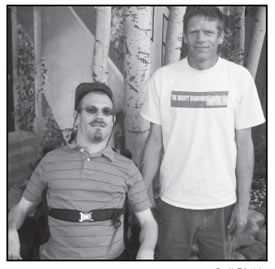
CHRIS AND SCOTT MACKIS

Chris Mackis (left) of Durango has seen improvement in his circulation and general health since using medical marijuana, according to his brother, Scott Mackis. Photo by Gail Binkly

Scott Mackis of Durango and his brother, Chris, agree. Both are MMJ patients — Chris for a form of cerebral palsy called spastic quadriplegia, and Scott for back pain following two serious automobile accidents.

Cerebral palsy is a type of brain damage that affects the muscles. In spastic quadriplegia, the entire body is affected. Muscles are stiff and rigid; because they cannot be relaxed normally, they may pull on bones, causing spinal curvature and other problems. Patients frequently have difficulty with speech as well.

Chris is confined to a wheelchair and has poor circulation on one side of his body. Part of his spine has been surgically fused and he has had hip-replacement surgery, Scott Mackis said, speaking for his brother.

About a year ago, because a friend with cerebral palsy was trying MMJ, the Mackis family decided to obtain a card for Chris. They visited a dispensary and purchased a topical ointment containing marijuana. At that point, Chris had been unable to open his hands for a month, Scott said.

“The muscles were so tight— it must be awful,” Scott said. “The lactic acid builds up. The first day, we got him home and put that salve on, and it was instant relief. He was able to relax his hands.”

Scott and his parents have been applying the salve to Chris’s whole body and believe it’s improving his circulation. “He used to have one cold foot. We applied it there, and it’s increased the blood flow and the warmth. It almost seems to get the electrical signals flowing to the nerves.”

They’ve continued to treat Chris with MMJ, mostly in the form of salve, though sometimes with edible products. (Chris is unable to smoke.) “I think it’s helping him in some other, subtle ways, because he’s more able to relax,” Scott said. “He’s said three or four new words since he’s been on medical marijuana. He seems to be making new neural connections.”

To Scott, who said he has had back pain for 20 years, marijuana is an alternative to opiate drugs, which he doesn’t tolerate well. “After my first wreck, they pumped me full of morphine and I left the hospital with withdrawal symptoms, so I decided not to get any more opiates.

“With herbs, I can quit without withdrawals. I quit for a year and tried to control my pain without it, but my quality of life was better with it. It’s been my only medicine since 1992.”

To Scott Mackis, the question of legalizing pot is a no-brainer. “I’ve been to multiple countries where it’s legal, or legal for medical use. The crime rate there was lower per capita than it is here.

“Colorado just got $9 million in application fees [from the Medical Marijuana Program Fund]. That filled a $9 million gap in the budget. To me, marijuana is creating jobs, it’s helping people, and this is money that is not going to the Mexican drug cartels.”

He also believes marijuana is no more dangerous than alcohol.

“What if people who drink had to get a card for their medicine? They’re self-medicating with alcohol for something.

“To me, legalization is just a logical step.”

Published in September 2010

When it comes to choosing food, locals are learning … There’s no place like home

Katrina Blair has known for most of her life that she’s called to live and work with plants.

“When I was a little girl, I was floating on Haviland Lake, and there were all these plants on the shore that were calling me over,” she remembers. Her brother and cousins paddled to a nearby beach to eat lunch, but Blair, then aged 11, paddled to the other side of the lake to heed the plants’ beckoning. “I got euphoric when I sat down. They said, ‘Oh, you’re home. You’re going to live your life with us.’”

Fast-forward two decades, and Blair’s passion has led to an undergraduate degree in biology, a master’s degree in holistic health, and a plant-centered organization in Durango called Turtle Lake Refuge. She and a consistent crew of volunteers grow, gather and serve all manner of plants. They dry weeds in solar dehydrators and grind them into powder for winter smoothies. They harvest acorns for acorn ice cream, Oregon grape berries for granola and wild pigweed (amaranth) seeds for crackers. The fruits of their labors supply bulk bins in stores, a booth at the local farmers’ market, schools and restaurants, year-round.

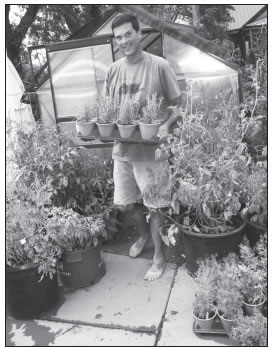
MATT KEEFAUVER SHOWING HIS HOME GARDEN

Matt Keefauver of Cortez, who is very active in the local-foods movement, spent a year eating nothing that had been produced outside a 200-mile radius of his home. Photo by Wendy Mimiaga

It may sound like a lot, but Turtle Lake’s activities represent just one portion of a flourishing local-foods scene. The refuge is part of Growing Partners of Southwest Colorado, with a mission to implement sustainable local-food programs for all incomes, ages and cultures. Other member organizations include the Southern Ute Community Action Program, La Boca Center for Sustainability and the Garden Project of Southwest Colorado, which helps schools and organizations start or enhance garden programs.

Many of La Plata County’s local businesses number among — or helped establish — the Local First collaboration, which advocates for locally owned businesses of all types, including local farmers and several local restaurants, such as Zia Taqueria and the Cyprus Café, which serve local foods.

Both Durango and Cortez boast thriving farmers’ markets during the growing season, late spring into fall. Durango’s is from 8 a.m. to noon on Saturdays in the parking lot of First National Bank, 259 W. 9th Street, and Cortez’s takes place at 7:30 a.m. on Saturdays in the Montezuma County Courthouse parking lot. There are smaller farmers’ markets in Mancos, Dolores, and Monticello, Utah.

Local produce is so plentiful, in fact, that Cortez City Council Member Matt Keefauver spent a year between the spring of 2008 and the spring of 2009 eating nothing — or almost nothing — that was produced outside a 200-mile radius of home. He doubled the size of his home garden, maintained 25 chickens, worked in exchange for veggies from Stone Free Farm in Montezuma County, ate goat cheese from a friend’s herd and procured wheat flour from the Cortez Milling Company, two blocks from his house. The 200-mile range allowed him to get fresh fruit from the Front Range and his staple grain, quinoa, from the San Luis Valley.

Keefauver said he did it partly to support local growers, many of whom he’d gotten to know by taking the products of his own business, Tierra Madre Herbs, to the Durango and Cortez farmers’ markets.

“The idea of local foods is way more about community than anything else,” he says. “It’s about making a connection with people who grow the food.”

And it’s about the environment; he’s trying to reduce the carbon footprint of his diet. On that point, Keefauver sees a practical side.

“Some day it’s just going to be more expensive to ship food across the country than it is now,” he said. “Our whole system is based on cheap oil. Some day that system is going to fall apart, and we’re going to need to rely on our local food systems.”

Rebecca Schild, the Environmental Center coordinator at Fort Lewis College, said the Durango area experiences a fairly short growing season with frosty nights lasting into early May and resuming as early as September. Both Durango and Cortez are at 6,500 feet, near enough to the San Juan and La Plata mountains that some mountain weather offsets their aridity. A thriving demonstration garden at Fort Lewis uses a greenhouse to get plants started before it’s warm enough to transfer them outside.

Schild says the whole five-county region — which includes Archuleta, Dolores, La Plata, Montezuma, and San Juan counties – has a rich agricultural history, but like Keefauver, she believes the emphasis on local foods entails a modern- day urgency.

“We are pretty vulnerable to energy issues and climate change,” she said. “I think people see local foods as a way to insulate us, to bring the community together again, and to make us resilient.”

For Turtle Lake’s Blair, that resiliency matters even at the level of the individual.

“I think people really are feeling the need to get re-empowered around their health,” she said. She uses the example of cancer, where options at a hospital — chemotherapy and radiation — are limited and fairly grim.

“Truly the options are vast when you turn to local and wild foods,” she says.

Blair believes cancers, like most human diseases, exist in acidic body chemistry. “When you start shifting toward more fresh greens and fruits, the chemistry of your body switches to the alkaline side and the cancer can no longer thrive in that condition. When you realize you can go out into your back yard and eat dandelions and have a shift, that’s empowering.”

Published in September 2010

The trail less traveled

New backcountry tours take hikers into Mesa Verde’s hidden areas

Mesa Verde National Park is opening up access to remote ruins as part of an effort to improve the visitor experience on a trail less traveled.

Daily guided hikes into the backcountry offer adventurous tourists and locals a chance to escape the crowded tour groups shuffling around the park’s signature ruins such as Cliff Palace and Spruce Tree House.

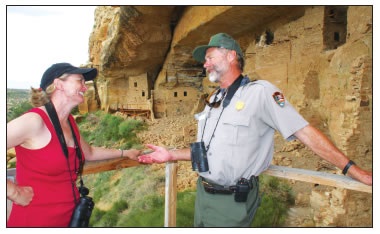
MARGI PUHLS AND INTERPRETIVE RANGER TOM WOLF NEAR CLIFF DWELLINGS AT MESA VERDE NATIONAL PARK

Margi Puhls asks a question of Tom Wolf, interpretive ranger, during a hike to Spring House at Mesa Verde National Park. The park is offering new, guided hikes to several backcountry areas. Photo by Wendy Mimiaga

“We’ve become known as an asphalt park to some extent, and these new tours are a way to offer something special for those willing to hike for a while,” said Tom Wolf, an interpretive ranger. “It’s a way for the park to give back to the community.”

He is guiding four of us on an 8-mile excursion across mesas and in and out of rugged canyons. Our destination is Spring House, a rarely seen, and incredibly stillintact ruin complex tucked into an alcove off Long Mesa.

The air is cool as we start off at 8 a.m. on a recent Saturday with backpacks filled with water, sunscreen and sandwiches. We descend a paved trail into Spruce Canyon, passing dozens of roosting turkey vultures enjoying the morning calm before the hordes of vacationers arrive.

We’ve all got a spring in our step as we pass through a locked gate and around a barricade with a sign telling other visitors that the area is off limits.

A surprisingly well-built network of (non-paved) trails crisscrosses this remote section of the park’s closed backcountry, a legacy from the heydays of the 1930s and ’40s, explains Wolf.

Back then the Civilian Conservation Corps brought young men into the park to build miles of trails as civic employment during the Great Depression.

“What they didn’t tell them was that most of their paychecks went back home to their families, but they didn’t mind too much because they had a job with meals in a place like this,” Wolf says.

In fact, before Mesa Verde closed off these trails to protect remote ruins from looters and vandalism, the area was popular with picnicking tourists exploring the region on horseback, he say. Well-buttressed switchbacks, artful rock retainer walls and stone-lined drains are a testimony to the masonry skills and labor of those workers. Along their trail to Spring House we have excellent views of Buzzard House, Teakettle House and Daniel’s House and several well-preserved signal towers and granaries.

Hikers, especially locals, have been critical of Mesa Verde because of the lack of longer trails (Free Press, May 2005). But with so many great trails unused, why are they closed?

Park archaeologists wrestle with the balancing act of protecting ruins from looters, and offering the public a close-up look at early human history in the area as it would have looked back then. The daily guided backcountry tours are an experiment, Wolf explains, a compromise that offers more access while also protecting the fragile sites from unsupervised exploration.

“They want to see how it goes, so we have to be very careful. So far it has been wildly popular and we’ve had a very positive response from people taking the tours,” he said. “Observing ruins in a more natural setting is great for visitors, and some rockjocks sign up just because they love the workout of canyon hiking.”

We dodge flags warning us to watch our step to avoid the endangered Mancos milkvetch growing along the trail as we climb up Wickiup Canyon. As if on cue, a law-enforcement ranger, Tim Cook, emerges onto the trail and joins our group. He’s a reminder of the importance of patrolling the area to protect the archeological and natural resources.

“I love the new tours; it has given me a job,” Cook says, explaining that the park hired two additional rangers to monitor the extra trail activity and offer assistance such as radio communications, first aid and transport if hikers require it.

Increased patrols have already netted “lost” hikers exploring closed areas without a guide. They are rounded up and ticketed with a $110 fine.

We all have our binoculars on a small dwelling tucked high onto a sandstone ledge. Soon, we spot a modern resident — a goshawk, standing large in the doorway of a cliff dwelling, protecting her chicks nesting inside.

“One of our archeologists spotted her,” Wolf said. “It is pretty rare for animals to take up residence in the ruins but there she has found a good spot.”

We top out on Long Mesa, and eat lunch enjoying panoramic views of Mesa Verde’s southern flanks. Then it is on to Spring House, which requires some scrambling down to a ledge, descending wooden ladders and using ropes to shimmy along slickrock to a narrow rock corridor that opens up onto a platform overlooking the impressive Spring House ruin.

As an art museum’s collection comes alive with the help of a docent, interpretive rangers breathe life into the diverse Puebloan culture that thrived here 1,000 years ago.

“The cleverness of the architecture and the sites chosen for defense are absolute genius,” Wolf says of the four-story Spring House ruin. “They made it hard to get into this site.”

We marvel at the 800-year-old wooden beams still holding up buildings, and contemplate a spring that feeds an ancient vanity in one of the rooms. Large potsherds litter the rock shelf below; one is a complete upper half of a black-on-white pot.

The ruins beyond the beaten track at Mesa Verde are kept in their original condition, Wolf says, without artificial anchors or interpretive re-building of fallen portions. Leaving things alone evokes a ghostly aura of a time long gone.

“Imagine this full of people, with lots of activity, not silent like it is today,” he says.

In Navajo Canyon, an ancient reservoir shows off the ingenuity and farming skills of the Ancestral Puebloans, formally referred to as the Anasazi.

RATTLESNAKE MESA VERDE NATIONAL PARK

Wildlife abounds in Mesa Verde’s backcountry, including this rattlesnake. Photo by Wendy Mimiaga

Further on the trail we startle a baby rattler basking on a rock and he hisses and strikes at air from a safe distance, falling over backwards in the process. These back canyon bottoms teem with bird life, including swifts, blue-gray gnat catchers and broad-tailed hummingbirds.

We’re silent climbing back to civilization, and after all that hiking our hunger makes it it easy to imagine ancient fires roasting wild turkey with sides of beans in the cliff alcoves and dwellings. But we settle for a beer and a cheeseburger at the cafeteria.

“I’ve been here nine times this summer showing relatives and friends the same ruins, but today was by far the best time I’ve had at Mesa Verde,” remarks Margi Puhls who hiked along with her husband, Don to Spring House for the first time.

“I am so glad they opened it up for us to see.”

Published in September 2010

Pot of Gold? Studies have shown marijuana does have medical benefits


Related stories

In one sense, marijuana is under-tested. Its status as a Schedule I controlled substance with no medical value has long discouraged efforts to study its clinical effects.

But in another sense, marijuana may be the most-tested drug in history. Used since ancient times, tried by every hippie worth his salt during the ’60s, sampled by an estimated 94 million Americans over the age of 12 today, the cannabis plant is hardly a mystery substance.

Yet debate continues to rage about its use, especially for medical purposes. Is marijuana genuinely good for the body, or do its side effects outweigh its purported benefits?

“Medicine (n.): any drug or other substance used in treating disease, healing, or relieving pain…” —Webster’s Unabridged Dictionary

Marijuana (cannabis) is a complex plant containing hundreds of substances, but its most active ingredients are THC and cannabidiol. In the 1980s it was discovered that many animals, including fish, reptiles, birds and mammals, have receptors in their brains for cannabinoids such as THC, receptors that don’t seem to bind with any other type of chemical.

In 1997, the White House’s Office of National Drug Control Policy commissioned a review of the scientific literature by the National Academy of Sciences’ Institute of Medicine to assess the risks and potential benefits of marijuana.

The resulting landmark 1999 report, “Marijuana and Medicine: Embracing the Science Base,” reached a number of conclusions, many of which are already widely accepted by the public:

• Cannabinoid drugs do show promise for relieving pain, quelling nausea, and stimulating appetite. The effects are generally modest but vary from person to person, so some people will respond better to marijuana than to other, more traditional drugs.

• Marijuana’s psychological effects can be disturbing to patients who aren’t familiar with the euphoria and spaciness. However, pot’s anti-anxiety effects can also enhance its medical benefits in certain patients.

• Because marijuana relaxes muscles, people shouldn’t drive cars or operate machinery while under its influence.

• Long-term users may suffer withdrawal symptoms if they quit, but those symptoms will be much milder than those resulting from withdrawal from opiates (morphine-related drugs) or benzodiazepines such as Valium.

A number of other studies have found that pot may or does help glaucoma sufferers, ease symptoms of Parkinson’s, reduce pain, and relax spastic muscles.

In 2000, the California state legislature created the Center for Medicinal Cannabis Research at the University of California to study the therapeutic value of marijuana. A February 2010 report from the cannabis center said that it had commissioned four completed clinical trials into marijuana’s analgesic effects on nerve pain, all of which found that cannabis did help patients. “This result is particularly important because three of these CMCR studies utilized cannabis as an add-on treatment for patients who were not receiving adequate benefit from a wide range of standard pain-relieving medications,” the report states.

The center also commissioned a study on muscle spasticity in multiple sclerosis. The study found that “cannabis reduces MS spasticity, at least in the short term, beyond the benefit available from usual medical care.”

“Now when your throat get dry
And you know you’re high
Everything is dandy.”
— Hancock Wayne, “When You’re a Viper”

Pot’s recreational effects are wellknown: mild euphoria, a pleasant dreamy state, an enhancement of the senses (especially hearing and taste).

As one Cortez police officer wrote in a recent incident report, “[The subject] appeared to be under the influence of marijuana in that he had the odor of marijuana on his person, his pupils were dilated and he appeared to be very relaxed and calm.”

But ganja’s steady march toward legitimate medical status has raised a host of new questions about its use. If it is medicine, how should it be regulated and dispensed? Should it be standardized and sold through pharmaceutical companies?

On the other hand, is it possible to completely control access to a plant that can be easily cultivated? Should pot simply be legalized altogether?

“To send me to prison for leaves of dried grass
While the real crooks are doubling the price of our gas
Seems to say something of this government’s laws
And its failure to cure society’s flaws. — anonymous

At the moment, medical marijuana exists in a jurisdictional limbo in the 14 states where it is legal, (including Colorado and New Mexico). It is neither standard medicine — approved and tested by the FDA — nor over-the-counter nutritional supplement. Instead, it is sold at specialized dispensaries to patients who receive a state-issued card after first getting a physician’s approval.

Travis Pollock, owner of Nature’s Own Wellness medical-marijuana dispensaries in Durango and Cortez, said there would be an upside and a downside to having marijuana’s medical uses recognized and regulated by the federal government.

“Any time you can get federal recognition, especially from an FDA or something like that, for this industry, it’s going to be beneficial,” he said. “But it’s also not beneficial, because if we allow large companies like Wal-Mart and Walgreens to be a part of this industry, it will hurt the small companies that are providing a quality product and can be more handson and more of a caregiver.

“It’s kind of a toss-up. You want acceptance from the federal government that this is a viable medical substance, but you don’t want to open up doors to companies that have a tremendous amount of capital but have a disconnect from the patient.”

In Colorado, medical marijuana was originally approved for use for eight conditions: cancer, glaucoma, HIV, cachexia (wasting), severe pain, severe nausea, seizures, and persistent muscle spasms such as those in multiple sclerosis. There is now a proposal to add Tourette’s syndrome to the list.

Medical-marijuana proponents tout the product’s use for many other conditions, including anxiety, post-traumatic stress disorder, Huntington’s disease, asthma, rheumatoid arthritis and fibromyalgia. More than 100,000 patients have applied to the state of Colorado for medical-marijuana cards, though because of a backlog, most applications have not been processed (a fact that has led critics to accuse the state health department of deliberately trying to undermine the industry).

Skeptics wonder whether a lot of these applicants aren’t simply finding a legal way to smoke pot recreationally. They wonder particularly about prescribing marijuana for pain, a condition that is highly subjective.

“Last dance with Mary Jane
One more time to kill the pain. — Tom Petty

Russell Wasley, Republican candidate for district attorney in the 22nd Judicial District, is among the doubters.

“There are problems with the way it is quote-unquote prescribed,” he said. “A lot of these prescriptions are not legitimate at all, or barely legitimate. If someone is a cancer sufferer in their last days trying to remediate pain, fine, but I find it suspect that a large number of 19- to 25-year-olds who should be the most healthy have some sort of back pain that causes them to get a quick and not very thorough examination for medical marijuana.”

Critics also say a raw, un-distilled plant doesn’t qualify as modern medicine. They say if it has any healing properties, it should be processed, standardized and dispensed as pills or ointments – not rolled into cigarettes and smoked.

Marijuana does exist in pill form as Marinol, a synthetic form of THC. However, some patients complain that swallowing Marinol, which takes about an hour to take effect, is less beneficial than smoking pot, which produces almostinstant results. They say they can easily regulate their own dosage by puffing on a joint, whereas Marinol delivers a sudden dose of THC. There have also been complaints that Marinol’s psychedelic effects are stronger than those of pot, possibly because the THC has been isolated from the rest of the plant’s compounds.

The fact that marijuana is smoked certainly makes it unusual among medicines, and there are efforts to find better ways to deliver it. If eating it isn’t desirable, it can be applied to the skin, and vaporizers are being studied as an alternative to smoking.

The 1999 NAS reviewers agreed there is concern about the long-term effects of inhaling pot. Marijuana contains many of the same carcinogens and irritants as tobacco, and experts say it could be even more dangerous because people inhale it more deeply. “Smoked marijuana . . . is a crude THC delivery system that also delivers harmful substances. . .,” the NAS researchers wrote. “Marijuana is not a completely benign substance. It is a powerful drug with a variety of effects.”

However, pot’s proponents point out that people generally smoke far more cigarettes daily than marijuana users. And the 1999 reviewers found that pot’s other side effects are generally minor.

“. . . except for the harms associated with smoking, the adverse effects of marijuana use are within the range of effects tolerated for other medications,” they wrote.

“Serotonin syndrome. This is a condition that may be life-threatening… Severe allergic reactions. Abnormal bleeding…. Mania. . . Seizures. Loss of appetite. Low salt (sodium) levels in the blood…. abnormal dreams, orgasm problems, decreased appetite, anxiety, weakness, diarrhea, dry mouth, indigestion, flu, trouble sleeping, decreased sex drive, feeling sick to your stomach, nervousness, sore throat, rash, watery nasal discharge, sleepiness, sweating, tremor, hot flashes, and yawn.” — from the list of warnings about the widely prescribed antidepressant Prozac

The medical literature says there has never been a documented case of a human dying of an overdose of THC or marijuana.

However, there may be drawbacks to marijuana beyond potential lung damage. The drug may lower testosterone levels in men, though the effects seem to be temporary. It can increase heart rate and blood pressure. There are concerns about its effects on short-term memory, though hard data is lacking. Some researchers believe it may cause psychosis in some users, especially teens and children; other studies found no link to brain damage, schizophrenia, or psychosis.

There are doctors and researchers who believe pot causes “amotivational syndrome,” meaning a lack of motivation to become a productive citizen. However, other experts say there is no proof that marijuana users are less motivated than anyone else, or that marijuana causes ordinary people to become unmotivated.

The NAS reviewers called for more studies into the use of cannabis’s components to help patients who have no other recourse for intractable conditions. “If there is any future for marijuana as a medicine, it lies in its isolated components,” they wrote.

If marijuana were to be prescribed as a regular drug, it would spell the end of the current system of patients, caregivers, and dispensaries. Some patients would welcome that; many other people, including recreational users, would rather see marijuana legalized altogether.

Why fret about whether patients are getting “high” while easing their pain? say the legalization proponents. Let marijuana be grown, harvested, sold to adults, and taxed and regulated like alcohol. After all, society tolerates the enormous adverse consequences of alcohol use in order to gain its benefits — and avoid the drawbacks of Prohibition.

Well, I ain’t seen my baby since I don’t know when,
I’ve been drinking bourbon, whiskey, scotch and gin.

— Rudy Toombs/John Lee Hooker

But many law-enforcement officers and other citizens are concerned that marijuana is a “gateway” drug that entices people to use stronger, more dangerous substances.

The NAS reviewers addressed that issue in their 1999 report, saying that, because marijuana is the most widely used illicit drug, it’s usually the first one people try, but most users try alcohol and nicotine before smoking pot.

“Because underage smoking and alcohol use typically precede marijuana use, marijuana is not the most common, and is rarely the first, ‘gateway’ to illicit drug use,” they wrote. “There is no conclusive evidence that the drug effects of marijuana are causally linked to the subsequent abuse of other illicit drugs.”

Marijuana’s image as the symbol of a hedonistic counter-culture may be behind much of the distaste with which it is viewed by a portion of the public. But other people have serious concerns about seeing it become widely available, whether through legalization or through a laissez-faire, quasi-medical system. They worry, among other things, about an increase in traffic accidents caused by stoned drivers, a surge in marijuana dependency, and a rise in under-age experimentation.

All that, researchers have noted, is beyond the purview of medical science.

“. . . there is a broad social concern that sanctioning the medical use of marijuana might increase its use among the general population,” stated the 1999 report. “. . . . this question is beyond the issues normally considered for medical uses of drugs and should not be a factor in evaluating the therapeutic potential of marijuana or cannabinoids.”

So far, that potential appears to be promising.

Published in September 2010

If it smells like trouble

There is an executive director for strategic initiatives with the National Federation for the Blind. It may be that his job involves sitting quietly for hours in an office, thinking up initiatives, then deciding if they are strategic enough. I don’t actually know if this is the case, but according to news reports John Pare supports a new plan to introduce artificial noises into the low-decibel emissions that hybrids generate at low speeds. The idea may have appealed to him during one of his quiet periods.

Apparently lawmakers in Congress have been spending too much quiet time too. They want to add sound-performance requirements for hybrids and electric cars to an auto-safety bill that is being considered in the wake of massive Toyota recalls. Automakers support the idea, because automakers helped Congress write the hybrid legislation. They are already experimenting with chirps, whirs, and who knows what — maybe even quacks— for new models like the Leaf and the Volt.

Poetically, the measure in Congress ought to be required to move forward only by silent vote. Hybrids account for 2 percent of the car sales in America. They are the silent minority of what constitutes America’s obese fleet of transportation. For researchers and safety groups to suggest that hybrids pose any serious risk to pedestrians and the blind because they are so quiet is equivalent to swatting at butterflies.

A friend who works almost exclusively on Harley Davidson motorcycles told me of a bumper sticker that’s been around for quite some time within the ranks of Harley riders: Loud Pipes Save Lives. By this standard, Harleys ought to qualify as the safest vehicles on the road. I’ve been thinking of designing a sticker for my hybrid: Silent Killer! A total of 4,300 pedestrians were killed in 2008 in auto/pedestrian clashes. Obviously, the car always wins in situations like these, and the bigger the vehicle, the more serious the damage. Why else would heavy-duty construction equipment come equipped with a standardized back-up noise, or trains with horns that can remove hair implants at 500 feet?

There is no research to suggest that hybrids are involved in a disproportionate number of pedestrian accidents, just as there is no data to justify spending a few more million dollars to study whether the bicyclers should be reclassified as the ultimate silent creeps.

When I was a kid, I used my mother’s clothespins to clip baseball cards to my fenders so they would flap against my bicycle spokes. I pretended the noise that issued from my rolling bicycle was an engine. The more noise, the better. That’s how children think.

Hearing is not, scientifically speaking, the most powerful sensory input a human has available. Smell reportedly triggers far more memories, deeper awarenesses, and is perceived more readily by the average person. If we are bureaucratically determined to introduce a safety measure for hybrids, let’s consider aromas. Chevrolet could deploy the sharp scent of ozone as their Volt discharges and Nissan’s Leaf could release a fresh glade aroma. As other car manufacturers design a new generation of electrics and hybrids, an extensive list of possible olfactory-installed incentives can be added: cotton candy, grilled steak, freshly brewed coffee.

There’s no reason why the blind have to go it alone. Their short-sighted pedestrian counterparts would breathe easier at the intersection too, while staying safe.

I know I’m barking into the wind, because loudness is a way of life, especially in America. It makes sense to keep the peace of mind that hybrids and electrics have introduced into our gas-guzzling petroleum-based carnival of commerce. Drivers are already required to wear the seat belts. Ought we require pedestrians to wear hearing aids?

David Feela writes from rural Montezuma County, Colo.

Published in David Feela

Gardening means living in the now

Addie began to plant grasses and perennials throughout the new orchard. She is down there daily digging, and watching, and watering. One evening soon after we began planting the trees she came up to the house stricken — prairie dogs were shredding the new grafts.

On our farm there are at least five orchards. The oldest is the peach orchard and it is dying. Peach orchards do not live long. Ours is about 30 years old. It was in decline upon our arrival. We cut out the dead. To save the orchard we chose to remove the trees that we perceived as weak, diseased, or difficult to irrigate.

Our actions were guided by what we thought was wise. To save the whole we needed to sacrifice a few. Smarter people would have cut out the entire orchard and started anew. But we have loved this orchard and we have poured our labor into it; we have learned wisdom and we have learned folly.

Peaches are to be savored, the tree and the fruit. The trees are short-lived and the fruit does not hold. I remember working in the field one spring evening. Looking up I saw a blue heron flying slowly across the orchard in full bloom, the sky slightly bluer than the bird, twilight throughout the pink blossoms, Ute Peak shining.

Peaches are of the moment: fruit in the mouth, blossoms on the tree. To know a peach is to know the reason of things.

There is an orchard in our garden: plum, apricot, apple and pear. Some of these trees have produced fine fruit, for others we wait. We began planting this orchard seven years ago and still it is not done. Some years we plant a tree, some years we replant three trees. This to could be vexation but it is not. When part of an orchard bears fruit, the wait is less tiring for that which has not.

Several years ago we started the new peach orchard above our house. It is a mix of peaches, nectarines, and Ukrainian almonds. Though not yet productive the trees are becoming strong in the ground.

Last fall I began to plant an orchard of rare apple varieties that I got from a friend, Gordon Tooley. They were whip and tongue grafts with enormous root-balls requiring large hand-dug holes in the dry fall earth. Soon after the irrigation ditch stopped flowing a young buck went under the fence and mauled many of the trees. Though they all survived the winter, the constant assault of grasshoppers has left the fate of a few in doubt. There is vanity and vexation in this, but there is a price to be paid for everything, and the deer and the grasshoppers will have their due.

And then there is the new orchard, which Addie walked up from, her face stricken. Over time we cleared out the center of the old orchard, cutting out the dead, removing the stumps. One chance after another allowed the prairie dogs to move in. I thought about their potential to damage roots, to undermine the trees. I should have know that they would eat the young scions but that was my folly. No amount of wisdom can translate into knowledge. Knowledge is not wise. It is indiscriminate. But wisdom is built upon the foundation of knowledge and knowledge invests in the markets of folly. It is passionate, it is impartial, and it is blind. Take what you may, live or live not.

So I went into the orchard to see what they had done. And my heart knew rage.

The trees all have cages around them now, with stakes. The first night that the trees were caged an unusually strong summer wind blew through the canyon. The next morning found cages blown around the orchard. There are times that it is easy to believe that God not only has no sense of humor but that in fact the Almighty out-and-out hates you. Of course, in a world of war, famine, and endless tears I do not believe that the small tribulations of this little orchard are of such importance. The truth is the trees are all alive and I can only hope that they will all live long enough to face greater trials. I may have to regraft one or two of the trees next year but that is the nature of this, it is a crooked path that needs not be made straight.

Always I am aware that it is the very act of doing that is of the greatest importance, regardless of the outcome. I cannot look into the rays of the sunrise and see the future any more than the sunset captures the past. There is now, in spite of what the future might bring. And now matters.

Jude Schuenemeyer is co-owner of Let It Grow Nursery and Garden Café in Cortez, Colo.


Published in Jude Schuenemeyer

Wanted: the perfect man

So when you are suddenly single, the question that spins around both inside your own head and from the people surrounding you is…

What about dating?

During the years that I was married, I thanked the heavens above on a regular basis that I was not out there on the playing field. I couldn’t imagine anything worse than having to interact on that level.

Well, here I am with that field looming in front of me and it has gotten me thinking about what it would take to convince me to actually go out with someone.

The last time I went on a real honest-to-God call-me-up-and-ask-me-out, take-ashower-and-brush-my-teeth date, I was still in braces.

And given that I am such a hermit, I don’t know how I would actually meet anyone who might want to ask me out. So this entire conversation is probably all for naught.

While my ex is happily ensconced in a relationship at the moment, I am happily un-ensconced.

But I do often think about what I would look for if I were on the prowl, so to speak. Funny, smart, sensitive.

That is so totally clichéd — I need something a bit more original:

o Likes to laugh at himself

o Thinks that I am really funny

o Because I am!

o Sexy — but not in an “I am 45 and need to prove myself to anyone” kind of way

o No butt hair

o Head hair would be nice

o Minimal nose hair

o Must not snore

o Must be OK with the fact that I do

o A boater would be nice— I don’t want to get used for my gear — the guy needs to row at least as well as my 13-year-old

o On the other hand, no more professional “players”; no guides, no high-altitude mountaineers, no ultra runners.

o Perhaps a banker?

o HA! Like that would ever happen

o My 13-year-old and his brother need to approve

o Must drink coffee

o Must love bringing it to me in bed

o Must love children

o Mine in particular

o Must love chick flicks

o Must love the desert

o Must be OK with my plants, my cats and my messy house

o Must call when he says he will

o Should enjoy tequila

o But not too much

o Must put the seat down

o Obviously

o A writer might be nice

o But, must not be better with the pen than I. My fragile ego couldn’t handle that

o Must do dishes

o Could there possibly be someone out there who would also scrub toilets?

o Must be smart enough to help my kids with their math homework

o Because I’m not

o Single would be a good thing

o Mustn’t be old enough to be my father

o Nor young enough to be my son

o Must actually want to spend time with me doing more than getting laid

o Must also want to get laid

o Must pass inspection by KK, KB, MB, VB, DB and JB

o They are a formidable crowd.

o And finally, must think that I walk on water.

I am not asking too much, am I?

Suzanne Strazza writes from Mancos, Colo.

Published in Suzanne Strazza

We have met the enemy and he is us

There is no America. There is no democracy. There is only IBM and ITT. . .” — Ned Beatty’s character in “Network”

I don’t know why people are so afraid of “big government” when they aren’t terrified by a much greater threat — big corporations. If we were more attuned and involved, we could correct and control the government, but we have almost no control over corporations. Government is responsible to the people but corporations are responsible to no one but the bottom line. Not even the investor can hold them responsible.

People call for term limits as if they were the answer to everything that is wrong with government. Well, we already have term limits in place for all elected officials – they’re called “elections.” How does a politician stay in his welfare job for 50 years? Because we are ill-informed, unconcerned, and uninvolved until after the election, and that’s the way politicians want it. We choose officials based on information gleaned from short sound bites.

It so happens the government we are so afraid of is us. We are the government — it is just our lackadaisical attitude that allows these people to stay in place. The great concern we should have is the multi-national corporations that have allegiance to no one but their own interests.

Understand, I am not against capitalism, as I have ventured into it several times during my life, using my own money and expertise. But the corporate moguls that go down in history as great men rarely use their own money — always someone else’s or the taxpayer’s. They build their empires by selling stocks and bonds to finance their endeavors, keeping business costs low with cheap labor, putting smaller entrepreneurs out of business, pillaging the environment, making policy they do not have to adhere to, garnering subsidies through their lobbyists and totally controlling government like the man behind the curtain.

They complain about paying the taxes that supposedly prevent them from paying even larger dividends to large stock-holders and even more unconscionable salaries to their CEOs. The chairman elects the board and the board elects the chair and we the consumer see nothing wrong with that.

What a brain-washing we have undergone! Yet we howl at the government and blame it for all our problems. Well, the government dances to the corporations’ tune. Our meager contributions to the candidates do not carry much weight when the corporations here or abroad throw their tax-deductible contributions of a million or more in the ring.

Of course I am aware that anyone can only give $2,000 per person to a candidate — what a joke. Thanks to our Supreme Court, corporations here and overseas due to an interpretation of free speech can now spend any amount on ads for their candidate of choice; because they are not a “direct contribution” they are considered free speech. Will a slick corporate commercial put together by slick Madison Avenue publicists affect the elections? Gee, what do you think?

So we, the electors and consumers, remain fools. We have the power through purchases and votes to guide the course of history, yet in all of our 200-plus years we seem to never have the will to come together. The mighty elephant can be brought down by a pygmy with a spear when the tribe comes together; instead we go off on tangents about things that distract us from the real threat.

When this country was first founded, transportation was a big problem. Horses, wagons and boats were not adequate to the task of settling and growing the nation. So the government (we the people) under the leadership of Lincoln put a railroad across the continent. If left up to the corporate moguls, it might never have been completed. It was not the private sector’s money, blood, sweat and tears that gave us the railroad. The government guaranteed the bonds and certificates issued to pay for it. Even then the moguls had to steal from people by issuing phony stocks, bonds and certificates to enhance their profits.

Then came the streetcars funded by cities. The passenger trains across the nation were subsidized by the people, bus companies, too. Let’s not forget the subways — a taxpayer-subsidized mode of travel acclaimed throughout the world.

Then came the era of the automobile. We in our eagerness to become independent gave up a lot of that independence by creating a dependent lifestyle and an environmentally unsound mode of transportation that put other economically wise modes of convenience out of business. Both the automobile and public transportation could have existed side by side but the corporations had to have it all.

I don’t hear much from the corporate politicians after the banking debacle. Now it’s all about small business. That’s business with 500 or fewer employees and a less-than- $50 million investment. How about the real backbone of the country, Mom and Pop stores? Oops, they are gone, taken over by the multi-nationals, small farmers by agribusiness, neighborhood service stations and garages taken over by giant corporations, manufacturing of clothing, rugs, textiles of any kind fled overseas, appliances gone to China by way of Mexico. Oh, but we have the Internet, Craig’s list, silly and macabre games. Let’s not forget the multibillion porno and child pornography business and I guess we are still number one in world sports. (How else to sell beer, alcohol, Nikes and fast fat food?)

If you think I’ve mentioned corporations too often, let me ask, when do you stop yelling “look out!” when you see someone about to step into the path of disaster?

Let’s grill our politicians like a hamburger and get the grease out of them, the grease put there by the corporations, and get back to entrepreneur capitalism. Maybe then we can get our country back.

Galen Larson writes from rural Montezuma County, Colo.

Published in Galen Larson

McInnis’ Water-loo

If you’ve lived in Colorado’s Third Congressional District for a while, the name of GOP gubernatorial candidate Scott McInnis should ring a bell. But even if it doesn’t, I would like to sound one now — an alarm bell warning you to vote for someone — anyone — else to do the job.

The duplicitous McInnis was elected to Congress for six terms beginning in 1992, even though he’d initially promised to limit himself to three. Term limits were a popular concept then, and the former speaker of the Colorado House wasn’t one to miss a political trick when it came to appealing to popular sentiment, regardless of how divorced it might have been from his actual ambitions.

When confronted about breaking his term-limit promise, McInnis explained that he had become so important in Washington, D.C., because of his appointment to the “powerful” (as it’s always called) Ways and Means Committee that he would be doing the good citizens of the district a disservice by quitting and thus depriving them of his vast influence. (See, even when it reflected poorly on him, he was always thinking of what was best for us.)

But this was far from McInnis’ only about-face during his time in the Capitol. For instance, there was his position on gays serving openly in the military, which was a hot issue at the time and resulted in Bill Clinton’s loony and hypocritical “Don’t Ask, Don’t Tell” policy.

McInnis told me — in one of the first political interviews I’d done for the Cortez newspaper — that he believed the only qualification for serving in the military should be, just as in any other job, the person’s ability to do the required work, and that sexual orientation should not be a consideration. That sounded good to me and, I would guess, many other voters who believe in basic fairness.

Of course, as soon as he got to Washington, the freshman representative changed 180 degrees, falling in line behind his religious-right conservative masters and coming out strongly against allowing gays to openly serve, even though many were indeed serving honorably if anonymously and dying right along with the straight soldiers in Iraq, Kosovo or wherever the government was sending our forces at the time. His explanation involved being him told by military brass that it was a bad idea because guys on submarines sometimes had to crawl over one another.

McInnis also said he would work hard to be objective about all proposed legislation, judging it solely on its merits rather than its politics. “The time for partisan politics is over,” I quoted him. Of course, once he got to Washington, his actions again belied his words, and he ended up with one of the strongest conservative ratings in Congress.

But never mind all that. Call it politics. Say they all do it.

What makes McInnis totally unfit to serve as governor involves his venal, dishonest behavior after he finally left office.

For those who haven’t been paying close attention, Denver Post reporter Karen E. Crummy recounted in a series of in-depth articles last month that the would-be governor was awarded a $300,000 two-year fellowship from a conservative think tank in 2004 to write a series of articles entitled “Water Musings” concerning Western Slope water issues. McInnis took the money and turned in some articles to the Hasan Family Foundation.

Only trouble was, he didn’t even write them and large parts were copied by the man who did from Gregory Hobbs, a water expert who is now a state supreme court judge.

That wasn’t what McInnis told his generous benefactor, however.

“All the articles are original and not reprinted from any other source,” he wrote in a 2005 memo to the foundation.

Dr. Malik Hasan, who made a fortune in the health-care industry, set up the foundation with his wife Seeme in 1993 to educate state residents on important issues, he told Denver’s Channel 7 News, which interviewed him after the plagiarism came to light. Hasan said he was sorely disappointed by McInnis’ efforts, especially after learning that what little material he had produced contained stolen portions. “In his communication to the website he said, ‘This was my original work’,” Hasan told 7 News.

Hasan’s wife reportedly read the alleged McInnis pieces and decided they weren’t worth publishing, but McInnis was paid anyway.

Asked if he thought McInnis had earned the money, Hasan replied with an emphatic, “No — not even a fraction. And what we got later on, we found that someone else had done that job and basically that somebody copied from somebody else. It’s like a joke — a bad joke.

“I thought he loved this state,” said Hasan, a former friend of McInnis’. “I thought he cared about the people he represented — now I think the McInnis I knew was abducted by aliens and there’s a substitute.”

The foundation asked for its money back but so far McInnis is not reported to have paid.

Teresa Fishman, the head of the Center for Academic Integrity at Clemson University, compared Hobbs’ writings with those McInnis represented as his, and told Crummy (the one who dug up most of this stuff and deserves great credit) that portions were definitely copied, both in thought and expression.

“In this case it looks like plagiarism of both — words and ideas lifted from an original source,” Fishman said. She added that if McInnis were her student, she would have given him an “F” and reported him to the academic dishonesty council.

But the former Congressman’s naked greed and thievery may not even be the worst part of the sordid mess.

The man who did write the articles, himself a water expert named Rolly Fischer, said he was paid “a few hundred dollars” apiece and was led to believe they were background material for McInnis’ personal use. Fischer said he was given no clue they were to be published as McInnis’ own work.

McInnis then claimed it was Fischer’s mistake and asked him to sign a letter taking all the blame for stealing pages upon pages of material from Hobbs. Fischer refused and told Channel 7 McInnis was lying.

“I had this sophomoric assumption that he wanted them for his own inventory,” Fischer said. “I did not know that he intended to submit that as his personal work.”

For his part, McInnis doesn’t dispute the basic facts of the matter, but says he’s somehow “accepted full responsibility” and it’s time to move on, because this is only a “political” thing cooked up by his enemies.

“It doesn’t matter,” he told Channel 7 reporter John Ferrugia when pressed at a recent rally in Alamosa and asked repeatedly if he or Fischer were telling the truth.

So the truth doesn’t matter, you see. It’s really small potatoes to the very kind of guy that makes people so cynical about politics and government.

There is still some question whether the matter might be investigated by the state bar association as a possible ethics violation or even by the state attorney general as a crime involving theft and fraud.

But the more immediate question is, do you want as your next governor a man who behaved like this? Who was willing to pass off someone else’s work as his own, who was willing to pay an alleged friend peanuts for something that netted him a small fortune from another alleged friend, money that an actual writer might have used to shed some actual light on knotty water issues facing the state?

It’s hard to imagine enough honest, upstanding Republicans saying “Yes” to those questions to give McInnis the nod in this month’s primary election.

But either way, we’d better learn how to spell Hickenlooper.

David Grant Long writes from Cortez, Colo.

Published in August 2010, David Long

‘Crazy’ for Patsy Cline

When people crowd into the Durango Arts Center for the start of “Always Patsy Cline,” they’re chatting and happy, full of anticipation.

But by the time the show ends, the theater is mostly quiet, the silence punctuated with the sound of sniffling.

TRACY LYN THOMAS AND MARY ELLEN CERRONI

Tracy Lyn Thomas (left) portrays Patsy Cline and Mary Ellen Cerroni plays a fan and friend of hers in “Always Patsy Cline,” now showing at the Durango Arts Theater.

That’s because the story of Patsy Cline doesn’t have a happy ending. The countrymusic star died in a plane crash on March 5, 1963, at the age of 30.

But “Always Patsy Cline,” a true story based on the artist’s life, is anything but gloomy. Through most of the show, the audience is laughing in the aisles.

“Always Patsy Cline,” which is performed on Friday and Saturday nights through Sept. 19 at DAC, is a true story based on the friendship between Patsy (played by Tracy Lyn Thomas) and her fan Louise (played by Mary Ellen Cerroni).

“It’s a great example of how two people who are so different from one another can become such good friends,” said Sheri Rochford Figgs, the executive director at DAC, who loves the show and has seen it twice.

Director Theresa Carson said, “I really enjoyed Cerroni and Thomas — they are both hard-working, dynamic, and sharp women.”

“Always Patsy Cline” has been produced by different theatre companies over the U.S. for the past 10 years. Writer Ted Swindley got the inspiration for the screenplay from the book “Honky Tonk Angel: The Intimate Story of Patsy Cline” by Ellis Nassour. It’s a two-person show, not including the band (led by C. Scott Hagler).

Swindley tells the story through the voice of Louise, who speaks to the audience as if they were sitting in her kitchen having a cup of coffee with her – which would apparently be extremely amusing, because Louise is depicted as very funny.

Carson said that Cerroni’s skillful perforance ensures that Louise is likable to the audience. (Cerroni’s husband says to her all the time, “Mary Ellen, you’re just a little clown!”).

Carson said it was satisfying to direct Cerroni, because she was good at following through and putting the right touch of emotion into the crucial poignant moments in the story.

Louise begins her story with the first time she heard Patsy sing and recounts how she became a fan and followed Patsy’s career closely. The two met at a concert in Houston and Patsy wound up spending the night at her house and Louise cooked her bacon and eggs. Louise gave her a ride to the airport the following morning. This meeting between the two took place six years before the plane crash that ended Patsy’s life.

Over those six years the two kept up a steady stream of correspondence and, through the U.S. mail, developed a great friendship.

Throughout the telling of this story Thomas sings 27 classic Patsy Cline songs, in a voice strikingly like Patsy’s.

Cerroni said she has long been a fan of Patsy’s, and described playing “Heartaches” on her guitar in the ’90s. She also recalls singing “Crazy,” which was written by Willie Nelson, at karaoke nights in her youth. A disc jockey told her that “Crazy” is the song most often sung by female karaoke singers.

Thomas is also a fan. She had a Patsy Cline album that she remembers playing over and over.

“After my mom saw the show she reminded me that I have been singing ‘Crazy’ since I was 12 years old.”

“Crazy” is Patsy’s signature song, but the first time she heard it she hated it. In late 1961 and early 1962 “Crazy” was a hit on three different charts. Loretta Lynn later reported that the night Patsy premiered “Crazy” at the Grand Ole Opry, she received three standing ovations.

Thomas was excited to find out she was going to get to play the star in “Always Patsy Cline.” She thought, “I already know the words to all the songs.”

Terry Swan, the president of the board of directors for the DAC, said he got the idea to present “Always Patsy Cline” at the same time as Carson. Swan was the managing director at the New Stage Theatre in Jackson, Miss., and during his tenure “Always Patsy Cline” ran twice.

He said, “The real Louise Seger who lived in Jackson at the time got to come to the show. She loved it.”

Cerroni thinks Louise must have been a “genuinely, really nice person,” who got to live her dream by having a close friendship with a big-name star that she adored.

“If we all stop to consider it, we could think of the famous person we would like to cook bacon and eggs for in our very own kitchen,” Cerroni said. “Mine was Karen Carpenter. I thought she hung the moon!”

Carson wanted badly to produce “Always Patsy Cline,” knowing she had Thomas and her amazing voice to play Patsy. “What really drew me to the script was the story,” she said. “I love a script with a good story.” Carson was having a hard time finding a place to produce the show and it was Thomas who got Carson and Swan together, and the rest, as they say, is history.

For people who like musicals, the DAC is also showing “A Grand Night for Singing” on Tuesday, Wednesday, and Thursday nights. The musical features all young adults who “have come up through the ranks at DAC,” according to Thomas, who is producing this show.

DAC is in partnership with the 9-R school system, and runs after-school programs once a week in each of the seven schools in and around the Durango area.

DAC runs a docent program that sends mostly retired teachers into the classrooms and senior centers during the day to talk about famous artists.

“My favorite program offered by DAC is GOAL,” said Swan, “and it’s because I truly believe this program has the ability to change the life of a young girl.” GOAL (Girls’ Opportunity through Arts and Leadership) is for middle-school girls and is a two-week, intensive art program.

DAC is still affiliated with the Durango Performing Arts Company even though they have launched themselves as their own non-profit.

Prior to the performance of “Always Patsy Cline”, Swan talks to the audience about the DAC’s financial struggles, and urges everyone to become members. He would like to see membership go from its current 600 to 1,000 by the end of the year.

But make no mistake, DAC is not a sinking ship. While last year they were in the red, this year not only have they paid the debt back, but they are functioning under a balanced budget. “The Patsy show is a great example of how strong DAC is again becoming,” Thomas said.

“Always Patsy Cline” involves a lot of audience participation. Twice during the show Cerroni comes off the stage and finds a gentleman to dance with.

So if you want to be the one she dances with, pull on yer best cowboy boots, make sure yer belt buckle shines all the way across the room, and git down to the Durango Art Center and see “Always Patsy Cline.” And if you own not a single cowboy accoutrement, go see the show anyway, because Louise doesn’t always pick cowboys to dance with.

Published in Arts & Entertainment, August 2010

The long and winding saga of the Recapture Trail

Recapture Canyon in Southeast Utah is a placid place in late July. Today, under a soft cloud cover that prevents the heat from becoming brutal, the only things moving are four hikers, birds flitting through the brush, and the ever-present flies and gnats.

A trail, part of a longer network that goes along the canyon rim, winds from one end of the canyon near the Recapture Dam, which sits just off Highway 191 between Monticello and Blanding, to the rim five or six miles to the south.
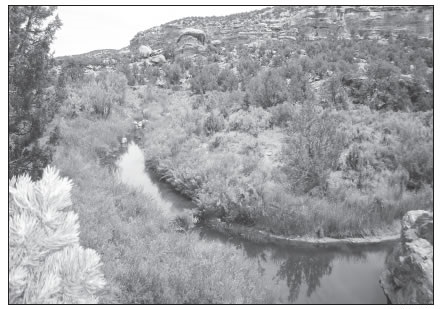
RECAPTURE CANYON NEAR BLANDING UTAH

The BLM’s Monticello (Utah) Field Office is doing an environmental assessment of a proposal to allow motorized recreation on a trail through scenic Recapture Canyon near Blanding. The trail was built without authorization in 2005. The canyon includes riparian areas and numerous archaeological sites. Photo by Gail Binkly

The scenic route follows the meanderings of Recapture Creek through a more riparian environment than the typical landscape of Southeast Utah. There are willows, cottonwoods, even beaver ponds.

But what makes the trail spectacular is its archaeology. The canyon harbors numerous Ancestral Puebloan sites ranging from cliff dwellings in high alcoves to room blocks, scattered potsherds and middens nearer the creek.

Late in 2005, someone constructed an off-highway-vehicle route through the canyon. These people — it likely took more than one individual — shored up curves, installed culverts, even built a wooden bridge over a creek crossing.

The result was a series of trails drivable by all-terrain vehicles and dirt bikes. Problem is, the route, which lies on BLM lands, was not authorized.

Today it is closed to motorized use while the BLM decides what should become of it. Meanwhile, an investigation into the culprits who built it is ongoing.

The case is a classic example of the intense struggle taking place between motorized and non-motorized users on public lands across the West and particularly in the Southwest, where ancient cultural sites are an added factor to be considered in deciding what uses are appropriate in which places.

Illegal acts

The illegal trail network crosses at least nine archaeological sites bigger than an acre each, according to material from the National Trust for Historic Preservation, and its construction damaged at least a dozen sites.

Yet it wasn’t until September 2007 that the trail was closed to motorized use, and a proposal to grant San Juan County a rightof- way for the system of trails is still under consideration by the BLM.

None of this sits well with Ronni Egan, executive director of the Durango, Colo.- based Great Old Broads for Wilderness, an environmental group that monitors and documents damage to public lands.

“How can you consider issuing a rightof- way for the trail when there are still two criminal investigations going on related to it?” she asked as she led this reporter and two Blanding residents along the trail.

The first investigation, into the trail’s construction, won’t continue much longer, as the statute of limitations for the offense will run out late this fall, according to Tom Heinlein, manager of the BLM’s Monticello Field Office.

Heinlein declined to say whether charges are forthcoming. However, he said the construction of the trail was definitely illegal, although at the time the area in question was designated as open to crosscountry motorized travel.

“The actual surface disturbance was unauthorized and illegal,” he said. “It involved destruction of public property. There are also violations of cultural resource laws.”

Felony charges can be filed for damage to archaeological sites that exceeds $500 and was done knowingly.

The second investigation involves looting that took place in mid-2007 at a large archaeological site accessible from the illegal trail. Known as the Recapture Great House, the site includes a multi-story pueblo from the Pueblo II period of the Ancestral Puebloans, according to the National Trust for Historic Preservation.

Egan said she spoke to a former BLM employee who saw the damage. “ATV tracks were all over, and pot-hunting holes had been dug,” Egan said. “The looters had even left their tools.” The BLM subsequently issued an emergency closure for 1,871 acres in the Recapture Canyon area in September 2007.

Environmental groups have charged that the BLM dragged its heels in responding to the illegal trail, both by leaving it open too long and by initially conducting a cursory investigation. Egan said the BLM officials first said the trail had not been mechanically constructed, then — after being presented with evidence such as the wooden bridge — did only a brief investigation and closed it. Heinlein, who was not the field manager at the time and came to his position in 2008, said as far as he can tell, the investigation was never closed.

“Several people have told me adamantly that it was, but I have no evidence in my office that it was,” he said. However, he said it was put on the back burner because of a mammoth investigation into the excavating and selling of stolen cultural artifacts that resulted in the arrests of 24 people in 2009.

“The [Recapture] investigation was delayed, and it continues,” he said.

Mitigating the damage

Heinlein said the BLM is preparing an environmental assessment of the county’s proposal for a right-of-way for the trail. Three other alternatives are being considered as well. “The county’s is the most extensive alternative,” he said. Two options would open smaller portions of the trail to motorized use, and the last, the no-action alternative, would maintain the emergency closure, meaning motorized use would not be allowed.

Even if the BLM chooses to let motorized use resume on all or part of the trail, that cannot happen until the damage already done has been mitigated, Heinlein said.

The emergency-closure order states, “The emergency closure area shall remain closed to OHV use until the considerable adverse effects leading to the closure have been eliminated and measures have been implemented to prevent recurrence.”

“That’s a very high standard to meet,” Heinlein said. “Basically that means, regardless of the alternative we ultimately accept in the EA, we cannot lift the closure till the adverse effects have been eliminated. We could not implement the decision till the damage has been eliminated.”

That would entail stabilizing or covering sites that have been eroding or have been opened, relocating trails around sites, and similar measures, he said.

The Monticello Field Office approved a revised resource management plan in 2008 in which the Recapture area is classified as allowing motorized travel on designated routes only, Heinlein said. The Recapture Trail itself was not designated in that plan, but it will be if the BLM chooses one of the alternatives to grant the right-of-way.

Heinlein said re-routing the existing trail to avoid cultural sites would be difficult. “It’s a tough one given the resources that exist and the fact that the trail was already roughed in,” he said. “Even if we chose an alternative that had re-routes, there are not a lot of alternative places to go.”

The people who created the trail “did not put it in the most advantageous places, both in terms of cultural resources and trail maintenance,” he said. “They didn’t really understand grades and switchbacks and erosion and things.”

However, he said, the builders certainly did a great deal of work. “A lot of time was spent on that trail,” Heinlein said. “I would like to be able to harness that energy for other purposes.”

Access for all

Many of the studies necessary for the EA, such as wildlife surveys, have been completed, but a cultural-resource study known as a Section 106 process (after the relevant section of the National Historic Preservation Act) is far from finished. In this case, the process involves monthly meetings with interested stakeholders to decide the best way to protect and preserve the archaeological sites that would be affected by the trail. “The most complex part of the EA process by far is the cultural part,” Heinlein said.
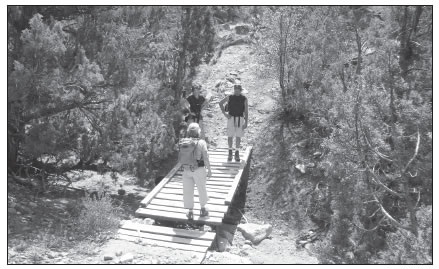
WOODEN BRIDGE OVER STREAM IN RECAPTURE CANYON

The unknown persons who built an OHV trail through Recapture Canyon even constructed this wooden bridge over the stream. Photo by Gail Binkly

The lengthy process is frustrating to San Juan County officials, including Commissioner Lynn Stevens, one of the county’s leading advocates of motorized use. He said when the trail was first closed, the state director of the BLM indicated it would be only through that winter while a mitigation plan was worked on. “That was three years ago, and we’re probably a year or more away from even getting an agreement in the 106 process.”

Stevens believes motorized users, particularly in his county, are being unfairly painted as renegades and villains. “It’s an unfair label to say San Juan County is hostile to the environment,” he said.

“The motorized-recreation people in San Juan County are probably every bit as environmentally conscious and interested in preserving the values as any other population.”

He believes motorized trails are important for “people that are a little older or less ambulatory, or younger ones who want to see more in less time.”

“We spend millions of dollars to accommodate Americans with disabilities so they won’t have difficulty moving around our cities, yet that seems to be totally inapplicable to some of our recreational areas.”

Stevens maintains the trail was not built illegally because the BLM management plan in effect at the time listed the area as open to cross-country motorized travel. “There aren’t restrictions on how you can hike or bike in the open area,” he said. “The allegation that it was done illegally has yet to be substantiated.”

He said portions of the Recapture Trail has been informally in use for many years, and much of it came about simply through repeated use, though some mechanical work was clearly done. “There were some tree stumps and limbs removed, some rocks moved,” Stevens said. “There is one crossing of a stream where a wooden bridge was constructed, which probably saves the environment rather than harms it.”

But however it came about, county officials strongly believe the trail should be reopened to OHVs.

“Recapture Trail is very important to the people of Blanding,” Stevens said. “First, it’s a great exposure to the archaeology of the entire county, a great recreational and educational experience.

“Also, you can leave your house anywhere in Blanding and be at the trailhead in 15 minutes or less. Even with a very slow-moving vehicle, stopping and pointing out the archaeology and other beauties of the canyon, you can be back off the trail in an hour and a half.”

But Egan says not all motorized users are driving the trail gently and eying their surroundings. She says parts of the illegal route have clearly been banked for speed and were driven that way when it was open. “As vehicles go around the hills fast they throw up dirt on the uphill side of their tires, and they make deep tracks,” she said. “You know how a race course is banked on the turns? The trail is banked like that.”

Sacred potsherds

Partly because of the county’s strong advocacy for motorized use, allegations linger that county officials were complicit in creating the road. Stevens said those are false. “There have been allegations that the county road department got involved with county equipment or county people. There’s no record of that, and our road department keeps very meticulous records.”

According to Stevens, the county did make two stiles (locals call them cattle-guards) that are used in the Recapture network to allow ATVs to climb a fence without going through a gate, but those are on the rim. “The county did construct several of those. They’re made in three pieces,” he said. “To my knowledge there’s only two cattle-guards made by the county on part of the trail and it’s the part of the trail that’s still open. So the claim that the county went in and constructed part of the trail illegally is false.”

Stevens, like many other locals, sometimes grows impatient with the idea that every archaeological site and artifact needs to be protected.

“I’ve been through most of these 106 sessions where the arguments are so ethereal — so ridiculously speculative on what damage could be done to a site 150 feet up a cliff, 200 yards from a road — that it just becomes annoying.

“Almost every potsherd that gets run over, you’re violating something sacred, yet there are more than 30,000 archaeological sites known in San Juan County, Utah. They can’t all be significant.”

But he does not condone the sort of willful looting that was alleged in the 2009 artifacts cases, the vast majority of which involved people from San Juan County. “San Juan County and the sheriff have gone on record vocally that looting of sites is illegal and we don’t support that at all.”

But the proximity of a road to cultural sites is not reason enough to close the route to ATVs and dirt bikes, Stevens believes. He said there are very few places where motorized use is not appropriate.

“There may be areas where it’s inappropriate from a safety point of view, but from an environmental-damage point of view, that has to be looked at pretty closely.”

Advocating education

Bob Turri of Monticello likewise believes in widespread access for motor vehicles on public lands. Turri is a member of the board of SPEAR (for San Juan Public Entry and Access Rights), a San Juan County-based off-road advocacy group. He echoes Stevens’ concern about access. “We have so many people in our organization that are old, and some handicapped. They were accustomed to going out and enjoying this wonderful land here and they can’t do it any more but they found by using ATVs or Jeeps that they are able to continue doing that.”

Like Stevens, he said the Recapture Trail is important because of the opportunity to view Ancestral Puebloan ruins.

“I strongly believe the archaeology belongs to the people, not archaeologists or agencies, and they have a right to view it.”

SPEAR is often fingered as a suspect in the construction of the Recapture Trail, but Turri said neither the organization nor the county had anything to do with it. He said he does have an idea who built the trail, but they were “two common guys” acting without SPEAR’s approval. He isn’t sure whether they knew they were violating the law.

“We do advocate responsible use, although I believe every user group has its renegades — people you can’t control,” Turri said.

“I know the trail was built illegally. There’s no question about that.

“They did a lot of work and some of it was nice, but it’s really unfortunate that happened because it really set us all back. I would certainly have developed the trail differently in certain places. We’re not interested in damaging those sites.”

Turri said a BLM law-enforcement agent investigating the incident asked him what he thought should happen to the people who built it. “I said, ‘Those people are not criminals, they’re some guys that made a real mistake.’

“A fine and probation — that sounds reasonable to me. You can’t let them go unpunished, I understand that, but I hope they aren’t too harsh on them.”

But Turri believes whoever looted the Recapture Great House deserves sterner penalties. “Archaeological vandalism is a different story. Those people deserve some pretty harsh treatment.”

He said a distinction must be made between responsible ATV riders and rogues. “We’re not all bad people because we ride an ATV, but the response I get is, ‘You’re exactly the same, you want to tear up the land’.”

Hikers and cyclists do damage, too, he said, and he witnessed that during his 25- year career with the BLM. “The Sierra Club came in once and did a hike in Grand Gulch and we had to hire a crew to clean up the trash they left. All user groups have a rebel or two.”

However, Turri conceded there seem to be more “rebels” in the ranks of motorized users than hikers, a fact that pains him.

He was with some other riders in the La Sal Mountains once, putting up signs marking numbered ATV trails, when they encountered four men on ATVs who accused them of putting up closure signs. “They were the true rebels. They were all carrying guns and drinking too. They said, ‘We’re going to follow behind you and shoot down your signs, and we have plenty of ammo’.”

Such renegades cast a pall on the image of all riders, he said. “It’s embarrassing to me if I see that somebody has misused a trail or been off the trail.”

But Turri believes that in the seven or eight years he has been active in SPEAR, he has seen a change in attitude. “The same guy that said, ‘Nobody is going to tell me where to ride!’ now is saying, ‘Stay on the trail.’ So education is really the answer, but it’s slow.”

‘A special place’

But Egan and other environmentalists maintain that some places just aren’t suited to motorized travel, and Recapture is one of them. Asked if re-routing would solve the problems with the trail, Egan said, “We believe that motorized use invites vandalism.”
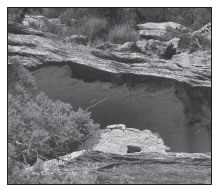
CLIFF DWELLINGS IN RECAPTURE CANYON

The Ancestral Puebloan ruins in Recapture Canyon include many cliff dwellings. Photo by Gail Binkly

Stevens said the county is willing to consider modifications to the existing route. He has traveled the trail numerous times, and agrees there are at least two places where it goes over a site — one a “cyst box,” or storage hole, the other a potential burial site. “I’ve told the BLM and the 106 parties that [having motorized use on] the entire 19 miles of the trail is not mandatory. They can rule some of it is inappropriate and if they have scientific facts to back it up, the county won’t argue, but they need to have something more than emotion.”

But Egan believes permitting OHV use on the trail after motorized users created it through a criminal act is “like giving the keys to the safe to the burglars and saying, ‘Help yourselves’.”

She wants to see the route dedicated to hikers, cyclists, horseback riders. “It could be a great asset to Monticello and Blanding.”

In the silence of the canyon this July morning, bird songs can be heard clearly. A fellow hiker, Mary Costello of Blanding, identifies them: scrub jays, rock wrens, chats. High in the red-rock cliffs, Ancestral Puebloan dwelling sites seem to look down on the trail. There is a sense of peace that belies the controversy that swirls over these few miles of desert.

“We think this is a special place,” Egan says.

That seems to be one of the few things people can agree on.

Published in August 2010

Reefer madness: Confusion over Colorado’s medical marijuana laws

This is the first in a two-part series about medical marijuana in Southwest Colorado.

Related stories

Gone are the days of her wild-eyed youth, when she was portrayed as an agent of the devil in government propaganda films like “Reefer Madness” (and simply being caught with her could earn you a prison sentence).

“Mary Jane” has grown up and become respectable — at least in the eyes of an increasing number of doctors and people who use marijuana legally to treat a variety of medical issues, from pain to lack of appetite.

Cannabis, a drug still classified by the federal government along with heroin as a Schedule I controlled substance having no medical use, is now legal to ingest as medicine in 14 states and at VA clinics within those states. Those include New Mexico and Colorado, where voters passed a constitutional amendment approving such use a decade ago.

Coloardo’s new rules

House Bill 1284 and Senate Bill 109, passed this year, attempted to tighten the rules surrounding medical marijuana.

Some of their provisions are:

• Local municipalities and counties are given the authority to prohibit the establishment of dispensaries in their community.
• Dispensary owners are required to show by Sept. 1 of this year that they are growing 70 percent of the pot they sell – which for many will be difficult, considering that grow operations are banned in many places. Also, growers must sell at least 70 percent of their crop through one dispensary.
• In addition to a state license, MMJ retailers or grow operations must have a license from their local government.
• Physicians now may recommend cannabis therapy only to patients with whom they have had a prior counseling relationship, and they must conduct first a physical exam. Physicians are prohibited from having a financial relationship with a medical marijuana dispensary.
• A statewide moratorium on new licenses for MMJ centers and grow operations is in effect until July 1, 2011, while the Department of Revenue develops further regulations for the medical use of pot. Working groups are to be formed with
patient advocates, MMJ growers and center operators, representatives of government, law-enforcement officials, and attorneys.

But the devil has certainly proven to be in the details.

Today, local governments, law-enforcement agencies, and citizens are struggling to decide exactly when and where and how medical marijuana should be available.

It’s a difficult task, particularly in Southwest Colorado, where traditional conservatism frowns on mood-altering substances but Libertarianism calls for small government and individual freedom.

Add to that the fact that medical-marijuana dispensaries offer economic benefits to revenue-hungry local governments, and you have a classic mix of conflicting interests.

In Cortez, home to a half-dozen MMJ centers, the questions raised are as thorny as anywhere else in the state.

“I’ve talked to a bunch of police officers,” said Cortez Mayor Dan Porter, “and one of them said to me, ‘We haven’t had a raise in how long and I’m sure these places are bringing in tax money — keeping us afloat right now,’ and (the officer) is absolutely right. Maybe not keeping us afloat, but it’s revenue.

“Then there’s the other side of that — is it right? Talk about a tough issue.”

Porter said while he knows there is some opposition to the use of marijuana for any purpose, he’s heard scant negative reaction to the city’s dispensaries, and some of that is misdirected.

“I get these people who are saying they’re a blight on Cortez and it looks bad, and then they point to our tobacco shops, which have hookahs in the windows, thinking those are the dispensaries,” he said. “I would tell them we could get rid of every dispensary and we’d still have tobacco shops selling hookahs in the windows.”

Porter said he does not have any objections to dispensaries in Cortez as long as the owners comply with regulations.

“If a person has been given a medicalmarijuana card for a valid purpose, I don’t have any problem with them getting their medication,” he said. “But we need to make sure the people who get those cards are doing it for the reasons people voted this in in the first place.”

Confusion and conflicts

When Colorado’s voters passed Amendment 20 back in 2000 with a 54 percent majority, few of them probably envisioned the confusion and conflicts it would engender.

The amendment to the state constitution allowed patients to use marijuana for certain debilitating conditions: cancer, glaucoma, HIV, cachexia (wasting), severe pain, severe nausea, seizures, or persistent muscle spasms such as those characteristic of multiple sclerosis.

Patients must have a doctor’s recommendation and must apply to the state for a medical-marijuana card.

Unfortunately, the amendment didn’t specify exactly how the patients were supposed to get the marijuana. It did provide that patients themselves, or “caregivers,” people different from physicians, could grow up to six plants at a time to provide pot for medical purposes.

For nearly a decade the number of MMJ patients and caregivers remained small.

Then, in 2009, the state’s marijuana industry exploded because of two factors: the Obama administration’s announcement that the feds would not seek to prosecute MMJ patients and providers in states where the substance is legal; and a state board of health decision not to limit the number of patients a marijuana-provider may care for.

Pot dispensaries began sprouting around the state. In addition, the number of MMJ patients increased; there are now an estimated 6,500 registered in Colorado.

According to the Durango Herald, there were seven dispensaries and one grow operation licensed with that city as of July 20, and one application for a dispensary was pending. In addition, eight complete applications for grow operations were returned to La Plata County in June, the Herald reported.

The town of Dolores has two dispensaries. Mancos, Dolores County and Dove Creek, however, have none.

The Wild West, anything-goes atmosphere raised concerns, and the state legislature scrambled to get the reins on MMJ.

This year, state legislature passed, and Gov. Bill Ritter signed, two bills that tightened the rules surrounding marijuana.

The bills required marijuana dispensaries (now renamed “centers”) to apply for state licenses by July 31 of this year and pay state licensing fees of $7,500 to $18,000. Owners of dispensaries cannot have been convicted of felonies in the last five years. If they have a felony drug conviction, they are banned for life from the medicalmarijuana business. (Peculiarly, convictions for other types of felonies such as theft and assault are deemed less serious; after five years, someone convicted of manslaughter or armed robbery can become a dispensary owner.)

The new law makes a distinction between dispensaries/centers and “primary caregivers,” the small-scale providers described in Amendment 20. Caregivers, whose role is considered protected by the state constitution, can serve no more than five patients and grow no more than six plants per patient, in almost all cases.

Anyone providing marijuana for more patients is considered a dispensary, or center, and is regulated by the Colorado Department of Revenue rather than the state health department.

The new rules triggered a stampede of applicants seeking to beat the deadline, after which a statewide moratorium on new dispensaries went into effect until July 1, 2011. According to the Denver Post, Department of Revenue officials were taking applications at their Commerce City office until 5 p.m. on Aug. 1, a Sunday.

Confusion and conflicts

Another new regulation set off a flurry of activity among local governments.

That was a provision allowing counties and municipalities to decide to “opt out” of allowing “medical-marijuana centers [dispensaries], optional premises cultivation operations, and medical marijuanainfused products” — either through a vote of the governing board or council, or through a vote of the people.

A municipality or county voting to opt out could thus not only prevent new marijuana dispensaries from opening, but close down existing ones.

This prompted hasty discussions among local boards about whether to (a) put the question to voters in November or (b) decide the matter themselves, and if (b), then whether to continue to permit the dispensaries or not.

It also caused some headaches for dispensary owners, who noted that in locations where the question was to be sent to voters, owners had to apply to the state — and pay the steep, non-refundable application fee — before they could even know whether voters would decide to allow MMJ centers.

So far, most boards in the area have decided the question themselves. La Plata County’s commissioners voted 2-1 not to put the matter on the ballot.

The city of Durango likewise won’t put a halt to MMJ centers, but has moved to regulate them more strictly. On July 20, the council passed on first reading an ordinance that bans grow operations within the municipality, ups the city’s license fee to $1,500 and requires a thorough background check for dispensary owners.

In Dolores, the town board initially leaned toward putting the matter to a public vote, then decided against it, leaving Dolores as a place where dispensaries can operate, according to Town Clerk Lana Hancock.

The Mancos Town Board likewise isn’t putting the question to voters, according to Town Manager Tom Yennerell. Dispensaries can operate in Mancos, but there are none so far.

The Cortez City Council took up the question of whether to ask voters about MMJ at its July 13 meeting during a lengthy public hearing attended by about 70 people. The hearing demonstrated the deep division in sentiment among the citizenry on the issue.

“Marijuana has been used as medicine over 4,000 years,” said Retha Williams, who said she had been a nurse for 42 years and had worked 10 years at a drug and alcohol detox center. “It’s a natural product, not put together like many of the things put together by the pharmaceutical industry, like thalidomide,” she added, referring to a now-banned drug that was given to pregnant women and resulted in horrible fetal deformities.

“In my 10 years I never saw anyone admitted for marijuana abuse or addictions,” she said.

But Garth Greenlee, a Cortez resident and retired pilot, had a different view. “All these people are wanting is legal marijuana,” he said. “Why not meth?. . .

“They want to start stores all over our wonderful town. They want to put marijuana in cookies and candy and put a menu on the wall like McDonald’s and that’s not right, people.”

Sheryl McCutcheon of Cortez agreed. The 80-year-old made it clear that she opposes marijuana even for medical purposes, although she said, “I have never seen it. I don’t know anything about it.” She added, “I take one thyroid pill. That’s all I take.”

And Russell Wasley, Republican candidate for district attorney in the 22nd Judicial District, said, “There are many questions regarding the legitimacy, if any, of this business.”

But Chad Davis, a medical-marijuana patient who said he broke his back two decades ago at the age of 18 and has been in pain ever since, commented, “Anything —anything — that will take that pain away is a blessing.” He doesn’t tolerate narcotics well, he said, but pot gives him some relief.

A number of owners of dispensaries spoke about the economic and medical benefits they provide. Sherry Garcia, owner of the Medicine Man dispensary in Cortez, said that by hiring four employees, “We’re feeding four families. They have jobs.”

“We are providing a safe, reliable and legitimate means of access to medicine for patients,” said Travis Polluck, owner of Nature’s Own Wellness Center.

Others pointed out that, if dispensaries closed, there would have to be a lot of care givers, at just five patients per caregiver.

Ultimately council member Matt Keefauver argued that leaving dispensaries legal would make the marijuana industry more transparent and easier to police, and the majority of the council agreed. They voted 5-2 not to send the question to voters and to leave in place the status quo, meaning dispensaries can continue to operate in the city if they get both a state license and a city sales-tax license.

Concerns about safety

On July 19, the Montezuma County commissioners also opted to make the MMJ decision themselves rather than putting the question on the November ballot, an action that would cost the county several thousand dollars.

“Why spend the money when they pay us to make a decision?” asked Commissioner Steve Chappell.

The commissioners set a public hearing Monday, Aug. 30, at 10:30 a.m. to decide the issue, but the board’s comments about MMJ have been negative so far.

“Pharmaceuticals are strictly regulated by the FDA,” Chappell said during the discussion July 19. “There is no control over the quality [of medical marijuana], or whether it’s even poison. If somebody dies after smoking it, who gets sued?”

“Those are all questions that weren’t thought of back in 2000,” Sheriff Gerald Wallace answered the board.

Wallace told the Free Press he has no problems with people growing a few pot plants to treat the conditions outlined in Amendment 20, but he has concerns about the increasing number of dispensaries.

“It’s taken on a whole new face,” he said.

Wallace said there have been problems associated with medical-marijuana dispensaries on Colorado’s Front Range. “I was talking to the sheriff of Adams County and he was saying the amount of crime increased dramatically,” Wallace said. “Within 10 days they had two gun battles outside the dispensaries.”

He also has concerns about the difficulties of testing marijuana patients who may drive under the influence of pot. Because it stays in the blood a long time — several days or more — a blood test that shows the presence of marijuana doesn’t necessarily mean the driver was high at the time he drove.

“Now, if we do a blood test and there is any evidence of marijuana in the system, it’s DUID [driving under the influence of drugs]. What is the limit you’re going to allow it to be? There are so many questions that are unanswered.”

But Wallace admitted it’s difficult to make a case that marijuana is a more dangerous drug than alcohol. “That is a very tough question,” he said. “Most drugs have their negatives. Alcohol is a big problem in this community. If you look at our [jail] inmates you can see that.”

Montezuma County Administrator Ashton Harrison said there are currently no dispensaries or grow operations in the unincorporated county. He said one such application was submitted to the county but the applicants chose to withdraw it.

Likewise, Dolores County has no MMJ operations. That county won’t be putting the question to voters. Commissioner Doug Stowe said other than having adopted a moratorium on dispensaries until regulations are better defined, the commission sees no need for more action at this time.

“We’re kind of in a holding pattern,” Stowe told the Free Press. “There will probably be a lot of litigation” challenging the state rules as well, he noted.

A checkerboard

So far, Cortez’s dispensaries have created no problems for the police, other than a break-in at one dispensary in which some marijuana was stolen, Chief Roy Lane said.

He noted that there is currently little in the way of laws pertaining to the clinics to enforce at any rate.

There’s also been no significant increase in police contacts with people obviously under the influence of marijuana since the medicinal dispensaries have opened locally, Lane said, “to my knowledge.”

So for now, Southwest Colorado and the Four Corners will remain a patchwork where larger, commercial MMJ operations are legal in some places, banned in others.

New Mexico already has a state-regulated medical-marijuana dispensary program, but is short of growers to supply the substance. Arizona and Utah do not allow MMJ operations.

Dispensaries are legal in La Plata County and Durango, legal in Cortez, Mancos and Dolores, but may be banned in Montezuma County. They have not been permitted so far in Dolores County.

And, of course, marijuana use is still prohibited under federal law.

Having pot be legal in some instances and not in others makes enforcing the law difficult, according to Lane, who advocates for consistency across the country.

“I’ve never seen checkerboard laws be effective,” he said. “Regardless of what the state of Colorado does, it is still against the law to do what they’re doing federally.

“Instead of having this checkerboard, we should do it one way or the other.”

Next month: Medical-marijuana growers, dispensary owners, and patients give their views.

Published in August 2010

Any portal in a storm

Often it starts with a trailer house on a couple acres and a reasonably rutted driveway running up to the house. Rather than grade, gravel, or pave the driveway, or get involved in the harder stuff, like landscaping the property, the owner decides the next big-dollar property improvement must be constructing a gateway at the driveway entrance.

And I don’t mean just installing a gate with a chain or latch. No, I mean something palatial, like hauling in a halfdozen gargantuan stripped ponderosa trunks, lashing them together into primitive pillars, and planting them in concrete on each side of the access, then finding a crosspiece to bolt flush against the two uprights so it looks a little like a goalpost, with a sign swinging from the crosspiece — some homey namesake inscribed on it like “The Extra Point Ranch.”

No doubt you have seen the same scenario, but maybe in elevations of higher economics where the gateway is crafted out of stone, emblazoned with finely wrought welded-iron letters, and polished wood – solar-powered drawbridges, representing, perhaps, an approach to Eden. Whispering Pines, Seductive Sycamores, Breathless Beechnuts. Those sorts of places.

I’ve wondered about the attraction — why so many extravagant entrance monuments adorn our private properties here in the West. Animals simply pee to mark their territories, but human beings have lost this breeding, so they build. It may be that the greater the entrance gate, the more pungent its aesthetic scent. Anyone driving past can’t miss how the portal dominates the landscape. It declares visually what our glands have lost the ability to express.

It’s common to see the elaborate entryway fronting community developments. The concept of a properly gated community depends on a properly installed barrier. A solid and overbearing entrance gate must prompt the residents to believe that, like the gates of heaven, only well-behaved people will be let inside. And if the entrance is imposing enough, with perhaps a sculpted bronze grizzly baring its claws and teeth, or an eagle with its copper talons blazing, then maybe the bad people will be scared away.

Sadly, all it takes is one ambitious property owner in the neighborhood and like a gateway drug, the other easily impressed landowners are hooked, trying to out-erect their neighbors. Such a symbol of masculinity — that is, until a good straight-line wind or an inebriated driver trying to sight a straight line knocks it down. If your home is your castle, why not install a simple moat?

It’s a low-profile solution to a long- s tanding problem. Stock it with piranha if you’re afraid of the neighbors, or just trout if you want to turn a trip to the mailbox into a proper outing.

David Feela writes from a home with no entrance gate in Montezuma County, Colo.

Published in David Feela

Planting an orchard: An act of faith

On a Monday this past June, Gillian Rose and I planted an orchard. Well, not the whole orchard, but the first young grafts that are to be a part of this new orchard. Planting the trees is the easy part of a many-year project that will take at least one lifetime to finish.

These are the trees that are grafted from scion wood taken from orchards across Montezuma County. Some of them are rare trees that are among the last living of their kind to be found anywhere. Others are unknown variants from historic orchards; many of the original trees are still living, but some have since died.

There are Early Strawberry and Raspberry apples, winter pears, and sugar pears. There is an unknown apple tree from the Gold Medal Orchard in McElmo Canyon, the trunk of the now-dead original being of the greatest in diameter for any apple tree that I have yet seen. We have a tree called ‘By Kenyon’s Drive About to Fall’ which produces large, crisp, phenomenally juicy apples, a Summer Sweet from George Kelly’s Place presumably planted by George himself, and a chance seedling from Duncan Springs named Addie’s Pumpkin Spice because that is what Addie said the apple tasted like.

It took years to collect and recollect scion wood, for not every graft takes. This is hours spent driving slowly down county roads discovering remnants of a past still living for a hundred years or more. It has been an immersion in the histories of the families that settled this land generously provided by the salient generations that remain. It is that perfect union of people, and place, and plants. Above all, it is the trees.

As Gillian’s little horses galloped imaginatively across the mud flats and through the trickle of irrigation water I spaced and eyeballed the rows of trees. I remembered with great pleasure on being in trees with the great orchard man Tom Burford and his comment that too-straight rows made him nervous. So I sighted in on the older peach trees for guidance and moved the new trees this way and that; straight enough to honor Jasper Hall, not so tight as to offend Mr. Burford. I planted the ‘Pear Next to Apple’ next to the ‘Apple Next to Pear.’ I put ‘Jeter T-2’  beside ‘Jeter T-3.’ The grave of Rambo the ram received a pear from Duncan Springs SW of house. An old Galloway Wolf River anchors the center.

Planting an orchard is an act of faith and imagination. The fruit of our labor will take years to mature. Failure will be quickly revealed but success is difficult to asses. A century from now will a tree remain? Will varieties that are now all but extinct be found common in orchards and home plantings again, and will people remember the passionate labor of those who passed these trees to us unknown and unseen across the slip of past and future?
In the hot sun of McElmo Canyon, questions of generations lose importance to the basic act of roots in soil, for ultimately potential is limited to the initiation of vigor in motion. So on that Monday, Gillian Rose and I planted an orchard.

Jude Schuenemeyer is co-owner of Let It Grow Nursery and Garden Café in Cortez, Colo.

Published in Jude Schuenemeyer

Things I have learned in the last year

1. My parents are incredible people.

2. Bad TV isn’t always bad.

3. Retail therapy really does have its place.

4. Never underestimate the power of flowering houseplants – especially the ones that you haven’t killed off.

5. Good friends will scrape you off the rocks – literally and figuratively.

6. The River is my sanctuary.

7. Kids are great judges of character.

8. Apparently, women in the middle of divorce are not.

9. Work can be a refuge.

10. Driving a large truck can make you feel like a superhero.

11. There is a place in this world for modern medicine.

12. “I love you” sometimes doesn’t mean diddly.

13. Sometimes it does (see #5).

14. You can call a nervous breakdown a “spiritual emergence” instead.

15. Cleaning the house can really mean Cleaning House.

16. There is culture to be found in Montezuma County.

17. I don’t really like smoking, although a cigar once in a while can be quite satisfying.

18. A guy friend can sometime be your best girlfriend.

19. I know for sure that I don’t want to live in La Plata County (no offense).

20. A heart really can break.

21. Blogging is not that hard.

22. Facebook still f@#$’s with me.

23. Only seeing your children parttime forces you to be more present when you are with them.

24. They appreciate that.

25. Red wine gives me a headache.

26. White doesn’t.

27. Obsessing about Tibet is a great distraction, but Brad Pitt is Really bad as Heinrich Harrer.

28. Not everyone views anniversaries as sacred.

29. I like sleeping alone.

30. My cats like that I sleep alone.

31. My dog likes it too.

32. I guess I’m not actually sleeping alone.

33. Death marches in the desert clear my head.

34. Reconnecting with old friends is great.

35. My kids are always good for a laugh.

36. Some people do take sides.

37. My vibrator always takes mine.

38. Sleeping under the stars ensures that I wake up in a good mood.

39. There’s something to the whole feng shue thing — moving my bed changed my entire outlook on life.

40. Wearing mascara at this point in my life is a bad call.

41. I can grow orchids.

42. Male co-workers tend to mind their own business (this is a good thing — see #9).

43. Every woman should own a cashmere tank top.

44. I can polish off an entire pot of coffee all by myself — I like drinking coffee alone.

45. Sad music doesn’t really help.

46. Neither do McDonald’s Happy Meals.

47. Really good friends will pretend that you are sane when you are not.

48. You have to lock the hubs.

49. It could be worse, I could be a Siamese twin — then there’d be two of me.

Suzanne Strazza writes from Mancos, Colo.

Published in Suzanne Strazza

Afraid of color

Man is an interesting animal. He is unlike other creatures in that he seems to be repelled by color. How else to explain the fear we have of people of different races?

Here in Montezuma County this fear seems to be well and thriving, as we hear calls for the county to take a stand against illegal immigration. When one does not have confidence in one’s self it seems easier to point fingers at others.

The much-touted melting pot of this great country is boiling over and the pride we once acclaimed in the Statue of Liberty is becoming tarnished. Wasn’t it Hitler who made the Jews wear an identification around their necks and sewn on their clothes? That brought shame and guilt on the world. Now Arizona is demanding that all immigrants keep their identification papers with them at all times or be charged with a crime.

Here in this country we had to fight a war to abolish another inhumane act called slavery. Then as now the root of the problem was big money. Remember, if agribusinesses and corporations did not hire these illegal immigrants who are trying to better themselves, there would be no problem.

We brought this on ourselves. We recruited people from south of the border during World War II and they helped us to win the war. Then agribusiness found them an asset to bring us cheap food and help with the finger-pricking task of picking cotton. The workers also poured concrete for roads and buildings. When Cesar Chavez tried to get them better wages in all aspects of agribusiness, we screamed that the cost of lettuce would starve us to death and we wouldn’t have any wine to soothe our nerves.

We hide behind the flag and the words, “I’m American.” But what does that mean? This is the United States of America. Mexico is part of America, our neighbor. To the south are South Americans. We are all Americans.

It is hate that drives us to demean others. We are hypocritical in our beliefs and selfish in our wants. There is no color in darkness and we should come out of our darkness and rejoice in the colors we can see. It would be a monotonous life with only gray; ask any person who has lost their sight.

Let’s see our fellow man as he is, another human to be respected. The Good Lord gave us color, whether the flowers in a bouquet, the green of the forest, the blue of the sky and the black and brown hues of the good earth that sustains us. Color is not the problem. Hate and hypocrisy are.

Galen Larson writes from Montezuma County, Colo.

Published in Galen Larson

And there she wasn’t

Two years. On May 14, 2008, I was in my yard with my best friend, Domonique. There she was, wearing her harness and leash as she had hundreds of times before, since our move transformed her from an indoor-outdoor cat to an indoor-only cat. It wasn’t the best of compromises, but she had learned to walk the yard, trailing her leash, while I sat outside with her.

On that day, I parked myself on a raised garden bed, Newsweek in hand. There she was. A few minutes passed. I heard her claws scrabbling against the wood fence; got up to check. And there she wasn’t.

She had wandered out of my life; I wandered — make that leapt — out of my mind. I undertook measures to find her that a lot of people would probably find extreme, but I have few regrets.

I concede most people would’ve called the game by now. But I am not most people, and she is not most cats. I still hold out hope, however slim.

That’s not to say I haven’t gained perspective. I found I’m stronger than I thought, as well as a good deal more resourceful — a friend even told her daughter: “If I go missing, I want Katharhynn on the case.”

I’ve learned something else: People are kinder than I thought. Friends and colleagues went out of their way to help me search for Dom. The Montrose Police Department and animal shelter are among my best allies, despite how busy they are with more important duties.

All but a few strangers were sympathetic and receptive to the flyers I handed out door-to-door, and some of them even became new friends. The vast majority of tipsters who called were (and are!) sincere and legitimate.

As for those who weren’t nice — a cathater here, an angry old woman there, a couple of harassing callers (including a few dimwits who hilariously botched an attempted extortion) — I’ve learned to feel sorry for them. How sad that they have nothing better to do than try to torment a stranger.

The good news is they are outnumbered. I can count on one hand those who have been cruel. I have lost count of those who have been kind — but that group includes Sapphire, the very patient kitten I adopted in fall of ’08. (It was my mother who helped provide some perspective here. She called one night, as I was on my way out the door for my nightly Dom search. She asked: “What about Little Cat?” Well, “Little Cat” was home alone all day while I worked, and most of the night while I searched. I realized that had to change.)

The many kindnesses have made my hard road a little easier to travel — and helped me see that others, too, need some compassion thrown their way. Everyone suffers; everyone, eventually, experiences devastating losses.

Now comes the tricky part. I know that I am expected to say: “There are worse things than losing a cat.” That is objectively true in the broader scheme of things, and my heart tears for people who have lost a child or loved one, or who are dealing with a devastating illness.

If, however, you know someone who is grieving a pet, please do not tell him or her right away that there are worse things. When you are in the thick of the pain, it comes across as diminishing.

Grief isn’t just hard. In some ways, it is selfish. In some ways, it will remain so for as long as there’s an inclination to deem some forms of grief socially acceptable, but de-legitimize others.

On the same token, if you’re grieving for a pet, please be understanding. People are not trying to hurt you when they tell you the truth. And don’t forget to show appreciation for the sympathy and support you receive — especially when it comes from people who are dealing with their own losses. Pay it forward. Help someone else — or even other cats and dogs.

I try to call all the numbers I see for people missing their cats, just to share resources with them. At least two of those numbers rang through to the homes of people I had visited while searching for Dom. As far as I know, “Baby Cat,” alas, remains missing. But Jasper was found safe, thank God.

Yes, I lost my cat. I just hope I can be there for others as they have been there for me. I get the feeling Dom would like that.

And so, two years later, I found myself hoisting a glass to Domonique, that hissing ball of fur I found in my Dad’s shop in 2002, along with her five littermates. I was the first human she ever saw, and she picked me, not the other way around. She was the alpha-girl of that litter, dominant, like her poppa, Norman (who also disappeared, in 2003).

I remember her loping around the yard, bringing in live robins (freed and released!), and I certainly remember the bat she brought into my bedroom (also released, as I grumbled that at least Dom had a rabies shot).

Domonique, who slept on my feet at night, who can take up an entire queensized bed. Dom, who would bury her head in my shoulder, and purr loudly while trying to eat my shirt. Domonique, a very large soul packed into a tiny cat body.

Domonique Norah F’Line, you are gone, but not forgotten. It may be that one day our paths will cross again, but if they don’t, thank you for six wonderful years, my friend.

Every cat is a gift. And I have been enormously blessed.

If you have lost a cat, there are proactive steps you can take. Sign up for the yahoo! group Missing Cat Assistance for detailed information, or contact Katharhynn through the Free Press for (non-expert) tips.

Katharhynn Heidelberg writes from Montrose, Colo.

Published in Katharhynn Heidelberg

Environmentalists, water-users team up to protect the pristine Hermosa watershed

Wilderness areas are sometimes criticized as being mostly “rock and ice,” swaths of above-timberline terrain that is hard to get to and has little risk of development.

The lack of practical access for roads, home sites, logging, dams and mining make these protected wilderness areas less controversial and therefore easier to designate by Congress.

MAN FISHING ON HERMOSA CREEK

A fisherman tries his luck in the clear waters of Hermosa Creek near Durango. The popular creek and the surrounding watershed may be protected as a special management area if legislation to create that designation is successful. Photo by Wendy Mimiaga

But mid-elevation forests and watersheds feature more biologic diversity, create critical wildlife corridors and, because they have easier access, are more at risk for development and overuse.

The Hermosa Creek drainage north of Durango is just such a place. The pristine forested basin with outstanding ecological values and the state’s purest waters is being considered for wilderness protection.

Located within the San Juan National Forest between Hermosa and the Purgatory ski area, Hermosa Creek is a popular recreation spot attracting horseback riders, mountain-bikers, hikers, kayakers, anglers, hunters and motorcyclists.

That multiple-use tradition can make negotiating for more restrictive public land management a difficult challenge. Add to that mining and grazing interests, water rights and roads, and the task becomes monumental.

Yet a consortium of local community leaders — from environmentalists and recreationists to water managers and miners — has proven that a collaborative approach and willingness to compromise can be an effective formula. Following nearly two years of monthly public meetings, a management plan has been put forward for Hermosa Creek with the blessing of everyone at the table.

“We all took the time to hammer out every issue piece by piece, and in the end we all gave up something and shook hands on a proposal,” said Jeff Widen, associate director of the Wilderness Society Support Center in Durango. “The final plan was forwarded to Congressman John Salazar and we hear that he and his staff are very interested” in introducing a wilderness bill for Hermosa Creek.

The proposal is two-fold. First, 50,000 acres of steep forested land and tributaries situated west of Hermosa Creek and east of the Colorado Trail would be designated as a wilderness area. The increased land protection prevents development such as new roads, logging, mining and dams, and bans motorized vehicles and mountain-biking.

Second, the entire watershed, from the headwaters north of Purgatory to the town of Hermosa, would be designated as a special management area (SMA) under the Forest Service to allow for additional protection and scientific study. The basin, with 150,000 acres, is one of the largest roadless areas in the state.

Compromise and grassroots community involvement were touted as the keys to a successful proposal for preserving Hermosa Creek.

BIKER ON THE HERMOSA CREEK TRAIL

The Hermosa Creek trails are enjoyed by a wide variety of users. Photo by Wendy Mimiaga

The proposal came after months of work by a citizens group known as the Hermosa Creek Workgroup, which operated under the auspices of the broader River Protection Workgroup Steering Committee. The RPW was formed by the Southwestern Water Conservation District and San Juan Citizens Alliance, a nonprofit environmental group, to take a look at protecting and managing rivers and streams in the San Juan Basin.

The two groups, who often have very divergent views, decided to start open, public processes to find the best ways to preserve the special values of the area’s most outstanding waterways.

The Hermosa Creek Workgroup began meeting in April 2008, with Marsha Porter-Norton as facilitator [Free Press, May 2008]. Meetings were open to anyone, and the ground rules were civility and respect. The goal was to reach consensus on a plan, so votes were never taken.

After much hashing out of issues, the group managed to reach a consensus that involved compromises on everyone’s part.

Wilderness proponents had to scale down their wishes for a basin-wide wilderness area to accommodate for multiple uses in the region. The Hermosa Creek trail is a rugged single-track popular with mountain- bikers and motorcyclists alike, so that trail will remain open to all recreation.

At one point a Forest Service proposal included the Colorado Trail within the wilderness area’s western boundary, but after an outcry from the mountain-bike community, the boundary was tweaked so the popular biking trail is not included.

Mountain-bikers gave up access to a rough trail in Clear Creek, in exchange for keeping Corral Creek open.

The eastern boundary of the wilderness would be set back from Hermosa Creek one-quarter-mile to avoid the effective prevention of most water development on the creek.

Logging may be allowed, subject to Forest Service approval, in previously logged areas, with restrictions to protect water quality in Hermosa Creek, which carries Colorado’s Outstanding Waters designation.

The SMA designation includes a mineral withdrawal, meaning no new mining leases, but two mining interests on the north (300-400 acres) and southwest (1,000 acres) boundaries of the SMA were exempted from the ban.

“That was a tough pill to swallow,” Widen said. “But the compromise did bring support from the mining community for the plan.”

While not part of the proposal sent to Salazar’s office, public-land and water managers have also expressed interest in possibly earmarking Hermosa Creek for a Wild and Scenic River designation, which includes a federally reserved water right, prevents any dams and limits new diversions. The idea is that in exchange, other streams in the area such as the Pine, Piedra, Vallecito, Animas and San Juan rivers and would be kept open for possible development to meet future water needs.

“There needs to be potential somewhere throughout the basin for some reasonable water development that can address future demands,” said Bruce Whitehead, a local state senator and former executive director of the Southwest Water Conservation District. He was also a member of the Hermosa Creek Working Group.

The San Juan National Forest recently identified Hermosa Creek as a candidate for Wild and Scenic River designation due to its outstanding recreational opportunities and a unique pool-drop habitat for the rare Colorado cutthroat trout. In stark contrast, the Statewide Water Supply Initiative, a comprehensive study of potential water-development sites, lists a site on Hermosa Creek as a possible location for a dam and reservoir.

The Hermosa Creek stakeholders group agreed to hold off on discussion of Wild and Scenic designation to allow ongoing discussions of other rivers in the San Juan Basin to reach consensus and conclusions on best management practices there.

Workgroup processes are under way for the San Juan River – East and West Forks and the Pine River/Vallecito Creek. Workgroups will be convened later to discuss the upper Animas River and Piedra River.

“The district is not comfortable addressing those [Wild and Scenic River] issues at this point without knowing where other future water supplies could come from,” Whitehead said. “There may be a circling-back process on that topic that occurs after we have looked at all the values and water supplies throughout the [San Juan] basin.”

He added that the wilderness and SMA proposal being considered by Salazar protects the environment in the Hermosa watershed and also effectively preserves water rights held in the creek.

“There is agreement that any existing water rights can be used and maintained,” Whitehead said. “There is always concern from private property interests when you start looking at changes in federal designation. So it was a good educational and collaborative process with local buy-in that appears the right direction to go.”

Published in July 2010

A green light for uranium-mining on the checkerboard reservation

A long legal battle over a proposed uranium mine on the border of the Navajo Nation near Church Rock. N.M., has apparently ended in favor of mining company Hydro Resources Inc.

The question decided by the court in HRI vs. EPA is whether private land to be mined in the so-called checkerboard area of the Navajo Nation constitutes federally protected “Indian Country” as legally defined by the U.S. Supreme Court.

The area is a mix of public, private and tribal lands located northeast of Gallup. Last year the 10th U.S. Circuit Court of Appeals voted 2-1 to uphold a 2007 ruling by the Environmental Protection Agency that the private land did fall under that unique legal designation due to its overwhelming Indian characteristics and because it is surrounded by Navajo reservation land.

But in a last-ditch appeal procedure, HRI was granted a rare en banc review of the case in January during which all 11 10th Circuit appeal judges heard arguments in the jurisdictional case a final time (Free Press, Feb 2010).

On June 15, the en banc panel ruled 6-5 that the land did not fall under the Indian Country designation, overturning the appeal decision and allowing the mine to go forward with stateissued permits, rather than federal. Industrial projects such as mines in Indian Country require environmental oversight at the federal level.

The decision is a blow to opponents of the mine, including the Navajo Nation, which banned-uranium-mining on its reservation in 2005 due to its legacy of environmental disaster and illness.

“It is really disappointing, and my feeling is that the majority misapplied (precedent), and it seemed to break along ideological lines,” said Eric Jantz, a staff attorney with the New Mexico Environmental Law Center, a watchdog group.

He said the close vote indicates that the case has a good chance to be ultimately ruled on by the U.S. Supreme Court.

HRI plans to mine the uranium in-situ, a controversial process that injects chemicals underground into the uranium ore to dissolve it and pump it to the surface, rather than digging it out. In-situ mining requires an underground injection control permit, but which agency issues it — the New Mexico Department of Health and Environment or the U.S. EPA — was at the core of the lawsuit.

EPA argued the private land met the legal definition of “Indian Country” and therefore put the permit in the hands of the federal government, which has a trust responsibility under treaty law to protect the health and safety of Indian communities.

HRI argued the private land is under the jurisdiction of the state of New Mexico and it had authority to issue the permit, which it originally did.

“This ruling enables us to immediately seek to renew the underground injection control permit that we had been granted by the State of New Mexico in 1989,” stated Don Ewigleben, president and CEO of Uranium Resources, HRI’s parent company, in a press release. “This is the last permit required for us to advance our in situ recovery uranium mining project on our Church Rock property where we hold 13.7 million pounds of in-place, mineralized uranium material.”

The Church Rock Chapter of the Navajo Nation that surrounds the HRI mine site has suffered greatly from the effects of past uranium-mining. In 1979, a breached tailings pond spilled millions of gallons of radioactive sludge into local rivers, effects that linger today in contaminated soil and water and illnesses to citizens that are believed tied to the toxic exposure. The area is still a Superfund site, and cleanup continues to this day.

“The waste piles are still there, emitting radon over the allowable limit,” reported Church Rock resident Larry King during the Indigenous Uranium Summit last year at Acoma Pueblo. “Old buildings were never cleaned up, some were buried. No one ever told us how bad the water was or what uranium exposure could do to you over the years.”

In-situ leach mining is too much of a risk because it threatens the groundwater and aquifers relied on by area residents and livestock, King said at the summit.

“Once contaminated, you cannot bring the aquifer back,” he said. “It all happens underground so you cannot detect the leakage or where the plume is going. We will make a stand and overcome all of this. We mean no.”

The Nuclear Regulatory Commission reports that in-situ mining has technology that protects groundwater from contamination. And HRI says it can control pollution within its property boundaries. But skeptics disagree.

“The position seems to be that this is like a brownfield area — since it is already contaminated, better use it for the same kind of industrial development,” Jantz said. “The debate the industry does not want to have is that nuclear power is a societal good, but some communities have to sacrifice their groundwater.”

Published in July 2010

Should Montezuma County enter the immigration debate?

The Montezuma County commissioners are considering whether to weigh in on the explosive issue of illegal immigration by formally supporting the governor of Arizona, the state that recently passed the toughest immigration law in the nation.

For three meetings in a row, the commission was pressed by the grassroots 9-12 Project to take a largely symbolic stance against illegal immigration. But as of June 28 they had not decided what action, if any, to take.

Bud Garner, emcee for the local chapter of the conservative group, told the board the 9-12ers are not seeking support for the Arizona law itself, but wanted the county to write a letter supporting Arizona Gov. Jan Brewer and the legislature for passing the measure.

The law makes it a crime for immigrants not to carry their registration papers, and requires police to ask people they contact for other infractions about their immigration status if police have “reasonable suspicion” they’re illegally in the country. It mandates that police detain possible illegal aliens. It also targets people who hire illegals or transport them.

The law is expected to face legal challenges, as enforcing immigration laws is a federal responsibility under the Constitution.

On June 14, members of the 9-12 Project asked the commissioners to write a letter supporting Brewer and stating that Montezuma County is a “Rule of Law” county and not a “haven for criminal elements.”

The issue was put on the June 21 agenda, at which time the board heard again from the 9-12ers as well as Sheriff Gerald Wallace, who was asked his opinion. Wallace, a naturalized immigrant from New Zealand, said he believes “the legal way is the right way” to enter the country.

Wallace said he endorses the concept of the Arizona law but sees some problems with the details. However, he said he didn’t envision illegal immigration becoming a huge problem locally.

“Do I think we will have an influx of illegal immigrants coming to Colorado and Montezuma County? I don’t really think so,” he said. “If we had a larger opportunity for people to work, that might be a concern.”

Wallace said if sheriff ‘s officers encounter someone they believe to be an illegal alien, they call the Immigration and Naturalization Service, but only a “slim number” of people are deported.

Several citizens spoke in favor of the Arizona law. Mike Gaddy told the board he spent a month on the Mexican border in 2005 as a member of the Minuteman Project and that farmers and ranchers were desperate for help combating rampant vandalism and crime. One man had put gates in his fence so illegals could walk through, yet his fence was cut every 15 to 20 feet, Gaddy said. Another had water towers with spigots where the border-crossers could drink, but the towers were vandalized and the spigots torn out. Cattle were also slaughtered and eaten.

Gaddy said once he was present when 27 Iranians were caught crossing the border.

Dexter Gill of Lewis said Arizona is “literally being raped and abused.” He likened Montezuma County’s taking a stance to putting up a sign on a home warning of a security system in place. “It’s saying, ‘You’re not welcome, criminals’.”

Dennis Atwater of Dolores said his ancestors immigrated to America in the 1600s, adding, “The Indians had a very poor immigration policy then, and look what happened to them.”

He said for 35 years he lived 5 miles from the Mexican border and saw the problems there.

“We’re asking that you support Arizona’s governor,” he said. “It’s about, who are we in Montezuma County and what are we about?

California is near bankruptcy largely due to illegal immigrants’ entitlements, he said, and the county must protect itself.

He said immigration is like a balloon — “when you push on it in one place it pushes out in another.” Since other states are starting to push back on illegals, Atwater said, the question becomes, “Shall we throw out the welcome mat or protect our economic viability?”

Garner urge the county to take action. “It’s going to come here,” he said. “It has no choice but to come here. We better be proactive.”

But that day, board members Steve Chappell and Gerald Koppenhafer said they would wait to hear from Chairman Larrie Rule, who was absent, before deciding.

On June 28, the board heard from a different group — folks who opposed the county’s taking a stance.

Jim Skvorc of Dolores asked how it might affect the county economically, noting that Brewer has said boycotts of Arizona have cost the state an estimated $90 million so far.

And while Arizona might have compelling reasons for taking a hard line, Skvorc said, “those reasons don’t apply in Montezuma County.”

“We, in the county, enter into the national debate over immigration at our own peril,” he said. “I know that no one here today, especially you three commissioners, is willing to see a loss of revenue or, more importantly, a loss of jobs, due to a potential ‘Boycott Montezuma’ campaign.”

Skvorc also said he didn’t want to see public demonstrations here like those that have occurred in Arizona. “There is no benefit and no service to the county if we do this. We do not want the negative image this would bring.”

Skvorc read letters from three others who opposed the idea of the county taking a stance on illegal immigration. [See Pages 26 and 27.]

Earl Rohrbaugh of Cortez also advised the board not to formally support Arizona, saying such an act was outside their purview.

“We have no jurisdictional authority to act or present an opinion with any meaning on this issue,” he said. “If we were to accept this authority. . . there is no limit to the other questions faced in Colorado or other parts of the United States in which we might feel one side or the other and ask you as commissioners to take a stand.”

If the board starts weighing in on the “hundreds of issues currently facing the country today,” Rohrbaugh said, “we would become a county-wide debating society.”

Chappell questioned Rorhbaugh closely, asking what he thought society should do about terrorism and comparing illegal immigrants to people who enter a house without knocking.

“Somebody that would enter your house without your knowledge would be an intruder,” Chappell said.

“Yes,” Rohrbaugh replied.

Chappell said that is what is happening on a larger scale in the United States. “We have people entering without knocking on the door.”

But Rorhbaugh insisted that the county’s writing a letter would “contribute little or nothing to the solution and may act as a detriment to addressing the real problems that face us as a county.”

“If you caught that intruder in the house, you would want to know why he was there,” Chappell insisted. He asked Rohrbaugh whether it wasn’t appropriate for the county to encourage the federal government “to protect our house.”

“That would be your judgment as to whether that would be relevant to the question and whether it would be at all persuasive,” Rohrbaugh said. “It isn’t as though people at the federal and state level are blind to these questions.”

Chappell said it might carry more weight for the federal government to hear from a county than from private citizens alone.

“I think that’s what people are asking here,” Rule agreed. “To be proactive.” He said he was in Gunnison, Utah, recently and people there told him they are seeing more illegal immigrants coming into the state because they are fleeing Arizona.

Rohrbaugh maintained that for the county “to become cheerleaders for the Arizona legislature on a highly explosive issue is a mistake.”

“I don’t see anything wrong with the county supporting our country’s federal immigration laws,” Chappell said.

“But that is not what this group is asking you to do,” Rohrbaugh replied.

J.R. Berry then told the board that the issue before them was simply whether they endorsed the rule of law in the United States.

“If you endorse this, all you are doing is saying that we are a country of law,” Berry said, adding, “Those who would oppose this don’t believe in the rule of law in this country.”

Commission attorney Bob Slough then asked Berry whether he meant anyone who did not support this particular law didn’t support the U.S. Constitution, state constitution and laws of Colorado.

“If you’re against the bona fide law, then I would say you don’t support the rule of law,” Berry said.

“So you’re choosing what you consider the bona fide law and if I choose not to support it then I’m not supporting the rule of law in this country?” Slough asked. “Certainly I disagree with that.”

“We could go on about this all day long,” Rule said finally, adding that the commission would take all the comments under consideration.

The 9-12 group had approached the Cortez City Council first for support, but the council did not take action then and has not discussed the matter further, according to City Manager Jay Harrington. “I don’t get the sense that it’s a big priority for the council,” he said. “At this point it’s not on an agenda for discussion.”

The San Juan County, Utah, commission has said it does not want Utah to adopt legislation similar to Arizona’s because it might lead to boycotts that would harm the county’s critical tourism industry, according to the San Juan Record.

The Navajo Nation has expressed concern about the Arizona law, fearing that it could lead to Native Americans being harassed and asked for identification papers.

Ute Mountain Ute Chairman Ernest House has reportedly also voiced opposition to the Arizona law.

However, law-makers in 18 states have said they will push for similar legislation, the Associated Press reports, although not all those states are likely to pass it.

Published in July 2010

A step toward county-wide zoning

After a lengthy and free-wheeling discussion of zoning’s pros and cons, the Montezuma County commissioners on June 14 gave their planning director the go-ahead to work on options for trying to get the entire county zoned.

“It’s not going to be easy,” commented Gerald Koppenhafer. “It’s never been easy. But we’ve got to address this thing. Zone it for what its use is, or get out of the zoning business.”

The commissioners and Planning Director Susan Carver agreed that she will revise two of five options she had earlier presented to the board in regard to zoning the county. Then she will present those revised options to the planning commission for their comment, then to the county commissioners.

On Aril 19, Carver and Jon Callender, chair of the planning commission, presented the original five options to the county commissioners, who asked for more time to think about them and more information on how they were developed.

One of the choices was to eliminate the county’s system of voluntary Landowner- Initiated Zoning, or LIZ, and replace it with conventional zoning. The board never seriously considered that.

Another possibility was to do nothing and stick with the status quo. However, after hashing out the issues June 14, the board rejected that possibility as well.

“So ‘Do Nothing’ is not an option?” Administrator Ashton Harrison asked the commissioners at the end of the discussion.

“No,” Koppenhafer replied, “because we’re either going to do something with it [zoning], or throw it out.”

The two options Carver will revise are:

• Option 2 — to divide the county into eight districts, then apply zoning to unzoned residential and agricultural properties according to their existing use and size. This would require a separate public hearing for each district.

• Option 3 — to follow a process like that in Option 2, after first adding a few new zoning categories. One would be for existing tracts under 10 acres created before 1972. Also, the current Ag- Residential 3-9 (acre) category would be split into two, AR 3-5 and AR 6-9, and the existing Agricultural Use zone would be available to parcels of 20 acres or more, instead of 35 acres or more as at present. This would allow smaller tracts to be zoned agricultural rather than ag-residential if they are indeed mainly agricultural, and Carver said there are numerous examples of small growers who sell at farmers’ markets.

The fifth option, which was rejected by the board, was to start a streamlined process to encourage voluntary zoning and to hold public workshops, then proceed with zoning for each district.

The push for change came from five workshops the county held last year at different locations to find out whether citizens thought the comprehensive land-use plan should be revised. The majority of people said that document didn’t need revision; however, they voiced considerable concern about the numerous still-unzoned properties across the county and the problem of commercial and industrial uses.

Providing predictability

“With 67 percent of the county being unzoned, it doesn’t create predictability,” Carver said.

“You know how you have predictability?” asked Commissioner Steve Chappell. “You buy the land around you.”

Chappell said he’d read over the comments from the five workshops and “there were comments both ways” regarding zoning. However, Carver and planning-commission members Andy Logan and Dennis Atwater, who were present at the June 14 meeting, said the majority at the workshops favored zoning.

Carver said there are people who would like to zone their properties but can’t afford the $500 application fee, and this new process would give them the opportunity to be zoned for free.

She noted that, for unzoned properties, the only “use by right” is the use that was in existence at the time the land-use code was adopted, in 1998. “To me, I have more rights on my property if it’s zoned than if it’s unzoned,” Carver said, since each type of zoning comes with a list of “uses by right.”

“What are you going to do with my 20 acres that I run my veterinary practice out of ?” Koppenhafer asked.

“Zone it commercial,” Carver joked.

“It’s a great question,” Harrison said. “Hopefully the plan would identify the questions the commissioners are raising today, and we’ll be asked other questions by the public.”

But Koppenhafer said the options presented by Carver failed to address the enormously controversial issue of commercial and industrial uses. When such uses are proposed in primarily residential areas, there is frequently a flurry of objections from neighbors, and the cases sometimes result in lawsuits.

One of the most notable of those was the case of a warehouse near Mancos on property owned by Jay Stringer. Stringer, who started out in 1992 with a machine shop in the same location, has said he came to the county planning department after the land-use code was adopted in 1998 and asked for his 52-acre tract to be zoned commercial.

Instead, he said, he was advised to select AR 35-plus (large agricultural) zoning. Under that zoning, a high-impact permit has to be obtained for operations that exceed certain standards.

In 2004, Stringer sought and received a high-impact permit to build a 30,000- square-foot expansion onto his warehouse. Neighbors objected and some filed suit; in November 2007 the Colorado Court of Appeals, reversing a lower-court decision, found that the county commissioners had erred in granting Stringer the high-impact permit.

The Colorado Court of Appeals ruled that, although Stringer had a commercial business on the property before the landuse code was adopted, “the right to continue the use does not include the right to enlarge the use.”

‘Dropped the ball’

On June 14, Koppenhafer said Stringer’s case is an example of the problems faced by businesses under the current regulations.

“We’ve got all these small businesses that have been in this county forever,” Koppenhafer said. “If they want to do anything without [getting] the proper zoning, they cannot expand. I think that’s the biggest issue we have to address.”

Carver said her idea and that of the planning commission had been to work on zoning the residential and agricultural tracts first, then deal with business uses.

But Koppenhafer said most of the unzoned properties are agricultural and aren’t controversial. “To me that is not the issue,” he said.

Koppenhafer said most of the owners of such small rural businesses would never have voted for a 1994 non-binding ballot question to adopt a land-use code if they had known tthey might not be able to expand their operation later.

Chappell agreed. “Most of these [landuse] plans are voted in by municipalities, and the people who are really affected don’t have enough voters to say they don’t want it.”

Carver, however, said she had researched other Colorado counties of similar size and demographics and all have zoning.

“I’m not saying we don’t have zoning,” Koppenhafer said. “I just want to know how we’re going to handle all these businesses out there.”

When LIZ was adopted in 1998, landowners had about a year to sign up for a zone of their choosing, although their choices were subject to approval if they wanted small-lot or commercial-industrial zoning. Owners of the smallest businesses merely sent in letters informing the county what they were doing.

That was a mistake, Koppenhafer said, as many people thought they had actually obtained commercial zoning when it had never formally been approved.

“Montezuma County dropped the ball,” he said. “They should have gone ahead to initiate zoning on the properties that people signed up for, not just held those letters. Most of those people thought they had [commercial] zoning.”

Carver said those citizens were told there would be blanket public hearings to get those uses approved, but they never took place.

Chairman Larrie Rule asked how many landowners would now be zoned if that had been done. Carver said at present just 0.5 percent of all the tracts in the county carry commercial or industrial zoning, and she estimated there would be some 300 to 350 more tracts with such zoning if it had been granted during the LIZ sign-up period.

Stopping lawsuits

Rule said there would be good reason to adopt county-wide zoning if it would stop lawsuits, but the commission’s attorney, Bob Slough, said that wasn’t realistic.

“Nothing is going to stop lawsuits,” Slough said. “Land use and zoning generate litigation. To think zoning is going to stop litigation is a fantasy.”

However, he added, “There are some real issues that come before this table about commercial and industrial zoning. You don’t see people in here complaining about AR this or that. Basically all the complaints are about whether you are going to approve a commercial or industrial zone in a given area.”

Slough said he believes the county should zone commercial-industrial uses at the same time as the rest of the tracts.

“A lot of those people feel they have more rights if they stay unzoned,” Koppenhafer said. “It’s going to be a fight in here over zoning all those properties, because they feel if they get zoned into an agricultural zone, they are restricted.”

Slough replied, “They shouldn’t be in an agricultural zone if they aren’t in an agricultural business.”

Koppenhafer suggested allowing commercial- industrial zoning along highways, but Carver said Colorado Department of Transportation officials don’t want more such uses along Highway 491 because it would reduce the speed limit.

But whatever the solution, Koppenhafer said, “We’ve got to fix this, because it’s not a good situation.”

Published in July 2010

Tapestry of life: Kady’s weavings depict family and surroundings

“I am very passionate about it,” says Navajo weaver Roy Kady of his art. “It’s my love. I can feel it at the tips of my fingers.”

Kady grew up in a weaving family in Goat Springs, a small community near Teec Nos Pos, Ariz., where he now lives. His father was the Salt Clan, his maternal grandparents from the Folded Arms Clan, and his paternal grandparents of the Yucca Strung Out On The Line People. Kady belongs to the Many Goats Clan.

ROY KADY DISPLAYING HIS WEAVING, "THE SUN'S HORSES"

Roy Kady of Teec Nos Pos, Ariz., with his weaving entitled, “The Sun’s Horses.” A mixture of natural colored yarns and vegetal-dyed yarns were used in this weaving.

Both his grandfathers made woven horse implements and braided rope. One grandfather knitted ceremonial socks and bags. Kady began learning to weave from them.

This is not unusual. Navajo men have always knitted and woven. “If we go back to the Creation Story, it tells how Spider Man helped (Spider Woman) set up the loom and instructed her in the weaving process,” Kady said. “He asked her to teach the rest of society how to weave.”

Women became known as weavers because in Western literature, the weaving story is told from Spider Woman’s perspective. Also when the U.S. Cavalry arrived at Navajo homesteads, they found women at the looms because the men were out hunting.

Kady’s grandmother shared with him her knowledge of vegetable dyes, as well as how to create plain and twill patterns. As he reached his teens, his mother helped him refine these techniques.

“So I kinda consider myself a fourth generation, but I may be mistaken. I haven’t researched further back,” he laughs, explaining that weaving in his family may extend to the days before the Spanish brought sheep to the Southwest, and the Navajo wove with wild cotton, tree and shrub bark, and yucca fibers.

The Spanish brought churro sheep. “It’s the sheep of choice for ’round here,” says Kady. “It actually thrives on the land.”

The churros eat plants at any elevation, and have evolved to require specific nutrition at specific times as herders drive them from winter camps in the valleys to summer camps in the mountains.

“When you get to encounter one, it still has a kind of wild instinct. It’s a true survivor,” Kady says.

After switching to churro wool, weavers created blankets and rugs as they always had, in bold striped patterns, employing four basic designs found in the Creation Story. Colors reflected the roughly 16 shades of black, gray, brown, red, or apricot found in their animals.

Always mindful of the traditional cardinal directions, the weavers referred to the colors of their fibers as white shell and white cloud to the east; turquoise shell and blue cloud to the south; abalone shell and red cloud to the west; and black jet stone and black cloud to the north. To supplement these hues and create bright pastels, they employed tea from plants gathered as they herded sheep between camps.

After Kit Carson force-marched the Navajos on the Long Walk to Fort Sumner, N.M., other breeds of sheep became available to weavers. So did new designs, as traders needed rugs to sell to Eastern tourists and collectors, and encouraged new motifs.

While everyone used the twill and plain weaves, regional styles emerged in communities such as Two Grey Hills, Teec Nos Pos, Ganado, and Klagetoh.

Now weavers, including Kady, research the history of these patterns, recombining them in new ways. “Our styles are unique to our interpretation. Some of them are tied into the stories.”

Kady’s designs relate to his environment and family. His grandfather kept more than 100 horses for plowing, hauling, or dragging logs to build homes. “He knew where every single one was at, and he rounded them up.”

Kady’s mother transported him and his siblings on horseback. Today, Kady uses horses in many of his weavings. “It’s just a creature that is one of the sacred animals like the sheep.”

He likes to create storytelling rugs around the sun horse, depicting the steeds the sun rides as its day progresses. He might see a band of wild horses and the weaving becomes “Horse Song.” The horse song describes horses, their food, and the four mountains sacred to the Navajo.

Sometimes the landscape inspires him as he herds his sheep. He’ll design a weaving with a background of mountains, valleys, and often the heavens. He employs lightning zig-zags or backwards swastikas to imply motion. Family stories become the basis for designs.

Kady creates his weavings in the traditional Navajo way, spending summers herding churros from the valley to the mountains so they can eat the balance of plants required to give them “healthy luscious wool.”

In the fall he shears, cards, and spins the wool into yarn, often mixing in alpaca or llama hair for strength, and to make the yarn silky to the touch. After choosing natural colors and creating hues from plant dyes, he strings his upright loom and weaves.

Traditional weaving is a long process. Many weavers no longer do it, turning instead to the more convenient commercial dyes or commercially dyed yarn.

“I am definitely privileged and honored to continue that process,” says Kady. “It was taught to me that weaving is a gift you were given, and to pass it on.”

He passes his knowledge on during workshops, lectures and exhibits around the world.

In Teec Nos Pos, he gives free weaving classes on Tuesday evenings.

“Wherever the road leads, that’s where I’m at. That’s where my sheep and my weaving take me.”

Published in Arts & Entertainment, July 2010

Challenging tradition: Women seek the Navajo presidency

Navajo Mountain in Arizona emerges as a symbol of beauty and tradition resting on the northern horizon of the Navajo Nation like an indigo ship at sea: graceful, mysterious and remote.

It is a two-hour drive from Kayenta and three hours from Tuba City, the closest towns on the reservation. Yet it is here that the Western Agency Council, composed of 18 chapters of local Navajo government, packed the chapter house early in the morning of June 12 to discuss legislative issues critical to the regional, collective chapter business.

Rising to the top of the agenda was the presentation of candidates running in the August primary.

It was the Navajo Nation presidential candidates that drew the most attention. Six of the 12 declared candidates for the top seat in Window Rock showed up to seek support.

Two are breaking a traditional Navajo taboo — still spoken of, though softly, when their names come up—- that women shall not run for leadership positions in the Navajo Nation.

It was 3 1/2 years ago that Lynda Lovejoy won the primary to campaign for the presidential seat. It was the first time in Navajo history that a woman had won a presidential primary. She lost a tight race against President Joe Shirley, Jr., by only 4,600 votes. She is running again, and so is a new female contender, Sharon Clahchischilliage (pronounced: clah – chis- chilli- azshe).

With web sites listing decades of leadership responsibility, they embody the strong qualifications needed to run for office. They are able candidates, but will the gender taboo affect their campaigns? Not according to Max Goldtooth, Tuba City Chapter president. “I think we [Navajo politicians] have broken every taboo already,” he said.

Goldtooth, a medicine man taught by his grandfather, Cowboy Begay, a wellknown Hatathli, says that he does abide by tradition and must uphold the appropriate teachings. “But the taboo issue has gone a little too far, like an excuse in Window Rock. I’ve worked with many women in highranking positions here on the reservation and Washington, D.C. They are informed, capable and know the issues.”

‘A worker for you’

SHARON CLAHCHISCHILLIAGE AND HARRY MCCABE

Navajo Nation presidential candidate Sharon Clahchischilliage with husband Harry McCabe June 12 at Navajo Mountain

Sharon Clahchischilliage opened her remarks at the Western Agency Council meeting with, “I will be a worker for you. “We need to decentralize the government, get a facelift, go on a diet, streamline the bureaucracy.”

Clahchischilliage, born in Farmington, N.M., in 1949 is Todik’ozhi, born for Kin lichii’nii. She is married and has two daughters, three sons, five granddaughters, and one grandson.

She was raised in Gad’iiahi, west of Shiprock, N.M., where her aspirations for a career in public service were encouraged by both her grandfathers, who were former Navajo Nation chairmen.

“Leadership was always present in my thoughts. I was raised with very strong men and women. It never crossed my mind that one gender was superior to another.” She watched politics in Window Rock from her grandfather Sam Adkeah’s lap, the baby in the council chambers, where she says she felt the power of the responsibilities “we need to return to today. We keep tending to the pathologies of the people instead of the advancement of our people.”

Clahchischilliage believes the current situation of the Navajo people and the government is critical. “We need to get through this with leadership based on a professional level of experience and a look through the reality lens at the honest experience of being Navajo.”

Sam Adkeah was the Navajo leader in 1946-1954, when the value of natural resources such as coal, gas, oil, and uranium was just being discovered. Clahchischilliage said her grandfather admitted he didn’t have the skill to get the job done, then went out to find professional help protecting the resources. “Then he made sure everyone knew what was going on. It was transparent.

“Today all the stagnation and pending contracts with Peabody coal, Gray Mountain wind, Desert Rock, abandoned uranium mines, Navajo Generating Station and Arizona Public Service are leaving the local people out,” said Clahchischilliage. “The voice of the Navajo people is not included.”

Clahchischilliage said she launched her campaign on the concerns identified during her nine years as executive director of the Navajo Nation Washington Office. “Officials in Window Rock are afraid to go to the chapters because nobody’s been listening. Nobody’s in the grandstands for the people there.”

She wants to mend the rift between the government and the people. “I managed my staff of eight people with the philosophy that the message is filtered down to everyone. All of us had to know what we want as a goal in order to accomplish the tasks we were charged with. I will be the people’s president. And be out in the community for them.”

While working in Washington, D.C., she learned that timing is everything. “Obama wants to modernize. This is prime time to jump on board, to end the fighting among ourselves, work together. The clock is ticking and no one in Window Rock is looking at the big picture. We need people in key positions who understand the level of information that supersedes their experience and are not intimidated by it.”

As a result of her efforts, the Navajo Nation is included for the first time in the 2010 national budget. She is responsible for “pushing and marketing to the Navajo government” as well as “explaining how to be pro-active, how to get into the national budget, work with Congress, the administration, know the different political seasons, when to do different things.”

Her web site details a professional and academic career spanning more than 20 years. Working at home in public health service, she focused on substance abuse and recovery, children youth and family counseling. She has been a special education teacher in the Albuquerque Public Schools, Bernalillo Schools, and Farmington School District, and a guidance counselor at the Southwestern Polytechnic Institute.

“We’ve got to stop the cycle of stagnation, the cycles of poverty, poor education, of chronic under-funding by missing application and reporting deadlines, stop the cycle of waste, fraud, financial abuse, finally stop the cycle of human self-destruction destroying our families and our culture.”

A seasoned pro

LYNDA LOVEJOY SPEAKING AT THE WESTERN AGENCY COUNCIL MEETING

Presidential candidate Lynda Lovejoy addresses the audience at the Western Agency Council meeting June 12 at the Navajo Mountain Chapter house. Photo by R. John Lovejoy

Lynda Lovejoy is a seasoned pro. Now in her second bid for the Navajo Nation presidency, she is confident her assessment of needs will meet the standards of change the Navajo people have wanted for a long time. “I received 30,000-plus votes three and a half years ago in the presidential campaign. Since then the caliber of candidates and dysfunctional government hasn’t changed and we still have disenchanted people unhappy about the gridlock.”

Although some naysayers continue to bring up her gender, she said, “In fact, women already hold leadership positions. I have been serving the people for over for 22 years now. It is not an issue.”

Currently a N.M. state senator representing District 22, she serves there on the Indian and Cultural Affairs Committee, and the Corporations and Transportation Committee. “It was a very difficult choice for me to run a second time. Should I win, I will have to give up the seat.”

Lovejoy announced her candidacy in her home town, Crowpoint, N.M. She is Ts’ah yisk’idnii, born for kin’yaa’aanii, her maternal grandfather is tse’nahabilnii and her paternal grandfather is To’di ch’innii.

Lovejoy and her husband R. John Lovejoy have eight children and seven grandchildren.

She has over 22 years’ experience in lawmaking and negotiations. During that time, she said, “I have represented the people first. I understand your needs very well because I had a traditional upbringing and I know how to compromise and work with people. I already have policy-making experience and have been in the trenches with critically important issues such as tax incentives, renewable energy. I understand the budgeting process.”

The question plaguing many Navajo voters today is the rift between the president’s office and the council delegates. It is no secret that animosity between the two arms of the Navajo government has stalled progress on projects. “We face very challenging times. The council reduction will change a lot in Window Rock,” said Lovejoy. “I want our president, tribal council and all our leaders to come back as a unified body again, as unified leaders.”

She has had plenty of experience in a variety of elected government positions, not only as a state senator since 2007 but also as a member of the New Mexico State House of Representatives, 1988-1998.

She also served as commissioner on the New Mexico Public Regulation Commission, 1999-2006. Her skills landed her the directorship of the Navajo Area Agency on Aging, and she is a consultant for the Telecom/Electric Utility.

“My familiarity with administrative practices has taught me that you need to know what people are doing internally. You have to plan, execute and follow through. Hold people accountable. This is a great weakness in our tribal government.”

Lovejoy is clear about the long-term gain for the people if natural resources are managed properly. “We are abundantly rich in tribal resources. If we hold to accountability and use them in the right way, they will benefit generations to come.”

She added that a leader must always have a plan in hand. “You are the front person keeping the people inspired, even the tribal council. You have to work to get them to see the logic and reasoning, thinking and planning with them.

“I am the first to admit we must keep the communications open.”

Complicating the election process this year are two challenges. President Joe Shirley, Jr., wants to run for a third consecutive term, defying the two-term limit. However, a hearing officer with the Navajo Nation Office of Hearings and Appeals recently ruled against him.

A second challenge, involving the disqualification of a Red Valley candidate for council delegate, is also in process in the OHA. Both cases could end up in the Navajo Supreme Court, further delaying the printing of ballots for the primary election slated Aug. 3.

The other candidates for president include the other four who spoke at Navajo Mountain: Deputy Attorney General Harrison Tsosie; Ben Shelly, Navajo Nation vice president; Arbin Mitchell, director of the Division of Community Development; and Anthony Begay, chapter official from Mariano Lake, N.M.

The others are Shirley; Donald Benally, Shiprock Chapter vice president and former council delegate; Rex Lee Jim, council delegate from Rock Point, Ariz.; Jerry Todacheenie, BHP Billiton employee; Daniel Peaches, former council delegate from Kayenta and former manager of Kayenta Township; and Dale Tsosie, citizen.

After the primary, only the top two candidates will square off for the final election in November. The controversy around gender taboo may be finally put to rest.

“If a woman wins this election, let’s see what happens,” said Goldtooth. “It would not be the end of the world.”

Published in Election, July 2010

Hart emphasizes commitment to community

The two Republican candidates for Montezuma County sheriff in the Aug. 10 primary have quite a bit in common: Both have more than two decades of law-enforcement experience, both advocate the fair and impartial enforcement of our laws, both have managed or are currently managing small businesses and both believe they know who would make the better sheriff. The following interviews with the Free Press conducted last week may help voters answer that question for themselves.

July 12 is the last day to register to vote or to change one’s party affiliation to vote in the primary. That can be done at the county clerk’s office or at www.govotecolorado.com

DAVE HART

Dave Hart

David Hart, 57, was Montezuma County undersheriff for the past five years until he decided to run for his boss’s job after Sheriff Gerald Wallace made the somewhat surprising announcement that he would not run for a third term.

Wallace had been elected by huge margins in both the primary and general elections in 2006 and was considered a shoo-in had he chosen to seek a third term. Instead, he has endorsed Hart as his successor and said he would be willing to continue in the role of undersheriff for a year to assure a smooth transition should Hart win election.

Under federal law Hart could no longer continue as undersheriff during his campaign, but still works in the office as public information officer.

Hart said aspiring to be sheriff is a culmination of his life’s work to this point.

“During my time in law enforcement, I held all the ranks: patrol deputy, patrol sergeant, patrol lieutenant, undersheriff — so it’s been a natural progression,” he said. “The only level left is sheriff.”

He said 11 of his 23 years in law enforcement have been in “command positions overseeing a large part of the organization.” In addition to management skills, he has experience handling a budget.

“Five of those years I’ve been undersheriff and previous to that I had 15 years of business management, so I have a combination of business skills. I ran a hardware store – I managed hundreds of thousands of dollars of inventory and the employees.”

Being sheriff means more than just enforcing the law, Hart said.

“I believe that a sheriff must be a leader of the community, and I am very much a part of the community,” he said. He has served on the board of directors for the Pinon Project the last five years, two of those years as president, and is currently vice president of the Character Council.

“I believe as the sheriff, you need to show that type of leadership outside of your role as a law enforcement officer – actually peace officer is the correct term – by being involved in the community in ways that have to do with developing character in the community with young kids and so on.”

Working with kids is important because juvenile crime is a large concern, Hart said, although it involves a small minority of kids.

“I was a school resource officer in Dolores School District, and the ones that get themselves in trouble tend to be the ones with basic character issues, a lack of respect, sometimes a lack of understanding of the pain they cause others, and you can’t teach that in school.”

For all those reasons, he said parenting is “huge.” “It doesn’t mean that, because a kid gets in trouble, the parent did a bad job but your odds go up,” he said.

Hart said the county has a variety of crime problems.

“There are a variety of issues, some of them drug and alcohol – not just drugs, not just meth. Meth is certainly an issue; however, in the community I came from, our meth problem was much worse.

“It’s absolutely a problem here, but there was crime before meth. You don’t want to get locked in on meth. Certainly alcohol is a problem – underage drinking and certainly DUI are very big problems.”

In addition, substance abuse leads to other crimes, such as domestic violence and child abuse, he said.

” I think those are actually the two worst crime problems we have in the county — without the alcohol and the drugs, you’d certainly have domestic violence, but inhibitions released by the substance abuse cause things to happen that wouldn’t normally happen.”

Hart’s opponent, Cortez Police Sgt. Dennis Spruell, has charged that turnover among sheriff ‘s employees is abnormally high, but Hart disputes that.

“One of the toughest things about the sheriff ‘s office is that you have to run the jail, and the bulk of the turnover is in the jail,” he said. “The jail is a tough place to work, very stressful. Last year we did lose several people in the jail and in operations, which is the patrol and detectives.

“The year before, we only lost three people in operations; the rest of them were all jail (deputies).

And often people leave when presented with better job opportunities, he said.

“Last year we lost nine in operations; however, all of them had extremely good reasons. Most were leaving for better money.” A couple were asked to leave because they just could not fit into the system, he said.

“One who left last year just came back to work for us last week and one of them went to the FBI because that is what his lifelong dream was,” Hart said.

“We have not lost an officer out of the operations division for nine months. We did lose one that got called up on reserve to Afghanistan, but that’s it. And we have not lost anybody to Cortez Police Department for at least four years.”

Wages have been increased and deputies added as a result of a mill levy passed three years ago for a rural Law Enforcement Authority, and this is beginning to have a positive effect on retention, Hart said.

“This year in January 2010 we met our basic wage goal that we were shooting for in 2007.”

But the sheriff ‘s office faces another budget challenge: the end of a 0.45-cent county-wide sales tax that was passed a decade ago to build a new jail.

“That sunset will take $330,000 or $350,000 annually out of the jail operations budget and that will be devastating. I think the community is going to have to look at that down the road.”

The detention center is already overcrowded, Hart said. “I think our population today was 117 and it’s supposed to hold 104. At times we have been at 143.”

In order to reduce the jail population and the rate of recidivism, new programs are being instituted through grants, he said.

“We have had to be very proactive. We have a grant for the first two years of a screening program. Everyone who comes into the jail now goes through an extensive screening process to see what is the actual underlying cause of that person being there. Is it emotional, is it mental issues, is it drugs, is it alcohol? We then try to hook those people up with the appropriate agencies when they come out of the jail.

“We’re also helping them get lined up to get their GEDs” so they can later find employment. “The purpose is to cut the recidivism rate, which helps the community at large and is good for the person.”

Hart believes the War on Drugs is not winnable but it has to be fought.

“As a society, if we’re going to say these drugs are OK, we would be giving credibility to products that are not only harmful to the persons themselves but to society because of the crimes that they do cause people, or at least lead people to commit.”

But he said busting addicts for simple possession can miss the larger target.

“Our concentration, and that of the drug task force, is always on dealers, not users. Most of the people in jail for drug crimes aren’t there for just possession but for another crime where drugs played a part.”

Hart was hesitant to criticize Spruell, but did contrast their experience in running a large organization.

Spruell, he said, “doesn’t have the command background. And one of the biggest things is there is no experience running the jail. The jail is probably the toughest part of the sheriff ‘s office to manage. So that’s just our difference in background, not a difference in ability.”

Hart said he believes law enforcement requires a broad vision.

“Too often law enforcement is locked in to just locking people up. The truth is, law enforcement’s priority has to be the community and the victims. When you get into the mentality of just locking people up, you are neglecting your priority. If you’re going to give somebody a pat on the back, it should be for having the character to go out and do the job well, even if they didn’t make an arrest.

“The truth is we are peace officers and we need to be out there protecting the people, protecting their rights. When we wrote our core values, one of the things we looked at was it’s not just upholding the law, but upholding the Constitution for the officer on the street, the Bill of Rights. That is crucial.

“The important thing is that we’re protecting the community and we don’t get caught up in the idea, ‘I have to get this guy, I have to get him right now’ — that’s when you start violating rights.

“The sheriff has to truly care about the people he serves — be fair with those citizens — and you have to be very firm in your administration of the sheriff ‘s office. Our credo is ‘commitment to community’ and that’s certainly going to continue.”

Published in Election, July 2010

Spruell proud of work with drug task force

Cortez Police Sgt. Dennis Spruell is nothing if not single-minded when it comes to his career path. At 52, he may be getting a little long in the tooth to be running fleeing suspects to ground, but that doesn’t mean he’s fallen out of love with being a cop.

“When I first applied almost 30 years ago they asked what I wanted to do. I said, ‘Someday I want to be sheriff of Montezuma County,’ and some day is now. Being a patrolman is kind of a young man’s sport. I’m getting to the end of my career, and I tell you I have loved law enforcement. I eat, sleep and breathe law enforcement. I think it’s an honorable profession and I want to bring that to the deputies of the sheriff ‘s department so they can feel the passion for the job and the community that I do.

DENNIS SPRUELL

Dennis Spruell

“I love being a cop and I don’t want to give it up, but there comes a point in your life where you say, I’m just too old for this.”

His experience includes a variety of assignments, from patrolling City Park for illegal drinkers to setting up drug buys as part of the 22nd Judicial Drug Task Force, which includes officers from several local agencies. For the past four years he has been project director of the drug task force; he had to step down from that in order to run for office.

“I’ve done everything a police officer typically does – I’ve had three working police canines, I’ve been a hostage negotiator, bike patrol, and a supervisor for 22 years.”

With his wife he owns Cortez Animal Bed and Breakfast, which has taught him to manage a budget. “I get along well with people and dogs,” he said, “and I understand law enforcement. I have the business experience and the leadership experience – 22 years as a supervisor. I never received an evaluation less than outstanding in my entire career.”

Spruell said he is especially proud of his work on the drug task force – an entity that now faces a precarious future because of a drop in federal funding.

“The drug task force is absolutely, positively one of the greatest things that we’ve done in Montezuma and Dolores counties as far as I’m concerned because we are able to concentrate on the illegal drug activity, specifically methamphetamines. The drug task force has been instrumental in taking down some major methamphetamine rings.

“When I first started [in 1999] we were doing five meth labs a year and the last four years we have not had a meth lab.” He said that dramatic result came in combination with the country’s restriction of access to medicines such as pseudoephedrine that are used to make meth.

“Over the last three years, I personally arrested 103 methamphetamine dealers – not users, dealers — they were charged with distribution of methamphetamine — so I’m pretty proud of that accomplishment.”

Spruell said the drug task force’s work extended beyond drug crimes and into solving murders.

“The last couple of murders that we had revolved around narcotics, specifically methamphetamine. During the Rael case [in which Michael Rael murdered Diane Cordova of Cortez], I received a phone call that night at home and a lady said, ‘You just had a murder.’ I said, ‘We did?’ and she said, ‘Yes, you did. and your suspect is Mike Rael and he is at. . .,” and she gave me the address. I was able to give that information to the detective division.

“That was one of the three cases when I believe the drug task force was able to help corroborate and solve murders because of our great informant base.”

Spruell said he would never claim that the War on Drugs is winnable. “I would never say that. I don’t believe we’ll ever win the War on Drugs. I believe we need to stay in the fight. If we fall back and let them take over, the crimes that are going to pop up because of the rampant methamphetamine use will only exacerbate.”

He believes the vast majority of identity theft and check-fraud cases locally are related to methamphetamine abuse, although he admits those crimes are committed because users need money to get their drug, not because the drug itself induces them to commit crimes.

Still, Spruell believes drugs need to remain illegal because of their harmful effects on individuals and society.

“If it were marijuana, and I am not an advocate of legalizing marijuana, I wouldn’t probably have a problem with it because we spend way more money fighting marijuana than is necessary.

“Back in the olden days, the government came out with a commercial saying if you take a hit of marijuana your head’s going to explode. We all know that’s a crock of crap. You may have Cheeto stains all over your hands but your head is not going to explode.

“However, methamphetamine is a different drug. It can be used one time and it can cause addiction. To legalize methamphetamine and say, ‘let people be people, if they destroy themselves so what,’ is all good in theory but when people take meth they change. They become different people. Grandparents are raising grandchildren right now because their kids are on methamphetamine. If it were legal would that make it any better? I don’t think so.

“Alcohol by far is our worst drug because it’s legal so more people are using it, so if you legalize all drugs there are going to be more people who try it.”

However, Spruell believes in 10 years marijuana will be legal, but not other drugs. “I think it’s the wrong message and it’s going to open the doors to something we cannot control.”

Although meth use and the crimes that stem from it are huge problems in the county, there are many other crimes to be tackled, and Spruell said he wouldn’t minimize any of them.

“I don’t prioritize any of the crimes. However, I would allow my deputies to make traffic contacts. I have a memo from the [current] sheriff saying that he doesn’t want them to make contact unless it’s very blatant violation of the law.”

Spruell has a different philosophy. “I feel that we can get a lot of criminals off the street by doing traffic contacts. Three weeks ago, one of my officers pulled a lady over for weaving, thinking she was drunk. She wasn’t drunk, but he could tell she was a methamphetamine addict. He asked permission to search and she allowed him to search, and he got methamphetamine, marijuana and illegal pills off her.

“Three days later, I see a guy at 1:15 in the morning riding a bicycle with no headlights. I am not going to write this guy a ticket for riding without a headlight; however, I would like to talk with him. I said, ‘Hey would you talk to me?’ and he immediately took off.

“He was chased down and we finally caught him. He was carrying an 18-inch bowie knife and he had two felony marshal’s warrants.

“Both of these people would never have gone to jail if the sheriff ‘s deputies followed the directive not to do traffic stops unless for blatant violations.”

Spruell said he believes a change is needed in the sheriff ‘s office because, “Right now the guys are micro-managed to death. They’re required for every shift to advise the sheriff and undersheriff what they did. If they’re given a job they’re stood over and every minute they’re watched.

“I am not a micro-manager. You have to allow these guys to make a mistake and if they do, they’re going to learn from it.”

Spruell said he is fortunate in that he has worked for the past 29 years for Chief Roy Lane, the longest-reigning police chief in the history of Colorado. “He gives you a job; how you accomplish it is up to you. It works for him and I hope that it’s going to work for me.”

Among the challenges the new sheriff will face is the sunsetting of a 0.45-cent sales tax allocated for the jail. “It’s going to be so tough, but we’re just going to have to deal with it,” Spruell said, adding that he will look at ways to reduce the jail population such as alternative sentencing and home detention.

“I will have to work with the commissioners to get the money to keep it running the way it needs to run,” he said.

Interestingly, Spruell said, the No. 1 question he has been asked at forums is not about the budget or crime but about the possible intrusion of the federal government into local matters.

“What I found out was the sheriff is the ultimate law-enforcement authority in America because he’s elected by the ultimate power, the people,” Spruell said.

Specific questions involved “Second Amendment rights, the BLM locking gates and we can’t ride our four-wheelers on these roads any more, things like that,” he said.

“If the BLM puts a gate across a road someone has been using for 30 years and they can’t get to their land, that could be criminal, or an FBI agent could want to go in a house without a warrant and the local sheriff can say, ‘No, sir, that’s a violation of the Constitution.’ And that’s a big place that the sheriff may step in.”

Spruell said his philosophy is “firm, fair law enforcement.”

He advised voters to “listen to the candidates and then talk to anybody in law enforcement, talk to the Cortez Police Department, talk to the communications center, search and rescue, the posse, the fire departments — ask them who are they going to vote for and why.

“And if they’ll do that they’re going to vote for me for the next sheriff.”

Published in July 2010

A timely admission

I love the season as it approaches summer, when daylight stretches luxuriously from horizon to horizon, never in a hurry. What I don’t care for is that adjustment we make twice a year, especially in the spring, when daylight savings time kicks in. I run around the house advancing my clocks by an hour. It’s completely normal. Everyone living in a DST area does the same.

What’s not normal, perhaps, is how many timepieces I own.

What’s even more not normal (I hesitate to use the word “abnormal”) is that I had to silence one of them, because trying to synchronize three chiming clocks became too much of a challenge. I was running up the stairs at the sound of one bell and running back down at the sound of another. The third chimer still keeps the hour, but it does so quietly.

I’ve always been fond of clocks, gadgets that have fascinated humanity since the beginning of (I have to say it) time. From the sundial to the most sophisticated titanium atomic radio-controlled watch that will gain or lose only one second over a 20 million-year period, clocks rock.

Here’s the rub. I have 24 clocks. Only five of them reset automatically.

Here’s the double rub. I’m not including my wristwatches, pocket watches, or the disabled clocks that I own. When I include these, the total winds up at 51. More or less. I know I’ve overlooked a few.

Of course, I don’t try to keep all 51 running. Not at the same time.

I own a clock that’s over a hundred years old. It’s called a seven-day kitchen clock that belonged to my father’s family. I call it Gerald Mc-Boing-Boing, after an old cartoon character my wife remembers from her childhood. It makes the most absurd boinging noise when a tiny hammer strikes a coiled wire on the hour and on the half hour. I wind it with a key once a week, and when I wind it up the clock runs fast. By the end of the week it’s running slow. I have to adjust.

I own a few railroad pocket watches, one that my grandfather carried when he worked on the railroad. I never knew until a year ago that the hands had to be set by unscrewing the crystal and pulling a tiny lever out from under the rim. I thought up until then that the watch was broken. Now it’s official: I have a pocketsized grandfather clock.

Isn’t it strange how nearly every electronic device you buy these days comes with a digital clock? You finally figure out how to set them and then the electricity goes out, and you reset them, and the electricity goes out, and you reset them again, and the electricity goes, well, you know here it goes. Eventually you let them blink and try to ignore their little digital fit.

One of my watches came with a DVD to explain how to manage its many functions. I watched the DVD six times before I understood how to manipulate all the buttons. The watch tells the date, barometric pressure, altitude, and temperature. It has a digital compass, lap time, a stop watch, and it displays cute little sun and cloud icons to indicate what kind of weather is happening if I don’t care to look up at the sky. It also keeps time. I store it in the drawer beside my bed. The watch, that is. I’m not sure where I put the DVD.

This fall when our clocks fall back an hour I’m planning an unconventional party. I want to sit up until 2 a.m. when the signal in Boulder connects with my only radio-controlled wrist watch. Supposedly those little sweep hands on its face spin like a pinwheel. They must have lunged forward an hour this spring, but as usual, I was asleep, like most normal people at that hour of the morning. And clocks aside, I really am normal. Just don’t get me wound up.

David Feela writes from rural Montezuma County, Colo.

Published in David Feela

Row, row, row your boat

As the entire world knows, this has not been the easiest 12 months for me.

So, on the year marker of the beginning of my personal hell, I decided that I needed to do something different.

I turned 45 this month and spent my 15th wedding anniversary in divorce court. I got to share that special day with not only my soon-to-be-ex, but also two of my best friends and their soon-to-be-exes. My personal life had just taken a rather messy turn and my older son was spending way too much time telling me that “Everything is going to be okay.”

It was time to take action.

So, I called the river-permit woman, the one who always has a kind word and the power to make or break a person’s day, and begged her to get me on the river for the weekend. I shamelessly told her that it was a matter of life or death for my sanity and that I was going to court on my anniversary. Suddenly, I had a permit.

I think she was just hoping to get me off the phone before I came unglued and she had to listen to it.

I packed for my trip a week before I even had the permit, because I needed something to do so I would stop obsessing about all of the not-so-good. I packed my food, my clothes, my tent. I borrowed my friend’s duckie and turned off the reruns of “Friends” that I had become addicted to.

I thought about another friend, the goddess, who had done a solo trip when her marriage fell apart. I thought, “If it worked for her…”

I had been pretty comatose for about two weeks. Apoplectic really. Suddenly, the reality of being 45 and divorced hit me and when I thought too much about it, I ended up in bed with the covers over my head, listening to Courtney Cox and canned laughter.

Enough was enough. I had become…

Pathetic.

So after work on a Friday I got ready to leave. I washed my face and changed my clothes. This was a celebration, you know. I even brushed my teeth. I put on clean jeans and my favorite white shirt. I thought, “No more walking around looking like the wretched, pitiable old lady that I have become.”

I got in the truck and headed west.

Twenty minutes into my drive I spilled my Dr Pepper right down my front. As I sat in the puddle, ice freezing my thighs, white shirt now brown and sticking to my sugarcoated body, I wondered if this was a sign.

Nah, just an accident — don’t read anything into it.

I drove off into the sunset. The music was cranked and I was psyched. I was brilliant. Strong, beautiful and competent. This was going to be the perfect thing to get me back on top of my game.

The weather report wasn’t great: Sunny but rather windy (if you call 60-mph gusts “windy”). But a little breeze wasn’t going to get me down.

I’m tough. I’ve even been called macho and badass.

Right?

I slept in the truck and awoke to a beautiful sunny day. Full of anticipation and joy, I launched. For the first time in a long time, I felt sane. I was going to reflect, enjoy and write. I had a trashy magazine in my dry bag and one celebratory beer in my cooler.

Obviously not a really big drinker here.

About an hour into my glorious journey the breeze began. Two hours into it, breeze turned to wind. Four hours into it and I was fighting just to stay put. To not get blown back upstream. Going downstream was icing on the cake.

My friends had been saying, “Are you sure this is a good idea?” I pooh-poohed them repeatedly. Suddenly I was wondering what they had known that I hadn’t.

Without going into all the details, let me just say that my arms have never been so worked, I had bruises on my right side from being slammed into the rocks. My fingernails were shredded from gripping the limestone to avoid flipping over and I had a small sand dune in each ear.

I didn’t stop to eat, drink or pee. I became Sir Edmund Hillary, determined to reach the top of my Everest. A little blustery weather would not daunt me.

I persevered through the day, through the river miles, with a smile on my face.

Unfortunately that smile was coated in sand.

“Why don’t you just go camping?” my friends had asked.

“Hillary didn’t just climb an anthill, he climbed Everest.”

By the time I was forced to camp, I was thinking that “Friends” wasn’t such a bad show after all.

I opened my beer and took a sip while waving to the passing commercial boaters. I put it down to roll a much-deserved cigarette and watched the wind blow every last drop of that beer out of the bottle and onto the rocks.

I considered lapping it up but I was too tired.

The magazine never left my dry bag. The pen never hit the page. I had a cracker for dinner and collapsed into the deepest drug-free sleep I have ever experienced.

I awoke the next morning to total darkness. It was 5 a.m., after all. I was determined to beat the wind at its own game — this was my trip. I got into my boat just as the sky was turning gray and paddled like hell.

Suffice it to say that I made it off the river without being pummeled again.

At the takeout, I got into my very big truck and would have given myself a hearty pat on the back except I couldn’t lift my arms.

Five days and as many showers later, I am still digging sand out of my ears. My thumbs are frozen into paddling position and I can’t hold a pen. My white shirt is in the trash. I am back in bed, enjoying the company of my six best Friends, laughing right along with the studio audience. I have not pulled the covers over my head, nor have I taken a Xanax.

It was a magnificent trip.

Suzanne Strazza writes from Mancos, Colo.

Published in Suzanne Strazza

The man in the mirror

I have a copy of a poem that I refer to often, quoted below. I can’t say that I live up to all its standards, but I can lay claim to some. But how are the rest of us doing? Here are some of my assessments. The great problem we face as a nation is that we let greed overrule common sense. Since the disastrous oil spill in the Gulf, a boycott of British Petroleum has been launched in Florida, but I saw a woman on TV stating that while she supports the boycott, she still patronizes BP stations because it is convenient. That’s the reasoning of most people in this great country. We are not free – we gave that up years ago when we let others do our thinking for us. Thinkers are a danger to government, corporations and religion, all oppressive entities.

BP has had an accident that will affect the nasty word “environment,” people’s livelihood and our vacation destinations, oh, my, my. Not much has been said about the 11 people who were incinerated in the explosion that took down the oil rig. You can bet if they had died in an explosion set by a terrorist, their photos would be all over the newspapers and the media would have covered their funerals and talked to their families. But when they die in a needless accident caused in large part by our thirst for petroleum, we just shrug and figure it’s all in a day’s business. Got to have cheap oil!

The last administration was too busy playing footsie with the oil companies to implement tough safety regulations for offshore drilling. But everyone lays all the blame on the present administration. One politician in Florida wants to put the Army in charge, as if this were another Desert Storm and Saddam Hussein had set the wells in Iraq on fire. The guy doesn’t even remember it was private industry called in by the Army that put out those fires and cleaned up the mess.

The Guy in the GlassDale Winslow ©1934When you get what you want in your struggle for self
And the world makes you king for a day,
Just go to the mirror and look at yourself
And see what that man has to say.For it isn’t your father or mother or wife
Whose judgment upon you must pass.
The fellow whose verdict counts most in your life
Is the one staring back from the glass.You may be like Jack Horner and chisel a plum
And think you’re a wonderful guy.
But the man in the glass says you’re only a bum
If you can’t look him straight in the eye.He’s the fellow to please — never mind all the rest,
For he’s with you clear to the end.
And you’ve passed your most dangerous, difficult test
If the man in the glass is your friend.You may fool the whole world down the pathway of years
And get pats on the back as you pass.
But your final reward will be heartache and tears
If you’ve cheated the man in the glass.

Drilling in the best of circumstances is a risky and dangerous business, but we pretend it’s safe and clean. Right now we’re all angry at BP, angry at the destruction of fisheries and wetlands, but we forget that just a few months ago, 60 percent or more of us were chanting, “Drill, baby, drill!”

But, really, it’s the man in the mirror who is to blame. We have to quit looking at the tie and the lie, and elect people who are more than sound bites.

As to the immigration problem, there again it is the guy in the glass who must take responsibility. During World War II, due to a shortage of labor (despite the enlistment of thousands of women doing the work of men — thanks, ladies!) we induced persons from Mexico to come here. We even sent recruiters there to bring them by train and bus. They weren’t wellpaid or sheltered, but they filled the labor gap to help us in the war effort. And, as the saying goes, how are you going to keep someone down on the farm once they’ve been to Paree? Agribusiness and large ranches found that Mexicans were easy to use to bring cheaper foods to the table of the man in the mirror, and since then the number of illegal workers has exploded. We hate them, but we sure love the low prices at the grocery store. And, remember, we wouldn’t have a drug problem on the border if the man in the mirror weren’t consuming those drugs.

How are we to get out of this mess? It comes down to us. We complain about those we elect, when we we give them no guidance. We cast our votes, strut if our person gets in office and whine like a child when they don’t, and then we forget about the matter. No one hires a babysitter, housecleaner, or equipment operator without monitoring and explaining what we desire of them.

So if you aren’t satisfied with things, stand tall, ask questions before we elect people, and take a long, hard look at the man in the mirror. If we all did that, we could once again be proud of the United States of America.

Galen Larson writes from rural Montezuma County, Colo.

Published in Galen Larson

Debating what to do about Utah dust and Colorado snow

We’ve all seen it — that red tinge of dirt that covers the snow on Colorado mountains after one of our infamous dust storms finally subsides.

Ski resorts and backcountry skiers despise it because it can shorten the season, and the dirt gums up under skis and snowboards, making for a rough ride.

CANYONLANDS IN UTAH

Dust deposition from Utah’s canyonlands is being blamed by some environmentalists for earlier snowmelt in the mountains of Colorado’s Western Slope. Photo by Gail Binkly

Water managers worry about the thermal effect red dust has on speeding up the snowmelt process that fills reservoirs feeding municipalities and agriculture.

Rafters are concerned it means less water for them, and water-treatment-plant operators in Aspen have blamed the dust for clogging their filters in the spring.

But where does this dust come from? Who’s to blame, and can anything be done about it?

A recent satellite image of the Western Slope provides a clue, making Utah a prime suspect. In the photo, a distinct red sheen can be seen on mountains stretching from Telluride to Steamboat. Meanwhile, the snow on the mountains of Colorado’s Front Range shows up as trademark white.

Some environmentalists are making the case that protecting Utah’s red-rock canyonlands from further development and motorized use would mean less dust on Colorado’s snows.

But while blaming Utah’s nearby desert country for early snowmelt would be convenient since it is often upwind from Colorado mountains, doing so ignores the bigger picture, which is quite complex, experts say.

In fact, according to Chris Landry, executive director of the Center for Snow and Avalanche Studies (CSAS) in Silverton, “the vast majority” of the dust on the snow does originate from the Colorado Plateau, a massive geologic feature that dominates the Four Corners region.

“Chemical and isotopic analyses of dust collected out of the snow show it is very strongly associated with the greater Colorado Plateau,” Landry said. “But, there was no real precision that it was linked to one specific township or chunk of land” in the area.

Its relatively large grain size proves the dust load is regional, brought here by prevailing winds mostly from the south and west.

Dust storms aren’t new to the region. Core samples from lakes in Silverton show dust deposition occurring for thousands of years. But the rate of accumulation increased dramatically after pioneer settlement and development began in earnest 150 years ago, according to some researchers.

Scientists from CSAS, the University of Utah, and the University of Colorado have analyzed what impact the red dirt has on snowmelt in the San Juan mountains since 2002.

Studies found that snow covered with red dust melts earlier and faster than adjacent snowfields that are white, given the same weather conditions, Landry said.

In 2005 and 2006, snowpack with a layer of dirt on Red Mountain Pass between Durango and Silverton and at other sites in the region melted 18-35 days earlier than more pristine snow in the vicinity.

In the spring of 2009, which featured a record 12 spring dust storms, studies showed that dusted snow melted 48 days earlier at test sites within the San Juan mountains compared to cleaner snow.

The accelerated and earlier melting is due to the high thermal properties of red dust, which readily absorbs solar heat while white snow reflects it. It’s similar to how wearing a dark T-shirt on a warm day has a sweltering effect.

Faster and earlier snowmelt from the dust can factor into how reservoir managers predict runoff volumes, explained Vern Harrell of the Bureau of Reclamation’s Cortez office, which helps manage McPhee Reservoir.

“This year was one of those marginal years where we are just on the edge of filling or not filling, so it did not really matter that the dust on the snow was making it melt earlier,” he said. “But had it not been there, it’s possible that the snow would have held back a little bit more.”

For boaters, that timing makes a difference. When floating the canyons on the lower Dolores River below McPhee Dam, premature runoff means recreational releases tend to come earlier in May when the weather can be less than ideal.

The snowfields in the mountains are like the regulating water tanks of the state. They can store more water, and longer, than a reservoir can. If the snowpack melts early, it tends to fill reservoirs faster, causing excess flows to be released downstream sooner.

During hot summer months, drawndown reservoirs can’t provide as much water for downstream habitat when it needs it most. Early spring runoff also translates to lower late-season flows for rivers and boaters across the Western Slope.

Another factor is that reservoir managers tend to practice a “fill, then spill” strategy. Due to a cooler spring this year, irrigation demand was low, prompting the reservoir to fill faster and therefore pushing up the date of downstream boating releases.

Lizard Head Pass and the Dolores Basin, which drains into McPhee, showed “quite a bit of dust on the snow on the northern slopes,” Harrell said. “The last four or five years it has become a factor, and I attribute it somewhat to the dry cycle we’re in right now.”

Trying to single out the effect of dust on overall snowmelt predictions is difficult because of the myriad other influences taking place simultaneously. Constantly changing conditions and weather can lead to surprising results. For example, Harrell explained, earlier melt-off from the dust might save water that otherwise would be sucked away by wind storms later.

“If you can get the snow off before it gets hit by all that wind, we might have more water,” he speculated.

One way to help reduce airborne dust is to establish more wilderness areas in desert regions, suggests Terri Martin, Western regional organizer for the Southern Utah Wilderness Alliance. The non-profit environmental group is promoting wilderness conservation efforts in Southeast Utah to restrict activities such as oil and gas development, road construction, and off-road vehicle use that disturb the fragile desert soil.

“Wind storms are natural, but the amount of dust in the air is not,” Martin said. “We’re saying, if you want to control the dust, look at how the BLM lands in Utah are being managed.”

In Utah’s portion of the Colorado Plateau, 20,000 miles of off-road vehicle routes were recently approved by the BLM, she said, which could contribute to windborne dust and erosion by destabilizing the soil and its protective layer of cryptobiotic crust.

Oil and gas operations also exacerbate the dust pollution by disturbing large tracts of land and exposing it to wind, she said. According to SUWA data, 80 percent of BLM land within Utah’s Colorado Plateau is available for drilling leases.

“Wilderness designation will not solve the problem of dust on Colorado snow, but curtailing some of these activities is a step in the right direction toward mitigating the problem,” Martin said.

A series of meetings has been held in San Juan County, Utah, by U.S. Sen. Bob Bennett to discuss wilderness proposals there, but no legislation has been introduced as of yet. And the fact that Bennett was recently defeated at the state Republican convention in his effort to get on the ballot for a fourth term in the Senate may mean his efforts will stall.

Bennett had been gathering local input to develop a wilderness bill that would be modest in scope and palatable for locals in conservative San Juan County.

Meanwhile, a citizens’ bill called America’s Red Rocks Wilderness targets 9 million acres of Utah BLM lands for wilderness protection. The bill, which has 163 co-sponsors in the House and 22 in the Senate, is in the initial committee stage. “Colorado should have an interest in this legislation because we know that you love this area and it has a secondary benefit of helping to mitigate dust on mountain snowpack,” Martin said.

Researchers caution that not enough long-term data has been collected to characterize recent dust deposition on the San Juans as showing a definite upward trend. Also, the question of dust on snow causing increased evaporation (as opposed to melting) has not been answered, nor have claims that the dust causes increased sediment in creeks been scientifically proven.

Published in June 2010

Growing native: Classes teach expertise in local plants, gardening

Magnifying glasses to eyes, men and women spread across a field bright with flowers. Someone examines a leaf and makes a note in a black book. Two others huddle and whisper, pointing to something at their feet.

Detectives at a crime scene? No. People on a plant walk botanizing, learning to identify native plants in a Native Plant Master Class offered by the Colorado State University Extension Service.

HANNAH LOWRY WORKING IN THE GARDEN

Hannah Lowry of Cortez is a Master Gardener from the Class of 2009. Photo by Wendy Mimiaga

“It is like a detective story,” says Extension Agent Tom Hooten from his office in Cortez. “We sometimes use a hand lens to see details that can’t be seen with the naked eye.”

Hooten defines a native plant as “a plant that has evolved and adapted to the area we are in.”

When the students complete a class, they take tests to demonstrate that they know which plants belong in a particular Southwest Colorado ecosystem, and more important, how to protect that system.

Students will also learn to appreciate an ecosystem’s aesthetics. “The beauty of many of these plants is something that is highly valued,” says Hooten.

After passing three classes, each emphasizing a different ecosystem, students will become Native Plant Masters.

The Extension Office also offers a separate course for people wanting to become Colorado Master Gardeners — volunteers who assist the local Extension in educating local gardeners and community members in growing healthy plants.

Colorado Master Gardeners can help with a broad range of topics centered around home yard care and gardening, including perennials, trees, vegetables, fruit, and turf management.

Native Plant Master classes take place throughout the year on three consecutive Fridays or Saturdays. This month, a class will be held at Priest Lake, near Lizard Head Pass.

Among other things, students learn how botanists use scientific names.

Common plant names can confuse people. “Two people can think they’re [talking about] two different plants but they’re really the same one,” says Hooten. Scientific names clear up the misunderstanding.

A scientific name has two parts. The capitalized first name represents a plant’s genus. The lower-case second name represents a species. Pears, for instance, belong to the genus Pyrus. Each species of pear has its own name.

Hooten likens genus to a family name. “So if I were a plant and had a scientific name, it would be closer to Hooten tom, rather than Tom Hooten.”

In Native Plant Master classes, students use botanical keys to learn the complicated genus and species classifications.

“It’s a series of steps,” explains Hooten. “This plant has a thin white line on three petals. This plant does not have a thin white line on three petals.”

Each step leads to further choices until as long as a half-hour per plant. “It can be very rewarding at the end.”

Once students learn to use a botanical key, they explore the relationships between native plants and imported plants. They must know which imported plants harm the environment and which don’t.

If an imported plant threatens native plants, it’s a weed and must be controlled. Canada thistle and cheat grass, which arrived with settlers and colonists, are prime examples of weeds in Southwest Colorado.

However, not all imported plants are weeds. Imported plants adapting to an ecosystem and becoming part of it are considered naturalized plants. After a time, they can become native.

In Native Plant Master Class, students learn to keep an eye out for new plants. Botanists constantly discover unknown species, and try to see where they fit into an ecosystem.

“Some of that is so complicated that we are just beginning to understand those relationships,” says Hooten.

Native plant ecosystems change over time. Millions of years ago, an inland sea covered Southwest Colorado. Plants today found in the tropics grew along the shore.

Once potential Native Plant Masters understand the ecosystem in the area they are studying, they turn to plant use.

Native landscaping has become popular as a step toward sustainable living. Many nurseries in Southwest Colorado stock native plants. One specializes in plants grown in-state.

Native Plant Master classes teach people to visit nurseries when seeking plants for their yards.

“We don’t want people going out in the field and saying, ‘Oh, this is a really cool plant. I think I’ve going to dig it up and take it home and plant it in my yard’,” says Hooten.

Wild plants often don’t transplant well. Also, digging up plants disturbs their environment. Under no circumstances should anyone but a trained botanist disturb rare, endangered, sensitive or threatened plants.

Nursery workers cultivate native plants by developing seed stocks. The Native Plant Master Program encourages people to buy seeds, not collect them in the wild.

Along with landscaping, Native Plant Master classes examine the role of plants as cover for animals. If a particular culture uses a plant, and someone from that culture is taking a class, instructors encourage that person to share knowledge appropriately. However, the classes do not instruct participants in medicinal uses of plants.

Once students pass their three courses, the CSU Extension Service asks each Native Plant Master to teach 20 people about native plants.

Published in Arts & Entertainment, June 2010

Not in the zone: Montezuma County seeks to get landowners to sign up

What’s your land zoned? Or is it zoned at all?

It’s a question that has come up more and more often of late.

The Montezuma County commissioners are still pondering what to do about the two-thirds of private land in the county that remains unzoned.

Although they said on April 19 that they would revisit the issue in about a month, that time line has been extended.

Planning Director Susan Carver and Jon Callender, chair of the planning commission, had visited the board that day to present five possible options for handling the zoning situation. The commissioners asked Carver to return to them with background information on how she had come up with the options, but she hasn’t had the time yet, she said.

Carver said she is just seeking direction from the commissioners. “I want to know, where do you want us to go from here, because of the resources, time and energy put into this, not only by staff but the planning- commission board members,” she said. “We’d like to come up with something that’s going to be adopted.”

The push to deal with zoning in a new way stemmed partly from workshops held last year by the county to gather public input on whether to rewrite the county’s comprehensive plan, a broad document that offers a general vision for future planning.

The feedback from the meetings indicated that a rewrite of the comp plan wasn’t necessary, but that there was concern among many residents about the large number of unzoned properties and the problem of commercial and industrial uses

cropping up in residential neighborhoods. The five options, which ranged from adopting conventional zoning to continuing with current policy, were largely aimed at getting the county zoned and providing a plan for handling commercial and industrial uses.

Confusion and controversy

There is little disagreement that the “unzoned” category in the county’s landuse plan has caused considerable confusion and created some headaches for the commissioners in the form of controversies and lawsuits – most recently, lawsuits stemming from the approval of high-density zoning for a subdivision on Granath Mesa north of Dolores and from the approval of industrial zoning for a planned business park north of Cortez.

But allowing people to choose to remain unzoned was a key component of the zoning scheme, known as Landowner- Initiated Zoning, adopted by the county commissioners in 1998 as part of the landuse code.

Under LIZ, county residents were given a period of about a year during which they could choose how their property would be zoned. The idea was not to impose zoning through county government but to let neighborhoods establish their own characteristics over time.

Landowners didn’t have carte blanche to choose just anything, however. People wanting potentially controversial zoning designations, such as small 3-to-9-acre lots or commercial and industrial tracts, could only express a “preference” to the county. That preference had to then be approved following a public hearing.

But that step was not widely understood.

“So many people thought they were zoned and that wasn’t the case, because the county didn’t do what they started out to do back then,” current Commission Chair Larrie Rule told the Free Press.

“People expressed a ‘preference’ — somehow that word ‘preference’ got involved. Those people turned in what they wanted to do. They thought they were going to be zoned, and that left a lot of people in limbo.”

Rule said he and his wife, Pat, were among the citizens left hanging in the process. “We actually turned in the whole works and it never got done,” he said. “There was a number of people in that same boat and then they started to do something [a new land use] and found out they didn’t have the zoning.”

Rule said he and Pat then owned a tract with a trailer home and some activities that he regards as commercial, “but they call it industrial now.” They sought to have the tract zoned for a commercial Planned Unit Development, “but it never got done. We still have all the paperwork, but we never went through the hearing.” He has since sold that piece of property, he said.

‘Sucker-punched’

Rule said such a case came before the commissioners recently when Kevin “Boss” Wright asked for industrial zoning on 123 acres on County Road F south of Road G. According to Rule, Wright thought he had been zoned long ago, during the sign-up period, but none of his property was actually zoned.

Carver agreed there is a great deal of misunderstanding about what happened during the LIZ sign-up period, and that many landowners truly believe they’re zoned when they aren’t.

“You see that mainly with the commercial- industrial zoning,” she said, also citing the example of Wright. “Six months ago he came in here and just knew it was zoned commercial. He said his dad had zoned it commercial during LIZ. We said, ‘Your dad sent in the form for LIZ but it never went to public hearing so it was taken off the zoning map.’

“He was stunned. It was like I had sucker- punched him.” This is not an uncommon occurrence, she added. “I’d say 70 percent of the time they feel stunned.”

Wright went through the public-hearing process after being advised to seek industrial rather than commercial zoning, and his application was recently approved by the county commissioners.

Carver said the commissioners at the time had promised there would be “blanket hearings” to formally zone some of the properties where landowners expressed a preference, but many of those hearings did not take place.

‘Nazism’

Newcomers to Montezuma County are often startled to learn that the county is not formally zoned, and many people are highly critical of local government for not acting faster to establish a more conventional land-use system.

However, zoning has always been highly controversial here, and many residents believe it violates basic private property rights. Until the mid-1990s, the unincorporated parts of the county were entirely unzoned.

“It was pretty much do as you please,” except for some subdivision and septic regulations, former County Commissioner Dewayne Findley (2002-2006) told the Free Press in an interview in 2005. “It was zoning by variance and exemption. There was no predictability — it was entirely up to the discretion of elected officials.”

After urging by the now-defunct Montezuma County Economic Development Council, the commissioners put a question to voters in 1994 asking whether they wanted to adopt a land-use plan (there was no mention of zoning). The question, which was non-binding, passed by a margin of 56 to 44 percent. The commissioners then appointed a 12- member citizens’ working group to develop the basic concepts for a plan.

“If the referendum had been for an official zoning system with zones to be determined by the government, the referendum would have never passed,” Findley said.

The working group was heavily stacked with owners of large agricultural parcels, the rationale being that they were the ones who owned most of the county’s private land and stood to be most affected by landuse decisions. Only one member, Chris Eastin of the Cortez Planning and Zoning Commission, was a staunch advocate of conventional zoning.

The group’s lengthy meetings generally drew a couple dozen people, almost all vocal opponents of zoning. Audience members, for instance, frequently labeled zoning as “Nazism” and suggested that things such as predator control were what belonged in the land-use code. That camp favored the idea of adopting a land-use code similar to that in Catron County, N.M., which stated in part, “Federal and state agents threaten the life, liberty, and happiness of Catron County. They present a clear and present danger to the land and livelihood of every man, woman and child.”

It was group member Wayne Lee, a developer, who proposed the idea of selfzoning as a compromise measure. And when the group took a weighted vote back in April 1996, that idea gained the most points out of six alternatives, with conventional zoning coming in last. A hybrid plan that combined self-zoning with a few defined industrial-commercial zones came in second.

The LIZ concept drew robust debate. Chair Larry Johnson, who opposed all zoning, commented, “Although the voluntary thing might have some pleasing points, I think it will be like being pregnant. Once you get the thing started it will keep growing and growing, and pretty soon you have a monster.”

Eastin, on the other hand, argued for conventional zoning and said LIZ would give landowners few reasons to choose a category instead of remaining unzoned – comments that now sound prophetic.

Eastin also said that landowners might not understand that remaining unzoned would not mean they could do anything they chose on their property, but that when they wanted to change from their existing use they would have to apply and go through a process.

“[LIZ] sounds like a good deal because it’s neighbor-to-neighbor and voluntary, but the truth is it’s just as likely to create a tremendous amount of differences,” Eastin said at the time.

But others argued that it was already too late to impose conventional zoning on a county where widely differing land uses existed side by side.

The down side to being unzoned

A decade later, the end result is that much of the county remains unzoned.

Rule said there was a definite down side to the LIZ plan and that he has even voiced that to one of the former county commissioners who adopted it. “I told him, ‘What are you doing? You’re messing up this whole deal. Either zone everybody or forget about it. Don’t go halfway into something.’

“Every road that comes into Montezuma County has a sign saying, ‘Montezuma County is zoned,’ Rule continued. “But it’s not zoned. It sort of is but it’s not. It’s just one of those half deals that has got people totally confused.”

Although the intention at the time was that neighborhood patterns would emerge, “the only pattern that’s really been established is north of Cortez in the Pleasant View area,” Carver said. “They came in and zoned A-80 [large agricultural] and AR 35+ [ag-residential over 35 acres] to qualify for cluster incentives. They came in as a group.”

Carver believes landowners are missing the boat by not getting zoned, however.

“Your property rights are limited being unzoned, it seems to me,” Carver said. “What if we had a commission with a different philosophy that was more prescriptive than now? If you are unzoned, your uses by right aren’t established. Zoning your property ups the ante and gives you more defined uses. Those uses are unprotected if you aren’t zoned.”

Rule agreed and said cost is also a factor to be considered. Back when LIZ was adopted and there was a sign-up period, people could zone their land or state a preference for free. “They were just going to let people come in and do it,” Rule said. “Now it costs.

“That’s a big issue that people need to think about,” he said. “If they have something they really intend to do [such as a subdivision or commercial use], they might as well do it now rather than four or five years down the road, when it might be more expensive. It’s not going to get any cheaper.”

Carver said if people want to get together and put in a zoning application for several parcels simultaneously, they can save money by doing so. “If people come in and they want to do neighborhood zoning, say they have 10 properties, their application fees would be only $50 apiece. If they do it separately the same application would be $500. For these landowners that have multiple tracts, they could put all their tracts in one application, even if they’re not adjacent.”

Rule said he has mixed feelings about pushing to get the remainder of the private land zoned. “I’m still not too crazy about the zoning part because the county’s not that big yet,” he said, adding that he’s already heard from citizens opposed to mandatory zoning.

“I’ve had people call and rip me over it because they don’t want to see it happen.”

But Carver would like to see some resolution to the ‘unzoned’ question.

“This is super important and I would be thrilled to death if we put together a plan that the county accepted and it worked for the landowners and helped to create predictability and alleviate some of the concerns people have,” Carver said. “That would be a major accomplishment.”

If the commissioners eventually pick an option and people are zoned, it will finalize LIZ, she said, and that was always the intent. “I’m shocked that 10 or 12 years later so many properties are still not zoned.”

Published in June 2010

Shonto, Ariz.: The little town that could

Shonto, Ariz., in the Navajo Nation, is a “can do!” community. Residents see themselves as participants in their own economic development and contemporary projects such as their solar/wind stand-alone-unit manufacturing plant. It is owned and operated by the people of the community, because they are certified by the Navajo Nation government to do business for themselves.

Ten years ago, Shonto became a certified chapter after elected officials acted on a resolution to apply for not-forprofit status. The process of certification is rigorous, especially at the beginning 10 years ago when Shonto was the first chapter to accept the offer. Until then all business flowed to and from Navajo central government, which then provided funds to local communities in a trickle-down fashion.

LARISSA JACKSON, BAHI WHITETHORNE, AND ELIZABETH BENALLY

Larissa Jackson, Bahi Whitethorne, and Elizabeth Benally, all of Shonto, Ariz., celebrate at a recent opening of Whitethorne’s paintings. Whitethorne will be the featured artist at the Rock the Canyon Arts and Music Festival June 12 in Shonto. Photo by Sonja Horoshko

Certification, however, jump-started a surge in independent thinking out on the rez. Gradually, chapters are following Shonto’s lead, becoming certified in order to enter into projects that can be owned by the chapter community and run by a local board of directors.

Since Shonto earned the not-for-profit status, its industrial development projects such as the solar/wind hardware manufacturing plant are out of the research and development stage and into the build-out for completion this summer.

Shonto’s projects are not all work and no play, though.

“In the winter of 2008-09, a group of us walked down into the bottom of the canyon near the old boarding school. It brought back a lot of childhood memories,” said Elizabeth Benally, current chapter secretary-treasurer. “While we looked at the old stone buildings, the wash and the sandy beaches beside it, someone said we should make a music festival here. It was our ‘Should Do’ stage, the one that happens in a moment of inspiration. We should do this! And then it gets born.”

Quick planning brought a crowd of nearly 200 to the first Rock the Canyon Shonto Arts and Music Festival, held in May 2009. After the festival tents came down, Benally said, “We proudly put it, ‘We did . . . Rock the Canyon!’”

The success was due, in part, to a collective show of Shonto hands — a stage built entirely of donated materials and labor which, because of constant, enthusiastic use throughout the day, needed quick structural repair by mid-afternoon.

The Rock the Canyon Community Governance Board of Directors also applied for a $10,000 start-up grant. It was easily matched and has become the start-up budget for this year’s event, which opens for a day of fun on June 12, from noon to midnight.

Although the design isn’t finished yet, Benally says the T-shirt this year may read, “We Did,” on the front, and “Rock the Canyon, 2010” on the back.

The featured visual artist is Bahi Whitethorne, an accomplished painter and children’s book illustrator. He will be exhibiting original paintings, prints and recycled art for sale in his booth.

Whitethorne is known throughout the Southwest and Europe for his colorful cultural content. He is a member and president of the Reunion of the Masters, a group of professional painters headquartered at the Gallup (N.M.) Cultural Center.

The Shonto community is also known for its charming location north of Highway 160 on the way to Page, Ariz., in gentle pinon-juniper canyon country.

There, nestled in front of the varnished red rocks in the bottom of the deep Shonto canyon, stands the remains of a boarding school that was Whitethorne’s childhood educational home.

“Even though our family lived just up there above the canyon I was enrolled in the boarding school at the bottom and had to live there while I was at school,” he recalled. “The road down into the canyon is called the, ‘I don’t want to go to school’ road, because of the harsh circumstances in those days.”

That school was replaced in the 1960s by a new school in town on the mesa above the canyon. “The road to that school is the ‘I want to go to school’ road,” Whitethorne says, because it is a good place to learn, and a successful school for students, community and faculty.

But the stone buildings of the old boarding school still stand in the bottom of the canyon, circled by towering cottonwood trees. A plaza in the center provides a natural opening for stage and seating, and easy access to food vendors.

Last year, while windstorms raged over the mesa on top of the canyon, people in the bottom of the peaceful, shady canyon rocked until midnight.

Once again, the stage this year is open mike for Native American bands and entertainers. James Bilagody, entertainer and comedian, will be master of ceremonies, and arts-and-crafts and food booths are expected to multiply.

“People are encouraged to camp if they want to stay through the night. We expect the Hopi Clansman to show up later in the night,” said Benally.

“Best of all, this year admission is free. We just want to get people here, play some of the games, smile, and enjoy the festival with our community.”

Search Google Maps for directions to Shonto and for more information call 928-206-9992.

Published in June 2010

History foreclosed

I have half a mind to say nothing about the closure of 13 Arizona state parks, but then the other half of my mind insists that something be said about boarding up the old Riordan Mansion in Flagstaff. No other mansion in America is quite like it, a sprawling 13,000-square-foot pioneer living space where two families huddled, composed of 40 rooms, designed and built in 1904 in the Arts and Crafts style of architecture, and filled with Gustav Stickley furniture which was new when it arrived, as well as all the amenities that should have made a frontier town like Flagstaff blush.

The house was a gift in 1978 from the second generation of Riordans to the city and it has since 1983 been managed by the Arizona State Parks system to stand as an historic reminder of what wealth can build in the middle of a burgeoning frontier town.

The reason I’m saying twice as much as I intended about the mansion is that it’s really two mansions — a duplex really — nearly identical structures joined by a 1,000- foot common room referred to as “the cabin.” Touring it nearly a decade ago, I was fascinated by the image of the mansion as a Freudian blueprint for the two hemispheres of one brain, albeit constructed out of ponderosa pine. You see, the two halfbrothers of Dennis Riordan came out West to make their fortunes by managing the older brother’s lumber business and they just happened to marry the two Metz sisters. These couples built and then set up house in complementary quarters, and during their stay did much for the Flagstaff community when they weren’t thinking about lumber all day or sawing logs in their sleep.

It’s really something to see, this mansion of rustic logs and volcanic stone. Or rather, it was something to see, furnished and restored with all the innovative paraphernalia of the era, like hot and cold running water, electric heat, and a refrigerator. There was even an early model of a telephone.

Now it’s closed. Mice are the only touring mammals, because the place was axed one more time, on Feb. 22, due to budget shortfalls. The oversight board voted unanimously to cut its funding and nobody shouted “timber.” It’s one more fatality in this ailing economy, because here’s the thing: the admission price to see our heritage is skyrocketing. Arizona State Parks increased every park fee, in several cases by as much as 100 percent. They probably consider it justified, but if the parks are suffering financially, what makes them think the people who visit their parks are doing any better?

The former $6 admission to tour the Riordian was fantastic, especially when compared to the overpriced tour packages required by other historic homes like Frank Lloyd Wright’s Falling Water House ($18), the William Randolph Hearst Castle ($24), and even a national treasure like Thomas Jefferson’s Monticello ($31). Knock knock. Who’s there? Nobody.

But there’s one more tragedy in the making. Closing down outdoor recreational areas like Red Rocks State Park near Sedona or Tonto Natural Bridge near Payson is not the same as shuttering a hundred- year-old mansion. The living trees and shrubs can nurture themselves without human interference, and they may even be better for a lack of tourist traffic, but the logs, roofs, walls, and floors of the Riordan Mansion can’t simply be dusted and left to fend for themselves. Profit should not have been the only priority in deciding to close the Riordian Mansion.

The integrity of such an old log building requires a level of vigilance that can’t be ignored and leaving it open would have gone a long way in sustaining and maintaining its delicate history. My only consolation in this matter is that if the closure becomes permanent, the mansion legally reverts to the family. And with a little luck, maybe the Riordian ancestors will turn half of it into a water park and the other half into a shopping mall. We don’t have enough of those now, do we?

David Feela writes from rural Montezuma County, Colo.

Published in David Feela