A vibrant lady who influenced others

Mary Moody Emerson was born on Aug. 23, 1774, on the eve of the American Revolution, in Concord, Mass., the fourth child of Phebe Bliss and the Reverend William Emerson. Both Phebe and William were very spiritual and came to America for religious freedom. In 1776, when her father, who was a chaplain to the Continental Army at Fort Ticonderoga, died of “army fever,” his widow had five young children to raise. Two-year-old Mary was packed off to be reared by a childless aunt and uncle who lived in nearby Malden, Mass. She later described these lonely formative years as a “slavery of poverty & ignorance & long orphanship.” The family was so impoverished that they often subsisted on a “bread-and-water diet” and the young Mary would be sent to keep watch for the debt-collecting sheriff.

Her journal entries suggest that living in “calamitous poverty” and isolation as a youth profoundly affected her entire life. Separated from her mother and siblings, she was reared with little social interaction and meager formal education.

However, Emerson took charge of her own education, reading widely in literature, philosophy, history, and the classics. It was said that before the age of 9 she had read Milton’s Paradise Lost from cover to cover. She found the book buried in dust in the attic.

In 1791, she moved to her sister Hannah’s home in Newburyport to help care for that family’s ten children. She felt optimistic at this point and declared that in leaving her situation in Malden, which was awful, the future was brighter. After Newburyport, the 17-year-old Mary began a sort of occupation as an on-call nanny and nurse for various relatives, which was to provide her room and board and keep her busy and moving around New England for many years.

Thanks to a modest inheritance from her grandmother and namesake, Mary Emerson came into adulthood as a rarity in early America: a property-owning single woman who could afford to refuse at least one marriage proposal. By age 30 she had committed to dance to the “musick of my own imajanation” and set out to craft a rich life as a scholar, theologian, reform-minded idealist, and writer.

For more than half a century — 1804 through 1858 — Emerson authored an immense series of journals she called her “Almanacks.” Numbering more than a thousand pages, these writings offer a rare and prolific example of early American women’s scholarly production. The manuscripts exist today in the Emerson family collections housed at Harvard University’s Houghton Library.

She was part of the Concord closeknit community that included the Alcotts, Thoreaus, her beloved nephew Ralph Waldo Emerson and many others in the transcendentalist and anti-slavery movements. Henry David Thoreau, after a few hours of conversation with the 77-year-old Mary Moody Emerson on a late November evening, stated that she was not only “a genius,” but “the wittiest and most vivacious woman” he knew. When she was 81, Thoreau said she “was the youngest person in Concord.” Thoreau referred to Mary as a vibrant, open-minded woman who thrived on engagement with others. Over the course of a long life, Emerson cultivated intellectual relationships, especially with younger women and men, like Thoreau, whose company she craved.

Mary and her nephew were very close and her nurturing of Waldo’s philosophical bent was vivid and profound. He later recalled that his aunt had “described the world of Plato, Spinoza, & all the ghosts, as if she had been mesmerized, & saw them objectively.” As a young minister, he found her “conversation & letters” better than all other research sources he consulted to write his sermons. Her nephew said a conversation with his aunt was “like a good spurring of the mind.”

Descriptions of Mary at 81 recall her as ageless, riding horseback “with rosy skin that never wrinkled, and bobbed yellow hair that never grayed.” She was eccentric and in later years was often seen on the rooftop in a white flowing gown, communing with angels and archangels.

Margaret “Midge” Kirk is a slightly eccentric artist, writer, bibliophile, feminist scholar and hobby historian who lives in SW Colorado. She can be reached at eurydice4@yahoo.com or visit her website www.herstory-online.com.

Published in Midge Kirk

Viva Zapata!

The 1952 movie Viva Zapata starring Marlon Brando portrayed an account of Mexican revolutionary Emiliano Zapata. The screenplay was written by one of my favorite novelists, John Steinbeck. But instead of taking you there, let me direct your attention to a completely non-Hollywood experience, an often explored Zapata not crafted by film-folk but by the natural forces of geology and weather which can be viewed by climbing 3.5 miles of switchbacks along a rocky road to the trailhead for Zapata Falls. You’ll have to bring your own popcorn.

Great Sand Dunes National Park & Preserve, southeast of Alamosa, Colo., is where you’ll have to go. During my first visit 20 years ago, Medano Creek pulsed and surged through the sand like an ocean tide, and I felt its mysterious current pounding against my legs. I still carry that experience, tucked safely into my memory’s saddlebags.

This spring I stood there once more, beside the park’s 30-square-mile sandbox, staring at the snow-capped mountains beyond. A few determined hikers with walking sticks were ambitiously trudging toward the highest visible dune peak, even as a stiff wind out of the southwest relentlessly erased their tracks. Children playing at the edge of the creek shouted and splashed in the water. Spring break had blossomed at the best beach in Colorado. I shed my jacket and sat on it like a towel while brushing damp sand from my bare feet.

My thoughts ran back toward the turnoff sign I had passed on my way into the park directing visitors toward Zapata Falls. The word drummed a rhythm in my head. Zapata Zapata Zapata. Like raindrops from some imaginary cloud. A 30-foot waterfall in this kind of desert? A view that proved so remarkable in my brain I tied my shoelaces and instead of hiking the nearby sandy slopes, my plans suddenly shifted to that new location.

The truck climbed three-and-a-half miles of knobby river-rocked access, bucking like a braying mule. 10 miles per hour, with a few acceleration bursts up to nearly 15. The climb felt like it lasted for hours.

When I reached the trailhead a single vehicle was parked there, and the view was spectacular. The overlook embraced the tallest sand dunes in North America stretched out lazily in the shadow of the much taller snowcapped Sangre de Cristo mountains. An information board at the trailhead explained in bold print that to reach the falls a hiker had to exert only a half mile of effort, but it was all uphill, including a hazardous stumble into the flow of a rushing creek, through a maze of loose, slippery rocks. Basically, it said, count on getting your feet wet. I glanced at my dry boots and thought, well, at least I’m not barefoot.

Trail conditions proved ideal, dry and not too steep. Spring had been here before me. Green grass and tiny mountain flowers basked in the sun. I stepped to the side as two young women outfitted in tennis shoes, tights, and camisoles headed back down the trail, distracted by their cell phones and their selfies.

Half-a-mile breezed by. When I reached the nexus where water and trail merged I found the creek, but it had been lulled into a trance, still meditating on winter, still covered with snowpack and ice. Clinging to a rock wall, I inched my way toward the sound of rushing water. I stood on a frozen platform above the trail while invisible water gushed audibly below my feet. Then farther upstream a slot in the rock grew wider, as if caught in a beam light, illuminating the sparkling and slippery surface.

Slick rocks towered above me. The notch broadened to reveal a wider cavern. I slid along the wall to steady myself, using it like a handrail. Suddenly I could see where the top opened to the sky and sunlight played against the surface of a massively layered ice sculpture that had crawled down to the floor where I stood. Within the mass of ice a ribbon of water pulsed through it, not over it. The creek was contained like a snake by its wintered skin.

The cavern trickled and dripped, trickled and dripped, filling the space so full of moisture it floated down from the skylight transformed into a flutter of whimsical snowflakes, like in a snow globe, and I was standing at the center of this little universe, stirred, but not shaken.

David Feela, an award-winning poet, essayist, and author, writes from Montezuma County, Colo. See his works at http://feelasophy.weebly.com/

Published in David Feela

Taking in the snake

“You knew damn well I was a snake when you took me in.”

Donald Trump said those words in 2017. As an analogy for migrants, he read from a poem about a woman who nursed a snake back to health only to be bitten.

These brown “others” weren’t just coming to America because of its opportunities, you see. They were coming on a stealth mission to destroy it. The cheers he received showed the number of people willing to lap it up.

And Donald Junior, one of the rotten apples to plop at the base of the Trump tree, expressed a similar sentiment when he compared Syrian refugees to a few poison Skittles in a jar of thousands. Sure. Maybe most of those people are OK — but some aren’t, and do you want to take the risk?

Well, that’s just how Donald Trump and his spawn roll, they said. Except now, he’s saying these types of things about Americans. Four women of Congress — Alexandria Ocasio-Cortez, Rashida Tlaib, Ilhan Omar and Ayanna Pressley — are apparently getting under the gossamer that is Donald Trump’s skin. On July 14, he stated on Twitter (where else!):

“So interesting to see ‘Progressive’ Democrat Congresswomen who originally came from countries (emphasis mine) whose governments are a complete and total catastrophe, the worst, most corrupt and inept anywhere in the world (if they even have a functioning government at all), now loudly……

“….and viciously telling the people of the United States, the greatest and most powerful Nation on earth, how our government is to be run. Why don’t they go back and help fix the totally broken and crime infested places from which they came. Then come back and show us how…

“….it is done. These places need your help badly, you can’t leave fast enough. I’m sure that Nancy Pelosi would be very happy to quickly work out free travel arrangements!”

The outcry did not shame Trump, a man who has no bottom, and it only elevated his stock among people who fear religious and racial minorities. Omar is a naturalized citizen from Somalia. Tlaib is of Palestinian heritage. Ocasio-Cortez is Hispanic and Pressley is black.

They are all Americans.

Trump’s initial defense was that he wasn’t saying they should “go back” to other countries, but back to their districts and pitch in. The explanation is ludicrous, even for Trump, considering the Tweet is there, in black and white, stating “who originally came from countries whose governments are a complete and total catastrophe.”

When that failed to do the job, he then doubled down, accusing the women of complaining too much and stating: “If you are not happy here, you can leave.”

Got that? The plain meaning: “I’m going to blow my racist dog whistle as hard as I can, because you are inconveniently brown, and are annoying me, and when you and others call me out, I am going to suggest that you are the ones who have the problem; that you’re the ones who hate; that you’re the ones who don’t understand what America is, or value it. I am going to use you to prove my point about snakes in our midst.”

For good measure, he also publicly stated that Omar sympathizes with Al- Qaeda. Translation: “I know my base fears Muslims and draws little distinction between Muslims and terrorists. Rise, base!”

Rise, it did. “Send her back! Send her back!” rally goers chanted in North Carolina. Trump, who would later claim through mouthpiece Mike Pence he was “not pleased,” basked in the shouts for a full 13 seconds. He’s since gone on to applaud as “incredible patriots” those who chanted, all while Pence continued to tepidly disavow the hateful behavior.

Trump is taking the temperature of the nation, testing (yet again) how far he can go as we devolve into shouting matches about what is and is not racist. (Hint: Chanting that an American citizen of Somali descent should be sent “back” is racist. “Go back” was racist in the civil rights era and it is racist now. This shouldn’t even be up for debate.) As ever, Trump is blaming the media in a cheap bid at deflection and, as ever, there are just enough people willing to buy it.

The response from the gullible has ranged from a deli that offered a “free side” to anyone who said “send her (Omar) back,” to an officer in Louisiana, who said Ocasio-Cortez needed “a round.” The officer was fired. The deli’s owner seemed to think the price of souls these days is mighty cheap.

The representatives are not perfect. There are perfectly valid reasons to question them. Consider Ocasio-Cortez’s slim legislative accomplishments so far and her ridiculous feud with Speaker Pelosi; or Omar’s violation of campaign finance rules and her problematic statements about Israel (although it is not inherently anti-Semitic to question the Israeli state’s actions, or America’s blind support).

But these women’s skin color or, in Omar’s case, national origin, are not among the valid reasons one might find to disagree with them — and the burden isn’t on the women to somehow prove they don’t deserve hateful attacks.

They are American citizens. They were elected to Congress — in other words, to serve. They appear actually interested in performing one of Congress’ key functions, checking presidential power, which is critical to preventing a slide into autocracy.

As a point of fact for the Tweeter in Chief, too, it is literally these women’s job to tell the government how to run. They are part of the government.

For a sitting president or anyone else to imply they are not “real” Americans; to question their loyalty to the country simply because they have questioned him … well, that actually is un-American.

Trump can song-and-dance this all he wants. He told them to “go back,” and he did not mean the Bronx, Minnesota, Illinois or Massachusetts.

He looked at four brown women, one an immigrant, and told all the entire world they weren’t truly from here; that they don’t share America’s values; that they should not be trusted.

He did it knowing how it plays to certain people, even if he might not know the term “dog whistle.” And he did it because they disagree with him. It ought to chill the blood.

It also proves he is afraid of Ocasio- Cortez, Omar, Tlaib and Pressley. Those with more inquiring minds should probably question why that is, instead of chanting along, or turning a blind eye and shrugged shoulder to his dangerous behavior, with some variant of the excuse that “Trump is Trump.”

Well, yes. Trump is Trump. And he never pretended to be anything other than a thin-skinned, race-baiting megalomaniac. Or, as he once said: “You knew damn well I was a snake when you took me in.”

Katharhynn Heidelberg is an award-winning journalist in Montrose, Colo.

Published in Katharhynn Heidelberg

Impulse control

Some people impulse-buy tennis shoes, or candy, or Shaquille O’Neal bobbleheads. I don’t pretend to understand the complex psychological phenomena that underlie impulse purchasing, except to know that I don’t experience any of them. I get to rest easy knowing that my purchases are all well-reasoned investments. Like this bat house.

Frankly, I knew nothing about bats before one of my social media accounts suggested I acquire this bat house. My bat-ignorance is due to the fact that Batman has really nothing to do with bats, except for putting Bat- in front of every Bat-thing he owns. Other superheroes have schticks for their names. Wonder Woman is, in fact a woman, and Iron Man has all the superpowers of iron, probably. Aqua Man sounds like Old Spice started making toothpaste. And Spider-Man got bitten by a radioactive spider, which never would have happened if he’d had himself a bat house.

You see, bats eat insects like Batman eats common criminals. (Hey, look! His name DOES make sense.) Hundreds of them every night. And no, radioactive spiders aren’t insects, Carol, but I guarantee that bats aren’t counting legs or abdominal segments before hoovering up anything that might bite you in your sleep.

But you know what bats don’t eat? Bees. Good thing, too. Otherwise, I’d be wasting my time with this beehive I haven’t set up because I don’t technically have it yet. But I’ve said for years, I say, “Zach, you are going to keep bees the moment your living situation is more stable than a reality-TV bromance.”

I couldn’t have my eventual bats eating my eventual bees. Bees are even cooler than bats, even though they don’t eat spiders. But they do eat glorified, delicious sugar, which they make by regurgitating nectar from their special honey stomach. Entire peaceful philosophies center themselves around bees and the gentle art of beekeeping. They (the bees) (but probably also the philosophies) are the key to human life on this planet. Without bees, we would have no almonds, and we would have nothing in our bonnets when we are obsessively agitated over something like getting a new beehive. Plus, bees have proboscises, which is the plural of proboscis, and that’s how I learn something every single time I write.

I may not have bees yet, but I do have bee-books, because taking up a new lifelong passion is the greatest excuse to buy new books. I’ll even read them someday. First, I have to finish reading this other book about natural movement.

It’s called, fittingly enough, The Practice of Natural Movement. I met a genuinely cool couple recently. They dance tango, but I do NOT have room for another tangent. One half of the couple practices natural movement, and the other half does not. I decided that the one crawling across the room and jumping through crosswalks was the one I wanted to emulate. I asked him how I could be like him, and he pointed me toward this book, so I bought it right away. Another well-reasoned investment.

The whole idea, in my nuanced reading of the dust jacket, is that human beings actually know intrinsically how to be supremely fit without ever going to the gym a day in their lives.

I was sold right there. There’s more to life than “pumping iron” and “getting swol,” and nothing symbolizes modern life quite so well as running on a treadmill for an hour and getting no farther away from the television screen stuck on conservative news or, worse, hot sports takes. I could get swol AND save money on gym memberships.

You ready for this radical assessment? Everything we do as kids is exactly how humans are meant to move. Our ancestors didn’t sit in chairs all day. They climbed trees and dug roots and chased smaller ancestors around the neighborhood. They rolled over grass and they crossed streams on felled logs and they picked their noses.

Those are our natural movements. Only now, so-called “civilization” has gotten us away from our inner wildness. We’re supposed to sit still and be quiet until we’re 65, by which point we’ve forgotten how to move at all.

We fool ourselves into staying fit by doing bench presses and yoga and bicep curls. Those manufactured, repetitive movements are good for only one thing: getting you cast in a superhero movie.

Who needs another Batman, when a bat house is mere clicks away?

Zach Hively writes from Durango, Colo. He can be read and reached through http://zachhively.com and on Twitter @zachhively.

Published in Zach Hively

Want a drink? Skip the bottle

When you walk into the workshop for the Cortez City Council and you’re feeling thirsty, you can have a drink – by grabbing a paper cup and pouring from a pitcher of water. When you attend a meeting of the Montezuma County commissioners, you can get a drink, also in a paper cup, from a nice water machine sitting at the back of the room. If you prefer, there are also water fountains out in the hall.

Thank you, elected officials, for giving us this choice. At too many other meetings we may attend – of various groups or committees – our only choice is to grab a plastic bottle of water off a table. That’s despite the fact that almost everyone realizes that bottled water is one of the worst ideas ever developed in the commercial world.

When it first came out, many people thought it would never become popular. Why on earth would consumers pay money to buy water in bottles when they could get it from a tap? But, as it turned out, people liked the convenience of having their own handy container of water, and were willing to pay a pretty amazing amount for that.

Decades later, most of us know that the real problem with bottled water isn’t its cost – if you are able and want to pay for it, why shouldn’t you? No, the real problem is the plastic. Discarded containers are trashing up the world. According to a recent article by the journalism nonprofit The Intercept, just 9 percent of the plastic waste in the United States was recycled in 2015, and four-fifths of all the plastic ever produced “has ended up in landfills or scattered all around the world.”

Plastic, you see, does not recycle easily. It can’t be broken down into its basic component parts, and there is little demand for products made out of recycled plastic. According to the article, the U.S. now incinerates six times the amount of plastic it recycles, pouring pollutants and toxic ash into the air.

So if you imagine that it’s okay to drink bottled water as long as you haul the empty bottles to the recycling bin, think again.

The fact is, there’s really no reason other than convenience to drink bottled water. It isn’t necessarily purer than tap water – a study last year found that 93 percent of the bottled water sampled contained microplastics, little bits of broken-down plastic that are going into your body. Other studies have found that much bottled water is merely municipal tap water stuck into an attractive container, while other brand are contaminated with pollutants or bacteria. Remember, municipalities are required to release annual reports on the quality of their water – companies selling bottled water are not.

There are, of course, a number of wasteful plastic items for which we need to be developing alternatives, including plastic bags, clamshells that food comes in, plastic lids and straws, and so on. But one of the easiest items for us to do without is bottled water.

Sure, we’ve all bought a bottle here or there when we were thirsty and didn’t have an easy way to get a drink otherwise. But there’s no excuse for bottles of water to be the only alternative offered at local meetings. It really isn’t difficult to get a pitcher, fill it up, and set out some paper (not Styrofoam!) cups or reusable glasses. If you’re really worried about water quality, filter the water. Yes, the filter will be in a plastic container, but it will produce a lot less waste than flats of bottled water.

We aren’t even asking that groups stop offering the bottles – just that they provide people an alternative.

As we transition into a hotter, more crowded, and more polluted world, protecting our water supply and our environment is going to become more and more crucial. Yes, the Bible says that humans are supposed to have dominion over the earth, but it doesn’t say we should simply make a giant mess and wait for God to come clean it up.

Drinking less bottled water is an easy step toward making things better.

Published in Editorials

Just follow the directions

I am a cook. Not a baker or chef. And as a cook, I enjoy the privilege of improvisation and substitution. I rarely follow a recipe; rather, I follow the whims and serendipity of whatever falls out of the kitchen cabinet. I attribute my recipe-reticence to the countless hours I spent in chemistry lab in high school and college, carefully measuring reagents in beakers and patiently waiting for the correct reaction to occur so I could be released to the sunny day I could see out the lab window. The result of this trauma is that I cook by taste and smell – with a dash of this and a dump of that. Ask anybody who has requested a recipe from me. I can’t reproduce anything. It’s all a unique taste sensation.

This approach to cooking has its downfalls. It does not work for baking or jelly-making. My husband, who grew up with a mother who bakes beautifully and is not bad at it himself, has tried coaching me, “Just follow the directions and you’ll have a reproducible result every time.” Once again, my devil-may-care method has proven to be my undoing. For the first time, we have a cherry crop. My husband’s young orchard is just starting to produce fruit and this year the cherry trees and bushes have produced a measurable crop. Even the birds left them alone for us. It seemed only appropriate to attempt a cherry pie with the sour cherries. Pie is fraught with challenges for me. My mother-inlaw makes perfect pie crust with whole wheat pastry flour. My attempts turn into sandy, cracker-like crusts — always tasty – great for apple pie, but not a flaky tender crust.

So, in an attempt to make a cherry pie, I followed the recipe in my trusty redand- white-checked Better Homes and Gardens cookbook to the letter. I made a small 8-inch pie using white flour and Crisco as directed. My only substitution (I couldn’t help myself) was butter and less sugar. It was a perfect pie! Tender, very pale crust burbling with molten cherries. Perhaps not blue ribbon, but a contender if it made it to the taste test.

That was too easy. My next attempt was larger because more cherries were ripe, and I used one cup of whole wheat flour with two cups of white flour. I just had to push it. This pie had the all-toofamiliar sandy texture and grainy crust. Dang! The taste was OK. . .but the crust kind of flattened the whole experience. My husband decreed that whole wheat pastry flour banned from the pantry.

With the profusion of sand cherries, aka Nanking or bush cherries, that are too small to pit, even with our nifty cherry pitting contraption, I decided to cook them down, pits and all, and strain the result to make jelly. I found a box of SureGel in the pantry and went for it. I dutifully read the directions on the box and decided after tasting the resulting cherry juice that it did not need all that sugar. Yes, I ignored the bold block letters NOT TO SKIMP ON THE SUGAR. And sure enough, my SureGel did not.

I had read someplace that you get a redo on jelly. You can add more pectin and sugar, re-cook the jelly mixture, and try to gel again. With that in mind I bought another box of pectin, a generic brand (an investment of only $0.99) and dumped the non-jelly into the pot with more cherries and the required amount of sugar. As I stirred this revised mixture, everything was sticky. It seemed like I was making candy, not jelly. Then it dawned on me, jelly is supposed to be sticky. I tried the freezer test and the test patch was not quite solid – but looked like it was going that direction. In the end, the second batch was more solid than the first, but not 4-H quality jelly by any means. I dubbed the first batch cherry syrup and the second cherry “jammy”, sort of a lumpy, runny jelly. In both cases, the taste was fantastic. It would win a ribbon in a blind taste test.

When one of the tasters of the jammy asked for the recipe, I just shrugged as usual, and said start with good fruit and ignore the directions on the Sure- Gel box.

Carolyn Dunmire is an award-winning author who cooks and writes in Cahone, Colo.

Published in Carolyn Dunmire

No place like home: A conversation with Chuck Greaves, whose new book has a Southwest Colorado setting and characters

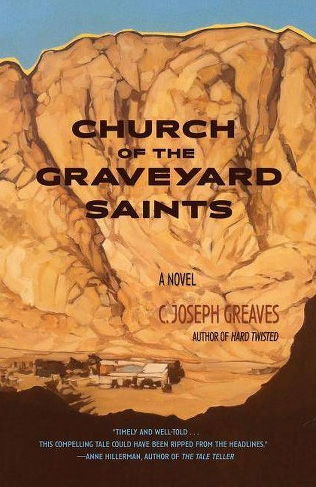
CHURCH OF THE GRAVEYARD SAINTSIt’s a pleasure to report that after earning national acclaim for his five earlier novels, local author and my fellow Prose & Cons columnist C. Joseph Greaves has turned his attention to his Southwest Colorado backyard with his latest work of fiction.

In Church of the Graveyard Saints, Greaves has woven a tale of multigenerational love and conflict set against the ongoing battle to preserve the peerless landscape of the American West. Set where he lives, in red-rock-rimmed McElmo Canyon near Cortez, Greaves’ new novel will resonate with all those who love and live in the Four Corners region.

Church of the Graveyard Saints is published by Salt Lake City-based conservation-literature publisher Torrey House Press. Greaves will launch the book with a reading and signing at Maria’s Bookshop in Durango on Tuesday, Sept. 10, at 6:30 p.m.

In the Q&A that follows, Greaves talks about the genesis of Church of the Graveyard Saints, as well as the novel’s locally sourced characters and the book’s personal connection to Greaves’ life in the Four Corners.

Q: After writing award-winning mystery and historical fiction, what motivated you to take on a commercial/ literary novel like Church of the Graveyard Saints?

Like many new novelists, I started out writing what felt natural to me, which was first-person, plot-driven fiction. But I never wanted or intended to limit myself to being just a category author. For example, my second novel, Hard Twisted, is a third-person account of true events written from the standpoint of a 13-year-old-girl adrift in the Depressionera Southwest. My last, Tom & Lucky, set in New York between the World Wars, employed four alternating viewpoints and mixed both first- and third-person prose. So yes, I’m always looking to stretch my legs as an author. That’s also why, to differentiate the two, my mystery novels are by Chuck Greaves while the others, including this latest, are by C. Joseph Greaves.

I recall a conversation I had in 2012 with Jonathan Evison, a dear writer friend, in which we discussed how one best propels a purely character-driven novel. He maintained that the difference between what a person has and what that person wants, along with the obstacles to its attainment, are enough to drive a book forward. I suppose I’m putting that advice to the test with Church of the Graveyard Saints.

Q: Addie Decker, the primary protagonist, is one of the more engaging characters we’ve met in recent fiction, let alone in Western fiction. Who is she, and where did she come from?

Several years ago, I read about Attachment Theory — the idea that your earliest maternal interactions can both determine and predict your later-life relationships. As an erstwhile psychology major, I found this fascinating, and I wondered, okay, but what if you never knew your mother? What if your only account of that relationship comes from your less-than-reliable father? And if you believe in Attachment Theory, might circumstances like those make you distrust your own ability to have a healthy adult relationship?

So that’s where Addie began — as an otherwise smart, strong, and resilient young woman who’s been raised by a difficult father and as a consequence is somewhat unmoored when it comes to her personal life.

Then the next question was: How do you integrate that aspect of her personality with a story about returning to your roots? The answer for me was to have Addie arrive in Cortez, her old hometown, with her new (and older, more sophisticated) boyfriend in tow and then have to deal with her high-school sweetheart, a likable lunk who’s newly divorced. The resulting frisson, while not the main thrust of the novel, provides another propulsive element.

Q: Addie isn’t the novel’s only compelling personality. Describe the challenge of writing such widely disparate characters as a university professor and a 20-something oilfield roughneck and an octogenarian cattle rancher.

The four viewpoint characters in this novel — Addie Decker, her father Logan, her boyfriend/professor Bradley, and her old flame Colt — could not be more different in terms of their educations and experiences and world views, which is wonderful grist for the mill because an important aspect of writing from multiple viewpoints is the language at your disposal. For a character like Bradley, certain urbanity is demanded, whereas Logan Decker might employ a more colloquial manner of thinking and speaking. Not that Logan is any less thoughtful or astute than Bradley — far from it. It’s just that in order to be credible, each character must think and act and speak in a way that’s consistent with his particular background.

Add to that the novel’s dozen or more supporting characters — a small-town lawyer, Addie’s irascible grandfather, a gung-ho deputy sheriff — and you wind up with a chorus of different voices that, if I’ve done my job well, should harmonize and lift to the rafters without hitting any false notes. Again, it’s what a character has, and what that character wants.

Q: Although you’ve described this novel as a love letter to the rural community in which it’s set, and where you live, it might seem to a reader like tough love at times. Why is that?

The Four Corners region has fascinated me, and attracted me, since I first saw it in 1993. It is one of our nation’s most beautiful and, paradoxically, least populated places. For over a century, unfortunately, it’s been treated as a national energy sacrifice zone in which various extractive industries — whether uranium, coal, oil, carbon dioxide, or natural gas — have enjoyed free rein alongside family ranching and farming operations, many multi-generational. Before that, of course, it was home to the Ancestral Puebloan people whose ruins, rock art, and artifacts still adorn the landscape. As more and more Americans — retirees, tourists, outdoor enthusiasts — have discovered the area, certain tensions have arisen, most notably between those who favor aggressive economic development and those who would prioritize environmental and archeological conservation.

In Church of the Graveyard Saints, I try to give voice to all sides of the debate, although it’s probably clear where my own sympathies lie. More importantly, I try to illustrate the whipsaw forces at play in a place like the Four Corners at a time when drought and market consolidation and diminishing economic opportunity might force a fifth-generation ranching family — a family whose love of the land is no less sincere than that of the most ardent environmentalist — to view extractive industry as its only hope for survival. Yes, that’s a sad state of affairs, but all too often in today’s New West, that’s the hard truth on the ground.

Q: Would you characterize Church of the Graveyard Saints as regional literature, or do you think it has broader national appeal?

First of all, what’s “regional literature” anyway? Isn’t To Kill a Mockingbird a regional novel? Isn’t Pat Conroy a regional author? Or Jesmyn Ward? All books are set somewhere, and it’s almost as though if the setting isn’t New York or L.A. or someplace overseas, then it’s regional and somehow lacks universality. Until it doesn’t.

One torment visited upon authors by their publishers is naming comparable titles that the publisher’s publicity department can then use to market the book. My first, purely instinctive response to Torrey House Press was Larry McMurtry’s The Last Picture Show, given both books’ small-town settings. But the real questions are: What’s the book about? What does it say? How are its characters different people at the story’s conclusion than they were at the beginning? What forces account for those changes? What lessons were learned along the way?

When viewed through those lenses, Church of the Graveyard Saints is sui generis. And yes, its themes are universal. Or at least I hope they are.

Scott Graham is the National Outdoor Book Award-winning author of the National Park Mystery series for Torrey House Press. The fifth book in the series, Arches Enemy, was released in June, and is available at bookstores and online at indiebound.org. Graham can be reached at scottfranklingraham.com.

Published in August 2019

A mistrial is declared in the Howe case: The head of a nonprofit is accused of taking advantage of an elderly client’s trust

A mistrial was declared July 25 in the prosecution of a Cortez woman accused of bilking an elderly widow out of her home last year shortly after the death of her husband.

Barbara Howe, head of Ability Consultants, a nonprofit which she represents as a “one-stop” help center for people with disabilities, was charged with felony theft and criminal exploitation of an at-risk person after an investigation revealed she had obtained a quit-claim deed in February 2018 to a Cahone residence that 85-year-old Joyce Cook had lived in for nearly 40 years.

Howe had then attempted to secure a $100,000 loan on the property to purchase a home of her own, according to a Dolores State Bank official.

Because of Cook’s age – now 86 – a competency hearing was conducted by 22nd District Judge Todd Plewe out of the presence of the jury to make certain Cook understood the significance of the proceeding.

“She answered just about all my questions,” Plewe concluded. “I’m confident she’s competent to testify.”

During the aborted three-day trial, Howe’s defense attorneys had also maintained Cook had been in full command of her facilities when she voluntarily signed the property over to Ability Consultants as a means of protecting it from creditors. And they pointed out that the alleged victim had never moved out of the house before Howe agreed to sign the quit-claim deed back over to Cook.

However, prosecutor Sheena Goldsborough pointed out during her opening remarks that Cook was emotionally and financially distraught in the months after her husband Wayne’s death, and contended Howe had exploited this state of mind. Along with additional funeral expenses, she explained, Cook’s social security benefits had been temporarily suspended because of paperwork foul-ups and she was nearly without resources.

“Mrs. Cook believed her creditors had the power to take her home,’ Goldsborough said. “She was terrified she would lose her home.”

In his opening statement, Public Defender Jonathan Jourdane conceded the agreement between Cook and Howe had been “terrible timing – an impulsive agreement,” but vigorously denied the defendant had “knowingly deceived” Cook when convincing her to sign away the property.

“That did not happen,” Jourdane said. “Ms. Howe is innocent and we will ask you to return a verdict of not guilty.”

As the first witness in the trial, Joyce Cook reluctantly admitted she had signed a quit-claim deed that transferred ownership of her three-bedroom house on two acres of land in Cahone to Howe’s company. However, she repeatedly stressed she believed it was just an “investment,” and that she never imagined she’d be asked to move out.

“(Howe) mentioned I could invest in her company by putting the deed to my house in her name,” Cook said. “I never thought she would do something that low.”

But then a realtor showed up with a “For Sale” sign and informed Cook she intended to put the property on the market, Cook recalled.

“I was in shock,” Cook said. “I never dreamed (Howe) would do something like that.

“Good gravy – I couldn’t believe it was happening.”

However, under cross-examination, Cook conceded she had also discussed with Howe moving to a more handicapped-accessible place.

And she repeatedly said she couldn’t remember, when asked by defense counsel if she’d discussed moving to a bigger house with another son and whether the realtor had been to her house on more than one occasion. Her recall of other events also failed her again and again.

A Dolores County clerk then testified that Howe had brought Cook and her son Eric Bergman, also disabled, to the courthouse to transfer the title.

Former chief deputy clerk Karen Kibel recalled that Joyce Cook seemed “kind of out of it” during the process and that Howe did most of the talking and was very insistent the deed get transferred quickly, even though certain things were incomplete.

Dolores State Bank Vice President Pam Thompson testified that when Cook had come to the bank in April to discuss a loan to pay off funeral expenses, she had been very upset and told Thompson she’d done a “bad thing” by signing over the deed to her home. Thompson testified that was when she became concerned and ultimately contacted the Dolores County Sheriff ’s Office.

Tammy Beanland, a loan officer at the bank, also testified that Howe had contacted her about getting a $100,000 loan on the same Cahone property after she had obtained the quit-claim deed. She said Howe wanted to use the property as collateral to buy a home in Cortez.

At that point, which was in April of last year, Dolores County Undersheriff Tim Rowell opened a joint investigation along with Adult Protection worker Melissa Markhart into that situation and Howe agreed to be voluntarily interviewed by them.

That lengthy recording was played for the jury in its entirety, including Howe’s repeated insistence that Cook had willingly donated her property to Ability Consultants and that Howe had intended to help her and her son find more handicapped-accessible housing in return.

Howe then stated on the tape she had suspected “something like this would happen – when people play games, they want to play it their way.”

After the interview, Howe notified Undersheriff Rowell she was transferring the property back to Cook and asked for a statement basically saying she’d done nothing wrong. But instead in June the felony charges against Howe were filed.

It was at this critical juncture of the trial, just as the prosecution had rested its case, and defense attorney Jourdane had begun to move for an acquittal by Judge Plewe, that an unusual and fatal mishap in the proceedings was discovered.

The court reporter found that the electronic device that is supposed to record all testimony, attorney questions, comments and objections as well as the judge’s rulings and citations had quit working, failing to capture about two hours of the remarks of two witnesses (Rowell and Markhart) – both key to the prosecution’s case.

After contemplating his options overnight, Judge Plewe announced his decision on July 25 to declare a mistrial, dismissing the jury and setting a hearing for Aug. 9 to determine when and where a new trial will be held. Plewe indicated it would probably not be in Dolores County, since a large number of the potential jurors had been already used in assembling the first panel.

Published in August 2019 Tagged ,

A way to bring harmony: A Gourd Dance will be done at a Cortez church for the first time

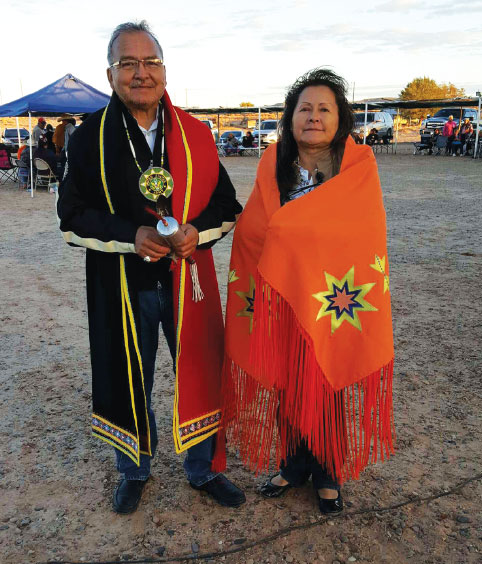
Pastor Norman Mark will lead the Gourd Dance on the grounds at the First United Methodist Church in Cortez. He is pictured here with his wife, Rebecca, in September 2018 as they participated in a similar ceremonial event. The Aug. 31 Gourd Dance is the first held on Christian church grounds in the region, says Pastor Jean Schwien. It is an event they hope will attract native people from surrounding communities and non-native people who wish to learn more about Native American culture at an authentic ceremonial dance honoring veterans and their families. Photo courtesy Norman Mark.

Legendary contemporary dancer Martha Graham once reminded us that practice is how we learn: “Whether it means to learn to dance by practicing dancing or to learn to live by practicing living, the principles are the same. One becomes in some area an athlete of God.”

Native Grace Intertribal Fellowship is hoping to exemplify that kind of living harmony when they present a traditional Gourd Dance in late August on the grounds of the First United Methodist Church in Cortez.

“It is a first,” says Native Grace Pastor Norman Mark.

“There is no other example of traditional native dance on Christian property that we know of in our region. The Gourd Dance is an opportunity to make the bold statement that a person doesn’t have to choose to be either Christian or traditional native. A person can be both and be blessed by practicing how to live side by side in harmony,” he says.

An intertribal veterans’ Dance

The Gourd Dance was begun by the Kiowa and Comanche tribes of the great northern American interior plains in the late 1700s, according to Roy Cook, a member of the Golden State Gourd Society on line at the website American Indian Source.

Songs associated with the gourd societies and the ceremonial dances were not presented in public until the middle of the last century, when a revival of the tradition gained popularity after the Second World War. At that time, many indigenous people drafted into the U.S. military served with great distinction beside white soldiers. The resulting experience of equality between native and white troops reinvigorated the effort to honor warriors in the Plains tribes by finding a means to translate the old ways into appropriate modern traditions. Fortunately there were people left who still remembered the old ways and the old songs when the Gourd Dance was reorganized in the 1950s.

In a traditional version of the Kiowa warrior song, a lone surviving warrior is trying to find his way back home to the tribe after a battle. He hears music and finds Red Wolf singing and dancing and holding a fan in one paw and a rattle in the other.

Red Wolf feeds the warrior and tells him to take the songs back to the tribe.

Cook explains that, “the call of the wolf is at the end of the song. If you listen closely you will hear it.”

When the warrior societies and the Gourd Dance were revived, women again sang the War Mothers’ Songs of Victory and men sang Songs of Brave Deeds. The warrior societies found a logical and useful extension in serving veterans returning from the Second World War. Much like the non-Indian Veterans of Foreign Wars and American Legion, these societies honored their returning soldiers.

The Kiowa have passed this warrior society on to other organizations and tribes.

The Gourd Dance is now known as an intertribal veterans dance found throughout the various tribal nations in the United States, honoring the military men dancing with a gourd and a fan. They are the warriors willing to lose their lives in defense of the people.

Sacred accord

Pastor Jean Schwien is clear about the purpose of offering the Gourd Dance on the First United Methodist Church property.

“This is an opportunity for Christian and native traditional cultures to work in accord with each other. Unfortunately, it doesn’t often happen. If it does, it’s all about Anglo people helping native people in whatever way Anglos believe to be appropriate. This is a whole different thing.”

The Native Grace Intertribal Fellowship meets on Sunday afternoons in the Methodist church sanctuary. Mark describes it as “a place of our own; traditional and Christian, with storytelling, dancing and singing. We are reaching out through our mission to teach that a person can be both Christian and traditional Diné, Ute or any other tribe.

Many reservation churches teach that a native person must turn away from traditional cultural practices because the beliefs are evil, or of the devil, he says. As a result, most Native Americans struggle with Christianity coming out on the reservation with such messages, says Mark, whose home is near Hatch Trading Post on the Navajo reservation.

“Being told you are evil makes it difficult to come forward and express who we are and not be ashamed of the traditions we come from,” he said. “The day I could say, ‘this is who I am. I am native and I am Christian at the same time’ was the day I opened up and began to heal.”

Mark says that boarding school told him not to speak his Navajo language and to be afraid of being native.

But five years ago he began a course of studies specifically for Native American pastors. That opportunity to study with the Rev. Calvin Hill on the Blackfeet Parish in Montana brought him to an understanding of who he was and how to heal from the lack of self-respect taught him as a child.

Now, a pastor at Native Grace, he feels his opportunity to work with Pastor Schwien is very potent, and as they are discovering, very rare.

“I am not generally welcome in the Christian churches on my own reservation. They won’t let me preach in their churches. But I am embraced by many traditional people out there and asked very often to conduct traditional services for funerals, baptisms and other family ceremonies.”

He even conducted an interfaith baptismal that included the Catholics, the traditional and the First United folks, Schwien adds, explaining that when Moses sees the burning bush in the Christian Bible story, “God speaks to him and says, ‘Take off your shoes. You’re standing on holy ground.’ I can’t understand how reservation preachers can overlook this; how they can persist in being out of Christian balance with the sacredness of mutual respect for the places we worship and how harmonious our beliefs are, how much we have in common.”

The Gourd Dance is being held on the grounds where Native Grace hopes to build a hogan sanctuary in the future. “It feels like we’re making progress and we want to invite all the people out on the nearby reservation to attend,” Mark tells the Four Corners Free Press. “It feels like the right time to do this. All are welcome.”

Bead stands, mutton and shade

The Gourd Dance begins at noon on Aug. 31 at 515 N. Park Ave. in the field on the northwest corner of the grounds. It will continue throughout the afternoon, accompanied by the Alfred Wall Drum from Towaoc, followed by a feast at the end of the day. Two sheep have been contributed for the mutton stew and space has been designated for arts and crafts, and bead stands where vendors can set up their shade tents in the designated ring around the dance grounds by paying a $10 registration fee. A blanket dance will also be performed in the afternoon for contributions to the Native Grace hogan church building fund to be built on the dance ground site.

The Gourd Dance is a “give back” for Mark’s initiation into the Dzil da’ hi zilíí Gourd Society. “When we’re initiated we are asked to give back a Gourd Dance. This is my give back. I welcome the Anglos who want to learn about one of our traditions first-hand, from this traditional event, from our point of view.”

He reminds people who may not know that guests should bring their own folding chairs and that those who have shade should offer space to people who didn’t bring an umbrella. “Anglos may not know the importance of chairs and umbrellas. It is necessary to be comfortable, to relax and enjoy the beauty of what will happen at the Gourd Dance that day.”

It is a huge step for the morning congregation, Schwien says, referring to the Anglo congregation by their familial church moniker.

“We’re all trying to get better at being in a harmonious relationship that expresses our many shared beliefs. It is critical, especially today as we face so much unconscionable political behavior.

“In our culture, Anglos are comfortable controlling the money and the power, so when Norman came to me to discuss the Gourd Dance as something he and the native people wanted, we agreed it would be a hopeful and healthy event, and moved forward.

“Native Grace makes their own decisions about all they do on our shared grounds. Since Norman has been conducting the afternoon Native Grace services, our relationship with each other is enhanced. To say we are glad about this is greatly understating the big steps we have taken together.”

The Gourd Dance will be held on Saturday, Aug. 31, at First UMC, 515 N. Park Ave., Cortez, from noon to sunset.

Published in August 2019

A sudden power shift: Empire Electric’s provider invites the feds to take over rate regulation, despite pleas to delay

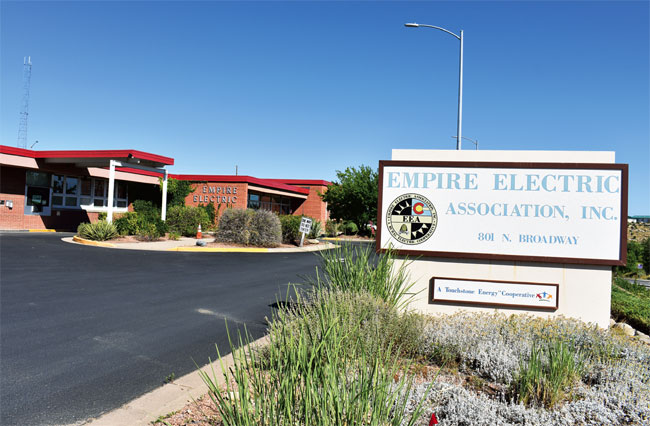
EMPIRE ELECTRIC ASSOCIATION OFFICE

Tri-State, which is the electric power provider for the Empire Electric Association, the local co-op, has caused some concerns because of its recent decision to seek federal rate regulation. Photo by Gail Binkly.

Despite requests to delay the move, the Tri-State Generation and Transmission Association has decided to seek regulation by the Federal Energy Regulatory Commission (FERC) instead of state regulators.

On July 9, the board of directors of Tri-State, which is the electric power provider for the Empire Electric Association, voted to move forward with an application to FERC for regulation of the wholesale rates it charges to its 43 member co-ops.

Fourteen days later, Tri-State filed its tariff application with FERC and announced that it expects the filing to be accepted in 60 days. According to Tri- State’s press release on the vote, “For the first time, Tri-State will be fully rate regulated. Tri-State would be required to file proposed rates with FERC, and FERC would establish just and reasonable rates through its regular rate setting process.”

The vote marked the end of a rushed process shrouded in mystery on the reasoning, timing, and voting results. During the three-week period before the vote, member co-ops submitted a long list of questions to Tri-State seeking to clarify the reasoning and implications of FERC oversight. Individual members of Empire Electric and other co-ops submitted questions to their own board of directors to clarify the vote, and members of the Colorado legislature requested a delay to better understand the implications of FERC oversight on Colorado ratepayers.

The vote on July 9 angered some members of the Colorado Public Utilities Commission (PUC) who felt that Tri-State is reneging on a deal it reportedly struck in May with the state legislature regarding a bill aimed at reducing Colorado’s greenhouse-gas emissions. What seems to be lost in the process is consideration of the impacts that FERC rate regulation will have on Empire Electric and other co-op members. “I have qualms about how the timing of this decision diminished our co-op’s voice,” said Heidi Brugger, an Empire Electric member who regularly attends board meetings, in an email response to a question from the Four Corners Free Press.

“The Empire Electric board met after the Tri-State decision was made on July 9th. Are we nothing more than a rubber stamp? And the federal oversight by FERC is not a bargain. While it may standardize withdrawal arrangements across the Tri-State co-op, every ask of FERC will have a high price tag, which eventually may impact EEA member rates. We needed more time to ensure that the questions raised were answered.”

The Tri-State family

As an Empire Electric customer, “You are part of something bigger,” the Tri-State website says. “You’re a part of a co-op. Your reliable and affordable electricity comes from Empire Electric Association working together with their power supplier, Tri-State Generation and Transmission Association. Collaboration is part of our DNA. Our family of not-for-profit electric co-operatives, including Empire Electric Association, leverages our combined resources and knowledge – giving us the stability we need to succeed when it counts for you.”

As a member of the Tri-State family, Empire Electric entered into a “full requirements contract” with Tri-State to provide all its electricity needs through 2040. The terms of the contract dictate that Empire Electric cannot “self-supply” more than 5 percent of its power needs. That is why Empire Electric is conservative on implementing local power projects and monitors net metering customers to ensure that they are not selling excessive power to the grid.

As a member/owner of Tri-State, Empire Electric has one vote on the Tri-State board and sends a representative from its own board to the monthly meetings.

Up until the July 9 vote, Tri-State proudly touted its independent management and oversight. Tri-State’s mission “is to provide our member systems a reliable, affordable and responsible supply of electricity in accordance with cooperative principles.” There are seven cooperative principles, including voluntary and open membership; democratic member control; and concern for community.

All co-operatives, including Tri-State and Empire Electric, are to follow those.

Tri-State explained its self-governance and rate regulation to the New Mexico legislature in 2017 as follows, “Our association is member-owned and member-governed. One member, one vote. Unlike investor-owned utilities whose rates include profit margins for their shareholders, co-operatives operate on a not-for-profit basis and have cost-based rates.”

In addition to its own by-laws and regulations, co-operatives in Colorado and New Mexico must abide by state regulations on business and accounting practices. The co-operative principles as implemented in by-laws and practices are overseen by the board of directors for the co-operative, who assume “fiduciary responsibility” for managing the enterprise in the best interest of the members they represent.

For co-operatives with a purchase power agreement with Tri-State, one director is selected to represent the co-op on the Tri-State board. This director assumes additional fiduciary responsibility for protecting the interests of Tri-State. What is not clear is what happens when Tri-State and the distribution co-op, such as Empire Electric, are at cross-purposes.

Several co-operatives such as La Plata Electric Association (LPEA) and San Miguel Power Association (SMPA) held emergency board meetings before July 9 to discuss their strategy as a group and guide their Tri-State representatives on a course of action. They also submitted letters to Tri-State and other co-operatives urging them to delay the vote until more questions were answered.

Empire Electric’s representative to Tri-State, Bill Mollenkopf, presented the information provided by Tri-State about FERC oversight at Empire’s regular board meeting on June 14.

In contrast to the flurry of activity and questions prior to the vote, there was relative silence afterward. Other than a confusing press release from Tri- State, there was no information released by the individual co-ops on how they voted and whether the questions or requests for delay were duly considered by the Tri-State board.

“After the FERC vote passed, I tried to find out how my co-op voted, because the press release from Tri-State and the news reports were vague and conflicting,” said Joan May of Telluride, an SMPA member. “I heard, secondhand, that the vote on this at Tri-State was a voice vote, and the votes were not recorded, it was simply that is sounded like there were a lot more yes votes than no votes. I’d love to confirm this, but of course Tri-State does not require votes to be attributed nor are their minutes (or agendas, or calendars, or board members, or notices) easily locatable. DMEA, LPEA — and I believe United — have volunteered that they voted no on the FERC vote.”

May continued, “One of the many ironies is that Tri-State claims that they are better off without PUC oversight because they have a democratic board of 43 members. It is misleading to call their board democratic, because they seem to be directed how to vote by Tri- State, and also because each of the 43 co-ops gets one vote, despite its size. So, when three of the co-ops oppose a motion, they represent 25 percent of the power demands on Tri-State but only a small minority of votes.”

In the end, a statement released by SMPA sums up the voting process for many Tri-State members. “SMPA is not necessarily opposed to Tri-State becoming rate regulated by the Federal Energy Regulatory Commission. We do feel that a less rushed, and more methodical process leading up to this would have allowed for a more complete understanding of what was being done, and why.”

Who is FERC?

The Federal Energy Regulatory Commission was created as an independent agency in 1977 to assume many of oversight responsibilities outlined in the Federal Power Act of 1920. FERC regulates interstate commerce for energy supply such as wholesale power rates and transport charges for oil and natural gas pipe lines. In addition, FERC oversees purchase contracts for qualifying facilities (QFs) under Public Utility Regulatory Policies Act of 1978.

Most generation and transmission companies like Tri-State that own and operate resources in multiple states are regulated by FERC. Tri-State is exempt from FERC rate regulation because it is owned by small electric co-operatives and borrowed from the Rural Utilities Service.

Despite its exemption, Tri-State has dealt with FERC over-rate and contract complaints. In 2016, Tri-State was denied a petition for a declaratory order from FERC to limit power purchases from QFs by the Delta-Montrose Electric Association, which wanted to exceed the 5 percent self-supply cap.

Tri-State’s new CEO, Duane Highley, who started work in April and came from the Arkansas Electric Co-operative Corp. and Arkansas Electric Co-operative Inc,. has experience working under FERC orders related to QFs.

Looking back, Tri-State has been on the path to be eligible for FERC oversight for the past few years. According to the Tri-State press release on July 23, “Tri-State has considered FERC regulation since 2010, as both Colorado and New Mexico exercised wholesale rate jurisdiction over Tri-State, which resulted in increased costs, unrecovered revenue and inconsistent rates to its members.”

In 2014 Tri-State repaid its Rural Utilities Service debt and in May 2019, the Tri-State board amended its by-laws to allow new types of members to join the association, effectively eliminating the exemptions to FERC jurisdiction.

Mollenkopf, the Empire Electric representative to the Tri-State board, said, “If we at Tri-State had requested FERC regulation when it was first seriously considered in 2012, Tri-State would have avoided just shy of $50 million that was lost in the New Mexico ($39 million) and Colorado ($11 million ) rate protests that occurred in 2013-14. Even with paying a $1.3 million annual fee to FERC over the intervening seven years, Tri-State members would be over $40 million ahead today!”

The primary reason that Tri-State puts forward for inviting FERC rate regulation is that it would “eliminate inconsistent rate treatment across states. It would preempt rate regulation in Colorado, Nebraska, New Mexico, and Wyoming. It would eliminate the three-protest rule in New Mexico, moot the New Mexico Federal Court case, eliminate the rate complaint jurisdiction in Colorado and prevent new rate regulation in Wyoming and Nebraska, as well as in Colorado and New Mexico.”

In a July 23 press release announcing Tri-State’s tariff application filing with FERC, Highley, the CEO, said, “If Tri-State is to be rate regulated, it makes sense to be regulated by a single regulatory body that would apply consistent rates to Tri-State’s members in each of our four states.”

By eliminating the cost of case-bycase opposition to state rate regulation, there would be a higher level of rate certainty because FERC uses formula rates. This rate certainty may also help reduce Tri-State’s borrowing costs. The costs to Tri-State with FERC regulation will be an annual fee of approximately $1.3 million, litigation costs, and increased staff costs for hiring FERC-qualified lawyers and analysts.

The costs to individual members have not been specified but it is expected that filing a rate complaint with FERC will be more costly than involving the state PUC. Josh Dellinger, general manager of Empire Electric, said in an email to the Four Corners Free Press that there could be both benefits and drawbacks.

“If Empire Electric did want to challenge a Tri-State rate, doing so at FERC would be expensive,” Dellinger said. “However, FERC offers an additional check that we presently do not have. Tri-State will have to file its rates with FERC and FERC will have to approve them before they become effective.

“As it works now, Tri-State’s rates become effective without any third-party review. The state commissions only become involved if there is a complaint. FERC is very familiar with electric utility rates, likely much more so than state commissions. Regulating wholesale electricity rates for utilities involved in interstate commerce is part of FERC’s core mission. A rate is going to have to be ‘just and reasonable’ for FERC to approve it in the first place. So, hopefully, the likelihood that we would need to challenge a rate will be reduced by having FERC review.”

Following co-operative principles?

The Tri-State mission statement specifies providing reliable electric power to its members while following the cooperative principles, including “voluntary membership.” The other benefit of FERC regulation, according to Tri-State, is that it would eliminate state jurisdiction over “buy-outs.”

In December 2018, Delta-Montrose Electric Association filed a complaint with the Colorado PUC to intervene in its negotiations with Tri-State on a buy-out agreement that would allow it to terminate its power purchase contract with Tri-State and exit the family. Mark Pearson, executive director for San Juan Citizens Alliance, suspects that Tri- State’s rush to move to FERC oversight is related to the DMEA complaint.

“It seems like the urgency for immediate action was entirely an attempt to avoid Colorado PUC oversight of the exit fee negotiation with Delta-Montrose,” Pearson said. “Tri-State flatly refused to address any of the questions raised by member co-operatives, including United and LPEA. The rushed, secretive nature of the decision can only raise questions.”

Pearson is not the only one who has questions about Tri-State’s timing. The Colorado PUC commissioners were concerned enough about the potential change of venue for the DMEA complaint that after they were noticed about the FERC filing they ordered Tri-State to “file a summary of all actions taken by Tri-State, its employees and any third party consultants, including attorneys, from the period January 1, 2019, through Friday, July 12, 2019, concerning the steps it has taken to consider and to move Tri-State toward additional FERC regulation.”

Just 10 days after the FERC vote, Tri- State and DMEA announced that they had filed a settlement agreement with the Colorado PUC and this previous complaint would be dismissed. In an effort to support “sound public policy, good faith and fair dealing,” another Tri-State member, LPEA, sent a motion to the Colorado PUC on July 18 that “any Settlement between DMEA and Tri-State should not be confidential … and in particular, that the Commission should make clear, transparent and public any details regarding the proper calculation of any just and reasonable exit charges, or equivalent charges.” As LPEA announced that it would submit a request for a buy-out estimate from Tri- State earlier in the month, a transparent settlement process would assist its consideration for leaving the family as well.

One confusing aspect of the reasoning behind FERC regulation is that Tri- State would always have the option of leaving FERC oversight. It is not clear how this would be possible now that Tri- State has eliminated possible exemptions or how new family members that are not member-owned would be treated if FERC oversight were to be terminated.

What does it mean for EEA members?

Overall the change from self-regulation to FERC oversight is a transfer of power and control from the elected member board to FERC. While this might clear up some of the fiduciary responsibility for the board members that represent both their own co-operative and Tri-State, it will saddle small distribution co-ops with big bills if they want to contest rate or contract terms.

How this power split will work will not be clear until Tri-State’s Contract Committee makes recommendations for new forms of membership and contract terms. Empire Electric board member Fetterman said, “As best as I can determine, the effect of Tri-State being rate regulated by FERC would be neutral to our members. It would be positive since we wouldn’t be rate regulated in five different states. The negative is that it would be an expensive venue to file grievances in.”

Pearson raised similar concerns. “One concern about moving regulation from the state level to the federal level is that it greatly increases the cost and difficulty of consumers to raise complaints about rates. Now, any rate complaints will require hiring extremely expensive lawyers in Washington, D.C., and expensive travel to a far-off location. FERC also has a reputation for taking years to complete decisions. The ultimate gist for co-op customers is a greatly more expensive process with a much slower response.”

It appears that while the move to FERC oversight was good for Tri-State, it has yet to be determined if or how it will benefit Empire Electric members. With ill-defined standing under the new membership and oversight rules, there seems to be little opportunity for individual members to be heard.

However, there is a new opportunity for Empire Electric members. On July 17, Tri-State announced that it will be a pursuing a “Responsible Energy Plan to support transition to clean energy resources, ensure reliability, with goal to reduce rates.” Part of this planning process will be facilitated by the Center for New Energy Economy, led by former Colorado Gov. Bill Ritter.

“As a co-operative, we understand that transformative change requires understanding and engagement with stakeholders,” said Tri-State CEO Highley in a release. “Governor Ritter and the Center for the New Energy Economy will convene for Tri-State the best and brightest to surface ideas that will inform and advance our planning.”

Marianne Mate of Dolores, an Empire Electric member, said she intends to stay involved in Tri-State’s ongoing process. “As an owner/member of EEA it’s important to me to continue to stay informed and advocate for cost-effective clean energy solutions.

“The issues are complex, and we need to be sure our board of directors are engaged and asking the hard questions and if they aren’t, we need to be asking those questions.”

Published in August 2019 Tagged

Desert Solitaire

Thank goodness New York publishing, unlike Hollywood filmmaking, hasn’t entirely succumbed to the bland congruity of blockbuster titles, series retreads, and the same old, same old. Thank goodness a trip to your local bookstore can still yield daring works by diverse new voices; quirky and beautiful novels that defy convention and expand the boundaries of traditional storytelling.

A PRAYER FOR TRAVELERS BY RUCHIKA TOMARRuchika Tomar’s debut novel, A Prayer for Travelers, is one such work. Initially set in a remote desert town somewhere in the American West, it tells the story of Cale Lambert, a high-school senior whose quiet introspection renders her socially invisible, her tremulous light eclipsed by the bright incandescence of a quartet of cool-girl classmates led by Penélope Reyes, aka Penny, the clique’s beautiful, enigmatic ringleader.

After graduation, when Cale lands a job at the local diner where Penny is waitressing, the two young women forge an unexpected and, for Cale at least, dizzying bond of friendship soon sealed in blood by a sudden act of violence. The inscrutable Penny, it seems, has a darker side than any Cale had imagined – one involving drugs, multiple seductions, and a freezer full of cash. Then Penny vanishes without a trace, leaving her cell phone and her cash behind, prompting Cale to embark on an odyssey of discovery – to find her missing friend, to fathom her motives for fleeing, and perhaps to discover herself in the process.

The story that follows, related through Cale’s increasingly-jaundiced perspective, is compelling enough in its own right – a cross-desert road trip through the gritty circumambient of trailer parks and truck stops, strip clubs and Indian casinos, with Cale out front and the local police chief lagging behind. But then Tomar takes her tale to another level entirely by scrambling the book’s chapters such that 2 follows 31, for example, and 52 follows 79. The resulting disorder mimics the disorderly nature of Cale’s comingof- age, and while somewhat distracting at first, it proves anything but random, becoming instead an essential element of the novel’s narrative magic, hurling the reader forward and backward in a way that deftly builds tension while depositing clues like so many breadcrumbs leading Cale – and us as readers – to her final and fateful destination.

Author Ruchika Tomar has a gold-plated resume for a debut novelist – a BA in English literature from the University of California Irvine, an MFA from Columbia University, and a Stegner Fellowship at Stanford University, where she is currently a Jones Lecturer. And while her writing fully reflects this pedigree, combining tightly wrought prose with deeply-realized insights, the book’s noirish settings and brisk pacing elevate A Prayer for Travelers above the already-lofty realm of “literary fiction” into that rarest of belletristic strata, that of the Damn Good Read.

“I pulled Penny’s phone from my pocket and tried powering it on, looking around the kitchen as if a power cord might appear, or Penny, some useful explanation. But the phone was dead. I tried to remember if I could ever recall Penny with two phones, if this could have been a duplicate. The sick feeling grew, the omniscient gray vapor rolling low and sinister through the halls.”

As for the book’s anachronous chapter order, I’m reminded of another novel reviewed in this space several months back, The 7 ½ Deaths of Evelyn Hardcastle, in which author Stuart Turton tested the boundaries of narrative structure to much less useful effect. In contrast, A Prayer for Travelers ($27, from Riverhead Books) disorients and delights in equal measure, in a style reminiscent of that rarest of Hollywood offerings, a Quentin Tarantino film. And that, my friends, is a tasty burger indeed.

Chuck Greaves/C. Joseph Greaves is a member of the National Book Critics Circle whose sixth novel, Church of the Graveyard Saints (Torrey House) will be in bookstores in September of 2019.

Published in July 2019, Prose and Cons

‘Acres’ is a homegrown treat

I’ve been a poetry aficionado all my life. As a kid, I devoured poems that had good rhymes and lively stories, whether or not they were regarded as work of the best order. “The boy stood on the burning deck” was mixed right in with “When I was four and twenty, I heard a wise man say,” and so on.

Later, of course, I took classes, read more works, wrote some abysmal stuff myself, and learned to appreciate poetry that is truly good, whether or not it rhymes or tells a rollicking story. The best poems are thoughts distilled into something that resonates with the reader and lingers long after the reading is done.

But I don’t claim to be an expert in judging this art form. Far from it. When it comes down to it, as with other art, I basically just know what I like.

And I like David Feela’s latest work, a chapbook called Little Acres.

Feela – who has written columns for the Four Corners Free Press as long as we’ve been publishing – has, as they say, a way with words.

His columns make us smile and make us frown. They make us think Oh, yeah or Oh, no; plant ideas in our mind that could germinate into who knows what.

And the poems in Little Acres do the same things. They are easy to read, but like all good poetry, have more to say with each reading. For example:

Just the Feeling

We wake one
morning thinking
just another day,
but satellites
colliding in
space spread debris

like a shattered
glass from last night’s
toast to everyone’s health,

or the rose blossoming
in a dream field of snow,
a beauty that doesn’t belong.

Now you know.
And it’s not that you know anything

specific, just that feeling in your gut
urging you awake, whispering
how something isn’t right

as sunlight paints the room
a perfect yellow.

The word choice and images are excellent, both familiar and unfamiliar. The observations are those of someone who never ceases looking at the world around him and thinking about it in new ways. Consider this poem:

Preheat

Daffodil burns like
a votive beside the sidewalk,
forsythia gushes

like an old gold faithful,
and this incandescent
flame of feather,

bluebird on a wire,
flickers like
the pilot light of spring.

There is a lot of poetry written these days, but much of it is read primarily by a specialized audience of other poets. That’s unfortunate, because some deserves a larger audience. Little Acres is definitely in that category.

If you enjoy poetry – or even if you aren’t a big poetry fan but you enjoy good writing – you should check out Feela’s latest. As he says, it’s homegrown and GMO-free.

Gail Binkly is editor of the Free Press.

Published in July 2019

Musings on public lands

In 1775 the combined population of all 13 colonies of America was approximately 2,500,000. When formulating the Articles of Confederation to join forces to fight for Freedom, Liberty and Property. The Crown or King controlled the property, resources and lives of the people. The smaller colonies feared the larger colonies would later dominate and rule over the smaller ones. This was a basis for the Bill of Rights and Equal Footing Doctrine in the later Constitution, to ensure one or more states did not dominate the smaller due to land and larger populations. There were no public lands.

Today, the State of Colorado has over 5.7 million of population in 64 counties. That is twice the population of the entire 13 colony/states at time of the Revolution. Nearly 80 percent of Colorado’s population, about 4.5 million is concentrated in only 9 of the 64 counties, which is only 14 percent.

When the 13 new sovereign states formed the Constitution and created the federal body for very limited purposes and powers, there was authorized a land base for the new federal entity to occupy, the District of Columbia. The land was voluntarily ceded by the states of Maryland and Virginia to provide that land. The only other lands available for the federal entity were specified in Art. I, Sect. 8, Cl 17 of the new Constitution, and those lands must be purchased and only by approval of the state legislature involved. There were no federal “public” lands authorized.

New territories were later secured from other countries claims west of the Mississippi, for the express purpose of creating new states and that those territories were to be open to the “public” to settle in to grow sufficient populations to enable a state to be created.

As Colorado was carved out of new territories in 1876, it was stated it “shall be admitted into the Union upon an equal footing with the original states in ALL respects whatsoever.” Further it declared “the State of Colorado shall consist of all the territory included with the following boundaries…”. The new state was no longer territory and no longer “open” for the public to settle at their choice as indicated by “the people inhabiting said territory do agree and declare that they forever disclaim all right and title to the unappropriated public lands lying within said territory.” There were no longer any “public” lands of the territory, as they had become lands of the state to be “disposed of ” where people could then purchase the land into private ownership. The new federal General Land Office was charged with disposing of and selling those lands on behalf of and for the new state as the federal entity was not authorized to own any lands within a state that was not authorized in Art. I. After some efforts at selling the lands, the Lands Office stopped trying, but did not complete official “disposal” of the remaining unappropriated lands to the state.

The above took place shortly after the War Between the States, which saw a growing federal government assuming authority and power not authorized in the Constitution as evidenced by creation of national forests and parks from the residual unappropriated lands within the new states’ boundaries. Political power and control lifted its ugly head. The national forests were established in 1905 here, ignoring the Constitution and State Enabling Act, but declaring the forest was to be managed and used for the benefits of local people.

In 1976 along came the Federal Lands Policy Management Act (FLPMA) declaring all the federally held lands of the states to be retained in federal control, then began the policy of declaring them “public.” This Congressional Act was again contrary to the Constitution and the States’ Enabling Act. This removed 36 percent of the lands of the state from control of the state. A state is not a state if it cannot control and govern the lands and resources within its boundaries. A new federal “state” had been superimposed within and over the Constitutional state, returning to “kingdom rule” of land and resources and thus lives of the people in just 200 years, 1776 to 1976.

Since that time, environmental laws have been enacted to further limit and eliminate the public access and use of the federal states’ land and resources. Wilderness designations have been legislated which further limits who can access the areas and by what means. The small “Lizard Head Wilderness” contains 41,525 acres with 37 miles of trails that are open only to hikers and equestrians. The trails are for access to a point of interest such as Navajo Lake or one of the five peaks to climb to mark off the bucket list for mountain climbers. Three of the peaks are fourteeners and two more are almost fourteeners. If the trails were given a 300-foot view right of way, the 37 miles would comprise only 1,345 acres out of the 41,525 acres, leaving 40,180 acres not used, managed or protected and not accessible to the rest of the public. The Kill Packer Trail is the most popular trail, with about 2600 users last year as it accesses two fourteeners. These are free use, while in Alaska, Denali climbing has a $365 permit charge. To climb Mt. Everest, there is an $11,000 permit fee per climber.

The federal “public” land “state” in Colorado comprises about 23,870,652 acres, which is larger than any of 13 different eastern Constitutional states and larger than many European countries. What was 1776 all about? What did the statehood statement “upon an equal footing with the original States in all respects what so ever” mean? What control do the people of a county of the state have over its own future when 73 percent of the lands and resources are not under its control and use? Is “We the people” really the government? Who are the public of the “public lands”?

Dexter Gill is a retired forest manager who worked for private industry, three Western state forestry agencies, and the Navajo Nation forestry department. He writes from Lewis, Colo.

Published in Dexter Gill

Independence

This July, we celebrate 243 years of American independence. All countries honor their origins, but let’s be honest. No country comes close to what the United States has achieved. Our founding declared us to be free. It is our tenacity, our shared values that our rights do not come from government, but rather they are the rights of every citizen either born on American soil, or earned through the immigration process, that keep us free.

The Declaration of Independence, the United States Constitution, and the Bill of Rights, with amendments, provide the framework to operate a functional government that clearly defines what those functions are. Current realities show an extremely divided electorate, due to a multitude of factors, that are putting our freedom and independence at risk.

One of those factors is that it seems we cannot agree on what a fact is. My college education was science-based. The basic tenets of science are based on facts, with plausible scientific hypothesis being subjected to facts as they appeared after testing. Not what you subjectively thought they should be. The science of Range Management has been assaulted by individuals wanting to factor in human values of aesthetics that extoll “pristine landscapes,” with a dose of Animal Planet thrown in. One of my elective college classes dealt with the concept that the future of conservation was not in the actual resource, but rather in the management of people. That particular professor was quite popular with students who could not pass the required courses of Organic and Inorganic Chemistry, advanced Calculus, Physics, and Soil Taxonomy that comprised a degree in Range Management. Or, in other words, the critical thinking classes that are based in hard science of resource management. Today, we are bombarded with what I am beginning to call emotional terrorism by all sorts of agenda-based interest groups that seek to convince us that their facts are the right facts.

A second factor that tears at our society today is closely aligned with what facts are. That would be what is true. This is where corporate media, left and right, go to work to earn their pay. I can say, I am wearing a blue shirt today, which is a fact. The shade of my shirt is royal blue, which is true. Another perspective might say, It’s electric blue, and as Jackie Gleason used to say, and away we go. Our news media corporations have made millions and live very comfortably by becoming partisan political cheerleaders instead of fact-based reporters. Despise Donald Trump? Watch MSNBC and read the Washington Post. Do you think Bernie Sanders is an existential threat to our country? FOX News can help you with that. Meanwhile, back at the ranch, egregious violations of our rights by government entities continues unabated.

Recently, the Journal posted a story about the La Plata County Assessor and Emergency Services combining efforts to surveil the entire county on a regular basis with high-resolution photography. This effort, already implemented, will increase tax revenue and lead to better protection of the people. If this doesn’t wake you up out of complacency, say hello to government management of your life. If, Montezuma County decides to go down that path, I will be shopping for new leadership. Technology can, and is, of great value, but we all know it has its dark side. It is incumbent on us, as citizens, to protect our rights as government always wishes to increase its size and its reach. That particular story screamed Judas and his 30 pieces of silver. Let us count the ways that information will be doled out to various interest groups.

Government is increasingly becoming a burden to the governed, as more citizens feel compromised by a bureaucracy that is more interested in itself than in the rights of its citizens. Instead of justice, people find themselves settling for mediation that requires compromises. Police, in some areas, decide which laws will be enforced and which ones do not rise to a level to be worth their time. Americans spend more on tax supported education than any country in the world and have mediocre results. Communities are having to deal with increasing homeless populations while our too big to fail corporate banks never faced consequences for their actions that had a direct impact on that. The Affordable Care Act has come to be more about billable hours than good care. Some advocacy groups are now clamoring for more money for their pet projects.

As taxpayers we are constantly being asked to pay for more programs to fix society’s problems. So many of today’s issues are more a result of greed and a lack of oversight and accountability than by actual needs. It reminds me of Warren Beatty in the movie “Bullworth defining what is really obscene.

Americans are intrinsically fair minded, but there are limits to being understanding. In contrast to our freedom and independence, we may in the near future, reach that limit.

Valerie Maez writes from Lewis, Colo.

Published in Valerie Maez

Bait and switch

We taxpayers and residents in Cortez, Mancos, Dolores, and Montezuma County are about to be hoodwinked (wink, wink) into the oldest con game ever put forth by shysters and our local supposed leaders.

Community center? For what and who? First question, who owns the empty old Walmart center? It seems they have already been hoodwinked. Were we the people involved in their getting shafted by Walmart, or are they still paying the former owners a pittance? I hate to see people being taken advantage of, especially in the welfare economy we are in. We are quite short of restaurants in the area, only offering Mexican and Tex-Mex, Oriental, or fast food stops – guts and butts offered by corporations who send their profits out of the area. We do have an excellent local hamburger shop here also serving dinners. I just wish there were someplace he could buy his meat and fish and poultry products locally.

The mysterious estimate as to how large a number will be needed to support this convention center, 700 to 1500 people, was stated in The Journal. Guesswork is not how to start a business. It takes quite a study to get the solid numbers. Without those numbers, it is a stupid venture. Build it and they will come only happens in baseball fantasy.

There are a great number of facts to be gathered. It may be a bait-and-switch lesson we don’t need to get sucked into. I have seen this happen in the many places I have been. The big one pulled on us was the one when things got tight and we invited and gave tax breaks to one of the richest corporations in this country. The killer of small towns. I’ll not mention names but you know who I’m talking about. Watch what you say about large corporations, they have lawyers who are standing by to cut their teeth on small lawsuits.

Their sales pitch is always the same: We will provide jobs. Well, we had business and jobs for our locals here. Where are they now? The jobs are gone and also the businesses. So let’s see. We are going to use a lodgers tax to fund that dream. Nothing ticks me off more in my travels than when you are quoted the cost of a mattress, two sheets and a wornout room to stay in and you present the amount and instead of the original quote they add on a big lodgers tax. Why, when you ask the price of the room, can they say, “Total cost is such-and-such without mentioning the add-on?”

Say those that want the convention center venture and get it off the ground run out of income to support it. Then they will say, we will have to find another source of revenues. Take a wild guess – it will be we the people! Need I say more? Bait and switch is the game. We the people need more information.

Galen Larson writes from Montezuma County, Colo.

Published in Galen Larson

Why Earth’s story matters, 2

Last month’s column left off with Earth looking like a snowball roughly a billion years ago. In fact, there were a number of snowball epochs in Earth’s past, though most didn’t actually have glaciers growing all the way to the equator. For this column those specifics make little difference since my point is mainly to introduce folks to the marvelous dynamics of Earth’s evolution. More details are easy to find on the internet.

It’s true that global glaciations drove many extinction events; still, enough plants and animals and microscopic creatures survived for Life to rebound. Seemingly learning from the past by incorporating lessons into new generations. Always reinvigorating itself as time marched on. Doing the best it could with what it had. Until another grievous assault brought things crashing down, only to have Earth and Life pick up the pieces and start all over again.

Each global deep freeze was begun and ended by its own unique combination of factors that lined up into one “perfect storm” or another. Each changing Earth as she matured. Here I think, rather than continuing down the stream of time, I need to take time out in order to consider many of the geophysical dynamics that contributed to starting and ending Earth’s great glaciations.

The most obvious driving factor is our medium-sized sun. Fortunately, it is quite stable. Yes, it’s been increasing its energy output, but that increase has been very slow and steady.

It turns out that the biggest factor in causing Earth’s fluctuating insolation – the measure of incoming sunshine — is our own planet’s position in relationship to the sun.

Back in the 1930s and ’40s, Russian astronomer Milutin Milankovitch documented how subtle fluctuations in Earth’s rotation, namely axial tilt and precession, along with periodic changes in the shape of Earth’s orbit, combine to vary the amount of heat Earth receives from our sun and how it’s distributed.

Down on Earth, “plate tectonics” drives an amazingly wide spectrum of influences on climate and landscape. Of course, we have volcanoes and earthquakes with all their varied and well documented landscape changes.

Unseen are volcanic greenhouse gases along with short-lived sunlight reflecting aerosols, sulfurous material and an assortment of toxic gases, along with massive quantities of water, all expelled into the atmosphere. Each of these individually and in concert with others, produces various cascading impacts upon Earth and climate.

For instance, water combines with sulfur and nitrogen oxides from volcanoes to form acid rain. Acid rain reacts chemically with both silicates and carbonates in crustal rocks. Thus hastening weathering and erosion.

Below the surface, hidden from human view until scientific ingenuity learned how to peer inside Earth, scientists discovered a relentless drama as heavier oceanic crust gets shoved under lighter continental crust.

No two chapters were the same, some were more dramatic than others. For instance, evidence indicates that while Rodinia was assembled straddling the equator around a billion years ago, a subducting plate got so jammed up under the supercontinent, that the mantle couldn’t support it any longer. The slab started sinking, broke off and dropped through the mantle like a cooling blob in a lava lamp. Dropping all the way down to the surface of Earth’s iron core, where it poured out over the top of it.

This in turn lowered the temperature in this portion of Earth’s dynamo in such a way that Earth’s magnetic dipole field was disrupted, tangling and weakened. It took the core a very long time to reestablish a strong dipole configuration.

This made a big difference to evolving Life because the magnetic dipole field is the thing that creates Earth’s protective force field. The force field that shields us from the constant stream of solar and cosmic rays and particles – when it fails, Life on Earth suffers.

Conversely, a smaller subducting plate may warm up so much that it becomes buoyant and presses up against the overlying crust, causing an orogeny. That is, a mountain-building episode.

Also since our continents are basically floating on Earth’s convecting mantle, as plates jostle and grind past each other they will also bob up and down. Not much, but it doesn’t take much when multiplied by the passage of hundreds and thousands, or even thousand times a thousand years, unfolding one day at a time, to cause significant sea level changes.

But wait, there’s more. Around 700 million years ago Earth’s slow cooling brought the upper mantle to a 650° C. threshold that resulted in geophysical changes which enabled the subducting crust and upper mantle to incorporate sea water into its subducting structure. So much sea water got sucked down into the mantle that sea levels lowered markedly. This exposed more land along the edges of the ever-changing continents.

Remember now, this whole time mountain-building was also going on only to be eroded away. This meant massive amounts of rocks and sand were constantly being transported down towards the sea. Slowly but relentlessly this mass accumulated, cementing together, then got piled on some more.

With lowering sea levels vast stretches of previously submersed continental shelves became giant evaporation ponds. Occasionally refilling with sea water, only to dry out, over and over again, thus extracting salts and metals from sea water. Remember the mountain-building and erosion?

It’s always just a matter of time. Eventually huge salt flats would be buried under mud flows and sand storms, effectively sequestering that salt. Thus over a few eons previously toxic ocean waters were scrubbed of excessive salt and metals, making those waters increasing hospitable for ever more complex organisms.

Also thanks to lowering sea levels, once deeply submerged continental shelves found themselves within the sunlight zone. Cleaner water, more sunlight, finely ground resources, vast expanses of uncolonized real estate and timing. The stage was set for something extraordinary.

But, you’ll have to plunk down another 50 cents for next month’s Four Corners Free Press to read the rest of this story.

Peter Miesler writes from near Durango, Colo., and maintains a few “information kiosk” blogs, including confrontingsciencecontrarians.blogspot.com/ and NOVillageAtWolfCreek.blogspot.com

Published in Peter Miesler

The joy of aging’s repeats

COLONOSCOPY … There’s a lot of O’s in that word, and perhaps fittingly. After my fourth with the good Dr. William “Bill” Ranier last week, his nurse gave me internal photos – a nice touch, if you ask me. Got to see the round muscle hole of my colon up close, polyps and all … Since Dr. Ranier had closed his Cortez office and clinic and had moved his practice to San Juan Hospital in Monticello, he had reminded me of my five-year deadline, and so I’d scheduled it for a weekday last month in Utah … My anesthesiologist there was surprised to hear I watched the operation my first time with Bill – in Cortez some 20 years ago. Back then I was still in my “bring-it-on”-let’s-see-what- the-world-offers-next mindset. It was interesting, if uncomfortable and a bit tedious. I learned getting knocked out and sleeping through the operating room procedures made the experience less onerous … In fact, it wasn’t much more inconvenience than three hours of a drug-induced nap, no pain except for a intravenous needle poke, and a touch of mind fuzziness on waking up … Bill stopped in to tell me he’d found two polyps which they will have tested and I will need to come back in a couple weeks. Last time I had a couple polyps too. Happily, they were benign. However, my brother died of colon cancer, so I went from a big C every ten years to one, post-polyps, every five years now … The hardest part of the whole thing — as a night owl — was driving over at 7 a.m. in the morning from Norwood to Monticello. And that after waking at 4:30 a.m. to drink 16 ounces of water mixed with Suprep (sodium sulfate, potassium sulfate and magnesium sulfate) with an additional 32 ounces of just plain water in the next hour after. It cleans one out. Real clean. Having to drive, half asleep, after numerous trips to the bathroom – as we say in this country, although these trips had nothing to do with bathing – was daunting.

BOTANY … On my way back home after a night out in Monticello, I stopped in the divide between Big Gyp and Disappointment on a little side road that takes one to a site where I once found lots of the rare Gypsum Valley cat-eye … Hailed as a new species by the University of Maryland botanist James L. Reveal (“best known for his contributions to the genus Eriogonum”) in 13006 [2006 AD] and named by him Cryptantha gypsophila. Unfortunately, an earlier American botanist, Edwin Blake Payson, who had written a monograph on Cryptantha spp., had used the name Cryptantha gypsophila in a description of a taxon now known as Cryptantha paradoxa. Under international nomenclature rules, even though the original name of a valid new species didn’t stick, it can’t be used again as it’s in the chain of lineage in the Linnaean system … So, in 13010, the dean of Colorado botanists William A. Weber (currently 101 years old) teamed up with Univ. of Colorado Museum of Natural History Associate Ronald C. Wittman to correct the error and rename Revel’s new species, Oreocarya revealii, honoring Reveal in the process … It’s a lovely white-throated little pincushion bush, found in the near barren grayish gypsum hills of the West End – formed geologically amid the Paradox member of the Hermosa Formation – and in other barren shale substrates … As a plant, it’s similar to the more common Cryptantha paradoxa, but can be distinguished in the field by its glabrous (“smooth, especially having a surface without hairs or projections”) upper leaf surfaces … Regrettably, I had one of my “most embarrassing moments,” as a county commissioner inviting Jim to come speak at the Wilkinson Library about his new discovery over a dozen years ago. Inexplicably, I failed to show up. Somehow the event had gotten lost in my haphazard juggling of a busy political schedule. As a long-time member of the Colorado Native Plant Society, I was horrified. Reveal felt snubbed. Plus I’d missed a talk I was deeply interested in … Reveal has since passed away, but he let nature lead him to understand and describe another rare plant in San Miguel County. In fact this one is really rare. With the highest endangered ratings globally and in the state, the Cushion Bladderpod, a yellow-throated pincushion of a plant endemic to Colorado and endangered globally and statewide, is known only from San Miguel and Dolores Counties. Reveal named this one, and the name has held, Physaria pulvinata. There’s a population not far from my house in Norwood, actually, and I visit it occasionally to make sure it’s still doing well.

PRE-RIVER FEST PARTY … Had a great time in Dolores last month at a party one of my friends hosted – meeting all kinds of people who remembered me from years ago. One year I emceed the Dolores River Fest. Since I never got invited back I figured I hadn’t done a very good job, but someone said they change emcees every year. So that was nice to hear … Val at the lumber yard was gone, so I couldn’t buy any wood, but I loaded up on old sawdust that I used for my compost toilet. … And then I got to visit Trail Canyon Ranch in McElmo Canyon (www. treesoftrailcanyon.com), where master arborist David Temple gave me a marvelous tour of his tree farm. So many unusual varieties that do well in our climate. I got one large tree and a couple small ones. If you want special trees for your landscaping needs, David is the one to contact. I got a black walnut cultivar and I’m very excited to see how it does. It almost dulls the pain of losing three 15-year-old spruce, a 20-foot narrowleaf cottonwood and significant die-off in my elms and coyote willows to last year’s drought.

BROKE DOWN … Of course, my trusty Nissan decided to die in Cortez on my way home. Thanks to CJ of Mancos Towing, I got a jump that worked. But I only got as far as Dolores, when – turning on the lights – the pickup lost all power again. And I couldn’t get it to jumpstart going down a hill. Figured it was the alternator, not the battery … So I called AAA again, and CJ came and rescued me a second time. If you need help for a vehicle down south of us, I’d highly recommend Mancos Towing. Drove me up to Telluride, where I left the vehicle with my new trees in the back (hoping it wasn’t a freezing night, and it wasn’t) … In the morning, the battery took a jump again, and I made it to Norwood, where the Nissan didn’t need an alternator, but merely a good cleaning of the battery terminals and it’s working fine … Ah, the adventures of living in the mountains.

Art Goodtimes writes from San Miguel County, Colo.


THE TALKING GOURD

Rutted

Why do I keep doing
the same thing over
and over again,
expecting change,
something different
to happen?
Haven’t I figured out
that the same thing
results in the same thing?
Why am I afraid of doing
something different,
something I haven’t tried?
Is it change that I fear,
or am I afraid of what
changes change’ll bring?

—Ed Brummel
Salida, Colo.

Published in Art Goodtimes

Don’t create a history to judge

In about the space of one week in June, Donald Trump suggested a newspaper committed “virtual” treason; joked (perhaps) about staying in office beyond term limits, while at the same time, saying two major papers would be out of business by then; said he is “all in” for an amendment banning flag-burning; said (before later backtracking) he would accept campaign help from a foreign power and that he wouldn’t call the FBI in such a circumstance; and fired pollsters because he didn’t like the numbers they produced — but declined to fire his chief counselor, who was found to have repeatedly violated the Hatch Act.

That’s one long sentence, and it only partially sums up one short span of days.

Trump’s assaults on decency, honor, the law and the underpinning principles of the republic are by now predictable. That predictability, though, makes it all the more frightening — the more we become numbed to his conduct, the more exhausting it is, and the more exhausting it is, the greater the tendency to just surrender. The temptation is especially great when one sees his devotees either ignore his conduct, or worse, defend and excuse it. No matter what facts come their way.

Still, that’s just a loud minority of gullible people whose vulnerabilities have been exploited (or, among a minority of that minority, whose hatred has been validated). And in the broad scheme, Trump is just one crass and selfish man with no impulse control.

But then there are his enablers — not just certain power-hungry members of Congress, but the people he installed in his administration, or put to work for him. Make no mistake: These people, too, think they are above the law, or they argue Trump himself is. The danger they pose is neither a small nor partisan matter.

In an attempt to reverse a federal court ruling allowing a House committee to subpoena records from his accountant, Mazars USA LLP, Trump’s attorneys argued Congress doesn’t have the authority to subpoena such records.

As reported by Bloomberg, attorney William Consovoy argued to a federal appeals court in May that the records are not tied strongly enough to Congress’ legislative function to clear the bar. That court rejected the argument; the ruling will be appealed. (Just days later, Treasury Secretary Steven Mnuchin refused to comply with a congressional subpoena for six years of Trump’s federal tax filings, invoking the same argument; the Justice Department later issued a finding backing Mnunchin. And round and round we go.)

In unpacking this, it can be said that here, at least, Trump is working through the court process. But as others have noted in published reports, what happened in May fits with the White House’s repeated refusal to comply with subpoenas and boils down to claiming Congress does not have authority to investigate a president.

“Apparently,” writes Washington Post columnist Aaron Blake, “the White House has landed upon saying Congress can’t investigate anything the president does unless it pertains to legislation.” For a White House to assert such a thing defies not just logic, but reality. To draw a bright line: The president has in effect said a coequal branch of government does not have the power of checks and balances, and his lawyer has the nerve, in making that argument, to wring his hands about separation of powers.

Speaking of nerve, one should never doubt Trump chief counselor Kellyanne Conway has plenty.

In June, the Office of Special Counsel recommended that she be fired for repeatedly violating the Hatch Act. The act prevents federal employees from engaging in campaign activity in their official capacity; it can even prevent local agency employees whose places of employment receive federal grant money from engaging in campaign politics in their official capacity.

Conway was found to have made “statements directed at the success of (Trump’s) reelection campaign or at the failure of candidates for the Democratic party’s nomination for president,” OSC Special Counsel Henry J. Kerner wrote June 13. In doing so, she used her official authority to advocate for or against candidates, he said; despite multiple warnings to stop, Conway proceeded.

“To make matters worse, Ms. Conway is a repeat offender,” Kerner went on, citing a 2018 report he said Conway also ignored.

“Ms. Conway’s disregard for the restrictions the Hatch Act places on executive branch employees is unacceptable,” he also said, adding that, if Conway were any other federal employee, her “multiple violations of the law” would get her fired. Her actions, further, “stand in stark contrast” to the culture of compliance the White House had promised.

So, Conway, despite her value as a propagandist, was summarily dismissed … Actually, of course she was not.

White House counsel Pat Cipollone claimed the OSC’s report was riddled with legal and factual errors as well as the result of an “unfair” process that “chills” Conway’s free speech rights, and the First Amendment rights of other federal employees. (An interesting shift, from a White House that last year pressured staffers to sign nondisclosure agreements.) Conway herself cried victim: the Hatch Act matter was an attempt to silence her, and “put a big roll of masking tape over my mouth.”

Prior, Conway had said of the Hatch Act: “Blah, blah, blah. If you’re trying to silence me through the Hatch Act, it’s not going to work. Let me know when the jail sentence starts.”

She meant, of course, that nothing is going to happen to her, not even if she admits violating the Hatch Act in front of the world, and then lights the OSC’s report on fire.

But the Hatch Act issue speaks to a much broader matter than whether Conway was appropriately mindful of her words while on the clock:

“As a highly visible member of the administration, Ms. Conway’s actions, if left unpunished, send a message to all federal employees that they need not abide by the Hatch Act’s restrictions,” Kerner said. “Her actions erode the principal foundation of our democratic system — the rule of law.”

Indeed.

But Conway-itis, so to speak, is catching.

Witness DOJ attorney Sarah Fabian trying to make a credible case that migrant children being detained in government camps are not entitled to basic hygiene items. The same week reports detailing appalling conditions at some of the camps emerged, Fabian came before a 9th Circuit Court panel. She argued that because the 1985 case establishing how kids in federal immigration custody must be treated didn’t specifically state they need towels, toothbrushes, soap — or even a bed other than a concrete floor — well, then, the government doesn’t have to provide those things.

The jurists rejected the argument; Fabian indicated the administration will appeal.

At this point, we should be beyond arguing who is to blame for why migrant children are here, and the way they are being treated ought to transcend political viewpoints.

The fact is, these children are here, and when we chose to detain them, we became fully responsible for them, regardless of what our immigration policy is. Ditto for adult detainees — who, in one instance, were crammed so many into a room that they stood on toilets in order to breathe.

The rule of law matters. But Trump’s team repeatedly and brazenly flouts the law, and nothing happens, except that more and more are emboldened and there is a cascading effect.

History will not judge them kindly, it is said — but in the end, that is a tepid response.

These people are on track to usher in a period of lawlessness, except for laws that will protect the powerful and punish those without any. Those who now rejoice at Trump, or excuse him, should know that one day, they will turn to the law for redress and not find it.

So forgive me for not finding comfort in the prospect of history wagging its finger at those who wrote this sorry chapter.

The best strategy is acting before there is a more of a history by which we can be judged.

What we face is the alarming combination of the blindness of rank and file Americans, the opportunism of those at the levers of power, and the corrupt soul of one man. The majority must assert itself through established, lawful means, before these means are no longer available. Don’t wait on history to sort it out.

Katharhynn Heidelberg is a journaist in Montrose, Colo.

Published in Katharhynn Heidelberg

UC-Berkeley’s first dean of women

LUCY SPRAGUE MITCHELL

Lucy Sprague Mitchell

Children should be seen and not heard. This was a common belief of her time, but one strongly rejected by Lucy Sprague Mitchell. Growing up in a well-to-do family, where children’s days were rigidly scheduled and expectations of her were high, young Lucy came to feel that she was incapable of pleasing her parents, that she was an inadequate person. Yet these feelings gave her the impetus to seek new ideas about child-rearing and education. Ultimately, she founded a college on those ideas.

She was born Lucy Sprague in Chicago, Ill., on July 2, 1878. Lucy was the fourth of six children of Otho Sprague, a wholesale grocer, and Lucia Atwood Sprague. Her father and his brother and another man, Ezra Warner, had been farmers in Vermont before moving to Illinois, where they started the Sprague- Warner Company that quickly became one of the largest wholesale grocery businesses in the world.

Lucy was educated at home with private tutors until she was 12 when she was enrolled in a local private girls school, but soon left because she had so much anxiety and felt great stress when going to class. It was too busy and structured for her. Back at home she read every book in her father’s extensive library and began to write stories, secretly, filling many notebooks. Eventually, she wrote many books that were published in her lifetime.

Although higher education was still uncommon for young women, Mitchell entered Radcliffe College in 1896. Studying John Dewey’s theories, she was especially impressed with his idea of education as a “social function,” connecting the child to the experiences of others. She graduated with high honors in philosophy in 1900.

She became the first dean of women at the University of California at Berkeley. This was at a time when women were beginning to organize at the university, preparing to acquire rights and privileges denied them simply because of their gender. She lectured in the English Department, promoting educational and career opportunities for women from 1903 to 1912.

In her time children were taken care of but silenced. They were looked upon as inferior and given strict scheduled lifestyles. She didn’t understand how anyone could expect to teach children when they do not understand the way children learn and what they are interested in learning. She wanted children to interact and learn through experiences. Her theories focused on relationships.

With some clear goals in mind, Mitchell left California for New York in 1913 and started the Bureau of Educational Experiences (BEE), which coordinated and sponsored experimental schools around the country and maintained its own nursery school. She promoted the development of healthy, emotionally secure children, “whole children” as she called them, as a way of building toward a “progressive, humanistic society.” Her focus was the study and develop optimal learning environments for children. The BEE evolved into the Bank Street College of Education. Mitchell’s early conflicts, which centered on how to grow and change as a female living at the turn of the century, set the stage for the Bank Street model of education. The school became known not only for its contribution to the early education of young children, but for enhancing the development of its faculty, including helping them recognize social problems and their responsibilities to the world at large.

There is so much more to her life, her writing and philosophies, I encourage you to look further into the life of this wonderful woman. Thanks for reading!

Margaret “Midge” Kirk is a slightly eccentric artist, writer, bibliophile, feminist scholar and hobby historian who lives in the SW corner of Colorado. She can be reached at eurydice4@yahoo.com or visit her website www.herstoryonline.com.

Published in Midge Kirk

Haberdashed

My mother recently sent me a link in an email. Now I know that when mothers send links in emails, the links usually lead to videos that were funny in 2004, or expired pages on their local newspapers’ websites, or news that Bill Gates wants to give me (me!) a new computer. But this particular email link was useful, because it led to a list of high-quality items that a person need purchase only once in life because of their durability. You know, things like a Stanley thermos, or a vasectomy.

I happened to be in the market for a new blender, so I figured I’d listen to Mom and spend a little extra for one that will last me until climate change ends civilization as we know it. But that plan went downhill as fast as a California mudslide as soon as I walked into the hat shop.

It’s no secret that I like hats. I like how the right hat can make me feel like Humphrey Bogart and look like Willie Nelson’s progeny. I like the air of mystery when the brim veils my visage. I especially like wearing a hat to restaurants, where there’s no place to hang it anymore because that courtesy died with American isolationism and comprehensible jazz somewhere before 1950, so you have to cradle your hat on your lap while eating or else leave it jauntily perched atop your noggin despite the rule preached in elementary school that boys can’t wear hats inside even though girls can and that rule makes no sense anymore now that we’re pretending to care about gender equality.

Because I like hats so, and because there’s not a custom hat shop where I live, of course I walked into the hat shop in this unfamiliar town. Of course I tried them on. Of course I asked about the base price after learning that every hat in the joint was custom-made. And of course I would have normally dropped the hats like a hot pork pie and bolted from the premises after hearing the cost of a custom lid.

But I—I listen to my mother. I understand the value of a purchase that will last me the rest of my lifetime, so long as I don’t encounter any stiff breezes. So I asked the good (and not at all mad) hatter to size me up and hat me.

And I am glad I did. The entire process taught me a great deal about the craft of millinery. For starters, I learned that millinery is hatmaking for women. Men just get hats. I also learned that haberdashery, although fun to say, is not in fact hatmaking, but I had already purchased the title of this column before learning that.

Furthermore, did you know that a hat becomes a tax-deductible expense the moment it, and the experience of acquiring it, becomes the central premise of a newspaper column? It’s true, I hope! Because this hat is the first purchase in my lifetime that has required a deposit on commissioned work.

You see, unlike what any reasonable consumer might expect upon ordering a tailored accessory, a hat isn’t made in a day. The shop didn’t close for an entire half hour after I placed my order, yet the man said I’d have to come by at a later date to collect my hat. All he could do with me sitting there staring at him is size my head.

I imagine a standard head-sizing doesn’t sound like a big deal to many of you, unless you too grew up hearing commentary from your mother about the girth of your head and how you’re lucky to have even made it through the birth canal. I expected that the hatter’s Velcro headband wouldn’t even make it around my skull. He’d have to call for reinforcements. I’d be told that custom hats don’t come in plus sizes, and that my deposit was nonrefundable. I nearly fled the shop.

But I worked through the sweat and the shakes, and it turned out that my head is a perfectly normal large size, even if it is indented on one side, making me look rather like a lima bean. Like a kid who did a good job at the dentist, I got to pick out my very own feathers from a box of feathers, and the kind hatter attached them to my hat for me when I picked it up before leaving town.

He told me this hat would last me a lifetime. And you know what? He’s right. Because for what it cost, you better believe I’m never wearing this thing outside the house.

Zach Hively writes from Durango, Colo. He can be read and reached through http://zachhively.com and on Twitter @zachhively.

Published in Zach Hively

Tech failure

At the risk of having my Official Man Club membership revoked, I must admit that I’m not very good at mechanical things, or modern technology.

I was reminded of that recently while visiting Northland Pioneer College in Holbrook, Ariz.

I was trying to sign on to the guest wifi but kept getting a message saying “authentication failure.” I flagged down a tech support person and told her I was having trouble signing onto the internet.

There was sympathy in her eyes as she patiently explained how to register for a free guest password. I told her I did that, but was getting the same message.

AUTHENTICATION FAILURE.

Aha, she realized that I was getting close to my Old Geezer years! She spoke slowly – because Old Geezers can’t hear in real time – and explained that after I register for a guest password they send it to your email address.

“Just check your email,” she said.

“Um, how can I do that if I can’t get online?” I asked. It seemed like a perfectly logical question.

A shocked look crossed her face, and she stood there, no doubt thinking, “Is this guy a moron?”

“That’s Mr. Moron to you,” I thought back at her.

The lady acted like she was talking to a three-headed dinosaur, with one of its heads stuck firmly up its rectum.

“Most people have their email linked to their phone,” she said.

Well, I didn’t, so I ended up having to pay $2 for a wifi day pass.

I remember going to a fast-food restaurant that had a sign promising “Free WIFI.” I wasn’t really looking for another wifey; after all, my wonderful Sara is everything I could hope for. But, heck, if they are free it couldn’t hurt to take a look at a free wifey. Maybe there would be a cute redhead (are there any other kind?).

It’s not just modern technology, either.

Back in college a girl with a flat tire asked me if I could change it for her. It was my chance to be a knight in shining armor!

“Aye, fair maiden!” I thought to myself. “I. Sir Johns-a-lot, shall gladly repair your conveyance!”

Only I forgot to block the wheel and the car rolled off the jack!

“Sorry, lady, I ain’t no Mr. Goodwrench,”

I muttered, as I slipped away in shame.

It seems I have always had bad luck with cars.

When I moved to Florida I had a black Volkwagen Rabbit. It was great in New England because it really kept me warm during the winter.

It was less great in Florida because the heat wouldn’t shut off.

Oh, and the windows wouldn’t roll down.

Instead of a car it turned out to be a torture chamber on wheels!

I tell you, I just don’t get mechanical stuff.

I was proud of myself when I got my first apartment – and bought a microwave oven. I dreamed of all the good stuff I could make myself to supplement my Twinkie diet!

I decided to cook a can of spaghetti.

After watching it for a while, I called my sister, Hilary.

“Hey, Hil, are sparks supposed to shoot out of the microwave when you use it?”

“NO!” She asked if I had put the can in the microwave.

Of course I did. Reading directions is for lesser men.

I know what you’re thinking – and it’s Mr. Moron to you!

John Christian Hopkins lives in Sanders, Ariz., with his wife, Sararesa. He is a veteran journalist – but never an enemy of the people – and a former nationally syndicated columnist for Gannett News Service. He is a member of the Narragansett Indian Tribe of Rhode Island.

Published in John Christian Hopkins

This is the time to support For Pets’ Sake

Montezuma County and the rest of the far southwestern corner of Colorado is home to a host of worthy nonprofit organizations that do a stunning amount of valuable work. We can’t begin to list them here, but they help people of all ages cope with a variety of problems.

When it comes to aiding companion animals, however, there is just a single local organization that really shoulders the burden and responsibility in Montezuma and Dolores counties: For Pets’ Sake Humane Society.

This nonprofit group is formed entirely of volunteers. It doesn’t have a single paid staff member. But it works to pay for spaying and neutering pets, offer low-cost vaccination clinics, and manage feral cat colonies. For Pets’ Sake fosters cats and dogs and finds homes for strays. It helps lost animals get home again. It aids local people who are hurting financially by helping them pay for needed veterinary care for beloved animals.

In order to raise the money to do all this, the group (among other things) applies for grants, holds bake sales in front of City Market in Cortez, and sponsors an enormous annual yard sale that is a real service to the area. Organizing the yard sale requires a tremendous amount of work — finding and prepping a suitable location, promoting the sale, hauling in tons of goods, selling them over a two-week period, then cleaning up after the event. Again, it’s all done by unpaid people whose motivation is helping pets and their owners.

July is the month when For Pets’ Sake seeks new and renewed memberships. July is also the time when the organization collects donations of change on a single morning at the farmers market in Cortez.

If you appreciate pets – if your life has been made better by the companionship of a tail-wagging dog or a purring cat – please join For Pets’ Sake. You can pick up a membership packet at the Cortez Public Library.

Or if you’d prefer, just bring them a donation of some coins – pennies, quarters, whatever – to the July 6 Cortez Farmers’ Market from 7:30 to 11 a.m. The farmers market, as you probably already know, is at the corner of Main and Elm streets in downtown Cortez. For Pets’ Sake will have a booth.

And, of course, continue to support the other worthy local organizations of your choice. These groups are helping make our local communities better places.

Published in Editorials

Instant Summer

After a record-breaking (or was it back-breaking) winter, we ushered in the summer solstice with almost two feet of snow in some parts of Colorado. Days later, it topped 80 degrees in Cortez. Instant summer? This wet and cool spring moved me into magical thinking as a gardener. My spring greens and peas were fantastic. The garlic is hitting new heights. Obviously, weed control would be the theme of the summer, but pests seemed to be non-existent and the extra moisture and cool weather made for some beautiful vegetable starts. Some of us even believed we had escaped the scourge of the cedar gnats.

And then summer arrived.

My tender snow pea pods changed into tough field peas overnight. The radishes went from spicy to surly in hours. My row of salad greens grew to colossal size and my contribution to any event involving food continues to be salad. I can freeze the spinach and peas, but I haven’t found a preservation option for salad greens. Reality also set in on the need for pest control. As I surveyed another limp potato plant, while scratching the gnat bite on my ear lobe, I realized that the plant was limp because it was no longer connected to its roots. The pocket gopher had arrived! My vernal rose-colored glasses made me believe that the ground was too wet and heavy for underground pests this year. So, I dusted off my gopher traps and started the annual battle with my subterranean “friends.” I have tried to ignore the grasshoppers in hopes that my investment last year in Nolo Bait and the birds nesting on or near my house would keep the population under control. So far so good, if you don’t look to closely.

This up-and-down weather has made planting impossible. My approach to planting is a matter of timing by trying to pick a weather window when the ground is warm and workable, and there is a forecast of moisture in the next few days. I just realized that I never planted any beans. I usually rely on the bean fields around me to signal bean planting time. This year I missed the memo. And now it is July and I don’t have any beans in the ground. What kind of self-respecting Dolores County gardener does not have any beans in the ground before the Pick ‘n’ Hoe celebration? I suppose I could try a late crop in the hoop house and use them as soil builder.

It looks to be a good fruit year. The apricots and cherries are loaded, though I imagine we will lose some to birds and squirrels. The apple and peach trees are all-or-nothing depending on the variety and when they chose to bloom. The rhubarb plants are now officially a hedge and I am going to need a chainsaw to harvest them. I have decided to treat rhubarb as an ornamental rather than food plant this year. I also laid off squash as I am still recovering from (and eating) the whale-sized fruit from last year. I expect berries and wild foods will be excellent this summer. Although like the domestic fruit trees, if they bloomed before a snowstorm the extra moisture could be for naught. I’ve heard reports of wild mushrooms already. Morels are expected this time of year, but giant puffballs, that’s a first for me.

Given my uneven planting and pest control, I’m wondering what the harvest will be this year. From what I have seen so far at the farmers market, my experience is not unique. Some growers are loaded with salad greens; others had success with early carrots, but not both. That’s the thing about gardening. Just when you think you are a gardening rock star; a pocket gopher brings you down to earth. Working with the dirt, weather, and “friends” that Mother Nature provides, we endeavor to grow something tasty. Luckily for me, there is good back up in the local gardening community and farmers markets. It’s going to be hard to show my face at the next neighborhood potluck without a bean dish in hand. Perhaps I can hide my meager offering under a rhubarb leaf. Here’s to all the intrepid gardeners out there. It looks to be a season of trade. Rhubarb, anyone?

Carolyn Dunmire is an award-winning writer who cooks and gardens in Cahone, Colo.

Published in Carolyn Dunmire

Coping with uranium’s legacy: Workshops offer Navajos guidance about dealing with toxicity

DOE SCIENTIST ANGELITA DENNY

Angelita Denny, working in the U.S. Department of Energy Office of Legacy Management
was the lead scientist presenting Uranium 101, a facts-based education program presented
at Marian Lake Chapter. The workshop will be presented in Cove Chapter on July 10. Photo by Sonja Horoshko.

In January 2013, a group of federal agencies in consultation with the Navajo Nation completed a five-year effort to address uranium contamination in the Navajo Nation.

The effort focused on the most imminent risks to people living on the land. While that initial effort represented a significant start in addressing the legacy of uranium mining, much work remained and the same federal agencies – the U.S. Environmental Protection Agency, Bureau of Indian Affairs, Nuclear Regulatory Commission, Department of Energy, Indian Health Service, and Agency for Toxic Substances and Disease Registry – collaborated to issue a second five-year plan beginning in 2014. It built initiatives on the first plan and made adjustments based on information gained during that time, while addressing the most significant risks to human health and the environment.

Near the end of the 35-page document the plan asks all agencies to work together, finally, on developing an enhanced educational opportunity for the chapter residents affected by mining and milling activities.

In an effort to fulfill that initiative, more than 10 agencies, Navajo and federal, showed up at the Mariano Lake Chapter in June to support the first of two summer outreach projects.

Affably titled Uranium 101, the workshop gave residents an understanding of uranium through science – what it is, where it’s found, how it behaves and when and why it is hazardous. It offered a foundation for understanding that will help local residents in affected chapters make well-informed choices when faced with decisions concerning uranium contamination in the future. The information also addressed behavioral changes that will reduce or eliminate exposure to contaminants, radon, and radiation, including understanding of pathways such as unregulated water sources used for livestock grazing that may affect the food they eat.

The complex workshop was presented in manageable increments by Angelita Denny, a physical scientist working in the U.S. DOE Office of Legacy Management. Each step in the curriculum she designed was followed by an explanation provided by a federally certified Navajo/English interpreter.

Although it has been offered at all the federal agency community meetings in the past, the need for a more central interpretation responsibility has grown over time as agencies learned that much of the information has no exact translation in the Navajo language. In many planning sessions held prior to the workshop Denny pressed for interpretive support of science facts. She explained to the federal and Navajo representatives that even very scholarly details, such as the release of energy and how alpha, beta and gamma rays travel through space would be welcomed information if interpreted properly.

During the workshop at Mariano Lake her explanations and PowerPoint visuals in English were followed by an often lengthy Navajo description.

Bess Tsosie expressed her appreciation. The interpretation at this meeting is culturally relevant and appropriate, she said during the question-and-answer period at the end of the day.

“In the past I found it difficult to understand exactly what ‘tailings’ is; but today when the interpreter explained it in traditional Navajo [using her hands to gesture the tail of something moving slightly down, with intermittent pauses, as if knotted] I finally understand. It was very fine cultural interpretation.”

Be’ekid Hóteelí Grass-root Organization President Bess Tsosie

Bess Tsosie addresses the many agencies that collaborated to present the Uranium 101 workshop. She said the interpretation was the highest quality. Photo by Sonja Horoshko.

Tsosie is president of Be’ekid Hóteelí Grass-root Organization, formed in 2011 to present the U.S. and and the Navajo EPAs with a list of demands, including recognition as the principal citizens group representing residents affected by the Gulf Mine, located at Mariano Lake Chapter. The group also demanded soil testing and investigation of earth cracks and open exploration holes as well as indoor radon testing.

Other commentators agreed with Tsosie, echoing a Navajo Nation statement included as an addenda in the 2014 Five Year Plan that “Diné know all things have within them the capability of both hozhooji (good or goodness) and hashkeji (bad or badness), and that both must be balanced to achieve beneficial results. This balance, known by the Navajo word hózhó, meaning harmony, is disrupted when natural laws are not observed. In Western science, this is known as a state of equilibrium, in which opposing forces balance each other and stability is attained and maintained.

“The Diné journey narratives speak of two Hero Twins that set about dealing with the Monsters. Navajo elders have taught that uranium, or leetsó, literally, ‘the dirt that is yellow’, is one of these Monsters — a powerful element that can disrupt hózhó when it is misused or disrespected. Certain substances in Mother Earth are not to be disturbed from their resting places, and the people now know that uranium is one such substance. Since leetsó has been disturbed by past mining and processing activities, Navajo natural laws charge the Diné with seeking ways to return leetsó to its natural balance with Mother Earth so that it does not further harm the sacred elements or the sacred balance of life.”

Shiprock disposal site

Simultaneously, the DOE Legacy Management team led by site manager Mark Kautsky is also planning two summer meetings. They are the next step in a concerted effort to teach residents about uranium science as it applies specifically to the Shiprock Disposal Site in northwestern New Mexico on the Navajo Nation. The meetings will be held Aug. 8 and Aug. 31 at the chapter house to discuss the deteriorating evaporation pond liner at the former uranium and vanadium ore processing facility, 28 miles west of Farmington, N.M.

Kerr McGee built the mill and operated the facility from 1954 until 1963. Vanadium Corporation of America purchased and operated it until it closed in 1968. The mill, ore storage area, ponds that contain spent liquids, and tailings piles occupied approximately 230 acres leased from the Navajo Nation.

In 1983 the U.S. DOE and the Navajo Nation entered into an agreement for site cleanup. By September 1986 all tailings and associated materials, including those contaminated from offsite properties, were encapsulated in a U.S. Nuclear Regulatory Commission-approved disposal cell built on top of the existing tailings piles.

A lined evaporation pond was built on the south side of the disposal cell. Water is pumped from horizontal wells on the north side of the cell from the floodplain alluvial aquifer between the San Juan River and the escarpment of the cell. The water from that and other nearby sources related to the disposal site around Shiprock is pumped out of the ground to the evaporation pond. It is, in a way, the interpreter explains, a method that enhances the power of Mother Nature — evaporation, natural solution.

Groundwater Compliance

The pond liner is 17 years old. Its estimated life span is 20 years. As the water evaporates and the water level decreases, small holes develop in the surface of the liner possibly from exposure to sunlight. Continual monitoring and repair of the holes is the responsibility of DOE Legacy Management. It is federally mandated to maintain the evaporation pond indefinitely to ensure that the selected groundwater compliance strategy protects human health and the environment.

As a practical response to the Uranium 101 Workshop, Legacy Management recognized that much of the printed material available to the public about the Shiprock site is difficult to understand. In an effort to increase the general understanding of the information they are also adopting the use of in-depth Navajo interpretation during the meetings to assure it is understood by everyone.

The group has indentified that the Shiprock residents’ understanding of the mill site and its presence in the community varies significantly. Basically, two groups’ needs will be addressed concurrently, making the dissemination of information a blend of history, site location, awareness and science. One group has first-hand occupational knowledge – a relative has become sick or passed away from exposure in the mill or a mine, or family contamination has occurred from construction materials or radon in the home, and /or they live downwind of a contaminated site. The group is generally older, and has lived in the chapter area for generations. They know the history of the disposal site and the mining extraction industry very well.

The other group is basically much younger. They have relocated there for many reasons, such as oil field employment, the Northern Navajo Indian Health Service Medical Center and access to a more convenient branch of Diné College. The result is a growing and prosperous community but also possibly less informed about the history site in the middle of town.

Unlike the workshop meetings, the Shiprock gatherings are intended to give the residents the necessary information that will help them understand the differences, risks and advantages of three options that may mitigate the hazard if deterioration of the evaporation pond liner becomes a reality.

The first, “No Action,” bears a misleading moniker. More correctly, it means no additional action will be taken and the current monitoring and maintenance will continue. Effectively, the option places the responsibility for any decision regarding the disposal cell in the future.

The second option is to replace the evaporation pond liner, meaning the uranium and other heavy metals settled in the bottom would be moved to facilitate replacing the liner.

Decommissioning the site is the third option. As under the second, contaminated waste would be disturbed. But in the decommissioning, the pond would be completely cleaned and all wastes moved to an off-reservation location. In both options the contaminated waste would be transported across Navajo Nation roads in order to deliver it to either a mill that re-processes waste or to another recognized disposal site off reservation.

But the Navajo Radioactive Materials Transportation Act of 2012 forbids the transport of uranium on roads inside the reservation. Many mining and milling proposals have gone before the Navajo Nation Council to affect changes that will open access to mining and transportation again, especially citing travel jurisdictions on state and federal highways that cross the Navajo land.

According to a DOE Legacy Management report of the May 2018 meeting at Cameron Chapter House in the Navajo Nation Western Agency Arizona, then-Navajo President Russell Begaye addressed the transportation of uranium, saying that although these routes run along federal and state highways, “Our sovereignty needs to be honored. If Navajo law says don’t transport uranium through Navajo lands that should be the final word.”

Collaboration

At the Mariano Lake meeting other agencies set up tables of helpful information because many people have difficulty translating and interpreting the tangled bureaucratic information. As an example the Navajo Birth Cohort Study, which tracks infants born to mothers living in areas where uranium was mined, milled or transported, was available to discuss their findings and also announce that their federal funding has been renewed. They are not going away.

There was information about the Superfund Research Program at the University of New Mexico in Albuquerque, and the Navajo Abandoned Mine Lands Reclamation projects. The Navajo EPA and U.S. EPA were there with information, beside the Agency for Toxic Substances and Disease Registry, the BIA, the Nuclear Regulatory Commission.

Representatives from the Indian Health Service handed out leaflets asking on the cover if you lived downwind of the Nevada Atomic test sites.

It was even possible to request a radon test kit for your home at the Mariano Lake meeting. That program has helped people replace contaminated homes on the reservation.

Although the audience was appreciative of all the interaction and collaboration, they were more influenced by the interpretation that was offered during the science workshop.

“I now ask you to provide this quality of interpretation at every meeting in the future,” added Tsosie at the end of the meeting. “I expect it,” she told the audience and the agency officials.

“The workshop was a success,” said Jamie Rayman, health educator and community involvement specialist with the Agency for Toxic Substances and Disease Registry. “Mariano Lake Chapter hosted Navajo and U.S. government agencies to share the science of uranium; practical ways to reduce exposure and protect health; and what actions are being taken to address uranium in the area.”

The next Uranium 101 workshop will be held Wednesday, July 10, at Cove Chapter.

Published in July 2019 Tagged ,

If you build it, will they come?: Talk of an events center sparks disagreement at town hall in Dolores

MONTEZUMA COUNTY FAIRGROUNDS ENTRANCE

The Montezuma County Fairgrounds is one place that has been proposed as the possible
site for a new convention and events center. Photo by Gail Binkly.

When the Montezuma County commissioners have a town-hall meeting, they generally hear comments and questions on a wide variety of topics. But the meeting they held on June 24 in Dolores turned into a discussion sharply focused on the concept of an events center and the need for more tourism.

The meeting, held with the Dolores Town Board, drew about 20 audience members. From beginning to end, most of the comments had to do with the idea that has been floated recently for the construction of a convention and events center, and the general desire to draw more visitors to the area.

It featured frequent verbal clashes and produced little apparent comity among the participants.

Susan Lisak, director of the Dolores Chamber of Commerce, voiced concern about the fact that the county’s Lodgers Tax Committee, which oversees funds collected from the tax, is reportedly planning to cut the amount of revenue it gives the Dolores and Mancos chambers by more than 75 percent beginning next year. The committee wants to direct those funds toward the center proposal instead.

The Cortez Area Chamber of Commerce doesn’t get any funding from the lodgers tax, which generates around $150,000 annually.

Lisak said the lodgers-tax funds that the Dolores Chamber receives are used to operate the town’s visitor center and do some promotion.

“Staffing the visitor center is probably the biggest chunk of money with lodgers- tax money,” she said in answer to a question about how the funds are used. “Also for marketing – printing brochures and maps, running the website.”

Lisak said an email she had received from Brian Bartlett, manager of the Baymont Inn in Cortez and a member of the Lodgers Tax Committee, had caused confusion.

In the email, dated June 18, Bartlett told her that lodgers tax money – which comes from a 1.9 percent fee on hotel rooms, campgrounds and similar lodging in the county – is “supposed to be spent exclusively to bring additional tourism dollars into our county.”

“Therefore, starting this year. . . if you are running a chamber primarily on lodgers tax money instead of through your chamber memberships, special fundraising events, etc., you need to know that this money will NOT be available for you to continue to use to keep your chamber solvent,” Bartlett wrote in the email. (See below for the full text of Bartlett’s  email.)

“If we lose funding it will basically close the visitor center, not the chamber,” Lisak told the commissioners at the town hall.

Commissioner Larry Don Suckla said the county’s lodgers tax is one of the lowest in the state and there is discussion about raising it by at least $1 a night. That, he said, would bring in thousands of dollars more.

“We’re looking at creating a fund to promote business such as an events center,” he said.

Commissioner Keenan Ertel said the Lodgers Tax Committee members “don’t want to be the funder of the Dolores Chamber of Commerce or the Mancos Chamber of Commerce.”

“Dolores and Mancos are so small compared to Cortez,” responded Lisak. “We don’t have the number of businesses to support a huge marketing campaign.”

Ertel said no decisions have been written in stone yet.

The population of the town of Dolores was 936 in the 2010 census. Mancos’s was 1,341, while Cortez’s was 8,482.

An activity hub

The town of Dolores usually gets $28,000 a year from the lodgers tax fund, said Shawna Valdez, an audience member. (Mancos gets a similar amount.) She added that the tax committee has three people on it from the greater Cortez area, “so we need representation.”

But Suckla said the county had run ads for a month seeking more people to serve on the committee, which reportedly has five members, but no one had applied.

Audience member Kirk Swope, owner of the Outpost Motel in Dolores, said he had been appointed to the committee some time ago but after he attended a single meeting, he never got another call or email about when the next meeting would be, so he eventually quit.

He questioned the idea of creating a convention center. “This is not going to help the town of Dolores. It’s going to help Cortez,” Swope said.

“You don’t think some of people are going to come to McPhee Reservoir and do something?” Ertel asked.

Ertel also said the proposed facility is not being called a convention center at this point, but an events center.

Commissioner Jim Candelaria agreed, saying the facility could serve as the hub for a number of local events. In May there is the 12 Hours of Mesa Verde mountain-bike race at Phil’s World and in June there is the Ute Mountain Roundup Rodeo, he said. “That place as an events center can be anything.”

James Biard, a trustee on the Dolores Town Board, said the events center in Grand Junction has three major events a year and a new center in the town of Montrose has just one.

But Suckla said the Montrose County commissioners had “told us the thing is packed all the time.”

Equine events

Katie Yergensen, media relations manager for the city of Montrose, told the Four Corners Free Press in a phone interview that their events center opened its doors in April 2018. The 93,000-square-foot facility cost between $10.5 million and $11 million to build, she said.

It has an indoor arena that features a dirt floor beneath a removable floor.

“It’s quite lovely,” Yergensen said.

It is not currently used much for large conventions, she said, though it has meeting rooms including one that can hold 350 people. It is utilized for numerous equine events.

The idea of constructing a convention center has been widely discussed since this spring. Two locations that have been proposed are the county fairgrounds, located outside Cortez, and the long-empty site of the old Walmart, which is within city limits at a shopping area on Cortez’s east edge.

According to the Journal newspaper, those pushing for an events center say there are groups that want to come to the Cortez area, but there isn’t a site that can host several hundred people.

“The motel people said if they had more space they could book more people,” commented Candelaria at the town hall. “The biggest room around here is 250-300 people.”

Biard, however, pointed out that there is a sizable space available in Towaoc on the Ute Mountain Ute Reservation.

The commissioners said Cortez, Montezuma County, and the Lodgers Tax Committee will probably be involved in a cooperative effort to finance and launch a feasibility study for the events center idea.

Taking away

Members of the Dolores Town Board expressed a number of concerns about the idea of pulling funding from the town in order to help the events center.

“Our chamber is working on a rebranding” for the town, said trustee Cody Folsom. “It’s a pretty good ball rolling. This funding is valuable to our chamber for future success.”

However, the commissioners pointed out that it’s the tax committee, not them, who originated the idea of taking funding away from Dolores and Mancos.

Trustee Val Truelsen listed places such as the Elks Lodge in Cortez, the facility in Towaoc and the Dolores Community Center as possible losers. “If you build a convention center, how much will it take away from them?” Truelsen asked.

Tramway to the park

According to the Journal, it’s been suggested that the convention/events center could be tied in with building a tramway from Cortez to Mesa Verde National Park to attract more tourists and reduce vehicle traffic into the park.

However, in 2004 a feasibility study looked into the idea of an aerial gondola system to the park and found that a privately financed tram would lose an estimated $1.6 million a year. The $28,000 study, by BBC Research & Consulting of Denver, said that though the gondola ride up the mesa would be a “noteworthy attraction,” it would probably not draw many new visitors to the area and could harm existing businesses by attracting new hotels and restaurants to the gondola’s base.

It also brought out a number of other concerns, such as the fact that if visitors rode the gondola into the park and a wildfire broke out that shut down the tram, they would have no way to evacuate unless a fleet of buses and drivers were maintained in the park for emergencies, which would be “prohibitively expensive,” the study said.

Also, a tram would require public transportation for the riders once they disembarked at the Mesa Verde terminus, a sure-to-be-costly venture that would no doubt require a public-private partnership to finance.

Struggling towns

Dolores Town Board members brought out some concerns about the email from Bartlett. Truelsen said it implies that Mancos and Dolores are misusing lodgers taxes, while Jen Stark questioned its statement that Mesa Verde Country, the area organization that promotes tourism, produces a “7 to 8 times return on that initial dollar spent.” The Lodgers Tax Committee reportedly doesn’t plan cuts in its funding to Mesa Verde Country.

Suckla said Mesa Verde Country had produced a video of the area shot with a drone that can be watched on Youtube.

Suckla said Cortez is doing fine with tourism while Mancos and Dolores are struggling. “What is Dolores doing?” he asked.

Lisak listed a number of ideas the town is pursuing, including expanding Escalante Days to two days and hosting a possible 4-by-4 truck event and a convention.

“Don’t forget the single-track fat-bike trail in the winter,” said Suckla, who is an avid cyclist.

Dolores town-board trustee Melissa Waters said promoting outdoor recreation needs to include some education about environmental impacts.

“I implore you to have a consideration that stewardship and preservation are an important part of that,” she said. “I don’t want ‘outdoor rec’ to turn into ‘outdoor w-r-e-c-k’ because that will eliminate any reason for anybody to come here… Some thought needs to be put into conscientious stewardship.”

ATVs in town?

Suckla also brought up the idea of the town allowing ATVs to ride through its streets in order to motor up into the national forest.

Throughout Colorado, some cities and counties have opened some or all of their roads or streets to OHVs in order to boost tourism. Montezuma County allows them on county roads in unincorporated parts of the county.

Suckla said the idea had been suggested some months ago for Dolores but the town had yet to act on it. The town has an ordinance against the use of OHVs on its streets.

Stark said there are residential committees and a town planning commission that need to be part of that discussion. The town’s manager, Jay Ruybalid, is also new.

The town’s land-use code also needs to be updated, she said.

“If you don’t have the proper infrastructure in place… it is not appropriate for you to say that we need to hurry,” Stark said.

But Suckla was very critical of the town board, saying it is “not doing anything, as far as I’m concerned. Give us a timeline. When are you going to take a vote?”

“We’re not going to take a vote,” Stark said. “This board has not elected to go that way.”

Trustee Tracy Murphy agreed. “We are working on our own timeframe,” she said. “That may include an OHV talk but we have other fish to fry.”

Ruybalid said opening up town limits to ATVs would have to be addressed through changes in the land use code, which would take money.

“You don’t have to hire a consultant,” said Suckla, who said the county doesn’t hire a consultant to change its own land-use code.

Ruybalid said the town’s planning commission members said they don’t feel they have the expertise to rewrite the code.

Suckla said paying a consultant would be “a waste of taxpayer money,” Truelsen said a number of town residents don’t want ATVs motoring through it.

“Till you have the public meeting you’re never going to find out,” said Suckla, insisting that the town board members are not working hard enough.

“This town will stay still until somebody sits in those chairs who is willing to roll up their sleeves and do something instead of planning and planning,” Suckla said.

The commissioners have scheduled another town-hall meeting for Friday, July 12, at 6:30 p.m. in Cortez’s City Hall.


Email from Brian Bartlett

The following is the text of a June 18 email from Brian Bartlett, a member of the Montezuma County Lodgers Tax Committee, in answer to a question from Susan Lisak, director of the Dolores Chamber of Commerce & Visitor Center.

Ok Susan, so the lodgers tax is money that is supposed to be spent exclusively to bring additional tourism dollars into our county. Although some folks at the chambers seem to think this is just a nice general slush fund for running their chambers, that is NOT what this money is, or ever was, for. Therefore, starting this year, and especially as we go into next year, if you are running a chamber primarily on lodgers tax money instead of through your chamber memberships, special fund raising events, etc, you need to know that this money will NOT be available for you to continue to use to keep your chamber solvent. The bottom line is that too many folks have come to rely on this tourism tax money just to keep their organizations in the black, instead of using their portion of the lodgers tax funds for a special event that brings tourists and their dollars into our county. This money was never meant to be used to run a chamber that is failing as a chamber to do their basic job of creating and promoting business memberships in each community, etc. Unfortunately, many of those who have gone before you just assumed that they would be given whatever amount they asked for just to keep the doors to the chamber open – or to keep the chamber afloat. Chambers of commerce (although important in some basic ways) actually do extremely little to promote and drive tourism into and through our area. The only organization in our community that is actually tasked with doing this and that truly delivers on this task is Mesa Verde Country. So, if we are going to be spending lodgers tax dollars to promote tourism, we are going to be more likely to spend those dollars through an organization like Mesa Verde Country where we get a 7 to 8 times return on that initial dollar spent. I hope this helps some, and I have cc’d Lee Cloy, the Chairperson of the Tax Committee in case I have been unclear in any way.

Thank you for asking and all the best, -Brian

Published in July 2019

Wildnerness? Really?

Recently there’s been a lot of talk and some action regarding new wilderness designations here in Colorado and in other western states to “protect” the public lands. Then there is the issue of the Forest Service deciding to use chain saws to clear trails for the hikers in the wilderness areas. There are also bills in Congress known as “Resilient Federal Forest Act” to “protect” the public forest lands from insects and disease and wildfires.

This may come as a surprise, but you cannot have designated wilderness and also protect and manage it. Why? Under the wilderness rules, nature is left in control using windstorms, disease, insects, wildfire and erosion as tools for its “management.” Man is not permitted to utilize or be involved in management of the wilderness forest. Let it die and burn naturally is the preference of the wilderness and other environmental corporations.

What is the most common word used in promoting wilderness areas? The word is “protect”! Webster defines that word as “to cover or shield from exposure, injury, damage or destruction.” Leaving a forest in the control of nature is certainly not going to “protect” it! The 416 fire north of Durango did not suddenly stop when it reached the Hermosa Creek wilderness sign, nor did the later flooding and erosion stop because it was designated a wilderness. So what does wilderness designation actually protect? It protects it from the public using and benefitting from it in fulfilling their God-given rights of Life, Liberty and Pursuit of Happiness, which includes having one’s own land. This whole wilderness thing is a fiasco and in violation of the U.S. Constitution and the Colorado State Enabling Act.

Let’s back up, just what is “wilderness” anyway? Webster defines it as 1. A region uncultivated and uninhabited by human beings; 2. Wild or uncultivated state; 3. A confusing multitude or mass. I really like that last one, it clearly defines what we have today. Back in September of 1964 Congress passed the “Wilderness Preservation System,” Public Law 88-577, with its own convoluted definition, to protect areas from man (that means you), and to manage the areas designated, “to maintain their wilderness character.” It is of interest that it specifically stated “Nothing in this Act shall be deemed to be in interference with the purpose for which national forests are established as set forth in the Act of June 4, 1897 (30 Stat.11), the said purpose was—‘to improve and protect the forest, or to secure favorable conditions of water flows, and to furnish a continuous supply of timber. The Act is not intended to authorize the inclusion within national forests of lands that are more valuable for mineral or agricultural purposes’, and the Multiple Use Sustained-Yield Act of June 12,1960 (74 Stat.215).” Today it does interfere and violate both of those original acts.

Do you realize the Forest Service is in control of 14.5 million acres of lands of the State of Colorado, with 3.8 million acres of it locked up in 44 designated wilderness areas? That is 27 percent of all the forest in designated wilderness thus not managed, improved or protected. Add to that, the “Colorado Roadless Plan” which mostly is adjacent and contiguous with the wilderness areas, includes another 4.2 million acres of quasi wilderness with similar management and access restrictions. Combined, that is 8 million acres of Colorado watersheds, or a full 55 percent of the National Forest removed from active management, protection and recreational use by a majority of the public.

It has been estimated that only about 2 percent of the United States population will ever visit a designated wilderness area. Let’s see, there are now about 803 designated wilderness areas encompassing 111 million acres. That is almost as much as the entire states of Colorado and Utah combined. Those acres have been set aside for a select few to access, limiting beneficial use by the majority. Are the wilderness areas and trails ADA compliant for our wounded veterans to access and recreate in? But wait, the Wilderness Watch corporation was quoted in the Cortez Journal’s May 4th edition as saying, ”the purpose of the Wilderness Act is to protect wild areas, not provide recreational opportunities.” Well now, the pushers of legislation for more wilderness designations cite the value of wilderness for recreation, which includes hunting and fishing. So now we have one group demanding lands to be protected from people and left natural, and the much larger population demanding the lands be managed and improved for water, economic use and recreation including hunting and fishing. Can you imagine what spot that puts the Forest Service in? They cannot scientifically and economically manage or protect the forest, but only comply with their political direction in Washington. Good land and resource management cannot be done by politics and courts! Incidentally, the decision to use chainsaws to clear the trails is completely legal under the Wilderness Act. I say kudos to the supervisor!

The Wilderness Act was an ill-conceived idea based upon the selfish dreams of one segment of society 55 years ago, without any sound scientific principles, locking up public lands from most public use and allowing the lands and resources to deteriorate and costing the public millions of dollars per year in wildfire fighting costs and hundreds of millions in lost economy to local areas and reduced forest health that will be lost for at least 100 hundred years and more to recover. We have just experienced a record drought. Will we take action to protect, manage and improve the entire watershed now, or wait for the next drought when it will be way too late again? It is time to repeal both the Wilderness and Roadless Acts and get back to being good stewards of the lands and resources, managing and protecting the health of the forest environment and local economies now and for future generations.

Dexter Gill is a retired forest manager who worked for private industry, three Western state forestry agencies, and the Navajo Nation forestry department. He writes from Lewis, Colo.

Published in Dexter Gill

Amtrak

The first trip I took on Amtrak was so bad, I swore they couldn’t pay me to take another trip.

When fiscal hawks in Congress started looking at slashing Amtrak’s subsidies to help reduce the deficit I couldn’t disagree. This was in the late 1980s. Last century, as the younger generation likes to say.

A few years ago, I needed to travel to California, and Amtrak’s California Zephyr out of Grand Junction seemed the best choice, even with all my misgivings about Amtrak. I was surprised by the difference. It ran on time, it was considerably cleaner, the car attendant was outstanding, and it was far more economical than if I had driven one of our vehicles. The time difference between driving versus taking the train was about six hours. All things considered, it was a good decision

Since then, I have caught the Zephyr out of Grand Junction five times. With the exception of the moronic narcissist rafters on the Colorado River in Ruby Canyon, who feel compelled to moon the Amtrak trains, every trip has been a pleasure. I have met interesting people, the trains have run on time, and I get to see a different perspective on our Western lands than what the highway gives. The food is better than your average highway pit stops. The bathroom facilities still need improvement, but a Ziploc bag of Lysol wipes helps.

I generally am not a fan of government subsidizing large segments of the economy, as the needs always seem to increase, and there never seems like there is any real oversight of most programs. They just keep expanding. The last Farm Bill and the Education Bureaucracy would be good examples of government spending running amok. I think Amtrak might become a model of a subsidized program exiting the nanny state in the near future.

In 2017, Amtrak hired Richard Anderson as their new CEO. Anderson has a three-year contract where he is not paid a salary, but is eligible for an annual bonus of up to $500,000. The Board of Directors determine the terms of his bonus. Anderson, who came from turning around Delta Airlines, has a documented history of aversion to subsidies for transportation industries. Be still, my racing heart! Since Amtrak’s inception in 1970, it has never turned a profit. Government subsidies since then have totaled 46 billion dollars. Amtrak’s primary revenue source is ticket sales, but it does pick up some money through cargo and delivery service. A Fiscal Year 2016 review shows that Amtrak operates 300 trains, transported 31.3 million passengers, which average out to about 85,700 people a day. The Northeast Corridor from Boston to Washington D.C. accounts for 37 percent of its riders, and 38 percent of its revenue. It is the only Amtrak route that turns a profit. The primary reason being that Amtrak beats drive time by an hour on that particular route.

In Fiscal year 2018, Amtrak’s yearly loss was $144.9 million, which was a decline of 28.5 million over FY2017. President Trump’s 2018 Budget would cut Amtrak’s 1.495 billion dollar subsidy down to 738 million, so as to free up money for his proposed border wall. I am unconvinced that robbing Peter to pay for Paul is a good idea. President Trump is suggesting that the individual states should pick up the tab for the portion of Amtrak routes that run between their borders. Using that logic, shouldn’t individual States be responsible for a Border fence? The outlook for Amtrak is improving, and at this point in time, I think it is in the national interest to keep it moving forward.

If you have never taken a trip on Amtrak, try it when you have the time. The California Zephyr from Denver to Green River, Utah in the autumn colors is a national treasure. If the train is running on time, Ruby Canyon is spectacular at sunset.

Valerie Maez writes from Lewis, Colo.

Published in Valerie Maez

We sure have to look up to our leaders!

I’m going to start this column with a short riddle.

I look down on no one, up to very few, my parents of course. I don’t think I’m better than anyone else, but I don’t know anyone better. But that is not what I said, is it?

I finally got to attend a commission meeting. Boy, what a surprise. Someone in that group has dictatorial ambitions. The 30-some years I’ve lived here I never remember attending a commish meeting where our elected officials looked down on we the people. The remodeled room looks like a court of law. Those welfare recipients we elected sit high on the bench like a judge.

I never remember having to look up to our employees before. It seems we have elected politicians instead of statesmen. The difference is politicians get in office to further themselves, while a statesperson applies for that position to work for the community.

This childish agenda about the Second Amendment and its need for sanctuary was laughable. Sanctuary is entering into a holy building to protect oneself from errant law. It isn’t something used to protect laws themselves.

I’ve read a few books on the Second Amendment . At one time it was to protect the voters from some bad decisions the electorate made. It wouldn’t help much in today’s political atmosphere. My Glock won’t protect me from a 60-ton tank.

It seems we are losing our status as a republic and democracy as we are led by a person with yellow hair. Why is it that corporations who enjoy conflict always send others to give their all, while they stay back and reap the profits?

I did my time in Korea – 1950 and 1951. I saw firsthand the waste and ravages of war or as they called it a police action. Some 51,000 dead and more maimed may differ on that.

As to leadership in Montezuma County, we have many local amenities here to provide good permanent employement, we are just short on thinking. Instead we have become a gasoline and fast-food pit stop for travelers who grab Cokes, burgers and fries and go on to some place interesting.

For this, the one commish wants to extend his welfare position for another four years at $60,000 a year. It was mentioned that it took some time to make contacts and get the lay of the land. When I was out in the labor force those that employed me expected me to be able to grab a shovel and hit the ground running. Mottot: Can’t do it, can’t stay. No time to learn, time to earn.

He stated he needs time to make friends and contact, but for whom? Himself or the community?

The Democrats had a person running for a position on the commish last fall. She attended most every meeting for years to acquaint herself with the integral and essential workings to the position. She was a statesperson. No, she didn’t get elected.

In my last employment I was given a substantial salary and retainer but nothing like the commish guys get. Like the teachers, the foundation of society, I had to put in 10-12 hours or more a day six days a week and had to produce. It is a sad commentary that we don’t think enough of our students to give the educators guiding our children for the future of country and county a livable income.

Cortez and Montezuma County are now just a welfare economy. As far as I’m concerned we have a group of welfare recipients employed as leaders. If you receive a check from the government you are on welfare. I say $60,000 is a lot of money for one commish meeting a week in this new-style judicial-type meeting room.

Galen Larson writes from Montezuma County, Colo.

Published in Galen Larson

Why Earth’s story matters

Who says understanding Earth’s Evolution is irrelevant?

Sadly, all too many.

I often hear people, not just the religious with their thoughtless rejection and outright contempt for our Earth and her story, but also rational educated people who superficially accept the notion of evolution, yet seem to have no curiosity about Earth’s Pageant of Evolution.

They dismiss the need to learn anything about it as though evolution were pointless. As if learning how to make money and survive while trying to have a ‘good time’ was all that mattered in life. All the while I’m thinking, but evolution created this world we depend on, isn’t it worth embracing?

The general disinterest just doesn’t seem right. Especially considering what an amazingly beautiful, action packed, complex, mysterious and absolutely relevant story Earth’s deep history has to offer us.

From its earliest formation and that improbable, just right, collision that blasted away Earth’s first ‘hostile’ atmosphere, which made room for a new atmosphere to form, with time of course. That collision also ‘liquified’ and reformed the mess into our amazingly advantageous coupled Earth and Moon arrangement, without which complex animals probably could never have evolved here.

On a microscopic level it started with the changing brew of elements and molecules, that kept on playing with each other, always trying to find advantageous pairings. Those select advantageous pairings lead to cascading sequences. Thanks to time, lots of time, some of those pairings started repeating themselves in a new way and very simple life was created.

That’s what evolution is, time, learning, changing, sharing, cooperating, consuming, and so on. Folds within folds of accumulating harmonic complexity flowing down the cascade of time.

First the unchanging elemental atoms that combined into ever more complex and interesting molecules. Then combinations of molecules becoming an ever richer assortment of minerals. Then life joined the party with a few tricks up it’s sleeves.

Life figured out how to ingest some of those newly evolving minerals and rearrange them into yet more unique minerals that could then be used for building body parts.

Life also somehow figured out how to split water molecules into their individual atom’s thus starting the rise of free oxygen. A very rare thing because oxygen is one of the most reactive atoms around. Meaning mineral evolution was supercharged once oxygen atoms were available to bind with.

Life kept on making more oxygen, with time oxygen ran out of minerals and elements such as iron to bind with, then it started to accumulate in the atmosphere.

That led to some real losers, still only oxygen had the properties (reactivity) that had the potential to power complex organisms with their intensive metabolisms. Meaning the losers were very simple organisms, while the stage was being prepared for something much grander.

Biology kept busy getting along and figuring out how to do the things it did better, since that’s what got passed down in greater quantity. Thus the first few billion years of Earth unfolded with little to see on the outside, but much experimentation going on at the fine detail level. Discovering biological tricks, engineering molecular components that would later enable complex life to blossom.

But biology couldn’t have done it without her partner geology! Earth’s geology includes our moon which probably played a big role in kick starting plate tectonics, which kick-started continent formation.

That turned into evolution’s forge. You know, with all that volcanic activity; its mixing, and pressing, and baking, and bulldozing, and dispersing huge masses of land.

We’ve also learned that the moon started orbiting rather close in to Earth and in the beginning the days were as short as 5 hours. Of course as the moon pulled away from Earth, the days became incrementally longer while the tides became shorter. The moon continues pulling away from Earth today, though now it’s slowed down to about an inch and half a year.

Try to imagine those first billion years, humongous relentless tidal waves racing at highway speeds, mowing down early volcanoes as they emerged from the oceans.

But the volcanoes were equally relentless, mountains and continental shelves slowly built up upon huge tectonic plates that floated atop Earth’s softer mantel, as baby continents were jostled around our globe, driven by deep down convection. These were destined to smash into each other and create yet more volcanoes and land formations, and so on.

Do you know that for the first nearly 4 billion years there were no plants, no roots, no soil, only wind, rain, rivers, and the pounding waves. Erosion, rocks, sand and ocean and those relentless waves.

Then some 600/700 million years ago, Earth’s rotational wobble aligned with continental movements and ocean currents to produce a couple glacial periods that covered the continents, turning our planet into a snowball Earth. Periods when glaciers pulverizing massive quantities of rocks on the continents. This then flowed into the seas enriching them with minerals and salts and more building blocks for life. Over the oceans ice reached all the way to the equator.

Then some really wild things started happening. For one, the simple one celled life, that had any sense, kept moving towards the open water and sunlight. See what’s going on here? Though glaciers covered the oceans, it was never 100% covered. There were always currents that came together, cracks and leads and narrow water channels where sunlight still accessed ocean waters.

So these single-celled critter of every variety were increasingly concentrated, meaning competition and opportunities for those who learned fastest and adapted bestest.

All the while, deep in the belly of Earth this kilometer, and more, worth of surface ice was acting not only as insulation but also as a pressure lid. Meaning volcanic activity was stifled, while heat from Earth’s deep interior was accumulating and volcanic pressures were increasing.

Something had to give. For the rest of this story, pick up next month’s Four Corners Free Press, a bargain at 50 cents.

Peter Miesler writes from near Durango, Colo., and maintains a few “information kiosk” blogs, including confrontingsciencecontrarians.blogspot.com/ and NOVillageAtWolfCreek.blogspot.com

Published in Peter Miesler

Fowl language

While my neighbors were absent, I kept an eye on their house to make sure things stayed safe. Not so much a neighborhood watch as a casual glance in their direction whenever I happened to walk past. I didn’t know if they had any kind of alarm system installed, but I stayed far enough away to make sure I didn’t find out.
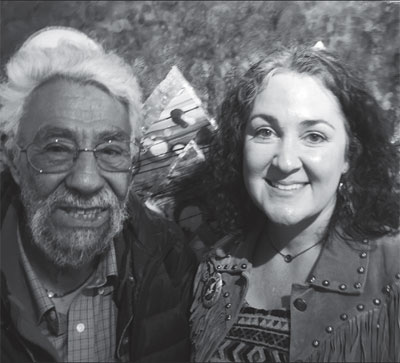
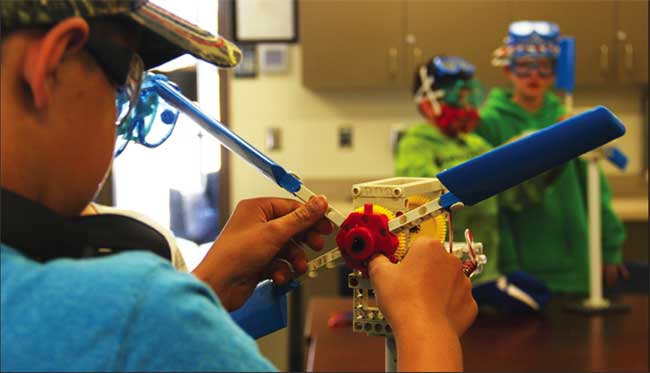
One morning I heard an unusual ruckus coming from next door. For such a quiet neighborhood it immediately caught my attention. At first I thought the noise human, but then I recognized the honky-horn-blowing commotion of Canada geese when passing overhead. What troubled me was that the noise didn’t vanish as one expects. The geese seemed to be circling in a holding pattern instead of driving their wedge toward a distant horizon.

Stepping outside for a peek, I couldn’t believe what I saw. On the roof of my neighbor’s two-story house, pacing the shingles like sentries, four flat-footed geese stopped to stare at me while a dozen or more of their companions grazed the brown lawn below. The sight unnerved me, as if a squad of goose-stepping guards had taken over. I waved my arms and shouted, hoping to shoo them away. They stayed, stolid and alert, perhaps even reporting my behavior to their supervisors. I had been dismissed.

In our community, seeing geese is not unusual. They settle in our parks, poop on our sidewalks, and would if they could handle a putter, play golf on the many acres of our irrigated fairways. Once a migratory species, many Canada geese have found urban and suburban areas provide a comfortable living without the bother of flying thousands of miles.

Eventually the “goostapo” moved off, but I still wondered about the ones that chose to spend their feeding time on my neighbors’ roof. Had living in our developed world skewed their natural instincts so badly they yearned to find new perches? Or porches? Divided from their natural instincts, it’s hard to say what motivates a goose to behave in a non-goose way.

Once while walking past the city park, I stopped to watch a group of about six people and two police officers pursue a goose back and forth across the lawn. For over 15 minutes the goose avoided a man holding out an old blanket like a matador. I joined in the chase and later heard that the goose had repeatedly tried to bite a child, which prompted a call to the police, which led to the all-out pursuit, which eventually resulted in its capture. It was as wild a goose chase as I’d ever seen.

A few domesticated geese have endeared themselves to their owners, but the birds aren’t typically known for being cuddly or affectionate. Goslings like all babies are adorable, but try to get near one even when the parents seem to be temporarily distracted and you’ll experience a goose’s dark side. Males especially are noted for being aggressive. One documented example cites a goose killing another by persistently pecking its head into the mud, resulting in the victim’s death by suffocation. It’s no wonder I couldn’t help thinking of my neighbor’s roof geese as a viable product line for an organic home security system.

I still don’t have an answer for their unorthodox roof behavior, but I have settled on a pet theory. Because I walk past the house regularly, I’ve reflected on that singular event so obsessively that a reasonable explanation has finally emerged.

The neighbors recently installed an array of solar panels along the southern exposure of their roof. While it proved to be a wise investment electrically and ecologically, it may have added a layer of complexity and confusion from a bird’s perspective.

Gliding along with the wind under his wings, glancing down, attentive to every sparkle of light where a lush marsh or pond might provide a nice post-flight snack, the goose flying point feels responsible for the squadron trailing along. There! He sees a ripple. All the flap behind him convinces him it is time for a break. He trims his wing angle and prepares for the descent.

Science may not back me up on this. Ornithologists could be snickering up their sleeves, dismissing my observations as just another amateur birdbrained theory. We’ll never know for sure, because the evolution of geese has not yet bridged our interspecies communication gap. In the end I felt foolish ordering those geese to get down. It was the down, after all, that helped get them up there.

David Feela, an award-winning poet, essayist, and author, writes from Montezuma County, Colo. See his works at http://feelasophy.weebly.com/


Published in David Feela

An activist for Indian rights

Mary Lucinda Bonney was the fourth of six children born to a devoted Baptist family in Hamilton, New York, on June 8, 1816. Her father was a farmer in good circumstances, said to be a man of integrity, sound judgment and strong influence. Her mother had been a teacher before her marriage (she could not remain a teacher and be married) and was known to be very cheerful, kind, interested in everything that concerned education, moral and religious movements. This was evident in way they raised their children.

Mary Lucinda Bonney

Mary’s education began at the Ladies Academy in Hamilton but soon transferred to the Troy Seminary, where she studied with Mrs. Emma Willard. The seminary was then the highest institution of learning for young ladies in this country.

She taught and held administrative posts in schools in Jersey City, various places in New York, South Carolina, Providence, Rhode Island and Philadelphia. She experienced great sorrow in 1850 with the loss of her father and hoping to care for her bereaved mother, she, with Harriette A. Dillaye, a former student and teacher at the Troy Female Seminary, established a school. The Chestnut Street Female Seminary (later the Ogontz School) in Philadelphia. The school offered young women in their teenage years both boarding and day school opportunities, focusing on liberal arts education that included science, humanities and physical education. The school grew and prospered and is currently the site of Penn State Abington College.

In 1878 when Congress proposed to take land from the treaties reserving lands in Indian Territory of particular tribes, Mary became an activist. She was very upset with this turn of events and began a petition, asking assistance from colleagues and church members. The campaign collected about 13,000 signatures and presented the petition to President Rutherford B. Hayes and then on to Congress.

In 1881, there was a subsequent petition that held 50,000 signatures and was presented to the Senate through Senator Henry L. Dawes. A year later she and some of her followers officially became an association, the Indian Treaty-Keeping and Protective Association. Mary was elected the first president. In 1882, a third petition with double the signatures was presented outlining a proposal to grant tribal lands to Native peoples.

She was one of the most important figures in the movement for the protection of Native Americans’ lands. The efforts she initiated finally culminated in passage of the Dawes Severalty Act of February 1887, which embodied the allotment principle.

After Bonney’s resignation in 1884, from the presidency of the organization and her retirement in 1888, from the administration of the Ogontz school, she remained active in the Indian reform movement. In 1888 she attended a London conference of Protestant mission societies. There she married the Reverend Thomas Rambaut. The two had known each other when she worked in South Carolina. She was 72 when she married him. He died in 1890. Mary spent her last years in her hometown of Hamilton, New York.

Margaret “Midge” Kirk is a slightly eccentric artist, writer, bibliophile, feminist scholar and hobby historian who lives in the SW corner of Colorado. She can be reached at eurydice4@yahoo.com, or visit her website www.herstoryonline.com.

Published in Midge Kirk

Dolores poet wins $500 Cantor Award

Berkeley poet laureate and this year’s Fischer Prize judge Rafael Jesús González with Cantor Award winner Renee Pudonivich of Dolores.

TALKING GOURDS … What a great crew we had at the Fischer Prize/ Cantor Award poetry awards ceremony of LitFest6 the other weekend …Talking Gourds co-director Rosemerry Wahtola Trommer teamed up with her Emerging Forms podcast co-host Christie Aschwanden for a live broadcast on the subject of Literary Prize Contests … Daiva Chesonis did a powerful dramatic reading of the late Ettore Rella’s “Onorina Rudelat/Immigrant Woman” from his book The Scenery for a Play and Other Poems. Rella was born in Telluride and a number of his relatives (the Bardwell family) came to hear him honored. The poem itself turns on picking mushrooms on the Telluride hills, the book being published the same year as the Telluride Mushroom Festival came to town … Luis Lopez of Grand Junction was honored as the fifth Western Slope Poet Laureate, following on the heels of David Rothman of Crested Butte. His poems reflected on life here on the Western Slope, where Lopez worked not only as poet and publisher, but as a driving force for poetry in Mesa County, and included gently humorous tales of growing up in Burque (slang for New Mexico’s largest city) … Elaine Cantor Fischer’s brother Sheldon Cantor gave out the annual prize for the best Colorado poet in the Fischer poetry contest, and judge Rafael Jesús González chose Dolores poet and professional counselor Renee Podunovich of Montezuma County. She was ecstatic, and read her “most vulnerable poem,” as she put it, which she really didn’t think would win: “The Poet’s Broken Heart.” Here’s an excerpt:

And at the end of the therapy hour,
I pack up this picnic of my own undoing
and tonight
when the moon is full,
I will walk into the desert,
find a certain place on red earth
where the moonlight is lace and ethereal,
will nurse my own wounds,
take this overworked cardiac steak
in my bare hands,
lift it so that moonlight bites
and stars alight on scorched surfaces,
and the words will pour forth from me,
because by the sheer will of my art I will be raw again.

MUSHROOMS AS MEDICINE … Colorado’s Front Range news media had egg on their faces as several outlets in the Mile High City wrongly projected Initiated Ordinance 301 as having lost on voting day last month, only to have the last-counted ballots turn that projection on its head. The ballot measure passed by a slim margin, but it passed … Decriminalization of psychedelic Psilocybe spp. of fungi means that Denver police within the city’s jurisdiction will not go after mushroom users, unless usage or sales falls into their laps. … It’s a first step in working towards legalization – a path similar to the one another valuable medicinal, Cannabis spp., took to change hearts, minds and legislation. Both have been outlawed for many years based on unscientific reasons … As Dr. Matthew Johnson, an associate professor of psychiatry and behavioral sciences at the Johns Hopkins University School of Medicine — and one of the authors of a study last year recommending that the Food and Drug Administration reclassify the drug to acknowledge its potential medical uses and relatively low potential for abuse — told the New York Times in May, “Psilocybin is not addictive, and ‘there’s no direct lethal overdose’ of the drug on record.” Which is to say, coffee and aspirin are more dangerous than psilocybin, the active entheogen in magic mushrooms. Of course, that scientific fact didn’t deter failed Drug War crusaders from outlawing it for decades … However, recent research from John Hopkins and other venerable medical institutions are putting the lie to that law. And in Telluride, the local Mushroom Festival has been educating folks to the truth about magic mushrooms for decades – they are powerful medicine. That’s what Dr. Emanuel Salzman, founder of the Telluride Mushroom Festival that’s now in its 39th year, has been saying forever. We shouldn’t be outlawing psilocybin, but figuring out safe protocols for its use … And those of us who cut our political and social teeth in the Sixties have always thought the law wrong and stupid. And have largely ignored it – though at substantial risk to our safety and well-being … So, the Denver vote is an historic moment in the history of mushrooms in this country. The federal FDA/DEA’s anti-mushroom crusade has been an emperor parading around without the clothing of accepted science, and Denver has just called them on that … However, decriminalization is not without its downsides. As an interim political measure, it’s a sound strategy. But as a social situation, it’s fraught with potential dangers … Psilocybin is not the same kind of compound as THC, and the effects on users can be ego-shattering. Dr. Andrew Weil, a leading national medical authority, has always insisted that attention to dosage and careful choice of set and setting were essential to having a good experience with magic mushrooms, as well as having a guide not under the influence of psychotropic substances. The fracturing of one’s ego structure can be a traumatic experience, and having a trusted friend to reassemble reality for one in a discombobulated entheogenic state is essential, especially for first-time users … Magic mushrooms aren’t recreational for most folks (although some long-time users accustomed to their effects use them so). It’s a spiritual/psychological experience that takes one to the edge of one’s known world, and back (if one has paid attention to dosage, set & setting and a guide) … Trying them on one’s own, especially at first, without attention to suggested guidelines is not recommended. But you know, with the recent decriminalization in Denver, that’s exactly what inexperienced people will likely attempt. And similar to the increased “freak-out” hospitalizations for overdoses of cannabis when it was legalized, I expect a similar spike in hospital visits will attend this mushroom decriminalization … Indigenous cultures had “coming of age” ceremonies and rituals for use of entheogenic substances. In our modern society, we’re unfettered by tradition and free to try anything. And that freedom, while highly valued, can get us into trouble … While I applaud the new Denver law, I think in addition to a commission to study the effects of decriminalization, there ought to be some kind of medical/psychiatric center/call line set up to help with mushroom freakouts. And a safe space and appropriate treatment facility will be needed for those that experience ego-shattering and have taken too much, or are in the wrong setting, or find themselves trapped in a negative space, or are without a helper to assist them back to our consensual reality … So Denver’s vote was a great victory for science and society, the first step in a path towards recognition of psilocybin as medicine. But it’s important to realize it’s also just a stop-gap measure that could have some negative impacts on the unwary or the unwise.

Art Goodtimes writes from San Miguel County, Colo.


THE TALKING GOURD

Morning Glories

In my mouth,
morning glory flowers
Full of raindrops
Until a nearby canyon wren
Brings me to my senses!

Carl Marcus
Telluride, CO

Published in Art Goodtimes

Gearheads

I just wrapped up my first-ever tour as a performing musician, and I am here to tell you that the lifestyle is every bit as sexy, glamorous, and dramatic as you imagine it is. Groupies. Parties spilling into hotel hallways. Massive amounts of free drugs. Booze-fueled hazes. Mudsharks. Free sandwiches.

Of course, I did not get to partake in any of that side of the lifestyle, because I spent all ten days of the tour unloading and re-loading the Subaru.

No one ever told me when I was 15 and rocking out in my bedroom to songs that didn’t have Bm chords in them that becoming a star might start off with a lot of manual labor. I would have gone into some less-demanding field, like testing prototype jackhammers, had I any inkling that troubadours clock more physical exertion than Crossfitters. I am an artist for a reason, and that reason is that the heaviest lifting I do on a regular basis is asking the pet store clerk to help me with a bag of dog food.

So while I had rehearsed my songs for entire days ahead of the tour, and my bandmate’s songs even less, I had not so much as stretched before she pulled up to the house to load up.

I packed light for this tour. Oxygen on Embers is an alt-folk duo, so we require nothing fancy. No lights, no fog machine, minimal pyrotechnics. It was just me and my guitar. And my other guitar. Two amps, guitar stands, mic stand, cables, extension cords. Harmonicas, of course. Small suitcase, hanging clothes, change of shoes, rain jacket. Assorted hats. Cooler of snacks. Bag of food. Box of band merch. I’m not bragging, but I have to say, my packing was as stripped down as our sound.

But my bandmate — let’s call her Carson, because why should she remain anonymous here — had the gall to pack her own instruments, and her own stands and cables, and her own clothes and changes of clothes, AND — something I would never once have considered bringing on tour myself — her purse.

By the time we Grinched every last guitar string into the back and middle and front of the car, I had no choice but to travel as a solo act.

Kidding! I’m not Art Garfunkel, but I knew I was better off performing with Carson, because she booked all our shows and knew where we were driving and when we needed to be there. She also booked our hotels and Airbnbs and spare rooms along the tour route. Apparently, she did not consider how much she was packing, because she booked places with stairs.

I for one anticipated spending these ten days as one with the music, but instead, I spent these days as a pack mule, schlepping crates and boxes and bags up and down stairs, unloading to keep gear out of the hot car, loading to take gear to a gig, unloading to use the gear at a gig, loading to take the gear back to the room, unloading to keep the gear out of a cold car, and contemplating leaving the gear on a street corner for someone to sell for meth money.

And to make matters worse, the first place we stayed, in a small New Mexico town, came with a memory foam mattress. The place did not advertise a memory foam mattress, because if it did, no one would book it and someone would burn it to the ground. I cannot understand the allure of the memory foam mattress. It tacos you in your sleep, and if you are lucky enough to emerge from it in the morning, you feel worse than if you had slept in the car atop all your amplifiers.

That first night, though, I had my most rock-and-roll moment of the entire tour. I woke up in the night in the bathroom, blood dripping from my eyebrow, no idea what had just happened and highly satisfied with the scab I was likely to sport.

I had yet to stumble upon any groupies with high-grade dope, so I don’t know if my heavy-metal sleepwalking was caused by unloading all the gear, or the memory foam mattress, or my general badassery. It taught me, though, that I did not need any assistance to have a mind- and life-altering experience on this tour. I’d had it already, before playing a single show. I felt fortunate to be alive, and free to go on stage and share myself through song. Nothing that could happen to me on stage could be worse than nearly dying next to a toilet.

I survived it all, and more than that, I grew inside in the process. Now that I’m home, and that trauma has worn off, I’m already game to go on the next tour. This time, maybe that nice clerk from the pet store wants to be our roadie.

Zach Hively writes from Durango, Colo. He can be read and reached through http://zachhively.com and on Twitter @zachhively.

Published in Zach Hively

It’s time to say thanks for a few things

Memorial Day has lost some of its original purpose over the years. It’s no one’s fault, really, but for many people, it’s become just a time to enjoy a day off, mark the start of the summer season, and go shopping at various sales.

But most of us are still at least vaguely aware that it began as Decoration Day in the years after the Civil War. It was an event designed to remember the soldiers who died fighting that terrible war. Later, as the United States suffered through more conflicts, the day’s purpose was broadened to honor all soldiers sacrificed in battle for this country, and the name gradually changed.

With that in mind, it was good to see the ceremonies that did take place this year commemorating the fallen. In particular, it was nice to see that the Colorado Rockies baseball team on Memorial Day honored the family of U.S. Army Sgt. 1st Class Will Lindsay, the Cortez man who died in March in Afghanistan. The crowd at Coors Field in Denver gave the Lindsay family a heartfelt ovation.

Also in May, there was a memorial of an entirely different sort – but also very worthwhile. A crowd traveled to Disappointment Valley on May 19 to share in a ceremony recognizing the dedication of Temple Butte, a mesa overlooking a valley that is home to a magnificent herd of wild horses. It was renamed late in 2018 in honor of Pati Temple, the McElmo Canyon resident who died about six years ago after a long battle with cancer. She was an incredible person – smart, funny, full of life, and enormously compassionate toward animals. She and her husband, David Temple, who spoke at the ceremony, were dedicated to helping preserve the wild mustangs that live in the Spring Creek Basin Herd Management Area in Disappointment. The renaming of the butte was a very worthwhile effort that involved a lot of work by a number of people, including Ann Bond and the county commissioners of San Miguel County.

While those remembrances recognized a couple of locals whom we have lost, there were also several people connected with the community and this newspaper who had some serious health problems this spring, although they are well on the path to recovery. Ric Plese, owner of Cliffrose Garden Center and Nursery (one of our most faithful, longestterm advertisers), had a life-threatening health scare. Fortunately he is now doing well, which is a relief to the entire community. Cliffrose is just a lovely place in general and Ric is a pillar in so much that goes on here. Here’s to a long life, Ric!

John Christian Hopkins, who frequently writes columns for us and who made an appearance at the Cortez Public Library a while ago as part of a talk by humor writers, has suffered a few serious health setbacks, including a small stroke in April. Hopkins, who lives in Arizona with his wife, Sara, is a really funny guy and a great person. He is on the mend and we send him our best wishes.

And of course the editor of the Four Corners Free Press, Gail Binkly (yes, that’s me, I’m writing this), had a weird fall early in May that caused a bad head injury. I was flown to Grand Junction for initial care and am now recovering. I want to thank some very kind friends and family who helped me out with food, medicine, yard work, and spiritual support – in no particular order, Jennifer, Kathy, Debie, Ned, Galen, Joe and Odie, Sonja, M.B., Carolyn, Nancy, Sarah, Sam, Ed, Johnny and Jim. Special thanks to M.B. for all you did (which was a lot), to Sonja for the really thoughtful help, to Debie for all the food and wonderful support, to Jennifer for food and medicine and books, to Carolyn for medicine and advice, and to Jim for (among other things) driving to pick David and me up in Grand Junction – we’d probably still be stuck there otherwise. I hope to do something good for all of you someday when I’m back to normal.

Thanks to my husband for flying with me to Grand Junction and sleeping in my hospital room, and for all the care you gave me back at home. Thanks to my sister for keeping me sane by telephone and for sending that care package. And thanks to everyone who sent cards and emails and messages, or who just saw me out and about and gave me their good wishes. It’s all greatly appreciated.

As you get older, you realize how short life is, and you come to appreciate it more. If you get a little extra time, you’re grateful. Here’s hoping all of us have a safe and happy summer.

Published in Editorials

Out of the very air

What are plants made of ? This is not a trick question. I began pondering this after reading about an experiment in The Overstory, the Pulitzer Prize winning novel by Richard Powers. The protagonist Patty Westerford (modeled after real-life tree behavior researchers) and her father conduct a long-term experiment with a beechnut tree. Before filling a large planter with soil and planting a seed, they record the weight of the soil. After more than 20 years, Patty returns to find the now-grown tree dead, neglected after her father’s passing. She removes the tree and all its roots and reweighs the soil. “The fraction of an ounce of beechnut now weighs more than she does. But the soil weighs just what it did, minus an ounce or two. There’s no other explanation: almost all the tree’s mass has come from the very air,” says Richard Powers in The Overstory.

It’s easy to forget that plants are made from air, water, and sunlight. The soil is merely the medium that holds the plant’s water pump and nutrient structure in place. Plants really don’t gain much nourishment directly from the soil – it must be freed up by insects, fungi, and other beneficial organisms and put into solution so the roots can “take it up” in the plant.

I have been contemplating the beauty of soil as I dug though mummified earth inside our new “hoop house”. We placed the hoop house over a patch of dirt in a convenient location, without regard for the potential soil underneath. Over the past months under the hoop house, the clay dried to adobe brick and I needed to employ the digging technique unique to our red dirt: 1) Carve out an indentation in the dirt. 2) Fill it with water. 3) Wait for an hour or two. 4) Dig in the now softened dirt. 5) Repeat. As I was carving, watering, waiting, and digging to get 15 holes dug for my tomato seedings, I had time to deliberate on the difference between soil and dirt.

Soil is a living breathing organism that lives in dirt. Simply by residing in the Four Corners, we have been gifted with beautiful red dirt. However, we are responsible for growing and tending the soil. Without soil, plants can’t thrive, and we would go hungry. Here are a few tips on growing and building soil in your red dirt.

  • One of the best features of our red dirt is that it is well balanced in mineral content and pH. However, to achieve top soil-growing conditions, it is often important to “amend” the dirt. This can be achieved with fertilizer (you might recognize the N-P-K (Nitrogen (N), phosphorus (P), potassium (K)) labeling) or organically with manure, compost, bone-meal, and ash. Since soil amendments require an investment of time and money, you might consider collecting a soil sample and completing a soil test to identify any deficiencies before spending on your soil.
  • Another organic option for amending and maintaining soil is to use mulch to cover the dirt and keep it cool and moist around the plants. This also reduces soil loss due to wind. Cover crops are designed specifically to cover and feed the soil when it is fallow. Their harvest is tilled into the soil to add nutrients and feed its micro-biome.
  • No till/minimal till is the latest way to maintain good soil. Rather than turning the earth each season to bust up the sod, so to speak, the latest thinking on soil maintenance encourages minimal tilling to maintain the network of mycelium and other underground structure to keep moisture and soil structure intact.

So, if we are what we eat, we are not dust, but water, air, and sun. Which makes me a bit more concerned about what is floating around in the air these days?

A reminder about the local Farmers’ Markets starting up the first week of June in Cortez, Mancos, and Dolores. The market season is always too short, so every week counts, and our farmers have been taking advantage of the plentiful moisture to have a variety of produce ready at the first markets. Don’t miss out!

Carolyn Dunmire writes from Cahone, Colo.

Published in Carolyn Dunmire

Free Press writers take four awards

The Four Corners Free Press took four awards in the Society of Professional Journalists’ regional Top of the Rockies competition for 2018.

Zak Podmore of Utah received a firstplace award in politics enterprise reporting for his in-depth piece in the May 2018 issue on “The cost of war,” how legal battles were draining the coffers of San Juan County and threatening it with bankruptcy. Podmore has since revitalized the Canyon Echo online and is now set to work for the Salt Lake Tribune.

Carolyn Dunmire of Cahone, Colo., took first place in arts and entertainment food criticism for her “foodie” columns.

David Feela, a contributor to the opinion section since the newspaper began in 2003, took first place in personal/ humorous column writing for three of his pieces.

And Sonja Horoshko, a longtime contributor to the news and arts sections, placed third in political reporting for “Winds of change?” in the July 2018 issue, an article about changes to the makeup of the county commission in San Juan County, Utah.

The competition included print, online and broadcast media in four states – Colorado, Wyoming, Utah and New Mexico. The Four Corners Free Press competes in the category for outlets with circulation of under 10,000.

Published in June 2019

Canyon Country Discovery Center offers learning adventures on the Colo. Plateau

Students from across the Colorado Plateau have taken advantage of the educational experiences and adventures offered at the Discovery Center. Courtesy photo.

You’ve got family coming from outside of the region and they want to visit Bears Ears, or perhaps they want to go to Moab, but you’re not too thrilled about that idea. They’ve let you know they want to see some red slickrock canyons, petroglyphs, maybe some cliff dwellings. Or maybe you have school-age children and need to plan some summer activities. What to do?

Adventure

It might be a good idea to head over to Monticello, Utah, and start out at the Canyon Country Discovery Center (CCDC).The new building, opened in November 2016, is right on Highway 191, near the Rodeway Inn and across from the Mountain View RV Park and Campground. At 7000 feet at the foot of the Abajo Mountains in Southwest Utah, the 48-acre piñon-juniper studded campus includes hiking trails, picnic areas, some outdoor exhibits, and an information and exploration center.

The mission of the CCDC, as stated on their website, is to create “lifelong learning experiences about the Colorado Plateau through adventure, education, and stewardship.” According to Seth Levy, chairman of the board of directors of CCDC, “Our role is encouraging people to discover the area and have learning and adventure experiences in the Four Corners region. A lot of people aren’t aware of what there is to see and do.”

Jeff Weinmeister, executive director of the center, agrees, “So often you talk to people and as you drive out of Monticello to Moab, they don’t know what we are and what we offer. It really is kind of a fun place for this region for people to go and see.”

The center offers pre-programmed outdoor adventures and educational opportunities, as well as designing your own trips. Want to go on a San Juan River trip?

“Just show up at the Discovery Center and that’s it,” says Weinmeister. “Our most popular river trip is two nights from Sand Island to Mexican Hat. Depending on the launch date, we either have 12 or 25 people that we can take. We offer tent and camping gear – sleeping bags and pads.”

Weinmeister explains that this is also his favorite trip. “It is an amazing experience, you get a really good picture of the different ecosystems and the different cultures in the area.”

The CCDC has river permits with the BLM and all trips are led by experienced river guides. Scheduled river trips for 2019 include Yoga on the River and San Juan River History with Andrew Gulliford. Other trips have included Bluegrass on the River and Storytelling with Craig Childs.

Or maybe river trips aren’t your thing and you’d rather take a guided day hike up Butler Wash, Mule Canyon or Comb Ridge. Besides day trips, the CCDC offers three-day base camp-hiking trips in Bears Ears.

“The reality of Bears Ears is that people hear about it because of the news but they don’t know where it is. It’s a place that nobody knows exactly where it is,” says Weinmeister. A Signature Best of Bears Ears Hiking Trip is planned for 2019.

The CCDC also offers corporate adventure retreats for your business or organization. You design the retreat in collaboration with CCDC staff, according to your needs. “We would highly recommend working with them and embarking on one of their trips. We hope to be able to do more work with them in the future!” That’s a quote from the Alpacka Raft Team on the CCDC website.

Education

The Canyon Country Discovery Center was founded by Janet Ross, as the Four Corners School of Outdoor Education, in 1984. Ross attended and graduated Prescott College from 1971- 74, and fell in love with the Colorado Plateau.

Prescott College is a small liberal arts school in central Arizona, started in the 1960s by Congregational minister Dr. Charles Parker, who had a vision of creating the “Harvard of the West.” Parker wanted to continue the Congregationalist tradition of founding educational institutions, which over the years have included Middlebury, Dartmouth, Amherst, Smith, Yale, Oberlin, Grinnell, Whitman, Colorado, Pomona and Scripps, in addition to Harvard. The college’s mission is “to produce the leaders increasingly crucial to successfully meeting the challenges of the changing world” and they do so by stressing experiential learning and self-direction within an interdisciplinary curriculum.

As a result of her experience at Prescott, Ross says, “I discovered the power of place-based education and I wanted to live on the Colorado Plateau and make my living here. I decided to start a school that was dedicated to preservation and conservation.”

Prescott’s programs included outdoor orientation sessions in which students spent time together doing things like backpacking in Zion, or floating rivers.

“Outdoor education was cutting edge at that time,” Ross says, and she wanted to provide more opportunities for the kind of experiences she had. “There are so few science education opportunities that are high quality,” she notes.

Ross moved to the Monticello area in 1977 and bought an old farm close to the Colorado border, in what is now called Eastland. Her property served as the base of the school for years, until the Discovery Center was built.

“It was never my idea actually to build a science center,” says Ross. “In the beginning, it was simply educational field trips – which are now called Southwest Adventures. That is all we did until the 1990s.”

But she realized that she wanted to build something that could live beyond her own involvement, and include her commitment to social change. “Running educational field trips was getting revenue, but we were not necessarily being an agent of social change,” she says.

“The first thing I came up with was a professional teacher training program,” says Ross. She and other interested community leaders wanted to create something that could be an economic driver for Monticello. They interviewed teachers all over the Colorado Plateau to see what their needs were, and out of this they invented the Bioregional Outdoor Education Project.

“We focused on place-based teaching and learning – using outdoor programs which enhance learning and education. The programs are teaching teachers how to teach differently in a way that would be more engaging to students,” she explains.

Ross’s dedication to high-quality outdoor education is reflected in the CCDC’s current educational and discovery programs. As listed on the website, “educational programs are developed for culturally diverse learners to explore and discover the natural history, landscapes, people, land use, astronomy, water and climate of the Colorado Plateau.” Educational programs focus on five themes: Life, Astronomy, Geology, Scientists, and Energy Use, all on the Colorado Plateau.

Students from all over the Plateau have taken advantage of the center’s offerings, with middle and high school classes from Kemper, Cortez, Dolores, Dove Creek, Montrose, and Grand Junction in Colorado, in addition to schools in Southeast Utah besides Monticello, including Blanding, Bluff, Montezuma Creek and Moab.

“This year so far, over 2400 students have utilized our programs,” says Weinmeister. “We have some schools that will come stay on the campus for a week. They can go on a three-day two-night river trip, then at the discovery center we have tent sites, and they can take part in our night-sky program, use our climbing wall, and then explore the rotunda. It just depends on the group, on their needs.”

Interested teachers can contact the center to plan a visit to the center or book a trip for their students.

Levy says “I think what makes us unique is that we’re dedicated to helping people discover and enjoy ALL the resources – recreational and cultural and natural. We’re not just dedicated to a specific park or specific culture or a specific activity, we’re dedicated to all of them. For someone travelling through, or a resident, we’re a great destination to get a perspective on the whole Colorado plateau.”

Besides school trips, the CCDC offers youth camps, as well as Signature trips. For 2019 these include an Earth Water Sky River Youth Camp for kids age 12- 15 in June.

Stewardship

The comprehensive perspective is also reflected in the CCDC’s commitment to stewardship and land-based education. “We started a youth corps, the Canyon Country Youth Corps, and many of the participants were Native Americans,” Ross says.

Youth Conservation Corps are nationwide – and even international – summer youth employment programs that engage young people in work experiences on national parks, forests, wildlife refuges, and fish hatcheries while developing an ethic of environmental stewardship and civic responsibility. The Canyon Country Youth Corps partners with diverse federal and private land management agencies in the Four Corners region, taking interested individuals ages 15-35 to work on various projects.

“The youth corps are providing jobs for a lot of Native kids where there are very few jobs, especially in conservation,” explains Ross. “We are encouraging kids to go into public land management, which is hurting for the future. This is a way to train individuals, and to give them an inside look at what that kind of profession would be like.”

Funds to pay the corps members are generated through grants from the U.S. Forest Service, BLM, Walton Foundation and other agencies as well as private donors. In 2012, Osprey Packs gave half of their proceeds from the annual fall locals fundraiser to the CCYC, to help with their conservation projects.

The CCYC was a founding member of both the Dolores River Restoration Project (See the July 2017 Free Press) and the Escalante River Restoration Project. “They work along with other stakeholders to come together to remove an invasive species at the watershed level,” says Ross. “It is a true partnership, with scientists working along with the youth – a cutting-edge way to do land management, while training the kids at the same time.”

Weinmeister says, “Our current program development coordinator is a Navajo who started as a youth corps member, then a crew leader and now he’s the program developer coordinator.”

To date the youth conservation corps crews have built 2.5 miles of hiking trails in southeastern Utah, 7542 feet of fencing, and have removed invasive species from 246 acres of land along the Dolores and Escalante Rivers. Corps members have worked with the BLM to restore native plants to sensitive ecological zones, by collecting and propagating seeds and plants. Forty-one youths have been trained. “It’s a real boost for the public,” says Ross.

Towards the future

On June 22, the CCDC will have its 35-year anniversary celebration. Entrance to the Discovery Center will be free for all attending. There will be a free picnic lunch, guided trail rides and hikes on the campus, and a wrangler will give a demonstration on how to saddle a horse. It will be the official opening of the Pollinator Path outdoor exhibit.

According to Weinmeister, this new exhibit includes a pollinator garden out front, “so as you walk up to the front, you have the option to walk along a couple of paths with the plants that the pollinators are attracted to. Then as you come into the rotunda, the exhibits will have some of the plants and terrariums.

“We have a brand-new microscope that projects up to the big screen, so you can look at pieces of pollinators. There is also a mural which has a landscape with plants and pollinators hidden in it. If the kids find the pollinators they get a button at the front desk.”

In the future hummingbirds will be added to the Pollinator Path exhibit. Center staff, including a geologist, are in the process of developing the Living Earth Biocrust Experience, another hands-on exhibit with a biocrust garden out front, and terrariums inside. “We want participants to see that this isn’t just dirt, this is a living organism,” says Weinmeister.

Looking into the future, Weinmeister expresses excitement about the new Biocrust exhibit, as well as making space for travelling exhibits inside, such as Fort Lewis College’s mountain lion exhibit.

“It’s one of the special parts of the world. I think we’re going to be looking at an increased emphasis on learning through doing, learning through adventure. We’ll be looking at ways to help people have life-changing experiences.”

Meanwhile, Ross, now retired, is happy to have accomplished more than she set out to. “I feel really blessed that I was able to do it and make it work for 32 years,” she says of her role in founding and running the Four Corners School of Outdoor Education and shepherding it into the next phase as the Canyon Country Discovery Center.

The transition from school to discovery center, including a capital campaign to build the new center. was a long process, she says, but “I don’t believe life should always be easy. I think it should be challenging and meaningful. I enjoy doing meaningful things.”

Make your summer a bit more meaningful and take a trip out to the Canyon Country Discovery Center.

Published in June 2019

Roads are in ruins in parts of Utah: Ownership transfer is creating confusion

Dozens of potholes of this immense size and depth pepper the road east of the junction of Utah Road 262 and Indian Route 5099, otherwise marked on Google Maps as Hovenweep Road, a western access to the monument. During the past three years about 2.5 miles have been repaired with fresh blacktop at the steep decline into the canyon before Hatch’s Trading Post, where the repair ends. Road conditions there have continued to worsen, creating dangerous drives for travelers. Photo by Gail Binkly.

A transfer of ownership of some roads in San Juan County, Utah, from the county to the Navajo Nation has resulted in disappearing road signs, general confusion, and spreading potholes.

Around October 2018, Manuel Morgan, a former San Juan County commissioner, noticed that the county roads signs in his community between Ismay and Aneth were missing.

“One morning they were gone – everywhere,” he said. “No county road signs to help people find us. No one told us the county roads signs would be taken down.”

He added that he didn’t know who removed them, and, “in fact,” he said, “nobody knew who removed them, or why. How do we give people directions to our homes when there are no road signs? How do people find us when there are hundreds of miles of unpaved roads out here?”

Disappearing roads

After two years of consultations with U.S. tribes the federal Tribal Transportation Program (formerly known as the Indian Reservation Roads Program) published updated regulatory changes in 2016 addressing tribal transportation needs. Included in the final rule was the need to document rights-of-way ownership for all roads in the network of surface transportation on and around tribal land by December 2017.

The TTP, an agency of the Bureau of Indian Affairs, is authorized as part of the Federal Lands Highway Program.

According to the minutes of an April 2018 work meeting with the San Juan County, Utah, commissioners, the Navajo Division of Transportation, following the protocol required by the TTP, requested legal documentation of all rights-of-way for those routes on Navajo land in the county.

The written request was submitted by NDOT executive director Garret Silversmith, who discussed changes within the Tribal Transportation Program at the meeting, explaining that the Navajo Nation would be taking over the road maintenance program. He also informed commissioners that, effective June 1, 2018, all routes without the requested valid ROW documentation, listed as county ownership, would be changed to tribal ownership in the NDOT and National Tribal Transportation Facility inventory.

In the same meeting, then-San Juan County Commissioner Rebecca Benally confirmed that she met with Silversmith earlier in April about the transition of roads from the county to NDOT. She explained what role the county will have with road maintenance once the roads are transferred. The minutes show that the letter covering the transfer of county roads to tribal roads at that time was given to the commissioners.

In the past, the BIA Department of Transportation accepted “assumed rights-of-way.” But an updated Federal Register of the Department of the Interior requires clear documentation of rights-of-way, the April 2018 letter states. Once received the documentation would then be submitted to the National Tribal Transportation Facilities Inventory, changing the ownership from county to tribe, and forwarded to the BIA DOT and the Federal Lands Highway Program for approval.

By June the county notified NDOT that no ownership records could be found for those roads, “No documents granting Ownership of Legal ROW to San Juan County exist.”

Four months later the county notified the Navajo chapters of the changes that would occur as a result of the transfer of ownership and responsibility. The road inventory transfer was complete at that time.

Road work halts

Current County Commissioner Bruce Adams told the Four Corners Free Press that the Navajo DOT cease-and-desist order [April 2018] also ordered the county road department to take down the county road signs in the Navajo part of the county. He said that NDOT would be putting up their own. Adams was one of the three former commissioners who approved the transfer of the road inventory to NDOT.

But nearly a year earlier at the June 2017 meeting, residents of the Red Mesa Chapter, straddling the border of Utah and Arizona, were told by Commissioner Benally that the “Navajo Nation is requesting the San Juan County road department begin removing all the county road signs, as they will begin replacing them with the ‘N’ [ Navajo sign] and their own numerical system,” the minutes say.

In addition, “San Juan County road 457 will be the last main road project San Juan County will work on prior to the Navajo Nation taking over the roads. Although the San Juan County road engineer completed the road inventory, the NN has their own procedures,” she said, “and will be conducting their own inventory again.”

The San Juan County road work on Navajo roads slowly began grinding to a halt in the summer of 2017.

Tangled jurisdictions

Recognizable landscape features work very well when giving directions on the reservation to people familiar with the land. “Turn left at the second road west of Baby Rocks on the south side, then watch for the buried tire on the right. We’re the red house four miles after that down by the river.”

During May a BIA DOT road crew repaired the cattle guard on Tribal Road 5067, also named Belitso Road on Google Maps and also CR 401, an access road to Hovenweep from McElmo Canyon. Clearly visible in the photo, the south side sank four inches during the winter. Residents in the neighborhood placed warning signs around the cattle guard while they waited five months for a repair crew. At one point a household door braced across the south side and bound to the fence posts warned travelers with florescent tape and spray paint of the danger. Photo by Sonja Horoshko.

But for others, finding a family or location on the reservation can be intimidating and time-consuming.

Morgan has used the store at Aneth, Utah, as a pin-point, describing their home simply as a certain number of miles northwest of Aneth on CR 402. He told the Free Press in a March 2019 interview that he is not sure how to describe it as easily now. “Do we say Indian Road 5066, or so many miles from the Utah Road 162, or maybe use the BIA DOT number? How about the road names on Google, like Ismay Trading Post Road, which isn’t on a sign anywhere?” One click on any of the many road numbers on Google Maps shows a tangled web of surface transportation jurisdiction, including three and fourdigit numerical systems that designate state, county, federal BIA or tribal roads. Google also shows named roads: Ismay Trading Post Road, and South Hovenweep; roads named after local families, Belitso Road; or even some bewilderingly general names, like Reservation Road.

But most roads trickling over the land in the network of 627 road miles toward family compounds in the Navajo side of San Juan County are unnamed and also unpaved transportation arteries, difficult to maneuver in inclement weather or long winter seasons for delivery trucks or visitors.

Funding puzzles

Funding for Utah roads is collected throughout the state in a fuel excise tax. It is dispersed back to the counties for B Road (rural) and C Road (municipal) transportation infrastructure projects.

In a packet sent to chapter officials in August 2018 the county included a letter explaining that “the county approved and submitted the official San Juan County Road Map, Year 2018 to the State of Utah, Division of Transportation, updating routes and mileage claims by San Juan County to reflect the ownership changes enacted by the Navajo Nation. No further expenditures of Class B road funds is permitted under Utah State Law and regulations governing Class B & C Road Funds. As such, continued maintenance operations have ceased.”

County officials explained that San Juan County and NDOT are currently “working to establish an MOU which will lay the groundwork for future Intergovernmental Agreements and would provide the necessary funding for necessary [sic] maintenance to be performed by San Juan County. All reports of road damage or maintenance requests should be directed from the Chapter to the Navajo Division of Transportation.”

Agreements between government agencies help share the costs of surface transportation projects. In multijurisdiction circumstances, such as those affecting roads now out of the SJC ownership and into the Navajo Nation, funding from the Federal Tribal Transportation Program can be used for road maintenance and construction projects including culverts, bridges, cattle guards and road signs. The purpose of the funds is to provide safe and adequate transportation and public roads that are within or provide access to tribal land.

As of 2015, the Nation Tribal Transportation Facility Inventory consisted of approximately 47,900 miles of BIA and tribally owned public roads, 101,300 miles of state, county and local government public roads and 12,500 miles of proposed roads.

When the Free Press asked Adams if county B Road funding could follow the transferred road inventory he was adamant that no excise fuel funding will go to NDOT.

“Why would we fund the Navajo road department when all they do is sue us?” Adams asked. “We notified the Utah Division of Transportation that we no longer owned the roads and they deleted the roads from the San Juan County list of county B roads.”

Adams’ 2012 election campaign made it clear that the Navajo roads were not the responsibility of the county. At that time his campaign material held that the county should not be paying for reservation roads, that the projects are the responsibility of the BIA.

Catch-up and make-up

While transportation funding and jurisdiction issues are sorted out, the change in ownership has resulted in a weakened infrastructure on nearly all the Navajo roads in the southern half of the county.

During the past three years a lengthy section of road beginning east of the intersection of Utah State Road 262 and Indian Route 5099 has developed a mile-long strand of deep and wide potholes. About 2.3 miles of fresh blacktop repaired a section of the road last year where it begins to decline further east into the canyon toward Hatch’s Trading Post. But the project stopped west of the historic building. The blotched road still threatens the safety of travelers unfamiliar with the deteriorating conditions waiting repair by Navajo Division of Transportation, the BIA DOT, or the county.

The south side of a cattle guard has sunk four inches from the surface of the road during the past winter about five miles past Hatch’s on the same road but closer to Hovenweep where it intersects with Tribal Road 5067, also labeled Belitso Road.

During the four months that the cattle guard was broken, neighborhood residents marked the perilous site with fluorescent tapes and cardboard spray-painted signs, and even a household door at one point, warning drivers of the danger. Finally, a road crew from the BIA office in Shiprock responded to a request from the Aneth Chapter officials in May 2019 and repaired the hazard.

Herby Larsen, a transportation manager for BIA DOT Gallup regional offices explained that they replaced the original hollow metal tubes with a structural solution that can withstand the heavy trucks and traffic count on the road. According to the NDOT Priority 2019 maps, 250 – 500 vehicles use the road per day. That same road is described in the priorities list as having an unclassified status for level of maintenance, roadbed and shoulder conditions.

The cost, said Larsen, was about $26,000.

With materials and work crews in short supply it is difficult for them to repair all the potholes, even on the same road, Larsen explained. They simply don’t have the budget. Larsen explained that priorities are the only way to manage the work load and NDOT, whom the BIA DOT works with on Navajoowned roads projects, “has asked each chapter on the Navajo reservation to prioritize 15 miles of road for maintenance and repair.”

There are 110 chapters in 27,413 square-miles of the Navajo Nation, and a population of roughly 350,000 people. Fifteen miles of road per chapter is barely enough to keep up with the deteriorating conditions.

The chapters must now follow procedures to report county road damage to NDOT instead of the county road department. Morgan suggests that chapters still apply for Utah B Road funding for the local projects. “Native people are residents of this county and state and pay those fuel excise taxes just as everyone else does who uses the roads in our county.”

Improving relationships

Near Monument Valley, Oljeto Chapter President James Adakai says that there was a breakdown in communications over the road transfers. Chapters were not informed until August 2018, when they received the packet of information about the new procedures. By that time the transfer was already done and as the jurisdiction funding is sorting out, the road conditions continue to worsen.

“The letters informed us about the road inventory transfer and what the next steps will be for the maintenance of roads in the county. But the chapters were not notified that this transfer was taking place. There was no transparency with tribal and county officials at all about this issue. Normally we inform our chapter members at monthly meetings, giving them a chance to weigh in on the decisions. This was a little different. It felt political. At the time the transfer was taking place, our county commissioner, Bruce Adams, stopped coming to meetings.”

Adakai says that the people are confident things will improve with the new county commissioners representing them now.

“The three prior years saw our chapter relationship with the county greatly hurt by politics. In the past we may have had differences, but we all know we have the same constituents and can’t limit services to our people. We’ve had a good working relationship with the county at times and other counties in Arizona and New Mexico have good agreements with their Navajo chapters for these types of road issues. They work together on roads. I think we can too.”

Addenda

At press time, Morgan telephoned the Free Press to report that a couple new road signs were going up near his home. One says, La Rancho Road and another says N5068. His home does not have a new sign or address yet, but according to the new signposts, Belitso Road was renamed Cahone Mesa Road, he said.

Published in June 2019

Crouch’s novel launches June 13 in Durango

RECURSION BY BLAKE CROUCHEver wondered what it takes to write bestselling novels that get turned into blockbuster Hollywood films and television series?

You can find out firsthand from local author Blake Crouch, who divides his time these days between his Durango hometown and Los Angeles, where he oversees his many ongoing film and television projects.

Crouch will launch his latest New York Times bestseller, Recursion, with a celebratory party and book signing at El Moro Spirits & Tavern on Main Avenue in Durango on Thursday, June 13, from 4:30 to 6:30 p.m., hosted in conjunction with Maria’s Bookshop of Durango.

Recursion is a science-fiction thriller, a love story, and a thoughtful exploration of human memory all in one. In it, New York City police officer Barry Sutton is tasked with investigating the devastating phenomenon called False Memory Syndrome, a mysterious affliction that drives its victims mad with memories of lives they never lived.

Barry teams with neuroscientist Helena Smith in a headlong attempt to halt the contagion before it destroys society. Helena has dedicated her life to creating a technology that will let anyone preserve their most precious memories—a first kiss, the birth of a child, the final moment with a dying parent. Now, she must work with Barry to instead direct her technology at saving victims of FMS.

However, as the two rush to cure the syndrome, they come face to face with an opponent more terrifying than the disease itself—a force that attacks not just the mind, but the very fabric of the past. As its effects begin to unmake the world, only Barry and Helena, working together, stand a chance at defeating it.

In a starred review, Publishers Weekly calls Recursion an “intelligent, mind-bending thriller” in which Crouch “effortlessly integrates sophisticated philosophical concepts into a complex and engrossing plot.”

Screen rights to Recursion already have been snapped up, as were the rights to 2016’s Dark Matter, Crouch’s previous bestselling thriller. The film version of Dark Matter currently is working its way toward production with Crouch as screenwriter.

In addition to Recursion and Dark Matter, Crouch is the author of the Wayward Pines trilogy, which became a Fox TV series. The television series Good Behavior, based on Crouch’s Letty Dobesh novellas, just wrapped its second season on TNT.

In the midst of his burgeoning success, Crouch remains rooted to Durango, making time to work the floor as a visiting, volunteer bookseller at Maria’s support-your-local-independent- bookstore events — and celebrating the launch of his latest blockbuster right here in southwest Colorado with his fellow locals on June 13.

Scott Graham is the National Outdoor Book Award-winning author of the National Park Mystery series for Torrey House Press. The fifth book in the series, Arches Enemy, has just been released, and is available at Maria’s Bookshop in Durango, Back of Beyond Books in Moab, and other area bookstores, and for order at scottfranklingraham. com.

Published in June 2019, Prose and Cons

Bye, bye Bernie

Philip Kerr died young – too young – in March of 2018. He was the author of more than 40 books, works of both fiction and nonfiction that include his Children of the Lamp middle-grade novels (as P. B. Kerr) and his popular Scott Mason thrillers. But it will be for his Bernie Gunther series of historical detective novels that Kerr, a Scotsman by birth, will forever be remembered, and lionized, as one of the greats of the crime fiction genre.

METROPOLIS PHILIP KERRI first encountered Bernie Gunther while reading Jane Kramer’s 2017 profile of Kerr in The New Yorker (“The Third Reich’s Good Cop”) and promptly purchased the first three books in the series (March Violets, The Pale Criminal, and A German Requiem), all published between 1989 and 1991 but reissued by Penguin in 1993 in a single volume titled Berlin Noir. After writing that trilogy, Kerr pursued other subjects until resurrecting Bernie in 2006 with One From the Other. Ten more Bernie novels ensued in rapid succession, a stunning oeuvre that includes such personal favorites as If the Dead Rise Not (2009), A Man Without Breath (2013) and The Lady From Zagreb (2015). And then, at the height of his growing renown, Philip Kerr unexpectedly succumbed to bladder cancer at age 62. But not before penning Metropolis, Bernie Gunther’s 14th and final jaunt through the seedy underbelly of Nazi-era Berlin.



Before getting to Metropolis, a word or two about Bernie. He’s a homicide detective in mid-century Germany, which places him in the awkward position of investigating murders under the auspices of a government itself run by genocidal murderers. The irony of that situation, and its attendant moral ambiguities, are not lost on Bernie, who’s every bit as smart and sardonic and world-weary as his more familiar American counterparts, Sam Spade or Philip Marlowe. While not himself a Nazi, he takes his orders from various Reich ministers, which he follows or not as his conscience dictates – a state of affairs that frequently leads both to professional jeopardy and personal redemption.

The Bernie Gunther novels are nonsequential, meaning one might find Bernie as a wartime SA officer working for the Gestapo and the next as a postwar private detective hunting the very criminals whose dictates he’d followed, or thwarted, as circumstance had required. And like those of Hammett or Chandler, Kerr’s stories can be densely complex, with a dizzying array of colorful characters. What they all share, however, is scrupulous historical accuracy – the books are chockablock with real people and true events – and the kind of immersive atmospherics that, after reading a few, will leave you feeling like a Berlin native.

Metropolis, then, is both a valedictory and an origin story. The novel opens in 1928, in the waning days of the Weimar Republic, when Berlin is a virtual Babylon of artistic and sexual freedoms. Bernhard Weiss, a Prussian Jew who heads the city’s Police Praesidium, recruits vice detective Bernie Gunther to join Berlin’s elite Murder Commission even as a rash of sadistic killings is terrorizing the city’s prostitutes. Worse, the killer is baiting the Murder Commission by leaving clues at his crime scenes and sending taunting letters to the press.

Bernie’s efforts to succeed in his new assignment will include posing as a legless war veteran, frequenting several of Berlin’s more notorious hotspots, and teaming with one of the city’s most infamous gangsters. But with anti-Semitism already rampant and Nazism close on the horizon, he’ll soon conclude that the murderer’s true agenda is more complex than meets the eye.

Like its predecessors, Metropolis ($28, from Marian Wood/Putnam) contains scenes of violence and sexuality that make it inappropriate for young readers. For the rest of us, it’s a fitting introduction – or farewell – to one of the greatest protagonists in all crime fiction.

Chuck Greaves is a member of the National Book Critics Circle whose sixth novel, Church of the Graveyard Saints (Torrey House), will be in bookstores in September. You can visit him at www.chuckgreaves.com.

Published in May 2019, Prose and Cons