Access denied is a right denied

Heed, for a moment, the stridently anti-woman crowd’s complaints after the Supreme Court of the United States’ June decision in Whole Women’s Health v. Hellerstedt.

Perhaps the caterwauling and handwringing show you what it shows me: the critical importance of a Supreme Court that applies the law, not ideology. The reason the anti-woman crowd is so angry over the Hellerstedt decision is because of how invested that crowd is in controlling women, and because its leaders know the SCOTUS decision is a major setback to such efforts.

The high court struck down, 5-3, Texas’ 2013 abortion restrictions that required abortion doctors to have admitting privileges at a nearby hospital, and required abortion clinics to meet the same requirements as ambulatory surgical centers.

The court’s majority made the only finding that is constitutional: Texas’ regressive, paternalistic law violated the 1992 Casey decision, which held that a state cannot place an undue burden on abortion access.

Justice Stephen Breyer correctly called the provisions of the Texas law “a substantial obstacle in the path of women seeking a pre-viability abortion,” the purported medical benefit of which was illusory. Additionally, there was no proof that women would be safer in an abortion clinic that followed the same regulations as an ambulatory surgical center, Breyer noted. In fact, Texas imposes no such regulations on home births, even though childbirth is 14 times as deadly as abortion, he said.

Anti-choice zealots were not as rational — why would they be, when the court just stripped from them one of their biggest weapons?

Justice Samuel Alito referred to the Philadelphia “abortion doctor” Kermit Gosnell, who murdered three live-born infants. Apparently, Alito’s lemon meringue pie ingredients include apples and oranges, as Gosnell’s conduct had nothing to do with how his physical clinic building was regulated, and what admitting privileges he had. (And when you kill a liveborn infant, you have not performed an abortion.)

“The court is becoming a default medical board for the nation, with no deference being given to state law,” wailed Texas Attorney General Ken Paxton. The fact that the State of Texas itself sought to play doctor — and to do women’s thinking for them —apparently did not cross his mind.

Justice Clarence Thomas, whose contempt for women is well documented, also complained that the majority’s decision applied the undue-burden consideration in a way that would “mystify” lower courts.

But the only mystery is how anyone could think the Texas law was not an undue burden on an established right. And actually, there’s no mystery there, either: Texas knew what it was doing when it passed its anti-woman law. Copycat states with similar legislation knew, too, that the provisions are not about protecting women, but about using the power of the state to interfere with their decisions; using the power of the state to block them from exercising a right; and using the power of the state to control them.

How they expected such laws to pass the constitutional smell test is anybody’s guess. Perhaps they were emboldened by previous anti-woman, head-scratching decisions by the high court.

In Hobby Lobby v. Burwell, for instance, the majority found that Hobby Lobby owner David Green was for some reason entitled to have his for-profit, secular business treated like a church or religious institution with respect to the law concerning contraception. It cannot be overstated that the court in this ruling set a very, very dangerous precedent.

But logic prevailed in SCOTUS’ Hellerstedt ruling, one which imperils the similarly anti-woman laws in other states.

The Texas law should have been laughed out of the lower courts on the first go-round: There was no requirement under the law that a nearby hospital actually grant abortion doctors admitting privileges; hospitals may have even denied admitting privileges because a doctor performed abortions.

Second, the building requirements for abortion clinics were deliberately onerous and designed to put such clinics out of business, rather than to “protect women.”

Third: The notion that a woman seeking an abortion could just trot along to the next nearest provider was absurd. The next nearest was in some instances hundreds of miles away, or even in another state. A well-off woman with the means to travel, pay hotel lodging, transportation and time off work, (plus access to child care if she had children at home), might find the law a little restrictive or inconvenient. For women of moderate to low means, the restrictions had the effect of being insurmountable.

But the law — and this is important — was a deliberate stumbling block the state of Texas erected in front of all women seeking to exercise their right to obtain a legal medical procedure. I don’t care if the woman in question has the income and resources of Taylor Swift, a deliberate attempt to chill her constitutional right is still a deliberate attempt to chill her constitutional right.

Women won a victory under the Hellerstedt ruling. The proper thing to celebrate is the correct application of the law, and not that there were enough “liberal” justices to counteract the “conservative” justices’ desire to allow states to continue treating women as something other than full individuals in their own right. The “correct” makeup of the high court is that of justices who truly understand the law of the land and apply it in all instances.

This time around, women and the Constitution won.

But consider our current political climate, in which the Republican frontrunner, formerly on the record as pro-choice, has selected as running mate one of the most anti-choice zealots of them all. Donald Trump also promised a pack of hypocrites known as “evangelical leaders” that he would appoint anti-choice Supreme Court justices.

His veep pick, Indiana Gov. Mike Pence, cut Planned Parenthood funding so extensively that the cuts have been blamed for an HIV outbreak. (In Pence’s state, Planned Parenthood provided STD testing at a number of small clinics, which did not perform abortions; when they closed, an outbreak was seen in Scott County, reports Mother Jones.)

Pence supports de-funding Planned Parenthood, despite the fact that abortion care accounts for approximately 2 percent of its services, and despite the fact that the recent “fetal body parts trafficking” scandal grew out of information so misleading that two of its purveyors were indicted by a grand jury — in Texas, of all places.

Pence also signed a law (since blocked) barring abortion for reason of race, gender or disability. It would have also required cremation or burial of fetal tissue, even in cases of miscarriage, according to some published interpretations.

While the aversion to abortion for the above reasons is completely understandable — I share it myself — how does the state of Indiana intend to prove a woman’s motivation for seeking an abortion? Will she have to sign an affidavit that the prohibited reasons are not a consideration? How is that not a violation of her privacy, and her medical privacy, specifically? That is, it is completely irrelevant whether I or Mike Pence approve of a woman’s reason for seeking an abortion. It is a legal right.

At least, it is for now. But a woman’s right to decide for herself whether her body will sustain a pregnancy is under continual attack by people who will not rest until abortion is completely banned in the United States.

So that Texas ruling? It’s vital.

Katharhynn Heidelberg is an award-winning journalist in Montrose, Colo.

Published in Katharhynn Heidelberg

Smartphoney

I have recently turned myself on to the concept of mindfulness. The basic idea behind mindfulness is to become fully present and engaged with one’s own body, thoughts, emotions, and surroundings in any given moment. I am in love with this calm and connected perspective on life. In fact, everywhere I go, I keep reading all about mindfulness on my smartphone.

I recently got my very first smartphone. Let me tell you, this new approach to engaging with the world has changed my life. I’m already talking about my phone like other people talk about their cats.

It is truly an honor to be on the leading edge of the smartphone crowd. My newest goal is to evangelize the joy of smartphones to all the people who have never yet heard of them — or worse, those stubborn Luddites clinging to outdated notions of a telephone.

“Telephones were invented for text messaging and lighting your way to the bathroom in the dark!” is how people justify their flip phones in the face of progress. The deep dark truth is, I was once one of these people. I did not want to “upgrade” to a smartphone because I believed I would spend my entire life constantly looking for a place to charge it.

But now I see that I was simply being unmindful of the technological present. I was clinging to the past and not living in the moment, which I now do by posting photographs of my breakfast to the Internet. I seriously wish that more people would start sharing all the essential moments of their everyday lives. It would make the Internet a much more fascinating place to visit.

In my old troglodyte days, I was always looking off to the future. Where will my life be in 10 or 20 years, I wondered. And also, when can I check baseball scores?

No longer, muchachos! The smartphone enables me to remain engaged in the present. I am fully aware of where I am — say, a peaceful sub-alpine forest, with the aspen leaves quivering into estival shades of living joy — while at the same time cursing an umpire’s blindness.

No matter whether I am in that forest, at the grocery store, or trucking down the highway with the cruise control on, this handy little device keeps me connected to the world around me in every conceivable direction. Why, as I write these very words, I am listening to the Wimbledon finals, scheduling an appointment, receiving real-time photographs of my mother’s dog, and striving vehemently to stay connected to a Wi-Fi signal. And I am giving each distraction my full attention! It’s incredible. Technology is like magic, only with autocorrections.

Of course, like any brand new technology, the smartphone has downsides. Those are, generally, that I don’t understand what the phone is telling me. I will be downloading an app for checking weather while looking into what exactly is a Snapchat anyway, and suddenly my phone will beep like R2-D2 at a surprise birthday party. But it won’t tell me why.

Maybe it downloaded updates? Maybe it successfully received the stolen plans to the Death Star? Maybe I pressed the beep-beep button? I, as the telephone operator, have no way of knowing.

But the reasons to curse at my phone are far outnumbered by the reasons I will never ever let it out of my sight again. The number one reason I love my smartphone is, as I mentioned, that I can… something. Was it count my calories? Look up a margarita recipe? Calculate the What3words address of my toilet?

No! Mindfulness. That’s it. I can read all about mindfulness everywhere I go.

Mindfulness is a lifelong practice. Mindful people take years and years to awaken to their experiences. It can take this long to learn to view your feelings without judgment or criticism. I think waiting is the worst, though. I hate the frustration of waiting. So thank goodness I’ve received an express course in mindfulness. After all, there’s an app for it.

My mindfulness is why this particular column reads so clearly, so powerfully, and so free of autocorrected miss takes. It may even win me a Pulitzer for its consciousness- expanding commentary, but who am I to plant that idea in the minds of the prize board? To be honest, I’m not even concerned with awards and acclaim. I’m much more concerned with finding a power outlet and a charging cable, pronto.

Award-winning writer Zach Hively writes from Durango, Colo. He can be read and reached through http://zachhively.com and on Twitter @zachhively.

Published in Zach Hively

Roy Lane honored with award

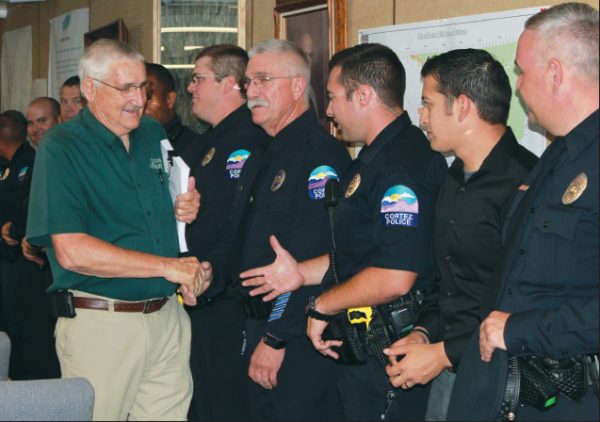
The entire Cortez Police force turned out June 28 to honor Chief Roy Lane during the city-council meeting. He was presented with the Charles K. “Pat” Steele Award, given to exceptional police chiefs in Colorado. Photo by Lori Johnson

Getting a citation in Cortez doesn’t usually involve the entire police force, but this wasn’t a speeding ticket or any other routine matter. It was, in fact, recognition for a job well done.

Witnessed by dozens of uniformed men and women who crammed into city council chambers June 28, Chief Roy Lane was presented with the Charles K. “Pat” Steele Award, named for a late Loveland police chief renowned for his inspirational leadership.

Nominees “must have maintained high personal and professional standards,” state the criteria of the Colorado Association of Police Chiefs, and “holding forth these values and ethics at times of unpopularity, difficulty and adversity shall cause greater consideration.”

And given those considerations, Lane — the longest-serving chief in the state of Colorado — was a slam-dunk.

Among other challenges during his 35-year tenure, Lane had shepherded his department through one of the toughest times imaginable, the murder of Patrol Officer Dale Claxton. In 1998 Claxton was ambushed by a self-styled survivalist wielding an automatic rifle, one of three suspects who also shot and wounded officers from other agencies while fleeing into the wilds of Utah.

Lane helped lead the massive manhunt for the fugitives, counseled Claxton’s grieving family and eventually recruited Claxton’s son into the Cortez department.

Lane began his career in Winslow, Ariz., as a 21-year-old rookie and also served as chief in Holbrook, Ariz. He became Cortez police chief in 1981. In a letter of nomination, Bayfield Marshal Joseph McIntyre noted that Lane has been a police officer 50 years, 41 of those as a chief. “He has earned the respect and admiration of his staff, community and his colleagues from the South West region,” McIntyre wrote.

Published in July 2016

Charter schools appoint new directors

Two Cortez public charter schools appointed new directors at the end of the 2016 school year.

Children’s Kiva Montessori School announced at their May 17 end-of-year barbeque held at Parque de Vida that Susan Likes, current interim head of school and former finance director, will be accepting the position of head of school.

“I would like our school to become the school of choice for Montezuma County,” said Likes.

CKMS opened its doors in 2014 with only 74 students, but expanded to serve 110 in August 2015, after relocating to a larger building on Beech Street in Cortez. “Being a start-up school, we have had some facility constraints,” said Likes, “and typical growing pains for a school that has just opened its doors.”

However, she sees many positive changes in the students so far. “As a result of our amazing teachers and the Montessori method, some of our students have quickly gained years in their reading,” she said.

Likes describes her students as having gained “lifelong skills” such as confidence in public speaking, self-motivation, and self-direction.

Also under new leadership is the Southwest Open School, introducing new director Charlotte Wolf on May 26 at their end-of-year cookout.

Wolf is relocating from a high school in Littleton, Colo., where she taught German and served as the international baccalaureate coordinator.

Born and raised in Regensburg, Germany, Wolf said she believes early language and literacy are crucial to develop in society. “I think literacy is the ticket to a successful future, individually and collectively,” she said.

“Research tells us that early language and literacy (reading and writing) development begins in the first three years of life and is closely linked with a child’s earliest experiences with stories,” she said.

“The interactions that young children have with such literacy through storytelling, singing, books, paper, and crayons, and the adults in their lives are the building blocks for language, reading, and writing development.”

Some of her goals for SWOS are to support the SWOS community so it can “continue to be a viable and exciting option for students in the area”; oversee that the needs of all students are met, “integrating their skills, passions, background, and heritage”; and also to “expand post-secondary options for SWOS students, both with regard to academic and workforce choices.”

Wolf enjoys hiking, biking, archeology, spiritual traditions, and history. More information can be found at www.kivacharter.org for Children’s Kiva Montessori School and www.southwestopenschool.org for SWOS.

Published in July 2016

Clean-up moves forward after spill: Entities vie for government funding in wake of 2015 Gold King Mine disaster

San Juan County is one of the five smallest counties in Colorado – only 388 square miles – but it undulates with some of the most rugged mountain terrain in the Rocky Mountains, and has the highest mean elevation of any county in the United States, 11,240 feet. Majestic topography surrounds the 635 residents who live in the only town, Silverton, located in the snowy heart of three watersheds where water melts each spring into Cement Creek, Upper Animas and Mineral basins and flows into the Animas River.

It is also home to the toxic August 2015 Gold King Mine spill, when contractors for the Environmental Protection Agency accidentally dislodged an adit plug a few miles above Silverton that held back mining wastewater.

The blowout sent 3 million gallons of yellow water contaminated with heavy metal plummeting into the waterways that nourish fisheries, agricultural and ranching land, backyards, parks, swimming holes and native tribal communities.

EPA director Gina McCarthy accepted full responsibility for the calamity and put into place emergency responses to mitigate immediate damage, including delivering potable water to residents and farms around the Animas River in Durango and Farmington, N.M., and communities along the San Juan River in the Navajo Nation.

McCarthy also entered into a course of action addressing long-term solutions to the breach and measures to prevent future damage in the mining landscape around the Gold King site.

Bonita Peak

A 13,000-foot mountain, Bonita Peak, has become the namesake for the proposal to place the area around the Gold King spill on the National Priorities List for Superfund designation. The Bonita Peak Mining District proposal asserts that the EPA has confirmed that 48 of the 300 mining sites in the county fit the criteria for Superfund designation.

The Region 9 Economic Development District reported in 2015 that San Juan County has the smallest year-round population and lowest total personal income in Southwest Colorado and is “almost entirely dependent upon tourism, primarily during the summer months when the Durango & Silverton Narrow Gauge Railroad is running.” If the region were to become a Superfund site, the county and the city would need certain guarantees. Highest on the list was assurance from the EPA that the project name would not reflect negatively on the Silverton community. “Bonita Peak Mining District” mostly alleviated those concerns.

The EPA also agreed to provide technical-assistance grants, establish and fund a citizens advisory group, and consider new technologies and alternative approaches to remediation. It also promised to incorporate local involvement in all phases of the project.

After the spill, property owners began to sense that banks and lending institutions felt uncertain about the value of properties in the county. U.S. Rep. Scott Tipton understood their concerns. Tipton Communications Director Liz Payne told the Free Press that from his experience with the community within the potential Pueblo Smelter Superfund site, Tipton saw that even the consideration of the designation has a negative impact. Many homeowners are having trouble getting an appraisal on their homes and can’t find real estate agents to list their properties.

Landowners asked the EPA to provide letters confirming that any property in question lies outside the boundaries of the Superfund site and is not meaningfully affected by the project. Citizens included a request for clarification from the agency, if they need it, to satisfy requirements of state and federal agencies and programs such as HUD, FHA, Fannie Mae or Freddie Mack.

There can be other drawbacks to the Superfund listing. One – dust – has obvious human health impacts, since the road to the site contains tailings from various mines. Even with limited traffic, CR 110 is dusty in dry weather. With traffic from EPA workers and contractors, it is clear that dust will increase, potentially “impacting the sensitive electronic circuitry of our chair lift and other equipment located at the base area of Silverton Mountain,” wrote the executive director of Silverton Mountain Ski Area, Aaron Brill.

The only communication resource at the north end of CR110 is a pair of barely functional analogue phone lines. In case of an emergency, an EPA worker would need to drive 8 miles down the road from Gladstone to make a cell call. “From a safety standpoint,” wrote Brill in a letter confirming support for the Superfund designation, “for both EPA workers and the town of Silverton it seems obvious that there is a need for a cellular tower.”

The current proposal utilizes a horn as a warning system for Silverton Mountain’s guests and the town of Silverton. A modern, cellular-based communications system is required, Brill says. It is not funded yet, but a request for the communications solution was described in the comment letter of support from Silverton Mountain Ski Area.

By February 2016 the community began to feel confident that their needs were being heard and that in the long term the Superfund designation will improve their community. The San Juan County Board of Commissioners and Colorado Gov. John Hickenlooper gave their official support, along with Ed Morlan, director of Region 9, on behalf of the 17 local government and nine private-sector members of the economic district.

“The Gold King mine spill has had a huge economic impact on the communities downstream,” Morlan wrote. “The impacts are continuing and the event has pointed out additional potential disasters from the scores of other abandoned mine sites in the drainage. A public investment now to mitigate the situation could avoid much higher financial and environmental costs in the future.”

The city of Durango, La Plata County, the Navajo Nation, Colorado Sen. Michael Bennet of Colorado, New Mexico Senators Tom Udall (Dem.) and Martin Heinrich (Dem.) and New Mexico Rep. Ben Lujan (Dist 3 Dem) are also on board.

Follow the money

Just prior to the close of the comment period June 13, the EPA held a community meeting in Farmington, N.M. The sparsely attended get-together attracted representatives of the Navajo Nation EPA and the Office of the Navajo President and Vice-President, local tribal agricultural and ranching stakeholders, NGO conservation representatives, a filmmaker, independent geologists, hydrologists, and scientists from the New Mexico Environment Department.

Superfund Project Manager Rebecca Thomas, EPA Region 8, explained the process that led to the selection of the 48 mining-related sites included in the proposal. Each contains waste rock, tailings piles and/or mine discharge out of adits.

Their findings indicate that contaminants from these sites had been released into Mineral Creek, Cement Creek and the Animas River prior to the spill as well as after. They found that stretches of the Animas River and Mineral Creek support fisheries that are harvested for human consumption and that wetlands are found near those waters.

The EPA Superfund Emergency Response Program has been active within the study area. In 2015 the agency installed a bulkhead at two of the mines in the Cement Creek drainage, and is treating the Gold King Mine adit drainage. Parties involved in past responses to the environmental issues in the district include the Bureau of Land Management, U.S. Forest Service, State of Colorado Division of Reclamation, Mining and Safety, private parties and a local stakeholder group. They have complemented the EPA work with analytical sampling, rerouting of adit discharge, installing bulkheads and waste pile consolidation within the mining district.

The BPMD project includes 35 mines, seven tunnels, four tailings impoundments and two study areas where additional information is needed to evaluate environmental concerns.

In May, the New Mexico Environment Department filed suit against the EPA and a mine-owner in the district. The lawsuit contends that residents in New Mexico, Utah and tribal lands suffered catastrophic harm from the spill because it “damaged water that is the lifeblood of downriver communities’ economy and culture.”

The heart of the allegations concentrated on water-quality testing and the demand that the highest testing standards be used and be done by an independent monitor outside the EPA. Additionally, the suit seeks nearly $7 million to reimburse communities for the spill-related emergency expenditures, and long term water monitoring.

The suit followed months of exchanges between the EPA and NMED over compensation. It also came after NMED was denied the full $6 million it requested in March for a comprehensive work plan to evaluate the long-term impacts of the spill. NMED was granted just 8 percent of the request.

In an April email from the Water Protection Division, the NMED demanded the EPA “provide access to the funds necessary to address these time sensitive matters now.” It alluded to the imminent spring runoff and people’s concern about the safety of their water supply. “We understand that … further federal funds may be forthcoming, [but] such a piecemeal allocation will not provide the affected residents the necessary confidence that we are ensuring the safety of their water right now… each task in our work plan is vital to protect human health and the environment. Therefore, NMED still requests the entire $6,054,552.”

In a reply, the EPA explained that in March when the NMED provided the EPA “with a copy of their $6 million two-year monitoring plan [the EPA] immediately began to find ways to fund as many activities that we could.” It allocated $2 million in funding to support states’ and tribes’ long-term monitoring plans. Nearly a quarter of it went to the NMED.

An additional $628,000 was made available to states and tribes to support spring run-off monitoring. $155,000 of that amount went to NMED.

“EPA approved using [another] $108,000 for two stream monitoring stations with real-time monitoring equipment and for conducting sampling and analysis to support both the Animas and San Juan River Spring Runoff Preparedness Plan and NMED’s monitoring plan. The real-time monitors are in place and collecting information. … EPA is fully supportive of collecting data that allows for a representative characterization of water quality in the Animas/San Juan watershed. To that end, we encourage states and tribes to collaborate on data quality objectives so that monitoring efforts are complimentary and to fully utilize available scientifically valid data currently being collected.”

Green downstream

The Animas flows into the San Juan River, which runs through Shiprock, N.M., home to Navajo Nation President Russell Begaye. Quick to criticize the EPA in the first few days of the Gold King crisis, Begaye, as quoted in the Navajo Times, warned, “We are going to make EPA pay for this,” adding that he was going to work with [Navajo Nation] EPA officials to do tests to see how serious the contamination was to Navajo lands. He said he didn’t trust the U.S. EPA to do the tests because he felt they would try to get the tribe to settle for “pennies” instead of the millions or billions of dollars of damage allegedly done by the contaminated water, the Navajo Times reported on Aug. 9, 2015.

In a March exchange with EPA Director McCarthy, President Begaye charged that the EPA has been dragging its feet.

“You have been personally and publicly promising accountability and dedication to those harmed by the spill… [but] seven months later the EPA has yet to compensate the Navajo; it has yet to designate the Upper Animas Mining District a Superfund site; the EPA has yet to implement, with Navajo feedback, a comprehensive plan to ensure no future contamination of Navajo land or waters; and has yet to provide the Navajo Nation with the tools it desperately needs to address the harms already caused and to mitigate against future harms. It is time for the EPA to act.”

McCarthy’s response clarified EPA funding to date, including more than $22 million on response efforts, with $1.1 million for agricultural water and hay for Navajo communities along the San Juan River. Further, on March 10, the EPA provided some $157,000 in reimbursement to Navajo agencies for response costs. The Navajo Nation Department of Justice accepted this payment on April 13.

McCarthy said the agency has requested the Navajo Nation Department of Justice substantiate the remaining reimbursement requests to determine their eligibility under the EPA’s response authorities and federal-grant principles.

McCarthy reiterated the need for continually posting water-quality data to the Gold King Mine website as it is available and sharing its interpretation of data with tribal, state and local governments and stakeholder groups.

She pointed out the dates that irrigation restrictions were lifted by Begaye’s office after the spill – late August 2015 for three Navajo chapters and Oct. 15, 2015 for the rest of the San Juan River. In late August, the Navajo Nation EPA also notified the Tribal Utility Authority that the San Juan River posed no threat to the Montezuma Creek drinking-water system.

The agency allocated $465,000 to the nation for water-quality monitoring and said the first round of sampling by the EPA in the fall after the spill showed no “exceedences” of Navajo Nation agricultural-water standards or of EPA recreational screening levels. The data is shared by the EPA and open to review by any independent investigators. In the letter, McCarthy also explained that since 1984 the U.S. EPA has provided more than $93 million in support of Navajo environmental programs and more than $100 million each for water infrastructure improvements and abandoned uranium-mine clean-up.

Despite all the criticism and haggling for money, all the governments affected by the spill have signed on in support of the Superfund listing.

So have grassroots stakeholders and officials in all affected counties and towns, and politicians, including Tipton — although he believes it is more effective for state and local groups familiar with the mines and the surrounding area to lead remediation and clean-up efforts.

In March Tipton joined Colorado senators Bennet and Gardner in their concern that remediation costs for abandoned mine sites surpass the capabilities of the EPA. They drafted the Good Samaritan Cleanup of Orphan Mines Act, legislation that would allow organizations to apply for permits, including some liability protection, to attempt clean-up at abandoned mines.

Published in July 2016 Tagged

A trip to the woodshed isn’t a bad thing — in jazz

When a jazz musician comes wailing out of the gate, spinning riffs and complex runs, fellow musicians will appreciatively murmur, “Cat’s been shedding!”, writes Paul Klemperer, sax player and ethnomusicologist living in Austin, Texas, in an article called “Woodshedding & The Jazz Tradition” on the Big Apple Jazz website.

“Alternately, when a player’s ego outmatches his technique, his peers may suggest he spend more time in the woodshed. Woodshedding is the nutsand- bolts part of jazz, the place where you work out the techniques that form the foundation of your improvisational ability.”

Blues harmonica musician Adam Gussow

Blues harmonica musician Adam Gussow was 28 in 1986 when he played on the streets of Harlem, sitting in with R&B musicians Mr. Satan and Professor Sixmillion. He will offer three workshops Crash Music in Aztec on July 9 & 10. Showtime for Gussow and the Blues Doctors is Saturday, July 9, at 7:30 p.m. at the music venue housed in the Historic Aztec Theater, 107 N. Main in Aztec, N.M.

Blues harmonica player Adam Gussow will push participants toward the woodshed in two days of workshops July 9 and 10 at Crash Music, a music and visual arts venue located in the renovated Historic Aztec Theater, in Aztec, N.M., a few miles east of Farmington. The weekend approach to music reinvention includes a classic blues-harmonica jam session and a Saturday night performance with the Blues Doctors.

Participants will work through licks, riffs and grooves on the wind instrument in classic blues tunes such as “Got My Mojo Working,” “Crossroads Blues” and “Hoochie Coochie.” Gussow, an experienced blues-harmonica musician since the 1980s, says “going into the woodshed is part of the process that moves a musician to transform music.”

In 1986 Gussow was the newbie on the streets of Harlem, where he sat in with Sterling Magee (Mr. Satan), an R&B legend who played with King Curtis, Etta James, and many other big names. “He was just beginning his own one-man-band odyssey when I met him. Within five years he and I had big-time management, a hit CD, ‘Harlem Blues,’ on Rounder Records; we had played the New Orleans Jazz & Heritage Festival, we’d opened for Buddy Guy in Central Park and toured the UK with Bo Diddley, and I had the right to call myself a touring pro. I lived that life from 1991 through 1998.”

Yet somehow in the long stretch of his professional music life Gussow directed his interest in the roots of Southern culture and Southern musical traditions into academic studies, earning his Ph.D. from Princeton. In addition to his career appointment as an English professor at the University of Mississippi, he also tours internationally, playing all of the major blues, jazz, and folk festivals. His primary teaching interest is the blues literary tradition.

In a telephone interview, Gussow described the player’s role in pushing the evolution of the instrument as a tension between the old blues and the new.

“People are still mining the old harmonica blues styles, not taking a step forward. As a result, blues harmonica playing is weighted toward white players today who want to play the real blues, the old blues,” making icons of the great players, like Little Walter.

Instead, Gussow’s approach pushes musicians out of the box and advises they spend time alone in the woodshed. He explains that the art is the result of listening and then reinventing the music. “The pinnacle, for me, is Little Walter, who listened to the jazz and blues players of his time as well as the traditional players, yet he was a modernist in the same way that Picasso shook things up in the visual arts.”

Gussow’s musicianship is heavily influenced by his father, Alan Gussow, an artist and environmentalist and the author of several books, including A Sense of Place: The Artist and the American Land, and Reinventing Regionalism: The Artist as Native. He created the program that put artists into the national park system. His father’s mentoring introduced Gussow to the parallels between contemporary visual arts and jazz. He says his father taught him there are two kinds of artists, those who do what they can and those who do what they can’t. “Those who do what they can’t are the ones who evolve the music and the art, like Picasso did in the 1950s.”

Well-known in the international blues community for teaching a transformative approach to harmonica, and playing it, he hopes the long-term result changes the music genre.

“Like Picasso, Miles Davis, and Jackson Pollack, who continued to reinvent the art and themselves, I teach people to be restless, move into other media, transform, experience what it means to go out into the woodshed.” In fact, two of the best examples of harmonica evolution, he says, are Sugar Blue and Jason Ricci.

“Their fast and furious harmonica playing is a complex reinvention of what it means to play harmonica.”

Gussow is the author of three books: Mister Satan’s Apprentice: A Blues Memoir, Seems Like Murder Here: Southern Violence and the Blues Tradition, and Journeyman’s Road: Modern Blues Lives from Faulkner’s Mississippi to Post-9/11 New York. Information and registration for the Adam Gussow harmonica workshop/ performance weekend is available at 505-427-6748.

The Animas Blues & Brews Fest

A week later, the Animas River community will flow with more blues and brews during the 11th annual Animas Blues & Brews Fest located in the Riverside Park in Aztec, N.M. Bluesman Zac Harmon called Katee Mclure, director of the Animas Blues and Brews Festival, to ask about being in the line-up. “I had heard his name, his music,” Mclure says, “but I wondered how we could afford him. I called him right back. It turns out that he sends the queries himself, so he knew us. He asked me to call his booking agent and we worked out an agreement. It was a great coup.”

Harmon is headlining the five bands playing from 1 until 11 p.m. at the Animas Park near the river. He’s an award-winning guitarist, organist, singer, and songwriter whose distinctive style combines the best of old-school soul-blues artists with modern lyrics and themes that bring the blues into a new century. In “Long Live the Blues,” a tune he wrote for the album “Right Man Right Now” (Blind Pig Records), Harmon sings the blues for the blues, “They took my songs, they got ’em all wrong, then they called it rock and roll…In my blood…Mississippi mud…How I feel.” It’s contemporary music that proves just how alive and relevant the blues is today.

According to Rick Bell, Groove Music Magazine, Jay White & the Blues Commanders feature the “rare trifecta talent” of White, “a combination of great guitar work, gravelly blues vocal style with dead on pitch and a song writing ability that garnered him his first hit record before he was out of high school.”

McClure says the music festival, established in 2006, now garners submissions from many bands. “I listen to every CD and then I like to spend time on YouTube watching the more raw videos a band has posted there. Anybody can sound good in a studio production, but it takes real talent to sound good live on stage.” She says the boards of directors look for a mix of genres for the line-up, including varieties as diverse as Chicago blues and the Mississippi Delta style.

Described as playing Texas Music with soul, The Wesley Pruitt Blues Band will deliver classics and originals in the afternoon. Fan favorites include “Taking Your Memories,” “Poor Man Blues,” and “Cocaine & Whiskey.”

Missy Anderson follows with timeless blues “going straight to the spirit and body,” writes Bill Wilson. According to Wilson, she sings in the moment, taking the listener through a wide range of emotions. “The band is as tight as any I have heard, leaving Missy all the room she needs to deliver her stories with authority and an emotional power that grabs the listener and holds them to the very end.”

The festival wraps up with the local Blues Guild of Albuquerque. Originally formed by vocal guitarist Joe ‘Daddy’ Warner in 2013, the Blues Guild of Albuquerque includes Kent Pittsenbarger on drums, Jeff Sipe, bass and Dinnie Ferguson on harmonica. They’re playing to keep the tradition of American Blues alive and pass it on to future generations.

Doors open at noon Saturday, July 16. Tickets, information and performance clips from can be found at http://www.animasriverblues.com/

Published in July 2016 Tagged

Boating the Dolores for the first time: a personal account

When I heard there was to be enough water for boating on the Lower Dolores River this spring, I knew there would be a lot of happy rafters and canoeists, but I didn’t figure I’d be among them. Circumstances have combined to keep me off the Dolores – I had, in fact, never rafted it, except for one brief excursion many years ago at twilight, from below the dam down to Bradfield Bridge. Since I couldn’t see much of anything and spent part of the trip running along the nearby road rather than actually riding in the raft, I don’t count that as a true rafting experience.

FLOATING THE LOWER DOLORES RIVER

One in a series of many boaters steers his craft through Ponderosa Gorge on the Lower Dolores River on the first day of the 2016 spill. Photo by Gail Binkly

Since I wasn’t going to be able to go, I consoled myself with sour grapes. Oh, well, I thought. The Dolores is probably nothing special.

I’d certainly talked to numerous rafting enthusiasts who cherish the waterway, but I remained skeptical about all the gushing adjectives: pristine, beautiful, unique.

My first real experience with whitewater rafting came many years ago, when David and I and a friend, Terry, took a raft down the Arkansas through the Royal Gorge near Cañon City. Terry was a professional rafting guide, although he had never done the Gorge before. David’s experience was limited to floating tourists along a stretch of river in Pueblo that had scarcely a ripple on it. I was along mostly as ballast.

We eddied out before the first major rapid, Sunshine, which is fairly challenging, and walked along the bank scouting it. “No good standing here,” Terry said at last. “Let’s go.” We got back in.

Our raft swirled between rocks and down a five-foot drop; icy waves (it was June 1) splashed in. Suddenly the spare oar tied to the side of the raft came loose at one end and began banging against rocks, threatening to hang us up. David leaned over and tried to free the end of the heavy wooden oar, to no avail. It was now jammed between two rocks and we were stuck in the middle of the rapid, not moving.

“Cut it loose!” shouted Terry, who never shouts. David struggled to untie the knot holding the oar. He had no knife, but Terry kept shouting, “Cut it loose!”

Water was pouring into the raft like that scene in The African Queen where Humphrey Bogart and Katharine Hepburn go over the falls. “Bail!” Terry yelled at me. Everything seemed to be happening in slow motion. I tipped the five-gallon bucket over the edge and laboriously filled it again. A rather scrawny weakling at that point in my life, I could barely move the water-filled bucket, but I did my best. “Bail, bail!” Terry cried.

Suddenly we broke free – I later learned that David had somehow got the oar loose at last – and we were moving into calmer waters. My feet felt like blocks of ice. We were all drenched and shivering, and even the Colorado sun couldn’t warm us, although my thighs were already fire-red with sunburn. “I thought for sure we were going to flip,” Terry said, reverting to his laidback voice.

The rest of the trip was strikingly serene. When we got out several hours later, I was hungry, exhausted, cold to the marrow, mosquito-bitten and blistered. And I couldn’t wait to go rafting again.

There followed a period in my life when I jumped on a raft every chance I had, mostly on the Arkansas. But then I moved, and bought a house, and seemed to get bogged down with chores and responsibilities. Combine that with the infrequency of managed boating releases from McPhee, and the result was, despite living in the area more than 20 years, I had not experienced the Dolores.

As anticipation grew over the pending 2016 spill, modest as it was going to be, I made up my mind I was going to get on the water somehow. After all, it had been five years since the last boating release – who knew when another might occur? So I begged, whined, and wheedled until some kind-hearted folks agreed to carry me through Ponderosa Gorge, an 18- mile stretch between Bradfield Bridge and the Dove Creek pump station, in order to shut me up.

The one down side to rafting is that there is a lot of preparation. Shuttling between put-in and take-out, preparing snacks, digging out life vests, toting suntan lotion and bug spray and a million other items, stuffing it all in dry bags, tying everything down.

I was ready in my jeans, my long-unused rafting shoes, and a cap that made me look like Elmer Fudd (the only one I could find with a chip strap). I had no work to do, so I watched impatiently as my hosts labored, silently urging them to move faster so I could get on the water, dammit!

Dozens of other eager boaters were milling about the put-in at Bradfield. Some had driven from Denver, New Mexico, or even Texas, having dropped everything to seize their chance at the Lower Dolores. The air buzzed with excitement. It was a Saturday morning and the water was flowing about 1,000 cfs. In addition to the recreationists, some people were there apparently just to view the hubbub, and a few others seemed to be basically hitch-hikers hoping, like me, to find a boat with space for an extra body.

But finally, finally, I was in the “cataraft,” a high-riding craft, with Carolyn and Glenn, and we pushed off, and there was the familiar tug and lift as the current seized us.

Ah, yes.

There is something mesmerizing and magical about floating down a river. I fell in love with the concept, long before I ever experienced the reality, while reading Huckleberry Finn as a child. The satire was over my head, but I was transfixed by the idea of Huck and Jim on their raft, free and in motion, moving effortlessly from place to place. It’s like being on a train, but without the racket – the ever-changing view slipping past on both sides, energy and power beneath you.

It’s probably impossible for anyone to boat the Dolores without talking, or at least thinking, about the politics of water management. As depicted in “River of Sorrows,” a short documentary produced by Rig to Flip, the Dolores is famously water-short. Every drop is spoken for, every acre-foot tightly managed. McPhee Dam is a faucet and no molecule escapes it without the blessing of the Bureau of Reclamation.

Since the dam and associated Dolores Project came online in the early 1990s, rafting releases have occurred on average every other year, thought not with anything like such regularity.

This is a source of considerable frustration for boaters. The 2016 season was the quintessence of unpredictability: In the winter, conditions appeared favorable for a spill, then they didn’t, then there was probably going to be one, then not, then yes after all. It was going to be over Memorial Day weekend, then it was postponed a week, and when it finally came it was lengthened at the last minute for several additional days.

All the seesawing might have been the work of a crafty cabal dedicated to driving boaters mad, but of course it wasn’t. While the ultimate decision-making authority for releases rests with the Bureau of Reclamation, the unpredictability was on the shoulders of Mother Nature.

Operating a dam and reservoir is complicated stuff, and this is particularly true regarding the Dolores. There are many figurative hands holding out empty cups, wanting water for their special purpose: agriculture, municipalities, industry, native fish, a sport fishery, a healthy ecosystem – and of course, recreation.

And many of these needs conflict with each other to some degree even beyond the simple matter of supply. For instance, the timing of a dam release that is ideal for promoting native-fish spawning and growth is not necessarily the same as the best timing for a boating release. The flows needed to periodically flush silt from cobble and improve riparian habitat take away water that could be used to make a longer boating season – depending, of course, on how much excess water there is. In a really wet year, a lot of different needs can be met, but years like that are few.

Glenn and Carolyn are veteran boaters who lament the paucity of opportunities on the Lower Dolores. Like many others, they say more-frequent and more predictable boating releases would allow for the development of a robust recreational economy based on the river. As it is, they say, there is almost no chance for skilled guides to put their abilities to commercial use.

I repeated a question I’d heard others ask: Would more-predictable boating mean implementing a permit system that would do away with the zany, spur-of-the-moment feel of the Lower Dolores and lead to a dominance of commercial users over non-paying locals such as ourselves? “I don’t know, but I’d sure like to have that problem to figure out,” Carolyn replied.

Over the years, many efforts have been launched to enable differing parties to talk about the best way to manage the Lower Dolores River and corridor, the best-known probably being the Dolores River Dialogue. Carolyn and Glenn are skeptical that all the talk has accomplished much.

But others, including many boaters and groups such as the local Dolores River Boating Advocates, believe the dialogue helps, and are committed to working with the Bureau of Reclamation and DWCD to try to improve the situation.

One group representing diverse stakeholders is currently working on a legislative proposal to establish a national conservation area along the corridor from the dam to Bedrock, Colo. Another group called the Monitoring and Recommendation Team offers advice and recommendations to the BOR and DWCD about river management. A long-time Montezuma County official (who was not a raging liberal) used to remark that, if the river were managed logically, we’d send all the water downstream to Mexico, where the growing season is longer. That, of course, is not how things are done. The majority of the Dolores’s water nourishes a vast system of crops throughout Montezuma and Dolores counties and on the Ute Mountain Ute Reservation. The dam also stores water for municipalities. Some is allocated to industrial purposes. A sizable chunk is set aside for the fishery – though not enough, biologists say.

In dry years, most users share in shortages. In the darkest days of 2013, Dolores Project irrigators, the fishery and the Ute Mountain Tribal Farm all suffered through a 30-percent water supply.

In wet years, everyone is happy. It’s during the in-between years, such as this spring, that the maddening dance of uncertainty occurs, as water-managers seek to fill the reservoir but keep it from spilling over the top (a highly undesirable occurrence).

The BOR’s Vern Harrell develops an operating plan to project how the spill water will be released in relation to Dolores River inflows. He turns the operating plan over to the Dolores Water Conservancy District, which manages the releases. Watching regional weather forecasts and Sno-Tel reports, managers attempt to gauge how fast the high snows will melt and come tumbling downstream, while balancing that with how quickly irrigation demand will start sucking water out of the reservoir.

To boaters it can seem as if they come last on the priority list, despite the fact that the need to protect boating is cited in documents associated with the Dolores Project.

But we did not dwell on all those issues as we glided downstream. It was too beautiful a morning. Glenn, a biologist, described the rarity of the beautiful ponderosa canyon that was slipping by on either side of us. The towering, yellow-barked ponderosas jutting up against the sandstone cliffs normally don’t grow in such a location and likely would not regenerate if they were ever to burn, he said.

Hawks, ravens, and turkey vultures wheeled in the sky. An otter popped its head up in the water near the shore. Ducks and other birds, startled by the sudden appearance of a river where none had been for several years, were fleeing nests they had built in the brush that now clogged the waterway.

The water was ice-cold and had a musty smell like the bottom of a fish bowl, something I attributed to the fact that it is released from the bottom of the dam rather than the higher elevations. (This is done to prevent non-native fish in the reservoir from being released into the river.) I was later told, however, that the smell resulted from the presence of organic matter deposited in the lake and river that is stirred up by the energy of the release.

Carolyn and Glenn wanted to camp halfway through the gorge, so we pulled over and picnicked with another group – Ryan, Maggie, and Kristen, who had kindly agreed to carry me the rest of the way to the takeout at the pumps. They had a traditional rubber raft that rode lower in the water, splashing us liberally – something for which I was grateful as the day heated up.

The three younger people had less interest in the never-ending debate about river management, but the topic still came up occasionally. One of the women said she thought there needed to be more talk about finding water for boating, “but when you bring it up with the farmers, they seem to get very defensive.”

Despite the fact that the river teemed with boaters in every possible size, type, and color of craft, as the day wore on we found ourselves alone for long periods. The fleeter kayaks and canoes had passed us, and we seemed to be on our own in this wilderness of stunning beauty. Ryan, who was at the oars, steered us so skillfully through the modest rapids that we were free just to gaze around.

I couldn’t stop thinking about the fact that I was seeing this view for the first time and that it might be years before I’d have the chance again.

McPhee’s managers are hopeful that filling the reservoir for the first time since 2011 will pave the way for a larger, easier-to-plan managed release in 2017. Then something close to an average snowpack this coming winter would be all that is needed to have a boating release two years in a row.

But, with climate change and La Niña looming, who knows whether that will happen? The worst-case scenario would be winter drought, which would mean another spring without boating.

Floating down the canyon, happily unaware of where we were on the river, we were surprised and saddened when the pump station suddenly appeared. The trip was over. I couldn’t begin to convey my gratitude for their generosity, but my guides seemed to think it was no big deal.

As I drove home, I realized that what is at issue on the Dolores is a form of access. Just as various user groups fight for the right to hike, Jeep, bike, and ride ATVs into the backcountry, boaters are seeking their own special kind of access – one that is non-motorized and quiet, that leads to places often unreachable any other way.

I had been fortunate enough to experience such access during a fortuitous alignment of factors that opened a window of opportunity.

I carry with me the memory of one blissful day, made bittersweet by the brevity and rarity of the experience.

Published in July 2016 Tagged

O’Nan’s latest is slender but powerful Prose and Cons

If the fine American fiction writer Stewart O’Nan is any indication, authors who adhere too strictly to writing only what interests them—and, they presumably hope, their readers—may well do so at their professional peril.

CITY OF SECRETS BY STEWART O'NANO’Nan counts among his most ardent supporters bestselling authors such as Stephen King, with whom he has cowritten two books, and Dennis Lehane. Yet, over the last two decades, his tight, spare novels on a variety of subjects and featuring all manner of intriguing characters rarely have found an initial readership of more than a few thousand. The result has been the move by O’Nan, time and again, from one unsatisfied publishing house to another.

O’Nan’s latest novel, City of Secrets, may well change that trajectory. It most certainly should.

City of Secrets is at once a riveting historical thriller based on true events in the Middle East, and a solemn meditation on humanity—in this case, the search for purpose, any purpose, in the wake of unspeakable evil. O’Nan’s combination of a thriller plot with the intense moral struggle of his lead character results in an engrossing reading experience, and a book readers likely will find themselves placing in the hands of others with the admonition that they, too, must experience it.

In City of Secrets, O’Nan uses the viewpoint of his protagonist, Brand, to depict a little known chapter in the struggle to create the Jewish nation of Israel. Brand, a Jewish survivor of the Nazi death camps in which his loved ones perished, has washed up in post-World War II Palestine. Unmoored by grief for his slaughtered wife and family, Brand fights the ever-present urge to commit suicide by joining an underground cell working to destabilize British rule in the region.

Brand finds solace in the arms of Eva, another emotionally damaged survivor of the war and a fellow member of his cell. When his work as a taxi driver cruising the streets of Jerusalem proves particularly useful to the underground, Brand is drawn ever deeper into the revolutionaries’ covert operations. As the missions in which he participates become increasingly desperate, he is torn by his loyalty to the cause and his increasing love for Eva.

An author of wide-ranging tastes, O’Nan long has taken readers deep into subjects he finds fascinating—from the celebrated life of F. Scott Fitzgerald in last year’s historical novel, West of Sunset, to the far-less-celebrated but, in O’Nan’s assured hands, equally engaging life of a restaurant manager working a chain eatery’s closing night in 2008’s Last Night at the Lobster.

O’Nan is known for his ability to bring characters and scenes to life with the lightest strokes of his word paintbrush. Indeed, Los Angeles Times reviewer Susan Salter Reynolds called Last Night at the Lobster a “Zen koan of a book.”

Readers of City of Secrets may well wonder how many words and passages O’Nan must have written and discarded to reach the lean, moving portrayal of Brand and Eva he commits to the fewer than 200 pages he uses to tell their heartbreaking tale. What really matters, however, is that every word and sentence in City of Secrets counts, making O’Nan’s latest a slender book of powerfully emotional weight.

Scott Graham is the National Outdoor Book Award-winning author of the National Park Mystery Series for Torrey House Press. The third book in the series, Yellowstone Standoff, was released in June. Visit Graham at scottfranklingraham.com.

Published in August 2016, Prose and Cons

Behind the times

OK, call me old-fashioned, but what is this Pokémon Go stuff all about?

I remember my oldest nephew, Jacob, used to really like them. I think they were collectible cards or something.

I had no idea there were so many Pokémons – or is that Pokemoni? Kind of like how a group of octopus would be called octopi. Of course it’s only octopi if there are 3.14 of them, I think.

Now that Pikachu thingamabob was cute. But I can’t remember the names of the others. I think I remember one whose tail had fire at the end? But I know there was no such thing as Poké mon Go when I was a little Squirtle.

Okay, maybe I am behind the times. I recently threw away my old vinyl records, but that’s only because I found this cool new thing called eight-track tapes.

And I just started wearing a belly purse. That’s what I called it, anyway. My wife, Sara, told me the correct name is fanny pack. I decided I wanted one after seeing The Rock in “Central Intelligence.” Now, The Rock – uh, rocked – the fanny pack. I could smell what The Rock was cooking.

Obviously I came to the conclusion that if I wore a fanny pack I’d look just like The Rock.

I bet the next time you see me you won’t be able to tell the difference.

When it comes to popular culture I always seem to be behind the times. I’m sure that I’m not the only one that still puts baseball cards on the spokes of his bicycle?

Maybe you’ve heard of Hello, Kitty?

I had never heard of that famous feline until I met Sara. She told me it was really popular. But I thought, “How can it be that popular if I’ve never heard of it?”

So I googled it. Turns out Hello, Kitty – real name Kitty White – pulls in $1 billion a year. In fact she lives in London, loves her grandmother’s apple pies and has her own pets.

I couldn’t believe that there could be such a widely loved product and I had never heard of it.

I don’t remember any Hello, Kitty’s or Pokémons when I was a kid. I had a Hula Hoop and a Slinky. Now, the Slinky was fun for about 30 seconds, but the second time it tried to go down the stairs it toppled over and the wire got tangled.

Thinking about it, maybe I’m not so behind the times. I was driving down the road in my Edsel, sipping on my Nehi, when I thought about my cellphone.

That’s right, I have a cellphone. It’s a flip-top, so whenever I use it I feel like I’m Captain James Tiberius Kirk with a Star Trek communicator.

“Kirk to Enterprise!”

Admittedly I don’t know how to use it too well. I can text a little, though I don’t know how other people can make all those fancy symbols in their messages. I’ve had my current cellphone for about four years and only found out about a month ago that it can take pictures. That was when I accidentally blinded myself with a flash.

So, see, if I was behind the times, how would I know about Miss Mary Mack, all dressed in black? She even had silver buttons on the back, back, back.

Booyah!

John Christian Hopkins, an award-winning novelist and humor columnist, is a member of the Narragansett Indian Tribe. See his writings at http://authorjohnchopkins.blogspot.com.

Published in John Christian Hopkins

Caregivers and our health system

On a recent morning I was treated to a news story that should have made me happy. Instead, it reminded me of things happening right here in Montezuma County.

The incident that made national news: High-paid exec gives up position to become caregiver to sister. It should have brought me to my feet, cheering. Instead, I wondered how many in this country are caregivers to their loved ones – struggling with lack of friends, strength, money, and expertise.

Years ago, many people urged me to put my stroke-stricken wife into a rest home. I refused that advice and fortunately was strong and knowledgeable enough to care for her in our own home in the rural part of the county. It took all of our savings and then some, but that is what the nest egg was for.

Yes, we had good insurance, but because I didn’t take the advice of the supposedly more-learned folks, the insurance paid nothing. If she had been admitted to a facility, they would have paid for a certain number of years of care. However, I was concerned not only about the care she would be getting but the agony and mental anguish of being away from me and her beloved home.

We paid for persons to come in three times a week for four hours – not to give care such as medicine or bathing, just someone to offer conversation and be able to call 911 in case of a fire or emergency while I left to get groceries.

When I carried my wife to therapy, I saw other wives and husbands struggling to care for their loved ones, also short of money, advice, and help from relatives and friends. I was very fortunate that the stroke only took her mobility, not her mind. I have one person from Hospice of Montezuma to whom I owe a debt that cannot be repaid. To me she was and still is my hero.

I am now and have been for some time a caregiver for a woman I was asked to help 10 years back, by her neighbor. I assume he had run the gamut of his religious friends and finally called me, a non-believer. Before he passed, he asked if I would still care for her after he was gone and I gave my word that I would.

She has now been stricken with further health problems. Her relatives are all in Texas and have their own problems. Poor dear, she is stuck with me.

Many people ask me why I am caring for her. I feel I have an obligation to my word and humanity. This lady has few friends, both by choice and by death; she was and still is a private and independent person.

Her relatives say, “Put her in a rest home.” I cannot think of a worse thing to do to a person in their last days, to leave them alone with strangers, no matter how fine the facility itself may be. I will relate a story about a lady in Durango, 101 years young, living by herself, who finally had to move into a care facility. Her mind was sharp; she was still writing books that were selling. I saw her just two days before her demise. She was having dinner and popped up like a jack-in-the-box when I entered. We talked and she said she missed her friends, home, and surroundings. I think loneliness finally drew the curtain.

I am 86, halfway to 87, and am so healthy it scares me. (The only pills I have to swallow are the bitter ones related to how this county and country are run.) I will continue to be a caregiver as long as I am able.

But I believe our health-care system needs to do a better job in providing assistance to caregivers such as me. It is far less expensive to keep someone in their own home than to put them in a facility, yet too often insurance does little to provide the things that would help keep the elderly and disabled at home. We need more alternatives to nursing homes and expensive assisted-living facilities.

We caregivers need some care of our own.

Galen Larson writes from Cortez, Colo.

Published in Galen Larson Tagged

Encouraging co-ops to look to renewables

It started with an email that read: “La Plata Electric Association’s board of directors is meeting on June 15 to consider a blanket waiver giving Tri-State Generation and Transmission, our power provider, the right to be the primary negotiator of ALL our renewable energy projects going forward. Given Tri- State’s reliance on coal, given how it is stonewalling affordable solar and other renewables …”

The email’s plea was simple: If you care about developing renewable energy, get informed, write the LPEA board, and attend the upcoming Board of Directors meeting for your short opportunity to share concerns.

My curiosity roused, I started googling related articles that pieced together an interesting regional story worth sharing. To understand what happened at LPEA this past month, you need to go back to the 1978 passage of PURPA (Public Utilities Regulatory Policy Act), which mandated that electrical co-ops such as LPEA start purchasing some of their power from renewable-energy sources.

In part PURPA was a reaction to the OPEC oil embargo, but it was also a sober acknowledgment that the USA needed to move away from dependence on fossil fuels. After all, the science of global warming and the dangers it poses to our next generations had become overwhelmingly clear.

It is true there were still many quibbling details, but in the big scheme of things, all those remaining uncertainties amounted to chump change. We knew what the accounts looked like. More atmospheric insulation meant warming our global climate system, which meant more extremes and destructive weather. It’s simple unavoidable physics.

PURPA was meant as a first step toward relieving the nation’s dependence on fossil fuels by exploiting less environmentally damaging, sustainable resources.

Then special interests (among them Tri-State) stepped in with their lobbyists, lawyers and PR specialists to do everything in their power to undermine the realization of PURPA’s mission and ensure fossil fuels’ continued stranglehold on our future.

Unlike LPEA, Delta Montrose Electric Association (DMEA) was enthusiastic about developing renewable energy when in 2006 after long-simmering frustration they refused to extend their Tri-State contract. Besides, not wanting to be forced to pay for Tri-State’s ill-conceived twin 700-megawatt coal-fired power plants – DMEA wanted to get out from under Tri-State’s culture of hostility towards renewable energy.

DMEA’s standoff escalated in 2015 when they filed a petition with the Federal Energy Regulatory Commission requesting the ability to sign power purchase agreements with independent power producers under PURPA. In July, 2015 FERC ruled that as per PURPA Delta Montrose Electric Association not only had the right but the obligation to purchase electricity directly from “Qualifying Facilities” over and above the 5 percent cap – Tri-State’s contracted limit.

This sent Tri-State into damage control. They have since been pressuring their 44 co-ops to waive their right to negotiate with local generation projects. This is where we get back to LPEA’s Board of Directors and our concern that they were getting ready to quietly sign away LPEA’s right to negotiate with local alternative-energy projects.

Alerted to the threat, many people began calling LPEA, writing letters and attending that board meeting to question the rationale for giving away LPEA’s negotiation rights. Though the board could not bring themselves to reject Tri- State’s waiver outright, they did postpone a decision.

They were also awaiting FERC’s decision on Tri-State’s retaliatory petition, filed Feb. 15, which asked approval for a “rate penalty” on co-ops that exceeded their 5 percent limit. Ironically, the day after the LPEA board meeting, FERC announced its decision, which systematically rejected Tri-State’s arguments and denied their petition.

FERC found that “Tri-State’s proposal seeks to undermine the Commission’s prior order in ‘Delta-Montrose’ by imposing financial burdens on Delta- Montrose that could affect its purchasing from Qualifying Facilities.”

Furthermore the commission found that Tri-State’s claim of being financially threatened by renewable energy didn’t hold up, considering Tri-State’s easy access to outside energy-thirsty markets.

One would hope this ruling will encourage forward-looking LPEA board members to take a stand on developing renewable energy and the need to retain local autonomy. It’s also a lesson in the power of an informed vocal constituency to encourage and guide their local electricity distribution co-op, be it LPEA, DMEA or Empire Electric. Can you help?

Peter Miesler writes from near Durango, Colo., and hosts the blog No-VillageAtWolfCreek.blogspot.com


E-mail this article

Published in Peter Miesler

Who decides what?

Smoke everywhere, wildfires burning up the public forests in the Western states. Wealth of the forests and local economies are going up in smoke. Hey, who is in charge anyway? The firefighters are doing a great job, but the reality is they have to do their job and attempt to do the forest management job that used to be done by loggers and ranchers in the past. Fact is nobody today wants to be held responsible, but everybody wants to be in charge. Who is supposed to be in charge?

The public lands of the state are caught up in this controversial dilemma. Everybody wants the lands the way they want them, don’t want them to change, do want to use them for free, do want to make the decisions for what is done, but do NOT want responsibility for their cost, care and management. Everybody has a different want and view, so how and who decides what to do? As a homeowner, you decide what color to paint the house and what trees to plant in the yard, right? Your name is on the title, you are responsible, so you make the decisions. Whose name is on the title of the Public Lands of the State? It’s not yours or mine or some environmental activist group. When the BLM sells some of the public lands it administers, where does the title/deed come from? Ready for this? It comes from the state! Are you confused yet?

Let’s take a quick trip into our history. When the country was formed under the Constitution, it was formed by already existing sovereign states. (Maryland and Virginia donated part of their land for the federal entity the states were forming). The Constitution specified all this in Art. I, Sect. 8. The states then wanted to provide an opportunity for the country to expand with more states, so added Art. IV , Sect. 3 to allow the new federal body to secure new territory to form new sovereign states. The Colorado territory was secured in three parts from 1803 — the Louisiana Purchase – to 1845 – from the Mexican War. On March 3, 1875, the Congress passed the “Enabling Act of Colorado,” authorizing “The People of Colorado to Form a Constitution and State Government, and for the Admission of the said State Into the Union on an EQUAL FOOTING With The Original States.” Paragraph 2 stated “State of Colorado shall consist of ALL territory included within the following boundaries…”, which included the eastern, central and western portions, to govern ALL the land and people of the new state, a State Constitution was to be established, and it “shall be republican in form”…” and not be repugnant to the constitution of the United States and the principles of the declaration of independence.” Being “republican” in form ensures it is not a democracy, but a republic with representatives to act on behalf of the people. A second provision stated “the people inhabiting said territory do agree and declare that they forever disclaim all right and title to the unappropriated public lands…” This was the individual people, not the State. The new State of Colorado was formally established Aug. 1, 1876, finally able to govern its lands and people itself, NOT Washington Territorial Bureaucrats — or so they thought.

The new State of Colorado established the various counties as the “local” governing arms of the state, keeping the republic form of governance with the Boards of County Commissioners as local representatives of the people to the state. The county commissions are the legal arm of the state to provide for the health, safety and welfare of the ENTIRE county, except for the withdrawn Indian Reservation lands. The county establishes the land-use plan for the county under state statute. All land use actions must be in compliance with the County Land Use Plan.

Today we have the U.S. Forest Service and BLM, both “johnny come lately” agencies with no state authorization, preparing land management plans and travel management plans on lands of the state, that are not in compliance with the county/state land-use plans. To top it off, they are circumventing the county‘s legal authority by holding meetings to ask for the general public what they want. Remember, the people had given up all right at statehood. In doing this the feds suggest they are giving the people rights to decide for the county and state on state land use. Are the Forest Service and BLM responsible for the health, safety and welfare of the people and lands of the county? Are the Forest Service and BLM officers the elected representatives of our republic form of government in the county and state? NO. The agencies are only overseers of the unclaimed lands at the time of Statehood, and have continued on as squatters seeking adverse possession of the States lands and resources. Note that neither agency existed at Statehood of Colorado.

Regardless of who holds the title, the control and use of the lands rests solely in the authority of the County Commissions and State as per the Constitutions of the U.S. and state. Federal agencies holding public comment meetings for supposed planning and use of the states’ lands is in violation and serves to attempt to change our form of government from a Republican form to a Democracy where mob rule is the standard and rendering the state as a “subject” under the federal agencies domination and causes dissention between the people.

Who is constitutionally supposed to be in the leadership and control and decisions of the lands of the state?? Clearly the county commissions as the arm of the state!

Dexter Gill is a retired forest manager who worked for private industry, three Western state forestry agencies, and the Navajo Nation forestry department. He writes from Lewis, Colo.

Published in Dexter Gill

Orlando and the endless loop

Orlando.

If gut-wrenching tragedies could be summed up in just a few words by a common person of no importance, these would be: I am tired. I am tired, because 49 human beings minding their own business were murdered at a nightclub because some disaffected monster wanted to make a point. About something — because he supported the terror cult ISIS, because he was a closet homosexual; pick a theory or blend a few. I am tired, because 53 more people were nearly murdered. And I’m tired, because, as usual, the armchair warriors (and columnists) got busy with absolute declarations.

The only absolute declaration to be made is that 49 people minding their own business were murdered. Beyond that lies a spectrum colored by (at the high end) investigation, action, introspection, and, at the low end, the speculation presented as absolutes.

A sampling:

It’s the mere existence of guns! The NRA has blood on its hands! It happened because we’re too politically correct! It’s “the Muslims,” even though “Muslim” is a religion, not a race or national identity, and the shooter was an American! It’s because club patrons weren’t armed, and if there’s anything that can reduce carnage, it’s people with zero crisis training, possibly with a few drinks in them, terrified and shooting at random inside a dark building in the midst of chaos!

It’s because God was punishing “the gays” for existing! And He is punishing America for finally beginning to recognize civil rights irrespective of sexual orientation! It is because we “took God out of schools” and is the result of a “heart problem, not a gun problem”! You know, Cain did kill Abel with a rock, not a gun! Actually, it was all an elaborate hoax, aided by “crisis actors” under the sway of our alien masters, who with the CIA are conducting mass mind-control experiments via Israel!

The last one isn’t made up. But neither is the contribution from raging homophobes masquerading as Christian pastors, one of whom said he wished more had died. I will take the ludicrous over the monstrous any day.

Another bit of nuttery you wouldn’t think was real: “The president’s reaction proves he is a secret Muslim who wants to destroy America! He can’t even say the words ‘radical Islamic terrorism!’ Never mind listening to his entire speech, in which he laid it all out. Let’s focus on the last bit, where he spends about 90 seconds pointing out Donald Trump’s grossness, and label it a tirade.

These statements emerge out of reflexive biases and conditioning as we struggle to understand what happened, and obviously not every theory is created equal.

It is reasonable to assert that these sorts of tragedies are hard to predict and therefore, hard to prevent. We like to think that whether we live or die is something we can fundamentally control. We cannot.

But this can be acknowledged without surrendering to helplessness, hopelessness and inaction on the things that we might control.

And so we come to the endless loop: Guns were used; ban guns! vs. Banning guns won’t stop criminals from getting the guns!

It is true that had assault weapons been banned, murderer Omar Mateen could still have found them, or another weapon, and committed the same act, or worse. It is simply wrong to hang his actions on every gun owner, for the same reason it is wrong to hang his actions on every Muslim.

Also true: No weapon fires itself. A person with his finger on the trigger does. That person makes a choice. That person. Not the gun. Nor — for all of its sins — the gun manufacturers’ lobby.

All the same, greater regulation of “assault weapons” might have brought attempts to obtain them to the attention of authorities before the massacre was committed. At a minimum, greater regulation might have slowed down Mateen’s plot, or exposed it in time. Too, were it not for the gun manufacturers’ lobby, perhaps these sorts of weapons would not be so readily available in the first place. Others have noted that greater controls might reduce the number of such weapons; it is possible they are correct.

After Orlando, America’s umpteenth mass shooting, it is crystal clear action is required. The action thus far: The U.S. Senate voted down four gun-control bills in June — and only troubled to vote at all because Sen. Chris Murphy led a filibuster for several hours. Alive, though feebly as of June 25, was Sen. Susan Collins’ compromise bill to exclude from firearms purchases people who are on no-fly lists.

The problem with such a ban is that a number of people on the no-fly list have been mistakenly or unfairly placed on the list. Opponents are correct that it creates due-process issues. (It’s sure been fascinating to see die-hard conservatives suddenly become advocates for the civil liberties of potential terror suspects. It’s also a bit interesting to see some liberals waver on due-process rights.)

The U.S. House of Representatives attempted to leave the matter with a moment of silence and “thoughts and prayers.” Democrats first walked out of this pander-show, and later staged a sit-in, chanting, “No bill, no break!” to protest the inaction on expanded background checks and prohibiting gun sales to those on the watch list.

They adjourned with nothing. As usual. But their protest does indicate that maybe, just maybe, it won’t be business as usual much longer. If the repeated mass murders committed with guns are not motive enough for law-abiding gun owners (that’s the majority of gun owners, by the way), perhaps the chance to be part of the solution, rather than merely bound by it, will motivate participation in the conversation.

They might consider what Hawaii recently did with its “Rap Back” database law. The database enables the FBI to notify police if a gun owner is arrested. The problem, as one assemblyman noted, is that people who have not broken a law are being placed into a criminal database for exercising a constitutional right. If, like me, gun owners find this troubling, they would do well to hammer out something more palatable, rather than digging in and denying that a conversation needs to take place.

For instance, requiring a background check, including for online purchases —rather than just for purchases made through federally licensed firearms dealers, or gun buys in states with such regulation — simply makes sense. It is not a substantial burden on a constitutional right. (You’re thinking of Texas abortion laws!) It is nothing like a “gun grab.” Keeping guns out of the hands of people on terror watch lists, as long as there are also robust reviews, notifications and appeals processes, might have some merit.

These steps will not prevent people who are determined to commit murder from doing so, but they could make it much harder for them to put their hands on a weapon that can kill 49 people in a matter of minutes.

The tricky part is the human part. Some camps see any regulation as an impermissible breach of a constitutional right. Another camp views as insufficient anything other than a complete ban on firearms. Most of us fall in the middle, and to the middle, the law must appeal. It is time for the middle to talk: about the proliferation of firearms, the grip of the gun lobby, the restrictions on federal research into guns as a public health issue — and the fears that drive both gunrights and gun-control advocates. The talk must also acknowledge that no measure is failsafe, and that the balance of rights vs. restrictions must always tip to the Constitution.

Although my views on guns have over the past 20 years “gone moderate,” I will not call for a repeal of the Second Amendment. But I will say we ought to consider some common-sense regulation, or at least agree to come to the table to discuss what that might look like.

Katharhynn Heidelberg is an award-winning journalist in Montrose, Colo.

Published in Katharhynn Heidelberg

Local artists enjoy their role in celebrating Mesa Verde

As the National Park Service rolls out its Find Your Park centennial celebration, artists continue to play an important role in the reflection of value the Department of the Interior hopes to encourage.

CANYON COUNTRY WATERCOLOR BY JOYCE HEUMAN

“Canyon Country Watercolor,” by Joyce Heuman. She will be painting in residence at Mesa Verde in September. Her workshop will lead visitors on a nature walk while demonstrating drawing techniques in the wilderness.

This summer, visitors at many parks and monuments throughout the U.S. will find an artist working to depict the significance of 50 residency programs in places such as Denali National Park and Preserve in Alaska, the Herbert Hoover National Historic Site in Iowa, the stone-lined fields at Weir Farm National Historic Site in Connecticut, as well as sites in the Southwest, such as Mesa Verde. Artists are provided with lodging in trade for the opportunity to create works of varied mediums on location for two to four weeks.

The program acknowledges the power of an artist’s ability to communicate the nuance of land, people, artifacts and cultures. The NPS recognizes the historic role artists played in establishing federal public policy that supports protection of magnificent natural landscapes, wildlife and significant cultural presences.

Catlin’s journal

Preserving the natural wonders was first suggested by George Catlin, a painter and memoirist remembered in American history for the native Indian portraiture he produced as he traveled across the great American prairie in the 1830s. Today his work stands as a critical record of the individuals and culture he witnessed at the time of his travels.

In his book, Letters and Notes on the Manners, Customs, and Condition of the North American Indians, 1841, he published his observations and called for “some great protecting policy of government” to preserve the native people and their culture.

“I would ask no other monument to my memory, nor any other enrollment of my name amongst the famous dead, than the reputation of having been the founder of such an institution.” His portfolio and journal conveyed sensitive testament to the native people and lifestyle at risk of disappearing under the pressure of relentless colonization. While his body of work was no more than a personal record, albeit well done and masterful, it was not politically motivated. But his work produced a personal and public response that expanded and influenced legislation, the political thinking at the time, evolving later into policies that created the National Park system.

In the 1890s another effort amplified his groundbreaking proposal to preserve and protect cliff dwellings, pueblo ruins, early missions, antiquities and objects of scientific interest in the public domain throughout the Southwest. That notion led to the Antiquities Act of 1906 which authorizes a U.S. president “to declare by public proclamation historic landmarks, historic and prehistoric structures, and other objects of historic or scientific interest” that existed on public lands.

The artist, the message

Today rock art protected at Mesa Verde and other ancestral sites in the region shows the narrative of a culture of people alive and thriving at the time the images chiseled in varnish, or stamped in painted handprints over stone, were made.

They provide thousand-year-old messages and aesthetic expressions of that time and place, a record of observation not unlike Catlin’s. The result of the artist’s work accomplished long ago is so powerful it is all we need to engage our thoughts about the ancient cultures at Mesa Verde.

Yet the artist who created the work with a picking implement in hand or a small pot of paint remains veiled in our imagination. The living artist has disappeared while the work has gained momentum and influence over time.

This summer two local artists, Joyce Heuman and Kit Frost, will join the historic ranks of artists in the parks who hope their work will bond in history, too, and represent the shared common interests protected by the NPS for generations.

The quietude of place

Watercolorist and 2016 Mesa Verde artist-in-residence Heuman explains, “It is a time to develop my personal relationship to the ruins, animals, landscape, colors and textures of this beautiful country. I truly believe the value for personal growth is limitless at the park.”

During her seven-year employment as graphic designer with the Crow Canyon Archaeological Center near Cortez, she was introduced to the value of the sites through work-related visits to the park.

“I visited often and gained a rich knowledge about the settlements there. The palette of earth colors in rocks, skies and soils … have their own particular beauty [as do] the people who lived there and animals living there still. The history, stories told, and life are rich indeed.”

Although she says she is not politically inclined, Heuman advocates for animals by representing them in their habitats. The recent debate in Western states over control of federal public lands puts wildlife at risk, she says. She questions how the animals would be protected if the lands were relinquished to state authorities. “Where would the operational / management funds be found that protect all that is currently under the care of the Department of the Interior?

“As an artist and advocate for animals in their habitat, I am a supporter of public lands. The question is how could the state manage existing lands and find the funding that maintains the responsibilities of the lands, including the animals? In general, I would like our public lands to remain with the federal government and to be awarded more funds to manage them appropriately.”

Heuman will offer a workshop to interested visitors. She will take them on a nature walk and hopes participants will want to draw in-situ. “They need only bring an interest in connecting to the landscape or historical habitat by drawing and looking closely at the subject. I will provide them with a drawing demonstration and supply all materials. Hopefully the experience will aid in [developing] their respect and connection to the park during this centennial season, perhaps open a personal creative channel and appreciation for the natural world for years to come.”

A walk in light

THE RAINBOW AT MESA VERDE BY KIT FROST

“The Rainbow at Mesa Verde,” by Kit Frost, a photograph of the view from Frost’s nearby home.

Another exploratory walk will be presented during the residency of local nature photographer Kit Frost. She plans to share tips and tricks for better point-and-shoot photography of the cliff dwellings. “I work with 35mm film and digital cameras, digital video, medium and large-format cameras. The workshop will ask participants to question what they are trying to say with the image, why they are on the walk and what stories they want to tell.”

Frost has answered those questions herself in the many national-park locations she has photographed. For her, the answers are found in the light and the time she spends under its influence in the environment.

“I believe that the photograph is not made by the camera but by the vision of the photographer. A residency at Mesa Verde will give me the commitment to refine that vision on location, scouting light, composition, and weather patterns, allow me to … create images that speak to the inspiring, changing light on the near and distant horizons, color and the power of weather … the daily rhythm of quiet moments exploring ruins, and chasing the light through the park.”

She lives four miles north of Mancos. The presence that Mesa Verde “and Point Lookout have [embedded] in my psyche. Mesa Verde is perfect for quiet contemplation of intimate and majestic imagery. Time there and access to sites, plus the location of the [hogan], are the keys to the kingdom, a gift that allows me to totally immerse in photography, enjoy the solitude and immensity of our national treasure, Mesa Verde.”

For information on workshop dates for both artists, check the Mesa Verde website.

Heuman will be working in residence Sept. 19 – Oct. 2.

Frost is scheduled to work the week of Oct. 3 – 16.

Published in June 2016

A grand quest: ‘Emerald Mile’ author is on an epic hike to protect a national treasure

KEVIN FEDARKO

Author Kevin Fedarko speaks to a crowd of about 130 at the Cortez Public Library on May 18 in the final presentation of the 2015-16 Amazing Authors Series. Don Kirk

Maybe it was the popularity of The Emerald Mile, a 2013 book that is a favorite with boaters, outdoors types, and anyone who enjoys a good read.

Or maybe it was simmering excitement over the approach of the first boating season on the lower Dolores River in five years.

But whatever the reason, about 130 people crowded into the Cortez Public Library on May 18 for the final presentation in the 2015-16 Amazing Authors Series – a talk by Kevin Fedarko, who penned the gripping tale of a giant dam, a tremendous flood and three Colorado River titans who propelled a tiny wooden boat into river history.

Fedarko recounted how he came to write the book, beginning with his visit – while seeking first-responder training in Flagstaff, Ariz. – to an outfitting company called Grand Canyon Dories, where he was “transfixed by the lines of the boats” he saw hanging on walls and sitting in the boathouse.

“There are four or five moments in my life that I can identify through the rear-view mirror as a threshold moment,” recalled the 50-year-old. That was one of them.

His attraction to the boats led him to seek to become a guide on river trips through the Grand Canyon. “I would like to be able to say I emerged as a golden Adonis-like dory guide,” he recalled, “but it was blindingly obvious to everyone down there that I had no business holding the lives of passengers in the palm of my hands.”

Instead, he took up rowing the “poo boat” that totes toilet supplies and containers carrying passengers’ wastes, which are required to be packed out of the canyon on the weeks-long expeditions. His boat – a rubber raft, not an elegant wooden dory – was called the Jackass, and he earned the name “Groover Boy.” (A groover is the poo box.) But his experiences on the river led him to tell the tale of the dramatic “speed run” of the Emerald Mile, one of those famed dories, through the canyon in June 1983. The biggest El Niño weather phenomenon then on record had caused Lake Powell, at the eastern end of the canyon, to swell with so much snowmelt that the operators of the Glen Canyon Dam were forced to release more than 70,000 cfs through spillways and river-outlet tubes to prevent disaster.

But while engineers were biting their nails and employing all options to keep the dam from being topped, three veteran boatmen were planning to use the dangerously high water to help them break the speed record for boating the canyon’s length.

The resulting book, subtitled, “The Epic Story of the Fastest Ride in History Through the Heart of the Grand Canyon,” is a mesmerizing account of not just the speed run, but the canyon’s history, construction of the Glen Canyon and Hoover dams, and the fight that stopped two more dams from being built within the Grand Canyon itself.

Fedarko thought once the book was written he would be able to move on to other things. But it bloomed into a New York Times bestseller and won numerous awards, and so became “like a locomotive engine,” pulling him in different directions. Now, he said, he gets to speak to everyone from “resentful high-schoolers” forced to read the book to receptive audiences such as the one in the Cortez library.

Fedarko fielded several questions related to the dory ride and the fate of the three men who made it, two of whom are now dead.

He discussed the contradiction between trying to make the fastest trip possible through the canyon and making what one might call the most mindful trip, such as the Hundred Days’ Journey he describes in his book. In the 1970s, when such things were still permitted, six friends took an extremely leisurely sojourn through the canyon, sometimes spending days at one site exploring side canyons and watching the river flow.

“As cool as it is to race through the Grand Canyon in a little wooden boat on top of an historic flood,” Fedarko said, “those of us who have been privileged enough to spend time inside this landscape. . . hate to face the incredibly unwelcome moment when we have to leave the world beneath the river.”

The paradox for him, he said, is that his book celebrates a means of interacting with the landscape that he does not respond to, although “the part of me that is 17 thinks, ‘Can I break the record?’”

With that in mind, he said, if he puts out another edition of the book, he would like it to have the subtitle he originally intended: “A True Story of Speed, Obsession and Grace in the Heart of the Grand Canyon.”

Meanwhile, Fedarko is on another Grand Canyon quest – hiking the entire length with a National Geographic photographer, Pete McBride. They began late last September and have been making the journey in a series of nine stages. They had trekked as far as Diamond Creek in the park’s west end by late March, when the temperature hit 111 degrees.

Fedarko displayed some cringe-inducing slides of them pulling cholla (a type of cactus) clumps from their skin and nursing enormous discolored blisters.

Their first push, he said, lasted only six days because McBride came down with hyponatremia, a serious electrolyte imbalance related to the heat. He and McBride will not return until after this summer, Fedarko said, about the time the article is scheduled to be published. “I just finished the story tonight,” he added.

He described the trek as “almost uninterrupted pain and misery. . . punctuated by moments of sheer glory.”

His purpose in making it, he said, is not adventure but to draw attention to threats that continually beset the canyon, despite its being “one of, if not the, crown jewels of the National Park Service.”

Fedarko said he used to have the idea that national parks were “giant playpens” to have fun in, as well as places where people can go on vacation and escape the complexities of life. He mistakenly believed they were “sacrosanct and inviolable” and that they were guaranteed to be preserved intact for future generations.

“I was wrong on every single one of those things,” he said.

Places such as the canyon face continual threats, any time someone sees a way to make a dollar from them. In the 1960s, “people who were dismissed as posy-pickers stood up and asserted their powers,” stopping the construction of the two additional reservoirs within the canyon that would have turned it into “a stair-stepped series of stagnant reservoirs accessible by roads and clotted by boats and jet-skiers.”

But today, a developer and the Navajo Nation administration have proposed the “Grand Canyon Escalade,” a 1.4-mile tramway from the south rim to the confluence of the Colorado and Little Colorado rivers; the tram would carry 10,000 visitors a day down to a restaurant and resort. The proposal is fiercely opposed by many other Native Americans, who say the confluence is a sacred area.

Recently, the U.S. Forest Service turned down another developer’s proposal for a 2,200 homes and 3 million square feet of commercial development in Tusayan, a small town 6 miles from the Grand Canyon Village on the South Rim. The development would have required access across the Kaibab National Forest. The idea, however, is not necessarily dead.

Fedarko mentioned a glass skywalk built by the Hualapai tribe at the far western end of the canyon, just outside the park. The skywalk itself, he said, is not particularly offensive, but the site has become the anchor point for a massive system that sends some 450 commercial helicopter flights a day buzzing 200 feet above the river.

In addition, the park’s austere beauty and wild nature are threatened by air pollution, noise pollution, aquifer depletion, and nearby uranium-mining.

Fedarko ended his talk with a plea that sounds peculiar for an author – but perhaps not for one who loves the Grand Canyon as he does.

“Don’t buy ‘The Emerald Mile’,” he said. “Give your money to the Grand Canyon Trust.”

Of course, those of a mind to could do both.


Authors series dubbed a success

Organizers of the Amazing Authors Series, which brought regional writers to three library venues (Cortez, Telluride, and Bayfield) every month from October through May, say the response was encouraging and they are looking forward to next year’s series.

“I feel it went really well,” said Eric Ikenouye. “I wasn’t sure how people would respond to an authors’ series, but the response from the community was really good and it grew with each author. With Kevin Fedarko (the final author) we had well over 100.”

Ikenouye said there were even some attendees who told him they had driven from Durango to attend a talk. “I was surprised and impressed.” Kathy Berg, facilitator for the series, agreed. “It’s been such a wonderful success and I appreciate all the support from the community. The authors were truly amazing – entertaining and bright.”

Organizers are at work planning next year’s offerings. “People have been asking us already what authors are going to come next year,” Ikenouye said. He said they welcome suggestions – “We don’t want to say no to anyone.”

People with ideas for authors who will speak, or anyone who wants to help sponsor the series, should contact the library, 565-8117.

Published in June 2016

Legal pot: Has is lived up to the hopes?

PROCESSED MARIJUANA SEIZED AFTER A ROBBERY ATTEMPT

Processsed marijuana, apparently packaged for resale, was seized from the home of 20-year-old Samuel Gordon of Cortez, who was killed May 24 in an apparent robbery attempt. Courtesy of Durango Police Department.

It was a dream among the Baby Boomer counter-culture – talked about by many, but believed realistic by few.

Legalizing cannabis, they said, would make society more enlightened and more honest. Responsible adults could openly indulge in a mind-expanding drug instead of clandestinely obtaining and consuming it in secret.

Crime would drop and Mexican drug cartels would be weakened as street dealing declined and the black market shrank to insignificance. Tax coffers would swell as revenue flowed in from licensed retail shops that dealt in a safer product grown in a controlled environment.

Drunk driving might even decline as drivers – particularly young males who get the majority of DUIs – turned from alcohol to pot and drove less aggressively, or just stayed home playing video games and feeding their munchies. And possibly, with the “forbidden fruit” allure of the drug gone, its use might actually dwindle once new users satisfied their curiosity and decided they didn’t really like the effect anyway.

For years, legalization proponents painted that rosy scenario. Then, in 2012, Colorado voters finally passed Amendment 64 to allow the recreational use of marijuana, becoming the first state to do so and setting in motion a social experiment whose results may not be fully understood for a long time.

The first recreational pot stores opened for business in January 2014 and currently number around 1,000 statewide, most in the Denver/Boulder area. (Sales and use of medical marijuana had been approved by voters a decade before, so a cultivation/distribution system was already in place and many outlets merely expanded.)

But how is the experiment going after these initial years of legalization? The results are mixed.

True, most of the marijuana bought and used in the state is now obtained through legitimate dealers. And, thanks to relatively steep taxes imposed by the legislature, a new source of revenue has been created for both the state and local governments that have chosen to allow sales and cultivation.

But all is not peace, love and flowers in Cannabis Land.

Legalized pot has brought a number of negative consequences, according to a comprehensive 2015 report commissioned by the bipartisan, nonprofit Police Foundation titled “Colorado’s Legalization of Marijuana and the Impact on Public Safety – a Practical Guide for Law Enforcement.”

“Legalization of marijuana is a complex issue and many unanticipated consequences have challenged Colorado law enforcement,” the report says. It states that while data is still being collected, some conclusions can be drawn based on information gathered by Denver police, including:

There has been a significant rise in Denver’s homeless population, both people coming to the state looking for work in the industry and folks just wanting easier access to their drug of choice. The report says 18-to-26-year-olds in particular are showing up in pursuit of cannabis-related jobs.

* There is a much higher rate of burglaries at pot stores compared to liquor stores (13 percent of Denver’s licensed outlets in 2012 and 2013, vs. 2 percent of liquor stores).

*This is most likely fueled by the large amounts of cash generated by transactions, since banks and credit-card companies remain reluctant to handle industry money. Although the U.S. government allows banks to work with legitimate marijuana businesses, bank officials worry about the conflict with federal laws, which still ban cannabis, and about the fact that the cash itself can smell of the weed. (This has caused an unexpected problem for law enforcement because drug-sniffing dogs hit on a substance that is now legal; the Police Foundation says they may have to be retrained.) Most cannabis businesses continue to be cashonly, and police say dealing in such large amounts of currency makes moneylaundering more likely.

* And a black market for pot stubbornly continues to thrive, despite the drug’s easy availability at retail shops. Illicit commercial grow operations also appear to be on the increase. (See “Pot: A growing menace on public lands,” Free Press, January 2016.)

The recent murder of a Fort Lewis College student, 20-year-old Samuel Gordon of Cortez, appeared to be related to a large quantity of weed that police say was being grown at his residence. Four Arizona men allegedly invaded his Durango home in what police say was a robbery attempt during which the victim was fatally shot. At press time, the suspects had been arrested and were awaiting charges.

A subsequent search of Gordon’s residence turned up 10 pounds of marijuana packaged for resale, along with more than $20,000 in cash. Several ounces of cocaine were found during the search of the suspects’ vehicles.

Montezuma County Sheriff Steve Nowlin predicted an increase in such incidents.

“We never had that before – you never saw home invasions when (marijuana) wasn’t legal,” he told the Free Press during an interview.

“If you look at the cost in retail stores compared to a street dealer who isn’t licensed and permitted, it’s cheaper, so there you go – it’s created its own market. Anything that’s legal has a tendency to be black-marketed. That just the way our society works – there’s a lot of folks making money off of it.”

The Police Foundation report notes that, with total taxes exceeding 20 percent in Denver, for instance, a recreational consumer might pay more in a legal outlet than he would on the black market.

Nowlin said he sees no upside to legalization, citing pot being more available in homes, kids seeing it consumed by their parents, and arguing this is different from alcohol.

“The biggest thing is more people under the age of 21 are finding it readily available,” he said. “We’re seeing more and more of it showing up in schools.”

The other major impact of legalization locally has been increases in people driving under its influence, he said.

“It’s definitely increased our crime rate here when it comes to marijuana use and driving under the influence. We’ve already had one fatality connected to that that occurred not too long ago.”

The consumption of cannabis-infused food and drinks, which many consumers prefer to smoking pot, is also creating problems, he said.

“Edibles are so dangerous – they’re out there in numerous amounts and there’s not any clear markings on them. I know the state legislators are still working on regulating that, but this is just one of the things we’re seeing.”

The perils of edibles are noted in a report by the Colorado Health Institute released (appropriately enough) on April 20, 2015. It says they affect users differently, taking up to four hours to produce effects vs. the nearly instant impact of smoking.

At first, the dosages of THC (the high-producing ingredient in pot) allowed in edibles came from the medical market and were designed for clients who needed frequent doses and didn’t want to smoke continually. The report says a single cookie might contain 10 doses, something recreational users didn’t understand. Rules were changed to limit doses, and the legislature now is requiring edible products (not just their packages) to be stamped or marked to make it clear they contain THC.

Nowlin said another concern is that some people cultivate more plants than allowed by law, which can be a concern for neighbors. (One resident complained at a county commission meeting the pungent smell in her subdivision was so strong her daughter was unable to exercise outdoors.)

On a larger scale, Colorado’s cannabis is also a concern for the state’s neighbors, none of whom allow recreational marijuana sales. The Police Foundation report says law-enforcement agencies nationwide seized 3.5 tons of Colorado cannabis in 2012 that was headed to other states – up more than 300 percent from 2009, before pot became legal here.

But Nowlin said the overall picture is complex and certainly the situation is not entirely negative. “We’re still gathering information– is it good, bad or indifferent? There are so many studies that go back and forth – pro and con.

“The good thing is it’s definitely a medical aid to people with debilitating diseases or chronic illnesses, even PTSD.”

Other that that, Nowlin said, “I couldn’t offer an opinion other than I hate to see the crime go up, I hate to see crashes, fatalities and injuries. It was bad enough with just the alcohol and marijuana’s just added to it.”

Still, pot proponents argue that legalizing recreational use has diverted much of what was formerly a wholly criminal, tax-free enterprise to legitimate businesses and away from street dealers, many of whom trafficked in other drugs as well.

While recognizing that problems remain, the Marijuana Policy Project, a strong advocate of legalization, sums up its position in a statement titled, “The Sky Has Not Fallen.”

Nearly $1 billion in sales in the state last year, or about 70 percent of the marijuana purchased, took place in strictly controlled stores, it says, creating jobs and tax revenues. The state economy has boomed, court cases for pot possession have plunged, and the list of positive effects goes on.

“I think it’s been incredibly successful,” Mason Tvert, the project’s communication director, told the Free Press. “Marijuana usage rates have not really changed, but the marijuana that’s being produced and sold is primarily distributed by regulated businesses instead of criminals on the underground market.

“These sales have generated millions in tax money for the state and localities, but that’s really just a bonus, because the primary goal was to take marijuana out of the underground market and that’s largely been accomplished.”

Tvert said much of the rest is distributed though a “gray market” in which individuals buy the substance from retail outlets to resell it in areas where stores are not allowed.

“Of course, there still remains some illegal activity since some localities are not allowing a regulated system and are creating an environment in which an underground market thrives, but just a few years ago all of the marijuana bought by adults for recreational use was purchased on the underground market.”

Tvert maintains the driving force behind the underground trade is the ban on legitimate shops in certain localities. For instance, he said, people will buy legal weed in Denver, then resell it in Colorado Springs, where recreational-marijuana sales are prohibited, to people willing to pay more who don’t want to make the trip.

“People who disliked marijuana then still dislike it, but by and large I think people recognize it has not been a problem and the claims that it would attract crime or cause other problems of that nature have not panned out.

“I’m not going to suggest there have been absolutely no problems that have occurred, but there’s been no new problems. Anyone who was not entirely opposed to the idea of legal marijuana from the get-go, you would find that they generally agree it’s gone well.”

The Marijuana Policy Project report says the state took in more than $135 million in taxes and fees from the regulated pot market in 2015, of which $35 million was funneled to school construction projects. Local taxes and fees are not included in that sum.

The city of Cortez reportedly took in more than $285,000 in marijuana taxes in 2015.

“A lot of opponents said it would damage the economy and make Colorado an undesirable place for business and tourism,” Tvert said, “but we’ve had record-breaking tourism the last few years, record-breaking conventions, and a handful of cities listed in Forbes’ ‘Best Places for Business,’ including Denver at No. 1.”

Tvert said fears about a surge in underage users have not materialized. “Of course there were concerns about increased teen use, and while there’s not data to really know what’s happening overall, we do know there’s not been a dramatic spike.”

According to the Marijuana Policy Project report, rates of marijuana use among the state’s adults have not risen significantly and teen usage is unchanged since 2005.

And the jury still seems to be out on whether legal cannabis is causing more DUIs and/or traffic accidents – partly because it remains difficult to establish whether someone is legally impaired by marijuana.

Andrew Freedman, director of marijuana coordination for Gov. John Hickenlooper’s office, recently said it was noteworthy that despite heightened enforcement efforts and more people driving, there was a decrease from 2014 to 2015 in the number of citations issued for driving under the influence of marijuana.

For Cortez Police, Chief Roy Lane said the main impact of legal cannabis has been to add another enforcement responsibility.

“Mostly, the impact on us has been that we put on an additional officer to do compliance on marijuana to make sure the stores all function properly,” he said, although that officer also does liquor compliance. “I don’t know there’s been a huge impact on us other than that issue.”

One argument proponents offered when campaigning for legalization was that it would put an end to charging and prosecuting people for what was increasingly seen as a petty offense, thus reducing the burden on law enforcement, but Lane said he hasn’t really seen that benefit.

“I don’t see any less work for us with it being legal than there was in the past. I do see it causing us a little bit more work for us, just the compliance (part) of it.” Judging the long-term effects on law enforcement will take more time.

“For sure we’re seeing more marijuana out there in the community, but I don’t think we can say whether it’s been successful or unsuccessful for at least five years – until the state has settled on all the rules and regulations.”

Currently those regulations change so often, Lane said, “you enforce it one way one year and it changes the next, so getting your people trained is one of the biggest issues out there. How do you get the six or seven thousand officers in the state trained? They pass a law in July and want you to be trained by the first of August.”

“We’ve had surprises and it’s more complex that we thought it was going to be – it was such an easy sale for the state to do it and we were behind the eight-ball because it passed and went into effect almost before we had the regulations out.

“A lot of the impact I think we’ll see down the road is in the area of social services – especially in the treatment of kids, things like that.

“It’s just like beer now – I don’t think there’s any difference between alcohol and marijuana as far as being accessible to kids.”

Lane agreed that cannabis is less likely to spark aggressive behavior than booze, which remains by far most people’s drug of choice.

“People on marijuana are usually pretty docile,” he said. “I think alcohol is still the No.1 drug in our county and I don’t think we’ll see a time here when alcohol isn’t the No. 1 drug.”

Despite the ups and downs, the likelihood of Colorado returning to pot prohibition seems very slim. Lane said the state will not go back to the days when people had to obtain the weed through furtive meetings with “connections.”

“Never, ever,” Lane said. “To get it taken off the books, you’d have to have two-thirds of the voting public pass it, and that’s never going to happen. It’s here to stay.”

Colorado as a whole seems to agree. According to a Quinnipiac University poll taken last November, 55 percent of Colorado residents still favor legalization, compared to 39 percent who believe it has had a negative impact.

After all, no one is talking about returning to the days when alcohol was banned, despite the staggering toll it takes on society. The Centers for Disease Control says alcohol causes more than 100,000 deaths annually in the United States, including half of highway fatalities, and costs the country more than $220 billion a year.

And despite all the concerns that were raised prior to the passage of Amendment 64, in places where recreational marijuana is sold, people walk down the streets and go about their daily lives as they did before.

Nowlin said that while he is not happy with pot’s legalization, “It’s a constitutional right. We protect people’s right to possess and consume marijuana in their own home.

“That’s your right and nobody can interfere with that.”

And he agreed with Lane that’s very unlikely to change.

“I don’t think you can put that beast back in the box,” Nowlin said.

Published in June 2016 Tagged

An epic chopping spree (Prose and Cons)

BARKSKINS BY ANNIE PROULXAnnie Proulx is perhaps best known for her 1993 bestseller The Shipping News, which won both the National Book Award and the Pulitzer Prize for Fiction. Or is it for her 1997 short story “Brokeback Mountain,” which brought her the first of her two O. Henry Prizes? Both, of course, were adapted into major motion pictures, with the latter garnering eight Academy Award nominations. She has also won the PEN/Faulkner Award, the Aga Kahn Prize, and the John Dos Passos Prize for lifetime achievement, making her one of America’s most celebrated living authors.

Proulx’s latest novel Barkskins ($32, from Scribner) – her most ambitious to date – is a sweeping, multi-generational saga of paradise lost, chronicling as it does the systematic deforestation of the New World. That saga begins in 1693 with the arrival in New France of two indentured servants, René Sel and Charles Duquet. “Here grew hugeous trees of a size not seen in the old country for hundreds of years,” observes Sel upon first sighting “evergreens taller than cathedrals, cloud-piercing spruce and hemlock.”

Sel and Duquet are tree-choppers – défricheurs, or barkskins – who’ve contracted to labor in the sunless forests of North America in hopes of earning both a small plot of land and a new start in life. While Sel fulfills his contract, takes a Mi’kmaq Indian bride, and meets a violent end, Duquet escapes his captivity and, after a series of high adventures as both fur trapper and trader, founds a timber empire that will last three hundred years.

Here, then, is the reader’s first glimpse of Proulx’s towering genius as a writer. She uses Sel’s descendants to tell her story from the viewpoint of an indigenous people whose culture and traditions fall victim to the European ax. She uses Duquet’s descendants to tell her story from the viewpoint of enterprising pioneers fulfilling their manifest destiny to wrest riches from a new and hostile land. Ultimately she uses both stories, seamlessly interwoven, to document the environmental devastation wrought by thirteen generations bent on razing, burning, and despoiling one of the world’s great virgin forests.

“Show, don’t tell” is an honored maxim of the writer’s craft, and here as well Proulx demonstrates her outsized talents. Where an “environmental novel” might, in the hands of a lesser writer, devolve into preachy polemic, Barkskins soars with rollicking tales of adventure, intrigue, bravery, and skullduggery, distracting the reader with 700-plus pages (I know, the irony) of confectionary sugar through which its spoonful of vital medicine is barely detected, and then only in welcome aftertaste.

A final hallmark of exceptional writing is the distillation of years of exhaustive research into the cultural, linguistic, and technical allusions that lend verisimilitude to historical fiction. It’s in this regard that Proulx, and Barkskins, truly shine. Her evocation of eighteenth-century Canada, with its customs and language, its wonders and hardships, transports the reader in time. So too her forays into Boston taverns, Dutch salons, Chinese gardens, Maine timber camps, Chicago mansions, and the forests – always the forests – of four continents. For the Sels, they depict a long and downward spiral of displacement, poverty, and genocide. For the Duquets, whose Duke & Sons empire grows with each generation, it’s a different journey altogether. But neither family, it seems, can escape the other, their shared origins trailing them each through time as a shadow follows a woodsman through a patch of clear-cut forest.

Scrupulously researched, expertly conceived, and flawlessly executed, Barkskins is a novel of beauty and substance that will rank among the very best you’ll read in 2016.

Chuck Greaves is the author of five novels, most recently Tom & Lucky (Bloomsbury), a WSJ “Best Books of 2015” selection and a finalist for the 2016 Harper Lee Prize. You can visit him at www.chuckgreaves.com.

Published in July 2016, Prose and Cons

Helpers in need of help: Strapped for volunteers, For Pets’ Sake considers scaling back

FOR PETS' SAKE CONSIDERS FUTURE

For Pets’ Sake Humane Society rescued these cats from a location in Cahone, Colo., along with several dogs and puppies, and took them to find new homes. FPS works to help companion animals in Montezuma and Dolores counties.

Every spring and fall, somewhere in Cortez, donations begin pouring into an empty building. Cars and pickups arrive, packed with furniture, clothes, books, bric-a-brac, kids’ toys, art works, and more. Volunteers hustle to ferry the goods into the building, while others sort them and set them out on display.

Bargain-hunters pore over the offerings. Avid readers snatch up books for a quarter apiece. Families nab children’s clothes, blankets, trikes and bikes. Sporting goods and exercise equipment find new homes.

An enormous amount of material is exchanged rather than sent to the landfill. And the proceeds go directly to programs that help dogs and cats in Montezuma and Dolores counties.

The semi-annual For Pets’ Sake Humane Society yard sale has become a Cortez phenomenon. The most recent one, in April, raised $15,000 (minus the cost of renting the building). Held over two three-day weekends, it was the biggest and most successful yet.

But the event’s future is uncertain. Its very success is becoming a problem, according to Marian Rohman, president of the board of For Pets’ Sake.

“Every sale has been bigger than the one before, which is great, but it’s gotten beyond our ability to handle it,” she said. “We’ve had to go into such a big space that we have to pay a lot for rent.”

Once in recent years, she said, Osprey was able to donate space in an empty building it was already leasing, but the company wasn’t able to do so this year. The only venue Rohman could find was in the old Walmart building at the Cortez Plaza on the east end of town, which cost $3,000 to rent.

“That one expense is probably more than we’ll spend on all our administrative expenses for the whole year,” she said.

Local options for alternate sites are extremely limited. It isn’t just finding a large space that’s the problem – there needs to be parking for 100 or 200 cars.

Rohman said renting a giant tent would be more expensive than the old Walmart space because rental would have to be paid for the days in between the sale’s two weekends.

But beyond concerns about the venue, there is an even bigger problem with the yard sale: burned-out, aging volunteers.

A core group of about a dozen volunteers regularly for all the For Pets’ Sake fundraising events. About 40 more volunteer specifically for the yard sale.

But even that isn’t always enough to help with set-up and clean-up, not to mention staffing the sale itself. Many, to put it kindly, are of an age when they probably shouldn’t be hefting sofas and cabinets or standing on their feet for hours.

At the end of the April sale, the weary workers started breaking down tables and hauling away unsold goods at 3 p.m. and didn’t finish till 8:30.

“We don’t have enough volunteers for set-up and break-down,” Rohman said, “so the people who are there and do show up get totally burned out.

“We just don’t know what we’re going to do with the yard sales because I don’t know how you make them smaller. I’ve said for two years in a row if we don’t get enough volunteers to set up and break down, I’m going to quit doing the sales.”

One option could be holding just a single sale a year, probably in the spring – but that would mean raising fewer funds.

“They’ve become such money-makers,” Rohman said. “Going to three days each weekend this time [instead of two] helped bring in even more money. That was the biggest jump we’ve had. We may go to one yard sale, but then we would lose money.”

And ending or cutting down on the sales would leave a certain void in the community, which has come to anticipate the semi-annual event. Many people save their unwanted goods for months so they can give them to For Pets’ Sake.

“Our yard sale is huge,” Rohman said. “We get wonderful donations, some brand-new. We had a woman who died and her sister donated a whole storage shed of things she had bought but never opened.

“We get people who are moving and say, ‘Can you take everything in my house?’ Usually we can’t because we don’t have the storage for it.”

Other organizations benefit from the sale. For Pets’ Sake donates clothes and blankets to the Bridge Emergency Shelter and funnels some school supplies to teachers for free. At the end of the sale, leftover items are given to Renew.

“The stuff doesn’t get thrown out but gets recycled yet again. We’re happy to connect with the rest of the community.”

By any measure, For Pets’ Sake Humane Society is highly successful.

Begun in 1984 and incorporated as a 501(c)3 in 1987,it has three main focuses: getting animals spayed and neutered; helping pet owners pay for medical emergencies; and a program to trap, neuter, vaccinate and release feral cats to reduce their population over time.

Through relentless grant-writing and fundraisers (the yard sale, bake sales, an annual membership drive, a Thanksgiving “turkey trot,” the July Pennies for Pets campaign and a summer wine festival), the organization has gone from an annual budget of a few thousand dollars to more than $100,000. Those funds provide for a variety of activities:

  • A 50-50 cost-share for spaying and neutering (that program is presently out of money, but the group has applied for more grant funds). FPS sponsors a spay-neuter clinic in Towaoc on the Ute Mountain Ute Reservation.
  • Two low-cost vaccination clinics a year, with the help of local veterinarians.
  • Financial assistance for pet owners facing steep vet bills.
  • Temporary assistance to owners short on pet food.
  • Foster care for homeless pets, and help matching them with new owners.
  • The Feral Cat Project.

Over the years thousands of pets have been neutered, vaccinated, rescued from dire circumstances, and provided with medical care.

And everything is done through volunteers. FPS has no paid staff.

A love for animals is something that transcends barriers: age, race, political leanings. People of all stripes have given their time and money to For Pets’ Sake.

“The community is dramatically supportive,” Rohman said. “Our fundraisers and donations are huge for the size of this community.”

But the need in the local area is also huge, and that leads to a perennial problem — finding folks to do all the work.

The group’s mainstay is its board, which is far more than advisory. The members roll up their sleeves and do the vast majority of work for the nonprofit.

They take phone calls, rescue injured animals, brainstorm fundraising ideas, bake items for bake sales, and badger friends and family to adopt cats and dogs in need – driven by the desire to reduce the suffering of companion animals that have come to depend on human beings.

A few years ago, for instance, Rohman began stopping to move dead cats off roadways. She came across two that weren’t dead. They now live with her and her husband.

FPS rescued a feral kitten found with a ruptured eye; it was treated and now has a home with another board member. A small dog in a similar situation likewise was rescued, had its eye removed, and has been adopted, thanks to FPS.

Board members tend to gravitate toward activities that particularly interest them. One writes the monthly newsletter, one serves as treasurer. Some work more with dogs, others with cats.

One focuses on finding donations of pet food, such as broken bags from Walmart, and relaying them to owners in need (on a temporary basis only).

Another board member helps connect pet owners with foundations and groups that can assist them with special situations, or find new homes for problem animals. Recently she arranged for two 11-year-old Bengal cats with behavioral problems to be transported by plane to Dallas to a rescue group specializing in that breed. “It took her over 150 emails,” Rohman said. “It’s a ton of her time but it doesn’t cost us any money.

“Sometimes she can place less-adoptable animals with rescue groups that work with those animals. None of the rest of us have the time.”

The problem is, as board members come and go, there aren’t always replacements to step into the niche.

For instance, Rohman said, For Pets’ Sake used to have a very active program fostering and finding homes for dogs, “but the two people who were running that both retired off the board and the one who took over moved out of state. We help people advertise animals on our Facebook page, but that’s about all we do. We don’t have people stepping up to help with dog foster programs.”

Rohman organizes the yard sale almost single-handedly and also manages the Feral Cat Project. “That is actually much more time-consuming than being [board] president,” she said. “We’re down to two volunteers from five or six [for the cat project] and this means the two people just go crazy.”

But the demand for the program, which has so far trapped and neutered nearly 3,000 feral cats, remains high.

“Last night I spent two hours catching six little five-week-old kittens in a longterm colony,” Rohman said. “We trapped two cats we thought were boys, and both turned out to be nursing moms.”

Feral kittens are taken to the Cortez Animal Shelter, where FPS pays for them to be fixed. The shelter socializes them and tries to find them homes; some are transferred to Colorado’s Front Range, where there is more demand.

Rohman says the Feral Cat Project has had a huge impact in reducing the number of cats in long-term colonies. “In places like trailer parks that used to be over-run with cats and scrawny kittens, now you see maybe one or two adults with their ear tips marked.” (The top quarter-inch of one ear is cut when the animals are vaccinated and neutered so they won’t be trapped again.)

However, Rohman says she still gets calls about new places where cats are running wild. “It’s all word of mouth, so people don’t hear about the project unless they know someone who’s already had it done. That has kept it at a manageable pace, but right now we’re short of money, so we’re not going to trap for a few weeks. There are two more colonies I’m not getting to, and now there are five on the waiting list – oh, well.”

It’s a situation common to many nonprofits – the need for volunteer help. But for this group, the need is critical since volunteers constitute the staff.

FPS bylaws call for the board to have nine to 13 members. It now has nine (Rohman, Cheri Valle, Lynn Dyer, Kristina Ricca, Sally Jo Leitner, Sara Reese, Kathy McWhite, Randy Rober and Lavina Sanstead), but Rohman expects to lose one in August. So far, no one else has stepped up to join. Also, the treasurer will be moving out of that position and someone with bookkeeping skills is needed.

“It takes a lot to run a humane society,” Rohman said. “If we don’t get the board members we need, we may have to cut back on services, or go on a moratorium.”

That would have a widespread impact – not only on companion animals throughout Montezuma and Dolores counties, but on local veterinarians. “Almost all the money we raise goes to the vets in the area, for spays and neuters and for medical expenses,” Rohman said. The group meets monthly, usually on the third Thursday, in the Cortez library; meetings are open to the public and are advertised in the Cortez Journal classifieds.

The annual meeting, which includes a picnic potluck and only a little business, will be Aug. 28, and the board will be talking about the future. “I’m getting close to 20 years [with FPS],” Rohman said. “Right now I’m so burned out I don’t even want to think about the possibilities, but we’re trying to keep For Pets’ Sake going as an active organization.”

Published in July 2016 Tagged ,

Donald Trump tells all!

As the most famous journalist in America, I was able to interview Republican presidential candidate Donald Trump.

Me: There was a recent incident in Orlando, Florida –

Trump: It was just terrible. So bad. It’s Obama’s fault.

Me: I was referring to the little boy killed by an alligator at Disneyworld. How was that Obama’s fault?

Trump: Obama’s a weak leader. He’s weak and our enemies know it. Why won’t Obama call them what they are – Islamic alligator terrorists? There’s something going on there. Something’s wrong there, I tell you. Does Obama support Islamic alligators? I don’t know, but some people think he does. Do they have alligators in Kenya?

Me: I think they have crocs.

Trump: I don’t care about his shoes. He probably wears something made in China. You won’t see that when I’m president. China is raping our economy. I’ll renegotiate all our trade deals. I’ll get a fantastic trade deal. It’ll be really great. The best trade deal ever. If China doesn’t like it, I’ll build a wall along their border.

Me: They already have a Great Wall.

Trump: China may have a good wall, but let me tell you, it isn’t great. Now when I build a wall, it’ll be the best wall ever, just a great wall. There’ll be a glowing sign on top of it saying Trump Wall.

Me: Earlier you seemed to suggest that Obama was born in Kenya?

Trump: I hired investigators to track down Obama’s birth certificate. They found something. Some people – and they’re great people, just fantastic – tell me Obama was born In Kenya.

Me: He was born in Hawaii.

Trump: Ah, ha! I knew he wasn’t born in America! To be president you have to be born in America, like Lyin’ Ted.

Me: Ted Cruz was born in Canada.

Trump: When I’m president I’ll make Canada a state. They’ll be so happy, you won’t believe it. It’ll be fantastic.

Me: Getting back to Orlando, what are your thoughts on the Pulse nightclub shooting?

Trump: It was a terrible thing. A travesty. It’s unreal that Obama lets Afghan terrorists enter the country.

Me: The shooter was born in America.

Trump: When I’m president I’ll ban all Muslims from entering the U.S.

Me: Isn’t that discrimination?

Trump: No it isn’t. I said ALL Muslims. If I said some Muslims, that would be discrimination. But when you say all, it’s not. I’ll ban all Muslims, from alligators to Afghans.

Me: The polls suggest that you have a problem with women.

Trump: I don’t have a problem with women. My hands are a good size, I can assure you of that. Have you seen the women I’ve been with? All beautiful. Very attractive. I don’t hang around with dogs. I mean did you see Carly Fiorina? I wouldn’t date her even if she had two bags over her head. And Rosie O’Donnell? Some men like fat, ugly women. I don’t. When I’m president I’ll add a constitutional amendment that all women have to be slim and gorgeous. I mean look at my daughter – she’s a real hottie. Am I right? She’s a total babe. If I wasn’t her father, I’d be her sugar daddy. You know what I mean?

Me: Some people have suggested that you encourage violence at your rallies.

Trump: That’s not true. My rallies are fantastic, just great. If some protester gets punched in the face now and then, that’s great, too. I’m renting the venue and protesters don’t have any right to interrupt my rallies. I tell my people not to worry about paying fines, I got their back.

Me: That sounds like you are telling your supporters to attack the protesters.

Trump: Look. I rent a place. I get to talk. Protesters start chanting and shouting and they interfere with my freedom of speech. So I say kick them in the butt, kick them out into the streets.

Me: What about their freedom of speech?

Trump: As long as they shut up when I’m speaking, they can think whatever they want. I love dumb people, I can promise you that. And dumb people love me …

John Christian Hopkins, an award-winning novelist and humor columnist, is a member of the Narragansett Indian Tribe. See his writings at http://authorjohnchopkins.blogspot.com.

Published in John Christian Hopkins

Amsterdam

Parenting in the era of legalized marijuana is an experience I never dreamed I’d have. When I was the age my children are now, I was definitely stoned, listening to The Dead, and hanging out in my basement with my friends, and having this conversation:

“Can you imagine if pot was legal?”

“Dude, they should totally make it legal – it’s natural.”

“Yeah, like it’s a plant, it’s like, healthy for you in a way.”

“Right? It’ll never happen.”

And none of those friends live in Colorado now so they are probably still having that conversation.

But here I am, the mother of teenagers, navigating my way through “It’s as acceptable as beer.”

Except it’s still illegal until you are 21, just not double-illegal.

Teenagers now fantasize about moving to Colorado (or one of the other states or districts that have chosen this path), but back in my basement, it was all about moving to Amsterdam. Weed, Van Gogh, and legalized prostitution – what more could stupid teenagers want out of life?

Which leads me to the story of my unexpected week in Amsterdam, with my two gay-but-didn’t-know-they-were-gay-yet friends, traipsing from museum to canal in wooden clogs, sporting key chains that chirped when you clapped your hands (or a door closed, or you ordered yet another brownie from the Bulldog – which is famously located in the Red Light District.)

I had just completed a semester of art college in Florence. The pasta and the cream sauces and the wine and the bread and the gelato were all fabulous. My participation in Art History was not; my ability to read and write Italian – even less so.

The shoe-shopping was phantasmagorical. Being the daughter of M.C. Strazza means that I have a genetic knack for finding screaming deals on exquisite Italian leather and an inability to say, “No more.”

Near the semester’s end, Palestinian terrorists hijacked the Achille Lauro cruise ship in Egypt, making it unsafe for Americans to travel, particularly out of any Mediterranean country, therefore making it necessary to drive across the entire European continent in Evans’ brand-new BMW to Amsterdam to fly to the U.S.

We chose Amsterdam because not only was it one of the three “safe” cities for travel, but Evan’s brother lived there.

We left Florence after sunset and drove through the night with suitcases full of all things Italian, my shoes, Loris’ cashmere sweater collection, and Evan’s 4,000 photos and camera equipment.

When we arrived in Amsterdam we pulled up to a small inn that, like many homes in that city, was very tall and very narrow, with a gazillion steps. Our room was just large enough for a lamp, small table, one chair and a double bed; quite agreeable despite the limited furnishings for three people.

We headed back down into the sunshine. From the door of the inn we saw the back window smashed in and all of our bags, gone.

Evan: “F***, my car. And all of my photos.”

Loris: “F***, all of my beautiful cashmere sweaters.”

Me: “F***ity F*** – all my shoes. My beautiful, buttery soft boots and shoes.”

The innkeeper was quite sympathetic but offered no solutions. The same with the police – they looked at us as a bunch of stupid, spoiled, American kids who’d come to Amsterdam to smoke pot and deserved to ripped off.

Wait, did someone say Pot?

So, f*** the police and the thieves and f*** having a bad day. Let’s go hit a hash bar and get high as American kites.

For the next five days.

Non-stop.

After decompressing over breakfast, we had to do a little bit of shopping: a change of clothes, toothbrushes, and a pair of shoes more appropriate for walking the city than the Ferragamos that I’d worn in the car.

In a judgment-impaired moment, I decided that when in Rome… I got myself a pair of wooden clogs. Yeah, those clogs you think of when you imagine the little Dutch boy with his finger in the dam. The kind that people buy and plant flowers in. I rocked them all over that city. I wore the shit out of those clogs. With no shame, not even a touch of self-consciousness.

Did I mention how much time we spent in hash bars?

One evening, Evan’s brother invited us to his house for dinner, which also included his business partner.

I made a stab at small talk, “You two are business partners. What do you do?”

I had to ask.

You know those handy-dandy key finder things — the ones that make noise when you clap your hands so you can audibly locate your missing chiave – well, these gentlemen were the genius behind them. But at that time, they were still a relatively small start-up and their offices were located in this home.

Which then leads me to the bizarre background noise that I hadn’t noticed at first but was becoming increasingly more a part of the conversation — like 10,000 crickets in the walls of the house.

Which basically it was.

Cases of these key-finder thingies lived in every closet, on every surface in every drawer in the house. The entire third floor was converted into warehouse space.

The chirp of one set off the others, so at any given time, there might be a hundred key chains playing Marco Polo.

The music ebbed and flowed – gaining in intensity and volume as more were triggered. In the living room, we raised our voices a notch.

And then, a moment of silence; a very rare instance that only came when all of the stars aligned and all of the chirpers finished chirping at exactly the same time.

As they say, the silence was deafening. While we could and did talk through the noise, we couldn’t continue when there was silence. We paused.

And then, the wind blew or the cat jumped off the back of the couch or someone farted and it started the cacophony again and we’d pick up talking where we had left off, never mentioning the blessed 45 seconds of silence.

And bless everyone’s hearts – not one of them admitted to not wanting to be seen with the girl in the wooden shoes. I guess they figured if I put up with their weird-as-shit house, they could put up with a pair of clogs for a couple of hours.

Living high on the hog in the land of weed, tulips, art.

We sat in the Bulldog, asking, “Can you imagine if pot was legal at home?”

“Dude, it totally should be – it’s natural, organic.”

“Right? It will never happen.”

The flight home was full of Americans who, like us, had ended up in Amsterdam as a portal to the U.S. They too were experiencing legalized pot for the first time.

The good people of Amsterdam encouraged us to take as much of their hash with us as possible. But the U.S. government opposed bringing it into the States, so the only thing to do was sit in the aisles of the plane and smoke it.

Pre-9/11. Pre-TSA.

So my experience with legalized pot was pure fantasy. It happened in another country, in another reality – one where I wasn’t ashamed to clod-hop in giant wooden klompen.

I returned home to all of my envious friends sharing details of debauchery and emanating coolness.

So I have a hard time wrapping my head around the reality of today, of my sons’ generation. I feel sorry for all the little potheads growing up in this state, this time, this life. They’ll never truly understand sneaky, covert, doing-this-makes-us-super-cool, risky and subversive behavior.

Suzanne Strazza writes from Mancos, Colo.

Published in Suzanne Strazza

TMP or TRP?

The wheel goes around and around, where it stops nobody knows! It has no beginning and no end. It has provided the means of transportation for men and women for securing food, wealth, protection and recreational enjoyment since about 3500 B.C., about 6,000 years ago.

Early on, the wheel was powered by man, donkey, oxen, mule and horse, followed by steam and gasoline. The steam and gasoline/diesel-powered wheel has provided the principal means of transportation to develop and build the Western civilization and economy we have grown up in and enjoy today. The ingenuity that our Creator has endowed us with allowed man to use various resources to build the wheel to help us build and enjoy the civilization and environment we have today. Big deal – so what? Well, just who should be allowed to travel and the means of travel and where they can travel have become a big issue with some people. The issue of access and use of the public lands of the State of Colorado is once again facing us.

The Forest Service is proposing its third Travel Management Plan for the Dolores Ranger District. This one is referred to as the Rico-Dolores West Roads and Trails (Travel Management) Project, and encompasses 244,255 acres in Dolores and Montezuma counties. The purpose is to determine, limit and restrict who can access which road or trail by what conveyance and when they will be allowed use of the roads and trails, many of which have existed and been used by the public for over 100 years on these public lands of the state.

The wheel seems to be the bad thing that must now be regulated out of existence or at least use on public lands. The National Forest Management Act of 1976 and subsequent individual Forest Plans promote Increasing Recreational use and development of more recreational roads and trails. The misnamed Travel Management Plan closes roads to recreation and public access and use, eliminates access and use of many roads and trails by any motorized wheeled vehicle, designates some trails that can be used only by certain users and no others.

Wait a big minute, I thought all recreation was to be improved and made more available to all the public. Well, maybe I am confused as to what is recreation. OK, are sightseeing, exploring, picnicking, camping, hunting, fishing, hiking, snow sports, mushroom and berry picking and fuel-wood cutting all recreation? Yes, I did say fuel-wood cutting, as that is many times a multipurpose recreation for families.

The advertisements say “Come enjoy your National Forest” but don’t’ mention that you can only do it when, where and how the Forest Service or BLM allows you to, it’s not yours! The roads and trails that have been constructed over the past 120 years are being closed to the majority of public recreation access and use. The public lands, roads and trails used to all be open for recreation, access and use unless a site-specific area was closed for legitimate reasons. Today they are all closed to travel, access and use unless specifically designated open.

The Travel Management Rule designates what road or trail you are allowed to ride an OHV or motorbike on since some people might not like to hear them. Mountain bikes should not be allowed on some trails because they are quiet and go too fast. Horses are a real hazard, they are slow and leave “stuff ” in the trail. Jeeps and 4×4 pickups are just out since they are too wide for the 12-foot old roads and you might hear them. It is just too bad for the elderly and disabled, I guess we are not supposed to enjoy the outdoors.

Camping is out unless you like to move into the alternative city campgrounds. Picnicking is still OK as long as you park right on the designated busy dirt road. Recreation opportunity and access is being severely reduced by the Travel Management Plans. A couple months ago a group asked the county commissioners for money to leverage a federal grant (our tax money) to design a program to give youth opportunities to enjoy the outdoors. Uuuhh, we live in the center of outdoor-recreation heaven, and the federal agencies are reducing, even eliminating outdoor-recreation opportunities, and yet they want to design programs to do what they are eliminating? What am I missing?

Twenty five years ago I gave a commencement address to a college class of graduating foresters. I told them that if they went to work for the federal government, their job would be managing and controlling people, not forest resource management. That is what the Travel Management Plans (TMPs) do. They are actually Travel Restriction Plans (TRPs).

The productive working forests of the state are being converted into “Central Park West,” where the people can be confined to specific-use areas and designated trails and controlled. We seek to promote more recreation opportunity, but bad management rules are compressing the growing recreationists’ numbers into smaller areas, accelerating resource damage, reducing the quality of recreation experience, and creating social animosity between differing recreation interests.

The roads, trails and camping access in the Public Lands of the State need to all be open for the diverse recreation use in concert with restoring forest resource management. Here in the good ole USA we all have the right to Life, Liberty, and the Pursuit of Happiness. It is our own personal responsibility to pursue our level of happiness in recreation. It is not the government’s role or authority, to make your recreation experience a happy one, by restricting another person’s recreation experience, all at the expense of declining forest resources and local economy.

Dexter Gill is a retired forest manager who worked for private industry, three Western state forestry agencies, and the Navajo Nation forestry department. He writes from Lewis, Colo.

Published in Dexter Gill

A woeful fable

The Republicans remind me of a tale of woe told in an old fable.

A farmer had a small tract of land and it was hard to make ends meet. But he had a very good team of horses that worked together at any task he put before them. He also owned a pen of hogs he was raising for sale. After the crops were in and the horses had finished all the other chores he could put them to, he let them out to pasture for a time and they survived on the grass they had worked at keeping plush.

But the hogs had to be fed a steady diet to increase their weight and thus their worth in bacon.

It so happened that feed was getting short and expensive, so someone told him to bring in the team and put the hogs in the plush pasture to fend for themselves. Then, as the team was no longer working so hard and moving around so much, he could keep them on short rations.

Well, the hogs rooted up the pasture till there was no more feed for them there. He had to go back to buying feed to fatten them up. At the time he was in a quandary until someone said, “Take some of the grain from the horses to feed the hogs. Since they’re resting, they don’t need so much.” The advisor told him to reduce the team’s rations gradually so they wouldn’t notice.

Well, he took this advice and cut back a little each day and it seemed to be working. The hogs got fatter and the team seemed to lose a little luster but he thought he could make it up to them once he sold the hogs. After a time the horses began lying down quite a bit and the farmer thought, “Good, now they’re need even less feed.”

One day as some of the farmers gathered to hash out thoughts for the coming planting season, they noticed that the man with the hogs seemed lost in thought. “How are you doing?” one asked him.

“Not too well,” he replied. “My team of horses just up and died.”

“That’s awful! But you were able to sell your hogs, weren’t you?”

“Not for as much as I thought. They were too fat for bacon so they were only good for lard, which doesn’t fetch a decent price. I wound up keeping them but now I have no team to do my plowing and no money to buy another.”

The moral of the story? Bad advice is always free and there are no short cuts to success. You have to nourish a good team to keep them going. We can see this as the Republicans want to cut back constantly on the very things we need to nourish our “team” – such as education and infrastructure.

Oh, and one more thing. Be careful what kind of swine you vote for; they may just become fat hogs.

Galen Larson writes from Montezuma County, Colo.

Published in Galen Larson

‘Cutting’ local water (Prose and Cons)

With their futuristic, otherworldly settings, science fiction novels aren’t generally meant to strike close to home. For residents of the Four Corners area, however, acclaimed western Colorado author Paolo Bacigalupi’s best-selling, green sci-fi novel, The Water Knife, does just that.

THE WATER KNIFE BY PAOLO BACIGALUPIThe Water Knife is set in a climate-change- wracked Four Corners of the not-too-distant future. Bacigalupi, raised in Paonia, envisions our corner of the world as a rainless region where a crooked Las Vegas cartel has wrested control of the Colorado River’s water flow for the benefit of themselves and their cronies, with predictably grim results for everyone else.

Las Vegas is studded with immense glass bubbles known as arcologies that house the super-wealthy in water-spouting excess. The rest of the Southwest has become a Mad Max-like dust bowl. Sandstorm-plagued Phoenix is fast turning into a mass ghetto that is home to millions of thirsty, desperate Arizonans, or “Zoners,” and swarms of refugees from Texas who have fled the desertified wasteland their state has become. Everyone in Arizona is scheming to make their way to Las Vegas or beyond, to the well-watered north.

Into this nightmarish world is injected detective/assassin/spy-with-a-heart Angel Velasquez. As a water knife, Angel “cuts” water for the Southern Nevada Water Authority — which is to say, he does whatever needs doing to keep the water of the Colorado River flowing to the Las Vegas arcologies.

In Phoenix, violent circumstances lead Angel to Lucy, a hardened journalist, and Maria, a young Texan migrant. As the city teeters on anarchy, the three find themselves pawns in a water scheme far more sinister than any of the vicious Southwest water battles that have come before.

Four Corners area residents familiar with High Country News will enjoy learning Bacigalupi is the former online editor of the Paonia-based environmental bi-weekly, from which, he readily admits, have come many of the environmentally based ideas for his science fiction.

Bacigalupi appeared at Maria’s Bookshop in Durango last month to promote the release of The Water Knife in paperback. He began his fiction career with the adult novel The Windup Girl, named a Top Ten Book of the Year by Time magazine in 2009. He also writes young adult science fiction, and was nominated for the National Book Award for his YA novel The Ship Breaker.

Marking Bacigalupi’s return to adult fiction, The Water Knife became a bestseller in hardback upon its release last year. With its paperback release, the tale is well worth local discovery as the Southwest’s real-life water wars continue to heat up.

Scott Graham is the National Outdoor Book Award-winning author of eight books, most recently Yellowstone Standoff (Torrey House Press), the third installment in the National Park Mystery Series. Visit him at scottfranklingraham.com.

Published in June 2016, Prose and Cons

Author Mauldin finds inspiration in parks

Baby boomers young enough in 1966 to remember scrambling into the back seat of their parents’ station wagon for a trip to a national park like Mesa Verde may also be able to conjure the jingle, “See the U.S.A. in your Chevrolet.”

WRITER AND INDEPENDENT RADIO PRODUCER BRONWYN MAULDIN

Mesa Verde 2016 artist-in-residence writer and independent radio producer Bronwyn Mauldin reads at “The End of Water,” a writing project she presented at Vista Hermosa Park, Los Angeles, as part of the Vision LA 2015 Climate Action Festival. Photo by Sonja Horoshko.

According to U.S. Secretary of the Interior Sally Jewell, Mission 66, the marketing campaign launched by the Department of the Interior that year celebrating the National Parks 50th anniversary, was “…rooted in the simple idea that investing in our national parks was an investment in the heart of our nation – not only our economy, but our very identity.”

An entire generation was inspired by those summer vacations. Those children “became today’s champions for the national parks,” Jewell said during recent remarks at the National Geographic Society 100th birthday celebration of the NPS, which now includes 400 natural, historical and cultural sites.

“America’s public lands were an important part of my childhood,” explains Mesa Verde 2016 artist-in-residence Bronwyn Mauldin, a writer and producer living in Los Angeles. “They have informed who I am as a writer today.”

When she was young, her family vacations usually involved long drives on the Blue Ridge Parkway and ranger-led hikes along the sun-dappled trails beneath oaks, slippery elm and loblolly pines. “We burned marshmallows on the end of unfolded wire hangers over the fire beside our popup camper.”

Twenty years ago, when Mauldin moved from the Blue Ridge Mountains to Los Angeles she threw everything she owned and a sleeping bag into her 1974 Superbeetle and set off on a cross-country camping adventure. En route she stopped at national parks and monuments. She credits Pictured Rocks National Lakeshore, Chippewa National Forest, Glacier National Park, Little Pend Orielle National Wildlife Refuge and many other public lands for the rich knowledge she gained while exploring. “In this way I learned the geography and topography of my country.”

At Mesa Verde, she says, she will have an opportunity to strengthen the connection between her writing and the region’s land and cultures. “As both a writer and a citizen of an overcrowded city, I treasure the quiet time I spend in nature [seeking] opportunities to learn about new cultures, to learn how other people see the world. My writing is deeply rooted in the physical world and in a desire to understand how people experience it.”

Mauldin is the author of Love Songs of the Revolution, a literary thriller set against a backdrop of geopolitical turmoil in the last days of Soviet Lithuania; a short story collection, The Streetwise Cycle; and a Kindle single, Body of Work. She won The Coffin Factory magazine’s 2012 Very Short Story Award for Meiguó, the sample writing included in her application to the Mesa Verde Museum Association jury. Her forthcoming novel, Off the Grid, focuses on power, both electrical and political.

Her encounters with students and artists during her tenure as director of research and evaluation for the Los Angeles Arts Commission and as adjunct faculty member in the Center for County Management in the Creative Industries master’s program at Claremont Graduate University expose her to trends in arts narrative and the contributions literature and the visual arts make to political and social justice platforms.

Last year she organized a public art/ author project as part of the Vision LA ‘15 Climate Action Festival, where arts projects supported stronger demands of the representatives negotiating in Paris for a new global climate-change treaty. “All sorts of artist-driven events raised the consciousness of Angelos about our relationship to water. Sadly, this effort only seems to happen when there’s a drought. It should be an ongoing education,” she explains.

Four L.A. authors joined her project, “The End of Water,” submitting short stories on the theme of water and their personal relationship to it. The final selections were read by professional actors in a public commons.

“I searched L.A. for an equivalent location, the right place for the back-to-back readings. Finally, in a densely populated part of the city I found a small park with a man-made water capture feature, a lonely little amphitheater on a small watershed almost hidden on the edge of downtown L.A. It was the perfect place.”

Mauldin knows people unite around the arts. It was important to bring the writing to the people. It worked. “People tend to think of artists in terms of the final product: a book, painting, dance or play. But what we really have to offer is in the way we think. We have the ability to imagine a world that doesn’t exist.”

“Writers need to find new outlets for work and new ways to connect with readers,” she explains on her web site Guerilla reads.com. “More and more, people are online, so writers have to be there too. At the same time the number of people who read for pleasure in their spare time is falling. If people are too busy to come to one of our readings, then we have to take our readings to them—in the streets, at the mall, on public transit, in small towns or large urban centers, the places where literature is not expected.”

In a 10-year effort to update approaches to publishing, she expanded her career into independent radio production, hosting a public affairs broadcast on Indymedia on Air on KPFK, the Los Angeles affiliate of the Pacifica radio network. The program looks for work people are writing around the world. Podcasts of small-town stories and short documentaries she introduces to the L.A. audience.

Her site, Guerillareads.com, an on-line video literary magazine or “zine” founded in 2008, takes literature to the streets in video format. The site includes tips for video production and writing, as well as submission guidelines. Writers use personal technology to make short videos reading their own work, usually poetry, in casual public settings such as a train station, places where literature is not expected, sometimes not even welcome. The video is submitted for preview and once accepted, it’s up-loaded to the site that now presents nearly 100 authors.

“It’s a labor of love,” she adds, “a reflection of the written word and the physical world I live in, another way for readers to find writers.”

Expanding audience using technology corresponds to the Park Service’s centennial outreach campaign. As Secretary Jewell explained, “The Centennial is about inspiring people – from all ages and all backgrounds and all walks of life – to love the great outdoors and our rich history and culture.”

Find Your Park, a collaborative campaign with the National Park Foundation and the Park Service, has already garnered nearly 6 billion impressions by making a special effort to target millennials and a diverse, young audience.

Mauldin will be introducing techniques that expand audience through technology in two Mesa Verde workshops during her residency. She will share approaches to writing in the landscape, note-taking and editing tips as she does on Guerillareads.com where writers can review techniques and hone their skills in the weeks prior to the workshops.

Recording and listening to her own work is a significant part of Mauldin’s personal editing process and one she will offer for workshop writers.

But her primary focus will be writing in-situ in the park with the participants. “We’ll do a five-minute fevered writing exercise, using a prompt specific to the park that I’ll provide. It’s an exercise where one tries to write faster than you can think for short periods.” Designed to break the ice, to get the hand, pen and mind moving, it helps break through inhibitions, or fears about self-expression.

Information on the September workshops will be finalized during the summer and available on the Mesa Verde website.

To work at Mesa Verde in the solitude of the Hogan on Chapin Mesa is an opportunity to deepen her writing, connecting it to lands and peoples that hold a special place in the American Imagination, says Mauldin. “This is a unique place where the state of the environment, the beauty of the natural world, and culture come alive in the iconic West, and, in addition, it holds a record of the history of the native people before the westward movement of the European people. All of this in one place. It’s a bit of a dream come true.”

Published in Arts & Entertainment, May 2016

Economic benefit from Mesa Verde estimated at $67 million, report says

A new National Park Service report shows that 547,325 visitors to Mesa Verde in 2015 spent $55.4 million in communities near the park. That spending supported 814 jobs in the local area and had a cumulative benefit to the local economy of $66.8 million.

“Mesa Verde welcomes visitors from across the country and around the world,” said Superintendent Cliff Spencer in a release. “National-park tourism is a significant driver in the national economy, returning $10 for every $1 invested in the National Park Service, and it’s a big factor in our local economy as well.”

The peer-reviewed visitor spending analysis was conducted by economists Catherine Cullinane Thomas of the U.S. Geological Survey and Lynne Koontz of the National Park Service. The report shows $16.9 billion of direct spending by 307.2 million park visitors in communities within 60 miles of a national park. The cumulative benefit to the U.S. economy was $32 billion.

According to the 2015 report, park visitor spending was for lodging (31%), food and beverages (20%), gas and oil (12%), admissions and fees (10%) and souvenirs and other expenses (10%).

Report authors this year produced an interactive tool. Users can explore current-year visitor spending, jobs, labor income, value added, and output effects by sector for national, state, and local economies and view year-by-year trend data. The tool and report are available at the NPS Social Science Program webpage: go.nps.gov/vse.

Published in May 2016

Spill controversy flows on: EPA rejects request for $6 million for spring-runoff preparedness plan

Farmington, N.M. – The U.S. Environmental Protection Agency has rejected a request of roughly $6 million for a “Spring Runoff Preparedness Plan” developed in response to last fall’s disastrous Gold King Mine spill into the Animas River.

The denial was announced at a Gold King Mine Citizens’ Advisory Committee meeting held April 25 at San Juan College.

NEW MEXICO ENVIRONMENT DEPARTMENT CHIEF SCIENTIST DENNIS MCQUILLAN

New Mexico Environment Department chief scientist Dennis McQuillan speaks to the Gold King Mine Citizens’ Advisory Committee on April 25 in Farmington, N.M. Photo by Waylon Plenty Holes.

Environmental agencies from New Mexico, Utah, Colorado, the Ute Mountain Ute Tribe, the Southern Utes, and the Navajo Nation had requested the funding because they believe the current plan set forth by the EPA is not extensive enough, according to a March 23 letter addressed to the EPA.

“The objectives and monitoring as currently defined in EPA’s Post-Gold King Mine Release Incident: Conceptual Plan for Surface Water, Sediments, and Biology do not provide for ongoing timely reporting on water quality to inform decisions about public health or other uses of the river,” said the letter, which was signed by the Colorado Department of Public Health and Environment, the New Mexico Environment Department, the Utah Department of Environmental Quality, the Ute Mountain Ute Tribe Environment Program, and the Navajo Nation Environmental Protection Agency.

The EPA responded to the request in an April 6 email stating that less than 8 percent of the funding will be currently made available because of what it called a lack of information in the work plan.

But in an April 21 letter to the EPA, the New Mexico Environment Department denies there is a lack of information, also stating, “instead of assisting us in devising an acceptable form to the plan […], the April 6 email only causes delays to the important work that needs to be completed in New Mexico right away.”

The spill occurred Aug. 5 of last year at the Gold King Mine near Silverton, Colo. EPA personnel and their contractrs accidentally destroyed a plug that was holding back wastewater trapped in the mine. Orange-colored water contaminated with heavy metals poured into Cement Creek and downstream into the Animas River. From there it traveled into the San Juan River in New Mexico, Utah and Arizona.

The EPA was castigated for not informing states and affected municipalities until the day after the spill, and although the agency took responsibility for the spill, it has also been criticized for its response.

Recently, the Silverton Board of Trustees and the San Juan County Commission approved a joint resolution seeking Superfund designation to help clean up the historic mining site. Previously, locals had resisted the designation because they feared it would hurt tourism.

The GKM Citizens’ Advisory Committee is made up of San Juan County stakeholders and citizens who serve to help communicate to the public the State of New Mexico’s long-term monitoring goals of the GKM spill. They also hope to tackle perceived transparency issues with the EPA.

“Part of the reason we have this committee is because the EPA is not responsive,” said one NMED official.

NMED chief scientist Dennis Mc- Quillan said that the spill will be monitored for at least a decade.

“This is outrageous. If I lived in a house and this was the back yard, I wouldn’t let my kids play in that and I’d get my kids tested for lead,” McQuillan said about the EPA’s claims that contaminants have washed out.

With spring runoff happening now, many citizens are concerned about the safety of their water.

“What are we to do?” asked rancher Sam Gonzales, calling the EPA’s response “criminal activity.”

“If this were any of us, we would be in jail if we caused a spill like this,” Gonzales said.

Jace Begay, a farmer and rancher from Shiprock, said that since the spill, he has to travel long distances to haul water. He feels that the reports concerning the spill focus mostly on the Durango and Farmington areas, neglecting the Navajo reservation residents.

The NMED said it did obtain permission from the Navajo Nation to perform testing on tribal lands as part of their ongoing monitoring.

Navajo Nation member and engineer George Baloo admits that even with his education and expertise, he would have difficulty reading all the reports because “[the data] is enormous” and will take time to analyze.

“If there’s any consolation to give you all, it’s that there are going to be some criminal indictments based on what happened with the blowout,” said Navajo Nation San Juan Chapter President Rick Nez, referring to a field hearing held by the Senate Committee on Indian Affairs on April 22 in Phoenix.

Upcoming events regarding the GKM spill include a two-day conference hosted by the New Mexico Water Resources Institute to “bring together academics, agencies, representatives, and community members and provide a forum for addressing concerns and questions over the Gold King Mine spill and the continuing monitoring efforts.”

The event will take place May 17-18 at the San Juan College in Farmington, N.M.

The next GKM Citizens’ Advisory Committee meeting will be on May 23 at 5:30 p.m. at the SUNS Room located on the San Juan College campus.

Published in May 2016 Tagged ,

Bad Blood: Montezuma County clashes with the mosquito-control district

MONTEZUMA MOSQUITO CONTROL DISTRICT

The Montezuma Mosquito Control District was recently ordered to
vacate this Quonset hut located in the county road yard, where the
district has been for nearly 40 years. Photo by Gail Binkly.

For nearly four decades, the Montezuma Mosquito Control District has operated out of the county road-equipment yard off Highway 145 in Cortez, the result of a handshake agreement in the 1970s.

But on April 18, the county commissioners voted 3-0 to tell the district to get out – even though the district constructed and owns the two modest buildings where it houses its office and equipment needed for battling mosquitoes in the sprawling district.

“They can pick up their buildings and take them with them,” Commissioner Keenan Ertel said.

The district reportedly was given until the end of May to vacate.

The extraordinary order came after increasing discord between the two government entities, including a clash at a meeting of the mosquito district’s board attended by Commission Chair Larry Don Suckla, who said the county’s concerns were rudely rebuffed.

Suckla said the county had become increasingly concerned about the fact that the special district – which is a separate entity with its own elected board, funded by its own mill levy – has not been putting out for bid its contract for mosquito- control services.

Since 1999, the district has contracted with Denver-based Colorado Mosquito Control to suppress the biting, disease-carrying insects.

Suckla said because the contract was not competitive, the amount increased every year, until it exceeded the revenues raised by the mill levy, at which time the company agreed to take a lesser amount.

“I would say No. 1 (among the county’s concerns) is the $68,000 in taxpayer money they wasted last year,” Suckla said. “They’ve had the same outfit for 14 years without putting a bid out.”

The district raises close to $200,000 annually from its levy.

“Because they never put it out for bid,” Suckla said, “they had a progressive increase for the contract every year, they made a sorry deal, and it got up to $258,000. Well, they were only bringing in around $200,000.

“Apparently they must have had some reserves – I don’t know all the details of their finances.

“For three years we have tried to get them to do something different.”

He said finally the board told the company, “ ‘All we got is $190,000’ and they (the company) said ‘That’s fine.’ “So in my opinion, the year before, they wasted $68,000 by not putting it out for bid.”

Suckla said he went to a recent meeting of the mosquito board and it became “very aggressive.”

“All this information started flowing and I made them mad because I said, ‘If you got the mosquito district’s yearly (budget) down $68,000, are you going to ask for a mill levy reduction so taxpayers aren’t paying as much?’

“And then I was told that was a stupid thing to say.

“As the topic got heated I said, ‘Well, then the county might think about putting you out there where you can rent another building.’ One of their board members stated to me, ‘I wouldn’t go there if I was you’.”

“I have no idea what he meant, but I went there.”

Suckla said wasn’t sure if it were actually a decision of the new board to renew the contract, or if someone made a phone call and “just did it.”

He said he believes there was someone else interested in bidding.

“I don’t know that for sure, but I believe if they were to put that out for bid – the statement was made, ‘We can’t find anyone cheaper than this because it’s $68,000 cheaper than it was last year.’

“Then our statement was, how in the world do you know if you didn’t put it out for bid that you might possibly get it cheaper than the $190,000? There’s no way of knowing.”

The county also had become concerned by a Dec. 14, 2015, letter from the state Department of Local Affairs’ Division of Local Government to the mosquito district threatening to disband it because, “Based upon the information available to the Division, it appears that the district: Has failed to hold or properly cancel the May 8, 2012 regular election; Has failed to hold or properly cancel the May 6, 2014 regular election.” Those elections would have been for people to serve on the five-member board.

Jason Carruth, an employee of Colorado Mosquito Control who since 1999 has served as office manager for the district, said, like many special districts, the mosquito district doesn’t generally attract a lot of people wanting to serve on its board. “Often people serve until they pass away,” he said. In addition, the cost of holding an election can be in the tens of thousands of dollars.

Recently, he said, two board members resigned and two other people were found to replace them.

Carruth said he had spoken with the state special-district administrator and learned it is fairly common for a special district to have issues around filing paperwork. He said the district allayed the concerns expressed in the letter and is now “100 percent up to date” on its filings, and there are no plans for the district to be dissolved.

He said district by-laws don’t require contracts to be put out to competitive bid.

Carruth called the county’s notice to vacate “pretty much a travesty.”

He said the county had never approached the district about taking over the buildings and offering a fair price.

“This is a special district that supports the county by trying to reduce the risk of diseases that are mosquito-borne, as well as the nuisance. It would be different if this had been an ongoing thing where they had approached us and said, ‘What can we do to buy the buildings from you or make it right so you get compensated for the buildings you own?’ ”

The district has been in the county yard for decades, he said. “In 1977 or so the commissioners at that time saw a fledgling district that had been hopping from rental place to rental place, so they put up this space within the county yard.” At that time the mosquito district shared it with the weed district, until the weed program moved into its own building next door.

Suckla said because no formal agreement exists between the county and the district as far as occupying the buildings, there has been no decision on any compensation.

Although its name may imply otherwise, the Montezuma Mosquito Control District is not operated or overseen by county government. It is a special district, a taxing entity unto itself, as are the Montezuma County Hospital District, Cortez Sanitation District, Dolores Water Conservancy District, or numerous other such entities. Board members are publicly elected when there are enough candidates to require an election, and meetings are open to the public.

Most special districts operate out of the limelight unless controversy erupts.

The mosquito district became the subject of considerable debate in the late 1990s, when concerns arose about the traditional method of mosquito control, which involved trucks trundling along county roads and city streets, spraying Malathion on summer nights. Despite its ominous-sounding name, the chemical is considered relatively benign for human beings, although it can cause reactions in sensitive individuals. However, it smells foul. And, because it is a broad-spectrum insecticide, it kills a host of insects, including ladybugs and bees, and is considered highly toxic to aquatic invertebrates and tadpoles.

Back then, numerous citizens complained about the chemical drifting onto their property even though they had posted “No spray” signs. Gardeners who otherwise grew chemical-free drops said the drift prevented them from selling their produce as organic.

An article in the Sept. 2, 1997, Montezuma Valley Journal stated, “Locally, the mosquito-control program sparks more complaints to the Montezuma County administration office, on a long-term basis, than just about any other issue. Office personnel field about a dozen calls a day during the summer months, many from angry citizens who refuse to believe the county is not in charge of the program. Some of the calls want more spraying, say county personnel, while others want it stopped.”

In 1999, the mosquito district contracted with Colorado Mosquito Control to handle the situation. Carruth, a local resident who is employed by CMC, became the district’s general manager. On its website, Colorado Mosquito Control says it provides service to more than 80 county, municipal and large-scale accounts across Colorado, including the Denver metro area, using “integrated pest management,” which involves a variety of control methods that begin with control of larvae in ponds.

The website says company managers have more than 100 years of combined mosquito-control experience and that it employs a staff entomologist. “Colorado Mosquito Control and management staff are all proud and active members of the American Mosquito Control Association and the West Central Mosquito and Vector Control Association and undergo extensive training,” it says.

Since the district adopted the integrated approach, scaling back fogging and using chemicals other than Malathion when it does employ airborne control, there has been seemingly little drama – until now.

“In the last 16 or 17 years there has been very little controversy,” Carruth said. “We run a very intensive integrated mosquito-management program to attack mosquitoes in all their vulnerable stages.” He noted that the district, which includes most of the county, is “giant.” “Montezuma County has a very large program and we have a large company that can make a response.”

The company hires eight to 10 seasonal employees during the warm months, he said, often college students. “We’ll do some training and then we’ll start out inspecting sites for mosquito treatment. We’ll start getting calls in a couple weeks.”

Carruth said he logs calls received and responds to everyone who requests service. But Suckla said things are not so rosy and the county has received complaints from constituents.

“The county is wanting the phone calls we have received – people saying, ‘I have called them three times and they won’t call me back,’ or another saying, ‘I called them and they said we have no money to come out and spray’ – we just want that fixed.

“All we want is better management – that’s all it needs and we could have a better mosquito district. The county has no intentions of wanting to take over the mosquito district.

“A statement was made in that [board] meeting that everything is fine in the county and there aren’t hardly any mosquitoes. Well, I can tell you story after story that I’ve heard from different areas of the county that they’ve got a problem and they’re not addressing it.”

Suckla also voiced concern about maps developed by Colorado Mosquito Control that reportedly show where its efforts have been implemented. “There is a set of maps that shows where all these pools of water are in the county, and when we asked for these maps, we were told by the district that it is proprietary information and that the county cannot have those and even the (mosquito district) board can’t have them, that it’s that company’s (property).

“How in the world could you be a manager protecting the county and let something like that take place? If this company just up and left, you could not get those maps.

“I don’t think the district has been managed very well – I know it hasn’t. I don’t think they even asked for the maps until we brought it up and then they told us no.”

Suckla was skeptical of the board’s claim it has trouble recruiting new members. “It’s really hard to get someone to run for a board if you don’t hold an election, which they did not for six years. They broke the law.

“If they were out of compliance because they didn’t hold an election for six years, then that means they would not actually be board members who would have authority to reissue the contract . . . because they didn’t follow the law. So how could they have the authority to reissue the contract if they’re not technically board members?”

He also said it was difficult to find information about the board.

Carruth said the board usually meets monthly on second Tuesdays during the mosquito season, at attorney Kelly Mc- Cabe’s office, and he believes the meeting notices are posted in the courthouse and/or City Market.

He referred such questions to the board, but no one on the group could be reached except Jim Fisher, a new member who said he hadn’t even been sworn in yet. The listed number for Eldon Simmons, the chair, was disconnected and he did not return a message left at the office of the Mancos Rural Water District, where he works. Another board member, Travis Willbanks, did not return a phone message. Contact information could not be found for the other members, one of whom, like Fisher, is brand-new.

McCabe also did not return a phone message from the Free Press.

Fisher said a neighbor had told him the district needed people to serve on the board and suggested he throw his hat in the ring. Having recently retired from the Dolores Water Conservancy District board, Fisher decided he had time to do it.

Later, he said, a woman with McCabe’s office called to say he had gotten the seat because there were no challengers. Only after that did he read an article in the Cortez Journal about the county ousting the district from the county yard. “It was a surprise to me,” Fisher said. He said he’s heard rumors about hidden motives behind the kerfuffle but didn’t know their veracity.

Regarding the idea of putting the contract up for bid, he said he found it “upsetting” that the district had not.

“If there’s somebody locally qualified, I would give them a preference,” he said. “That would be my goal, to make sure we investigate locals.”

As far as being in the county yard, he said, “It seems like a logical place to be.” However, Fisher said he’d heard the district had recently found a new location.

“I think they do good things,” he said of the district.

Carruth said the timing for the eviction was bad because the district is just gearing up for the coming season.

“We’re starting a program in the next week or so, so it’s kind of important to get on it fast so we can stay ahead of it. Now it looks like we’ll probably be moving to another building while this is going on.”

As a longtime area resident and a taxpayer, he said, he is annoyed that the county is spending time and money to evict a special district from a building. “It seems like pretty poor timing, for not even legitimate reasons.

“But we will adjust and I’m sure we’ll do fine.”


The shift to newer methods

The following is from the website for Colorado Mosquito Control, the company currently performing pest-management services in Montezuma County:

“The Montezuma Mosquito Control District has traditionally controlled mosquito populations by targeting the adult (flying) stage of the insect. This method has focused on the application of the chemical insecticide malathion via airborne ULV (ultra-low volume) spraying. Controlling mosquitoes using only chemical means has come under heavy environmental and political pressure in many parts of the country over the past several years, including Montezuma County. Chemical insecticides have the advantage of being easy to apply, and usually work quite well in the short term. But, these chemical ULV insecticide applications have no residual and last only a short while, generally only a few days, making repeated applications necessary. As many as 18 applications per season had been applied in past years. This became quite an expensive proposition and over time began to provide diminishing returns. Over a period of years mosquitoes can develop resistance to a chemical which has been applied repeatedly, and its effectiveness is lost.

“The Montezuma Mosquito Control District Board recognized these problems and in 1999 contracted Colorado Mosquito Control to provide a comprehensive, modern program designed around the scientific principles of Integrated Pest Management. (IPM). To combat the problems associated with chemical fogging for adult mosquito control, CMC has developed a program which targets larval (aquatic stage) mosquitoes and utilizes field surveillance, scientifically timed biological (non-chemical) control methods and least-toxic materials. The implementation of this program over the past three years has provided a dramatic shift from a program which was 100% chemically based, to one which has, over a three-year period, dropped the use of chemical adulticides to approximately 10% of the original program.”


Published in May 2016

Get along, little dogies!

What is that all over the highway? Strange-looking big greenish blobs, where would they have come from? Wow, look, there is a herd of cattle in the middle of the road! Quick, grab the camera, this is so exciting — we are in the middle of an Old West cattle drive!

CATTLE DRIVE NEAR DOLORES

Twice a year around here that can be the highlight of a tourist’s visit to Montezuma County. The locals just take it in stride, even if we do get delayed a little. Be honest, now, we enjoy knowing there are people still willing to work hard at the way of life that helped build this corner of Colorado out of the desolate and dry high desert.

Who doesn’t like a natural, free-range, grass-fed T-bone steak or lamb chop fresh off the grill? Well, maybe not the two vegans that I heard actually moved into this ranching country. But I’m pretty sure even the vegans like good wool or leather clothing. Guess where leather and wool come from. No, they are not mysteriously created in the back room of Walmart, they actually come from cattle and sheep. For well over 120 years the ranchers worked at providing meat and products for clothing for mining towns and others. In recent years, the newcomers are making noises like “we don’t want cattle and sheep to be on our public lands.” I guess they don’t realize the lands are not theirs, but a lot of other people’s too. They try to sound kinda nice by saying they appreciate the hard-working ranchers, farmers, miners that developed this nice area for them to enjoy, but they don’t need them anymore. Sound crazy? Well, it’s not!

There is a lot of ignorance being expressed regarding livestock grazing on public lands. Here are a few bits of information you are likely not aware of.

The combination of logging and grazing was the catalyst that enabled the current beautiful stands of ponderosa pines to reproduce. The hundreds of water holes that now attract ducks and other wildlife were constructed by the ranchers at their own personal expense. The miles of fencing to provide for management of the range were all the ranchers’ responsibility, except early on sometimes the Forest service was able to provide some of the wire, but all other costs was on the rancher. The rancher-built water sources have expanded wildlife numbers, health and variety. Management and use of the timber increased the forage for livestock as well as elk and deer. If you were hunting elk, you went to good cattle range areas; elk aren’t dumb — they know where the food is best.

Good livestock-grazing aids in wildfire control costs and efforts. What about grazing fees? you ask. Some are quick to point out the wide discrepancy in renting private land vs. public land allotment fees. If the public lands constructed and guaranteed access to the necessary watering facilities, constructed and maintained all the fencing, provided protection from public vandals, protection from carnivores like lion, bear and coyote, conducted range improvement to increase the forage, then the differences in fees would be partially resolved.

Another little-known fact is that the rancher pays his annual allotment fees to the federal agency, then the state sends him a tax bill for “possessory interest” for the fees he pays for the allotment. He is taxed on what he pays out for “rent,” then IF he actually makes anything, he pays taxes on that also.

So why am I bringing this up? Well, things have been and are changing. The conservation and health of our public lands and resources are in danger. Grazing and timbering are two of the principal tools that resource managers need for managing the forests for water, wildlife, and local economy. Ranching here is a real-life “living history” that tourists are excited about. The grazing allotments are being reduced in carrying capacity, due to overly dense trees crowding out forage. Non-tax-paying groups are working to end all grazing on public lands. For example, the Wild Earth Guardians state that “Livestock have done more damage to the Earth than the chainsaw and bulldozer combined.” Their action plan is “Calling for Grazing Permit Retirement Legislation.” The Center for Biodiversity works to create “Wildlands” and “a future in which species and ecosystems are finally afforded primacy among public lands priorities.” That means no use by man, mountain bikes, ORVs, jet skis, snowmobiles, etc. A listed achievement was “retirement of a number of grazing allotments in southwest national forests and removal of cattle from 330 miles of rivers in the Gila River basin.”

Many allotments on Forests and BLM have been ended and more are expected, all due to pressures from groups like these.

There is a current fascination with old history, like Indian ruins, Escalante trail, restoring the first water flume. This area could become a destination place to see and experience actual living and working history of the real West, but not if the pseudo-environmental groups kill it first!

Dexter Gill is a retired forest manager who worked for private industry, three Western state forestry agencies, and the Navajo Nation forestry department. He writes from Lewis, Colo.

Published in Dexter Gill

Futuristic ‘Zero K’ has style and substance (Prose and Cons)

It has long been my observation that the three incubatory professions most overrepresented in the pantheon of great American authors are journalism, law, and advertising. The reason, I suspect, is that each involves a reductive writing process – the art of making the complex simple, be it a news story, a tangled dispute, or a commercial product or service. And so I was not surprised to learn that Don DeLillo – one of America’s most revered novelists, and the author of such modern classics as White Noise, Underworld, and Mao II – last worked as a lowly copy writer at the Ogilve & Mather agency before he began penning his first novel, Americana, in 1964.

ZERO K BY DON DELILLOWhich is not to suggest there’s anything simple, or slick, about DeLillo’s writing. To the contrary, his is among the more challenging prose you’ll find on the bestseller lists. What his background does portend is a compelling story well and succinctly told for those intrepid readers willing to roll up their sleeves and tackle this two-time finalist for the Pulitzer Prize for fiction.

DeLillo’s latest novel, Zero K, his 16th overall, delivers on this promise. The title refers to zero degrees Kelvin, or minus 459.67 degrees Fahrenheit, better known as Absolute Zero, the theoretical temperature at which all molecular movement ceases. It is an apt prelude to a novel in which cryonics – the low-temperature preservation of human bodies in the hope that future medical advances will return them to life – plays a central role.

Jeffrey Lockhart, our protagonist/ narrator, is a young man adrift in the often dehumanizing bustle of modern-day Manhattan. Ross Lockhart, Jeffrey’s estranged father, is a captain of global finance whose second wife, Artis, is confronting a slow and certain death. In response to her crisis, and in furtherance of his own search for life’s deeper meaning, Ross has helped establish the Convergence, a militarized compound in a remote Central Asia desert at which biologists, social theorists, futurists, geneticists, philosophers, neuroscientists, ethicists, and artists have joined forces in the hope not just of extending biological life but of deconstructing and redefining what it means to be human.

“Everyone wants to own the end of the world,” Ross informs Jeffrey at the novel’s outset, whereupon we travel with father and son to the Convergence where, Ross hopes, they will reconcile their personal grievances at Artis’s deathbed. Then, in the novel’s second act, the two men return to the Convergence some years later for what will prove their final farewell. During and between these visits, the reader is buffeted by questions large and small, borne of the interplay between an older man intent on transcending the limitations of his mortality and a younger man contented simply to experience “the mingled astonishments of our lives, here, on earth.”

Zero K ($26, from Scribner) is a hallucinogenic, through-the-looking-glass reading experience. While much of this is owing to the Convergence itself and to Jeffrey’s explorations of its physical and metaphoric levels, much stems from the Really Big Questions the novel raises. For example, would you trade part of your precious time on earth for a chance at immortality? What does it mean, exactly, to be immortal? What are the societal consequences of never-ending life? And ultimately, is immortality a blessing or is it a curse?

In the hands of a lesser writer, inquiries of this nature might seem trite or overly pompous. DeLillo, however, is no ordinary wordsmith. (Portions of the novel were excerpted into “Sine, Cosine, Tangent,” a short story that ran in the February 22 issue of The New Yorker magazine.) It requires a unique talent to distill the complex and esoteric into the visceral and entertaining, and in Zero K this former Mad Man delivers a novel of both style and substance, and a worthy capstone to an already-extraordinary career.

Chuck Greaves is the award-winning author of five novels, most recently Tom & Lucky (Bloomsbury), a Wall Street Journal “Best Books of 2015” selection. You can visit him at www.chuckgreaves.com.

Published in May 2016, Prose and Cons

Free Press wins 8 Society of Professional Journalists awards

The Four Corners Free Press nabbed eight awards in the Society of Professional Journalists Top of the Rockies regional competition for work done in 2015. The awards were announced April 22 in Denver.

Sonja Horoshko received three awards:

  • First place, Agriculture General Reporting, for “Connecting carrots with consumers,” an article about the Southwest Farm Fresh Cooperative. The judge’s comment was, “Well-sourced article on how farmers are trying to keep up with the times and get their produce directly in the hands of the consumer. Very interesting.”
  • First place, Environment General Reporting, for “Making their voices heard/Public-lands restrictions may affect wood-cutting,” about the Utah Public Lands Initiative, a grassroots effort to cobble together a compromise publiclands management strategy. The judge said, “Nice perspective of the daunting task of managing millions of acres of public lands in Utah as the federal government calls for more monuments and Native Americans have proposals.”
  • Second place, Environment General Reporting, for “A legacy of distrust,” about the Navajo Nation’s concerns about water quality in the wake of the Gold King Mine spill into the Animas River.

The writing team of David Long and Gail Binkly also garnered three awards:

  • First place, Business General Reporting, “Polishing a diamond in the rough,” for a February 2015 article about the county’s efforts to revitalize recreation at McPhee Reservoir. The judge wrote, “Well-backgrounded piece that touched all the bases about Montezuma County wanting to bring more business to a recreational manmade lake. Good job.”
  • Second place, Investigative/Enterprise Reporting, for the April 2015 cover story titled, “Should federal lands be turned over to the states?” The judge’s comment was, “A thorough examination of an important issue — should the state take over federal lands. Good variety of viewpoints in this nicely done package.”
  • Third place, News Reporting, Single Story, for “Up in smoke?”, an article about a failed effort to hold a competitive “bong-a-thon” in Montezuma County.

Two Free Press columnists also were recognized. Binkly took second place in Personal/Humor Columns, and Zach Hively took third in the same category.

The Top of the Rockies contest includes media outlets from Colorado, Utah, Wyoming, and New Mexico. The Free Press competes in the category for newspapers with circulation under 10,000.

Published in May 2016

Are mail-in ballots unfair to Navajo voters?: The question spawns conflicting suits in San Juan County

An ongoing dispute about voting rights in San Juan County, Utah, has spawned a second federal lawsuit by the Navajo Nation Human Rights Commission – as well as a counterclaim from the San Juan County commissioners.

A previous lawsuit resulted in a U.S. District Court judge’s order that the county’s districts for county commissioner and for the school board be redrawn.

The latest suit, filed in February in federal court in Salt Lake City, involves the county’s implementation of mail-in ballots in 2014.

NAVAJO MOUNTAIN CHAPTER HOUSE ENTRANCE SIGN

This sign at the entrance to the chapter house for Navajo Mountain, one of the remotest areas of the Navajo Nation, indicates its isolation. Photo by Lynn Arave.

The suit – by the Navajo commission and seven Navajo individuals as plaintiffs – claims San Juan County’s vote-by-mail procedures violate the Voting Rights Act, as well as the Fourteenth Amendment to the United States Constitution. According to court documents, the mail-only voting system puts a disproportionate burden on Navajo voters’

ability to participate fully in elections. Proponents of the mail-in system cite numerous benefits: It puts the ballot directly in the hands of the voter, and gives the elector a long period to consider candidates and issues. They say it creates early voting options, and is more inclusive of folks who live or work away from home or are in the military and use absentee ballots. The result, supporters say, should be higher voter turnout for the county in general.

But the suit alleges that numerous factors affect the Native American population, which, according to the 2010 census, makes up about 50 percent of the county’s nearly 15,000 residents and a slight majority of eligible voters.

The vast majority of Native American residents in the county are Navajo, and many of them live in remote rural homes accessed by lengthy drives on unpaved roads that are often precarious in bad weather. There is no mail delivery to such places; residents use post-office boxes, usually found near local chapter houses.

English only

The mail-in system “is a deliberate effort by San Juan County to suppress Navajo voting strength,” charged Leonard Gorman, director of the Navajo Nation Human Rights Commission, in a January 2016 update posted on the NNHRC website. “Mail-in ballots violate the rights of Navajo speakers who do not speak English well,” because translation of the information on a ballot is difficult.

Gorman further explained in an interview with the Free Press in February that mail-in ballots are a particular concern for the elders, who now feel disenfranchised by the language and format of the procedure.

“Interpretation of English ballot language to the Navajo or other native languages for native-language-only speakers is extremely difficult, especially referendums, or text-based explanations,” he said.

At the time the suit was filed, San Juan County citizens could still vote in person on Election Day by traveling to the county seat in Monticello in lieu of using the mail ballot.

But that option can pose a severe hardship, Gorman said, citing “the 202-mile, eight-and-a-half-hour round-trip drive in good weather from Navajo Mountain in the western side of San Juan County to Monticello, located between Blanding and Moab in the eastern side.”

The post-card test

The plaintiffs contend that using the Postal Service can be risky for Navajo voters. If, on the last possible day to mail the ballot, the voter doesn’t get there in time for the daily pick-up of the mail, usually around 1 p.m. in rural post offices, the stamped date may show the next day.

In July 2015, Gorman asked officials at the post office in Montezuma Creek, Utah, if they date-stamp the mail at that location. They assured him that they did. But in a trial mailing, Gorman’s staff sent itself a postcard from the Montezuma Creek post office, mailing it at noon. He said when it arrived at their offices in St. Michaels, Ariz., the date was correct, but the place stamp was Provo, Utah. Thus, Gorman said, voters can’t assume that a ballot will be delivered from such rural places on the reservation in time to be counted in the election.

San Juan County attorney Kendall Laws told the Free Press that the state of Utah requires mail-in ballots be sent out no later than 21 days prior to the election. “To be counted they must be postmarked the day before Election Day – I presume so that the vote can be counted on Election Day.”

The drive to the post office to pick up the ballot becomes problematic when families do not pick up their mail on a regular schedule. Ease of voting by mail is also compromised because a significant number of Navajo residents lack access to reliable transportation. There is also no public transportation and limited family resources must be used to pick up and return the ballot into the U.S. mail system in a timely manner. In addition, there is very little connection to internet and cell phone coverage in these areas, making it challenging to get information posted on websites, or contact services in the county clerk’s Monticello office.

A seat at stake

FORMER SAN JUAN COUNTY COMMISSIONER MARK MARYBOY

Mark Maryboy, a former county commissioner in San Juan County, is one plaintiff in a suit against the county over voting. Photo by Sonja Horoshko.

At stake in the county’s first mail-in election in November 2014 was the commission seat for District 3, which has a 93 percent American Indian constituency. Commissioners in San Juan County are not chosen at-large, but by district, the result of a 1987 federal consent decree that eliminated at-large voting. Since then, District 3 has always elected a Native American, while the other two commission seats have always been held by Anglos.

Rebecca Benally, a former Montezuma Creek Elementary principal, succeeded in winning the District 3 seat in 2014, defeating Manuel Morgan of Aneth, Utah, and write-in candidate Kenneth Maryboy, Montezuma Creek. One of the two men or Maryboy’s brother Mark Maryboy had previously held the District 3 seat since 1988.

Shortly after the election, complaints from community members surfaced concerning the difficulty of mail-in voting, and possibly some fraudulent signatures on the envelopes. According to the NNHRC website, the U.S. Department of Justice has a memorandum of understanding with the Navajo Nation to promote and encourage effective enforcement of federal civil-rights laws.

The complaints merited an investigation. By October 2015 a 10-day DOJ assessment visit was under way to examine the grievances. Although the Human Rights Commission had no formal feedback from that examination, Gorman said in February that figures from the county clerk’s public records indicate that the mail-in ballots produced a low voter participation among registered Native voters in San Juan County in the 2014 elections: “23 percent of registered Native voters in the latest elections, while non-native turnout was 53 percent –– just what they wanted, a dilution accomplished by a mail-in ballot.”

But San Juan County disputes that. In the counterclaim – filed March 31 by the three county commissioners and the county clerk against the Navajo Nation Human Rights Commission and the seven individual plaintiffs in the original suit – the county says, “Furthermore, the results from the 2014 election showed a substantial increase in voter turn out as a result of allowing voters the option of voting by mail, especially among Navajo voters. In fact, during the 2014 election the number of Navajo voting actually doubled compared to previous elections without the vote-by-mail option.

“This significant increase in voter participation occurred despite the fact that the 2014 election was not a national election which tends to produce a higher number of voters.”

Laws said while there is no way to identify a voter’s race from the ballot, the census numbers in certain communities “make it possible to predict or ascertain with higher probability the turnout of Navajo, or native voters, such as White Mesa, which is a Ute Mountain Ute community [20 miles from Blanding]. We certainly have no way to know exactly because the process is, of course, confidential.”

Increasing access

A recent Montana voting-rights case has inspired the introduction of the Native American Voters Rights Act, legislation crafted in the spring of 2015 by the U.S. Department of Justice and sponsored by Tom Udall, D-N.M., and Sen. Jon Tester, D-Mont.

Udall’s website says the bill will increase voter protections and access to the polls for Native Americans. “… According to the National Congress of American Indians, Native American voter turnout was 17 percent less than non-natives in 2012.”

The Native American Voting Rights Act would require states to establish polling locations on reservations upon request from a tribe, and direct state election administrators to mail absentee or mail-in ballots to the homes of all registered voters if requested by a tribe.

Udall is a member of the Senate Committee on Indian Affairs, and Tester is the committee vice chairman.

Mail ballots are sent to all active voters, not all registered voters, in San Juan County. Active voter status is determined by the Utah Lieutenant Governor’s Office, Laws told the Free Press, “where ballots, registration lists, etc., are maintained. The county can highlight a possible inactive status for determination if there is a reason to indicate the recipient is not at the address – returned mail, or moved, as an example. There are numerous reasons people are inactive.”

A look at the count in sparsely populated San Juan County illustrates the potency of lost or gained active voters and their turnout between the elections in 2010 and 2014. The combined active-voter decline in five Navajo communities — Montezuma Creek, Aneth, Red Mesa, Oljeto and Navajo Mountain — since the 2010 election was 311 people. While the combined 2014 active voter turnout in Montezuma Creek and Aneth increased by 164 people over the 2010 election, the total active voter turnout in Oljeto, Navajo Mountain and Red Mesa declined by 294, a net loss of 130.

Results posted on the county clerk’s website show a decline in active voter turnout at three locations. Oljeto, near Monument Valley, lost 26 percent, Navajo Mountain 11 percent, and Red Mesa 6 percent, all of them considered the most remote native communities in the county. Both towns in Benally’s home chapter gained in turnout percentage. Aneth increased 19 percent, as did Montezuma Creek with 15, most likely the result of heavy campaigning by supporters there and a closer proximity to the county offices in Monticello.

Taking steps

The county’s counterclaim asks for declaratory and injunctive relief and a trial by jury. It challenges the testimony of the individual plaintiffs in the original suit, accusing them of misrepresenting facts and acting in bad faith.

The document says that Justice Department representatives met with county and Utah state officials in October to review voter complaints. As a result of those discussions, San Juan County has adopted and is implementing additional vote-by-mail procedures for 2016 and future election cycles.

They include additional satellite inperson polling places at Montezuma Creek, Navajo Mountain and Oljeto, all within the Navajo Nation and a onehour drive or less from Navajo homes. Language assistance to explain the election processes and ballot information will be available at the polling places and at county telephone number.

The plan also calls for Navajo-language ballots in audio form at all four polling locations, announcements on Navajo language radio stations, and at a link on the county’s website. Laws assured the Free Press that the polling places will be open the same hours as every Utah polling place on election day, 7 a.m. to 9 p.m., because the hours are set by state statute.

A conspiracy?

Additional charges in the counterclaim challenge the individual testimony of the seven Navajo plaintiffs in the underlying claim. For example, the document asserts that plaintiff Peggy Phillips alleged in the original lawsuit that she is not comfortable voting in English. The counterclaim states that prior to the county vote-by-mail election system Phillips had acted as a Navajo interpreter for in-person voting as well as an election judge, for which services she was paid by San Juan County.

Other accusations are that the plaintiffs gave inaccurate mileage for the distance from their homes to the polling location in Monticello and local post office locations; and that those who claimed a preference for voting in-person actually used the 2014 mail-in system even though they stated they didn’t want to. (Mail ballots make it possible to track voter participation by name because the envelope requires a voter signature on the outside before it can be counted.)

According to the counterclaim, the Maryboy brothers, Manuel Morgan and Gorman conspired in the spring of 2015 to suppress participation of many Navajo voters in the future in order to control the election for commissioner from District 3.

The document claims that Benally has been harmed by derogatory comments and is entitled to an award of punitive damages. The county also seeks compensation for its attorney fees.

The countersuit alleges that in 2014, “Commissioner Benally was able to defeat Kenneth Maryboy and Manual Morgan as a direct result of the increased voter participation due to mail-in-ballots” and therefore, “Counterclaim Defendant Mark Maryboy, his brother Kenneth Maryboy and Manual Morgan met and agreed between and among themselves to challenge the County’s use of vote-by-mail. . . for the express purpose of controlling the election of the County Commissioner from District Three by denying Navajo voters the right to vote-by-mail, thereby reducing the number of voters in future elections for the office of County Commissioner from District Three.”

It continues, “In the Summer of 2015, Gorman joined in and became part of this conspiracy by agreeing to have the Navajo Human Rights Commission fund the Underlying Action for the purpose of suppressing the participation of many Navajo voters by interfering with and/or otherwise depriving them of their right and ability to vote-by-mail.

“Thereafter, Counterclaim Defendant Mark Maryboy, Kenneth Maryboy, Manual Morgan and Leonard Gorman set about fabricating a sham lawsuit to challenge San Juan County’s use of vote-by-mail.”

No reply

Repeated requests for comment via telephone messages, texts and email from commissioner Benally were not answered. Commission chair Phil Lyman did reply to a text, saying he had been unavailable previously, but he could not then be reached for further comment.

County Commissioner Bruce Adams said he didn’t have anything to add to what is already in the document. “The counterclaim is self-explanatory.” Mark Maryboy referred a request for comment to John Mejia, an attorney with the American Civil Liberties Union offices in Salt Lake.

“The plaintiffs brought this action to vindicate the voting rights of Navajo voters in San Juan County,” said Mejia, who represents the plaintiffs in the original lawsuit. “This lawsuit is not the appropriate place to attempt to bring the kind of allegations and claims attempted in the counterclaim. Keep in mind that what we are talking about in the lawsuit are very important questions about constitutional rights. The counterclaims only distract from those vital questions.”

Manuel Morgan spoke with the Free Press in a personal interview at his home in San Juan County four weeks after the counterclaim filing. “It’s the first I’ve heard about this conspiracy theory. If the county has an issue with me they must have sent it through the mail. I haven’t received it. Kind of like the mail-in ballot issue.”

Delay in redrawing

Laws explained that the recent ruling requiring the county to redraw its county-commission districts allows the county to conduct the 2016 general election using the districts as they presently exist. The school districts precincts are to be based on the changes adopted by the county in January 2016.“If we had to define commission precincts by November of this year, the process would be in disarray for the election. But in this ruling it’s possible to avoid turning it into a disastrous process.”If all goes as the lawyers for the counterclaim hope, a declaration from the court that San Juan County’s vote-by-mail procedures fully comply with both the Voting Rights Act and the Fourteenth Amendment of the United States Constitution the general election will be decided by a mail-in ballot procedure, as was instigated by the county in 2014.

Published in May 2016 Tagged

Singular focus: Photographer and Mesa Verde artist-in-residence Gregory Spaid specializes in the ‘lone tree’

LONDON PLAIN TREE BY GREGORY SPAID

Artist in residence Gregory Spaid will teach a photography workshop on Thursday, May 26 at Mesa Verde. He photographed the London Plain Tree on Governor’s Island, NYC, 2015. Photo by Gregory Spaid.

Each January, the Mesa Verde artist-in-residence program reviews dozens of applications from national, international and local artists who are hoping to create writing, visual art or music compositions while living at the park.

This year was no exception. The jury committee met in March to scrutinize 60 proposals, ranking each for professionalism, experience, project feasibility and medium diversity. It is a rigorous, competitive process.

This year, four 2016 artists accepted the two-week appointments at the park, where they will work and live in a 1933 stone hogan located in Braves Village on Chapin Mesa. They are Ohio photographer Gregory Spaid, environmental writer/podcast producer Bronwyn Mauldin from Los Angeles, and local artists Kit Frost and Joyce Heuman.

President Theodore Roosevelt set aside Mesa Verde in 1906. Since then the National Park Service has preserved and protected nearly 5,000 known archaeological sites there, including 600 cliff dwellings, and 3 million associated objects in the park’s research division. Mesa Verde was the first designation established to protect the works made by ancestral, indigenous people in the U.S.

Seventy-two years later, UNESCO designated the park a World Heritage Center, identifying it as a spectacular opportunity to provide the public with an understanding of Native American life prior to the arrival of Europeans.

The program, sponsored by the Mesa Verde Museum Association in collaboration with the park service, does not provide a stipend for food, supplies, transportation or work associated with the two-week stay. Cell and internet connections are not accessible there, either. But the renovated hogan is fully and comfortably furnished, and although it is within walking distance of the museum and Spruce Tree House, it is essentially off limits to tourists. It offers the solitude that nurtures creative work.

In return for the residency award the artist provides the Museum Association a digital image of the work informed by the time spent at the park.

The park service is also commissioned with protecting wildlife, birds, and other natural resources found at Mesa Verde. Photographer and Kenyon College Professor Gregory Spaid, arrives in May to address a singular aspect of this more nuanced mission, a solitary tree in the park. Although he won’t know for certain until he’s on-site, he says it’s possible the tree as subject matter for his lens may be found in the remaining charred areas from the fires that burned 28,750 acres of the park during the past 14 years.

“It’s hard to unwrap the reasoning behind my concentration on the solitary tree as subject matter,” he says, yet credits his past portfolios of rural American high desert and the Great Plains as the breeding ground for his awareness of their iconic beauty. Vast, spare, uniform landscapes stretch between rural towns where corporate farming has changed the narrative of place between settlements. Looking back over his prior work, Spaid sees the consistent presence of the lone trees in the wide, deep distances.

In a telephone conversation with the Free Press, he explained that the trees “are like special events in those landscapes – not too many where industrial farming is circling around between the towns. Their presence finally insisted I pay more attention to them. I am just now starting to figure out how to make sense of them in the images I produce.”

His work is often bisected with focus. Where the foreground spotlights texture and pattern found in the bark and leaves of a London Plain Tree, as an example, the cityscape, or sky, behind the tree will drop out of focus.

It is by no means a simple or stereotypical image. The subtle, dynamic tension between foreground and background obliges a viewer to abandon rigid conventional perception in favor of discovering finer details that rejuvenate the human relationship to the tree. The viewer is treated to a powerful, small-scale, jewel-like approach to telling the environmental narrative of our time and place.

“Because I teach in academia, I am aware of the influence of the 19th century French Academy, the conservatories, and how they dictated the most important things a student should learn,” he says. “That system created an increasingly obscure and inaccessible body of visual art that in turn developed the smaller and smaller audiences echoing out of art centers today, such as those found in New York, Chicago, Paris.” He adds that he has been pushing his work in a direction that will make the subject matter more comprehensible to a wider audience.

“Almost everyone is aware of our relationship to trees,” he adds, “but in a deeper sense they give [us] metaphors for wildness, resilience, balance, endurance, vulnerability, fragility, shelter, grace, grandeur and majesty. They give a sense of scale in the environment, measure time in units that help us think far into the future and deep into the past. And there is growing scientific evidence that they keep us healthy, lower our stress, and even promote faster healing.”

Tree research done since 1984, he explains, has even influenced hospital design because it shows that post-operative stays for patients with a view of a tree through the window are shorter than those of patients who see only a blank wall.

Spaid will meet the public during a workshop on Thursday, May 26, where he will offer advice on how to photograph at twilight or in low light. “There are some simple steps that can be taken to enhance the quality and visual drama in an image when the light in the sky is deepening and fading. The techniques I will present can be used with phone camera, simple point-and-shoot cameras or more sophisticated digital single-lens reflex cameras.”

Published in April 2016, Arts & Entertainment

Navajo delegate guilty of fraud

Sure, giving his children more than $33,000 out of the Navajo Nation Council’s discretionary fund may have violated Navajo ethics rules – but was it a crime?

No, defense attorney Jeffrey Rasmussen told jurors on March 16, the opening day of Delegate Mel R. Begay’s corruption trial.

But the Window Rock District Court jury disagreed.

On March 23, after three hours of deliberation, the six-member jury in Judge Carol Perry’s courtroom found Begay guilty of all 10 charges against him. Begay was convicted of one count of conspiracy to commit fraud and nine counts of making or permitting false Navajo Nation pay vouchers.

Begay’s trial was part of a larger corruption case involving some 70 members of the 88-member 22nd Navajo Nation Council. Most of the defendants agreed to plea arrangements with the special prosecutors; admitting guilt and agreeing to pay restitution to avoid any jail time.

The Begay case was the first to go to a jury trial.

It had been scheduled to begin March 15, but had to be postponed when the court was unable to seat the minimum 14 jurors required. More than 80 jury notices were sent out, but only 13 potential jurors appeared in Window Rock District Court.

Ironically, that forced Judge Carol Perry to delay the start of the trial after she had rejected several motions by the defense to dismiss the charges or limit the trial to five days maximum.

Begay (Coyote Canyon/Naschitti/ Mexican Springs/Tohatchi/Bahasti’ah) was accused of conspiring to funnel money to his six children between 2006 and 2010. The total amount was $33,750.

Rasmussen noted Begay signed forms affirming that he did not violate any ethics laws. Why didn’t the special prosecutor charge Begay with that infraction rather than filing criminal charges? Rasmussen asked in opening statements.

“This was not criminal,” he insisted.

Rasmussen also pointed out that Begay did not have the power to approve the request – that rested with Laura Calvin with the Office of the Speaker.

Calvin should be on trial, not Begay, Rasmussen suggested. (Calvin has already reached a plea deal with the special prosecutors.)

The defense’s argument seemed to be that Begay did file false funding requests, but that did not cross the line from ethical lapse to criminal action.

Of course, denying that Begay took part in the slush fund fiasco would be difficult given the massive amount of evidence introduced by the prosecution.

The eight-day trial featured 14 prosecution witnesses and about 70 exhibits. The defense called no witnesses and entered no exhibits.

Rehoboth Christian School band director Kevin Zwiers testified March 21 that the reasons for grant requests from Begay’s children were based on untruths. Begay’s children are identified through initials in the complaints.

One example was from his daughter – T.B. – who requested $1,620 in emergency assistance for a band trip. Begay approved $600.

But the cost per student was only $450 – and was covered by money earned through fundraisers, Zwiers told the jury.

Another of Begay’s daughters, M.B., sought $1,075 for a band trip in 2009. However the band did not go on a trip in 2009, Zwiers said.

The band schedules its trips two years in advance and only travels during spring break in even numbered years, Zwiers explained.

Rehoboth Chaplain Kevin Ruthven testified that a $1,055 request from another of Begay’s children, for a missionary trip to Mexico was also untrue. The cost per student for the trip was only $150, Ruthven said.

Rasmussen and lead prosecutor Mark Lowry did agree on one thing: the discretionary fund system was highly flawed.

A majority of the 88 22nd Navajo Nation Council delegates serving between 2006-2010 – including former Speakers Johnny Naize and Lawrence Morgan – were ensnared in the corruption case involving misuse of discretionary funding. More than 50 of the accused delegates have also agreed to testify against other defendants.

Following the verdict, Rasmussen decried the Window Rock District Court as the most “fundamentally unjust court” he has ever practiced in. He vowed to appeal the decision to the Navajo Supreme Court.

Sentencing for Begay is scheduled for May 17. He still serves on the council.

Current Speaker LoRenzo Bates did not comment on whether Begay would be removed from his seat, as prescribed under Navajo law.

Judge Carol Perry denied several last-minute motions filed by defense attorneys, paving the way for the case to come to trial more than two years after Begay was first charged.

On March 7, Begay’s wife, Mitzie, was jailed for contempt of court after she refused to answer questions from the special prosecutors.

Mitzie Begay claimed spousal privilege, but Perry had ordered her to submit to questioning. The prosecutors wanted to ask her about grants she may have received from other delegates.

Mitzie Begay was released from jail March 21 after Judge Perry noted that neither side planned to call her to the stand.

The special prosecutors charged the majority of delegates with conspiracy and fraud for misuse of the discretionary funds that each delegate receives to assist needy community members.

Instead, the prosecution claims, many delegates schemed to skim money from the fund to enrich their own families. Since delegates cannot give discretionary funds to their own immediate families, they conspired to circumvent the rules, the prosecution contends.

Delegate A, for example, would approve $5,000 for a member of Delegate B’s family, and Delegate B would reciprocate by approving the same amount to someone in Delegate A’s family.

Begay’s attorneys filed several motions recently.

Begay asked that the trial be restricted to five days because Rasmussen had a prior engagement. However, prosecutors objected, arguing that they had numerous witnesses and more than 100 exhibits to introduce at trial.

The prosecution also noted that Rasmussen was Begay’s co-counsel, and the lead attorney is Jennifer Baker.

Perry denied Begay’s motion.

Begay also sought a dismissal of the charges, claiming that the special prosecutor had overstepped his bounds.

The tribe, through its special prosecutors, argued that Begay and his legal team were filing “a frivolous motion.”

The judge again ruled against Begay.

With the Begay verdict, only one outstanding defendant remains.

Former delegate Hoskie Kee faces six charges of bribery and conspiracy to commit bribery. When he failed to appear for arraignment an arrest warrant was issued.

Navajo police arrested Kee in January 2014, following a brief foot chase near his residence in Haystack. Kee was given a $1,500 bond on released after agreeing to report to the probation department monthly. His trial has since been moved to Dilkon District Court, in Arizona.

Navajo Nation Speaker LoRenzo Bates has asked the Election Administration to look into removing Begay from office.

Published in April 2016

Democratic hopeful Bernie Sanders makes his case to the Navajo Nation in Arizona

BERNIE SANDERS SPEAKS AT TWIN ARROWS RESORT IN FLAGSTAFF, ARIZ.

Presidential candidate Bernie Sanders speaks at the Navajo Nation’s Twin Arrows Resort. Photo by Yaz Berrada.

Flagstaff, Ariz. – When Sen. Bernie Sanders spoke to a packed crowd at the Twin Arrows Resort on March 17, he became the first presidential candidate to visit the Navajo Nation in nearly 20 years.

Over 2,000 people waited outside in an overflow area where Sanders spoke first before he went inside to begin the rally.

Navajo Nation President Russell Begaye took to the stage inside welcoming the crowd of about 900 people to the sovereign lands of the Navajo Nation.

Begaye commended Sanders for bringing Native American issues like treaty rights, sovereignty, and cultural preservation to the forefront of his campaign.

“We need a candidate that will honor the color of our skin. It doesn’t matter what color,” Begaye said to loud cheers, “[and to] uphold the sacredness of being able to speak in your own language.”

Language and cultural preservation has become a priority for many tribes due to the U.S. and state government’s policies of cultural oppression such as the Dawes Act of 1887, the boarding school era, and the Termination Policy of 1953. Many tribal languages, dances, and ceremonies were not protected under federal law until the Indian Religious Freedom Act of 1978, which finally passed Congress in 1993.

Sanders named some of these past policies in his speech but also highlighted current concerns.

“All too often Native Americans have not been heard on issues that impact their communities,” Sanders said.

“Despite the logistics of negotiating treaties which coerced tribal nations into ceding, as we all know, millions of acres of their homelands to the United States in exchange for guaranteed rights, many of those rights have not be upheld,” he said.

“I’ve been all over the nation speaking to tribal leaders, not just here in Arizona, and this is what I heard.”

Sanders cited statistics about Native Americans, one of which made the entire audience gasp and grow quiet – the fact that the second leading cause of death for Native American youth, ages 15-24, is suicide.

“That speaks to incredible despair,” said Sanders.

“We need a candidate that will back up economic development even in rural areas on Indian nation land,” Begaye said.

According to a 2014 report by Diné Policy Institute, the Navajo Nation which is roughly the size of West Virginia spanning across western New Mexico, southeastern Utah, and northeastern Arizona, has a total poverty and at-risk poverty rate of 63 percent.

“It’s important that we lay this out because without the knowledge we cannot go forward,” Sanders said about the statistics.

“Most of the programs dedicated to the tribal nations are underfunded. That has led to inadequate housing, inadequate healthcare, inadequate education, and insufficient law enforcement,” he said.

BERNIE SANDERS RALLY IN FLAGSTAFF, ARIZ.

Bernie Sanders supporters at the March 17 rally in Flagstaff, Ariz. Photo by Adrianne Chalepah.

The audience cheered, “Bernie! Bernie! Bernie!” when Sanders brought up the Save Oak Flat Act, a bill to repeal a federal land transfer of a sacred site to a foreign mining company.

Sanders is a co-sponsor of the bill that would reverse the original 2014 land exchange that was quietly attached to the National Defense Authorization Act by a handful of Arizona Democrats and Republicans, including Senator John McCain.

According to the grassroots organization Apache Stronghold, “this bill has been snuck in a land package that has been added to the National Defense Authorization Act that must be signed by Obama to fund the U.S. military. The San Carlos Apache tribe has worked tirelessly to avoid this from happening.”

Sanders received another loud cheer when he talked his opposition to the Keystone XL Pipeline.

“You all are living here in this beautiful state. You have an unbelievable natural resource. It is called the sun,” Sanders said pointing upward.

“The sun, especially in your state, is out almost every day – wish I could say that about my state,” Sanders joked. Sanders spoke for nearly an hour and the crowd dispersed. Some attendees drove 3-4 hours, while others were local. The crowd was diverse with people of all ages and demographics. While waiting to hear him speak, a group of supporters sang, while others shouted “Feel the Bern”. No protestors were visible and attendees chatted with each other about politics. One man held a sign that read, “African American men are not super predators.”

Some attendees waited as long as seven hours to hear Sanders speak. One undecided voter said she was glad she waited. “I liked how he explained everything. He has a plan for all of his ideas,” she said.

College student Danielle Sherlock said she likes Sanders’ idea of a tuition-free college education for all.

“College is expensive. Not many students have that kind of money,” Sherlock said.

Republican voter Louise Curley said she also likes Sander’s position on education. She talked about how education on the reservation is encouraged, but many accrue so much student debt that they can’t pay it and are forced to leave to pursue jobs elsewhere.

“It’s hard to be a Navajo on the Rez,” Curley said. “Some people drive an hour, hour and a half every day to work. You have to be fully educated to get a good job. And that’s what Bernie Sanders is saying. Some of these people are saying, ‘How are we going to pay for it’,” Curley said. “I think if we get educated, we can reduce welfare.”

The other Democratic presidential hopeful, Hillary Clinton, has not come to the reservation, but did meet with Begaye and Vice President Jonathan Nez on March 21 in Phoenix at a multi-tribal leadership meeting. Nez has endorsed Clinton, but Begaye has not endorsed a candidate.

Published in April 2016

Don’t count your chickens yet: Mancos delays a decision on a proposed livestock ordinance

They came. They spoke. They prevailed.

“They” are Mancos residents who opposed proposed ordinances 710 and 709, regarding raising livestock within town limits and structures for those animals (respectively).

In February, Planning and Zoning met to finalize an ordinance to put before the Mancos Town Board at the meeting on March 9. The proposal addressed what livestock would be allowed to live within town limits, how many of those permissible animals, what types of structures would be not only accepted but perhaps necessary, and the setback rules for those structures.

P&Z’s proposed ordinances would allow for hens and quail (12) and rabbits (eight), and setbacks for “housing” structures on in-town lots would follow the same guidelines as the land-use code for accessory buildings.

Those lots labeled AR (agricultural residential) would have slightly different regulations, freeing up the owners of those few lots to have a wider variety of live animals, yet bigger setbacks for the necessary structures.

The March 9 meeting was open to public comment, and comment they did. But before residents spoke, Town Administrator Andrea Phillips presented a brief history of the issue before the board.

A year ago, the town codes said nothing about livestock, only dogs. With more people wanting to raise chickens, rabbits, and even cows in town, a need for some sort of regulation was felt by many to be necessary. Bottom line, with the increase in critters came an increase in neighborly complaints to Town Hall.

The town randomly sent out a written survey to residents and compiled the results. The majority, but not all, of the respondents said that they were OK with chickens, quail, rabbits, aquaculture, and bees. Just a few residents felt that larger animals should be permitted as well.

Along with allowable numbers of animals, P&Z’s proposal included a requirement for manure management and odor control and raised the question of grandfathering existing structures. At one point, the grandfather clause was also considered to include existing livestock, but that has been nixed. Phillips wanted to clarify that not all of the suggestions in the proposal were unanimous.

In attendance at the March 9 meeting were town board trustees Todd Kearns, Matthew Baskin, Lorraine Baker, Michele Black, Queenie Barz, and Will Stone (Barz and Stone are both running for mayor) and current Mayor Rachel Simbeck. The audience section was full but not overflowing because the upcoming meeting on March 23 was the one that was actually promoted as the meeting open to public comment.

After the approval of last month’s minutes, an announcement was made regarding the VFW annual Easter egg hunt. Will Stone, whose 55 chickens are at the heart of the livestock code debate, offered to donate the eggs for the hunt. All other agenda items were moved to the second meeting of the month in order to allow enough time to address the livestock ordinances. And so began the comment period. Each speaker was allowed three minutes and only those living in closest proximity to the cows and chickens seemed to be in favor of passing the ordinances as they stood.

Barbara Zeutzius, who had spoken at the recent Planning and Zoning meeting in favor of rabbits, stated that her sense of the P&Z meeting was that “everyone just wanted to go home.” Several others expressed this sentiment as the evening wore on.

Celeste Aurorean of the Backyard Animal Committee, which submitted a proposal to P&Z before the last meeting, said, “There are too many rules. If there’s no way to enforce the rules, we shouldn’t make them. If we only enforce some of the ordinance, then we will be targeting people.”

Then she brought up that Colorado is a “fence-out” state and declared, “If I have to fence out my neighbor’s cattle, I should be allowed to have 25 chickens on my side of that fence.”

Her final statement was an acknowledgement of the process and request for further efforts before passing the ordinances. “I know that people want to get this over with, but we need to take the time to do this well.”

Kevin Keith, town resident and goat owner, raised the point, “Our questions shouldn’t be differentiating between livestock and other pets. We should be asking what animals make good neighbors. Not roosters, not male goats. But 1000 U.S. citizens per day require ER treatment for dog bites mostly from pit bulls and rottweilers. There’s nothing about that in the ordinances. How often do you hear about goat attacks?”

Many members of the audience took sides depending on their experience with livestock in town. Those residing near roosters or the cows in question wanted the ordinances passed that night and enforced immediately. Several others wanted to protect personal liberties, unconditionally.

Among these folks were those who had moved to Mancos because of the freedoms that have historically been a part of the community – like riding horses through town and raising chickens in your backyard.

Maddie Williams, who lives on Grand Avenue and does not currently have any livestock, declared, “I ran into two women on horseback on my way home from the library today. That’s why I came to this town and how I would like it to stay. Apparently some people moved here with the intent to clean up and change things – like some of us do with our spouses. I thought I could escape gentrification here.”

Rayne Grant, who has both chickens and roosters on her property on Bauer Avenue, advocated for roosters, stating that they help keep flocks healthy and protect the hens. She then offered a solution for the noise problem, a “No-Crow Rooster Collar” is purportedly harmless to roosters, but greatly reduces both the volume and frequency of their trumpeting. She suggested the town make these koozie-like apparatuses a requirement for raising roosters.

After all 14 audience members had had their opportunity to speak, Mayor Simbeck transitioned to the trustees’ discussion segment.

Barz said, “I think we need to do more research on this. I agree that the P&Z meetings were a joke.”

Barz questioned the practicality of the setback portion of the ordinances. Many town residents have existing structures on their property and those structures are right on their property lines. The ordinance, as proposed, would require all of those structures to be moved and Barz believes that many of the affected members of the community would not have the means to move them.

One sentiment repeatedly expressed throughout the evening was, “Keep Mancos the way that it is.” But when trustee Black had her turn, she was quick to point out that these are new issues – at least the cows are – and that the question shouldn’t be viewed as “keeping what is, but keeping up with the changes.”

Another key point brought up both by community members and trustees is enforcement of the ordinances – whatever they might be. Tim Hunter, longtime Mancos Valley resident but new to living within town limits, is a proponent of protecting personal liberties and not creating stricter regulations about what people can do on their own property. He suggested enforcing the noise and sanitation rules already on the books. Many question the ability to enforce any rules regarding odor.

Much of the conversation returned to Stone’s three cows and 55 chickens and roosters. Simbeck tried valiantly to steer the conversations away from the personal and to talk, instead, of issues “town-wide.”

Stone recused himself from the trustees’ discussion, then angrily protested the “personal attacks,” and left the meeting.

Trustee Baskin noted, “People are complaining about the worst offender. Only when it becomes a problem do we have these discussions.” He continued, “I am really surprised at how this conversation has shifted; we went from how to make it work for the neighbors to have a cow to just NO COW.”

Many of the attendees were in agreement with this perspective, which lent one more argument for not passing anything just yet.

This seemed to be the direction toward which the trustees were moving – to not make any major decisions that night and take more time to craft an ordinance better suited to the Mancos community.

Because this has become such an emotional issue, most were in agreement that no matter what is decided, some residents will be unhappy.

Simbeck attempted to get the board to agree on some points within the ordinances, but even small steps seemed impossible.

Trustee Todd Kearns commented, “I just wish that people could be good neighbors. Why can’t we work these things out over the fence? But that seems impossible without ordinances of some sort and it is our responsibility as trustees of the town to do something about this.”

Then he addressed the argument that many have used in support of allowing livestock in town – that the town motto is “Mancos, where the West still lives.”

“That’s great,” said Kearns, “but it’s not typical anywhere for ranchers to keep their cow in the foyer. We’re talking about responsible animal husbandry and how they (livestock) affect your neighbors.”

The discussion continued for another 45 minutes, much of it reiterations of what had already been said. The general consensus was that no one was willing to vote on any of it yet.

The decision was to take the issue off the meeting agenda on March 23 and make it a key item for the next, and for many trustees not running for re-election, their last board workshop in hopes of devising a plan that will work, if not for everybody, at least for the majority of the impacted residents.

Published in April 2016 Tagged

Should the county re-up with the American Lands Council?

Montezuma County undecided about renewing with American Lands Council

A year after joining, the Montezuma County commissioners have not yet renewed their annual membership in the American Lands Council, a controversial group that lobbies for transferring federal public lands to the states.

‘We haven’t made a decision on it yet,” Commission Chair Larry Don Suckla told the Free Press on March 25. He made a similar statement at the commissioners’ meeting on April 4, saying the membership was in limbo.

It was on March 16, 2015, that the board voted 2-0 to join the group with a $1,000 contribution. (Commissioner Keenan Ertel was absent.) The topic was not listed on the agenda for that meeting.

The commissioners have since taken some heat in letters to the editor and other venues for joining the Utah-based group, but it was also popular with many of their supporters, including the local 9-12 group.

The mission of the ALC, according to its website, is “to secure local control of western public lands by transferring federal public lands to willing States.”

The site says the ALC is “a 501(c)(4) non-profit organization of individuals, counties, business, and organizations” that “is leading the charge by giving leaders the knowledge and courage to battle for the only solution big enough to ensure better access, better health, AND better productivity through the Transfer of Public Lands (TPL) to local stewardship.”

The site no longer appears to list the ALC’s members, but at the time it joined, Montezuma was the third county in Colorado to do so, along with Mesa and Montrose. The majority of Utah’s counties are members, as well as two counties in New Mexico, several in Arizona, and a number in other Western states.

Governmental memberships start at $1,000 per year and increase to $25,000 for a “platinum” membership.

The ALC has been under attack almost since its inception over its actions and expenditures.

The group was started in 2012 by Utah state Rep. Ken Ivory and Demar Dahl, a Nevada county commissioner. Questions quickly arose about the comingling of Ivory’s work as a legislator and his lobbying efforts as president of the ALC. Several watchdog groups charged that Ivory was flouting laws, and investigations were launched in four states, but none resulted in charges.

For instance, last June, the nonprofit Campaign for Accountability demanded that the states of Utah, Arizona, and Montana investigate Ivory for fraud, saying the ALC was deluding counties into donating taxpayer money toward the extremely unlikely end of forcing a federal-lands transfer. According to the Salt Lake Tribune, when Utah’s Attorney General Sean Reyes investigated, his staff interviewed numerous county commissioners who had given money to Ivory’s group; they said they did not feel deceived. Reyes then dropped that investigation.

In Colorado, the secretary of state’s office last year found “reasonable grounds to believe” the group had violated rules requiring lobbyists to register as such, but did not pursue charges.

Critics also alleged that the ALC seemed primarily aimed at enriching Ivory’s bank account. Of the $546,000 the ALC reportedly spent in 2013 and 2014, nearly half ($268,000) went to Ivory’s salary and that of his wife, the group’s communications director.

Earlier this year, Ivory stepped down as president of the ALC to become head of the “Free the Lands” campaign of the South Carolina-based group Federalism in Action. Echoing language from the ALC, its web site states, “The transfer of public lands from the hands of the federal government to the states is the only lawful and peaceful solution big enough to tackle these challenges head-on. As such, our ‘Free The Lands’ project will shepherd the transfer to the states from the federal government.”

The “Free the Lands” campaign is described by thinkprogress.org as a joint effort of Federalism in Action, which is backed by the billionaire Koch brothers, and the American Lands Council Foundation.

Ivory is to remain on the executive committee of the ALC in an unpaid position.

Montana state Sen. Jennifer Fielder is taking over as CEO of the ALC and is also to be unpaid, according to various reports.

Recently Ivory has come under fire again from the Center for Accountability, which charges that Ivory used his legislative email account to promote the ALC’s agenda, then lied about it, saying he had never used state resources to promote the ALC and had never identified himself as a legislator when doing ALC work.

In a March 16 letter to Reyes, the CfA called for Ivory to be investigated for “misusing official resources” and “obstructing justice and engaging in official misconduct by falsely responding to questions. . .” The letter and various emails from Ivory are posted at https://www.documentcloud.org/ documents/2764683-CfA-Ken-Ivory- Complaint-With-Exhibits-3-16-16. html.

Fielder herself is not without controversy. After one of her legislative aides registered as a lobbyist for the ALC, he was asked to resign (and did so) because of the conflict of interest in holding both positions.

In March 2015, Suckla told the Free Press the county joined the American Lands Council because “they’re an advocate for states having the right, if they so choose, to have federal lands transferred over to state jurisdiction.”

Suckla said he believes states could provide better management of public land.

About 37 percent of Montezuma County is federal public land (an additional 33 percent is the Ute Mountain Ute Reservation, though that is often mistakeny lumped in with the rest when talking about “public land”).

Published in April 2016 Tagged

Flavor of the month

I spent most of my life as a journalist, believing that I was keeping the public informed of the important events of the day.

But today I was listening to CNN and realized how embarrassed I am about the state of what passes for news these days.

The CNN anchor was reporting that Republican presidential contender John Kasich had stopped off for some ice cream. The reporter said it looked like the Ohio governor was eating chocolate ice cream, but that he hadn’t gotten confirmation of that yet.

What the hell?

Reporting that someone stopped for ice cream is lame enough, but spending time trying to confirm whether it was chocolate is utterly ridiculous.

I mean, strawberry lives matter, too.

The other big news story on CNN was that Fox News reporter Megyn Kelly was meeting with GOP frontrunner Donald Trump.

So now reporters report on who other reporters are meeting with? CNN’s panel had no idea why the pair was meeting, or who initiated it … they might have been able to do more in-depth reporting but all their resources were apparently being spent on trying to find out what kind of ice cream Kasich was eating.

Speaking of Herr Trump, he cancelled a planned trip to my home-state of Rhode Island because of protestors. What if he gets elected and Putin protests him? Or ISIS heckles him?

Trump will probably find solace in a bowl of ice cream – and, like his path to the White House, it will probably be Rocky Road.

Actually, I like Rocky Road. I figured I’d let you know in case Anderson Cooper asks you, friends.

I used to order pistachio, but I never liked it. Back when we were kids, my younger brother used to copy me and order whatever flavor I did. So I would order pistachio because he hated it. I got him good.

What’s with all the anti-gay laws being passed lately? How long before Louisiana passes a law to make Tutti Fruitti ice cream illegal?

A lot of people want to argue that the laws aren’t anti-gay, but instead a matter of religious freedom. I guess they want to be free to discriminate against gay people.

It amuses me how they want to use the Bible to defend their prejudices. They seem to be able to quote every chapter and verse – except the one that says not to judge other people.

I had a gay roommate in college once. Being a bit backwards, I didn’t really realize it, though. Steve was a theater major, so seeing him put on make-up didn’t clue me in.

Steve was funny and a good guy. We used to go to the dining hall together.

Then a group of other people in the dorm came to me to tell me that Steve was gay and they were trying to get him to move out of the dorm. They said that I was the only one in the dorm who still talked to him. If I stopped being his friend, he’d move out, they told me.

I was backwards, but not a bigot.

Steve was a nice guy and his sexual preference made no difference in that equation.

Like the Good Book says, people worry too much about the speck of dust in their neighbor’s eyes while ignoring the plank in their own.

After I realized Steve was gay, though, I was somewhat disappointed. I mean he never hit on me, right. What am I, chopped liver?

Fortunately I consoled myself with a bowl of ice cream. Let’s see if CNN can figure out what kind.

John Christian Hopkins, an award-winning novelist and humor columnist, is a member of the Narragansett Indian Tribe. See his writings at http://authorjohnchopkins.blogspot.com.

Published in John Christian Hopkins

The long way home

“I went to the woods because I wished to live deliberately, to front only the essential facts of life, and see if I could not learn what it had to teach, and not, when I came to die, discover that I had not lived … I wanted to live deep and suck out all the marrow of life …”

— Henry David Thoreau, “Walden: Or, Life in the Woods”

I went to the desert, my Walden, my escape.

I often do this. What better place to be quiet and contemplative? To see incredible vistas? To lie in my sleeping bag under the stars, straining to hear a sound beyond that of my own breath?

I have been going to what we call “The Waterfall Desert” since my children were old enough to give it that moniker. For years we camped in the exact same campsite – ideal during the toddler years because there were no places where a child could drop into nothingness.

As they grew older, we branched out a bit, but I have a special fondness for the original home. So that is where I returned last weekend, wanting to lie on the warm slickrock, sleep under a million stars and hike until I dropped.

I actually said that.

Careful what you wish for.

Friday afternoon, my stubby-legged dog, Elvis, and I packed up delicious decadent food and a truckful of down and headed west. When we arrived, he was as excited as I and ran all over the slickrock until I was ready to take a pre-dinner hike.

Off we went, down the wash to the sand pits where the children spent hours of their youngesterhood. There was a minimal amount of snow, but running water everywhere. The sounds of dripping and flowing created a cacophony that is beyond rare to hear out there.

Even better: frozen waterfalls hung around every bend.

I couldn’t wait until the morning to really go.

I woke up at 4:00, snug as a bug in the back of my truck. I wrote. Elvis slept in until 7:00. Lazy f-er.

We ate breakfast in the sun and debated whether to wear shorts or pants, running shoes or flip-flops. Let’s stop right here and thank the powers that be that gave me the good sense to opt for more coverage rather than less.

We set off in a northerly direction across the top of the slickrock, running, jumping, scampering. Joyous to be alive in this stunning landscape.

After getting cliffed-out, we dropped down to cross the main creek, just above the waterfall. It was deep enough and the current strong enough that I had to carry Elvis across so that he didn’t get swept over the raging falls.

So far, so good.

We dropped into the drainage to follow the creek. In some places we walked in sand, in others, we had to wade through the running water up to my knees, over Elvis’ head.

Still fun, still happy.

When we arrived at the bottom of the drainage that would take us back to camp, we went up.

This water was also raging – almost as much of a river as the main creek. A total anomaly. In all my years, I had never seen these side creeks run.

Scrambling around the desert, although fun for Elvis, is somewhat of a challenge; jump-ups and pour-offs are not easy for someone with such short legs. So traveling up a drainage involves a lot of lifting and reassurance. Tasks that I am completely up for, but do tend to get exhausting, especially when, as he gets more and more frustrated, he runs the other way after I’ve already climbed over something so I have to do it again after catching him.

I was starting to feel sorry for him and I was getting a bit worn out – it was February, and February means I’ve been sitting on my arse for a couple of months cursing the snow outside my window.

We reached a dead end of sorts – there was no more traveling in the bottom of the creek – it was time to climb out. As we did, I was sure, due to my incredibly strong (irony) sense of direction, that we were going to be damn close to our campsite. But when we got on top, all I could see for miles in any direction were more canyons, more slickrock and the sun, directly overhead.

So I knew it was noon, but it gave me no indication whatsoever as to which way was south. Plus, all of the landmarks by which I should have been able to orient myself were blocked out by higher points of sandstone.

Suddenly, I was lost.

But not panicked. Yet.

Mild anxiety kicked in when I got to a place where I couldn’t move forward any more as everything was a severe drop-off. I was not about to go back the way I came since I had worked so hard to get here. In hindsight, it would have saved me hours and miles.

Finally, I found a cairn and started following a maybe-trail. I was still imagining myself to be on a triangle of small canyons surrounded by two roads and the main creek. How hard could this be?

Up and down, over and under, and crossing flowing water again and again. I was back in the bottom of a canyon, unable to see the sun and get my bearings and also unable to differentiate one creek from another.

Miles and hours later I was filled with dread. The words “Aron Ralston” ran through my mind while I watched Elvis for warning signs of a heart attack. I stopped enjoying the beauty. I craved other people.

Finally, finally, I came upon a road. I let myself relax just the tiniest bit as I followed it, assured that soon I would come to the primary road and hop right back to camp. I ignored the fact that nothing looked familiar.

Miles later, I hit another road. From here I could finally see some of the landmarks that I know so well. But they were in all of the wrong places. Nothing made sense.

I walked a couple of miles further and thought, “If I’m where I think I am, this road goes on for a very long way before it hits the main drag.”

With visions of carrying my 30-pound dog on my shoulders, I took a deep breath and left the safety of the road to travel once more across the desert.

This time, it worked. Not only did I land on another road, but also I heard voices – human ones. And they were laughing; they weren’t lost like I was.

Shamefaced, I approached their camp and said, “Where. The F—k. Am. I?????????”

One of them even looked familiar, I think she was from Cortez, but I didn’t want to catch her eye in case she recognized me. This situation was much too mortifying.

They pointed me in the right direction and told me my camp was very nearby. Well, it was nowhere near as close as I hoped, but eventually I did make it there, approaching my truck on my hands and knees, hugging my tires in relief while Elvis collapsed in a pothole.

Suzanne Strazza is an award-winning writer in Mancos, Colo.

Published in Suzanne Strazza

Learning, growth expected for Canyon Country Discovery Center

canyon-country-discovery-centerThis will be a year of development and learning for the Canyon Country Discovery Center – the new campus of the Four Corners School of Outdoor Education in Monticello, Utah.


“There are things we just don’t know — from hours to activities and the tourist market,” said Chris Giangreco, the center’s development director. “We want to learn as much as we can in 2016. There’s so much that we don’t know and so much that we need to figure out to make this center a success.”

In an effort to build enthusiasm for science and encourage an economic boost in Monticello, Utah, the Four Corners School opened the Discovery Center, in December of last year. It sits on 48 acres a half-mile north of Monticello.

The center focuses on a hands-on, place-based and experiential approach to learning by creating interactive opportunities using technology and unique design concepts. Nothing has ever existed in Monticello similar to this.

“We have an opportunity to breathe life into our little town of Monticello and this hasn’t really even been done before,” Giangreco said. “The town is a great little place to live, but there isn’t a whole lot for people to do, or to drive the economy.”

Janet Ross, executive director of the center, agreed and looks forward to witnessing the change in Monticello culture. “The community saw the center as an economic-development opportunity and an economic driver for the town, including job creation.”

The center will ultimately hire 20 new staff members and create permanent jobs in Monticello.

Giangreco said that of the more than 2 million people driving through Monticello on their way to different scenic locations on public lands, not many people stay in the town itself.

“This is a great opportunity for people to stop and spend some money while learning about the places they’ll be seeing,” he said. “There’s a great economic-development aspect to this.”

Rebecca Bailey, the center’s education coordinator, who previously served as a park ranger for 10 years, views this as an opportunity to bring people together and help them engage with their surroundings.

“We want people to connect to the land around them,” she said. “Visitors can go out into canyon country and apply the knowledge they’ve received at the center and hopefully have a different appreciation for it.”

An interactive approach is very important to the mission of the center.

“When you’re able to touch, play with, and experiment with something, it becomes more tactile and people tend to learn much better,” Giangreco said.

“When you pick up a rock and are exposed to it, it helps teach people what the different colors mean, why it’s there and why it’s important.”

Bailey said that while fun and creativity are factors that are foremost in developing programs, adhering to science standards is also important — both for current students and the next generation.

“Our goal is to let them know that science is fun,” Bailey said. “Science can be understandable for anyone and is not as esoteric as many people may think.”

The center has a portable star-lab planetarium to visit schools and locations by request to reach local residents.

“Students get a chance to look at planets and the moon and learn about Navajo mythology,” Bailey said. “It’s cool to expose people to the planets and it’s very popular.”

Sitting on 48 acres of juniper and sagebrush and located in the gateway to Utah’s iconic Canyon Country, the center includes trails for hiking, snowshoeing, and cross-country skiing; a full catering kitchen and five picnic pavilions; an observatory for night-sky viewing; classroom and research lab; wetlands and pond; and a more than 16,000-square-foot building for seating up to 120 people.

The building itself incorporates state-of- the-art, energy-efficient technology into a design inspired by the Colorado Plateau’s aesthetic.

Bouldering and movie nights are two current programs designed to bring more locals to the center. Beginning around April, a shift in activities will be targeting programs for visitors as well, including marketing efforts focused on the Denver, Las Vegas, Los Angeles and Phoenix areas.

“We want to be beyond Moab,” Giangreco said. “It’s a niche market to those visitors who want that kind of experience. Here, you’re getting a similar environment without the traffic.”

Bailey, who is also involved as the outreach program guide, helps develop science-based programs for schools in the area targeting pre-kindergarten to middle-school children. The center also hosts many adult-education efforts.

“We want to broaden our programs to fit everyone’s needs and interests relating to the Colorado Plateau,” Bailey said.

To achieve this goal, the center is focused on cultural-sensitivity training and being inclusive.

“Our goal is to be welcoming to all people and to teach from that perspective,” Giangreco said. “There’s one perspective on the night sky many people are familiar with, but there’s a different understanding from the Navajo point of view who have lived here for hundreds of years.”

Ross said they want to celebrate people’s similarities rather than differences in understanding the region and culture, but to be respectful in their approach. “There are things in Navajo culture not talked about at certain times of the year,” she said. “We need to be aware of this.”

Giangreco is excited to share the Colorado Plateau with both visitors and area residents.

“We’d love to get everyone out to the plateau to see and experience it,” he said. “It gives people a true adventure in a part of the country that is one of the most beautiful, desolate, and isolated places. There is so much to see and experience here, and in today’s world, we don’t get outside enough.”

Ross echoed Giangreco’s sentiments.

“Everyone understands their own local place rather than one they don’t know in a different way,” she said. “The Colorado Plateau is a very special, beautiful place that people should care about. There is no other facility in the world that focuses on the educational values of the Colorado Plateau.”

The center has been made possible through various fundraising efforts, including memberships, donations, partnerships, in-kind donations, and volunteering. In total, $12 million has been raised through donations from individuals, government, corporations, and others for the Canyon Country Discovery Center.

Giangreco gives much of the credit for the center’s existence to Ross.

“Janet has had the vision to keep all of this together and has made this happen through the hard work she has put into raising funds for the capital campaign,” Giangreco said. “Through her relationships built from being a resident here for the last 40 years, she has made this possible.”

The center resides on the campus of the Four Corners School of Outdoor Education, founded by Ross in 1984. The school provides a wide range of outdoor educational programs focused on the Colorado Plateau, including youth and adult service on public lands; student, youth and adult outdoor education; and teacher training.

“All ages and backgrounds are invited to the center,” Ross said. “We’re not focused on one or the other. Anyone who wants to come and experience this place is welcome.”

Giangreco said he hopes the center will bring inspiration into the pursuit of the sciences.

“We hope it will spur more interest in engineering and advancements in technology to encourage careers for kids,” he said.

The Canyon Country Discovery Center is open to the public on Thursdays and Fridays currently and will transition to five days a week on March 21 and to six or seven days a week soon after to accommodate all schedules.

For more information and to book campus programs or for the planetarium, visit FourCornersSchool.org, call 1-800-525-4456, or visit the Four Corners School of Outdoor Education at 49 W 600 S, Monticello.

Directions: North of Monticello, Utah 1/2 mile located on the west side of Highway 191. From Cortez turn right on Center St. and Main St. head north 1.5 miles look for the Canyon Country Discovery Center sign to your left, the entrance is on your left. From Moab head south on Highway 191 for 54 miles look for the Canyon Country Discovery Center sign to your right. The entrance is on your right.

Published in Arts & Entertainment, March 2016

Cultural-center revamp highlights history

CORTEZ CULTURAL CENTER DIRECTOR JEFF WEINMEISTER

Cultural-center Director Jeff Weinmeister explains how a renovation unearthed hidden treasures such as these two baskets. The top tri-pod basket is of unknown origin, and now that it is on display it is the subject of much discussion. Photo by Sonja Horoshko.

When Jeff Weinmeister took over the directorship of the Cortez Cultural Center in 2015, the not-for-profit was called by some on the street a sinking ship. The board was fractious and the mission and offerings – including archeological collections and a gift shop – had grown dusty and marginalized in a regional tourist market dominated by Mesa Verde National Park, the Anasazi Heritage Center, Crow Canyon Archaeological Center and numerous retail outlets.

Except for the magnificent mural painted on the north side of the building by the late Buford Wayt, the arts offerings at the cultural center received little attention.

The center was rapidly becoming unable to compete in either tourism or cultural niches while enduring seven continuous years of operating deficits.

Last year, shortly after his appointment to the center, Weinmeister and the board of directors assessed the facts and faced the possibility of shutting the doors of the historic “old building with a great plaza” on North Market Street.

In June 2015, the board decided it would be necessary to close in September. In a letter to its membership and the city the cultural center announced the gallery and gift shop would not continue, museum items would be returned or sold, classes and annual events such as the Pueblo-to-Pueblo Run and the Birding Festival would end, and ultimately the non-profit would sell the building and the plaza.

The announcement stirred community concern, but reviving the organization would depend on the administration and board’s ability to scrutinize the reasons for existing. What did the center have to offer tourists as well as locals? If a new vision could be developed, it would be critical to find outside support and grant opportunities.

Today, a visitor to the center finds a new and refreshing layout. The center’s displays have changed. The gift shop is played-down and the exhibits played to the forefront. The space has moved. Light floods the room. Inventory is visible. It represents quality while reflecting community and cultural life in the past and present. The direct approach entices visitors to the generously spaced objects and provokes them to participate and learn, to connect to the people who left behind the objects of their daily living.

What happened?

In late November, Weinmeister attended a workshop in Denver by the Colorado Tourism Office. A pile of brochures landed in his lap. He found one that seemed like a fit for the cultural center. The Cultural, Heritage/Agritourism Mentor Program, CHAMP, purported to stimulate the development of high-quality tourism experiences for travelers in Colorado.

The peer-assisted training program focuses on farms and ranches, businesses, museums, attractions and organizations wanting to improve or expand their own cultural, heritage tourism or agritourism attractions.

Weimeister applied, submitting a business plan to CHAMP administrator Kara Penn.

“It happened quickly,” Weinmeister said. CHAMP wanted to help because their organization was vested in the mission of our organization and felt we were in a position to benefit from the advice they offer.”

“The toughest part for the organization was differentiating themselves from other regional offerings done better than they could,” said Nancy Kramer, program coordinator for the Northwest Colorado Cultural Heritage Program. Her role with the project focused on the center’s financial and revenue arm. “There were a lot of low-hanging apples out there, so what of their vision could set them apart?”

In meetings with Weinmeister, the center’s board and an advisory committee from Montezuma County Historical Society, the mentors searched for the story at the core of the center’s inventory and purpose. Eventually, it became clear that the center could tell the active, living story of Cortez inside the region, a broadbased and more inclusive approach to a niche history.

The experience they wanted to share at the cultural center was not dead history. It was not appropriated Native American history or stoic Anglo Western expansionism. Instead, it was alive, a story of people who live here now as it connects to those who came before.

Implementation of the new vision began with team designer Jackie Noble, certified interpretive planner and trustee of Historic Denver Inc. In a telephone interview she said “the knowing and feeling of the cultural crossroads had gotten lost in the organization. During the evaluations a universal theme was found again.”

The group saw that the center’s vision focused on the role of women in all the cultural artifacts found there. The storytelling could begin with them. “We began bridging the gap from history to a Way of Life today through the women’s stories.”

With members of the administration, board and historical society, it reorganized the space, discovering gems – such as a large pre-historic, tripod basket of unknown origin and a set of outsized ledger books from the turn of the century displayed in an elegant antique case.

Interpretive panels now hang on the walls above a new floor contributed by Top-Line, a business in Cortez. Navajo, Ute Mountain Ute and pre-Puebloan displays have been redesigned. A stack of classic turn-of-the-century bolts of cotton cloth was donated by Cortez Quilt Company. Many of the display cases came from the historical society, yet much of the inventory is stand-alone. An old, classic typewriter sits beside a large set of antique publishing stamps, a cup of pencils and sheets of paper. It’s a place to try your hand at typing.

“We hope people will write down their responses to the display of photographs we found upstairs, tell the stories that come to mind,” explained Weinmeister, “or type them, if they wish.”

Weinmeister has taken a job as executive director of the Cortez Chamber of Commerce, but he reportedly plans to join the board of the cultural center.

Kramer sees a stable future for the center’s operations, timelier fundraising and sponsorship for expanding program support, and increasing membership. “If the visitors – locals as well as tourists – engage in the idea of the displays, then the organization is well on the road to healing.”

“They helped us create a solid baseline for the center and the next couple of years,” said Weinmeister. “The new displays are only Phase 1 of the process. The reorganization has made it possible to move into Phase 2, which involves a one-year assessment grant for the architectural consultation needed to renovate the building structure.”

The Pueblo-to-Pueblo Run is on the calendar, April 30. It offers a 5K run and a 28-mile bike ride. The Birding Festival is set for May 11-15 and the annual membership drive will be in June.

“We are trying to be more truly representative of the entire history of the county. We’ve demonstrating that with this beginning phase and hope the community appreciates the direction we have taken.”

Published in Arts & Entertainment, March 2016 Tagged