Southwest Open High seeks to build a solid foundation

Related stories

Cortez’s Southwest Open Charter School is coming apart at the seams – literally. At least two of the scattered modular buildings that comprise the 176-student alternative high school, known as SWOS, show gaps along their central seams.

“We try to keep carpet over them, but you can see the gap right here,” said SWOS Director Judy Hite on a recent tour of the campus, located at 401 N. Dolores Road on the city’s eastern edge.

SWOS DIRECTOR JUDY HITE

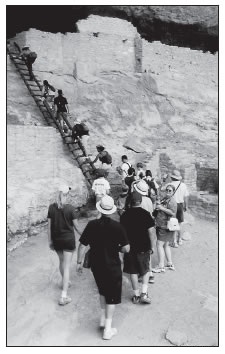
Southwest Open Charter School Director Judy Hite takes visitors on a tour of the campus, which consists of modular, pre-fab buildings dating back to 1973. The school has received a $7.4 million state grant for a revamp, but it is contingent on a bond proposal passing Nov. 1. Photo by Wendy Mimiaga

Some of the school’s prefab buildings date back to 1973. One double-wide has a hole in the skirting and is splitting at the top as well as along the floor seam. The ceiling was slowly collapsing, so new boards had to be nailed in.

“We put metal on most of the roofs, but you can only do so much when they start splitting,” Hite said. “It’s not like we haven’t tried to keep them repaired.”

Most of the buildings leak, she said, and in two or three, water drips through the light fixtures when it rains. For obvious safety reasons, the lights have to be turned off at those times.

Some rooms smell because of moisture and the occasional animal carcass trapped beneath the structure. “In my office you can see mold everywhere, all over the ceiling,” Hite said.

Faulty electrical wiring has sparked a couple of small fires.

There is no running water in any of the classrooms. There are bathrooms in just two buildings.

A yurt, built a dozen years ago, serves as an art space. “It’s not the safest building, obviously,” she said.

And the heating system is outdated. “The furnaces are so old you can’t get parts for them,” Hite added. “And you don’t want to put a $5,000 heat system on a piece of junk.”

Hite said there is no sense of permanence to the campus.

“When I first came here I had nightmares about coming to school and finding everything gone. I realized it’s because nothing here has a foundation.”

But there may be a light at the end of the tunnel. This summer, SWOS received a $7.4 million grant from the Colorado Department of Education’s Building Excellent Schools Today program.

One of the chosen few

The BEST grants are extremely competitive and difficult to get, as there are always far more requests than money to fill them.

This year, 11 lease-purchase grants for major construction were awarded, along with 25 cash grants for smaller projects. The group awarded $142 million in state funds, but a total of $372 million had been requested by the more than 70 applicants.

At the several-day meeting of the state Capital Construction Assistance Board in Denver in June, the board originally put the SWOS request at No. 12 on its list, meaning it would not have received one of the 11 grants. At the last minute, one of those was switched to a cash grant, Hite said, and SWOS made the cut.

“I was so excited,” she said.

District Re-1 had sought a $39 million grant at the same time to do major renovations to several of its schools, but this proposal was rejected.

The catch for SWOS is that the school must obtain $3.4 million in matching funds. If it fails to do so, five alternates were named for the grants.

SWOS received approval from the district school board to put a question on the Nov. 1 ballot seeking voter approval of the $3.4 million bond to go with the BEST grant, which would be repaid over a maximum of 20 years. It would increase the local mill levy by 0.521 mills and would add approximately $4.15 to the annual property tax on a $100,000 home.

If the measure passes, SWOS will launch a $10.5 million revamp of the campus, replacing all the temporary buildings with eight stick-built, permanent quads. The total square footage of the buildings would go from 11,000 to 37,000, most of that coming from a multi-purpose gymnasium that could be used by the community afterhours. “I believe in using buildings 24/7,” Hite said. The school currently has no gym or recreational facilities.

Eager for school

SWOS began in 1986 as a place where teen parents and drop-outs could receive an education.

“Unfortunately, it’s kept that reputation,” Hite said. “But maybe that’s good in a way. Sometimes I say we’re the best-kept secrets in Montezuma County. Parents say, ‘My kid is getting me up and wanting to come to school. He never did that before.’”

Today, any student who asks to come to SWOS will be accepted, as long as there is room. The school takes students who have been expelled from Montezuma-Cortez High School along with others who just feel out of place at MCHS or are having a difficult time there.

At SWOS they receive a more-flexible, hands-on, exploration-based learning experience, but one that still meets all state curriculum requirements and offers a traditional high-school diploma.

“It’s not just somebody telling them what to do, it’s somebody showing them,” Hite said.

Kids feel safe at SWOS, she said. “They don’t have to watch their back. If you fight here, you’re gone forever, expelled. And students say we don’t have cliques. People hang out together but you move from group to group, that’s what the kids say.”

When they first arrive at the school students must take a course called “SWOS-ology,” which includes sections on anger management, team-building, conflict resolution and self-advocacy.

“The kids take responsibility for their own behavior and their own learning,” said Hite. “We’re totally getting them ready for the real world. When they leave here, they should be ready to deal with anything that comes in life.

“We want them to not have a victim mentality. We want them to be able to take care of themselves and other people. We want them to be taxpayers, to give back to the community.”

The students already give back to the community through an after-school philanthropy course in which they raise money and donate it to such groups as the Bridge Emergency Shelter, Cortez Animal Shelter and Make-a- Wish Foundation out of Colorado Springs. The class has raised and distributed almost $40,000 over six years, Hite said.

Getting by

The school’s students and staff are used to finding creative ways to get by with very little.

When students wanted more shade on the largely tree-less campus, they constructed benches and small shade structures themselves.

“We never have any graffiti,” she said. “Our kids are so respectful of our school. Our kids really monitor each other.”

The school started with two small buildings and has grown by bits and pieces. When one old trailer was scorched by a fire several years ago, it was salvaged and turned into an equipment shed, but the school needed another building.

“We were out of room,” Hite said. “We didn’t want to go into debt – we’ve never had debt here. I saw a notice in the paper that said a triple-wide modular was for sale for $20,000.”

The triple-wide had been used during construction of the Animas-La Plata Project and was in three pieces in the middle of a field. She was dismayed, but talked the owner into selling it for a small sum. SWOS found a base for it and two of the school’s staff members remodeled it. “Now it’s nice and we’re going to keep it,” she said.

When she first came to SWOS, the kids were eating lunch outside, even in the winter. Now hot lunches are brought in from Manaugh Elementary and served indoors. Hite hopes to be able to have lunches cooked on-site in the new facilities.

One building known as La Casa, which was an on-site day-care facility for 19 years until that program had to be shut down, was constructed by students at the San Juan Vocational Technical School. It now houses a small health clinic that serves all the Re-1 schools, attended by two nurse practitioners, where students can be examined for minor ailments, even tested for things such as strep throat. Courses are offered in health topics such as substance abuse. “It takes seven grants to keep this going,” Hite said.

A rare chance

Hite believes the time is right for the campus to be expanded and improved. Interest rates are at all-time lows, enabling the bond to be paid off cheaply, and the BEST grant offers a rare opportunity to have most of the improvements paid by the state.

“We can reapply but there is no guarantee we could get it again,” she said.

The BEST program, which is funded by school trust lands and lottery revenues, reportedly will be giving substantial grants for only another year or two. After that most of the BEST monies will have to be allocated to paying off previously approved projects, according to Education News Colorado.

Published in October 2011

Community steps up to help RE-1 teachers

Related stories

Teachers in Montezuma-Cortez School District Re-1 have gone without pay raises for four years, have had to take two furlough days this year, and are buying more and more classroom supplies out of their own pockets.

But a Cortez woman is spearheading an effort to take a little of the financial pressure off educators.

Last spring, Judy Schuenemeyer launched Montezuma County Loves Its Kids and Teachers, an informal project to find donors to provide supplies and funding for specific needs.

Schuenemeyer and her husband, Jack, know a number of teachers and decided it wasn’t fair that they were shouldering so much of the burden of the school district’s budget woes. “Our teachers aren’t that well-paid compared to the rest of the state and country to begin with,” Schuenemeyer said.

“This community is generous when they know there’s a good cause and there’s something they can do that’s specific. The response has been tremendous.”

After clearing her project with the school board and administration, she met with principals and handed out a form on which teachers could list their classroom needs and wishes. So far close to 40 teachers have responded.

Schuenemeyer thought that church groups and businesses would then step up to help fulfill those needs, which they did in droves. What she hadn’t anticipated was that a number of individuals would come forward as well.

Educators’ requests have included supplies such as notebooks, composition books, scissors, pencils, paper and binders. One teacher is seeking funds to take his kids on a field trip to Mesa Verde and to the La Plata Mountains to study geology and minerals. Others have asked for nutritious snacks for children. Some elementary-school teachers are seeking volunteers to help kids one-on-one with reading.

Matt Keefauver, a fourth-grade teacher at Kemper, said Schuenemeyer’s effort is “a perfect example” of how the c ommu n i t y can step forward to help schools. “I have things now that I didn’t have before, like pencil-top erasers that I didn’t have to buy out of my own pocket,” he said.

Re-1 Superintendent Stacy Houser said the project is a boon but not a solution to the funding problem.

“Judy’s effort has been to offset some of the impact from the lessening of the supply budget and that has really helped a lot and we’re grateful to the community, but it’s not a remedy,” he said.

Schuenemeyer agreed, saying the funding situation is “awful.”

She noted that the last new school built in the district was the high school, in the 1960s, although there have been improvements to the middle school.

“People before us weren’t rich – this has never been a rich community – but they made sacrifices to get schools built,” she said.

“Somebody paid for all of us to go to school. We have to invest in schools for the future.

“In the meantime, we need to help the teachers and the kids with what we can.”

Published in October 2011 Tagged

Bluff Arts Fest focuses on storytelling

Southwest author Craig Childs will be among the gathering’s notables

Every year, on a chilly January day, somebody wandering into the Bluff, Utah, post office will find a sign-up sheet. Planning has already begun for Bluff Arts Festival, an annual autumn event that spreads across town, draws between 200 and 300 visitors, and fills area motels.

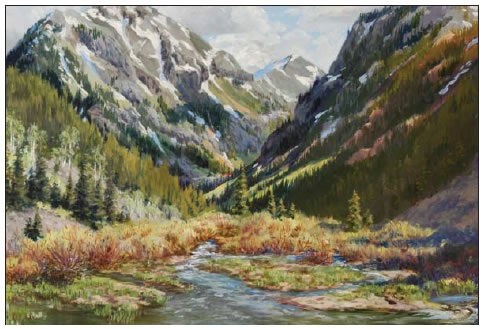
EILEEN FJERSTAD PAINTED LANDSCAPE

Eileen Fjerstad of Southwest Colorado, whose work includes this landscape, will offer a workshop called “Painting the Landscape Oil en Plein Aire” as part of the Bluff Arts Festival Oct. 21-23.

“We want to encourage arts in the community,” says Tina Krutsky, co-director of this year’s festival, which takes place Oct. 21-23. “We want to support not just artists in town, but artists from the surrounding communities, including the Ute and the Navajo.”

The 2011 festival features a variety of prominent writers and artists, including authors Craig Childs (“House of Rain”) and Kate Niles (“The Basket Maker,” “The Book of John”). There will be workshops, storytelling sessions, and art walks.

Organizing the annual festival in the tiny, scenic town takes months and months of planning.

Soon after the sign-up sheet fills, the Arts Festival Committee convenes. It selects a theme for the weekend, this year’s being “Storytelling Through the Arts.” A call goes out for a featured artist. A graphic designer develops a festival brochure. Someone begins overseeing the website. Other volunteers find artists to lead workshops for adults or kids who want to try their hand at anything from drawing to dancing and weaving.

A prospectus goes out to locals who would like their studios to be on the Trail of Artists art walk each afternoon of the festival, so visitors can meander in and see their work. Inns and local businesses join the Trail of Artists.

Artists from around the region receive invitations to participate in the Saturday Arts Fair at St. Christopher’s Episcopal Mission outside of town.

The Friday Night Film Festival and the Saturday Night Gala take shape. The grant writers get busy. Rocky Mountain Power, local businesses, the Utah Arts Council, San Juan County Economic Development, and the Utah Humanities Council support the Bluff Arts Festival. Artists pay nothing for booths at the Arts Fair, and most workshops are free to the public, though occasionally participants pay a materials fee.

“We really try to make [the festival] accessible for artists and the community,” says Krutsky.

By the time programs, workshops and art events fall into place, the July sun heats the red rocks that surround Bluff. The detailed planning begins. Workshop leaders need housing. Someone must find volunteers to do everything from greeting artists, to setting up booths, to collecting trash.

“I realized we need more [people] than we had last year,” Krutsky laughs. “Live and learn.”

She got involved in the Bluff Arts Festival when she moved into town and wanted to be useful and make friends. She has done both, and met artists whom she would have met no other way. “Identifying people’s strengths and building on them, if you can make it happen, is very satisfying,” she says.

The Bluff Arts Festival has been going for seven years. A former vicar at St. Christopher’s Mission started the festival, focusing on writing and dance. The event grew to include other performing and visual arts. The film festival is the newest addition.

The present mission vicar, Red Stevens, and his partner, Willie Hulce, coordinate the arts fair. The open-ended event has no jurying process. Artists in all media and of all backgrounds can participate. So far, this year’s group includes silversmiths, weavers, sculptures, jewelers, pictorial artists, and gourd artists.

As well, workshops offer visitors a chance to experiment with a variety of media. “Bluffoon” (as locals call themselves) Kyle Bauman will show people how to make willow weavings, and encourage them to weave stories as they work.

Bluff jewelry artist Amanda Bouchard will encourage everyone aged 4 and up to make bead pins, necklaces, or bracelets to decorate their laughing spirits. Archaeologist Ben Bellorado will lead a hike to show how native people used rock art to tell stories.

Local oil painter Eileen Fjerstad will offer “Painting the Landscape Oil en Plein Aire.” She will also participate in the Trail of Artists. Writer Niles of Durango, Colo., will encourage participants in her workshop to use the extraordinary setting around Bluff as inspiration. Participants in Niles’ class can draw further ideas from the Ute and Navajo cultures, and archaeological sites. “I look out my window at the red rocks,” says Krutsky. “All I have to do is walk around a little and I find petroglyphs and pictographs practically in my own backyard.”

Bluff Arts Festival evening events also center on storytelling. Thursday night, Bluff Yarn Spinners will tell Stories in the Dark, followed by fireworks. Friday night, local film-makers, including school children, will present their perspectives on the Bluff community in the Second Film Festival.

“Saturday night’s desert potluck and silent art auction is my favorite event of the weekend,” says Krutsky.

Dancer Amy Becenti, who grew up in Bluff, will perform her Diné Cabaret Belly Dance, which she describes as Warrior Humming Bird telling the story of life, and how to live it joyously and fearlessly in the service of nature’s bounty,

Diné composer Juanito Becenti will perform, and nationally known Colorado writer Childs, whose most recent book is “Finders Keepers: A Tale of Archaeological Plunder and Obsession,” will discuss the natural sciences, journeys into the wilderness, and archaeology.

“It’s going to be one big party,” chuckles Krutsky.

When the Bluff Arts Festival is over, the festival committee will write up grant reports, take a couple of months off and start work on the 2012 event.

Krutsky isn’t sure she’ll continue as co-director. “There’s a lot going on in Bluff. Nobody on this year’s committee was involved two years ago.”

But she is considering taking a piece of the work to do. “We really need a grant writer,” she muses.


Published in Arts & Entertainment, October 2011 Tagged

The digital tree

When Amazon announced it currently sells more Kindle electronic book downloads than it does traditional hardbacks and paperbacks combined, I got to wondering, What do people do with all the electronic books they’ve read? It turns out that technically (and legally), people can do nothing with their consumed tomes except stack them on a theoretical and eternally expanding electronic bookshelf, which never needs to be dusted. Though they bought the book, they don’t actually own it. Their purchase only leases the rights to read and reread the material.

So it turns out the e-book doesn’t fall very far from the digital tree.

Recently at a thrift store I leaned against a physical set of shelving while I considered the purchase of an old-fashioned book. I cradled the binding in one hand and flipped a few pages. The background had slightly yellowed but it was bright enough to read without readjusting or recharging. If not, I could simply step closer to a window. If I didn’t like the story, I could give it to a friend or donate it to another thrift store where somebody with more eclectic taste than mine was bound to (don’t think Facebook) like it.

Here was a concept on the verge of being buried: A product that didn’t come with a service trail.

While I browsed the bookshelves, a tween stepped into the aisle with his little sister in tow. They stopped to stare at the wall of VHS films the store displayed. There were literally hundreds. “These are movies,” the brother explained.

DVD technology has apparently prompted the same kind of readjustment among these young movie fans that Kindle has foisted off on me, a change in format, complete with the claim that our lives will be more sophisticated. The girl looked up at her big brother with an obvious sense of awe.

“I want to see this one,” she insisted, pulling a video off the shelf.

“You can’t see that one, it would give you nightmares,” he explained.

“Why?”

“It’s a Stephen King.”

“I seen a Stephen King before.” “No, you haven’t, mom and dad wouldn’t let you.”

“They don’t let you either.”

“I’m older.”

“When will I be older?”

“Maybe when you’re as tall as me.”

“I’m almost that tall.”

“But you’re not tall enough for Stephen King.”

“How tall is he?”

“It doesn’t matter, he’s just more sophisticated.”

“What’s sophisticated?”

“He can read.”

“I can read.”

“No, you can’t.”

“I can too.”

“Find a different movie, I’ll be over there looking for a book.”

“What are you going to read?”

“Somebody told me Stephen King writes books too.”

As the boy passed by me, scanning the wall of books, I reached up and pulled a copy of “The Stand” off a shelf. “Here you go, kid, an ancient pre-movie incarnation of Stephen King.”

“Thanks,” he said, scrutinizing the cover art.

He’d never have spotted the book, way up there on a top shelf. Only then did I realize I had picked a piece of non-digital fruit, and downloaded it in the most original way.

David Feela writes from Montezuma County, Colo.

Published in David Feela

Seeds of confusion

Recently we have found ourselves in a predicament concerning seeds. For our conundrum to make any sense, an understanding of seeds — where they come from, how they are developed, discovered, propagated, and preserved — is called for now, on this occasion.

Seeds occupy a unique position for us as living beings. They are the absolute potential of life upon which our lives depend. A seed is trial and error performed again and again. Seeds are information stored for that which is possible in drought or in rain, temperate weather, hard spring frosts.

Seeds are living histories of people; with them we evolve. We depend upon them as they depend upon us.

As a people we have changed. No longer are we Jefferson’s Agrarian Republic. Citizenship and farming are noble truths deeply rooted upon the foundation of sweat and toil, experience sublime, but labor is effort and it is time spent in the act that time itself controls. And who among us has the time? Token effort and an allegiance to trends are a simpler path than the self-determination of innovation.

The drawback of this convenience, of our ability to wash from our hands the dirt of our substance, is the deep rut of ignorance regarding what we eat and from where it comes. There is danger in this; it is surrender. To proxy food is to proxy life lock, stock, and barrel.

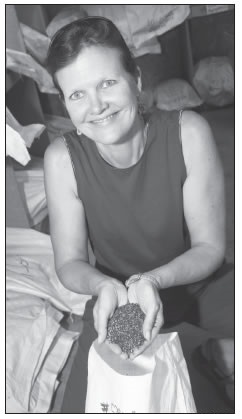
I remember a woman in our shop buying seeds. She wished to be reassured that we would not sell her any of those “genetically modified hybrid seeds”. Her fear was of something that she did not know; such is the nature of fear. This woman with short-cropped graying hair was in earnest about gaining control of the most basic functions of her life, and for that right to eat she was willing to engage in the most revolutionary of all human behavior: to grow your own food, to sustain yourself. But she did not know seeds; most people don’t.

Look through seed catalogs, read seed packages. There are terms in common usage, though rarely understood: F1 & F2 hybrid, Genetically Modified Seed, Heirloom, open pollinated seed. Here I offer a basic explanation.

Heirloom seeds are seeds with stories: Olga’s Round Yellow Chicken, June Pink, Radiator Charlie’s Mortgage Lifter, Zuni Gold, San Juan Pinto, Pink Eye, Pink Banana Jumbo Squash, Wando, Green Arrow, Moon and Stars, Marglobe, King Banquet. These are seeds that have been passed down from hand to hand, generation to generation. They are open-pollinated seeds. They can breed a true reproduction of themselves from seed. Here is the reason why.

Plants have parts — male and female parts. Some plants, like humans, have separate, individual males and females — spinach and mulberries come to mind. Most plants have both male and female parts; they are hermaphrodites. They produce both the male pollen and the female egg. Some of these plants are called in-breeders or self-pollinating. The flower of an in-breeding plant is arranged in such a way that the stigma of the pistil usually becomes receptive and pollinated before the flower opens, thus preventing cross-pollination from other plants.

Peas, beans, lettuce, most tomatoes, McElmo peaches, and coffea arabica are all self-pollinating or in-breeding plants. Because their pollen rarely crosses, they are the easiest seeds to save. Seeds from just a few plants contain all the genetics needed to keep the line vibrant generation after generation.

Some plants have self-incompatibility issues; the male finishes blowing its pollen before the female has even blossomed, preventing self-pollination, so another plant will have to do. Or they can be pollinated by another flower from the same plant.

These plants are called out-breeders. They cross-pollinate. To save these seeds you need to hand-pollinate each plant specifically, or be able to isolate fields of these crops from similar varieties. By saving the seed from 20 different watermelon plants you capture the genetic variations of that type of watermelon. To maintain the genetic diversity of a corn strain you would need to save the seed from at least 100 different corn plants, but a thousand would be much better.

New varieties of open-pollinated plants are rarely developed commercially; there is not much money in seeds that can be saved. Most new plants are hybrids, a cross between two different but similar plants.

F1 (first filial) hybrids refer to plants whose seeds came from a cross between two different pure-breeding varieties of a closely related plant. Here is an example. If I had a big late-season tomato and a small early tomato I could cross-pollinate them with the hope of getting a big early tomato. If that worked then the seeds produced by that cross would be an F1 hybrid. I would have to continually cross those two parent varieties to produce future F1 seeds.

Now if I were to take the seeds of those F1 tomatoes and plant them, the F2 generation, then this is what I would find: 3/4ths of them would be big tomatoes (T) and 1/4th would be small (t), though not all of the big tomatoes would be early.  I could describe it as a  (TT + Tt + Tt +  tt). If I followed this through another generation or two (F3, F4) I could cull out all of the non-early (TT) and small (tt) plants, leaving only the big early tomatoes (Tt). These should now be in-breeding open-pollinated seeds for a big juicy early tomato.

The latest, and most controversial, form of seed development comes in the form of genetically modified organisms and the seeds derived from them. GMOs occur in laboratories where scientists add, change, or remove specific plant genes. GMOs have the ability to reshape the plant world. For some they hold promise; to others they bring fear. They are created by companies large enough to bribe any president from either political party. They can make any state Ag Commissioner dance at will.

For some farmers they have great appeal in their increased yields and decreased need for costly herbicides and pesticides. It has been harder to convince consumers that a potato that is labeled as a pesticide is safe to eat. The ethical questions surrounding these crops have churned guts. Farmers that were saving their own seed of open-pollinated or traditionally bred hybrid corn face prosecution not because they planted GMO corn seed but because their neighbors’ corn crossed their own crop on their own farm. Private property rights recede before corporate will. Seed savers have been financially ruined.

The other side of GMOs is their potential to help people. Much of our planet’s population is dependent on bananas as a food crop. A blight is killing banana trees. A GMO banana might solve this problem by removing the gene that is blight-susceptible. This could be done through traditional plant breeding, but that takes time. If your children were starving and a banana could feed them would you care if it was a GMO?

Part of the problem with GMOs is that nature is deviant. Like reanimating the tissue of Frankenstein, it is impossible to know how the monster will react to chance circumstance (remember Mel Brooks’  blind monk inadvertently lighting the monster’s thumb on fire?).

Remember these points. Heirloom seeds are open-pollinated, easy to save, true to type from seed. They have almost no monetary value. They have survived because they are exceptional varieties, proven over time.

Most new plant varieties are hybrids developed for specific commercial requirements — “the light-year tomato” able to be shipped fresh across space. Most new hybrids are patented. They will not reproduce true to type again from seed in future generations (unless you know Mendel’s Laws of Genetics).

GMOs are made in laboratories. They have enormous financial resources behind them to lobby and litigate.

If what I have told you makes sense then what I am going to tell you next should matter.

Jude Schuenemeyer is co-owner of Let It Grow Nursery and Garden Café in Cortez, Colo.

Published in Jude Schuenemeyer

Don’t take water for granted

How can a person taking an oath to protect his country oppose regulations that stop the contamination of our lifeblood?

I refer, of course, to water, the umbilical cord that sustains life on this planet. There are people who have already realized the value of this commodity. If you don’t think those who have power over water aren’t in total control, let me relate an experience I had in Arizona in my younger days.

A friend of mine purchased a 6,000-acre ranch just outside of Wickenburg. No one had worked it for years. The contract called for 60 to 80 head of cattle, but they were wild as deer.

To try to gather them we rode two to three hours at different times each day. After many futile attempts to gather them, we covered four of the five watering holes on the place and built a corral around the other, then sat back and waited.

In about four days we heard them coming. They stopped when they saw the corral but thirst got the best of them and in a short time they docilely walked right in. They had the instincts and knowledge to survive in that harsh area for years. They had fear and cunning, but thirst overcame both, and they soon rested on a toasted bun at McDonald’s.

If one can control a thousandpound wild animal through water, how long do you think a person can hold out against thirst? A diamond may have a false value, but one would gladly give a bag of stones for a soothing drink of cool water. If you think we are controlled now by our appetite for fossil fuels, think what will come about when a few corporations purchase all the water rights.

Can’t happen? Ask the people in Owens Valley, Calif. Power and control in the hands of a few has been the downfall of a number of countries and societies.

“The Ripple Effect: The Fate of Freshwater in the Twenty-First Century,” a book by Alex Prud’homme available at our local library, is a great read. Here are some facts garnered from that book: As of the year 2000 some 1.2 billion people in the world lacked safe drinking water. By 2025, 16 years hence, that number is projected to be 3.4 billion. Oh, but that is other people’s problem! But in our country between 2004 and 2009 the Clean Water Act was violated some 506,000 times by more than 23,000 companies and other facilities.

Federal agencies have set maximum safe amounts for 91 chemicals in water supplies. An Environmental Working Group study found excessive limits of 49 of these chemicals in drinking-water supplies for approximately 53.6 million of our fellow Americans. Gulp! The above information was lifted from just 10 pages of the book. And it gets worse by the page.

The human race has a lot of cleaning-up to do if we are to survive. Even with all the regulations and regulatory groups we are still drinking dirty water and some in Washington demand that we do away with these supposedly “job-killing” safeguards. Aren’t the people doing the testing and relaying the information employees? Aren’t those jobs?

More jobs could be made when we hire people to clean up this life-sustaining fluid. Can’t even make beer or martinis without it. And you can’t raise vegetables or livestock without it. We in Montezuma County who have water rarely give a thought to many here who haul water and through cost and necessity learn to conserve. In that respect we are somewhat like a Third World nation. The only difference is we truck it instead of carrying it on our heads.

When I was a youngster in Minnesota I carried water in five-gallon buckets from a shallow well to the house for household use and of course to our animals, locked in the barn from October to sometimes the 1st of May. We didn’t have running water in the house till I got back from Korea in 1952. It is amazing that we take for granted so scare and precious a commodity.

We have a selfish group in Washington who almost ruined this country by raving about debt. We have always left the next generation some sort of debt but that can be paid through perseverance. A more important issue is, are we going to leave them access to reasonably priced clean, unpolluted life-sustaining water? Without that, all other problems are null and void.

Galen Larson writes from Montezuma CountyColo.

Published in Galen Larson

Wicked good: Colorado author recounts true tales from the Wild, Wild West

One June day in 1912, gunfire rattled Ophir, Colo. When the roar subsided, “twenty-five-year-old Charles Turner lay in the dirt by the railroad tracks, blood pouring from his mouth, and a hole in his chest.”

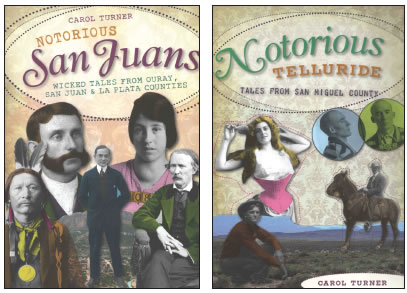
Ninety-eight years later, his grand-niece, Carol Turner, published his story, which she called “Death by Gold Fever,” in her book “Notorious Telluride: Tales from San Miguel County,” published by the History Press.

CAROL TURNERS' WILD WEST BOOKS“I am interested in all those wonderful, exciting, juicy stories from the past,“ the Denver-area writer laughs.

With a bachelor’s degree in English from Sonoma University, and a master’s degree in creative writing and literature from Bennington College, she considers herself a writer, not a historian, who got “sucked into writing about the past” by Charlie’s story.

He came from Montreal to Denver with his family in 1885 at age 5. His father died, leaving Charlie’s mother, Agnes, alone with several children.

“Death by Gold Fever” describes her struggle to raise them with income from property in Montreal, wages earned by her older boys, and help from her brothers, who mined on Yellow Mountain in Telluride.

Eventually, the Yellow Mountain property passed to Agnes and one brother, who worked it with a partner, Frank Ensign. By the time Charlie grew up, Ensign controlled the entire holding.

As far as Carol Turner knows, Ensign had a good reputation, and came by the land honestly. But Charlie believed the family “had been ripped off ” and though unarmed, attacked Ensign, who shot him with a 32-caliber rifle.

Turner decided to learn why Charlie started the altercation. Newspapers in Telluride told her nothing. One called him a bully; another reported him to be a nice person. Turner believes Charlie’s reaction came from watching his mother mismanage the family money. For Turner, Charlie’s story shows that “life was rough and cheap” on the frontier.

As she researched Charlie, she came across tales from Ouray, Durango, Silverton, and Pagosa Springs, in the Colorado Historic Newspaper Database, as well as her own memory. Her mining-engineer father had searched for the old Catbird Mine in Telluride, and worked the Eureka Mine in Boulder Canyon.

“I grew up [in Boulder] right around the corner from riches,” she laughs.

The History Press limited her to 35,000 words per book, so when “Notorious Telluride” reached the limit, she wrote “Notorious San Juans: Wicked Tales from Ouray, San Juan and La Plata Counties.”

Her favorite story in this collection, “Death of the Secret Service Man,” occurred in 1907 when the Secret Service’s main job entailed catching counterfeiters.

However, agents had also begun investigating fraudulent homestead claims. Because the government limited where mining companies could purchase property, and charged for mineral rights, speculators bought land from farmers, evading fees and restrictions.

So on Sunday, Nov. 3, 1907, while Secret Service agent Joseph Walker stood guard above ground, two government contractors and two Secret Service agents descended by rope into an air shaft on a farm, and found themselves in the Hesperus Coal Mine near Durango, Colo. After exploration, they returned to the shaft to find their rope cut and brush blocking their escape. Shouts for help to Walker brought no response.

One of the contractors scrambled up the rock and reattached the rope. When everyone climbed out of the hole, they found Walker sprawled on his back, riddled with bullet holes.

Secret Service men from Washington, D.C., and Denver poured into Durango. Police arrested two men who claimed they had shot Walker in self-defense. They went to trial.

“I won’t tell you what happened,” laughs Turner. “But I can tell you it had far-reaching implications.”

Those included the founding of the FBI and (because Joseph Walker’s widow had no death benefits) the establishment of a pension for Secret Service wives.

“It was a pretty wild history, and justice was hit-ormiss,” Turner muses. Defendants often had stronger cases than the prosecution. Short prison sentences resulted in citizen mobs lynching crooks. People operated on both sides of the law, trying to survive.

Turner did most of the research for “Notorious Telluride” and “Notorious San Juans” on the internet. Piecing her stories together from her sources, she found as much misinformation as accurate accounts. She acknowledged the disparities by pointing out places where the tales got murky, or where newspaper articles disagreed. “I found stories where the newspaper reporters obviously just made something up. There’s a story like that in my Telluride book.”

The tale describes a stagecoach robbery. Right after the incident, the papers reported that a bandit shaking with fright had stopped a slow-moving stage. Fearful that the man’s guns would go off accidentally and kill someone, the half-dozen male passengers gave him some odds and ends and sent him shuddering away.

A year later, in a second version of the story, the bandit, a gun in each hand, stopped a stage coming full speed down a hill by grabbing the bridle of one of the lead horses. Women passengers screamed in terror.

“I would like to have seen that,” Turner laughs. “The newspaper reporters were as wild as the [desperadoes].”

Besides “NotoriousTelluride” and “Notorious San Juans,” Turner has written “Notorious Jefferson County: Frontier Mayhem and Murder,” and “The Forgotten Heroes and Villains of Sand Creek,” published by the History Press.

“I consider myself like my father, who was gold-mining. I’m tidbit-mining. It’s wonderful. So much fun.”

Published in Arts & Entertainment, September 2011

Warmer temperatures may hurt trout, help native fish

Climate change could deal a crippling blow to Western trout populations by heating up their coldwater streams, according to a new study — but those same warmer waters could actually help endangered fish like the native humpback chub.

The study, published last month in the peer-reviewed journal Proceedings of the NationalAcademy of Sciences, uses data from nearly 10,000 fish surveys across the interior West, along with climate models, to try to predict the responses of native cutthroat trout, non-native brook trout, brown trout and rainbow trout to climate change.

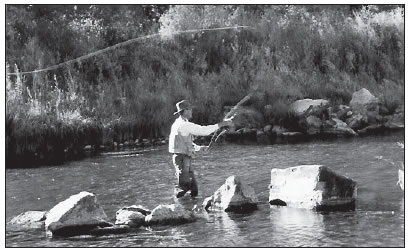
FISHERMAN ON THE DOLORES RIVER

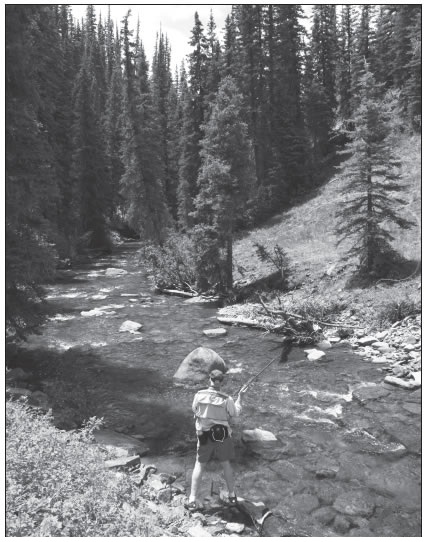
A fly fisherman tries his luck in the Dolores River. A new study says climate change could affect both trout and native-fish species. Photo by Wendy Mimiaga

Lead author Seth Wenger, a fisheries biologist with Trout Unlimited in Boise, Idaho, and his colleagues report that one of their analyses predicts a 47 percent decline in total suitable habitat for all trout.

“We project that native cutthroat trout, already excluded from much of its range by nonnative species, will lose a further 58 percent of habitat due to higher temperatures and competition with other species,” they write.

“Habitat for nonnative brook trout and brown trout is predicted to decline by 77 percent and 48 percent, respectively, driven by increases in temperature and winter flood frequency caused by warmer, rainier winters.”

According to the study, habitat for rainbow trout will decline the least, only 35 percent, because harmful temperature effects would be partly offset by higher winter river flows that benefit the species.

Some models predicted more warming than others, but under even the most optimistic model, native cutthroat-trout populations in the West could decline by 33 percent, the study found.

Cutthroat-trout populations are already in trouble, according to a statement released by the sportsmen’s conservation group Trout Unlimited — some subspecies have been removed from 90 percent of their historic native range and are listed under the Endangered Species Act.

Early warning

The study’s authors say large declines in trout habitat are likely, but with the early warning from research like theirs, management efforts could be targeted toward key habitats where trout could hang on.

Some such work is already under way. Matthew Clark, the Cortez-based backcountry coordinator for Trout Unlimited’s Sportsmen’s Conservation Project, said his group is working to analyze the upper Dolores watershed to determine the most pressing needs for habitat restoration and protection.

The local Trout Unlimited subchapter, the Dolores River Anglers, is also installing fish barriers and restoring tributaries to the Dolores that contain genetically pure strains of native cutthroat trout.

“This is important because cutthroat trout can hybridize with rainbow trout, so it is critical to protect genetically intact populations when they are identified, especially in light of the much-reduced range that they currently inhabit,” Clark said.

Mixed bag

Temperature increases by themselves are likely to play a dominant role in future declines of cutthroat trout, brook trout and rainbow trout. But the likely impacts from climate change reach beyond warmer waters, the study authors point out.

Different species are likely to have different responses to flow-regime changes, for example. Fall-spawning trout like brown and brook trout are sensitive to winter floods; the study predicts that if warmer and rainier winters increase flows in that season, those populations will suffer the most. Spring-spawning cutthroat and rainbow trout may actually benefit from higher winter flows, because high water in summer can scour their eggs from gravel nests or wash away young fry. Furthermore, many native trout are threatened by invasions of introduced trout species; brown trout have displaced native trout in much of North America.

Silver lining

The predictions in the study might not be all bad for warmwater natives like the endangered humpback chub. In some parts of their range, such as the Colorado River below Glen Canyon Dam, introduced rainbow trout are predators that hamper recovery efforts.

But Dan Luecke, a Boulder, Colo.-based expert in endangered Colorado River Basin fish recovery, says trout are coldwater species and are found in the upstream reaches of rivers, whereas the Southwest’s endangered fish generally are warmwater species in downstream reaches.

The non-native threats to the native fish tend to be smallmouth bass, catfish, northern pike, sunfish, and other warmwater species that are found in the same reaches as the natives, he said. One interpretation of the new study, he suggests, “is that as the coldwater habitat of the trout shrinks, the warmwater habitat of the listed natives will increase.”

Clark adds that on balance, “Native coldand warm-water species have co-existed across the natural temperature gradient in our Western streams and rivers for millennia. It is ultimately a question of protecting native fish, both cold- and warmwater-dwelling, not a question of trout vs. warmwater natives.”

He said the tailwater fishery below McPhee Reservoir includes an area of overlap between the warm- and coldwater reaches of river, which would be potentially suitable habitat for trout and warmwater species. But it’s a relatively small percentage of the river from McPhee to its confluence with the Colorado.

“Additionally, there are very small numbers of trout that inhabit that zone of overlap,” he said, adding that a much-greater concern is the establishment of invasive, fish-eating smallmouth bass in the lower Dolores that have the potential to share the entire warmwater reach with the native fish.

“Even though the impact of the trout fishery below McPhee is relatively quite small,” he adds, “TU is committed to exploring ways to ensure that the impact is minimized even further while still maintaining a high-quality trout fishery in the coldwater reach below the dam that is unsuitable as warmwater native fish habitat.”

Conservation mandate?

Wenger, the lead author, and Trout Unlimited have been quick to use the study results as a call to action. They point out that by restoring and reconnecting coldwater drainages and by protecting existing healthy habitat largely located on public lands in the West, some of the decline in trout populations can likely be avoided.

“Essentially, Trout Unlimited is already protecting remaining strongholds and restoring degraded habitat — exactly the kind of things that need to be done to reduce the impact of a changing climate on coldwater fisheries in the West,” Wenger said.

“This study validates the work TU is doing in the West and all across the country to protect, reconnect, restore, and sustain trout habitat,” added Chris Wood, Trout Unlimited’s president and CEO.

“It also reinforces the danger in congressional proposals that would remove protection from backcountry roadless areas and cut funding for state and federal natural resource agencies.”

Published in September 2011

The long, hot summer: Drought hits parts of the region


Montezuma County is feeling the heat, with more than half of the days in August hitting the 90-degree mark and less rain falling on thirsty crops.

Last month, the U.S. Department of Agriculture declared farmers here eligible for certain loan relief because of the county’s proximity to drought-hammered parts of Arizona. Also eligible for the relief are both New Mexico and Utah’s San Juan counties, as well as other counties in both states. Shared borders can equal shared woes — it is hot and dry in the Four Corners.

STORM CLOUDS ABOVE THE SLEEPING UTE MOUNTAIN

Storm clouds gather over the Sleeping Ute Mountain as seen from near Aneth, Utah, in late August. Many storms missed Cortez during the normal monsoon time. Photo by Gail Binkly

As to Cortez, though, the word from National Weather Service is mixed: Month-tomonth since the current water year began last October, Cortez has swung between below- normal precip to well above, then back again, especially in June, which saw only 0.01 inches, compared to the average of 0.54.

As of Aug. 24, the Cortez area had received 5.03 inches of water for the year, according to local weather observer Jim Andrus. The average moisture for the year on that date is 8.72 inches, leaving 2011 at 43 percent of normal.

Throughout the usual monsoon season in late July and August, Cortez residents saw plenty of clouds but only spatters of rain. “It’s been a drier monsoon season for us,” Andrus said. “We’ve got the monsoonal humidity, but it’s a question of where storms will unload the rainfall when they do arrive. A lot of storms have been missing Cortez.

It’s like throwing a deck of cards into the air. You don’t know where the cards are going to land on the ground.”

Dust Bowl days

A strong La Niña weather pattern is driving storms north, said meteorologist Jim Pringle of the National Weather Service in Grand Junction. While La Niña has left Cortez a bit more arid than usual, she’s brought near-scorched earth in Texas, most of which is considered to be under “exceptional” drought conditions.

“It’s really bad for them,” Andrus said. “It’s been about the worst for them since the Dust Bowl days of the 1930s.”

Parts of Arizona, Utah and New Mexico are also in drought. In Clovis, N.M., the lack of rain has led to a lack of feed for livestock. The Associated Press reported Aug. 15 that livestock sales there have nearly tripled. Ranchers are selling because there is no grass for their cattle to graze, and feed is at a premium.

According to the University of Arizona’s climate study for August, drought conditions in Arizona and New Mexico waned slightly, but remain “widespread and intense,” while a strong pressure ridge raised temps to 2 to 8 degrees above average.

“I think a lot of why certain areas of the southwestern United States have been dry, and others not, can be explained by the El Niño Southern oscillation pattern,” the weather service’s Pringle said.

Four Corners counties qualify for disaster aid

The U.S. Department of Agriculture has designated five counties in Arizona as primary natural-disaster areas due to damage and losses caused by ongoing drought and related disasters that began Jan. 1 and continue. The counties are Apache, Cochise, Graham, Greenlee, and Santa Cruz.

Farmers and ranchers in the following counties in Arizona also qualify for natural-disaster assistance because their counties are contiguous: Gila, Navajo, Pima and Pinal.

Farmers and ranchers in the following counties also qualify for natural-disaster assistance because their counties are contiguous: Montezuma County, Colo.; San Juan County, Utah; and Catron, Cibola, Grant, Hidalgo, McKinley, and San Juan counties in New Mexico.

All counties listed above were designated natural-disaster areas Aug. 16, making all qualified farm operators in the designated areas eligible for low-interest emergency (EM) loans from USDA’s Farm Service Agency, provided eligibility requirements are met. Farmers in eligible counties have eight months from the date of the declaration to apply for loans to help cover part of their actual losses. FSA will consider each loan application on its own merits, taking into account the extent of losses, security available and repayment ability. FSA has a variety of programs, in addition to the EM loan program, to help eligible farmers recover from adversity.

USDA also has made other programs available to assist farmers and ranchers, including the Supplemental Revenue Assistance Program, which was approved as part of the Food, Conservation, and Energy Act of 2008; the Emergency Conservation Program; Federal Crop Insurance; and the Noninsured Crop Disaster Assistance Program. Interested farmers may contact their local USDA Service Centers for further information on eligibility requirements and application procedures for these and other programs. Additional information is also available online at http:// disaster.fsa.usda.gov.

The pattern dictates the track of storms — whether a northern-moving La Niña, a southern-moving El Niño, or “Niño-neutral,” he explained.

“We’re watching it very closely,” Pringle said. “There are a lot of implications if we go back into another La Niña this winter. It’s a little too early to say for sure if we’re going to be into that or a neutral pattern, which looks right now to be the two possibilities this winter.”

Based on measurements volunteers collected at Cortez Municipal Airport, October 2010 was above normal, with 1.54 inches of water received. November lagged behind — 0.36 inches compared to an average of 0.92. December was another high month, with 1.81 inches vs. an average of 1.07, but January plummeted to just 0.11 inches, far below the normal of 1.05.

“That’s pretty dry,” Pringle said.

February was also low — 0.47 compared to an average of 1.05, as was March, with 0.51 inches compared to a normal of 1.15.

But rains slammed the area in April and May, which both saw 1.19 inches. In June, things were back down again, and July, at 0.92 inches, was behind its normal moisture content of 1.25 inches.

“It wasn’t that far off normal. We did have some dry months, but we had some abnormally wet months,” Pringle said. “The further north you go across western Colorado, the wetter it has been, generally speaking.”

Rainfall has also varied from point to point in Montezuma County, he said, sometimes significantly.

“Southwest Colorado is doing pretty well this year, all things considered, for the water situation,” Pringle said.

“The monsoon is still in place; it’s just a matter of where the main plume is,” he said, adding that the area could get a weather pattern vulnerable to monsoons early this month. But whether Cortez and surrounding areas see a significant surge is “the question mark,” Pringle said.

“It’s just a matter of whether there are big surges, or little spurts in Southwest Colorado.”

McPhee holding steady

Water users have not been left high and dry this summer, says Mike Preston, general manager of the Dolores Water Conservancy District.

“We’re going to meet all allocations this year, in terms of our obligations,” he said. “We filled the reservoir this spring.”

The district oversees McPhee Reservoir, which serves farms north of Cortez, to Yellow Jacket and Dove Creek along the Highway 491 corridor, as well as Ute Mountain Farm and Ranch Enterprise. The reservoir also supplies municipal water to Cortez, Towaoc and Dove Creek.

“Those are first priority. Municipal water supplies don’t get shorted,” Preston said.

Inflows to the reservoir between the key period of April through July stood at 260,000 acre-feet. The 30-year average is 320,000 acre-feet for the period, so this year, McPhee is at 81 percent of average in terms of the amount of water that came in.

That was enough to fill the reservoir, and release about 58,000 acre-feet downriver for rafting and ecological work, Preston said.

“The reservoir was full, and we were spilling until June 25. We had a late start to the irrigation season, so we were able to keep the reservoir full,” he said.

The 260,000 acre-feet surpassed the 235,000 forecast for the period in May. Storms at the end of that month boosted the water supply, though, Preston said.

“What really turned this from what could have been a low spill year … was those late storms that we got in the month of May. Otherwise, it could have been touch and go as far as filling the reservoir.”

The conservancy district plans a few years in advance, always trying to carry over as much water as possible from year to year — sort of a “non-rainy-day” fund.

“We started out in pretty decent shape even before the runoff, because we’ve been carrying water from previous years,” Preston said. “This year, we didn’t even have to start using the reservoir storage until the latter part of June. … But an 81-percent year without that kind of storage could have been a problem.”

Irrigated crops in the county appear to be holding on, according to information from the Colorado Agricultural Experiment Station/Southwestern Colorado Research Center in Yellow Jacket. Dryland crops are experiencing more difficulty.

“This year, it’s been pretty dry,” said researcher Abdel Berrada, who also noted May’s big rain helped.

“So far, we have about 6.8 inches (of water) from January to now. Normally, we’ll get close to 10 inches for a normal-year average. For the year, we are only about 42 percent of an average year.”

Winter wheat did “surprisingly well,” he said, though kernels were on the small side.

As for dryland beans, some fields are OK, Berrada said. Irrigated beans are doing fine — though farmers might have to continue irrigating, unlike last August, when rainfall was above average.

“We have to irrigate constantly. I’m not sure we’re keeping up with the demand,” Berrada said.

“The dryland crops, I’m sure, are not as high-yielding as they could be. The winter wheat was not bad, but spring wheat is being harvested now. Beans are probably low, and sunflowers – it’s too early to tell yet.”

Irrigated sunflowers, like irrigated beans, are doing better than their dryland counterparts, which Berrada said are “hanging in there.”

“We planted on fallow ground. It benefited from the moisture already in the ground. But it can badly use rain now.”

Without additional moisture, he expects an average harvest at best, and possibly below-average. “Everything is going fast, because we’ve had some warm weather and dry weather,” he said.

Although the first cutting of alfalfa had a lower yield than average, the quality is good and the prices “excellent,” Berrada added.

“We’re definitely dry,” agreed Andrus, “but we can limp along.”

Published in September 2011

Costly claims: The fight over RS 2477 roads


Part 2 of a two-part series. Last month, the series covered the long-running legal battle betweenSan Juan County, Utah, and the National Park Service over ownership of the Salt Creek trail inCanyonlands National Park.

In 1866, the U.S. Congress passed the Lode Mining Act, a bill regulating mining on public lands. Section 8 stated, “And be it further enacted, That the right of way for the construction of highways over public lands, not reserved for public uses, is hereby granted.”
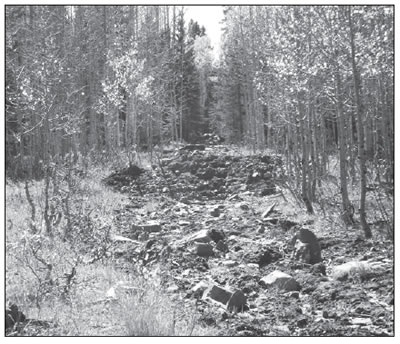
A DECOMMISSIONED FOREST SERVICE ROAD ON HAYCAMP MESA IN THE SAN JUAN NATIONAL FOREST.

A decommissioned Forest Service road on Haycamp Mesa in the San Juan National Forest. Both the closing of some roads and the method of doing it – using a bulldozer to tear up the route – have been criticized. The dispute is part of an ongoing debate over old public-lands routes, some of which are claimed under the 1866 statute RS 2477. Photo by Duane Likes and Rick Newby

One hundred forty-five years later, that brief provision, known as RS (Revised Statutes) 2477, has become the basis of one of the biggest ongoing controversies in the West, spawning endless litigation and furious debate.

In the view of environmentalists, RS 2477 is “a nightmare for America’s wild public lands,” a description provided on the web site of the Southern Utah Wilderness Alliance, which has fought 2477 claims.

“People say, ‘Hey, there’s this law from the 19th Century – maybe we can use this to stop them from closing roads.’ So it gets dusted off any time the Forest Service does something to protect its lands,” Ted Zukoski, an attorney with the environmental group Earthjustice, told the Free Press.

“There are 400,000 miles of roads on Forest Service land. You can almost get to the moon and back on Forest Service roads but it’s not enough for some people.”

But advocates of motorized access see the historic statute as an unequivocal right that requires many old roads and trails across both public and private lands to be kept open.

There are countless thousands of RS 2477 claims and potential claims throughout the Intermountain West, including some 15,000 to 20,000 claims in Utah alone, many within Canyonlands, Bryce, and Zion national parks as well as in proposed wilderness areas.

A firestorm

In Montezuma County, Colo., no formal legal claims under 2477 have yet been pursued. But the statute emboldens constitutionalists and public-access advocates who see it as a basis for opposing road closures on local public lands.

In the view of Dennis Atwater, numerous routes on the San Juan National Forest qualify as RS 2477 roads. Atwater is a member of the Montezuma County Planning Commission as well as two advisory committees – one in Montezuma County and one in Dolores County – appointed to study issues involving federal lands for the county commissioners.

He is also a vocal critic of Forest Service policies and officials.

“They’re disingenuous and they’re not working in good faith,” he said. “They do not negotiate on anything. In all the meetings we’ve had, absolutely nothing has been negotiated. Every meeting you start at Ground Zero and every contentious issue is still out there. Nothing gets resolved.”

Locally, the contentious issues center around travel management on the forest. A firestorm erupted last year with the approval in 2010 of the travel-management plan for the Boggy-Glade forest area north and west of Dolores, with residents furious over proposed closures of some 62 miles of roads and the end of cross-country motorized travel, even for game retrieval.

In vain did the Forest Service point out that most of the roads were two-track dirt roads, user-created routes, and old logging roads, and that the ban on cross-country motorized travel is being implemented nationwide.

Locals said there should be flexibility for local circumstances and that the road closures were largely illegal because the routes were de facto RS 2477 routes.

The Boggy-Glade travel plan was eventually appealed and overturned for reasons unrelated to RS 2477 – in fact, because its road density was too high – and is currently in limbo. A new round of public comments were taken and the Dolores Public Lands Office is currently “taking all of those comments and trying to come up with another alternative that incorporates people’s concerns and comments into a decision we hope to have out later this fall,” according to Tom Rice, deputy district ranger with the Dolores Ranger District of the San Juan National Forest.

Confusion and controversy

Much of the confusion and controversy surrounding RS 2477 results from the statute’s very brevity. What constitutes a “highway”? “Construction”? “Public lands, not reserved for public uses”?

The statute was repealed by the Federal Land Policy and Management Act of 1976, meaning no new 2477 roads could be created, but FLPMA left intact existing 2477 routes.

The problem is deciding what those routes are.

According to Atwater and those of like mind, any road that pre-dates the passage of FLPMA might qualify.

“Our position is certainly there are some roads up there that should have been closed,” he said, referring to the Boggy- Glade area. “Some are old logging roads or go to a [grazing] lease. They required remediation at the end of the contract, and a lot of those were never done.

“Now we’re in a predicament where a lot of those existed on Oct. 1, 1976, and became a route. A two-track that fell into ‘right-of-way’ or ‘right of use’ under FLPMA – if you read the law it is very clear. FLPMA is very explicit about right-of-way and right of use.”

He said it is not necessary that a court first certify RS 2477 status. “They would like you to believe that, but the only time it has to be enforced through a court is if someone objects.”

Under FLPMA, he said, “only Congress can close RS 2477 roads. If a federal agency or its employees closes such a road it would be a violation of federal law.”

Statements like that led to talk of Montezuma County Sheriff Dennis Spruell possibly arresting Forest Service employees, something that has not come to pass so far.

At an Aug. 15 meeting of the local 9-12 Project/Tea Party in Cortez, Spruell briefly addressed the 2477 issue. “I think I have the backing legally to stop any encroachment on an RS 2477 road; however, I’m not going to take a case to court unless I can win,” he said.

But he said he is prepared to fight for search and rescue parties’ rights to travel closed roads. “If they [the Forest Service] try to tell us we can’t go somewhere you just watch and see what happens,” he said.

However, Rice told the Free Press that emergency use of closed roads is certainly allowed, even if a search and rescue group has to cut a lock. “The [travel-management] decision allows search and rescue operations to access the forest via any of these roads.” Off-road travel for fire control and medical emergencies is also permissible.

“So the assertion that we would be prohibiting search and rescues, firefighting efforts or emergency access – that is false,” Rice said.

Up to the courts

But to Atwater and others, the question isn’t whether the agency grants access on the roads, but whether the agency has control of them in the first place. To him, any publicly used roads across the forest pre-dating FLPMA should automatically have 2477 status.

But Atwater’s interpretation is not the prevailing view. Courts, attorneys and the Forest Service say an RS 2477 claim must be proven in court.

“The Forest Service is not in business to decide whether a road is an RS 2477 road,” said Rice. “That is the courts’ decision, and we would be bound by any court decision that a road is a 2477 road. It is the responsibility of the claimant, typically the county, to pursue that assertion by going to court.”

However, no claims have been brought before a court regarding the San Juan National Forest, he said. “I know there’s some interest by some members of the public who have talked to the Montezuma County commissioners about potential 2477 claims and we’ve even taken a look at maps.”

The commissioners have said if they feel they have a strong claim, they will follow up, Rice said.

However, there has been discussion of the agency voluntarily turning over some specific roads to the county or counties, such as the Dolores-Norwood Road and Red Arrow Mine Road (Forest Road 567). Another significant difference between the views of constitutionalists such as Atwater and the prevailing interpretations of RS 2477 is the date used in determining the validity of road claims.

Most courts have held that routes across national forests have to pre-date the creation of that forest, rather than the passage of FLPMA, to qualify as 2477s. That’s because, earlier in the nation’s history, land was considered unappropriated public land until it was “reserved” – for an Indian reservation, a military post, or a national forest. After that date, there would not be an automatic grant of right-of-way.

“Most of the Forest Service lands were designated by [Theodore] Roosevelt or in that era,” said Zukoski. “So the proof [that a route existed] is going to have to go back to the 19th Century in a lot of cases and it’s hard to find people or photos, so you’re relying on really old evidence. You have to hope the courthouse hasn’t burned down in the last 100 years.”

In Southwest Colorado, national-forest lands, including those now belonging to the San Juan National Forest, were reserved by Roosevelt in 1905.

The standard is different for BLM lands; in that case, 1976 is often considered the cut-off date.

Another key question is what standard is used to show that something is a public route. Because the statute is so vague, courts have turned to state standards for guidance; however, those can vary widely.

Colorado, for instance, has no specific time frame for showing “continuous use” of a route, while Utah does, Zukoski said.

“If you look at the Colorado cases, most involve uses of 15 to 20 years or more, but the state law itself does not require that,” he said. In Utah, though, a route must have been used for 10 years continuously.

Other arguments have arisen over the terms “highway” and “construction.” In general, state and county governments and off-road-vehicle activists believe those terms should be broadly interpreted, meaning an old road need only be, in extreme cases, a dirt track where someone moved a rock out of the way to constitute an RS 2477 road.

Environmentalists say the terms should be more strictly defined and point to cases where claimed routes go through extremely narrow slot canyons, along winding stream beds or up almost-impassable rocky slopes. “I’ve got a case in California where the claimants have an old map that shows a route around in the general area, but it doesn’t go where it goes now,” Zukoski said. “It goes up and down vertical cliffs.”

He said assembling evidence to convince a court that a route is an RS 2477 road is very difficult. “Locating evidence is the first major hurdle, and then you have to have a trial. You have to sue the federal government and that is in federal court, so you have to travel. All that costs money.”

Questioning costs

Cost is an issue that has been raised by others. A 2010 article in the Denver University Law Review that discussed the legal complexities of RS 2477 stated, “Growing evidence in the local media suggests that state and local governments, as well as their citizens, are growing weary of R.S. 2477 litigation. While counties continue to file and prosecute R.S. 2477 claims, the fact remains that an R.S. 2477 right-of-way claim can take years to resolve, all at the expense of the taxpayer.”

San Juan County, Utah, has spent at least $1 million battling for control of a Jeep route in Canyonlands National Park, according to commission chair Bruce Adams, who told the Free Press, “Once you’ve invested a million, you’d better fight for the result you want, hadn’t you?”

And Kane County, Utah, allegedly has spent that much fighting its own battle over some 60 roads going through Grand Staircase-Escalante National Monument. The head of the Taxpayers Association of Kane County, Sky Chaney, told High Country News that his examination of county budget spreadsheets indicated the county had spent at least $1 million and possibly much more if overtime and contract time for mapping were considered.

“You have to wonder, what aren’t they spending money on because of these other costs?” asked Zukoski. “Of course, Utah counties have money to spend on the claims because they have a state legislature that requires all the taxpayers in the state to pay for the litigation.”

More than a decade ago, the Utah Legislature created a Constitutional Defense Fund and, according to a review by the Utah Office of Legislative Auditor General, from 2000 to 2004 appropriated nearly $8 million from that fund to an RS 2477 rights-of-way account.

This year, the Utah Legislature passed HB 76, which establishes a federalism subcommittee of the Constitutional Defense Council to review federal laws applying to Utah, and encourages state officials to attack “unconstitutional” laws and mandates, providing up to $1.2 million a year for them to do so. The bill will provide cash to support lawsuits related to RS 2477 roads.

Yet despite the sizable amounts of money poured into the battle, Utah’s victories regarding road claims have been few. In May of this year, a U.S. district judge ruled that the Salt Creek road in Canyonlands did not qualify as an RS 2477 road. San Juan County has decided to appeal that ruling to the 10th Circuit Court of Appeals.

In the case of Kane County, there have been mixed results.

In August 2003, a county commissioner and the county sheriff removed 31 BLM closure signs from roads and trails in the Grand Staircase monument they considered to be county-owned 2477 roads. The county also passed an ordinance encourag ing off-road-vehicle use on closed areas in the monument and a wilderness area. In September 2009, a panel of the 10th Circuit Court of Appeals ruled that Kane County hadn’t established any road rights and that its actions violated the U.S. Constitution’s supremacy clause, which says that disputes between federal laws and state, county or local laws will be resolved in favor of the feds.

However, a few months later the court reviewed that decision in an en banc hearing (before all of the circuit’s judges) and ruled that the environmental groups that had filed the lawsuit had no standing, meaning the U.S. government would have to pursue the case. Subsequently, the Obama administration granted Kane County the rights to five of the least-controversial roads in question.

“The court did reverse that,” Zukoski said. “The court didn’t endorse anything Kane County had done but said we were the wrong people to bring that lawsuit, and if anybody could bring suit against Kane County for tearing down signs, passing an ordinance that opened closed roads and so on, it would have to be the United States.”

However, Zukoski said the case was not to actually determine an RS 2477 claim. “Kane County wasn’t trying to get the roads through 2477. They said that 2477 allowed them to manage any roads that they think are 2477.”

Right of access?

That’s the view espoused by Atwater. However, he said he is not necessarily fighting for local counties’ rights to maintain old routes, as many Utah counties are doing, just for the people’s right to continue to use them.

“Most of our folks that I’m dealing with that want to protect our rights agree that the forest has a wonderful way of mending itself,” he said. “Many, many of these old roads and trails that are in fact 2477 have trees growing up through them that are 8 and 10 inches in diameter and we don’t propose that anybody go disturb that, but we want the right to use it – without doing habitat damage or unreasonably disturbing wildlife.

“We don’t want the county to do a darn thing except to protect our rights to these roads and they can exist just as they do today. But we have a right of access. We want to use them like we have always used them.”

However, motorized use is not as damaging as some maintain, Atwater said. “Years ago, prior to the explosion of the ATV market, when we went berry-picking or hunting we would put chains on our four-wheelers and we did have a tad damage, but you could go back the next year and not find the same trail,” he said.

Today’s ATVs are much less damaging, with smaller tires, he said. “The uses we use them for – getting firewood, getting our deer and elk, berry-picking – are not doing resource damage.”

Forcing ATVs to stay on designated trails is merely concentrating the usage, he said. “Those trails in places show massive habitat damage because they’re shoving it into one area.”

Atwater admitted that desert habitat is more fragile than forest. “Yes, the areas vary and each has its own ecological differences, but the travel-management plan is a cookiecutter plan. One size fits all. It doesn’t matter if you’re in the grasslands in Missouri or the high mountains of Colorado. That’s ridiculous.”

Most motorized users are responsible, he said. “There are always going to be 2 to 5 percent of the people that screw things up but 95 percent of the population loves our forest and we’re going to be good stewards.”

Breaking an ankle

A particular bone of contention for Atwater and others is the way the Forest Service has been decommissioning the old roads – building large berms, laying logs across routes, ripping them up with bulldozers.

He spoke of the old Lost Canyon Stock Driveway, once the only road to Rico, which starts off Highway 184. “When Rico became a boom town, all the equipment for mining came up that road on 13-mule-team jerk lines,” he said. “All of this has been researched. It’s obviously an RS 2477 road.”

Today, Atwater admits, “you can’t even access part of the road where it goes down into Bear Creek,” but he takes issue with the Forest Service’s having torn up part of the route. “They have taken it a couple of miles and obliterated it where you can’t even walk on it. You’d break an ankle – it’s that bad.”

Rice agreed some of the work had been excessive. He said forest officials took a field trip recently with the Montezuma and Dolores County commissioners and representatives of motorized and non-motorized user groups to look at the types of road closures being used.

“The large berms, the ripping of roads – we agreed with them in many cases that we did not need to go to that degree and we could just put a couple of boulders in front of an old road and let it grass in on its own.

“That review of what we did up on Haycamp with those road closures, I think, was indicative of Forest Service and local governments and user groups working well together. I believe that was a positive step in the right direction.”

‘What is the point?’

Jimbo Buickerood, an organizer with the local environmental group San Juan Citizens Alliance, said he would like to see more dialogue and less animosity.

Buickerood said the road dispute has become more of a philosophical argument than a battle over something truly worthwhile. “In Montezuma County, one of the routes in discussion is the Lost Canyon Stock Driveway. It’s not even a road or a used trail any more. It’s an elk trail. What is the point? Is the point to prove philosophically that the county’s in control? Does the county want another road to maintain?

“I think after a series of non-wins, people will be saying, ‘Do we really want to continue this?’”

He called for a fair discussion about balancing the need to protect watersheds, wildlife and even cattle-grazing with the desire for access.

“I think the important thing is to have a community dialogue on what these lands need and how they support our community, and I think it’s much more than just public access to the roads.”

He added that cost is indeed a concern when taxpayer dollars are involved.

“What do people want to spend money on? Trying to keep open, and in good enough conditions, some low-value roads not used by many people or for many purposes? We can’t do it all. We need to make some choices here. How much of the federal budget do we want to put into maintaining thousands of miles of roads?

“I think the day of reckoning is going to come when citizens will ask counties, ‘What do you have to show for the hundreds of thousands of dollars that you have invested in this?’ ”

But Atwater said the roads in question are important for diverse uses and for now, the fight will continue. He said a nonprofit, 501(c)3 group has been formed called the Southwest Public Lands Coalition to represent forest-users of all stripes — the disabled, seniors, oil and gas companies, hikers, bikers and motorized users. “We are going to build a war chest in case we have to take the Forest Service to court. We will defend everybody’s use as much as our own,” he said.

For Montezuma County, the issue comes down to several things — having a good case, really wanting the road in question, and being able to afford the costs, according to commission chair Larrie Rule.

“If you claim an RS 2477 road, you’ve got to be able to prove it,” he said. “As commissioners we’ve got to look at the law., and we’ve got to listen to our attorney.

“Another question is, do we want to claim all these 2477 roads if they’re going to leave them open, because if we do, we could wind up taking care of them. That could be an expensive deal for us. We can’t spend money we don’t have.

“Now, if they’re going to close the roads, that’s a different story.”

But some roads, such as the Lost Canyon Stock Driveway, may not be worth a fight because a nearby road goes to about the same places, he said.

For now, Rule said, the county is waiting to see the revised travel plan for the Boggy- Glade area. “It’s not a dead issue, that’s for sure, but we are waiting to see what they are going to do.”

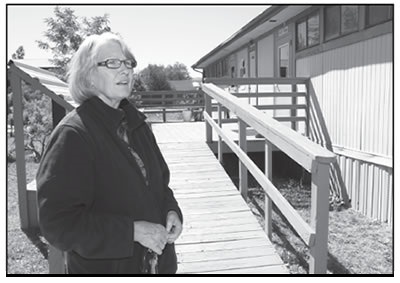
Published in September 2011

Adopt a campground

“It’s not easy being green.” —Kermit the Frog

I never realized how difficult it is toting a political snack. All I’d planned was a short hike, no more than five miles round trip. I thought it wise to carry something extra along with me in case I got hungry. The granola bar looked like trail food ought to look – lightweight and edible – but about three miles down the trail I peeled away the foil and ate it. Now I’m hooked.

When I sat in the shade scrutinizing the list of ingredients off the wrapper, I never noticed, maybe because of the fine print – way down where the wrapper folds into its seam – the suggestion that mixed with the oats, brown sugar, almonds, honey, corn syrup, and whey came a political agenda. Since then I’ve become a helpless granola cruncher and there’s no turning back. That’s what happens when people snack indiscriminately. I should have chosen the jerky.

I’ve never had much interest in politics, but people who express a sympathy for the welfare of this planet have been called a litany of other names, including treehuggers, whining liberals, green weenies, hysterical liberal socialists, eco-terrorists, lemmings, and – believe it or not – Democrats!

As I hike the trails of our public lands, I try to think about treading more lightly on the earth. More carefully. People shouldn’t label environmentalists as bad guys for worrying about the impact a society has while taking its spin on this planet. All I want to do is feel my step grow fainter and fainter until I am no heavier than dust.

According to the Denver Post, public lands and their facilities are being re-evaluated and recommended for closure or decommissioning wherever those facilities are deemed “less profitable” or in “poor condition.” The system faces a multi-milliondollar backlog in maintenance and officials seeking financial salvation are putting their faith in volunteers or private groups willing to adopt some of their orphaned sites.

It’s a strategy we’ve already seen implemented beside our highways for trash pickup. For the price of a metal sign with “Your Name Here,” the highway department provides roadside maintenance. And the sad thing is that it works, thanks to the generosity of countless Americans who spend a few hours a month in their hiking boots, toting and filling trash bags.

I’m the profile for a guy willing to adopt a campground with a couple of my ecofriends, intent on becoming public land guardians. But I suspect I’d be given a garbage sack and toilet brush just to keep me from interfering with the administrators’ more worthwhile plans for development and profit. I mean, let’s get all the environmentalists together, exile them to outdated and poorly maintained ex-Forest Service facilities, and let’s get on with the work of building a civilization. Right?

I have a better idea. Why not just hand these lands back over to the public? Whoever heard of an adoption where the parent maintains legal custody of the child? I’ll cut the weeds, trim the trees, dust the rocks, empty the trash cans, firerings, toilets, and basically provide a nurturing natural atmosphere for the bugs, birds, and critters that live there.

You see, I don’t care for this government-sponsored foster-care approach. Being green is deeper than the color of an official uniform, and it means more than crunching revenue statistics. The trees need to see the future as something more than a boarding school. Ask me where I want my tax dollars spent and I’ll insist they support the smaller, less profitable sites, because it’s the massive, tourist-glutted mega-recreational destinations that need the tightening and toning, not the lean ones struggling with low occupancy rates. I mean, let’s get the cellulite off of Yosemite’s thighs.

Geez Louise! I can’t believe I just said that. I’m starting to sound like the jerky.

David Feela writes from Montezuma County, Colo.

Published in David Feela

Sailing on the ship of fools

Sixteen months till the next election. I’m already receiving letters and brochures from incumbent candidates and new persons who would like my time and money to help them get on the elite welfare rolls. One even suggests I’m a “like-minded” person.

I have never met this man or even heard of him, but because I belong to an organization he may have just joined, I have apparently become like the Good Book says, a sheep. But mobs are dangerous and destructive. I prefer to agree to disagree.

That being said, one might think I’m an independent. Independents are a group who beat their chests, stand alone, pull themselves up by the bootstraps. They are proud to say they elect candidates, and they do.

But they do not pick the candidates. That is done by the two parties that control elections. The independents, unless they change their affiliation temporarily, are not allowed in the assemblies of either party or in the primaries where candidates are chosen.

I personally think the independents should have as much say in who they can vote for as anyone in either party. It affects them as much as anyone else.

Both major parties have picked some winners and losers; the problem is they both got elected. Now enters a new player: the Tea Party. They make sure God is stated loudly in the pledge. They wave the flag and display it on their clothing and even (and this irritates this veteran) make clothes out of the flag. They display Communist- made ribbons on their vehicles crying, “Support the troops.” They proudly proclaim their patriotism and love of country – yet refuse to pay taxes to support it.

Here come the Republicans, not realizing their party has been taken over by the banks, the nouveau riche, the corporations. They are no longer the people’s party, no matter what Boehner, McConnell or Cantor say. The leaders of the Republican Party are bought and paid for. They have become the slaves of the corporations. To sell one’s soul for mammon doesn’t say much for one’s integrity.

And here come the Democrats with their own problems. Yes, they left a surplus in the bank, but they sell out, too. They’re supposed to stand up for the little guy, but too often they misplace their spines the minute they hit Washington, D.C.

When we do get a person elected to city, county, state or federal government, we go about our business and let them run amok. We attend no meetings, write no letters, make no phone calls. But we sure as hell can complain over the high price of coffee. How we can be so afraid of government when we are the government boggles my mind.

Persons steered by popular applause, though they bear the title of leaders, are in reality the mere underlings of the multitude, and let’s not forget it. We the people are and should be the government.

This is a very high responsibility. To vote the tie and the lie is to shirk our duty. We owe our elected officials nothing. We pay them good salaries, give them vacations and health benefits, pay for them to travel around the world and provide them retirement. For that we should get exemplary results. Yet they work to help mainly the few on top, not the masses.

Oh, we can’t tax the corporations! Not to worry – they take very good care of themselves. Here are some facts that might make you wince. There are 27,000 corporate officers allegedly housed in a five-story building in a tax-exempt country. There is a two-bedroom house in Cheyenne, Wyo., that is occupied by two ladies who rent space to 2,200 corporations. That bedroom must get a little crowded while we get shafted! There is also a small and nondescript house in Nevada that has corporate guests who pay no taxes.

Who allows this? Our elected officials. We need campaign finance reform, not a charade like the McCain-Feingold measure, but real reform. No more corporate funding or mysterious commercials from the likes of Karl Rove. We the people should and can fund the campaigns.

We own the airwaves, which are sold at a pittance to the broadcasting companies. They should give equal air time to each candidate, state and federal. The candidate that sends you the letter and brotherly story doesn’t have to be purchased by big money.

Will this happen? Hell, no, but as the song goes, I can dream, can’t I? Until that happens we will continue to sail on the ship of fools an the sea of corruption. Don’t forget to vote!

Galen Larson writes from Montezuma County, Colo.

Published in Galen Larson

First they came for your fat kids…

Did Dr. David Ludwig of Harvard go all Jonathan Swift on us, when he suggested fat kids should be removed from their parents’ care?

Not quite. As it turns out, the media blew out of proportion his and researcher Lyndsey Murtagh’s commentary advocating government intervention in extreme cases. No “Modest Proposal,” this; apparently, the good doctor does not want to create and unleash the Fat Police — nor even satirically suggest doing so to make a point.

But the fact that he could raise the possibility for the media to run with should be cause for concern. Not because parents are trying their best, or need help, or because being labeled fat stigmatizes kids, as pundits have suggested. Rather, it’s cause for concern because parents do not “make” their children fat.

Repeat: Parents. Do. Not. Make. Their. Children. Fat. Not anymore than they can “make” their children brunette, or tall, male, or female simply by changing “habits” and “getting with the (government) program.”

While you can starve a child, you cannot “obesify” a child. Even overfeeding a child is not a guarantee he or she will become fat — and the mere fact that a child happens to be fat does not mean he or she has been overfed. Nor does it mean parents are too stupid, or unwilling, or unable to buy quality food and make sure the family gets ample exercise.

It just means some children do not conform to others’ aesthetic preferences.

But you won’t hear the finger-waggers and the head-shakers saying that. It doesn’t fit with The Message. Fat kid = bad parent. End of story. And once again, weight becomes a matter of virtue, in this case, parenting virtue and responsibility.

I truly wish the fat-haters would take the kids out of their gun sights. Don’t they have enough to do, what with guilt-tripping me into conformance, and codifying discrimination against large bodies? But, no. Apparently, they so hate fat bodies that they want to target even the very young — the better to ensure the kiddies don’t grow up fat, my dear, haha!

These same folks probably would write me off as a fringe lunatic — a fat fringe lunatic, to boot. But there’s ample evidence to support what I say.

Exhibit A:

“Weight is as heritable as height.” This, from the safely thin Dr. Jeffrey Friedman, who also told New York Times science writer Gina Kolata: “We have this naïve view that the whole system of weight control can be controlled by willpower,” and concludes that eat less- move more hasn’t made people thin, though it’s been the go-to advice for millennia.

This does not mean people genetically disposed to heft are powerless in the face of a Twinkie. But it does mean their heft isn’t attributable to Twinkie binges and prolonged couchsurfing. It means their genetics predispose them to being fat — and that it’s much harder for them to lose weight or maintain weight loss. (Neither of which, it should be noted, are easy for anyone.)

Exhibit B:

Dr. Jules Hirsch, Rockefeller University, concludes: Fat people do not eat significantly more than thin people. And, almost no one exercises enough to make a true dent in their caloric needs. (Kolata.) Also per Kolata, Benjamin Caballero, of Johns Hopkins, studied more than 1,700 kids in 41 schools in the 1990s. His test program taught kids how to select healthy fare, and ensured they got regular physical activity, as well as the tools to pass along the info at home. It resulted in … no significant weight loss. Healthier kids? Likely. Thinner kids? No.

Exhibit C:

Dr. Mickey Stunkard and Thorkild Sorensen’s study of 540 adults who’d been adopted young. Conclusion: “a clear relation between the body-mass index of biologic parents and the weight class of adoptees, suggesting that genetic influences are important determinants of body fatness .. there was no relation between the body mass index of adoptive parents and the weight class of adoptees, suggesting that childhood family environment alone has little or no effect.” (Emphasis mine.)

Stunkard and others also studied identical twins raised apart, and fraternal twins raised together. Results: “Almost all of the differences in weight between members of a population are due to genetic differences.”

But what if a child is super-duper fat? Surely governmental intervention is warranted then? Consider Exhibit D, Anamarie Regino:

When she was 3, the Albuquerque girl was taken from her parents in what “Obesity Myth” author Paul Campos succinctly summed up as “a chilling tale of what can happen when people of modest means and social status find themselves, through no fault of their own, facing the full brunt of the prejudice that fuels the war on fat.”

Anamarie stacked on the weight — as well as the height, though this did not concern social workers and the government. Her parents were desperate to figure out why their 16-month-old daughter weighed 67 pounds. They took her to specialist after specialist. She was 130 pounds by the time she was 3. That’s when social workers stepped in, saying the Reginos couldn’t “handle” their daughter, and — of course — the government didn’t want her to “die.”

I remember seeing tales of Anamarie on TV, each filled with hushed horror at her weight. Like everyone else, I believed what I was told: that her parents were to blame. I didn’t realize the Regino family, the TV reporters, and me had all fallen victim to “moral panic.”

“There are moments when certain things become the focus of the society because they are believed to be a danger to the society and it is believed that if you focus on it you will be able to avoid or cure it,” Sander Gilman of Emory University told Kolata. Nailing it was Abigail Saguy, who said in Kolata’s “Rethinking Thin,” it’s not by chance that moral panic focuses on kids. “If you can play the child card or the youth card, you are more effective. People are worried about their children, and if you can play up those fears, you will get more mileage.”

Back to Anamarie. Per Campos, when the state seized her, there was no proof her health was in jeopardy; test after test had failed to detect actual health problems. The state also removed Anamarie from the hospital where her supposedly awful parents had admitted her, and into a foster home. And, despite the state’s claims she was being overfed, the Reginos had, in fact, been putting her on medically prescribed diets, one, of no more than 500 calories a day.

“That there could even be a discussion about whether the state ought to take a child away from her parents under these circumstances indicates how severely the topic of fat distorts public debate in America,” Campos said. “ … the whole idea that parental dietary practices might play a significant role in producing a 130-pound 3-year-old is absurd. … every bit as bizarre as the idea that Anamarie’s parents were damaging her health by forcing her to become twice as tall as other children her age.”

He should tell that to Dr. Ludwig, and anyone else who believes fat kids have bad or neglectful parents.

Think back to your last diet. Was it easy to lose weight? Did the weight loss last? Now, imagine your body was predisposed to fat in the first place. Then imagine being told on a daily basis, in countless ways, that you are Public Enemy No. 1 because you are fat. Add to that the scolds, politicians and doctors who suggest — with growing sincerity — that you are not fit to be a mother or father; that if you cared enough about your children, you’d shed the pounds, and do whatever it takes to make sure your children don’t make the same bad “lifestyle choices” as you did.

Imagine, on top of all this, living with the fear that the government will take away your children, should they reach a weight others find objectionable. Imagine being labeled a “child abuser” by a massive pack of illinformed bigots who are so ignorant that they think having a fat child is the same as starving a child. It is not. Pick a dietitian, any dietitian. They will tell you it is better to be overweight than underweight. Everyone has to eat. If a child’s not eating, he’s not living for very long. The risk is imminent. That is not the case with a fat child.

Now imagine this: What if one of your children was fat…but the other two were thin? Do you think people could credibly support the idea that your fat kid means you are a bad, stupid, abusive parent? That you are overfeeding one of your children, and teaching him to be sedentary, while loading the other two up with veggies, fruits and lots of fiber before they run their daily marathons? Of course not! The kids in one household eat pretty much the same. And if you’re wondering how a fat kid can have thin siblings, consider what a doctor told me: “Even sisters have different genes.”

We are being held hostage by an assumption so strong that it substitutes for reality and reason. It’s the same assumption that led New Mexico to simply state Anamarie Regino was at risk of heart failure, with no evidence other than her weight — and in defiance of what evidence existed.

It’s why we continue to diet, when there are comparatively few real successes in a 2,000-plus year history of reducing. It’s why we keep believing falsehoods about body size. We are doomed to repeat history. And we will, until we at last divorce weight from morality.

Katharhynn Heidelberg is a journalist in Montrose, Colo.

Published in Katharhynn Heidelberg

No place like home: A slow economy inspires tourists to enjoy their own backyards

A stagnant national economy has hurt local tourism in some ways, but tight vacation budgets are inspiring residents to visit attractions in their own backyards more, boosting sales and making up for losses.

In Arches National Park, Utah locals are jamming the parking lots, says park ranger supervisor Sharon Brussell.

LONG HOUSE AT MESA VERDE NATIONAL PARK

Visitors enjoy a tour of Long House at Mesa Verde. Photo by Wendy Mimiaga

“We’ve had overflow to the point that many go on to Canyonlands National Park down the road,” she said. “With the poor economic conditions, it stands to reason that people who may have been planning a big trip far away are instead staying around, exploring their area.”

Brussell attributes Arches’ 4 percent increase in visitation, and Canyonlands’ 6 percent increase from this time last year, to people vacationing closer to home. “They’re looking to save a buck,” she added.

As of July, Arches had seen 626,757 recreation visitors for the year, up from 604,448 from the same time last year. Canyonlands National Park went from 233,967 total recreation visitors by July last year to 269,327 by the same month in 2011.

Other parks are being hit harder by the sluggish economy, but have come up with creative solutions to attract visitors.

Mesa Verde National Park has seen a 17 percent decrease for 2011 to date. As of July of this year, the park drew 274,507 visitors, compared to 329,913 by the same time last year. The month of July totals were especially low, dropping 26 percent from last year.

To help offset the fickle tourism, park managers began offering several backcountry hiking tours to ruins not usually open to the public, and the response has been huge.

“We’re selling out of tickets for these tours. People really have a great experience,” said Laurel Rematore, executive director of the Mesa Verde Association.

Special care is taken by park archeologists to protect the thousand-year-old structures in remote areas of the ruins-rich park, but managers also understand the importance of sharing this cultural heritage with the public.

“It’s great for locals who have already visited the park’s main features, like Balcony House and Cliff Palace, a few times and want a different experience, so it gets people back to the park who might not have otherwise returned,” Rematore said.

New tours are on a trial basis to monitor any potential impacts, but so far there have been no problems. Now visitors can sign up to explore (with a guide) remarkable ruins such as Spring House, Square Tower House and Oak Tree House and Fire Temple. Go to www.mesaverdeinstitute.org for tour availability and more information.

In general, Cortez has had a steady tourism industry, reports Mesa Verde Country director Lynn Dyer, in part because the area does not suffer from boom-and-bust cycles, so the highs and lows are never too extreme.

“Some lodgers and businesses are up one month, while others are down, and then the next month it is the other way around, so overall it has been OK, considering the economy,” she said.

July visitation at the Colorado Welcome Center in Cortez was higher than expected, Dyer said, and Mancos and Dolores also saw good numbers this summer, though those have dipped recently.

“I think people are driving more for vacation because that is still the cheapest way to travel, and it is cheaper to explore your own backyard, too, so we see a lot of regional travelers,” she said.

“But I’ve seen license plates from Washington, Oregon, Canada, Florida and Maine as well. Motorcyclists are very fond of this area’s excellent roads and are coming through in droves yearround.”

A few hours away in Arizona at Grand Canyon National Park, attendance is holding at approximately 2.6 million year-to-date, nearly exactly the same as last year, reports Shannan Marcak, public-affairs specialist.

“We fluctuate just like everyone else does, but because the Grand Canyon is a destination park, away from urban areas, people tend to be more resistant to changing their plans once they have decided to come here.”

In tough times, visiting national parks is a good bargain, she said.

“Parks are nice because they offer opportunities for traveling for different budgets, so if you were planning to stay at hotels but can’t afford that now, you can still make the trip and stay at a park campground.”

Published in September 2011

Preferred plants: Agency ecologists work to find species best-suited to restoration efforts


The Bureau of Land Management is looking for a few good plants. Fourteen plants, actually — mostly grasses that will be better suited for restoration projects than the ones they’ve used in the past.

The BLM and other agencies have been studying restoration efforts that haven’t gone as well as they’d like. In the worst cases, plantings don’t take and the agencies are left with barren, erosion-prone ground or land that’s primed for invasion by noxious weeds. Biologists have begun to suspect they have two areas for improvement: selecting their restoration plants from those that grow closer to the target rehabilitation area, and starting out with “pioneer species,” the plants that naturally make the best colonizers of disturbed soil.

ROBBY HENES

Robby Henes, vice president of Southwest Seed in Montezuma County, shows seeds from native plants that are being carefully chosen to improve restoration efforts on damaged BLM lands. Photo by Wendy Mimiaga

One of the best lessons has actually come from plants in their natural habitats. Forests don’t just begin with the trees. First, shallow-rooted, fast-growing grasses — the pioneer species — spring up in meadows. Grasses with deeper and thicker root systems eventually join them. Then come the shrubs.

Pine and/or deciduous trees may take decades to enter the scene.

Local ecologists with the BLM and the Forest Service think it would be better to begin their restoration projects with local species such as purple three-awn, yellow owl-clover, bulbous spring parsley, Louisiana sagewort, wild tobacco, and woolly plantain. They think these native plants would establish quickly, hold the soil better, and more effectively outcompete noxious weeds.

But there’s a problem: availability. The plants grow all around us, but there’s no reliable supply of seeds that land managers can use when it’s time to reseed a restoration project.

And that’s where the Native Seed Recovery Act Project comes in. Cara MacMillan, staff ecologist at the BLM’s Dolores Public Lands Office, is the lead researcher on a project to study the 14 target species in the wild, and evaluate their potential to be used in reclamation efforts. The project is named partly because it got its start with Recovery Act dollars.

Southwest Seed, Inc. of Dolores has conducted the first test plantings and will evaluate seed yields for the next three years. An economic analysis is also under way to find out whether the native pioneer seeds can be produced commercially, and then sold to both public and private land rehabilitators.

MacMillan said land managers got lucky after the 2007 Goodman Point Fire northwest of Cortez. They used seeds that were commercially available and appropriate for the site. As soon as they planted, big rain came.

“There was a perfect storm – the timing and the precipitation regime that came afterwards,” she said. “What I’m hoping is that we don’t need as much of a perfect storm to get things to work.” Choosing the best plants for the job will be key in guaranteeing success, she said.

Robby Henes, vice president of Southwest Seed, said there’s something “inherently smart” about using plants for restoration that grow somewhere nearby: “I’m not introducing something that shouldn’t have been here, from a wetter area or whatever.”

It gets even more complicated than that.

MacMillan said part of the challenge is using plants from similar-enough habitats and climate patterns, which may mean eventually maintaining seed stocks that are a bit more nuanced than a subset of the 14 species being tested now.

“I’m not trying to be a splitter to the nth degree,” MacMillan said. “I’m not limiting plants to a 10-mile radius to make them local. I’m in the business of trying to take a practical approach and say, ‘Which are our workhorse species?’ ”

She added that another goal is to “fill gaps where currently available species and varieties are unsuccessful or may be negatively affecting the ecology of an area” – by being unsuitable for the local pollinators, for example.

And she and her collaborators are trying to develop species that establish quickly in degraded areas. That trait is especially important when restoration should happen quickly, she said, especially for rehabilitating unauthorized travel routes, routes created from a permitted oil and gas activity but not open to the public, or burned areas where there is a threat of erosion.

MacMillan is working to establish a native-plant garden at the Dolores Public Lands Office to showcase the native plants under study. The garden will serve as a pilot project and learning tool for researchers, land managers and the community.

Meanwhile, she and her partners in the effort are hoping to put eligible grasses to work sooner, rather than later, at Canyons of the Ancients National Monument.

Heather Musclow is a BLM natural-resource specialist in Dolores. She says she’s eagerly awaiting the results of MacMillan’s research to use in weed control on some properties that were obtained by the monument within the past few years.

“They were fallow fields and devoid of native vegetation,” she said. “Therefore noxious weeds such as musk and Canada thistle have prevailed along with mustards, cheatgrass and other invasives. We’ve been treating the weeds for years. However, without establishing desirable plant species, the weeds just keep coming back.”

She’s also always in need of native seed for road closures; monument planning efforts have identified 41 miles of routes needing to be closed because they were duplicates, invited damage to cultural and natural resources, or caused soil erosion. Monument staffers have closed 15 miles of the roads so far, with 26 more to go.

“I wouldn’t say anything is currently missing from the seed mix, because we use seed that we already know about,” Musclow said. “What Cara’s project does is examine seed we don’t yet know about.

“The results from Cara’s work may benefit both Southwest Seed and the BLM on what seeds we propagate in the future, or incorporate into our seed mix to be used in specific soil types, reclamation situations or any number of possibilities.”

Published in August 2011

Hopkins’ ‘Carlomagno’ imagines the life of a Native American pirate


Career journalists always have a book in their belly. Most dream of writing the investigative story that will change the world for the better.

John Christian Hopkins, an award-winning reporter (and a Free Press columnist) who formerly wrote a nationally syndicated column for Gannett News Service, dreams, too, that his book, “The Pirate Prince Carlomagno,” will shed light on native culture. His tale is a swashbuckling Native American story based on little-known tribal history to which he is personally related.

“As a child I slept clutching books to my chest and dreamed of becoming an author,” says Hopkins. “I even traded a rocking horse to my brother for a set of wooden alphabet building blocks when I was only 3. I’ve never wanted to do anything but write.”

After 20 years editing and writing for eastern news media, Hopkins moved to Gallup, N.M., to freelance as a writer/correspondent for Dine’ Bureau, Indian Country Today; News from Indian Country, The Gallup Herald, The Westerly Sun, South County Independent and Native Peoples Magazine.

Hopkins, a member of the East Coast Narragansett Indian tribe, is a descendant of King Ninigret, patriarch of the tribe’s last hereditary royal family.

Such distinguished lineage influences his avid love of history and, subsequently, his obsession with reading and journalism.

But he strayed far out of the canon of typical Native American literature to tell the story of, Carlomagno, published this year by Wampum Press.

It is a fictional 17th century story of a Native American pirate riding the high seas in the Caribbean heading back home to his people, the East Coast Wamponoag tribe.

At book-signings (including two at the Spruce Tree Coffee House in Cortez last spring) Hopkins’ voice resonates with the spirit of the tall tale he sees in his head. It is obvious that he is mesmerized by his own storytelling and his enthusiasm for historical research, writing and sharing it with others.

“I am proud of my native community and the excellent native writers in this country,” he said. “We are naturally great oral storytellers, so it will flow over into writing.”

However, Hopkins is determined not to be pigeon-holed as a native author. He sees himself as an author who is Native American. “I want to break the bonds and go out on my own, tell a story that challenges people’s concept of what is native life.”

The details, he says, make the characters come alive, and, “I can visualize the story. I write the scene I see, like watching a movie in my head. It’s an adventure, a romance story, but it’s also a boatload of history,” the kind kids of all ages can sink their teeth into for a great escapist read.

At the beginning of the book, Hopkins takes up the story of King Philip’s War, 1675–76, the most devastating war between the colonists and the Native Americans in New England.

Other tribes, the Nipmuck and the Narragansett, joined the Wampanoag in fighting against all the New England colonies. In 1676 the Narragansett were completely defeated; the Wampanoag and Nipmuck were gradually subdued.

King Philip, the Wampanoan tribal chief, was killed after his hiding place at Mt. Hope (Bristol, R.I.) was betrayed. Philip’s wife and son were captured.

The war was extremely costly to the colonists, but it was even more devastating to the native peoples, resulting in the virtual extermination of tribal life in that part of New England.

There is no record of the name of Philip’s son. The last recorded information about him says he escaped death at the hands of the pilgrim colony victors only to be sold into slavery in the West Indies.

Fictionalizing the son’s life after the war that memorialized his father, Hopkins named his 7-year-old hero “Carlomagno,” a name he fell in love with in his ninth-grade Spanish history class.

“ ‘Carlomagno’ was a name from a region and period of time that stuck with me and I always knew I would use it for a character. Twenty years later in my mid-30s, King Philip’s son needed a name. It fit, just like a crossword puzzle.”

Hopkins breathes life back into his own tribe’s history by creating an adventure for the prince who longs for his tribal home — a hero based on Wampanoan culture.

The story is rich with history. At the time Carlomagno is enslaved in Hispaniola, piracy was a flourishing business in the Caribbean and Europe.

“Imagine being a little boy taken away from everything you know, with no resources and a long, long way from home in distance and culture. All he wanted was to go home, and piracy offered the only reasonable way back.”

According to Hopkins, piracy, in truth and glorious legend, was one of the first democracies. Anyone could vote on a ship; everybody was equal. “There were rules and abeyance and a share in the bounty. The success of the ship is based on everyone doing his job.”

For Hopkins, the research was fun, a natural part of his profession as a reporter.

“Even in journalism I like to write from front to back. After I get the facts, the story rolls and breaks and lives on its own. I get so absorbed in the story because I know the history. If the next scene pops into my head I just get up and write it.”

But it was not always easy.

Hopkins developed glaucoma in his 20s. He lost all vision in his left eye and his right eye was growing hazy. He underwent five operations in three years. “I got scared. I didn’t want to lead the rest of my life wondering if I could ever write the history and stories I wanted to tell.”

Later, after the operations returned most of his eyesight, Hopkins took time away from his journalism career to commit fully to the process of writing and finishing the book. He worked eight hours a day until the book was completed. “It took almost four months to write but I’ve been thinking through the story and the research for many, many years.”

Hopkins’ adventure saga is doubly fascinating because the character names jog stereotypes, making the reader work a little to keep all them in their place — a device that mirrors absorption and relocation strategies employed against native tribes to remove the people from the tribal lands.

Hopkins plunks us down in the heart of heroic pirate culture, as well as Jamaican and Haitian places, people and tribes.

At first it’s hard to imagine a native tribal leader named King Philip, or a son named Carlomagno. It is even slow going to learn how to pronounce Wamponoag. But, the beauty in the book is exactly that. We are more informed by the end of the read than at the beginning.

“I always want to incorporate native characters,” Hopkins says. “Most readers only know about Apaches, Cherokees, Navajos, Hopis and other Western tribes. I want my native characters to be multidimensional – some are good, some are bad guys just like everyone else, and I want to put them in places people wouldn’t expect. I want the reader to wonder like I did as a kid, ‘Was the world really like that in those days?’ For me it is the ultimate compliment if readers are curious and do research on their own, just for the love of it.”

Western writer Louis L’Amour was Hopkins’ greatest influence. His stories piqued Hopkins’ curiosity, causing him to research the places and incidents he read about in L’Amour’s writing.

Hopkins fell in love with the West and accepted an offer in Gallup to cover Native American government and natural-resources issues.

There he met a like-minded and equally accomplished journalist, Sara Begay. She had worked in public broadcasting all over the country, but returned to Tuba City, Ariz., to manage KGHR, the public radio station at Greyhills Academy. Hopkins began to drive the standard Navajo dating commitment – 4 1/2 hours between Tuba City and Window Rock.

During their courtship, “she became the inspiration for the true love Carlomagno finds in Hispaniola,” says Hopkins. More practically, he says he couldn’t have published without her help.

“I am so lucky to be married to Sara. She’s the only woman who understands why I needed to concentrate on my work when I said, ‘I’m crashing a deadline’.”

After many successful years in print and broadcast journalism covering tribal news from Tuba City and Page, Ariz., the couple moved back to New England in July. Hopkins has returned home, to a place named Hope Valley, and, like Carlomagno, brings back many stories about his adventures in the Southwest, a mostly mysterious region to an East Coast native.

“I couldn’t imagine putting this many desert miles on a vehicle, and loving every minute of it. I’m glad I did.”

His book is available in Kindle format at Amazon, or in hardcover at Amazon and Barnes & Noble or by contacting him directly at hopins1960@hotmail.com.


Published in Arts & Entertainment, August 2011

This historic battle over access to a desert creek


First of a two-part series

For two decades, a furor has raged over the fate of a slow-moving stream that meanders through the heart of the Needles District of Canyonlands National Park in Utah.

CAR DRIVING THROUGH SALT CREEK

A car traverses the Salt Creek streambed in Canyonlands National Park in the days before motorized travel was banned along the riparian corridor.

The saga has its own distinctive elements, but in many ways it exemplifies the disputes over motorized access now gripping the West.

It even includes an actual instance of a county sheriff defying the federal government and cutting open a gate.

At one time, motor vehicles could rumble southward along the streambed to reach a stunning rock formation called Angel Arch at the far end. Today, that route is closed to motorized travel. Environmental groups and the National Park Service have fought to keep it that way, while San Juan County, Utah, and the State of Utah have battled to have it reopened.

The county alone has spent more than $1 million on the fight, according to one of its county commissioners.

On May 27 of this year, a U.S. district judge issued a landmark ruling that the route did not meet the standards of an historic road under the statute known as RS 2477.

Now, San Juan County and the State of Utah have decided to appeal that decision to the U.S. Tenth Circuit Court of Appeals in Denver, meaning the legal battle will continue for years more.

“Once you’ve invested a million, you’d better fight for the result that you want, hadn’t you?” San Juan County commission chair Bruce Adams said in a phone interview.

Far-reaching

Environmentalists, the Park Service, the county and the state don’t agree on much, but they agree on one thing: The case, and the recent ruling in U.S. District Court, could have far-reaching implications.

“It’s a huge decision and I think it’s very significant,” said Liz Thomas, a Moabbased attorney for the nonprofit Southern Utah Wilderness Alliance, a key party in the dispute.

In his 81-page ruling, U.S. Senior District Judge Bruce Jenkins found that the county and state had failed to prove that the route had experienced the 10 years of continuous public use that is necessary in Utah to qualify as an RS 2477 road.

“For purposes of R.S. 2477, at least absent proof of continuous public use as a public thoroughfare for the requisite amount of time, a jeep trail on a creek bed with its shifting sands and intermittent floods is a by-way, but not a highway,” Jenkins wrote.

Environmentalists hailed the decision.

In an e-mail to the Free Press, Thomas wrote that, “The Court’s decision is enormously important, not just for Salt Creek, but for the thousands of R.S. 2477 claims on federal public lands across Utah (by some counts, this could be 15,000 to 20,000 claims!).

“The UT Fed. Dist. Court’s decision makes clear that old trails with a sparse history of occasional use by cowboys, prospectors, or off-road vehicle users are not ‘county roads,’ but are federal lands subject to federal control and management,” she wrote.

Adams agrees the ruling was monumental, but takes issue with the outcome.

“We simply think that it’s not appropriate to close the road to Angel Arch,” Adams said. “We think it’s of national significance and everybody, including disabled people, should have the right to enjoy its beauty.

“What the ruling does – it limits the access to those who are physically fit enough to ride a horse or hike 24 miles round trip. We just think that’s wrong and we think the public deserves better and the judge got it wrong.

“The judge in his ruling has almost redefined what Congress and others had defined as an RS 2477 right-of-way.”

Locking the gate

In January 1995, the Park Service adopted a backcountry management plan for Canyonlands that addressed growing concern about the impact of motorized travel on Salt Creek, the only perennial waterway in the park other than the Green and Colorado rivers, which are virtually inaccessible from the Needles District.

Salt Creek, which originates in the Abajo Mountains and runs 32 miles to the Colorado, supports the park’s richest diversity of birds and wildlife outside the river corridors.

“It’s a gorgeous part of the park, very rich in archaeological resources, rich in wildlife,” said Paul Henderson, Park Service spokesman for Canyonlands and Arches national parks. “People have been drawn to that area for thousands of years.”

Prior to the 1995 plan, there were no limits on the number of vehicles that could drive up Salt Creek, according to Henderson. The route didn’t see abundant visitors every day, but over holiday weekends there were upwards of 75 vehicles a day traveling the path, he said, and that caused concern about impacts to water quality, erosion and archaeological resources.

“You don’t have to be much of a biologist to figure out that that many vehicles driving through a stream bed is not a good thing for a healthy riparian zone,” Henderson told the Free Press.

The management plan limited motorized travel to 10 private and two commercial vehicles a day. A gate was installed at the north end of the route and permits were issued to travel beyond that point to Angel Arch. “That seemed to be a good trade-off at the time. The county had never objected to our backcountry management plan. They never really objected to the limits as long as access was available.”

But SUWA objected to any continued vehicle access and filed suit in June 1995 challenging the park’s plan. In 1998, the district court overturned the park’s permit system. The Park Service then installed a second gate on the creek at Peekaboo Spring, a few miles south of the first gate, and locked it.

AVT ACTIVISTS IN MONTICELLO UTAH

Motorized advocates take to the streets of Monticello, Utah, in April 2011 to protest road closures on public lands. Photo by David Grant Long

Supporters of motorized access appealed, and in August 2000 the Court of Appeals enjoined the district court’s ruling and remanded the case to the original court for further consideration. The Park Service was also to re-evaluate the impacts of motor vehicles on the creek.

Between 1995 and 1998 “when the court told us to kick the gate shut, there were only a few weekends a year that we did sell out all of those permits,” Henderson said, adding, “I’m not sure that claims that there are thousands of people wanting to drive up there are necessarily true.”

The agency meanwhile kept the gate closed, something that did not sit well with county officials. In December 2000, then- Sheriff Mike Lacy, a deputy, and two other county employees traveled to Peekaboo Spring, removed the lock and chain from the gate, cut the wires, and took down “Road Closed” signs.

The county won that symbolic skirmish, but the legal process continued, and the park did further studies.

“We got a team of a lot of ‘ologists’ and they decided that vehicle use within the corridor was impacting park resources,” Henderson said. In June 2004 the Park Service announced a final rule ending motorized access to Angel Arch.

In July 2004, the county filed suit in U.S. District Court claiming a rightof- way along Salt Creek under R.S. 2477.

The brief statute, adopted in 1866, states, “. . . that the right-of-way for the construction of highways over public lands, not reserved for public uses, is hereby granted.” It was intended to encourage mining and development of the West.

Congress repealed R.S. 2477 in 1976 but said that established roads retained their rights-of-way.

Washed away?

The Salt Creek case went to trial in fall 2009. The county and state provided evidence of what they viewed as continuous use of the Salt Creek route for at least 10 years prior to the establishment of the national park in 1964. San Juan County attorney Shawn Welch argued that continuous public use began with the arrival of a cattleman in the 1890s who moved livestock up the creek. Evidence of use by other ranchers and a cattle company was also provided.

But assistant U.S. attorney Carlie Christensen argued that “sporadic use” did not qualify the road for R.S. 2477 status and said the public still has access to Angel Arch on foot or on bicycle.

Judge Jenkins agreed, writing, “it would strain the language to characterize [the cattle company’s] presence as a ‘public’ use. . .” Scenic tourism via four-wheel-drive vehicles began in the 1950s, the judge wrote, but even then, visitors were “very few and far between.”

Jenkins found that continuous public use of the claimed public thoroughfare had not begun by September 1954, 10 years before the park was created. He ruled in favor of the Interior Department and Park Service, and ordered the county and state to pay the defendants’ costs in the case.

Adams, however, believes the state and county did provide ample evidence to show 10 years of continuous public use. “That creekbed was used by ranchers, farmers, hikers, Boy Scouts, Jeepers – everybody loved to go up Salt Creek to look at Angel Arch.”

Adams said he took his entire family to the arch within a month of the closure because, “I was afraid if I didn’t, my children and grandchildren would never see the Angel Arch.” He has visited the arch numerous times, he said, “but I’ve never hiked the 24 miles and I don’t intend to,” although he might ride a horse.

The only other way to Angel Arch is via Cathedral Butte to the south, and that involves a long hike down a very steep canyon, he said. “That’s even more limiting than the Salt Creek route.”

He said any damage done by motor vehicles is soon eradicated by nature. “Every time it rains, all the traces of man are washed away.”

But SUWA’s Thomas disagrees.

“I would say that perhaps the tire tracks are washed away,” she said by phone from Moab. “Vehicles make ruts and when there’s a big flood event the path of least resistance is through the ruts because they’re linear and going downstream. It creates immense erosion that would not be there if it were a healthy floodplain.”

Supporting wildlife

Today, the route remains closed to motor vehicles pending the outcome of the latest court battle.

“Nothing has changed on the ground,” said Henderson. “We closed Upper Salt Creek to motor vehicles in June 1998 when the courts ordered us to do that, and this thing has been in court ever since. It has been a long weird path to where we are at.”

Thomas, who has made the hike to Angel Arch, said Salt Creek today is beautiful, with “tons of vegetation.”

She said research she did regarding Arch Canyon, a BLM-owned riparian area in San Juan County where motorized use is also an issue, showed that riparian areas make up less than 1 percent of the total BLM land mass in Utah and yet support 75 to 80 percent of all wildlife. “I can’t imagine it’s different for Park Service land,” she said.

Henderson said there are places in Upper Salt Creek where one can no longer tell there were ever tire tracks. “The recovery truly has been amazing,” he said.

Henderson said the Park Service doesn’t keep track of day users in Salt Creek but issues permits for backcountry camping. During the prime hiking season (spring and fall) the backcountry sites in Salt Creek are booked months in advance. “They’re among the most popular places in the park.”

But, he noted, “There’s certainly a segment of the population that hates the fact that they can’t drive up there and feel they’ve been denied access.”

Creating criminals

That segment includes most of San Juan County, according to Adams. He said the commissioners’ decision to appeal was unanimous and he believes the vast majority of the county agrees as well. Access is a huge issue in San Juan County, he said.

“We’re not only pursuing the RS 2477 claim on that road, but there are many, many other roads that we’re claiming as RS 2477.” The county has been advertising for members of the public to come forth with concrete evidence of the use of any road in the county prior to 1976. “We think it’s in the best interests of the public at large to have open access.”

Adams said there are more ATV riders in the nation now than ever before and “you can’t say every place in the world is off-limits to ATVs. Then you start making criminals out of your constituency because they want to ride.”

Thomas, however, said in San Juan County there are some 5,000 miles of designated motorized routes on BLM land alone. “There’s plenty of places for people to drive vehicles.”

Worth fighting for

Even if the county ultimately wins the Salt Creek battle, it would gain only a narrow right-of-way through a national park. But Adams said the access is worth fighting for because of the precedent the case will set for other RS 2477 claims.

“I’m sure the other side looks at it the same way,” he said. “How many roads is the county going to spend $1 million on to fight to assert its position? We felt this case was as winnable as any we had in the county. If we could win this one we think that would set a precedent for us as well as other counties.”

The Park Service’s Henderson, who was in his position in June 1998 when the road was closed and has watched the various decisions, said he is not surprised that the county would appeal.

“It’s because this is such an issue throughout Utah and certainly some places in Colorado,” he said.

“If this decision were to stand and become the new case law, there’s parts of it I feel do put the onus of proving what is a right-of-way on the county or the political subdivision making that claim.”

The case is important to the park as well, he said.

“For Canyonlands National Park it certainly is. If the decision stands, it would put to bed the notion that someone other than the public of the United States has either a right-of-way or a title claim to any of the land in Salt Creek. I think from our perspective it just allows us to continue the management in the Salt Creek corridor we’ve had in place since 1998. For us, we just won’t have to be spending quite so much time preparing for court cases!”

Next month: The controversies and legalities surrounding some other RS 2477 claims in the region.

Published in August 2011

A cultural crossroads: Cortez center is a museum, a gallery, an entertainmnet hub and much more


It’s a little bit of a lot of things.

Part museum, part art gallery, part natural and cultural resources preserve, and part gift shop featuring work by local crafters, the Cortez Cultural Center draws people from all over the world to its facility at 25 N. Market Street in downtown Cortez.

“Our mission is to provide a forum for the community’s educational, cultural artistic. and scientific interest,” says Shawn Collins, the center’s executive director.

Collins wants more local people coming through the doors. “I have to help them realize what a great resource we have,” she says.

On the job just two months, she has already formulated an idea of how to attract locals, even in these tough economic times. An anthropologist and archaeologist by training, she believes that culture defines who people are, regardless of financial situations.

Her voice becomes animated. “Maybe it’s time to see who we are, (and) then look at other people and see who they are. Try to find some of that cultural continuity, rather than (thinking) us versus them.”

She hopes to start the search in the center’s modest museum, which features Ute, Navajo, Hispanic, and Anglo American cultural exhibits, and information concerning the Hawkins Preserve, 122 acres south of town, which the Cortez Cultural Center manages.

Like the Anasazi Heritage Center in Dolores, she wants an interactive museum. Right now, kids can design their own petroglyphs or weave on Navajo looms, but adults need similar activities. “It gives us a chance to step back and see what it was like to live in one of these cultures,” she states.

Some of the Cultural Center’s exhibits have been on display since 1988 when the facility opened. Cases need repair, and she would like to redefine the relationship between the displays.

Currently, each stands alone, without acknowledging the cultural interaction that takes place in the Four Corners. She would love to show things like the influence of European trade beads on Ute clothing construction. “And there was cultural interaction going from the Ute to the Euro Americans as well,” she asserts.

She also wants to emphasize that cultures evolve, citing the Native American dances the center presents Monday through Thursday evenings each summer. One dancer, Norman Roach, wears traditionally styled costumes, but in the neon colors of the 21st Century. Some dance groups present Navajo and Ute dances. One ensemble offers a mix of Navajo and Lakota pow wow dances.

In addition, storyteller Sharon French tells the saga of Black Shawl, her Navajo great-great-great-grandmother, who married Mormon missionary Ira Hatch. Collins wants people to see examples like hers and understand how they molded the Four Corners for both good and bad.

The Cortez Center was started on July 8, 1988, by University of Colorado alumni; it was known as the CU Center, a term still used by many locals. Eventually the college affiliation was dropped and area residents took over the center.

The Cultural Center has a gallery as well as a museum, and Collins plans to expand the concept of cultural dynamism to art classes and presentations. She hopes to open classes to teens as well as adults, and to show more work by area artists. She has drawn upon the Aspen Guard Station artists- in-residence program for people to offer programs at the Cultural Center.

Artist Jane Pederson has led journaling workshops for teens. This month, puppeteer and storyteller Don Kirk performs “Stories Worth Telling Stories Worth Hearing” for adults.

In September, the Cortez Cultural Center holds its 4th Traders Rendezvous. Descendants of trading-post families will share their ancestors’ stories with the public.

That same weekend, the center will kick up the celebration of Cortez’s 125th anniversary. Three authors, Violet Schwindt, Dale Davis, and Janet Weese, will sign their book, “Cortez: The Little Town that Could.”

As part of the festivities, Collins hopes to invite people to bring antiques that their great-grandmothers stored in attics and through them, learn Cortez’s history.

She works with antiquities through another Cultural Center program. Ancient pueblos and archaeological sites dot the Hawkins Preserve, which the center oversees.

Donated to Cortez by builder Jack Hawkins with the provision that the area offer recreation as well as cultural and natural resources, Hawkins includes the city bike path, hiking trails, and roads for mountain-bikers. Cliff climbing is allowed with a permit.

Part of McElmo Canyon, according to the reserve’s manager, Linda Raczek, Hawkins boasts habitats for foxes, skunks, deer, badgers, the occasional mountain lion, and birds.

Monthly programs, such as August’s Star Party, help the whole family better understand their Hawkins experience.

Immediate Hawkins projects focus on ruins stabilization, but like Collins, Raczek hopes to expand Hawkins’ offerings. “I’d like to see a teen intern each summer,“ she says, “And eventually build a classroom at the edge of the parking lot to better serve the children of Montezuma County.” She would like kids and adults to learn that the Hawkins Preserve is dedicated to nurturing plants and animals native to Cortez.

She wants visitors to learn to look at animals and not feed or touch them; and to not disturb plants. She wishes that they learn to leave artifacts in place for archaeological purity and out of respect for the descendants of people who lived on the Hawkins Preserve.

Above all, she would like people to understand how great a resource Hawkins is.

So would Collins. “It’s a little bit of wilderness without having to leave town,” she says.

She hopes people will help her realize her vision for the Hawkins Preserve and the Cultural Center. “I look forward to hearing their ideas,” she says.

Published in Arts & Entertainment, August 2011

Republicans fight a ban on uranium mining near Grand Canyon


A federal effort to protect 1 million acres of public land around the Grand Canyon from the potential hazards of uranium-mining was a sure thing just weeks ago, but the measure has been hitting resistance lately from Republican members of Congress.

Interior Secretary Ken Salazar is poised to ban new hard-rock mining claims on the watershed of the Grand Canyon for the next 20 years in order to safeguard water resources.

During a speech at the South Rim on June 20, he reportedly told a crowd that the proposed ban was necessary because allowing a uranium-mining surge risks polluting the Colorado River and nearby springs, a source of drinking water for some 26 million people locally and downstream.

“All of us — by the decisions we make in our short time here — can alter the grandeur of this place. As Teddy Roosevelt famously implored, ‘Leave it as it is . . . man can only mar it,’” Salazar said.

“Millions of Americans living in cities like Phoenix and Los Angeles rely on this river and this canyon for clean, healthy drinking water, and that is one of the many reasons why wisdom, caution, and science should guide our protection of the Grand Canyon.”

His decision comes at the close of a twoyear temporary mining ban to allow for environmental and hydro-geologic studies within the 1 million acres. The study could not rule out that increased mining activity, especially for radioactive uranium, would not negatively affect water quality in the river basin over time. The mining moratorium, known as a “mineral withdrawal,” exempts mines with valid existing rights, of which there are an estimated 8-11 in the region, some of which are being hotly contested in court by environmental groups and mining companies.

However, Salazar cannot enact his preferred alternative of a 20-year ban on new claims — the maximum allowed under the Department of Interior laws — until December to allow final drafts of environmental reports to be completed. In the meantime he extended the two-year mining ban for an additional six months to stop the mining industry from seizing on the loophole to start up mines.

Salazar’s pending decision was applauded by environmental groups, the National Park Service and downstream cities, but drew criticism from pro-mining interests, including U.S. Rep. Jeff Flake (R-Arizona) and Ron Hochstein, CEO of Denison Mines, a Torontobased company with several uranium mines in the Southwest and within area of the Grand Canyon mining ban.

In July, Flake and other Republicans added a last-ditch amendment to the Interior and Environmental Protection Agency’s 2012 appropriations bill that would strip the legal authority of Salazar’s office to impose a 20-year ban on new uranium mining outside the park where it has been traditionally allowed under the 1872 Mining Law.

“Uranium-mining outside of Grand Canyon National Park can create jobs and stimulate the economy in northern Arizona without jeopardizing the splendor and natural beauty within the Park,” wrote Flake in a July 12 press release. His office did not respond to phone and e-mail messages for comment.

Flake’s rider is part of a wave of last-minute amendments designed by the Republican Party to surreptitiously gut environmental laws such as the Endangered Species Act, the Clean Air Act, mountain-top-removal restrictions for coal-mining, and the Wilderness Act, by tacking them on to budget bills needed to fund public-land agencies.

The amendment to rebuff Salazar’s mineral withdrawal and re-start uranium-mining around the Grand Canyon was awaiting a vote for cancellation by Democrats, but was mired in the debt-reduction bill languishing in the U.S. House of Representatives as of press time.

Public-lands watchdogs say the rider tactic is a familiar political game.

“This is changing laws to serve an industry that donates to their political campaigns,” Taylor McKinnon, public-lands coordinator for the Center for Biological Diversity, told the Free Press. “It is Congress trying to make pork out of public lands.”

The Center for Biological Diversity has been fighting to end uranium-mining in the region and educate the public about the risks to the environment when things go wrong or clean-up is ignored. Dozens of spent uranium mines litter the Southwest, especially on the Navajo Nation, which banned uranium-mining in 2005 due to its legacy of environmental damage that lingers today in the form of radiation poisoning.

Salazar’s preference for a 20-year moratorium is “excellent news for the Grand Canyon and when the final decision is made, it is one we will celebrate and defend,” McKinnon continued. “The bottom line is that the uranium industry can’t guarantee that mining won’t pollute the aquifers that feed Grand Canyon springs and if that pollution were to happen it would be impossible to clean up.

“Industry is asking the public to risk irreparable harm to aquifers’ and springs’ biologic diversity relied on by species and people.”

But uranium advocates contend that modern technology and strict environmental laws make uranium-mining safe to the land, water and public.

“These mines are small and the EIS [environmental impact statement] shows there is no significant impact in the past or predicted for the future,” said Ron Hochstein, CEO of Denison Mines, which operates mines in the withdrawal area.

In a phone interview with the Free Press, Hochstein said the mines are a significant component to feeding the White Mesa Mill, near Blanding, Utah, which transforms the ore into yellowcake, the first step in the creation of fuel rods for U.S. nuclear power plants. The White Mesa Mill employs 150 people and is the only such plant in the country, although another is planned for Paradox Valley, Colo.

“The uranium industry provides good jobs that pay well with a lot of spin-off opportunities, and for people in the Four Corners looking for work that is important,” Hochstein said. “Salazar is pandering to the anti-development groups, but people need to realize that industry can work hand in hand with tourism; it doesn’t have to be one or the other.”

The Obama Administration faces a conundrum when it comes to nuclear energy.

The President and his energy secretary support more nuclear power plants as a way to replace more-polluting coal plants contributing to global warming. But when geologic coincidence puts uranium reserves next to cherished resources such as the Grand Canyon and the Colorado River, the risks of extracting the radioactive substance seem too great. But the West is vast and replete with valuable minerals, so there is always somewhere else to mine for uranium.

“Critics will falsely claim that with a full 1-million- acre withdrawal from new hard-rock mining claims, we would somehow be denying all access to uranium resources,” Salazar said at the South Rim. “That of course is not true. Uranium remains a vital component of a responsible and comprehensive energy strategy and we will continue to develop uranium in northern Arizona, Wyoming and other places across the country.”

A new U.S. president could rescind mineral- withdrawal orders by the former Interior Secretary. A bill by Rep. Raul Grijalva (D-Ariz.) called the Grand Canyon Watershed Protection Act would protect the area around the Grand Canyon permanently.

Published in August 2011

The roadie in me

I’ve slept in the desert at a motel I won’t name.
It felt good to get out of the car.
The road was hard but the bed was harder.
I wish I’d learned to play a guitar.

As you know, the band America wrote better lyrics, which paid for a few expensive rooms when they were on the road. I always end up at those poorly lit fiascos, pulling in around sunset when the light is perfect for concealing all the obvious flaws. A row of quivering florescent bulbs create a halo effect during check-in and only after I unlock the door do all the grimy little truths crawl out to introduce themselves.

Question: If an honest proprietor ran a sleazy motel and named it “Pa’s Flea Bag,” would anyone ever pull in to ask for a room?

Answer: Probably me.

I’ve driven past the posh palaces. Elaborate lobbies greet you instead of a slot in the wall where a Smeagol-like character behind a tinted piece of bulletproof glass passes you his precious key. Some of the fancier places call themselves “inns” instead of motels, or they rent “suites” which turn out to be just basic rooms chopped into alcoves where the management has crammed a sink, a refrigerator, and a microwave.

The summer tourism market may be advertising bargains, but it will still be the same places describing themselves with inflated language, charging inflated prices. It’s important that I remind myself of these exaggerations, because I’m a sucker for a well-turned lie.

My expectations were a bit too high when I stayed in Flagstaff, Ariz., at a place that sported a five-star rating. Every room had a bronzed plaque beside the doorknob, a hallway of suites with engraved reputations and huge flat-screen televisions. The beds were cushy, an open bar served complimentary drinks between 5 and 7 p.m. Free appetizers decked the lobby tables. Someone brought me a glass of orange juice when I handed over my credit card. I thought the bellhop was going to carry me to my room.

The amenities were extravagant, everything with a touch of class, except nobody mentioned the train’s night schedule. Why should they? Anyone trying to sleep would eventually figure it out.

I feel compelled to mention this experience, because it soured me on the notion that a person ever gets what he pays for.

Why waste money if I have to suffer? Too often my bed is rigid and the shower dribbles. The toilet tank runs all night unless I jiggle the handle, and it’s impossible to jiggle the handle hard enough to make the toilet next door stop running. The carpet is so dingy I put my shoes on before getting up to pee in the middle of the night. It’s the kind of place where you don’t make reservations but still, you have them.

If by some chance, however, there’s a towel on the rack that doesn’t feel like it has been used at a car wash, or there’s an extra roll of toilet paper to make up for the empty Kleenex dispenser, it’s easy to feel blessed.

You see, I tell myself I’m only staying for the night. How bad can it be? A person doesn’t want to end up at a place on some Shangri-La highway where the accommodations are flawless and you can actually afford it. You’d be tempted to stay there for the rest of your life.

David Feela writes from Montezuma County, Colo.

Published in David Feela

A Jersey girl

“Nothing matters in this whole wide world
When you’re in love with a Jersey girl.” —Tom Waits

I am totally revisiting the Jersey days — it’s kind of weird. When I left New Jersey a hundred years ago, it was in that get-me-out-of-here-as-fast-as-possible-I-will-NEVER-return-again sort of way. And now I am suddenly a Jersey Girl.

Not that my childhood was bad – nor NJ for that matter. I grew up in “horse country”: woods, meadows, open space, clean air and enormous homes. My formative years were filled with family, friends, horse shows, tennis matches on grass courts, golf (but I sucked at that), and summers on the Vineyard.

Nothing to complain about. But, boy, did I want out. I was always very aware that there was a place in this world where my unclassy, unpolished, inner-dirt-bag self would fit in better than at the Club.

So, here I am, settled comfortably in the heart of Montezuma County, fully prepared to grow old in Mancos.

Even my parents and brother have left and moved West.

So why am I suddenly nostalgic for New Jersey? I haven’t been back in over 20 years. I have kept in touch with no one.

But recently, several of those folks that I haven’t kept up with have gotten in touch with me and I am actually having fun with it. I am not that person; I am an out-of-sight-out-of-mind person. So maybe realizing that I actually like some of those folks has my brain spinning. I’ve even had the treat of seeing some of them too, which has been amazing.

Although it also brought back the trauma of being an uncomfortable 15-year-old misfit.

So the memories have been flooding back and as much as I would never ever move back there, I am realizing that there are a few things that I miss. A few things that make me still feel connected to my childhood home.

It’s like having escaped the brutal Chinese rule in Tibet, climbing over mountains, risking life and limb to do so, knowing that leaving was the only choice, yet missing it sometimes, remembering the good and not the bad, from the safety of Darhamsala or wherever else you may have ended up.

I am safe here in Colorado, but suddenly my past doesn’t look nearly as bad as it felt when I was living it.

And the things I am feeling sentimental about are a little bizarre and they definitely reveal my blue-blood upbringing. And there are also the things that just make me feel that permanent connection to place.

• I am a sucker for seersucker. Pink pants with lobsters on them would have me swooning. Put it together with a navy blazer and I’m yours.

• I still think that pink and green complement each other, magnificently.

• I would rather watch tennis than any other televised or live sport. A man in whites gives me butterflies in my stomach.

• My favorite drink is an Arnold Palmer, followed closely by a Tom Collins.

• My most coveted dishes are the Lilly Pulitzer cups that K brought me from Vero beach.

• I still feel deep shame that I do not enjoy lobster.

• The married man who is pursuing me wants to have a liaison in Nantucket. I can count on him to wear a blue blazer.

• I still view Ralph Lauren as the “newcomer.” Alligators laid claim to this territory long before the pony came running through town.

• I have to consciously tie my sweater around my waist, not my shoulders.

• I am appalled when my son uses a salad fork for his main course.

• I believe that you look decent to go to the grocery store because you never know who you might run into. Jackie O was a regular at our A&P.

• I am a huge fan of the Thank You letter.

• Boarding school was a good thing.

• Never show up for dinner emptyhanded.

• Never scrape and stack dishes at the table.

• Being overdressed is way better than being underdressed.

• A man wearing a belt is hot. But not with the rodeo-rider-license-plate-sized belt buckle.

I have a friend here in town who is of the same ilk as I. As a matter of fact, small world that it is, our families’ circles even overlap in several places. We tease each other relentlessly; when I show up in my yellow and green Lilly pants, or his collar is standing at attention, we’ll mention, “your roots are showing.”

Thing is, I take great comfort in this friendship. It’s been my only connection to that past life in my new (25 years) life. Until now when all of these old friends are back in my world.

So I sit here listening to Bruce Springsteen, reminiscing over the days of my youth. Thing is, I never actually listened to Bruce back then, having become a Dead Head at a very young age. I never even heard the song “Jersey Girl” until I was living in California at age 28.

But of course, now, Bruce and Tom Waits are symbols of my youth and the only artists that I can listen to when I get in one of these melancholic I-miss-thegood-life-in-Jersey moods.

I would never move back – God forbid. It’s hot, muggy, buggy and crowded. As much as I love pink and green together, I don’t want to see it every day. I enjoy not having to worry about which fork I am using and whether my belt matches my shoes.

I love the proud feeling of having escaped, of having discovered something better.

But, as I age, as I sort out what I do and don’t want in my life, I get that there are things that influence me now that I will never leave behind. So I will embrace those things, give in to them.

Matter of fact, I just bought a pair of Madras pants.

Which I will wear with my pearl earrings while dreaming about Asbury Park.

Former Jersey girl Suzanne Strazza writes from Mancos, Colo.

Published in Suzanne Strazza

The politics of politics

Politics is a system of welfare devised by the people that need it the least on the premise that if elected they will do something for those that need it the most.

Contact me, write me, I would like to hear from you, say our elected officials. As a concerned, diligent constituent, I call, write and try my utmost to contact my congressperson or senator. Who answers the phone? An aide who has no way of remembering the information I impart.

When I ask if this conversation could be taped, the reply is always, “No, it’s against the rules.” What rules? Almost every business one calls nowadays with a complaint or question tells you that the conversation may be recorded.

So when an aide tells me it won’t be taped, I take this as a polite rebuff. “I really don’t want to hear from you” would be more to the point. Now, if I were a lobbyist, you can bet your ass that the message would be relayed post haste to said official and it wouldn’t be from memory.

And if my letter isn’t accompanied by a monetary donation, into File 13 it goes. As to e-mail, often the box is full or the message is just deleted, so that’s a waste of time as well.

Oh, the politicians do make a token effort to listen to us – on our dime, as is everything they do after being elected. They have “town meetings” and arrive in a flurry, usually late, to give the impression of how busy they are. They throw out a few stale jokes, then commence to tell us why they can’t get anything accomplished – it’s the other guy’s fault. Then a few questions and if they generate too much heat, it’s, “Got to keep on schedule,” and on to the next batch of dolts.

Is it any wonder we feel left out of our government? The corporate lobbyists do the influencing. Who speaks for us?

We have the Tea Party and the 9/12ers, but they don’t want government at all. “Smaller!” is their battle cry. There are 310 million people in this great nation but somehow we’re going to get by with a government that does nothing but pave roads and wage war?

“Get rid of the waste!” they say. Well, unfortunately there is a certain amount of waste inherent in any system, whether an internal-combustion engine, nature (like a tree that produces millions of seeds), or digestion. It will never be eliminated.

But back to our elected representatives. We send these people to Washington to work together, not to act like kids in a sand pile arguing about who gets the shovel and who gets the pail. But these charlatans stay in office thanks to the apathetic and politically ignorant public.

We vote the tie and the lie. “Term limits” we cry. Well, we have term limits, they’re called “informed voting.” Yet we spend more time watching our plumbers and asking them questions than we do our elected officials. (Of course, that’s partly because they can duck faster than a prairie dog with a gun aimed at it.)

Elections are like Super Bowls: People who haven’t been paying attention suddenly want to get involved. People vote even if all they know about the candidates is that one has a prettier wife or a slicker 30-second TV ad.

We constituents need campaign finance reform in the best way (we already have it in the worst way) but thanks to the Supreme Court’s ruling that corporations are people, we aren’t likely to get it. Politicians spend millions one year to get elected and then they must immediately start to gather money for the next charade. We elect these people to assemble in our nation’s capital to do the nation’s business. How can they do the business of the nation and its people while endlessly raising money? There should be a limit on the time for airing campaign ads and the media should give each candidate on the ballot a certain amount of air time for free. Those air waves belong to the people.

If only those who call for term limits would get involved, informed and activated before and after elections, just maybe we would get our elected officials’ attention.

Galen Larson writes from Montezuma County, Colo.

Published in Galen Larson

Value personal sovereignty? Watch it

It is easier to exploit fear than to appeal to reason.

If you’ve been reading my past few columns, you’ve probably begun to recognize a pattern. I wish that weren’t so — which is to say, I wish it weren’t necessary for me to keep writing about politicians’ attempts to roll back the clock on women’s rights.

But it is necessary, and though my views on abortion are as nuanced and gray-areaed as anyone’s, the latest rush by politicians to prove their “conservative” bona fides by restricting this legal, medical, private procedure is a threat to women. They are asserting legislative control over women’s bodies, when there is no comparable medical procedure for men with which they may interfere.

If there were, and politicians tried that (as if!), they would be out of office tomorrow, possibly with a good coating of sticky pitch and fluffy down. If you’re female, though, your rights take a back seat to those of a fetus. You are, as Susan Faludi noted in “Backlash,” nothing more than an incubator with legs, and your only value lies in the ability to reproduce.

In the past months, despite all their bluster about “fixing the economy” (while out of the other side of their mouths, saying the market is best left to regulate itself), Regressive conservatives have pushed through a number of anti-choice laws.

Several states have banned abortion after 20 weeks. As an individual, this doesn’t trouble me much, because as an individual, I can’t imagine why anyone other than a rape or incest victim would want to terminate a pregnancy that is five months along for nonmedical reasons. With proper intervention, a 5-month-old fetus is viable outside the womb. This must be why only 1 percent of pregnancies are terminated after five months, according to the Guttmacher Institute.

The states are therefore addressing a nonexistent problem — and the creepy part is, it isn’t about “saving lives.” It’s about intimidating women by making abortion as difficult as possible.

Such legislative efforts are mild compared to other moves afoot. The rogues’ gallery:

• Louisiana Rep. John LaBruzzo’s proposed bill that would have banned all abortions, even for the victims of rape and incest; even when a woman’s life was jeopardized. This regressive, sexist, chilling bill was killed by the La. Legislature — not because it’s, hello, wrong, but over fears the state could lose billions in Medicaid dollars.

The Hyde Amendment — the very law that prevents federal funding of abortions — requires that rape and incest victims be allowed to have abortions, and allows states to cover abortions in those cases. LaBruzzo’s law made no such provision, and that put the billions on the line.

Not that he’s repenting. “There is nothing in the statute that says, ‘The penalty is that we’re going to pull all of your money,’” he said. “It’s permissive. If the rape and incest exception applies, then you may or may not [fund abortion]. My bill says you may not.”

Does it also say why you hate women so much that you’d compel a rape victim to carry her pregnancy to term? Or why you’d force a 12-year-old girl to bear her perverted uncle’s child? Or why you would sentence a woman to death by compelling her to bring to term a pregnancy that will kill her?

When ideological purity is more important than real people (those viable outside the womb), we have a serious problem. It’s worth noting that, per Roe v. Wade, the question of viability is a medical one, not a political one. The High Court has held that even after viability, abortions to save the mother’s life, or for her health, can’t be banned — and again, that this is a medical, not political question.

But LaBruzzo and his ilk don’t see females as real people once they are ex-utero. They will never put what is fair to women, and in a woman’s best interest, above their pet wedge issues.

• IndianaThe state cut funds for Planned Parenthood — an organization wrongly tagged as an abortion mill. In fact, only 3 percent of Planned Parenthood’s activities are abortion-related (despite Jon Kyl’s insane exaggeration in April); the rest are reproductive health services for women and men alike, especially for poor women and men.

Indiana now finds itself in a tangle similar to what Louisiana is trying to avoid: billions of Medicaid dollars are on the line. Turns out, ya can’t randomly decide which agencies provide care to those covered by federal/ state programs and still keep the money, reports the Associated Press.

In a rare showing of actual spine, President Obama told Indiana to cut it out, or be cut off. Unfortunately for him, this amounts to extortion — and it won’t work. After all, if the Regressives in Indiana actually gave a fig about po’ folks, they would never have de-funded Planned Parenthood in the first place. Obama’s gambit allows them to add insult to injury by claiming the high ground.

• Rick Perry. Remember Regressive Ricky? He’s the fellow who thinks women are so unaware of what an abortion is, that he signed into law a requirement that they obtain a sonogram before having an abortion. Last month found the Texas governor in Los Angeles, pandering to a crowd of Hispanic voters opposed to abortion.

Not that event organizers were cynical enough to say that. “After he found out about this event, he wanted to unite himself to anything we were doing to end abortion,” said actor and attendee Eduardo Verastegui. Mmm. Hmm. Perry’s presidential aspirations have nothing whatever to do with his decision to travel out of state and talk to a sizable voting bloc about a wedge issue.

It may be that Perry is genuinely opposed to abortion on moral grounds. But when he talks about it, it is for political gain, and not to “save babies,” or to “protect women,” and it certainly isn’t out of any respect for life. If it were concerned about that, he would not rail against life-saving embryonic stem-cell research, let alone mischaracterize it as “turning the remains of unborn children into nothing more than raw material.”

• Moves toward “life at conception” laws. The problem: These proposed laws don’t even get the definition of conception correct. When egg meets sperm, that is fertilization. But a fertilized egg must be implanted before there is “conception.” Hundreds of thousands, if not millions, of fertilized eggs fail to implant in the womb, and there is no pregnancy. Will the women to whom this happens be jailed for failing to exert their will over their physiology? How will anyone know it’s happened? Who’s policing every woman who’s having sex?

And could that be coming? I don’t have to stretch my imagination much to see an America in which states that have banned abortion also take steps to prevent women from seeking abortions elsewhere — rights to privacy and freedom of movement be damned! And once prosecuting women for having abortions out of state takes hold, Regressive zealots might see a need to make blessed sure a woman leaving their fair state is either not pregnant, or still pregnant upon her return. Again, rights be damned.

I am woman, my Regressive friends. And. I. Vote.

Katharhynn Heidelberg is a journalist in Montrose, Colo.

Published in Katharhynn Heidelberg

Maybe it wasn’t such an inexplicable act

“a politician is an arse upon which everyone has sat except a man.” – e.e. cummings

The mass murder spree in Arizona a few weeks ago sure got people talking, especially our elected leaders.

Glib politicians all extended sympathy to the families of the slain and maimed, and almost universally decried the act as “senseless.” And of course regardless of party they couldn’t say enough good things about U.S. Rep. Gabrielle Giffords (D-Ariz.), the target of an assassination attempt carried out by a well-equipped young citizen who really knew how to use a semiautomatic handgun to dispense his own political commentary.

Those of the rightwing fringe and their fellow travelers – the duplicitous Republicans who paint themselves as moderate in comparison to the gun nuts on whom they often depend for election – were quick to dissociate themselves from the perpetrator, particularly because a few of their champions frequently had used references and metaphors tied to armed violence in their appeals for votes and money from the romantics to whom such allusions are most attractive.

For instance, former Alaska Gov. Sarah Palin, who regularly regurgitates colorful “shoot-’em-up” solutions to philosophical differences – “don’t retreat, reload” and so on – surely can’t be blamed for encouraging unbalanced folks to act on their fantasies, such as killing authority figures and saving mankind. She also used illustrations with the crosshairs of telescopic sights on election maps last fall, asking her fans to defeat Giffords and numerous other congressional members.

In fact, Palin’s campaign ad prompted Giffords to assert during an interview on NBC that such graphic tactics can have real consequences. (Giffords’ words now seem hauntingly prescient.)

Then there was Republican Senate candidate Sharron Angle, who narrowly lost to Nevada Sen. Harry Reid, suggesting during the campaign that “Second Amendment remedies” might result if Reid were re-elected. It really worried her, she said.

But never mind, no one’s responsible for a random shooting other than the shootist, right?

Listen, the conservative chorus sang, we all know this guy was a major nut (“deranged” seemed to be the favorite adjective) who couldn’t understand rational discourse anyway, so therefore fiery rhetoric bounced off him quite harmlessly. Suggestions of a connection between his act and any recent political speech or campaign ad were quickly condemned as a cynical ploy by left-wing opportunists, callously using a tragedy for short-term political gain. (Gee, how rare is that, regardless of party?)

At any rate, no one – especially loudmouth politicos – should be blamed for what happened, most of them self-righteously proclaimed, not in the slightest way, even if a big part of your image – the one that keeps grizzly mommas slavishly worshiping you – is about blasting a firearm and being a frontier woman who poops in the woods for fun.

End of story.

Well, no one knows or likely will know what caused this sociopath to make a name for himself in this horrible way. Certainly no one encouraged him to gun down 20-some people outside a Tucson supermarket.

On the other hand, violent imagery from either side of the political divide probably isn’t a good thing overall. But free speech allows room for lively commentary, and can include calls for armed rebellion, which in some scenarios may not be a bad idea anyway. (What was it Jefferson said about occasionally refreshing the tree of liberty with the blood of patriots?)

But to call this macabre act “senseless” is superficial and dishonest, and only distracts from a larger reality that doesn’t appear likely to change, even with the periodic reminders such as Columbine, Luby’s Cafeteria, Virginia Tech and so on.

We have a population of 300 million, mostly good productive folk who wouldn’t dream of such a deed.

The problem is we also have a certain population, including people with acute mental-health problems, that does dream of doing something so sensational that their names are on everyone’s lips.

And short of possessing great ability or special talent, the simplest way to achieve this status is by causing mass death. And the easiest way to do this is by shooting into a crowd with a gun that will deliver dozens of bullets in a few seconds just by squeezing the trigger.

As it stands right now, unless someone is a convicted felon or has been certified as mentally incompetent, anyone can purchase the means to achieve such instant fame, and powerful financial interests (fronted by the NRA) spend huge amounts of campaign money to make sure the market for these scary weapons is not restricted.

As long as we good citizens keep electing lawmakers who accept that money and continue allowing the sale of large-capacity magazines that deliver death in wholesale lots, nothing is going to change.

Nearly 100,000 Americans a year are injured or killed by gun violence. Our nation ranks seventh or eighth highest in gun crimes per capita, depending which list you look at – behind nations such as Mexico and South Africa. Our rate of gun violence is roughly 20 times that of the United Kingdom; our murder rate is even higher. And we’re ninth on the worldwide list for homicides by all methods, not just guns.

So spare me all the talk about toning down the political dialogue and becoming a kinder, gentler nation. At least be honest about this nation’s passionate love affair with guns and violence both.

Jared Loughner’s spree wasn’t senseless. This most recent slaughter – they happen so regularly that to review them would take up too much space – makes all the sense in the world when you actually think about it.

David Grant Long writes from Cortez, Colo.

Published in David Long, February 2011

Classic sound: An alphorn will echo as Music in the Mountains takes off

The sun blazes its way to the horizon. Shadows stretch, ready to envelop the mountains. As the breeze blows itself out, wildflowers and grass bow one last time and stop their rustling dance. All is still.

Then an alphorn echoes in the valley, its rich tones reaching out to welcome evening.

GREGORY HUSTIS

Gregory Hustis

The end of a day somewhere in Switzerland? No, the beginning of a Music in the Mountains Classical Music Festival concert at the Durango Mountain Resort.

On Sunday, July 17, long-time festival horn player Gregory Hustis and the Music in the Mountains Festival Chamber Orchestra will perform Leopold Mozart’s “Alphorn Concerto” in honor of Music in the Mountains’ 25th season.

Most people know an alphorn from the Ricola Cough Drop commercials, according to Hustis. The instrument’s upturned bell rests on the ground, while the player stands several feet away, blowing through a wooden mouthpiece into a long tube.

Hustis and Music in the Mountains’ music director and conductor, Guillermo Figuroa, selected the “Alphorn Concerto” for this year’s program because Hustis performed it under the direction of Music in the Mountains’ founder and conductor laureate, Mischa Samenitzky.

Hustis chuckles, remembering. “One of my favorite professional pictures is of Mischa in front of the orchestra and me playing the alphorn.”

Since that concert, people have asked Hustis to play the concerto again. “Now is time to dust it off and bring it out,” he says.

An alphorn is an unusual instrument to find in an orchestra. Originally used for signaling across mountain tops, it was not conceived of as a concert instrument. That Leopold Mozart did so intrigues Hustis.

The father of Wolfgang Amadeus, Leopold “was pretty innovative for back in the18th Century,” Hustis says.

Leopold Mozart employed many unusual instruments and sounds in his scores, including hunting horns, the dulcimer, shotguns, and barking dogs.

While Hustis admits that 18th Century composers often wrote “weird stuff ” by today’s standards, Mozart’s work exceeded the norm even for his time.

Hustis isn’t sure why Mozart wrote the “Alphorn Concerto,” but suspects that a patron wanted it.

Neither Hustis nor musicologists know if the composer intended to perform the piece on an actual alphorn.

Brass players of Leopold Mozart’s time used instruments of various lengths. Clear delineation didn’t exist between horns, trumpets and tubas.

“There were lots of sort of in-between instruments made of all kinds of things,” says Hustis.

He imagines that people fashioned early alphorns from animal horns and whatever else they found. “If you lived on the beach 600 years ago, you probably played a sea shell.”

Hustis has two alphorns, one of wood and the other of plastic water pipe. He’ll play the wooden one for the Music in the Mountains concert.

“I think it’s beautiful visually and as far as the sound it makes,” he says, adding that William Hobson, a horn player in the Calgary Philharmonic, built the instrument. Hustis considers its tone superior to alphorns he’s played in Switzerland, and much better than his plastic one.

The wooden horn produces what he describes as a pastoral sound based on a simple chord progression. Occasional notes sound out of tune because they do not belong to the instrument’s normal harmonic overtone series.

Hustis believes Leopold Mozart’s concerto will appeal to the Music in the Mountains audience because listeners will hear something people used for hundreds of years to signal each other. But he warns that concert-goers should not expect virtuosity from the alphorn.

”You can’t play ‘Flight of the Bumble Bee’ on a alphorn.” He chuckles. “It is a beautiful eerie sound, but you are not there to experience great technical fireworks. That isn’t going to happen.”

When Hustis played the “Alphorn Concerto” the first time with Music in the Mountains, he got a kick out of the experience. He also found frustration.

Most players can hear the sound of their instruments close around them, but depending on the tuning of the alphorn, its sound can be 12 or 13 feet away from the player.

“[It’s] a little bit strange . . . because . . .you don’t hear what’s going on until a tiny bit later, and it seems awfully far away because it is.”

The wooden mouthpiece presents a further challenge. “You’re trying to play with great players and a great conductor, and the instrument doesn’t make the job easier. You just hang on for dear life and go ahead.”

Still, an alphorn is no more difficult to play than a modern horn, which would be as long as an alphorn were it stretched straight.

Getting enough air at Durango Mountain Resort’s 10,000-foot altitude will challenge Hustis, but the alphorn was made for playing in the mountains. He anticipates no trouble bringing off his performance.

In fact, playing the alphorn in a mountain environment excites him. So does using it as part of a symphony orchestra.

His excitement comes from experience. He has played his alphorn in mountain pastures and finds the sound he gets depends on where he’s standing and where the peaks are in relation to him. “It’s more of a nature experience and less of a music experience,” he muses.

Playing quietly in the tent at Durango Mountain Resort and performing a piece designed for the stage will be a musical experience, and he anticipates that his second encounter with this concerto will be a delight.

“It’s like getting reacquainted with an old friend,” he says.

Music in the Mountains, offering orchestra, chamber and conservatory performances of classicaland world music, takes place July 9-31 at different venues around the San Juan Mountains in Southwest Colorado. Tickets are on sale now.

Festival orchestra members are drawn from the ranks of major symphony orchestras across theU.S., and guest artists come from international capitals. Among some of the distinguished guestartists are violinists Vadim Gluzman and Philippe Quint, and pianists Aviram Reichert and DavidKorevaar. Pops Conductor Carl Topilow will return for the popular “Pops Night Benefit Dinner & Concert,” on July 20 at the Festival Tent at Durango Mountain Resort.

Published in July 2011 Tagged , ,

Changes to the management of San Juan Public Lands

The local offices of the Forest Service and BLM will be ending some aspects of their joint operations as of Sept. 30, but they will continue working together in many ways, according to a spokesperson.

“People hear about this and get excited, but in fact it’s an internal restructuring that most of the public won’t even notice,” said Ann Bond, public-information officer for San Juan Public Lands.

MOCK WEDDING BETWEEN JIM WEBB AND SALLY WISELY

Mike Preston, then Montezuma County’s federal-lands coordinator, “officiates” at a mock wedding between Jim Webb of the Forest Service and Sally Wisely of the BLM in 1994. The wedding was to note the agencies’ intent to share services.

Since 1994, when the agencies joined forces – and celebrated their union with a mock wedding ceremony – the San Juan National Forest and San Juan Field Office- BLM have operated as a Service First entity, meaning they work together to manage the intertwined BLM and Forest Service lands in Southwest Colorado. The arrangement allows them to share skills, equipment and vehicles, thus saving money and providing “one-stop shopping” for the public for things such as firewood permits.

The local agencies have offices in the same buildings in Dolores, Durango, and Pagosa Springs, and have worked together on a revised land-management plan to oversee the San Juan Public Lands.

All that is not changing, according to Bond. However, an internal practice known as “dual delegation” will be ended, which may mean some changes in leadership.

According to a May 26 letter by San Juan Forest Supervisor/San Juan Public Lands Center Manager Mark Stiles, the agencies will have separate managers.

“We have been among the pioneers in agency integration, providing enhanced customer service and coordinated landscape scale resource management,” Stiles wrote. “This integrated approach will continue, but with separate agency managers. We will let you know who these agency managers will be as soon as we finalize our transition plan.”

Stiles wrote that the transition plan “will focus on those aspects of Service First that make the most sense for the land, our employees, and the public.”

Under the dual-delegation system, line officers – district rangers, field managers, and forest supervisors – worked for both agencies. That caused a number of problems, according to Bond.

“Each one is one-half BLM and one-half Forest Service,” she said. “That has caused some internal hassles we’ve never been able to solve, mostly because the two agencies are in different departments of government and use different computers and systems, different time sheets and different travel programs, different rules and regulations.”

The Forest Service is under the Department of Agriculture, while the BLM is under the Interior Department.

The decision to terminate the dual-delegation practice at the end of the fiscal year came from the Region 2 Forest Service office and BLM Colorado.

“As you know, a unique aspect of Service First in southern Colorado is the practice of dual-delegation of our line officers,” wrote Regional Forest Rick Cable and Colorado State BLM Director Helen Hankins in a memo on May 23. “Our two units in southern Colorado are among a very few places in the country where we have pushed the concept of Service First to this degree.”

According to Bond, the Rio Grande National Forest was the only other forest practicing dual delegation.

“The BLM will immediately take steps to fill Field Manager positions on the San Luis Valley and on the San Juan unit,” Cable and Hankins wrote in the memo.

Those in positions of authority have been able to sign both BLM and Forest Service documents and make decisions for both agencies, and that will end under the new system, she said. “The same person won’t be doing both.”

However, the memo said there may still be cross-delegation of some positions such as safety officers or public-affairs officers.

Bond emphasized that the agencies will continue to share many operations. “We’re going to share where it makes sense but not where it doesn’t. We expect we’re all going to be in the same office and the same desks. We don’t think the general public is really going to notice.”

However, people who have other types of dealings with the agencies, such as grazing permittees, will experience a difference, she said. Under the dualdesignation system they work with just one range conservationist who deals with both BLM and Forest Service regulations.

“ That’s been extremely difficult for those employees because we could never merge those two sets of rules,” she said. “So range permittees [operating on both types of public land] will go to two different people.”

She said she does not expect changes in fire-fighting and fuels-treatment efforts. “We’re still working it out, but we don’t expect fuels treatment and fire to change at all.

“We’re going to do our best to make these internal changes not even noticeable to the public.”

In 2007, the San Juan Public Lands Center and ranger district/field offices received a National Interagency Service First Award for their collaboration.

According to the nomination letter, which did not identify the nominating entity, the center’s contributions to the Service First concept included work on the 2007 revised land-management plan for local BLM-Forest Service lands.

Under the interagency agreement from June 2005, the nomination letter said, “employees of the San Juan Public Lands Center and its Ranger District/Field Offices are working together as a single team. . . The employees have responsibility (dual-designation for both BLM and National Forest System lands.”

Published in July 2011 Tagged ,

Who cares about native fish? You might be surprised


It’s spring, and the sun-dappled waters of the Lower Dolores River are warming. In a stretch downstream from the Dove Creek pumping station, thousands of fish eggs are waiting to hatch. They’re flannelmouth-sucker eggs – laid and fertilized by a few old fishes that have survived more than 25 years.

But lurking in the river are smallmouth bass, and they’re hungry. Nosing along the gravel riverbed, they spot the eggs and begin eating.

FLANNELMOUTH SUCKERS

Native flannelmouth suckers get ready to spawn on the Lower Dolores in 2006. Photo by David Graf

When they’re done, just a few eggs remain. A week later, when those larval fish hatch and begin to float into the stream, the bass aren’t far away. In a flash, the remaining larvae have been devoured.

This is the sort of primal drama that occurs all the time in nature, and is rarely of much concern to human beings.

But a lot of folks are taking a keen interest these days in the doings of fish on the Lower Dolores. They are particularly interested in three warmwater native species – the flannelmouth sucker, bluehead sucker and roundtail chub. And some of the people most concerned about these fish aren’t biologists or environmentalists, but local water managers and irrigators.

That concern has led to the formation of an unusual alliance including rafters, anglers, environmentalists and water-users with the shared goal of helping the native species survive.

‘A looming issue’

For Amber Kelley, Southern Dolores river organizer with the non-profit San Juan Citizens Alliance, the presence of native fish is key to a healthy river environment.

“The native fish are a really important component of the whole ecosystem down there,” she said. “They have their own intrinsic value as a species, but also they are, hopefully, part of a healthy ecosystem.”

For others, however, aiding the fish could have some very practical benefits to humans.

That’s because of the possibility that one or more of those native fish might someday make it onto the federal endangered-species list. If that should happen, the Lower Dolores could potentially be included in critical habitat for the species, and some of the water now used for growing crops and slaking the thirst of municipalities could be diverted to save the fish.

“The main reason [to help the fish] is to make sure we don’t have a listing and create a situation where part of that [Dolores] project water will have to be used to re-establish the population of those native fish,” Montezuma County Commissioner Gerald Koppenhafer told the Free Press. “That would basically take away from the livelihood of people using the water.

“As a commissioner, I can’t do my due diligence and look out for this county without trying to take care of this situation.”

His concern is echoed by others in water- management and local government. “There is a looming issue there,” agreed Don Magnuson, general manager of Montezuma Valley Irrigation Company, a private water company. “[A listing] can make life difficult for water managers.”

“We all have different reasons we want to help the fish,” said Dolores County Commissioner Ernie Williams. “It would be very detrimental to Dolores County if they list those fish and start taking the water to protect them. That’s one of my concerns.”

“Dealing with the native species is a water-supply protection issue,” said Mike Preston, general manager of the Dolores Water Conservancy District, which manages McPhee Reservoir and provides water to the area. “We’re committed to the ecological goal as well, but the water supply is our broad, primary interest.”

Williams, Magnuson, Kelley, Koppenhafer, and Preston are members of the Lower Dolores Working Group, formed in December 2008, as well as a sub-committee of that group that is working on a possible legislative proposal to create a special management area along the river.

Dwindling numbers

In the early 1980s, the Dolores was one of the longest undammed rivers in the Lower 48 states. McPhee Dam, completed in 1986, was a tremendous boon to agriculture and residential growth in the area, but, like all dams, it had environmental consequences. It divided the lower portions of the river from upstream tributaries where some native fish lived. It also changed the amount, timing and temperature of water flows, and introduced some non-native, predatory fish into the river.

As a result of those and other factors, the numbers of flannelmouth suckers, bluehead suckers and roundtail chubs in the Lower Dolores are at epic lows.

Recently, the legislative sub-committee of the Lower Dolores Working Group heard from three native-fish specialists with whom it had contracted to conduct a review of existing science about the fish.

The experts painted a gloomy picture of the three species’ status, saying they were all in danger of disappearing from the Lower Dolores entirely.

That wasn’t news to biologists with the Colorado Division of Wildlife.

“They have been declining for some time,” Jim White, a DOW aquatic biologist based in Durango, told the Free Press. “Ever since water development in the 1880s, their habitat has been under stress.”

The three species are in trouble not just on the Dolores but throughout the Colorado River Basin, where they have disappeared from about half their historic habitat. A range-wide conservation agreement involving the Four Corners states plus Wyoming and Nevada is in place.

But the fish are having a particularly rough time on the Lower Dolores, especially the 100 miles from the dam to the confluence with the San Miguel River. That stretch has one of the poorest native-fish populations of large Western rivers, according to the DOW, and the species’ range has shrunk considerably. Native suckers are nearly gone from 53 miles of the Dolores above Disappointment Creek where they once were common.

Furthermore, the native fish remaining seem to be disproportionately old, possibly dating from the relatively flush water period after the dam was built but before all the allocated water was being taken.

“They are [in bad shape],” White said. “It depends on where you are in that river system. Below the San Miguel, the native-fish status is better. There is evidence of reproduction and higher numbers of fish but not really what the system used to support, prewater development.”

So there is general agreement that the native fish are in decline and need help. But the causes for the decline are numerous and complex, and thus the solutions are elusive. And no matter what solution is suggested, there is a down side.

Temperature changes

One of the major factors believed to be harming the fish is a change in the way water comes down the Dolores in spring.

Before the dam, the river stayed fairly cold well into spring, as snowmelt came down from the mountains. There would be a high peak of runoff around in late May and then the river would slowly get warmer and drier.

The dam changed all that. Now, in a typical, moderate-flow year, the water below the dam warms up early. That’s because McPhee’s managers are holding it back in order to fill the reservoir and also, ideally, to prepare for a spill (the technical term is a managed release) for boaters around Memorial Day. Until the spill, flows below the dam are scant and thus the water warms faster than normal.

“With McPhee, you had several impacts to the spring runoff pattern,” White said. “Although there are more predictable base flows than there used to be given the size of the channel, the habitat is quite altered.”

Temperature cues native fish to spawn, so when the water warms up early, they spawn early. Then the sudden gush of cold water from the reservoir sends them into “thermal shock,” causing young larvae to die.

The solution is simple, in one sense: Recreate a more-natural set of temperature changes. The problem is how.

One way would be to spill more water earlier in spring, to prevent the unnatural early warming. There are two problems with that.

First, the reservoir’s managers must make sure there is enough water in the lake to fulfill all the allocations later in the summer.

Second, spilling earlier means an earlier, colder rafting season. Managing for rafting is a legal obligation under the documents that created the reservoir.

Yet another way to prevent the “thermal shock” of the sudden cold spill would be to release water from higher in the lake. The dam was built with selective level outlet works, called SLOWs, so that water could be released from different reservoir elevations.

Throughout McPhee’s history, however, water has been released only from near or at the bottom of the dam, where it is very cold and devoid of life.

It would seem like a no-brainer to release warmer, higher-elevation water instead – but, again, there is a catch: It would let nonnative fish into the river.

McPhee has been stocked with game fish, including the highly predatory smallmouth bass. Some bass already are present in the Lower Dolores, thanks to a genuine spill (meaning, over the causeway) that occurred in 1993. Because of some not-completelyunderstood limiting factors, however, they seem mostly confined to the reach between the Dove Creek pump station and Disappointment Creek downstream.

Biologists say it could prove disastrous if the bass spread. In systems such as the Yampa River they have exploded, overwhelming native species. And there seems to be no foolproof way to keep non-native fish and their eggs from slipping through the higher SLOWs.

Another fish that worries managers is the white sucker, which will interbreed with native suckers, essentially wiping them out. The white sucker is largely absent from the Lower Dolores, and managers want to keep it that way.

For those reasons, releasing water from the upper levels of the lake is not a possibility at present.

Trouble with trout?

Then there is the problem, if it is a problem, of the catchand- release trout fishery – browns, cutthroats and rainbows – below the dam downstream to about Bradfield Bridge. The fishery, like the commitment to rafting, is a legal obligation created with the establishment of the dam.

Some people believe the trout are detrimental to native fish because browns, which are very hardy and self-sustaining, will eat native species. In addition, the trout may compete with the suckers and chub for food and habitat.

But Division of Wildlife biologists say the picture is not so black-and-white. Both trout and native species have tended to do well or poorly in relation to the amount of water in the river, they say. This indicates they occupy somewhat-different niches.

In addition, biologists note, trout prefer the cold water that exists just below the dam – something that isn’t likely to change any time soon. They won’t move further downstream because the water is too warm.

Preston said he is convinced of that after hearing from the native-fish researchers. “For the foreseeable future the first eight miles [below the dam], at least, will be cold, so there are no reasons in my mind to stop stocking rainbows, because the water there is too cold for natives,” Preston said.

Six-lane freeway

Then there is the factor that may be the stickiest: the amount of water in the river year-round, known as base flows. Biologists are united in their belief that more water would help the fish. True, the native species are hardy and evolved in a system that historically used to dry up in the hottest summer months, while today there is water in the river year-round.

But biologists say the amount just isn’t enough. For one thing, the spring spill is never as large as it used to be before the dam, which limits the high flows needed to scour out deep pools where the fish could wait out dry periods.

“You get a lot of folks that say, ‘The channel’s wet now – it dried up all the time before’,” White said.

The difference is that the historic river channel was broad because of the occasional huge spring floods. Now the year-round trickle isn’t enough to remove sand, much less rocks. “Now it’s like a six-lane freeway with only one lane of traffic going down it,” White said. “Yeah, there’s water in the channel – it looks better than it did when it was dried up – but these habitats are so degraded.”

The problem is, of course, where to find additional water in a fully allocated system.

Earlier this year, the Montezuma Valley Irrigation Company board floated an idea that raised hopes of improving the status of native fish. The proposal was to lease 6,000 acre-feet of the company’s surplus water to the state of Colorado for its instream-flow program. The program acquires water from willing sellers or lessors for the benefit of the ecosystem in streams and lakes.

MVIC’s board proposed leasing the water for just three out of 10 years — which years would depend on stream-flow conditions.

“No matter how you look at the situation it seems like there’s additional water needed, so we felt we had the ability to supply some of that water,” Magnuson said, adding that his opinion is not that of many stockholders. “The lease would give us the ability to really test what the [biological] impacts were, in a temporary situation.”

But when the board put the proposal to MVIC’s stockholders in May of this year, they voted it down, concerned about giving up any water in the arid Montezuma Valley.

Magnuson said the lease idea may return in some form because it generated considerable interest. “You can’t go any place today without people talking about it.”

Another idea to put more water down stream is building another small reservoir. The DWCD holds a water right on the Upper Dolores that could allow it to build a 20,000 acre-foot reservoir on a tributary. It would be filled during spring runoff. “Then when you need that water, it’s sitting in that reservoir,” Preston said.

But building a dam would be expensive, not to mention controversial.

A sense of hope

The problems seem daunting, but momentum is building to take concrete steps to try to aid the fish.

The Lower Dolores Working Group was created because the BLM, which manages much of the landscape through which the Lower Dolores meanders, had listed the river as “preliminarily suitable” for designation as a federal Wild and Scenic River.

That designation – which would require an act of Congress – would bring with it a federal reserved water right along with a variety of federal regulations, and few locals wanted to see that. So the group was formed to come up with alternative ways to protect the river.

The LDWG’s sub-committee is working on a proposal for legislation for a special management area on the Lower Dolores, trying to work through the tangle of issues around the native fish while respecting private water rights.

After hearing from the native-fish specialists, committee members seem energized and hopeful. The researchers discussed a number of ways to help the situation even within the constraints involved.

“I very much appreciated the information that came out of the scientific studies,” said Magnuson. “From my personal perspective, these environmental issues below McPhee Dam are a community problem. If the community wants to do things to improve the situation, I think we have opportunities.”

Koppenhafer agreed. “I think it’s a very complicated problem and it’s going to take some give and take on all sides, but we can make good things work.”

Managers at the Bureau of Reclamation and DWCD, who operate the dam, already have experimented with releasing more water early in spring to provide more-natural temperatures. And the rafting community has expressed a willingness to give up a little boating water to help the native species.

One good thing about the native fish is that, because they live so long, they don’t have to have successful reproduction every year. “It just has to happen often enough to sustain the population,” White said. “They just need a good year every four or five years or so.

“Nobody in the biological community is thinking we can go back to pre-water development populations of fish, but we’d like to see a more stable population with evidence of reproduction and multiple age classes.”

Kelley said the committee has “really come together” in a way that gives her hope.

“I’ve been so impressed by how well we’ve all been able to work together in the working group and legislative sub-committee. Seeing the agricultural community and conservation community and recreation community and local governments come together to work on a solution – I think that’s a positive, positive thing.”

Published in July 2011

Melting Snows: What climate change could mean to Colorado


Colorado is headed for warmer and drier days and less water, according to two new studies. And that’s likely going to require some fancy accounting when it comes to water supplies in the Colorado River basin.

The first study was led by Greg Pederson, an ecologist with the USGS in Bozeman, Mont., and was released last month in the journal Science. Pederson and his colleagues used tree-ring records to determine that the past 20 years have seen record lows in snowpack across the North and declines throughout the West, even though – compared to that trend – this past year was abnormally robust.

SAN JUAN MOUNTAINS

Snow still sits on the San Juan Mountains in late June, but a recent study of tree-ring records found that snowpack is shrinking in the northern Rockies. Photo by Wendy Mimiaga

And the study authors say warming temperatures throughout the Rocky Mountain and Greater Yellowstone areas may be overriding natural variation as the primary driving force behind the winter storms that dictate the snowpack each year.

The second study is called the Colorado River Basin Water Supply and Demand Study. Its authors hail from the U.S. Bureau of Reclamation and the seven Colorado River states, and they’re attempting to use all available information – including climate records, computer models and water-use data – to predict future supply and demand for Colorado River water.

So far, the findings are general and not too encouraging: The Colorado River is projected to contain about 9 percent less water over the next 50 years, with droughts lasting 5 or more years occurring about 40 percent of the time.

For more information on the ongoing Colorado River Basin Water Supply and Demand Study see www.usbr.gov/lc/region/programs/crbstudy

“It is a good indicator that there could be shortages in the future that we all need to be planning for,” said Bruce Whitehead, executive director of the Southwestern Water Conservation District in Durango. His district, authorized by the state legislature in 1941, manages water supplies for nine counties in Southwest Colorado including Dolores, Montezuma, La Plata and San Juan.

Throughout Southwest Colorado, maintaining water supplies for cities and farms is going to require careful management of the reservoirs, efficiency, conservation – and some wheeling and dealing where water rights are the currency.

Good year

Despite a general trend of warming and drying, most of Colorado has enjoyed a great spring. To start with, the USDA’s Natural Resources Conservation Service (NRCS) documented record levels of snowpack throughout the Colorado River’s northern headwaters.

“Even many of the old-timers have never seen some of the depths measured across northern Colorado this month,” Allen Green, state conservationist with the NRCS, said in a May statement about the records.

That could have spelled disaster, if higher-than-normal temperatures through May and June had sent snowmelt gushing to overflow the rivers. Unlike other parts of the country, much of Colorado also got lucky in that respect.

“It’s really been ideal, especially up north, which has helped to reduce flooding issues,” said Mike Gillespie, a snow-survey supervisor with the NRCS in Denver. “Our snow melt has progressed in an orderly fashion with only minor problems reported from high-water issues across northern Colorado.”

In the southern half of the state, weather has proven less ideal. Extreme drought in southeastern Colorado has sent water levels in the Rio Grande and Arkansas reservoirs plummeting to 24 percent of capacity.

Statewide, Colorado’s reservoirs are at 57 percent of capacity, or 92 percent of average – but mostly that’s a reflection of the southern basins pulling down otherwise strong levels.

The San Miguel, Dolores, Animas and San Juan river basins, measured together, are at 110 percent of average volume, and at 91 percent of capacity. That’s not because the snowpack in Southwest Colorado was especially strong. It wasn’t. But reservoir operators kept a tight rein on water releases.

“This year has been one of remarkable contrasts,” Gillespie observed, “with record- high snowpacks across northern Colorado to extreme drought conditions in the southeastern corner of the state. Colorado once again finds itself sitting on the fence between contrasting climatic conditions across the western U.S.”

Waning snowpack

If the Science study findings are predictive, springs like this one could become increasingly rare in northern Colorado. In general, Pederson and his colleagues found, warmer springs are reducing snowpacks in the Greater Yellowstone and the Rocky Mountain regions, so there’s less snowmelt feeding their respective watersheds – the Columbia, Missouri and Upper Colorado rivers.

The tree-ring records revealed that the snowpack reductions across the northern Rockies are almost unprecedented over the past thousand years.

According to Pederson, since the 1950s, snowpack has declined by 30 percent across the West, with the lowest elevations and costal ranges exhibiting the greatest declines (up to 60 percent). The highest and coolest elevations have not registered as severe a decline, and in some cases individual records show level to modest increases in snowpack. “This too is expected, and reflects the important role temperature plays in controlling snow accumulation,” Pederson said.

He said a 2008 science paper by Tim Barnett (Scripps) and others estimated that 30 to 60 percent of those declines were caused by human-induced, or greenhouse gas, warming.

But what’s more stunning is the shifting climate patterns that are driving the decreases. Historically, it appears that natural variability dictated a sort of tug-of-war between the Greater Yellowstone and Northern Rocky Mountain regions feeding the Missouri and Columbia rivers, and the southern Rocky Mountain region feeding the Colorado.

That story starts with changing sea-surface temperatures that drive the El Niño and Pacific Decadal oscillations, which in turn trigger north-south shifts in storm patterns that dump precipitation over one region or the other.

But there are periods of time in the historic record – for example in the 1350s and the 1400s – when regional air temperature reduced snowpack over both places at once. And it looks like that’s happening again.

Until the 1980s, the higher and cooler elevations of the southern Rockies region seem to have buffered the snowpack from substantial temperature-driven losses, the authors say. But warming is pushing mean winter temperatures above the freezing point at important snow-accumulation areas across the Rockies, at times when snowpack would otherwise be growing. And that means less snowpack to fuel spring snowmelt into the Colorado River’s headwaters.

Higher temperatures can also mean less late-summer runoff because the warmer temperatures melt the snow earlier, trigger precipitation that falls as rain rather than snow, and increase evaporation.

The study “foreshadows fundamental impacts on streamflow and water supplies across the western USA,” the authors write. “When coupled with increasing demand, additional warming-induced snowpack declines would threaten many current water storage and allocation strategies.”

Hedging bets

Colorado’s water managers are aware that current storage and allocation strategies have their limits, which is why they’re active-ly looking ahead. As executive director of the SWCD, Whitehead oversees efforts to make sure this area’s storage and allocation strategies hold up even in a harsher climate.

The Bureau of Reclamation report has already shown that “in a 10-year average, use has now outstripped supply” in the Colorado River basin, said Terry Fulp, deputy regional director for the agency’s Lower Colorado region, in a webinar about the early findings.

Besides a handful of rural wells, nearly all of Southwest Colorado’s water comes from surface flows. So far, there’s one factor standing between that overall water deficit and dire shortages: reservoirs. McPhee numbers among five reservoirs in the Dolores, Animas and San Juan basins. Together, they have a capacity of 680,000 acre-feet.

But already in some drought years, cities have run a bit short. In 2002 and 2003, for example, Mancos, Cortez and Pagosa Springs implemented outside -watering restrictions. Durango requested voluntary curtailing of outside watering, but didn’t have to impose restrictions – partly because that city has landed a bulletproof waterrights portfolio.

Water rights, whether they’re owned by cities, farmers or other users, come with a seniority date. When water rights are bought and sold, their seniority dates go with them – and the oldest water rights are the most valuable because they get fulfilled first. All the cities own portfolios of water rights with mixed histories.

For example, “Durango holds some of the most senior rights on Florida River, but then their portfolio extends to more junior rights that aren’t always fulfilled on a daily basis even in a normal year,” Whitehead said.

Teasing out exactly which water rights would dry up in an increasingly hotter and drier climate would be nearly impossible, Whitehead said – no one’s attempted it yet.

That’s not only because of the tangled web of priority dates, but also because the day-to-day changes in water flow are just as complex. For example, a hotter-than-average May could melt even a poor snowpack to send ample water down the Colorado for a water user needing to exercise his water right during that month, as long as he’s not impacting senior withdrawals. But that same user might be out of luck after the spring rush dies down – or if a senior irrigator takes his full entitlement that day.

The high-stakes nature of those limits means Rege Leach’s job can get prickly during a drought. Leach is the division engineer for Division 7 of the Colorado Division of Water Resources, which covers the area between Red Mountain and Wolf Creek Pass south and west to the New Mexico and Utah state lines.

If the predictions in the studies hold true, more people will be shut off earlier in the year, he said: “It will definitely increase the intensity of our job; people will be angry about not getting water.”

He says most of the long-time water users in Southwest Colorado know to expect drought. “People have seen these fluctuations before,” he said. “In the early ’50s there was a series of droughts even more severe than in 2000, in terms of the number of years of drought in a row.”

Still, conflicts can arise when in-stream diverters accidentally – or knowingly – withdraw water that’s on its way to fulfilling a more senior water right. It’s the occasional deliberate dishonesty – born out of desperation, no doubt – that gets people so riled they call Leach’s office.

“We see those kinds of conditions on the La Plata every year,” he says. “There’s so much more demand for water than there is water, even in a good year. People are very tuned in to how much water is in the river, who’s diverting. It’s almost self-policing.”

Whitehead and his board are working on several fronts to make sure impacts from shortages stay at a minimum. Building additional storage to buffer lean years is one front – the Animas-La Plata project, filled for the first time last month, is an example. Built to satisfy Indian water rights, it also provides storage for use by non-Indian entities.

Water conservation and maintaining current infrastructure will be other key aspects of a workable solution, but not silver bullets.

In addition, the SWCD and the Colorado River Water Conservation District, which performs the same function for 15 West Slope counties, are working together on the concept of a water bank, an arrangement where irrigators could voluntarily fallow their irrigation ground and allow a more junior use – like a critical withdrawal in a city’s portfolio — to get water.

“The idea would be to have those folks who own those senior water rights to be compensated,” Whitehead said, adding that the idea is to make sure the critical uses – as in cities — don’t end up running dry.

Published in July 2011

MCHS theater students head to Scottish festival

A group of high-school theater students from Cortez will be headed to Scotland in August for the Edinburgh Festival Fringe, said to be the largest arts festival in the world.

Ironically, the teacher responsible for their being there no longer works at Montezuma- Cortez High School, and budget woes have forced cutbacks in the theater department.

One thousand schools were nominated to apply for the festival, of which only 50 would be chosen.

“It was about a year ago that I first heard we had been invited to apply,” said Bennie Palko-Herrera. At the time Herrera was the drama teacher at MCHS.

“We were honored and excited. We completed the application, sent it off, and crossed our fingers.”

Herrera was then a full-time teacher. Subsequently, the school district downsized the theater department, and her contract was not renewed.

When Herrera and her students received the news that they had been invited to perform at The Fringe, they were faced with a tough decision. Go it alone, without the support of their high school, or let this prospect pass them by.

“This is a once-in-a-lifetime opportunity,” said Miranda Warren, one of the students going to Scotland. “Turning it from a dream into a reality is a life lesson – if you want something you have to go out and get it.”

Removing themselves from their high school meant forming their own theater group and turning their teacher into a sponsor. Thus the birth of StageDweller Productions.

Of the 17 students who initially showed interest in the trip, five have committed to going: Warren, Lecil James, Mariah Kingery, Bryan Tripp, and Kaytlyn Alexander.

They will perform in the American High School Theatre Festival, a part of The Fringe.

The Fringe is internationally known. 2009 statistics recorded 34,265 performances of 2,098 shows in 265 venues. Ticket sales for that year were 1.8 million.

When asked what they are looking forward to the most, Kingery replied, “Seeing and meeting other theatre geeks like us from around the world.”

The students will perform “Standing on my Knees,” by John Olive, about a female writer coping with mental illness and the effects it has on her relationships.

“Through a lengthy process of voting, I let the kids choose what they would perform,” Herrera said. She called “Standing On My Knees” a “fun and challenging piece.”

The biggest hurdle has been fund-raising. Each warm body needs $6,393 to make the trip. This includes air fare, lodging, food, fees to perform, the West End show they will see in London, and the workshop at the Globe Theatre with the Royal Shakespeare Company they will participate in.

Each student is required to come up with half the money, and the other half is to be raised through group effort. Each began by asking their immediate and extended family for money. They also took jobs to help.

“We’re just a bunch of goofy kids who want to go to Scotland and are willing to make it happen for ourselves,” Tripp said.

Much imagination has gone into fundraising. And they are well within reach of their goal.

As a part of the group fund-raising they wrapped presents outside Walmart on Black Friday, had a car-smashing on homecoming night, wrote, produced, and performed their own Christmas show, did yard work for folks in the community, and held a raffle of locally donated items.

“I went to local businesses and asked for money,” said James.

They are also accepting donations through gofundme.com. Look for Stagedweller- Fringe on the web page to make a contribution.

The task – and the risk involved in fundraising – is for the most part what made other students back away from the trip.

The trip is being planned through World- Strides, a student travel organization. “From the time the trip is planned you have to start giving money towards your fund-raising goal to WorldStrides, and the closer you get to the trip, the less and less money you get back for canceling,” said Tamara Hamilton, mother of one of the students who decided against going. “We canceled pretty early on and of the thousand [dollars] that we had already given, we only got five hundred back.”

If the five students going to Scotland could have a theme song it would be, “I Get Knocked Down (But I Get Up Again)” by Chumbawamba. As they pack their bags, travel to the airport and embark upon their journey to Scotland, they can feel proud of their achievement.

The bad news to them has been the downsizing of the MCHS theater department. The school will be hiring a new, parttime drama teacher for the fall.

“Herrera was amazing with the kids,” Hamilton said. “She turned a simple drama class into a full-on theater department. She created a thespian society. She had the ability to bring out a level of emotion in the kids that they didn’t even know they possessed.”

One former MCHS student, Kyle Mc- Caw, said, “My participation in the performing- arts program in high school inspired me to attend college, and I studied performing arts my first year at UNC.”

“Performing arts is my child’s passion,” said Kristin Croker, mother of Lecil James. “It is her intention to study the arts in college and become a professional in the field.”

The loss of the theater department raises a question in Croker’s mind. “What about those students who will miss the opportunity to find out that the theater department will become their home away from home, their safe haven, a place to express themselves, a place to become confident, motivated, and happy?”

Croker and Lecil are considering other schools. “My daughter’s needs are not being met at MCHS and the loss of a full theater department is a big component in that decision,” Croker said.

School District Re-1 Superintendent Stacey Houser did not return phone calls from the Free Press.

However, Jack Schuenemeyer, a member of the Re-1 district board, said he believes arts have an important role in the curriculum. “It has been documented by studies that students’ skills in the sciences will be enhanced by their participation in the creative arts.” Schuenemeyer emphasized that his comments are his opinion only and not the opinion of the board as a whole.

“I don’t believe the board or administration are against the theater department, as may be perceived in the community,” he said. “The changes in the theater department were due to budget cuts and low participation in the department.”

Schuenemeyer does not see this as the end of the theater department. “It will make a comeback,” he said.

Published in July 2011 Tagged , ,

Exit laughing

George Carlin: Born: May 12, 1937 Died: June 22, 2008.

In Las Vegas if you stare up from the Strip at all the flashing billboards announcing which eternally recycled performers will be appearing, it’s easy to come to the conclusion that, sadly, there are no new talented performers alive in America. At least not in Las Vegas. I mean, there’s Wayne Newton, Siegfried and a bit of Roy, Celine Dion, David Copperfield’s magic act, and Cher, the performer who stands on her one name. Not only are they not new, their billboards read like epitaphs.

I remember long ago when I noticed George Carlin was going to appear on the Strip. I wanted so badly to see his show, but the bank wouldn’t loan me the money for a down payment on his tickets. I had to settle for a recording I found at a second-hand audio store. I listened to him at home and just laughed, his imagined presence filling the little room where I sat.

It’s hard to believe over three years have passed since George Carlin passed. And what a strange word for dying, Carlin might have observed, to say someone has “passed” – as if a life has just accelerated out of reach. Carlin was famous for word lists, many of them containing euphemisms, and now the man himself has been euphemized. What a way to go.

Carlin often discussed death. He said, “Death is caused by swallowing small amounts of saliva over a long period of time.” He also said, “I’m always relieved when someone is delivering a eulogy and I realize I’m listening to it.” George, you should be ecstatic, because you don’t have to listen anymore. You are in that strange place where jokes go after they are told, their impact recalled but their punch lines eternally forgotten.

Perhaps becoming cynical as we age cannot be helped, but to lose the humor makes us unbalanced. The news, for instance, can’t help reminding us of the tragedies and the dying, that the number of people 65 or older is expected to double in the next three decades. Anticipating that looming threshold, Carlin claimed by 2011 we’d refuse to refer to ourselves as the elderly. He suggested we call ourselves the pre-dead.

I think the man just grew wiser. I own a book with his signature scrawled on the title page, one of my possessions that rises above Carlin’s famous nomenclature, that our possessions are “just stuff.” I found it at a thrift store, a first-edition copy of “When Will Jesus Bring the Pork Chops.” Someone just tossed it out, probably because Carlin’s humor offended (and still offends) some people. Noted for his social criticism, he poked many taboo subjects squarely in the eye. He had a knack for laughing black.

Seventy-one years on this planet and he still exists in countless recordings and books that are easy to find. If he has anything left to say about humor, given his currently unique perspective from the afterlife, it’s still a mystery, though more than likely very funny. I’m hoping to get to his afterlife performance, eventually, but I’m going to be more than a little crabby if it still costs money.

David Feela writes from Montezuma County, Colo.

Published in David Feela

Playing games with global warming

Perhaps the most enduring argument global-warming skeptics use against the broad scientific consensus regarding manmade climate change is attacking something called the “Mann hockey-stick graph.”

What’s a hockey stick got to do with understanding global warming? Well, it goes back to the 1980s and ’90s. Following a flood of new atmospheric and Earth observation data, scientists began to search for ways of uncovering past climate changes in order to put the new information into historical perspective.

Scientists realized there were many natural “proxies” that recorded climate conditions as they grew: trees, glaciers, all kinds of geologic depositions. They reasoned that it should be possible to learn how to tease out climate information from such proxies.

Michael Mann and a team of fellow researchers focused on tree-ring studies. In 1998 they released a graph reflecting the tree-ring data they had been working on for years. In 1999 their graph was extended back to cover a thousand years. It didn’t actually look like a hockey stick; it was a bunch of waves with a radical uptick at the end. The “hockey stick” appears when one draws an average-line through the main body of past small and medium fluctuations before getting to the recent steep increase.

Basically, the shape underscored the profound influence our energy-consuming society is having. Thus it became a target of scorn for all who wanted to deny humans’ responsibility in climate change.

Republicans such as Sen. James Inhofe (R-Okla.) really got carried away proclaiming that the science was doctored in a broad scientific plot to unduly alarm the public about the seriousness of us injecting over a couple billion tons of greenhouse gases into our thin atmosphere month after month.

They claimed it was part of a conspiracy to hobble the growth of our consumer/industrial/ military/oil complex. Some even claimed scientists wanted to promote a one-world government. Sounds a bit silly, but so long as the Republican media machine focuses on such distractions, it leaves no time for considering the real issues facing all of us.

Into this PR effort stepped a Canadian mining engineer, investment promoter, and statistician named Stephen McIntyre, who went over the team’s work with a finetoothed comb. McIntyre did find some minor flaws in how Mann, et al., processed their calculations.

One might think this was no problem – a further refinement, considering that Mc- Intyre’s work altered the look of the graph by less than 1 percent. This was science after all; one of its cornerstones is finding and correcting mistakes. Although it should be noted, even this tiny correction is in dispute.

Yet the denier echo-chamber, and Mc- Intyre himself, presented this tiny adjustment as somehow overturning the whole field of climatology.

Such “denialism” ignores the fact that since 2000, dozens of independent teams worldwide have been studying many different proxies, and without exception the basic “hockey-stick shape” emerges from the data. That shape is telling us that our world is on a trajectory of warming not seen since deep geologic time. And we are the ones propelling the change.

A key part of the hockey-stick myth is that it’s hiding a Medieval Warm Period and the Little Ice Age. But it doesn’t – they are reflected in the graph. More importantly, those events were regional and driven by a combination of factors scientists have come to understand: vulcanism, solar activity, and ocean-current oscillations, among others.

We should be clear that these factors are playing a role in today’s situation. Volcanoes have been adding their cooling aerosols; our sun is at a historic minimum, and ocean oscillations continue to exert their regional influence.

What’s so different about today’s situation is that before industrialization, CO2 levels hovered around 280 parts per million for over 400,000 years, giving our biosphere the stability to develop into this cornucopia that we have learned to exploit so well.

But with industrialization, atmospheric CO2 broke free from the historic trend and started going uphill, driven by our society’s increasing consumption of coal, oil, gasoline and other carbon-based energy sources. Currently, our atmosphere has surpassed 390 ppm, a level not experienced on Earth in over 10 million years.

Today, all but the most committed quacks agree that CO2 is indeed a potent greenhouse gas and a significant regulator of our planet’s temperature. While there isn’t, and can never be, absolute agreement on the exact amount of warming, those arguments are over fine details!

We should find no comfort in that uncertainty, since Earth observations are showing our planet changing much faster than scientific forecasts predicted. Yes, this is cause for alarm.

While Republicans have turned this into a parlor game of who can best manipulate the political debate, the harsh, down-to-earth consequences are already being felt across the planet and they promise only to get worse as Republican statesmen and business leaders with their media machine continue their cynical political game of manufacturing willful ignorance.

When are we the people going to demand of our business leaders, politicians, media and ourselves that we all stop allowing faithbased pipe dreams to trump realities?

Peter Miesler writes from near Durango, Colo. His essays, along with global-warming information, are posted at Citizenschallenge.blogspot.com.

Published in Peter Miesler

The gift of life

On another trip out to the chicken coop I spied a bird dying. It was a smallish bird and I do not remember its definite color. Breath still moved through it; the gift of life had not yet gone from the creature. Soon it would, but for now life still lived.

I left the bird there to live out its life the best that it could, the last dance worth having.

A short time latter Cecilia came into the house crying, for there was a bird that was dying.

“But Papa, there are ants eating its eyes and it is still alive and can’t you kill it and put it out of its misery?”

“Yes, I could,” said I, “but the gift of life is not mine to give and I should not take it so easily. For that bird is alive and if I kill it, it will not be.”

I told Cecilia that life is precious, that it is a gift that does not last; that the difference between living and death is everything.

I told Cecilia that life must be lived moment by moment, making each one matter.

I have seen the puzzled faces of the living as death became them. I know that there is no way back. We are here, then we are gone. Infinity and immortality are conquests of imagination, of a spiritual being, a way of forward understanding. But they are not the beating of a four-chamber heart gone still. They are not lungs filled with air repeatedly, and then forever fallen.

I told Cecilia that the life that the bird was living was all of the life left to it. No matter how painful that life might seem, it was still life, the gift, the living. To kill the bird would be to take all that it possessed; to take life was to take everything.

Tears and stuttering breath rolled through her body. I knew that she understood insomuch as any living thing can understand with compassion the dignity of life, the salient grace of all that are born, the irrevocable knowing that all of this ends.

I knew not what else to teach her, which words of meaning that I might impart to span a distance so great as mortality.

In the morning the bird was gone, flown not away. Consigned to the flesh of another, life lives on life that way.

Jude Schuenemeyer is co-owner of Let It Grow Garden Nursery and Café in Cortez, Colo.

Published in Jude Schuenemeyer

Alone in an empty nest

Note: This column is NOT about my children. Since we have recently discovered that their friends apparently read the Free Press and like to share it, in school, I have been forbidden to ever use them again as a topic for discussion. They were especially distressed about the words “sniveling, fetal position and squeaky-voiced.”

The kids are gone. They left last night for Branson, MO. Branson is apparently the Country Music Evangelical Redneck Capital of the World. I wouldn’t know, having never spent any time between the Eastern Seaboard and the Rocky Mountains except to drive through all of it as fast as I could.

But my kids are busting with excitement. Tubing, go-carting, shooting, 4-wheeling – their every fantasy, unachievable while with their peacenik mother, will be lived out in glory. I know that for the next five years, at least, all I will hear is, “Well, when we were in Branson…” Dad will certainly be the cooler parent and they will be more disappointed in me as a human being than they already are.

They are going to meet their future stepgrandparents and aunts and uncles. Admittedly, it’s a little bizarre. Mostly in the fact that said step-grandparents are probably pretty close to my age, given the fact that the future stepmother is young enough to be my daughter. But, besides that fact, they will have a great time and I will actually get some time to myself.

I can count, almost on one hand, how many days I have had alone since the divorce. Not many at all. And that’s okay, don’t get me wrong, I want them around as much as possible – even though these days, the feeling isn’t mutual. The thing about it all is…

I have no idea what to do with myself.

Is that totally pathetic?

Everything I do revolves around them or at least their presence. If I am not cooking dinner for them, I am squeezing in a quick run before I have to cook dinner for them. When they are not here, I am checking in with them to know where they are until they do arrive back home. And I am always at the grocery store.

Now that they are gone for almost two weeks, I don’t have to cook noodles for anyone, I can actually do my own laundry and I may not go to the City Market for at least a week.

So what am I going to do with all of this free time?

Here is a list of possibilities:

  • I could go to a movie.
  • Go out to dinner.
  • Go to dinner and a movie.
  • I could leave the house without my cell phone.
  • I might have a party.
  • Go to the casino.
  • Work late (right).
  • I could stay out all night.
  • Or, stay home, drink wine and watch porn until I pass out.
  • Have a different man over every night.
  • Combine those two.
  • Run 10 miles every day before 8 a.m.
  • Eat doughnuts for breakfast and ice cream for dinner.
  • Play my music really loudly instead of “Hollywood Undead.”
  • Let the dishes pile up in the sink.
  • Not make the bed.
  • Walk around the house naked – with or without each of those different men.
  • Run away. As an aside here, I am having trouble coming up with a list – that’s how out of practice I am at this.

What I will probably do instead:

  • Sit on my ass.
  • Call my Mom.
  • Rent a movie so I don’t have to leave the house.
  • Stare at the cell phone, hoping they will call.
  • Not have a party because I don’t like people all that much.
  • So not a gambler.
  • Actually, probably will work late.
  • Be in bed every night by 9.
  • Alone.
  • Drink tea, not wine, since I do have that thing about drinking alone.
  • Watch “Friends,” not porn.
  • Hate porn.
  • Really? Run every day?
  • Eat lots of leafy greens since I belong to a CSA and I am overwhelmed with lettuce, Asian mix and parsley.
  • Listen to “Hollywood Undead” so I feel like they are in the next room instead of half way across the country.
  • Do the dishes since I am completely anal and can’t stand even a spoon in the sink.
  • And yes, the bed will be made since, as mentioned, I am a little OCD.
  • Clean their rooms.
  • Clean the entire house.
  • Go grocery-shopping to stock up on Hot Pockets for their return.
  • I will run away – river trip. But I will miss them the entire time.
  • So, I will pull river gear. I will try to evict the black widows so they don’t drown when I put my boat in the water.
  • I will attend to those items that slipped off my radar after last fall’s river trip
  • And yes, fellow boaters, you can imagine what that unsavory task might be…
  • And as for the plethora of men that I could be entertaining,
  • I don’t even know that many different men.
  • And no one really wants to see me naked right now.
  • Especially not drunk and naked.

In other words, while they are visiting the site of the Country’s Largest Jesus Statue, I will be twiddling my thumbs, getting a ton of sleep, viewing an endless stream of chick flicks, scrubbing toilets and jogging from here to the coffee shop.

Suzanne Strazza writes from Mancos, Colo.

Published in Suzanne Strazza

30 questions for Scott Tipton

1. What have you done to bring jobs to your constituents, as you promised?

2. In hindsight, was killing thousands of Iraqi civilians during our futile hunt for non-existent weapons of mass destruction morally right, since you supported the war effort?

3. How much do you really know about Israel and Middle Eastern policy and history, anyway?

4. What do you honestly think about the Tea Party movement that is dividing and radicalizing the GOP?

5. What is your opinion of your good friend and predecessor Scott McInnis, whose campaign for governor ended in allegations of plagiarism?

6. Do you believe it is prudent for banks to give enormous bonuses to their CEOs in a time of deep recession?

7. Do you think Morgan Chase made an honest mistake when they foreclosed on the homes of military personnel serving in Iraq and Afghanistan?

8. Is it wise to drill for oil in the Gulf, knowing now that the blow-off preventer works only on paper and not in practice?

9. Are you comfortable importing medicines and foodstuffs from foreign countries, especially China?

10. Why did you vote to end Medicare?

11. Do you support the “big straw” to take water from Flaming Gorge Reservoir to Denver, thus opening up the possibility of diminishing Western Slope supplies?

12. Are you aware that large corporations are buying up water rights around the world? What do you think their motivation is?

13. What are your thoughts about large agribusinesses setting the standards for organic goods?

14. What do you think about altering our food supply through genetic manipulation of animals and produce?

15. Would you ever vote in favor of a military draft, and under what circumstances?

16. Do you think our military should be supplied by other nations?

17. Do you think a rapid-transit system is needed across the country?

18. Do you think it might be wise to borrow more money and put people to work on our crumbling infrastructure – roads, bridges, water and sewer lines?

19. Do you think labor should be able to bargain for the sweat equity they provide for the corporations?

20. Do you support subsidies for corporations, oil companies, and agribusiness?

21. Is it OK for these corporations who moved overseas or offshore with our subsidized help to not pay taxes on their profits?

22. Is it fair to give subsidies to big business but not small entrepreneurs?

23. Have you ever been unable to afford health care?

24. Do you really want an overpaid CEO of an insurance company to be your medical examiner or decision-maker as to whether you have a life-saving organ transplant? Isn’t that CEO in effect becoming the “death squad” the Republicans railed against?

25. Do you believe adequate health care is a fundamental right for all, or a privilege for only those who can afford the skyrocketing costs of private insurance?

26. If a privilege, do you believe in the government at least paying for the funerals of the impoverished who die after using up all their resources on a lengthy illness?

27. Do you believe environmentalists have done any good?

28. By your own admission, you are not an environmentalist. Why not?

29. Do you support Communism?

30. Do you shop at Walmart?

Galen Larson writes from Montezuma County, Colo.

Published in Galen Larson

My body is not your business

I’ve got news: My body is not your business.

On the serious side, I’m talking to the South Dakota Legislature, which in March passed a law requiring women to listen to an ideologically based spiel about abortion before they can obtain one — a law passed in the name of (you’ll love this) “protecting” them. Also, the fine state of Texas pulled a similar stunt in May, requiring women to view sonograms so they “can have all the facts.”

On the less serious side, I’m talking to departing Fox contributor Glenn Beck, who in May treated his radio-show listeners to a bizarre attack on Meghan McCain. McCain had the audacity to bare her shoulders in a skin-cancer awareness advert, and of course (snark) should have known Beck thinks she’s too fat for that to be permitted.

South Dakota is the state that in 2006 attempted to ban all abortions, including for rape victims. (The law, whose title also claimed to “protect” women, was repealed.) A 2005 South Dakota law, still tied up in the courts, requires doctors to lecture their patients about what an abortion is. And this March, the state’s Legislature passed a law that requires a 72-hour waiting period before a woman can obtain an abortion. (There was already a 24-hour waiting period.) More objectionable — and frightening — is the requirement that women first receive “counseling” at a “pregnancy help center,” whose goal is to “educate, counsel, and otherwise assist women to help them maintain their relationship with their unborn children.”

Sen. Al Novstrup, a fellow impervious to irony and hypocrisy, touted the measure as a way to protect women from coercion. And then Texas Gov. Rick Perry signed into law a bill requiring women to undergo a vaginal ultrasound 24 hours before getting an abortion. This, he says, will arm women with “all the facts” about the procedure and its “devastating impacts.” Did you catch that? Texas just passed a law dictating a medical procedure for pregnant women, one that also dictates procedures to their doctors, and one, presumably, for which the woman pays. There’s only one thing to say. Thank you, Al, for protecting me from the burden of thinking for myself!

Thank you, Rick, for the unlooked-for pleasure of having an instrument shoved inside me, so that I can see for myself how pregnant I am! I don’t understand how I ever got through life without a bureaucrat drawing a map for me, and goodness knows, if I were ever in the position of having to terminate a pregnancy, I would surely benefit from the ideological interference of “counseling” centers. I am dumb. I need someone with an agenda to lead me by the hand; I need it so bad that it should be a legal requirement! I guess you’re right — the government should come between doctor and patient when the patient is a woman. And especially if the patient is a woman who’s had sex!

The government should do all it can to control women’s sex lives, even after the fact. It should hide behind “respect life” arguments to do so, even though that strategy is a cheap emotional appeal that shows no respect for my life and decision-making capacity. You know us womenfolk: We’re loose, and weak; we live on pedestals, and when we step off them, we should be punished. Spare me your “protection,” South Dakota.

Spare me, Rick. And for the love of Pete, can’t someone send Al, Rick, and the other bobbleheads in their states’ Legislatures a calendar? One that clearly shows what century this is?

Glenn Beck also needs that calendar — or at least, a memo about how competent provocateurs and showmen at least try keep their comments hitched to reality and relevance.

Meghan McCain participated in a public service announcement about skin cancer. (Her father, Sen. John McCain, is a melanoma survivor.) The ad was shot to highlight the dangers of sun exposure, and McCain was wearing a strapless dress, thus appearing “naked” from the collarbone up.

Beck saw this as cause for alarm, not because skin cancer is a serious threat, but because the thought of McCain naked made him want to vomit. He then spent several minutes on his show pretending to puke, and suggested McCain wear a burqa. (Entertainment at its finest!)

You gotta wonder about a guy who takes the mere sight of a woman as an invitation to openly fantasize about her, and then pretends to be greatly offended by something that happens in his own head.

But my concern isn’t whether McCain is fat (at size 8, she clearly is not). My concern is not even whether women should believe that there’s something so wrong with being fat, that they owe strangers an explanation.

Rather, it’s that Beck’s comments show he’s comfortable with judging women’s bodies whenever he feels like it — and that his is a level of comfort possible only in a society that has institutionalized the judging of women’s bodies.

Such judgment is practically a national pastime. Witness one online comment that said McCain should “show some humility” because Beck is more “accomplished” than she. There ya have it, folks! Rich, arrogant men can say whatever they please about women’s bodies, and if the woman objects, then she’s the one with the problem. Humble yourself, sister!

While this ultimately silly kerfuffle between McCain and Beck cannot be compared to the very serious issue of abortion rights, the endless debate about which women have strangers’ “permission” to terminate a pregnancy, and under what circumstances, also shows a society that is comfortable with judging women’s bodies — in this case, what they do with their bodies, and what can be done to control and police them.

But women’s bodies are not public property, and it’s well past time we come to grips with that. You do not publicly declare a woman too fat (or too thin) for the same reason you do not walk up to her and say “nice rack.” You don’t get to pass judgment on her simply because she enters your line of vision.

Nor should you expect her to be flattered if you do like her looks. And you don’t get a vote on a stranger’s reproductive health, any more than she gets to decide yours.

My body isn’t here for you to love, hate, judge, mock, praise, or control. It’s here for me to use. And I decide how. decide.

Katharhynn Heidelberg is a journalist in Montrose, Colo.

Published in Katharhynn Heidelberg

Is there a little prince or princess in your house?

All the recent hoopla around “The Royal Wedding” in London sickened me – mostly figuratively, but a bit literally as well.

The actual wave of nausea came when I saw the latest “Royal Couple” on the front of both Time and Newsweek, publications to which I now subscribe primarily to help our terminally ill print news media, and which are mere shells of their former glory days when they actually made and broke real news – Watergate, the Iran/Contra deal and so on, back when their reporters made sleazy politicians quake in their Armani loafers.

So I say thanks to those who killed Bin Laden for truncating what was promising to be endless coverage of these two young people with few or no accomplishments and minds as vacuous as our Hoover, and replacing the Duke and Duchess with his bearded, glowering mug on the covers of these fading queens of journalism.

Yeah, the terminators who executed that brutal punk spared us from even more vomituous accounts of two glaring symbols of the larger injustices bin Laden used to recruit his true believers. Important stuff like the new Richie Rich and his fawning bride riding around in horse-drawn carriages or vacationing in lavish decadence in the British colony of Bermuda, or whatever. (It was a slow news period, and cable news in particular was filling the void with what it does best: easy and superficial stories about media-created celebrities.)

But a tummy ache I can get over in short order. It’s the attitude of the American people toward the whole concept of royalty that galls me in a place no antacid can reach.

In theory, at least, this country was founded on the principle that all men (and, eventually, women and folks of color) are created equal and each person is as deserving as the next when it comes to their rights and liberties, their status and opportunities to achieve the heights of glory and power, however those are defined.

You may remember reading in high school about the American Revolutionary War, where outnumbered, under-armed and poorly equipped colonists fought the repressive redcoats, the lobster-backs of Crazy King George, and giants like George Washington, Thomas Jefferson and James Madison conceived a new form of governance based on representative democracy.

You may also remember reading about how in medieval times vicious thugs who assigned themselves the ultimate royal status as kings ruled the peasantry with iron fists, allegedly deriving their power from a self-serving concept known as “The Divine Right of Kings.” Under this bogus theory, “God,” usually the Christian God, had declared only certain meritorious people and their progeny fit to rule, and all others were supposed to obey them, no how loony, degenerate or cruel they might turn out to be.

They and they alone had the power to chop off heads, confiscate property, and decide who could marry whom, what taxes should be levied and who should be sent into battle to die.

The Revolution was mostly about resisting such nonsense, as we are free to read (thanks to the First Amendment and other protections in the Bill of Rights) in the Declaration of Independence, authored by Jefferson for the very purpose of stating the principles of equality and democracy for which we used to stand.

But at some level, it seems, a large portion of Americans dearly miss the notion of some of us being superior to others, sipping tea and crying, “Jolly good!” We yearn for those fine old days when monarchs made the rules and we simply followed them like herd animals.

We have, of course, created our own ruling class, those rich, famous and powerful enough to influence the masses, or “the great unwashed” as they like to think of us common folks. We fawn at the feet of Hollywood actors, pop singers and sports stars. But at least anyone in this country — via shows like “American Idol” and the political or sports arena — has a chance to achieve the same level of fortune ot fame. Not so with the Brits, where no average citizen can aspire to be king or queen, not even for a day.

Perhaps Americans’ fascination with royalty can only be explained by genetics, some gut-level longing to be “a little princess” or “a prince of a guy” ourselves.

Whatever, I see our fascination with the pageantry and pomp involved in two bejeweled regal airheads getting hitched as one striking clue, unfortunately among many, that perhaps we are no longer capable of embracing the concepts of liberty, equality and justice for all, or assuming the responsibility and hard work that come with being truly independent agents – mistresses and masters of our own fate, to use the archaic terms related to “class.”

And showing the world — much of which lives in the wretched poverty that breeds the very radical elements to whom Bin Laden appealed — that we are such ardent fans of Royal Pukes and Pukesses only exacerbates the hatred he so sucessfully exploited.

Actually I still feel kind of queasy just thinking about it.

David Grant Long writes from Cortez, Colo.

Published in David Long, June 2011

Reflections on the 10th anniversary of a hate-crime killing in Cortez

I was a rookie crime reporter for the Cortez Journal 10 years ago when I got the call that a body had been found down by the sewer ponds on the southern edge of town.

At first, we assumed it must be a local homeless person, because police said the identification on the body didn’t match any pending missing-persons reports. Little did we know that this death would trigger a chain of events that would turn the town upside down.

FRED MARTINEZ, JR

Fred Martinez, Jr., a Navajo teen who liked to dress in women’s clothing and considered himself transgendered, was brutally murdered in Cortez on June 16, 2001.

Discovery

The body was in fact that of Fred Martinez, Jr., a Cortez 16-year-old, and he had been beaten to death the night of June 16, 2001. His body lay in the blistering summer sun for several days before two young boys stumbled across him. It took a few more days before the Montezuma County Sheriff ’s Office released his identity, but just one short interview with a handful of high-school students to paint a picture that would set the stage for a very public confrontation of homophobic fervor, cultural differences and community reflection.

The day the authorities released Fred’s name, I went directly to the high school with a yearbook in hand, on a mission to find out who Fred was.

A group of girls gathered on the steps of the school at lunch provided me with my first glimpse into Fred’s world. Without hesitation, they told me that Fred was “different” because he carried a purse, tweezed his eyebrows and wore makeup on a daily basis.

They were quick to say that he’d been made fun of at school, and was the butt of many jokes. His sexuality made him stand out, and his differences made him an easy target for bullying, or worse.

I included these few details in the next day’s article, though it was somewhat buried in the second or third paragraph. The District Attorney’s office issued only a brief statement that it wasn’t appropriate to speculate on whether Fred’s sexuality was a motive for the murder because “all crimes were hate crimes.”

However, the Associated Press picked up the story, moving his sexual orientation to the forefront and thrusting the small-town murder case into the national spotlight.

From that point on, I was no longer the only reporter on the case.

Meet the press

Reporters from across the country flew in to cover the story, and Cortez was suddenly a town under the microscope – just as it had been three years earlier, when three men stole a water truck, killed a Cortez police officer, and fled into the desert, triggering a massive manhunt.

I wasn’t at the Journal then, but people told me there was a similarly charged atmosphere in the town. Fred’s murder drew widening attention as the news spread. Lesbian, gay, transgendered and bisexual (LGTB) organizations took note, and their representatives were quick on the scene.

I wrote dozens of stories that summer on the Martinez murder, and with each article I was confronted with the challenge of how to cover the case.

A constant stream of letters to the editor in the Journal exposed a conflicted community, and forced me to do a gut check on what constituted responsible and ethical journalism. The paper in general, and I specifically, were criticized for paying too much attention to Fred’s sexuality – or too little. For every opinion there seemed to be an opposite one, and people were voicing them all.

As a reporter, I did my best to report the news fairly and accurately, carefully phrasing everything I wrote. But I had crossed into unfamiliar territory, where words weren’t just words, but powerful catalysts that were constantly scrutinized by our readership.

In the beginning, I had no idea what was appropriate language for discussing gender differences. But it didn’t take long before I was inundated with opinions on the matter.

Fortunately, LGTB organizations provided me with literature and statistical information that aided in my attempt to report Fred’s story with compassion. I was glad to have the help.

One reader kept a running tally of how often I wrote the word “homosexual” in each article, stating that it was offensive, and she was “sure there is a flaw in everyone… and no one wants to bring it out in the open.” Another letter, written by a local pastor, stated that “there is no such thing as gay” and society should not be asked to accept or tolerate gender differences.

Letters defending the gay community poured in, citing the need for tolerance, but many were from people in neighboring communities and from out of state.

Speculation about how Fred’s sexuality played into the crime was plentiful, but most discussions were awkward as people struggled to communicate their thoughts and feelings.

At the vortex of all the chaos – and sometimes forgotten amid the controversy – was a grieving mother, Pauline Mitchell, whose painful loss played out in the public eye.

Maternal instincts

FUNERAL PROGRAM

Fred’s funeral program.

I went through three possible phone numbers before I found one that rang through to Pauline’s little trailer at Happy Valley just a few blocks from where her son had lain lifeless days before. She seemed shy by nature, and the trauma of losing her son had sent her into a reclusive state. Our conversation was very brief, and the softly spoken woman asked for her privacy, so I gave it to her. I later learned that she had good reason to have her guard up.

Before long, LGTB activists came to Pauline’s assistance, helping her to issue a written statement that blasted local law enforcement and the DA’s office for violating her rights as a victim.

In the early days of the investigation, Pauline and the police gave starkly different statements about whether or not Fred had been reported missing before he was found. Neither party conceded their stance, and eventually the point became moot, but it was an indication of the sometimes-strained relations between Fred’s family and the authorities.

Even worse, it emerged that the district attorney’s office had neglected to provide her with complete information about her son’s death before they released it to the media, and she had learned the state of Fred’s badly decomposed body via one of my articles.

The DA’s office quickly responded and obtained a gag order on all information pertaining to the case, but it was little more than a gesture at that point.

Months later, Pauline and I met in the hallway after a court hearing for a guilty plea by the perpetrator. Though we’d barely spoken, she hugged me and thanked me for the job I’d done. It meant more to me than any award could have.

Nadleehi

The weeks following Fred’s death saw a frenzied, ever-evolving community discussion about gender identity and the concept of “hate crimes.” According to his mother and friends, Fred identified himself as transgendered – a girl trapped in a boy’s body.

In traditional Navajo culture, Fred was considered “two-spirited,” or “nadleehi,” a man with feminine characteristics. It’s a trait that is celebrated because such people posses the ability to understand the perspectives of both sexes, often earning a position of high respect within their community. Fred’s story later inspired the documentary film “Two Spirits,” shedding more light on the subject.

But Fred lived amongst a dichotomy of attitudes, and not everyone agrees that people such as he are specially gifted. One of the more memorable examples of open bigotry in the wake of his death was a sign in the back of a truck parked outside a forum in Cortez on hate-crime legislation. It read: “God hates fags!”

Homegrown hate

Police and sheriff’s officers pursued the case diligently, and on July 5, 2001, an 18-year-old Farmington man was arrested for the murder. Shaun Murphy, who was eventually charged with first-degree murder, was known by school officials and law enforcement as a troublemaker with a violent past. His record included a variety of charges and convictions, primarily for assault. His demeanor in court did nothing to improve his public image, as he said very little and frequently scowled at the camera. Facing the possibility of the death penalty, he pleaded guilty to second-degree murder and was sentenced to 40 years in prison.

Over the course of multiple court hearings and police interviews, Murphy said very little to answer the question of motive. He and Fred did not know each other prior to June 16, when they ran into each other at the Ute Mountain Rodeo and then crossed paths later near a convenience store. Sometime after that, Murphy left an apartment where he was hanging out with friends and apparently tracked Fred down and smashed the boy’s head with a rock.

Later, he bragged to friends that he had “bug-smashed a hoto” – slang for beating up a gay person.

That detail was revealed July 7, in a court affidavit released at the time of Murphy’s arrest, one that came the day of Fred’s memorial.

On Aug. 16, a vigil for Fred, organized by local and national LGTB advocates, was held in a Cortez park. Judy Shepard – the mother of Matthew Shepard, the gay man tortured to death three years earlier in Wyoming – attended.

The attention the case garnered served as a vehicle for the community to address issues that would otherwise have remained taboo.

The learning curve

It didn’t take long before attention turned to the local educational system and how it had dealt with both Fred and Shaun.

Shaun had been kicked out of middle school, Montezuma-Cortez High School, and eventually the local alternative school for disruptive and violent behavior. The Journal received more than one anonymous letter suggesting that his descent into violence was not surprising.

Fred, in contrast, had dropped out of MCHS as a result of harassment from other students, as well as school policies that appeared to discriminate against individuals with gender differences: He was once sent home for wearing girls’ sandals, for instance.

Fred’s death prompted the school board and school officials to re-examine and revise anti-bullying policies. Early in the school year that followed Fred’s death, the district held an in-service day dedicated to bullying prevention in what I believe was a genuine effort to heal a hurting community.

20/20

My time at the Journal was short, but memorable. I left the paper the next year for a less-controversial career opportunity in magazine journalism.

Ten years later, I‘ve again found myself working in the community, but in a very different capacity. The face of the town hasn’t changed much, though I suspect there have been strides made towards tolerance and acceptance of the gay community. Many LGTB individuals and couples who lived in the area before Fred’s death made their presence known that summer, and continue to live and function in the community as openly gay.

In a post 9/11 and Columbine world, I think Americans in general are more thoughtful about the impact of prejudice and hatred than they were just 10 years ago.

But there are also reports that bigotry is still alive and well, and in some surprising venues. Recently, I heard of a local family who moved away from the area after facing reportedly anti-gay attitudes from personnel at their school.

Although my days as a crime reporter are behind me, I’d like to offer myself one more time as the messenger and sounding board for Fred’s story by posing one question for anyone who’d like to engage in a thoughtful discussion about bigotry and bullying. Have attitudes towards the LGTB community changed in the 10 years since Fred‘s death?

If you have thoughts on the subject, please send an e-mail to freepress@fone.net with “Attention Aspen” in the subject line. Your anonymity will be protected unless you choose to waive it. I hope to report the results in an article this summer.

Editor’s note: The Cortez Journal’s coverage of the Fred Martinez case, led by Aspen Emmett and with contributions from Katharhynn Heidelberg and Jim Mimiaga, was one of five finalists for a national award from PFLAG (Parents, Families and Friends of Lesbians and Gays).

Published in June 2011 Tagged , ,

Living with the legacy of uranium on the Navajo Nation

Box Springs, Ariz., is cut off by the Little Colorado River from access to any paved roads or the conveniences of groceries, gas stations, banks, electricity and power, not to mention jobs and economic development.

But the community’s willingness to solve its own problems is gaining it recognition as one of the most pro-active areas on the Navajo Nation.

BOX SPRINGS, ARIZONA

The road to Box Springs, Ariz., is lonely, washboarded and slow, but it’s the route citizens have to use to haul drinking water. Photo by Sonja Horoshko

Surrounding the tiny hamlet is the country in the Navajo Nation Western Agency referred to by some as “Cancer Alley” – the heart ofleetsoii, the uranium belt stretching through the Navajo Nation to the Four Corners region.

It is a place where unregulated water sources are poisoned with contaminants left behind by the un-remediated abandoned mining operations begun in the mid-1940s to fuel the Atomic Energy Commission and the Cold War.

As if the lack of safe, potable water isn’t problem enough, Box Springs, a community of less than 150, is 30 miles from Leupp, Ariz., the nearest town — a drive that often takes an hour. Harsh winter weather and the crenellated, pitched washboard of the partially graveled road add stress to the difficult, typically wind-whipped trip to haul drinking water twice a week for consumption and hygiene. The necessity is the dominant concern for all families living there.

On a mid-April Friday morning, the Tahonnie family opened their home to another community meeting of their grassroots organization, The Forgotten Navajo People, to hear from the Navajo Department of Water Resources about plans for a water delivery schedule beginning that day and to welcome the first 4,000-gallon water truck to the area.

“It is a blessing today, “said Rolanda Tahonnie. “A lot of progress has been made here, so it’s a beautiful day. Two years our water barrel has been completely empty and now it’s full.”

Thirty percent of Navajo families living on the reservation haul drinking water, compared to 1 percent of the U.S. population nationwide. With gas prices exceeding $3.80 per gallon and the expense of wear and tear on the vehicle, the price tag for Navajo consumers is more than 10 times the cost of water for a typical household in Phoenix, one of many Arizona metropolises fed by the water found beneath the reservation and transported through it to cities lying south of the reservation boundaries in Arizona.

WATER TRUCKS

New water trucks, purchased with a U.S. Environmental Protection Agency grant, will provide clean drinking water for Box Springs, Ariz., on the Navajo reservation. Photo by Sonja Horoshko

The new water truck was bought with a U.S. Environmental Protection Agency grant awarded to Indian Health Services, providing the Navajo Department of Water Resources funding for a three-year Safe Drinking Water Hauling Feasibility Study and Pilot Project.

Its huge shiny white hulk rumbled over the hill into the clearing that served as a casual parking area filled with pick-ups and trailers loaded with empty water containers. Following close behind was another truck hauling a new trailer and two 200-gallon tanks to be used by the residents there to move their personal water from the Tahonnie watering point and storage tank to homes further out in the community. Tó … Tó … Tó … (drip, drip, drip)

“Today is a great day,” said Forgotten People program director Marsha Monestersky. “Box Springs and the Forgotten People have become the heart of the Navajo reservation. It is the beginning.”

The program is a model that can work in all communities tucked into remote locations where water is scarce and roads are rough. “We are working with Department of Water Resources to schedule regular delivery points here in the Western Agency chapters, including Canyon Diablo, Gray Mountain and Cameron and then Coal Mine,” Monestersky said.

“It is a model water-hauling project,” added the director of DWR, Najam Tajiq. But it was a tough crowd gathered in the room: the local people, the real experts at hauling water. They directed their concerns to him about the lasting reliability of the program.

Benson Willie told Tajiq that they will need to strengthen the one bridge crossing a small arroyo on the road. It was not built to withstand repeated trips carrying the weight of a 4,000-gallon water truck and, he said, “The spigot on the Tolani Lake storage tank has been broken for months. We aren’t allowed to fix it, even though it’s a job any high-school student could do. We’ve been told it’s under warranty and it’s NTUA’s responsibility.” NTUA is the Navajo Tribal Utility Authority.

Adding to the challenge is the anticipated heavy maintenance and repair of the truck because of the ongoing Navajo Department of Roads maintenance issues.

In their mission statement, the Forgotten Navajo People write that they are dedicated to the rebuilding of the communities using a participatory methodology that strives to empower the local communities and ensures that they own and control their sustainable development agendas.

At the meeting, Don Yellowman, president of the group, explained progress at the two additional test-well projects upstream on the Little Colorado at Black Falls Crossing and near Leupp. If the water found there is potable and palatable, it will be piped through 12.4 miles of new waterline extensions to 155 homes in the area of concern.

Someday the water will be here, he told the group. “Nine homes now have bathroom additions and fixtures plumbed and ready for the water when it comes, and they were built by sharing each other’s labors, organizing the people’s teamwork in a traditional Diné way with Black Falls Project Manager Ronald Tahonnie.”

Blue gold

By 2007, the United Nations had announced two human-rights-to-water declarations. The first, issued in 2002, said, “The human right to water entitles everyone to sufficient, affordable, physically accessible, safe and acceptable water for personal and domestic uses.” It requires governments to adopt national strategies and plans of action which will allow them to “move expeditiously and effectively towards the full realization of the right to water.”

But in 2007 the office of the U.N. High Commissioner for Human Rights expanded the statement to include in the definition, “the right to equal and non-discriminatory access to a sufficient amount of safe drinking water for personal and domestic uses. . .” ensuring a sufficient amount of water that is “good quality, is affordable for all and can be collected within a reasonable distance from a person’s home.”

DON YELLOWMAN

Don Yellowman, president of the grassroots Forgotten Navajo People, speaks at an April meeting in Box Springs, Ariz., about hauling clean water for the community. Photo by Sonja Horoshko

The description fit the needs of Navajo people throughout the reservation. FNP began to work on a submission to the U.N. that would eventually lead to a 2010 historic declaration and help from its own central government in Window Rock, and a Navajo Commission on Emergency Management “Declaration of Public Health State of Emergency” for Black Falls/Box Springs/ Grand Falls.

Contamination in the water sources is attributable to uranium-mining and other natural-resources mining practices that began in the mid-1940s. Monestersky said, “The people here have been drinking contaminated water from unregulated livestock sources and springs for more than 40 years. This was our opportunity to address the issue on a global scale, to declare a human rights emergency.” The case they submitted contained comments from interviews of Diné people denied access to water due to uranium contamination throughout the Navajo Nation, including their neighborhoods in Grey Mountain, Tuba City, Moenkopi and the New Lands.

Currently, the Diné are threatened by new uranium mining just outside their borders, despite a ban on such mining within the Navajo Nation, issued in 2005 by former president Joe Shirley, Jr. Adverse health effects continue, according to the stories in the document prepared by the Forgotten Navajo People, as a result of more than 1,100 un-reclaimed uranium sites throughout the Navajo Nation. The document includes graphic testament to conditions inflicted on the people living around Peabody Coal Company mining operations who are denied access to safe drinking water due to destruction, degradation and diminution of their water sources.

The report also includes a statement alleging that, “The Diné live on lands the U.S. Department of Energy calls a ‘National Sacrifice Area’.”

Response to the submission strengthened relationships with partners already working on the cataclysmic environmental and health disaster. The U.S. EPA Superfund, Indian Health Service, Bureau of Indian Affairs, Department of Energy, Navajo Nation EPA, Navajo Abandoned Mines, DWR, and others, working on remediation and attribution of responsibility, have activated programs addressing the issues since the mid-1990s.

In 2006, Judy Pasternack, journalist and author of “Yellow Dirt,” began publishing excerpts from her work-in-progress in the Los Angeles Times.

The series painted a stark picture of national disgrace and neglect and the continuing presence of radioactive contamination in the Navajos’ “drinking supplies, in their walls and floors, playgrounds, bread ovens, in their churches, and even in their garbage dumps. And they are still dying.”

Hope fueled the work of the grassroots organizations. The Forgotten Navajo People began to feel remembered. They knew best what was needed in their own community and assumed the role of experts working toward solutions.

Ticking meters

But while the picture may have improved for Box Springs, at least in regard to drinking water, the dark legacy of uranium mining hangs over the Navajo Nation like a specter.

A month after the water-hauling meeting, the U.S. EPA announced a Superfund meeting in Tuba City on the Abandoned Uranium Mines project in the Western Agency. Nearly 200 people representing all the communities in the Western Agency crowded the conference room on May 14 with members of several Navajo grassroots environmental-justice and natural-resources organizations, including the Forgotten Navajo People.

Svetlana Zenkin, site assessment manager with EPA Region 9’s Superfund Division, explained the mine screening that provided for the initial evaluation of 520 sites found by 2000. During the first four years of a five-year plan of action, 383 of the sites throughout the reservation have been screened in an initial evaluation.

Sites under investigation in the Western Agency chapters include mines, transfer stations, homes and outbuilding structures, hogans, schools, water sources, tailing piles, landfills, barrow ditches, access roads and the Rare Metals mill site east of Tuba City. All 126 were identified in the original study found in the Abandoned Mines 2000 Atlas. The initial investigation of these was to be completed by the end of May, yielding a prioritized list identifying sites requiring additional investigation.

“Our main goal was to gauge the level of interest in the region, educate the people about our progress and to locate what sites people come into contact with that we didn’t know about,” said Zenkin.

The biggest surprise of the meeting was the contamination level discovered for a site east of the Cameron Chapter House on the west side of the Little Colorado River, not far from Box Springs.

According to Alex Grubbs, a representative of Weston Solutions, the Superfund contract environmental consultants for the project, “The meter maxed out three times … at a million,” which is an actual reading of 1,000 radiation counts per minute— a relative measure of radiation to the surrounding background area. Background radiation is typically between 5 and 60 cpm, rarely exceeding 100 cpm.

Although people in the community believe the site may have been a transfer station for ore, Zenkins said, “We hesitate to label the site until we have finished the intensive study required of such a screen. It has definitely moved to the top of the priority list.”

“Superfund” is a retroactive liability law, not a monetary fund. It has the authority to identify and locate hazardous sites and require the responsible party to fund the clean-up — even if it is a government entity such as the Department of Energy or the Nuclear Regulatory Commission (former Atomic Energy Commission).

Contaminated water is the highest-priority threat because it is the most direct internal contaminant. Today, the subject of safe, clean water is also a hotly contested issue in the Northeastern Arizona Indian Water Rights Settlement.

In a special session in November 2010, the 21st Navajo Nation Council voted 51-24 to pass legislation supporting the settlement.

Ron Millford, a concerned Navajo citizen and opponent of the settlement, asked Superfund project manager Debbie Schechter for a clarification of authority. “Does the EPA Superfund have authority over waivers contained in the settlement?” According to Millford, “The waiver releases all claims against the state or corporations — including Arizona Power Service and Peabody Coal, that may pollute the environment,” including violations of the Clean Water Act.

Because the Superfund can go after any responsible party, it seems logical that it would have authority over such a waiver.

Schechter told Millford, “It is a question that we will ask the EPA lawyers, and get an answer for you on this.” At the time of this writing, Millford had not heard a response from the lawyers.

Green dust

Afternoon breakout groups at the May 14 meeting gave citizens an opportunity to tell their stories directly to the Superfund project managers. Of great concern was potential future contamination from possible Grand Canyon uranium-mining.

A single-parenting father of two young boys said, “I teach my sons to clean up after themselves, to be responsible. What will they think when they learn about the mining residue left behind by the corporations at these natural-resources operations?”

He added that the dust is everywhere and he’s concerned for his children who may play in contaminated soil picked up and blowing in the wind. Another young man called its presence in the windstorms, “unavoidable green dust,” and another woman added that children continue risk exposure when they put it in their mouths. “It tastes like rock candy,” she said.

Sarana Riggs, a young woman living in Tuba City, said she is very concerned about “the potential 50 trucks a day transporting uranium ore from the Grand Canyon through Cameron and Tuba City, Monument Valley and the Utah strip of Navajo Nation to the mill in Blanding, Utah.”

“What is the level of our awareness?” she asked. “What education can we be doing for our communities to prevent a repeat of this contamination and its aftereffects?”

Those answers remain unclear.

Published in June 2011 Tagged , , ,

How to manage Colorado’s roadless areas?

On Wednesday, June 8, Southwest Colorado residents will get a chance to study and respond to the Proposed Colorado Roadless Rule, the latest effort in a decade of attempts to decide the fate of forested land in Colorado that doesn’t yet support roads.

Roadless areas are so treasured across the state – and elicit so much passion – that this is the third version of a plan to protect them. All of the others have failed amid opposition by the various groups that either want to protect the land, or wish to be able to use it – or both.

HERMOSA CREEK

An angler tries his luck on Hermosa Creek north of Durango, Colo. The Hermosa Creek area, managed by the U.S. Forest Service, contains the largest inventoried roadless area in Colorado. Most of it lies within the USFS 2001 Roadless Rule boundaries and is managed under this rule. A plan to create a 148,000-acre special management area around Hermosa Creek, including 50,000 acres of wilderness and some additional roadless but non-wilderness acreage, is being supported by Sen. Michael Bennet. Photo by Wendy Mimiaga

But now, officials with the Forest Service hope they’re close to striking a balance, and protecting the state’s roadless areas in a way that allows sufficient flexibility to allow their use but enough restrictions to protect them.

Back to the drawing board

While efforts to inventory the country’s roadless areas – including Colorado’s – date to the 1970s, the Clinton-era roadless rule of 2001 took the process to a whole new level. That rule would have set aside 58 million acres of Forest Service land across the country, including 4.2 million acres in Colorado.

Amid multiple court challenges to the Clinton rule, the Bush administration opened the door for states to draft their own roadless-area plans. Only Colorado and Idaho took up the task. The courts remain divided about the legality of the 2001 rule, and there is a hodgepodge of roadless-area management strategies across the country.

Meanwhile, Colorado drafted its own plan in 2005 and 2006, and Gov. Bill Ritter’s administration, in cooperation with the Forest Service, brought it to the public in 2008. But that plan went back to the drawing board after the Forest Service received 22,000 written comments, many of them form letters generated by interest groups.

For example, “We had concerns from recreation groups and the ski industry,” said Rick Cables, the agency’s Rocky Mountain regional forester. “We had concerns about effects on coal-mining; we have to find a way to ventilate the mines. That means poking holes in the surface to allow ventilation.” The Forest Service also heard from numerous environmental groups with a variety of concerns about wildlife.

Significant natural insults have also hit the forests since 2001, including 4 million new acres statewide ravaged by beetle kills, and two of the largest forest fires in the state’s history: the 80,000-acre Missionary Ridge Fire near Durango in 2002 and the Hayman Fire, which burned more than 130,000 acres south of Denver that same year.

Cables said the general feedback from the public leading up to the 2008 plan was that “there wasn’t enough flexibility in 2001 to allow us to do some protection.”

But then, some critics of the 2008 plan thought it went too far.

“In the 2008 proposal, we allowed too much to occur,” said Ken Tu, team leader for the Forest Service on the roadless rule. “We tightened that up quite a bit and limited it to communities at risk.”

As for wildlife concerns, “I think the current draft is tighter on protections for most everything,” Cables said. “And yet, I believe it’s a contemporary rule in that it acknowledges a lot has changed since 2001.”

Take Two

The revised draft issued in April of this year spells out more restrictions, putting about 540,000 acres into a special “upper-tier” designation with prohibitions against most roads, and the remaining 3.6 million acres into a category where some limited development, especially for energy infrastructure, could proceed.

The Forest Service, according to the National Environmental Policy Act, must evaluate several different alternatives for a given decision on the land in a document called an Environmental Impact Statement. In this case, the first alternative is to go back to the Clinton-era rule that protects all of Colorado’s inventoried roadless areas. They encompass 363 separate roadless areas totaling nearly 4.2 million acres, about 29 percent of Forest Service lands in Colorado.

That alternative is a favorite among some environmental groups, but least preferred by industry.

Colorado’s plan is listed as the second alternative, and the one preferred by the Forest Service.

Cables says the preferred alternative allows for roadless protection with “some nuances, things about Colorado that are a little different.” For example, 8,300 acres would be removed from road prohibitions for ski permits.

“It’s a reasonable shift, I think, in recognizing the importance of the ski industry in Colorado.”

The third alternative would scrap any overarching roadless rule for the state, allowing each forest to manage its own road-less areas. The fourth alternative would be the state’s plan with an additional 2.6 million acres designated as upper-tier roadless land deserving of the highest level of protection. It is garnering the support of conservation groups, especially those whose memberships comprise hunters and fishermen.

Angling for more

Aaron Kindle, the Colorado field coordinator for Trout Unlimited, said the latest revision of Colorado’s plan – the Forest Service’s preferred alternative – still doesn’t go far enough.

“They’ve adopted the places in each forest plan where they were already going to prohibit road-building anyway,” he said. “It’s not protective of the key habitat.”

Kindle said Colorado’s prized trout populations – including Colorado River cutthroat in the West Slope, Rio Grande cutthroat in the Rio Grande and greenback cutthroat in the East Slope – have already dwindled to 14 percent of their former sizes. Of their remaining habitat, more than 70 percent occupies roadless areas.

“To me it becomes really clear that the remaining roadless areas are really basic to conserving those populations,” he said.

Kindle points out that hunting, fishing and wildlife-viewing contribute nearly $2 billion and over 20,000 jobs annually to Colorado’s economy, citing figures from the Colorado Division of Wildlife’s last assessment in 2008.

Trout Unlimited and some of its partner groups, which also include sportsmen’s organizations concerned with elk habitat, are pushing for alternative four because of the additional habitat it would protect. They’re also encouraging the Forest Service to tighten up protections for lands designated in the upper tier. Right now, those lands could still be subject to some road-building for energy development, among other specified uses.

“Energy development is the big thing we’re seeing on the horizon,” Kindle said. “We’re looking into the future, what could happen as the value of energy fluctuates, the value of timber. Until we get something that’s pretty solidified, it’ll always be a threat out there.”

Have your say

So far, the new draft has been well received in public meetings around the state, Cables said: “It feels like we’re getting a lot closer to the sweet spot.”

For instance, in 2008, when the Forest Service conducted its public meetings about the plan, opposition groups were setting up concurrent meetings in rooms next door. This time around, that’s not happening, he said. And he’s optimistic that, although the details might change, the process will yield a plan that’s palatable to the majority of interested people – and protective of the forest.

“We have an opportunity to lock down protections on about 4.2 million acres,” he said. “I’d love to see us get these acres locked down and protected, and have this in perpetuity in Colorado.”

Southwest Colorado will get its chance to review the draft plan from 5:30 to 8:30 p.m. on Wednesday, June 8, at the Community Recreation Center, 2700 Main Ave. in Durango.

Oral comments won’t be taken at the meeting, and proceedings won’t be recorded. However, people who show up will get the chance to ask questions of Forest Service staff, view maps and other information, and submit comments in writing.

All comments on Colorado’s revised roadless rule must be received in writing by July 14. They can be sent by e-mail to COComments@fsroadless.org, submitted on the Internet at www.regulations.gov or by postal mail to Colorado Roadless Rule/EIS, P.O. Box 1919, Sacramento, CA 95812.

Internet submission is preferred because it’s most efficient for Forest Service staff members who must respond to each comment – and it’s the least costly option for taxpayers. All of the comments will be publicly available at roadless.fs.fed.us

Published in June 2011 Tagged , , ,

Golden fleeces: The role of sheep in Native culture

“Her instinct was very strong and she accepted her young with no problem,” says TahNibaa Naataanii of one of her Navajo churro sheep, which became a first-time mom this spring.

Naataanii serves as project director of Diné be’ iiná, Inc., (DBI) an organization centered on preserving the Navajo churro sheep and the related life ways of the Navajo people.

SHEEP IS LIFE FESTIVAL ARIZONA

Participants in the annual 2007 Sheep is Life Festival, in Arizona, show off their animals.

June 20 through 25, DBI hosts its 15th annual Sheep is Life Celebration at Diné College in Tsailé, Ariz.

Week-long workshops and weekend public programs will “teach (Navajos) to sustain life and further to use their product to bring money into the household and give it added value,” explains DBI President Ron Garnanez.

The Navajo churro sheep resulted when the Spanish brought Moreno and churra sheep to the new world in the 1500s. Morenos had beautiful but oily wool that required water to clean. The Morenos also produced meat, marbled with fat.

Churros had coarse fleece but lean meat that the Navajos liked. One of the earliest domesticated sheep and bred in the desert, churras were also hearty.

The Spanish refused to cross morenos and churras because churras belonged to peasants, and morenos to aristocrats, but the Navajos saw no problem with the mix, producing an animal with the churra’s lean meat and the moreno’s good wool in a double coat, minus the extra oil.

“It was the first North American breed,” says Garnanez. “You don’t have to card churro wool. You can take it right from the sheep to the drop spindle.”

The Navajo churro was also hearty like the churra.

“They bounce back to their wild ways if left alone,” says Garnanez.

Navajo churros have also bounced back from extinction three times when the U.S. Government took them away from the Navajos and tried to introduce new breeds. Weavers saved the churros.

“My grandmother was a weaver and she supplied other weavers with wool,” Garnanez recalls.

He doesn’t know why the ‘a’ in the Spanish word ‘churra’ became an ‘o,’ when the Navajos borrowed it, but he speculates that the ‘o’ comes from the word ‘Navajo.’

At the “Sheep is Life” celebration, participants can learn this history and more as they attend sessions on weaving, felting, butchering, herbal veterinary medicine, sheep related religious ceremonies, and many other subjects.

Children may attend a fiber camp where they will learn about many weaving styles. Public programs will allow visitors to hear lectures on sheep; and wool arts and crafts.

When people tire of talks and demonstrations, they can enjoy an outdoor museum, food vendors, and storytelling.

“Sheep is Life” includes the exhibit “Na’ashjé’ii Biyiin: Chant of the Spider,” a Holistic Journey into Diné Fiber Arts at the Ned Hatathli Museum on the Diné College campus.

“Chant of the Spider” offers its own lectures, panel discussions, and films exploring the interconnected spiritual and technical processes of Navajo weaving.

Fiber artists Roy Kady, TahNibaa Naataanii, and Gilbert Begay will share their personal stories, traditions, and relationships with the natural environment that inspire their creative process and artwork.

Ron Garnanez hopes people who see Chant of the Spider will learn to recognize designs such as the diamond shaped eye dazzler, the box, or the straight line as original to Navajo weavers.

Other patterns like Two Gray Hills or Teec Nos Pos originated with traders, who wanted Persian rugs with a Navajo twist. Garnanez also hopes that by recognizing the differences and learning the history of patterns, Navajo weavers will better understand the design choices they make when they create a rug.

“Sheep is Life” will host a juried weaving show, which replaces the rug auction of previous years. The show setting will give weavers and buyers a chance to meet and talk to each other.

With the auction, with so many weavings coming in and out, they can go through 10,000 weavings,” TahNibaa Naataanii explains. “That type of sale is not part of our Navajo life way teaching. We want to continue the respect of our weaving and where they go from our loom to someone’s home.”

Garnanez adds, “We consider (a rug) as our child; our creation. We want it to go to a good home.”

“Sheep is Life” will also emphasize respect for the sheep by presenting a lecturer whom Garnanez calls “a sheep whisperer.” “Animals can read a person,” he says. “If you learn to read them, you can enjoy each other’s company.”

Lecturers will help people explore the Blessing Way chants which keep both animal and human spiritually healthy.

“The sheep have a special chant. So does the loom and each tool a weaver uses,” Garnanez explains.

TahNibaa Naataanii believes Navajo churro sheep and Navajo weaving have survived because of a strong spiritual connection to the Navajo people.

People hung on to their chants and to this day are still doing them, and DBI serves to reconnect the sheep with the people.”

The connection is strong. Young Navajos have begun joining DBI. The ABC Square Youth Group from Teec Nos Pos serves as the vice president of the DBI board.

“It was so moving when these young people were willing to come,” says Garnanez. He chuckles. “My grandmother — if a coyote killed a sheep, she’d say ‘Well! Now I paid my rent.’ And if a sheep died, she’d say ‘I’ll catch up to you later.’”

He laughs out loud. “At ‘Sheep is Life,’ we want to teach people about that.”

Published in Arts & Entertainment, June 2011 Tagged , , ,