How to make a Maltese cross

The bus driver was in a foul mood, shouting out the window in broken English, “Whadda ya want?” when I politely inquired if his bus went to Rabat. Then he turned away from me, perhaps nodding his head, perhaps not, and examined his fingernails. I’d watched him curse a pigeon for landing near his bus prior to asking for information.

We were, after all, just tourists on his island, and it was our first attempt at using Malta’s notorious fleet of yellow buses. According to our guide book, the buses will get you anywhere on the island. According to our driver, questions will get you nowhere.

Pam travels with me because she doesn’t get flustered easily. She turned to a passenger standing on the loading platform and asked, “Does this bus go to Rabat?” and when he nodded she asked how much fare is required.

In my version of an Un-Lonely Planet travel guide, I would advise readers to always travel with a companion, preferably one that comes up smelling like roses every time you step in the dog pile.

We took our seats only a few rows from the door, afraid to miss our stop. Without warning, without so much as the door closing, the bus lurched to life. We hung on tightly to the seat in front of us, nearly spilled into the aisle by the cornering as we headed out of the roundabout terminal and into traffic.

We’d accomplished our travel goal for the day: Try something unusual. If we survived, we’d try for a more pedestrian goal tomorrow, like walking.

Some of the old buses still in operation were manufactured in the 1950s, and all are painted a bright yellow, often with pin-striping and hand-lettered messages across the fenders like, Thank God, or, Life in Heaven. Nearly every bus has an inspirational picture of either Jesus or the Virgin Mary prominently displayed inside, often on the panel just above the driver’s head. The Maltese are mostly Catholic and their devotion to the church is perhaps justified by scaring the hell out of so many tourists.

After our breakneck start, the driver picked up more passengers on the way out of town. I was impressed by every passenger’s consideration for older folks, always moving toward the back of the bus to allow, say, a little old lady a convenient front seat. Pam tapped me on the shoulder to point out an older man who’d just boarded, paid his fare, and then made the sign of the cross immediately as he seated himself — no doubt, a kind of spiritual self-defense. We cleared the crowded streets of Valletta, Malta’s capital city, without crushing any tiny vehicles weaving in and out of the traffic lanes.

Deep down every Maltese motorist desires to be a bus driver. The roads are so narrow I still have trouble believing two buses moving in opposite directions pass without scraping paint. Out of the city, we settled back to watch the countryside open up like the pages of a picture book, miles of the island’s rock walls and terraced fields, cactus hedges and 16th century limestone buildings, inducing a trance that made me forget the oncoming traffic.

It must have been a deep trance, because suddenly the bus braked so hard we were lifted from our seats into a standing position. The driver hit the horn as if the little town of Zebbug formed the new walls of Jericho, a virtual canyon of tenements on both sides of the bus he wanted to reduce to rubble. The horn blared, nonstop, echoing off the stone. I could see through the windshield that nobody occupied any of the cars parked along the street, but he may have planned to move them by the sheer force of decibels.

We waited five minutes, our ears ringing, when from behind a tiny doorway a young woman emerged, hurrying toward the offending cars. She jumped into one of them, started it up, and pulled away. The bus took off, and we were seriously making up for lost time. At the next town we stood to exit with a clutch of passengers. I suspected it might be Rabat, but I wasn’t going to ask. I did, however, thank the driver before exiting. “Whadda for?” he shouted at me, one hand poised in the air like a priest at the end of mass. What could I say? We’d been blessed.

David Feela writes from Montezuma County, Colo.

Published in David Feela

Take back our country

“Take back our country” is the mantra of the Tea Party folks. But what does that mean, exactly? The people’s country was lost when the Mayflower first hit the rock – if you refer to the original inhabitants of this land.

So take our country back to where? Do they mean to when it was founded? Founded by whom, for whom? I know you get tired of hearing it – but it was the corporations. (it was founded by wealthy slave-owners to protect their economic interests, a concept that evolved into our present seemingly bullet- proof mega-corporations.)

Let me relate a short story to explain why I don’t like corporations but do support capitalism. There is a big difference.

When I was a youngster on a farm in the ’30s, things got tough. Dad was innovative. He found a small wholesaler of chickens. They struck a deal: The wholesaler furnished chicks and feed, we did the work, and it was a prosperous union.

Along came a corporation that bought out the wholesaler and came up with a supposedly better idea. My dad would be allowed to purchase the chicks and food from the corporation and then sell the product back to them when the chickens were raised, thus supposedly taking advantage of a fluctuating market – allowing him possibly greater profit.

Dad was no dummy. He saw through that scheme. He said it was simple: His product had a shelf life at a certain time. When that time came, if the corporation didn’t want to pay his price, he would be stuck with a big investment and a bank loan to repay. He would have been forced to sell at the corporate offered price.

His answer to them was, no, thank you.

So I have to chuckle when I hear big CEOs and Wall Street lobbyists claiming to worry about small entrepreneurs. Corporations concerned about small business? Ho, ho, ho. Just look at what they are trying to do here in Colorado. They want to squeeze all the small liquor stores out of business by being allowed to sell strong beer (over 3.2) in their grocery stores.

Just consider what happened to the Mom-and- Pop corner stores. When the corporations came in and opened their 7-11s, they could just as well have called it a 9/11 for the corner store. Now we have corporate fueling stations selling packages of junk food. No more window-washing, tire-changing, full-service stations. Pump your own, pay first, get a stale beer and five cents’ worth of Coke and ice for a dollar-fifty.

I believe in capitalism and entrepreneurship and competition, not the Walmarts of the world that suck the life’s blood from our communities and get government tax breaks to boot.

You want your country back? Quit supporting the corporate hack.

And I laugh when I see the Constitutionalist 9-12ers and Tea Party wrapping themselves in the flag and proclaiming their patriotism, yet refusing to pay tribute to support their country. It’s always someone else who should pay. They want their Medicare and their Social Security, heavens, yes, and they want the Donald Trumps of the world to pay zero percent in taxes, but somehow we’re going to balance the budget. Explain to me how that math adds up.

After listening to the likes of Palin and Trump and Huckabee and wimpy blue-dog Democrats, I wonder if there are any truly compassionate, honest people in Washington. They all profess to be Christians but I am sure Christ would not recognize any of their causes. I’m not a churchgoer, but I was under the impression that Christ’s agenda was to feed the poor, heal the sick, drive mammon out of the churches and spread love for our neighbors. What do these politicians talk about? More money for the defense budget, newer and better ways to kill people, more oil, more cars, more wealth concentrated in the hands of a few. Where is the Christianity in all of that?

To me, taking back our country would mean freeing it of the pernicious influence of lobbyists and Big Money and Wall Street. It would mean ending “golden parachutes” of tens of millions of dollars for fired, incompetent CEOs. It would mean no more tax breaks for oil companies and superstores and agribusinesses that deny poor farmers the right to save seed for next year’s crop.

But the Tea Party folks don’t talk about any of that. Instead, they mill about in silly colonial garb and march like zombies to the Communist-supplied Big Box stores.

Galen Larson writes from rural Montezuma County, Colo.

Published in Galen Larson

Phantom candidates don’t deserve to win

To the good citizens of Cortez:

If you truly know what’s good for you, you’ll turn out in droves to vote against recalling the five members of the city council that a few disgruntled malcontents and developers are trying to get rid of – for reasons that are so lame these opponents can’t walk a convincing walk, let alone run for the would-be vacancies themselves. (And now that I’m a prizewinning columnist, I expect my opinions to be given the great weight they so obviously deserve.)

Beyond that, however, I served for four years on the council and so can speak with some authority about the travails of making decisions that affect the welfare of several thousand people. The process isn’t easy and the decisions aren’t always right, but those who make them mostly do so only after careful deliberation. I was sometimes on the losing end of votes concerning matters I cared about deeply, but never had any doubts that those who prevailed had any motive other than acting in what they perceived to be the best interests of their constituents.

I also covered city government for 10 years prior to that for the former Cortez Sentinel/Montezuma County Journal, plenty of time to understand how the system worked and to form opinions of how I might do things differently and whether the members were well-suited for governance. Some of the folks I came to know were downright visionary and were largely responsible for creating our beautiful park system, recreation center and snazzy library.

There were also a few I found to be, well, less than visionary. But I never came to a conclusion that any of the counselors were so dishonest or incompetent that they should be run out of office. They had been legitimately elected, or appointed to fill vacancies, and did nothing that would have merited their removal through means other than the next municipal election – certainly not by holding a special election that essentially asks voters to overturn their own recent judgments.

“Are you sure about the choices you made just a year ago? We’d like to spend thousands of taxpayer dollars to find out.”

Proponents of the recall effort make vague accusations that people who signed recall petitions were contacted and “intimidated” by the council members in question, but name no names and cite no concrete evidence. They also allege that fulfilling the requirements to run for the seats they want vacated involves such onerous paperwork and financial disclosure that those who were considering it decided to wait and try to get appointed rather than stand for election themselves.

What bushwa.

How does that strike you as far as advocating true representative government and open democracy? Let’s get on the board through this devious path rather than tell the public why we want to be on the council and what we would like to do if we were.

More likely the scarce supporters of the foundering recall were too afraid of the public humiliation and embarrassment of being soundly rejected themselves.

I consider the members up for recall to be able and competent. But the way local government functions, of course, makes them all dependent – sometimes too much so – on the recommendations of the city’s full-time staff and department heads. These staffers are also remarkably able for a town the size of Cortez. But this doesn’t mean they can’t sometimes have a lapse in judgment and advocate a course of action that, upon reflection, might have been done differently.

Perhaps the decision to essentially subsidize a very small (four-lot) development in return for direct access to Highway 145 falls into this category. Frankly, the issue is so complex, and has been made even cloudier by the somewhat hysterical accusations of the recall crowd (if a few hundred souls constitutes this designation), that I can’t say I understand it well enough to decide myself.

But, as a young pop singer annoyingly points out, “Everybody makes mistakes.”

If this decision was such a moment, well, that’s unfortunate, but if it’s the worst one made in the history of this city, we’re in really good shape. It’s certainly nothing that warrants a recall, which usually occurs in cases of flagrant corruption or wrongdoing.

And I have no problem continuing to pay our present council members a measly $400 a month to wrestle with more of the same until term limits (a foolish idea, by the way) remove them from office with little more than a handsome plaque and a taste of underappreciation in their mouths to show for their years of faithful service. Work that involves reading reams of often-tedious reports and requests such as applications for conditionaluse permits so someone can build an oversized shed, or making a minor change to an outdated provision of the city charter, or (as once really happened) whether to consider a cat-at-large ordinance, which was quickly shot down by the town’s cat-lovers.

So be sure to vote “no” on Tuesday and bring a neighbor to the polls – a small way to say thanks to those who actually serve, not just carp and whine.

David Grant Long lives in Cortez, Colo. He was on the city council from 2002 to 2006.

Published in David Long, May 2011

What kind of rafting season can boaters expect?

A short whitewater rafting release is “probable” for the lower Dolores River canyon this month, according to water officials.

Beginning May 20, the Dolores Water Conservancy District expects to release 800 cfs from McPhee Dam into the lower canyon for an estimated 10-day period. The release is scheduled to coincide with Memorial Day weekend, May 28-30.

Recent rain and snowpack monitors showing a healthy water content above 9,000 feet elevation “bodes well for solidifying the most probable forecast, which remains. . . a ten-day release . . around May 20,” according to the DWCD website’s update April 26.

A below-average winter snowpack for the Dolores River Basin is limiting the rafting season this year, reports DWCD general manager Mike Preston. “But the good thing is that going into last fall, the starting reservoir level was higher than the previous year and that improves the prospect for a small spill” this spring despite the marginal winter, he said.

As of April 26, the reservoir is forecasted to fill, and no shortfall is expected for irrigation demands, Preston said. During low snow years such as this one, managers are careful to practice a “fill-and-spill” strategy with the reservoir, making sure it fills to capacity first before any boating releases are considered so that irrigators may receive their full shares of water for the agricultural season.

Once full at 380,000 acre-feet, extra runoff from the upper Dolores River may be allowed to pass through the reservoir and spill into the famed Dolores River Canyon, a scenic and popular rafting destination.

Boating the desert/mountain canyons of the lower Dolores River does not require a permit. The river is considered intermediate with rapids at Classes 2-4 on a scale of 1 through 6, with 6 representing unrunnable and 1 being a ripple.

Snaggletooth Rapid, at Class 4, is the most formidable and is located eight miles below the pumphouse. Stateline Rapid, at the Colorado-Utah border, is also a very challenging whitewater section.

A popular local day trip is the 18-mile Ponderosa Gorge, from Bradfield Bridge (4 miles below McPhee dam) to the Dove Creek Pumphouse (continuous Class 2-3 rapids). Multi-day trips from Slickrock to Bedrock, a 50-mile stretch into remote wilderness, are also ideal for river adventure and the section does not exceed Class 3 rapids.

Whitewater releases are subject to change based on weather, rate of runoff and irrigation demand, officials warn. Hot weather, high winds, dust, dry mountain-soil conditions and high irrigation demand could quickly diminish mountain snowpack and erase the extra water for the whitewater spill. Or cooler weather, rain, moist soil conditions and lower irrigation demand may sustain runoff volume that is above reservoir capacity and help to extend the rafting season slightly.

“Mother Nature is driving the train,” Preston said, adding that “small spill years such as this one are the most difficult to manage.”

Keep apprised of the most up-to-date forecast for boating releases at doloreswater.com. Click on “releases” for current information

Published in May 2011 Tagged ,

New Mexican finds art in everyday moments

The crisp odor of oil paint and solvent greets anybody visiting the studio of Farmington, N.M., artist Gerald Farm, just next to the home he and his wife, Shari, built in 1973.

They separated the buildings because, Farm says with a grin, “Shari told me to get out and go to work.”

WARMING THE BONES

“Warming the Bones,” an oil painting by Gerald Farm of Farmington, N.M., is one of his many works focused on rural life.

As if he hasn’t been working. His 40 years’ experience in the art business includes a listing in “Who’s Who in American Art.” His paintings have appeared on Leanin’ Tree greeting cards, and in Southwest Art Magazine.

In his studio basement he photographs the models who will fill his canvases. He finds then almost anywhere. His first one, a rancher named Leroy McDaniel, glanced into a hardware store where Farm was buying supplies.

Although the artist had never requested anyone to pose for him, he bolted to the street and asked McDaniel if he would. The cowboy agreed and Farm took him home for the first of many sittings.

Since then, Farm has constantly searched for interesting faces. “I’m looking for the character in a person,” he says.

Once he has photographed his model dressed in one of the many costumes he has collected over the years, Farm develops his composition, beginning with sketches and color studies. Finally he enlarges the images and transfers them to canvas or wood panels.

His life experience gives him much to use in creating an oil painting. A native of Grand Island, Neb., Farm began drawing as a child, copying the comics. As a high school student, he thought he would become an illustrator, and began the Famous Artists Course.

He finished it after graduation while serving in the Navy. His tour of duty took him to the Mediterranean and Washington, D.C., where he worked in the Navy’s art and animation department.

After discharge, he returned to Kearney, Neb., where his parents now lived, and attended the University of Nebraska.

He taught school in Loveland, Colo., and along the way, married Shari, a fellow teacher who to this day proclaims herself “his greatest fan.”

After a year as an art instructor, Farm joined Hewlett-Packard as a commercial artist, churning out publicity materials for “stuff their engineers devised.” Shari stopped teaching to raise the couple’s two children.

By 1969, Gerald Farm had become Hewlett-Packard’s art director, but the long hours of work disenchanted him. He began to feel ready for a change.

“There was always another fire to put out,” he recalls.

Shari wanted a change, too. “He came home one day and I said, ‘Ger, I want to go back to teaching. Why don’t you paint?’ ”

Farm realized that if they wanted to make a switch, they should do it. He quit Hewlett- Packard “almost the next day.’ Sherry found a job teaching in Bloomfield, N.M., and they moved to the Four Corners sight unseen.

“Talk about stupid, dumb and ignorant,” Farm chuckles. “But we had to give it a try.”

When Shari saw the New Mexico desert after living in green Loveland, she admits she felt sick to her stomach.

Farm laughs, “We thought, ‘Oh, my goodness, what have we done?’”

Fortunately, Shari loved her job, and Farm’s framer found him a gallery. Soon Farm was showing oils in Santa Fe and Taos, art centers offering gallery owners and managers whom Farm recalls as “delightful people.”

He and Shari began to like friendly little Farmington, despite its few paved streets and fewer fellow artists.

“We just lucked out,” Farm muses. “Western art was big, which is what I painted.”

The Farms also traveled to Europe so Gerald could study the old masters’ rules of composition, and their use of light, shadow, and color values. How they solved technical problems especially interested him.

Later he traveled to Mexico and France, where he found many subjects. His compositions and use of light bring to mind the likes of Vermeer and Sargent.

Farm’s “Warming the Bones,” an oil of a squirrel sitting on a plow illuminated by a single shaft of light, resembles Rembrandt with an American twist.

Farm strolls to an oil leaning against the studio wall and lifts it. A doctor sits with a small boy who wears the doctor’s hat and coat. Both examine a puppy wrapped in a blanket. From the expressions on their faces, they seem to be agreeing on some secret, perhaps that a treatment of dog biscuits three times a day will cure Pooch’s ills.

“Well, that’s kind of the fun, because you can make it as exciting as you want to tell that story,” Farm says of the black-and white feel-good image.

Farm changes his style to reflect the mood he is trying to portray in a painting. “Old Bud,” an oil of a grizzled cattle raiser lost in thought by a barn, has the sharpness of a photograph. The shape of the plow sitting in the shadows becomes abstract. Other works have crisply focused subjects and soft backgrounds, reminiscent of the Impressionists.

Farm no longer shows in galleries. He only occasionally mounts an exhibit. When he turned 65, he decided to slow his pace and devote himself to selling on the Internet.

He gets together with the Lunch Bunch, a group of artists that collected in Farmington over the years that he and Shari have lived there.

“We’re satisfied,” Farm says. “Things have worked out fine.”

Published in Arts & Entertainment, May 2011 Tagged ,

How building a street led to a historic recall election

Voters in Cortez will go to the polls May 3 to decide whether to oust five of seven members of the city council in response to claims that the council squandered public money and needlessly aided a private subdivision.

The recall question has sparked vociferous debate throughout the city.

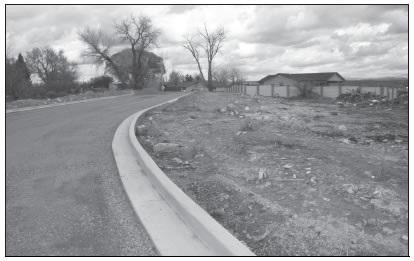
TUCKER LANE

Tucker Lane, shown here facing west, will provide access between the giant Brandon’s Gate subdivision and Highway 145. The terms of the agreement between the city and a developer whose land Tucker Lane will cross prompted a recall effort against five Cortez City Council members. The election is May 3. Photo by Wendy Mimiaga

Targeted for removal from office are councilors Matt Keefauver, Robert Rime, Betty Swank and Donna Foster, along with Mayor Dan Porter. Keefauver, Foster, and Porter are in their second terms, having been first elected in 2006 and re-elected in 2010.

However, just one person has stepped forward as a replacement candidate. Justin Dodson, an artist, is on the ballot to fill Porter’s shoes if the mayor is recalled.

“Some of the folks we tried to get to run. . . they are holding off to see if the election is successful,” explained Bud Garner, a member of the recall committee, in an interview on KSJD radio that aired April 20. Garner said if the council members are thrown out, those interested in replacing them will then seek to be appointed to the board.

“If you do a petition to be on the ballot you have to file all this ridiculous paperwork as a candidate and report all the income and expenses and all of those campaign finance laws, and they are a monster in and of themselves to try to comply with,” Garner said.

He said it is “easier and cheaper” to be appointed rather than elected, but it was not the recall committee’s preference. “That was their [the potential appointees’] view of how to do it. That is not the committee’s view. . . .The committee’s tried to get people to be on the ballot,” he said.

City Clerk Linda Smith said the requirements for getting onto the ballot as a replacement candidate were to collect 25 signatures from registered voters in the city and to fill out a form at three different times listing campaign contributions of $20 or more.

The other members of the recall committee are Jodie Henley, who is a member of the Cortez Sanitation District Board; Norma “Joyce” Turner; and Richard Biery.

Recall fervor

Recalls are the rage across the country. Time magazine reported in April that 57 mayors were targeted for recall in 2010, up from 23 in 2009, and another 15 have been put in the crosshairs in 2011. Just a quarter of last year’s recall attempts were successful, however. Time blamed the bad economy, the Tea Party movement, and the new power of social media for the surge in recalls.

In Cortez, the first recall attempt in city history was prompted by the council’s approval on Aug. 24, 2010, of the final plat of a small, four-lot subdivision known as Flaugh-Clark. The controversy over the subdivision stems from the fact that the city agreed to pay cash to the developers and make infrastructure improvements in order to acquire the right of way to build a street through their property.

The street, Tucker Lane, will connect the enormous Brandon’s Gate subdivision on the west of Flaugh-Clark with Highway 145 on the east.

Recall proponents call Tucker a “road to nowhere” because Brandon’s Gate is as yet not built out.

But city officials say Tucker Lane was on the city’s 1999 master street plan as a proposed throughway.

Other developers questioned the deal that was being given to developer Don Flaugh. At a public hearing on June 22, 2010, to approve the preliminary plat for Flaugh-Clark, developers Dave Waters and Don Etnier said they did not believe it was fair to make them compete with a developer who was being given so much financial help by the city. However, the council passed the preliminary plat that day on a 6-1 vote and approved the final plat on Aug. 24, 2010, by the same margin.

The lone dissenter, Tom Butler, is not targeted for recall, nor is councilor Bob Archibeque.

According to Garner, the reason the other five councilors were targeted is because they were on the council in May 2008, when the city entered into the contract with Flaugh. Two of those, Keefauver and Foster, voted against approving the contract, Garner said, but they did not do enough to stop it.

“They made no effort that we can determine to bring up the legal issues that were involved,” he said in the KSJD interview, adding that he believes the council in general is too easily led by city staff. “If the city lawyer or the city manager or city building inspector comes up and says, ‘Let’s do this,’ boom! vote on it, it’s done.”

Direct access

But both current City Manager Jay Harrington and former City Manager Hal Shepherd say the agreement with Flaugh, while perhaps too generous, was necessary and not without precedent.

The extension of Tucker Lane westward was needed to provide access to the huge Brandon’s Gate subdivision, they say.

There are other accesses to Brandon’s Gate, including an entrance at its north side onto County Road L and some exits to the south back into the city. But Tucker Lane provides a short, direct route onto Highway 145.

“The access to the south would have been through some very poorly designed streets from the ’50s,” Shepherd said. Shepherd was city manager until his retirement in September 2007. He was present when negotiations were begun with Flaugh but left before the agreement was finalized and has said he wouldn’t have recommended accepting the terms of that agreement.

“We saw the need for Tucker Lane. I certainly thought it was important for traffic circulation because of the poorly drawn streets on the south side. From Tucker you can get onto 145 and zoom right down to Highway 160. It just made sense to get that access for police and fire protection and better circulation.”

However, extending Tucker meant going through Flaugh’s subdivision, which at that time was an inholding not annexed into the city and lacking good street access. Just one of the four lots was developed.

Going around Flaugh’s property would not have been feasible because of conflicts with other properties, Shepherd said.

“I looked at that, but Tucker was the only interface that would work,” he said. “Farther north there are other housing problems and private property and it wouldn’t be as direct.” In addition, the elevation of an irrigation canal that has to be crossed is lower at Tucker, he said.

Harrington agreed. Trying to move the access north of the Flaugh property would have meant skimming very close to existing housing and devaluing that property, he said, and there were conflicts on all other routes. “If we had had a clean right of way to connect to, we would have used it,” he said.

So the city approached Flaugh to ask for a right of way, but it wasn’t negotiating from a strong position because it didn’t want to exercise the right of eminent domain, Shepherd said.

“The council didn’t want to condemn the right of way, I’m not sure why,” he said. “That was what condemnation was designed for – for roadways. I always thought it was questionable to use it for economic development as some cities do, but sometimes it’s necessary for a road.”

Meanwhile, John Stramel, one of the developers of Brandon’s Gate and one of the forces behind the recall, was pushing for the Tucker Lane access to be completed. “Stramel wanted it badly,” Shepherd said. “He called every week.”

The city eventually agreed to spend an estimated $325,000 to provide infrastructure for the Flaugh-Clark subdivision, including building Tucker Lane. Normally, developers pay for infrastructure themselves and then deed the rights of way to the city.

“Flaugh got water lines and a sewer line to the four lots, and a sum of money,” Shepherd said. “The street opened up four lots he’s selling – otherwise they were pretty landlocked. That’s a real benefit for him and to add water and sewer to the lots was going too far. But you don’t have much leverage if you don’t want to force the right of way.”

Harrington agreed. “The city didn’t do a particularly great job in those negotiations but we got too far down the line still needing the right of way to connect to Brandon’s Gate,” he said.

Cities as developers

Harrington said when he presented the agreement to the council, he told them it wasn’t a great deal, but it was the best they could get at that point and they had to weigh it against the potential costs of further delays or pursuing the condemnation process, which is time-consuming and expensive.

However, the deal incensed other developers who had been used to spending their own money on infrastructure in their subdivisions. “I got a call from John Stramel saying, ‘Can we blade in Tucker Lane so people can see where it’s going?’” Harrington recalled.

“I said, ‘We don’t have the right of way yet. Here’s the contract.’ He came back and said, ‘You’re giving him too much. Now I don’t want it’.”

Stramel, along with Etnier and Waters, who spoke against the agreement at the June 2010 public hearing, have supported the recall effort, reportedly providing an office for the committee’s headquarters, administering a website and collecting signatures on petitions. However, members of the recall committee insist they decided independently to push for the recall and are not just doing the bidding of the developers.

Garner told the Free Press he believes a route could have been found to provide eastern access to Brandon’s Gate without requiring condemnation. “There could have been a minor adjustment to the north to avoid any of that,” he said. “This project seems to have the effect of benefiting only that particular individual.”

But Harrington and Shepherd said the project was actually done to benefit not Flaugh but Brandon’s Gate by providing it with a main access other than the one onto Road L. Routing too much traffic onto L would have required revisiting the city’s agreement with the county about road impact fees there, Harrington said.

Shepherd said it is not unprecedented for a city to aid a developer. The city helped Brandon’s Gate with its costs for geotechnical work, its impact fees to the county, and some deeper road base that was required because of the soils at the site, Shepherd said.

Nor is it unheard of for a city to act as a developer, said Shepherd, who has more than 35 years’ experience as manager of different cities. “Normally a developer will build the streets and donate them to the city but I’ve been involved in individual projects where the cities put in streets to get factories built and provide jobs. In this case it was more of a transportation issue.”

The city of Cortez paid to extend Seventh Street westward to Sligo near Walmart to relieve congestion on Main Street. “Cities do it all the time,” Shepherd said. “Seventh Street is a good example. We didn’t do it for those private property owners along there, but it will have a benefit for them.”

No basis for complaint

Garner, however, disagrees. He said the scope of the assistance to Flaugh was unprecedented and the council had a responsibility to stop the agreement from going forward.

“There are certain things the staff can and does present [to the council] that are clearly not a government issue or shouldn’t be and I think that’s where the city council past and present has failed the citizens,” he said. “We’re seeing more and more at all levels of government that government should be the solution to everything and that can’t be the case.”

He said he will be very disappointed if the recall fails. “If the citizens of Cortez think that’s OK, if they find no problem in Flaugh-Clark and they would just as soon not pay attention and let them do what they’re going to do, then my view is they have no further basis upon which to complain about anything, whether city council, state legislature or federal government Just shut up and go on down that road; you have forfeited your right to participate.”

Published in May 2011 Tagged , ,

Free Press wins awards in four-state competition

The Four Corners Free Press received six awards in the 2011 Society of Professional Journalists Top of the Rockies contest.

The Free Press competes with other newspapers under 10,000 in circulation in Colorado, Utah, Wyoming, and New Mexico. The competition was for work done in 2010. Results were announced April 16 in Salt Lake City, Utah.

David Grant Long won first place in personal-column-writing for columns about the Tea Party, about accusations of plagiarism against former U.S. Rep. Scott McInnis and about former local District Attorney Jim Wilson.

Gail Binkly took first place in environmental general reporting for “A Long and Winding Road,” an August 2010 article about the controversy over the Recapture Trail in Utah. Binkly also placed second in editorial-writing for pieces about tax law, medical marijuana and illegal immigration.

Binkly, Long, and Jim Mimiaga took second in general reporting (series or package) for a collection of articles about medical marijuana.

Anne Minard placed second in environmental feature writing for “Goshawks: Caught in the crossfire” in January 2010.

Sonja Horoshko placed third in general news writing for a December 2010 story about sub-standard housing on the Navajo reservation.

Published in May 2011 Tagged , , , , ,

Concern over the spread of tamarisk beetles

It’s not so hard to see why people in the late 1800s liked tamarisk trees. Their long, wispy branches boast showy pink or white flowers for much of the year. They can quickly grow to heights approaching 20 feet, and they make great windbreaks. Their combination of deep roots – up to 90 feet in some cases – and extensively branched surface roots naturally help stabilize soils along riverbanks.

And so they were planted, in yards and along western waterways throughout the early West. They took off.

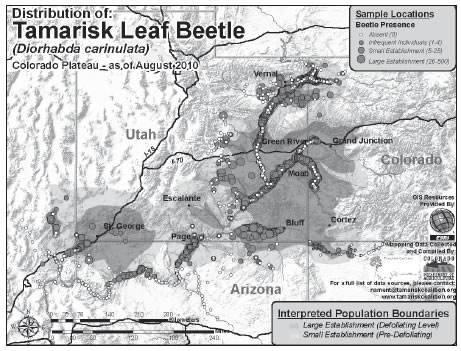
MAP OF COLORADO PLATEAUAlso called salt cedar, the tenacious trees jack up the salt in the surrounding soil by drawing up alkaline water and then depositing it around them as they drop leaves. The tamarisk can tolerate the saltier environs, but native trees – like cottonwoods and willows – cannot.

Tamarisk trees now dominate 1.6 million acres of riparian, or riverside, habitat throughout the Southwest. They’re thirsty trees, and they spread wildfire more readily than native varieties, putting their ecosystems at greater risk than before. No major rivers in the Four Corners states have been spared the tamarisk invasion – not the Dolores, the San Juan, the Colorado, the Virgin, the Rio Grande or the Green.

Since about the 1940s, biologists have tried to remove tamarisk. In places such as Grand Canyon National Park, these efforts are often aggressive and even heroic, involving week-long treks or river trips into remote and difficult riverside habitats where the trees’ millions upon millions of seeds have taken root.

The biologists win battles – in pristine side canyons in Grand Canyon, for example, where they are able to stop the tree’s menacing creep. But until recently, the trees looked most likely to win the war. At the Grand Canyon, the trees are so well established along the Colorado River that park managers gave up trying to stop them there.

“From the beginning we knew we were not getting rid of the source,” said Lori Makarick, Grand Canyon’s vegetation program manager.

And then came the salt-cedar leaf beetle. This relatively new tool in the arsenal against the tamarisk trees, imported over the past decade and released into tamarisk thickets, is proving highly successful – more successful, even, than the USDA and its cooperating agencies expected. It’s been so successful, in fact, that some biologists worry the beetle could become a scourge in its own right, wiping out tamarisk trees too quickly for other species in the ecosystem to adapt.

Taking hold

Following two decades of research into the idea, the USDA’s Animal and Plant Health Inspection Service (APHIS) began importing salt-cedar leaf beetles in the late 1990s from Kazakhstan, China and other areas where they naturally munch on tamarisk trees.

Starting in 2001, land managers in all the southwestern states – except Arizona and New Mexico — began releasing them into tamarisk thickets. Some of the first locales included Lovelock and Schurz, Nev.; Delta, Utah; Pueblo, Colo., and Lovell, Wyo.

In 2004, APHIS invited Utah agencies and organizations to collect beetles from the Delta location and release them in various private and state lands across the state. Many of those beetles went to Moab and St. George.

Jack Deloach, an entomologist recently retired from the USDA’s Agricultural Research Service, was one of the pioneers of the beetle introductions and once called the program “one of the most successful biological control projects ever in the U.S.”

He says the beetles have taken off from almost all the sites where they started. “In several places they’ve gone more than 200 miles from the release sites,” he said. “In Nevada, they’re all over the state now.”

The secondary releases around Moab have proved especially fruitful. They’ve traveled down the Dolores, crossed into northern Arizona along the Colorado and into New Mexico along the San Juan.

“It’s about 1600 river miles now that have been defoliated by that one release at Moab,” said Deloach.

Defying the odds

SALT-CEDAR LEAF BEETLE

Salt-cedar leaf beetles, released in parts of the West to combat tamarisk, are spreading faster and farther than researchers anticipated.

Based on input from the U.S. Fish and Wildlife Service, no beetles were released within 200 miles of nesting locations for the southwestern willow flycatcher, a bird endangered since 1995 that now appears to rely on tamarisk trees, nesting in them even when native trees are still around.

And there was supposed to be another built-in beetle-control strategy: the species released into Nevada, California and Utah wasn’t supposed to be able to survive below the 38th parallel, which crosses roughly above the bottom third of Colorado and Utah. They were adapted to more northern latitudes, with body clocks set to overwinter when the days got short enough. But farther south, such rhythms should have meant they’d go dormant way too soon, and never make it through consequently long winters.

But the beetles quickly adapted, staying active long past their normal bedtime, figuratively speaking.

In the spring of 2009, the Tucson-based Center for Biological Diversity filed a lawsuit against APHIS and the U.S. Fish and Wildlife Service over the “indiscriminate introduction of the tamarisk leaf-eating beetle into critical habitat of the endangered southwestern willow flycatcher,” especially because the group believed beetle introductions at St. George, Utah, were too close to flycatcher habitat along the Virgin River. The center settled that lawsuit just a few months later, when the agencies agreed to renew consultations on the beetle introductions in light of hazards to the endangered birds.

APHIS has since stopped introducing new beetles, but the agency has balked at the suggestion that it should help maintain the birds’ habitat by participating in restoration efforts to plant native trees, like willows, in the wake of tamarisk trees that may die from beetle attacks.

“With no evidence that anything is being done to remove jeopardy from the flycatcher, and with the beetle now poised to move below Lake Mead and into the Rio Grande Valley,” the center requested documentation of the agency discussions on April 14, in line with a plan to renew its lawsuit, Robin Silver, the center’s co-founder, wrote in an e-mail.

Meanwhile, in late 2009, Grand Canyon biologists got a surprise when they found just a few beetles about 12 miles downstream from Lees Ferry, Ariz.

Surveys last year revealed that those beetles — probably from Moab — are now eating tamarisk leaves between Lees Ferry, where Grand Canyon National Park begins, and Redwall Cavern, about 33 miles downstream. Another population of beetles apparently has migrated into the canyon from St. George, and set up shop 100 or so miles downstream.

“I am a little freaked out about how fast they’re coming and moving,” Makarick said. “We didn’t even expect them to be here.”

Management at national parks closely adheres to the National Park Service mission to “conserve the scenery … and the wildlife therein and to provide for the enjoyment of the same in such manner and by such means as will leave them unimpaired for the enjoyment of future generations.” Normally, that means parks will go out of their way to oust nonnative species so the native ones can thrive –removing tamarisk trees, for example, so cottonoods and willows stand a chance.

But Grand Canyon and other parks generally below the 38th parallel are in a bind with tamarisk, because the endangered, songbird-sized southwestern willow flycatcher has seemingly come to rely on the non-native tree.

So whereas Dinosaur National Monument in far northwestern Colorado can celebrate the fact that 50,000 tamarisk-eating beetles have begun to devour the leaves off the trees in much of that park, Grand Canyon biologists are worried.

The fear is that if the beetles kill tamarisks too fast, it will be a hit to wildlife species that have gotten used to them, especially the endangered flycatchers. Furthermore, without native trees to fill in the gaps left by dead tamarisk, other weedy invasives, like Russian knapweed, Russian thistle, pepperweed, and camelthorn, could take up occupancy.

Makarick says her team is about a year out from being fully prepared to plant native trees in the wake of tamarisk, which could die out after just a few seasons of beetle feeding. But they’ve already started collecting and growing native saplings – which, mercifully, grow quickly.

New food on the block?

Rusty Lloyd, program director for the Grand Junction, Colo.-based Tamarisk Coalition, a non-profit that aims to stem the tide of tamarisk invasion, says there are cases in Utah, Arizona, and Nevada where the beetles have defoliated tamarisk trees quickly enough to kill reptiles and insects by altering the microclimates they need to survive. The loss of tamarisk leaves has also fatally exposed flycatcher chicks to increased heat and predation.

But the beetles are inconsistent, and their patchy habits could give Grand Canyon biologists — and willow flycatchers — a break.

“In some tamarisk stands mortality has been very high, maybe 70 percent or more. In other stands, tamarisk mortality has been near zero,” said Kevin Hultine, a plant ecologist at Northern Arizona University in Flagstaff.

And in some places, the ecosystem is showing signs it can rise to the challenge of beetle invasion.

Defoliation in northern Nevada slowed down when local predators keyed into the presence of the beetles. Arthropods such as ladybird beetles, assassin bugs, stink bugs, preying mantis, spiders, and ants tended to keep beetle numbers down, said Tom Dudley, a riparian ecologist at the University of California at Santa Barbara.

“Birds also fed readily on the beetles, and we saw increases in the diversity and abundance of birds in areas with beetles compared with nearby areas where they had not yet colonized,” he added.

Wing and a prayer

Deloach calls the southwestern willow flycatchers’ preference to nest in tamarisk trees a “fatal attraction”: The dense branches at the tree crown are appealing because they offer stability for the nests. But seen from below — as they are by some predators, like cowbirds — the nests are much more visible than they would be in a willow. Cowbird attacks on flycatchers are three times higher for flycatcher nests in tamarisk than willows, he said.

So far, southwestern willow flycatchers have only met the salt-cedar leaf beetle in one watershed — along the Virgin River, which flows through southwestern Utah and Nevada before joining the Colorado River at Lake Mead.

There is anecdotal evidence that flycatcher numbers suffered because of tamarisk defoliation, Dudley said. “On the other hand, where restoration has been done in the upper watershed near St. George, those flycatchers nesting in tamarisk did a very interesting behavioral switch last year to nesting in the willows.”

Once in the willows, one of the trees with which they co-evolved in the first place, the birds tripled the number of chicks they successfully fledged the year before, when they were living in tamarisk trees. Deloach takes it as a sign that southwestern willow flycatchers will end up better off in the wake of the tamarisk-chomping beetles.

“I think salt cedar is very destructive in the ecosystems,” he said. “And I think there’s good evidence that the flycatcher is not going to be at all harmed by this.”

Published in May 2011 Tagged ,

The fuel on the hill

I owned a wood stove once. Actually, the stove owned me. It consumed every stick I fed into it, then it stared longingly out toward the trees.

We were young, deciding to change our little threeroom house over to wood heat, green as the trees we foolishly hauled in from the country. It didn’t take long to learn that where there’s smoke there’s not necessarily fire.

More often, though, as our experiences smoldered, I grew less enchanted with my wood-burning chores, staying in bed as long as I could, buried to our noses under a mountain of blankets and quilts. When I finally couldn’t avoid the inevitable, I’d slip into my union suit, intending to lay a rip-roaring fire in record time and rush back to the coals of my dreams while the house warmed itself to a more hospitable temperature. From the tropical island of our bed, we’d listen to the clanking racket cold iron makes when it’s startled to life by a fitful passion of flame.

Of course, things rarely go according to plan, especially when dealing with wood stoves. More often than not the ash tin brims and needs emptying. Then the can where the ashes get emptied brims too, and it needs to be emptied. Or the convenient stack of wood I thought I’d left just outside the door gets hauled away by the wood elves, prompting a major expedition through the snow to the woodshed.

You’d think we were cold all the time, but no, our place was the only house in our neighborhood where the doors stayed propped open on the coldest nights. Even the dog crawled outside for relief, preferring the temperate glow of the moon and stars.

I can’t forget the fire behind the chimney wall that provided us with one more reason to reconsider our roles as primitive fire-builders. Why I climbed to the roof to smother the chimney I’ll never understand, because instead of taking away the fire’s oxygen and quickly extinguishing our danger, I prompted the entire house to fill with smoke. My wife roused a neighbor and together they choked and gasped while pulling down the chimney wall with a couple crowbars. They may have saved the house, but I knew for the first time that evening that the wood stove was on its way out.

We hauled wood for another year, learning to count our months by the cord. Eventually we had wood delivered, but we were never delivered from the labor of wood. I hauled my wood twice, as stove-length pieces and as ash. Once each month on Sunday morning I religiously scraped our chimney clean. I singed my eyebrows, we both burned holes in our favorite sleeves.

We scrubbed and repainted the ceilings each spring, trying to restore them to their former purity. Sharpening blades, filing saw teeth, replacing axe handles, pulling, sputtering, and choking the daylights out of more than a few chainsaws, we came to dread even the philosophical sound a tree makes when it falls in the woods. With our luck, it always landed directly on another beautiful autumn weekend.

Aldo Leopold wrote that splitting good oak gives one “a wealth of detail denied to those who spend the weekend in town astride a radiator” and I know he’s right. Judging by the cloud of wood smoke that hovers over my little town, there are still a lot of wood-burners out there. When the air gets too thick to breathe, maybe we can burn it.

Our wood stove moved in with a mountain man who appreciates its appetite for attention. I’ve wooed a propane model fireplace where a chorus line of tiny blue flames dances whenever the thermostat says it’s time. We like the new stove’s simplicity, the opportunity to put another metaphoric log on the fire by twisting a dial. Who knows what will become of the time we’ve saved? Maybe I’ll write a book. And if that doesn’t work out, I’ll have the effort to pass along for starting fires.

David Feela writes from rural Montezuma County, Colo.

Published in David Feela

An avocado grove in McElmo Canyon?

Taken from the headlines of one hundred years ago, from time to time people bring me copies of old articles about farming and such in Montezuma County. Sometimes I can understand the who and where of the story while I am reading it. Many times I lack the knowledge to comprehend what I am reading and only through time do the missing pieces come together, giving me a picture complete. Then there is the third category to which this story belongs.

Often I am given copies or clippings, photos or maps and I just do not have the time to process them. So to a pile they go, protected by the safety of my absentmindedness until such time exists that I might find and read, contemplate and absorb that central kernel of knowledge that falls unpopped.

This story concerns a man by the name of Artemus Ward. Mr. Ward worked the mines of the Alta district, above Ophir, from 1874 until the snow melted away sometime about June of the following year. Mr. Ward came to our country as a veteran miner from ’49er, a participant in that great gold rush. Prior to that he was a farmer born along the banks of the Little Chinoweega Creek, near Mulfuresburg, Tenn.

I imagine that though he saw his fortune in mining his heart was always on a farm.

After leaving Alta he settled into lower McElmo Canyon, planted an orchard, had cattle, and resumed farming. Among the crops that he grew were avocados. Yes, avocados.

Apparently his seed stock came from the high foothills surrounding the gold country near Truckee. Through some set of trial and error he found seed in his stock that would grow higher, just barely higher, than the Sierra Mountains that had thus far sustained them.

For the first few years he took no chances. After going dormant the trees were gently laid down and pinned to the ground with one to two feet of loose mulch applied as insulation against the winters of 5,478 feet.

Each spring found many trees dead but as always a few survived until about five or six avocado trees remained from the original 632 seedlings.

A review of weather data from those years does reveal unusually warm winters consistent with powerful La Nina events except for occasional, nonspecific, briefly neutral climate occurrences.

One spring when the jaw-dropping, breakneck spectacle of thousands of peach, plum, pear, quince, apricot, apple, and persimmon trees in blossom stunned all residents of McElmo Canyon alike, the avocado trees set fruit.

Artemus Ward took the seeds from those 123 fruits and planted them again. Within two years these trees were three feet tall, and after four more years a grove of 26 avocado trees was in full production.

Tragically, and friends, this is a tragedy, Mr. Ward was killed by the poison of the rare but always fatal avocado pit weevil.

The avocado grove in McElmo Canyon, according to this report by a Mr. Orpheus Kerr, persisted until the winter of 1932, when temperatures of 36 degrees below zero proved insurmountable for the avocado trees forgotten.

This story was submitted respectfully by the observant Mr. Kerr on the first day of April, 1953.

Jude Schuenemeyer is co-owner of Let It Grow Garden Café and Nursery in Cortez, Colo.

Published in Jude Schuenemeyer

The age of heartaches and hormones

So, I am standing in line at Walmart of all places. I am with my three sons (the two I gave birth to and the one who seems to live on my couch and calls me mom).

We’re in the impulse-buy area and when I finish unloading my cart, I turn around to see the boys clustered around something.

It’s not gum. It’s not Pokemon cards.

It’s the Sports Illustrated swimsuit issue. Holy S@#^, I have teenage boys. When did that happen?

I stood there staring at them, mouth agape while they stood there staring at breasts, mouths agape.

The earth shifted on its axis and I was aware that nothing is the same any more. We have gone from sweet little boys to verging- on-gross young men.

There have been indicators along the way to this point.

There’s hair, boy-stink, eating meals every hour on the hour.

One’s voice has changed – he never even went through that squeaky thing. He just woke up one day and had a voice deeper than his father’s. The other one is the one who’s voice will crack for two years before it finally settles into a man’s voice, if it ever does.

They both have girlfriends.

Well, at this point, only one does.

The other one just broke up with his first love (not the first girlfriend, not by any means, but definitely the first love).

I went into his room a couple of weeks ago to find him in the fetal position in bed, curtains closed, sniveling.

When I tried to talk to him, he burst into tears, snot flying and actually hugging me. His heart was broken and I didn’t know what to do about it.

I knew that he had reached a milestone – the first broken heart stays with you forever, colors every other relationship that you have.

I dragged him out of bed and out to the desert for some fresh air and a distraction. He lagged behind all day, mentally drifting off to the days of making out at the school bus stop.

Two days later, he’s fine. When questioned, his response…

“Mom, I’m in middle school – we don’t dwell on these things.”

And during the time this is going on, his brother is quietly texting the girl who is 8 inches taller than he. He’s going to have to stand on a chair to kiss her if it ever gets to that point.

Actually, in the time it has taken me to write this, the other one and his giantess gal pal have also split. My home abounds with broken hearts and hormones.

They give me relationship advice, which, apparently I need. Not sure that pubescent boys are the best resource, but they offer it up freely, so I listen.

They tried to use the word “chick” but I put the kibosh on that one immediately.

They watch horror films. Gone are the days of worrying about “Pirates of the Caribbean” being too intense. I guess I was about 13 when Friday the 13th hit the big screen.

I was also 13 when I started drinking and smoking pot, so I now spend a lot of time smelling breath and scrutinizing their eyes when they come home from friends’ houses.

They have conversations that stop when I walk into the room.

It wasn’t that long ago that they told me everything. That I was with them everywhere they went. That a pack of gum in the grocery aisle was exciting. That they didn’t even know what a breast was except something used to feed a baby.

They snuggled with me in my bed and watched “Spirit – Stallion of the Cimarron.” Now they stay up all night watching things that I am sure would horrify me so I close my bedroom door and pretend they’re at their father’s house.

They leave without kissing me goodbye, although before school I insist on a hug.

It’s like pulling teeth some mornings to get that.

But there are other people whose company they would never part from without multiple kisses.

I tell them I love them and I hear nothing. And I know they can say, “I love you” because they do (or did) with their girlfriends all the time.

Yuk.

I think about the boys I knew when I was that age – all zitty and sweaty-palmed, braces and awkwardness. Slow dancing pressed up against each other, unable to separate due to unexpected and embarrassing bulges.

And now, that’s my son (s).

One of my mother’s favorite words is “snarky.” Loosely translated it means having the personality of a snake combined with that of a shark.

Teenage boys.

If one isn’t mad at me for something, the other one is. If they aren’t being nasty to their father, they are being wretched to me.

They come to the dinner table, rest half their asses on their chairs and inhale their food before I can even pick up my fork.

They rummage through the refrigerator at 2 in the morning.

One of them spends a LOT of time brushing his hair in front of a hand mirror. The other one puts on deodorant about once and hour.

They are loud. They listen to terrible music (which is also loud). They have awkward, gawky friends who think they are ultra cool. They have a lot of fun at my expense. They have secrets and inside jokes. They have an entire language that I don’t speak. They oogle at girls in swimsuits and fantasize about them in the privacy of their rooms. They have no need for me, would rather be with their friends and are most definitely embarrassed by their uncool mother.

But, at the end of the day, when I look around the dinner table and see two or three extra boys, when I go to bed at night and they crawl in with me to visit, when they tell me who their favorite swimsuit model is, when a heart is crushed and they need someone with whom to cry.

I know they still love me and they are still my babies.

Hormones, swimsuit models and all.

Suzanne Strazza writes from Mancos, Colo.

Published in Suzanne Strazza

Where would we be without unions?

This past month there has been a very big and important brouhaha in Wisconsin over the right of labor to do any collective bargaining. Having been on both sides of union bargaining as well as a member of several different unions, a spokesperson for union and company, and still a card-carrying duespaying member of a union, I feel I am in position to give my opinion.

This governor is a lackey of big corporations and the Koch brothers. These are the types of people the union organizers have been dealing with for more than a hundred years. The scabs and free-loaders that benefit from murder and mayhem rained on the unions by persons like the Wisconsin governor should read some history of the union movement.

The corporations have their lobbyists — why can’t labor, which built this great nation, be allowed to have a place at the table? Today union members and the free-loaders should be recall to mind a barbaric catastrophe that happened 100 years ago this March. I’m referring to the Triangle Shirt Factory fire that burned alive hundreds of under-age girls in a sweatshop in New York. That’s what happens when you don’t have unions to give protection to workers. Will the free market look after the lowly citizens who make the executives rich? Hardly.

Union organizers have been shot, maimed, incarcerated, spat on by our police, National Guard, Army, Pinkertons and hired thugs, but they persevered. They gave us the 40-hour work week, eight-hour work day, paid vacations, health care, minimum wage, and retirement benefits, along with well-made products, skyscrapers, and military equipment. They proudly fought and died for their country while their union wives built a ship a day to carry the men and munitions to the shores of our aggressor.

Coal-miners came together and did away with grossly hazardous working conditions, the greedy company store, and the rent and grocery bill that could never seem to get paid. Don’t you think a man’s life is worth more than $2,400 to the widow and children?

The wealthy barons of the past garnered all the glory as to shaping this country, when in reality it was the union workers that gave us our present-day standard of living. Those that rail against unions, labor and corporations cite corruption. Well, corruption is less rampant in unions than in corporations. It is a human trait, whether in government, corporations, unions, religion, this right-towork state.

Right-to-work — what a misnomer. We all have a right to work. The question is, do we have the right to bargain for better wages, health care, a safe working environment and a retirement program where we are rewarded for years of hard work and can still contribute to the economy of the nation that unions built with money from our pensions? Or do we go backward to the time of 12-hour days, seven-day weeks, child labor, on-site dangers, company housing and the company store?

The union history in Colorado is not a saga we should be proud of. Think of the Ludlow massacre, when the miners and their families were driven off their homes and lived underground on public lands as much theirs as anyone’s. They were machine-gunned down and gasoline was poured into their tents and dugouts, which were then set on fire by police, the Army, the National Guard, and security hired by the corporations. Nice guys, hey? Telluride, Cripple Creek, Leadville and numerous other mining towns in Colorado had strike for just wages and safe working conditions. From the Appalachians to California, labor has struggled for decent pay, health care and retirement. Is there anything wrong with that?

To try to take away bargaining rights from labor doesn’t bode well for Wisconsin governor, as he is finding out. With the backing of the wealthy Koch brothers, he is even defining the Wisconsin Supreme Court. Thanks to Walmart, a great supporter of communism and non-union corporations, China now outranks the United States in manufacturing. But look at all the shoddy merchandise and recalls. I’ll take unionmade any time.

Galen Larson writes from Montezuma County, Colo.

Published in Galen Larson

‘Sacred Images’ showcases ancient rock art

The photo exhibit, “Sacred Images: A Vision of Native American Rock Art,” will fill the Special Exhibit Gallery at the BLM Anasazi Heritage Center in Dolores, Colo., from April 1 through Oct. 30.

The exhibit features Utah rock art in vintage chromogenic prints by photographers Craig Law, Tom Till, and John Telford. Their work acquaints the visitor with four major styles—Barrier Canyon, Hisatsinom, Fremont, and Ute—as well as the perceptions, sensibilities, and cultures of early people who hunted and farmed the Great Basin and adjacent areas.

FREMONT PETROGLYPH

This photo of a Fremont petroglyph is among those that will be on exhibit at the Anasazi-Heritage Center through Oct 30. Photo by John Telford/Center for Documentary Arts

Rock art can be found along cliff faces, inside overhangs, and on boulders. Whether pecked or painted on stone, the images represent an artistic tradition reaching back at least 8,000 years. They convey a wealth of information ranging from simple details to complex narratives.

Occasionally the photographers recorded sites located close to paved roads. But reaching other sites required multi-day wilderness hikes with llamas to carry the heavy photographic equipment. Their reward was a wealth of fascinating subjects, including some of the finest rock art found anywhere in the world. The exhibit was organized by the Center for Documentary Arts of Salt Lake City, with comments by curator David Sucec. His texts describe the aesthetic and cultural content of each image, and connect each style with evidence found and interpreted by local archaeologists.

Sucec, who holds a Master of Fine Arts degree from San Francisco State, has devoted years to researching Southwestern rock art. He has been a faculty member at Virginia Commonwealth University, and a member of the Salt Lake Art Center faculty.

Sucec will speak at the museum on June 26 at 1 p.m. in connection with the Four Corners Lecture Series.

The Anasazi Heritage Center, three miles west of Dolores on State Highway 184, features permanent exhibits on regional archaeology, history, and Native culture. It is open daily from 9 a.m. to 5 p.m. through the end of October.

For more information, contact the center at 970- 882-5600, or visit the web site at www.co.blm.gov/ahc.

Published in April 2011, Arts & Entertainment Tagged , , , , ,

Fruits of their labor: Day workers plan an enterprise garden

A group of men waiting at the Day Labor Center in Cortez recently began talking about the links between work and food.

Waiting for jobs at the center can be expensive and dispiriting if none are available. But it also proved to be fertile ground for a discussion that led to resourceful problemsolving. When no jobs are available, how will day laborers feed their families? A result of the stark, realistic look into the personal and daunting situation has generated a community project growing from the ground up. The day laborers are founding their own community garden.

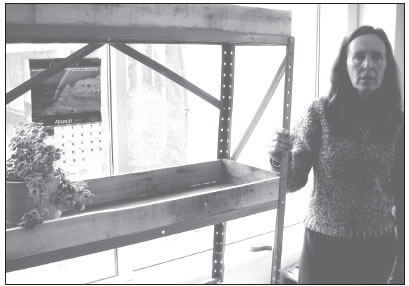
ANNA BOUSQUET DISPLAYING SEEDLING SHELF

Anna Bousquet, manager of the Day Labor Center in Cortez, shows off the first finished seedling shelf built at the center by clients for their Day Labor Enterprise Garden. Photo by Sonja Horoshko

The project, Day Labor Enterprise Garden, has garnered enthusiastic support from organizations throughout Monetzuma County; it is the self-made link in the chain that opens accessibility of local healthy food and nutrition, to people of lower income.

Anna Bousquet, manager of the center, says the men hold planning meetings in the mornings. Through an inspired process to help themselves, they have decided a community garden is the most potent use of their labor, and, it provides valuable work they can do when no day jobs are available.

Redefining themselves as a gardening team, they have written a plan, objectives and procedures that include accountability and record-keeping and a client for their produce, a future for their own work. They hope the first recipient of their harvest will be the soup kitchen that serves the homeless people in the community.

They have also identified the need for education, how to build soil, cultivate, water, harvest and, yes, cook the food they grow. By designing their own objectives and goals they have also defined their own curriculum. They also know now what they need to learn and are looking forward to the educational block classes being offered to them, tuition free, through the support of Live Well Montezuma.

Clients will be given instruction and training classes as they earn a gardening certificate. “It’s a chance to give back to the community,” says Kevin Litsue. “We hope to work to help the soup kitchen. Working in the garden backs us up, when there’s no day job.”

At the end of the training and after a season of working in the garden they hope to have developed skills that qualify them to build gardens for others, especially people who want a garden but need physical assistance. Their production and management knowledge will enable them to hire out as a garden enterprise team, a business that will supply work for the garden / landscape team while providing income to support their families.

Live Well Montezuma heard about the work they were doing and offered to collaborate on the project. JoDee Powers, director of LWM, hopes the first season is a success. “If the first step is manageable then the project can grow in the coming years,” she says. “For now, we hope they produce enough to supply the soup kitchens with some produce from the garden and, of course, when day labor families need assistance, the garden can help provide local healthy, affordable vegetables for them.”

The Day Labor Center is a program managed under the umbrella of the Bridge Emergency Shelter where adult men and women can find emergency shelter and a warm meal from October through April. Many of the same people are clients at the Center.

“There is also a socialization component to the garden project,” says Bridge director Sara Wakefield. “It’s character modeling, social interaction with various community members and also builds skills and creates work. Food security and homelessness are linked. A pro-active project like the Day Job Garden lends a lot to the hope and spirit and supports the whole person working in it. It can be a shining star in our community.”

Live Well Montezuma is collaborating to support the day-labor workers who see opportunity in their jobless reality. Powers says, the concept of the day-labor garden fits into “the strategies LWM set to increase afford able, accessible, healthy, nutritious foods for lower income populations and residents of Montezuma County.” The organization sees the project as a long term food enterprise with potential to grow into lifestyle changes that affect choices in healthy eating and active living. According to Powers, “There has been a huge explosion of community interest in this project and how it links to the longer vision for our larger community.”

“This is an agricultural economy,” says Mitchell Toms, president of the Montezuma Community Economic Development Association. “It always has been, and we’re glad about the collaboration bringing the people in these three organizations together to address the issues around food supplies, production, sustainability and nutrition.”

Renewed interest in the Cortez Farmers Market has revived broad-based community access to the local, fresh food available in Montezuma County. Although the day-labor garden workers would like to have a presence at the Farmers Market this year, they first want to build a garden that works for the produce as well as their need to accept day jobs when available. Bousquet says, “There will be some scheduling issues, but the planning they are doing is careful and realistic.”

The Methodist Church has provided the land and water for the garden and initial work has begun. Two of the day laborers are building shelving for spring seedling germination in the back room while conversation every morning at the Day Work Center focuses on the business plan. Cost of goods is built into the funding requests to supply garden materials, pots for seedlings, deer fence and chicken wire, a secure garden door, soaker hoses and seeds, plant selections, seeds, soil amendments and compost piles.

Long-term objectives include the desire to generate sales to the community institutions, which can eventually help pay some of the labor costs and allow the project to become self-sustaining. In the meantime, even cooking is seen as an educational component of the project. Classes will be offered to the day laborers in food preparation, food safety, nutrition and culture and use of spices and herbs. How we cook our food, what we eat and who sits with us at the dinner table embeds human nourishment into the process, gluing the community together.

When Bousquet asked the men to think about what they can do for themselves and their families while they are waiting for work at the center she saw their self images change as they worked through the process.

“We see ourselves as wealthy and generous when we can produce our own food and feed others,” she says. “It is also an education for the community and if volunteers want to help that will also offer respect for the men and the project. Gardening is like a friendly hug…it spreads to the next plot of land and that hug spreads again to the next plot of land.”

More information can be found at daylaborcenter@hotmail.com, and bridgeemergencyshelter@gmail.com and lwmontezumz@gmail.com.

Published in April 2011 Tagged , , ,

Bluff, Utah, says no to centralized wastewater treatment

A March 19 decision by the Bluff Service Area Board to take no action regarding its sewage-treatment options has left the town in limbo and at least one board member aghast.

The meeting was purportedly held so the board could decide which of two fundable options for sewage treatment it should present to the Utah Division of Water Quality. Instead, the board voted 4-3 to take no action, prompting its chair to resign in frustration.
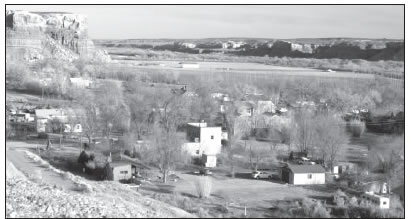
BLUFF, UTAH

A decades-long controversy over wastewater management in scenic Bluff, Utah, has heated up once again with the recent decision by the town’s Service Area Board to take no action on a centralized sewage-treatment system. Photo by Wendy Mimiaga

“It’s a horrible situation,” said former chair Dr. Dudley Beck, a physician with Indian Health Services for 38 years, who resigned the day after the vote.

He said he had been on the board about five years, “and I feel like I’ve totally wasted five years of my life for a community that doesn’t deserve the board’s efforts.”

“I’m so sad and so disappointed,” Beck said. “It’s been an emotional nightmare.”

The Service Area Board looks after issues such as garbage, recreation and mosquito abatement for the unincorporated town of about 320 on the northern bank of the San Juan River. For several decades, one of the community’s biggest issues has been sewage treatment.

The state and the county have pushed Bluff to install a centralized wastewater system instead of relying on individual on-site septics, but many locals have resisted, maintaining that the cost would be high and that there is no need in such a small town. But advocates insist a system is necessary because of Bluff’s proximity to the river and the fact that its soils are not ideal for handling septic-system effluvia.

In May 2008 the Service Area Board voted to pursue funding for a decentralized sma l l – p i p e collection system and applied for grant money to complete the design phase.

The recent meeting was intended to see which of two treatment options the community wanted to pursue, according to Skip Meier, now the board’s chair.

“The whole purpose of the meeting. . . was to see which of the fundable options we were going to submit to DWQ to seek funding,” said Meier. Only two options were fundable, he said – a small-pipe collection system with treatment and surface discharge; and a largepipe system with a lagoon. Each would have cost abut $5 million.

“This is where it gets sort of fuzzy,” he said. “The board was to vote on which option we would present to DWQ, but somehow two options which were not fundable, and which were not really the purpose, were included, and then four trustees voted to do nothing.”

Meier said he had favored the small-pipe system, which was the least-expensive treatment alternative and the one favored by Nolte Associates Inc., the engineering firm hired to study the situation and propose options.

Beck, who also voted for the small-pipe system, charged that opponents of any centralized system sabotaged the entire effort.

“This community was requested five years ago to tell us what they wanted, and they all told us, and we went down a path to make that happen, and in the final hour they come in the back door and stab us in the back,” he said. “They get some of their cronies on the board at the last minute and vote to shut down any effort to solve a problem that’s been plaguing the community for 30 years.”

At present, Meier is the only board member that has run for office in a contested election. The remaining trustees were appointed to fill vacancies; some would have run in the most recent election but had no opposition.

“Nobody wants to be on the board – it’s a miserable job. In the past nine months we’ve had people quitting, and then people who want to stop this whole project volunteer to be on the board. They come in late, they refuse to work – their sole purpose was to block this,” Beck charged.

About three weeks prior to the meeting, the board sent an electronic poll to a group e-mail list so town residents could comment on the treatment options prior to the final vote, Beck said. The poll was not an official vote and was open to anyone who wanted to respond, including homeowners, renters, even visitors.

The board secretary removed signatures on the e-mailed responses before giving them to the trustees. By 11 on the morning of the meeting, Beck said, the tallies were roughly equal, with 20-some respondents favoring doing nothing and the same number each favoring a small-pipe system or a large-pipe lagoon system.

In the next few hours, however, the number favoring no action zoomed up to around 60 while only a trickle of responses came in for the other categories, Beck said.

“It just makes you wonder,” he said.

In the end, 59 – a plurality – preferred no action, and 65 votes were split among the different treatment options.

“Fifty-nine wanted to do absolutely nothing,” Meier said, “whereas 65 wanted to do something. So the majority who responded to the poll wanted to do something, but the trustees said the majority wanted to do nothing, so that’s where everybody’s upset.”

But Jackie Warren, a recent board appointee who opted for no action, said the furor over the vote was something of a non-issue, considering that the state reportedly has no funding available for any type of treatment.

“At the end of the meeting on Saturday with the state and geologists, etc., they said there is not enough money to fund this option, any option. That is how they ended the meeting. So the vote is kind of ludicrous,” Warren said.

“It’s kind of a no-brainer. There isn’t any money, the whole town doesn’t want it, and we don’t need it.

“I don’t know why they were making everybody jump through the hoops when they didn’t have the money, but they said, ‘You need to go through these procedures so when money becomes available, you know what the people want’.”

Warren contends there is no problem with residential waste disposal in Bluff. “Absolutely not,” she said. “All the new septic tanks and leach fields have been approved.”

She said she’s done her homework and cited a report by David Snyder, an engineer with DWQ, that found no widespread problems. “There are a few small lots that are very old that shouldn’t even be built on, and that’s a zoning issue that the county controls. If the county approves your building permit, who’s at fault if your lot is too narrow for even a house, let alone a wastewater system?

“That’s what we’re going to work on. When people voted ‘do nothing’, it wasn’t do nothing, it was, ‘do not accept any of these options because two of them they wouldn’t fund anyway, so let’s figure out what to do with the narrow lots,” she said.

“At the meeting, DWQ said we had pristine groundwater in Bluff. ‘Pristine’ was the word they used.”

Meier, a longtime board member, believes that assessment is too rosy. He said there have been a number of septic failures on residential properties and several notable failures of larger systems.

A July 2005 report by Nolte found that in Bluff, “Many onsite systems already failed or are malfunctioning while many systems have potential to fail or malfunction in the future.” The report said the failure rate of 10 percent or more in two years among the 122 systems was disturbingly high.

“When the school’s system failed nine years ago, there was raw sewage on the playground, and when the Twin Rocks [Café] leach field failed, the septic tanks were pouring raw sewage into Jackie Warren’s yard,” Meier said. “And of course Recapture Lodge – it was the same sort of thing.”

In September 2009, Recapture, one of Bluff’s largest and most prestigious businesses, was issued a notice of violation by the Utah Division of Water Quality for failures of its waste-disposal systems and the unauthorized discharge of wastewater and sludge into an unapproved lagoon system.

A bilateral compliance agreement has since been worked out between the lodge and the state, and the lodge recently reopened its laundromat, which it had voluntarily closed when the notice of violation was issued.

Warren, who works at Recapture, said the failure there was an isolated incident caused by freak circumstances.

“The day the state came down was the day we had had 70-mph winds and the power was out for six to eight hours. We had electric lines lying on the highway and the whole fire department and everybody was running around town,” she said.

Recapture has its own sewage plant, but that shut down for six hours, which was when the state did its testing, Warren said. Recapture has since installed a new battery backup system.

Meier said there remain serious concerns about the individual septic systems in Bluff. Many were not built to existing standards, he said, and the state health department has the authority to require lots with non-compliant systems to become compliant when the systems fail. The problem is that some of the lots are too small to support an on-site system.

“They are probably going to have to do whatever is necessary to meet standards, whatever that means, and whatever that means is where the big question is,” Meier said.

“Can the place be red-tagged? Can occupancy be vacated? Are they going to allow alternative systems? Are they going to allow the effluent to be treated and taken off-site? All of these very vague things which have been totally avoided for the past 50 years in the state of Utah are going to be coming to a focus in Bluff.”

Beck concurred. “They [central-system opponents] have chosen to call the bluff of the county health department, the county commissioners, the state, and I would be extremely surprised if the current wastewater rules and regulations are not implemented in a way that will cause harm to many poor people in this community.

“People have invested their life savings in small places and now they risk losing them, and there’s people that don’t care. That’s what angers me the most. It makes me ashamed.”

He said some of the blame belongs to San Juan County. “I think it’s sad the county has let things get to this point. They’re way too lenient on rules and regulations. They control the building permits and for 40 years all they have cared about is growth.

“People have been sneaking around for years – what do you do when your system fails? You get some local to come in in the middle of the night and dig a ditch so people won’t know there is a failure.”

A pressing concern posed by the situation is the upper aquifer beneath Bluff, according to Meier. When a system fails, a typical response is to dig deeper. “If you put it deep enough, it won’t surface, now will it? So then it goes into the aquifer.”

Inspection reports on septic systems are generally vague and incomplete, he said. “We might know that a leach field was put in at the bottom of a trench at 10 feet down, but we have no idea if it was ever checked to see if the water table ever reached 10 feet.

“The untreated effluent is being put deep so it won’t surface, but that allows it to get into the ground, so that’s your potential risk. You’re not preventing it from reaching the groundwater.”

Meier said test wells have indicated that the upper aquifer is being influenced by humans, though not necessarily contaminated. “Things like chloride and sulfates and ferrates that couldn’t have gotten there any other way were present,” he said.

He said the three aquifers below Bluff are all interconnected and are also connected to the San Juan River, and if contamination ever reaches the river, the federal government will step in. “They don’t sit around and hem and haw. They say, ‘You shall cease and I don’t care how’.”

Warren thinks such concerns are exaggerated. “You know what? We could get a tsunami here, too.”

She said groundwater test wells have found no contamination.

“Groundwater moves very, very slowly. They’re saying 10 to 20 years before they would even bother to retest them because that’s how long it takes bacteria to move through groundwater.

“We can worry about a lot of things, but they have the test wells in place, they will check them, and for the last 120 years the people have lived in this valley. It’s not contaminated.”

She mentioned a remark by David Cunningham of the Southeastern Utah Health District that septic systems are at inherent risk of failure. “Let me tell you, so is my body,” Warren said. “Should I go to a nursing home now at 62? Should I just sign myself in because I’m going to die some day? Or do I take care of myself?

“I’m inherent to failure but I’m taking care of myself and that’s how leach fields or septic systems work. It’s God’s plan. Bacteria goes into the ground and breaks down.”

Beck believes implementing a central treatment system would be the best way for Bluff to take care of itself. He said there is a genuine health risk in the current situation, and that risk needs to be tackled. “It could be dealt with through a central system that is preventive in concept, and to not do that is taking an incredible risk in a droughtstricken area where water is so critical.

“I think people are crazy to take that risk.”

Meier agreed. “A lot of people are aware of what happens if you don’t keep your waste under some sort of control and observation – it’s a dangerous thing. Not quite as dangerous as released radioactivity, but released poop can be dangerous.”

Marilyn Boynton contributed background information to this report.

Published in April 2011 Tagged , ,

Blowing in the wind: Why renewable energy is slow to catch on in the region

Looking at resources alone, the wide open West is poised to be a breadbasket for the country’s ambitious renewable-energy goals. But finding places to put the necessary infrastructure is proving to be a trickier matter.

That’s partly because of a reality that is a bit counter-intuitive: Sure, renewable energy is “green” development. But tell that to the neighbor of a huge solar installation, its panels gleaming hot and black for acres and excluding wildlife that used to be common. Or the rancher whose vast tracts of land are now crisscrossed with power lines that buzz just like all the rest. Or the rural resident who’s savvy to the already numerous threats to bats and birds, and adds fatal encounters with wind towers to the distressing list.

SOLAR PANELS

A number of obstacles have impeded large-scale renewable-energy developments in the Four Corners, although solar panels such as these are popping up in more places.

The greater Four Corners area, with its varied – and too-often mountainous – terrain, doesn’t start out ideal for the industrial- scale energy projects that will fuel the country’s green-energy needs. Factor in its culturally and environmentally significant areas, and the land that’s ripe for renewables shrinks even more.

But that doesn’t mean the Four Corners area isn’t doing its part. That’s partly because on a smaller scale, there are movements under way that could allow the Four Corners area to power itself.

Wide-open spaces?

When the Boulder, Colo.-based National Renewable Energy Laboratory started releasing its renewable resource maps two decades ago, the Southwest emerged as a gold mine – especially for solar resource potential. But that was before the Interior Department got hold of the maps – and overlaid them with habitat for endangered species, culturally sensitive areas, and lands that had already been sold or committed for development, among other restrictions.

The national effort to identify the lands available for solar is the National Solar Energy Development Programmatic Environmental Impact Statement (PEIS), now in the draft stage. So far, that effort has identified 24 solar-energy zones – places where, all known factors considered, development of large-scale solar resources is feasible, and a high priority. The zones surround, but neatly avoid, the Four Corners area. The nearest zones to the east fall into the San Luis Valley, and the nearest zones to the west are in western Utah’s Escalante Valley, and across the border with Nevada.

Beyond the national inventory, the BLM in each state has taken the lead on an even closer look at places where energy development could get the green light – and where, on the other hand, land has already been promised for development, where it’s likely to get caught in the mire of Endangered Species Act protections, where transmission lines are missing, or where water is limited for solar development, which requires ample water for cooling if it’s to be done commercially at a reasonable cost.

Arizona, New Mexico, Colorado and Utah are in various stages of analyses to explore the areas where renewables could go, but so far the numbers have been whittled like this: 13,735 acres in Arizona, down from 4.5 million acres that were considered in the national PEIS; 113,000 acres in New Mexico, down from 4 million acres; 148,000 acres in Colorado, out of 8.3 million acres owned by the BLM in that state; and 19,000 acres in Utah, most of them in the state’s south-central region, out of 2 million acres where solar power could have been harvested.

Sandy Bahr, director of the Sierra Club’s Grand Canyon Chapter in Arizona, gave most renewable-energy development so far a nod of approval, largely because the processes are focusing on lands that have already been disturbed.

“The bottom line is we want to see investment in renewables,” she said. “But that doesn’t mean you just put it anywhere.” The Sierra Club keeps a close watch on the new developments; most recently they asked the BLM to consider birds, bats and other wildlife in comments on a huge wind farm proposed for the Mojave Desert. But so far, developments closer to home – like the 120-megawatt-capacity Dry Lake Wind Power Project that opened last year between Snowflake and Holbrook, Ariz. – have been sited on lands that were fair game, from the Sierra Club’s perspective.

“These lands had livestock-grazing,” Bahr said. “It wasn’t in a major flyway. If there were cultural issues, they weren’t raised with us.”

A new proposal to site a 99-megawatt wind farm south of the Grand Canyon near Williams, called the Perrin Ranch Wind Energy Center, has also raised no alarm bells with the environmental community.

 Special obstacles

The Four Corners is a challenging place to site renewable energy. Its mountainous terrain is too high for solar, and in most places, cloudy days reduce the solar radiation that could make solar-power collection worthwhile for large-scale commercial interests.

Tom Heinlein, field manager for the BLM field office in Monticello that covers San Juan County, Utah, said large-scale proposals are unlikely in his area because of an “incredibly high density of archaeological sites that cover the landscape of southeast Utah and the difficulty involved in placing a commercial-scale development within an area of such significant, non-renewable, cultural resources.” He also noted that large-scale solar developments require flat sites, which aren’t typical in canyon country.

Some high mountain ridges in the region would be good for wind, including several in extreme northeastern Arizona and southwestern Colorado, especially Sleeping Ute Mountain. But all of those areas are on Native American land, and some of them – like Sleeping Ute Mountain – are sacred enough to prohibit development altogether.

The Ute Mountain Ute tribe has been considering wind development elsewhere on their land, and saving more than $4,000 a year by using photovoltaic solar panels to power a tribal water pump. That tribe, the Southern Ute tribe and the Jemez Pueblo tribe in northern New Mexico have all expressed interest in bringing large-scale solar developments to their lands, in the hopes that they’ll be profitable enough.

As of last year, renewable-energy installations in the Four Corners tribal lands added up to just over 500 kilowatts of capacity, including wind and solar projects at Hopi, the Navajo Nation, Southern Ute, Ute Mountain Ute and numerous Pueblo tribes in northern New Mexico. In total, that’s equivalent to the capacity of a three-plus acre, 2,700-panel solar array that will easily supply the power needs of the University of New Mexico’s Taos campus when it goes fully online this summer.

Tribal efforts are getting some help from environmental groups for the installations, but their relationships are fairly aloof with federal agencies around renewable-energy development.

When it comes to the lands in Arizona that are considered eligible for renewable energy development, “there’s nothing on the reservations,” said Dennis Godfrey, an Arizona BLM spokesman. “There was outreach and contact with the tribes, and… they’re just choosing to go their own way.”

Sam Woods, energy and policy advisor to the Navajo Nation President’s Office, said that’s a fair assessment. The nation employs an Energy Advisory Committee that is working on a comprehensive energy policy for the tribe and should have it completed sometime this spring, he said. “We are exploring opportunities in solar and wind, biomass and clean coal technology,” he said, pointing to a wind-energy deal that’s in the works at the Big Boquillas Ranch in northwestern Arizona.

But tribal renewable development could evolve at a slower pace outside the coordinated – and often better-funded – national efforts. And each tribe will face its own cultural and governmental challenges in making it happen.

For example, the central Navajo Nation government and the Cameron Chapter recently were at loggerheads over wind resources on Gray Mountain: Sempra Energy was planning to develop a 500-megawatt wind farm in partnership with the Cameron community – while the central government was working on a conflicting plan with Citizens Energy. It’s not clear yet how development there will proceed.

Power on the move

The communities of San Luis, Alamosa and Crestone, Colo., boast more than 1,000 solar systems between them, due in part to a rush of solar entrepreneurship in the 1970s. Solar infrastructure in the San Luis Valley has reached a capacity of 63 megawatts – enough to supply all the energy needs of its scattered 50,000 residents, wrote Ceal Smith, a member of the San Luis Valley Renewable Communities Alliance, in a High Country News essay last year.

But they’re not especially interested in sharing – especially if it means sacrificing their own area’s independence or character. Residents there organized opposition to Xcel Energy and Tri-State’s proposed, large-scale solar development in their back yards and a 95-mile line that would ship power from the valley through the Sangre de Cristo mountains to energy markets serving Colorado’s Front Range to the north. The opposition includes not just the infamous billionaire rancher Louis Bacon, but Smith’s Allliance and a separate group, the Transmission Line Coalition. Ceal and like-minded activists are pushing for so-called “energy sovereignty”: small-scale, community-based power that avoids large-scale transmission projects leading out of “energy sacrifice zones.”

Despite the backlash, the state Public Utilities Commission approved the transmission line last month. It will now start through an Environmental Impact Statement with the USDA’s Rural Utilities service.

“We are also concerned about a move on the part of the legislature to bypass county review of transmission,” Smith wrote in an email. “We don’t know the outcome on that yet but it passed the Senate last week.”

Closer to home, Tri-State Generation and Transmission Association is proposing San Juan Basin Energy Connect Project, involving a single, 230-kilovolt transmission line from the Farmington area to Ignacio, Colo. That project is just starting through the EIS process that will bring it under the public eye.

Aiming for solutions

Just because the Four Corners area isn’t likely to attract large-scale renewables doesn’t mean it can’t support renewable energy at smaller scales. To some extent, it’s already starting.

“Things have definitely picked up since 2006 in the local renewable-generation arena in La Plata and Archuleta counties,” said Mark Schwantes, manager of corporate services for the La Plata Electric Association.

Prior to 2006, the association had only installed 12 systems, for a total power capacity of 69 kilowatts. An average home draws a few kilowatts of power. But recent years have seen a boom – the area now boasts more than 250 systems, most of them solar photovoltaic – generating over a megawatt of power in total.

The Four Corners Office for Resource Efficiency, 4CORE for short, got going in the fall of 2006 with an office in Durango, and just hosted a grand opening for an office in Cortez.

“I think it will be really great to expand into that area,” said Sandhya Tillotson, 4Core’s weatherization-program coordinator. “It seems like people in La Plata County want to put solar on their houses to be green, and people in Montezuma County want to put solar on their homes to be more self-reliant, especially in the rural areas.”

Tillotson said increasing numbers of people are expressing interest in solar – but her first task is to encourage people to do basic energy audits and weatherization on their homes.

“We really try to encourage people to get the low-hanging fruit first in terms of energy efficiency,” she said. “Solar is sort of the Prius effect.”

If people don’t first replace windows with double-pane or even storm windows, get basic energy audits with an infrared camera to see the cold and hot spots, and switch to high-efficiency appliances, “your [photovoltaic] system is going to have to be really huge.”

For more information

Published in April 2011 Tagged ,

The fruit police

To escape the holiday snow that usually makes gigantic sugar plums out of the Colorado mountain peaks, we had to drive a long diagonal across Arizona, steer clear of that enormous rut known as the Grand Canyon, and ease ourselves into two reserved lounge chairs beside a resort pool under the twinkling starlight of Palm Springs, Calif.

Several weeks before we left, packages from friends and relatives containing Christmas gifts started arriving. Among the gifts was a beautifully wrapped fruit box from Harry & David. It showed up the day before we locked up the house. I dutifully tucked it away with our suitcases in the trunk of our car, inhaling its sparkling scent of fresh fruit right through the cardboard.

The temperature was nearly 50 degrees and hardly a snowflake was visible. I can faithfully recall we had forgotten all our responsibilities by the time we gazed at the Superstition Mountains, but that fantasy came to an abrupt end as a warning sign loomed near the California border: Inspection Station— All Vehicles Must Stop!

We straightened our seats, as if preparing to land on an airplane. We didn’t carry firearms, or drugs, or deal in the transport of illegal aliens, but we glanced at each other, not saying the word “fruit” out loud; still, both of us thinking it so tangibly the image of those plump pears and honey-crisp apples hung from our lips.

We’d forgotten that officials in khaki uniforms protect farmers who live in California. They stop any vehicle crossing their sovereign border to question the occupants until they can determine if they are the kind of eco-terrorists who might carry some form of highfiber contraband into an otherwise tan and healthy environment. Believe it or not, we were the kind of people they were looking for.

The pickup truck in front of us idled for a long moment while I watched its driver duck from view, then reappear, handing one officer a clear plastic bag containing three plump grapefruit. The officer’s hand remained extended and a single bright red apple got positioned very prettily in the center of his upturned palm. Then the officer’s partner motioned the driver through the gate and the truck accelerated away into the California sun.

I pulled up to the interrogation position and rolled down the window.

“Where are you coming from?” the officer inquired.

“Colorado,” I replied, with an even voice, smiling a big smile, as if I had just stepped off a ski slope, my teeth glistening like ice. Then he asked the question I knew he would ask, the one he had been trained to ask, the question he probably mumbled in his sleep for over 20 years.

“Do you have any fruit?”

Now, I confess I hadn’t forgotten our fruit: four tender, sweet, potentially delicious pieces of perfect California fruit that had been shipped to us FROM California no more than a week before this awkward moment. The fruit had been left by a deliveryman who also wore a khaki uniform. I knew instinctively that I couldn’t explain the harmless business of fruit transportation to this officer who was in charge of detaining fruit at the California border check station. His job was simple: confiscate the fruit, destroy it, and don’t listen to excuses. He looked serious. He looked bored. He looked pale, as if he hadn’t been eating enough fruit.

“I’ve got an unopened bottle of wine in the trunk,” I offered. He motioned with his wrist—a kind of get-out-of-here gesture— just as his Nazi-fruit partner mouthed the question, “Should we trunk them?”

I stepped on the gas, not even checking my rear-view mirror, afraid I would instantly hear sirens and gunfire. I drove like a Californian, my mouth dry as tissue paper, my fingers white against the steering wheel. I drove. When I finally regained my composure, my wife was rapidly tapping my shoulder, motioning for me to pull off at a gas station. I parked the car and turned off the motor. I sat quietly, listening to my heart ticking.

“You look like you could use a snack,” my wife offered.

She got out of the car and walked around to the back. “Pop the trunk lid,” she shouted. I hesitantly reached down and pulled the latch. After slamming the trunk, she climbed back into her seat, holding all four pieces of fruit. She handed me a pear and an apple, then we sat like Adam and Eve, saying nothing, savoring that forbidden moment.

David Feela writes from rural Montezuma County, Colo.

Published in David Feela

Why we need the IPCC

On Feb. 19, the U.S. House voted 244- 179 to kill funding for the International Panel on Climate Change because, they claim, we can’t trust them and we don’t need their stinking information anyways. (The bill has yet to pass the Senate.)

To appreciate why such thinking is shortsighted, we need to understand what the IPCC actually is. First, we should recognize that weather knows no borders and that international cooperation among meteorologists began way back in 1873 with the founding of the International Meteorological Organization. In 1950 this evolved into the World Meteorological Organization (WMO).

In the early 1960s our first weather satellites blasted into orbit, followed every few years by improved generations of satellites. Climatologists were beginning to learn about our atmosphere and weather dynamics like never before. What used to be a discipline taught out of a few textbooks exploded in complexity and volume.

In response, universities, governments and non-governmental organizations throughout the world launched dozens, eventually hundreds, of Earth and climate study programs.

At the same time, the physics of CO2 made it clear that increasing levels of atmospheric CO2 would lead to increasing global temperatures. This conclusion was, and is, unavoidable given that greenhouse gases inhibit loss of warmth – like a blanket. By increasing atmospheric CO2 we’re basically making our planet’s blanket thicker. It’s simple, well-understood physics.

Where things get complex is in mapping the full scope of the cascading effects following from the atmosphere’s increasing temperature and humidity. This is where theories and models come into play, but theories and models need to be tested and refined – something the increasing flood of incoming data was making possible.

Reports and data sets were piling up right and left. This material needed to get organized. How else could the knowledge become publicly available and useful? Even the fabled G7, leaders of the free world, recognized the need when they initiated a process that in 1988 culminated with the WMO and the United Nations Environment Program establishing the IPCC.

The new group’s charge was to “assess the scientific, technical and socioeconomic information that relates to human induced climate change.” It seemed like a thoughtful thing for world leaders to do.

Did you know the IPCC doesn’t do research? Its duty is “to organize the assessment and summarizing of research” done throughout the world. The process is open to the review and critique of anyone competent to keep up with the formidable science.

In itself, the IPCC is only a few offices and ten employees. Beyond that, periodically hundreds of scientists donate their time when helping develop and publish reports. The IPCC sets up meetings and symposiums where scientists get together to exchange information. At these meetings the full spectrum of current published reports is reviewed, including claims from qualified skeptics; the IPCC can’t help it when facts and due science consistently reveal gross deficits in the voracity of skeptical claims. After formal vetting, the IPCC publishes its compilations of the available climatology.

IPCC reports are acknowledged by the world’s practicing climatologists to be the authoritative assessment of the current state of understanding. Now, this doesn’t mean the IPCC scientists are perfect, but they know more about the science than anyone else. That alone demands their expert assessments receive more respect than politically driven misrepresentations.

I question why Republicans resort to imaginary global conspiracy theories. Why put so much effort into demonizing thousands of hard-working scientists who compile their studies in good faith? The uncomfortable consequences of the truth are no justification for ignoring the evidence. Politicians need to get beyond reactionary emotionalism and start to learn about the reality of the heat-engine that is our climate… and our life-support system.

Watching the way “skeptical” groups such as the Marshall Institute, SPPI, Heartland and their media echochamber attack the IPCC brings to mind those long-ago “fence wars” when old-time cattle barons refused to recognize that their world was getting smaller and that fences and cooperation were the unavoidable waves of the future.

The IPCC offers an open platform for the nations of our shrinking planet to work together in coming to grips with what the science is discovering. Republicans should replace their campaign of willful ignorance and denial with a good-faith effort to learn about climate realities. For this we need an international coordinating agency, just like the IPCC.

Peter Miesler writes from Durango, Colo.

Published in Peter Miesler

Orchards show the power of resolve

As I travel across this county I see the shape of imagination, of energy formed into motion. I see the absolute power of resolve.

For over 120 years these orchards of Montezuma County have been the living part of this landscape, connective tissue for people and place, a memory bank for generations. These orchards are a vision of a future filled with plenty, planted and tended by people that knew how to do with less. They represent the resolute insistence of individuals that believed in their ability to do something beyond their own survival.

Orchards are and have always been about faith in this future. Not one fantasized but one created by the actions and inclinations of now. Orchards are windmills meant to be charged at; they are an ideal that is by its nature audacious. To walk into the woods and feed yourself by no other act than eating fruit from a tree. Can I look through the still water of time and see now before me Eden reflected? Can I taste that fruit?

But here are these trees, these orchards. They are tangible, not imagined without toil but root in soil, limb in sun, blossom in wind. They are the work of a 94-year-old’s grandparents passed on to a 36-year-old unsure of the whole family history but able to savor the flesh of the seed just the same.

These trees are here for all to share. This is the fruit of labor long ago paid. The debt is ours but with a bill no greater than the recognition, the participation, the willing involvement of ourselves in these orchards of Montezuma County.

This March is the 29th anniversary of the Four States Agricultural Exposition. That is a long time to bring people together.

This year, in spite of my most persistent stonewalling, my most exuberant procrastination, and surely because of my most dedicated distractions, the idea of grange has flourished. A grange was the place in rural America where people got together to share knowledge and find solutions. They were not partisan, they were not divisive. They were a tool for people that needed to get things done.

During the last two Expos we have brought in speakers and had classes on different aspects of agriculture. We are not trying to build a physical structure but instead honor that Jeffersonian belief that an educated group of farmers contributes more to our republic.

This year we will have more speakers and classes from across the agriculture spectrum. But what I am really happy about, that which keeps me moving, is our orchard program. Grafter and orchard-est Gordon Tooley will be coming up from New Mexico. He will speak on orchards and he and I will be doing a grafting workshop. There will be a class on setting up orchards and again the Montezuma County Historical Society will be helping out with the Montezuma Orchard Restoration Project.

If ever you have driven down a county road and looked upon an orchard and wondered about the passing of time stored in that wood, if ever the experiences of days gone are refreshed with the blossoming of spring, or the crisp bite of an apple from the tree; if ever your imagination desired that the doubt of toil should be transformed into the fertility of something that can outlast your own persistence and yet have that same tenacity to be a living part of this place, accessible to all who will find it, then be a part of these orchards of Montezuma County. They are here for all to share.

Jude Schuenemeyer is co-owner of Let It Grow Garden Café and Nursery in Montezuma County.

Published in Jude Schuenemeyer

Meet the Regressives

A woman’s work is never done — not when it comes to guarding hard-won civil rights and advances in equality of the sexes.

If you think we’ve left behind in the dustbin of history the days of the economically dependent woman who is the legal equivalent of a child, think again. If you think the days when women had to resort to burning their bras in order to be heard are gone for good (OK, it was actually a few women who threw their bras in a trash container), I’ve got news for you.

Those days are not as far gone as you think. And if one segment of American society, and its compliant politicians have their way, the Bad Ol’ Days are coming back.

Look no further than February’s attempts by the Regressives to restrict women’s access to the legal, medical procedure of abortion. Several Regressives in Washington — among them, Colorado Reps. Mike Coffman, Cory Gardner and Doug Lamborn — co-sponsored a measure to further ensure that no federal money would be used to pay for abortions.

So concerned were they, that they sought to essentially rewrite the definition of rape to ensure that only in instances of “forcible rape” could a woman utilize federal programs to pay for or subsidize an abortion.

The overall purpose of the “No Taxpayer Funding for Abortion Act” is to eliminate tax breaks for businesses whose healthinsurance plans offer abortion services, as well as to prohibit women from using their flex-spending accounts for abortions, the New York Times reports. (Flex-accounts allow you to save money for medical expenses, pre-tax.)

If the Regressives have offered up a similar bill to interfere with how men may spend their money, I have not heard it. I guess I’m surprised they trust our pretty little heads to spend our tax refunds (money from the federal treasury!). But the strategy here is, of course, to limit a woman’s access to a legal medical procedure, and to limit it to the point that the right becomes irrelevant.

Can the Regressives really be so paranoid about a woman “getting away with” having an abortion that they forgot what century this is? After all, even some congressional Republicans pointed out that all rape is “forcible.”

Still, at any minute, a rape victim could be aborting the fetus inflicted on her by her rapist — and in some very narrow circumstances, she could be doing so on your dime. Regressives to the rescue! With their act, only “forcible” rape has any chance of subsidized coverage.

Meaning: If a stranger in the bushes leaps out at you with a knife, drags you off, and batters you while raping you, good news! If you become pregnant as a result, the generous Regressives will grudgingly allow you to use your own flex account to get an abortion, and they might not penalize your employer. They don’t really want to help you out, but, OK, OK! Even the conservative fringe that is their base would balk at such an overt endorsement of sexist codswallop. (Because the ratchet-backsubtly effect works better than the in-your-face move when it comes to undoing advances in women’s rights.)

But the “forcible rape” provision also means: If you are the victim of incest or acquaintance rape, were too intoxicated to give consent (that is a specific crime in Colorado, by the way — sexual assault-victim incapable), statutory rape (that means a girl cannot legally give consent because she has not reached the age at which the law deems her competent to make such decisions), or if your husband forced you to have sex, well, that’s not really rape.

Thus, the anti-woman crowd kills two birds at once:

  • The act would restrict access to abortion. As has been pointed out in The War on Choice, the legal right to an abortion is useless if the female in question cannot afford one, or cannot access abortion providers.

States with mandatory waiting periods know the access trick, especially the eight states that require two visits to an abortion clinic, a day apart. The strategy isn’t designed to give women time to “think about it.” Obviously, everyone walking into an abortion clinic has “thought about it.” The strategy is employed to make it much more difficult for someone with limited income, unreliable transportation, a strict work and/or childcare schedule, or who, like most women on the Western Slope, lives a fair distance from an abortion provider. (Colorado is not one of the eight states. Yet.)

Those who blockade abortion clinics also know the trick is to limit access by scaring women away. Certainly, murderer Scott Roeder knows it: Gunning down Dr. George Tiller in church led to the closure of Tiller’s clinic, and left women with even fewer options for a legal, medical procedure.

  • The No Taxpayer Funding for Abortion Act, by differentiating between “forcible rape” and “other” rapes, implies those other rapes aren’t “really” rape. Women have walked the She Must Have Wanted It Road for decades, if not millennia. The act’s attempted differentiation suggests there was something the victim could have done, indeed, should have done to prevent the rape. That it was her responsibility to stop it; that despite being the “weaker vessel,” she was somehow in full control of the man; that it is her conduct, not the rapist’s, that must be brought into question. Doesn’t seem that the way we’ve come is really all that long, baby.

No matter what a person thinks of abortion — and for the majority, it is not cutand- dried; few people (including yours truly) like the idea of ending a pregnancy — redefining rape in this way isn’t just regressive. It is evil.

The fact that sponsors later backed down, insisting the bill would not make an attempt to change the definition of what is and is “not really” rape, does not change the evil — particularly in light of reports that, a week later, the “forcible rape” provision remained in the bill.

The Regressives are also considering another bill to cut federal funding from women’s clinics that offer abortions, the NYT reported Feb. 8.

Still another Regressive bill cited by the paper would “prohibit Americans who receive insurance through state exchanges from purchasing abortion coverage, even with their own money. … The bill would also permit hospitals to refuse abortions to women, even in emergency situations, if such care would offend the conscience of the health care providers.”

See points above, about access, and dictating what services women may or may not buy. And add to that a big, fat ARE YOU KIDDING ME?!

What offends my conscience is knowing there are people who would rather see women dead than with access to abortion, and that we actually have elected leaders willing to turn this primitive attitude into law.

As for those health-care providers? Find another staffer willing to perform an abortion, if you cannot bring yourself to show more respect for the life that is right in front of you (your patient!) than the potential for life that she carries.

Like it or not, Regressives, this is the 21st Century, and if you’re not trying to interfere in, or dictate, what medical procedures men may undergo, hands off the ladies.

After all, it’s been 90 years since we done got that thar’ right ta’ vote. Just because you’ve forgotten that doesn’t mean we have.

Katharhynn Heidelberg is a journalist in Montrose, Colo.

Published in Katharhynn Heidelberg

Sheriff distances himself from radio show (web only)

Montezuma County Sheriff Dennis Spruell is dissociating himself from the avowed principles of a nationally syndicated radio show on which he recently spoke.

On Feb. 5, Spruell was a guest on “The Political Cesspool,” a program based in Memphis, Tenn., that is billed as “the South’s foremost populist radio program.”

The show’s “statement of principles” on its web site includes a “pro-White” philosophy and a call for whites to increase their birth rate worldwide relative to other races.

Other principles of the program include:

• “America would not be as prosperous, ruggedly individualistic, and a land of opportunity if the founding stock were not European.”

• “Since family is the foundation of any strong society, we are against feminism, abortion, and primitivism.”

• “Secession is a right of all people and individuals. It was successful in 1776 and this show honors those who tried to make it successful in 1865.”

• “We are against homosexuality, vulgarity, loveless sex, and masochism.”

During his appearance, Spruell spoke about recent proposals by the Forest Service to close some roads in the Boggy Draw-Glade area of the San Juan National Forest. He did not discuss anything to do with race or sexual orientation.

When contacted, Spruell said he had never seen the “Political Cesspool” web site and “wouldn’t even know what it looks like – absolutely not.”

After being read some of the statement of principles, Spruell said sarcastically, “Oh, wonderful.”

“No,” he added, “I don’t agree with any of their statement, any of their mission statement, whatever it may be. All I did was do an interview on their station. Had I known that, I would have told them I wasn’t interested.

“Yeah, I had no idea. It’s one of those deals where you go, woops, shouldn’t have done that.”

Spruell said he’d been asked to do the show by a local man and did not know anything about the program and had never listened to it.

“I am appalled that they stand for something like that,” he said. “All they did was say, ‘Hey, will you interview with us?’ It was actually one of the local people saying, ‘I know this guy and I want to know if you’ll interview with him,’ and I said, ‘Yeah, I’ll tell him what’s going on, I have no problem with that,’ and that’s as far as it got right there.”

Spruell spoke on a segment with Michael Gaddy of Montezuma County, who was described by host James Edwards as the program’s former “correspondent on the ground to us from the Minuteman Project in Arizona” in 2005.

During the show, Edwards asked why the Forest Service was proposing closures of the roads in question.

Gaddy said there “seems to be a preponderance of evidence now. . . there is a great possibility that our present administration has used our public lands and our mineral resources and what have you as collateral for the debt that we owe China.”

Spruell, however, said on the show that he was “not a conspiracy guy like Mike.” He said he’d been told by the Forest Service that there were too many roads already and that closures would make better habitat for elk and deer. He said that explanation “didn’t really hold water.”

On the program, Spruell also discussed the possibility of the sheriff’s office citing and/or arresting forest officials for road closures.

“I have an obligation to protect my county against enemies both foreign and domestic, so if the federal government comes in and violates the law it’s my responsibility to see that it stops,” he said.

He continued, “I have told them that if I catch them violating the law I have no recourse but to throw them in jail. It doesn’t matter who you are, it’s what you do.

“If I have to cite them, that’s a good possibility, I will cite them. If they have to go to jail, that’s a possibility.”

However, he added, “That’s certainly nothing that I want to do.”

The Colorado political-commentary web site coloradopols.com posted a comment on March 7 about Spruell’s appearance on the radio program, calling it “a weird, weird story about Montezuma County Sheriff Dennis Spruell.”

“Merely calling into a radio program that explicitly states its desire to ‘revive the White birthrate’ and ‘grow the percentage of Whites in the world relative to other races’ reflects pretty poorly on the sheriff, but what Spruell actually said on the program doesn’t make him look any better,” the posting states.

“The Political Cesspool” is carried by the Liberty News Radio Network. One of its partners is the Council of Conservative Citizens, whose home web page includes headlines such as, “Iraq War vet dragged to death by black woman. US media silent” and “Swedish politician denounces race-mixing.”

Spruell told the Free Press, “I wasn’t trying to do any kind of a political agenda, anything, I was just talking about the situation we’re having in Montezuma County. I’m not about overthrowing the government or any of that kind of crap.”

He added, “I had no idea they were that type of people whatsoever. Yeah. None whatsoever. And I wouldn’t have done the interview had I known.”

The entire radio interview with Spruell is available at www.thepoliticalcesspool.org under “Archive.”

Published in March 2011 Tagged , ,

Montezuma’s Table offers fine dining for a good cause

A dining table in the back room of Pepperhead restaurant is layered with handwritten notes on a yellow legal pad, Post-Its from a local printer and a single sheet of bond paper creased where it was folded to fit in a chef’s pocket. It bears a slight oil stain in the center. Three master chefs scribble notes about exotic recipes and treasured ingredients with individual enthusiasm and energy, comas, exclamation marks, crossed out ideas and arrows inserting a reduction sauce above a line item on the menu and a wild game meat below.

Pete Montaño, Luke Hubbard and Brandon Shubert were meeting to wrap up the collaboration event, “Montezuma’s Table – a Progressive Gourmet Dinner,” which closed two premier Cortez restaurants to the general public on Saturday night, March 12, and accommodated seating for the fine dining event to benefit The Nest Child Advocacy Center.

CHEFS WORKING IN THE KITCGEN AT MONTEZUMA'S TABLE

The chefs for Montezuma’s Table at work. Around the cook top table: Pete Montano (Pepperhead), Michael Christianson (Stonefish), Brandon Shubert (Stonefish) and Luke Hubbard (Pepperhead).

Culinary-arts discussion finally turned the attention of the three master chefs to the aesthetic consideration of their desert offering — color, form, shape, spice, sweetness, weight and delicacy, and texture — soft and hard, rippled and smooth — aroma, the bitterness of Mexican chocolate, the flourish of Java Caramel Sauce and the allure of Bischochito with kiwi, mango and chili.

“There’s a little chocolate here, some reddish-yellow, lime and leaf green and cream white,” said Brandon Shubert, Executive Chef at Stonefish Sushi & more. He drew a small circle representing a plate, adding contour lines for the nesting desert components – chocolate, leaves, lime shapes, sauce, layers of color inside a shot glass.

“It looks good. It works for me.”

Hubbard, executive chef at Pepperhead, said, “We’ll definitely be losing our Saturday night business, but to me it shows our commitment to the community. We’re doing it for the best cause and we want to do something for the cause that Cortez doesn’t get a chance to experience very often.”

Montezuma’s Table was a five-course progressive gourmet dinner. It began at 5:30 at 34 W. Main, where guests were served hors d’oeuvres and select fine wine — ceviche, gazpacho shots, southwest bruschetta, rolled lobster lolly pops in sweet chili sauce and assorted sushi. An hour later, patrons moved on to Stonefish Sushi & More, 16 W. Main.

“It’s an exclusive opportunity to stretch our wings as chefs, to express our gourmet culinary artistry for the benefit of child advocacy,” explained Shubert. He and his wife Mel opened Stonefish Sushi & More in June 2010 and are delighted with the community response and acceptance of their restaurant. “Both our restaurants, Stonefish and Pepperhead, are theme-oriented and as chefs we are always focused on the fine art of repetitive food preparation and quality. But, this opportunity is expansive, a chance to create on a different level. I have been a professional chef for over 18 years and it’s wonderful to think that creating a fine dining menu and that cooking it will benefit the children and families in the community.”

At Stonefish dinner patrons dined on carpaccio, a chili seared scallop with a citrus reduction and a timbale ratatoulli. The elegant appetizer course was followed by roasted butternut soup with papitas where color of the soup matched the interior butternut color of the walls in Stonefish.

Hubbard described the responsibility as a shared preparation. “Each of us will be collaborating with the other chefs, sharing our skills. Brandon’s favorite may be the soup, but I am looking forward to preparing the carpaccio, the raw beef tenderloin sliced extremely thin and pounded to the thickness of parchment paper served dressed lightly with chili infused oil. It is a dish focused on the exceptional quality of the meat and we will do nothing that could burst the flavor in it.”

Leaving Cortez at age 21, Hubbard studied with a Chef de Cuisine in Seattle. “I began working in the kitchen for Pete [Montaño] in his first Cortez restaurant. When I got into the business I never thought it would be for life,” he explains, “but now, after Seattle and coming home to Chef for Pepperhead, it is a real passion instead of just a career.”

Tess Montaño, Pete’s daughter and co-owner of Pepperhead, is the event coordinator for the revolving dinner. She knows the value of a nurtured childhood, “My dad has always been in the kitchen cooking. It’s part of my childhood, my life. ‘He’s a “Green Eggs and Ham’ kind of father.” As a board member of The Nest Child Advocacy Center, she cherishes a healthy relationship with parents.

“The food culture is the most basic language we share,” she said. “It is the best way to nourish the children in our community.”

When Montaño presented the idea in a recent board meeting, action happened quickly. “It’s fantastic!” said Rose Jergens, executive director of The Nest. “The idea of connecting a culinary feast to benefit child advocacy will open the possibility of educating and reaching a different group of supporters. We provide a nurturing environment for safe transitions as we begin to replenish abused children whose childhood has been robbed. This event opens doors to support that we have not accessed before.”

The Nest is the hub of child-abuse investigation, treatment, management, prosecution and review. The agency works closely with the police department, sheriff’s office and the district attorney. But the team at The Nest is not driven by prosecution.

“Our internal focus at the center is treatment,” said Jergens. “In the early 1990s when The Nest began, most of the investigation was done inside the law-enforcement facilities. At times the Child Advocacy Center had to rent motel rooms to interview victims because it was less emotionally harmful than the police department building.”

Over the years, and with the strong support of board members and community benefactors, The Nest has evolved. All services are offered under one roof at 140 N. Linden, a home environment that provides toys, books, peace and healing resources as well as an opportunity to work with  therapists specializing in childhood and abuse.

“The Nest helps to stem the tide of child abuse in our community. I saw the need from it’s inception when I joined the board,” said Montaño. “Now, my daughter carries on the family tradition of community involvement. It was her idea to cut the chefs loose with this progressive evening.”

Shubert said it was great to be asked to join the team, great to collaborate with other professionals.

Montaño agreed. “Even though I consider myself more of a ‘foodie’ than a chef it is an opportunity to let the people around Cortez learn about the exquisite quality of food that can be prepared by local chefs. It’s here and we get to do it to benefit children.”

The final two courses were served at Pepperhead. The entrée course included elk loin roast in a pinot noir balsamic reduction sauce and chorizo stuffed prawn dressed in cilantro cream. “We’re also making baked Flamenco Roll, a favorite dish from Spain, consisting of the classic Cajun spiced Tasso ham rolled around white asparagus, sliced and drizzled with a béchamel sauce.

Ten days before Montezuma’s Table, Montaño said, “Really, it’s an artistic culinary collage – three chefs, three sets of eyes unifying a Southwest spin on recipe traditions of Italy, Spain, Cajun country, the forest and the sea. It has been a blast so far to work with the team. It is so exciting to order the food. It feels like Christmas.”

Montezuma Partners, LLC provided the first location, dubbed, “The Vacant Space,” for the event while Art Juice Studio Design provided the custom menu and graphic services. In addition, local food and liquor vendors, Sysco Food Service, Shamrock Food Service, Let It Grow, Seven Meadows Farm, Dolores Brewery and Republic National Distributors, made it possible to dedicate the entire ticket price to The Nest.

The number of $100 reserved tickets was limited due to the seating capacity of both restaurants.  The group expected to sell out and hand a big check over to feather The Nest at the Child Advocacy Center.

And they did, three days before the banquet.

According to Shubert, “The people who purchased tickets did the right thing by contributing their support to The Nest; now we’re doing the right thing by providing them with the ultimate dinner, exceeding their expectations and setting new precedents. It’s where it’s at in Cortez. Collaboration with Pepperhead has been a fresh and progressive experience.

One unidentified, silver-haired gentleman lingered long after desert and coffee to compliment the three chefs, the sommelier, Jeff Mobley, event coordinator Tess Montaño and the staffs of both restaurants. He told them each that in all his years living in Montezuma County there has never been a meal as gourmet or excellent or rare as this. “Thank you,” he said.

For information on the restaurants contact: Pepperhead, 44 W. Main St. (970) 565-3303, and Stonefish Sushi & More, 16 W. Main St. (970) 565-9244. To learn more about The Nest Child Advocacy Center visit: www.nestcac.org

Published in March 2011 Tagged ,

Local writer uses sci-fi to delve into relationships

The Four Corners has among its populace an emerging science-fiction writer. Hans Christian Hollenbeck’s self-published novel “Highpoint” was released two months ago, and has sold nearly 1,000 copies.

“I first got the idea for this story eight years ago in the back yard of a friend’s house. It was 4 in the morning, and we were watching a meteor shower. I thought how cool it would be to travel into space with simply the power of thought,” Hollenbeck said.

HIGHPOINT BOOK COVER“Highpoint” is a first-person account told by Chris Wyer, whom we first meet as a youth growing up with his younger brother under the guidance of a single father.
Wyer’s world drastically shifts when his brother suddenly dies. Wyer’s adolescent way of coping with this tremendous loss is to become an angry, unruly bully.

A favorite target of his aggressive attacks is a skinny, quiet kid named Leonard Caldwell.

Wyer’s self-destructive bent nearly kills him and Caldwell on a rainy night when the two wind up together in Wyer’s car. But Caldwell saves him.

Once again Wyer’s world is drastically shifted.

HANS CHRISTIAN-HOLLENBECK

Hans Christian-Hollenbeck

As we approach the end of Part 1, we, along with Wyer, are perplexed by how exactly it was that Caldwell saved Wyer’s life, and by the new relationship the two have moved into.

Hollenbeck uses his own childhood as the framework for Part 1 of “Highpoint”: “I wanted this story to feel real, and touch people on an emotional level so I wanted to touch myself on that level,” he said.

Hollenbeck and his younger brother grew up in Ridgway, Colo., and were very close. Hollenbeck said, “I knew I had to hurt myself on the inside while writing this part, so I imagined what it would have been like to have my own brother die.”

Part 2 of “Highpoint” drops us in on a middle-aged Wyer, who has married the woman of his dreams, fathered a daughter he adores, and landed a job that supports his family.

He’s very cozy in his life, and then one day he receives a coded letter written completely in blood. The story picks up a frantic, desperate pace at this point, moving rapidly through twists and turns that keep the reader guessing.

The drama leads Wyer to deeply affirm within himself that by far the most important thing to him is the intimate, loving relationship he has with his family.

Hollenbeck wrote “Highpoint” as a 21-year-old who had just fathered a daughter and was still trying to understand the relationships in his life. “I was able to deepen and strengthen the relationships I have with my family, daughter, and friends through the process of writing this book,” he said, and paraphrased the Beatles: “The love you make in your life will be equal to the love you take.”

Hollenbeck has several important messages to convey throughout “Highpoint.” He says, “One of the tricks of life is trying to know yourself.”

“‘Highpoint’ is a representation of itself. As the story grows, and as Wyer grows, the book grows too,” Hollenbeck says. He purposely, subtly shifts his writing style in the book in order to represent this.

“It took me eight months to write the book,” he said. “I was working a lot at the time and would come home and shut myself in my room and write. Writing the book was a way for me to process some of the difficult relationship issues I was having in my life at the time.”

After finishing the novel, Hollenbeck let it sit in his computer for four years and pretty much forgot about it. “Then my aunt who is in the publishing business found out I had written a book and asked if she could read it.”

Her encouraging praise of the book inspired Hollenbeck to resurrect it, and after doing some editing he began sending it out.

“I queried like 250 agents.” He received a reply from 30, and ended up with two that were interested. Both wanted money up front and he told them he wasn’t interested. However, one was very persistent, continuing to contact him, telling him she was sure she could sell his book.

He decided to pay her the requested $300 to sell “Highpoint.”

“I was a little nervous about the whole thing, and was wondering if I wasn’t just flushing my money down the toilet. I had never heard of paying an agent up front.”

It seemed as though his fears were materializing, because he didn’t hear anything for a year and a half. Then one day he was contacted by Xlibris, a self-publishing firm that wanted to print “Highpoint.”

Hollenbeck signed a contract for them to print 10,000 copies; he receives royalties. He says having “Highpoint” see the light of day was one of the best moments of his life.

“If even just one person is touched deeply enough by my book that it improves their life in some way, then I feel I have succeeded. One of my goals with this book is to have a random person I don’t know recommend my own book to me.”

“Highpoint” can be purchased from one of the many on-line booksellers, or Maria’s Bookshop in Durango.

Hollenbeck’s web site is at www.hanshollenbeck.com.

Published in March 2011 Tagged ,

The high cost of fertilizer hits area farmers hard

Montezuma County’s farmers are encountering a bit of sticker shock this year, as they stock up on the fertilizer they’ll need for their crops.

Phosphorus is more expensive than usual right now, mostly due to global economic realities that are well beyond local farmers’ control – at a time when prices for the area’s main crop, alfalfa, are depressed.

IFA COUNTRY STORE

IFA Country Store associate Beau Skidmore helps local farmer James Oliver, of Pleasant View, with some fertilizer options. Photo by Wendy Mimiaga

“It’s really high,” Don Schwindt, a Montezuma County alfalfa farmer, said of the cost of the essential element. “It’s high enough that it’s a significant problem, at the same time the market’s a little spooky.”

Schwindt already bought phosphorus for this year’s crops; he typically pre-buys both phosphorus and nitrogen in December. Prices were up for both. He bought less than his normal amount of nitrogen, but didn’t skimp on phosphorus, he said: “You don’t raise a crop if you don’t fertilize it.”

Phosphorus, the wonder rock

Phosphorus for fertilizer is mined from deposits all over the globe, including the huge “Phosphoria Deposit” underneath parts of Idaho, Utah and Colorado’s Western Slope. It’s processed in facilities that were notoriously polluting in the past, and have gotten only marginally better with environmental regulations. Besides fertilizer, phosphorus is used in explosives, matches, fireworks, toothpaste, pesticides, detergents and soft drinks.

For living things, it’s essential. Phosphorus is one of nature’s most important building blocks, forming – among other key materials – the structure of cell membranes in animals and cell walls in plants. The element shows up naturally in soils after it’s weathered from rocks, but often the concentrations in soils are low enough that they must be supplemented to support crops. Lately, the cost to do that has been spiking.

Val Christensen, store manager at the IFA Country Store in Cortez, said last year on March 1, phosphorus cost $620 a ton. Now it’s at $945 a ton. For alfalfa, Montezuma County’s biggest crop, customers are putting on anywhere from 200 to 400 pounds per acre, he said. For a 100- acre farm, that translates into a cost for phosphorus of $9,450-$18,900, an increase of as much as $6,500 over the cost a year ago.

The Big R farm store in Cortez sells phosphorus mostly in the form of animal feeds, and those price increases haven’t been too dramatic, said store manager Tim Weyers. In a price hike last July, for example, a 50-pound bag of one brand of animal feed went up about $6 – but that’s the only significant rise in several years that he’s noticed.

The hike becomes most obvious in the quantities needed by farmers. According to the latest figures, released in 2009 by the Colorado Department of Agriculture, there were 51,900 acres of harvested cropland in Montezuma County. Most of that – about 35,500 acres – is in hay, primarily alfalfa.

Steve Trudeau, manager of the Basin Coop in Arriola, said prices, combined with the sluggish economy, have hit his store hard.

“Nobody is coming in here buying anything that they don’t absolutely need for the next few days,” he said. “It’s bad. Overall our sales are way down. We slowed down in August and we never have really picked up.”

Peak phosphorus?

This isn’t the first time Christensen has watched phosphorus prices spike. “They really peaked in 2008; that was a really wild year,” he said, “and then it dropped way down. In November 2008, prices went to $1500 a ton, then dropped. In August 2009 it was $499 a ton. It’s been creeping up since then.”

Christensen said there are several factors that could cause phosphorus prices to rise. For one thing, “we’re in a global market now, not just Montezuma County or Colorado,” he said. “What happens in India and China and Brazil affect it. If India, for example, increases demand, then it increases the price across the entire world.”

Tom Hooten is interim director for Colorado State University’s agricultural extension program in Montezuma County. He said even daily events can affect commodity prices for phosphorus and nitrogen. “I heard oil went up to $100 a barrel today and stocks went down,” he said, referring to the recent strife in Arab nations. “A lot of these fertilizers are dependent on petroleum products, especially nitrogen. That’s going to drive the input prices up.

“Farmers are at the mercy of that. They can’t increase the prices of the crops they sell. Especially if they’re producing commodity crops, they’re relying on market prices.”

Besides world events and demand on phosphorus, there’s a nagging question about supply. One 2010 study got international media attention when it predicted a global peak in phosphate reserves in 30 years, with declining supplies after that.

“While the exact timing may be disputed, it is clear that already the quality of remaining phosphate rock reserves is decreasing and cheap fertilizers will be a thing of the past,” wrote the authors, Stuart White and Dana Cordell of the Institute for Sustainable Futures, in Australia. That study, and other information, is available at phosphorusfutures.net.

Christensen said he’s heard about the prediction that phosphorus could peak.

“It could,” he said. “I’m hoping it doesn’t go up any higher. I’m hoping this is the last price increase for the spring.”

Ray of hope

Hooten has one loophole to suggest for farmers: soil testing.

“Some farmers test their fields and some don’t,” he said. “What we try to encourage is that the farmer takes the time to actually test the soil to see what is needed for the crop, and then apply that amount of fertilizer. Once you reach a certain threshold, more fertilizer isn’t going to increase yield.”

The extension office keeps tables that farmers can use, based on the composition of their soil and other factors, to see how much fertilizer to apply. Soil testing could be a way to save money on expensive fertilizers and reduce input costs.

Despite the elevated prices, customers at the IFA store are still buying fertilizer as far as Christensen can tell – but most sales aren’t due to happen for another couple of months. The decision each farmer will have to make, he notes, is whether the higher prices will be worth it when it comes time to sell hay.

So far, projections for that are looking up.

There’s a cotton shortage, Christensen says, so prices are high for that crop, which is typically grown farther south in Arizona, New Mexico and California. That means farmers in those southern states are forgoing alfalfa crops in favor of more lucrative cotton – leaving the production burden on alfalfa regions like Montezuma County.

“That’s creating a shortage of alfalfa hay,” Christensen said, “so the price of alfalfa should go up this year.”

The Co-op’s Trudeau agrees: “I expect we’ll pick up because with all the other commodities that we cannot raise here being high, pretty soon alfalfa hay’s got to go up in price. It’s just a waiting game to see what happens.”

Like Christensen and Trudeau, Schwindt has also heard the sunny predictions for alfalfa demand, both because of the cotton shortage and because of the flooding in Australia, which affected croplands there. He doesn’t count on such projections, he says, preferring a “bird in hand.”

An upward tick in alfalfa prices would be welcome after two years of a downward trend; prices are depressed and he still hasn’t sold all his hay from last year’s crop. By now, in a good year, he would have.

But all the ups and downs are part of the life, he points out: “Farming is a pretty tough business, and I’m generally optimistic.”

Published in March 2011 Tagged ,

Field of lost dreams: What happened to Dove Creek’s sunflower plant?

After two short years in operation, Dove Creek’s biodiesel plant has run out of fuel. The plant closed its doors in October 2010, citing financial hardship and a flailing economy as the main culprits.

“Basically, the biodiesel market crashed, and then commodities,” said Erich Bussian, current CEO of San Juan BioEnergy, the company operating the plant. “We were carrying just too much debt.”

CLOSED BIOENERGY PLANT IN DOVE CREEK

Dove Creek’s bioenergy plant, which was launched with great fanfare in 2007, is no longer operating. Its directors are hoping to find a new company to buy the facility. Photo by Aspen C. Emmett

The plant, located on the edge of town at 7099 County Road H, now stands empty, save for a few sacks of rotting seeds.

The closure affects some 60 farmers in the area, as well as a community of hopefuls who had expected the facility to give a much-needed economic boost to the area. The plant will not re-open under the current ownership, and its future remains uncertain, with its assets slated for auction this spring.

“Most farmers know the status,” Bussian said. “And I want them to know we are working hard to find an appropriate buyer.”

Great expectations

Touted as the eco-friendly solution to energy demand, biodiesel is a domestic, clean-burning alternative to petroleum based high-sulfur diesel fuel. It is derived from plant seeds pressed into oil and then processed into a fuel that can be burned in place of the highly polluting diesel. The few by-products of the process are non-toxic and can be used for other purposes, such as livestock feed from the meal and seed hulls.

San Juan BioEnergy’s Dove Creek facility was the result of environmentally considerate innovations by Jeffrey Berman, who was the company’s CEO during its concept stages in early 2005.

The plant came to fruition with production starting in 2008 on the high hopes that a new cash crop could transform the economic outlook of Dolores County and beyond. More than 200 people, including dignitaries such as then-Gov. Bill Ritter and then-U.S. Rep. John Salazar turned out for the Sept. 8, 2007, groundbreaking.

Farmers from Dolores, Montezuma, La Plata, San Miguel and San Juan (Utah) counties were recruited to produce sunflower and safflower crops for the plant.

It was a green gamble that made sense for farmers looking to increase their bottom line by growing a new crop in rotation with bean and wheat production on area drylands, according to Dan Fernandez, CSU extension agent for Dolores County, who also serves on the board for San Juan BioEnergy.

The switch to sunflower and safflower crops required very little modification to the equipment farmers were already using, and was considered a good rotation with bean and wheat harvests. A simple finger-like extension added to the front of combines made it possible to harvest the hearty crops.

“You didn’t have to spend a lot of money on your equipment to do it,” Fernandez added. “There were just a few slight modifications.”

The first year, 80 acres of land were planted with three varieties of sunflowers in order to see how they would do, Fernandez said.

“That did very well, and crop production continued to increase,” Fernandez said.

By 2008, the plant was offering 20 cents a pound for sunflower yields, according to SJB’s website. For a typical crop of 900 pounds per acre, that meant a gross of $180, compared to a $134-per-acre gross for wheat or $165 per acre for beans.

Crop production jumped from the 80- acre test run in 2005 to upwards of 18,000 acres of local farmland by 2009.

But 2009 also brought with it a slew of problems for the plant, and with the national economy struggling, things started to unravel.

An unforeseen drop in demand for the fuel complicated matters further for SJB, when the bottom fell out of the biodiesel market, forcing the plant to refocus on producing food-grade vegetable oil in order to survive.

“There was a perceived – and it turned out to be real – shift in the demand for biodiesel,” Bussian said.“We were waiting for things to turn around, which of course they did not.”

The decline in enthusiasm for biodiesel was reflected in uncertain funding, and despite efforts to evolve and adapt throughout 2008 and 2009, the facility faced defeat.

“The [biodiesel] tax credit was only being renewed by Congress on a yearly basis,” Bussian explained. “We never knew if that credit would be there the following year.”

An inconvenient truth

Research scientist and sunflower farmer Abdel Berrada. Ph.D., said despite good intentions and enthusiasm, the plant operation came up short, leaving farmers to wait for checks, and in his case, still holding the bag.

“They still haven’t paid us for 2009,” Berrada said in mid-February of 2011. “I don’t think they had enough financial backing from the start.”

Congressman Salazar managed to procure $296,977 in stimulus funding for the plant in March 2010 to help it cover costs, but even that proved to be only a stopgap measure.

In September 2010, Bussian was appointed the CEO of SJB, and Berman stepped down, taking a place on the board of directors. One month later, the plant closed its doors, and production came to a halt.

“It didn’t help that it was at the start of the worst economic downturn since the Great Depression,” Fernandez reflected. “It’s difficult to see because a lot went into it.”

San Juan BioEnergy now faces an uncertain future, with outstanding property taxes and financial obligations to Weber Industrial Park and numerous creditors, Bussian said.

“We are working hard with the banks to bring it to auction,” he said.

Forging ahead

But not all was lost. Farmers who already had safflower and sunflower crops in the works for 2010 found that those products were still in demand.

“Sunflower prices are still very high right now,” Fernandez said. “And the farmers are still very engaged. The farmers are fine. Alternative markets have been found.”

Berrada confirmed that he was able to find a buyer for his 2010 crop yield – and that it came with a prompt paycheck.

“There is still a market out there,” he said. “We have had good crop yields – they’re well adapted to the area and the climate.”

Plants like High Country Elevators in Dove Creek and Adams Group, an agricultural commodities firm in northern California, are offering prices that are comparable to or better than what SJB offered, Berrada explained.

From his 20-acre plot, he said, he produced more than 35,000 pounds of product in the 2010 rotation.

“So, yes, it’s still very worthwhile,” he said. “And they [Adams Group] said they would buy all the sunflowers they could get from this area.”

New horizons

Alternative buyers may be the temporary solution that the farmers needed, but locals haven’t given up hope that the Dove Creek plant will make a comeback.

Berrada believes that there is still a place for the facility in the community if it’s able to adapt and evolve. He suggested that the plant will need to reassess a number of things aside from funding in order to guarantee sustained success.

“They need a new business model,” he said. “They will need a lot more crops to sustain the plant. If local people have ownership, it would make a big difference.”

Berrada estimated that it will require at least 40,000 acres to produce the 1.5 million gallons of oil needed to drive the Dove Creek operation.

Additionally, further research is needed to determine just how much the dryland soil can support sunflower and safflower crops over time.

“We have a good feeling for what to expect,” Berrada said. “But it takes several years to get the good data.”

Because the plants have roots that extend six to seven feet into the ground, they can take quite a toll on the nitrogen supply. In drier-than-normal years, production can deplete the soil so thoroughly that it may require a more frequent rotation with other crops or even allowing the land to lie fallow for as long as three years.

And although the crops were originally promoted as dryland-friendly, it would dramatically change the production if water could be added to the equation, he added.

“They [sunflowers and safflowers] respond really well,” Berrada said. “You get two times or more with irrigation supplement.”

Fernandez is also optimistic about the future, acknowledging that there is still a need for research development and a plan as farmers and investors move forward.

“We have a new crop for our dryland that will be around for a long time,” Fernandez said. “I’m hoping the plant can be sold and get going again. This is something that can really benefit this area.”

Published in March 2011 Tagged , ,

Citizen unrest: Locals push the county to get tough with forest officials

It’s beginning to seem like the meeting of the irresistible force and the immovable object.

Urged on by some local citizens who believe counties need to assert more authority over federal public lands, the Montezuma and Dolores County commissioners are pressuring the Forest Service to make changes in its travel-management plans and its planning overall to reflect their concerns.

Officials with the San Juan National Forest, however, continue to say that they are doing their best to respond to local sentiments while conforming to national policies as well as the need to protect resources.

“I still feel like we have a long way to go on some of these issues,” sighed Dolores County Commissioner Julie Kibel at a Jan. 18 meeting among the two county commissions and representatives of the San Juan National Forest.

The controversy over public-lands management has become so rancorous that it has led to a protest march, scattered talk of recalling the Montezuma County commissioners, and demands for forest officials to be brought before the county and ordered to “comply” with the land-use code within 30 days.

Though the counties and Forest Service have been working to resolve their differences for months – ever since concern erupted over the proposed travel-management plan for the Boggy Draw-Glade area northwest of the town of Dolores – they remain at loggerheads over several issues.

Those issues include specific elements of the travel-management plan – such as the closing of some 62 miles of publicly accessible roads and a ban on the use of cross country motorized travel to retrieve big game carcasses in hunting season.

But the sentiment against the agency is also more broadly based, reflecting general concerns about public-lands management, federal authority and the size of the government.

“Very few people [who are upset] can specifically point to existing routes [that are to be closed],” said Steve Beverlin, manager of the Dolores Public Lands Office, which oversees the Boggy-Glade area. “And when they finally do get down to talking about existing routes, the vast majority go, ‘Oh, those are still open.’

“So I think it’s a philosophical concern about closing access rather than about what we’ve actually done.”

Protest march

Frustrated over what they perceive as a lack of sensitivity to local needs on the part of the federal agencies, the Montezuma and Dolores County commissioners have called on the Forest Service and BLM to “coordinate” with them. They believe this gives the counties more power and influence in public-lands management decisions, although exactly what it means for the agencies to “coordinate” with local governments is still subject to some argument.

Under the Federal Land Policy Management Act of 1976, which established much public-lands policy, coordination is defined as having five elements, which include keeping apprised of state, local and tribal land use plans; assuring that consideration is given to those plans when developing a federal plan or management action; working to resolve inconsistencies between local and federal plans; and providing for meaningful public involvement of state and local officials into federal land-use decisions.

The commissioners have demanded more input into planning processes and have been exchanging letters with Mark Stiles, San Juan National Forest supervisor and manager of the San Juan Public Lands Center. Stiles has said the national forest’s legal experts are evaluating the meaning of “coordination” and will soon give a reply to the county.

But for some citizens, that isn’t enough.

Their feelings came to a peak on Feb. 4, when approximately 100 people staged a quarter-mile protest march along Highway 145 to the Dolores Public Lands Office. They carried signs such as, “Keep roads open for our disabled and elderly” and “Fire USFS.”

A number of people spoke at the gathering, complaining about everything from animal-rights activists to God being taken out of public schools, in addition to publiclands management.

Dennis Atwater of the Montezuma County Public Lands Coordination Commission told the crowd that the DPLO’s rule-making and scoping for the travel-management plans had “not been done in a legal manner” and that it was “in violation of the Montezuma County land-management plan.”

The PLCC was appointed by the commissioners in 2010 to work on public-lands issues.

“We also need a board of county commissioners that understands coordination and that’s a problem here too,” Atwater said. “Most county commissioners to this day don’t understand what coordination is.”

Sheriff Dennis Spruell also spoke briefly. “Isn’t it great to live in a country where we can gather and enjoy our First Amendment rights?” he said, adding, “This is what America’s about – fighting for our rights – congregating – bringing attention to what’s wrong and making a wrong right.”

He encouraged the crowd to be civil to federal employees. “I want to encourage everybody to be nice. A lot of Forest Service employees are making a good wage, but they’re not bad people. They’re doing what they’re ordered to do. Let’s not personally attack them, but let’s keep up the fight because if we don’t keep up the fight, we’re going to lose.”

One speaker, Louie Edwards, noted that none of the county commissioners were present. “Elections are coming up before long,” Edwards said. “If they’re not going to do their job and represent us in the manner they’re supposed to, they should step aside.”

‘Stonewalling’?

About 20 people came to the Feb. 7 meeting of the Montezuma County commissioners to urge them to put more pressure on the Forest Service.

Atwater told the board the agency was “stonewalling” regarding its obligations to coordinate with the county.

He charged that the staff of U.S. Rep. Scott Tipton had asked Beverlin’s office for some information in response to citizens’ inquiries, “and it turns out there’s nothing in the file,” Atwater said.

“So it’s exactly what we say it is. It’s stonewalling. The county needs to take a position.”

He asked the commissioners to send a letter immediately to the agency.

“We already sent a letter [to Mark Stiles],” said Commissioner Steve Chappell. “We’re getting a response. We’re going to have a meeting. But your request is to keep sending letters?”

Atwater said yes. He had a fiery letter drafted by the PLCC that called for the agency to start over with travel planning.

“The Montezuma County, Board of County Commissioners declares the preparation and implementation of, ‘Travel Management & Off-Highway Vehicle (OHV) Program,’ in Montezuma County, to be a flawed process as it was not prepared in compliance with, 36 C.F.R. Section 219.7 (c) that requires review and coordination of State, Local and Tribal Governments land use before making a decision,” the letter stated, adding that the travel planning also violated other laws and regulations including the county’s comprehensive land-use plan.

“Therefore, and in the interests of the Health, Safety and Welfare of the citizens of Montezuma County, The Travel Management and Off-Highway Vehicle (OHV) Program must, in Montezuma County, be retracted in its entirety and the process began again in full compliance with the law,” the draft letter stated.

Not satisfied with the commissioners’ response that they would take this under consideration, some folks made angry comments as they were leaving.

One told one of the commissioners to “act like a man!”, while others said they were sorry they had voted for them, and that people were talking about a recall.

The commissioners did not send the PLCC’s letter, but wrote a different letter thanking Beverlin and the San Juan Public Lands Office for working with them while still “strongly” urging them to halt further road closures until any RS 2477 roads (public routes predating the creation of the national forest) can be identified.

The commissioners’ letter added that many citizens are concerned about the ripping- out and berming of closed roads and about possibly not being able to have access to areas for wood-cutting. It also urged the agency to “reconsider seasonal game retrieval in most hunting areas.”

“While we feel that there are some very good aspects to the Boggy/Glade Travel Management Decision the process used to develop the Decision has resulted in unresolved issues,” the letter said. “Therefore, we request that the Forest Service accept additional comments on the Decision and work government to government to find acceptable resolutions to those remaining issues.”

‘Waffle words’

But on Feb. 28, Bud Garner, spokesman for the local 9-12 Project group, complained that the commissioners’ letter was too tame. He said it was “full of waffle words” and “does not express your authority – it does not demand anything of the Forest Service.”

Garner took issue with the use of the phrase “we strongly urge” rather than “require” or “demand.”

“This letter in my view and the view of the 9-12 group is inadequate in expressing your proper authoritory role in controlling this Forest Service,” he said.

Garner asked to be on the commission’s agenda, he said, because Commissioner Steve Chappell had run into him a couple of weeks earlier and expressed concern about some of the activities of the local 9-12/Tea Party chapter.

Garner said, contrary to rumors, the 9-12 group did not organize the protest at the Dolores Public Lands Office and is also not pushing for the recall of five members of the Cortez City Council, though there may be overlap in some of the people involved.

Because of campaign finance laws, Garner said, “We legally cannot be involved in some of the things rumors have us involved in, such as the rumor the 9-12 group is supporting a recall of the county commissioners.”

Garner said he had heard of the comments about recalling the commissioners, but those were not a threat, just remarks by citizens interested in current events.

He said the 9-12 group is “information and education-based” and studies current issues. “The top issue of the day is this public lands business,” he said.

Garner charged that local Forest Service officials are “in clear and concise violations of federal law,” adding, “They are in the same violation of state law and they are in violation of the Montezuma County land-use plan. How many violations do we tolerate?”

He said he had been to a recent county public hearing at which the commissioners gave a landowner 30 days to fix a land-use code violation. “Mr. Beverlin and Mr. Stiles have never sat at this table in that regard,” Garner said, adding that they should be brought in and ordered to comply with the code.

“Let’s have a public hearing with Mr. Beverlin and Mr. Stiles sitting where I’m sitting and explaining their past violations of the law, the same way you treat your citizens for violations of the comprehensive land-use plan,” Garner said.

Chappell asked Garner if he had a list of these violations. Garner said they were cited in the draft letter from the PLCC, which talks about regulations regarding RS 2477 roads and the definition of “coordination” under FLPMA.

Chappell said the commissioners had brought up the citizens’ concerns in their own letter to the agency. Chappell said they had received a recent letter from Stiles that promised a field trip with representatives of the U.S. Environmental Protection Agency regarding concerns about the decommissioning and berming of forest roads possibly violating the Clean Water Act.

“Writing letters back and forth is a delaying tactic,” Garner said.

When he continued to press the commissioners to do more, Chappell said, “I think we have a good understanding of what your desires are and what the 9-12 group is about, and we’ve gone over 30 minutes,” after which Garner and about 25 people who had also come for the discussion, including Sheriff Spruell, left.

Not a simple matter

Later, commission attorney Bob Slough told the board it should seek specifics before accusing agency officials of violating any county regulations.

He noted that the county’s comprehensive land-use plan is just advisory in nature, offering a general vision for the county. The land-use code, on the other hand, has the force of regulation, but it deals with specific issues such as high-impact permits, commercial and industrial operations, and zoning. “How is the federal government violating that?” Slough asked. “You need to say specifically what it is violating in the land-use code. You have to be a little bit more specific if you’re going to go to court. You have to have a case. You have to have evidence.”

Slough added, “It’s not as simple as sitting there and saying, ‘Make them do this, make them do that.’ When you have a case that merits going to court on, you can do that, or you can continue to try to talk and work things out.”

Beverlin told the Free Press he had welcomed the tone of the commissioners’ letter. “I appreciated their acknowledgement of the complexity of working through travel management issues and I appreciated them identifying specific issues they had concerns with,” he said.

“I’m encouraged about where we’re at. I feel like we’ve turned a corner in our understanding of the travel-management process and have built relationships that allow us now to sit down in a respectful manner and talk through these issues face to face. Obviously we’re never going to agree on everything but I look forward to continuing to work with them.”

Related story
Boggy, Rico travel plans remain in limbo

Published in March 2011 Tagged , , ,

Boggy, Rico travel plans remain in limbo

The Boggy Draw-Glade travel-management plan, which was overturned on appeal last year, has yet to be formally adopted and implemented.

“We haven’t re-signed the decision at all,” Steve Beverlin, manager of the Dolores Public Lands Office, told the Free Press. The DPLO manages the Boggy-Glade and other local areas of the San Juan National Forest. “We are determining the appropriate course of action. We’re talking with Montezuma County and Dolores County to see the best strategy to work through with them.”

Under the new travel plan, 62 miles of public roads were proposed for closure, a fact that prompted outrage among many local citizens as well as the Montezuma and Dolores County commissions. However, the vast majority of those roads were two-track dirt roads, user-created routes, and old logging roads, according to Beverlin. Furthermore, 63 new miles of ATV roads were proposed to replace the closed routes.

The plan had been appealed by seven parties, most of whom based their appeals on opposition to the road closures and a ban on motorized game retrieval. However, the appeal that was upheld was by Colorado Backcountry Hunters and Anglers and was based in part on the fact that road densities in the new travel plan exceeded thresholds established in the San Juan National Forest’s recently revised draft Resource Management Plan.

Beverlin had indicated several weeks ago that the plan would be revised only slightly in response to the appeal, with language added to clarify why it was deemed important to exceed road density in a particular area. However, he said later that “there’s probably an opportunity to resolve some of these things in a new decision.”

At a meeting with the Montezuma and Dolores County commissioners on Jan. 18, Beverlin said that he hoped to have a new decision by the end of January or the middle of February. However, he said on Feb. 25 it’s not known when the new decision will be in place.

In the meantime, none of the planned road closures in the Boggy area have been implemented, he said.

“No roads or areas or trails or access or cross-country travel has been closed in Boggy Draw,” he said.

The travel-management plan for the Rico area, which in December 2009 was also overturned on appeal because of concerns about too much motorized access, is still in limbo as well.

“We’re still determining how we’re going to proceed with that,” Beverlin said.

The furor over roads and access is not unique to the local area, he said, and intensified in 2005 when the Forest Service adopted a national travel rule that required local districts to designate specific trails for motorized use and ban cross-country motorized travel.

Related story
Citizen unrest: Locals push the county to get tough with forest officials

Published in March 2011 Tagged ,

Where the recycling ends

Many people donate their discards to area thrift stores, and believe me, the stores are grateful. Donations are their inventory.

But what most people don’t see, especially the ones who don’t shop there, is the mountain of useless junk that gets dropped off — goods that can’t be sold, not by any stretch of the imagination. Clothing so worn, so filthy or odorous, so laced with mothballs or mouse droppings, that volunteers literally swoon when they open the bag.

And the thrift store has to pay to have this garbage hauled away to the dump, where it should have been sent in the first place.

I would like to propose an alternative to business as usual, especially since most thrift stores serve a greater mission, one that directly assists their communities. Offer to purchase a reverse extended warranty. Simply double whatever price the thrift store asks for this item and say very loudly, “A reverse extended warranty, please.”

Normally, an extended warranty allows you to purchase a false sense of security, that when your new product fails to function, which often occurs just beyond its official warranty period, you can still have it repaired. Never mind that the extended warranty is just another cheap marketing device, a gimmick to increase the cost of your already inflated price tag. Many warranties today (if you read the small print) also require that you pay the return shipping costs — which often amount to half the price of the product itself.

A reverse warranty, however, is a better deal, at least in the recycled world. It guarantees the thrift store (and the public that shops there) that if you find, for any reason, the product you are purchasing to be defective in any way, you will toss the damn thing in the trash, where it belongs, and not donate it once again out of some sense of misguided altruistic responsibility.

A lady at the checkout counter of one of my favorite thrift stores had her arms full of some very good bargains she’d culled from the racks. I wasn’t far away, browsing through the books, listening to the checkout chatter.

“Oh, that’s pretty,” the cashier cooed as she removed a hanger and examined the price tag.

“Wait!” the customer shouted, “don’t ring that one up!” She sounded desperate at first, then she lowered her voice, as if embarrassed. I had to move closer toward the jewelry counter just to properly overhear what came next.

“Is three dollars too much?” the cashier asked.

“Oh, no, the price is fine.”

“Then is the sweater torn or stained? Sometimes our volunteers miss things before they put clothing out for sale.”

“No, no. It’s practically new, but it looks so familiar I’m afraid I might have been the one who donated it.” I can’t think of a warranty to cover that, but believe me, it happens.

Not too long ago I purchased a book that was touted to be a riveting read. When I sat down at home, I noticed my own signature scrawled at the top of the title page. And I know for a fact that the book wasn’t all that interesting.

David Feela writes from rural Montezuma County, Colo.

Published in David Feela

The denial machine keeps cranking

What a long, strange trip it’s been. Forty years ago I was a bright-eyed high-school science student learning about greenhouse gases and the atmosphere and how that related to this incredibly fruitful climate our society has been enjoying, especially compared to all other planets, or even previous periods during our own Earth’s evolution. It was fascinating stuff, and the science lessons soaked in.

In the decades since, climatologists have made astonishing strides with ever-improving instruments/tools, satellites, computers and graduating classes of skilled dedicated scientists. A large portion of the serious scientific findings they have produced has been collected and organized at SkepticalScience. com for those who care to learn.

Thirty-five years ago the Intergovernmental Panel on Climate Change was created as an organizing agent for the massive amounts of data from incoming climate studies. And, although the IPCC suffers vitriolic attacks, it continues to function much better than its political opponents dare admit. Recently, a new website, Zvon.org, has made the IPCC’s 4th Assessment Report’s data base easily accessible.

Where the trip got strange is that instead of learning to understand and grasp the significance of this incoming climate information, Republicans have resorted to a different tactic – denial. Corporate-funded “think tanks” such as Marshall Institute, SPPI, and Heartland have been busily producing “skeptical” talking points that use emotion and PR tactics to confuse the public and detract from actual climate science. Under serious scrutiny their arguments fall, one after the other. Problem is, they use really loud megaphones to discred the messengers in order to counter the message.

For example, the right honorable Sen. James Inhofe (R-Okla.) demonstrated his disdain for serious climate science with a concocted list of “Prominent Scientists Disputing Man-Made Global Warming Claims.” Trouble is, Inhofe’s list consists of non-climate scientists, engineers, TV weathercasters and even folks on ExxonMobil’s payroll. “Obscure scientists” would have been more accurate than “prominent.” Why such desperate attempts to malign the mainstream scientific community?

Why did Inhofe resort to using an enterprising fiction writer (Michael Crichton) as an “expert” witness before his Environment and Public Works Committee? Why use a discredited political performer and propagandist, one Lord Viscount Monckton of Benchley, as a climate science adviser and “expert” witness? Could it be because the Senator is a Creationist and therefore resents science on an emotional, religious level to begin with? What use is Inhofe’s attitude when preparing for the future?

In addition to ignoring science, the anticlimate- change media-manipulation machine has manufactured an image of a greedy scientific community, eager to tamper with evidence and peddle gloom and doom for cash. Do the deniers offer any proof? Of course not – just putting the lies out there and repeating them is enough.

It’s disgraceful how Republicans such as Inhofe have managed to vilify and discredit scientists. I think it’s worth stopping and catching our collective breath for a moment. Why not consider the type of person who becomes a scientist? Remember those guys and gals in high school? The thoughtful ones, who stood back and focused more on learning than taking part in all the fun action. Not that scientists are flawless, but a person who chooses to become a scientist generally sees knowledge and facts as core values. Such a belief is worthy of our respect.

The strangest, most self-destructive part of deniers’ distortions is their glib refusal to appreciate how massive global climate processes are. A supertanker coming into port plans and makes its speed and course adjustments well ahead of time, with care and respect for the shoals. Why are we allowing the Republican “masters of the universe” to tell us to disregard the shoals and run our megatanker at full throttle?

Back in high school we had a saying, more a joke than anything we actually believed: “Don’t trust anyone over 30.” It’s strange to think that some day today’s kids, reflecting on their elders’ track record of arrogant disregard for Earth’s processes, will realize our leaders didn’t have a clue. Maybe this time around the saying is right – better not trust anyone over 30, since we seem incapable of looking beyond the rear-view mirror.

For more detailed information regarding climate change, see http://citizenschallenge. blogspot.com. More than 30 hot links embedded within the text of this essay provide information sources offering background.

Peter Miesler writes from Durango, Colo.

Published in Peter Miesler

The value of time

They say that during the Great Depression this nation stopped. Of course not all activity ceased; babies were born, weddings were held, kids went to school, people grew old and died. But that greatest of gifts that all Americans share, that boundless optimism, that belief in unlimited opportunity that has cast its light upon this world to all who wish for a better life, reached a pause, unknown and unimagined.

But the pursuit of happiness should not be treated as a trivial folly. Even when the capital needed to follow such dreams as were self-evident was not available, the ideal was not diminished. Like a rock in swift water the rough edges were made smooth, the pearl made brighter.

This is the value of time. Joseph Campbell alone, a cabin in the woods, reading, reading, reading. When you do not have that do-re-mi to do what you want to do most, that essential part that defines who you are and your relationship to this place and this time, you use the time that you do have for the things that are most important.

Now matters.

There are stories of traders on Wall Street selling apples for a dime apiece during that Great Depression. However improbable it may seem they were following their bliss. The traders were trading. Resiliency taught, compromise listened.

Here in these Four Corners the clouds of our current Great Recession still linger. Businesses have cut staff, dropped inventory, lessened hours. Fewer people are working. But in this decline there is a rising. For in all of that time there is an energy released, a slow ambition realized.

With the value of time, things that were not can now be; the pile of wood, once turned with labor from tree to fence post, then left sitting as an ant home, is pulled from decay and erected to its rightful intent. Projects that were planned, materials that were purchased, ideas that would have been actuated but for the investment of time can now become complete.

Time is more than a task. It is the ability to live here and now and to know the life that you are living. It is a Christmas play enjoyed, cows living in the neighborhood (fewer in the winter), people you know that are passing. It is the power to think and accomplish and reflect. It is the wisdom to appreciate all that you have received. And if time is a measure of redemption, that space to make wrongs right, then from this time redeem.

Already light stays longer in the evening sky; the sun is brighter early. Momentum will build, time becomes compressed. Old friends will pass and go, but unnoticed. It is a fast world out there. Soon this pause will end. And that is the value of time.

Jude Schuenemeyer is co-owner of Let It Grow Nursery and Garden Cafe in Cortez, Colo.

Published in Jude Schuenemeyer

Obsession

I am obsessed. Completely.

And no, it’s not about a man.

It’s skiing. Cross-country skiing to be specific. Classical cross-country skiing to be exact.

I am a plodder. I don’t go fast. I don’t fly up hills. I don’t race around corners with the wind whipping through my hair.

I plod. I place my skis in unwavering parallel lines and slide one foot forward, then the other. I go only where the tracks go. I don’t think for myself.

I am a sheep.

An able-bodied sheep – I can do this for hours – if the tracks went from here to New Mexico I would be in Silver City by now.

Like a sheep, I keep my head down, eyes on the terrain in front of me. I don’t look up for fear that I might actually catch someone’s eye and have to say hello.

This break in rhythm most often lands me on my ass.

Then I am an embarrassed sheep.

A sheepish sheep.

Yet, even though I am just an unthinking ungulate, I am consumed by the activity.

I begin my week by planning out the days on which I have a good chance of skiing. I am shooting for at least 5 days a week – anything less will lead to a complete mental breakdown. Friday, Saturdays and Sundays are completely devoted to the pursuit of plodding. I think about it when I brush my teeth, cook dinner and stare at my computer screen at work. I talk about it, giving the impression that I am an athlete.

To see me in action, I am really more of an asslete.

I find myself lying to friends, family and coworkers, telling them that I “have an appointment,” when really I am going to Chicken Creek.

It has become that-around-which-my-world-revolves.

One unfortunate side effect of this is that my personal hygiene has gone to hell in a hand basket. I have turned into a total dirtbag, wearing the same clothes day in and day out. I wear my long underwear under my work clothes just to make it faster to get dressed to ski. I change my clothes while I drive so that when I get to the parking lot I can jump out of the car and go. Better to not be on the road when I am swerving my way up the hill pulling my socks on.

I blow off a showering because I think, “Well, I am going skiing this afternoon so I will do it after.” Then afterwards I think, “Well, I am just going to go tomorrow so why shower now?”

Next thing I know a week has gone by and I am still in my stinky sweaty skivvies and I haven’t taken my beanie off in days and my head itches.

Fortunately my best friend is equally obsessed and stinky so I don’t feel too bad about myself.

I look like a plodder. I see these skate skiers up there in their fancy bright-colored and often tight shiny clothing and look down at my faded, stained grinch-ass pants and 15 layers of worn-out, never hip (not even 20 years ago) jackets. Worst of all are my prissy white boots. Even when I try to find a pair of pants that fit and gloves that match (each other, not the pants) and I think I might look passable, I put on those god-awful boots and I know it’s hopeless.

This is the one activity in my life that is not all about the clothes.

Part of my obsession is the exercise. Part is the fresh air. The biggest part is the alone time. I do my best thinking while I am out there. It’s where most of my writing happens.

Some of the thoughts that spin through my brain while I am plodding are: “I hope I don’t see anyone – I stink” “What am I going to make for dinner tonight?”

“Really, he wasn’t that good. I just told him he was.”

“If that big cat pounces on me, I’ll call Kate with my last dying breath so she’ll know where to find my body. Then she can make dinner for my kids.”

Round and round, my brain goes. I tried taking paper and a pen with me so that I could record my most profound thoughts, but my grace and forward momentum are so tenuous that when I stop to write, I can’t manage to start up again.

I then tried to ski with my iPod and that was a disaster – any outside stimulation just throws me. And back on my ass I go.

I plan my routes around specific factors such as where I am likely to run into other people (these routes I avoid), where I am likely to get eaten (of course these are the routes where I am not likely to find other people) and where I am least likely to fall down (nowhere, really). Every day is an adventure in avoidance, unfriendliness and spastic-ness.

Thing is, I could care less. I don’t care that my clothes make me look like a bag lady. Don’t care that my poles are sticking out to the side as I slide uncontrollably downhill. Don’t care that I when I sing out loud to scare off the mountain lion I am completely off-key. Don’t care that my co-workers are handing me bars of soap.

So if you see me and I seem more checked-out than usual, I am mentally plodding away.

Suzanne Strazza writes from Mancos, Colo. Her blog entries may be enjoyed atsuzannestrazza.wordpress.com.

Published in Suzanne Strazza

Leave something for the future

I’m 81 years old and have walked and ridden horseback many a mile in our national forests.

I have walked Stoner Canyon from the top to the highway several times. I have traversed the Glade and enjoyed several strolls in the Boggy Draw area.

I’ve gotten several elk, been within 60 feet of a bear, fed a little squirrel from my hand, taken a snooze on an elevated flat rock only to awaken and find deer tracks where they came to investigate me.

I have hiked and ridden horseback up the Rainbow Trail north of Pagosa and brought 14 pack animals down that same trail at night in a blinding snowstorm and never lost an animal. I’ll admit I didn’t know where I was but the horses knew. Try that with a pickup or four-wheeler. Now, at my age, I am unable to repeat many of those feats. But I still enjoy a good walk, not as fast as I used to, but I get a greater enjoyment pausing to smell the roses, as they say.

Before I wrote this article I was going through some of the pictures my late wife and I had taken on some of our sojourns in our national forests. I see none of those scenic places that would have been enhanced by four-wheelers or pickup ruts.

There are places in this United States I haven’t seen and now will not because I am no longer physically able to get to them. But I don’t care to see them destroyed for my benefit so others can’t experience the same enjoyment I did in my youth. To selfishly demand the right to destroy nature’s beauty speaks of criminality. As I told a fellow the other day who accused me of being an environmentalist and a tree-hugger, “Yep – me and God.”

There is a group in Montezuma County that is feeling its oats, raising heck with the Forest Service for wanting to close off a few old roads that were never much used anyway. I saw a photo in the paper of a little boy holding a sign saying he wants to hunt where his grandpa hunted. Why not be honest and tell him if we allow all these roads we don’t need and let the four-wheelers run willy-nilly through the national (everybody’s) forest, there won’t be any animals to hunt?

It never ceases to amaze me that many of those who ride their four-wheelers and pickups are able to carry in six-packs of beer and pop, yet cannot carry them out when empty.

We need to be more concerned with what we leave our heirs than our own self-serving selves. With that said, let’s leave these beautiful places to our young to see as we saw them, with fewer roads, less garbage and less noise. We owe them that much.

Once a pristine area is destroyed it will never be the same. When my wife and I purchased our place, there was a road in the bottom of the canyon. We closed it off and never used it, but 35 years have passed and nature has not erased all the damage.

Let’s face it: This is not about roads, hunting or access. It’s about government and regulations. These guys don’t like the government and believe we’d somehow be better off without rules and regulations. But when we had no rules about grazing or motorized travel on our public lands, horrible damage was done.

As I said, I am 81 and there are places I’ve been that I can’t get to any more. I am happy to say that I still have my memories of being there and of having done no damage, so that my grandchildren can see it as I saw it.

Take nothing but pictures, leave nothing but footprints. Not a bad motto. If we really want to be good stewards let’s leave something for others to enjoy.

Galen Larson writes from Montezuma County, Colo.

Published in Galen Larson

A nation of hypocrites

I was under the impression that I lived in the United States of America – united we stand, divided we fall. Instead I find we are selfish, inconsiderate, mean-spirited and hypocritical – certainly not united.

There are people out there who say they love this country but hate – sometimes even refuse – to pay taxes. That’s akin to saying, “I love my children but they can fend for themselves. I take no responsibility for their survival.”

Isn’t it strange how we come together in killing? If our leaders say we need to invade some country and kill men, women, children, the elderly, in the most heinous ways, we strut and cheer and send someone else’s child to do it. The Iraq debacle cost untold billions, not to mention the sacrifice of 4,500 of our troops, plus the injuries to another 125,000, many of whom will never be completely healed. All to invade a nation that most of our schoolchildren can’t even find on a map.

We portray ourselves as a Christian nation, yet blithely ignore Christ’s teachings. We teach compassion on one hand and deliver destruction with the other and hide behind his name in the process.

When we are asked to help those in need through health insurance, food, clothing, shelter or jobs, we turn our back and place the blame on the victims. When someone can’t afford an operation or is about to lose his home because of medical expenses, we have chili cookoffs, pie sales, quilt auctions to raise a pittance, making the ailing feel guilty and still not raising enough to give any meaningful help except to our conscience.

Yet when we could come together and contribute as a nation to make a genuine difference to those that need medical help, we balk. We not only turn our back and a blind eye but blame the infirm for their conditions. We don’t seem to understand the saying, “There but for the grace of God go I.” If we can afford our former war president’s establishment of health care for the Iraqis, and I think we should as penance for the havoc we wrought on them, we should be more than willing to keep our fellow man in that great nation as well.

I, thanks to all of you out there, have universal health care. I can go to any of my hospitals in the nation, give them my last four Social Security digits and in minutes have my prescription filled or health problem attended to.

So the guidelines to provide such health care are there — if those we elected to lead us just did their duty instead of paying off their bribes from the lobbyists. We could continue to be the greatest nation in the world instead of slowly sinking into the mire of dictatorial nations. Look at the world around us and see which countries provide health care for all and which don’t, and ask yourselves which group we want to emulate.

I am tired of speaking to someone in India or the Philippines if my phone goes out. I don’t want onethird of my ground beef coming from countries that don’t have FDA regulations. I don’t care to purchase catfish or shrimp farmraised in the sewers of China, Vietnam or Cambodia, even if it is a dollar and a quarter cheaper than those raised under our own guidelines.

Now, if we had risen up when jobs were going offshore and fought to keep them here, we would have enough tax money in the coffers to pay for health care, the repair of our infrastructure, and armament for the military, and we could once again be proud of ourselves.

By the way, my health care is provided through the Veterans Administration. If I remember right (and it was 60 years ago), the war we were fighting then was for freedom from Communism. One can’t very well be free when one cannot afford to be sick.

Our crybaby Speaker of the House is the same person who handed out checks to his pals from tobacco companies that sold a product that increased the cost of health care for this entire nation. He supported the corporations going overseas and using our taxes to pay for the move, supported the misguided war and its expenditures, now blubbers that there is not enough money to care for the health of our citizens. Will the real Christians please stand up and defend themselves from these imposters? A number of our presidents, both Republican and Democrat, have tried to pass universal health care. It wasn’t defeated by the people, but by the lobbyists for the insurance companies that keep hiking premiums.

A friend of mine just found out theirs is going up to $900 a month. You would have to have a chili benefit every week just to make the payments. We could afford health care for our citizens if we just refused to spend a billion a month killing people in Afghanistan.

Galen Larson, a veteran of the Korean War, writes from Montezuma County, Colo.

Published in Galen Larson

The end of a chapter in the Recapture Trail saga

One chapter of Utah’s long and tortuous Recapture Canyon saga closed in mid- January, with two guilty pleas to destruction of federal property. However, the debate about the off-road vehicle trail that Kenneth Brown and Dustin Felstead created on Bureau of Land Management land in the scenic canyon is far from over.

Brown, 67, and Felstead, 38, tendered guilty pleas to the misdemeanor offense on Jan. 13. The U.S. Attorney’s Office in Utah announced the Blanding residents’ pleas and sentences a week later.

WARNING POSTER

These posters were put up at the Recapture trail-head and on road signs in San Juan County, Utah, some time during December. The perpetrators have not been caught, but the posters are being regarded as evidence of a threat, according to a statement by the Utah State BLM Office.

Brown is to serve a year’s probation, and pay $27,000 in restitution — and all but $5,000 of that was due by Jan. 31.

Felstead was sentenced to two years’ probation, and ordered to pay $8,000.

A call to Brown’s number rang unanswered, while contact information for Felstead could not be located.

Reactions to the plea and sentences show a rift between wilderness supporters and San Juan County leaders. Ask San Juan County Commission Chair Bruce Adams, and the men got a raw deal. But Ronni Egan of the Great Old Broads for Wilderness believes the punishments send an important message about the value of ecological and archaeological resources.

“We’re very pleased to see a meaningful penalty attached to this activity, because in the past, often, people have only received a slap on the wrist for their misdeeds on federal lands,” Egan said Jan. 25.

“We think it did send a message. This kind of unauthorized construction on a public land is a bad thing.”

But Adams said the men might not have known they were doing anything wrong. “The people who did the work on that trail, in my opinion, did it innocently, not to harm anything,” he said.

“I think it’s over the top to make them pay a big fine. I think to demand that kind of fine out of them is excessive and will really do damage to them. It might even break them.”

Bob Turri, a member of San Juan Public Entry and Access Rights (SPEAR), agrees. He said that while his grassroots organization does not condone lawbreaking, Brown and Felstead didn’t mean to cause damage.

“The fines are a little steep, in my opinion, for guys who really didn’t know what they were doing,” Turri said. “I don’t think they had any idea as to the magnitude of what they did. They’re going to serve as the example. It’s unfortunate, but that’s the way it is.”

He added: “Our group does not uphold illegal actions. We try to be a responsible user of the lands.”

Egan says the fines don’t even come close to paying for the damage to Recapture Canyon, and she isn’t convinced Brown and Felstead were ignorant of what they were doing – or that they acted alone. The offroad vehicle trail was constructed in 2005, without the BLM’s authorization. But the agency waited until 2007 to close the trail, which crisscrosses 9 acres of Ancestral Puebloan archaeological sites. County officials said they were told the closure was temporary, and to apply for a right-of-way permit, but years later, that request remains under review The U.S. Attorney’s Office says Brown and Felstead admitted to using picks, shovels and other tools to construct the trail, which boasts a wooden bridge, shored-up curves, and culverts “I can’t imagine anyone not knowing that kind of construction was illegal without proper procedures and archaeological clearances,” Egan said. “There might have been some people who showed up to work on these who didn’t know, but there were people in the process who must have known. She said she believes more people than Brown and Felstead were involved. “There are thousands of hours of labor in that trail. It was civil engineering, basically. U.S. Attorney’s spokeswoman Melodie Rydalch declined to say what led investigators to Brown and Felstead, but Egan and Turri both said they were told the men confessed at some point last year, before the statute of limitations would have expired.

Presumably, the government continues to investigate looting that took place at the Recapture Great House ruin, also in 2005. The site is accessible from the illegal trail, but all sides in the trail dispute condemn the looting.

“We aren’t able to comment about the means and me t h o d s of an investigation, or whether there are pending or continuing investigations,” Rydalch said in an e-mail Jan. 25.

What becomes of the trail remains, for now, an open question. The BLM is still undertaking an environmental assessment, or EA, as it considers San Juan County’s request for a right-of-way — a request the Great Old Broads say should not be granted.

“We feel that this is strictly a bogus route to take with an illegally constructed trail that has fallen into bad disrepair because it has been closed for four years,” Egan said.

“It was badly sited, and it’s disintegrating fast. The BLM doesn’t have the money to fix it, or to fix the damage to the archaeology. They certainly don’t have the money to enforce any regulations as far as motorized access.”

The Great Old Broads are not opposed to non-motorized access for the Recapture area, she said. “Motorized traffic in a sensitive riparian area like that simply is destructive to both biological and cultural resources,” Egan said. “There are thousands of miles of open roads and trails in San Juan County for folks to ride on. This is one short, tiny area we think should be protected from motorized access.”

But Adams says the county was told the trail’s closure would be temporary.

“We were promised, about three years ago, when a BLM employee entered the office and told us this will be a temporary, at most, six-month, closure,” he said. “We’ve been wondering why it’s taken over three years, and it doesn’t look like we’re any closer to getting it open.”

He took his concerns directly to the state director of the BLM on Jan. 25. “They were unwilling to commit to any date,” Adams said. “The county has applied for a right-of-way permit in Recapture Canyon. They (BLM) have to do an EA. They’ve also got to decide how they’re going to mitigate the damage caused by the trailbuilders who pleaded guilty. They were unable to give me a timeline.”

Turri said he believes the BLM encountered “a whole host of blocks” from different interest groups.

“I wish it would get over with — win, lose, or draw, get this damn thing over with,” Turri said.

The ongoing controversy over Recapture Canyon has generated “a lot of hatred” and pitted people against one another, he added. Citing the wounding of Arizona Rep. Gabrielle Giffords and 12 others Jan. 7 — in an attack that left six others dead — Turri called on everyone to tone down the rhetoric.

Turri earlier mentioned WANTED: DEAD OR ALIVE posters that someone put up on at the Recapture trailhead and on road signs around San Juan County in December. The signs said, “Members of Great Old Broads for Wilderness are not allowed in San Juan County Utah by order of the San Juan Sheriff Office (sic) and the Monticello BLM Office.”

Those agencies both denounced the posters, and Utah State Director of the BLM Juan Palma issued a statement saying, “These posters are a cowardly attempt by an unknown group or individual to intimidate a legitimate conservation organization that is a civil proponent for the management of public lands in southeast Utah. The notices have been collected by a BLM Law Enforcement Officer as evidence of a threat.”

Turri agreed that name-calling and possible threats are unnecessary. “And not just on a local level. No matter what the conditions are, you can keep a civil head on it when you’re dealing with it,” Turri said.

Egan also mentioned the Tucson shootings, saying they cast the “cockamamie stunt” of the wanted posters in a whole new light. “We [first] thought it was a pretty amusing little stunt. But it was nevertheless a death threat,” she said. “It came just before the shootings in Tucson, and it took on a greater meaning to us than just a cockamamie stunt.”

Egan denied suggestions, raised in a letter to the San Juan Record, that the Great Old Broads had put up the signs themselves to manipulate public sympathies. This “is of course ridiculous,” she said.

“Sentiments run very high in Southern Utah among some of the population that just loathes everything to do with the federal government,” Egan said. “They don’t like the BLM, or the fact that the federal government controls a great deal of land in San Juan County. Pretty much any BLM regulation is frowned upon.”

The Great Old Broads, Southern Utah Wilderness Alliance, SPEAR, San Juan County, and others are to meet Feb. 2 and 3 concerning Recapture Trail. To be considered are whether the BLM should issue the right-ofway permit, and with what stipulations.

“It’s hard to pull heads together when you know people have minds that go in different directions,” Turri said. “But it will probably work out. We’re hoping it does.”

Published in February 2011 Tagged , ,

Grassroot reporters spring up on the rez

Ed Becenti’s e-mail list is rez rich and choice. It contains most of the names of key activists in the Navajo rez and their organizations.

When Becenti attends a Navajo council meeting in Window Rock, Ariz., he writes his own account of what transpired.

NAVAJO COUNCIL MEETING AT WINDOW ROCK

Observers pack the gallery in the Navajo council chambers at Window Rock, Ariz., on Sept. 29, 2010, during a peaceful protest over water negotiation rights. Photo by Sonja Horoshko

Then, through the use of what he calls “simple social networking,” supporters pass on his information to thousands of activists and associations, including global causes such as Green Cross Sweden, whose 800 members potentially then connect the indigenous Sampi people to the goings-on in Window Rock.

Thousands of people may be paying attention when Rezztone e-mails pop up in the inbox. Grassroots organizations such as the Black Mesa Water Coalition can connect his report to their nearly 5,000 Facebook fans if they choose to forward his writing.

“I have urban, rez, global, military people adding their names to my e-mail list because they can’t be there, they can’t follow it in the newspapers,” said Becenti. “This information highway is more like our Navajo clan system.”

True, his writing is more conversational than traditional news reporting. The nuances lost in conventional papers show up in Becenti’s voice, inserting, “da” for “the” and other atypical vernacular. It’s very much a language of the brothers and sisters, for instance, in this excerpt from the rezztone report on Jan. 24 announcing the election of Johnny Naize as 22nd Navajo Nation Council Speaker. Becenti writes,

“Yateh Dine’ People & Friends! Just a quik update from central government. After an all day battle between 24 tribal legislators …. Each of the 5 nominees were given 15 minutes to issue a platform and by far, the most popular speech came from new delegate Russell Begay of Northern Navajo. He was followed by Lorenzo Bates but the final voting told otherwise. As expected, there were ‘ooohs’ and ‘ahhhs’ from the public but as the announcement came that Mr. Naize had won, a lot of young people got up and left the chambers abruptly!So take it for what it’s worth…we do have a new Speaker in place. I am a little under the weather so this is all i will report for tonite. Thank you for your patience!”

Very chummy. Very powerful.

Blogging and citizen journalism is taking its place in news coverage of the turbulent politics of Dinetah.

It’s the immediacy of the observer that is so compelling, especially in a place so difficult and expensive to get to as the seat of Navajo government in Window Rock, Ariz., where delegate and executive behavior had deteriorated in the past year to such a low point prior to the new president’s inauguration that citizens had had enough.

“I can’t believe it has been just two months,” said Becenti, “when we began covering the CDs [council delegates] in session over the issues then of Peabody Coal and water rights.” The local people who are directly affected deserve a voice at the negotiations, he said, and that’s why he’s in the right place at the right time.

Coal and water were not the only issues heightening government tension as the holidays drew near. Turmoil prevailed in all branches of the government, triggered on Sept. 29, when Special Prosecutor Alan Balaran filed criminal complaints against 77 of the 88 Navajo Nation 21st Council delegates.

Balaran was hired by the 21st Council the year before to investigate possible procurement violations in the Office of the President and Vice President involving contracts with tribal enterprises BCDS and OnSAT.

Then a rift between the legislative and executive branches erupted when the 21st Council directed that legislation be drafted to fire Attorney General Louis Denetsosie and Deputy Attorney General Harrison Tsosie after Assistant Attorney General Henry Howe said he could not provide financial information about the Office of the Special Prosecutor outside of an executive session.

By Nov. 14 council delegates were accusing Howe, the Department of Justice, the Supreme Court and the executive branch of mounting a conspiracy against them.

And then on Oct. 22 the Navajo Nation Supreme Court disbarred Chief Legislative Counsel Frank Seanez, the top attorney for the legislative branch, for advising his clients to defy a court order. The decision was rescinded on Dec. 3 by the high court and the disbarment replaced with a four-year, one-month suspension.

All of this simmered behind the scenes of the November elections during which the Navajo people were set to choose a new president and vice president and seat 24, not 88, council delegates, under a government restructuring passed by the people a year before.

Former Vice President Ben Shelley and running mate Rex Lee Jim were elected as the new chief officers despite complaints against both alleging fraudulent use of slush funds.

The electorate also voted in 8 freshmen delegates that joined the returning 16 winning delegates running for re-election, 11 of whom, at the time of the election, faced outstanding slush-fund complaints.

It was a time of chaos. The news was hard to follow. Local papers, the Free Press and the Navajo Times flew off the stands, but it wasn’t enough. The people left behind, at home and work were hours away from Window Rock. That is when Becenti’s email list began to grow by requests, even from media in Australia.

By the time the chilly inauguration took place, Becenti and another citizen journal ist, Norman Patrick Brown, began meeting face to face with the delegates, “on behalf of the people who live with the coal, uranium, oil.”

What grew from political chaos was a promise by President-elect Shelley and the 22nd council to work together, to find a new beginning. So far, the council is receiving good marks for eliminating legislation that gave exorbitant pay for attending caucus meetings during sessions. They voted also to collapse the 12-committee structure into four committees, established the new Committee of the Whole, or Naa’bik’i yati, which translates to “one voice of a group,” while discussing how they can integrate Navajo traditional concepts of thinking, planning, life, and the achievement process into the restructuring of the committee system.

Brown is a veteran filmmaker currently wrapping up work on “The Rainbow Boy,” which he wrote, directed, and produced with an all-Navajo cast. He holds court on Facebook. His nightly posts often reflect the business at council chambers.

“It’s hard to estimate how many people read my posts because many send out and share what I write. It could be in the hundreds. I get many, many friends daily because of my wall.”

Becenti and Brown have seen the delegates stay focused since the day after Christmas when they began the mandated restructuring of operations necessary to fit their working 24 into the shoes of the former 88.

“The old guard is trying hard to influence the new delegates, but I think it is hopeful,” said Brown by phone. “They even let me address them the Monday after inauguration at the Quality Inn in Window Rock on natural-resources issues and URI contributions to the inauguration funds.”

Brown said some of the new delegates are trying to create a new path. “My role is to stress their responsibility to the people – accountability, integrity, transparency and the ancient value system of the people. This is how I participate – by educating. I get the word out.”

There is no financial compensation for their work and no by-lines more than the handles they use on their social media. But there is a satisfaction that comes with setting an example as a citizen reporter.

A recent post on Brown’s wall reads, “If you don’t like something don’t complain. do something, if you don’t like problems, find solutions, if you want justice work for it, if you want accountability demand it, if you want transparency don’t look away, if you want a strong nation, PARTICIPATE in START BUILDING ONE” [his caps].

Tina Deschenie, former editor of the Tribal College Journal and freelance journalist, said that she isn’t on Becenti’s rezztone e-mail list but, “I have great appreciation for ordinary Diné citizens who can attend Navajo tribal government meetings to observe and report on their observations. It does take a lot of commitment and interest to attend meetings at your own expense.”

“I consider my work global and I will work with just about anyone out there,” said Becenti.

“I plan to keep guard on our new 24 as well as our Navajo president and vice president. My encouragement to continue stems from individuals that contact me out of the blue and I appreciate that.”

Published in February 2011 Tagged ,

Managing conflicts in the Grand Canyon

The search is on for a permanent superintendent at Grand Canyon National Park following the retirement last month of Steve Martin, who took over in February 2007.

STEVE MARTIN RETIRED RECENTLY AFTER FOUR YEARS AS SUPERINTENDENT OF GRAND CANYON

Steve Martin retired recently after four years as superintendent of Grand Canyon. Photo by Cyd Martin.

Martin’s career began and ended at Grand Canyon, with positions there bookending a total of 35 years with the National Park Service. His efforts as superintendent were the capstone for his career – and the issues that commanded his focus are the most urgent and important challenges facing the world’s most famous natural wonder. As such, a look at Martin’s nearly four years at Grand Canyon serves as a “state of the park” address.

Stakes are high at the Grand Canyon. The superintendent and staff – currently 500 employees – must aim to appease the park’s myriad users, including hikers, campers, boaters, airplane pilots and the industries that capitalize on the park’s assets, like hydropower out of Glen Canyon Dam.

At the same time, they are under constant pressure from environmentalists, along with their own mission statement, to carefully safeguard the park’s natural resources. Their decisions are under constant scrutiny from more than 4 million visitors a year who hail from all over the globe.

With agency connections that stemmed from a two-year stint in the NPS’s Washington office, Martin was able to push forward several major initiatives that had been in the pipeline for years before his arrival, including resource management on the Colorado River itself and a new transportation plan that has already begun to alleviate crowding at the South Rim entrance station and ever-popular Mather Point. More will be revealed about Martin’s influence on other issues, including a backcountry management plan and new rules regulating air travel over the park. Both of those plans are expected to emerge this year.

Teamwork and elbow grease

Martin’s not shy about saying newfound energy came around on his watch, on thorny issues like overflights and Colorado River management.

Previously, “on many of these issues, there was almost no movement,” he said, adding that he brought experience both from his time in the NPS’s Washington offices and 32 years in the field, at parks including Yellowstone, Grand Teton, and Denali and Gates of the Arctic in Alaska.

But he also credits teamwork. The aspect of his time at the park he’s most enjoyed, he said, has been “developing and then getting to work with an incredible team of people – conservation groups, federal and state agencies, and employees in park believing they can get things done.”

In an interview just before he retired, Martin was most animated when he reflected on upgrades to the “horrendous” employee living and working conditions he found when he arrived post four years ago.

“Literally, there were trailers that were 30 years old that we would have employees in,” he said. “If you wanted to come here even as a permanent employee, you couldn’t bring your kids or your spouse or your dog.” He said new employees would sometimes live in shared housing for a year before they could move into a place with more privacy. And for some workers, office conditions weren’t much better.

“Our entire science division was working out of a garage that had been abandoned by our maintenance division seven years ago,” he said, adding that they suffered a leaky roof, mice and oil-stained floors with no carpeting. “To the credit of our employees, they stuck it out. But just because they’re willing to do it doesn’t mean you don’t take care of them.”

MULES CARRY VISITORS DOWN THE KAIBAB TRAIL AT GRAND CANYON

Mules carry visitors down the Kaibab Trail at Grand Canyon. Juggling the needs of the park’s millions of diverse visitors will fall to a new superintendent, as Steve Martin retired recently after four years at the helm. Photo by Wendy Mimiaga.

As such, one of Martin’s proudest accomplishments is remedying those conditions with measures including 64 LEED-certified green housing units under construction now.

And on Dec. 15, the park announced that its environmental assessment gave the green light to build a new science and resource management workspace in Grand Canyon Village. That new building is also being designed according to LEED certification standards and may include a rainwater catchment to irrigate vegetation, solar collectors to provide hot water for an in-floor heating system, passive solar to aid in building heating and cooling, and other energysaving features. The new construction is among the first at the park that’s incorporating cutting-edge energy-efficient design, including solar.

Challenges abound

Martin said he was surprised that he had to go to bat for the park on several fronts, fighting for recognition of the park’s worthiness for both funding and resource protection.

“Coming here I was … surprised that in some ways we were continually having to advocate for the Grand Canyon on a variety of fronts, when you would think people would understand protecting the canyon,” he said. Specifically, he thought it strange that some camps needed to be convinced of the value of flows out of Glen Canyon Dam to enhance the resources in the Colorado River.

“Here you have a law that says we’ll improve the resources of Grand Canyon by changing the way Glen Canyon dam is operated, without changing power production. It’s still difficult to get that done,” he said.

But he said it’s been fun to encourage every park employee to promote the park’s greatness, especially when he’s seen that it’s recognized around the world.

The canyon’s status as a world wonder is deserved not just because of its physical magnitude, he said, “but also because it’s so intimate. It’s truly a magnificent landscape, with worldwide constituencies. It’s humbling.”

And if that fails to impress would-be supporters or funders, he usually points out the park’s economic value.

“The park generates $750 million annually for the regional budget,” he says. “If you can’t buy into the fact that it’s a spiritual, biological and geological wonder, it’s good business too.”

‘Political risk’

Four years isn’t long, but Martin managed to build strong friendships and allegiances; it’s not hard to find people who will miss him.

“I’m just sad that Steve is leaving, just because he was the first super in a long time who had any idea of what the canyon is all about, and all the various communities within the canyon,” said Christa Sadler, a geologist and frequent Grand Canyon river and trail guide.

“The river community is usually the redheaded stepchild, and the river is often placed at a lower priority because it’s so far away from the rim. But his experience with the river allowed him to realize that it is the heart of the park, despite the fact that it’s not millions of people per year that see it. Who knows who we’ll get in replacement?”

Nikolai Lash worked with Martin as an activist on the ever-contentious issue of how to manage flows out of Glen Canyon Dam. As water-program director for the Flagstaff-based conservation group the Grand Canyon Trust, Lash represents conservation interests on the Adaptive Management Working Group, established in 1997 to guide the U.S. Bureau of Reclamation in managing dam operations for both natural resources and power generation. It’s been an effort rife with conflict and even legal actions over the years. Martin stepped into the fray with courage, Lash said.

“All the main resources in Grand Canyon are in one way or another tied to sediment conservation,” he said. Science has long shown that high flows timed with sediment inputs create backwater channels where native fish thrive, build beaches and increase protection for cultural and archaeological sites. Subsequent steady flows out of the dam help to maintain those conditions.

“Steve recognized that dam operations needed to change, and expressed his beliefs when it wasn’t easy to do,” Lash said.

That’s because high and steady flows, while best for natural resources, diminish power production and hence revenue generated from Glen Canyon Dam, although not by as much as it was once believed. As such, “the politics of water and power dominated and continue to dominate at Grand Canyon,” Lash said. “He stuck his neck out when it wasn’t easy to do and said we need to accept diminishment of hydropower at Glen Canyon Dam.”

Martin’ efforts resulted in a high-flow experiment in 2008, with the backing of the Interior Department. And a new high-flow experimental protocol has been drafted for the future, with commitment by Interior Secretary Ken Salazar.

“It’s a change of operations at Glen Canyon Dam that happened in part because of Steve’s advocacy,” Lash said. “It’s not just words. And he did it with political risk, in a politically contentious environment.”

Moving on

Martin says his family won’t be jumping with both feet into retirement right away. His wife, Cid Martin, will keep her multiposition appointment as director of Indian affairs for the NPS’s Intermountain Region, superintendent of Canyon de Chelly and Navajo national monuments and the Hubble Trading Post.

He and Cid have ambitions to work with the international conservation community in Chile, Australia and Mexico.

“As you might expect, we’re outdoors people,” he said.

He said getting the overflights plan into a final draft will require work and public involvement.

“We really need to continue to be advocates for the restoration of the Colorado River,” he added. “It’s not a water issue. It’s a timing and flow issue.”

And taking care of the employees is something that is a constant, he said, along with continuing to adapt outreach efforts to changing times. That means adapting earth science lessons for the new, computer-savvy generation, he said, but being ready to educate them on how to survive outdoors once they arrive at the canyon.

“The work is never done,” he said. “You just sort of jump from the speeding train and hope someone else takes the wheel.”

In the short term, Jane Lyder, deputy assistant secretary for Fish and Wildlife and Parks for the Interior Department, has been named acting superintendent of Grand Canyon. She’ll assume her new duties this month.


Grand Canyon Roundup

Here’s a list of key developments at Grand Canyon that have marked the last four years of outgoing Superintendent Steve Martin’s career. Martin, who spent 35 years with the National Park Service, retired as of Jan. 1.

Employee housing: One of Martin’s proudest accomplishments is an $8.1 million project to build 64 employee apartments on the South Rim. The set of 8-plex buildings is expected to be finished next summer, and the park hopes they’ll be certifiable through the U.S. Green Building Council’s LEED (Leadership in Energy and Environmental Design) certification with a Gold or Platinum rating. The project will include construction of one and two-bedroom apartments, 96 parking spaces, utility connections, sidewalks and landscaping, construction of an access road, and the demolition and removal of several obsolete trailers that currently occupy the site.

Regulation of flows from Glen Canyon Dam:Martin has advocated for sometimescontroversial resource flows out of Glen Canyon Dam, high flows that mimic the river in its wilder, undammed days. The U.S. Geological Survey, in a press release issued last year, said experimental high flows in 2008 increased the area and volume of sandbars, expanded camping areas and boosted the number and size of backwater habitats where native fish rear their young. The flows are also credited with reducing non-native seedling germination, indirectly protecting archaeological sites from wind erosion, and cutting back the New Zealand mud snail population in Lees Ferry by about 80 percent while benefitting young rainbow trout.

“Insights gained about the effects of the 2008 experiment will be invaluable in helping determine the best frequency, timing, duration, and magnitude for future high flows to benefit resources in Glen Canyon National Recreational Area and Grand Canyon National Park,” said John Hamill, chief of the USGS Grand Canyon Monitoring and Research Center.

Colorado River Management Plan: The plan to allocate recreational river trips through the Grand Canyon was actually finalized in 2005, and park officials began implementing it in 2006, just before Martin took the helm. He’s overseen details for the plan – still controversial with some user groups – as they’ve continued to unfold.

Overflights: The issue of aircraft over Grand Canyon came to a head in the mid-1980s, after a mid-air collision between two aircraft killed 25. The National Parks Overflights Act of 1987 requires the Federal Aviation Administration and the National Park Service to work together to restore the natural quiet of Grand Canyon National Park through the development of overflight plans. Final rules were first proposed by the agencies in the mid-1990s, and have been hotly contested ever since, with pilots and air tour operators arguing for more freedom in the skies over the canyon, and many other park users – including boaters – begging for quiet. A new plan is due out any day (it was expected in December), and is projected to be just as controversial as past rules.

South Rim transportation plan: The park’s plan, issued in 2009, re-routed parking at Mather Point, one of the most crowded viewpoints on the South Rim. It also added stations at the main entrance, just north of Tusayan, to cut wait times. Enhancements to shuttle services have reduced overall traffic through Grand Canyon Village by up to 25 percent at peak times.

Martin says park visitors will notice significant improvements as soon as they approach the entrance station at the South Rim. “We had as much as two-hour waits at the entrance station, just chaos at Mather Point,” he said, referring to one of the most commonly visited viewpoints. “We moved the road, we fixed the entrance station so the longest waits are 10 or 15 minutes, created a beautiful walking esplanade all the way out to Mather Point. We replaced the shuttlebus fleet with green vehicles, and have linked that transportation system to Tusayan.”

Published in February 2011 Tagged , ,

Changes may be in the wind for regional power plants

For years, residents of the Four Corners have watched with various degrees of dismay or resignation as a smudgy haze has blurred the once-crisp vistas of the scenic region.

“When I drive out from Bluff, the smog just hangs in that big open space between Red Mesa and Teec Nos Pos [in Arizona],” said Blanding, Utah, resident Marilyn Boynton. “On a cold day you can really see it. Some days you can see it coming across the north side of Ute Mountain.”

SAN JUAN GENERATING STATION

The San Juan Generating Station near Waterflow, N.M., would have to cut emissions under a proposal by the Environmental Protection Agency. Photo by Wendy Mimiaga

“The air quality has degraded,” said Mike Eisenfeld, the New Mexico organizer for the San Juan Citizens Alliance, an environmental non-profit. “You used to be able to look down from Mesa Verde and see Ship Rock [the formation]. When we’re on Cedar Mesa and looking down at Monument Valley, it’s depressing.”

But there is increasing pressure to change that picture.

  • On Jan. 20, a coalition of environmental groups filed a lawsuit in U.S. District Court in Washington, D.C., charging that the Departments of Interior and Agriculture are dragging their heels about responding to previous petitions designed to improve the visibility in certain pristine areas, including Mesa Verde and Grand Canyon national parks.
  • Also, the U.S. Environmental Protection Agency announced in October 2010 that it expects the Four Corners Power Plant, one of the region’s biggest polluters, to clean up its act by installing some $717 million worth of controls designed to cut its nitrogen-oxide emissions by about 80 percent.
  • And the EPA wants to make the San Juan Generating Station, another coal-fired power plant in northern New Mexico, install similar equipment to slash its nitrogenoxide emissions. That proposal would cost an estimated $750 million.

All this may mean big changes for the aging plants, Eisenfeld believes.

“The big question is whether slapping some control technologies on a battered old facility is the answer,” he said.

“The [EPA’s] Regional Haze Program came out in 1999. And there had been discussions then of some of these older facilities. People said they would be offline by early 2000, yet here we are in 2011 and they are still operating.”

The first units of the 2,040-megawatt Four Corners Power Plant, which sits on the Navajo reservation near Fruitland, N.M., on the south side of the San Juan River, began operating in the early 1960s.

The 2,250-megawatt San Juan Generating Station, which is at Waterflow, N.M., on the north side of the river, came online in the early 1970s.

Another major contributor to pollution in the Four Corners area, the 2,250-megawatt Navajo Generating Station at Page, Ariz., began operating in 1974.

“These are 40- to 50-year-old coal plants,” Eisenfeld said. “They’re not even designed for some of these retrofits.”

According to the lawsuit filed against the Interior and Agriculture departments by the environmental groups, the Navajo Generating Station annually impairs visibility more than 0.5 deciviews (a visible measure of haze) at each of eleven Class I areas within 300 kilometers of the facility, including an average of 2.5 deciviews at least eight days a year in Grand Canyon alone.

The Four Corners Power Plant annually impairs visibility more than 0.5 deciviews at each of 16 Class I areas within 300 kilometers and an average of 3.1 deciviews at least eight days a year at Mesa Verde, the suit alleges.

Class I areas under the Clean Air Act are special areas such as national parks and wilderness areas whose air quality is deemed top priority.

According to the National Parks Conservation Association, one of the groups filing the lawsuit, Class I park units near the San Juan Generating Station alone had more than 8 million visits and supported more than 18,000 local jobs in the Four Corners states in 2008.

“Haze pollution, in contrast, is an economic deterrent, causing lost work days, lower productivity, increased labor costs and higher health insurance costs — as well as health impacts like asthma, heart attacks and premature death,” the NPCA states on its web site.

Nitrogen oxide and sulfur dioxide, which are among the major emissions from coalfired power plants, are a prime factor in haze, as are particulates.

According to the Environmental Integrity Project, the Four Corners, San Juan and Navajo plants rank No. 22, No. 44, and No. 49 among power plants nationwide (more than 350) for the amount of nitrogen oxide they release. Some rankings show Four Corners as No. 1 in nitrogen oxide.

“I think the EPA is saying the reason they have this haze in other parts of the country is cars or other factors,” said Eisenfeld. “But here we don’t have that many cars, just two huge coal plants.”

But haze certainly isn’t the only concern associated with air pollution. Nitrogen oxide and sulfur dioxide contribute to acid rain. Particulates – which are produced by power plants, diesel vehicles and woodburning cause respiratory problems.

And ozone, a gas created through the interaction of nitrogen oxide, volatile organic compounds, and sunlight, is linked to respiratory conditions such as asthma. The Four Corners is close to exceeding the federal standard for ozone, something unusual for an area with such a low population.

Another pollutant of concern is mercury, a toxic element released when coal is burned. Concentrations of mercury in rainfall monitored at Mesa Verde National Park are among the highest in the nation.

The Navajo Generating Station ranks 29th highest in the country for the amount of mercury it emits, while the Four Corners plant is 38th.

A study by the Mountain Studies Institute analyzed data from 2002-08 and employed modeling to investigate the source of the mercury at Mesa Verde. “The combination of evidence from the various analyses. . . lead us to conclude that coal-fired power plants south of Mesa Verde National Park are likely an important source of mercury in wet deposition to the park,” the report stated.

But the coal industry has always pointed to the endless demand for electricity and the need for jobs as reasons to keep the power plants going.

The Four Corners Power Plant and the BHP Billiton Navajo coal mine that feeds it reportedly provide close to 1,000 jobs, well-paying positions that are hard to find on the Navajo Nation. The plant pays some $60 million annually in taxes to the tribe, according to the Four Corners Business Journal.

The San Juan Generating Station is the seventh-largest coal-fired power plant in the West and employs 400 full-time workers, according to its web site.

The EPA’s crackdown on emissions has left the facilities scrambling to decide how to proceed and seeking extensions on deadlines to consider the proposals.

The San Juan plant is already spending $320 million on an upgrade begun in 2006. Arizona Public Service, co-owner and operator of the Four Corners plant, has made a counterproposal to the EPA to shut down three units at the plant and install controls on the remaining two units to meet the new standards.

The EPA extended the public-comment period on its proposal regarding Four Corners to March 18, 2011, to allow time to assess the alternative proposal, which APS says will result in bigger reductions in emissions than the EPA is asking and will save jobs.

Four hearings are eventually supposed to be held around the region about the proposal, at Farmington, Nehnahezad, and Shiprock in New Mexico, and in Durango, Colo.

Meanwhile, Public Service Company of New Mexico, majority owner of the San Juan plant, has sought an extension of the public-comment period on the EPA’s proposal regarding its facility, saying the issues involved are complex.

An open house and public hearing regarding that proposal and the plant’s nitrogenoxide emissions has been scheduled for Thursday, Feb. 17, in Farmington, at San Juan College, 4601 College Blvd., Computer Science Building, Room 7103. The open house will begin at 3 p.m. and end at 5; the public hearing will begin at 6.

The EPA’s recent proposals aren’t the only factor driving the power plants to change the way they operate. A California law that now bans that state’s utilities from making new investments in coal-fired electricity is complicating the picture.

According to the New Mexico Business Weekly, Southern California Edison must divest itself of its 48 percent ownership of Units 4 and 5 at the Four Corners Power Plant by 2016, when the current lease with the Navajo Nation expires.

Arizona Public Service, which owns 100 percent of Units 1-3 at Four Corners, has agreed to buy Southern California’s share for $294 million as part of its plan to close the three old units and upgrade the other two. However, the minority owners – who would have to help pay for the upgrades – still have the right of refusal, the New Mexico Business Weekly reported.

And the Navajo Nation at press time had not approved a new lease with APS for the power plant. Lease extensions need to be approved well before the current lease ends in 2016 or the company will have to start looking elsewhere for power and decommissioning the plant, according to the Four CornersBusiness Journal.

“We are not sure what the dynamics are,” Eisenfeld said. “The California law has created a great dilemma for the utilities and whether they’re willing to invest in these very old coal facilities.”

He said public hearings concerning the proposals should prove interesting.

“The coal industry will be there saying these coal plants are so vital to the local economy, and we’ll say a real economy is dependent on cleaning up these facilities. The economy around here is greater than PNM and APS’s profits.

“We need to break this energy-exportzone mentality. Why should we be making power that’s going to be used 500 miles away?”

The Navajo Nation had planned to become home to a new, cleaner coal-burning plant called Desert Rock, which was to be built in Burnham chapter southwest of Farmington. However, the $3.6 billion, 1,500-megawatt plant by Sithe Global appears more and more moribund.

Under the Obama administration, the EPA revoked the air-quality permit it had granted to Desert Rock, saying there had been deficiencies in the analysis. The plant was rejected for stimulus funding that would have paid to add carbon-capturing technology to the facility, and the tax-free industrial-revenue bonds that had been issued by San Juan County, N.M., for the project then expired.

Eisenfeld said when Desert Rock was proposed, no one was talking about shutting down the other two northern New Mexico plants. “They said they were going to be the third coal plant. If it’s on the table for Desert Rock to replace Four Corners and San Juan, that’s a whole different discussion.

“When we brought that up in our scoping comments in 2003 [having Desert Rock replace the older plants], they laughed at us.” Eisenfeld is adamant that the older coalfired plants are a technology of the past and that, despite the cost to consumers, the facilities need to be cleaned up or replaced, preferably with more advanced forms of energy.

“Coal is expensive when you think about the impacts to public health. The utilities still want to perpetrate the ‘national sacrifice zone’ concept in the Four Corners so everybody gets cheap energy in El Paso and California. But we’re done. We’re tired of it.

“Hundreds of miles away, they don’t care about the impacts to our public health.” Furthermore, the impacts to tourism and the area’s parks need to be considered, Eisenfeld said.

“We should have the most pristine air in the country. Are the people in Cortez deriving a lot of benefits from the San Juan Generating Station, or Four Corners? What benefits are there to visitors to Mesa Verde other than to be disgusted when they try to enjoy the view?

“The iconic Southwest and places like Mesa Verde and Monument Valley – don’t we understand that these are huge economic drivers? If we don’t protect the resources we have, we will lose them.”

Published in February 2011 Tagged ,

They call it a courtesy

Recently, a Colorado Highway Patrol trooper pulled me over, or maybe it would be more precise to say, I made room for him on the shoulder. I had driven barely a quarter-mile from my house at a breakneck speed of 25 mph, preparing to travel on Highway 491.

I knew immediately what I had done: I’d failed to come to a complete stop at the sign before entering the highway, but rather than meditate on my crime, I recalled an old joke about a man who, upon hearing that most accidents occur within 25 miles of home, decided to move.

I’m not saying the trooper was wrong. I’m not even saying I had an excuse, though my brain worked very quickly trying to think one up. Rather, I was a victim of bad timing, a cosmic offense for which the universe is routinely punishing me.

The officer must have blessed his perfect day — I was waiting on the shoulder even before he got around to turning his lights on.

Nobody wants to hear my explanation, though the officer involved was obliged to listen to it, because he foolishly asked the question, “Do you know why I pulled you over?” Since he had to listen, so do you.

My county road climbs an embankment to meet the highway, leaving me on an incline where the stop sign has been planted. When the road is covered by snow or ice, my wheels spin and the car slides backward if I come to a full stop. In bad weather I usually creep up the slope and past the stop sign, pulling immediately to the shoulder, and from that position I wait for my best chance at merging with highway traffic.

On this particular day the snow and ice had thawed, but my habit of creeping past the stop sign stayed firm. That’s the way it goes with habits, and why people habitually call them by that name.

I offered my license, registration, and proof of insurance. I stayed calm. I remained polite. After instructing me to stay in my car, he went back to his.

I sat like an accused man for over 20 minutes. No doubt he called my numbers in, waiting for a report on my criminal history.

I kept glancing at the mirror, trying to figure out what could be taking so long. I had no outstanding warrants, no expired or improperly executed paperwork. I was an unwanted man.

I’d rather have been talking with the trooper about the drivers that use the shoulder to recklessly pass me while I’m waiting to make a left turn off the same highway.

It happens a couple times a week, sometimes more. A vehicle blows past me on the shoulder at 65 mph, a gust of wind that rocks my little car and feeds images of twisted pretzels through my brain. But the officer was busy doing his paperwork. I had to wait.

If you, too, are waiting, perhaps for this paragraph to end, may I take a moment of your time to ask you, please, to use a little caution and patience. Slow down — even come to a full stop if you have to. Let the poor fellow in front of you make his left turn. Don’t use the shoulder to pass a vehicle that’s signaling a left turn.

I know. I used to do that too.

In the end, I received a courtesy warning, the kind of citation that says, We noticed you driving a little dangerously but we’re going to give you a second chance. I was relieved.

All the way into town I vowed to stop completely at each and every stop sign. And I did. And I do. Courtesy warnings have that effect: They reward you for your patience.

You can go now.

David Feela resides in Montezuma County, Colo.

Published in David Feela

Badgered

This story is specifically for my friend, D, with whom I love to share animal stories.

Not long ago, a friend and I headed out on a girls’ trip to south-central Utah. It was a five-day escape for two friends who, for various reasons, both needed to get away.

On the morning of our departure, while enjoying a cup of coffee, a friend (male, gentleman, cowboy) expressed grave concern about two little ladies heading into the wilds of Utah without either a man or a firearm.

Taking a man was not an option, so that left us with the firearm.

Totally unbeknownst to me.

We drive off. We have a cooler of beer, canned chicken chow mein and a very big truck. We drive away from Mancos and after a stop at Shirttail Junction end up camped at the base of Mule Canyon. That evening, we sit in our chairs and watch streaks of lightning strike the mesa tops 360 degrees around us.

Later, after crawling into our tent, we are awakened by a loud roar.

Not thunder. Not an 18-wheeler.

Soon, Comb Wash is filled with raging flood water, which was beautiful and impressive but slightly disturbing to those of us camped in the wash bottom.

The next morning, having survived the flood of biblical proportions gives us a heightened sense of bad-ass-ness, with which we head off to our final destination.

About an hour into the morning’s journey, my friend turns to me and declares, “We’re packing heat.”

“Excuse me?”

“I have a gun.”

“S@#$, do you even know how to use it?”

“Heck, yeah.”

And on we drive. Now comes the exciting part…

Over the hill, around the bend, and there, right in the middle of the road, is a large, bloodied animal.

“Stop!!!”

She slams on the brakes and I jump out of the truck, Walmart bag in hand, ready to be a bleeding-heart do-gooder and move the carcass out of the road. There is no dignity for a dead animal in having its guts spilled all over the yellow line.

“K, it’s a badger.”

“K, it’s still alive.”

“F@#$”

K jumps out of the truck and we stand together watching him watch us, head moving, eyes blinking.

“Get the gun! Get the gun!”

“Why?”

“We (read: you) have to shoot it.”

So she gets the gun out of the truck, returns to my side, takes aim, then lowers the gun wondering if the bullet will ricochet off the road if she misses and hit one of us.

After debating the physics of a bullet shot from a small handgun, K takes aim and fires. The bullet hits the badger’s skull and flies into the cutbank, sending up a cloud of dirt. Badger blinks.

“Do it again.”

She does.

Badger blinks twice.

“F@#$”

We know she’s hit the damn thing – its eye is bleeding.

But he is still watching our every move.

At this point I am starting to crumble. My bleeding heart is breaking. Here we are trying to put him out of his misery and instead we are making his last moments on earth a living hell.

One more bullet and K caves. I look him in the eye and he raises his head and hisses.

“@#$#@$$%#@#%#@#%$!!”

Why won’t he die?

Next thing I know, K has run to the truck and returned with a shovel – she is going to scrape him off the road.

I grab the shovel and bring it down on the badger’s head.

Wham! It bounces off his skull. I try again. Same thing.

I give up and hand the shovel to K.

She tries to scoop him off the road and he hisses at her.

Seriously? This guy has been run over, shot three times and whacked on the head twice and he is still alive and feisty at that?

I order K to get in the truck and run him over. This poor guy has got to die.

But in words unspoken we understand that we have set something into motion with our hands that must be finished that way. Running him over would be the easy way out, although, probably the most humane.

Frustrated, exasperated, guilt-ridden and in tears, K slams the shovel down on his head.

One. Still watching.

Two. Still breathing.

Three. Dead. Finally.

We pull the badger off the road and leave him for the turkey vultures. And head west.

Suzanne Strazza writes from Mancos, Colo.

Published in Suzanne Strazza

An unwise action by our new DA

In case you missed it, the new DA in the 22nd Judicial District has made a really foolish move.

As I get it from reading the Cortez Journal, our DA-elect, Russell Wasley, came to a DUI trial on Nov. 16 to inform one of his soon-to-be employees, in the courtroom before the start of the trial, that he might not get a promised raise next year.

The employee, an assistant DA, went ahead with the trial until noon, but his supervisor decided he was so distracted by hearing that he wouldn’t get just compensation for his job that he could not continue the prosecution. At the request of the supervisor, the trial was ended and the charges dismissed.

The alleged offender in the trial has a revoked license for a previous alcohol-related offense, but after this debacle, he had to be set free before the jury could decide whether he was guilty or not on this new charge.

This act by a person elected to serve in a very vital position in government warrants considering a recall if anything does. Forget about the foolishness over whether the city of Cortez should have a Christmas party or not, or whether the council members should get a free, modest dinner on the nights they have a meeting. Who ever heard about having a recall over such nonsense?

What about actions instead that allow an alleged drunk driver to go back amongst the public? Don’t those types of actions have greater consequences than sponsoring a Christmas party for city staff?

Now, you may say that Mr. Wasley didn’t know any better, but he should have. When I was a superintendent for a worldwide construction company, I knew that the first rule of thumb was: Never discuss termination, wages, discipline or quality of work in public.

This type of discussion should always, always be reserved for office conversations without an audience present. It is a one-onone discussion behind closed doors – never, never right on the job site (where it could cause the employee to be distracted, as it did in this case) or among other employees.

If I had done anything like Mr. Wasley did and the division office had become aware of it, I would have been called in and rebuked immediately.

There were many other ways for our new DA to approach this individual than in the courtroom. If an office isn’t available, couldn’t he have taken him out for coffee? Mr. Wasley had no way of knowing that his behavior would result in a trial being canceled, but he should have known that it could at least cause the prosecutor to be distracted in a way that could have impaired his performance in court.

The DA’s position is a very critical one. It has to do with murder, mayhem and mischief, also long-lasting effects on people’s lives. This blunder by Mr. Wasley raises questions about whether he is qualified to take on the responsibility of administering this office and supervising his staff.

This man was elected not because of his qualifications but through herd mentality, riding the tide that swept a lot of conservatives into office. Well, sometimes herd mentality can get one in quite a predicament. Ask a lemming.

Galen Larson writes from rural Montezuma County, Colo.

Published in Galen Larson