Republican Jim Candelaria won the right to replace James Lambert on the Montezuma County Commission, defeating Democrat M.B. McAfee by fewer than 400 votes Tuesday, Nov. 6, in an election that saw nearly 60 percent of county voters casting ballots.
Candelaria garnered 4,754 votes to McAfee’s 4,361, a margin of 40.7 percent to 37.4 percent.
Supporters of McAfee, who mounted an energetic campaign in an effort to become the county’s second-ever female commissioner and the first Democratic commissioner in about two decades, had hoped the presence of two unaffiliated conservatives on the ballot might help her. However, neither Steve Chappell Jr. or Jesse James Sattley siphoned off enough of the county’s conservative majority to enable McAfee to win.
Chappell notched 1,862 votes, while Sattley picked up 681.
County Clerk Kim Percell called voter participation “astronomical.”
“This is the most exciting thing I’ve ever been through,” she said. “The turnout is way over 2014,” the last non-presidential general election.
Of the county’s 19,681 registered voters, 11,864 cast ballots.
– By Gail Binkly
Montezuma County chooses Candelaria in close race
“Will Work for Food”: Street people seem to be on the rise in Cortez. What are the causes and what can be done?

Panhandlers are a common sight in Cortez at places such as Walmart and City Market. Photo by Gail Binkly.
On a gorgeous, preternaturally warm day in late October, I was strolling to the Walmart in Cortez when I noticed two men sitting on a shady slope above the northwest entrance to the parking lot.
One, a short man with unkempt, graying hair and a lot of missing teeth, looked to be in his 60s. The other was tall and thin and much younger, perhaps in his 40s. Each had a bicycle lying beside him in the grass. Though they were near the spot where panhandlers usually stand with signs seeking handouts, right now they were just munching sandwiches and talking.
“Nice day,” I said, and they agreed. I climbed up to where they were.
“Doing some cycling?” I asked.
The younger man shook his head. “Just sitting here,” he said. “I’m homeless.”
I looked at the other, and he nodded. “Me, too.”
‘Move on’
Street people of all types can be seen around Cortez in numbers that seem greater than in the past. Once upon a time, the city’s vagrants primarily congregated in the central park complex or at City Market. Most were older alcoholics who were referred to, affectionately or not, as “the park rangers.” Many were well-known to law enforcement and local citizens.
Now, there seem to be more street people throughout the city, and many of them aren’t familiar to the citizenry.
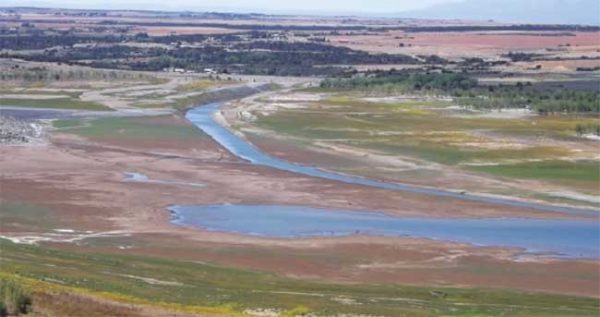
Pedestrians strolling through Cortez’s Carpenter Natural Area around dusk often notice two or three young men gathered near the mostly dry pond, sipping from plastic bottles of clear liquid. Empty bottles litter the mud.
Every day, men and sometimes women bearing cardboard signs stand at the entrances to Walmart and City Market, begging for money or work. People in grubby clothes, shouldering grimy backpacks, walk along Main Street to points unknown. One chilly night in October, two young men curled up and slept in front of the restrooms in Centennial Park, snoring loudly in the deep sleep of the intoxicated.
The increased visibility of street people combined with the number of unfamiliar faces has caused some unease.
“I have had a number of people call and say, ‘I can’t get into Walmart without being accosted, without seeing someone standing out there’,” Cortez Mayor Karen Sheek told the Four Corners Free Press. “Lots of people say, ‘arrest those folks, drive them out of town’.
“Well, guess what, the ACLU doesn’t like you to do that.”
In 2015, in a case involving an Arizona church, the Supreme Court ruled 9-0 that regulations that impose differing restrictions on different types of signs according to their content are unconstitutional. Attorneys with the American Civil Liberties Union have successfully argued that the ruling applies to signs held by panhandlers and that panhandling is a form of protected free speech.
“It sounds good [to some people] to have our officers say ‘move on’, but that opens you up for a lawsuit,” Sheek said.
Some people link the increase in transients and street people to Colorado’s legalization of cannabis. Montezuma County Sheriff Steve Nowlin has urged locals to watch an hour-long video by DrugFree Idaho called “Chronic State: How Marijuana Normalization Impacts Communities.” The video includes interviews with people in Denver and Pueblo who say there has been a surge in homelessness since the drug was legalized for recreational use in 2012. The theory is that people come to the state to enjoy legal marijuana but can’t find work – or never planned to look for it – and instead wind up panhandling to pay for pot.
A dozen citizens expressed similar concerns on Sept. 11 at a public hearing before the Cortez City Council over a proposal for a new pot shop on the city’s east side.
But is marijuana truly behind the increase in street people?
“I would be inclined to say no,” Sheek said. “It’s not only happening here.”
Blurring the picture
The rate of homelessness in the United States stands at about 17 people per 10,000, according to the U.S. Department of Housing and Urban Development. That’s reportedly the lowest rate since the count began in 2007. The information comes from the January 2017 Point-in-Time count, the most recent national estimate.
However, the count found more than half a million people (553,742) experiencing homelessness across the country. And the total number (not the rate) ticked up, by 0.7 percent, between 2016 and 2017, the first increase since the 2008 recession.
Rates in different states vary widely. Colorado’s is listed as 19.7 per 10,000 people – the highest rate among the Four Corners states. (Arizona is at 12.9, New Mexico at 11.9, and Utah at 9.3.) None of the three other states have legalized recreational marijuana.
Homelessness in Colorado rose 8 percent between 2013 and 2017, according to The Guardian newspaper, and 100,000 new residents migrated to the state in 2015.
Those statistics might point to cannabis as a contributing factor in the state’s homeless population, but other numbers blur the picture. For instance, the state with the highest homelessness rate is Hawaii, at 51 per 10,000 residents, where recreational pot is not legal. And according to a report by the University of Denver, Colorado’s homeless population grew by 600 percent from the late 1990s to 2010, long before marijuana was legalized.
“Marijuana is part of the picture of homelessness, but not all of it,” said Laurie Knutson, executive director of The Bridge Shelter in Cortez, which offers overnight housing during the cold months of the year. “It’s still connected to the continual ramping up of housing costs. Those numbers are rising across the country. You can’t seem to build affordable housing fast enough to keep ahead of it.”
Knutson said the first year that pot was legally available, there was “a huge uptick” in homeless numbers across Colorado. Since then, however, the numbers have stabilized both statewide and locally.

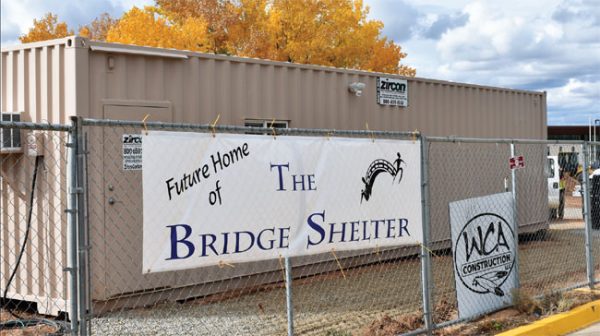
The Bridge Shelter in Cortez is building a new facility on Empire Street to provide overnight housing for the homeless, but it won’t be open for use this season. Photo by Gail Binkly.
Last year the Bridge recorded 1,000 fewer bed-nights (one person staying a single night) than the previous year, but served two more individuals than the year before, Knutson said, meaning the people being served didn’t remain as long in the area.
“People are definitely coming from all over,” she said. “The last few years have seen a more transient population. They’re coming but not staying as long, moving from town to town more frequently than they used to.”
Not much work
But the two men I talked to at Walmart both said they were locals. The older man said he was born and raised in Aztec, N.M., and had worked for the oil and gas industry. The younger one said he was from Cortez and does all types of work, particularly construction. “But there isn’t much this time of year,” he said.
The older man – whose arms and legs trembled and twitched as he talked – said he isn’t looking for work at this point. “I spent 42 years busting my butt and I’m through,” he said. “Just hanging out.”
Neither one appeared to be intoxicated or under the influence of drugs.
The prevalence of homelessness in Colorado may seem perplexing given that the state’s economy has been booming. According to a report titled Guide to Economic Mobility in Colorado, by the nonprofit Bell Policy Center, the state had the country’s second-lowest unemployment rate in August 2017, 2.4 percent.
Yet the same report provides another statistic that is critical: Average weekly wages, adjusted for inflation, have been essentially flat since 2000. Meanwhile, housing costs have soared.
‘A refugee crisis’
“We’re losing lower-income established neighborhoods across the country,” Knutson said. “Look at downtown Denver. How much is being lost to huge expensive condos going up? And as more and more people rent houses to Airbnb, how much affordable housing are we losing to that?
“This issue is really complicated. It would be nice to say it’s all marijuana sales, but that’s not true. There’s some reason to say marijuana has increased some of the homelessness, but it’s also rising in some states that don’t have legal marijuana.”
Three years ago, Knutson said, the Bridge had a surge in senior clients. “One-quarter were over 55, so what caused that? That’s not pot,” she said.
“To me it’s like we have a refugee crisis in our own country. You’re not traveling in big caravans and attracting the attention of the news, but there are a lot of people who are homeless. There’s no larger city that’s not inundated, so some people are going to rural areas.”
In addition to stagnant wages and high housing costs, Knutson said, another contributing factor is mental illness and addiction, coupled with a lack of help for sufferers.
“There is very little access for mental health and addictions treatment,” she said. “Those who can afford it get it, and those who can’t, don’t.
“Rehab facilities are closing, which is counter-intuitive when we need more treatments. That drives more people onto the streets because addicts eventually get kicked out of their homes. Addiction is an ugly disease and if there aren’t places to treat it, it remains untreated.”
Sheek agreed that there are multiple factors involved in homelessness. “It’s nationwide. It’s much worse in the bigger cities and I don’t know what the answer is.”
For some people, not working has become their occupation, she said. “There is work out there if people really, really want to do something. We are seeing generational poverty now, second and third generations of people, this is how they live. How do you break that cycle?”
But merely having a job doesn’t guarantee that someone can afford a home.
“There are plenty of homeless people working part-time,” Knutson said. “Looking at the employers who will hire people with low job skills or, God forbid, a felony, it’s basically going to be fast food, which probably means minimum wage. And many of those companies don’t want to employ people full-time so they don’t have to provide benefits.
“If you can’t survive on a full-time minimum wage job, imagine working just part-time. If you get a few shifts a week you can keep yourself in food and pot, if that’s your thing, or sports gambling or whatever. But people just don’t have enough income to live independently.”
In 2018, the fair-market rent for a one-bedroom apartment in Colorado averaged $987 per month, according to a report by the nonprofit National Low Income Housing Coalition, Out of Reach: The High Cost of Housing, . But a person working full-time at the state’s minimum wage of $10.20 an hour could afford to spend no more $530 a month on rent, based on the traditional formula that rent should cost no more than 30 percent of income.
“People may resent the fact there are people on the streets, but a lot of them are working part time,” Knutson said. “Most of us in this town who have a full-time job are pretty lucky. Most of my staff have another job.”
The back of a pickup
Two-thirds of the homeless are staying in some type of shelter or transitional housing, according to the Point in Time count, but the other third inhabit “places not meant for human habitation,” such as cardboard boxes, alleys or open fields.
I asked the two men at Walmart where they were sleeping. “In the back of a pickup,” they both replied.
“It gets pretty cold sometimes,” the younger one added.
The Bridge shelter traditionally opens in October, but this year it lost its longtime home in the old Justice Building in Cortez’s Centennial Park when the structure was purchased by the Children’s Kiva Montessori School.
The Bridge is building a new facility on land donated years ago by Montezuma County, but it won’t be ready this season, so the shelter had to seek a temporary home. The Grace Fellowship Evangelical Free Church on Chestnut Street offered to house the Bridge’s clients and staff from 5 p.m. to 7 a.m. daily. The city council recently approved a conditionaluse permit for the operation, but the shelter wasn’t set to open until Nov. 1.
‘Working really hard’
Sheek is proud of the steps Cortez and the broader community have taken to try to alleviate the problem of homelessness, particularly in contrast to Durango, where homelessness has become a source of endless controversy. Hundreds of people are reportedly camping in the woods near the city because they have no place to go. Durango has a shelter, but it is considered “high-barrier,” meaning it doesn’t accept people who are high or intoxicated. Durango also has a detox facility operated by Axis Health, but it isn’t a shelter and it releases people as soon as they sober up.
The Bridge, on the other hand, is a “low-barrier” shelter that will house the intoxicated, although in recent years only about a quarter of its clients have been under the influence.
Knutson said she has warned people in Durango that the Bridge won’t be able to handle any overflow this year. “I’ve let Durango know – the hospital, Axis Health, etc. – that you can’t send us people this year. They always have, because they have more-restrictive entries and more people. But this year we are already going to be turning people away.”
The church can handle a maximum of 33 clients a night, Knutson said. Last year, the Bridge averaged 45-47 people nightly, “and well into the 50s when it was cold.”
“When I see what’s happening in Durango I think little-bitty Cortez is head and shoulders above that,” Sheek said. “We have a group of private citizens that saw a need and addressed it [through the Bridge]. Come spring they will have a building. We provide meals six days a week [at soup kitchens].
“And lots of our nonprofits are dealing with issues like food insecurity. I think for a little community of less than 9,000 we’re working really hard.”
But there may be more that could be done, she said. She mentioned the approach being taken by the City of Albuquerque, which sends a van around every morning to contact panhandlers and ask them if they would like a day’s work. The vast majority say yes, according to a TED Talk by Mayor Richard J. Berry. They earn $9 an hour to do chores, and get a meal at the jobsite. At day’s end they have the opportunity to stay in a shelter and be connected with counseling and other services. The program has reportedly been highly successful.
Compassionate people who see someone on the street are often motivated to give them money, but both Sheek and Knutson advised against it.
Knutson said the folks she sees holding up signs around Cortez aren’t usually clients of the Bridge. “Most of them I don’t know,” she said. “There is a huge group of people who don’t want to be in a shelter, probably because they don’t want to comply with our rules. I never give money to panhandlers.”
Sheek agreed. “If you feel compassion, give to the Good Samaritan [food pantry], the Bridge or your local church,” she said. “It’s better than giving it to somebody and you don’t know if they’re going to buy a sandwich, or something to drink, or just pocket it and say, ‘Sucker!’. I know that seems unkind, but the truth is, giving somebody just a handout is probably not the kindest thing you can do.”
But the impulse to give money is strong. Neither of the men I talked to at Walmart asked me for anything, yet I felt apologetic that I was carrying no cash and had nothing to offer.
I said something to that effect and they shrugged it off. “That’s okay,” they said.
“Well, hang in there,” I said lamely.
“We don’t have much choice,” one answered.
And then, not knowing what else to do, I walked on.
Desert duet
When writers and editors speak of “voice” in the context of fiction, they refer to stylistic qualities of attitude and personality an author employs to engage the reader, as conveyed through tone and word choice. A unique and powerful voice – think of Mattie Ross recounting her childhood travails in Charles Portis’ True Grit – can turn an otherwise mundane story into a riveting page-turner. A dull or flaccid voice, in contrast, can render even an international spy thriller into a soporific slog.
That brings us to Jonathan Lethem’s latest installment in an authorial oeuvre that includes The Fortress of Solitude, his 2003 New York Times bestseller, and Motherless Brooklyn, winner of the 1999 National Book Critics Circle Award, because with The Feral Detective, Lethem’s 11th novel, he demonstrates just how effectively a potent voice can combine with an engaging story to produce masterful fiction.
Phoebe Sigler is a fish out of water – a Manhattan-based writer, recently unemployed, on a personal mission to locate her best friend’s runaway daughter Arabella, last sighted somewhere amid the strip malls and scrubland of Southern California’s sprawling Inland Empire. Success for Phoebe will require a kind of cultural immersion for which she, though stubbornly game, is temperamentally ill-suited, a state of affairs underscored by Lethem’s revealing first-person prose in which Phoebe describes a City of Upland where “the malls and gas stations and chain restaurants took on the quality of a single repeated backdrop, such as Fred Flintstone would motor past” and where “to make an appointment here was to have dropped through the floor of your life, out of ordinary time. You weren’t meant to be here at all, if you were me.”
The appointment in question is with Charles Heist who, while not its narrator, is the novel’s titular protagonist. A self-described finder of lost persons, Heist is a laconic private detective, “fiftyish and cowboyish,” with a strip mall office and a trailer park home to which strays and runaways, not all of them human, seem to gravitate.
This, we soon learn, is no accident. Heist, you see, is a prodigal son of the desert – the firstborn child of a Mojave-based hippie commune since devolved into competing clans of nomadic survivalists. “The ones who dug in deeper and continued to drag the teepees around and hold meetings and share food around the circle came to be called the Rabbits,” Phoebe discovers. “The others, the ones who hewed off into the higher ranges, into the dark and wild, and who returned less and less frequently to the ceremonial fires to share what they’d found out there, were called the Bears.”
With Heist as her native guide, Phoebe enters this fraught netherworld in search of Arabella and, in a very real sense, in search of herself in a story Lethem describes as “a chase scene through the desert, interspersed with episodes of sex and violence.”
The novel is, rest assured, much more than that, thanks largely to Phoebe’s distinctive narration – a voice in turns sarcastic and acerbic and laced with bon mots and double entendres she sends zinging over the heads of her audience. Her antic chatter masks not only her fear and insecurity as the stranger in a very strange land, but also the disillusionment of an educated woman freshly unmoored by unemployment and by the 2016 presidential election – events that are not unrelated – making her sojourn into the Mojave a kind of personal rebirth and Heist a reluctant midwife to her new and wiser self.
The Feral Detective ($26.99, from Ecco) is one of the better crime novels I’ve read in recent years. Draw close, and lend it your ear.
Chuck Greaves is a member of the National Book Critics Circle and the author of five novels, most recently Tom & Lucky (Bloomsbury.) You can visit him at www.chuckgreaves.com.
And then there were two: San Juan County prepares for its first-ever Native-majority commission
For the first time in its history, San Juan County, Utah, will seat a Native American-majority county commission in January.
In an historic victory, after colossal grassroots and legal efforts, Willie Grayeyes won his bid for the District 2 commission seat by 95 votes. That seat was previously held by Phil Lyman, who left it to run a successful race for the state legislature.

Willie Grayeyes won election as the first Native American commissioner in San Juan County’s District 2. Photo by Sonja Horoshko
With his residency in the county and therefore his right to run for the office in question, Grayeyes’ bid for the commission was in jeopardy until a U.S. District Court issued a preliminary injunction in August assuring that the election would proceed with his name on the ballot.
Kenneth Maryboy, a Navajo from Mexican Water Chapter, was elected over a write-in candidate to represent District 3, while Bruce Adams, a sitting commissioner, was unopposed in District 1.
Grayeyes and Maryboy are Democrats, while Adams is now the commission’s sole Republican.
The door to the historic election was opened by a series of legal challenges to San Juan County’s voting districts. The three commission districts had been essentially the same since the 1980s, when the county drew them under a consent decree that also provided that commissioners were elected by district rather than at-large.
Those districts allowed for the first election of a Navajo to the county commission by providing for a district where Natives held a majority.
However, over time, the Native population grew, yet it was never possible for more than one Native American to be elected to the board because nearly all the Navajos were stacked into the one district, District 3.
The Navajo Nation filed suit, demanding that the districts be redrawn, and as a result of a federal judge’s order two years ago, they were. All three commission seats were vacated, with the new members all elected in November. Adams’ term is for two years, the others for four.
On Nov. 8, two days after election results were finalized, Utah Federal District Court Judge, David Nuffer, dismissed the Grayeyes case, saying the court cannot provide any other relief to Grayeyes than the preliminary injunction that it issued on Aug. 6.
Satisfaction
“The Navajo Commission is very satisfied,” said Leonard Gorman, executive director for the Navajo Nation Human Rights Commission, in a press release. His group brought the litigation against the county for voting-rights violations.
“The preliminary injunction did the job. It forced San Juan County to place Mr. Grayeyes on the November 6th general election ballot. The only matter that is still pending is the San Juan County appeal to the 10th Circuit Court of Appeals.”
San Juan County has historically neglected the needs of local Ute, Diné, and Paiute communities, said Mark Maryboy, former county commissioner and brother of commissioner-elect Kenneth Maryboy. As an example, he emphasized in a statement from the nonprofit Utah Diné Bikeyah, approximately 40 percent of the Native Americans in San Juan County lack running water and electricity in their homes.
Both Native commissioners-elect are excited to address those issues now that the local majority Native American population will be fully represented. According to the 2010 census, Native Americans make up just over 50 percent of the county’s population.
The battle for representation has raged for more than 40 years, said Janet Ross, current secretary/treasurer of the SJC Democratic party. “There has never been an active Democratic party in San Juan County, Utah. There was no point,” she told the Free Press. “We would never win a race. But redistricting gave us that opportunity and we did win. Credit must be given to the voter registration drives. The effort brought 2,000 new voters to the election. It is an historic time.”
The bitter race for representation in San Juan County prompted considerable pushback from the non-Native community, with some voicing concerns about the fact that Navajos living on the reservation do not pay property taxes (they do pay sales taxes). The online publication Canyon Country Zephyr likened the situation to “representation without taxation.”
But Grayeyes has said he will represent all of the people in his district, pitching a peacemaking platform to white and non-white constituents, a path toward reconciliation.
Grayeyes is offering hope for an inclusive approach to governance. It’s all about healing, he told the Free Press. “You have to be positive to achieve consensus,” he said. “Hopefully we will create conversations that change local attitudes toward Native Americans and our priorities. You have to be positive in order to get results.”
‘Step up to the plate’
But Gorman is a realist. “While Grayeyes and the Navajo people in San Juan County prevailed in this case, I expect much more hard-line stances against Navajo leadership in San Juan County.”
And so does Ross.
“During my 40 years living here I have heard plenty of racist comments,” Ross said. Retired now, she is the founder of the Four Corners School of Outdoor Education, in Monticello. “I hope people in the county can step up to the plate and end this attitude. I don’t know if it’s entirely possible, but I am hopeful.”
She asked Grayeyes and Maryboy what support after the election looks like to them. “There’s support right now,” she said, “but we have to sit down and figure out how and what Grayeyes and Maryboy will need, how much it will cost to help them meet the challenges they face. Maybe commission governance training or even simple efforts to help with the five-hour one-way drives Willie will do to carry out his work.”
Grayeyes’s residency will come up again and litigation is still pending on some issues around it, explained Ross, “but right now what will it take for them both to handle the responsibilities of the office they now hold?”
Ken Maryboy was the minority commissioner during his prior tenure, so he is familiar with the job, she said. “But this will be a first for Grayeyes. The commission work is a bureaucratic job. They will both have to make decisions, do the paperwork, while directing county administrators to do the work they will be charged to understand. They’re both up to it,” but will need continued support, she said.
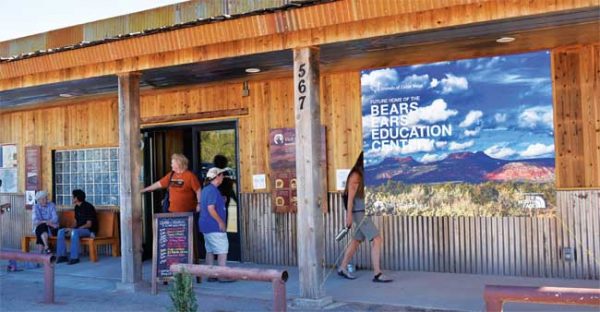
Both Grayeyes and Maryboy have served on the Utah Diné Bikeyah board of directors since its inception. The group is the force behind Bears Ears National Monument. Maryboy and Grayeyes were key negotiators during the process with the Obama administration. They are advocates for Bears Ears National Monument, a point of contention for native people who allege the commission greatly misrepresented native support of the national monument in the county.
After their election victories, both Maryboy and Grayeyes resigned their positions on the board. Gavin Noyes, co-director of UDB, told the Free Press that the group has since nominated and invited members to fill the vacancies.
Noyes is hopeful that the effort Grayeyes is making to heal the divisions in the county will be met with a positive local response. He also sees the broader shift in the state political structure demonstrated in the Utah election results that may turn attention more toward collaboration around the issues in San Juan County that came to light during the years of redistricting and voter rights litigation.
He points to the growing efforts of a number of elected officials to reach out to native leadership. The newly elected officials bring collaboration to their constituencies in an understanding that everyone in Utah is needed to address the issues represented in San Juan County.
“The results of the last election recognize that the structure of continuing discrimination in San Juan County absolutely needs to change for everyone,” Noyes said. “It is of social, economic, spiritual and political benefit to us all to come together. It is a great moment in our history, a window of opportunity and critically important for the future.”
Congress
In November Rep. John Curtis, won the seat he was appointed to when Utah District 3 Congressman Jason Chaffetz retired in late 2016. Curtis is demonstrating a willingness to learn from the native communities around Bears Ears that he represents. Last February, he met with Navajo Nation leaders at the Mexican Water Chapter House near the Arizona border. The Navajo Nation president and vice-president, attorney general, and local elected officials from seven chapters attended the meeting.

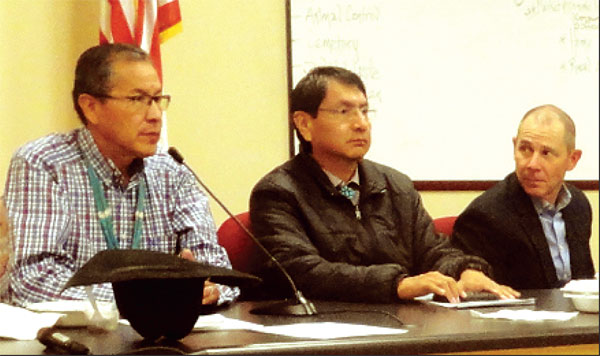
Utah Representative John Curtis (right) meets with leaders of the Navajo Nation for the first time in Mexican Water Chapter. Kenneth Maryboy, on left, is now a commissioner-elect in San Juan County, and Jonathan Nez, center, is president-elect of the Navajo Nation. Photo by Sonja Horoshko
Notably, this was the first time in recent history a sitting member of Congress held a meeting on the Navajo Nation with Utah constituents. Although the get-together was basically about the need for native input and support of the congressman’s ill-fated bill to ratify President Trump’s revocation and replacement of Bear Ears National Monument, Curtis listened attentively to comments on a variety of topics, including discrimination in San Juan County.
Navajo Vice President Jonathan Nez attended the meeting. Since then Nez won his bid for Navajo Nation president. He is from the Northern Navajo Agency in the reservation. The Utah Navajo Chapters are also members of the same agency. At the February meeting with Curtis, Nez emphasized the importance of establishing the Navajo tribe as a sovereign nation entitled to government-to-government relations.
“While Native people have always honored their treaties, tribal nations often have to remind their federal counterparts to live up to their obligations,” Nez said at the meeting. “We seek your leadership as a voice of reason and fairness to help advocate for local needs. We have the same rights as any other U.S. citizen. We’re asking you to work across organizations to secure our rights and basic equity.” It is expected that Nez will continue his support of the Navajo communities in San Juan County as they seek fair treatment by the county and state government.
Look north
Farther north in the state, Democrat Ben McAdams defeated two-term Republican Rep. Mia Love by 700 votes in the race for the 4th Congressional District.
McAdams, known for his ability to build coalitions and consensus while he served as mayor of Salt Lake County, returned an email to the Free Press on the day Love called to concede the race.
“Yes, I’m aware of the positive results in San Juan County,” he wrote. “Happy for them. I will work in a bipartisan manner with Rep. John Curtis and others to resolve the bitter fights over public land issues in our state. These lands are treasured by all Americans.”
During Mitt Romney’s successful bid for the U.S. Senate, he discussed race and racism, writing on his website that “it is not tangential to the great issues of our day: it is one of them. It is impossible for America to achieve and sustain high growth, economic superiority, and global leadership if our citizenry is divided, disengaged, and angry. But more than this, we must foster equality if we are to remain a great and good nation.”
Statements such as his, and the reputations of the newly elected Utah politicians advocating support for equitable treatment of all citizens, are giving rise to expectations of successful representation in embattled Native communities like San Juan County.
A significant move
Larry Echohawk, a lawyer and member of the Pawnee Tribe, joined the Obama administration in 2009 as assistant secretary of the Interior for Indian Affairs. He resigned his position at Interior on April 27, 2012.
Now, Utah Gov. Gary Herbert has appointed Echohawk to serve as special counsel to the governor on the subject of racism in the state – a move that demonstrates concern for the Native populations in San Juan and Uintah counties.
Anna Lehnardt, public information office for the governor, confirmed in an email that the governor and the state attorney general’s office are jointly retaining Echohawk as a special counsel.
Echohawk is a revered member appointed by the General Authority Quorum of Seventy of the Church of Jesus Christ of Latter-Day Saints, the first Native American to hold the position.
In a phone conversation with the Free Press, former commissioner Lyman said he had inferred from an email on the topic that Echohawk’s appointment was probably more related to the Uintah County Native relationships than San Juan County.
He added that Echohawk is “a controversial character to San Juan County residents. His ideological approach to county issues is not based on the reality of what is happening here.”
Commissioner Adams told the Free Press he had met with Echohawk recently but could not comment further.
Renew works to rebound after tumult: The nonprofit is seeking a new board and new director following charges against Beene

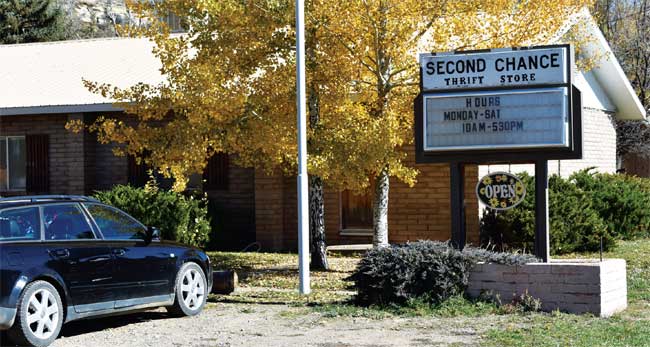
The Second Chance Thrift Store, which is operated by Renew, has been doing a brisk business
after the departure of the nonprofit’s former director. Photo by David Long.
Renew, Inc., a Montezuma County nonprofit dedicated to helping victims of domestic violence and sexual assault turn their lives around, is itself undergoing a major renewal after a period of upheaval, sparked when its longtime former director was accused of stealing from the organization.
Renew has operated WINGS, a safehouse for abused women in Cortez, for about two decades, and provides a 24- hour hotline and counseling services for these survivors as well. It also runs Second Chance Thrift Store in Dolores, which sells donated items to help support these services.
But in August, in a story broken by the Four Corners Free Press, former director Cheryl Beene was charged with felony theft following a lengthy investigation by the Montezuma County Sheriff ’s Office. Beene, 60, is accused of taking numerous donated items intended for the thrift store and shelter for her personal use, as well as monetary donations she allegedly spent for meals and other personal wants (Four Corners Free Press, September 2018).
Beene, who was fired shortly thereafter, has been bound over to district court for arraignment on Nov. 20.
This shocking development was followed by a stormy meeting of Renew’s board of directors on Sept. 18, during which several staff members as well as board member Dena Guttridge demanded the resignations of five other board members in lengthy written statements cataloguing the problems and shortcomings besetting the organization. Their complaints were forwarded to local press outlets as well.
The laundry list of grievances emphasized the board’s lax oversight of Renew and Beene as well as her “gross mismanagement” of the organization.
The previous board had given the director “a glowing review in May 2018 without even visiting the agency or speaking to staff,” the letter stated, “while Beene was stealing funds and goods, treating clients with disrespect and using emotionally abusive behavior against the staff.”
Other shortcomings outlined in the letter concerned the board’s alleged lack of familiarity with the staff and budget issues, mishandling of personnel matters and lack of fundraising efforts. It asked for and received the resignation of the five members.
Now, the 501(c)3 is developing a new approach to its mission that Rose Jergen, its interim director, firmly believes can rescue the organization from a sea of troubles brought about mostly by what she believes was a dearth of oversight.
“We’re working fast and hard,” Jergen said. “I think we have the brain power to do that,” especially with the support of District Attorney Will Furse, the directors of Montezuma and Dolores counties’ social service programs and several other local nonprofits.
Jergen, herself the full-time director of the Four Corners Child Advocacy Center, is volunteering her time and energy to get Renew back on solid footing.
“We were able to develop an advisory committee that’s made up of quite a few of the leaders in the community who understand the value of the service, so it became a top priority to do everything we can to keep it open,” Jergen said.
“That means having committees who are working on projects that are guided and directed by some of our funders asking for specific things to be completed – reviewing financials and policies – using best-practice approaches, so that has been a community effort.” Jergen said they have set goals in three-month intervals.
“Best-case scenario, we would have a full board seated and all these (new) policy pieces in place by the end of the year and be ready to hire a permanent director.”
Jergen said the staff has been “amazing.”
“I stepped in and it’s just been business as usual. They’re working very hard to maintain the highest quality of services they can under the circumstances.
“I’m pretty impressed, honestly – it kind of goes without question that there’s been no lapse in services.”
WINGS can accommodate up to six clients, Jergen said, and is currently at capacity, although one room is kept for emergency referrals. Clients are housed in individual quarters akin to efficiency apartments and share a common kitchen.
Jergen outlined the steps in progress to not only secure Renew’s future but make it a more vital and constructive part of the community
“Since (the September board meeting) we’ve had the resignations of past board members and we’ve been fairly quickly bringing on a transitional board,” she said. “At this point they are tasked with making sure that there’s going to be some implementation of new fiscal policies and new personnel policies, or at least reviewing and revising and making sure those are up to standard.”
Then there’s the process of choosing a new board of knowledgeable, high-energy people.
“It’s almost as if it’s going to be a new organization, so they’re going to have to be extremely committed to hard work at first. I would advise anyone interested to apply,” she said.
“But we’re not looking for just warm bodies – we want people who can come in here and provide that fiscal oversight and governance and make sure we’re doing some really amazing fundraising efforts. This is going to require some work.”
She said the thrift store has been doing exceptionally well lately, possibly because people are shopping there as a way of showing community support for Renew in light of its recent trouble. ”They said they had two record days within the last couple weeks – $600 days – that’s huge! And they were just random days in the middle of the week. We’re finding that thrift store is a gold mine.
“I’m hoping people are shopping there because they understand the need and are seeing some of this stuff in the media and wanting to support us,” she added. “That awareness is something important for us to spread.”
Still, beyond that source of revenue, plans for some major local fundraisers need to be developed, she said.
“One thing I think is important is that diversification of funding – so there’s a bigger percentage of funding coming in from builders in the community as opposed to depending on grant funding.
She said ideally 50 to 60 percent of Renew’s operating budget would be derived from local funding.
She expressed confidence that Renew’s future will be bright. “It’s our sheer determination that we’re going to make this place bigger and better than it was.”
Restarting the presses: Old equipment in the the former home of the Mancos Times-Tribune is being given a new purpose

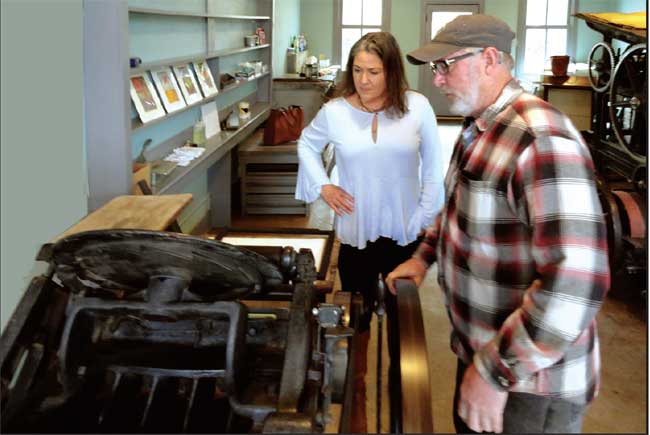
An immense mural by Mancos artist Brad Goodell on the side of the Mancos Times-Tribune building illustrates the energy and effort in a newsroom 100 years ago. The building, now restored, is the home of the Mancos Common Press, a printing arts shop. Photo by Sonja Horoshko.
A project to preserve and restore the historic Mancos Times-Tribune building on Grand Avenue in Mancos is on the threshold of repurposing the technology that printed the news in Southwest Colorado for more than 100 years.
A rare 1910 American Cranston printing press, a Chandler & Price platen press, typesetting tables and workbenches, and cabinets of moveable lead type stand quietly within the ambiance and aroma of a restored classic newsroom. The archaic equipment attracts artists and writers returning to the technology precisely because it is a preciously slow, hands-on process – an organic, high-quality method of relief-based printmaking.
Lead-type printing has changed little since 1439, when Johannes Gutenberg invented the first precise, rapid metal moveable type suitable for the common screw-presses in use throughout Europe at the time. Although the press and moveable type have been continuously modernized, the concept remains the same. A raised bed of lead type and incised wood blocks is placed opposite another surface spread with an even layer of ink, while a sheet of paper is positioned between them. All of it is pressed together once, leaving the ink imprint of the text and images on the paper.
The resulting print can be reproduced repeatedly in a short period of time.
Gutenberg’s invention opened the door for the democratization of information, which until then had been contained in handwritten, illuminated manuscripts produced for the wealthy and the church.
Until the early 2000s, when digital information began replacing print resources, news ruled the domain of letter presses. Today, the techniques are earmarked for artists and writers.
Behind the wall
The Mancos Times¸ founded in 1893, one of Colorado’s oldest newspapers, enlarged to become the Mancos Times- Tribune under new ownership and moved to the Grand Avenue building in 1910. It remained in the building on Grand Avenue until the 1970s, when the newspaper moved production to Durango. It has since ceased publication.
Over the years, most such print equipment has been disassembled, the presses silenced and sold for scrap. The skilled typesetters and pressmen have retired, leaving a void in knowledge of the newsprinter’s craft. The survival of the Mancos Times building is a rare success story.
Frank Matero, professor of architecture and chair of the graduate program in historic preservation at the University of Pennsylvania, spends his summers in Mancos working with graduate students doing restoration projects at Mesa Verde National Park. The building on Grand Avenue always interested him. In 2013 he asked Betsy Harrison, then chair of the Mancos Chamber of Commerce, if he could look inside it.
The windows in the back of the building were boarded up with plywood and all sorts of things had been stacked in the dim, dusty room. Although he was focused on the architecture, Matero noticed the unmistakable form of a printing press, the old Cranston, one of only a handful that exist in the country today.
“It was never moved out of the building,” said Harrison. “There it sat forgotten behind the wall all those years.”
Matero returned that year with a proposal for the Chamber of Commerce. In addition to basic historical research and an inventory of the property by his students, he proffered a partnership with the university’s PennDesign The Common Press letterpress printing program established in 2006.
If the town accepted his offer and formed a steering committee, the collaborating groups could revive the building as a printmaking arts and educational center.
Stringent criteria
Representatives of several local groups organized the Mancos Common Press and a steering committee. Richard Ballantine, publisher of The Mancos Times-Tribune and Durango Herald, joined the committee and eventually donated the building to the project.
The result was a restoration of the building as a new facility for students of graphic arts, a unique opportunity for the town of Mancos, the Pennsylvania Center for Architectural Conservation and PennDesign The Common Press.
Matero’s students prepared a Historic Structures Assessment and conservation analysis of the interior and exterior. They uncovered a complete set of newspapers printed in the building from 1910-2010, a valuable historical record of the town and county.
Parts of the collection are in the Denver Public Library being digitized, Harrison said. At some point the group hopes to have them all accessible to the general public.
Although their surveys uncovered treasures in equipment and documents, the projected restoration costs were growing. In 2014 the steering committee became a board of directors, giving the group access to Colorado State Historical Society grants.
“Finally, the project was funded in 2017, which has made it possible to finish the restoration of the property,” Harrison said.
Ballantine commissioned an exterior mural on the west side of the building showing a newsroom with an American Cranston press like the one inside. It was painted by Mancos muralist Brad Goodell. Today, a wooden stage in front of it provides a backdrop for the Mancos Farmers Market.
The whole project has been documented by graduate student Samuel Loos in his thesis. The back wall, which had been significantly altered, was recreated from a 1911 photograph. His restoration files now include the photographs and numbering record of each ornamental metal tile originally used on the building while they were temporarily removed during installation of the modern heating and ventilation system. Missing and damaged areas were filled in with plastic replica pieces made at PennDesign’s Fabrication Lab using modern vacu-form technology.
While volunteers worked on the Cranston press, getting it ready for another century of use, the existing exterior and interior paints were analyzed and replicated in the printing shop as it was 100 years ago, creating a fresh workshop with sky-blue walls, a yellow ceiling and frieze, and gray woodwork.
“The preservation criteria have very stringent requirements. Because of the guidelines the project was completed properly, as it should be,” said Harrison. “Now we’re moving into a new phase, the printmaking arts, classes and residencies.”
Backwards and upside down
During a recent visit to the building, local poet Rene Podunovich, met with Goodell for an introduction to the printing process. Goodell, who is a commercial illustrator as well as a muralist, moved with his family to Mancos after he taught studio design classes at the University of New Mexico. “I’m really more the technician than an arts coordinator,” he admitted as he began organizing a woodblock image beside some type in a metal chase he recently built to match the one in the press.

Brad Goodell demonstrates the use of the Chandler & Price platen press to local poet Renee Podunovich.The press, and two smaller greeting-card-size presses were donated to the Mancos Common Press project by Larry Hauser, a former Cortez Journal pressman. Partially in view on the right is the 1911 American Chandler Press. Photo by Sonja Horoshko.
The chase is a frame that locks moveable lead and wood blocks into place to ensure the content won’t fall apart in the printing process. He put the new one in place below the inking plate and then turned the fly wheel to demon strate. It didn’t quite fit. “It’s the nature of printing on equipment like this,” he explained. “I’ll have to grind it down. It’s got to be perfect.”
He showed Podunovich the type cabinets built with meticulous dividers designed to keep the varying sizes of individual lead fonts in order. They are used as the typesetter holds a metal gauge to organize letters and words in a line. “The trick,” he told her, “is the words are spelled backwards and upside down, and the column is set per article from the bottom to the top. It’s an art.”
Goodell and the Common Press board are working to develop classes that thoroughly educate users about the care and value of the studio, the presses and the suites of print runs that come from the effort.
“Can you imagine breaking down a behemoth metal press like this old Cranston and moving it across the county on a train in 1911,” Goodell asked, “then putting it into wagons and pulling it by draft horse to get it to Mancos?” He climbed up on the operator’s platform on the side of the press nearly four feet above Podunovich as he explained the basic differences between the smaller, working Chandler & Price platen press and the giant Cranston.
The latter machine can actually be dangerous when it’s running. “We are not offering any workshops on it until we are absolutely sure all the parts are working properly, and we are convinced that the operator has enough experience to respect the process,” he said.
Harrison is hesitant to commit to any schedule of classes at this time, pointing to the same considerations Goodell has, but said the sustainability of the presses and equipment, the space and the quality care of the building are issues the board will untangle soon.
She said word of the studio is spreading among artists and poets.
“Learning the exacting process creates respect for how it was done in the past,” Pudonovich said. “The press and ink render such high quality. You can actually feel it impressed in the finished piece. It speaks to our times, how easy it is to get all kinds of information, news and arts on digital media today, while in the past it was so manually intense.”
Harrison says the group has a lot to explore about revenue and expenses, sustainability, preservation issues, the equipment and its responsible use. “We are switching gears from restoration to studio arts education and production. It’s a giant step, but one that will support the identity of Mancos as a professional arts community. We’re just not there yet.”
Where are our conservative columns?
Recently we did a readership survey via SurveyMonkey online as well as in the newspaper itself. The results showed that the majority of the people who responded like the Four Corners Free Press and want us to continue doing more of what we’re doing.
Here are a few of the (unedited) comments we got in response to a question asking when and why people picked up the paper (no, we’re not making any of them up, but yes, we’re picking the most positive ones here):
- Monthly. I think this is the best source for local news in the Four Corners region.
- It’s less fake than the other “fake news” newspaper in Cortez.
- We subscribe to Free Press because the reporting is fair and balanced and well done. Plus there’s lots of local information.
- The first day it hits the stands. Best indie rag around!
- Delivered to my home. Great independant news for the Utah/Colorado area on topics that concern me.
- For in-depth coverage of local political and environmental issues.
- I’ve subscribed since the first year because the local paper wasn’t giving me the type of information I wanted. That’s still the case!
- Pick it up as soon as it comes out – because of the feature stories – short news – calendar and events, community info
- Because its a great read.
But when we asked readers what they would like to see more or less of in these pages, several answered that they wished there were more conservative commentary in the opinion section.
“I think your Opinion page is irrationally left wing,” wrote one respondent. “I could post a reply to anything Heidelberg, Miesler, Larson write. And the letters! Trump Derangement Syndrome runs rampant. Dexter Gill seems to be the only writer that uses facts. I am not renewing my subscription because of this irritable leftwing persuasion. I do like the in-depth writing of the local and area news and the crime report is a hoot!”
“More conservative commentary,” said another. “Like it or not we do exist out there.”
“less liberal,” said a third.
We conducted the survey in order to learn what readers want and we take all the responses seriously. So we’d like to address the indisputable fact that we have only one regular columnist, Dexter Gill, who could be considered conservative, and by his own choice he writes specifically about issues related to public lands and natural-resource management.
The reason there aren’t other conservative columns, or letters, is simply because nobody sends us any. When we started the Four Corners Free Press more than 15 years ago, we actively reached out to a half-dozen local conservative leaders to see if any of them would write for us. All said no.
Since then, we have published rightward-leaning columns as they have come to us, including three a few months ago by Cortez’s Bud Garner. And many years ago we had one regular columnist who wrote in favor of gun rights and hunting. So it isn’t as though we’re sitting on a stack of such material and refusing to publish it. In fact, we generally publish all columns and/or letters to the editor that we receive. About the only times we don’t is when we run out of space, when the letters have already been published elsewhere and are “stale” when we get them, or when the pieces come from writers out of the area who send them out nationwide to a thousand newspapers.
We want the Four Corners Free Press to have a local and regional focus, so we aren’t going to start reprinting nationally syndicated columns by people such as George Will. And hardly anyone who works or writes for our newspaper holds conservative views, for whatever reason, so we aren’t going to be writing right-wing opinion pieces. Most of us believe Donald Trump is a god-awful president, to be frank, and it wouldn’t be any easier for us to pretend otherwise than it would be for you folks on the right to embrace Hillary Clinton.
We understand that people like to see points of view that resemble their own and reflect their values – everyone does. But if you want more conservative material in the Free Press, someone is going to have to write it and send it to us, there’s just no way around that.
There isn’t space here to go into the other feedback we received, but we’ll try to share more of it in the future – and to be responsive to all our readers’ interests and concerns.
Sportsmen vote public lands and waters
By David Lien
September was Public Lands Month, a celebration of America’s iconic public lands and waters. Fall is also a time when hunters, anglers and other outdoorsmen and women are getting their boots dirty on the 640 million public acres that belong to all of us. Public lands contain some of the best remaining trout and salmon watersheds in the entire United States and provide millions of sportsmen and women with world-class hunting and fishing opportunities.
Here in Colorado, an estimated 90 percent of Coloradans use the 24 million acres of public lands in our state. And a survey by the Congressional Sportsmen Foundation found that 92 percent of Colorado hunters use public lands. But the threats to our public lands – including national forests, wildlife refuges and parks – are as real as ever. Some members of congress have been advocating for state or local control of federal lands, not to mention sales to private interests.
Although such transfers haven’t happened on a big scale, Ryan Busse, national board chair of the Backcountry Hunters & Anglers (BHA), says hunters and public lands advocates are now on the defensive. “I think our folks have always been very appreciative of our public lands, but they’re taking them much less for granted now that they’re coming under direct political attack.”
Earlier this year, U.S. Sen. Mike Lee (of Utah) outlined a three-part plan to privatize our public lands. As he explained in this tweet, his plan is simple: sell off the public lands that give you unparalleled opportunities to hunt, fish and recreate.
In response to similar proposals, BHA president and CEO, Land Tawney, said: “This issue is our Second Amendment. Any attack on public lands is a non-starter for us.”
Make no mistake, these anti-public-lands legislators are making anti-hunters giddy, because the most powerful antihunting movement in the U.S. is the loss of places to hunt, fish and shoot. In the words of Northern Wilds publisher/ editor Shawn Perich (in the 1/5/18 Outdoor News): “Such politicians are a greater threat to the future of hunting and fishing than any animal rights group. Know your enemy, folks.”
Colorado Gov. John Hickenlooper considers our state’s public lands “spiritual and economic assets,” and says “we need more public land, not less.” Hickenlooper added: “Our protected public lands are part of what makes Colorado special.”
Similarly, Montana’s governor, Steve Bullock, said: “This ain’t about politics. Whether you’re a Democrat, or Republican, or Libertarian, or vegetarian, these lands belong to you. They’re our heritage. They’re our economy. They’re our quality of life.”
According to statistics recently released by the U.S. Bureau of Economic Activity, nationwide the outdoor recreation economy accounted for 2.2 percent of GDP ($412 billion) in 2016. The oil and gas industry accounted for $162 billion in economic activity the same year, or 0.9 percent of GDP. Mining activities accounted for $61 billion or 0.3 percent of GDP.
The report also revealed that compensation for the outdoor recreation economy grew at a rate of 4.3 percent compared to 2.7 percent for the U.S. economy.
“My best days, and our country’s best values, both are found within our vast public lands,” said Ryan Busse, a Montanan. “Our shared ownership of these places and our freedom to explore them is uniquely American. Once we set foot upon this birthright, wealth, status, race, color, creed and orientation melt away, and we become one with our great country– on the same footing with every other citizen and inferior to none. There is no other equalizer like it on our planet!”
With public lands issues taking center stage in numerous races across the country, the votes of sportsmen and women represent an increasingly powerful force. Your vote is the number-one way to make sure your voice is heard – in Washington, D.C., and state legislatures across the country.
“With elections looming in the fall, both current and prospective politicians should take heed of the growing voice that is public lands sportsmen and women,” Land Tawney stated. “We hunt and we fish. And we vote public lands and waters.”
For additional information (from Outside Online) on “How to Vote for the Outdoors: Non-partisan midterm elections guidance from key environmental organizations,” see: https://www.outsideonline.com/2354171/how-vote-outdoors
David Lien is a former Air Force officer and chairman of the Colorado Backcountry Hunters & Anglers. He’s the author of “Hunting for Experience: Tales of Hunting & Habitat Conservation” and during 2014 was recognized by Field & Stream as a “Hero of Conservation.”
Making Anatomy grow again
Hello, friends, Dr. Peter Bigg-Pickle here. I am the Federal Official of Length (FOOL).
It was recently brought to my attention that porn star Stormy Daniels publicly insinuated that President Donald Trump was lacking size in one particular area of his otherwise manly anatomy.
As the nation’s FOOL, it is my duty to dispel misconceptions relating to the length of things. Never allow a disgruntled woman’s puerile and juvenile denial of your man-size to be the final word on the subject.
As Americans, we tend to think that “bigger is better.” But is it?
If there was a cuddly kitten on your lap you would probably pet it and say, “Hello, Kitty!” But switch that soft kitty with a wrinkly rhino and you’d be yelling, “Help!” If you were still alive, that is. So, you see, bigger doesn’t always equal better.
Now, I know what you’re thinking: “Why is Dr. Bigg-Pickle defending those unfortunate men with small appendages?” Maybe you think I’m one of them? Well, I can put your minds at ease on that score. I’m no Vienna wiener; nor an Anthony Wiener, for that matter.
But, neither am I some narcissistic Jumbo Frank.
I’m more like a regular old bun-length hot dog.
I’m not bragging, mind you; but I can hold my own.
And often have.
You can’t judge a book by its cover, or a man by his size.
Did Andre the Giant live up to his name in EVERY area? I don’t know, but I’m just glad I didn’t have to share a prison cell with him!
And what about Tiny Tim? Was he accurately named? We don’t know, though he did like to tiptoe through the tulips.
Think of me as the Statue of Liberty: Give me your wretched, your poorly endowed, and I grant them a lifetime of freedom from self-doubt and embarrassment.
That’s why I am proud to introduce “Dr. Bigg-Pickle’s MAGA Program.”
MAGA – Making Anatomy Grow Again – is the product for any man out there with size sensitivity. Instead of a little blue pill, it’s time to wear a big red hat. (Overly long tie is optional.)
Don’t be defined by what you’re lacking; it’s time to show the ladies what you’re packing!
With Dr. Bigg-Pickle’s MAGA Program you can keep embarrassing gossip away simply by building a wall in your underwear. (And Mexico will pay for it!)
But don’t just take my word for it! Here are some letters from satisfied customers:
“Dear Dr. Bigg-Pickle: I saw Uncle John with long, tall Sally; he saw Aunt Mary coming and ducked back in the alley … but your product worked so well that part of him stuck out like a sore thumb!” Signed, Little Richard.
“Dear Dr. Bigg-Pickle: Your MAGA Program is fabulous. I haven’t had this much confidence since I was a munchkin on the Yellow Brick Road!” Signed, Naughty Shorty.
“Dear Dr. Bigg-Pickle: Your MAGA Program isn’t fake news! Great work. Keep it up!” Signed, 45.
“Dear Dr. Bigg-Pickle: I used to feel like Little Boy Blue, but thanks to your MAGA Program it’s a different story!” Signed, Booty and the Beast.
For more information please contact: Dr. Peter Bigg-Pickle at the Department Of Penile Enhancement.
John Christian Hopkins, an award-winning novelist and humor columnist, is a member of the Narragansett Indian Tribe. See his writings at http://authorjohnchopkins.blogspot.com.
The lie of the land
“Truth is the most valuable thing we have. Let us economize it.” –Mark Twain
An ancient marble mask sculpted during the Roman Empire’s heyday hangs on a church wall outside Rome’s Santa Maria in Cosmedin. Archaeologists aren’t sure about the mask’s original location or purpose, but since the 13th century this church has served as its custodian. Formally known as La Bocca Della Verità (the Mouth of Truth), it attracts a curious population. Tourists wait in line for the chance to test the oracle, to place one hand inside its open mouth. Legend claims a liar will lose that hand.
What did I do when my turn arrived? Naturally, I stuck my hand into the orifice – not knowing what to expect – then pulled it free, intact, still flexible enough to reach into my pocket and deposit a few coins in the donation box.
Catching a liar in a fabled guillotine seems like an unreliable way to test the purity of a random conscience, but placing a hand on the Bible and swearing an oath hasn’t proven more effective. Any observant tourist in line at the Mouth of Truth might have noticed I used my left hand, the one I don’t depend on – just in case.
Every day the news reports our collective failures, people we once admired caught in a labyrinth of lies. We used to wash a child’s mouth out with soap for fibbing, hoping that by instilling virtue at a young age we set a lifetime course. But even a child won’t readily admit to a lie, repeatedly denying the act, eventually exhausting the interrogator.
Stealth arrives with experience. Children grow older, and they cleverly camouflage their lies. If by some grace a stretcher-of- truths matures and achieves a measure of respectability, he or she can wear that position of power like a disguise. I should mention one big fat liar to serve as a prime example, but we know who I’m talking about, mostly because we also know ourselves.
M & W Healy’s 1915 book on lying puts it this way: “All pathological liars have a purpose, i.e., to decorate their own person, to tell something interesting, and an ego motive is always present. They all lie about something they wish to possess or be.”
Modern experts recommend avoiding the untrustworthy predictors when trying to judge if a person is lying. Don’t expect to see a protruding Pinocchio nose, dysfunctional eye contact, or even those pearly beads of sweat that supposedly pop up like an uncontrollable truth serum on a wrinkled brow. Pathological liars tend to be more sophisticated than that.
Between the innocent white lies and the universally dishonorable ones lurk the half-truths. Political ads, campaigns, and reaction news story headlines use these hybrids to deliberately mislead the listener. The phrase “alternative facts” meets this standard, as in the trade-tariff story about how Japan drops bowling balls on American cars to test their safety. The truth is, they don’t, but Press Secretary Sarah Sanders in defending her boss’s fabrication said it “illustrates the creative ways some countries are able to keep American goods out of their markets.” She wouldn’t admit the story was a lie, but offered an alternative truth to distract us, hoping to make the lie sound more credible.
Research also finds the more a person lies, the easier it gets, and the lie – remember, not the nose – often grows. A 2010 paper published in Human Communication Research surveyed 1,000 Americans, asking them to report how many lies they told in a 24-hour period. Only 40 percent of the respondents admitted telling a lie. Truth may be turning into a matter of semantics, a persistent and petty quibbling over who’s standing on the higher moral ground.
Rudy Giuliani claimed, while being interviewed on Meet the Press, that “truth isn’t truth,” a comment that prompted his interviewer, Chuck Todd, to stifle a spontaneous laugh. Giuliani went on to justify his statement, explaining that contradictory statements are two different versions of the truth, as if both were equally credible depending on your sympathies and loyalties. In today’s political climate perhaps Giuliani is right, and dishonesty isn’t dishonesty, and perjury isn’t perjury. We can even amend the Constitution to permit governing by the unpopular vote.
I laughed when comedian John Oliver on his show Last Week Tonight joked “the only thing that feels better than lying to someone is lying to someone then regaining their trust, then lying to them again.” At first I thought what he said amounted to a joke, but now I’m not so sure. If we hold these lies to be self-evident, aren’t we also endowed with certain inherent and inalienable wrongs? It may be time to revise our Declaration of Independence.
David Feela, an award-winning poet, essayist, and author, writes from Cortez, Colo. See his works at http://feelasophy.weebly.com/
Next stop: platinum
As expert recording artists, my bandmate and I recently booked our first-ever studio time. Some people think we are jumping ahead, because we have not even played our first gig yet. (That’s on Nov. 8 in Durango at The Listening Room! Tickets on sale now!) However, the preference on the “right order of things” comes down to a matter of opinions, only one of which is correct.
Live music delivers a certain energy, I grant you. It’s a bit of a high-wire act, where anything is possible, and any number of musicians could plummet to their deaths. However, music wasn’t ever intended as a spontaneous, generative, communal act of creation. Music isn’t designed to incorporate our human flaws, those little moments when we play the wrong note or start singing a different song altogether. That’s what jazz is for.
Recorded music, on the other hand, doesn’t force your performance to compete with beer and women for anyone’s attention in the moment. The producer at the soundboard is your entire audience until you eventually acquire some groupies, and he gives you his complete attention. Recording music is what he loves to do. And also, you are paying him.
In the studio, you also negate the risk of music’s ephemeral transience. With live music, the moment you hear has already happened. It’s in the past. The same is true with recorded music, of course, only you can play back every breath and every beat as many times as you like until the neighbors call the police.
Our soundman (who would like to remain anonymous, which is why I’m avoiding publicly thanking Scott “Scooter” Smith at Scooter’s Place for his skill in recording us with more nuance and depth than I ever managed with my Voice Memos app) had one simple recommendation for us as our recording date approached: Practice the songs.
“Play them a thousand times,” he said, “because I guarantee you’ll forget how to play them when you step into the studio.”
I understood how some musicians might succumb to nerves like that. So I was certain to play our songs once a day, every day, for the entire weekend beforehand. I felt good about “laying down these tracks,” as those in the biz say, because our band has no pressure to succeed.
Some musicians, like Beethoven, have the weight of their reputation boxing them into perfection. Others, like Bob Dylan, have to live up to their accolades, and there’s nowhere to go but down after landing a song in a Victoria’s Secret commercial. Our band — let’s call it “Oxygen on Embers,” because that is its name — can do whatever it wants, because we are true artists, beholden to no industry standards or capricious fans, so long as they buy our merch.
Pressure-free, we arrived at the studio at noon, because rock ’n’ rollers don’t do things in the morning. Rock ’n’ rollers also don’t typically carry their own instruments, but we believe in not hiring roadies until we’ve paid off our studio time. So we hauled in all the gear two people need to record three songs in an afternoon: electric guitar, acoustic guitar, tenor guitar, ukulele, harmonicas in five keys, a very fine hat, amplifiers, snacks, lucky totems, a framed photograph, picks, capos, straps, and a shaker egg, just in case.
Unloading the cars spent a significant but necessary amount of our studio time, so we set right to work recording, as soon as we tuned our instruments and ate a snack and confirmed that we had each practiced the same three songs over the weekend. Scooter, it turned out, still had work to do too. For instance, he had to demonstrate for us how to wear headphones so we could hear ourselves.
And I mean hear ourselves. One can spend one’s whole life talking to oneself, and singing in one’s shower where the acoustics are particularly resonant. One can even listen to one’s own voicemail recording. And still, one is underprepared to discover just how amazing one sounds, even if one is apparently a little flat, although I honestly can’t tell the difference.
The rest of the afternoon is a haze of drugs and booze, which sounds way more rock ’n’ rollerish than singling out one member of the band for enduring a case of nerves. We discovered just how long you can spend working on recording and re-recording the guitar solo for a single song, and we learned that high-quality speakers make us sound WAY better than playing at an open mic night.
Most of all, we learned that we are doing the right thing by pursuing our passions and being true to our art. So buy our album when it comes out! (Which it does at our concert! Nov. 8 in Durango at The Listening Room! Tickets on sale now!) You can feel good knowing that 100 percent of our profits will probably benefit a roadie in need.
Zach Hively writes from Durango, Colo. He can be read and reached through http://zachhively.com and on Twitter @zachhively.
Magical thinking threatens our government
The increasingly shrill and disconnected- from-physical-reality attacks on science by faith-based organizations and individuals have me thinking about an essay that evolutionary biologist Stephen Gould wrote some 20 years ago.
It was an attempt to address the tension between scientific truths and religious truths. His solution was the notion of “non-overlapping Magisteria” which delineated two teaching “authorities” (magisteria) – the magisterium of science and the magisterium of religion. It wasn’t his original idea, rather a continuation of a centuries-old dialogue between scientists and the Catholic Church.
Gould concluded there should be no conflict because each realm has its own domain of “teaching authority.” Since these magisteria do not overlap, they cannot contradict each other and should be able to exist in mutual respect.
When it first came out, I loved the idea because of my own spiritual journey, which was embedded within gathering and learning from sober scientific knowledge about this Earth, while also dealing with the spiritual aspect of “touching Earth” and having experienced “God’s breath” against my back.
Gould’s idea gained a lot of attention, but in the end seems to have offered little to either side. For myself, the critics made sense and my enthusiasm diminished. Still, the conflict kept echoing like an unresolved challenge as I increasingly engaged faith-shackled contrarians in regard to science.
In the years since, I’ve kept learning more about Earth’s amazing evolution and geophysics and also the scientific process itself. A process that’s basically a set of rules for gathering and assessing our observations in an honest, open and disciplined manner that all who understand science can trust.
Recently it occurred to me that what Gould was missing was a much more fundamental divide that is crying out for recognition. Specifically, the Magisterium of Physical Reality vs. the Magisterium of our Human Mindscape.
In this perspective we acknowledge that Earth and her physical processes and the pageant of evolution are the fundamental, timeless touchstones of reality.
Part of Earth’s physical reality is that we humans were created by Earth out of her processes. Science shows us that we belong to the mammalian branch of Earth’s animal kingdom. Yet it’s undeniable that something unique happened about 6 million years ago when certain apes took an improbable evolutionary turn.
By and by, besides the marvel of our two hands, we developed two feet and legs that could stand tall for hours and a brain that learned rapidly. And through the evolutionary process, something extraordinary was born, the Human Mindscape.
On the outside, hominids learned to make tools, hunt, fish, and select plants, plus they mastered fire for cooking and better living.
On the inside, our brains were benefiting from the new, super nourishment while human curiosity and adventures started filling and stretching our mindscapes with experiences and knowledge beyond anything the “natural” physical Earth ever knew.
While the human mind and spirit are ineffable mysteries, they are also of tremendous consequence and real-world physical power. They drove our growing ability to study and manipulate our world, to communicate and record our experiences and to formulate explanations for mysteries, threats and wonders.
People learned to think and gossip and paint pictures upon the canvas of cave walls, or even better, upon the canvas of each other’s imaginations. We’ve been adding to our brain’s awareness and complexity ever since.
Of course, while all this was going on, the human mind was also wondering about the “why” of the world it observed and the difficult, fragile, short lives we were allotted. In seeking answers to unknowable questions, it seems inevitable that Gods would inhabit our mindscape, I suspect inspired by memories of being coddled within mom’s protective bosom those first couple years of life.
No doubt these Gods enabled further successes, not through supernatural interventions, but rather through their ability to form, conform, reform and transform the mindscapes of the masses of people beginning to congregate.
After the Middle Ages, tribal stories, accepted ancient doctrines and religious “truths” were no longer enough to satisfy our mindscape’s growing desire for ever more understanding and power over the Earth. The human brain took another tremendous leap forward in awareness with the Intellectual Enlightenment and the birth of disciplined scientific study.
Science’s success was dazzling in its ability to learn about, control and manipulate Earth’s physical resources and to transform entire environments.
Science was so successful that today most people believe we are the masters of our world and most have fallen into the hubristic trap of believing our ever-fertile mindscape is “reality.” Which brings me back to Gould’s magisterium and his missing key.
The missing key is appreciating the fundamental “Magisterium of Physical Reality,” and recognizing that both science and religion are products of the “Magisterium of Our Mindscape.”
Science seeks to objectively learn about our physical world, but we should still recognize all our understanding is embedded within and constrained by our mindscape.
Religion is all about the human mindscape, with its wonderful struggles, fears, spiritual undercurrents, needs and the stories we create to give our lives meaning and make living worthwhile, or at least bearable.
What’s the point? Religions, God, heaven, hell, political beliefs, even science are all products of the human mindscape, generations of imaginings built upon previous generations of imaginings, all the way down.
Here we are, 2018. The sober assessment of physical facts is out of fashion, while fantasy thinking in the service of ruthless avarice is in.
Now it threatens to topple our government For The People, By The People, in favor of a Me First, profits-over-people, oligarch-run machine.
All the while the actual physical creation outside of our conceited little minds keeps on unfolding, following well-understood geophysical rules regardless. We ignore them at our own peril.
Peter Miesler writes from near Durango, Colo., and maintains a few “information kiosk” blogs, including ConfrontingScienceContrarians.blogspot.com ConfrontingScienceContrarians.blogspot.com and NO-VillageAtWolfCreek.blogspot.com
Rape Mythology 101
The result was predictable: Although allegations of sexual assault against Brett Kavanaugh took his smooth-sail Supreme Court nomination into choppy waters, he made it to dry land, propelled in no small way by the gusting grandstanding of Sen. Susan Collins.
Now shaping American jurisprudence is a man who, by his own stated opinions, is inclined to rubber-stamp any question involving expanded executive power that might come before him. As I’ve lamented before in these pages, this is the overarching danger of a Justice Kavanaugh.
Given that Kavanaugh was confirmed despite this, it is not a surprise that the sexual-assault allegations of Christine Blasey Ford, Ph.D., could not keep him from the bench. Nor is it a surprise that another former classmate’s allegations could not keep our polarized and tribal Senate from voting to confirm. Not:
- When the person who nominated Kavanaugh was elected despite being on tape bragging about sexually assaulting women.
- When Sen. Mitch McConnell said — to a standing ovation — “in the very near future, Judge Kavanaugh will be on the United States Supreme Court. Keep the faith. … We’re going to plow right through it and do our job.”
- When the Senate, as mentioned, willfully overlooked Kavanaugh’s reckless view that presidents should be spared the indignity of being investigated while in office and We, the Peasants, should just wait until after their presidencies end to deal with any abuses.
- When Sen. Lindsey Graham went on a snarling rant about how unfair it is to dare question the character of someone who will, for life, issue rulings on behalf of an entire nation. Graham, by his words, all but decreed Kavanaugh entitled to a seat on the court, even asking why “ruin” his life? And by its vote, the Senate majority endorsed this sweeping sense of entitlement.
- When Sen. Dean Heller described as “a hiccup” allegations that, in 1982, a then-teenage Kavanaugh pinned Blasey down, tore at her clothes, groped her and covered her mouth.
- And when, in 2018, so many people react to sexual-assault allegations by spouting textbook rape myths.
Now, I don’t know what happened in 1982. I have little confidence anything can be proven about it in 2018 (particularly when an “investigation” is limited, rushed, and the results are kept from the public).
Also, due process matters, regardless what one might think of another person. Kavanaugh has emphatically denied the allegations, which, again, are not proven.
What I do know? A rape myth when I hear it.
“We’re talking about a 17-year-old boy in high school with testosterone running high. Tell me, what boy hasn’t done this in high school? Please, I would like to know.”
A woman spoke these words. On national television. Gina Sosa was not alone in that Sept. 20 CNN interview; other women also spouted rape myths to a national audience.
In Rape Mythology 101, Sosa’s tonedeaf, diminishing nonsense is properly placed under the chapter “Boys will be boys (no matter who it hurts).”
To answer her question, though: Most boys. Most boys have not, even as they ride the crest of ye olde testosterone wave, pinned down a girl, tried to rip off her clothing, and pressed a hand over her mouth, as was alleged here. Because, even though they’re just teenagers, they know right from wrong and actually are able to control themselves.
No doubt, some remain confused about what’s wrong with the “boys will be boys” line.
Fine. Consider, then, “the boys,” since you will not consider the girls: Believing a male just can’t help himself requires a categorically low opinion of males. And it is as sexist as labeling all females as hysterical, as liars, or as promiscuous.
Sosa went on to say Kavanaugh should be on the court, even if the allegations were proven. “We all make mistakes at 17. I believe in a second chance.”
And here we come to one of the more tiresome rape myths: “It was a (youthful) mistake.”
Sexual assault is not a “mistake.” It is a crime.
In the same Sept. 20 interview, another woman suggested: “Perhaps maybe at that moment she liked him and maybe he didn’t pay attention to her afterward … and she got bitter.”
This chapter of Rape Mythology 101 could be very long — but also so very short, because such remarks speak for themselves.
The myths just kept coming. A third woman interviewed said: “there was maybe a touch,” but no intercourse — so why was Blasey still “stuck on that”?
Let us turn now to the Rape Mythology 101 chapter “Nothing happened, and if it did, it doesn’t matter because it only affected a female who should just get over it.”
Again turning to the allegations: Being forced into a bedroom and pinned down onto a bed is not “nothing.” Being pawed is not “just a touch.” Having the male who’s pinning you tear at your clothing is not nothing. Having his hand over your mouth to keep you quiet is not nothing.
Again, Kavanaugh has only been accused of this conduct, not convicted. But the allegations are of a crime, not “nothing.” Plus, it actually is possible to disbelieve an accuser without diminishing her expression of trauma, or mocking her.
Speaking of which …
Donald Trump used his position of power, not merely to support his nominee, which might be understandable, but to pillory Blasey.
First, he suggested that if anything had really happened, she would have reported it at the time — comments that betray his complete lack of understanding of the legal system and trauma.
The same week Trump sounded his barbaric yawp via Twitter, The Washington Post reported the story of a girl who in 2006 immediately reported a sexual assault to police, who in turn found evidence, including DNA. The result: She was branded a liar and ostracized. A Texas grand jury did not indict. And that’s just one case.
Trump went on to openly mock Blasey as a liar, possibly even a little bit crazy, during an Oct. 2 rally. He used his position to exact revenge on a woman who dared question “his” man and his judgment.
He mimicked her testimony to the Senate, presenting Blasey as utterly addled concerning how much she had to drink, how she got to the home, where it was and when. In so doing, he mischaracterized her testimony (Blasey actually provided answers to those questions.)
Yes, that guy, the one who slept with a porn star, cheated on all three of his wives, and who has told more than 5,000 documented lies in about two years in office — he is taking jabs at Blasey’s credibility.
Only a few senators offered any criticism. I don’t care on which side of the political fence senators may stand. I don’t care what they think of Kavanaugh. The entire body — not just the Democrats and three Republicans — should have condemned Trump’s remarks.
The White House simpered Trump was “just stating the facts.”
And his supporters ate it up. They cheered. They laughed.
This single detail is more despicable than any other. We by now expect Donald Trump to spew bile. We expect him to be cruel. But up until that moment, I, at least, expected better of my fellow citizens.
Trump then flipped the script to suggest false accusations are a greater danger than sexual violence.
I do not excuse willfully false allegations, or minimize their harmfulness. But there are already legal remedies for these, and, of reported rapes, only between 2 and 10 percent are deemed false (as opposed to “unfounded,” which means lack of proof, or that the evidence supports something other than rape).
The furor over Kavanaugh does not prove what happened in 1982. What it does prove, though, is disturbing enough.
Women endorse rape myths. Men endorse rape myths. The Senate endorses and amplifies rape myths through a highly public forum, in lieu of taking the time to fully vet the accusations.
Rape Mythology 101 is a boundless tome. It is past time to close the book.
Katharhynn Heidelberg is an award-winning journalist in Montrose, Colo.
It’s mine — no, it’s mine!
Maybe a better opening would be “I want I want”! We really hear a lot of those words these days when the subject of “public lands” comes up. I want to raft the Dolores River; I want to save a sucker fish; I want to stop all oil & gas drilling; I want to save the trees; I want all livestock off my public forest; I want to save a wolf, why? Don’t know; I want to stop all hunting; I want peace and quiet on my hike in my public forest; I want the roads closed. The list goes on and on like the Energizer bunny. This became real recently when finally one user group had to sue the Forest Service to open access that it closed due to environmental activists threatening to sue if it wasn’t closed. This puts the Forest Service in a Catch-22 position, darned it they do and darned it they don’t, and the taxpayer pays!
A couple of questions come to my mind. First, what are the unappropriated lands of the state they call “public lands” to be used for? Second, just who is the public?
To start, first think for one minute, our entire economy and life comes from the natural resources that are in or on the ground. When God created man, He conducted the first open pit mine and took some dirt with various minerals and added water, and voila! man. They say you are about 60 percent water (by volume) and the rest minerals. Actually they say the brain is about 70 percent water, which explains a lot for some people. Contrary to popular belief, our food, clothing, shelter, protection and place to be at, all come from the ground not Walmart or the internet. So what are the unappropriated lands of the state to be used for? To provide water, food, clothing, shelter, protection.
Now, who is the “public”? That seems simple, since Webster would define it as relating to all people in a region or state. When I read or hear environmental activist groups saying “our public lands,” they are claiming the “public” lands to be theirs, not mine or yours. We don’t count or matter. As a friend used to say “what am I, chopped liver?” If the lands are truly “public,” then they are for all the people, not any one person or group, right? So how can the lands be used and managed for God-created purposes and also meet the numerous and devisive wants of the selfish and fickle public that think the land belongs to them?
This past year, we have seen the “public” lands dried up, burned up, resources wasted and public being barred from historic use. Reality is starting to settle in to a few people that the lands must once again be managed, used, protected and cared for if their purpose and benefits are to be realized. That sounds good, right? Well, what that means is trees must be thinned and used, roads and trails reopened, livestock and wildlife range and waters restored, all forms of recreation use renewed and fire protection restarted. That will not sit well with the environmental activist groups that have shut down management and use over the past 40 years, using politics and courts to get their way. How were they able to do that?
Well, long story short, in 1976 passage of the Federal Lands Policy and Management Act (FLPMA) declared the federal government would retain and take the unappropriated lands of the states for itself and declare them “public” lands. The federal agencies were to “coordinate” with local governments on the management and use. Then they formed policies where local agency offices were to solicit and receive “public” input on all proposed management actions. Aha, now the environmental “public” thought they got to have a say and vote in what the federal agency does, that is democracy by mob rule. By then there had been a number of environmental laws passed to please the activists. In all that process, the “public” could then sue a federal agency when it did not like what the agency did and thus stop management. Subsequent laws provided that the feds would pay the legal costs of the activist litigator. What a sweet deal, get paid for suing to get your way. The local governments don’t get that sweet deal if they sued for the exact same thing. This has created government-funded multimillion- dollar annual business enterprises in shutting down and preventing management and use of the God-created lands and resources for all men’s benefit.
I saw a Facebook page from the Forest Service this week as they are seeking “public” input to start up some much needed management actions. The post said “Many times, the Forest Service only hears from those who don’t support the project, making them the squeaky wheel that gets the oil.” That pointed out what we all knew, “the anti-management” environmental groups have been getting their way on our public lands, and the Constitutional and scientific process of managing the public Lands of the states has been broken and non-functional for 42 years. Under the U.S. and Colorado Constitutions, the “public” have no rights to dictate to either government how the unappropriated “public” lands of the state are managed and used. That is the sole discretion of the legitimate governing bodies. Locally that would be our governing representatives, the Board of County Commissioners working with the employed management agency, the Forest Service and BLM. To restore management and use for ALL, we must get back to the basic rules under the Constitutions. Management cannot be accomplished when politics and courts are directing, everybody loses. The lands are NOT yours or mine, they are lands and resources of the state to be used for the benefit of all the people of the state.
Dexter Gill is a retired forest manager who worked for private industry, three Western state forestry agencies, and the Navajo Nation forestry department. He writes from Lewis, Colo.
The spice of life
In a year when I am blessed with an abundance of squash, it would be remiss on my part as a local foodie not to comment on the Pumpkin Spice phenomenon. The seasonal appearance of pumpkin spice harkens a time of harvest and thanksgiving. Except that it starts earlier each year. And with climate change, autumn is arriving later each year.
Pie is a perfectly wonderful use for an abundance of pumpkin and, like rhubarb, pumpkin takes well to sugar and spice. What would it take for you to eat a jack-o-lantern on Thanksgiving? In the spirit of the coming holiday season, here are my musings on all things pumpkin spice.
First, pumpkin spice does not include any pumpkin at all. It is remotely based on the combination of spices used to flavor a potentially bland pumpkin pie. However, modern pumpkin spice has grown far from the pumpkin vine. Consulting the recipe in the all-American cookbook: Better Homes and Gardens “New” Cookbook (the three-ring binder with red and white-checked cover) second printing 1969, pumpkin pie includes cinnamon, ginger, nutmeg, and cloves. Today, the first ingredient in most pumpkin spice foods is sugar. Additions to the foundational pumpkin pie spices include allspice, cardamom, vanilla, and in a world where food can never be hot enough, chili powder.
The commercialization of pumpkin pie spice points most certainly to Starbucks and the “PSL” (Pumpkin Spice Latte). The Starbucks website says of the PSL, “Our signature espresso and milk are highlighted by flavor notes of pumpkin, cinnamon, nutmeg and clove to create this incredible beverage that’s a fall favorite. Enjoy it topped with whipped cream and real pumpkin-pie spices.” While this is not an effort to deter enjoyment of all things pumpkin spice, the ingredients in a PSL are: “Milk, Pumpkin Spice Sauce [Sugar, Condensed Skim Milk, Pumpkin Puree, Contains 2% Or Less Of Fruit And Vegetable Juice For Color, Natural Flavors, Annatto, Salt, Potassium Sorbate], Brewed Espresso, Whipped Cream [Cream (Cream, Mono And Diglycerides, Carageenan), Vanilla Syrup (Sugar, Water, Natural Flavors, Potassium Sorbate, Citric Acid)], Pumpkin Spice Topping [Cinnamon, Ginger, Nutmeg, Clove, Sulfiting Agents].” As I said, PSL has fallen a long way from the organic pumpkin vine.
In an effort to offer complete pumpkin spice reporting, I tried a PSL prepared at the Starbucks in Cortez. I guess I was hoping for something tasting close to a Snickerdoodle or other spiced cookie. But all I could get was “cloyingly sweet,” a term I didn’t understand until I tried a PSL.
The pumpkin spice phenomenon goes way beyond food. It has become a way of living that evokes feelings of warmth, comfort, and love in a world where winter is always coming. An American version of Hygge (look it up). There are pumpkin spice scented candles and room fresheners. This odor used to be called “Olde Spice” or “Grandma’s Kitchen.” It is designed to conjure visions of pie and cookies baking in a kitchen furnished with avocado or harvest gold-colored appliances, successfully targeting the millennial market with no experience of these kitchens and whose real grandmothers’ kitchens are furnished with stainless-steel appliances and granite countertops.
There are also pumpkin-spice accessories such as autumn leaf-patterned kitchen towels, cornucopia salt and pepper shakers, and other tchotchkes that would have been found in the idealized 1970s grandma’s kitchen. These accessories certainly complement the 21st century kitchen dominated by an instant pot, small-batch canning setup, and fermentation crock.
To say nothing of the pumpkin spice meme that I think should be changed to pumpkin spice mean. These internet -ba sed quips can be very unkind to pumpkin spice aficionados, particularly white girls. As a white girl myself, I couldn’t help but pass on a meme that caught my fancy: How is Donald Trump like a pumpkin? Orange on the outside, hollow on the inside, and thrown out in November.
I guess I shouldn’t be surprised by how far a spice mix designed to make Cucurbita-based desserts palatable has permeated our culture. In these uncertain times, we all miss the comfort and kindness of our grandmother’s kitchen. Perhaps we could all spread a little PSL in our world – though make mine sugarfree, please.
Carolyn Dunmire cooks, eats, and writes in Cahone, Colo.
Time to press ‘pause’ on pot?: The Cortez City Council is hearing calls for a moratorium on new retail marijuana outlets
Does Cortez have too many retail marijuana outlets? Should it allow any more in the future? Is the presence of legalized marijuana causing an increase in crime and homelessness?
The Cortez City Council pondered those questions during a spirited discussion at its workshop on Sept. 25, but came to no conclusions.
The discussion had apparently been prompted by comments the council heard during a public hearing on Sept. 11.
That hearing concerned a proposal by NuVue Pharma, LLC, of Pueblo, Colo. for a retail marijuana outlet in the 500 block of Patton Street on the eastern outskirts of the city. But some of the people who spoke voiced concerns not so much about that particular proposal, but about retail marijuana stores in general and the ways they believe they are changing the community.
A dozen citizens – not all of them city residents – spoke at the hearing against the prospect of yet another pot shop in town in addition to the five that already exist.
Other than the applicants themselves, just one person – the realtor who was involved in the transaction – spoke in favor of the new license.
‘Prom dress on a prostitute’
Bruce Burkett, a pastor with Lighthouse Baptist Church in Cortez, said he believed the majority of city residents don’t want to see yet another marijuana dispensary open up.
“From the start, it’s been obvious that [marijuana] is a gateway drug,” Burkett said. He said levels of THC, the psychoactive ingredient in cannabis, have been rising in commercially grown strains of the plant, while levels of CBD, which has medicinal benefits, have been reduced to 0.1 percent.
Burkett linked marijuana to increases in crime, drugged driving, driving fatalities, homelessness and teen drug use across Colorado.
He said the Bible speaks against the use of mind-altering pharmaceuticals, although the term used is “sorcery.”
Kathleen Tarr, who said she had moved to Cortez from Los Angeles “to get away from what’s coming here,” asked whether the city had any limits on either pot shops or liquor stores. When told it does not, she said she was shocked.
Duane Cook of Mancos told the council there are 22 dispensaries already within a 50-mile radius around Cortez and asked the board to “use their moral compass” and deny the NuVue license.
A Summit Ridge man said high-school students are buying pot from dispensaries and then distributing it to other kids in the Walmart parking lot.
Charlotte Jones, a native of Cortez, likened marijuana to unsavory activities such as prostitution and robbery. “You can class up anything,” she said. “You can put a prom dress on a prostitute on the corner. . . or a suit on a bank robber. . .” but the underlying truth is the same, she said. “There’s no way to class up marijuana and drug abuse and alcoholism.”
Following the public hearing, Councilor Jill Carlson noted that the council by law cannot deny a license based on religious grounds, or because of societal problems allegedly caused by marijuana, or based on speculation that the operation might cause traffic, noise, or vandalism problems. Instead, she noted, the council is allowed to consider the “reasonable requirements of the neighborhood,” the desires of adult inhabitants, or the character of the applicants.
In addition to the citizens who spoke at the hearing, the city had received a half-dozen letters opposing the dispensary, several of them from neighbors of the proposed shop, who said although the land was zoned for commercial uses, they didn’t want to live next to such a business.
Mayor Karen Sheek said she did have concerns about the neighborhood because all the city’s other marijuana dispensaries are in areas that are more purely commercial in nature. This outlet, she said, would be located in an area near many private residences.
The council, with little other discussion, then voted 7 to 0 to deny the license for NuVue.
But the larger issue of marijuana’s place in the city as well as Montezuma County remains a subject of considerable debate.
Sheriff Steve Nowlin has recently been disseminating a video titled “Chronic State: How Marijuana Normalization Impacts Communities” and urging citizens to view it.
The hour-long video by DrugFree Idaho paints a dark picture of legalized cannabis, featuring interviews with people in Denver and Pueblo who link pot to increases in transients, homelessness, crime, and the use of more serious drugs such as heroin.
It also talks about the negative environmental impacts of growing cannabis, from the problem of illegal marijuana grows on national forests to the host of pesticides needed to raise the crop, legally or illegally – fungicides, molluscicides, rodenticides, and more.
The video can be seen at https://vimeo.com/280127474
‘Slow it down’
During the Sept. 25 workshop, City Attorney Mike Green said he had sent the council a memo containing a draft ordinance that would impose a one-year moratorium on new retail marijuana licenses.
There are currently five marijuana outlets in Cortez. The city doesn’t have a cap on the number of outlets, but cannabis retail stores must be 1,500 walking feet from each other and from campuses, child-care centers and schools. City officials say that requirement essentially limits the number to a half-dozen or so, but Green said there are as many as six other locations within city limits where new retail outlets might still be feasible.
Asked why Cortez seems to be such a focus of interest for the cannabis industry, Green speculated that it’s because of the city’s location near the junction of four states and two Indian reservations. “We’re a border town,” he said, adding that many license plates at the retail outlets are from out of town.
Councilor Carlson voiced opposition to passing a moratorium without more facts to go on. She said there had been “a lot of unsubstantiated claims” made at the public hearing on Sept. 11.
“If I knew there were pot gangs in the Walmart parking lot handing out weed to students it would be one thing,” she said. “If that is the determining reason behind this, I’m not comfortable limiting a business owner’s right to seek a license. . . . Why are we picking who merits a license and who doesn’t?”
But Councilors Sue Betts and Gary Noyes said a moratorium was a good idea. “Slow it down so we can catch up and see what’s happening,” Noyes recommended.
Ty Keel appeared conflicted. “We have to take into consideration the greater good,” he said.” We can’t always base our opinions on the free-market economy.”
Keel said he is very cautious about legislating morality but that it’s necessary to take into account “what’s going on in the greater city area.” He said it would be difficult for him to base decisions purely on data.
High-priced weed
The councilors asked Cortez Police Chief Roy Lane, who regularly attends council workshops and meetings, about his concerns about legal pot.
Lane said commercial cannabis outlets aren’t a major factor in underage marijuana use. “High-school kids are not going to go buy that high-priced marijuana from a store when they can get it for a third of the price elsewhere,” he said.
Lane said his department has tried sting operations to see if the commercial outlets are selling to underage buyers, but didn’t find that any were.
However, Lane said enforcement of regulations is an ongoing concern for the police department. The city receives little help from the state, he said, in checking that retail outlets and growers are following all the rules.
“ Most checking here is done by the police,” he said. “We didn’t anticipate the lack of help from the state. I have a half-time person who should be working full-time. If we ever get to the point where we have nine or 12 shops, I’m going to have to ask you for additional personnel to take care of these issues. I want marijuana shops operating the way they should operate.”
Mayor Sheek asked whether licensing and fees are supposed to cover the costs of enforcement.
“That’s up to you folks,” Lane said. “It’s not my responsibility to tell you what to do.”
Carlson asked if crime had increased. Lane said the number of calls has gone up but that can’t be definitively linked to marijuana.
The councilors noted that the Town of Dolores is considering legalizing commercial cannabis and wondered whether that would lead to the closure of some of Cortez’s pot shops.
Orly Lucero asked what would happen if an existing marijuana outlet closed after the moratorium was passed. Green said the moratorium would mean no new shops could open, period, unless the former owner was able to transfer his license to a new buyer.
Carlson insisted she would need actual facts to justify a moratorium. “Someone just saying, ‘My church doesn’t agree with it’ or, ‘I saw someone in the park’ – that’s not the stores’ responsibility, that’s a citizens’ responsibility.”
Carlson said if the council should suddenly issue a moratorium it would appear to be responding to comments from the small subset of the population that spoke at the Sept. 11 public hearing.
“Issuing a blanket moratorium, especially after such a heated meeting, looks like a knee-jerk reaction,” she said.
“Nothing has happened to lead to us issuing a moratorium at this point and the only way I can be comfortable is if we have statistics. The only thing that happened was we voted down a license.”
Legalized marijuana is here to stay, she said. “Like it or not, this is part of Colorado now.”
Lucero asked whether the council might consider earmarking some of the city’s marijuana sales-tax revenues for law enforcement, and Sheek said that could be decided at budget time.
The board then agreed to table the issue to think about it further before making any decision on a possible moratorium.
Renew director terminated after charges: Witnesses allege Beene took donations intended for the Second Chance thrift store
The longtime executive director of Renew, Inc., a local non-profit that helps victims of domestic violence and sexual assault, has been accused of stealing myriad donations from the organization’s Second Chance thrift store in Dolores.
Following an investigation by the Montezuma County Sheriff ’s Office, Cheryl J. Beene, 60, was issued summonses on Aug. 21 for both felony and misdemeanor theft. She is due in court Sept. 12.
Revenues from the thrift store help support WINGS, a battered women’s shelter in Cortez operated by Renew, and also fund counseling sessions and other services for victims of physical and sexual abuse.
Beene faces an additional felony count of witness tampering for allegedly instructing one employee to make false statements regarding the fate of an electronic gaming system that had been donated to WINGS for the use of clients and their children.
A 10-page summary of the investigation contains a long litany of allegations that describe Beene helping herself to donations of both merchandise and money from the store, as well as items intended for victims and their children staying at the shelter.
Sheriff ’s Detective Yvonne McClellan interviewed a number of current and former employees and advocates of Renew during her investigation.
According to McClellan’s report, Brenda Kell, who worked at Renew for five years, said during her tenure it was commonplace for Beene to examine all donations that came into Renew and take what she wanted before sending the rest to the store.
“Brenda (Kell) said it was so bad that if other employees or the employees’ friends wanted to make donations, they would wait until Cheryl was not working to ensure the donations would get to the women,” McClellan wrote.
Kell recounted one particularly striking example of Beene’s alleged practices: The Montezuma County Fair Board annually donates a Christmas tree to the shelter, she told McClellan, and asks for information (ages, genders and sizes) on the women and children staying there, in order to give them suitable presents. But one year when no children were residing at WINGS over the holidays, she said, Beene submitted her own grandsons’ information and then gave the donated gifts to them.
According to Kell, two electronic tablets donated by the fair board for the use of WINGS’s clients were appropriated by Beene as well.
“Cheryl told Brenda her grandsons needed the tablets for school,” the report said. Kell was told to “keep her mouth shut and to quit asking questions” when she persisted in challenging her boss’s actions, according to the report.
Terrie Williams, Renew’s board president, told McClellan that this July, Beene allegedly took an elaborate Xbox 360 gaming system donated to WINGS in 2015 by a charity named Child’s Play, along with a large cabinet custom-built for the system and donated by Elevation Exhibits & Events. Williams said Beene had the gaming system, valued at $2310, removed from the safehouse, supposedly to be sold at Second Chance.
But after it arrived there it was loaded onto a trailer, reportedly to be taken to Beene’s residence. Williams said another employee had taken photos of this occurrence.
Linda McKnight, the current manager of the thrift shop, reportedly told McClellan that Beene later told her, “If you are ever asked, I paid for a gaming system.”
In one poignant incident, Kell related that an elderly woman had come into the Renew office one morning last summer and given her a $10 bill, specifying that it was a donation for the clients of the safehouse. Kell said she passed the bill along to Beene. A little later that day, however, she allegedly asked Kell to go pick up her lunch for her, and handed her the same $10 bill to pay for it, according to the report.
McClellan was told that employees had been instructed to bring a collection jar containing cash donations made at the thrift shop to Beene’s office rather than depositing the proceeds in the bank along with money from the sale of merchandise. Beene then allegedly used those funds for lunches and purchasing Tupperware.
Other items of note allegedly taken for her personal use included:
- A portable CPAP machine still in its box. • A highboy dresser the giver said had belonged to her grandmother. • A laptop computer. • A Playstation.
Lacy Osterloh, manager of the safehouse, told McClellan that supporters would often drop off items there for the thrift shop, and Beene would select any she wanted for herself before the rest were taken to Second Chance.
After the Four Corners Free Press reported on its website in August that Beene was being investigated, Williams confirmed in an email that Beene was terminated Aug. 22, just a day after she had been served with the summonses. Beene had been with Renew for some 15 years.
Renew’s annual revenues from all sources were reported at about $325,000 last year.
Williams stressed that Renew will continue to provide uninterrupted services to victims of domestic violence and sexual abuse.
“We believe that all individuals have the right to live a life free of abuse,” she said, “and we have advocates available 24 hours a day to help those individuals fleeing from violence.”
In just this year so far, she wrote, Renew has provided more than 1100 nights of shelter to abused women and their children at WINGS, along with meals and a supportive environment. The organization also provides criminal-justice services and maintains a 24-hour crisis hotline.
“The program has continued to operate without interruption, providing full services to the victims of domestic violence and sexual assault in Southwest Colorado,” Williams wrote.
“The board is committed to moving forward and supporting the organization as it transitions to new leadership in the coming months.”
District Attorney Will Furse explained that felony summonses such as those issued to Beene are a direct filing by law enforcement – rather than a suspect being arrested on a complaint from the DA’s office.
They are used only for non-violent offenses involving a suspect with no recent arrests.
“[Beene] has been summoned to court on those charges and the DA will be tasked with filing formal charges at a later date upon a review of the report and investigation,” Furse said.
“A felony summons is. . . an alternative to being arrested on a felony allegation,” he added, “but the DA has the ultimate discretion in filing charges, so charges have not yet been filed formally – but very often they mirror the same allegations contained on the summons.
“I like it because it gets someone into court a lot faster,” he said.
Allegations of elder abuse: The director of a Cortez nonprofit dedicated to helping the disabled is facing charges of theft, criminal exploitation of an at-risk person
A Cortez woman who represents herself as a “one-stop” advocate for people with disabilities has been charged with theft and criminal exploitation of an at-risk person after she allegedly persuaded an elderly widow in Dolores County to donate her home to the suspect’s nonprofit.
Barbara J. Howe, the executive director of a 501c(3) company called Ability Consultants, is accused of talking 85-year-old Joyce Cook of Cahone, Colo., into transferring ownership of her residence to the company in February through a quitclaim deed – apparently with the intent of either selling it for personal gain or using it as collateral to buy a house of her own.
Cook’s disabled son also lives at the residence.
The charges against Howe were filed in June by District Attorney Will Furse, based on evidence turned up during a three-month joint investigation by Dolores County Undersheriff Tim Rowell and the county’s social-services office.
Howe was arrested June 13 and released three days later after posting $1,000 cash bail, which had been reduced from an initial $25,000 bond.
Sufficient evidence was then presented during a preliminary hearing Sept. 11 to have the defendant bound over to district court.
A hearing set for Oct. 9 could result in either a plea agreement or a not guilty plea and having the case set for trial, Furse told the Four Corners Free Press, or possibly a defense request for more time to consider options.
After the death last December of Wayne Cook, his distraught widow was having difficulty paying for the funeral and other bills she owed, according to Rowell’s affadavit. Howe allegedly convinced her she was in imminent danger of having her home seized by creditors and urged her to donate it to Ability Consultants to prevent it from being taken.
Cook told Rowell that Howe had assured her she would then be “allowed to reside in the house until she perished if she were to sign her home over to Barbara (Howe),” the affidavit recounted.
But in April a real-estate agent showed up at Cook’s property with a “For Sale” sign and a key box, telling Cook she would have to move out immediately once the property sold. The agent later told law enforcement that Cook and her son became very upset and said that was not the agreement they’d had with Howe. The agent left and later contacted Howe and told her she was cancelling the listing.
During his investigation, Rowell and other officers interviewed numerous people who expressed concern about what they had seen transpiring between Cook and Howe.
Kim Young, a home health worker who had cared for Wayne Cook, contacted the sheriff ’s office in April to file a complaint after Joyce Cook told her she’d donated her house to Howe because she was afraid it would be seized to pay bills.
And Melissa Markhart, a caseworker with social services, described Cook as “very upset, crying and shaking” when she visited Cook’s home.
According to the affidavit, Cook told her that Howe had been very insistent that she and her son needed to find other accommodations because their house was supposedly not handicapped- accessible.
However, Markhart said in inspecting the residence, she found it “neat and tidy,” with walk-in showers, toilets with risers, hallways and walkways that were clear of obstacles, and an access ramp from a sliding glass door to the driveway. She said Cook and her son do little cooking, with meals delivered from the senior center, and are provided with housekeeping services several times a week.
Markhart noted that Cook had adequate income for her basic needs and Bergman gets SSI and has home health care.
Howe is additionally accused of conning Cook’s son, Eric Bergman, who also suffers from multiple disabilities, into donating his 1991 Ford Tempo to Ability Consultants just after he’d put new tires on it and was trying to sell it for $1,000 to help with their bills.
Howe allegedly scoffed at Bergman’s plan, telling him he’d never get that much for the vehicle and promising to pay him an unspecified sum if he’d sign it over to Ability Consultants. Bergman told Markhart he’d never received any payment, but later heard Howe had given the vehicle to someone in return for some computer work.
“Eric stated that he feels ashamed and stupid that he has let Barbara take advantage of them like this,” Markhart said, “but he stated again (that) we trusted her because she is an advocate and is supposed to help people.”
Bergman suffers from heart disease and back problems and is a borderline diabetic.
In April, Rowell was also contacted by Pam Thompson, a vice president of Dolores State Bank. In a written statement, Thompson said that once she became aware of the situation, she’d encouraged Cook to ask Howe to return her property because it appeared there had been “a huge misunderstanding.”
When Cook told her Howe had refused to do so, Thompson said, “I felt that this was elder abuse and called Mrs. Cook to tell her I was calling the Dolores County Sheriff ’s Department.”
Just a week later, Howe allegedly came to the bank seeking a $100,000 loan on the same property. In her written statement, loan officer Tammy Beanland said Howe told her Cook’s former residence had been valued at $125,000 and she intended to list it with a realtor.
“(Howe) stated the people in the home weren’t sure about moving but they would have to find something more accessible for them and she wanted to have them moved out in 60 days.
“She told me that ‘it was time to do something for Barb’,” Beanland recalled in the affidavit. “She went on to say it was her intention to borrow $100,000 on the property in Cahone and use the funds to purchase a home for herself in Cortez and also pay off a small loan and some credit-card debt.”
Howe had obtained a quitclaim deed to the property in February after a series of visits to the county clerk’s office during which Cook and Bergman appeared quite passive, according to several employees of the office. “In my opinion, it was like Barbara was running the show,” said one. In their written statements to Rowell, several employees also remarked on what they deemed Howe’s rude and haughty behavior, such as demanding to have her paperwork for the quitclaim deed processed before others already waiting and asking for legal advice they are not allowed to provide.
Deputy Clerk Karen Kibel stated that Howe was “extremely aggressive and insistent that the deed be recorded rapidly,” even though it was incomplete.
And a woman who works in the assessor’s office added, “There was a feeling amongst the employees . . . that Joyce may have been taken advantage of. She rarely spoke while in the office – Barbara (Howe) did all the talking.”
Howe was also reportedly quite testy when Rowell informed her of his investigation and asked for an interview. She demanded to know who had instigated the investigation and stressed that she herself is handicapped and it is difficult for her to get around, despite the numerous visits to the clerk’s office when she was obtaining the deed to Cook’s property.
When Rowell said the investigation was about concerns regarding Joyce Cook’s home, Howe said, “You’re talking about the property Joyce used to own.”
At one point Howe sent written notice to Rowell that any further communication between them should be only in writing, but then she relented and offered to return the property to Cook with certain conditions. On May 11 she faxed Rowell:
“After consulting with various legal people it would be in the best interest of Ability Consultants to return the house at (address) that was donated to Ability Consultants rather than continuing the errors involved in this issue. “ . . . it is better to keep the process of being able to help disabled people than have others accuse Ability Consultants of misdemeanors that are not valid or true.” She added that she preferred to no longer deal with Joyce Cook and that she expected Cook to pay the fee to transfer the property back to her.
On May 15, however, Howe filed a notarized document with the clerk’s office deeding the property back to Cook. She paid the $23 fee.
A week later she faxed a request for “something in writing stating that Ability Consultants and Barbara J. Howe’s names have been cleared in the matters of Joyce Cook and her family members.”
Rowell’s affidavit outlining Howe’s alleged crimes was notarized June 12.
Howe had not entered a plea as of press time.
A perennial problem: When dealing with weeds, homeowners and managers must decide what’s worse — the plants or the chemicals
Editor’s note: This is the third and final article in a series about weed control and management. The other articles were published in the April and June issues of the Four Corners Free Press.
“Every human being is now subjected to contact with dangerous chemicals from the moment of conception until death.” — Rachel Carson, Silent Spring (1962)
What’s more dangerous – a noxious weed or the substances used to kill it? That question has plagued homeowners, gardeners, farmers, and local government officials for years, and it still has no easy answer.
If we’re talking about just dandelions, the answer is simple – the weed killer is more harmful. Dandelions may be viewed as unsightly, but they don’t compromise human health. Indeed, if all you had to eat was a dandelion and you munched the entire plant – root, leaves, flower, stem and seed – you’d have all the nourishment needed for human survival.
But what if your pasture is full of Russian knapweed, one of Colorado’s “B” List noxious weeds? In that case, you are mandated by Colorado law to suppress and control the infestation.
The preferred plan includes both mowing and the application of Gordonor Milestone (carboxylic acid growth inhibitors). Dow, the manufacturer of Milestone, says it is “less toxic than table salt” and “practically non-toxic to birds, fish, honeybees, worms and aquatic invertebrates.”
However, you are warned against walking over areas that have recently been sprayed with the herbicide, and not to eat any berries treated with it.
The directions also advise you to wear coveralls, chemical-resistant gloves, shoes and socks; avoid spray drift; stay out of treated areas for at least 12 hours; and avoid using treated plant residues or manure from animals that ingested treated hay or forage in your compost.
Besides the knapweed, Milestone will kill alfalfa, cotton, dry beans, flowers, and other broadleaf or vegetable crops, fruit trees, ornamental plants.
In this case, it’s not easy to determine which is more harmful – the knapweed or the herbicide.
What are herbicides?
A simple definition for herbicides is that they are agents that destroy or inhibit plant growth. Herbicides are pesticides – substances used to destroy “pests.”
The category includes not only herbicides (weed killers), but insecticides (bug killers, including repellents), fungicides, rodenticides, antimicrobials (microbe killers including disinfectants), algaecides, molluscicides (killing snails, slugs and other mollusks) and even miticides (killing mites).
Name a “pest” and there is probably a substance developed to kill it.
Today, herbicides can be purchased online as well as at grocery, hardware and big-box stores like Walmart or Costco.
The products are readily available, but in order to avoid harm, they must be used according to their labels.
Tom Hooten, Colorado State University Extension agent for Montezuma County, said that for all herbicides, “the label is a legal document. The purchaser is required to use it according to the label.”
Similarly, the Montezuma County Noxious Weed Department has clearly highlighted in red and marked in bold “THE LABEL IS THE LAW” on the first page of its website.
What this means is that you have to adhere to the label’s instructions, and by doing so you assume all risk associated with the chemical. It also means that if you suspect an herbicide has not been applied correctly yet it has caused damage to your property or yourself, you can notify the Colorado Department of Agriculture’s Pesticide Division.
You may not receive any monetary compensation but your complaint will be investigated. However, neither the state nor the manufacturer will assume responsibility for any harm potentially caused by the product.
But how does the ordinary citizen know whether an herbicide can cause harm? This is tricky.
All chemicals are toxic
Herbicides have several modes of action. They can be broad-spectrum, like Roundup, or they can focus on one kind of plant while leaving others alone.
Most, including Roundup Ultra and Paraquat, work on both broadleaf plants and grasses. Others are selective only for broadleaf plants, such as 2,4- D and Gordon, while some target only grasses.
Application methods are essential to proper use of herbicides and are specified on the label. Weather conditions, including the time of day, are important, as rain may wash some herbicides off and into surface waters, while wind causes drift.
To help consumers sort this out, the EPA uses “signal” words on pesticide labels:
- Poison – causes illness or death if ingested, especially when a low dose will kill;
- Danger – causes corrosive-permanent or severe skin, eye, or respiratory damage;
- Warning – causes moderate skin, eye, or respiratory damage, and small to medium dose causes death, illness, or skin, eye, or respiratory damage;
- Caution – causes mild irritation, but at higher dose could cause death, illness, or skin, eye, or respiratory damage.
“The county weed program does not use any herbicides with the signal word poison,” said Bonnie Loving, weed manager for Montezuma County.
“A vast majority of the herbicides we use have either a caution or warning signal word.”
But she adds that any chemical can be poisonous. “All chemicals, if taken in a high enough dose, are toxic.”
Some herbicides are “restricted use” (RUP) meaning they are only made available through a licensed outlet, such as a farm co-op, to people with a private applicator’s license. In Colorado, these include any products that contain Bromacil, Diuron, Monuron, Prometon, Sodium Chlorate, Sodium Metaborate, and Tebuthiuron.
The primary herbicides used in Montezuma County are Roundup, Milestone and Gordon, according to Hooten.
Colorado law says noxious weeds must be either eradicated (List A), controlled and suppressed (List B), or recommended for suppression (List C). Montezuma County promotes the use of biological and cultural methods of weed control in addition to herbicides. Yet in many cases, pulling, mowing, burning, or allowing livestock to graze are not viable methods of weed control or eradication.
Many of the so-called noxious weeds are harmful to horses or livestock but cause no harm to humans.
However, weed killers can expose humans and some wildlife to increased health risks. What is the answer?
“As long as you use the herbicide in accordance to the label there will be no threat to the applicator’s health, animals, and or the environment,” Loving said.
But can we be certain? The debate is furious.
Herbicides in the environment
Lyn Patrick, a naturopath in Mancos, said that 2,4-D (an ingredient in Agent Orange) was sprayed on the town park with no signage to warn citizens to stay off the recently treated area.
According to the National Pesticide Information Center, 2,4-D has limited impact to humans, causing eye irritation, vomiting, diarrhea, headaches, kidney failure and muscle damage. In dogs it can cause vomiting, diarrhea, excessive drooling, lethargy or convulsions, and it is also toxic to fish and other aquatic life. The chemical is a common ingredient in many over-the-counter weed treatment products for lawns.
In Mancos, a citizen-based initiative prohibiting the use of Roundup in the town park was passed, and the town now posts information about what will be sprayed and when. Patrick, who lives less than a quarter-mile from the park, said she has been tested for glyphosate and her levels of the chemical have decreased since the town stopped using Roundup.
In Dolores, city parks aren’t sprayed at all, according to town staff, but infestations of noxious weeds along the river trail are sprayed, as mandated by state law. The county weed department provides the town with information about what needs to be controlled and where.
The City of Cortez contracts with Eddy Lewis of Southwest Weed Control to eradicate List A weeds such as knapweed (spotted and diffuse), cutleaf teasel and common tansy. Lewis primarily uses a selective agent, called Confront, available only for commercial use.
Mark Boblitt, Cortez Parks and Recreation superintendent, said public safety is paramount.
“We’re trying to be as safe as we can – we don’t spray haphazardly,” he said.
Two years ago the city applied allorganic fertilizers on city parks, and, according to Boblitt, is moving towards more organic and non-toxic methods of weed control. All areas sprayed are placarded, and both Boblitt and Dean Palmquist, Parks and Recreation director, said they try to keep people away from treated areas even longer than required.
“If the label says that it is safe to be in contact as soon as the spray dries, or in half an hour, we tell people to stay off for 24 hours,” said Boblitt. “We’re even more conscientious in the dog park – we close that for two days, but we don’t spray every year.” The city uses Landmaster, a nonselective herbicide, primarily around fence lines to spot-treat weeds growing at park edges. Placards notifying the public of the treatment are placed on all main park entrances three days ahead of time.
“I want people to be informed,” said Boblitt, “so they can make that decision themselves.” The EPA regulates insecticides, fungicides and rodenticides, but has no specific regulations for herbicides. The USDA has a pesticide data program, but does not test for residue of glyphosate – the main ingredient in Roundup, and the most widely used herbicide in the world. The USGS maintains a Pesticide National Synthesis Project website with links to maps of estimated herbicide use, by herb and by year, but none of this can determine human exposure. The Centers for Disease Control does not measure glyphosate exposure in either children or adults.
Accurate information about herbicides in the environment and their impact on human health is difficult to find. Research by Monsanto/Bayer and other corporate interests has found lower environmental levels of herbicide residue and little negative impact on human health, while many studies conducted by private, academic or activist organizations demonstrate a plethora of deleterious impacts on humans and the environment.
Increasingly, we are exposed to more and more of these substances, often without our knowledge. One exposure won’t harm us, but what about coming into contact with a chemical day after day, year after year?
Pesticides, including glyphosate-based herbicides, have proliferated in the environment since their use began over 60 years ago. Monsanto/Bayer first marketed Roundup in 1974.
In 1996, Roundup-Ready, herbicide-tolerant soybeans, corn and cotton were approved for use in the U.S. This meant that glyphosate could be used as a “broadcast post-emergence” herbicide, which significantly increased the amount used. Roundup also started being applied to crops post-harvest as a desiccant, increasing the shelf life of grains like wheat, barley and oats.
In Kansas, the annual use of glyphosate tripled between 1995 and 2012. Worldwide it has been estimated that over 9.4 million tons of glyphosate have been applied since 1974 – 1.8 million tons in the U.S. alone.
Other crops treated with glyphosate include sugar beets, wheat, barely, alfalfa, sorghum, oranges, canola, beans and cotton. Currently, herbicides containing glyphosate are used in over 160 countries, with the U.S., China, and Brazil applying the most. In the United States, more than 17,000 pesticide products are on the market.
Herbicide residue is not limited to agricultural fields or places that are treated directly. In addition to town parks and athletic fields, herbicide residue has been discovered in swimming pools, cosmetics, pet food, streams, lakes, tap water, farm animals, tampons, beer, and infant formula as well as human, rabbit, and cow urine.
The herbicide atrazine, linked to birth defects, infertility and cancer, is found in 94 percent of U.S. drinking water tested by the USDA, according to the Pesticide Action Network.
In 2017, the Organic Consumers Association found traces of glyphosate in Ben and Jerry’s ice cream. Glyphosate has also been found in Cheerios, Ritz crackers, gluten-free oatmeal cookies, hash browns, bagels, bacon, and a host of other products. It is even found in numerous organic products including unbleached flour, cream of wheat, soy creamer, hash browns and produce, although levels are significantly lower in organic products.
Public safety
People not only ingest food and water containing the chemicals, they breathe air polluted by their application. There is no doubt that the chemicals affect human health, but to what extent and in what ways remains controversial.
A study published in Environmental Health in 2016 found that glyphosate-based herbicides contaminated drinking water, were endocrine disruptors, and increased the risk of developing non-Hodgkin’s lymphoma. Other widely published research noted altered gene function and liver and kidney damage in rats exposed to amounts of glyphosate allowed in tap water in the European Union.
In 2015, the World Health Organization’s International Agency for Research on Cancer declared glyphosate a probable human carcinogen. This was used as evidence in a lawsuit against Monsanto filed by a man named Dee- Wayne Johnson with non-Hodgkin’s lymphoma.
Johnson applied Roundup up to 30 times a year in his job as a pest manager for a California school system. In August 2018, a San Francisco court awarded him $289 million, saying that Roundup contributed to his fatal cancer. More than 2,000 other individuals suffering from non-Hodgkin’s lymphoma have since filed suit.
Monsanto/Bayer denies any link between the product and terminal cancer and plans to appeal the ruling. Yet the evidence for a causal relationship between cancer and exposure to Roundup, glyphosate, other glyphosate-based herbicides and organophosphate pesticides is mounting.
So is public awareness.
Boblitt said he is aware of these trends, and since Cortez is known for its parks, his job requires him to minimize exposure to harmful agents while also adhering to state and county noxious- weed regulations. “We want to be responsible in what we do,” he said. “Public safety is paramount.”
The EPA does not consider glyphosate a human carcinogen, but is reviewing the research. Some of this research includes evidence that switching to an organic-only diet reduces herbicide levels in the body.
One study found that when school children in Seattle began eating an all-organic diet, their levels of herbicide residue dropped to non-detectable levels.
Minimizing exposure
But many farmers, municipal officials, and property owners say it isn’t feasible to control weed infestations completely without chemicals. In Mancos in particular, the town board and staff have struggled to deal with the concerns over the use of herbicides in the parks.
A group of people had stepped up to say they would pull weeds by hand, but over time the number of volunteers dwindled. Meanwhile, some people using the parks complained that their dogs were getting weed seeds such as cheatgrass in their fur and ears, and the county weed department had said the parks contained several noxious weed species.
So the dispute continues. However, on an individual basis, there are ways to minimize exposure:
- Eat more organic foods, and
- Stay away from areas that are known to have been treated with herbicides and/or pesticides.
- Find out what plants are considered noxious, and how best to treat them. When possible, use a mode of weed control that does as little damage to humans and the environment as possible.
- Keep in mind that there are local, state and national organizations devoted to informing the public about the health impacts of herbicide and pesticide use. Locally, town and city officials can also be of help.
RESOURCES
USGS Pesticide National Synthesis Project
https://water.usgs.gov/nawqa/pnsp/usage/maps/index.php
https://water.usgs.gov/nawqa/pnsp/usage/maps/compound_listing.php
Colorado.gov Pesticide Division complaint form:
http://montezumacounty.org/web/wp-content/uploads/2018/01/2018-No-Spray-Agreement-Form.pdf
Types of herbicides and their impact
http://twig.tamu.edu/B6081.pdf
National Pesticide Information Center
http://npic.orst.edu/index.html
Pesticide Action Network
http://www.panna.org/
EPA information on endocrine disruptors
https://www.epa.gov/endocrine-disruption/what-endocrine-disruptionwatershed/monthly/smdasjrb_huc_snow_1803.pdf

Visiting with respect: As publicity draws more people to Bears Ears, a nonprofit opens an educational center

The nonprofit Friends of Cedar Mesa opened the Bears Ears Education Center on Sept. 22 with a day of festivities. Photo by Gail Binkly.
Bluff, Utah — Nearly two years after its creation, Bears Ears National Monument remains mired in controversy. Originally 1.35 million acres in size, it was reduced by 85 percent by President Trump in December 2017. That action is still being challenged in court.
But whether the monument remains at its current size of two relatively small parcels or is ultimately restored to its original vision, the nationwide debate and publicity have forever put it on the map, “with skyrocketing numbers of tourists threatening sensitive archaeological sites,” as a press release from Friends of Cedar Mesa put it.
With that in mind, Friends, a nonprofit conservation group based in Bluff, Utah, set out to provide education to help mitigate the impacts of all the visitors.
On Sept. 22, the group opened the Bears Ears Education Center in a building on the outskirts of the town that used to house the Silver Dollar Bar, an establishment catering to uranium miners and oilfield workers in the 1950s, ’60s and ’70s.
“This is the most ambitious thing we’ve ever done,” said Josh Ewing, executive director of Friends of Cedar Mesa, at a party that capped off a day of lectures, tours and demonstrations celebrating the new center. “Nine months ago, there wasn’t a working septic system here.”
The group raised money to buy and renovate the building at 567 W. Main St. in the newly incorporated town. Modest though it is, it will probably serve as the monument’s visitor center for a number of years, Ewing said.
The center includes educational exhibits, a resource library, a conference room, and a small store. It aims to show visitors how to enjoy the scenic, archaeology- rich area without damaging sensitive cultural, historic, and paleontological sites.
“Bears Ears deserves to be celebrated and visited with respect,” Ewing said. “This is not a playground. It’s a sacred space.”
The center opened without the benefit of any government money. More than 3,000 individual donors from around the nation contributed to the project, along with companies in the outdoor industry and charitable foundations such as the Lewis Family Foundation, the Kendeda Fund, and the George S. and Dolores Dore Eccles Foundation.
Ed Kabotie, one of the guest lecturers on Sept. 22, spoke briefly about environmental issues affecting Native American nations in the Four Corners area. “To me it’s just touching and moving to see what you guys are doing,” he said.
He said people are losing their ties to the earth. “It’s the spirituality, the reconnection that we’ve lost,” he said. “We don’t know the cycles of the sun and moon any more.”

Exhibits in the center are aimed at teaching
visitors to protect the monument’s resources. Photo by Gail Binkly.
Kabotie, who also provided live music for the party with the group Tha ‘Yoties, then played a version of the Bobby McFerrin song Don’t Worry Be Happy that includes lines such as, “Peabody coal has been full of lies; they say, ‘we don’t know why your streams run dry,’” and concludes, “Don’t worry – be Hopi.”
Rob Gay, education director for the nonprofit Colorado Canyons Association, gave an enthusiastic talk on the plentiful fossils in the Bears Ears area.
“Just as numerous [as cultural artifacts] but maybe not as well understood by the average visitor is the paleontology,” Gay said, adding that there is “300 million years’ worth of stories” in the greater monument.
The area includes “super significant” fossils such as reptile and amphibian tracks, including a set of tracks showing a predator and prey interaction, one of just three such sites in the United States.
He said there has been considerable looting of fossils done from the Morrison Formation, a type of sedimentary rock from the Upper Jurassic Period – especially west of Blanding. “Some of it is very professional,” he said.
Almost all of the Morrison Formation lies in the excluded areas designated by President Trump, he said. “It’s no longer in the monument though it’s suffering the most looting.”
But the mood was festive at the gathering, with supporters of the monument saying even the designation of the smaller area was a step in the right direction.
The BLM and Forest Service have released draft plans for managing the Indian Creek and Shash Jáa units of Bears Ears National Monument and are taking public comment until Nov. 15. The draft documents are on the BLM ePlanning website at https://goo.gl/EHvhbc.
The Bears Ears Education Center will be open from 9 a.m. to 5 p.m., Thursdays through Mondays. It will close Dec. 1 for the winter and reopen for Celebrate Cedar Mesa Weekend, which starts March 1.
Y and Z have merit
There are 13 statewide questions on the Colorado ballot vying for your attention and possible support. Of those, two stand out as particularly worthy of consideration: proposed constitutional amendments Y and Z.
Referred to voters by the state legislature without a single “no” vote, the amendments represent a sincere effort to salvage the integrity of our democratic processes, at least in Colorado.
As things stand, we have a win-lose system when it comes to politics. And whichever one of our two major parties is currently the “winner” works as hard as possible to stay on top. One of the best tactics for retaining power is gerrymandering – drawing the maps of various voting districts in order to ensure that as many of your people as possible can keep winning re-election. It’s to the advantage of the party in power to “stack” voters from the opposition into as few districts as possible so the others can more easily be won by the party on top.
Colorado is a pretty purple state. We have one Democratic senator, one Republican. We have four GOP congresspeople, three Democrats. Republicans control the state Senate, while Democrats control the state House.
So you’d think there would be a reasonable chance in most voting districts for either a Republican or a Democrat to win. But you’d be wrong, according to Jean Fredlund, a member of the state board of directors of the League of Women Voters of Colorado.
Fredlund spoke to the Montezuma County chapter of the hard-working LOWV at a presentation Sept. 8. She said just three out of Colorado’s 65 seats in the state House, and just six of its 35 Senate seats, are actually competitive, meaning they could conceivably be won by a strong candidate of either party. Likewise, she said, of the seven districts for U.S. representative, just one is competitive.
What’s the effect of that imbalance? Well, in most districts the general election is just a sham, and the non-majority party has to decide whether even to bother putting up a candidate who is essentially cannon fodder. The real election takes place in the primary. And who votes in primaries? Mostly people who are especially “gung-ho” for their party, Fredlund says.
“Those people tend to choose candidates on the extremes,” she said. “So you end up with people in the state legislature who are a bunch of extremes and you end up in deadlock. Nothing gets done.”
Not only that, but with most Coloradoans being fairly moderate and centrist in their views, they are being poorly represented by a pack of ultraright and ultra-left politicians.
This year featured an open primary that allowed unaffiliated voters to cast ballots in either the Democratic or Republican primary, but so far it hasn’t had a big impact on the partisanship of the voting as a whole.
And the reason most of the state legislative districts are so lopsided in
favor of one party or another is because the maps are drawn by an 11-member commission that has no guaranteed seats for unaffiliated citizens. This generally means a 6-5 majority for whichever party holds the governor’s office.
It’s a similar situation regarding congressional voting districts. The state legislature chooses the maps, and if the two houses can’t agree, a judge selects the final map.
In 2016, the LOWV and other parties decided to set about coming up with a different plan. After a lot of work, they came up with the proposal in amendments Y and Z. Y involves congressional redistricting, Z involves the state legislature, but the idea is the same. The voting districts would be drawn by a commission composed of four Republicans, four Democrats, and four unaffiliated voters. All of them would have to have been registered as such for at least the past five years. Any map they come up with would require the approval of a majority of eight, two of whom would have to be independents.
The process for picking members of the commission is fairly complex, but ultimately they would be chosen by a three-member panel of senior judges.
Furthermore, in contrast to the current setup, where decisions about voting districts can be made at the last minute in private, amendments Y and Z would require that every meeting of the commission be public. Meetings would be held in different locations around the state, three in each congressional district. Decisions would have to be made at the meetings. Any citizen of the state could give input.
“We’re looking at making the districts as competitive as possible,” Fredlund said.
Redistricting would be done every 10 years, following the census.
The proposal probably isn’t perfect – nothing is – but, as Fredlund said, “it’s much, much better than what we have right now.”
So dig out your big blue 2018 State Ballot Information Booklet and take a look at amendments Y and Z. Even if you plan to vote no on everything else, give these a good perusal.
People deserve a genuine choice when it comes to the folks who will represent them in the state legislature and the U.S. Congress. Right now, we don’t have that.
¿Hablas desobediencia civil?
The Spanish language is in my bloodstream. I grew up in New Mexico; Spanish was a part of daily life, from the street signs in my neighborhood to the street signs in other neighborhoods.
However, just because it’s in my bloodstream doesn’t mean I know how to use it. Kind of like white blood cells, actually. I just trust them to come out when I need them.
But what about those times I want Spanish but don’t necessarily need it? I never learned to call it forth on command, any more than I can coagulate on command. So that’s why I’m taking Spanish lessons.
More accurately, I have taken a Spanish lesson. As in uno. And already, all sorts of dormant words are waking up. Things like hasta la vista, baby and yo quiero something something and y tu mamá también and phrases you probably can’t print in a public newspaper even without the accompanying translations. Also, for some unknown reason, miércoles, which is either whipped cream or mascarpone.
It’s empowering to discover just how well-stocked my brain already is, because the more I know, the less I have to work to become fluent enough to dance el tango.
That’s the real reason I took my Spanish lesson, after all. Just as culinary artists learn French and advertisers learn to talk like youths these days, I decided it was high time to learn the language of this dance I love. The best part, pedagogically speaking, is that one need not speak at all to dance el tango.
You see, it’s all in the eyes. When one wants to dance with a woman, one does not ask her to bailar. Oh no. One makes intense eyes at said woman until finally, three or so hours into the night, she makes eye contact back. Thus, she agrees to dance three songs with one — in a row, mind you. And so long as one does not step on her toes, one need not say anything at all. All communication in the dance happens with the heart. Which pumps blood. Which is where my Spanish lives anyway. ¡Bueno!
But the day after my lesson, I discovered a new reason that I will sound impressive for learning Spanish: it’s openly rebellious.
I haven’t traveled the world, but I’ve hit maybe three of its four corners. I therefore know that a passport is the most valuable thing you can possess abroad, aside from the ability to pass as Canadian. You’d rather misplace your left arm in the vicinity of a Dublin heroin deal than lose your passport under a sheath of mold. Which sounds arbitrary and random, I know, but my passport did mold in Ireland, and I feared I might never get home if the Homeland Security agent was allergic.
But I could laugh it all off in the end, because passports are admirably resilient, and also because my last name didn’t sound like the street names back home. Nowadays, having a last name paired with the second-most common native language in the world (hint: it’s Spanish) is enough to get your American passport — and with it, the protections and benefits of your United States citizenship — yoinked from you without cause.
I’m aware that I’ve engaged in hyperbole here twice, maybe thrice, before. So you’d be forgiven for thinking I’m exaggerating. You’d also be wrong. American citizens are losing their passport at the border because they are Hispanic. ICE agents are going to Hispanic citizens’ homes and confiscating their passports. Americans are being detained by ICE simply because they spoke Spanish in public.
You know what I did last week for an hour in a coffee shop? I spoke Spanish in public. I could have been forced to surrender my passport and been carted away just for saying ¿Donde esta el baño? ¿Donde esta el supermercado? ¿Donde esta miércoles? even though I didn’t actually mean a single one of those questions.
It didn’t happen, even with my marvelously trilled r’s, because I am a gringo. It’s happening now to someone, though. The fundamental rights of citizenship are being disregarded during passport renewals simply because the State Department can declare that it doesn’t believe you when you prove your citizenship.
So speaking Spanish is now subversive. I don’t care if this column is seditious — I encourage you to speak it too. Speak Farsi and Klingon and whatever else you’ve got. Let our compatriots know, whatever languages they speak, that estamos juntos. It’s civil disobedience at its most linguistic.
And then, come dance with me, por favor. I’m getting tired of staring at you already.
Zach Hively writes from Durango, Colo. He can be read and reached through http://zachhively.com and on Twitter @zachhively.
Ooh, that smell!
F—ing skunks.
If you have seen me recently, you may
have noticed that once again, I am injured. And once again, there is a great story to the injury: one that includes a large amount of clumsiness and little to no grace on my part.
It was a skunk: a skunk who seemed to have more natural grace than I.
I was lying out under the stars one night, contemplating whether I wanted a sweet or savory bedtime snack, when Elvis, the mighty quart-sized African hunting dog, started barking up a blue streak.
I effectively ignored him while I made my final decision on the snack.
I would have both.
The barking became incessant, obnoxious, and somewhat frantic. Suddenly it was clear to me that Elvis was after something specific, not just the breeze in the oaks.
He’s not that smart.
Elvis is a small-ish and round-ish Corgi Basenji mix, both very intelligent breeds, but I think in Elvis’ case, the brains of both cancelled each other out.
He’s certainly loveable.
Anyway, the barking…
It slowly dawned on me, as I imagined my bowl of ice cream with potatochip sprinkles, that I needed to get up and do something about this. There was definitely a visitor in my yard and Elvis wasn’t going to let it slink off quietly.
Having just returned from Florida, where I managed to cut my foot on an oyster shell, I was thinking clearly enough to run inside to get shoes before confronting whatever creature I was about to encounter.
I ran back outside, clumsily slipping my feet into flippies and grabbing my phone to use as a flashlight.
Elvis – still going off.
I stumbled my way out the door, off the deck, phone over my head shining ineffectually into the vast dark of night. I could see nothing.
I had the thought, “Is it a mountain lion? Is this going to be my chance to see one up close? Oh Jesus, is it a mountain lion???????”
Suddenly, I spied two distinct white stripes glowing in the blackness and thought, simultaneously, “Oh holy shit,” and “Dammit, not a cat.”
I was more panicked about being attacked by a skunk than the thought of a mountain lion in my yard.
Primal survival mode kicked in and suddenly my world was all about not getting skunk spray on me.
At all costs.
I started calling for Elvis, using my sternest, most urgent voice, and he thought he was in trouble and rolled over onto his back with a submissive hard-on – right at the feet of the nocturnal demon.
My mind was racing, “Don’t get sprayed. You can’t cook for people if you smell like skunk. Has Elvis already been hit? Or has he not? Don’t grab him in case he has. Ow, my foot. Elvis, stop the supplication and get your curly tail over here. Oh dang, it’s turning around. On no, the tail just went up.”
Elvis, get your sorry ass inside.
Miraculously, he quit cowering and ran to the back door. I followed, not letting him into the house until I had sniffed every square inch of him, relieved that I had saved him, saved me, saved the evening.
Ice Cream, here I come.
As Elvis and I sat in the kitchen reliving our near miss, my foot began to blow up like a balloon and was purple before I could even take off my shoe. I watched it, fascinated at the speed with which it was deforming – right before my very eyes – and it struck me that maybe I had done something to it.
So I took a picture and posted it on Facebook, because isn’t that what we do in these situations?
An f—ed-up foot seemed a small price to pay for the security of being inside without needing a tomato-juice bath.
Later, much later, after the adrenaline had worn off for both of us and my foot looked like something you might see on a troll, I let Elvis out for one last pee before bed.
And wouldn’t you know, that damn skunk was still in the yard, just waiting for the return of the annoying little mutt.
Bark bark bark yipe yipe yipe.
Cursing him, I dragged him by the collar, through the back door, all the way across the house to the bathroom, avoiding actually touching his fur, and plunked him down in the shower where I proceeded to pour a gallon of vinegar over his head.
Having done all I could do at midnight, I went to bed.
The next day, the dog smelled like a distillery and my foot was broken.
But is this the end of the story?
Nope.
The next weekend, a friend and I camped in the desert – the sandy desert, not the wooded desert. In the middle of the night, Elvis began barking. I had no idea what he was after but I figured it must be something innocuous and I didn’t want him keeping up my friend.
So I lay in my bed on the sand and called him back to me. He came, he lay down, I fell asleep, and he got up and started going after whatever it was. I spent the next hour calling him back, trying to get him to shut up, pissed that I wasn’t having a peaceful night.
The next weekend I camped in the same spot and the same thing happened and I kept calling him back to bed, dozing off and then waking up to the barking again.
It was agonizing.
And remember, I have a broken foot so running around corralling him in the dark was not an option.
The next weekend, same place, same routine, and I figured, “Oh, to hell with it. He can bark until his throat’s hoarse for all I care.”
Yipe yipe yipe.
Next thing I knew, he was trying to crawl into my sleeping bag with me. And his face was wet.
Moreover, he smelled.
Remember what I said about his IQ level.
Since when are there skunks in the desert?
Seriously.
There is probably one in the entire southeast corner of the state of Utah and my brilliant dog found it.
Well, Shitdamn.
Maybe he’s smarter than I think.
Suzanne Strazza writes from Mancos, Colo.
Cars in our stars
It requires determination to reach the Nebraska panhandle, an area wedged between South Dakota, Wyoming, and the northeast corner of Colorado. Some might go so far as to say there’s little to recommend the attempt. But over 60,000 visitors set their sights on a strange tourist site every year, which has been dubbed “one of our nation’s 10 wackiest attractions.” I finally managed an up-close encounter after decades of promises to myself. I missed its official dedication on the summer solstice of 1987 all the way to its enormous gathering camped out for a glimpse of 2017’s once-in-a-lifetime total solar eclipse. Carhenge depicts a recycled piece of history, an impulsively accurate replica of England’s prehistoric Stonehenge ruins which have been falling apart on the Salisbury plain since 2000 BC. Like its ancient counterpart, Carhenge occupies a circle containing three standing trilithons, two station stones, a heel stone, and a slaughter stone, all placed to mimic the original.
As its name suggests, nobody dragged monolithic stones across the Nebraska Sandhills to engineer the Carhenge installation. In 1987 artist Jim Reinders retrieved 39 dilapidated heaps from local sources, mid-20th century American auto salvage, pumped up the tires and rolled them into the circle, completing the work in six days. Twenty-two cars tipped into 5-foot trenches stand with their headlights pointing toward the stars. Eight are laid flat and welded across upright car pillars to imitate traditional trilithon arches. Eventually painted gray, the entire structure mimics the color of stone, though I suspect the family just wanted to avoid the unavoidable chore of washing and waxing the cars.
Carhenge is not a tribute to classic American automobiles, although any savvy autophile might easily identify a ’61 Cadillac DeVille, a ’65 Chevelle, and a ’51 Willys Jeep in the mix. Overall, the cars lack luster. They qualify as carcasses rescued from the jaws of the crusher. The monument originated as a tribute to the artist’s father, but the finished product also qualifies as an elaborate tribute to parody.
A 2017 interview with 90-year-old Jim Reinders exists on YouTube where you can still see the twinkle in his eye as he recounts his personal history working for an international oil company as a petroleum engineer, being shifted to many locations around the globe. His time in London – his favorite assignment – provided plenty of up-close time with Carhenge’s distant relative, a place he loved to visit and revisit while living in the UK.
Standing in the Carhenge parking lot, glancing across its 10-acre field, I could appreciate how perfectly the Reinders clan memorialized America. After all, most people arrive at this remote site north of Alliance, Nebraska by car – our legacy to the world – like it or not.
Erecting the monument required a family crew of about 35 relatives and friends. Of that monumental undertaking, the artist writes: “We were able to reduce the time of the original Stonehenge construction by 9,999 years and 51 weeks.” And as if to drive the point of America’s automotive birthright home, three small foreign cars were buried on the Carhenge site with this sign: “Here lie three bones of foreign cars…they served our purpose while Detroit slept.” A wisecrack delivered by a high priest of irony.
The sculpture received much criticism when completed. Detractors maintained it was an eyesore and should be torn down. I wish this sort of sentiment would erupt in my neighborhood where salvage litters the landscape of backyards and backlots. I even know of one place where a buried car with its windows rolled up served as a makeshift septic tank.
A group known as the Friends of Carhenge rescued the monument. While grumpy neighbors complained, loosely organized defenders claimed the installation had enough market potential to enhance the local economy. Political bickering ensued. Eventually a comment box appeared on site where visitors reacted to what they’d seen, and an overwhelming support for the project emerged, not only among the community, but among a small but growing tourist population. Eventually Reinders gave the 10 acres to the city of Alliance and one of the “wackiest attractions” in America found a semi-permanent place on the map.
I say “semi-permanent” because in the earthly game of rock, metal, and scissors, Stonehenge will outlast Carhenge. But if visitor statistics continue to surge, it’s only a matter of time before the city council proposes sacrificing the occasional tourist.
David Feela, an award-winning poet, essayist, and author, writes from Montezuma County, Colo. See his works at http://feelasophy.weebly.com/.
Muddied waters
Wow! Why is the west arm of McPhee Reservoir all mud and weeds? Why is water still being released out of the dam but the much-needed irrigation water was shut off a month and a half early? Have you been reading about fears of Lake Mead “drying up,” and the need to dump extra water into it from Lake Powell? So what does that have to do with us? It is all connected, so let’s take a brief look at a little history.

The west arm of McPhee Reservoir on Sept. 13 looking toward the Great Cut Dike. Photo by Dexter Gill.
Water is right up there with oxygen in the “must have for life” category but can also be a problem when there is too much, or it’s too dirty, or there is not enough, all of which can cause bitter fights and battles. As Montezuma and Dolores counties began to develop in the 1880s, it was pretty dry south of the Dolores River and west of Mancos Creek. By 1890, diversions had been constructed with private monies and workers, bringing water into the Montezuma Valley and Cortez from the Dolores River. The dusty, dry sagebrush valley was converted into the verdant green valley you see today without the hindrance of the EPA and environmental laws of today. Thank God they didn’t exist then or this would still be a dusty dry valley.
In the early days, there weren’t many people and the water seemed endless to them, but soon as the states began to grow in the Southwest, everybody was using the Colorado River as a main source of water. Everything has a limit, even the Colorado River. To prevent Western water war shoot-outs between states, seven states in the Colorado River Basin formed an agreement on who could use how much and what controls would be used. This agreement was drafted in 1922 and was/ is known as the Colorado River Compact.
The river basin was divided into the upper basin, where most of the water originates, and the lower basin, where the states have little water production but high use of the river water.
The upper basin states are Colorado, Utah, and Wyoming. The lower-basin states are Arizona, New Mexico, California and Nevada. The water gurus at the time determined that the upper and lower basins would divide the water by about 50 percent, with each basin having exclusive beneficial use of 7.5 million acre-feet; however, the lower basin could have an extra million if needed for beneficial use. Surely there would always be plenty for everyone.
That was all fine and good as long as there was over 15 million acre-feet of water being produced from the upper basin watersheds. It is important to note that it was explicit that the water was “to secure the expeditious agricultural and industrial development of the Colorado River Basin.” Further definition included use for “household, stock, municipal, mining, milling, industrial.”
Under the misconception that there would always be plenty of water, some thought the Western Slope of Colorado surely did not need all the water produced there, so along came the water thieves. The Front Range of Colorado, which is not in the Colorado River Basin, began buying up water rights on the West Slope and diverting the water over to the Front Range to supply the growing population there, part of what they call “buy and dry,” where the agriculture water is purchased for municipal use and the farm is dried up. Then along came the Endangered Species Act, which allowed activists to demand water rights for fish. That affected McPhee Dam construction and management. Then came the state’s “Instream flow” program under which activists decided the river flows must not drop below a level they determined that should be minimum to maintain their perception of natural conditions. Then recreation was included in the need to designate water-use priority. Things are getting pretty muddy by now in figuring out who has how much water to use for what. Then throw in the Indian Treaties on water rights and international agreement with Mexico for their share of leftover water. There doesn’t seem to be any leftover water these days. The consumptive use of water in the Basin has gone up and up, while the production of water has gone down and down, creating a supply and demand problem.
Now do you see the connection between Lake Mead and our waters? All of the above changes to the original compact for use of the water have created a very convoluted and confusing water/ river management nightmare involving state water laws, multi-state compacts and international treaties.
Why has water production gone down? Why do you weed your garden? Because weeds suck up the water and starve the crop you are growing. The overcrowding of too many trees and brush has sucked up water and increased the transpiration and evaporation of water while reducing snowpack accumulation and runoff. The cessation of forest watershed management on most forests in addition to wilderness and roadless areas has resulted in the unhealthy overstocked forest watershed. You throw in the recent drought periods on top of a deteriorated and unmanaged watershed and you suddenly have a water crisis. Food production, economic development and environmental health for all life, including man, is being threatened.
What to do? In the short term, develop a balanced conservation plan for all users, while fully protecting water rights of all water on the West Slope and Southwest Colorado; ensure no new claims can divert or restrict/limit the stream flows. In the big picture, recognize that clean water production is the highest and best use of all the watersheds; take action to reinstate forest and range management actions for a resilient forest to withstand future times of drought that occur; to improve and protect all the watersheds to restore the historic clean water flow production of the Colorado River Basin. Our future depends upon it!
Dexter Gill is a retired forest manager who worked for private industry, three Western state forestry agencies, and the Navajo Nation forestry department. He writes from Lewis, Colo.
In with Indigenous Peoples Day
OCTOBER 4-8 … There’s been quite a movement around the country to replace Columbus Day. As Euro- Americans we identify with the discovery of the new world. But for indigenous peoples of the Americas it was the start of one of the world’s largest genocides … That’s a word we hear used for the Jewish slaughter and maybe a few other catastrophic mass murders in history – Rwanda, Serbia, Armenia. But it’s one we rarely own up to, in this country … Nevertheless, genocide is the appropriate term for how New World settlers often behaved towards indigenous people in the era of manifest destiny. Massacres were common. Need proof? Try reading Benjamin Madley’s An American Genocide: The United States and the California Indian Catastrophe, 1846-1873 (Yale University Press, 2016), or David E. Stannard’s American Holocaust: The Conquest of the New World (Oxford University Press, 1996), or Roxanne Dunbar-Ortiz’s An Indigenous Peoples’ History of the World (Beacon Press, 2014) … As Indigenous legal scholar Walter Echo-Hawk said at a historical conference in Boulder several years ago, “America will never be at peace until it makes reconciliation with native peoples in this country” … We in San Miguel County have been wrestling with that concept for the last 20 years, ever since we changed the name of Columbus Day to Indigenous Peoples day. I mean, even aside from what happened after he arrived, Columbus was not an heroic figure. Read this historical account if you’re not already acquainted with his many sins … www.vox.com/2014/10/13/6957875/ christopher-columbus-murderer-tyrant-scoundrel … So, for the past three years, on the Indigenous Peoples Day weekend, San Miguel County has been holding a group of talks and presentations to educate people on the real history of our country, to help us get to know our indigenous neighbors, and to heal the wounds of the past … This year former Ute Indian Tribal Chair Roland McCook of Montrose will speak on current issues in Indian country. Curandera and poet Eutimia Cruz Montoya of Denver will hold a healing workshop to try and help us work through our histories. She will also do a reading of her wild poetry Sunday evening. Archaeologist Glade Hadden will speak of Delta County’s Eagle Rockshelter and the 130 centuries of near continuous indigenous habitation of the Western Slope. Regina Lopez- Whiteskunk will hold two roundtable discussions to answer any and all questions about reservation life. Telluride local Joe Pacal will talk about his 18 years working on the Navajo reservation, and New York City urban Indigenous leader Rick Chavolla will talk about his dream of an all-Nation Indigenous Cultural Center … For more info, visit the Facebook community page Indigenous Peoples Day– San Miguel County, or the Indigenous Peoples icon at www.tellurideinstitute.org
SALZMAN AWARD … For the last 10 years, the Telluride Institute has been offering a Salzman Award for the person who has contributed most significantly to the Telluride Mushroom Festival. It’s one of the oldest and largest mycological gatherings in the country — where all aspects of mushrooms are discussed, from toxins and medicines to entheogens and forest remediation … The first award went to Dr. Emanuel Salzman and his wife Joanne of Denver, who founded what began as a medical conference in Aspen and ended up a full-blown fest in “The Town Without A Bellyache” … This year the Salzman Award Committee unanimously chose to give the honor to Giuliana Furci, founder of Fundacion Fungi in Santiago, Chile, and a regular lecturer in Telluride for the last three years … One of the reasons cited for sending the award out of the country is the gradual internationalization of the Telluride event – drawing participants from Chile, Brazil, Canada and Norway … The award itself consists of a wooden sculpture of a mushroom donated annually by Curt Haney of San Francisco and a metal stand engraved with the award name and year by Lisa Issenberg of Kiitellä in Ridgway.
LINCOFF AWARD … With the passing of festival mycologist and founder Gary Lincoff, the Telluride Institute is making its first Lincoff Award for significant contributions to American mycology … Not surprisingly, Paul Stamets was named the winner. Few researchers have made such a big impact on the study of mushrooms and the promotion of mycology. Paul long ago recognized mycology as an extremely important biological field, as well as a research opportunity for developing new myco-tools for healing the planet. And those of us who’ve been attending the festival for the last 30-plus years have been lucky enough to be witnesses to the growth in knowledge and insight that Paul has brought to his work.
NUCHE NEWS … The Southern Ute Drum of Ignacio did a beautiful obituary for Sage Remington. We met at Western State Colorado University’s Headwaters conference years ago. I was impressed. He was an activist and a leader. Participated in American Indian protest actions at Alcatraz, Ft. Lawton, Pyramid Lake, Pitt River and Frank’s Landing … As the Drum eulogized, “He marched with Cesar Chavez during the migrant worker protests and with Harvey Milk for gay rights. Throughout his life he served on local and national boards bringing the unique Ute perspective to those tables of strategic planning … His many friends throughout the activist universe mourn the passing of a warrior of the Indians of All Tribes.” As do many of us non-Indians – a warrior for us all.
SENIOR BENNIES … I just finished working off my county property taxes by doing landscaping work — cutting, weeding, mulching – down at the Downvalley Park. I was taking advantage of San Miguel County Senior Workoff Program, one of those programs I helped set up when I was commissioner. It’s a great deal for us retirees on fixed incomes who don’t mind doing a little physical labor for minimum wage … And it’s a double delight. Because, in Colorado, seniors who’ve lived in their homes for 10 years or more (in other words, not investment speculators) get half off their property taxes from the get-go. In some lean years (thanks to the combined effect of the Gallagher Act and TABOR, the mis-named Taxpayer Bill of Rights) the state legislature has rescinded that senior residency benefit. But currently under Hickenlooper it’s still in effect … If you don’t know about either program, try asking your county assessor. Not all counties offer the Senior Work-off Program. I’m sure glad San Miguel County does.
N A T H A N CARSON … This brilliant but troubled young man — who wrote incisive poetry among many other creative endeavors — took his own life recently. Wendy Videlock of Palisade has a lovely eulogy on her website, https://nutshellwendy. blogspot. com … Nathan was a mercurial soul. Those of us who met him miss him.
Art Goodtimes writes from San Miguel County, Colo.
THE TALKING GOURD
It’s strange,
The way that people pick puppies.
In a cardboard box
Off to the side of the road
On a whim
Instantly forming a bond that lasts
Forever.
I have tried to do the same
With people.
Nathan Carson
1979-2018 [CE]
How to U-pick
With a bumper crop of apples this year, I believe it is a good time to remind readers/eaters that there is an etiquette to U-pick. Whether you are paying to enter a pumpkin patch or just heading over to the neighbor’s backyard to help unload their apple tree, there are a few things you need to understand. Here’s some friendly advice to make your U-pick experience safe and fun for all.
- Be respectful to the owner. Remember that they are opening their property to you. Be clear about which trees or rows you can harvest and how to safely access these locations without disrupting other farm, orchard, or garden operations.
- Be responsible for yourself and your fellow pickers. Most places, like your neighbor’s, probably won’t require a signature on a release form that clarifies liability and responsibilities for each party. But when you cross onto property with “intent to pick,” you are entering into an implied contract with roles and responsibilities for both parties. There are risks and hazards to venturing onto a working farm, orchard, or garden. You need to be aware of stray garden implements, uneven ground, and animal pens with gates and fences. If you or your dependents should get hurt while visiting an orchard or farm during a U-pick session, you are responsible for your safety and medical care. If you break or damage something such as picking equipment on the property, it is best to fess up to the accident and offer to pay to repair or replace it.
- Offer a fair price or trade for the privilege of accessing the property and picking fruit. This does not have to be a cash transaction. You can pick extra fruit for processing by the owner or others. Or offer to return later to help with pruning or weeding. I try to give the U-pick owner a jar of the applesauce or salsa made with their fruit after a picking session. This might even make it more likely that they will invite you back the next time there is fruit.
- Bring the kids – not the dog.
- Recognize the hard work and sustained effort that made this U-pick possible. Farmers and ranchers are proud of their operations. Show some interest and you may learn a thing or two. Ask how they manage their orchard. How do they control for pests? Have them show you which varieties they recommend for your menu plan – pies, drying, sauce, jam – and how to select the ripeness that suits your timing.
- Adjust your expectations to match the qualities of tree-ripened fruit. This is not the fruit you would find in a grocery store that is processed and packaged. Tree-ripened fruit will have flaws and imperfect shapes. Some might have worms, bird pecks, or hail damage. I can pretty much guarantee it won’t be perfect. But it will be some of the freshest and tastiest fruit that you and your family have ever tried. And you can select which ones you take home – so it is your choice on the size, ripeness, and quality, rather than getting a mixed bag selected by Mr. Kroger.
- You will be outside in the elements and potentially exposed to sun, wind, rain, ants, bugs, uneven ground, scratchy plants, and dust. Dress accordingly with sturdy shoes, long pants, long-sleeved shirt, and sun hat.
- Bring your own boxes, gathering baskets, and containers to carry your haul.
- Be gentle with the trees and plants. Ask the owner/manager to demonstrate how to pick and handle the fruit. Being able to remove the fruit with a gentle twist shows it is ripe and ready to eat – no yanking necessary. Avoid branch-breaking.
- Taste! Encourage the kids to taste right off the tree (if there hasn’t been any recent spraying or other treatment). This is a chance for them to learn where their food comes from.
- Be grateful – have some fun – try something new. Ever wonder what a “Winter Banana” tastes like? Now is your chance to try one.
Celebrate the community bounty by sharing a pie or pumpkin art or … with your friends and neighbors. U-pick!
Carolyn Dunmire grows, cooks, and writes in Cahone, Colo.
Montezuma County commissioners oppose Proposition 112
Saying it would prove disastrous to the local economy and schools, the county commissioners on Monday, Sept. 24, voiced strong opposition to Proposition 112, a measure on the Colorado ballot in the November general election.
The commissioners unanimously voted to pass a lengthy resolution against the proposition, which if passed by voters would greatly restrict new energy development in the state.
The initiative would mandate a setback of at least 2,500 feet for new oil and gas development from occupied buildings as well as other areas designated as “vulnerable.” Vulnerable areas are defined as “playgrounds, permanent sports fields, amphitheaters, public parks, public open space, public and community drinking water sources, irrigation canals, reservoirs, lakes, rivers, perennial or intermittent streams, and creeks, and any additional vulnerable areas designated by the state or a local government.”
The setback requirements do not apply to federal lands or to existing oil and gas wells. However, reviving abandoned wells would be considered new development and the setback requirements would apply.
Current setbacks for wells are 1,000 feet from high-occupancy buildings such as schools and hospitals and 500 feet from occupied buildings such as homes.
The commissioners allowed public comments regarding their proposed resolution, though they said they were not conducting a public hearing.
M.B. McAfee of Lewis, who is running for a seat on the county commission, questioned several aspects of the resolution while saying she was not speaking for or against it per se. She raised the issue of transparency because the full resolution had not been made available publicly prior to the meeting, although it was displayed on a viewscreen during the discussion.
“When you’re allowed to speak about something, that would be called transparency,” said Commissioner Larry Don Suckla.
“But I don’t have this in front of me,” McAfee said. “I’m looking at it on a screen in bits and pieces. You might have attached this to the agenda. I’m just saying there are other ways to do this.”
She also questioned the final part of the resolution, which states, “Be it resolved that the Montezuma County Board of County Commissioners unanimously oppose Proposition 112 and encourage our local voting residents to vote no.”
“I’m not sure that’s the role of a resolution,” McAfee said. “I think the last phrase [encouraging ’no’ votes] is very out of line.”
Suckla said Proposition 112 had come up at recent debates for the county-commission candidates and that McAfee had voiced her support for Proposition 112. “What would be the difference?” he said.
McAfee said she had merely been giving her views after being asked directly and she was not urging people to vote one way or another. “You didn’t hear me at the debate asking everybody else to share my opinion, I don’t think.”
Commission Chair James Lambert said it is the responsibility of the commissioners “to deal with the welfare of Montezuma County.” He said, “This proposition, if it’s passed, will be extremely detrimental to Montezuma County.”
But McAfee insisted it wasn’t appropriate to include language telling people how to vote within a resolution and if the commissioners wanted to encourage people to vote against 112, they could do it in a newspaper column or on the radio.
Jim Candelaria, who is running for the same seat on the commission, then noted that the events that had been held for the candidates had been forums rather than debates and he had been asked the same question about Proposition 112. He said he supports the commissioners’ resolution “because of what this proposition is going to do to us in Colorado.” He added that 2,500 feet is an arbitrary number.
Christi Zeller, executive director of the La Plata County Energy Council, said she had written the resolution and urged the commissioners to pass it. She said Proposition 112 would virtually shut down future oil and gas production in the county and estimated it would be a loss of $6 million to the annual budget. She said schools will probably be the most impacted.
Eighty-nine percent of Colorado’s total production of carbon dioxide comes from Montezuma County, she said.
“I highly support making people understand how devastating this will be for Montezuma County,” Zeller said.
Dexter Gill of Lewis said the proposition constitutes “a total violation of personal property rights of individuals and corporations in the state of Colorado” and that it would be destructive to the local economy.
County Planning Director LeeAnn Milligan said there are many mineral owners in the county and they have a right to be able to profit from their mineral ownership. She said the detrimental effects of carbon-dioxide production are minimal compared to oil and gas development.
James Dietrich, the county’s federal-lands coordinator, said that if a 2,500-foot setback were implemented around all occupied structures and vulnerable areas, almost the entire county would be off-limits to energy development. The county has more than 12,000 occupied structures, he said, as well as numerous lakes, ponds, drainages, streams and irrigation canals that would be considered “vulnerable areas.”
He said although the measure doesn’t apply to federal lands, he expects the federal agencies would begin applying the restrictions anyway.
But Ellen Foster of Dolores, noting Lambert’s comment about protecting county residents, said, “A lot of people who live within 500 feet of a well site don’t feel they have been protected.” She reminded the board of a 2017 explosion resulting from an uncapped natural-gas line in Firestone, Colo., that killed two people. She said she would not want a well site within 500 feet of her home.
“They can put one 20 feet from my house!” responded Suckla.
Commissioner Keenan Ertel said he had seen an operation in Parachute, Colo., no more than 1,000 feet from a large neighborhood. He said the energy company had put walls around the site “and you couldn’t hear, smell or see anything but a big brown wall.”
“I think oil and gas in this state is making every effort they can possibly make,” Ertel said.
Foster said not every company does the same thing.
“It has to be financially feasible,” Ertel said.
Suckla said Kinder Morgan, the carbon-dioxide giant operating in Montezuma County, had donated 24 laptops to an area school. “The haters of Kinder Morgan – how much do they donate to the schools?” he said.
“I haven’t given a single one,” Foster said.
“That’s my point,” Suckla responded.
Foster said quality of life is an important part of property values and proximity to an energy operation could lower the value of one’s home.
Lambert said the supporters of Proposition 112 are “messing with people’s emotions.”
Foster asked whether emotional issues should never be considered. “So everything should be decided on money?” she asked.
She said a study in Garfield County had found detrimental health impacts resulting from energy development.
But Suckla said that was debatable and that the benefits to Garfield County from additional revenues – such as paved roads and a flourishing hospital – would outweigh negative impacts.
Gala Pock of Lewis said if the oil and gas industry were sincere about working with landowners and mitigating detrimental impacts, it would not be so resistant to new regulations on methane. That prompted a discussion about the methane “hot spot,” a concentration of the greenhouse gas that hovers over the Four Corners. Lambert said the hot spot is “mainly from coal underground,” while Pock disagreed, saying much of it is the result of leakage from energy sites.
Pointing out that Democratic gubernatorial candidate Jared Polis opposes Proposition 112, Suckla said Colorado has “the liberalest man running for governor and he’s against it.”
The board then voted 3-0 to pass their resolution against Proposition 112. The outcome of their vote had apparently never been in doubt, as the resolution itself stated they were “unanimously” opposed.
– By Gail Binkly

Cortez rejects new marijuana dispensary
The Cortez City Council just said no Tuesday night, Sept. 11, to a license for what would have been a new recreational-marijuana dispensary in the city.
Following a lengthy public hearing at which a dozen citizens – not all of them city residents – voiced concerns about having another retail marijuana outlet in town, Councilor Gary Noyes made a motion to deny a license for NuVue Pharma, LLC, which would have been located on Patton Street on the eastern outskirts of the city.
NuVue is owned by Dr. Malik M. Hasan of Pueblo, Colo.
Bruce Burkett, a pastor with Lighthouse Baptist Church in Cortez, said he believed it was the wishes of the majority of city residents not to have another marijuana dispensary open up. He said, “From the start, it’s been obvious that [marijuana] is a gateway drug” and said levels of THC, the psychoactive ingredient in cannabis, have been rising while levels of CBD, which has medicinal benefits, have been reduced to 0.1 percent.
Burkett linked marijuana to increases in crime, drugged driving, driving fatalities, homelessness and teen drug use across Colorado.
He said the Bible speaks against the use of mind-altering pharmaceuticals, although the term used is “sorcery.”
City resident Shari Noyes asked the council, “Where’s your limit? Where do you draw the line?” regarding the number of recreational cannabis dispensaries within city limits.
Likewise, Kathleen Tarr, who said she had moved to Cortez from Los Angeles “to get away from what’s coming here,” asked whether the city had any limits on either pot shops or liquor stores. When she was told it does not, she said she was shocked.
Mayor Karen Sheek said the number of cannabis dispensaries is somewhat limited by the city’s requirement that none of them can be within 1500 feet of a school, day-care center, or other marijuana facility.
Realtor Terry McCabe said she had been working with NuVue for the past six months and the owners had been extremely professional and would “bring a touch of class to what’s already a legal use in our city.”
But Charlotte Jones, who said she was born in Cortez, commented, “You can class up anything. You can put a prom dress on a prostitute on the corner. . . or a suit on a bank robber. . .” but the underlying truth was the same. “There’s no way to class up marijuana and drug abuse and alcoholism,” she said.
Some citizens brought up the fact that NuVue is being sued by a group of investors in Pueblo County. According to the Pueblo Chieftain, the plaintiffs want their $1.25 million investment back because they hadn’t realized that one of the terms of investing in the business would be extensive background disclosures on their spouses.
Attorney Kelly McCabe, representing NuVue, told the council the lawsuit has no validity, adding, “Anybody in the United States can bring a lawsuit.” He said the litigation “has no application to this particular license application.”
The city also received a half-dozen letters opposing the dispensary, including one from Steve Chappell, although it did not state whether it was Chappell the former Montezuma County commissioner or his son, who is currently running for the commission.
Following the public hearing, Councilor Jill Carlson noted that the council by law cannot deny a license on religious grounds, because of societal problems allegedly caused by marijuana, or based on speculation that the operation might cause traffic, noise, or vandalism problems. Instead, she noted, the council can consider the “reasonable requirements of the neighborhood,” the desires of adult inhabitants, or the character of the applicants.
Sheek agreed that the council is operating under legal constraints, although, she told the audience, “in private conversations many of us probably feel the way you feel.” She said she did have concerns about the requirements of the neighborhood because all the city’s other marijuana dispensaries are in areas that are basically commercial in nature. This one, she said, would be located in an area where there are many private residences, although the zoning allows for commercial uses.
Gary Noyes then made a motion to deny the license, and the council voted 7 to 0 to do.
By Gail Binkly
Atmospheric mystery features fallible detective
There’s everything to like about Gemma Monroe, the young, conflicted police-detective protagonist of Denver author Emily Littlejohn’s headed-for-the- stars mystery series published by Minotaur Books, the mystery imprint of St. Martin’s Press.
In Lost Lake, the third in Littlejohn’s series released this month, Monroe finds herself torn between investigating the brutal murder by asphyxiation of the director of the local history museum in the fictional Colorado ski town of Cedar Valley, and caring for her newborn baby along with her similarly hard-working boyfriend in the months following the baby’s arrival.

The same qualities that imbue Monroe — stubbornness, a droll sense of humor, and an iron-willed work ethic — are found in Littlejohn herself, and speak to the reason Four Corners-area devotees of great writing and captivating mysteries should make a point of attending Littlejohn’s first visit to the region next month at Maria’s Bookshop in Durango.
Littlejohn will appear at Maria’s on Thursday, Nov. 8, at 6:30 p.m. with Margaret Mizushima, another notable Front Range mystery writer also making her first visit to the region. Mizushima is the author of Burning Ridge, the fourth book in her top-selling Timber Creek K-9 Series, released last month by Crooked Lane Books. I will serve as moderator for the event, during which Littlejohn and Mizushima will discuss the pleasures and challenges of writing police-procedural mysteries set in Colorado mountain towns from their home bases in the Denver metropolitan area.
As she did in the first two highly praised books in her series, Inherit the Bones and A Season to Lie, Littlejohn introduces in the opening chapters of Lost Lake a slew of quirky suspects connected by numerous threads. Some of those threads trail back more than a hundred years to the deaths by drowning of several teenage girls from Cedar Valley over the course of a single month in the eponymous lake of the book’s title.
The early setup of the tale also includes a museum employee gone missing during a camping trip to Lost Lake, high in the mountains above Cedar Valley, at about the same time as the director’s murder; and the theft of a priceless, century-old mine owner’s diary, said to be cursed, that may shed light on the teenagers’ presumed suicides- by-drowning in the late 1800s, as well as on the present-day killing of the museum director.
As she races to reveal and apprehend the murderer before more bodies pile up, Monroe rides a caustic mixture of stale snack food and greasy fast food from one suspect interview to the next, while catching only short snatches of sleep and even shorter, guilt-ridden snippets of awake time with her baby daughter.
Like Monroe, Littlejohn is a young working mother whose sudden success with her series has resulted in unavoidable work-life stresses. Those stresses clearly find their way into the psyche of Monroe as the Cedar Valley Police Department detective works to solve the interlocking mysteries at the heart of Lost Lake, making the book satisfying both as a humanly emotional read and as a head-scratching whodunnit.
Emily Littlejohn’s Lost Lake is not to be missed. The same goes for her appearance, in conversation with Margaret Mizushima, at Maria’s Bookshop in Durango on Nov. 8.
Scott Graham is the National Outdoor Book Award-winning author of the National Park Mystery Series for Torrey House Press. The fourth book in the series, Yosemite Fall, was released in June. Visit Graham at scottfranklingraham.com.
The vapid and the dead
Ambition is a commendable attribute in a debut novelist, as is the courage to take chances, stretching the boundaries of your chosen genre. Combine the two, and the potential for literary transcendence is manifest. So too, alas, is the potential for a very messy splatter.
Just when you thought you’d read all there was to read in the realm of crime fiction, along comes The 7 ½ Deaths of Evelyn Hardcastle, Stuart Turton’s dizzying thought experiment in how to bring a fresh perspective – or multiple perspectives – to the venerable trope of the British locked-room murder mystery. Consider:


A lone man stands in a rain-soaked forest. He has no memory of who he is or how he got there. He shouts a woman’s name – “Anna!” – although he knows not why. And then he witnesses what he believes to be Anna’s murder.
The man is baffled of course, and terrified, and then a shadowy figure approaches him from behind, slipping an object into his pocket. “East,” the stranger whispers, then disappears into the trees. The object proves to be a compass, and it leads the man to Blackheath House, a crumbling Victorian-era manse whose owners, Lord and Lady Hardcastle, are hosting a weekend debauchery to celebrate the engagement of their daughter Evelyn; a party that, we later learn, coincides with the anniversary of the murder of Evelyn’s brother.
Evelyn, the man soon discovers, will herself be murdered before the night’s festivities are ended. His task is to solve that murder after it happens. In order to do so, however, he must first relive the same 24-hour period eight different times while inhabiting the bodies of eight different “hosts” – guests or household staff ranging in age and ability from an elderly butler to a morbidly obese banker to a dogged police constable. Then to complicate matters further, our man also learns that he is in competition with two other would-be detectives, that each of their various incarnations is being stalked by a shadowy knife-wielding assassin intent on thwarting their mission, and that only one of them can, by being the first to solve Evelyn’s murder, escape Blackheath House alive and return to the outside world. As for the rest, they are fated to relive the same day over and over and over again in maddening perpetuity.
Think of it as a mashup of Downton Abbey, Groundhog Day, and Clue. Or is it Quantum Leap, Gosford Park, and Twelve Monkeys? Whatever Turton’s influences, he’s melded them into a Byzantine novel guaranteed to test the wits of even the most avid armchair detective. If, on the other hand, all of this sounds like a recipe for corned beef hash, then pull up a chair. Or better yet, open an Excel spreadsheet, which is the only way you’ll hope to keep track of the dozens of actors – the Ravencourts and Rashtons, the Davies and Derbys, the Sutcliffes and Stanwins – whose secret agendas and murderous manipulations in and around Blackheath House somehow manage to stir not a jot of reader sympathy except, perhaps, for those characters sentenced to relive the book’s clichéd peregrinations all over again.
“I stare at Evelyn’s body and see Michael thrashing in the sunroom and Stanwin’s baffled expression when Daniel shot him in the forest. Peter and Helena, Jonathan and Millicent, Dance, Davies, Rashton. The footman and Coleridge. The dead piling up. How does somebody escape all this?”
Giving Mr. Turton credit where due for audacity, my guess is you’ll be asking yourself the same question long before The 7 ½ Deaths of Evelyn Hardcastle ($25.99, from Sourcebooks) wheezes to its inevitable conclusion.
Chuck Greaves is a member of the National Book Critics Circle and the author of five novels, most recently Tom & Lucky (Bloomsbury). You can visit him at www.chuckgreaves.com.
Life-saving measures? Officials hope staff cuts, expanded facility will boost the hospital

Southwest Memorial Hospital in Cortez recently completed a $32 million expansion that includes this new medical office building. Photo courtesy Haley Leonard Saunders
Southwest Memorial Hospital in Cortez is preparing to open its new lobby early this month, the culmination of a $32 million expansion project.
Ironically, the opening comes just a few weeks after the hospital laid off more than 40 employees – roughly 10 percent of its staff – as a cost-cutting measure to keep the organization afloat.
Anthony Sudduth, interim CEO of the hospital, said he realizes the two occurrences may appear to be in conflict with each other.
“I do understand the concern,” he told the Four Corners Free Press. “It becomes a major issue for the community. We had to get rid of 40 very good employees who really did nothing wrong.”
The positions cut, he said, were mostly administrative rather than involved with direct patient care. They included administrative assistants, some unit secretaries in the emergency room, the hospital’s public information officer, and some positions within specific programs, such as administrative directors.
“The reduction in staff caused a lot of concern, but frankly the concern should be in not doing anything,” he said. “We were heading down a path that was not sustainable.”
Since 2015, the hospital had added more than 100 full-time-equivalent positions during a period when revenues stayed almost the same, Sudduth said. “That was a trend that could not continue.”
All the hospital buildings and facilities, new and old, are owned by the taxpayer-funded Montezuma County Hospital District. But the hospital is managed by Southwest Health System, a private, not-for- profit corporation.
SHS has contracted with Community Hospital Consulting, the management and consulting arm of the Texas-based Community Hospital Corporation, to handle the hospital’s management responsibilities.
This spring, the hospital terminated its former CEO, Kent Rogers, as well as its chief financial officer, chief nursing officer and chief ambulatory services officer, over a period of about two weeks.
In April, Community Hospital Consulting brought in Sudduth – an accountant with more than 30 years’ experience in health-care finance – to serve as the interim CEO. Community Hospital Consulting has been analyzing the hospital’s operations with an eye to greater efficiencies.
‘Really important’
The upheavals at the hospital have prompted comment and concern in the community. The hospital, which Sudduth said now has 383 employees, is one of the biggest employers in Montezuma County, and the reduction in force will have a ripple effect throughout the local economy.
And, of course, everyone is invested in the continued availability of quality health care and a critical-access hospital, said Cortez Mayor Karen Sheek.
“Our hospital is a really important part of our community,” she told the Four Corners Free Press. “Health care is important to all of us, regardless what stage of life we’re in, and for a community to have access to a hospital and health-care professionals is critical.”

One of three new ICU rooms in the new inpatient wing. Photo by Gail Binkly.
She noted that the community had stepped up to create the hospital in the first place. More recently, in 2015 the hospital district’s voters approved a sales and use tax of 4 cents on every $10 to pay for the expansion, which included a new, state-of-the-art patient wing, an ambulance garage, and a medical office building.
“I think it’s kind of heartbreaking in a lot of ways that this hospital seems to struggle,” Sheek said. “I think we showed with the vote [for the tax] that this community is invested in good health care and we certainly don’t want to see it go away.”
With only two private medical practices continuing to operate outside the hospital, Sheek said, the bulk of physicians and health-care professionals in the county now work for Southwest Memorial, making its viability even more critical.
Sheek said the city has offered the use of City Hall for a public forum for SHS and the hospital district should they want to discuss public concerns. The city has live-streaming and archiving capabilities for such a forum.
“The taxpayers have a big investment in our hospital, and every community wants good health care,” she said.
‘Just outstanding’
The new facilities at the Southwest Memorial campus wowed a crowd of local citizens who showed up for tours in June. The new inpatient wing includes four ICU rooms, three family birthing rooms, and 13 rooms for medical and post-surgical patients.
Hospital officials are reportedly evaluating what to do with the second floor of the existing hospital where the patient rooms used to be.
The new rooms include nurse-server storage cabinets to house medical supplies. The cabinets open into the patient room on one side and into the hall on the other, allowing supplies to be restocked and laundry taken from the outside.
This may seem like a minor innovation, but it reduces the number of times people have to barge into patients’ rooms, which can mean fewer interruptions of sleep and rest.
Some other features in the inpatient wing include:
- One-way windows, so no one can see into the building.
- A family lounge that includes sleeper furniture.
- Lock-down doors for security.
- Two negative-pressure rooms to prevent the spread of airborne diseases.
The medical office building has room for 25 providers. It includes waiting areas with separate parts for people who might have a contagious disease such as the flu. The office building also includes a retail pharmacy.

An examining room in the new medical office building at Southwest Memorial
Hospital. Photo courtesy Haley Leonard Saunders
Sudduth, of course, was not involved in the decision to expand as he was not with SWMH at that time. “But,” he said, “when I look at the former structure, we were hearing that people were saying, ‘That facility is getting old and I don’t want to come’ and so I feel really strongly that the addition and the consolidation of the medical staff is going to be a positive.
“The inpatient unit is just outstanding and there’s no one that has better facilities than we do right now.”
The money for the expansion came entirely from the sales tax passed by voters, he pointed out. “The expansion was not a factor that led to where we are right now.”
He added, “I can honestly say the financial position of the hospital would be no better today and maybe a little worse” had the expansion not occurred.
“Since we have opened the new inpatient unit, we’re starting to see volume growth,” Sudduth said.
But concerns remain.
A bright future
Sudduth said SHS plans to sell the Heyl building on its campus to the hospital district, then lease it back. SHS also hopes to sell the hospital annex on Market Street downtown and is in the process of obtaining appraisals for it. That would mean relocating visiting physicians’ offices that are now housed in the annex, probably to the new hospital facilities. SHS officials reported to the Montezuma County commissioners recently that because of its problems with revenues, the hospital has fallen out of compliance with the bonding obligation tied to the financing of the hospital expansion.
SHS is supposed to have 81 days’ operating cash on hand, but has far less than that, they said, only about 21 days’ worth.
In addition, officials said that a recent effort to bring in revenues by rebilling some 11,000 Medicaid claims for which they believed the hospital had been under-reimbursed had not produced as much money as hoped.
And the hospital still faces a “whistleblower” lawsuit filed in U.S. District Court for the District of Colorado by a former nurse, Robyn Bragg, who says she was fired as retaliation for complaining about fraudulent records and billing practices. Officials with SHS and the hospital have denied the charges, calling them groundless.
But Sudduth says, following the reduction in force, Southwest Memorial is poised to rebound.
“I feel really good about the future of the organization because they were willing to take the step to secure the future for the hospital,” he said.
He warned that, without the staff cuts, the picture would have been grim. “A year from now we would have been looking at laying off 400 people – the hospital would have closed if we had continued on that track.
“It’s probably a year away before we’re back to a good position, but we are positioned to get there now.”
Clear-cut?

Above, a beetle-killed area of ponderosa pine that has been cleaned up (note, however, that the background has not been cleaned up. Below, a previously thinned area, mostly saved from beetles due to healthier trees. Photos by Dexter Gill.
Now, that is a word that has sparked the emotion of some people for over 50 years now. Most of those that get their knickers all in a twist over the word don’t realize that natural clear-cutting has been happening long before man and settlement of the West ever happened. Some [natural clear-cuts were large and some were medium or small. Some clear-cut wetlands and even stream banks, and yes even our conjured-up sacred wilderness areas and are still happening today.
What? Who is doing this? Well, it is the natural processes that our Creator put into motion long before loggers and environmental activists came along. There is an old truism, saying “only two things are certain, death and taxes.” The trees don’t pay taxes, but they are certain to die, just like you and me. How can nature do this? Let me list some of the key ways: wildfires, landslides, avalanches, windstorms, tornadoes, volcanic eruptions and insects and diseases. There is one big difference between man and nature’s clear-cuts, nature leaves a bigger mess. Man works to remove and utilize the tree crops and has learned how to better clean up most areas behind him. Nature just leaves standing dead, burned, jack straw and buried masses plugging streams.
Two local examples of large natural clear-cutting on the San Juan National Forest are the 416 wildfire and the West Glade bark-beetle infestation. Why has it been acceptable to allow thousands of acres of forest to be devastated “clear-cut” by wildfire and insects, but it is unacceptable to conduct protective works by thinning the over-dense forest, removing dead fuel and developing access routes for those protective/prevention actions? I am baffled by the mentality that says it is bad to harvest and use forest products but it is good to let them burn! What did I miss in studying “Logic and Common Sense 101”?
I’ve heard it said that in the past, foresters put out too many fires too quickly, thus causing the fuel to build up to the level it is today, so the fires now must be let burn to clean up the fuel loads. Well, yes, we did put out the fires to protect a valuable product and watershed that contributed to the local economies. BY harvesting and removing that product, the fuel load was being reduced and making room for a new crop. Over 40 years ago, the federal government decided to no longer remove/harvest much of the “fuel load” for management and economic return, so the fuel load grew and grew and grew, creating an unhealthy forest, so what was the real cause of the fuel loading? Now, looking at the insect problem, we find that it is also connected to the no-harvesting and fuel build-up problem. When harvesting was taking place, it opened up the old dying forest and established a new young forest, which became too thick, kind of like growing radishes, have to thin them. The question became how to thin, by man or let nature? Nature’s “wood butcher” is insects that have no morals and reproduce faster than rabbits. The beetles are indigenous and always here and always killing trees, but usually in small groups. However, when the forest is allowed to become too thick there is insufficient water for so many trees, so they become unable to ward off attacks by the beetles. The beetles are not selective managers, as they attack and kill all the trees they can to create much larger “clear-cuts” of dead standing trees, which contributes to nature’s second tool, wildfire. It kind of reminds you of the old Mongol hordes descending on a village to kill, pillage and burn, neither of them clean up after themselves.
On the West Glade there are three little buggers that have ganged up to form the horde, the mountain pine beetle, the Western pine beetle and the real nasty one, the round-headed pine beetle. Their combined effort has resulted in several thousand acres of “clear-cut” pillaging. Fortunately, the Forest Service is able to follow behind, selling many of the dead trees, letting the wood market do the work and pay for the clean-up. Some is locally made into a special blue-stained wood paneling, and other is marketed as pine firewood. The other option would be to let it stand, deteriorate and later burn, causing further destruction to the watershed, similar to the 416 Fire results, which is what happens in all designated wilderness and roadless areas.
Putting “blame” on the problem doesn’t solve it. It is what it is, now what do we do to correct it? Do we want more natural clear-cuts, leaving it to nature and providing no benefit to man or beast? Man already knows how to manage and use and protect the forest for the benefit of the vegetation, watershed, wildlife, and yes even man! So, get the selfish do-gooders out of the way and protect, use and develop the forests for the future of all. You and I and even our children will not live long enough to see the forests in these two areas restored to what they were just last year. What do we do with the rest of the forest as we look to the future of our grandchildren and the forest health? How about restoring the economic-industry use of the forest “fuels” of wood and forage? What a shocking concept that would be.
Dexter Gill is a retired forest manager who worked for private industry, three Western state forestry agencies, and the Navajo Nation forestry department. He writes from Lewis, Colo.
True blue for Trump
I come to praise President Trump, not to bury him.
Now that he has clarified that only 80 percent of the media are enemies of the people, I can finally come forward as a true-blue – or is it orange? – Trump supporter. Enough of the phony media and their fake news!
The lamestream media would have you believe that our beloved president is skirting the edge of treason. But you can’t believe them because the truth isn’t always the truth.
Yeah, it’s about time someone had the guts to say that. Those words will go down in history alongside trite sayings like, “Four score and seven years ago …,” or “Ask not what your country can do for you …”
The truth isn’t always the truth is elegant in its simplicity.
Trump is innocent. Ain’t that the truth!
I don’t think people give the president the credit he deserves for his selfless generosity. Look, two women came forward and claimed to have had lurid encounters with this staunch family man. Of course it wasn’t true. Don’t believe me? Well, Trump himself said it’s not true.
But, out of the goodness of his heart, he secretly arranged to pay these women to keep quiet about something that never happened in the first place.
Who else would be so kind-hearted?
But the press likes to stir up controversy and scandal where none exists.
Some are whining about his tax returns – “Trump is exaggerating the size of his bank account,” they claim.
Big deal. I exaggerate about the size of my … um, well, whatever, all the time.
People like to make fun of the way the president looks. They say he’s fat.
Nonsense, he may be poundage-challenged, but definitely he’s not fat. Wait, which is worse, to be fat or obese? Well, anyway, Trump’s the good one of those choices.
Everything about Trump is good.
People are just jealous of his luscious orange complexion. Like he just rolled around in a giant bag of Cheetos! He just sounds delicious.
I don’t think he gets the credit he is due for his athleticism. He is obviously very nimble. I mean, even with bone spurs he was fast enough to dodge the Vietnam draft several times.
A patriot like that deserves a parade down the streets of Washington, D.C.
And stop the loose talk about him being racist. Where’s the proof, I say. Look, he has a forgiving heart, a willingness to see the best in people. Trump has never met a Nazi or Klansman that he didn’t like. But that doesn’t mean he hates Mexicans.
He said himself that he “guessed” a few of them might be good people. Just not the ones who are rapists or murderers … or brown.
But some loony liberals still want to cry about the lack of diversity in his administration. Look, why do you think they call it the White House anyway? And Trump seems to like to surround himself with cronies who commit white-collar crimes.
But that does not a racist make.
Am I racist just because I like Betty White? Or because I like to dream of a white Christmas?
People are plain jealous because our beloved president gets the best of everything. Is it so hard to believe that his inauguration was the biggest ever? Are you going to believe Trump or your own lying eyes?
Look, let’s be honest, President Trump is the richest man in the history of the world, he’s the best businessman, the handsomest fellow ever and he’s had the prettiest wives.
Even if some of them were married to other men.
President Trump is a good man, a devout Christian and an expert Twitter-user.
So get over it, lefties!
Why, if Trump was a horse, he’d be a stabled genius.
John Christian Hopkins, an award-winning novelist and humor columnist, is a member of the Narragansett Indian Tribe. See his writings at http://authorjohnchopkins.blogspot.com.
The root of the problem
There comes a time in all writers’ lives when, after years of studying the craft and traveling the world to gather new experiences, their art and their career culminate in that kismet moment called “I have aspired to define my generation, and yet here I am, writing about flowers.”
But unlike my peers who have run out of other things to discuss, I have a really good reason for writing about flowers: they’re the closest objects at hand at this particular moment. They’re inspiring me, these marigolds and snapdragons and unidentified volunteer squash plants — and not only with their luscious beauty. They’re also inspiring me with the realization that, by including them as an integral element of this piece, they may become a deductible business expense.
Now, I’m not one of those people who take advantage of our tax system by filing frivolous business expenses. I’m simply preserving my Jefferson-given right to pursue happiness, which, once a year, means I go to the garden center. To do that, I require all the cash I can get.
Garden centers, after all, transform perfectly rational human beings into perfectly irrational ones. I become a man obsessed. It’s like the more living beings I purchase, the more life I myself acquire. Ponce de León looked in all the wrong places for the Fountain of Youth; it exists in every garden center.
Wise people say that the only way money buys happiness is to give it away. Good thing, because I pass through that gate, and money loses all relative value under the influence of that wet dirt smell. I pay real money for pots with holes in the bottom, and I pay extra money for plates to hold whatever leaks and spills out of those holes.
I pay money for special dirt to put in those pots, even though there’s free dirt for sale on Craigslist. And then I pay money for a special vessel to carry water from my sink to these pots — which, I knew all along, would just leak out the bottom anyway.
And then I heap my cart full with plants I’m buying on spec. These plants are not native here, or else I would just dig them up myself. They did not evolve over millions of years to survive in the precise conditions of my front porch. I have no guarantee that these plants will thrive, let alone not die, over the course of a summer of wildfires, heat, too little rain, too much rain, deer, and my neighbor’s weird cat that enjoys eating flowers.
That all assumes I don’t kill them myself. But I don’t let that fear stop me from spending a month’s grocery budget on plants I will never eat, unless I kill and roast that cat. Obviously, though, I don’t hoard flowers for any practical reason. They are not things I need, but they help keep my house from looking abandoned.
I can’t say the same for other things I don’t need in life — things I have already gotten rid of, as a matter of fact, but that somehow keep finding their way back to me. Since you brought it up, one such relic haunting me from my past is a vibrating football game.
This game makes garden-center shopping look like a well-organized activity. You place small plastic football players on a metal field, plug the field into a wall socket, and the figures buzz in circles until they congregate in a clump along the edge of the field. Play goes until you realize, at 8 years old, that your life is worth more than this.
I did not throw away the game, though. I refuse to drop possessions in the garbage if they have any semblance of life in them, because I won’t have clogging our landfills on my conscience. So I make other people take my stuff so they can clog the landfill on their conscience.
That’s why I gave away that game more than two decades ago, to my mom’s friend’s son. Just last week, they texted me to ask if I would like my game back. I decided to change my cell-phone number and pretend I never got the text, because I really don’t want to see that thing ever again.
And that’s when I realized why I enjoy my flowers so much. It’s not for the aesthetic pleasures opening for me at dawn. It’s for the reminder that life is fleeting, and I don’t want to waste my precious life on things like the worst game ever invented. The only certainties for my flowers, as well as myself, are death and taxes. That’s a pretty deductible deduction, if you ask me.
Zach Hively writes from Durango, Colo. He can be read and reached at zachhively.com.
An urning wage
One thing you never expect to find in a thrift store is your parents, and I don’t mean an elderly couple strolling the aisles reminiscing over items they used to own. Parents, especially retired ones living on fixed incomes, appreciate thrift stores offering regular senior discounts. By now you are probably imagining sweet old people holding hands in a secondhand shop, searching for bargains. But no, the couple I’m referring to sat quietly on a shelf in two polished and permanently sealed funeral urns.
Seriously. I picked them up and felt the heft of ash shift inside. I tipped them to peek at their bottoms where a volunteer had scribbled a price. Six dollars. Each.
To be clear, these were not my parents, nor may they have been anyone’s parents I have ever met, but I assure you they were two expensive cremation urns with three to five pounds of a loose powdery something inside – what I know to be the approximate weight of an incinerated corpse, minus pocket change. I carefully placed them back on the shelf, puzzled by what I’d found.
Mark Twain characterized the hereafter as “Heaven for climate, hell for society.” Where ending up in a thrift store fits into these options is hard to say. A sympathy welled up inside me. I felt like handing the money over and taking these unwitting eternities home with me, maybe hammering their lids loose and scattering their remains in more traditional locations like beautiful meadows, shimmering lakes or rivers, or emptying them over the edge of a ruggedly alluring cliff. It would have been the proper thing to do, because all cultures seem to agree the dead deserve our respect.
As I stepped back and sat on a slightly worn but perfectly serviceable couch that was itself hoping for a second life, I pondered what to do. I watched another customer pick up one of the urns, cursorily examine it, and return it to the shelf. Moving six feet to the left, she leaned forward to look deeply into a bathroom vanity mirror, as if testing the temperature of a quiet pond by touching its surface with one finger, then she wandered away. Soon a young man grabbed an urn and held it up to the light before putting it back. No sale. Life moves on.
The thought of spending eternity in a thrift store prompted me to consider the many residents temporarily evacuated from their homes. I can hardly imagine returning home after fire containment and understanding all too poignantly a future reduced to ash. It must feel like an eternity. Thankfully a natural optimism resides in trees and given time, the forests can anticipate a new life.
Our own fate is more subject to speculation. The average funeral and burial today costs $8,000 to $10,000, which partly explains why almost half of the dying opt for cremation. Besides, I would have felt less comfortable finding two sealed coffins pushed up against a couch in the furniture section. To my delight, a friend related a personal insight when I told my tale about finding the urns. His experience helped me put a funeral home’s excessive add-on expenses associated with death into perspective. Funeral-home personnel quoted a price of about $400 to purchase an urn. Can’t be helped, my friend thought, but while sorting his relative’s household to dispose of her worldly goods he discovered a beautiful piece of
stoneware. He called the funeral home to ask if a piece of pottery could serve as an urn. Reluctantly, the funeral manager agreed, but apprised him of the legal requirement for putting any pottery in a burial box if it is to be placed in the ground. My friend asked how much? About $400, was the reply.
While continuing the excavation of his aunt’s belongings. he came across a surprisingly serviceable metal storage trunk. Would that do for containment? He called. Hesitantly, the substitution was approved.
How these cremation urns turned up at the thrift store may have a completely reasonable explanation, but I’m not sure I want to know. Until someone involved writes me a letter with another good story, I’ve decided that ending up where you never expected may be a happy alternative to our streamlined rest-in-peace industry. After all, as I witnessed while seated across from my mystery couple, the living are still inclined to hold you, sometimes tenderly, or they gently upend your complacency by shifting what used to be your bones like sand in an hourglass. I wouldn’t be opposed to a little more of this kind of existence before moving on to the greater and unquotable unknown.
David Feela writes from Montezuma County, Colo. See his works at feelasophy.weebly.com
A sad saga in San Juan County
It’s hard to know what to make of the political situation in San Juan County, Utah, where the furor over Bears Ears National Monument (now reduced to two much-smaller monuments) and over the coming election has split the populace into deeply divided camps.
In August, a federal judge issued a decision that restored Willie Grayeyes, a Democrat and a member of the Navajo Nation, to the ballot in the race for county commissioner in District 2. It was a hugely significant decision, as the makeup of the commission and the future direction of the county are at stake in a way that they aren’t in a typical election.
All three county-commission seats are open this November, the result of previous decisions by another federal judge that found that the county’s voting districts were unconstitutional and needed to be redrawn. The old districts had most of the Navajo population – a slight majority in the county – crammed into a single district. Now, two districts have smaller Navajo majorities, meaning that there could, for the first time in the county’s history, be a commission with two Native Americans.
But on March 20 of this year, a Blanding Republican who then was seeking the District 2 seat, Wendy Black, emailed the county clerk/ auditor, John David Nielson, saying she wanted to formally challenge Grayeyes’s candidacy because she had heard that he did not actually live in the county.
Now, it’s perfectly legitimate to challenge a candidate’s or a voter’s residency. The issue doesn’t come up often, but it does periodically. And the question of Grayeyes’s residency has yet to be completely resolved, as he apparently spends time in Arizona as well as Utah (although he has voted in Utah for years). At any rate, the next day, Nielson emailed the sheriff to suggest that someone check out Grayeyes’s purported home.
This is where the story takes a strange turn and the county starts to look very, very bad.
According to information in the court decision, under state law, Nielson had only until the end of day on March 22 to make a decision on the challenge to Black’s candidacy, and did not do so.
On March 24, the San Juan County Democrats nominated Grayeyes for the District 2 seat. On March 28, Nielson sent Grayeyes a letter saying his right to vote and/or hold office in the county had been challenged.
On April 13, Nielson e-mailed Black a formal voter-registration challenge form, which she somewhat reluctantly filled out and turned in at his office on April 16.
But she backdated the form to March 20, the date of her original challenge, and Nielson affirmed that incorrect date. You read right – the county clerk falsely affirmed an incorrect date on the form.
“The right to vote and to seek political office are fundamental civil rights,” wrote U.S. District Judge David Nuffer in his decision, adding that Nielson’s actions had denied Grayeyes of due process guaranteed by the Fourteenth Amendment. Furthermore, the challenge filed by Black was insufficient because it included no evidence.
“Both forms of the challenges received— March 20th Challenge and April 16th Challenge—were insufficient,” Nuffer said. “The timeline to determine a candidacy challenge was not complied with, and Defendant Nielson improperly sought to expand that timeframe by using the voter challenge statute to make a backdoor challenge to Plaintiff Grayeyes’s candidacy. Defendant Nielson overstepped his role by taking on a prosecutorial role; an investigative role; and directing Ms. Black to complete a voter challenge. He also falsified the voter challenge once received.”
In comments posted under one of the excellent Salt Lake Tribune articles on the controversy, a person posting as Wendy Black (we can’t verify it was her), wrote that the judge’s decision was wrong.
“Yes, I filed my complaint on the 20th of March,” she wrote. “It was an outdated paper and therefore when the clerk found out it was an outdated version of the same paper he had me sign the new one with the original complaint date on it. There is not one person on here commenting that could claim they have never postdated a check or predated a paper.”
But this was far different than postdating a check. A county clerk of all people should know the importance of hewing to the letter of the law and getting facts and dates correct on all documents.
The Navajo Nation is now calling, with justification, for the Utah attorney general’s office to investigate Nielson and other county officials for their actions in regard to the coming election.
Also, according to the Tribune, the county attorney, Kendall Laws, actually tried to get the county attorney for Davis County to look over the file on Grayeyes with an eye to possibly filing criminal charges against the Navajo candidate. Davis County declined.
Here’s the kicker: The county attorney’s father, Kelly Laws, is the Republican who will face Grayeyes in the November commission election.
There has been a lot of talk about racism being the motivation behind this whole effort to keep Grayeyes off the ballot, but honestly, it’s not clear that that is the case. Yes, there’s racism in San Juan County (and everywhere), but the motivation by Black, at least, appears to have been political. She is an ardent opponent of the creation of Bears Ears National Monument, while Grayeyes is a vocal backer of the monument.
In fairness, it has to be pointed out that there is one Navajo on the county commission at present, Rebecca Benally, and local officials don’t seem to have problems with her. That’s because, although ostensibly a Democrat, she opposes the monument and generally votes with the Republicans.
She lost a narrow primary race to another Navajo, Kenneth Maryboy, who doesn’t even have a Republican opponent in the general election. Likewise, in the other remaining district, Republican incumbent Bruce Adams has no Democratic opponent. So the Grayeyes-Laws vote will decide who holds the majority on the commission – Navajo Democrats or Caucasian Republicans.
Is your head swimming? We don’t blame you. But the key takeaways are these:
- The San Juan County clerk falsified a date on an important document and took far too active a role in supporting a challenge to Grayeyes’s candidacy. He should be investigated and possibly thrown out of office.
- The county attorney needs to recuse himself from any issues that involve his father’s candidacy.
- And whoever is ultimately elected to the commission needs to be able to put aside partisan considerations and try to do what’s best for the entire county, regardless of race or political affiliation.
We realize that’s asking a lot, but we hope the winners will step up and do it.
Home at last: The Bridge Shelter is breaking ground on a new facility even as it scrambles to prepare for this winter

Laurie Knutson holds architectural plans for the new Bridge Shelter. It will offer transitional housing on the second floor in addition to emergency shelter on the ground floor. Photo by Sonja Horoshko.
The Bridge Shelter in Cortez is breaking ground Thursday, Sept. 6, at 9 a.m. on construction of a $2.3 million shelter in Cortez. The new building at Empire and Park streets near the new Montezuma County Combined Courts building and Osprey Packs headquarters, is conveniently close to Centennial Park, Southwest Memorial Hospital, and one of the two soup kitchens that serve a hot lunch to many of the same clientele six days a week.
The shelter offers emergency housing to a core group of about 20-25 people seven days a week, October through April, says Bridge Executive Director Laurie Knutson, and October is just around the corner.
The complexity of city and county approval for the project has delayed the schedule three months, causing concern that the homeless people seeking assistance will be put at risk of hypothermia and death outdoors this winter.
Volunteer nucleus
The Bridge Shelter was founded in 2006 by an entirely volunteer staff after years of individual care was offered to vulnerable people who had nowhere to go at the end of the day. They were stranded and sleeping outdoors around the perimeter of the city in the winter.
The need was great in those days, and it hasn’t diminished. Today, the professional growth of the Bridge and the services they offer guests has increased the staff to 13 paid employees, in turn supporting 13 families in the community.
During the past 12 years the shelter assisted 3,053 guests. Programs that encourage people to move toward independence are a top priority at the Bridge. The shelter offers everyone referrals to case-management services and substance-treatment programs while collaborations with other local organizations support the Bridge effort to offer more than the basic need for showers, a free laundry, a bed and two meals.
The day-labor program connects workers with temporary jobs while collaborations with the Piñon Project and Axis Health System offer access to physical and mental health care, child programs and family support. And it’s paying off for some of the working poor who utilize the shelter, as the number of guests working full or part-time has increased in recent years.
As a result, Bridge statistics are staggering. Over the years they have served 48,926 meals during 97,852 nights of stay.
Fresh start
The board and Knutson identified the need for a new, permanent building when the Bridge lost its long-time home in the former Justice Building at the northeast corner of Centennial Park. They used the loss of their permanent space as a challenge to expand housing access for the people and community the shelter serves.
By January 2018, the vision for the new shelter had taken shape. They contracted with Michael Eberspacher, RMBA Architects, Durango, to design a building that serves the temporary, overnight emergency clientele but also implements a transitional-housing phase in support of those clients who are working toward independence in the community.
The new plan for the first floor provides emergency shelter for 26 people, a sobering space for up to 15 people, day-labor facilities and office space. Total temporary emergency beds on the ground floor will house 41 people 18 and older.
The second floor provides transitional housing, rented at a very modest rate to 24 formerly homeless, qualified clients. The one- and two-bedroom apartments will generate income to offset costs of sheltering operations.
The facility is the first of its kind in the state of Colorado that includes sheltering, labor opportunities and transitional apartments under one roof.
Roomies
Renter/clients will be sharing the spaces with roommates, explains Knutson. “To other people, it may seem like an inconvenience to share a space with another formerly homeless person, but the opportunity will stabilize people who are trying to land affordable housing and a job in Cortez. It becomes an incentive.
“To live in a secure environment where a person has access to internet communications, is able to learn about job mobility, connect with programs designed to support their needs, socialize, and share responsibilities dignifies a person, helps them feel that normalcy is possible again,” says Knutson.
“When they qualify for the program I’ll tell them to go buy an alarm clock, something homeless people don’t have need of when they are living on the street.”
The Department of Local Affairs committed $1.9 million to the project while the Gates Foundation granted $80,000 toward construction. The remaining monies have been raised through matching donor-campaigns and community fundraising drives. “We’re offering a natural transition to the nearby low-income Cortez Apartments,” explains Knutson, the next step in low-income housing.
The project is capitalizing on innovative, inclusive design objectives targeting dignity as a restorative force that can help a person cope with the crises of seeking emergency shelter. The building will continue to provide emergency shelter, day-labor and collaborative case management opportunities. It is a stepping- stone program that can potentially stabilize a client, and increase job retention, improve income and emotional strength.
Knutson says the shelter board chose to include transitional housing in the design requirements because it directly addresses the U.S. affordable-housing crises that Cortez and Montezuma County now face.
Global and local crises
The clients at the shelter are often newly homeless. People find themselves without the ability to earn enough money to rent on low-income wages. Affordable housing is a global issue, Knutson explains.
“The people are not the crisis. Housing is the crisis. Minimum-wage jobs coupled with cost of living and rent increases are impacting the need for emergency shelter. People are having a hard time making ends meet in a market prime for real estate investment and profit.”
CBS recently reported that although unemployment is at record low levels in the U.S., income levels for low-wage earners are not rising and as a result 10 percent of the population suffers from food scarcity. That leads to health and work issues, stagnating income mobility, and puts low-income earners at risk of homelessness.
In August, 2018, New York City and State reporter Ben Adler wrote that homelessness truly is a housing problem.
“Once the homeless are indoors and safely out of any rich person’s sight, public interest in what becomes of them evaporates. But most homeless … are not subway panhandlers or other avatars of the stereotypical mentally ill or drug-addicted beggars and bag ladies. The major increase in homelessness is among people who simply lack a place to live and wind up in a homeless shelter.”
Even for people with other risk factors, homelessness could often be averted if they had affordable housing. “It’s not a homeless crisis; it’s a housing crisis,” said Sam J. Miller, a spokesman for Picture the Homeless. “There are plenty of mentally ill people who have housing; there are CEOs of Fortune 500 companies who have substance-abuse problems. It’s still about whether you can afford housing.”
Knutson agrees. People lose their apartment or home and sleep on couches at friends or relatives for a month or two. Eventually they have to move on. Often they share living costs, like food and electric bills, and pitch in for rent if they have a job, she explains. Many are saving to get back into a place of their own, but the homeless circumstance opens the door for other problems, like depression, drugs, alcohol and abuse.
“It’s tough in Cortez, where rents can cost 67 percent of a minimum-wage income,” she says. “It’s very hard to stabilize your own housing, which is the first step. You can’t get ahead. If you are evicted then the problem intensifies because after that most landlords won’t rent to you.”
According to Archdaily.com, a professional news site for architects and designers, housing investments today are becoming a means of accumulating wealth rather than fulfilling the fundamental goal of shelter.
In Cortez, notes Knutson, investors are acquiring houses at very low costs, doing some basic cosmetic renovations and then renting for $1200-$1300 a month. No homeless or low-income family can afford first and last month’s rent and a deposit in such a market.
“People of some means are moving here, growing an upscale community, which overall is good for the town, but meanwhile the cost of rent and living increases.” It becomes harder to get traction and move out of a poverty cycle.
Barriers
The bridge is a low-barrier shelter, the only one in the five southwestern Colorado counties. They rarely turn people away. The staff is trained to recognize signs of a health crisis, clues about drug use. They are educated in conflict-resolution and harm-reduction techniques. There are very few criteria for accepting people in the emergency shelter.
As a result, many people come from other high-barrier shelters where they aren’t admitted, such as the Veterans of America shelter in Durango where they set higher admission requirements, such as no inebriants or people on drugs.
Before the Bridge Shelter organized, Cortez Police Chief Roy Lane, his wife and a handful of volunteers collected blankets, gloves, hats, and winter coats, and delivered them to people living outdoors in the canyons or sleeping under the sagebrush around the town during winter months. He knew where to find them. They were regulars.
There was a core group of about 20 to 25, says Lane. It was mostly a Native American population back then, 20 years ago, but now there is an increase in Anglo people in need of emergency shelter.
For many minimum-wage workers, life is about hand-to-mouth survival. They have little to show for their labor. They are often forced to make choices between food or medicine, walking to work or riding a bike rather than owning a car.
In spite of their efforts, they remain vulnerable, especially to eviction that often leads to homelessness and a need for emergency shelter — with a place to store belongings, a shower, a bed, a private place to think, a warm meal, and emotional help.
Winter of risk
Overbuilding to meet city codes, such as a last-minute need to design for a required drinking fountain on the second floor of the new building, created delays in the new shelter’s construction schedule, which then increased its costs, says Knutson.
“Current construction costs are rising by 15- 20 percent across the country due to the federal tariffs on buildings materials today, and we’re feeling the effect of that.”
Although the Bridge has secured more than $185,000 from local foundations, businesses and community members they are now seeking an additional $100,000 to cover final construction costs. A recent $40,000 challenge grant has been offered to help meet the overruns with a fundraising campaign beginning at groundbreaking.
Weeminuche Construction is contracted to build the shelter. Construction is expected to be finished by Spring 2019.
Meanwhile, the construction delay may have put shelter clients at risk this winter. The Bridge is working to locate temporary shelter for this coming winter. At press time negotiations with landowners were pending approval by the city.
However, the process could take until the end of October, meaning the shelter would not be able to open on time.
Additional options for immediate sheltering are few.
The homeless in the community are more mobile today, offers Lane.
“And, in my opinion,” he says, “most of the homeless do have homes somewhere. Home for at least some of the Native American population is close-by. I have been in law enforcement for 37 years, always in border towns around the reservation.
“Over the years I have seen people repeatedly come looking for their family members. They come to pick them up and take them home.”
The issue is not only a family issue, but a tribal one. “Over the years we have tried to work with the surrounding native governments, like the Navajo Nation,” he said, “to develop a program where they could get their people back home. Unfortunately, we have not been successful in our attempts to solve this dilemma.”
Knutson said the shelter expects about 40 people this winter, of which about 80 percent are usually male, “and there are always new people who stay two to four nights and then move on.
“People often assume these people can’t take care of themselves, when, in fact, they certainly can and it’s empowering to provide ways they can take charge of their own lives.
“Just because our building has been delayed doesn’t mean the need isn’t going to be there in October. We need to prepare for them.”
Southwest Memorial has seen ups and downs
Turbulence and even controversy are nothing new for Southwest Memorial Hospital in Cortez. Small rural hospitals historically have struggled to keep revenues flowing in and remain competitive in the cut-throat world of health care, and SWMH is no exception.
The private, not-for-profit corporation that operates the hospital, Southwest Health System, was given control of the operation in 1996 only after a protracted struggle with the Montezuma County commissioners. When the taxpayer-funded Montezuma County Hospital District, which had been running the hospital, proposed the privatization, the county commissioners and a number of citizens were skeptical. Among other things, they worried about possible conflicts between a public special district and a private corporation, what would happen if the corporation went bankrupt, and whether the hospital would be “over-governed,” with both an MCHD and SHS board.
The commissioners insisted they had the authority to approve or disapprove the restructuring because state law required special districts to get county approval for “material modifications” to their original service plans. Counsel for the hospital district argued that the restructuring was not a material modification, but ultimately the district agreed to work with the commissioners on the terms of a 50-year lease with SHS and the operating bylaws.
Among those terms was a provision in the lease requiring SHS to report its financial status quarterly, and prescribing actions to be taken if financial ratios fell below certain levels. Hospital and SHS officials still give an update to the county commissioners quarterly.
In 1998, the hospital was in the headlines again. A furor erupted over the district’s plans to sell $9.6 million in bonds to build a medical office building. The county commissioners went to court seeking a preliminary injunction to stop the sale, but their motion was denied.
But in May 1998, an election to fill five seats on the hospital-district board drew nearly 2,000 voters to the polls, a huge number for a special-district election. Four of the five winning candidates were opposed to the bond sale and office building, and it fell through.
In 1999, after learning that 31 fulltime positions might soon be cut at the hospital, the county commissioners called for SHS to be dissolved, saying it had precipitated a “downward spiral” for the facility.
The commissioners questioned a plan at that time for a $1 million emergency- room expansion, saying the cuts might leave the hospital short of staff to operate the ER.
But SHS was not dissolved and continues operating the hospital today. And the $32 million expansion project recently completed on the hospital campus included a medical office building.
Weird abundance, or peacetime in the Hopper Wars
With the cooler weather and shorter days, we have moved into an uneasy peace in the “Hopper Wars.” I can’t seem to pinpoint the exact day when the number of grasshoppers was noticeably reduced,and I timidly uncovered some of the plants in my vegetable garden. But it seemed safe to risk them being devoured by the diminished hordes. It was a bit of a horror to find what had survived the hopper invasion. The plants that made it were obviously stunted by the millions of hopper chomps. About half the plants, particularly potatoes,cooked underneath my linen closet of plant coverings and died. I probably should have invested in the professional lightweight row cover. But there was one true survivor, in fact it has thrived in these hot, dry, and insect-ridden conditions – the squash plants.
I have never have been successful at growing squash. Whether it was not enough water or too much shade (we finally took down the offending shade tree), I could only muster a few spindly plants that produced one or two measly squash. Sometimes a fruitful zucchini plant would put out one summer squash a week. A polite thing to do when your family consists of two people. This year, however, is a whole other story.
During the hopper wars, my husband insisted that I cut the squash plants back because they were harboring hoppers. The hoppers used the squash vines as a refuge but were not inclined to eat the hairy, prickly leaves and stems. I just couldn’t trim the only thing that was growing in the garden without cover. It would be admitting defeat too early. So, I left the squash plants alone and uncovered to fend for themselves. And fend they did.
This year, I planted my usual assortment of squash varieties from the seeds I dutifully saved from the previous year’s bounty or from farmers’ market purchases. Really, squash seeds are a no-brainer when it comes to seed saving – you’re scooping them out before cooking anyway and all you need to do is dry the seeds and find an envelope or container large enough to safely store them. I am especially focused on saving banana-squash seeds – a local favoritewith seeds that are surprisingly difficult to find in the catalogs. My purchase of two large orphan banana squash at the last farmers’ market in the fall produced plenty of seeds for this spring’s planting. I even started the banana-squash plants early – another one of my usual squash failures – and transplanted them in early May under the cover of Wall-o-Waters. I also planted a few hills of zucchini and acorn-squash seeds in hopes that with a diversity of squash species, at least one type might grow and produce something to eat.
After the hopper invasion and subsequent uncovering, the garden was mostly bare, but fertile dirt. Not anymore. The squash plants have roamed over the entire garden expanse. In fact, I am afraid to go near them as I can feel the tendrils curling around my ankle. They have even grown through the perimeter fence towards the house. So, if I don’t write next month… you know where to start searching for my remains.I should stop watering them, but I am cultivating a morbid or rather fertile curiosity about the types, number, and size of squash fruit that these enormous plants can produce. I am also discovering something about the “open-pollinated” seeds that I saved. They result in some weird produce. I know that if I save sunflower seeds – even from the most brilliant orange or red flower – they will grow out yellow-colored as the local pollinators cross my orange flowers with the wild yellow sunflowers and yellow is the color that dominates. I did not realize that this is also possible with the squash flowers.
It turns out that my carefully preserved banana-squash seeds have resulted in a mutant cross of banana squash and zucchini – kind of a hybrid winter/summer squash. An autumn squash? Its good attributes are that it is a true survivor of drought, grasshoppers, and heat. It has a beautiful yellow color and a banana-squash shape and shall-we-say ample or goddess size. The taste is okay, kind of a bland banana squash. Oh, and did I mention, it is an abundant producer. I have banana squash dripping out of my garden. I also have green pumpkins, giant zucchini-like fruit with hard skin, and yellow Hubbard-shaped squash growing in the patch.
So instead of complaining about rhubarb – this year it is squash I can’t figure out what to do with. I have frozen quarts and quarts of calabacitas –a New Mexican succotash made with squash, corn, green chilis, onions, and garlic. This has been the side dish with every meal for the last month and the standard potluck entrant. I fired up the spiralizer – a scary contraption – and made zoodles, squash pie, and zucchini bread. I suppose I could dry the shavings, but the resulting flavor and calorie content is not worth the effort for backpack trips. I can’t even save the seeds because I don’t even want to imagine what the double crosssquash would be. I suppose I could adopt the approach to processing this vegetable that I witnessed in the countryside of Turkey during squash harvest one year. They feed the squash flesh to the animals and save the seeds for the people to eat. On a caloric basis, this is what makes most sense. But the seeds of my autumnal variety are kind of soft, more like a zucchini than a pumpkin and not suitable for roasting.
I can’t even seem to give the stuff away. My friends have stopped responding to my invitations to get together as every time I see them I bring one or two or six squash with me. In my desperation to do something with all this weird abundance, I may have to resort to some sort of reverse-theft and aggressively offer them to strangers. It is possible that in this unstable and Curcubita-addled mental state, I may not be responsible for my actions. I recommend that my neighbors and City Market shoppers keep their car and house doors locked as they may find a squash or two on their driver’s seat or in their mud room. You have been warned.