Current events

Denver author Peter Heller is a master storyteller, and that talent is on full display in The River, his third novel since bursting onto the world literary scene in 2012 with his New York Times-bestselling debut, The Dog Stars.

THE RIVER BY PETER HELLERJack and Wynn have been best buddies since their first meeting during freshman orientation at Dartmouth. Wynn is a Vermont farm boy, hulking but sensitive, as likely lost in a book as in the hardwood forests of his native New England. Jack is a Colorado ranch kid to whom, in Wynn’s telling, “sleeping under the stars, cooking on a fire, were as natural as breathing.” Both love the outdoors – flyfishing, camping, and especially whitewater – and it’s in pursuit of these passions that we first encounter the boys on a late August canoe trip down the Maskwa River in northern Canada.

Unfortunately for Jack and Wynn, things go awry from the novel’s opening sentence when smoke from an approaching wildfire reaches their remote riverside camp, turning what was to have been a leisurely summer idyll into an urgent race against death. After overhearing an argument in the fog, they soon encounter another canoeist, distraught and disoriented, who reports that his wife has gone missing. When the boys backtrack and find the woman beaten and nearly comatose, they realize that the fire behind them may pose less of a threat to their survival than the woman’s armed and dangerous husband now waiting somewhere up ahead.

Heller, it must be said, knows the lay of this land. An avid outdoorsman and adventure writer, he’s been a contributing editor at Outside magazine, Men’s Journal, and National Geographic Adventure, and the book-length nonfiction he wrote before becoming a novelist covers such subjects as surfing (Kook: What Surfing Taught Me About Love, Life, and Catching the Perfect Wave), whitewater kayaking (Hell or High Water: Surviving Tibet’s Tsangpo River) and wildlife conservation (The Whale Warriors: The Battle at the Bottom of the World to Save the Planet’s Largest Mammals.) This background, combined with his MFA from the prestigious Iowa Writers’ Workshop in both poetry and fiction, uniquely equips him to blend authentic technical detail with achingly beautiful prose. Consider:

“Wynn looked downstream at the course of sky curving away between walls of living woods. Soon the channel of firmament would pulse with a star, then three, then a hundred, and it would keep filling and deepening until the stars sifted and flowed between the tops of the trees in their own river, whose coves and bends would mirror the one they were on. He had thought it before, and he loved thinking about the two rivers. The river of stars would find its way to its own bay and its own ocean of constellations and Wynn imagined, as he had before, that the water and the stars might sing to each other in a key inaudible, usually, to the human ear.”

The River, then, is a cat-and-mouse thriller artfully rendered and deeply understood – a delicious confection of pulse-pounding suspense, gorgeous writing, and keen introspection about nature, both wild and human. Comparisons to James Dickey’s Deliverance may be inevitable, and perhaps even justified, but The River ($25.95, from Knopf) stands on its own as a future classic of wilderness fiction and anoints Heller a worthy successor to Jim Harrison and Norman MacLean as poets laureate of the great American outdoors. And if the ending doesn’t leave you in in a puddle, my friends, then I suspect nothing will.

SAVE THE DATE: On Friday, March 22, at 6 p.m., please join me in conversation with the inimitable Vince Lee at the Cortez Public Library to discuss Vince’s gripping memoir Old School, which recounts his exploits as a climbing instructor, mountaineer, and wilderness explorer in the halcyon days of outdoor adventure. Not an evening to miss!

Chuck Greaves’ sixth novel, Church of the Graveyard Saints, will be in bookstores September, 2019. You can visit him at www.chuckgreaves.com.

Published in Prose and Cons

A tough row to hoe: Colorado’s new commissioner of agriculture knows farmers and ranchers are seeing tough times, and she hopes to help

Water woes, a trade war, low prices for cattle and wheat – Colorado’s farmers and ranchers are facing a lot of challenges, to put it mildly. But Kate Greenberg, the state’s newly appointed commissioner of agriculture, is ready to face them.

Greenberg, a Durango resident, told the Four Corners Free Press she knows that ag producers are experiencing hard times.

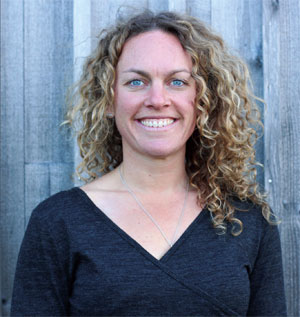
KATE GREENBERG

Kate Greenberg of Durango has been chosen by Colorado Gov. Jared Polis to be the new commissioner of agriculture.

“Producers are feeling the impacts of the trade war, low commodity prices, the ongoing drought. The decisions people had to make in 2018 were very difficult – when your water gets turned off in July, what do you do with your herd or crops? Financially speaking it doesn’t get much more real than that.

“We are here to try and find solutions to those challenges and make sure farmers and ranchers have the support and resources they need.”

Greenberg grew up in Minnesota but has what she calls “a roundabout family connection to Bayfield.” Her uncle ran cattle there before she was born and her parents have spent a great deal of time in the Four Corners. Since her appointment, she is now dividing her time between Durango and Denver.

“Durango is still home base,” she said in a phone interview.

As a Four Corners resident, Greenberg is keenly aware of how changing times are affecting ag producers. She is particularly familiar with the problems posed by the region’s long-term drought – which persists despite this winter’s snows.

“We’re at a moment –a critical moment – with water, which is what drove me to be here,” she said.

“Water is baseline, fundamental to all that we do. But there is so much changing in our world so fast. Changes in the Colorado River Basin, especially the Four Corners – that’s the geography we are most impacted by.”

Greenberg has been deeply involved in water issues, most recently as Western program director for the National Young Farmers Coalition. In that position she worked with the state’s nine basin roundtables, which bring stakeholders together to discuss water issues, and became familiar with Colorado’s Water Plan, adopted in 2015, which attempts to provide a road map for meeting future water needs.

“The Colorado Water Plan was finished under the Hickenlooper administration and [Gov.] Jared Polis is committed to funding it,” Greenberg said. “Part of my vision is that ag needs to have a seat at the table in all those decisions and we need to make sure whatever choices we make to meet the supply-and-demand gap – which is significant – that those uphold ag and support ag.”

Greenberg is pleased by the growth of the National Young Farmers Coalition because it’s part of an effort to counteract the aging of farmers and ranchers, a worldwide phenomenon. In the United States, 40 percent of farmers are over 55, according to the U.S. Department of Agriculture.

“In 2015, when we started, I was the fourth employee [at the NYFC]. Now it has 25,” she said. “I’ve worked to grow our membership.”

In 2016 she co-authored a report for the NYFC called, Conservation Generation: How Young Farmers and Ranchers are Essential to Tackling Water Scarcity in the Arid West. The report calls for creativity in taking on water challenges and for enlisting “the next generation of farmers as allies” in seeking solutions to water shortages.

Noting that farmers over 65 years old outnumber those under 35 by a 6-to-1 ratio and that more than 573 million acres of farmland is expected to change management in the next two decades, the report states, “If we fail to recruit enough new farmers, we risk furthering the consolidation of our food system, increasing permanent losses of agricultural lands, and losing a generation of water stewards.”

For the past six years, Greenberg has traveled to farms and ranches across Colorado and the intermountain West, “working with producers of all ages to connect people to one another, to listen to people in the field,” she said.

“A lot of my work was to connect producers and elected officials. I wanted to make sure farmers and ranchers, especially young farmers and ranchers, had a seat at the table. I want to make sure policies are grounded at the farm level and not made in a board room in D.C.”

As commissioner of agriculture, Greenberg will be oversee a department with 300 employees and eight divisions, including animal health, brand inspection, the state fair, and more. She’s the first woman to hold the position in Colorado and, at 31, one of the youngest people to hold it. But she brings a wealth of experience to the job.

Her career has included managing a native-tree greenhouse and seed program with the Sonoran Institute, managing natural-resource field programs at Whitman College in Walla Walla, Wash., and working full-time on a direct-market farm in western Washington. Since 2013 she has been a member of the board of the Quivira Coalition, a nonprofit that focuses on issues involving soil, biodiversity, and resilience in working landscapes in the West.

“For the last decade, my life and my work have focused on water and agriculture in the West,” she said. “That’s an important background moving forward. “I don’t pretend to know everything. I’m coming in with no preconceived notions. I am intent on listening and asking questions.”

Greenberg said although agriculture is facing numerous challenges today, to some extent that has always been the case. “Ag is not an easy business, regardless of the scale or operation type,” she said.

Even in these difficult times, agriculture generates some $40 billion in economic activity statewide and supports 173,000 jobs, she said.

“Regardless of where you are in the state, ag is essential and it has a multiplier effect. If you have a strong ag economy, you have a strong local business economy. Ag can be the anchor.

“In thinking about what rural Colorado looks like moving forward, in my mind having a strong ag economy is going to allow us to stay in rural places and have a strong economy in rural places. There is so much that benefits the community at large when we support agriculture.”

Asked what, if any, bright spots there are in farming and ranching, Greenberg answered, “Hands-down, the people.”

“Where I find the most inspiration and sense of excitement is the people doing the work. People have stuck it out through incredibly hard times. Their creativity, perseverance and sense of community is the bottom line. I have so much faith in the people doing the work. Many are friends and colleagues, but many others I have yet to meet.”

She said people are finding their way into farming and ranching in a variety of ways now, and that’s good.

“I came into ag from a non-traditional route – I was not from a farm family but I found it on my own. The more diversity we have in ag, the more inclusive ag is, the more we’re going to continue building an exciting, thriving, successful industry.

“With ag as one of the top drivers in the state, we can meet the climate challenges ahead, the challenges of drought, soil, and water. Ag is at the helm in that.”

Published in February 2019

Winning a seat at the table: An effort to oust San Juan County, Utah, Commissioner Willie Grayeyes from office fails

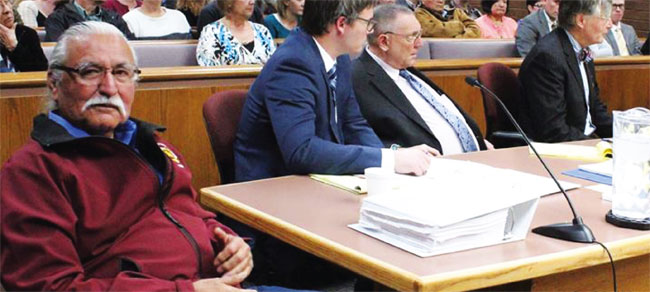
Willie Grayeyes, in red jacket in the foreground, at a Jan. 22 hearing to resolve the question of his residency.

Willie Grayeyes, in red jacket in the foreground, at a Jan. 22 hearing to resolve the question of his residency. Photo by Ryan Collins/Utah pool

To understand why San Juan County Commissioner Willie Grayeyes’ Utah residency was recently challenged in court, it helps to understand the area where Grayeyes is registered to vote.

Grayeyes was born on Piute Mesa, a remote strip of redrock on the Navajo Nation in southern San Juan County, Utah, and he has held a grazing permit there for decades. Driving from the mesa — which contains roughly 20 modular homes and traditional hogans — to the hamlet of Navajo Mountain, Utah, requires crossing a deep sandstone canyon that can become impassable when wet. And accessing basic services such as grocery stores, laundromats, gas stations, and broadband internet requires an even longer trip across the Utah state line.

With Lake Powell to the north, the 10,300-foot Navajo Mountain to the west, and an maze of canyons to the east, the only roads to the Navajo Mountain and Piute Mesa area go through Arizona. Navajo Mountain is essentially an island of San Juan County land cut off from the county seat in Monticello by a nine-hour round-trip drive.

Grayeyes, 71, registered to vote in Navajo Mountain when he was 18 and has never voted outside of Utah, but like most residents of Navajo Mountain he registered his vehicles in Arizona and has an Arizona driver’s license. His mail is delivered to an Arizona post office box since there isn’t a post office in Navajo Mountain. And he owns property in Arizona where his children attended school 30 years ago.

The second residency Challenge

All of these factors were explored at an all-day hearing over Grayeyes’ residency status in 7th District Court in Monticello on Jan. 22. An audience of 65 packed the courtroom, and at least a dozen others weren’t admitted because the room was full.

The hearing was held in response to a complaint brought by Blanding resident Kelly Laws, a white GOP county-commission candidate who lost to Grayeyes by a nine-point margin in the November election.

Laws’ complaint was the second time in the last year that Grayeyes, who ran as a Democrat and is a member of the Navajo Nation, had his Utah residence formally questioned. Another Blanding resident and Republican commission hopeful, Wendy Black, filed a challenge in March 2018, and Grayeyes’ name was subsequently removed from the ballot by San Juan County Clerk John David Nielson.

Grayeyes sued. In an August ruling, U.S. District Judge David Nuffer found that Nielson and Black improperly backdated a document in order to make the challenge valid. Nuffer ordered Grayeyes’ name be placed back on the ballot, but he did not rule on whether Grayeyes was in fact a resident of Utah.

On Dec. 28, Laws filed a new complaint in district court. Laws cited a doublewide Grayeyes purchased in Page, Ariz., in 1981 as evidence of Grayeyes’ Arizona residence. That house played a key role in the Jan. 22 trial when Laws’ attorney, Peter Stirba, argued the Page home was Grayeyes’ “primary residence” since Grayeyes has owned no other home and since his children attended public school in Page in the late ’80s and early ’90s.

A doublewide in disrepair

Multiple witnesses, including two of Grayeyes’ daughters, testified that Grayeyes last lived in Page during the 1987- 1988 school year, following the passing of his wife. In the decades since, he has traveled frequently while representing the Navajo Mountain area in various posts on the Navajo Nation tribal government and school system.

Grayeyes has also served on the boards of several nonprofits, and only recently left his role as board president of Utah Diné Bikéyah, an advocacy group that was instrumental in President Obama’s 2016 creation of Bears Ears National Monument.

The doublewide has fallen into disrepair.

Several witnesses called by Laws’ attorney, Stirba, disputed Grayeyes’ claim that he spends 60 to 80 percent of his time in the Navajo Mountain area.

In an April 2018 declaration, Grayeyes identified a home on Piute Mesa as his primary residence, but a San Juan County social worker, a Navajo Mountain Chapter official, a sheriff ’s deputy, and Laws all testified that the home was currently occupied by Grayeyes’ cousin, Harrison Ross. Later testimonies from witnesses called by Grayeyes’ legal team confirmed that Ross does live in the home, but its ownership is in dispute. The home used to belong to a mutual relative of Grayeyes and Ross who passed away several years ago, and title to the homesite lease is tied up in probate proceedings in Navajo tribal court.

In an April 2018 declaration, Grayeyes identified a home on Piute Mesa as his primary residence, but a San Juan County social worker, a Navajo Mountain Chapter official, a sheriff ’s deputy, and Laws all testified that the home was currently occupied by Grayeyes’ cousin, Harrison Ross.

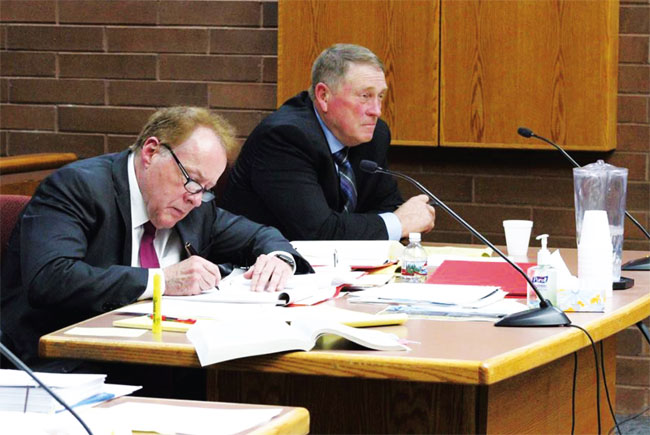
Kelly Laws (right) and his attorney, Peter Stirba, listen to testimony at the hearing in Monticello on Jan. 22. Laws, who lost to Willie Grayeyes in the November election, had challenged Grayeyes’ Utah residency.

Kelly Laws (right) and his attorney, Peter Stirba, listen to testimony at the hearing in Monticello on Jan. 22. Laws, who lost to Willie Grayeyes in the November election, had challenged Grayeyes’ Utah residency. Photo by Ryan Collins/Utah pool

Later testimonies from witnesses called by Grayeyes’ legal team confirmed that Ross did live in the home; its ownership is disputed and the title to the home-site lease is tied up in probate proceedings in Navajo tribal court.

Laws’ complaint leaned heavily on a police report compiled by the San Juan County Sheriff ’s Office after it conducted an investigation into Grayeyes’ residency in the spring of 2018. Judge Don M. Torgerson, who oversaw the case, decided the report was inadmissible as evidence because its author, Deputy Colby Turk, had conducted an investigation on Navajo Nation land without proper approval from tribal authorities.

Turk is cross-deputized to investigate criminal cases on reservation land, but Torgerson indicated that Turk’s authority does not extend to civil cases. Some of Turk’s body camera footage was later admitted as part of his oral testimony at the hearing.

‘We live in different worlds’

After five witnesses testified for Laws, several elders from the Navajo Nation, including medicine man Johnson Dennison and former Navajo Nation President Peterson Zah, were called to the stand by Grayeyes to discuss definitions of home according to traditional Navajo culture. Stirba repeatedly made objections that cultural beliefs are not relevant to the residency statute, but the judge overruled him each time

Dennison and Zah stated that, for traditional Navajo people, the burial of a newborn’s umbilical cord ties that person to a specific place for life.

“No matter where you go, you always go back to where [your umbilical cord] is buried,” Dennison said. Grayeyes’ umbilical cord is buried on Piute Mesa.

Zah said grazing permits issued by the Navajo Nation are another important indicator of a person’s “home space.”

“We live in different worlds,” Zah said of cultural definitions of home, “and the Navajo world is in many ways different from the non-Navajo world.”

In a order filed on Jan. 29, the court ruled that Grayeyes met the residency requirements according to Utah law. The judge concluded that none of the evidence brought forward was compelling enough to remove Grayeyes from the county commission, and noted Grayeyes’ deep roots in Utah.

“He is connected to San Juan County as deeply as any resident of the county,” Torgerson wrote. “In practice, he has always participated in the voting process in San Juan County. And his rich cultural history adds to his connection — he has always returned to the area and will always intend to return to the area when he has traveled away.”

According to Utah statute, a person’s principal place of residence is defined as a “single location where a person’s habitation is fixed and to which, whenever the person is absent, the person has the intention of returning.”

Due to the isolation of Navajo Mountain and Grayeyes’ itinerant tendencies (he told Deputy Turk that he’s on the road “almost all the time”), it was difficult to pin down Grayeyes’ place of residence to a single home. Torgerson instead wrote, “‘a single location where a person’s habitation is fixed’ could mean a larger geographical area […] particularly for someone like Mr. Grayeyes who observes traditional cultural practices. He may stay on Pitue Mesa under a shade hut during the summer. Or at his daughter’s cabin. Or at his sister’s home in Navajo Mountain. As long as those all fall within a single voting precinct, that geographical area is sufficient to be a principal place of residence.” Steve Boos, an attorney who represented Grayeyes in both residency cases, said he was satisfied with the ruling.

“The judge did a careful and comprehensive job of analyzing the law and the facts that were presented at trial, and he made the correct conclusion based on that,” Boos said.

Legal bills mounting

Laws could not be reached for comment before this article went to press. Stirba did not respond to a request for comment.

Limited financial resources could stifle a potential appeal, however. Laws said at trial that he waited until the last possible moment to file his complaint because he didn’t think the residency case should be paid for by private citizens.

However, at press time word was received that Laws is indeed appealing the ruling to the Utah Supreme Court.

At an early January town hall meeting in Monticello, Laws said he raised at least $30,000 to hire Stirba initially, even after Stirba told him the case would be an “uphill battle.” Laws estimated the case would end up costing $100,000 for the initial trial.

The 2018 challenge to Grayeyes’ residency was paid for with public funds, and early in 2019, San Juan County settled with Grayeyes’ attorneys for $225,000 to cover costs of that suit.

As the Four Corners Free Press has previously reported (May 2018), the county has spent close to $3 million on legal battles between 2016 and 2018 and could soon face bankruptcy.

In 2012, the Navajo Nation sued San Juan County under the Voting Rights Act for racially gerrymandering its voting districts, and a federal judge ordered the county to redraw its district boundaries in 2017. That ruling led to the election of Grayeyes and fellow Navajo commissioner Kenneth Maryboy in November, marking the first time in San Juan County history that Navajo candidates have controlled the three-member commission, even though Native American residents make up over half the county’s population, according to the most recent census data. The outgoing commissioners appealed the ruling, and the county could be asked to pay millions of dollars in legal fees to the Navajo Nation if it loses.

A shifting landscape

Leonard Gorman, executive director of the Navajo Nation Human Rights Commission, told the Free Press that the question of Grayeyes’ residency was “settled long ago. It has been settled ever since he was born.”

Gorman sees the repeated challenges to Grayeyes’ eligibility as a commissioner as tied to the history of racial discrimination that led to the voting rights lawsuit.

“We believe that Indigenous peoples are essentially second-class citizens [in San Juan County],” Gorman said, adding that he believes the changes to San Juan County’s leadership won’t be accepted by all residents overnight.

Critics of the redistricting often point to the complications associated with having a large portion of the county in the Navajo Nation. At the January town hall, Laws questioned the incoming Navajo commissioners’ ability to understand basic fiscal concepts because of that mixed jurisdiction.

“What happens when you have two commissioners who have never paid taxes?” Laws asked, presumably referring to the fact that residents of the Navajo Nation lease home sites from the Department of Interior instead of owning land outright. “They don’t understand how taxing works. It’s free money. What happens to your property tax when the county is out of money? It goes up.” (Ironically, the crux of Laws’ attorney’s argument in court a few weeks later was to say that Grayeyes had paid property taxes on his Page house for close to 40 years.)

For his part, Gorman welcomes the shift of political power south to where the Navajo Nation is located. “It’s a long time coming for this kind of shift,” he said. “It was due several decades ago, and it is very unfortunate that we have to not only go through litigation but expend an exorbitant amount of limited resources to arrive at this point in time.”

Zak Podmore is editor of the Canyon Echo Journal in Bluff, Utah.

Published in February 2019 Tagged

Will ‘Not of This Fold’ mean no longer of this flock?

Will she or won’t she?

As in, will bestselling mystery author and practicing Mormon Mette Ivie Harrison be excommunicated from the Mormon Church or won’t she? In the course of four Linda Wallheim Mormon Mysteries set along Utah’s Wasatch Front over the last four years, including just released Not of This Fold (Soho Press), Harrison has used the mystery genre to lift the veil on life as a woman within the present-day Church of Latter Day Saints.

NOT OF THIS FOLD BY METTE IVIE HARRISONNot of This Fold takes series protagonist and amateur sleuth Linda on a hunt with her younger Mormon friend Gwen for the killer of Gabriela, a Hispanic single mother who was a member of the Mormon Church’s so-called Spanish Ward in the working-class Salt Lake City suburb of Draper.

Before her murder by strangulation at a local gas station, Gabriela’s final phone call was to Gwen, and the dead woman’s voicemail reveals she knew she was in danger. Gwen concludes the police aren’t doing enough to get justice for Gabriela and decides to find the killer herself. Fearing for Gwen’s safety, Linda reluctantly joins Gwen in her vigilante sleuthing.

While tracking the killer, Linda and the more liberal Gwen spar over the strictures placed on them by their church and, in nearly equal measure, their husbands. As such, Harrison uses the characters of Linda and Gwen in Not of This Fold to represent two sides of the debate underway among Mormon women about their place in today’s LDS Church.

The mother of five young-adult sons and a new grandmother, Linda abides by a can’twe- all-get-along approach to the Mormon life she was born into, and to which she remains deeply committed despite the obvious faults she sees in her church, the bedrock of her life. After all, questioning her religion would threaten everything she holds dear: her marriage to her loving, if condescending, husband, a lay bishop in the church; her high standing — for a woman, at any rate — in the church as a bishop’s wife; even her continued regular visits with her baby granddaughter.

Childless Gwen, her marriage collapsing, has less to lose and is therefore more willing to call out the church for what she sees as its overt sexism, homophobia, and racism.

Harrison’s frank views of the Mormon Church as expressed through the characters in her books have resulted in whispers that the author might be on the verge of excommunication. Whether Harrison’s fourth, eye-opening look at the perceived faults of the Mormon Church is the one that results in her banishment from the church remains to be seen. What is clear, however, is that, through Not of This Fold and the previous three books in the Linda Wallheim series, the light Harrison is shedding on her church from within — at least for the time being — makes for fascinating reading for anyone curious about the inner workings and questionable dictates of today’s Church of Latter Day Saints.

Scott Graham is the National Outdoor Book Award-winning author of the National Park Mystery Series for Torrey House Press. The fifth book in the series, Arches Enemy, will be released in June. Visit Graham at scottfranklingraham. com.

Published in Prose and Cons

A philosophy of food

My recent obsession with all things diet has finally led me to consider a philosophy of food. Philosophers are quick to point out that food has been a topic for thinkers since the dawn of civilization. Plato included diet recommendations in his teachings and the Old Testament has some very specific dietary restrictions for followers of the one true God. More fundamentally, cuisine is one of the pillars of culture, along with language, dress, and ceremony.

How to build a consistent framework around food, food preparation, and eating? Where to start with my philosophy around food? What ethical guidance do I use to make food choices? Whatever I end up with needs to be more inclusive than just what to eat and when to eat it. It needs to consider how my food choices affect others – not only the source of my food but other eaters. How do my food choices affect the health and food security of others?

When pressed, I would say my philosophy around eating is something like the guidance offered by Michael Pollen in his book In Defense of Food, “Eat food, mostly plants, not too much.” That spells out a path for my personal health, but it does not directly address how my eating habits affect others and the planet. I have taken some time to examine transport and packaging around my food, the less fossil fuel involved the better, but what about the people who grow and harvest my food? Or those that process and prepare it when I am too busy to do it myself ?

One portal for uncovering a philosophy of food is be thankful for all the people that provide our food and drink. A.J. Jacobs, the author of A Year of Living Biblically and other books where he challenges himself to undertake a new way of living or eating, has a new book titled Thanks a Thousand where he recounts his journey to personally thank the thousands of people involved in preparing his morning cup of coffee. You can find a summary of this adventure in a TED talk at: (https://www. ted.com/talks/aj_jacobs_my_journey_ to_thank_all_the_people_responsible_ for_my_morning_coffee). His trail of thanks, as he calls it, involved thousands of people from the barista who prepares his morning cup of joe to the brothers in Colombia that grow the coffee beans to the folks that operate the New York reservoir that sources the water. Along the way, Jacobs summarized his approach to gratitude with a few guiding actions such as:

  1. “Look up” and see the person serving you the food. In Jacobs’ example, it is looking up from his phone to meet the eyes of the barista or cashier serving his coffee. It is important to notice the person behind the food experience whether that is the produce manager at the local grocery store, the butcher, or the baker. Look up and greet and thank the people that provide your food.
  2. “Smell the dirt”. Take the time to understand and experience the details, dirt, plants, trees, and places that are involved in growing, processing, and preparing your food.
  3. “Find the hidden masterpieces all around you” or notice the small details. In Jacobs’ case the ingenious coffee cup lid that allows the drinker to get a good whiff of the coffee he/she is drinking. Take the time to notice the plate, food preparation, design of packaging, or even the dining room that enhances the enjoyment of your food.

While, I am not nearly as ambitious as Jacobs, I believe that his guiding words will help me become more mindful of food. One area where I am currently evaluating my eating habits is in the category of meat.

Should I eat meat? If so, are there some meats that are better than others? Red meat versus white meat. As an angler, I know that fish, particularly salmon, bleed just as red as any other animal when I clean them. Why are fish the exception to the red meat rule? Wild game compared to domestic beef. The Old Testaments says you shouldn’t eat pork. (Is bacon included with that?) What is my justification that local meat, whether wild or domestic, is better than meat from outside my local area?

I guess it comes down to that fact that I can look the grower and the processor in the eye and say thank you without purchasing a plane ticket. If I buy local, I can personally express my appreciation for the care and love that they put into every bite of meat, veg, fruit, and grain that I put in my mouth. Tis a privilege to live in Southwest Colorado.

Carolyn Dunmire gardens, cooks and writes in Cahone, Colo.

Published in Carolyn Dunmire

Having fun, fun, fun!

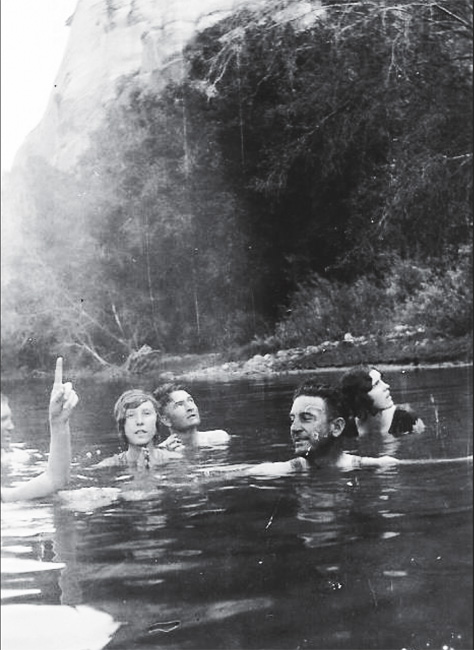
Recreation in Southwest Colorado in the mid-1930s. This farm family hiked down to Dolores River below Lone Dome for a swim after a week of work.

Recreation in Southwest Colorado in the mid-1930s. This farm family hiked down to Dolores River below Lone Dome for a swim after a week of work.

Hey, let’s hit the slopes this weekend, there’s a good storm blowing in some fresh powder, it will be great! Here we are in the recreation capital of Southwest Colorado, and it is free. Well, maybe not so much.

We hear a lot about “recreation” or “recreation Industry,” but just what is recreation? Is it going bowling, dancing, hiking, biking, skiing, horseback riding, four-wheeling, fishing, hunting, motor-biking, riding ATVs, swimming, picnicking, camping, bird-watching and photographing? It may be all of those, or some, or none, depending upon who is involved and why.

According to Webster, recreation is “restoration to health; to create anew; restore, refresh; refreshment of strength and spirits after work; a means of refreshment or diversion.” Now I begin to wonder how skiing into a tree and crashing a bike, sending the “recreationist” to the hospital, is “restoring to health.” So what is my point?

Recreation used to be to relax and enjoy something different after working hard all week in some industry of manufacturing, building, agriculture, etc. It cost very little if anything.

Today, “recreation” has become a large consumptive business and is not by definition an industry. Industry produces a tangible product to be sold or exchanged, thus creating new wealth and economy. Recreation and tourism sells or exchanges a product manufactured by industry and/or a service to a public, thus simply redistributing wealth that was earned or produced elsewhere, it does not create new wealth.

Many of the products for recreation are actually produced overseas in places such as Vietnam, China, and Indonesia. Today’s work environment provides personal income that may be used for recreation “activity” such as completing a bucket list for having climbed all fourteeners or hunting a record 6×6 bull elk, or the challenge of a new mountain-bike trail. That is all great, but everyone has their own different and varied interests and wants. Recreation and tourism has morphed into largely a luxury expenditure that many go into debt to participate in.

Is that bad? Not if you can afford it and we are happy for businesses to help you to redistribute your wealth/debt. We all have the liberty to make our own choices — just don’t let your choices nullify my choices. By necessity, my choice is for low or no-cost recreation.

Here in Southwest Colorado about 73 percent of the public lands of the state are controlled by the federal government, which seem to be controlled by tax-exempt special-interest corporations by threat of litigation. These lands hold the greatest opportunity for recreational activity by our local people as well as tourists. That brings up the next question: What recreational interests should have preference over the others for use of the public lands? That is the basis of the current litigation over the Rico-West Dolores travel management plan. An environmental group doesn’t want motor bikes on an historic trail that they want. What “right” does any user group or person have to the land, resources or trails? ZERO, nothing under the Supreme Law! Recreation and tourism revenues are nebulous and fickle at best.

What happens to recreation businesses when there are wildfires, low water levels, high gas prices, road closures, recreationuse regulations, oh and government shutdowns? Recreation and tourism are fair-weather, “soft” economies.

We certainly should promote and make the best of them, but concentrate on rebuilding our economy through energy, manufacturing and agriculture.

Recreation can and will result when those basic economic drivers are healthy and growing.

Dexter Gill is a retired forest manager who worked for private industry, three Western state forestry agencies, and the Navajo Nation forestry department. He writes from Lewis, Colo.

Published in Dexter Gill

Imploding institutions and the millenials

The failure of highly educated and highly compensated CEO’s, along with their corporate boards, to manage their companies’ future is stunning. It is more of an indictment of the status quo business model that some corporations have embraced than it is an indictment of capitalism per se.

Somewhere along the line, crony capitalism became business as usual in too many of America’s Fortune 500 companies. The 2008 financial crisis was never resolved and the ripple effect is beginning to noticeably reverberate. The lessons to be learned from PG&E, Sears, and banks too big to fail are important ones that have generational aspects that should not be ignored.

The United States population is currently around 327 million. That population falls into six distinct generational categories:

Greatest Generation — 3.79 million Born before 1928

Silent Generation — 28.32 million Born between 1928-1945

Baby Boomers — 75.52 million Born between 1946-1964

Generation X — 65.72 million Born between 1965-1980

Millennials — 79.4 million Born between 1981-1996

Generation Z — 73.6 million Born between 1997-2015

(Data from Knoema Corporation, July 30, 2018)

The Millennial Generation is now the largest, with expected immigration to increase this number significantly. It is worth noting that current estimates suggest that the peak number will be around 85 million, while 71 million of those were actually born in the United States.

Most of the Millennial Generation had come of age at the time of the so-called Great Recession of 2008. They were old enough and educated enough to understand as they watched politicians pick the winners and losers of Wall Street and the effect it had on their young lives. Who received the government bail-outs? Who went broke? Who went to jail?

A great many average Americans lost their homes and some millennials saw their chance to attend college disappear as well. President Obama’s Treasury Secretary, Timothy Geithner, was a Goldman Sachs alumnus. He orchestrated billion-dollar settlements from corporations that went to the government. While the Heartland seethed, very few of Wall Street’s elite were even held accountable, much less sent to jail. Just like the Great White Shark in the movie Jaws, a restless wave was forming. Once under water, it is just now starting to surface.

Sears Holdings Chairman Eddie Lampert was a Goldman Sachs intern. His turnaround of Auto Zone was so impressive, he was being touted as the next Warren Buffet. Not anymore. Sears is filing for liquidation. No need to be concerned for Mr. Lampert, he will do just fine. The employees, the mom-and-pop shareholders; not so much. Sears, once an icon of American prosperity and after 126 years, is history. While sad, that is exactly what should happen. The company’s executives failed to accurately gauge what their customers wanted in a changing demographic.

Pacific Gas and Electric is filing for Chapter 11 bankruptcy to protect itself from liability for damages that their negligence caused. According to an NPR report, PG&E is replacing its board and plans to sell off its natural-gas division. There have been reports for years that PG&E, one of the nation’s largest utility companies, has endured poor management decisions. Company strategy seemed to be indifferent to long-standing consumer complaints, regulatory oversight issues, and basic safety procedures that every energy company faces.

PG&E has a record of spending millions of dollars on lobbyists and campaign donations to elected officials, which they have every right to do. The prospect of PG&E now selling off assets to show good faith and corporate accountability, after years of trying to game the system, looks more like desperation rather than contrition. There are other utility companies in California, and perhaps the free market will create new ones. PG&E should fall.

That being said, I would hope that California taxpayers and the customers of PG&E also hold their government leaders’ feet to the fire. If all those paid junkets and campaign contributions that PG&E provided to politicians resulted in crony capitalism, Californians should demand their resignations if they still hold office. If not now, when?

Since the economic meltdown of 2008, we have witnessed the rise of populist movements amid increasing cynicism of basic governance. The Occupy Wall Street movement, the Tea Party movement, the Black Lives Matter movement, the #Me Too movement, while seemingly disparate events, all originally signified a sentiment of rage at the perceived status quo’s lack of justice. Most social movements become co-opted over time by political party hacks who prefer to be in charge of messaging.

There is a great deal of speculation that the millennials are turning to socialism as personified in Alexandra Ocasio-Cortez. The median income for a millennial, according to Business Insider, is $40,000/ year in both California and Colorado. In general, they do tend to be quite liberal but they are also quite young. More than half of the millennials that have registered to vote classify themselves as independents. Due to high levels of student-loan debt many have yet to establish the firm moorings that previous generations adapted as a matter of course.

As older generations wonder if the Republic is doomed, I think it is just as likely they will become fiscally conservative. The millennials are not a shy bunch and they seem to have little patience for business as usual.

Can you feel that restless wave rising? I can.

Valerie Maez writes from Lewis, Colo.

Published in Valerie Maez

A woman who soared to new heights

Colorado’s Millicent Young, who was among the first female pilots in World War II, died at 96 on Jan. 15, 2019.

Colorado’s Millicent Young, who was among the first female pilots in World War II, died at 96 on Jan. 15, 2019.

Millicent Peterson Young was born circa 1922 near Lodgepole, Neb., on the family farm. When she was six years old, a pilot landed his plane on their property telling her, “Don’t touch that plane, little girl.” That was the wrong thing to tell Millicent. It seems that was the very day she decided, without a doubt, that she was going to be a pilot.

Six years later, when she was 12, she had her first ride in a plane with a crop duster who charged $5 a ride. She traveled to an airstrip in Ogallala, Neb., in 1943 where she did learn to fly. When she requested a ride from her mother to Kansas City, she fibbed and said she was going shopping for school clothes. She was presented her wings by General Henry “Hap” Arnold, who led the Allied forces in an air campaign that toppled Hitler.

During 1943 our government put out a call for some aviators. They were needed as a result of the “severe loss of male combat pilots” in the war. Still, the Army Air Force was very selective. More than 25,000 American women applied for training, but only 1,830 were accepted and took the oath. Millicent was one of those chosen. They were called “Fly Girls.”

She told The Spokesman-Review in 2010 that she could drive a truck and a car by the time she was 10 and did not doubt she could qualify for the WASPs. She says she was inspired by Evelyn Sharp.

The WASPs went through the same rigorous flight training as the male Army Air Forces’ cadets. They also took many of the same risks, sometimes with planes that were new and/or had problems. Over the program’s two-year span, 38 of the Fly Girls died – including Evelyn Sharp, who had inspired Millicent. Millicent herself specialized in towing targets for gunnery practice, she recalled, with 100 feet of distance between the targets and the AT-6 she was flying. This was at a female-only air base in Sweetwater, Texas.

But the government position was that the WASPs were not actually military. This manifested itself even in the way their dead were treated. The military did not pay for the burials, nor did it allow gold stars in their parents’ windows or flags on their coffins. This seemed so unfair, but it was what happened.

The Fly Girl program ended suddenly. With victory in WW II almost certain, on Dec. 20, 1944, the WASPs were quickly, quietly and unceremoniously disbanded. There were no honors, no benefits, and very few thankyous, if any. They had paid their own way to enter training, they had to pay their own way back home. The WASP military records were immediately sealed, stamped ‘classified’ or ‘secret,’ then filed away in dusty and obscure government archives, unavailable to the historians or scholars who wrote the history of WW II.

However, stories were told, and eventually the information became known, with the help of the WASPs’ “Wings Across America,” an organization dedicated to educating the American public about their service. There also have been exhibits at many museums, including the Smithsonian. Thousands of women aviators flying aircraft have benefited from the service of the WASPs and followed in their footsteps.

For a short time after the war, Millicent worked as a commercial pilot. She then attended the University of Nebraska in Lincoln on a scholarship from the Union Pacific Railroad. There she met and eventually fell in love with another pilot, Bill Young, who had flown for the Army Air Corps, and they married. She became the mother of five and for many years she devoted herself to being a mother and wife.

The family moved to Colorado Springs in 1952.

Millicent Young worked various jobs, parking cars at the Antlers Hotel, selling encyclopedias, even penning a food column for The Gazette, then called the Gazette Telegraph. She spent more than two years working for the El Paso County Department of Human Services, being named “Working Woman of the Year” by the state in 1985.

She continued to fight to get WASPs full military status. Finally, in 1977, her hard work paid off and her fight was won. She pledged to gather 1,000 signatures for that legislation, visiting bars across Colorado and Nebraska to collect them from men who often offered to buy her a drink after they had given their autograph, her daughter Martha Young said. Another victory for Millicent Young. In the interview in 2010, she was asked if she felt bad about the past treatment received by herself and the other Fly Girls. She said no. “Why should I forget the good times,” she commented with a wide grin, “just because somebody was stupid?”

Her son Bill has written a book about his mother and the WASPS, “Going for the Gold.”

Young and other surviving WASPs were awarded the Congressional Gold Medal, among the nation’s highest civilian honors, in 2010.

Margaret “Midge” Kirk is a slightly eccentric artist, writer, bibliophile, feminist scholar and hobby historian who lives in the SW corner of Colorado. She can be reached at eurydice4@yahoo.com, or visit her website www.her-storyonline.com.

Published in Midge Kirk

A mountain town in France

SMITHSONIAN … It’s easy – even as far away from the widening gyres of the Center as we are, on the Inner Basin West’s eastern fringe – to get caught up in the hyenas of the moment. Abortion. Judicial appointments. Immigration … To find ourselves worried about the changing sidewalk demographics of the neighborhood. New faces. Different language. Hard-labor job crews. Government wanting to build fences. Leaders spewing insults. … It’s easy to start scape-goating the Other … Of course, our Christian teachings are supposed to help us in this respect, but sometimes fundamentalists seem to turn every gray to black & white. … That’s why the story the Smithsonian tells of a mountain village in France that has a tradition of welcoming immigrants and settling refugees for over 400 years is so important. Le Chambon-sur-Lignon in France’s south-central Haute-Loire region. It was here Protestants found 16th Century refuge from Catholic persecution, WWII Jews from German Nazis, fleeing Kosovos, Chechnyans, Congoleses … It’s not a huge thing. One town the size of Ouray. Adopting a few dozen families. Working across generations to make their home a more-inclusive place. But it is a huge thing. A very beautiful, Christian huge thing.

ROLLER-COASTER CURE … No, it’s not for headaches. Roller-coaster rides usually give me one. Nor for nausea, which it can easily induce. They appear to be a cure for passing kidney stones … According to two researchers from Michigan State University’s College of Osteopathic Medicine, using a surrogate 3-D printing of the stones on a backpack-sized plastic kidney replica, they found almost two-thirds of the 3-D stones passed though the replica’s urinary tract when the pair rode at the tail of the coaster. “It seems that shaking, twisting and diving from on high could help small stones dislodge themselves from the kidney’s inner maze of tubules,” said Science News.

WRONG AGAIN … How many times since the Reagan era have I had to listen to election politicos swearing tax cuts pay for themselves? But they don’t. We taxpayers are the ones who pay. The Republicans do it over and over, and citizens believe them … Take this latest tax cut the Republicans unleashed on us. Yes, the economy grew by almost 3 percent in 2018, but federal tax revenues fell by 2.7 percent. Yet once again, after a profligate Republican administration, our deficit is on track to break the $1 trillion mark.

WOODEN CHEST … It’s like our duly-elected pluto-bully who’s been leading the industry’s raid of the public treasury has overdosed on meth, and we’re having to figure out how to save him from himself before the whole nation goes into wooden chest.

NUMBERS … I read about science, micro and macro, so I’m always running into new mathematical terms. But this one had me stumped: “four inverse femtobarns of data” … It’s what CERN’s Large Hadron Collider in Switzerland produced last year watching 400 trillion proton-proton collisions.

MORALITY TALE … I was a sucker for fairy tales and morality tales when I was a kiddo, learning everything I knew from books, pre-wikipedia. Puss & Boots. Three Little Pigs. Cinderella … Now, as a former Californian watching the missteps and retribution befalling Pacific Gas & Electric, one can’t help but shake one’s head. You could see it coming. Bad decisions. At-risk infrastructure. Huge corporate payouts. Having to go bankrupt after another fire season of catastrophic liability … But the real moral here is very targeted. It’s to Colorado’s own cooperative electric company: Tri-State Generation and Transmission. San Miguel County fought them over the under- grounding of powerlines though some of our most flammable forest mesas. Tri-State refused to even deign to consider the off-set savings in catastrophic liability from putting their generation lines into the ground. A savings that could prevent Tri-State from having to declare bankruptcy should an errant powerline of theirs cause a catastrophic fire in Colorado one day in the future.

RELATIONSHIPS … This era of social media friending has brought us face-to-face with the reality of how many relationships at a time can we reasonably maintain. As the September 2018 issue of Scientific American pointed out, “Study after study confirms that most people have about five intimate friends, 15 close friends, 50 general friends and 150 acquaintances” – a threshold imposed by brain size and chemistry … Except, of course, in my case – and my 5000 Facebook friends.

OP-ED COLUMNS … I’ve been writing personal columns in Telluride since January of 1981 … My first “Pandora’s Box” column appeared in the defunct Telluride Times in January of 1981. I’ve gone on to write columns for most of the papers that appeared in Telluride – the San Miguel Journal, Telluride Mountain Journal, Telluride Times-Journal, the Daily Planet and, of late, the Watch. Either as “Pandora’s Box” or “Up Bear Creek” … I had a column in the old Mountainfreak magazine (that San Miguel County Commissioner Hilary Cooper edited) called “Far Freakin’ Out” that came out of Telluride … And I have a longrunning monthly column in the Four Corners Free Press out of Cortez and a weekly online column in the Montrose Mirror … Not to mention lots of shorter- lived columns in regional papers and newsletters … For an English major – one of those college degrees that usually don’t get you very far in the job market – I’ve managed to turn my love of language into a successful journalism career … And I look forward to continuing it for as long as I can still put pen to paper, fingers to the keyboard … But not for the Telluride Watch anymore. After all the changes in Telluride they were still paying me less than I got 12 years ago, before the Downturn … People look to government to solve our housing crisis, but there’s another culprit that makes it near impossible – some members of our business community that pay predatory wages … So, no more Watch print columns for me. I’m moving out of town and into the region …. Find my weekly column at Montrose- Mirror.com and my monthly column here.

Art Goodtimes is a former county commissioner in San Miguel County, Colo.


THE TALKING GOURD

Still

In Rainbow old age
the newsome place a curious
toe finds itself

Seems the bellbottom
semelparity of the Sixties
hides its radioactive flair
in see-through pools

In an uptight overheated
millennium of
uncool

But I can’t stop
tasting the waters
testing for shark

Yes I will swallow fire
Kiss karma’s ruby lips

Still
McRedeye sez
I miss hip’s chill

Published in Art Goodtimes

Senti-mental

This week, I had an essay turned down by a literary publication for bordering on “the sentimental.” I’m not entirely certain what the editors mean by “the sentimental,” but let me assure you that they were generous and kind and complimentary about my work in every other part of the rejection letter that didn’t begin with, “We regret to inform you.”

So I have come to the conclusion, based on the evidence that they did not pay me untold tens of dollars for my so-called “beautifully written” and “fascinatingly structured” work, that the sentimental is an undesirable trait to editors of literary publications. An unforgivable and unforgiving sin, akin to plagiarism or writing for children.

The rejection itself does not sting. One does not make it far in this writing business if one does not develop a thick tolerance, perhaps even a guilty glee, for the well-crafted rejection letter. The internet once delivered me a story about a man who submitted pieces by canonical authors to literary journals around the country, each one of which was told that tastes are subjective and we are certain your future work will make for very effective firestarter. Through all of one’s own rejections, one holds such anecdotes close to one’s chest until one finds a home writing for the local alternative paper, at which point one fashions oneself a plausibly passable Pulitzer that’s still displayed on my refrigerator today.

Even the apparent slight of suggesting my work borders the uncouth land of the sentimental does not sting. Namely because, my essay is sentimental. I cannot state this more plainly: it is an essay about my dog. Forget avoiding the sentimental. All my craft, all my skill, all my automated spellchecking, exerted itself upon using distinct words and not ending every sentence with “Whoozagoodboy? Huh? Huh? Yezyouare!” Because that is how I would naturally write about my dog, or around my dog, or anyone else’s dog for that matter.

Shoot, as I narrate to myself right now, Hawkeye is resting in front of my writing chair, head nestled atop his purple chew toy, and heezocyootyezzeIS! He is pure love and tennis balls, just as my last guy Wally was pure love and contemplation, and basically my pen is now spewing out saccharine pawprints and puppy dog eyes.

The sentimental. I suppose I could have written myself kicking the dog once or twice, or discoursed upon how dogs really aren’t people and it’s okay to leave them chained up in the alley overnight. Let his ribs show, in Steinbeckian prose, of course. Forced him to ride in the bed of the truck instead of the cab. That might have done the trick and gotten my essay published, at least on the ASPCA’s watch list.

I will own that “sentimental” badge. If it means I have a feeling, bleeding, beating, melting heart, for dogs if not always for other people, I’ll take it. There’s just one problem: I’m on deadline for that local alternative paper, and now I’ve got the yips.

You see, I was going to write about taking Hawkeye out for his first-ever snowshoeing adventure. But they don’t make snowshoes for dogs. Kidding! Of course they make snowshoes for dogs, probably. They must. I mean, you can buy a personalized onesie for your dog. You can hire a personal life coach for your dog. You can send your dog to boarding school so you and your wicked new spouse can have the house to yourselves. Snowshoes would be the least shocking dog-related idea I’ve heard about this week, and if somehow no one else has made them yet, I call dibs.

No, I wore the snowshoes, and Hawkeye was essentially naked, as were his two doggie friends. My two human friends were, perhaps sadly, perhaps fortunately, clothed.

That’s what I was going to write about, but now I hear that gremlin atop my armchair clucking at each of my ideas and questioning its sentimentality. I was going to explain to you Hawkeye’s anxiety around taking walks, and how I wasn’t even sure he would make it past the parked cars. Too sentimental. I was going to describe the thick white snow and how Hawkeye’s two friends taught him to enjoy his trek. All true, but probably sentimental. I was going to regale you with tales of how good all three dogs were, except for when two of them ate horse poop, and one of them made a break for the trailhead, and you’ve never really lived until you’ve seen two people on skiboards and one on snowshoes running in three different directions all trying to prevent the need for vet bills and Lost Dog posters. Definitely too sentimental.

So until I can overcome these yips and re-embrace the sentimental, I suppose this column is on hold. But you don’t mind, right? You’ll love me anyway? Huh? Huh? Yezzyouwill.

Zach Hively writes from Durango, Colo. He can be read and reached through http://zachhively.com and on Twitter @zachhively.

Published in Zach Hively

What happened to Crime Waves?

The answer is that our tiny editorial staff managed to come down with various demonic plagues right around press time, and we simply weren’t able to produce Crime Waves this month. We also had to make this a smaller-than-usual newspaper and to skip the calendar. Both Crime Waves and the calendar are very time-consuming, so we decided to focus our limited energies (between coughing, blowing, sleeping, sweating, shivering and so on) on the rest of the paper. We hope you can forgive us.

This is probably a good time to mention that Crime Waves is one of the most popular sections of our paper, but there is a vocal minority of people who don’t like it at all. They argue that (1) it might be harmful to tourism; (2) it is depressing; (3) it makes fun of people struggling with substance abuse and (4) we don’t need to know about this stuff.

Most newspapers run some form of police blotter. The idea is that it lets citizens know what type of crime, even petty crime, is going on in the community — where it takes place, what sort of substances it involves (around here, alcohol is still the worst problem), and how the police handle the situations.

When we started the Four Corners Free Press, we decided to try to make the traditional blotter a bit more interesting by adding some colorful writing and occasional observations of our own. We don’t mean to pick on people with substance-abuse problems per se, but rather to shine a spotlight on the flaws and foibles in human nature to which all of us may fall prey.

We also have a strong desire to show the kinds of situations that law enforcement officers face on a daily basis. If you think it gets tiresome reading about people cursing at the cops or staggering in the parks or fighting each other over petty nonsense, think about how tiresome it must be to deal with that kind of behavior as part of your job. The police and sheriff ’s personnel rarely get the credit they deserve for handling most of their contacts with patience and restraint.

And as to the tourism concern, well, crime happens in every community. It is, for the most part, much less serious here than in most metro areas. Crime Waves isn’t even available online, so we don’t believe it will have much of a dampening effect on potential visitation to our area.

Newspapers often have to struggle to obtain incident reports. We’re fortunate to have had access to the detailed reports by both the Cortez City Police and Montezuma County Sheriff ’s Office all these years.

But we take your comments seriously and we will try to be responsive to the concerns of those who think Crime Waves is too insensitive.

Published in Editorials

Concerns about county social services prompt examination by ombudsman

The Office of the Child Protection Ombudsman of Colorado is looking into approximately 17 cases involving concerns expressed about Montezuma County’s Department of Social Services.

In a case briefing report, Stephanie Villafuerte, child protection ombudsman, wrote that on April 30, 2018, her office was contacted by a “community stakeholder” who alleged that practices in the county’s social services office were compromising child safety. The complainant said that following a series of personnel changes in the office, the county department had “failed to assess 28 child welfare cases – two of which involved allegations of sexual assault on children.”

Those concerns turned out to be exaggerated, according to the case briefing. It states that the ombudsman immediately reviewed the 28 cases and found that there were “only 11 cases that had been neglected by a former county department employee.” The county reportedly informed the ombudsman that a supervisor had reviewed the cases “and the children’s safety and well-being were not at risk.”

Also, the two cases involving sexual assaults had, in fact, been investigated by law enforcement.

However, according to the ombudsman’s report, the review “revealed violations in how the cases were handled by the county department.” And during the three months following the first inquiry, the ombudsman’s office was reportedly contacted by “multiple community members” about other concerns not related to the original case.

“These inquiries raised case-specific and systemic concerns about the county department’s practices,” the report states.

A total of 16 additional inquiries was received, according to the report, and on Aug. 1, the office opened a case and incorporated the 16 additional cases into it.

The case briefing lists the individual case numbers, the status of each, and the general nature of the concern involved, but does not give specifics, for reasons of privacy and confidentiality. However, most or all of the cases apparently involve situations that occurred under the tenure of the former social services director, Josiah Forkner, who resigned in April.

“A lot of these issues were raised before my time, with the former director,” said Gina Montoya, the current director, who was appointed in July 2018. The ombudsman’s office, she said, is “obligated to come do their own independent investigation if there are concerns. They have a right to look at those cases and ask those questions. We’re working with them and we’ll have to see what the outcome is.”

For some months, a number of local citizens have expressed concerns about the social services department in Montezuma County. There is even a Facebook page called “Montezuma Citizens for Improvements to Social Services.”

“Demand Change,” it says in large letters at the top of the page.

In answer to a message from the Four Corners Free Press, the unidentified manager of the page wrote: “The individuals who run this page have insight and concern with the neglect the children of this community have suffered at the hands of social services, county commissioners, and law enforcement alike. Currently there are 18 cases as of now, there were 17 cases, with the Onbudsmens office that are being investigated, that is just in this county, community and within a small timeframe. Imagine if that timeframe were to be broadened, how many cases, and what would be found? There is simply not enough being done, not enough being said, not enough comfort levels being taken away.”

The person did not give further specifics about the concerns.

Forkner had been in his position for about 3 1/2 years when he resigned abruptly last spring, not long after a March 5 executive session among the county commissioners which, according to the minutes, included “an issue in Social Services” as among the topics to be addressed.

On April 1, Lance McDaniel of Cortez, who is now a member of the Cortez City Council, spoke to the county commissioners during the public-comment portion of their meeting and called for counseling to be made available to social services employees because they “potentially have been forced to endure personal trauma during the tenure of the former director.”

McDaniel, who said he was submitting his concerns on behalf of a group of constituents, also called for more oversight for every division of Montezuma County’s services.

The Cortez Journal reported in April 2018 that the 22nd Judicial District Attorney’s Office opened a “preliminary investigation” into Forkner at the time of his departure, but no charges were ever forthcoming. Then-County Administrator Melissa Brunner told the Journal at the time, “He’s been a good director.”

Three women who had dealings with social services, including one who said she had contacted the ombudsman’s office with her concerns, spoke to the Four Corners Free Press on condition of anonymity because of the sensitivity of the cases involved.

Although the three of them had had different dealings with the department, all said that things had seemed to deteriorate after the retirement of longtime director Dennis Story in 2014. They said they believed that some decisions about personnel and about child welfare cases were made on the basis of personality, with people treated well if they were in favor with the administration and treated poorly if they were not.

Local attorney and Cortez City Council member Jill Carlson, who represents some clients in cases involving social services, came before the commissioners on Sept. 10 and asked them to reinstate a citizens’ review board for social services, and ultimately they did. They advertised for new members, interviewing the applicants in executive session, and ultimately appointed four people: Jerry Ayers, Jeremy Rosenbaugh, Elizabeth Tozer, and Kathryn Garlinghouse, according to Montoya.

She said anyone with concerns about child welfare cases being handled by the county social services department can go to the review panel or contact her directly.

Montoya previously worked for 10 years in Boulder County as a child protection caseworker and in Adams County as a clinical supervisor. She said she has never heard of such a cluster of cases coming to the ombudsman’s office concerning any single county.

“I have not heard of this before in terms of this many complaints,” she said. “This is new to me too.”

She said she wants the public to know that there is a 13-member Child Protection Team that reviews all decisions made by caseworkers in child welfare cases, making it very difficult for decisions to be made arbitrarily.

“We don’t work in a bubble,” she said. “We have referrals, we go out and do our assessments, and review those with the Child Protection Team. The professionals on that team go over those referrals with us and tell us what we may have missed. It’s not like the caseworker makes the decisions herself.”

The Child Protection Team includes representatives from the probation office, Piñon Project, Re-1 School District, Axis Health, Southwest Memorial Hospital, sheriff ’s office, district attorney’s office, and more, she said.

“When I talk to a layperson, they have no idea that we have to review our cases,” Montoya said. “It’s not just something we do by ourselves. Hopefully we get a better assessment when we have a team working on the cases. They may find things that we cannot see. They’re very objective.

“It’s heartbreaking to me to hear of this coming out in the newspaper or on Facebook because you often get just one side of the story.

“People don’t hear about the good things we do, like when we reunite a family.”

Montoya said working on child welfare cases involving potential abuse and neglect is difficult and sometimes even dangerous. One of her staff members was recently physically assaulted in the course of the job, she said.

“I would take a look at the positives as well,” she said of the department. “I say, don’t be part of the problem, be part of the solution.”

Jordan Steffen, deputy ombudsman with the state ombudsman’s office, declined to comment on whether the 17 or so cases in Montezuma County was an unusual number. She said the ombudsman’s office received a total of 611 contacts during the last fiscal year, 2017-18, which was its busiest yet. Those came from around the state, and clearly most of the calls were from more populated areas.

“We call them ‘contacts’ because most often they involve a concern,” she said. “Sometimes they involve people with questions, or citizens looking for help navigating the system.”

The majority of the office’s contacts involve “assists,” she said. “Maybe someone has an open case with a county and is struggling to understand the procedure or having a complaint. We do a review of third-party records and see if there are concerns.”

The next level of activity is an actual investigation, she said. Investigations typically involve a “more systemic look into an issue and an agency as a whole – a broader issue than an individual case involving one specific family or child.” Because of confidentiality rules, Steffen could not discuss specifics of the various Montezuma County cases. However, the ombudsman’s website gives general information about what type of concern each represents.

All of them fall into one of three categories: sufficiency of response, service delivery, or assessment of needed services.

Steffen explained that the categories are very broad. “Assessment of needed services,” she said, “might be how that agency engaged with a family and a child and determined the services the child needed.”

Sufficiency of response, she said, involves “examining when an entity becomes involved with a family and what was the response – was it enough? Was it proper?”

Service delivery involves the question of whether services are getting to families in an appropriate, timely and efficient manner, she said.

Steffen said although obviously there is a higher number of contacts coming from the state’s metro areas, the gap between rural and metro contacts is closing as the office does more outreach in rural areas.

The cluster of cases in Montezuma County, she said, could theoretically be due to people spreading the word about the office among themselves, although she did not know if that was the situation.

The ombudsman’s office has no enforcement authority, but if after examining a case or complaint the office believes there may have been a violation of state law or rules, they will issue letters of compliance concern. These are not an actual determination that laws were violated or rules weren’t followed, she said.

A copy is sent to the agency being looked into, and a response is requested. The letter and response are then sent to the state Department of Human Services, which reviews them and decides whether any necessary action should happen.

If the office does open an investigation, it makes recommendations as well, Steffen said.

The case briefing regarding the Montezuma County concerns says since receiving the first inquiry on April 30 of last year, the ombudsman’s office has visited the county twice and spent more than 40 hours interviewing dozens of community members, including social services staff, local law enforcement, parents, foster parents and others. The office has also done an in-depth review of the 16 individual cases “as well as additional child welfare cases the CPO [Child Protection Ombudsman] found to be pertinent to its understanding of the county department’s practices and community relationships,” the report states. The office also consulted with the Colorado Department of Human Services.

Now, the office needs more time to draft “more than a dozen final documents,” the report says.

“Such documents include letters outlining identified compliance concerns and a final investigation report discussing systemic findings and recommendations,” it says.

The final documents will be published on the website.

The report says the cases are to be wrapped up by April 29 of this year.

Published in February 2019 Tagged

Groping for memories

Sexual assault disorder (SAD) is not exclusively a man thing, but what’s really sad is the behavior is so ingrained in the drinking culture that this alcohol-induced lifestyle choice leads to acute cases of repressive memory disorder (RMD) and the assaulter, unable to recall what he did, sometimes denies his actions even in as little as the morning after. Binge drinking (even beer) may explain the memory blackout, but the victim remembers what happened for the rest of her life.

In light of the recent SCOTUS nomination procedures, it also appears some elected officials are beginning to question the propriety of being held accountable. The thinking goes like this: a person’s behavior may be the result of a condition that can’t be helped, especially if it occurred in those good old days when boys were expected to sow their wild oats. In the wild oats euphemism, the male represents the farmer and the female embodies the earth. On the surface it appears to be a healthy metaphor, full of robust natural comparisons that unfortunately fizzle out if we remember how the petroleum industry’s drilling and fracking practices have provided us with another metaphor for harvesting the earth’s resources.

An uninvited pat on the ass is not just an alternative handshake, and we should call it poetic justice when a man’s style of courtship eventually ends up in court.

Collectively we question every woman who publicly makes any allegation. We use the word “allegation” just like reporters use the word “alleged” when talking about a suspect’s arrest, in order to preserve his or her right to due process. But women who lodge complaints risk being silently convicted of trying to ruin a man’s life just by bringing up something his RMD already dismissed. Or could she be seeking revenge for feeling humiliated by a man who turned her down? She may have made the whole thing up. Any woman voicing any complaint can end up being classified in the public’s mind as a Woman Emoting an Imaginative Revenge Disorder (WEIRD) and if one woman in a hundred-thousand admits to doing so, then every woman must be harboring the same motive.

It appears I’ve paragraphed myself into a corner. Some readers may believe I am actually questioning the legitimacy of reporting sexual assault complaints, so it may be appropriate to come clean about what happened to me. My experience is trivial compared to the sexual dynamics women deal with every day. And to be clear, at the time of my encounter I hadn’t been drinking, smoking weed, or digesting any mind-altering drugs. At least, let me say for the record, I don’t remember. The woman involved must remain anonymous, unless she comes forth to file a complaint. Defending myself would only result in exposing not the woman but my own overwhelming and somewhat sordid lifetime relationship with literature in general, and poetry in particular.

Once while browsing the shelves at a bookstore coincidentally dubbed Between the Covers, I came upon a book title that caught my attention: Poems That Touch You. Immediately the words felt like an awkward title for a book of poems, and as I browsed the pages it certainly lived up to that hunch. You see, I’ve read poetry that didn’t touch me, and the truth is — if I had to choose — I’d prefer what’s less invasive. Sadness, rage, hormonal indiscretion, it all amounts to a crafted literary-kind-of stimulation, like a sonnet that couples with itself in the last two lines. I do not want any indiscriminate touching when I pick up a book and stand in the aisle reading a page or two, clueless as to what I’ll feel. Women don’t either. Boundaries ought to assert themselves in a world so random.

I remember accidentally turning and bumping into a woman who didn’t expect it, touching a spot she preferred to keep to herself. She immediately and justifiably pulled away. To her I am no different than the poem she was forced to memorize in the fifth grade and has since forgotten.

If art must imitate life, then let us not be touched when all we want is to be moved.

David Feela, an award-winning poet, essayist, and author, writes from Montezuma County, Colo. See his works at http://feelasophy.weebly.com/

Published in David Feela

Voluntary laws?

Do you always obey all the laws of the land? When you do obey a law you voluntarily do so, usually on fear of prosecution of being caught, right? Did you know that the Supreme Law of the Land, the Constitution, has no penalty clause for enforcement and prosecution of those violating it? John Adams stated “Our Constitution was made for a moral and religious people. It is wholly inadequate to the government of any other”. Uh-oh, Houston we have a problem. With those new Congressmen taking an oath to uphold and protect the new Constitution, it was understood that they were moral and religious (believed in God) so could be trusted to voluntarily comply with the new Supreme Law. Later, with new faces in Congress, there was at least one area of the Law that has been voluntarily violated repeatedly with no consequences to the perpetrators. That was in the formation of new states into the new union and the lands and resources therein.

The story begins in 1776 with the Declaration of Independence by the 13 Colonies, where they stated “These United Colonies are, and of right ought to be, FREE AND INDEPENDENT STATES…”. Each new state was declaring it to be an independent, sovereign state/country. Prior to this time, the British monarch had claimed lands called “Crown Lands” west of the Appalachian mountains to the Mississippi River, and from the Canadian border in the north to the northern border of Spanish Florida in the South. At the onset of the Revolution, seven of the then-declared sovereign states asserted claims to portions of the unappropriated Crown lands, with some of the claims overlapping with other states, thus creating contentious issues. The Continental Congress developed the Articles of Confederation to unite the 13 sovereign States together. The articles were approved by the Congress and by 1779, signed by all except Maryland, which was small and did not have access to lay claim to any of the Crown lands. They feared the now-larger states would have access to greater wealth and population and would eventually dominate the affairs in the new Confederation. Smart thinking! How to save the new Confederation of states?

To resolve the issues and save the Confederation, in 1780 the Congress passed several resolutions, which were not enforceable, but would rely upon trust and voluntary compliance. The key to settling the issues was to have the states with now Crown land claims to cede portions of those lands to the Congress to dispose of the territory by establishing new states from them. The new states were to become part of the new federal union; be settled as republican states; have the same rights, sovereignty, freedom and independence as other states (i.e. equal footing); lands were to be granted and disposed of for common benefit of all members and granted and settled under regulations to be agreed upon by the Congress. There was NO provision for indefinite retention of these territorial or public lands under any federal title or governance by the federal/municipal entity. The lands were to be disposed of by issuing titles. With these promises, Maryland signed and the Articles of Confederation were fully ratified in 1781. By 1783 the Revolution was over and building of the new Confederation of States began.

The creation of new states from the old Crown lands had begun with the states with Crown land claims agreeing to cede portions turning those lands into new “territories” to be disposed of. In 1785, the Congress passed “An Ordinance for ascertaining the mode of disposing of Lands in the Western Territory”, which resulted in the beginning of our land survey system. There were four territorial areas that were identified and by 1787 Virginia offered to cede a very large portion of its claim north and west of the Ohio River. The resolution accepting this offer was the Northwest Ordinance of 1787, which also established the rules for disposal of all the territorial lands by establishing new states with the same and complete sovereignty, freedom, self- governance and security of personal property rights as all the original 13 states. The federal involvement was to be only temporary. Those rules became the foundation for how the new federal Congress would deal with and dispose of ALL currently new and future territorial lands. When developing the Constitution, new states that would be developed from any new territories obtained, would be entitled to the same measure of complete sovereignty as the original states under the Equal Footing Doctrine.

The new confederation of states was developed by all entities [[voluntarily complying with the rules of the compact developed under the Northwest Ordinance of 1787, principles of which were also later included in the Constitution as Article IV, Section 3, Paragraph 2. As new territories were secured further west, issues leading to the Civil War were arising, resulting in delaying the forming of any new states due to political concerns for power and control of lands and wealth.

After the war, as new western states were finally being formed, the eastern powers ignored the Supreme Law of the Land, the Constitution with its specific and clear rules relating to territories, states and the purpose of the federal body. Since the Constitution had no penalty clause for violating it, those in power ignored and evaded the Supreme Law, resulting in the “Equal Footing Doctrine” being violated in the western states by not fully disposing of the lands of the new states, to the states. Contentious issues of control, economies and land and resource management have resulted. The western “states” are not states at all, but are simply federal subdivisions controlled/ governed by the growing federal “state” as it lays claim to more lands and wealth, dominating the affairs of the 12 western states, the very issue that Maryland feared 238 years ago. We must dust off the Northwest Ordinance of 1787 and Constitution and voluntarily re-implement them to correct past violations for a brighter future.

Dexter Gill is a retired forest manager who worked for private industry, three Western state forestry agencies, and the Navajo Nation forestry department. He writes from Lewis, Colo.

Published in Dexter Gill

Media and voting

Marshall McLuhan was a man ahead of his time who had a great deal of insight on the issue of how media is the message rather than a benign conduit. As such, its power to transform cultures should be consciously assessed rather than accepted on a passive level. In other words, be very careful of what you see, hear, and believe through any news site.

With today’s technology, news is constantly being generated and disseminated without any real oversight by neutral parties. Honestly, I am not convinced there are any neutral parties left to oversee much of anything these days. As a people, we have every reason to be cynical as government institutions are riddled with cronyism and over-reaching bureaucrats out to enlarge their power bases. The unholy alliance of government, mega corporations, non-governmental organizations, media, and technology is a real and present danger to our democracy and constitutional freedoms. Both major political parties are quick to point at the other, claiming they did it. Truth is, they both did it. The primary reason that the wealthiest zip codes in the country lie just outside Washington, D.C., has everything to do with access to power, and elected politicians looking to get re-elected.

Dissatisfaction with both major political parties is giving rise to a larger segment of the population turning to alternative party candidates. As an individual who has voted for a candidate who I believed would bring much needed reform, only to watch them go off to Washington and turn into swamp creatures, I understand the urge to bolt. I found a presidential candidate in the 2016 election that in good conscience I could vote for. Of course that person never stood a chance; but I felt better than if I had followed the herd.

On a local level I think the recent county commissioner race was a reflection of that sentiment. Two of the four candidates vying for an open seat were unaffiliated. I attended every single one of the public forums and voter participation was impressive. I think it would be fair to say that three of the four could be characterized as center-right candidates. The fact that one of those three was elected speaks volumes, that while Montezuma County is fairly conservative, there are voters who are willing to send a message.

Some, I think, responded to Steve Chappell’s message of great concern over cultural changes that erode the nuclear family and the appalling rise of drug use and its associated problems in our community. Similarly, Jesse Sattley’s message of “stop taxing and spending us into oblivion” resonated with those who work hard for their money and want to keep some of it. As a somewhat libertarian-leaning voter, I think both men had important messages to deliver. I am, however, somewhat circumspect in regards to that such divisiveness could lead to a train wreck of epic proportions. The total vote garnered by the three similar candidates was 7,297 to the Democrat candidate of 4,361. Looking at it proportionately, it was 62.59 percent to 37.41 percent. If the Democrat had succeeded due to the splitting of votes by essentially a homogeneous group, it would have led to a majority being represented by a person who would be in conflict with those values.

Elections come every two years and they all matter. Whether it is a local, state, or national election I urge you to get involved. Do your homework before the caucuses and the primaries roll around, so that you will be an informed voter. There are too many agendas and mischief-makers out there that count on apathy and indifference. If we really care about our democracy and our rights we need to avoid the obvious traps that special interest groups, who can package and sell almost any candidate, groom us into accepting. Instead let’s find quality over the photo ops, deceitful ads, and obscene money sent in by professional lobbyists.

The ability of media forces that can shape any election outcome cannot be over-emphasized. Last week, I heard an interview on the radio. The host was in a conversation with a guy named Ben Ferguson of some social media platform called the Ferguson File. It was an interesting conversation and since I had never heard of the guy, I Googled him. Google kept changing the word file to the word fire. It took typing in the guy’s name to bring it up on a search. While such manipulation is annoying, it also can be dangerous.

Marshall McLuhan was right about the medium being the massage.

Valerie Maez writes from Lewis, Colo.

Published in Valerie Maez

A rare winner of the Nobel Peace Prize

Emily Greene Balch was born in Jamaica Plain, Mass., on Jan. 8, 1867. Hers was a prosperous family. Her father was a successful attorney and had been secretary to United States Sen. Charles Sumner.

Emily Greene Balch

Emily Greene Balch

As a young girl, she attended private schools and was a member of the first graduating class of Bryn Mawr in 1889. Her major was economics but in her last year, she did an independent study in the then-new science of sociology. Upon her graduation, Bryn Mawr granted her a fellowship to go to Paris, where she studied under Emile Levasseur and authored Public Assistance of the Poor in France, published in 1893. She completed her formal studies with various courses at both Harvard and the University of Chicago and a year of work in economics in Berlin ending in 1896.

Upon her return to the United States, she worked at the Children’s Aid Society with Charles Birtwell and taught sociology and economics at Wellesley College. While at Wellesley she established pioneering courses in economic history, immigration, and social pathology. She took her students on field trips so they could see firsthand the realities of immigrant neighborhoods, sweatshops, union halls, and general living conditions. She was also on two municipal boards, one regarding children and the other on urban planning.

She was on two state commissions, one on industrial education and the other on immigration. She became involved with movements for women’s suffrage, racial justice, control for child labor, and better wages and working conditions. However, due to her outspoken views and radicalism, Balch’s contract with Wellesley was not renewed after 1918.

She attended a summer institute sponsored by the Ethical Culture Society, where she met Katherine Coman, Vida Scudder, and Jane Addams, who became the role model and idol who helped shape her career. Balch helped to establish Dennison House, which was modeled on Addams’ Hull House.

She followed closely the peace conferences at the Hague in 1899 and 1907, becoming convinced that her life work lay in furthering humanity’s effort toward peace and ridding the world of war. Emily played a prominent role in several important projects through the Women’s International League for Peace and Freedom and in preparing proposals for consideration by the warring nations. She served on a delegation sponsored by the Congress to the Scandinavian countries and Russia to urge their governments to initiate mediation offers; and in writing, in collaboration with Jane Adams and Alice Hamilton, Women at The Hague: The International Congress of Women and Its Results in 1915. Although she was not a member of Henry Ford’s “Peace Ship” in 1915, she was a member of his Neutral Conference for Continuous Mediation, based at Stockholm, for which she drew up a position paper called International Colonial Administration, proposing a system of administration not unlike that of the mandate system later accepted by the League of Nations.

In 1946 she became one of two American women ever to receive the Nobel Peace Prize.

Margaret “Midge” Kirk is a slightly eccentric artist, writer, bibliophile, feminist scholar and hobby historian who lives in the SW corner of Colorado. She can be reached at eurydice4@yahoo.com, or visit her website www.herstory-online.com.

Published in Midge Kirk

The dangers of powerlines

UNDERGROUNDING … Back when Tri-State Generation and Transmission – a co-op utility (which I like) that seems mired in the dark ages of coalfired generation (which I don’t like) – decided to run a generation line from Nucla to Telluride through San Miguel County a dozen or so years ago, I was a commissioner. And our Land Use Code required powerlines to be undergrounded. It was an epic battle that saw Gov. Owens and a Republican-led legislature change the rules in the middle of the game, taking away local control of powerlines (can you believe, it was the Republicans who took away local control, one of their long-time political mantras?) and gave the decision to a three-person Public Utilities Commission, appointed by the governor … One of the main arguments the county and mesa landowners presented to the PUC was the option of direct burial, common in Europe, which would have been cheaper than aboveground power towers. One of the issues I testified to as a witness in the PUC hearings was the danger of fires with abovegrounding. However, my testimony was ignored, and the avoided cost of fires from undergrounding (which took place over the mesa portion of the route, but in heavy concrete bunkers which cost a bundle) was never figured into the cost equation between Tri-State and its affected SMPA owner-customers … Now we learn that the Camp Fire – the deadliest and most destructive wildfire in California and the sixth worst ever in the United States – is attributed to the failure of a PG&E transmission tower, according to a Dec. 7 story in the Sacramento Bee. Journalist Dale Casler says the report has led to a lawsuit and “a steep decline in parent company PG&E Corp.’s stock price amid speculation that the company, already facing billions in claims from last year’s wine country fires, could be in deep financial distress.” … According to a June 8 Reuters story by Steve Gorman, “A dozen of the wind-driven blazes that swept northern California’s wine country last fall, killing 46 people in the deadliest firestorm in state history [pre-Camp], were sparked by PG&E-owned power lines” … And it’s not just in California. According to the Texas Wildfire Mitigation Project, powerlines have caused more than 4,000 wildfires in Texas in the past three and a half years. … How long can Tri-State and the PUC ignore the danger from aboveground powerlines and not begin calculating the avoided-cost value of powerline undergrounding?

JANNELI MILLER … A ride down to Dolores to get a load of wood from Val Truelsen’s sawmill this winter gave me a chance to visit my old professor friend, Janneli F. Miller. I met her when she was teaching at Western Colorado University, before it upgraded from Western State. She had been a midwife, and got so interested in the subject she went on to get a doctorate in medical anthropology from the University of Arizona and work with the Rarámuri (those Mexican indigenous folks we call the Tarahumara) … Her dissertation thesis fascinated me. As I understand it, she documented her belief that unassisted childbirth was the indigenous norm among the people she studied, and it was only with the entrada of European colonists that midwifery came to be the standard. She recorded how pregnant Rarámuri women did not want any psychic energy not their own around the very private ritual of childbirth – not even close family or spouses. Instead, she explained, they would go alone into the nearby forest and hang from the branch of a tree to let gravity assist with the baby’s delivery. It was only with the introduction of Western ideas that midwives began to operate in Rarámuri country. And it was the narco-trafficking that made going alone into the forest a dangerous activity that has led to the cessation of indigenous childbirthing customs … For a while, Janneli taught at Fort Lewis. But a few years ago she left and settled in Montezuma County, writing for the Four Corner Free Press and building up her own alternative medical practice based on Mayan wisdom … For Janneli it’s a return to her pre-academic life as a women’s health care practitioner that began in Oregon in the ’70s with the Oregon Midwifery Council. She began her training in Belize in 2008 and received her certification in Arvigo Techniques of Maya Abdominal Therapy eight years later … ATMAT are non-invasive, external massage techniques to help guide abdominal organs into position for optional health. Effective for both women and men, the techniques improve organ function by releasing physical and emotional congestion. Making use of anatomy, physiology, herbology, naprapathy and ancient Mayan healing methods, ATMAT can address common health complaints, as well as improve the flow of chi and fluids to the circulatory, lymphatic and nervous systems. … During her three years living with the Rarámuri, Janneli focused on women’s reproductive health, traditional midwifery, and indigenous healing practices, including ethnobotany. She continues her efforts to reduce maternal and infant mortality worldwide by promoting culturally appropriate reproductive health services. She is working on a manuscript about her experiences in the Sierra Madre and returns to the region as often as possible. Part of her practice involves preparing herbal tinctures and other remedies … I myself have incorporated her male tonic tincture into my daily regimen. It contains man vine root (Securidata diversifolia), balsam bark (Myroxylon pereira) and corn silk (Zea mays) in a solution of brandy … Janneli recently moved her office to just outside Dolores. Contact her at 970-275-1590 or visit www.drjanneli.com.

UTE YOUTH SKI WEEKEND … Youngsters from the Ute Mountain Ute and Southern Ute recreation programs and their chaperones – about 50 folks in all – got to ski for free at the Telluride Ski Resort last month under a program spearheaded by the Telluride Institute and its Ute Reconciliation project (thanks, Regina Lopez-Whiteskunk, Audrey Marnoy, Durfee Day, Mandy White) … The ski area supplied tickets and instructors (thanks, Bill Jenkins, Jeff Proteau, Lisa Morgan, Kyle Lusk). Telluride Sports provided equipment (thanks, Nathan Frerichs, Amanda Cole). Telluride Alpine Lodging provided lodging (thanks, Jenny, Chris, Lisa) … Thanks to Manuel Heart for helping pay for food. Thanks to Pamela & John Lifton-Zoline for supplying cooked chickens. And most of all, thanks to White and Lopez-Whiteskunk for serving as hosts … It’s exciting to be able to continue cultural exchanges and sharing with our Ute neighbors.

The multi-talented Art Goodtimes writes from San Miguel County, Colo.


THE TALKING GOURD

Bailing wire twisted, turned
Knotted symmetrically
I don’t even know the conjugation
For what the pliers inspired
In that thin metal column
But it held fences
Transcended politics
Conducted electricity
Wired together communities

— Zoey McKenzie
Shiprock, N.M.

Published in Art Goodtimes

Have a GFF New Year

Any day now I’ll walk into a shop where a “Gluten Free” sign hangs on the wall. Striding up to the counter, pointing toward the sign, I’ll request a free bag of gluten. I haven’t done it yet. I’m rehearsing a straight face. Until I succeed, any shop can safely keep the likes of me away simply by inserting a proper hyphen between the two words. But please, no colons.

The gluten-free diet evolved as a health alternative for people who no longer want to suffer the intestinal discomforts of gluten intolerance. It takes guts. Excessive gas and diarrhea inspire many of its victims to adjust the way they eat. A gluten-free friend told me at a social gathering how his diet has significantly reduced embarrassing encounters at social gatherings. I congratulated him, as I cautiously squeezed his hand.

The word “intolerance” fosters an awkward relationship between those who won’t eat gluten and those who will. It’s not the same as telling someone you have a peanut allergy. Pop a handful of nuts into your mouth and the doubters can watch your face swell up as you start wheezing. If you manage to mumble “I told you so” before doubling over, at least you’ll have created a believer.

Gluten doesn’t work that way. Claiming you can’t eat gluten won’t summon the paramedics, or even a sympathetic flutter of hugs from your friends, and certainly not from strangers. A few people might say, “Gee, I can’t tolerate gluten either” but some will just look at you, roll their eyes and ask, “Well then, what can you eat?”

It all sounds so natural. Gluten is a protein. It has been around since the dawn of agriculture. Accounts of historic figures whose lives were shortened by gluten don’t exist. Julius Caesar didn’t die of gluten, unless his conspirators smeared it on the tips of their knives.

By checking a list of ingredients on packaged foods, disciples learn what to reject: mainly products containing wheat, though barley, rye, and many seasonings/spice mixes also include gluten. Sometimes even lunch meat. Not to mention (but I’m going to anyway) durum, einkorn, farina, faro, and spelt. If it’s unhealthy to swallow a spelt, then how foolish one must feel having missed spelt while scrutinizing an ingredient list.

Once I hosted a little gathering and invited friends to a potluck. Big mistake. I received earnest replies asking what food I’ll be serving, shadowed by the inevitable follow-up question, “What I can I bring?” By the time I made note of all the dietary restrictions, my spontaneous potluck had turned into a minefield. GFFs sometimes avoid dairy, soy, GMO, and even nuts. In the end, I threw my hands up in the air and said, “Just bring something you can eat.”

Dining out poses other getting-safely-back- home challenges. You can’t just drop bread crumbs anymore. Menus evolve, and entree descriptions at the better restaurants try to offer customers essential dietary information. A simple Grilled Reuben with choice of side might be rephrased to read, Grass-fed corned beef on Jewish kosher gluten-free rye, baked with amaranth flour and sprouts, grilled in extra virgin olive oil. Topped with an aged reduced-sugar/salt brine sauerkraut, non-dairy Swiss cheese, on a bed of arugula and kale. 855 calories (sandwich only). Traditional low-fat Thousand Island dressing or heart-healthy vinaigrette available. Substitute sweet potato fries or butternut squash medallions for only $2 more.

Researchers fear only 20 percent of Americans who suffer from celiac disease — which can be made even more serious by eating gluten — have been diagnosed, but in a study of 55 glutenfree dieters cited by WebMD, 53 tested negative for the disease. Gratuitous gluten- free diets may also pose nutritional health risks. Some 1.8 million Americans are celiacs, and another 1.6 million observe gluten-free diets. Reportedly, there is little overlap between the two groups. So go ahead. Eat more fruits and vegetables. It can’t kill you. Meanwhile, the $7 billion gluten-free food marketing industry would like to see self-diagnosis continue.

Recently I bought four gluten- free chocolate chip cookies for the outrageous price of $5.

I ate one, then passed the remainders along to a GFF who reluctantly accepted them. My aversion to the wretched little excuses for cookies might have been obvious on my face, though I’d prefer to believe his own alternative food experiments had already taught him to be wary.

So during these holiday get-togethers, stay wise. In the end, choosing the best foods for a healthy lifestyle may be less concerned with what we put into our mouths, but more about how much of it goes in.

David Feela, an award-winning poet, essayist, and author, writes from Montezuma County, Colo. See his works at http://feelasophy.weebly.com/.

Published in David Feela

Sleeping dog’s lie

I recently broke the most universally applicable, insightful, and helpful advice I’ve ever heard. It didn’t come from a rabbi or a Hallmark card. It didn’t come from Mr. Rogers or a scout leader or an elderly neighbor. It certainly didn’t come from the internet or a teacher. Rather, it came from a Dean Koontz thriller:

“Never lie to the dog.”

Lying to a dog is easy — at least on paper. After all, dogs can’t read. But even if you lie to dogs out loud, they’ll treat you just the same as if you spoke the truth. Oh, they’ll know you lied to them — they’ll smell that one part-per-million of guilt that drips into your heartless bloodstream. But that doesn’t stop their unconditional affection, or fear, or whatever it is they feel toward you. I suspect that for the dogs, lying is a lesser offense than, say, failing to feed them bacon grease or salmon skins for breakfast.

Lying to the dog doesn’t matter to the dog. But it matters to me. Oh, sure, I could lie to myself all day. Other people, even, given good cause. Yet I refuse to speak untruths to an all-heart-and-nose being who can’t even understand the words I’m using except when he wants to.

I adopted a new dog — let’s call him “Hawkeye” because that is his name — late this summer. For more than four months, I succeeded in not lying to him. I didn’t even break my word, or soften the truth enough to bend it.

Then I went to a Christmas party.

Now, I do enjoy the occasional Christmas party. I particularly enjoy this one specific Christmas party. I get to see plenty of other introverted writers and photographers and other artists whom I ever see only at this one Christmas party. We all laugh and flirt and buy each other drinks because the bar is open. When the bar tab closes, we caravan around town, shutting down other bars until we nearly get in a fight with cowboys, which we back down from because we are artists and they break horses. Then we all celebrate the annual Christmas hangover. It’s always worth it, once we’ve forgotten about last year’s annual Christmas hangover.

But not this year. This year, I was set on driving my own self home after the first stop. No after-after parties, no tussling with cowboys. I told Hawkeye so. I’d be home to feed him dinner after the official party wrapped.

I didn’t mean to lie to the dog. But I did.

I did as soon as I accepted the first drink I didn’t order for myself. I’ll always have enough college student left in me not to decline a free double. Plus, I couldn’t well be rude, could I? Not on Christmas. This drink was an embodied act of Good Will To Men — specifically, Good Will To Me. Besides, I sipped it slowly, until I had to slam it to catch up with everyone else going down the street to the next establishment.

I kept my wits about me. I had enough sense, for example, not to pick up ping pong paddles or foosball handles and pretend I could play respectably. I had enough sense to pocket my wallet when I ditched my coat along the back wall. And I had enough sense, when someone asked me how I was getting home, to abandon my resolve to drive myself there.

The shared cab dropped me at the end of the block. I got home, and Hawkeye was purely happy to see me. He didn’t gripe about dinner being hours late. If he smelled my greater than one part-per-million of Christmas cheer, he kindly didn’t mention it. We played fetch outside, in the dark and all 10 degrees of Fahrenheit.

Drinking doesn’t affect me like other people. It’s just a mask I can put on or take off to be with people I enjoy being with. That’s always been my truth.

Back inside, I pulled a bottle off the top of the fridge and took a whiff. Then I dumped it down the sink. I dumped all of it. Every remnant of every bottle.

I enjoy the bonding that seems to happen over a glass. I do. I like the way I feel while I’m having a drink. But I don’t like the way I feel when I’m done drinking. I like not losing Saturday to Friday night. I like being myself, and talking with folks who enjoy me being myself.

I’ll still go to Christmas parties, and I’ll deck the halls with my ping-pong opponents. But I’m done sloshing myself to fit as a round peg into those square holes. I’m ready to embarrass myself of my own volition, without any help. I’m ready to keep my word with my dog.

I don’t ever deal in absolutes. And I always say, you never know what’s coming. So I cannot say I will never drink again. I mean, what if I’m dining in Paris’ finest, and the sommelier suggests a perfect pairing for my duck confit oui madame? Or I’m in a remote foreign village without the words to explain my refusal of my host’s traditional liqueur? Or someone buys me a beer?

I won’t know what I’ll do until it happens. I like to think that I care about what I think of me more than I care what anyone else thinks of me. I like to think I’ll stick to my word, as long as it serves me.

So here’s to making the hard choices. No — to making the choices I need to make! I won’t drink to that.

Zach Hively writes from Durango, Colo. He can be read and reached through http://zachhively.com and on Twitter @zachhively.

Published in Zach Hively

Rec committee should display diversity

In the recent movie Bohemian Rhapsody, Freddie Mercury, lead singer of the band Queen, leaves the group to do some solo projects. But eventually he comes back, telling the other members that – without their feedback and criticism – his work simply hasn’t been as good.

This is a fictionalized account, but there’s an underlying truth to it. Consider the Beatles. All four of them were talented, but their individual work after the band’s breakup never came close to matching the quality of the songs they produced together. That’s because it was through the friction of their competition and arguments, the medley of their divergent voices and views, that their finest art was achieved.

What does all this have to do with recreation in Montezuma County?

Well, the county commissioners are seeking to put together a Recreation Advisory Committee that will “advise the Board of County Commissioners on the planning, construction, land acquisition, operating and maintenance, and organized and coordinated activities and other issues related to recreation in Montezuma County,” the notice states. The deadline for people to apply was Jan. 4.

In the application form, the commissioners ask what interests people have, but they don’t say the committee will actually have specific “slots” for representatives of different groups. That leaves open the possibility that the people they select won’t be diverse at all.

Now, when we talk about “diversity,” we don’t necessarily mean in regard to Affirmative Action issues such as gender and race (although those are also a concern). We’re talking primarily about diversity of viewpoints. For this committee, that would mean having a host of representatives of different forms of recreation, not just motorized users with a few cyclists thrown in.

Why are we concerned? Well, over the past several years, the makeup of the county’s boards and staff has steadily become more homogenous and less diverse. For example, in 2015, the board shrank and reconfigured the Planning Commission, encouraging specific people to apply in an effort to make sure that all the members would be totally in line with the commissioners’ views. (This didn’t entirely happen, but that was the goal.)

The commission itself consists of three men whose views vary about as much as northwest varies from north-northwest. And the commissioners have generally appointed staff who either agree with their views or won’t say much if they don’t.

This policy makes for smooth sailing at meetings, with few disagreements among the board, but it can lead to rash decisions. A good example was the vote in 2015 to throw away $1,000 of taxpayer money on the American Lands Council, a Utah-based nonprofit that advocates for the transfer of federal lands to the states. This issue wasn’t even on the agenda when it was brought up, but it quickly passed the board 2-0 (Commissioner Keenan Ertel was absent). It turned out later that nearly half of the money the council raised was going to pay the director and his wife.

If there had been among the commissioners someone with a somewhat different viewpoint, such a silly decision might have been questioned. That’s why so many people were excited and energized by the candidacy of M.B. McAfee, who came within 400 votes of winning a seat on the commission this fall. Clearly, the majority of the populace of Montezuma County is conservative, but there is a sizable contingent – 35 to 40 percent – that is more progressive and feels utterly shut out of discussions at the county level because they don’t have even a voice at the table to raise questions and concerns. The commissioners allow public comment twice a day during their weekly meetings, but they don’t truly listen when anyone says anything even slightly contrary to their views; they either turn a deaf ear, or interrupt and argue with the opposition. Then they do exactly what they were planning to do in the first place.

McAfee couldn’t have changed the fundamental conservatism of the county or the commission, but she could have offered new ideas and raised critical questions. Even now, she and two other women who have been faithfully attending the commission meetings for years – Ellen Foster and Gala Pock – are the board’s only consistent watchdogs, goading them into adhering to open-meetings laws and demanding they follow proper processes and procedures.

Commissioner Larry Don Suckla is widely rumored to have political ambitions beyond the county level. We don’t know whether that’s true, but if it is, it could be a good thing – he has plenty of energy and ideas. However, in order to accomplish much legislatively, you have to do more than advocate for the people who voted for you. You need to be able to occasionally reach across the aisle and work with folks of different political persuasions, and so far there is no evidence that he is willing or able to do this. (Sitting down with cyclists when you’re a cyclist yourself isn’t reaching very far across the aisle.) This commission’s attitude when it comes to negotiations has been, “Our way or the highway.” This has been true in regards to the Rico-West Dolores Travel Plan, ownership of the Dolores-Norwood Road, the Dolores River NCA proposal, and more. And while there certainly are issues that are worth going to the wall for, it shouldn’t be the case for every single one that comes up.

So we’re hoping that the recreation committee won’t, as we fear, be made up solely of a few cyclists and a host of motorized advocates such as Casey McClellan. The wheeled contingent is important, but the committee should also include representatives of hunting, angling, hiking, quiet-use, equestrian and boating interests, if the ideas they produce are to be worth their salt. Members need to be able to work together, yes, but a group composed of nine clones isn’t likely to come up with fresh and interesting suggestions. The best work is done when people of different talents, experiences, backgrounds and skills sit down together and hash out a product that reflects their best thinking.

Published in Editorials

Water fight: Montezuma County pulls its support from a drought plan as Colorado River Basin states seek to prepare for a drier future

Photo by Gail Binkly

The Montezuma County commissioners have rescinded their previous support for a drought contingency plan for the Upper Basin states on the Colorado River.

It was a small gesture of defiance in what looms as a much, much larger battle.

“I don’t think we can stop this, but 10 years down the road, when this does take place, I want my community to know I was there fighting for them and I didn’t go along with this,” said Commissioner Larry Don Suckla.

At issue is a sweeping effort to try to deal with increasing water shortages in the American Southwest, which is enduring one of its longest dry spells in recorded history.

“The entire Colorado River Basin is currently in the worst hydrologic cycle in the historic record,” says a Nov. 15, 2018, policy statement adopted by the Colorado Water Conservation Board, which helps oversee the state’s water.

New normal?

Between 2000 and 2018, the document says, the river basin experienced its single driest year on record (2002) as well as the driest two years in a row (2012 and 2013).

Only five times over the past 19 years has the basin seen above-average runoff. Average natural flows at Lee’s Ferry on the Colorado River in Arizona have been running about 20 percent below the historic long-term average. And forecasts are for “a likely continuation of the trend of reduced flows and increased demand,” the statement says.

“Regardless of whether this is an extended drought or the new normal hydrology,” it says, “the potential impacts to the state and its citizens could be significant.”

That’s something of an understatement.

If conditions worsen, the document points out, water levels in Lake Powell could decline so far that it loses “operational functionality” for generating hydroelectric power.

Additionally, mandatory water-saving measures could be imposed to ensure compliance with legal agreements.

More water, fewer users

Usage of water in the Colorado River and its tributaries is governed primarily by the Colorado River Compact of 1922. That act separates the seven river-basin states into two groups – the Upper Basin (Colorado, Wyoming, Utah and New Mexico) and Lower Basin (Arizona, Nevada, California). It spells out how the water is to be allocated between those basins.

However, the compact was written during a time when there was generally a lot more water in the river system and there were considerably fewer users. Experts say the Colorado River has been over-allocated since the compact was signed and the situation has only grown worse.

In 2000, reservoirs throughout the Colorado River system were nearly full; now the system is less than 50 percent full.

Lake Mead, which straddles the Arizona-Nevada border, serves as the emergency reserve of water for the Lower Basin states, while Lake Powell, near Page, Ariz., is the reserve for the Upper Basin.

During the recent drought, users have been pulling from those two reservoirs to meet their needs. Mead’s water levels have fallen to less than 40 percent, while Powell is at about 44 percent. Under a set of interim guidelines adopted in 2007, the Lower Basin is able to draw water from Powell to “equalize” the reservoirs as Mead gets low.

In compliance

Under the 1922 compact, if the Upper Basin ever falls short of delivering the amount of water it’s supposed to – something that hasn’t happened so far – the Lower Basin could issue a “call” to demand its full allocation. Then Colorado’s state water engineer would impose mandatory cuts in water usage.

Since the Dolores Project and McPhee Reservoir have water rights that are largely “junior” (established later in time) to other rights in the system, the local area could be hit hard.

At the urging of the federal Bureau of Reclamation, in 2013 the seven states began developing drought contingency plans, one for each basin.

The Upper Basin’s drought plan is intended to avoid an occurrence such as a call. It recommends developing a system of voluntary “demand management” under which water users would be compensated for voluntarily using less water, and the establishment of a “non-equalized” Upper Basin storage account in Lake Powell for up to 500,000 acre-feet of saved water. That means the saved water couldn’t be used to balance water levels in Powell and Mead. It would be used specifically to make sure the Upper Basin could stay in compliance with the compact.

The Lower Basin’s plan calls for those states to reduce their water consumption and try to leave more in Mead. Both basins have agreed to coordinate their plans.

Seeking approval

To be implemented, the Upper Basin plan must be approved by each of the four states, certain water users in those states, and the Upper Colorado River Commission.

Lower Basin states don’t have a commission like the Upper Colorado River Commission, so they must individually approve the drought plans.

At press time, all the necessary parties had signed on except Arizona and California. If their approvals come through, federal legislation would be sponsored approving the two drought plans and the special water-storage “bank” in Lake Powell.

In December, U.S. Bureau of Reclamation Commissioner Brenda Burman told representatives of those two states she will give them until the end of January to wrap up their plans before the bureau takes action and imposes its own measures, according to the Colorado Independent.

Burman made her announcement at the Colorado River Water Users Association annual conference in Las Vegas, Nev.

Approval of the Upper Basin drought plan came only after lengthy negotiations and the hashing out of a number of concerns, particularly between Colorado’s Front Range, with its big, thirsty cities, and the Western Slope, where the population is low but agricultural demand is high.

The Southwestern Water Conservation District, which oversees water resources in a nine-county area, and the statewide Colorado River Water Conservation District outlined such concerns in a letter to the CWCB dated Sept. 17, 2018.

The conservation districts emphasized that they wanted the demand management program to “avoid disproportionate impacts to any single basin or region within Colorado.

“This means that the water generated from Colorado under the Demand Management Program will be derived from water rights used on both sides of the Continental Divide…,” they wrote. It was only after such concerns had been satisfied that the CWCB supported the drought plan.

‘Sideboards’

The Montezuma County commissioners initially supported it too, but after a lengthy discussion on Dec. 3, they voted 3-0 to pull their support. The discussion included Don Schwindt of the Southwestern Water Conservation District board, SWCD Executive Director Bruce Whitehead, and Ed Millard, Montezuma County’s representative to the Southwest Basin Roundtable, one of eight water roundtables in Colorado.

Schwindt and Whitehead tried to persuade the commissioners to stay on board with the preliminary support they had already given for the drought plan.

Whitehead said the commissioners’ previous letter of support had been very helpful. “Those letters that came from you and four other counties helped the CWCB put sideboards in some of the drought contingency plan that was adopted,” he said, adding that the separation of the issues of demand management and compact compliance was an important point.

“Our concern was the West Slope would become a target for demand management,” Whitehead said. “We wanted sideboards in place to limit that.”

Whitehead told the commissioners that mandatory curtailment of water use won’t happen unless the Upper Basin were to be found to be in violation of the compact. The drought plan is intended to avoid such a situation.

“I have a personal opinion on when curtailment could take place and that only happens when we’re in a compact violation or it’s imminent.”

The demand-management program is a way to avoid that, Whitehead said.

“The voluntary [demand-management] program is to pay for reduction of use to create a ‘bank account’,” he explained. “It really is the alternative to curtailment we’re trying to get to.”
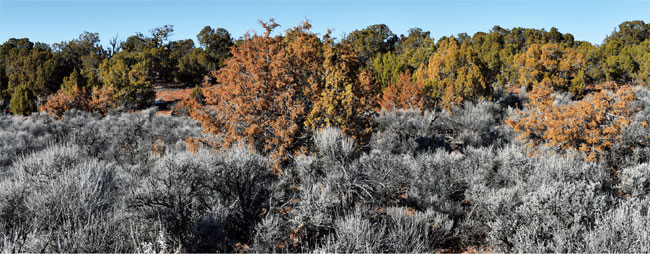
A widespread die-off of juniper trees in southeastern Utah is being reported. Here, a mixture of live and dead junipers is seen along the Utah-Colorado border. The cause of the die-off is unknown, but there is speculation that it’s related to the warmer, drier winters being produced by climate change and/or the ongoing drought in the Southwest.

A widespread die-off of juniper trees in southeastern Utah is being reported. Here, a mixture of live and dead junipers is seen along the Utah-Colorado border. The cause of the die-off is unknown, but there is speculation that it’s related to the warmer, drier winters being produced
by climate change and/or the ongoing drought in the Southwest. Photo by Gail Binkly

‘It is coming’

But the commissioners were skeptical.

“I’m looking after our people in this county,” said Commissioner Keenan Ertel.

He said the Lower Basin states are using too much water and “have been abusing the compact for a number of years.”

“We’re the screwees and they’re the screwers,” he said. “That’s how it seems to me.”

Whitehead said the drought contingency plan is a form of insurance to keep the Upper Basin in compact compliance. “We feel this is a good compromise to avoid mandatory curtailment,” he said. “Southwestern [Water Conservation District] is not trying to impact anybody’s water. We’re trying to protect the interests of all of this area, trying to keep us from having curtailment imposed.”

The Dolores Project, he reminded them, has a more junior water right than many rights in the basin and “could be one of the first ones curtailed.”

“But I don’t think we should be talking about curtailment at all,” he added. “We’re not there yet.”

But Suckla said “it does not take a genius” to see that local water supplies are at risk, given the millions of people in Phoenix, Las Vegas and California. “It is coming and you ain’t stopping it,” he said. “I would bet the ranch that in 10 years or sooner they are coming to fallow our ground.”

“Nothing here has changed my mind,” he said. “I know the conservation boards are doing what they think is best but I’m going to have to say you’re wrong.”

Ertel agreed. “We’re the ones that stand at the front of the line to get water taken from us,” he said, adding, “I’ve been educated by Mr. Millard.”

Whitehead said if locals wait until shortages occur, there will be mandatory cuts rather than voluntary reductions. “Mandatory curtailment can be forced if you are not in compact compliance.” He also warned about triggering speculation by investors looking to buy ag water.

“If we open that market up you will be impacted even quicker than the 10 years you’re talking about,” Whitehead said. “We’re trying to stay in compact compliance. A drought contingency plan is only used if necessary.”

He said SWCD is being cautious and hasn’t supported the entire policy package adopted by the CWCB. “My recommendation is we stay clearly in the discussions.”

Schwindt agreed, while saying he shares the commissioners’ concerns. “My point is, we need to be loudly saying [to the Lower Basin], ‘You need to reduce your use’,” he said.

If the Lower Basin does reduce usage, he said, the Upper Basin may be able to protect itself for the near-term future.

Word choices

But Millard said there are many unanswered questions. He said there needs to be a firm definition of compact noncompliance. “How do you solve a problem when you don’t know what it is?” he asked.

He said the Upper Basin drought plan “was negotiated largely in secret” and should have been done in the open.

He said there is 500,00 acre-feet of evaporation from Lake Powell every year and “if there’s a severe drought, that water bank is not going to help us – it’s too small.”

Whitehead said any strength the local area has lies in being part of a larger effort. “The position you took helped get some things in place that benefited us,” he told the commissioners.

But Suckla said they didn’t get everything they wanted, so “there’s no strength in going along with everything.”

He said he believes there is more power in opposition. Schwindt asked what precisely the commissioners are opposing.

“Word choices are really important,” Schwindt said. “We have to think about what are we opposing and what are we for.

“I think we all need to learn a little bit more,” he added. “I don’t have the answer to all of Ed’s questions.”

Millard said the CWCB has already given its support for the plan and he doesn’t believe the county’s opposition will change that.

“If we’re the only ones not on board, then maybe the ship’s fixing to hit an iceberg,” Suckla said.

He then made a motion to withdraw the commissioners’ letter of support for the Upper Basin drought contingent plan and the CWCB policy statement passed in November. The board voted 3-0 in favor of his motion.


A global water crisis

Many experts believe that disputes such as the discussions over the Colorado River are only the beginning of inevitable “water wars” that will be occurring worldwide.

Despite its name, about three-quarters of the Earth is covered in water. However, most of that is seawater; only a tiny fraction – 2.5 percent – is fresh water. And that is increasingly in short supply in various parts of the globe.

The more than 7 billion people on the planet “share the same amount of water that was available to less than one-sixth of this population at the turn of the 19th century,” writes journalist Jeffrey Rothfeder in the book Every Drop for Sale: Our Desperate Battle Over Water in a World About to Run Out, published in 2001.

How much water people have is largely based on the luck of geography, wealth, and politics. People in Haiti and Gambia exist on as little as 3 liters a day of fresh water, though the absolute minimum people need for safe drinking, hygiene, and cooking is estimated at 50 liters per day, according to Rothfeder.

In contrast, Americans use around 100 gallons (378 liters) per day, the majority of that for flushing toilets and taking showers. In Cortez, which has ample water rights for its current population, per capita use is a whopping 200 gallons a day, down from 325 in 1990, according to the city’s 2018 Water Conservation Plan.

This figure is for residential use only – it doesn’t include water a society uses for agriculture, industry, mining, and so on. Agriculture is typically the largest draw on a region’s water, depending on the crops produced and how much meat people eat. It takes 1,000 tons of water to produce just one ton of grain, according to the website theworldcounts.com, while producing a single steak can require 1,232 gallons of water (to feed, water, and raise the cow and clean the slaughterhouse).


 

Published in January 2019

Mumbo gumbo

In the sometimes insular world of crime fiction, James Lee Burke’s is a name spoken with reverence thanks to his 36 novels, his two Edgar Awards, and his status as a Grand Master Award recipient (in 2009) from the Mystery Writers of America.

Once hailed as “America’s best novelist” by the Denver Post, Burke has the rugged good looks and vagabond past that invite comparisons to Jack London or Louis L’Amour. His books have been widely translated and adapted for both film and television, his protagonists portrayed by the likes of Alec Baldwin (Heaven’s Prisoners) and Tommy Lee Jones (In the Electric Mist). A Texas native turned Montana rancher, Burke’s series characters include Louisiana sheriff Dave Robicheaux (21 novels), Texas Ranger Hackberry Holland (three novels) and Texas attorney Billy Bob Holland (four novels).

THE NEW IBERIA BLUES BY JAMES LEE BURKEHaving never read Burke, who is now 82 years old, I jumped at the chance upon learning that his 37th novel, The New Iberia Blues, would revisit the aging but still formidable Dave Robicheaux and his private investigator sidekick Clete Purcell as they pursue a serial killer through the pinewood honky-tonks and backwater bayous of southern Louisiana. With a celebrated author at the helm, a high-stakes game afoot, and a richly atmospheric backdrop against which to operate, I figured what could possibly go wrong?

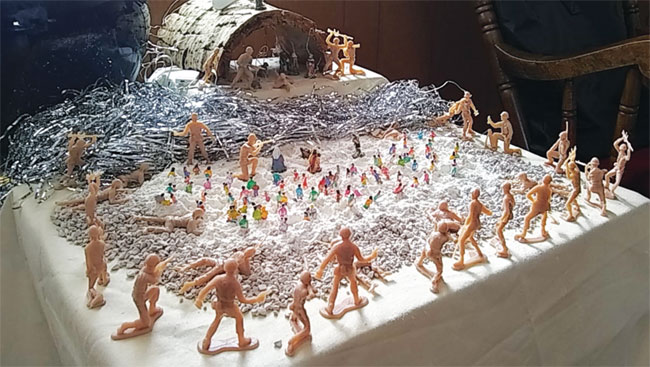

The answer, alas, is just about everything. Burke’s latest novel is a steaming mess from start to finish – a rambling, bloated yarn that leaves no sense unscathed and no cliché untapped.

Desmond Cormier is a local-boy-made- good; a New Orleans street urchin who, we’re asked to believe, rose from poverty and obscurity to become a wunderkind Hollywood film director. The New Iberia Blues opens with a scene of grotesquely ritualized violence, the first of many to come, in which the crucified body of Lucinda Arceneaux, a local preacher’s daughter, is discovered (by Robicheaux himself – what are the odds?) floating off the shore of a seaside mansion owned by Cormier and occupied by his visiting L.A. entourage, a sketchy assortment that includes a foppish sadist named Antione Butterworth and a former mercenary soldier named Lou Wexler.

Coincident with these peregrinations, Clete Purcell’s nearby fishing idyll is interrupted when he witnesses a uniformed man leap from a passing train into the Mermentau River. The jumper proves to be Hugo Tillinger, an escaped Texas inmate with ties to a white supremacist prison gang and a direct connection to the crucified woman thanks to the Innocence Project with which she formerly (when not catering movie sets) volunteered.

Stay with me now. Soon more bodies are turning up, each suggesting some connection to the cards of the Tarot (the Suit of Wands, the Suit of Pentacles, etc.), or at least according to Bailey Ribbons, a comely young police officer who’s to be Robicheaux’s new partner (and who herself might have a murderous past) but whom Cormier wants to cast in his current movie. Next thing we know, Wexler is dating Robicheaux’s daughter Alafair, a lawyer-novelist-screenwriter who’s also somehow working on the film. Enter Chester “Smiley” Wimple, a freakish killer-for-hire with ties to the New Jersey mob which may or may not be secretly financing Cormier’s film project. Or is it Saudi oil money? And what does any of this have to do with the Aryan Brotherhood? Or with a crooked cop who’s running prostitutes? Or with the Maltese crosses popping up everywhere? Or with Cormier’s inexplicable obsession with the John Ford film My Darling Clementine?

Who knows? And at this point in the novel, who really cares?

Beyond its exhaustively complex and improbable plot, The New Iberia Blues employs just about every trope in the detective novel canon. Robicheaux’s a recovering alcoholic? Check. He and Clete are Vietnam buddies with dark battlefield secrets? Check. Despite their forty-year age difference, the beautiful Bailey can’t resist Robicheaux’s steely implacability? Check. All the snitches to whom Robicheaux looks for help seem to turn up dead? Check, check, check.

You get the point. For devout fans of Burke and Robicheaux, The New Iberia Blues ($27.99, from Simon & Schuster) might prove a thrilling stroll down memory lane. For the rest of us, allow me to suggest something by John Grisham or Elmore Leonard instead.

Chuck Greaves is a member of the National Book Critics Circle and the author of five novels, most recently Tom & Lucky (Bloomsbury.) You can visit him at www.chuckgreaves.com.

Published in Prose and Cons

A diet in good taste

During this time of New Year’s resolutions, it seems appropriate to consider our diet and examine what we eat and why we eat it. In a socially connected digital world, there seems to be an infinite number of diet options based on body type, food source, nutrition, religious practice, or celebrity endorsement. I believe it is important to review our diet periodically and I want to propose some parameters for measuring diet success other than weight loss or personal energy level. This year I am resolving to adjust my diet to include measures of community welfare and planetary health in addition to counting calories and grams of sugar.

When I really dig into the concept of diet, I want to eat food in good taste. Good taste is more than flavor, it incorporates how the food makes me feel. Is it nourishing to body, mind, and soul? For example, single-use plastic containers leave a bad taste in my mouth, and not because there is a residue of petroleum flavor. It is the long-term garbage problem that colors the taste of the iced tea that I am sipping through a plastic straw. That is why I have decided to challenge myself to select food and food sources that promote a thriving local community and improve the long-term health of the planet. This diet includes some surprising new rules and measures.

Rather than focusing on labels, I am going to have to stop reading, look up, and start talking to local growers and processors. I won’t need to source exotic food combinations like coconut water and raw cane sugar but search out food resources and providers in my neighborhood. I will need to pay attention to where and how food is grown and handled rather than paying a shipping and handling fee to Amazon and USPS. I will need to do more myself – spending time collecting, transporting, and processing raw food products. While this will mean more time dedicated to food each day, the results will be more than worth it. I will get exactly what I want at the peak of flavor while eliminating what I don’t want or need such as food coloring and preservatives.

And don’t forget the calories burned during food prep. Maybe I will just eat less or elimninate some foods from my diet altogether. Oreos™ may not be available locally, but I can bake up a tasty cookie using mostly local ingredients such as Bluebird flour and applesauce from this year’s fruit harvest and eliminate processed fat, sugar, and plastic packaging in the exchange.

Meat is good on this diet. With our local ranching community and healthy deer, elk, and hunter populations, eating local or wild meat is very supportive of our local economy and healthy for our ungulate populations. It is easy to forget that the Cortez Sale Barn is one of the few weekly livestock auctions remaining in Colorado. In the same vein, we have lots of local egg sources, but poultry meat is problematic because we lack a processing facility. This is something that has been the local food-processing infrastructure wish list for many years. And while we lack a medium or even small-sized dairy, there are several family-run “mini-dairy” operations in the area that are not hard to find if you take the time to look for them.

Even lard is good food on this diet.

With locally sourced pork and home processing, it can be a healthy fat, full of flavor and Vitamin D and ideal for cooking and baking if used sparingly. With all the gluten-free madness, this diet supports locally-grown and processed wheat and wheat products. Certainly not appropriate for those with celiac disease, but freshly milled flour from locally-grown hard winter wheat has some distinct advantages, including great taste and high protein content. Consider purchasing Bluebird or Red Rose flours for more than fry-bread binges. Cortez Milling also has whole wheat flour and wheat-germ products for sale. And like the Sale Barn, if we don’t support these local food infrastructure gems, they will go the way of the sage grouse. Extinct in our lifetime. As I have noted before, Cortez is one of the best places in the U.S. to be a locavore because we have a regular farmers’ market, flour mill, and livestock auction nearby. And don’t overlook the abundance of heritage fruit trees and amazing backyard gardens in the surrounding county. It is heartening to see the resurgence of the apple juice industry in the region for hard cider and other products.

So, consider looking beyond the number on the scale and adding some new measures to your dietary regime. Maybe we can overcome some of the economic doom and gloom forecasted for 2019 by supporting our local food infrastructure and becoming the biggest winner in health and community welfare.

Carolyn Dunmire gardens, cooks and writes in Cahone, Colo.

Published in Carolyn Dunmire

Living in exile: In February, Rosa Sabido will complete 600 days in sanctuary

Rosa Sabido, who has been living in sanctuary in the Mancos United Methodist Church since 2017, shows where she kisses the hands of a statue of the Virgen Guadalupe that belonged to her mother. Photo by Janneli F. Miller

In mid-February, Rosa Sabido will mark her 600th day of living in sanctuary in the Mancos United Methodist Church.

What does it mean to live in sanctuary? And why would someone make a choice to do such a thing?

The church accepted Sabido on Friday, June 2, 2017. She is there because she does not want to be deported, something which is happening to people who check in for routine appointments with ICE (Immigration and Customs Enforcement).

Sabido, who speaks perfect English, was born in Mexico, but has spent most of her life in the United States, arriving in 1987 at age 23 for the first time, to visit her parents. She obtained a visitor visa.

Her mother, Blanca, who had divorced Sabido’s biological father when Sabido was ten, came to the United States in the early 1980s, and married Roberto Obispo, an agricultural worker living in the U.S. as a lawful permanent resident in Cortez. Obispo became a U.S. citizen in 1999, and filed papers that allowed Blanca to become a citizen in 2001. However, at that time, immigration law did not allow Sabido to be included as a family member.

When people hear about Mexicans living in the U.S. or seeking sanctuary to avoid deportation, many ask, “Why don’t they follow the laws and become a legal citizen?” But the pathway is often arduous, even impossible.

Sabido, now 53, wants people to know she is not a criminal. She has been trying to follow the complex immigration laws and become a legal U.S. citizen for more than 20 years. During that time the laws and regulations have changed, with each change bringing a new set of procedures to comply with.

Joanie Trussel, a supporter and media contact for Sabido, explained, “She did do it legally! She has been spending $5,000 a year on lawyers for at least four or five years. She did do what she was told to do, but she still is unsafe.”

Trussel said Sabido sought sanctuary because her lawyer told her, “If you show up to your stay-of-deportation interview, you’ll probably be deported.”

“ICE has been deporting people in Durango,” Trussel said. “They have no mercy. They show up, find people and deport them. It’s such a contrast to the idea that this is the land of the free and home of the brave.”

Craig Paschal, pastor of the Mancos United Methodist Church, said that Sabido’s case “points to a broken immigration system.”

Rosa Sabido created this work depicting an image of the U.S.-Mexico border in which the people (immigrants) are surrounded by police/ICE while there is a Nativity scene in the background. Courtesy photo

He said his congregation of around 100 decided to become a sanctuary before they knew of Sabido’s situation because sanctuary fit within the tenets of their beliefs, starting with the idea of loving your neighbor.

“All human life has value and dignity and worth,” said Paschal. Other values include the idea of common humanity, and the notion of building a “beloved community.”

Paschal cited the Pledge of Allegiance, which ends with the words “with liberty and justice for all.” He noted that it doesn’t say liberty and justice for some.

The congregation was well aware of the increasing tension around immigration and had identified perhaps 12 to 15 families – all long-term members of the community – who could perhaps be at risk of deportation due to the changing regulations and shift in cultural attitudes. Paschal said becoming a sanctuary was a result of the congregation’s commitment to their beliefs. “It’s living out our values,” he says.’

Pink hands

Sabido spends her days in the Fellowship Hall of the church. Every day she kisses the hands of a statue of the Virgen Guadalupe. Now, she points to show how her lipstick has tinged the praying hands pink. The statue belonged to her mother, who died in June 2018 at age 71 from complications of cancer surgery.

Before becoming ill, Sabido’s mother visited daily, offering her daughter support and companionship. When she was diagnosed with cancer, Blanca travelled to Mexico for her medical care, which for her was easier to obtain and more affordable than in the U.S. However, this meant that Sabido could not be with her mother during her medical treatment, nor could she attend the services when she died.

“I asked if they could bring me the statue of the Virgen,” Sabido said. “I always go to it every day. I kiss her hands and I kiss her lips.”

Leading by Example

Sabido, a devout Catholic, feels that God has placed her in her current situation in order to help others in a similar plight. She is not married, and this gives her the freedom to devote her energies to other things.

Rosa Sabido keeps these dried flowers from her mother’s funeral in her room in sanctuary because she wasn’t able to attend the funeral in person. Photo by Janneli F. Miller

“I believe that destiny put me in this place so that people can learn better who we are. I know that many Mexicans don’t have the fuerzas [strength] to teach more about Mexican culture – they don’t want to. But I can teach them or lead by example,” she explained.

Sabido has helped organize vigils to mark every 100 days of her time in sanctuary. Most recently she helped plan a posada, a Mexican tradition reenacting the Biblical story of Joseph and Mary’s journey to Bethlehem and search for shelter there. The word posada translates as “inn” and in Mexico is usually celebrated for the nine nights before Christmas with processions, songs, and candles.

In Mancos the recent posada, held on Dec. 21, consisted of a procession leading from St. Rita’s Catholic Church to the United Methodist Church, where participants shared a meal. “Lots of people came, and they didn’t know what a posada was,” Sabido said.

“Joseph and Mary were refugees, looking for housing. It’s up to me to put forward this perspective of what happened then and what we living now. It is exactly the same.”

Sabido becomes animated when she describes how the events she helps to organize help local residents understand more about Mexican culture.

Last November, she reached 500 days in sanctuary.

“We did a Day of the Dead altar, so that the people know why we did it. The meaning of the Day of the Dead is a lot deeper than what you see on the tele. We showed the milagros that are miracles, so that they can learn, and valorize our traditions.”

She said she understands that there are American traditions such as Thanksgiving, “but they don’t know our customs. I want to provide a deeper meaning. Christmas is not only about the presents – Joseph and Mary were looking for lodging, refugees just like us.”

Her sentiments and activities are a fundamental part of what it means to live in sanctuary, and Sabido’s faith gives her the strength to continue. She said that, yes, every day she could become depressed, but she is committed

to helping others. It’s not just about her. She believes it is her mission to educate others about her country, her culture, and her plight.

Beadwork

The contemporary sanctuary movement consists of more than 800 faith communities organizing in order to protect and stand with immigrants facing deportation. Locally, community members are offering support, helping Sabido by going shopping for her, or coming by the church to give her acupuncture, massage, chiropractic treatments, or even a yoga session.

Every week women from Lewis and Mancos come by to sit and do beadwork with Sabido. One of these women, Betty Schneider, explained, “We moved our beading group here so we could be with Sabido. She is good company and we enjoy her.”

The beaders emphasize that they don’t ask Sabido about her plight because their intent is to provide friendship. They don’t feel a need to discuss her situation, but instead pass the time in creative expression, laughing as they make earrings, necklaces, and ornaments.

The decision to enter sanctuary was voluntary. Sabido wants people to know that she is not being detained. But she added, “I don’t have freedom – this does not exist. Not here, not outside.“ She is also not hiding. In addition to articles in local papers including The Journal and Durango Herald, she has received national press coverage in the Washington Post, L.A. Times, Boulder Weekly and on digital news sources including aol.com and CNN.

‘I’m a target’

As long as she stays on the church grounds she is protected by the 4th Amendment of the U.S. Constitution, which limits government searches and seizures on private property. ICE agents cannot enter the Mancos United Methodist Fellowship Hall without a warrant.

However, if she steps outside of church grounds she fears she could be picked up and deported. She has no idea if ICE agents are watching her.

One result of this is that she does not receive visits from any of her Mexican friends.

“One time they came here, but now I think perhaps they are afraid,” she said. “They know that I’m a target, and they’re afraid. But I know that they support me, from the Catholic church.” Sabido spent eight years as a secretary for the Catholic church in Cortez before coming to sanctuary.

“I want people to know I’m still here. I will not give up. It is important that people know I am here, 18 months now. I continue.”

“She is in this limbo,” said Trussel. “And this limbo is really difficult, after a year and a half.”

Sabido, wearing clothes that Trussel bought for her, and cooking food in the church kitchen for herself and for community events, is a bright and energetic woman. She has dedicated herself to transforming personal trials into educational efforts. She hopes that raising awareness about the cumbersome and dysfunctional immigration system will lead to better circumstances for others.

“I am here. I will not give up. My work can help others,” she said.

Published in January 2019

A powerful voice against slavery

Josephine Sophia White Griffing was born Dec. 18, 1814, in Hebron, Conn. Her father was Joseph White Jr., a representative in the state legislature. Her mother was the sister of portrait artist Samuel Lovett Waldo. Very little is actually know of Josephine’s early life.

At the age of 20, she married Charles Griffing and they settled in the town of Litchfield, in northeastern Ohio. They had five daughters, three of whom survived to adulthood.

Josephine Sophia White Griffing

Josephine Sophia White Griffing

She became involved with some radical organizations while in Ohio. By 1849 Josephine was a passionate member of the Western Anti-Slavery Society and by 1851 she was traveling around the country for this organization. Her platform was “no union with slaveholders.” She became one of the most vocal and prolific anti-slavery lecturers in the region.

Charles and Josephine’s home became a stop on the Underground Railroad. Throughout the 1850s she lectured against government and slavery in Ohio, Indiana, and Michigan. One of her lectures, in 1858, clearly showed her passion and commitment to freeing slaves:

“Impatient are we? There is a power which crushes our brothers into dust and mocks at God’s authority. And we are impatient because we wish to have the rights of the slaves restored, because we wish them to be developed by intellectual culture, because we would have them enjoy the social relations, would restore the husband and wife to each other, give back the babes to the mother…”

In 1864 she relocated to Washington, D.C., working with the Freedmen’s Bureau, assisting the newly freed slaves as they streamed into the city by the thousands (one estimate was 20,000 people). They were hungry, sick and tired with no means of support or shelter. As a woman, with no voice or vote, she had to petition Congress to gain permission to do this work, which they finally granted.

She wrote to William Lloyd Garrison:

“I have seen them in every condition of want – from their first landing, sitting in the sand, with their babies hovering round them, without shelter or bread, through all the varieties and grades, up to comparative comfort and independence. I conclude, without hesitation, that with assistance from Government, in protecting them against the control and the frauds of any and all who wish to usurp authority over them in regard to their homes, labor and children, this independence is their proper status of rights and duties, and the only one that will give them satisfaction, and secure their confidence in our Government and people. Indeed, I am astonished at the self-reliance and thrift they possess under these insurmountable difficulties.”

In addition to her work for the freed people, Griffing was a women’s rights activist. She became very involved with women’s rights organizations, making contact with women who would inspire her to fight for the rights of women as well as African Americans.

Excerpts from a letter written by Frederick Douglass regarding Josephine: “…Mrs. Griffing was a woman of more than ordinary intellectual gifts and literary attachments. She, for many years, addressed public meetings upon the subject of the liberation of the slaves, and in 1865, at the close of the war, removed to Washington, DC, devoting the remainder of her life to the care and interests of the freed people. Her labors in Washington consisted in securing the first food, shelter, and clothing for the many thousands of freed people who flocked to Washington after the emancipation, the greater number of whom were from the adjoining states, although, later, many came from the states further south. Through the assistance of Secretary Edwin M. Stanton, she secured condemned barracks for shelter, army blankets, and army rations and wood for the old and sick…”

Margaret “Midge” Kirk is a slightly eccentric artist, writer, bibliophile, feminist scholar and hobby historian who lives in the southwest corner of Colorado. She can be reached at eurydice4@yahoo.com, or visit her website www.herstory-online.com.

Published in Midge Kirk

Bogged down: User groups sue the Forest Service over the Rico travel plan

This 2015 photo shows single-track damage to wetlands and meadows on the Northern Calico Trail in the Dolores Ranger District.

This 2015 photo shows single-track damage to wetlands and meadows on the Northern Calico Trail in the Dolores Ranger District. Photo by Steve Johnson.

More than a decade after Forest Service officials began working on a travel-management plan for the sprawling Rico-West Dolores area of the San Juan National Forest, the effort remains mired in controversy and tangled in litigation.

In September 2009, the then-ranger of the Dolores District of the forest, Steve Beverlin, approved what was supposed to be the final travel plan for the area while acknowledging how tough it had been to come up with a decision.

“The Rico-West Dolores Travel Management Plan has been the most divisive and difficult issue I have dealt with since I became the District Ranger/Field Office Manager for the [DPLO] in August of 2005,” Beverlin wrote in the decision notice for that document.

Now, after the writing of another travel plan and years of legal wrangling, the new document has been challenged by both motorized users and environmental groups.

On July 31 of this year, the Forest Service issued its final decision authorizing the plan, called the Rico-West Dolores Roads and Trails Project. It sets out rules for travel across nearly a quarter-million acres (244,554) of national forest in Montezuma and Dolores counties. About half of the area is designated as roadless.

On Sept. 14, three motorized-use advocacy groups filed a petition in U.S. District Court for the District of Colorado challenging the project, saying that it reduces single-track motorized travel by about 30 percent.

“These reductions, unsupported by logic and contrary to law, will create substantial adverse impacts to the human environment and to Plaintiffs, their members, and other Recreationists,” wrote Paul Turcke, attorney for the groups, which are the Trails Preser vation Alliance, San Juan Trail Riders, and Public Access Preser vation Association, all Colorado nonprofits.

In their petition, the groups contend that the closed trails “have received environmentally conscious and sustainable motorcycle travel for over 40 years.” The reductions, they say, will concentrate motorized use on remaining routes, remove some key connections between trails, and adversely affect public safety, local economies and access, including to the town of Rico.

On Nov. 13, three environmental groups and Dunton Hot Springs, a private resort located within the project area, likewise filed suit against portions of the plan. They argue that it doesn’t go far enough to protect wildlife, water quality, and quiet uses from motorized travel.

A stunning landscape

The various parties may not agree on much, but they do agree on the beauty and special nature of the Rico-West Dolores area.

“The Project area is an incredibly varied landscape of mesas with huge expanses of aspen stands, jagged snow-covered peaks, and steep slopes of dense conifers,” wrote the attorneys for Dunton Hot Springs and the environmental groups – the San Juan Citizens Alliance, WildEarth Guardians, and Sheep Mountain Alliance – in their petition to the court.

Likewise, the lawsuit by the motorized groups states, “The Area includes mesas, aspen stands, steep slopes of dense conifers, and snow-covered peaks.”

In the past, motor-vehicle travel in national forests was allowed on a policy of “open unless designated closed,” meaning there were many areas where vehicles could travel cross-country.

That changed in 2005, when the Forest Service adopted an agency-wide Travel Management Rule that said roads, trails and areas were CLOSED to motorized vehicles unless they were officially designated as open.

Motorized users argue that off-highway- vehicles of all types are increasing in popularity, so there should be more, not fewer, routes open for ATVs and dirt bikes. But environmental groups say motorized uses are more damaging than other forms of recreation and need to be managed carefully.

“The Forest Service has identified OHV use as a growing threat to National Forests,” the petition from the environmental groups states. “OHV use adversely impacts the natural environment.” They contend that motorized uses can damage soils, degrade water quality and riparian habitat, harm vegetation and disturb wildlife.

Talking it over

The disputing parties had tried to work out compromise solutions to their differences.

The Forest Service launched its new travel-management planning effort for the Rico-West Dolores area in 2014. In May 2016, the agency published a draft environmental impact statement for the new plan, and in July 2017 it published a supplemental draft EIS incorporating some changes.

The two environmental impact statements offered five management alternatives. Alternative A was the “no action” alternative describing current management. The other four offered varying amounts of motorized use.

Alternative A provided the most miles of motorcycle trails (114). E had the least, at 65, and B had the second-least, 86.

The alternatives also differed on another key issue – seasonal restrictions on motorcycle travel. A had none. Under Alternative B, the agency’s preferred alternative, trails would be open to motorcycles only from July 1 to Sept. 8. Under the other three alternatives, trails would be open for motorcycle travel from June 1 to Oct. 30.

In November 2017, the Forest Service published a draft record of decision and initial final EIS, selecting Alternative B, but with modifications. Under this plan, 83 miles of trail were designated for motorcycle use, and seasonal restrictions only limited motorcycle use on designated trails from June 1 to Oct. 30.

Both environmental groups and motorized- use advocates submitted objections to the draft decision, and in February and March the objectors took part in several phone calls designed to resolve the issues.

“The groups Paul [Turcke] represented and the quiet-use groups did a lot of conversations and counter proposals,” Jimbo Buickerood, lands and forest protection program manager at San Juan Citizens Alliance, told the Four Corners Free Press. “If the Forest Service would have given us more support, like us sitting down in a room, we might have come up with a resolution. I felt it was worth a try. There was very good will for the most part. Overall it was a good healthy exchange.”

But Forest Service officials felt the process was not going to result in a resolution, and called it to a halt. On April 4, the agency issued a written response to the objections and the reviewing officer supported the preferred alternative (B, with modifications). On July 30, the agency signed its final ROD.

The environmental groups charge that the plan will adversely impact elk and their habitat, hunting opportunities, water quality, quiet uses of the forest.

They say the seasonal restrictions are inadequate, noting that elk herds are already in decline in Southwest Colorado.

The elk rut and mating season, they say, runs from mid-September through mid-October, and most elk calves in Colorado are born from May 15 to June 15. Disruption of the rutting season can result in later spring births, meaning more calves die in the winter because they are smaller and younger.

“The magnitude of disturbance to elk throughout the Project area increases dramatically during the big-game hunting seasons,” they write. “Prohibiting motor vehicle use on trails in elk production areas during calving season can mitigate the impact of human activity on elk.”

Colorado Parks and Wildlife had recommended closing motorized trails in the area until June 30.

“There is research that motorized use in calving or nursing areas is a stressor,” Buickerood said. “It’s certainly not in the benefit category.”

Hikers can also disturb wildlife, he said, but their impact is much less. “A hiker travels 5-10 quiet miles a day but dirt bikers looking for long loops may go 60 to 80 miles,” he said. “They might move through an area quickly but they’re noisy and the amount of territory is impacted is much greater. It’s rare that a bicyclist will go that far in a day. One factor is the visual impact but another is noise and it’s a pretty big issue. Sound really carries on ridgetops. On Bear Creek, you can hear a dirt bike miles away.”

Aggressive treads

In addition, the environmental groups express concern about motorized travel eroding trails and sending dirt into waterways.

“The Dolores River is a low-gradient . . . stream that tends to accumulate excess sediment,” they write, adding that the West Dolores River and parts of Bear Creek have a similar problem.

The plan authorizes motorized uses on trails adjoining or crossing the headwaters of numerous streams and tributaries, they argue. They say motorized use at the headwaters of Fish Creek and Willow Creek has caused proven damage to water quality and riparian areas.

Motorized travel on the North Calico Trail, Spring Creek, East Fork trails is also known to have adversely affected wetlands, they say.

They also argue that motorized uses on high-elevation trails can cause deep ruts, making the same trails difficult to navigate for hikers and horses.

Mountain bikes leave ruts as well, but they are much smaller, Buickerood said.

“The horsepower involved in a human riding a bicycle compared to a 200- 300 horsepower motor is very different, and you also have aggressive treads. This is the kind of thing we’re seeing on the alpine loops. Jeeps, ATVs, side-by-sides have aggressive tires like a farm tractor tire. Law enforcement and people working on those roads say you see a lot more erosion. If you had a bike there would be a two-inch-wide strip of grass matted down but the chances of turf being dug up – there’s no comparison.”

‘Significant restrictions’

But the motorized groups see things differently. In their petition, they say that the final plan imposes “significant restrictions” on motorcycle travel, including:

  • A ban on motorcycle travel on Winter , West Fall and East Fall Creek Trails in the vicinity of the Dunton Hot Springs Resort;
  • A reduction of 85 percent in motorcycle travel in the popular Bear Creek area;
  • The elimination of motorcycle trail connection to the Town of Rico, through closure of the Burnett Creek and Horse Creek Trails;

“In broad terms, the Final ROD designates a total of 84 miles of trail for motorcycle use, down from 114 miles prior to the Decision,” the motorized groups write. “Aside from the arithmetic reduction of mileage, the changes greatly impact the connectivity, ability to ride loops, aesthetic experience, and safety for motorcycle riders in the Area.”

They are calling for the Forest Service to set aside the Rico-West Dolores project and start over.

Starting over?

The environmental groups don’t want the plan to be scrapped, said Buickerood.

“We don’t want to see a do-over. It’s been more than 10 years. The community has done a tremendous amount of work. We don’t want to see the Forest Service in travel-management land for another five years.”

The environmental groups have filed a separate petition to intervene in support of retaining the Rico-West Dolores plan.

“If the Trail Riders’ requests for relief are granted, Proposed Intervenors’ interests would be impaired,” the groups state in their petition. To set aside the decision, they say, would essentially reinstate “the previous travel management policy of the forest–or lack thereof–and would require the Forest Service to conduct a new round of planning and decision- making. . .”

“Importantly, should Trail Riders be successful,” they write, “the Rico-West Dolores project area would be left without restrictions on off-highway motorized vehicle use until a new travel decision is made. This includes elimination of the requirement to prohibit cross-country motorized travel except where specifically authorized.”

It would also continue to allow motorcycle use on the 30 miles of trail that were closed under the plan.

“We would like to see a conclusion to the effort,” Buickerood said, “so we’re supporting their overall closures on cross-country motorized travel and most of the things that fit into the Travel Management Rule. Motorized groups are not intervening to support them.”

He said he remains disappointed that the effort to resolve the conflicts did not work out.

“I feel good that the quiet-user groups worked quite hard in good faith during the objection process to come up with something. We were hopeful but didn’t quite get there, so unfortunately it’s come to this litigation piece. I’m not as hopeful as I was. It was a missed opportunity by the forest.”

Published in December 2018

Stay healthy – avoid plastic

Reviewing the predicted food trends for 2019, I found that many are focused on food waste and packaging, specifically plastics. With the horror stories of marine animals dying after ingesting large amounts of plastic, I decided to examine how much plastic my family is exposed to through our food and drink.

The results were a bit disturbing. Despite my best efforts to “BYO” grocery bags, I realized that pretty much everything I buy at the grocery store touches plastic. In fact, when I took a closer look, all our food, except what is eaten straight from the ground or tree, touches plastic somewhere along the route to our plate. Mostly it is in the form of plastic packaging. Even the organic vegetables I carefully select from the produce racks are toted home in a plastic bag.

That’s hardly the same as eating plastic, I can hear some folks say. You can wash off any plastic residue or just peel the fruit. And that is probably true, but I am trying to reconsider that carrying my sandwich in a plastic bag may not be as sanitary as I once thought. Perhaps a paper, or better yet, cloth napkin or clean handkerchief would be a better option – making the hobo stick the lunchbox for 2019.

The main problem with plastic containers is that they can leach compounds from the plastic into the food. Much attention has been paid to Bisphenol A (BPA), a compound use used in hard plastics that are made into beverage containers and plastic dinnerware, among other things. BPA epoxy resins are also used in the protective linings of food cans.

According to the Centers for Disease Control (CDC), “General exposure to BPA at low levels comes from eating food or drinking water stored in containers that have BPA.”More importantly, the CDC is uncertain about the health effects of BPA exposure, as noted on their website, “Human health effects from BPA at low environmental exposures are unknown. BPA has been shown to affect the reproductive systems of laboratory animals. More research is needed to understand the human health effects of exposure to BPA.” And just in case you thought you were safe, in a recent test of more than 2,500 Americans six years old and older, “CDC scientists found BPA in the urine of nearly all of the people tested, which indicates widespread exposure to BPA in the U.S. population.”

Now that I have your attention, here are some New Year’s resolutions to consider that will reduce your family’s exposure to BPA and other plastic compounds when eating and drinking.

  • Don’t buy or use plastic water bottles. Those cases of plastic water not only expose your family to plastic compounds, but the bottles themselves are a huge solid-waste problem. Better to use a reusable water bottle, preferably glass or metal, and fill it with water from a local tap.
  • Don’t microwave food or drink in plastic containers. Remove food from plastic containers and reheat in glass or ceramic dishes. It might be time to toss that plastic coffee mug and go back to using the “World’s Best Dad” ceramic mug at the back of the cabinet.
  • Use alternatives to plastic containers to store food and drink. Some options include glass, stainless steel, wax paper, brown paper, cellulose, or cloth. I am planning to make lightweight mesh or cloth bags that can replace plastic vegetable and bread bags as gifts this Christmas.

Some medical researchers suggest steering clear of plastics with recycling numbers 3, 6, and 7 that contain “compounds of concern.” And since we can only recycle plastics with recycling numbers 1 and 2 locally, this practice would help with “end of life” issues for your plastic containers as well.

  • Consider purchasing from bulk food bins instead of buying pre-packaged grains, nuts, granola, coffee, and flours. Carrying the bulk foods home in your own non-plastic containers, further reduces your plastic exposure and waste.

This trend in plastic reduction may clash with another current food trend. Sous vide cooking is all the rage with kitchen gadget-users. It entails vacuum-sealing raw foods in plastic bags and heating the bag in a water bath held to a specific temperature. I have been assured that sous vide cooking works in glass containers as well.

Don’t forget the pets – replace plastic food and water bowls with ceramic or metal.

Bake your own bread.

My “go to” reusable plastic bags are the ones that hold my husband’s favorite bread. Since you can’t rinse off the bread crust to remove plastic residue, one option would be to line the plastic bag with paper, so the bread is not in contact with plastic. However, this protective sheath would be added long after the warm bread is inserted into the plastic bag at the bakery. An even better solution would be to fill your home with the smell of baking and enjoy bread fresh from the loaf pan.

Here’s to happy and healthy eating in 2019.

Carolyn Dunmire gardens, cooks, and writes in Cahone, Colo.

Published in Carolyn Dunmire

For everything there is a season

A dense spruce stand crowds out other vegetation. One lone aspen survives in a small opening. Photo by Dexter Gill.

There is a time to be born! There is a time to plant! There is a time to harvest! There is a time to be thankful! There is a time to fight! There is a time to love! There is a time to build! There is a time to die, which is now the time for many trees in the forest. Right now is the time for us to rejoice!

WHAT? We just had a record drought, the lakes are about dry, the forests were burning (still are in California), floods are washing out what didn’t burn, nasty election battles for who gets the power to rule over who, and you say rejoice?

Well, yes, our fires are out; we started off the new water year (a water year is Oct. 1 to Sept. 30), with the first month recording above-average moisture; the elections are over; wonder of wonders, the world didn’t collapse or get flooded from global warming. Looks like our Creator may give us another chance, so let’s not muff it!

December is the time of the year when we are reminded that our Creator cared enough for us to send His Son to give us an eternal way out of the mess we have made for ourselves – wow, what a gift! Why He did that I have virtually no idea, but sure do rejoice in it! At this time, many cut a tree, decorate it as a “Christmas tree” and give gifts to friends and family to commemorate that great Heavenly gift. We have already cut our tree, a beautiful Colorado blue spruce that we located on Haycamp Mesa, and yes, I did get a permit. I like the spruce, as it has sturdy branches, although they are kinda prickly, but will hold the ornaments well. Incidentally, as a side note if you cut a blue spruce you may see some little cone-looking things on the tips of some branches. Those are not cones but what is called a Cooley spruce gall, which is the leftover house for a species of aphid insect. No problem, just clip them off, or maybe you think they look neat, your choice. Also, I like the smell of the spruce and it is a “musical” wood. Historically it has been the favorite wood to make the sound boards for stringed musical instruments like violins and guitars.

If you haven’t cut your own Christmas tree it might be a good time to start. It is a great way to help thin the forest and it is a great family tradition to trudge through the snow and cold to finally find a tree everyone can agree on, only to find your vehicle is now stuck in the snow. That is why we cut our tree before the snow gets too deep on the mountain and stick it in a bucket of water for later decoration. It is still a good family memory trip, even getting stuck.

The Forest Service will sell you a permit for $8 to cut one of five species, the favorites being white fir, subalpine fir, spruce and also piñon and juniper. In the past too many people were told we should not be cutting the trees. You have heard the old saying, “woodsman, spare that tree,” and fear tactics of “deforestation” and losing “carbon sequestration,” but that is totally false as we have been shown that the trees are way too thick and need to be thinned for better forest health, water production and reduced severe fires. Also, without management, over time the trees will begin to edge out into the meadows, gradually reducing the size of the meadows and the grass and forbs that are needed for animal forage and plant diversity.

Ground litter under ponderosa pine prevents other diverse plant growth. Photo by Dexter Gill.

When we went to cut our Christmas tree I noticed some thinning work the Forest Service had done. In checking I found that they were trying to open up the stand enough to get some sunlight and moisture to the ground so a more diverse plant community could be established and improve the growth and health of the residual trees. Upon inspection, the ground was covered with a dense mat of pine needles, which prevents grasses, forbs and new tree seedlings from becoming established. Thinning and some soil disturbance is required to improve the forest health and environment. This was in a ponderosa pine stand, but the same holds true in all the different stands of trees and brush that are too thick, and is very noticeable in the spruce and fir stands.

So, help out the forest with thinning out a Christmas tree. That is a win-win, you get a family memory for rejoicing and the forest gets some relief and health improvement.

Late November was a time for giving thanks. December is the time for rejoicing. Come January will be a time to build! So get ready, there is much work to be done.

Dexter Gill is a retired forest manager who worked for private industry, three Western state forestry agencies, and the Navajo Nation forestry department. He writes from Lewis, Colo.

Published in Dexter Gill

What trees have to teach us — a lot

FOREST SERVICE … I spent much of my time in public office as a commissioner working with the federal public-land agencies. That’s because over 60 percent of the land base in San Miguel County is non-taxable public land, managed by the feds … When I left office, I was delighted when GMUG Forest Supervisor Scott Armentrout gifted me with a hardback copy of Peter Wohlleben’s The Hidden Life of Trees: What They Feel, How They Communicate, Discoveries from a Secret World (Greystone Books, 2015). I think long-time GMUG staffer Corey Wong may have recommended the book. And I was stunned … There was a time when I thought all federal land managers cared more about timber-harvest quotas than the health of the forest. But I was wrong. As I learned over the years, that was our mama and papa’s Forest Service. Today’s agency folks care deeply about the forest. And the trees. As does Wohlleben, who kicks off his intro this way: “When I began my professional career as a forester, I knew about as much about the hidden life of trees as a butcher knows about the emotional life of animals” … Of course, through long study of the mushroom kindom [sic], I’ve come to understand how fungi in soil help trees communicate, and lots of other secrets buried in arboreal cambrium. Wohlleben explains how trees talk through pheromones and sound waves, protect themselves with tannins, bloom together on mysterious cue to maximize gene-mixing. We learn of tree etiquette, tree “schools,” and tree specialists who thrive in the most extreme of climates. Did you have any idea, as Wohllebein writes: “There are more life forms in a handful of forest soil than there are people on the planet” or that “the older the tree, the more quickly it grows” or that “For every square yard of forest, 27 square yards of leaves and needles blanket the crowns”? … This is a book of surprises, startling insights, and counter-intuitive wisdom. I’m saving it for a second read in a year or two. There was just too much to absorb and reflect on in one sitting … And I’m thanking our lucky stars to have foresters like Wohllebin, Armentrout and Wong in our midst. Highly recommended.

URSULA LEGUIN … You may have heard that this Portland novelist died in January of this year. But you may not have known that the mother of this celebrated American sci-fi master, poet and essayist was Theodora Kroeber née Kracaw … Theodora was well known as the wife of the famous cultural anthropologist Alfred Kroeber of the University of California-Berkeley. She was also the author of the classic California story, Ishi In Two Worlds … But even more importantly for locals, the Kracaws moved from Denver to Telluride and ran a grocery store in the town of Saw Pit about a hundred years ago. Back in 2002 [C.E.] I interviewed Telluride oldtimer Alta Cassietto at her Montrose home for my Mining the Gold history column, and she told me that “Irene Wichman” – whose family ran the Wichman Brewing & Mfg. Co. in Telluride until 1939 [C.E.] – graduated from the same Telluride High School class as Theodora did. And that the Kracaws also ran a mortuary in Telluride … Theodora went on to write one of the best accounts I’ve read of life in Telluride in the early 1900s [C.E.] Her account of the constant reverberations from the ball mills operating in the valley and the egalitarian friendships of folks of differing ages still stick in my mind. It can be found as a chapter in her fine biography of her second husband, Alfred Kroeber: A Personal Configuration (Univ. of Calif. Press,1970 [C.E.]).

ORIGINAL THINKERS 2018 … I’m no stranger to the magic of a Telluride festival weekend. Since my first Telluride Film Festival in 1976 [C.E.], and stretching over 40-odd years, Telluride’s festivals have provided an almost endless stream of unforgettable memories. But two weeks ago, I was lucky enough to take part in an extraordinary new festival experience, Original Thinkers 2018 … I am still processing the images and ideas this threeday weekend event threw at me. It isn’t too early to sum it up like this: the best Telluride Festival ever, the most thoughtful and thought-provoking! I’m not kidding. The weekend was structured around ten major programs in the large Mountain Village conference center. I can count the multiple turns of this kaleidoscopic festival on my ten fingers … Presence as answer and antidote to polarization … A gritty and witty exploration of wealth as an ultimate addiction, our addiction … In-depth and very atypical portraits of the deep South, from slavery to today, by two equally atypical women photographer- artists … A harrowing exposé of the way glyphosate is redrawing the cancer map of our country … An intimate look at some extreme, and extremely different, cases of overcoming overwhelming odds … An epic story of a group of veterans trying to use the healing power of poetry, art, and collective solidarity to deal with PTSD … Behind-the-scenes looks at efforts to reveal and reverse the modern world’s war on women, narrated by courageous women journalists … The surprising tale of horizontal gene transfer between species that is reshaping the story of evolution on earth … Gripping and occasionally humorous stories about the bravery and risks of truth-telling, from Sudan to Nashville … And in closing, a festival wrap-up program that left us all stunned, and flying high, energized by a series of passionate speakers, calls to get it right, not to look away, and to celebrate all we can celebrate, from the 50th anniversary of a vision of earth from space that should have changed everything but hasn’t yet, to a breathtaking dance performance by burn victim and amputee Prince Amponsah, who personifies the notion not just of overcoming odds but transcending them gloriously … Original thinkers, and their original thinking, are ultimately a call for original action. A call we all felt, and with luck can keep on responding to … Finally, I need to mention, and thank, one more original thinker, David Holbrooke, who dreamed up this festival and brought it to life, who was somehow able to morph the lessons of his ten years at the helm of Mountainfilm into something even more ambitious, even more challenging, even more exciting. This year’s Original Thinkers festival is just the beginning of one more open-ended Telluride adventure. Stay tuned, and reserve the first weekend of October 2019 for the next chapter of this amazing story.

TONY HOAGLAND … This marvelous Houston-based poet exercised a wry imagination that veered like a swing over troubled waters, alternating from heartfelt to humorous. He passed on this past week. A short excerpt for our poem this month

Art Goodtimes writes from San Miguel County, Colo.


THE TALKING GOURD

from the poem “America”

…But how could [my father] have
imagined
100 channels of 24-hour cable
Or what kind of nightmare it might be

When each day you watch rivers of
bright merchandise run past you
And you are floating in your
pleasure boat upon this river

Even while others are drowning
underneath you. And you see their faces
twisting in the surface of the waters

And yet it seems to be your own hand
Which turns the volume higher?

In “What Narcissism Means to Me”
Graywolf Press, St. Paul, Minnesota

Published in Art Goodtimes

Shooting the breeze

It’s a beautiful autumn day, the mountain trail cobbled with golden leaves like a path to heaven. The sun warms your back, a breeze chatters among the leaves. You’re listening intently to the conversation when the crack of two rifle shots pierces the air. You’re not the target, but the sound startles you, those bullets darting along undisclosed trajectories of your imagination.

Moments like these remind me that autumn in the high country is unavoidably hunting season, when our multi-use federal lands sport camo-and-orange attire. The expression “to die for” may or may not in this case apply.

A friend of mine related his experience bowhunting this year, filling his tag first day out, and said he had a good trip but felt disappointed. What would he do with the rest of the season? For safety’s sake I suggested cleaning his bow.

The good news? Hunting-related accidents have charted a serious decline in the last decade, only about 80 to 90 annual fatalities, nationwide. My chance of being killed by drowning, car crash, terrorism, or the usual lack of judgment leading to so many unforeseen deaths is far greater than being unintentionally shot while hiking. Hunters are not the problem. So why doesn’t my brain just relax and take a hike?

The not-so-new news is that I am not a hunter, as if you couldn’t guess. The meat I do harvest comes from the deli, and for me a good hunting trip occurs when there’s a sale and I arrive on day one.

My father tried teaching me to hunt. We marched through the dry cornfields in rural Minnesota like soldiers, me assigned to my row with a half-dozen or so rows between us, trying to flush a plump pheasant out of hiding. I never killed one, and though I heard the occasional report of my father’s shotgun I don’t remember us ever returning home with a bird. He issued me his old single-shot, bolt-action 22, apparently reluctant to buy an additional shotgun until I perfected my skills, a reasonable strategy in protecting himself from me.

But we did have some luck, the kind I reminisce about these days as the good kind, a male bonding ritual of sorts without the killing, a rite of passage without the one-upmanship. As the day unraveled and our shadows lengthened, we behaved more like two hikers absentmindedly carrying firearms, out for a walk in the countryside.

My fondest memory of our hunting trips involves setting up cans on a stump or fallen log and practicing knocking them down like tin targets at a carnival booth. My father became genuinely excited when I hit one, the flush of pride visible in his cheeks, the praise and camaraderie bubbling from within. He’d served as an infantryman in WWII and had plenty of shooting experience, but he refused to talk about the killing part despite my earnest and persistent questions. What I learned during boot camp was to stop asking, because when I did ask he simply changed the subject, closed himself up, and returned to his drill sergeant self.

What I grew to love most involved simply being outdoors, the sound of the crackling leaves and cornstalks as I tested my stealth. The sun, the wind, the crisp cold air when we first stepped out of the car. I didn’t want to actually shoot a pheasant, but I sometimes wished one would conveniently fall from the sky so I could run over, pick it up, and ask my father, Is this what you want from me?

We’d tramped the cornfields until late one particular afternoon, finally deciding to call it quits. At the edge of a field where a few trees provided some shade we trudged to a standstill, listening, not saying a word while the world inhaled its collective breath. Making sure my safety was engaged, I lowered the butt of my rifle to rest beside my boot. At the same instant a pheasant flushed from the tall grass between us, so close one of us might have reached and snatched it from the air. I thought my brain or my heart had exploded. Or simply that I’d just been shot. Normally a pheasant prefers to run, but if startled it can burst upwards at great speed, wings thrumming a blur.

My desire to hunt vanished as completely as that bird. Coulda, shoulda, woulda mighta been our conversation on the way home, but for me the heart has always known what to say before the brain can rationalize an explanation. It’s like a sixth sense, knowing when to call it a day.

David Feela, an award-winning poet, essayist, and author, writes from Montezuma County, Colo. See his works at http://feelasophy.weebly.com/

Published in David Feela

Conservancy’s effort raises questions

These are some thoughts on Montezuma Land Conservancy (MLC) acquiring ownership and developing land that was originally placed into a conservation easement.

MLC is a nonprofit whose mission is to keep open space in perpetuity through the use of conservation easements on private land. It is a legally binding contract that economically compensates a landowner for eschewing development forever, even if the landowner dies, sells, or, in the case of Fozzie’s Farm, “gifts” the land.

Fozzie’s Farm is located in Lewis, Colo. Chuck and M.B. McAfee placed this parcel into a conservation easement on Nov. 15, 2006. The deed clearly states that one of the qualifying criteria for the easement was its “open space because it will be preserved for the scenic enjoyment of the general public” and that “its development would impair the scenic landscape.”

MLC acquired the property by recorded transfer from the McAfees on Oct. 4, 2016. On the same day, Jon Leibowitz, then director of MLC, recorded a transfer of the parcel to MLC Holdings, a limited liability corporation. Just prior to the McAfees gifting the property, they had contracted with the Natural Resources Conser vation Service to design and install an expensive irrigation system for their land. Under the terms of the program, MLC would not have been eligible.

It is troubling that MLC has created a precedent for changing the context of their mission, as well as for changing the context of legal agreements by the creation of a limited liability corporation that exists only on paper. Is this to be an avenue that anyone who places their land into conservation easements which was deeded with preserving open space as is, into perpetuity, can now change? If I had placed my land into a conservation easement, I would be consulting a good attorney.

MLC is in the process of constructing an educational facility on this property, after receiving a high impact permit from the county earlier this year. It is their stated intent to enter into partnerships with the local school districts and High Desert Conservation District to teach sustainable agriculture to children and the community, including plans for daycare.

Seriously? I think we had better define “sustainable.”

It certainly doesn’t seem economically sustainable, which is the basic cornerstone of any operation. MLC did not pay a dime for the land, the 80 shares of Class A MVIC water, or the new, taxpayer-funded irrigation system. Recently, they were awarded a three-year GOCO grant of $1.8 million to fund their dreams. This is not a farm operation that teaches independence, it seems more like a kibbutz for hipsters.

Outdoor education in Montezuma County is alive and well, without MLC. There is a consortium of federal, state, and local organizations that provide conservation materials to children and adults alike. Future Farmers of America and Colorado Extension are very viable outlets. Farm Bureau, the Cattlemen’s Association, and Southwest Cowbelles all do outreach programs. Currently, all the local school districts have on-site access to environmental and farm education programs, as well as school gardens. As taxpayers, we pay for these school programs. Enough is enough.

MLC’s partnership with the High Desert Conservation District is also of concern. The district has stated that they will be seeking a mill-levy increase from the taxpayers in the near future – after an inept attempt last spring that was fraught with problems such as insecure ballot boxes, no county oversight, fraudulent voters, and questionable boundaries lines. One can be forgiven for suspecting that these alliances are attempting to forge a solid stream of taxpayer money, to be disbursed at the discretion of the privileged few. MLC does not have a publicly elected board of directors that can be held accountable by the taxpayers. How much money does one 80-acre farm deserve from the public sector?

As to the prospect of MLC engaging in agricultural research, there are many excellent institutions that provide verifiable scientific research on range management. Holistic range management, as advocated by Allan Savory, has its share of science-based critics. Sierra Club Magazine contained an excellent article, “Allan Savory’s Holistic Management Theory Falls Short on Science,” that delineated in detail its many defects. The primary one being that his methodology cannot be replicated. Well, Hell, let’s just wing it and see what happens. We can always explain it away.

I do not want to give the impression that I am opposed to conservation, education, or open space. Quite the contrary.

However, MLC should not be able to own land through a limited liability corporation, nor should it get away with virtually no real accountability. What was once a good and altruistic mission is on its way to becoming a con-artist scam. We will protect your land forever; trust us and sign on the dotted line.

Until we change our minds.

Valerie Maez writes from Lewis, Colo.

Published in Valerie Maez

Heeeeeeere’s Zach!

My avid readers across the country — one of whom isn’t even related to me — often comment to me on my distinct voice.

At first I took this as an insult, the equivalent of saying I have a face for radio, or worse, a face for pre-HD television. But I took the charitable road of assuming they were ignorant. So I explained to them how newspapers work, that you cannot actually hear my spoken elocution in print.

Then they backpedaled to explain that they meant my writing voice — the distinct way I string words and ideas together. Why hadn’t they said so? I love voice. Voice is an element of writing that you cannot learn in a graduate program, even if you’re paying off that program until climate change renders concepts like “money” irrelevant or you reach the 25-year forgiveness threshold. Voice is the Great Intangible. Dickens has it. Austen has it. Seuss has it. I have it.

In fact, I have it in such abundance that, face for it or no, I am taking my voice to the radio airwaves.

That’s right. Like Colbert taking over for Letterman, or Fallon taking over for Leno taking over for O’Brien failing to take over for Leno, I am the newest host of KDUR’s Four Corners Arts Forum (Mondays at 9:00!). I am the latest dignitary in a line of DJs so integral to the college radio station’s heritage that even the station manager can’t remember how many people have done the show before me.

Some people feel nervous about public speaking. I, however, did not experience any anxiety going live on-air for the first time. I approached my debut on the Four Corners Arts Forum with the same improvisational confidence that I used to take the ACT and choose a career.

After all, the talk show is only 30 minutes long. If sitcoms can fill half an hour with witty banter every week, then I, with a Writer’s Voice and a guest who does some of the talking, should have no problem doing the same. Besides, I sometimes interview people in my career as a writer too, and I am a pro at massaging their quotes to make me sound good.

So the morning of my first show arrived. I appeared at the studio as well-prepared as ever, and alack! I had no guest. But that was okay, because I was the guest. My long-running predecessor, the Johnny Carson of Monday morning radio, brought me on her final show to introduce me to my newest fans. I still had a full week left to find an artistic guest to talk to, and also to choose my walk-up music.

I don’t know what they call it on the radio. But in professional baseball, each player chooses a walkup song that plays on the stadium loudspeakers every time he comes to bat. A walk-up song can be any song, so long as it has certain defining traits.

  • It must be loud.
  • It must strike a Pavlovian fear into the opposing team’s pitcher.
  • It must be entirely inoffensive to everyone else in the stadium.

As a young and aspiring baseballer, I spent as much time imagining my walk-up music as I did practicing my eye-black application. My future baseball career ended pretty much exactly the same moment that I decided to be a writer one afternoon, but my walk-up dreams never died.

And this — this was, finally, my big chance to live that dream.

I spent all week sifting through my music library to find the One True Song that would make people feel so engaged, so energized, that they would sit spellbound through my show even during pledge week. I wanted something that spoke to my distinct Writer’s Voice while also encapsulating a universal appeal. I wanted something that would give me street cred without being obscure. Most of all, I wanted something that would make my Radio Voice sound more like butter than toast at 9 o’clock on a Monday morning.

And then I called in a favor to schedule my radio guests, and we selected my requested walk-up song from the studio library with six minutes to spare, and I even ad-libbed my first public radio pledge spiel. I think it all came out pretty great.

But why should you listen to my own evaluation? Let me make myself sound good with a follow-up quote from one of my rabid readers-turned-listeners, who said: “I never really appreciated your writing voice till I heard you on the radio.”

Zach Hively writes from Durango, Colo. He can be read and reached through http://zachhively.com and on Twitter @zachhively.

Published in Zach Hively

Baby, you can’t drive my car

When I first heard about self-driving cars, my reaction was amusement. That’s going to be a disaster for Hollywood, I thought.

Just picture a car chase involving two self-driving cars. Neither would be able to bump the other, thanks to anti-crash software that automatically throws on the brakes when you’re about to hit another object. Neither would be able to exceed the speed limit. So you’d have one vehicle following another through town at 25 mph, gliding gently around corners and stopping at every red light.

Not exactly The French Connection or Bullitt.

Still, Hollywood will probably find a way to create suspense flicks without the usual scenes of automobiles tumbling down steep slopes to a fiery demise.

But, as I learn more and more about self-driving cars, I’ve come to realize there is a serious side to this advance in technology.

First, let’s agree that self-driving cars, or autonomous vehicles (AVs), will be a lot safer on the whole than human-driven transportation. Most people are terrible drivers. They text, guzzle alcohol, gobble food, yammer on the phone, and apply makeup, all while driving. They’re prone to fits of rage when they get in conflicts with other drivers, sometimes leading them to run off the road, crash, or even haul out that handy gun they’re carrying and blow someone away.

Self-driving cars will eliminate those problems, or so their supporters say. Computers won’t get angry, won’t fall asleep at the wheel, won’t become distracted and plow into a tree. They won’t peel out at intersections or blow foul clouds of “coal-rolling” smoke at innocent pedestrians.

All that sounds great. And yet I worry.

The dozens of articles I’ve read about the future of transportation say the goal is to eliminate human-driven vehicles, at least within cities. No one will own personal cars. Instead, the cities (and possibly private companies) will maintain fleets of AVs that citizens can summon through their smart phones.

Freed from car payments, automotive maintenance, and automobile insurance, we would likely save a lot of money, although presumably there would be increased taxes to support the municipal fleets, and people would also have to pay per-ride.

“In less than 20 years we’ll all have stopped owning cars, and, what’s more, the internal combustion engine will have been consigned to the dustbin of history,” predicted Justin Rowlatt in an October article for BBC News.

“Self-driving electric vehicles organised into an Uberstyle network will be able to offer such cheap transport that you’ll very quickly – we’re talking perhaps a decade – decide you don’t need a car any more,” he explained.

But count me among the skeptics.

First off, there are logistical questions. How would you make a cross-country trip? How would I, for instance, travel to the Front Range to visit my family? As it is, I throw what I need into my trusty old car and drive straight to where I’m going. Usually I make a few purchases over there, and also bring home some things from the family house.

Personal AVs for road trips are considered unlikely. So would I have to board a self-driven bus to make it to the Colorado Springs city limit, then transfer all my belongings into a municipal “taxi” to travel to the family home, then reverse the entire process for the return trip? That sounds cumbersome and annoying.

And there are lingering safety questions. Sure, self-driving vehicles will improve over time, but will they ever be able to handle the complexity of driving in different conditions? I’ve motored over Wolf Creek Pass a hundred times in all sorts of weather. Would I trust a computer to navigate that pass for me when snow is falling thickly and the lane lines and even the road markers aren’t visible?

Or, in a very different scenario, what would happen if you had to flee your home ahead of a wind-driven wildfire like the one that swept down on Paradise, Calif.? Would you have to call for a ride and then wait helplessly for an AV to come? Who would decide where the cars would be sent first?

Then there are questions about situations where a driver has to make a split-second decision between two bad choices. How would a computer choose whether to hit a deer standing in the road, or a fence along the roadside? Another car stopped in front of it, or a child sitting on the curb?

Even if you believe that artificial intelligence will ultimately be able to handle all those situations, there is also the fun factor to consider. Most people enjoy driving. Driverless taxis would be great for the elderly or disabled, or anyone who doesn’t want to own a car, but for many of us, they would be a poor substitute for heading out on the highway in a car or motorcycle. (For that matter, what about motorcycles? Would they be self-driving, too?)

But my biggest concern is the most serious. AVs would spell the end of individual autonomy other than by foot or bicycle, and that could facilitate the rise of a Big Brother-style government.

Am I paranoid? If so, I’m not alone.

In May, The Economist commented, “AVs will offer an extraordinarily subtle policy tool which. . . in the hands of authoritarian governments could also become a powerful means of social control.”

The people owning fleets of AVs will have the ability to manage citizens’ movements. During elections, for instance, city leaders could send people in one political party to the polls faster than their opponents. There would be countless such opportunities for mischief.

“Passengers could lose the freedom to go anywhere they choose,” said The Economist. “The risk that not all robo-taxis will serve all destinations could open the door to segregation and discrimination.”

Let’s say there’s a protest in one part of a city. It could be anti-abortion, pro- Black Lives Matter, or pro-gun rights – it doesn’t matter. City leaders want to squelch it. Now they have an easy way to do so: They can just program their municipal AVs not to carry anyone to the demonstration.

So much for the right to free assembly.

And so much for any remaining shreds of privacy. In these city-owned, computer- controlled cars, our every venture out of doors would be documented. As The Economist states, “AVs will record everything that happens in and around them. . . . In one infamous analysis of passenger data, Uber identified one-night stands. . .” In this high-tech future, Thelma and Louise would never be able to run for the border.

More and more, technological advances will force us to decide which is more important – safety or freedom. There is no easy answer, because both are vitally important.

All I know is, I won’t give up my steering wheel without a struggle.

Gail Binkly is the editor of the Four Corners Free Press.

Published in Gail Binkly

What has Amazon ever done for you?

Every year we hear reminders to “shop local.” Some people heed them, but others ignore them, preferring to rack up bargains online. Hey, there’s no doubt that online shopping offers a world of choices. The selection of goods is practically infinite – everything from food to furniture, clothes to carpeting.

But there are a few things you still can’t purchase online, and one of them is a strong local economy. And while retail isn’t the entirety of the local economy, it’s a very critical part. People wander through stores in their home town, look over the goods and mumble, “Gee, I can get that cheaper online.” And probably they can, at least some of the time.

But there are good reasons that merchandise in local shops may cost a bit more. Those retailers are paying local sales and property taxes. They’re providing jobs for people right here, not at some giant Amazonian anthill on the right or left coast. And, most importantly, they’re supporting our community.

Think about it. Where do you turn when you want a sponsor for your documentary film showing, your concert, your forum? You turn to the local business community, not to some mega-company that you can’t even reach on the telephone. When was the last time Amazon or Wayfair sponsored the Cortez Parade of Lights, fireworks in the park, an author’s appearance at the library, or a high-school play?

How you spend your money demonstrates what you care about. If you truly care about a vibrant downtown, you shop downtown at least some of the time. If you want a variety of jobs to be available in your small municipality, you support local businesses. If you want local news, you contribute in some way to the outlets that provide it – you subscribe, underwrite, advertise. If you enjoy live music, you pay to see local bands and concerts.

It isn’t torture, after all, to be a friend to your community. It’s fun to browse the bookshelves at Books in Cortez or Maria’s in Durango, and you’ll find things you would never come across online. It’s fun to dine out at any of the great eateries in downtown Cortez, savor a scrumptious breakfast from the Absolute Bakery and Café in Mancos, or head up to the Dolores River Brewery for pizza, beer, and a “selfish salad” – heaven!

This Christmas season, there are dozens of delightful gifts you could give that come from local businesses and enterprises. How about a beautiful plant or decoration from Cliffrose, chocolates or ice cream from Moose & More, a ticket to an event in the SouthWest Colorado Concert series or one at the Sunflower Theatre?

Get pictures of your children, precious grandchildren or precocious pets framed at Custom Calligraphy in Mancos. Give a gift certificate for a session with a local massage therapist or yoga instructor, or a membership in the Cortez Rec Center. Buy an Make someone a meal with local foods from Dolores Food Market. For the cannabis-minded on your list, stuff their stockings with edible treats from the Doobie Sisters.

And if you and yours have enough in the way of material goods, you can always make a donation in someone else’s name to any of our many worthy local nonprofits.

So, yes, enjoy yourself this season. Do a little shopping online, travel to Farmington or Montrose and walk through the malls.

But don’t forget to support the merchants who are the glue that holds your hometown together.

Shop local, too.

Published in Editorials

Attorneys flow through ‘River of Secrets’

Among the many qualities of Roger Johns’ Wallace Hartman Mystery series, one of the most engaging is Johns’ generous use of law practitioners as characters, be they wise, murderous, or anything in between.

A fresh lawyer-as-character pops up every few chapters in River of Secrets, the recently released second book in Johns’ Southern-noir series featuring tough-and- troubled Baton Rouge homicide detective Wallace Hartman. Attorneys appear as murder suspects, political power brokers, media hounds, and, in one case, learned confidant to Wallace as she works the case of a Louisiana state senator murdered in his capital-city office by the brutally efficient placement of a plastic zip tie around his neck.

RIVER OF SECRETS BY ROGER JOHNSJohns, a former corporate attorney and law professor turned author, clearly knows the weaknesses and foibles of those who practice his initial profession, and he just as clearly revels in sharing with his readers some of the juicier bits of chicanery and skulduggery he witnessed in the course of his legal career.
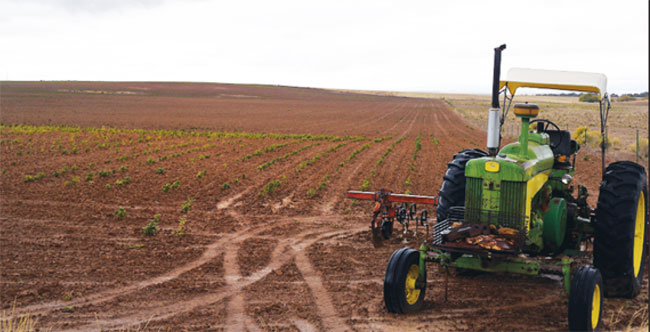
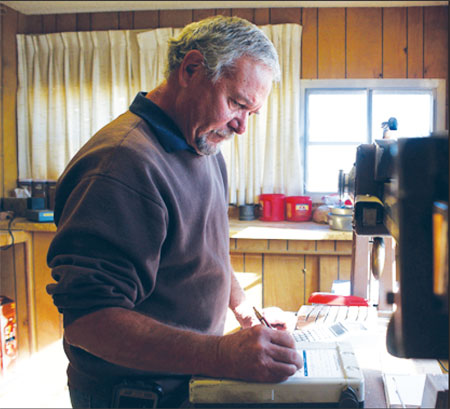

In River of Secrets, Wallace finds herself in the middle of a budding race war when she is assigned the high profile murder case of State Senator Herbert Marioneaux. After Marioneaux is found dead in his office, the evidence leads directly — perhaps too directly — to firebrand civil-rights attorney Eddie Pitkin. Wallace’s forced arrest of Pitkin, despite her doubts, leads to race protests and street riots.

Amid the bloody reopening of Louisiana’s age-old racial wounds, Wallace follows the trail of Marioneaux’s killer, first out of the city to a lakeside vacation cabin, then back to the menacing heart of Baton Rouge, where the evidence she uncovers leads ever closer to her family, endangering the lives of those she loves most.

Along the way, Wallace directs her suspect interviews with questions ranging from subtle to pointed, scrutinizing suspects for tics indicating guilt or innocence, down to the faintest flashes of awareness deep in inter viewees’ eyes.

As she tells one suspect, a member of Baton Rouge’s uppermost crust, “I collect information and I pass judgment.”

“Based on nothing, as far as I can see,” the suspect protests.

“But it’s what I see that counts,” she replies coolly. “You don’t want to fool yourself into believing otherwise.”

With just two installments so far in his Wallace Hartman series, Johns is making fast believers out of a lot of readers, leading to his recent nomination for the vaunted Killer Nashville Readers’ Choice Award for 2018. River of Secrets’ many qualities — zippy plot, witty dialogue, and all those (mostly scurrilous) lawyers —certainly made a believer out of me.

Scott Graham is the National Outdoor Book Award-winning author of the National Park Mystery Series for Torrey House Press. s Visit Graham at scottfranklingraham.com.

Published in Prose and Cons, Uncategorized

Agriculture on the edge: Drought is rattling Southwest Colorado’s dryland farmers

A tractor with cultivators sits in a Dove Creek beanfield, where it was last parked — before drought destroyed most dryland crops across the region.

A tractor with cultivators sits in a Dove Creek beanfield, where it was last parked — before drought destroyed most dryland crops across the region. Photo by Ole Bye.

“Beans don’t ask for much,” muses Denise Pribble, in between selling small souvenir bags of pinto beans to the occasional curious tourist. She owns Adobe Milling, one of three bean elevator companies in Dove Creek.

The town bills itself as the “Pinto Bean Capital of the World,” but the proclamation doesn’t attract many tourists – farming is still the primary economic driver here. In a typical year, Pribble will take in 3 million pounds of pinto beans grown without irrigation water – dryland beans.

This summer, despite their admirable thrift, the bean plants withered in bone dry conditions. Southwest Colorado’s entire 2018 dryland bean crop failed, along with almost all of its wheat, sunflower, and safflower.

“They just sat there and sat there and stunted,” says Pribble of the beans. Farmers, as they look to crop-insurance payments to recoup some of their lost income, are reeling as the worst drought in 120 years forces hard choices on an already precarious agricultural regime.

Between Cortez, Colo., and Monticello, Utah, stretches the vast Great Sage Plain, a wind-swept plateau sloping gently south to the edge of the broken canyon country along the San Juan River. Hundreds of Ancestral Puebloan archaeological sites scattered across the area give evidence of previous largescale dryland-corn cultivation enduring until about 1280 A.D.

Over the last hundred years, enterprising American farmers again cleared the sagebrush, piñon, and juniper from the flats, and have banked on a typically steady cycle of winter snows and late-summer “monsoon” rains to infiltrate the deep red soil. With skillful cultivation and careful timing, they have brought dryland crops to maturity, year after year, on the edge of a desert.

It has not always worked. Drought hit in 1950, 1956, 1966, and 2002. Other years saw yield problems, too. But nothing has been as severe as 2018. For over a year, the precipitation record has foretold catastrophe for dryland farmers.

Exceptional drought

Dolores County has been in category D4, “exceptional” drought – the worst classification – since April. The USGS water year (Oct. 1 through Sept. 30) brought just over five inches of precipitation, down from a typical 10 to 14.

From August 2017 through September 2018, precipitation did not once break the historical mean of 2 inches per month. All fall, the U.S. Drought Monitor map has shown a large crimson blister centered over Southwest Colorado – the largest and worst concentration of drought-stricken counties in the country.

Often as important as the quantity of precipitation is the timing sequence of snow and rain. The problems started in August 2017 when it stopped raining – the soil dried out and many farmers didn’t plant winter wheat.

Next, a warm and dry winter brought scant snow moisture to germinate and sustain 2018 spring-planted crops like spring wheat and beans. A weak monsoon season came and went in July and early August, but by then it was already too late to revive the desiccated plants. Farmers started to disc or “work in” the failed bean crop, and later harvested a miniscule 10 percent wheat crop. Then, in early October, it rained enough to plant a winter wheat crop for 2019. But not enough to get Dolores County out of D4 drought, where it remains.

Rain lifts spirits in dryland country, but it won’t wash away the memories – nor the consequences – of the 2018 drought. The damage is weighing on everyone, and oral reports corroborate the catastrophic precipitation record and its impacts.

“I planted 800 acres of beans but I didn’t get any of ’em,” says farmer Mike Coffey. “I’ve been doing this for 48 tries, and this is the least I’ve ever had.”

Rod Tanner, who owns Midland Bean Company, received no dryland bean crop this year: “Sixty percent of bean growers didn’t even plant. We’ve been here a hell of a long time but I’ve never seen it this bad.”

Bruce Riddell, general manager at High Country Elevators, agreed. “I’ve been doing this since 1980. It’s definitely the worst in 38 years.”

Paul White, FSA director for Dolores County puts it bluntly: “Basically if it wasn’t irrigated, there’s no crop.”

After weighing a truck on the antique Spinks truck scale at High Country Elevators in Dove Creek, General Manager Bruce Riddell fills out a receipt for farmer Steve Garchar’s load of hard red winter wheat seed. Garchar hopes it will sprout before winter.

After weighing a truck on the antique Spinks truck scale at High Country Elevators in Dove Creek, General Manager Bruce Riddell fills out a receipt for farmer Steve Garchar’s load of hard red winter wheat seed. Garchar hopes it will sprout before winter.

But even irrigated producers saw production fall to about 50 percent of normal as water shortages and harsh conditions took their toll. Most had to “water up” their crops after spring planting, instead of getting a boost from snow moisture. Some reduced irrigated acreage to consolidate what water they had.

Ranchers have been hit hard, too, and many are reducing their herds by 75 percent in the face of barren pastures and hay costs that have doubled.

“I have a lot of family, old-timers. I always ask every one of them have they seen anything like this, and the answer is no, not this bad,” relates Travis Herrmann, who runs cattle on dryland pasture in Dolores County. “Say 120 cows on 160 acres should last four months, this year it’s a month. We’re getting zero grow-back this season.”

With so many losses, the safety net of federally subsidized crop insurance is kicking into full swing. “With the exception of one farmer, every farmer and landlord filed a claim this year,” says Ken Brengle, an insurance agent in Cortez who processes Risk Management Administration claims. “It was not a profitable year for crop insurance,” he admits.

This safety net is flawed, though – most farmers don’t recoup nearly what they would with a good harvest. One factor is that average yields have gone down in recent years, pushing down the “guarantee” or “proven yield” that the insurance industry uses as a baseline comparison. The paid difference between the actual yield and guarantee gets squeezed as the proven yield gets farther from historical norms.

“One [drought] year isn’t too bad,” explains Brengle, “but multiple years can really hurt their guarantee. If you have too many low-yield years it hurts your guarantee, and your premium actually goes up. The worse the average yield is, typically the higher the premium is.”

The domino effect of drought shakes farm businesses to the core. A small insurance payment and a fractional harvest (that costs as much as a good harvest) don’t combine to offset lost income and expenses that climb every year.

“The safety net of crop insurance pays nothing by the time your proven [wheat] yield gets knocked down 10 bushels,” says dryland farmer Eric Guynes.

At High Country Elevators, Riddell has seen drought impact farmers before. “They always seem to make it, but this year I’m not so sure.”

‘Can’t stop the bleeding’

Dolores County, population 2,000, encompasses a sizeable rectangle of the Great Sage Plain. It is home to 75,000 acres of dryland farms, representing 90 percent of its agricultural land base. Farming is key to the region’s economy, and in Dolores County, it is the largest sector, accounting for 30 percent of economic activity. Dove Creek retail businesses serve primarily farmers and those who work in farming. Without a diversified economy, the county has no appreciable buffer between drought and disaster, and the severity of this year’s drought is testing the limits of local resiliency.

Brett Martin, mayor of Dove Creek and owner of Dove Creek Implement Company, has seen a 50 percent decrease in business since mid-2017; farmers aren’t buying new equipment. Martin decreased his payroll from 18 employees to nine and still can’t make ends meet.

“I’m losing money hand over fist and I can’t stop the bleeding,” he says.

“You can already see the impacts blowing through the communities,” says Gus Westerman, Dolores County Extension director. “We are one of the few ag-based economies left on the Western Slope. The drought… just ripples throughout the economy.”

Even in a good year, dryland farming is intimidating. The sun withers and the winds desiccate. Old equipment breaks. Bodies wear out. Commodity prices fluctuate at the whim of international markets. The price of diesel creeps up.

Furthermore, ordinary dryland yields run from one-sixth to one-12th that of irrigated ground, and to compensate, farmers take on vast tracts, creating a scheduling nightmare for critical planting and harvest windows.

“We’ve taken on so much ground because the profit margin is so low,” explains farmer Matt Forst. “There’s a balance point, but you almost topple over.”

His colleague Eric Guynes corroborates, perhaps evoking more than just acreage: “We farm more than we want to in order to make a living.”

In dryland farming, anticipating and evaluating climatic changes is paramount, and in addition to sophisticated meteorology resources and devoted Extension personnel, farmers rely on their well-honed expertise to provide critical guidance in decision-making. A seasoned dryland farmer like Mike Coffey can sift through topsoil with his fingers and make the risky determination of whether a 160-acre field is wet enough to plant – and germinate wheat.

Harrison Topp, the membership field representative for the Rocky Mountain Farmers Union, shares what he sees across the region. “Over half the ag regions in western Colorado are water- short. We’re losing track of what a normal year is.”

In Dove Creek, people often cite winters trending warmer over the last few decades. Riddell affirms this perception: “When I first moved here in 1980, they talked about snow being up to the third wire on the fences, but it gets less and less every year.”

It seems evident that the hundred-year-old paradigms for producing food in this climate are no longer reliable, and farmers are struggling to stay ahead of the changes.

“The soil dries out quicker. I’m behind on planting. The old ways don’t work anymore,” admits Mike Coffey.

As for the future of dryland farming, no one is recklessly optimistic. Alternative farming practices don’t always translate here, and farmers may not be able to afford the necessary new equipment.

“It’s really hard to just take a new practice and implement it. We’re a unique little pocket,” says Westerman. For example, he says, no-till (planting into undisturbed soil) has not been adopted here, in part because the soil gets too dense for bean-harvesting equipment. Cover crops, used in wetter climates to enrich and stabilize soil, here serve to wick away soil moisture faster through evapotranspiration than from soil left bare. Industrial hemp needs too much water for dryland farming. And so on.

Diversifying

The future, as a result of these challenges, tends to promise changes in bigpicture economic strategies for farms, rather than widespread investments in new soil-management practices. Farmer retirement also factors in – at 63, the average age of farmers in Dolores County is well above the already alarming national average of 58.

“I don’t think the outlook is good. I don’t know how long people can hold on to what they’ve got. People are going to have to make choices that will take farm ground out of the picture,” worries Eric Guynes.

Westerman sees dryland agriculture facing big changes, but also adapting. “I expect to see fewer operations farming more acres, more subdivided parcels, more smaller specialty-crop production, and I expect to see some new alternative crops we haven’t seen. Sorghum would be an example.”

Forst is more optimistic than many: “I don’t think the hope is lost. We’re diversifying and changing constantly. I just think you gotta be open-minded [about new techniques]. It’s not a losing battle, because we love what we’re doing.”

The Great Sage Plain hosted plenty of dryland agriculture before modern times – dryland corn was the diet staple for the Ancestral Puebloans who once worked these same fields. Corn was originally cultivated here from about 1 A.D. to about 1280, when most people left the area under severe drought conditions.

Out in one of Coffey’s large fields, his son Mike, a researcher at Crow Canyon Archaeological Center, is growing Hopi corn varieties and helping to demonstrate that Hopi corn can thrive in areas once farmed by Ancestral Puebloans. The Hopi assist in this project, because they are interested in validating their cultural traditions and origin story that links their heritage to Ancestral Puebloans around Mesa Verde and the Great Sage Plain.

On a stormy day in early October, Coffey begins to harvest the small corn patch. The long ears of Hopi blue aren’t as robust or plentiful as they were in 2015, when the same plot yielded 40 bushels an acre. But there is a crop, suggesting that Ancestral Puebloans could have survived a drought like this.

Coffey says there is evidence of negative societal impacts from drought in the archaeological record. “If you have a short year it’s really going to affect the economy and social structure – the way the Ancestral Puebloan people did business.”

In modern dryland farm country, everyone is watching the weather, praying for snow and rain, and hoping for a much better 2019 growing season.

The survival of many farms may depend on it.

Published in December 2018

Turnaround sees New Mexico Democrat winning after all

In a wild turnaround, Xochitl Torres Small, a Democrat, appears to have won the race for New Mexico’s Second Congressional District seat a little less than a day after her opponent announced that she had won instead.
Late Tuesday night, Republican Yvette Herrell held the edge over Torres Small by 1,970 votes and claimed victory. However, Torres Small refused to concede because more than 8,000 absentee ballots from Doña Ana County had not been counted. There, the clerk’s office quit counting overnight and resumed the count in the morning.
According to published reports, Torres Small wound up winning the absentee voting by a landslide, with 6,411 votes to just 1,847 for Herrell. That was more than enough to give Torres Small the win by a margin of 2,724 votes, and late Wednesday she announced her victory to her supporters. However, now it was Herrell who was refusing to concede.
If the results are confirmed, it would mean that all three of New Mexico’s congressional representatives are now Democrats, with Debra Haaland and Ben Lujan also winning. In New Mexico’s Senate race, Democrat Martin Heinrich captured 54 percent of the vote to easily defeat Republican Mick Rich (31 percent) and Libertarian Gary Johnson, the former governor, (15 percent).

Published in November 2018

A seismic shift in San Juan County, Utah – and other regional election results

San Juan County, Utah, is preparing for a seismic shift on its county commission.
Although the San Juan Record reported that not all the mail ballots had been counted Wednesday, the Salt Lake Tribune and other sources were reporting that Democrat Willie Grayeyes appears to have won a seat on the commission, defeating Republican Kelly Laws in District 2.
Coupled with the victory of Democrat Kenneth Maryboy in District 3 over a write-in candidate, the results indicate that San Juan County will have its first-ever Navajo-majority commission.
In the other district, incumbent Bruce Adams, a Republican, coasted to victory.
Grayeyes had been struck from the ballot by the county earlier this season over questions of his residency, but a judge ruled that he was to be put back on.
If the results stand, the fact that there are two Native American Democrats on the commission could mean major changes in the county’s stance on public lands, Bears Ears National Monument, historic road claims, and other issues.
The road to Grayeyes’ victory was paved by earlier rulings by a federal judge that forced the county to redraw its voting districts for the commission as well as the school board in order to ensure that Native Americans, who constitute a slight majority of the population in the county, were fairly represented.
In other Utah news, the state passed a ballot measure allowing the use of medical marijuana and also voted to expand Medicaid.
New Mexico
New Mexico is sending a Native American woman to Congress – one of the first two Native American women ever elected to that body. Democrat Deb Haaland, a member of the Laguna Pueblo tribe, won in the state’s First Congressional District. (The other was Sharice Davids, also a Democrat, in Kansas).
New Mexico also became the first state ever to elect two women as governor back to back. Democrat Michelle Lujan Grisham, a Democrat, defeated Republican Steve Pearce for the position. Pearce, a strong conservative, was a member of the House Freedom Caucus.
Lujan Grisham will replace Susanah Martinez, a Republican who in 2010 was the first Latina woman ever elected governor in the country.
Navajo Nation
Jonathan Nez, current vice president of the nation, was elected to be its next president, replacing Russell Begaye Jr. Nez defeated Joe Shirley Jr., who had formerly served as president, by a margin of nearly 2 to 1 to become the tribe’s youngest president ever at the age of 43.
Arizona
In a furiously contested race for the Senate now held by Jeff Flake, Republican Martha McSalley held a razor-thin edge over Democrat Kyrsten Sinema, 49 percent to 48, with a Green Party candidate capturing 2 percent of the vote. Though 99.4 percent of the votes had been counted, the race was considered too close to call as of 6:30 p.m. on Wednesday.

Published in November 2018 Tagged

Montezuma County is red enclave in blue state

Colorado went blue in a big way Tuesday night, but Montezuma County and the state’s southwest corner remained staunchly red.
In Tuesday’s election, Montezuma County kept its county commission all-Republican, choosing Jim Candelaria over Democrat M.B. McAfee and two unaffiliated candidates. Republicans Don Coram and Marc Caitlin easily retained their seats in the state Senate (District 6) and state House (District 58), respectively.
And Third Congressional District Rep. Scott Tipton of Cortez sailed to re-election over Democrat Diane Mitsch Bush by a margin of 52 to 43 percent.
But it was a different story statewide, where Democrats captured all the highest offices (governor, attorney general, secretary of state and treasurer), flipped the state Senate blue while retaining control of the state House, and picked up one congressional representative, in District 6, where Jason Crow unseated Republican incumbent Mike Coffman on a 53-44 margin.
Coloradoans had to vote on a slew of ballot questions, but only a few of those passed.
The state’s voters rejected two different measures to increase funding for roads, propositions 109 and 110. They said no to a tax increase for schools (Amendment 73). And they said no to two measures affecting the oil and gas industry, but in opposite ways. Amendment 74 was supported by the industry; it would have given landowners compensation for any regulations that might have hindered the development of property. It was rejected, along with Proposition 112, which was opposed by the energy industry because it would have greatly increased the minimum distance drilling operations had to be from homes, schools, and waterways.
Voters passed two minor measures, constitutional amendments A and W, that removed language about slavery from the state constitution and that condensed the way that judicial retention questions are listed on the ballot.
They agreed to let the state legislature define industrial hemp (Amendment X) rather than having it be defined in the constitution. They passed amendments Y and Z, creating nonpartisan commissions to draw up voting districts. And they supported Proposition 111, tightening the rules on payday lenders.
But they said no to lowering the age for state legislators (Amendment V) and to trying to even the playing field between wealthy and less-wealthy political candidates (Amendment 75).
Montezuma County voters, however, bucked the trend on one of those questions, voting strongly in favor of Amendment 74, the “takings” amendment, which failed statewide.

Published in November 2018

Patagonia just made history. Now it should do even more.

If Patagonia really wants to advocate for the environment, the brand should back candidates who will vote for a Green New Deal

Recently, Patagonia announced its support for two Democratic candidates running for Senate seats in November — Jon Tester in Montana and Jacky Rosen in Nevada. Despite a long history of activism, making political endorsements is a first for Patagonia, and Outside speculated that backing national political candidates could be a first for any company, period.

Patagonia has donated significant sums to conservation causes over the years, but in the weeks following the victory of then president-elect Donald Trump, Patagonia founder Yvon Chouinard was ready to take the environmentally minded brand into full-blown agitation. That November, Patagonia donated all of its Black Friday sales, some $10 million in all, to conservation causes. In the years since, Chouinard has called other outdoor gear companies “weenies” for refusing to respond with requisite urgency to the environmental attacks unfolding under Trump’s leadership. In 2017, Patagonia sued the Trump administration for rolling back federal protections on over 2 million acres of public land in the Bears Ears and Grand Staircase-Escalante national monuments in Utah.

Patagonia’s latest ads state a vote for Tester or Rosen is a “a vote for public lands,” and both Montana and Nevada, like most western states, have a great deal of federal public land in their boundaries. But it’s not hard to figure out why Patagonia chose to focus on those two candidates specifically. Both are running in purple states that Democrats need to win if they want to retake control of Congress in the midterms. If Democrats can win a majority in the Senate, it would pose a serious challenge to Trump’s agenda of slashing environmental and public lands protections. In that narrow scope, Patagonia’s endorsements make sense.

But we also have to ask: if Democrats go on to control all three branches of government in 2020, what will their environmental agenda look like? The last time that happened, it was 2008. In President Obama’s nomination victory speech, he famously said, “If we are willing to work for it…I am absolutely certain that generations from now, we will be able to look back and tell our children that this was the moment…when the rise of the oceans began to slow and our planet began to heal.”

Apparently America wasn’t ready to work for it. Obama passed the Clean Power Plan and increased fuel efficiency standards, both of which Trump is working to roll back. Earlier this month, ten years after Obama’s speech, the U.N. Intergovernmental Panel on Climate Change (IPCC) issued a dire report that warned the world has 12 years to avoid being locked into catastrophic climate change, and in those 12 years we need to transform the global economy away from fossil fuels at a rate with “no documented historic precedent.”

Neither Tester nor Rosen, Patagonia’s chosen candidates, are proposing large-scale government programs to make such shifts in the economy. Rosen as a 97 percent approval rating from the League of Conservation Voters, and has penned legislation to train military veterans to join the solar industry. But she has also voted with Trump 42 percent of the time since he took office. By that metric, Rosen is one of the 10 most conservative members of the House. Tester took out full-page ads in Montana newspapers welcoming Trump to the state when he visited in June. And when Ryan Zinke was being confirmed as Secretary of the Interior in 2017, Tester voted to support the nomination. He also backed Energy Secretary Rick Perry. Both Tester and Rosen are centrist Democrats that would likely govern to the right of Obama if their ilk retakes control of the government in 2020 — tinkering at the edges while the world burns.

There are a number of candidates running in the 2018 midterms who want to respond to climate change on the scale that the IPCC report suggests is required. The Green New Deal, as their proposal is being called, is part of the platform of progressive of working-class candidates like Senate hopeful Kevin de León in California and House candidates like Alexandria Ocasio-Cortez in New York, Randy Bryce in Wisconsin, and Diane Mitsch Bush in Colorado.

Though proposals vary, the basic idea is to revive a version of the New Deal’s Civilian Conservation Corps (CCC) and Works Progress Administration (WPA), which employed millions of people in the 1930s and 40s. WPA workers built public works infrastructure across the country. The CCC, in its nine-year existence, was able to plant 3 billion trees and construct thousands of miles of trails on public lands.

A modern-day Green New Deal could be coupled with a federal jobs guarantee to hire millions of people at least $15 per hour to install solar panels, build wind farms, and retrofit homes and businesses for energy efficiency. And like the original New Deal, the program would require substantial tax hikes on wealthy individuals and large corporations. In 1938, the highest federal income tax bracket was set at 79 percent. Today, it’s under 40 percent on paper, and most of the richest Americans pay far less taxes (if they pay any at all).

Data suggest that supporting a Green New Deal may be a winning strategy for Democrats. According to a poll analysis from the think tank Data for Progress, 55 percent of Americans support a “green job guarantee,” and only 18 percent are opposed to such a program. The numbers are higher among independent and Democratic voters.

For well over three decades, Patagonia has been striving to lead by example and show that it’s possible to be a profitable company while also being responsible to employees and the environment. The tactic has worked. The company now has over $200 million in annual revenue and Chouinard is a billionaire, making him a member of, not just the one percent, but the 0.00000175 percent. At the same time, Patagonia’s products are necessarily expensive and as such they’ve reinforced the notion that environmentalism is something that’s reserved for the wealthy.

When Patagonia poured $1.7 million into its campaign to promote Bears Ears National Monument in San Juan County, Utah, where I live, my neighbors who are monument opponents saw it as proof that the Bears Ears effort was being driven by outdoor companies that only want to preserve elite playgrounds for their well-to-do customers. It was to be expected, perhaps, but what surprised me was how many local supporters of Bears Ears agreed. Patagonia’s virtual reality videos and banner ads on the New York Times homepage often felt more like advertisements for the brand than environmental activism. Even though the company donated to local conservation groups, its high-profile presence may have diluted the grassroots, Indigenous-led effort to designate the monument, which was initiated by five Native American tribes with cultural ties to the Bears Ears landscape. There seemed to be a massive disconnect between the perception of the brand as Patagucci and monument supporters on the ground. The Navajo Nation, for example, abuts the monument boundary. It has a 42 percent unemployment rate, and needless to say it is not home to any Patagonia outlet stores.

If Patagonia wants to throw its weight behind conservation-minded politicians, I’m all for it. But heading into 2020, it should back candidates who are going take the necessary steps to slash carbon emissions. By supporting those who are pushing a Green New Deal, Patagonia would show they are not are not only going to defend playgrounds for rich recreationists but are also fighting to put unemployed and low-income people to work building the renewable energy infrastructure needed to stave off the worst effects of global warming.

In coordination with the endorsements last week, Chouinard made a folksy video encouraging people to vote.

To help Patagonia kickstart its next campaign, I wrote a new script it is welcome to use. Yvon is standing beside a river in Wyoming, a fishing pole in his hand and waders on his legs. He looks into the camera with his characteristic curmudgeonly stare begins to grumble out his lines:

“Since I founded Patagonia in 1973, we’ve been taxing ourselves. We’ve given millions of dollars to small grassroots environmental organizations to fight big-money interests looking to exploit our public lands. We’ve shown other businesses that it’s possible to be responsible and successful at the same time. And we’ve helped countless customers connect with wild places by providing the best gear possible.

“But I can no longer rely on only taxing myself and my company. Starting today, we will be begin backing Congressional candidates who pledge to tax billionaires like me and large businesses like Patagonia in order to fund a Green New Deal. With the revenue raised, we can create hundreds of thousands of high-paying jobs for unemployed workers in order to jumpstart the economy, respond to income inequality, and quickly transition our energy systems away from fossil fuels to fight climate change while there is still time.

“I’m pledging to donate to candidates who pledge to tax me. Because lord knows most of the weenie billionaires and CEOs out there are not going to tax themselves.”

Zak Podmore writes from San Juan County, Utah.

Published in Guest Column